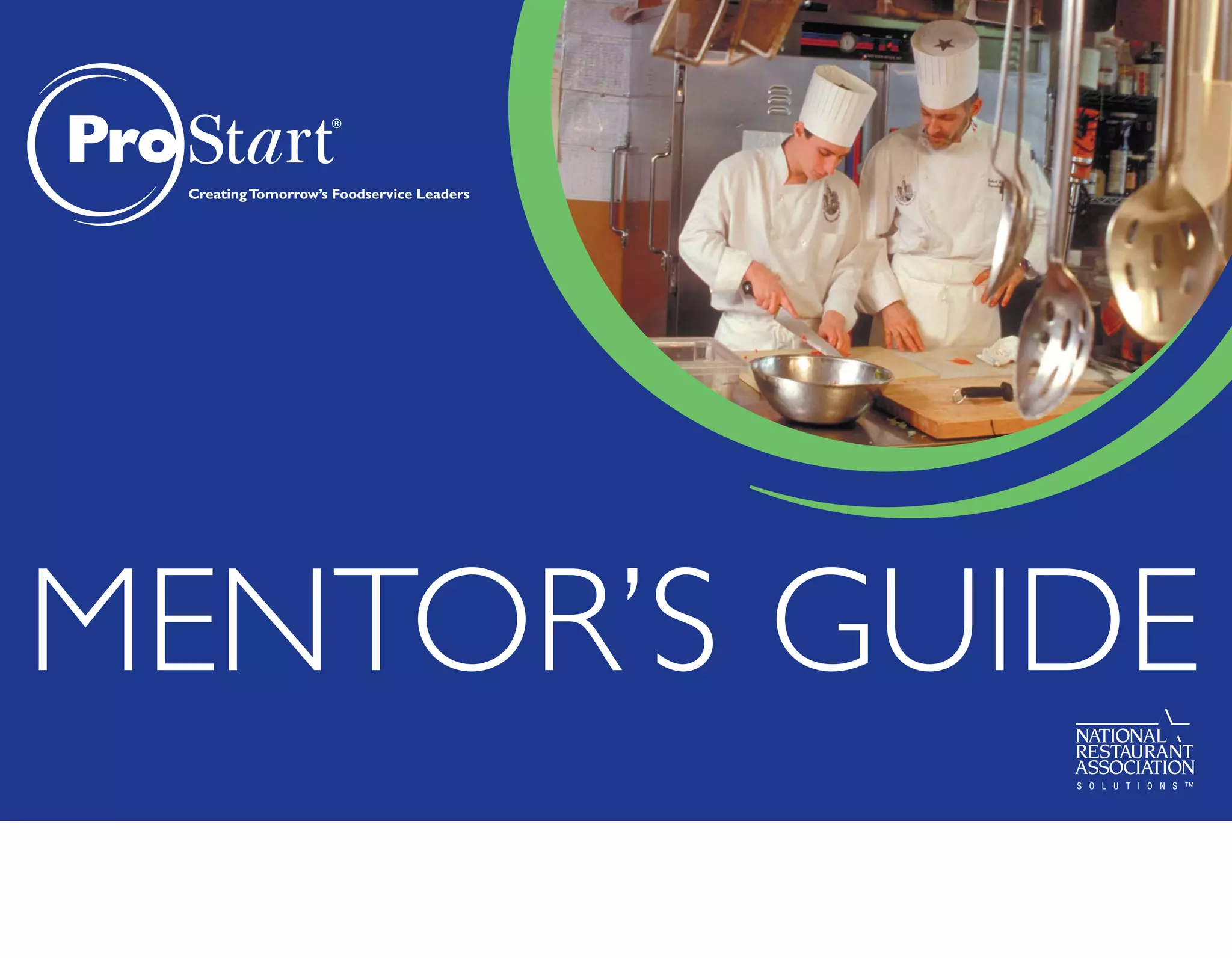
MENTOR’S GUIDE
OVERVIEW
HOW DOES THE PROSTART PROGRAM WORK?
The ProStart program in each state is based on a partnership between that state’s restaurant association and the state
department of education.
At the national level, the ProStart program sets the standard of quality for state restaurant and foodservice
educational programs.
The program links classroom learning with on-the-job experience. Skills learned at the workplace are ­reinforced
through practical classroom instruction. High school students learn business skills in the classroom and become
acquainted with career opportunities at career workshops and on field trips. They also gain practical skills during
on-site, hands-on experiences at local restaurants and foodservice work sites.
The ProStart program fulfills two objectives: 1) Students get a head start toward exciting and rewarding restaurant and
foodservice careers; and 2) Restaurant and foodservice industry supervisors and mentors take the lead in meeting the
labor demands of the next decade.
WHAT IS A MENTOR?
Teacher? Supervisor? Coach? Counselor? Role Model?
As a mentor, you will play different roles at different times, according to your student employee’s needs. Mentors help
students make the connection between their present performance and their future. Mentors provide overall support for
student goals, career competence and character development in the following ways:
Teacher—Instructs students in various areas not limited to job tasks.
Supervisor—Gives direction. Thinks in terms of how students fit into the needs of the organization.
Coach—Provides motivation and information to help students meet performance expectations.
Gives ongoing feedback and encouragement.
Counselor—Helps students work through problems or attitudes that affect job performance.
Role Model—Leads by example. Helps students develop effective professional skills and habits.
WHAT IS THE
PROSTART®
PROGRAM?
The ProStart®
program, developed by the National Restaurant
Association Educational Foundation (NRAEF) and
administered by National Restaurant Association Solutions,
is a nationwide system of high school restaurant and
foodservice courses linked with mentored work experiences.
The ProStart program is comprised of state-driven industry
and educational partnerships throughout the country, and it
exists as the national umbrella organization for restaurant
and foodservice career education.
To learn more about the ProStart program visit
www.weareprostart.org.
Overview | benefits | top 10 list
BENEFITS TOP 10
TOP 10 STEPS MENTORS
TAKE TO ENGAGE STUDENTS
	Treat students like the valuable resource
they are—our future workforce!
2	Communicate with students at least
15 minutes per week (longer when necessary).
	Track student’s competencies on a regular basis.
	Understand the importance of the rotational
work ­experience, which is designed to keep students
interested.
	Discuss any problems or questions about the
program with the program teacher or coordinator.
	Explain why college is the next step to a
successful career.
	Provide the student with a letter of recommendation
upon completion of the work experience.
	Volunteer to speak in class and offer the teacher a
site visit whenever possible.
	Be an advocate for the industry.
	Share the tremendous opportunity this program
represents to the students.
WHAT ARE THE
BENEFITS OF MENTORING?
Personal Benefits
Play an important role in a student’s life.●●
Contribute to the future of the ­restaurant and●●
­foodservice industry.
Learn by teaching.●●
Improve your supervisory and ­management skills.●●
Explore new ways of looking at your●●
job and operation.
Company Benefits
Gain motivated student employees who are focused●●
on the industry as a career.
Groom potential employees by creating a rewarding●●
work experience.
Create new operating procedures with the skills and●●
fresh ideas learned through mentoring.
Contribute to the industry by helping create a●●
high-quality labor pool.
WHAT TO EXPECT
WHERE DO I BEGIN?
Prepare Other Employees
Make sure all your supervisors and employees●●
know why the student employee is there and
understand program goals.
Enlist their enthusiasm and support.●●
You don’t have to do it all yourself. Delegate●●
responsibilities to qualified employees but maintain
control of the student’s experience.
Orient the Student to the Company
and the Work Site
Does your organization have a formal, well-organized
­orientation process? Can you provide the student
employee with a standard orientation package or
handbook? ­­Orientation should address the
following issues:
Brief history of the company, its products, services,●●
and customer base
Building layout●●
Requests for time off●●
Breaks●●
Dress code●●
Telephone use●●
Eating on the job and consuming company food●●
Lines of supervisory authority: To whom are student●●
employees directly responsible?
Sanitation and safety procedures●●
Smoking policy (Policy should state that minors are●●
not allowed to smoke on premises.)
Payroll system – timekeeping, schedules,●●
pay periods, deductions
Impact of their jobs on the company●●
and their fellow co-workers
Student involvement by including the student in●●
informal meetings and work-related discussions
Share Your Success Story
How did you get started in your career?●●
What qualifying skills did you start with?●●
What skills did you acquire, and how?●●
Discussion Expectations
Create expectations for the student’s behavior and●●
performance.
Make sure students understand these ­expectations.●●
Inexperienced young people may think that simply
putting their time in the program will prepare them
for a job in the restaurant and foodservice industry, or
that you are going to “give” them what they need.
Discuss Career Opportunities
and Future Outlook
Pass on your insider’s knowledge. In any job, there are
ways of doing things that separate the great employees
from the merely good ones. You were chosen as a mentor
because you’ve already proven yourself in the workplace.
Now you have a chance to pass it on and help a young
person in the process.
Share your vision for your career and for your●●
organization. Students will be interested in the career
decisions you’ve made for yourself.
Explain why you chose this kind of work. What do●●
you like and dislike about it?
Expose student employees to a spectrum of●●
opportunities by involving them in different aspects
of the business.
Help students explore the wide variety of careers●●
that can be found within your ­organization.
Emphasize the opportunities for careers and●●
advancement for everyone regardless of sex, race, age,
religion, etc. The most important ­ingredients for
success include performance, skill and attitude.
Share with students any information you may●●
have regarding career ladders, training, job
descriptions and salary ranges.
MENTORING
Diversity
The biggest challenge to successful ­mentoring is●●
learning to value diversity.
How much professional and personal ­experience do●●
you have associating with ­people from diverse cultural
and ethnic ­backgrounds? To understand and support
­students, it is important to deal with any issues you
may have accepting and ­working with differences.
Discomfort with others also leads to a lack of●●
critical feedback. If you’re not giving students honest
feedback, you’re denying them the ­opportunity to
learn and grow.
As a mentor, it is your responsibility to respect●●
­students’ differences. Your respect for them models
how they should respect others.
Diversity in an organization is an asset because it●●
offers a variety of ways to think about problems
and business strategies and better serve a diverse
customer base.
Communication
Be clear about assignments, expectations●●
and sources of help.
Be alert for non-verbal clues to students’ ­feelings●●
because teenagers are often ­uncomfortable expressing
themselves openly to people they don’t know well.
These clues may be:
Avoiding eye contact●●
Slumped shoulders●●
Lowered energy or productivity levels●●
Tension or nervousness●●
Self-Esteem
Find positive ways of interacting to help boost the●●
­student’s self-esteem. The ­uncertainties of adolescence
and of beginning to move into self-directed life can
affect ­confidence and self-image.
Many teenagers are easily embarrassed. As with●●
other employees, using discretion when giving
personal ­comments and negative ­feedback is
important. Discuss any sensitive issues in private in
an appropriate and ­professional manner.
Other Values That Are Very Important
to Today’s Young Workforce Include:
Appreciation●●
Flexibility●●
Personal development●●
Involvement●●
Having fun●●
Integrity●●
Respecting their views and opinions●●
Patience
Treat mistakes as learning experiences for ­students and
yourself. Most effective ways to ­handle mistakes:
Define the problem.●●
Figure out what went wrong. Don’t blame.●●
Decide what should be done to correct●●
the problem, then do it.
Put it behind you.●●
YOU’RE GOING TO BE A
GREAT MENTOR
Think about the beginning of your career in the restaurant and foodservice industry. Who taught you the skills that helped you get to where you are today?
Was there someone who acted as your ­mentor? Your answers to these questions will help you get started with your young beginners.
WHAT TO EXPECT | WHERE TO BEGIN | HOW TO BE A GREAT MENTOR
Set Goals
Make goals short-term. Achieving success,●●
­particularly early on, and especially repeated
­successes, is a proven motivator. Define how and
when you will measure progress and achieve goals.
Expect students to turn in their work ­experience●●
competency checklists that outline the goals a ­student
should attain.
HELPING STUDENTS
Develop Talent
Help students identify interests, capabilities and skills●●
they already possess.
Help students identify areas needing ­improvement.●●
Discuss performance in neutral, non-­judgmental●●
terms. Focus on the ­performance issues and tasks
rather than the person. Teenagers’ self-esteem can
be fragile.
Think of ways to eliminate the performance gap (the●●
difference between what you expected and what the
student produced).
Did students understand what was expected?●●
Did they have adequate training?●●
Is there a way to redesign the task/assignment/●●
method to make it more workable?
Ask students for their suggestions.●●
Give Feedback
Give both positive and negative feedback. If you●●
withhold constructive ­criticism, ­students will not
learn the changes necessary to improve their skills.
Focus on performance and outcomes.●●
Be clear about what skills need improvement,●●
and ask students to suggest ways to improve.
Expect that students want to—and can—improve.●●
Give students a professional performance ­evaluation●●
based on your ­organization’s ­evaluation procedures.
Build Trust
If a student has never had a job, you will be his or●●
her first example of a manager, supervisor or boss.
Working with you in the adult world, students learn
what it means to be a responsible adult.
Let students know you trust them. If trust is broken,●●
deal with the issue immediately.
Be trustworthy yourself. Keep your word. Honor●●
confidentiality. Do not share private information
about other employees.
When faced with a delicate situation,●●
remain professional.
Develop Character
Teach and reinforce good work habits:
Dependability●●
Responsibility●●
Courtesy to customers and co-workers●●
Motivation and willingness to learn●●
Positive attitudes●●
Communicate the importance of a focused,●●
positive attitude to career success
Obey organization rules●●
Follow supervisors’ directives●●
Be cooperative and help co-workers●●
Encourage Professionalism
Emphasize that your reason for being in ­business●●
is to serve the needs of your ­customers.
Help student employees relate present ­learning to●●
the real world and their own futures. Example: how
to use math skills they are presently learning to help
convert recipes or help determine menu prices.
Help Students Succeed
Make it clear that you are taking an interest in●●
the students. Ask them what they are learning
at school and talk about how schoolwork and other
activities lay the groundwork for success.
Let your students know that you support their●●
efforts to learn. Set up meetings with industry
­contacts who can expose the student employees
to something different or special. Set up a
meeting for them.
Be patient. Don’t expect too much too soon.●●
Give factual, non-judgmental feedback frequently.●●
Student Internship Highlights:
Four semesters: broad-based and rotational.●●
Work site industry operator mentors oriented●●
by the state partner.
15–20 hours/week—school year; after school until●●
9:00 p.m. on school nights; anytime on weekends.
Full work week in the summer.
Student internship wages: prevailing wage.●●
The employer has the right to interview, hire●●
and terminate, if necessary.
The mentor, program coordinator and student should●●
develop a training plan incorporating as many
stations as possible.
Competencies are evaluated bi-weekly at 15–20●●
minute conferences. When all competencies are met,
a student moves to a new station.
Motivate and Empower Your
Student Employees
Promote team spirit. It works in sports, and it●●
works in restaurant and foodservice operations.
Encourage friendly competition between work
teams with contests or reward programs.
Recognize and reward good performance●●
immediately. A timely reward is more ­meaningful
and appreciated.
Express positive expectations.●●
Listen to students’ ideas and use them●●
when appropriate.
Give students enough responsibility to ­promote a●●
feeling of ownership.
Explain the Workplace Culture
Discuss how students should deal with ­customers
who are friends.
Lengthy or personal conversations on the job.●●
Request for special treatment or prices.●●
Business confidentiality.●●
Model The Proper Use of Authority
Use your power and authority as a supervisor to●●
assist in the learning experience, not to apply
undue pressure.
Insist that regular employees respect students●●
and treat them like team members.
Helping Students
CHALLENGES
CHALLENGES FACING MENTORS
Introducing young people to the working environment is a rewarding
experience. It does, however, present challenges.
Mentors may experience some
of the following obstacles:
Student employees may lack a clear
­commitment to the work experience.
Students may be committed to their experience, but may never have
worked before. They may have to be reminded of the opportunities
that will await them after ­completing the work experience.
Student employees sometimes have to be monitored
more ­regularly than other entry-level employees.
Try to “team-mentor,” so that the management team and/or a
few experienced ­employees share the responsibility for monitoring
the students’ progress.
Students sometimes have difficulty juggling priorities,
such as after-school sports or spending time with friends.
Discuss the time commitment required to complete the work
experience and help students prioritize their goals.
Students often have a hard time
communicating their problems or needs.
Clarify a student’s concerns so you are able to clearly work
out a solution.
Student employees might not work
for you for more than a few months.
To allow students to experience various aspects of the
industry, some ­programs may shift students among several
businesses during the two years of the program. The continuous
rotation of student employees gives your operation access to
more potential employees following graduation.
HOW TO MINIMIZE
THESE CHALLENGES
In order to minimize these challenges,
students must sign the employment
­agreement, which outlines the
requirements for the work experience.
Students must live up to this agreement
in order to qualify for the ProStart
National Certificate of Achievement.
Some student employees might not
view this experience as their first step
to a career in the restaurant and
foodservice industry. However, your
mentorship will still be valuable to the
student by instilling lifelong work habits.
You can help these students:
Strengthen their attitude about the●●
­importance of work
Understand job ethics, punctuality,●●
­cleanliness, and other basic personal
­qualities and skills
Learn teamwork●●
Understand why customer satisfaction●●
is at the root of every business
endeavor
Gain a lifelong appreciation of●●
hospitality patrons and employees
Challenges | WHAT ELSE CAN YOU DO?
WHAT ELSE CAN YOU DO?
Let’s say you enjoy your mentoring experience so much that you want to become even more involved.
The possibilities are endless, of course, but here are a few opportunities you might want to consider:
HOST A TOUR OF YOUR OPERATION
Working with your state program coordinator and teachers, sponsor a visit to your business for small groups of new
or potential students. Model the tour after a typical tour that a new employee would have on his or her first day.
Introduce students to as many co-workers as time permits. Have your co-workers explain what they do during a
typical business day. Encourage questions from students.
GUEST SPEAK
You know what it takes to put a smile on a customer’s face. You know how to make your business run like a
well-oiled machine. Your first-hand knowledge of the restaurant and foodservice industry is something you should
share with both students and their teachers. A quick 30-minute talk on what employers look for in a new employee
could go a long way toward letting students know what you expect from them throughout the school year.
SPONSOR A FIELD TRIP TO A LOCAL RESTAURANT OR
FOODSERVICE-RELATED TRADE SHOW
Let students see the many facets of the industry and show them there are a multitude of careers and
opportunities available.
COORDINATE FIELD TRIPS TO YOUR VENDOR’S FACILITIES OR...
Encourage them to spend a minute with the students when they visit your establishment. Another way to broaden
your students’ exposure to industry opportunities is to contact your vendors and arrange field trips to their business.
HAVE STUDENTS DEVELOP NEW IDEAS OR PROMOTIONS
Given a chance, students can often come up with great ideas for new products and promotions. Turn the process of
coming up with a new product concept into a contest, offering the winner prizes like free movie passes or a free
meal for them or their family.
Mentoring young people is a rewarding ­experience that
requires patience, enthusiasm, and conviction. Your efforts
will not only ­contribute positively to the student’s growth,
but your commitment will help you become a better
manager. Your company will benefit from your expanded
knowledge, and the ­industry will gain a valuable employee.
Remember to communicate openly and often with your
student employees, their teachers and advisors, and
decision makers in your organization. Involvement is what
will make the difference.
The lives you touch will continue to grow in many ways.
Congratulations and good luck!
PROSTART PARTNERS
FOUNDING PARTNERS
AFC Enterprises, Inc.
American Express Corporation
Anton Airfood Inc.
The Coca-Cola Company
Ecolab, Inc.
Golden Corral Corporation
The H.J. Heinz Company
Foundation
Hyatt Hotels  Resorts
The J.Willard  Alice S. Marriott
Foundation
Sodexo, Inc.
T.G.I. Friday’s
PLATINUM PARTNERS SILVER PARTNERS BRONZE PARTNERS
SUPPORTING PARTNERS
GOLD PARTNERS
PROSTART PARTNERS | LEGAL CONSIDERATIONS­­
Legal Considerations
Minimum Age Standards and Federal Child Labor Law Guidelines
There are various legal issues to take into account when hiring teenagers to work in your
operation. However, because the ProStart program is considered a cooperative vocational
training program under a recognized state or local educational authority, there are
exemptions for teenage workers.
Please note there are required child labor restrictions as to hours, driving and hazardous
jobs by the Department of Labor under the federal and state levels. To view current laws
declared by the Department of Labor, visit www.youthrules.dol.gov/employers. Please
contact your legal counsel to check scope and applicability under federal and state laws.
You can also contact your local school board, state board of education, state restaurant
association, local restaurant association and/or department of labor for further
specification.
It is the responsibility of both the school and the mentor to comply fully with all federal,
state, and local laws when participating in the program. All states have child labor laws and
compulsory school attendance laws. Other federal and state laws may have higher standards.
When these apply, the law setting the higher standards must be observed.
This overview is for reference only and is not intended as legal advice.
175 W. Jackson Boulevard, Suite 1500
Chicago, IL 60604-2814
www.weareprostart.org
©2008 National Restaurant Association Educational Foundation. All rights reserved. ProStart® is a registered trademark of the National Restaurant Association Educational
Foundation, and used under license by National Restaurant Association Solutions, LLC, a wholly owned subsidiary of the National Restaurant Association.
08022906  v.0803

Mentors Guide

  • 1.
  • 2.
    OVERVIEW HOW DOES THEPROSTART PROGRAM WORK? The ProStart program in each state is based on a partnership between that state’s restaurant association and the state department of education. At the national level, the ProStart program sets the standard of quality for state restaurant and foodservice educational programs. The program links classroom learning with on-the-job experience. Skills learned at the workplace are ­reinforced through practical classroom instruction. High school students learn business skills in the classroom and become acquainted with career opportunities at career workshops and on field trips. They also gain practical skills during on-site, hands-on experiences at local restaurants and foodservice work sites. The ProStart program fulfills two objectives: 1) Students get a head start toward exciting and rewarding restaurant and foodservice careers; and 2) Restaurant and foodservice industry supervisors and mentors take the lead in meeting the labor demands of the next decade. WHAT IS A MENTOR? Teacher? Supervisor? Coach? Counselor? Role Model? As a mentor, you will play different roles at different times, according to your student employee’s needs. Mentors help students make the connection between their present performance and their future. Mentors provide overall support for student goals, career competence and character development in the following ways: Teacher—Instructs students in various areas not limited to job tasks. Supervisor—Gives direction. Thinks in terms of how students fit into the needs of the organization. Coach—Provides motivation and information to help students meet performance expectations. Gives ongoing feedback and encouragement. Counselor—Helps students work through problems or attitudes that affect job performance. Role Model—Leads by example. Helps students develop effective professional skills and habits. WHAT IS THE PROSTART® PROGRAM? The ProStart® program, developed by the National Restaurant Association Educational Foundation (NRAEF) and administered by National Restaurant Association Solutions, is a nationwide system of high school restaurant and foodservice courses linked with mentored work experiences. The ProStart program is comprised of state-driven industry and educational partnerships throughout the country, and it exists as the national umbrella organization for restaurant and foodservice career education. To learn more about the ProStart program visit www.weareprostart.org.
  • 3.
    Overview | benefits| top 10 list BENEFITS TOP 10 TOP 10 STEPS MENTORS TAKE TO ENGAGE STUDENTS  Treat students like the valuable resource they are—our future workforce! 2 Communicate with students at least 15 minutes per week (longer when necessary).  Track student’s competencies on a regular basis.  Understand the importance of the rotational work ­experience, which is designed to keep students interested.  Discuss any problems or questions about the program with the program teacher or coordinator.  Explain why college is the next step to a successful career.  Provide the student with a letter of recommendation upon completion of the work experience.  Volunteer to speak in class and offer the teacher a site visit whenever possible.  Be an advocate for the industry.  Share the tremendous opportunity this program represents to the students. WHAT ARE THE BENEFITS OF MENTORING? Personal Benefits Play an important role in a student’s life.●● Contribute to the future of the ­restaurant and●● ­foodservice industry. Learn by teaching.●● Improve your supervisory and ­management skills.●● Explore new ways of looking at your●● job and operation. Company Benefits Gain motivated student employees who are focused●● on the industry as a career. Groom potential employees by creating a rewarding●● work experience. Create new operating procedures with the skills and●● fresh ideas learned through mentoring. Contribute to the industry by helping create a●● high-quality labor pool.
  • 4.
    WHAT TO EXPECT WHERE DO IBEGIN? Prepare Other Employees Make sure all your supervisors and employees●● know why the student employee is there and understand program goals. Enlist their enthusiasm and support.●● You don’t have to do it all yourself. Delegate●● responsibilities to qualified employees but maintain control of the student’s experience. Orient the Student to the Company and the Work Site Does your organization have a formal, well-organized ­orientation process? Can you provide the student employee with a standard orientation package or handbook? ­­Orientation should address the following issues: Brief history of the company, its products, services,●● and customer base Building layout●● Requests for time off●● Breaks●● Dress code●● Telephone use●● Eating on the job and consuming company food●● Lines of supervisory authority: To whom are student●● employees directly responsible? Sanitation and safety procedures●● Smoking policy (Policy should state that minors are●● not allowed to smoke on premises.) Payroll system – timekeeping, schedules,●● pay periods, deductions Impact of their jobs on the company●● and their fellow co-workers Student involvement by including the student in●● informal meetings and work-related discussions Share Your Success Story How did you get started in your career?●● What qualifying skills did you start with?●● What skills did you acquire, and how?●● Discussion Expectations Create expectations for the student’s behavior and●● performance. Make sure students understand these ­expectations.●● Inexperienced young people may think that simply putting their time in the program will prepare them for a job in the restaurant and foodservice industry, or that you are going to “give” them what they need. Discuss Career Opportunities and Future Outlook Pass on your insider’s knowledge. In any job, there are ways of doing things that separate the great employees from the merely good ones. You were chosen as a mentor because you’ve already proven yourself in the workplace. Now you have a chance to pass it on and help a young person in the process. Share your vision for your career and for your●● organization. Students will be interested in the career decisions you’ve made for yourself. Explain why you chose this kind of work. What do●● you like and dislike about it? Expose student employees to a spectrum of●● opportunities by involving them in different aspects of the business. Help students explore the wide variety of careers●● that can be found within your ­organization. Emphasize the opportunities for careers and●● advancement for everyone regardless of sex, race, age, religion, etc. The most important ­ingredients for success include performance, skill and attitude. Share with students any information you may●● have regarding career ladders, training, job descriptions and salary ranges.
  • 5.
    MENTORING Diversity The biggest challengeto successful ­mentoring is●● learning to value diversity. How much professional and personal ­experience do●● you have associating with ­people from diverse cultural and ethnic ­backgrounds? To understand and support ­students, it is important to deal with any issues you may have accepting and ­working with differences. Discomfort with others also leads to a lack of●● critical feedback. If you’re not giving students honest feedback, you’re denying them the ­opportunity to learn and grow. As a mentor, it is your responsibility to respect●● ­students’ differences. Your respect for them models how they should respect others. Diversity in an organization is an asset because it●● offers a variety of ways to think about problems and business strategies and better serve a diverse customer base. Communication Be clear about assignments, expectations●● and sources of help. Be alert for non-verbal clues to students’ ­feelings●● because teenagers are often ­uncomfortable expressing themselves openly to people they don’t know well. These clues may be: Avoiding eye contact●● Slumped shoulders●● Lowered energy or productivity levels●● Tension or nervousness●● Self-Esteem Find positive ways of interacting to help boost the●● ­student’s self-esteem. The ­uncertainties of adolescence and of beginning to move into self-directed life can affect ­confidence and self-image. Many teenagers are easily embarrassed. As with●● other employees, using discretion when giving personal ­comments and negative ­feedback is important. Discuss any sensitive issues in private in an appropriate and ­professional manner. Other Values That Are Very Important to Today’s Young Workforce Include: Appreciation●● Flexibility●● Personal development●● Involvement●● Having fun●● Integrity●● Respecting their views and opinions●● Patience Treat mistakes as learning experiences for ­students and yourself. Most effective ways to ­handle mistakes: Define the problem.●● Figure out what went wrong. Don’t blame.●● Decide what should be done to correct●● the problem, then do it. Put it behind you.●● YOU’RE GOING TO BE A GREAT MENTOR Think about the beginning of your career in the restaurant and foodservice industry. Who taught you the skills that helped you get to where you are today? Was there someone who acted as your ­mentor? Your answers to these questions will help you get started with your young beginners. WHAT TO EXPECT | WHERE TO BEGIN | HOW TO BE A GREAT MENTOR
  • 6.
    Set Goals Make goalsshort-term. Achieving success,●● ­particularly early on, and especially repeated ­successes, is a proven motivator. Define how and when you will measure progress and achieve goals. Expect students to turn in their work ­experience●● competency checklists that outline the goals a ­student should attain. HELPING STUDENTS Develop Talent Help students identify interests, capabilities and skills●● they already possess. Help students identify areas needing ­improvement.●● Discuss performance in neutral, non-­judgmental●● terms. Focus on the ­performance issues and tasks rather than the person. Teenagers’ self-esteem can be fragile. Think of ways to eliminate the performance gap (the●● difference between what you expected and what the student produced). Did students understand what was expected?●● Did they have adequate training?●● Is there a way to redesign the task/assignment/●● method to make it more workable? Ask students for their suggestions.●● Give Feedback Give both positive and negative feedback. If you●● withhold constructive ­criticism, ­students will not learn the changes necessary to improve their skills. Focus on performance and outcomes.●● Be clear about what skills need improvement,●● and ask students to suggest ways to improve. Expect that students want to—and can—improve.●● Give students a professional performance ­evaluation●● based on your ­organization’s ­evaluation procedures. Build Trust If a student has never had a job, you will be his or●● her first example of a manager, supervisor or boss. Working with you in the adult world, students learn what it means to be a responsible adult. Let students know you trust them. If trust is broken,●● deal with the issue immediately. Be trustworthy yourself. Keep your word. Honor●● confidentiality. Do not share private information about other employees. When faced with a delicate situation,●● remain professional. Develop Character Teach and reinforce good work habits: Dependability●● Responsibility●● Courtesy to customers and co-workers●● Motivation and willingness to learn●● Positive attitudes●● Communicate the importance of a focused,●● positive attitude to career success Obey organization rules●● Follow supervisors’ directives●● Be cooperative and help co-workers●●
  • 7.
    Encourage Professionalism Emphasize thatyour reason for being in ­business●● is to serve the needs of your ­customers. Help student employees relate present ­learning to●● the real world and their own futures. Example: how to use math skills they are presently learning to help convert recipes or help determine menu prices. Help Students Succeed Make it clear that you are taking an interest in●● the students. Ask them what they are learning at school and talk about how schoolwork and other activities lay the groundwork for success. Let your students know that you support their●● efforts to learn. Set up meetings with industry ­contacts who can expose the student employees to something different or special. Set up a meeting for them. Be patient. Don’t expect too much too soon.●● Give factual, non-judgmental feedback frequently.●● Student Internship Highlights: Four semesters: broad-based and rotational.●● Work site industry operator mentors oriented●● by the state partner. 15–20 hours/week—school year; after school until●● 9:00 p.m. on school nights; anytime on weekends. Full work week in the summer. Student internship wages: prevailing wage.●● The employer has the right to interview, hire●● and terminate, if necessary. The mentor, program coordinator and student should●● develop a training plan incorporating as many stations as possible. Competencies are evaluated bi-weekly at 15–20●● minute conferences. When all competencies are met, a student moves to a new station. Motivate and Empower Your Student Employees Promote team spirit. It works in sports, and it●● works in restaurant and foodservice operations. Encourage friendly competition between work teams with contests or reward programs. Recognize and reward good performance●● immediately. A timely reward is more ­meaningful and appreciated. Express positive expectations.●● Listen to students’ ideas and use them●● when appropriate. Give students enough responsibility to ­promote a●● feeling of ownership. Explain the Workplace Culture Discuss how students should deal with ­customers who are friends. Lengthy or personal conversations on the job.●● Request for special treatment or prices.●● Business confidentiality.●● Model The Proper Use of Authority Use your power and authority as a supervisor to●● assist in the learning experience, not to apply undue pressure. Insist that regular employees respect students●● and treat them like team members. Helping Students
  • 8.
    CHALLENGES CHALLENGES FACING MENTORS Introducingyoung people to the working environment is a rewarding experience. It does, however, present challenges. Mentors may experience some of the following obstacles: Student employees may lack a clear ­commitment to the work experience. Students may be committed to their experience, but may never have worked before. They may have to be reminded of the opportunities that will await them after ­completing the work experience. Student employees sometimes have to be monitored more ­regularly than other entry-level employees. Try to “team-mentor,” so that the management team and/or a few experienced ­employees share the responsibility for monitoring the students’ progress. Students sometimes have difficulty juggling priorities, such as after-school sports or spending time with friends. Discuss the time commitment required to complete the work experience and help students prioritize their goals. Students often have a hard time communicating their problems or needs. Clarify a student’s concerns so you are able to clearly work out a solution. Student employees might not work for you for more than a few months. To allow students to experience various aspects of the industry, some ­programs may shift students among several businesses during the two years of the program. The continuous rotation of student employees gives your operation access to more potential employees following graduation. HOW TO MINIMIZE THESE CHALLENGES In order to minimize these challenges, students must sign the employment ­agreement, which outlines the requirements for the work experience. Students must live up to this agreement in order to qualify for the ProStart National Certificate of Achievement. Some student employees might not view this experience as their first step to a career in the restaurant and foodservice industry. However, your mentorship will still be valuable to the student by instilling lifelong work habits. You can help these students: Strengthen their attitude about the●● ­importance of work Understand job ethics, punctuality,●● ­cleanliness, and other basic personal ­qualities and skills Learn teamwork●● Understand why customer satisfaction●● is at the root of every business endeavor Gain a lifelong appreciation of●● hospitality patrons and employees
  • 9.
    Challenges | WHATELSE CAN YOU DO? WHAT ELSE CAN YOU DO? Let’s say you enjoy your mentoring experience so much that you want to become even more involved. The possibilities are endless, of course, but here are a few opportunities you might want to consider: HOST A TOUR OF YOUR OPERATION Working with your state program coordinator and teachers, sponsor a visit to your business for small groups of new or potential students. Model the tour after a typical tour that a new employee would have on his or her first day. Introduce students to as many co-workers as time permits. Have your co-workers explain what they do during a typical business day. Encourage questions from students. GUEST SPEAK You know what it takes to put a smile on a customer’s face. You know how to make your business run like a well-oiled machine. Your first-hand knowledge of the restaurant and foodservice industry is something you should share with both students and their teachers. A quick 30-minute talk on what employers look for in a new employee could go a long way toward letting students know what you expect from them throughout the school year. SPONSOR A FIELD TRIP TO A LOCAL RESTAURANT OR FOODSERVICE-RELATED TRADE SHOW Let students see the many facets of the industry and show them there are a multitude of careers and opportunities available. COORDINATE FIELD TRIPS TO YOUR VENDOR’S FACILITIES OR... Encourage them to spend a minute with the students when they visit your establishment. Another way to broaden your students’ exposure to industry opportunities is to contact your vendors and arrange field trips to their business. HAVE STUDENTS DEVELOP NEW IDEAS OR PROMOTIONS Given a chance, students can often come up with great ideas for new products and promotions. Turn the process of coming up with a new product concept into a contest, offering the winner prizes like free movie passes or a free meal for them or their family. Mentoring young people is a rewarding ­experience that requires patience, enthusiasm, and conviction. Your efforts will not only ­contribute positively to the student’s growth, but your commitment will help you become a better manager. Your company will benefit from your expanded knowledge, and the ­industry will gain a valuable employee. Remember to communicate openly and often with your student employees, their teachers and advisors, and decision makers in your organization. Involvement is what will make the difference. The lives you touch will continue to grow in many ways. Congratulations and good luck!
  • 10.
    PROSTART PARTNERS FOUNDING PARTNERS AFCEnterprises, Inc. American Express Corporation Anton Airfood Inc. The Coca-Cola Company Ecolab, Inc. Golden Corral Corporation The H.J. Heinz Company Foundation Hyatt Hotels Resorts The J.Willard Alice S. Marriott Foundation Sodexo, Inc. T.G.I. Friday’s PLATINUM PARTNERS SILVER PARTNERS BRONZE PARTNERS SUPPORTING PARTNERS GOLD PARTNERS
  • 11.
    PROSTART PARTNERS |LEGAL CONSIDERATIONS­­ Legal Considerations Minimum Age Standards and Federal Child Labor Law Guidelines There are various legal issues to take into account when hiring teenagers to work in your operation. However, because the ProStart program is considered a cooperative vocational training program under a recognized state or local educational authority, there are exemptions for teenage workers. Please note there are required child labor restrictions as to hours, driving and hazardous jobs by the Department of Labor under the federal and state levels. To view current laws declared by the Department of Labor, visit www.youthrules.dol.gov/employers. Please contact your legal counsel to check scope and applicability under federal and state laws. You can also contact your local school board, state board of education, state restaurant association, local restaurant association and/or department of labor for further specification. It is the responsibility of both the school and the mentor to comply fully with all federal, state, and local laws when participating in the program. All states have child labor laws and compulsory school attendance laws. Other federal and state laws may have higher standards. When these apply, the law setting the higher standards must be observed. This overview is for reference only and is not intended as legal advice.
  • 12.
    175 W. JacksonBoulevard, Suite 1500 Chicago, IL 60604-2814 www.weareprostart.org ©2008 National Restaurant Association Educational Foundation. All rights reserved. ProStart® is a registered trademark of the National Restaurant Association Educational Foundation, and used under license by National Restaurant Association Solutions, LLC, a wholly owned subsidiary of the National Restaurant Association. 08022906  v.0803