UNDERSTANDING
MENTAL HEALTH
Mental health
1. What do we know about mental
health/illness?
2. What local words do we use for mental
illness? What do they mean?
Mental health
The definition of mental health is more
than just the absence of disease or mental
illness.
It is the possession, development and
interaction of a number of characteristics
and qualities, some inherited and others
acquired.
Mental Health
Complete spiritual, emotional, and cognitive
wellbeing, not merely the absence of a mental
disorder.
A state of well being in which an individual
realizes his or her own abilities, can cope with
normal stresses of life, can work productively
and fruitfully and is able to make a contribution
to his or her community.
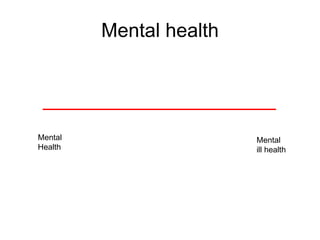
Mental health
Mental
Health
Mental
ill health
Mental Disorders
Any illness experienced by a person which
affects their
• emotions,
• thoughts or
• behaviour,
which is out of keeping with their cultural
beliefs and personality, and is producing a
negative effect on their lives or the lives of
their families.
Mental Disorders
What is the criteria for determining that a
person has a mental disorder?
1. Abnormality
2. Mal-adaptiveness
3. Personal distress
Abnormality
Behaviour that deviates from the typical
person.
Qualitatively abnormal behaviour – deviates
from culturally acceptable standards,
perhaps even seeming bizarre.
Quantitatively abnormal behaviour- deviates
from the statistical average.
Give examples
Maladaptiveness
Behaviour that seriously disrupts social
academic or vocational life. Give examples
Personal distress
Subjective feeling of anxiety depression or
another unpleasant emotion determines
whether one has a psychological disorder.
CLASSIFICATION OF MENTAL
DISORDERS
Diagnostic and statistical manual of mental
disorders published by the American Psychiatric
Association (DSM IV and ICD 10)
Earlier tools classified mental illness into two
categories
Neurosis and psychosis. The world psychosis
has remained in every day talk, even if no-longer
used for classification.
DSM IV provides five axes for diagnosing
psychological disorders.
1. Axis I – contains 16 major categories of
psychological disorders
2. Axis II – contains developmental disorders and
personality disorders.
3. Axis III – contains medical conditions that affect
the person’s psychological disorder.
4. Axis IV- contains rating (1-6) of the degree of
social stress that a person has been under in
the past year.
5. Axis V- contains rating (90-1) of both the
currents level of functioning and the highest
level of functioning during the past year.
CAUSES OF MENTAL DISORDERS
Biological Factors
• Heredity
• Chemical substances
• Infections
• Brain trauma
• Excessive or prolonged use of alcohol and drugs
• Brain tumors
• Aging
• malnutrition
CAUSES OF MENTAL DISORDERS
Psychological
Personality
Poor up-bringing
-child abuse
-parenting style
-domestic violence
CAUSES OF MENTAL DISORDERS
Social and Environmental
• Natural disasters
• Man – made disasters
• Poverty
• Crime (victim or perpetrator)
• Social stress like relationships problems,
bereavement, loss of work etc
FIVE MOST COMMON MENTAL
DISORDERS
1. Anxiety disorders
2. Somatoform disorders
3. Mood disorders
4. Schizophrenia
5. Epilepsy
6. Alcohol and drug
Anxiety disorders
A psychological disorder marked by persistent
anxiety that disrupt everyday functioning.
Anxiety – feelings of apprehension accompanied
by sympathetic nervous arousal, which
increases sweating heart rate and breathing
rate.
In as much as anxiety is a part of everyday life, in
the disorder it is intense chronic and disruptive
of everyday functioning
Types of anxiety disorders
1. Generalized anxiety disorder- an anxiety
disorder that is marked by persistent state of
anxiety that exists independent of any particular
stressful situation.
- Central feature is worry.
2. Panic disorder – marked by sudden unexpected
attacks of overwhelming anxiety often
associated with fear of dying or loosing ones
mind.
- Often accompanied by dizziness, trembling,
heart palpitations shortness of breath etc.
Anxiety disorders continued…
3. Phobias – marked by excessive or
inappropriate fear.
- the person realizes that the fear is
irrational but cannot control it.
4. Obsessive – compulsive disorder – the
person has recurrent, intrusive thoughts
(obsessions) or recurrent ritualistic actions
(compulsions).
SOMATOFORM DISORDERS
A psychological disorder characterized by
physical symptoms in the absence of
disease or injury.
Different from malingering in which the
person invents symptoms to evade certain
responsibility.
Types of Somatoform Disorders.
1. Hypochondriasis – a person interprets
the slightest physical changes in their
body as evidence of a serious illness.
2. Conversion disorder – a person exhibits
motor or sensory loss or the alteration of
physiological function without any
apparent physical cause.
MOOD DISORDERS
A psychological disorder marked by
prolonged periods of extreme depression
or elation, often unrelated to the person’s
current situation.
Types of Mood Disorders
1. Major Depression (clinical depression) –
marked by depression so intense that a person
may not be able to function in everyday life.
Person’s may express despondency,
helplessness, and loss of self esteem.
2. Bipolar disorder – marked by periods of mania
alternating with longer periods of major
depression.
Mania is marked by euphoria, hyperactivity,
grandiose ideas, annoying talkativeness,
unrealistic optimism and inflated self-esteem.
SCHIZOPHRENIA
A class of psychological disorders
characterized by grossly impaired social,
emotional, cognitive and perceptual
functioning.
Characterized by hallucinations, cognitive
disturbances, schizophrenic language,
delusions.
Types of Schizophrenia
1. Disorganized schizophrenia- marked by
personality deterioration and extremely
bizarre behaviour.
2. Catatonic schizophrenia – marked by
unusual motor behaviour such as bizarre
actions, extreme agitation or immobile
stupor.
3. Paranoid schizophrenia – marked by
hallucination, delusions, suspiciousness
and argumentativeness.
4. Undifferentiated schizophrenia.
Epilepsy
Common symptoms
• Recurrent seizures or fits
• Sometimes loss of consciousness
• May pass urine and faeces
TYPES OF EPILEPSY
1. Grand mal epilepsy
2. Petit mal epilepsy
3. Simple partial seizures
4. Temporal lobe epilepsy
5. Continuous fits
ALCOHOL AND DRUG ABUSE
1. These are common problems in our
communities
2. The abuse of alcohol takes place when a
person consumes more than their body can
handle.
3. Abuse of both alcohol and drugs takes place
when a person cannot control the amount or
type of consumption.
4. Abuse takes place when a person is addicted
and will loose dignity of the opportunity to
consume the drug or alcohol.
Development Disorders
1. Normally caused by a mutation of one of
or a set of genes.
2. May also be as a result of injury or
trauma during pregnancy or the birthing
process.
Development Disorders
• Downs Syndrome
• Autism
• Attention deficit disorder with or without
hypersensitivity.
In summary
Mental disorders
1. Affect ones ability to maximize their
potential
2. Affects a persons ability to cope with
everyday stresses of life
3. Affect the person’s productivity.
“any one who has a brain can have a mental
disorders”.
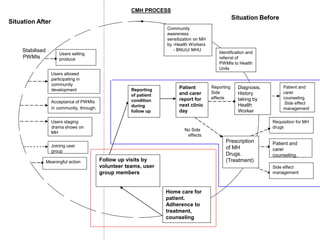
Reporting
Side
effects
Stabilised
PWMIs
Users selling
produce
Users allowed
participating in
community
development
Acceptance of PWMIs
in community, through:
Users staging
drama shows on
MH
Joining user
group
Meaningful action
Diagnosis.
History
taking by
Health
Worker
Prescription
of MH
Drugs.
(Treatment)
Patient
and carer
report for
next clinic
day
Reporting
of patient
condition
during
follow up
Requisition for MH
drugs
Patient and
carer
counseling.
Side effect
management
Side effect
management
Patient and
carer
counseling.
No Side
effects
Community
awareness
sensitization on MH
by -Health Workers
- BNUU/ MHU
Identification and
referral of
PWMIs to Health
Units
Follow up visits by
volunteer teams, user
group members
Home care for
patient.
Adherence to
treatment,
counseling
Situation Before
Situation After
CMH PROCESS
THANK YOU

MentalHealtMentalHealtMentalHealtMentalHealt

  • 1.
  • 2.
    Mental health 1. Whatdo we know about mental health/illness? 2. What local words do we use for mental illness? What do they mean?
  • 3.
    Mental health The definitionof mental health is more than just the absence of disease or mental illness. It is the possession, development and interaction of a number of characteristics and qualities, some inherited and others acquired.
  • 4.
    Mental Health Complete spiritual,emotional, and cognitive wellbeing, not merely the absence of a mental disorder. A state of well being in which an individual realizes his or her own abilities, can cope with normal stresses of life, can work productively and fruitfully and is able to make a contribution to his or her community.
  • 5.
  • 6.
    Mental Disorders Any illnessexperienced by a person which affects their • emotions, • thoughts or • behaviour, which is out of keeping with their cultural beliefs and personality, and is producing a negative effect on their lives or the lives of their families.
  • 7.
    Mental Disorders What isthe criteria for determining that a person has a mental disorder? 1. Abnormality 2. Mal-adaptiveness 3. Personal distress
  • 8.
    Abnormality Behaviour that deviatesfrom the typical person. Qualitatively abnormal behaviour – deviates from culturally acceptable standards, perhaps even seeming bizarre. Quantitatively abnormal behaviour- deviates from the statistical average. Give examples
  • 9.
    Maladaptiveness Behaviour that seriouslydisrupts social academic or vocational life. Give examples Personal distress Subjective feeling of anxiety depression or another unpleasant emotion determines whether one has a psychological disorder.
  • 10.
    CLASSIFICATION OF MENTAL DISORDERS Diagnosticand statistical manual of mental disorders published by the American Psychiatric Association (DSM IV and ICD 10) Earlier tools classified mental illness into two categories Neurosis and psychosis. The world psychosis has remained in every day talk, even if no-longer used for classification.
  • 11.
    DSM IV providesfive axes for diagnosing psychological disorders. 1. Axis I – contains 16 major categories of psychological disorders 2. Axis II – contains developmental disorders and personality disorders. 3. Axis III – contains medical conditions that affect the person’s psychological disorder. 4. Axis IV- contains rating (1-6) of the degree of social stress that a person has been under in the past year. 5. Axis V- contains rating (90-1) of both the currents level of functioning and the highest level of functioning during the past year.
  • 12.
    CAUSES OF MENTALDISORDERS Biological Factors • Heredity • Chemical substances • Infections • Brain trauma • Excessive or prolonged use of alcohol and drugs • Brain tumors • Aging • malnutrition
  • 13.
    CAUSES OF MENTALDISORDERS Psychological Personality Poor up-bringing -child abuse -parenting style -domestic violence
  • 14.
    CAUSES OF MENTALDISORDERS Social and Environmental • Natural disasters • Man – made disasters • Poverty • Crime (victim or perpetrator) • Social stress like relationships problems, bereavement, loss of work etc
  • 15.
    FIVE MOST COMMONMENTAL DISORDERS 1. Anxiety disorders 2. Somatoform disorders 3. Mood disorders 4. Schizophrenia 5. Epilepsy 6. Alcohol and drug
  • 16.
    Anxiety disorders A psychologicaldisorder marked by persistent anxiety that disrupt everyday functioning. Anxiety – feelings of apprehension accompanied by sympathetic nervous arousal, which increases sweating heart rate and breathing rate. In as much as anxiety is a part of everyday life, in the disorder it is intense chronic and disruptive of everyday functioning
  • 17.
    Types of anxietydisorders 1. Generalized anxiety disorder- an anxiety disorder that is marked by persistent state of anxiety that exists independent of any particular stressful situation. - Central feature is worry. 2. Panic disorder – marked by sudden unexpected attacks of overwhelming anxiety often associated with fear of dying or loosing ones mind. - Often accompanied by dizziness, trembling, heart palpitations shortness of breath etc.
  • 18.
    Anxiety disorders continued… 3.Phobias – marked by excessive or inappropriate fear. - the person realizes that the fear is irrational but cannot control it. 4. Obsessive – compulsive disorder – the person has recurrent, intrusive thoughts (obsessions) or recurrent ritualistic actions (compulsions).
  • 19.
    SOMATOFORM DISORDERS A psychologicaldisorder characterized by physical symptoms in the absence of disease or injury. Different from malingering in which the person invents symptoms to evade certain responsibility.
  • 20.
    Types of SomatoformDisorders. 1. Hypochondriasis – a person interprets the slightest physical changes in their body as evidence of a serious illness. 2. Conversion disorder – a person exhibits motor or sensory loss or the alteration of physiological function without any apparent physical cause.
  • 21.
    MOOD DISORDERS A psychologicaldisorder marked by prolonged periods of extreme depression or elation, often unrelated to the person’s current situation.
  • 22.
    Types of MoodDisorders 1. Major Depression (clinical depression) – marked by depression so intense that a person may not be able to function in everyday life. Person’s may express despondency, helplessness, and loss of self esteem. 2. Bipolar disorder – marked by periods of mania alternating with longer periods of major depression. Mania is marked by euphoria, hyperactivity, grandiose ideas, annoying talkativeness, unrealistic optimism and inflated self-esteem.
  • 23.
    SCHIZOPHRENIA A class ofpsychological disorders characterized by grossly impaired social, emotional, cognitive and perceptual functioning. Characterized by hallucinations, cognitive disturbances, schizophrenic language, delusions.
  • 24.
    Types of Schizophrenia 1.Disorganized schizophrenia- marked by personality deterioration and extremely bizarre behaviour. 2. Catatonic schizophrenia – marked by unusual motor behaviour such as bizarre actions, extreme agitation or immobile stupor. 3. Paranoid schizophrenia – marked by hallucination, delusions, suspiciousness and argumentativeness. 4. Undifferentiated schizophrenia.
  • 25.
    Epilepsy Common symptoms • Recurrentseizures or fits • Sometimes loss of consciousness • May pass urine and faeces TYPES OF EPILEPSY 1. Grand mal epilepsy 2. Petit mal epilepsy 3. Simple partial seizures 4. Temporal lobe epilepsy 5. Continuous fits
  • 26.
    ALCOHOL AND DRUGABUSE 1. These are common problems in our communities 2. The abuse of alcohol takes place when a person consumes more than their body can handle. 3. Abuse of both alcohol and drugs takes place when a person cannot control the amount or type of consumption. 4. Abuse takes place when a person is addicted and will loose dignity of the opportunity to consume the drug or alcohol.
  • 27.
    Development Disorders 1. Normallycaused by a mutation of one of or a set of genes. 2. May also be as a result of injury or trauma during pregnancy or the birthing process.
  • 28.
    Development Disorders • DownsSyndrome • Autism • Attention deficit disorder with or without hypersensitivity.
  • 29.
    In summary Mental disorders 1.Affect ones ability to maximize their potential 2. Affects a persons ability to cope with everyday stresses of life 3. Affect the person’s productivity. “any one who has a brain can have a mental disorders”.
  • 30.
    Reporting Side effects Stabilised PWMIs Users selling produce Users allowed participatingin community development Acceptance of PWMIs in community, through: Users staging drama shows on MH Joining user group Meaningful action Diagnosis. History taking by Health Worker Prescription of MH Drugs. (Treatment) Patient and carer report for next clinic day Reporting of patient condition during follow up Requisition for MH drugs Patient and carer counseling. Side effect management Side effect management Patient and carer counseling. No Side effects Community awareness sensitization on MH by -Health Workers - BNUU/ MHU Identification and referral of PWMIs to Health Units Follow up visits by volunteer teams, user group members Home care for patient. Adherence to treatment, counseling Situation Before Situation After CMH PROCESS
  • 31.