Psychological & HR Services
Mental Health Booklet
2015-5-11
1. MENTAL HEALTH
1. Mental Health
ABOUT MENTAL HEALTH
We all have mental health. Mental health relates to how we
think, feel, behave and interact with other people.
The World Health Organisation has defined mental wellbeing
as ‘a state of mind in which an individual is able to realise his or
her own abilities, can cope with the normal stresses of life, can
work productively, and is able to make a contribution to his or
her community.’
It can be helpful to understand wellbeing as being made up of
two key elements:
1) Feeling good
2) Functioning well
Feeling good means experiencing positive emotions like
happiness, contentment and enjoyment. It also includes
feelings like curiosity, engagement and safety.
Functioning well is about how a person is able to function in
the world. This includes having positive relationships and social
connections, as well as feeling in control of your life and having
a sense of purpose.
GOOD MENTAL HEALTH & WELLBEING
Mental wellbeing does not mean being happy all the time and it
does not mean you won ’ t experience negative or painful
emotions such as grief, loss, or failure, which are a normal part
of life. People with high levels of wellbeing will still experience
these feelings, but are likely to be better able to cope with them
without it having a significant impact on their mental health.
Good mental wellbeing is closely linked to good mental health,
but they are not quite the same thing. Someone who has been
diagnosed with a mental health problem may experience high
levels of wellbeing for some of the time, but would be more
likely to experience periods of low wellbeing than someone
without a mental health problem. Equally, supporting people
who have low levels of wellbeing can help to prevent the
development of mental health problems, particularly depression,
stress and anxiety, and can support recovery and improve health
outcomes.
Our mental health and wellbeing are strongly influenced not
only by our individual attributes, such as age, personality, gender
or genetics, but also by the circumstances in which we find
ourselves and the environment in which we live.
• LIBERA INSANI • PSYCHOLOGICAL SERVICES •
CAUSES OF CHANGE
There are a whole range of things that can
have an impact on our mental health and
cause us to act in a different way to normal.
These can be factors that are internal to us
(e.g. our feelings and reactions to situations,
pain or illness) or external (e.g. changes in
our environment, how other people behave).
Think about what might have changed to
cause a difference in someone’s behaviour.
For a child or young person with a learning
disability, some causes of change might be:
External
• Lack of social opportunities
• Transition
• Loneliness
• Bereavement
• Lack of stimulation
• Moving house
• Change of staff
Internal
• Physical illness
• Pain
• Puberty
• Medication
• Missing home
• Change of routine
• Parental separation
• Failure in activities
• Weather Internal
• Physical illness
• Pain
• Puberty
• Medication
• Missing home
• LIBERA INSANI • PSYCHOLOGICAL SERVICES •
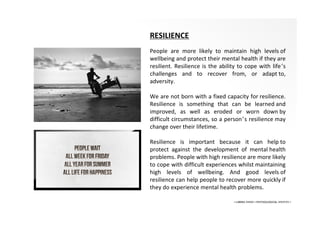
RESILIENCE
People are more likely to maintain high levels of
wellbeing and protect their mental health if they are
resilient. Resilience is the ability to cope with life’s
challenges and to recover from, or adapt to,
adversity.
We are not born with a fixed capacity for resilience.
Resilience is something that can be learned and
improved, as well as eroded or worn down by
difficult circumstances, so a person’s resilience may
change over their lifetime.
Resilience is important because it can help to
protect against the development of mental health
problems. People with high resilience are more likely
to cope with difficult experiences whilst maintaining
high levels of wellbeing. And good levels of
resilience can help people to recover more quickly if
they do experience mental health problems.
5-WAYS TO WELLBEING
2015-5-11
CONNECT..
With the people around you. With family, friends,
colleagues and neighbours. At home, work, school
or in your local community. Think of these as the
cornerstones of your life and invest time in
developing them. Building these connections will
support and enrich you every day.
BE ACTIVE..
Go for a walk or run. Step outside. Cycle. Play a
game. Garden. Dance. Exercising makes you feel
good. Most importantly, discover a physical activity
you enjoy and that suits your level of mobility and
fitness.
TAKE NOTICE..
Be curious. Catch sight of the beautiful. Remark on
the unusual. Notice the changing seasons. Savour
the moment, whether you are walking to work,
eating lunch or talking to friends. Be aware of the
world around you and what you are feeling.
Reflecting on your experiences will help you
appreciate what matters to you.
• LIBERA INSANI • PSYCHOLOGICAL SERVICES •
2015-5-11
KEEP LEARNING..
Try something new. Rediscover an old interest. Sign up for
that course. Take on a different responsibility at work. Fix a
bike. Learn to play an instrument or how to cook your
favourite food. Set a challenge you will enjoy achieving.
Learning new things will make you more confident as well as
being fun.
GIVE..
Do something nice for a friend, or a stranger. Thank someone.
Smile. Volunteer your time. Join a community group. Look
out, as well as in. Seeing yourself, and your happiness, linked
to the wider community can be incredibly rewarding and
creates connections with the people around you.
• LIBERA INSANI • PSYCHOLOGICAL SERVICES •
2015-5-11
• LIBERA INSANI • PSYCHOLOGICAL SERVICES •
2. MENTAL HEALTH PROBLEMS
• LIBERA INSANI • PSYCHOLOGICAL SERVICES •
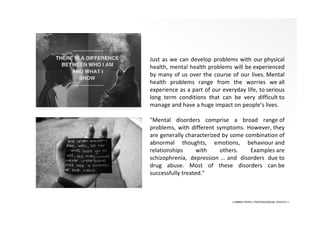
Just as we can develop problems with our physical
health, mental health problems will be experienced
by many of us over the course of our lives. Mental
health problems range from the worries we all
experience as a part of our everyday life, to serious
long term conditions that can be very difficult to
manage and have a huge impact on people’s lives.
"Mental disorders comprise a broad range of
problems, with different symptoms. However, they
are generally characterized by some combination of
abnormal thoughts, emotions, behaviour and
relationships with others. Examples are
schizophrenia, depression … and disorders due to
drug abuse. Most of these disorders can be
successfully treated."
• LIBERA INSANI • PSYCHOLOGICAL SERVICES •
It is estimated that one person in four will be
affected by a mental health problem each year:
• Anxiety and depression are the most common
problems, with about 1 in 10 people affected at any
given time5. Anxiety and depression can be severe
and long-lasting and have a big impact on people’s
ability to lead their daily life.
• Between 1 and 2 in every 100 people will
experience a serious mental health problem such as
bipolar disorder, psychosis or schizophrenia. People
affected may hear voices, see things no one else
sees, hold unusual beliefs that are not in line with
what is generally accepted as real, feel
unrealistically powerful or feel worthless, with a loss
of interest in daily life.
2015-5-11
TYPE OF MENTAL ILLNESS
TYPE OF MENTAL ILLNESSES
• LIBERA INSANI • PSYCHOLOGICAL SERVICES •
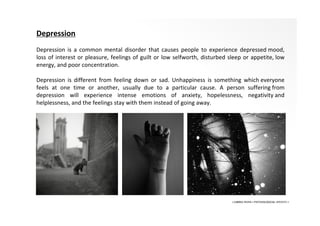
Depression
Depression is a common mental disorder that causes people to experience depressed mood,
loss of interest or pleasure, feelings of guilt or low selfworth, disturbed sleep or appetite, low
energy, and poor concentration.
Depression is different from feeling down or sad. Unhappiness is something which everyone
feels at one time or another, usually due to a particular cause. A person suffering from
depression will experience intense emotions of anxiety, hopelessness, negativity and
helplessness, and the feelings stay with them instead of going away.
• LIBERA INSANI • PSYCHOLOGICAL SERVICES •
Anxiety
Anyone can have feelings of anxiety, including children and young
people. Anxious feelings often occur in response to a stressful situation
and include: feeling scared or panicky, feeling irritable, having negative
thoughts or worries, feeling shaky, dizzy or sick, breathing fast,
sweating, having tense muscles or palpitations. Sometimes these
feelings can be helpful, for example, by increasing a person’s ability to
perform in a race or exam. These feelings are normal.
However, anxiety can become a problem when the symptoms are more
intense or long-lasting and begin to interfere with a person ’s
concentration and ability to do routine tasks. People may: avoid
situations that could provoke feelings of anxiety, feel embarrassed or
ashamed a lot of the time, not have the confidence to face new
challenges, or have problems eating and sleeping. This interference
with daily living, as much as the symptoms themselves, may lead a
person to seek help.
Anxiety disorders come in various forms, and include generalised
anxiety disorder (GAD), social anxiety disorder, phobias, panic attacks,
obsessive compulsive disorder and post-traumatic stress disorder
(PTSD).
• LIBERA INSANI • PSYCHOLOGICAL SERVICES •
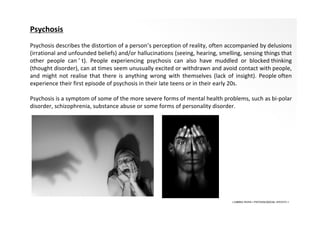
Psychosis
Psychosis describes the distortion of a person’s perception of reality, often accompanied by delusions
(irrational and unfounded beliefs) and/or hallucinations (seeing, hearing, smelling, sensing things that
other people can ’ t). People experiencing psychosis can also have muddled or blocked thinking
(thought disorder), can at times seem unusually excited or withdrawn and avoid contact with people,
and might not realise that there is anything wrong with themselves (lack of insight). People often
experience their first episode of psychosis in their late teens or in their early 20s.
Psychosis is a symptom of some of the more severe forms of mental health problems, such as bi-polar
disorder, schizophrenia, substance abuse or some forms of personality disorder.
• LIBERA INSANI • PSYCHOLOGICAL SERVICES •
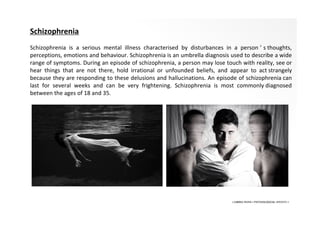
Schizophrenia
Schizophrenia is a serious mental illness characterised by disturbances in a person ’ s thoughts,
perceptions, emotions and behaviour. Schizophrenia is an umbrella diagnosis used to describe a wide
range of symptoms. During an episode of schizophrenia, a person may lose touch with reality, see or
hear things that are not there, hold irrational or unfounded beliefs, and appear to act strangely
because they are responding to these delusions and hallucinations. An episode of schizophrenia can
last for several weeks and can be very frightening. Schizophrenia is most commonly diagnosed
between the ages of 18 and 35.
• LIBERA INSANI • PSYCHOLOGICAL SERVICES •
Bipolar disorder
Diagnoses of bipolar disorder in younger children are rare, but young people may experience their
first bipolar episode in their late teens or early 20s.
8 Children and Young People with Learning Disabilities - Understanding their Mental Health
Bipolar disorder, also known as manic depression, is a mood disorder characterised by swings in a
person ’ s mood from high to low - euphoric to depressed. In the high phase (also referred to as
hypomania), someone with bipolar disorder may have huge amounts of energy and feel little need for
sleep.
They may think and talk faster than usual, and their thoughts may jump rapidly from one subject to
another, making conversation difficult. They may also have what are called ‘ grandiose ’ ideas or
delusions about their abilities and powers, and a loss of judgement. People in a high phase can get
themselves into all sorts of difficulties that they would normally avoid – they may leave their job,
spend money they don’t have, or give away all their possessions.
In a low (or depressive) phase, people feel hopeless, despairing and lethargic, become full of self-
blame and self-doubt and have difficulty concentrating. This can make it difficult to cope with
everyday life. People may withdraw from friends and social contacts, and may feel suicidal.
2015-5-11
TREATMENT & SUPPORT
TREATMENT & SUPPORT
• LIBERA INSANI • PSYCHOLOGICAL SERVICES •
Talking therapies
Talking therapies involve talking to someone who is trained to help deal with negative feelings. They can help
anyone who is experiencing distress. Talking therapies give people the chance to explore their thoughts and
feelings and the effect they have on their behaviour and mood. Describing what’s going on in your head and
how that makes you feel can help you notice any patterns which it may be helpful to change.
It can help you work out where your negative feelings and ideas come from and why they are there.
Understanding all this can help people make positive changes by thinking or acting differently. Talking
therapies can help people to take greater control of their lives and improve their confidence.
Talking therapies may also be referred to as:
• talking treatments
• counseling
• psychological therapies or treatments
• psychotherapies
Types of talking therapies include:
• Cognitive behavioural therapies (CBT)
• Dialectic behaviour therapy (DBT)
• Psychodynamic therapies
• Humanistic therapies
• Other kinds of talking therapy
• Support and information.
• LIBERA INSANI • PSYCHOLOGICAL SERVICES •
Self Management
Self-management There are many different ways that
people experiencing mental health problems can
manage their own mental health. For example, they
may practise spiritual activities, use peer support or eat
or avoid certain foods. This is often called self-help or
self-management.
Self-management has another, more specific, meaning
when it describes the way that people can learn to
control long-term health problems. Increasing numbers
of people with a physical health problem use self-
management to help them control their symptoms.
People with mental health problems can use a similar
strategy to control serious
mental health problems such as bi-polar disorder or
schizophrenia. Through self-management, many people
gain the confidence, skills and knowledge to better
manage their mental health and gain more control of
their lives at a time when they may feel they have lost
control.
Self-management can have
as positive an impact on
mental health as medical
treatment, enabling people
to lead fuller, more active
lives.
Research has shown that it
can help boost the self-
esteem of people with bi-
polar disorder and lower the
risk that they will consider
suicide.
• LIBERA INSANI • PSYCHOLOGICAL SERVICES •
Many people are using self-management without realising it, but formal selfmanagement skills can be
learnt on courses, usually run by people with direct experience of mental ill health. The courses help
people understand how their own mental health problems affect them and how to recognise the
early signs and prevent or minimise the impact of an episode of ill health. They are based on the
principle that individuals know best what works for them.
During their training, participants typically learn to:
• recognise what triggers a crisis in their own mental health
• read the warning signs of a possible crisis
• identify if any particular actions can prevent a crisis developing
• figure out which coping strategies work best for them in a crisis
• tap into other sources of support like local groups for people experiencing similar distress
• build ongoing coping strategies into a mentally healthy lifestyle
• compile an action plan
• draw up an advance directive setting out how they would like to be treated if they ever lack the
capacity to make decisions about their treatment in the future.
Self-management is more often available for adults, but can also be effective for teenagers and young
people. The use of self-management skills by people with learning disabilities has not been widely
researched, but anecdotally we know that people who receive the right support can do well with self-
management.
• LIBERA INSANI • PSYCHOLOGICAL SERVICES •
#changethestigma
Are we doing enough to address the growing mental health challenges?
People with a mental illness often face the stigma attached by society to mental illness. This stigma
causes discrimination against people with a mental illness in employment, housing, health care, and
an ability to buy health insurance. By learning more about mental illness and the effectiveness of
treatment, this discrimination can end, removing the stigma that acts as a barrier to successful
treatment.
HELP IS HERE
PT. GRIYA LIBERA INSANI
Gedung Sarinah Lantai 12 Unit 02
Jalan MH. Thamrin Kav. 11
Jakarta Pusat 10350
Phone : 021 - 3904176
Hotline : 0888 1415 000
Email : info@liberainsani.com
Website : www.liberainsani.com
Facebook: Libera Insani
Twitter : @liberainsani
Instagram: @liberainsani
Operational Hour
Monday - Friday: 08.00 - 21.00
Saturday: 08.00 – 17.00
Sunday & public holiday can be arranged through initial appointment
• LIBERA INSANI • PSYCHOLOGICAL SERVICES •

MentalHealthBooklet-ForEmail

  • 1.
    Psychological & HRServices Mental Health Booklet
  • 2.
  • 3.
    ABOUT MENTAL HEALTH Weall have mental health. Mental health relates to how we think, feel, behave and interact with other people. The World Health Organisation has defined mental wellbeing as ‘a state of mind in which an individual is able to realise his or her own abilities, can cope with the normal stresses of life, can work productively, and is able to make a contribution to his or her community.’ It can be helpful to understand wellbeing as being made up of two key elements: 1) Feeling good 2) Functioning well Feeling good means experiencing positive emotions like happiness, contentment and enjoyment. It also includes feelings like curiosity, engagement and safety. Functioning well is about how a person is able to function in the world. This includes having positive relationships and social connections, as well as feeling in control of your life and having a sense of purpose.
  • 4.
    GOOD MENTAL HEALTH& WELLBEING Mental wellbeing does not mean being happy all the time and it does not mean you won ’ t experience negative or painful emotions such as grief, loss, or failure, which are a normal part of life. People with high levels of wellbeing will still experience these feelings, but are likely to be better able to cope with them without it having a significant impact on their mental health. Good mental wellbeing is closely linked to good mental health, but they are not quite the same thing. Someone who has been diagnosed with a mental health problem may experience high levels of wellbeing for some of the time, but would be more likely to experience periods of low wellbeing than someone without a mental health problem. Equally, supporting people who have low levels of wellbeing can help to prevent the development of mental health problems, particularly depression, stress and anxiety, and can support recovery and improve health outcomes. Our mental health and wellbeing are strongly influenced not only by our individual attributes, such as age, personality, gender or genetics, but also by the circumstances in which we find ourselves and the environment in which we live. • LIBERA INSANI • PSYCHOLOGICAL SERVICES •
  • 5.
    • LIBERA INSANI• PSYCHOLOGICAL SERVICES • CAUSES OF CHANGE There are a whole range of things that can have an impact on our mental health and cause us to act in a different way to normal. These can be factors that are internal to us (e.g. our feelings and reactions to situations, pain or illness) or external (e.g. changes in our environment, how other people behave). Think about what might have changed to cause a difference in someone’s behaviour. For a child or young person with a learning disability, some causes of change might be: External • Lack of social opportunities • Transition • Loneliness • Bereavement • Lack of stimulation • Moving house • Change of staff Internal • Physical illness • Pain • Puberty • Medication • Missing home • Change of routine • Parental separation • Failure in activities • Weather Internal • Physical illness • Pain • Puberty • Medication • Missing home
  • 6.
    • LIBERA INSANI• PSYCHOLOGICAL SERVICES • RESILIENCE People are more likely to maintain high levels of wellbeing and protect their mental health if they are resilient. Resilience is the ability to cope with life’s challenges and to recover from, or adapt to, adversity. We are not born with a fixed capacity for resilience. Resilience is something that can be learned and improved, as well as eroded or worn down by difficult circumstances, so a person’s resilience may change over their lifetime. Resilience is important because it can help to protect against the development of mental health problems. People with high resilience are more likely to cope with difficult experiences whilst maintaining high levels of wellbeing. And good levels of resilience can help people to recover more quickly if they do experience mental health problems.
  • 7.
  • 8.
    2015-5-11 CONNECT.. With the peoplearound you. With family, friends, colleagues and neighbours. At home, work, school or in your local community. Think of these as the cornerstones of your life and invest time in developing them. Building these connections will support and enrich you every day. BE ACTIVE.. Go for a walk or run. Step outside. Cycle. Play a game. Garden. Dance. Exercising makes you feel good. Most importantly, discover a physical activity you enjoy and that suits your level of mobility and fitness. TAKE NOTICE.. Be curious. Catch sight of the beautiful. Remark on the unusual. Notice the changing seasons. Savour the moment, whether you are walking to work, eating lunch or talking to friends. Be aware of the world around you and what you are feeling. Reflecting on your experiences will help you appreciate what matters to you. • LIBERA INSANI • PSYCHOLOGICAL SERVICES •
  • 9.
    2015-5-11 KEEP LEARNING.. Try somethingnew. Rediscover an old interest. Sign up for that course. Take on a different responsibility at work. Fix a bike. Learn to play an instrument or how to cook your favourite food. Set a challenge you will enjoy achieving. Learning new things will make you more confident as well as being fun. GIVE.. Do something nice for a friend, or a stranger. Thank someone. Smile. Volunteer your time. Join a community group. Look out, as well as in. Seeing yourself, and your happiness, linked to the wider community can be incredibly rewarding and creates connections with the people around you. • LIBERA INSANI • PSYCHOLOGICAL SERVICES •
  • 10.
    2015-5-11 • LIBERA INSANI• PSYCHOLOGICAL SERVICES • 2. MENTAL HEALTH PROBLEMS
  • 11.
    • LIBERA INSANI• PSYCHOLOGICAL SERVICES • Just as we can develop problems with our physical health, mental health problems will be experienced by many of us over the course of our lives. Mental health problems range from the worries we all experience as a part of our everyday life, to serious long term conditions that can be very difficult to manage and have a huge impact on people’s lives. "Mental disorders comprise a broad range of problems, with different symptoms. However, they are generally characterized by some combination of abnormal thoughts, emotions, behaviour and relationships with others. Examples are schizophrenia, depression … and disorders due to drug abuse. Most of these disorders can be successfully treated."
  • 12.
    • LIBERA INSANI• PSYCHOLOGICAL SERVICES • It is estimated that one person in four will be affected by a mental health problem each year: • Anxiety and depression are the most common problems, with about 1 in 10 people affected at any given time5. Anxiety and depression can be severe and long-lasting and have a big impact on people’s ability to lead their daily life. • Between 1 and 2 in every 100 people will experience a serious mental health problem such as bipolar disorder, psychosis or schizophrenia. People affected may hear voices, see things no one else sees, hold unusual beliefs that are not in line with what is generally accepted as real, feel unrealistically powerful or feel worthless, with a loss of interest in daily life.
  • 13.
    2015-5-11 TYPE OF MENTALILLNESS TYPE OF MENTAL ILLNESSES
  • 14.
    • LIBERA INSANI• PSYCHOLOGICAL SERVICES • Depression Depression is a common mental disorder that causes people to experience depressed mood, loss of interest or pleasure, feelings of guilt or low selfworth, disturbed sleep or appetite, low energy, and poor concentration. Depression is different from feeling down or sad. Unhappiness is something which everyone feels at one time or another, usually due to a particular cause. A person suffering from depression will experience intense emotions of anxiety, hopelessness, negativity and helplessness, and the feelings stay with them instead of going away.
  • 15.
    • LIBERA INSANI• PSYCHOLOGICAL SERVICES • Anxiety Anyone can have feelings of anxiety, including children and young people. Anxious feelings often occur in response to a stressful situation and include: feeling scared or panicky, feeling irritable, having negative thoughts or worries, feeling shaky, dizzy or sick, breathing fast, sweating, having tense muscles or palpitations. Sometimes these feelings can be helpful, for example, by increasing a person’s ability to perform in a race or exam. These feelings are normal. However, anxiety can become a problem when the symptoms are more intense or long-lasting and begin to interfere with a person ’s concentration and ability to do routine tasks. People may: avoid situations that could provoke feelings of anxiety, feel embarrassed or ashamed a lot of the time, not have the confidence to face new challenges, or have problems eating and sleeping. This interference with daily living, as much as the symptoms themselves, may lead a person to seek help. Anxiety disorders come in various forms, and include generalised anxiety disorder (GAD), social anxiety disorder, phobias, panic attacks, obsessive compulsive disorder and post-traumatic stress disorder (PTSD).
  • 16.
    • LIBERA INSANI• PSYCHOLOGICAL SERVICES • Psychosis Psychosis describes the distortion of a person’s perception of reality, often accompanied by delusions (irrational and unfounded beliefs) and/or hallucinations (seeing, hearing, smelling, sensing things that other people can ’ t). People experiencing psychosis can also have muddled or blocked thinking (thought disorder), can at times seem unusually excited or withdrawn and avoid contact with people, and might not realise that there is anything wrong with themselves (lack of insight). People often experience their first episode of psychosis in their late teens or in their early 20s. Psychosis is a symptom of some of the more severe forms of mental health problems, such as bi-polar disorder, schizophrenia, substance abuse or some forms of personality disorder.
  • 17.
    • LIBERA INSANI• PSYCHOLOGICAL SERVICES • Schizophrenia Schizophrenia is a serious mental illness characterised by disturbances in a person ’ s thoughts, perceptions, emotions and behaviour. Schizophrenia is an umbrella diagnosis used to describe a wide range of symptoms. During an episode of schizophrenia, a person may lose touch with reality, see or hear things that are not there, hold irrational or unfounded beliefs, and appear to act strangely because they are responding to these delusions and hallucinations. An episode of schizophrenia can last for several weeks and can be very frightening. Schizophrenia is most commonly diagnosed between the ages of 18 and 35.
  • 18.
    • LIBERA INSANI• PSYCHOLOGICAL SERVICES • Bipolar disorder Diagnoses of bipolar disorder in younger children are rare, but young people may experience their first bipolar episode in their late teens or early 20s. 8 Children and Young People with Learning Disabilities - Understanding their Mental Health Bipolar disorder, also known as manic depression, is a mood disorder characterised by swings in a person ’ s mood from high to low - euphoric to depressed. In the high phase (also referred to as hypomania), someone with bipolar disorder may have huge amounts of energy and feel little need for sleep. They may think and talk faster than usual, and their thoughts may jump rapidly from one subject to another, making conversation difficult. They may also have what are called ‘ grandiose ’ ideas or delusions about their abilities and powers, and a loss of judgement. People in a high phase can get themselves into all sorts of difficulties that they would normally avoid – they may leave their job, spend money they don’t have, or give away all their possessions. In a low (or depressive) phase, people feel hopeless, despairing and lethargic, become full of self- blame and self-doubt and have difficulty concentrating. This can make it difficult to cope with everyday life. People may withdraw from friends and social contacts, and may feel suicidal.
  • 19.
  • 20.
    • LIBERA INSANI• PSYCHOLOGICAL SERVICES • Talking therapies Talking therapies involve talking to someone who is trained to help deal with negative feelings. They can help anyone who is experiencing distress. Talking therapies give people the chance to explore their thoughts and feelings and the effect they have on their behaviour and mood. Describing what’s going on in your head and how that makes you feel can help you notice any patterns which it may be helpful to change. It can help you work out where your negative feelings and ideas come from and why they are there. Understanding all this can help people make positive changes by thinking or acting differently. Talking therapies can help people to take greater control of their lives and improve their confidence. Talking therapies may also be referred to as: • talking treatments • counseling • psychological therapies or treatments • psychotherapies Types of talking therapies include: • Cognitive behavioural therapies (CBT) • Dialectic behaviour therapy (DBT) • Psychodynamic therapies • Humanistic therapies • Other kinds of talking therapy • Support and information.
  • 21.
    • LIBERA INSANI• PSYCHOLOGICAL SERVICES • Self Management Self-management There are many different ways that people experiencing mental health problems can manage their own mental health. For example, they may practise spiritual activities, use peer support or eat or avoid certain foods. This is often called self-help or self-management. Self-management has another, more specific, meaning when it describes the way that people can learn to control long-term health problems. Increasing numbers of people with a physical health problem use self- management to help them control their symptoms. People with mental health problems can use a similar strategy to control serious mental health problems such as bi-polar disorder or schizophrenia. Through self-management, many people gain the confidence, skills and knowledge to better manage their mental health and gain more control of their lives at a time when they may feel they have lost control. Self-management can have as positive an impact on mental health as medical treatment, enabling people to lead fuller, more active lives. Research has shown that it can help boost the self- esteem of people with bi- polar disorder and lower the risk that they will consider suicide.
  • 22.
    • LIBERA INSANI• PSYCHOLOGICAL SERVICES • Many people are using self-management without realising it, but formal selfmanagement skills can be learnt on courses, usually run by people with direct experience of mental ill health. The courses help people understand how their own mental health problems affect them and how to recognise the early signs and prevent or minimise the impact of an episode of ill health. They are based on the principle that individuals know best what works for them. During their training, participants typically learn to: • recognise what triggers a crisis in their own mental health • read the warning signs of a possible crisis • identify if any particular actions can prevent a crisis developing • figure out which coping strategies work best for them in a crisis • tap into other sources of support like local groups for people experiencing similar distress • build ongoing coping strategies into a mentally healthy lifestyle • compile an action plan • draw up an advance directive setting out how they would like to be treated if they ever lack the capacity to make decisions about their treatment in the future. Self-management is more often available for adults, but can also be effective for teenagers and young people. The use of self-management skills by people with learning disabilities has not been widely researched, but anecdotally we know that people who receive the right support can do well with self- management.
  • 23.
    • LIBERA INSANI• PSYCHOLOGICAL SERVICES • #changethestigma Are we doing enough to address the growing mental health challenges? People with a mental illness often face the stigma attached by society to mental illness. This stigma causes discrimination against people with a mental illness in employment, housing, health care, and an ability to buy health insurance. By learning more about mental illness and the effectiveness of treatment, this discrimination can end, removing the stigma that acts as a barrier to successful treatment.
  • 24.
    HELP IS HERE PT.GRIYA LIBERA INSANI Gedung Sarinah Lantai 12 Unit 02 Jalan MH. Thamrin Kav. 11 Jakarta Pusat 10350 Phone : 021 - 3904176 Hotline : 0888 1415 000 Email : info@liberainsani.com Website : www.liberainsani.com Facebook: Libera Insani Twitter : @liberainsani Instagram: @liberainsani Operational Hour Monday - Friday: 08.00 - 21.00 Saturday: 08.00 – 17.00 Sunday & public holiday can be arranged through initial appointment • LIBERA INSANI • PSYCHOLOGICAL SERVICES •