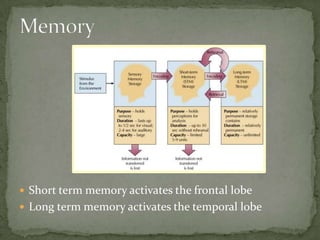
 Short term memory activates the frontal lobe
 Long term memory activates the temporal lobe
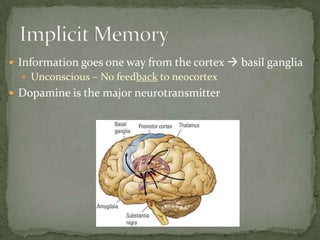
 Information goes one way from the cortex  basil ganglia
   Unconscious – No feedback to neocortex
 Dopamine is the major neurotransmitter
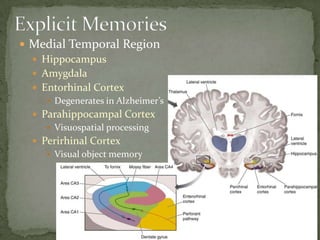
 Medial Temporal Region
   Hippocampus
   Amygdala
   Entorhinal Cortex
      Degenerates in Alzheimer’s
   Parahippocampal Cortex
      Visuospatial processing
   Perirhinal Cortex
      Visual object memory
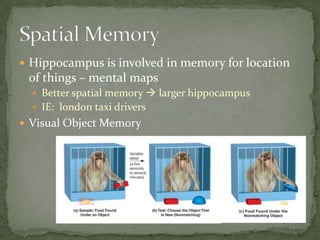
 Hippocampus is involved in memory for location
 of things – mental maps
   Better spatial memory  larger hippocampus
   IE: london taxi drivers
 Visual Object Memory
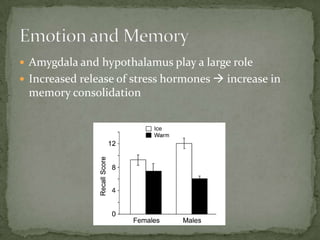
 Amygdala and hypothalamus play a large role
 Increased release of stress hormones  increase in
 memory consolidation

Memory for moodle

  • 2.
     Short termmemory activates the frontal lobe  Long term memory activates the temporal lobe
  • 4.
     Information goesone way from the cortex  basil ganglia  Unconscious – No feedback to neocortex  Dopamine is the major neurotransmitter
  • 5.
     Medial TemporalRegion  Hippocampus  Amygdala  Entorhinal Cortex  Degenerates in Alzheimer’s  Parahippocampal Cortex  Visuospatial processing  Perirhinal Cortex  Visual object memory
  • 6.
     Hippocampus isinvolved in memory for location of things – mental maps  Better spatial memory  larger hippocampus  IE: london taxi drivers  Visual Object Memory
  • 7.
     Amygdala andhypothalamus play a large role  Increased release of stress hormones  increase in memory consolidation

Editor's Notes

  • #3 Procedural memory is on the right side of the brainLanguage memory is stored in the temporal lobe