2018 REGULATORY
UPDATE
Presenters: Doug Johnson and Melissa Sewell
Confidential & Privileged DocumentConfidential & Privileged Document
Introductions
Doug Johnson
Director of Product
Management. Doug is
responsible for directing and
managing the Baker Hill
product strategy, market
research, as well as client user
community interaction.
Melissa Sewell, MBA, NCCO
Studied Finance and Economics
at Indiana University and is
pursuing Doctor of
Jurisprudence Degree from IU
McKinney School of Law.
Background is predominantly in
the financial industry with a
focus in areas of Internal Audit
and Regulatory Compliance.
Confidential & Privileged DocumentConfidential & Privileged Document
Legal disclaimer
The materials made available for or during this presentation are
for informational purposes only and not for the purpose of
providing legal advice. Neither of the presenters are attorneys.
You should contact your attorney to obtain advice with respect
to any particular issue or problem.
AGENDA
1. New Regulations & Advisory Bulletins
2. New Solutions & Compliance
3. Future Compliance Hot Topics
1. NEW REGULATIONS & ADVISORY
BULLETINS
HMDA Examiner Transaction Testing Guidelines
Small Dollar Rule
Confidential & Privileged DocumentConfidential & Privileged Document
HMDA key fields interagency statements
• Examiners identified 37 Key HMDA Data Fields for 2018 filings.
• Fields selected were chosen as most important for CRA and
HMDA examination purposes.
• Also, considered likeliness of being recorded correctly based
upon past examinations.
Confidential & Privileged DocumentConfidential & Privileged Document
37 key HMDA fields
Universal Loan
Identifier (ULI)
Application Date Loan Type Loan Purpose Occupancy Type
Loan Amount Action Taken Action Taken Date Census Tract Income
Race of Applicant or
Borrower: 1
Race of Applicant or
Borrower: 2
Race of Co-Applicant or
Co-Borrower: 1
Race of Co-Applicant or
Co-Borrower: 2
Ethnicity of Applicant
or Borrower: 1
Sex of Applicant or
Borrower
Sex of Co-Applicant or
Co-Borrower
Age of Applicant or
Borrower
Age of Co-Applicant or
Co-Borrower
Ethnicity of Co-
Applicant or Co-
Borrower: 1
Lien Status Credit Score of
Applicant or Borrower
Credit Score of Co-
Applicant or Co-
Borrower
Origination Charges Discount Points
Lender Credits Interest Rate Debt-to-Income Ratio Total Units Loan Term
Automated
Underwriting System
Result: 1
Manufactured Home
Secured Property Type
Combined Loan-To-
Value Ratio
Property Value Reverse Mortgage
Open-End Line of
Credit
Business or Commercial
Purpose
Confidential & Privileged DocumentConfidential & Privileged Document
FFIEC HMDA Examiner Transaction Guidelines
• Thresholds for errors, size of sampling size,
and tolerances for minor errors.
• Discusses compliance management system
and considerations to HMDA data errors.
• Applies to all institutions
Confidential & Privileged DocumentConfidential & Privileged Document
FFIEC’s HMDA Sample Size and Error Thresholds
LAR Count Stage 2 Sample
Size
Stage 1 Sample
Size
Stage 1 Error
Threshold
Resubmission
Threshold (#/%)
25-50 30 15 2 3 10.0
51-100 30 20 2 3 10.0
101-130 47 29 2 3 6.4
131-190 56 29 2 3 5.4
191-500 59 30 2 3 5.1
501-100,000 79 35 2 4 5.1
100,000+ 159 61 2 4 2.5
Confidential & Privileged DocumentConfidential & Privileged Document
FFIEC Tolerance Statement
But there is relief….
• 3 calendar days for date received vs date
shown on application.
• $1,000 for loan amount and gross annual
income (rounding errors).
• 3 calendar days for date action taken.
Confidential & Privileged DocumentConfidential & Privileged Document
FFIEC Ethnicity or Race Data Field Errors
But wait, it gets better….
The group of Ethnicity or Race data field
equate to one data field for error
purposes.
Statement:
“If one or more of the six ethnicity of
applicant or borrower fields have errors,
they would count as one (and only one)
error for that data field group.”
Confidential & Privileged DocumentConfidential & Privileged Document
HMDA & Compliance Management
Update Compliance Management Systems:
• Policy
• Procedures
• Compliance Audit Plan
• Training
• Board Oversight
• Risk Assessment
• Etc.
Confidential & Privileged DocumentConfidential & Privileged Document
Geocoding tool
https://www.consumerfinance.gov/data-
research/hmda/tech-preview
Confidential & Privileged DocumentConfidential & Privileged Document
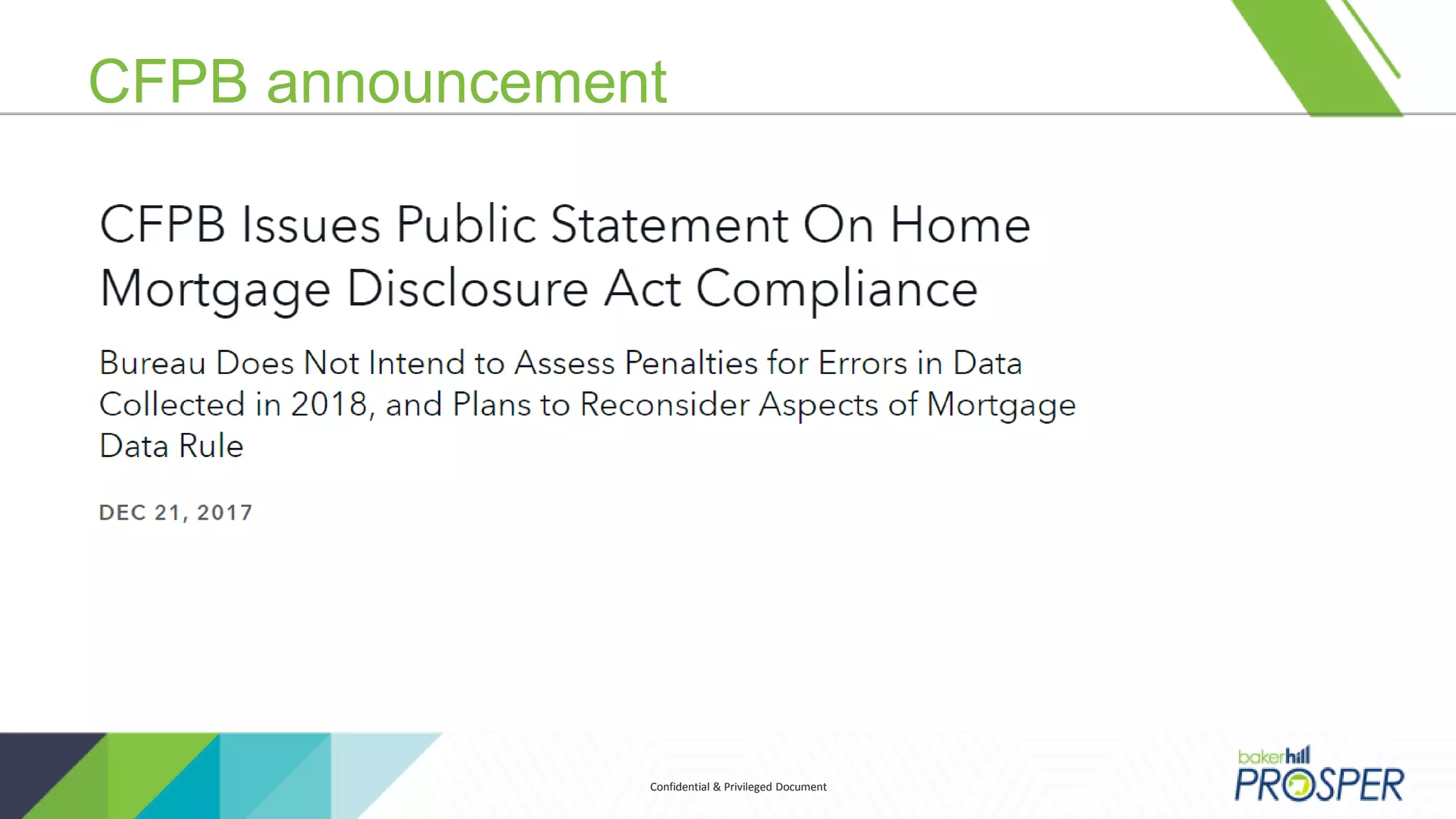
CFPB announcement
Confidential & Privileged DocumentConfidential & Privileged Document
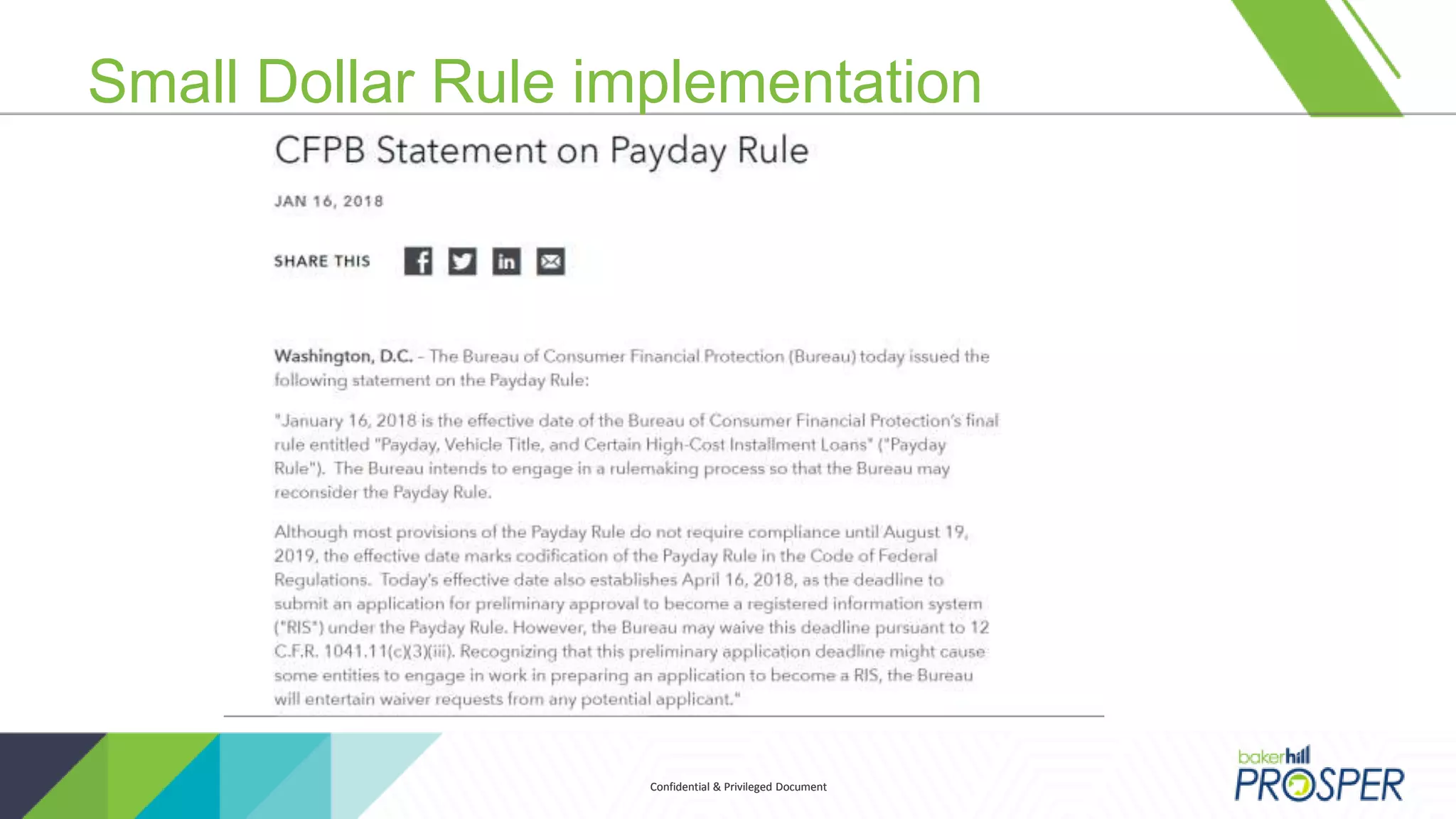
Small Dollar Rule implementation
Confidential & Privileged DocumentConfidential & Privileged Document
Small Dollar Rule Scope 12 CFR 1041
Short-term
• Repay obligation within 45 days
Longer-term balloon
• Closed-end: At least one payment that is more than twice as large as
any other payment
• Open-end: Repay substantially the entire amount of an advance in a
single payment more than 45 days after the advance is made or is
required to make at least one payment on the advance that is more
than twice as large as any other payment(s)
Other longer-term
• The cost of credit for the loan exceeds 36 percent per annum, and;
• The lender or service provider obtains a leveraged payment
mechanism.
Confidential & Privileged DocumentConfidential & Privileged Document
Excluded from Scope
• Purchase money security interest loans (“sole-purpose”)
• Real estate and dwelling secured loans
• Credit card loans
• Student loans
• Overdraft services
• No cost advances
Confidential & Privileged DocumentConfidential & Privileged Document
Conditional exclusions
• Accommodation Loans: fewer than 2,500 loans in each of the
current and previous years and less than 10 percent of
revenues.
• Alternative loans: P.A.L. previously approved by the NCUA for
credit unions.
Confidential & Privileged DocumentConfidential & Privileged Document
UDAAP and Small Dollar Rule
• Consumer’s ability to repay
• Short-term or longer-term balloon-payment loans
• Not imposing a ban on any “product” but instead is simply
prescribing rules to prevent the acts or practices so identified
Confidential & Privileged DocumentConfidential & Privileged Document
Baker Hill and Small Dollar Rule
• Reviewed the Rules
• Considered the Rules and the
implications to clients in designing
NextGen
• Monitoring Congress and CFPB actions
2. CURRENT HOT TOPICS
CECL
Electronic Signatures
Confidential & Privileged DocumentConfidential & Privileged Document
CECL overview and purpose
• CECL stands for Current Expected
Credit Loss
• Allows the leveraging of current
internal credit risk systems to
estimate expected credit losses.
• Purpose is to provide more
decision-useful information to
users of financial statements.
Confidential & Privileged DocumentConfidential & Privileged Document
CECL changes
• Changes the ALLL “probable” loss
threshold to an “expected” threshold
• Recognizes potential credit losses earlier
in the life of the loan.
• Does not change total amount of net
charge-offs on loans or loan is placed in
nonaccrual status.
Confidential & Privileged DocumentConfidential & Privileged Document
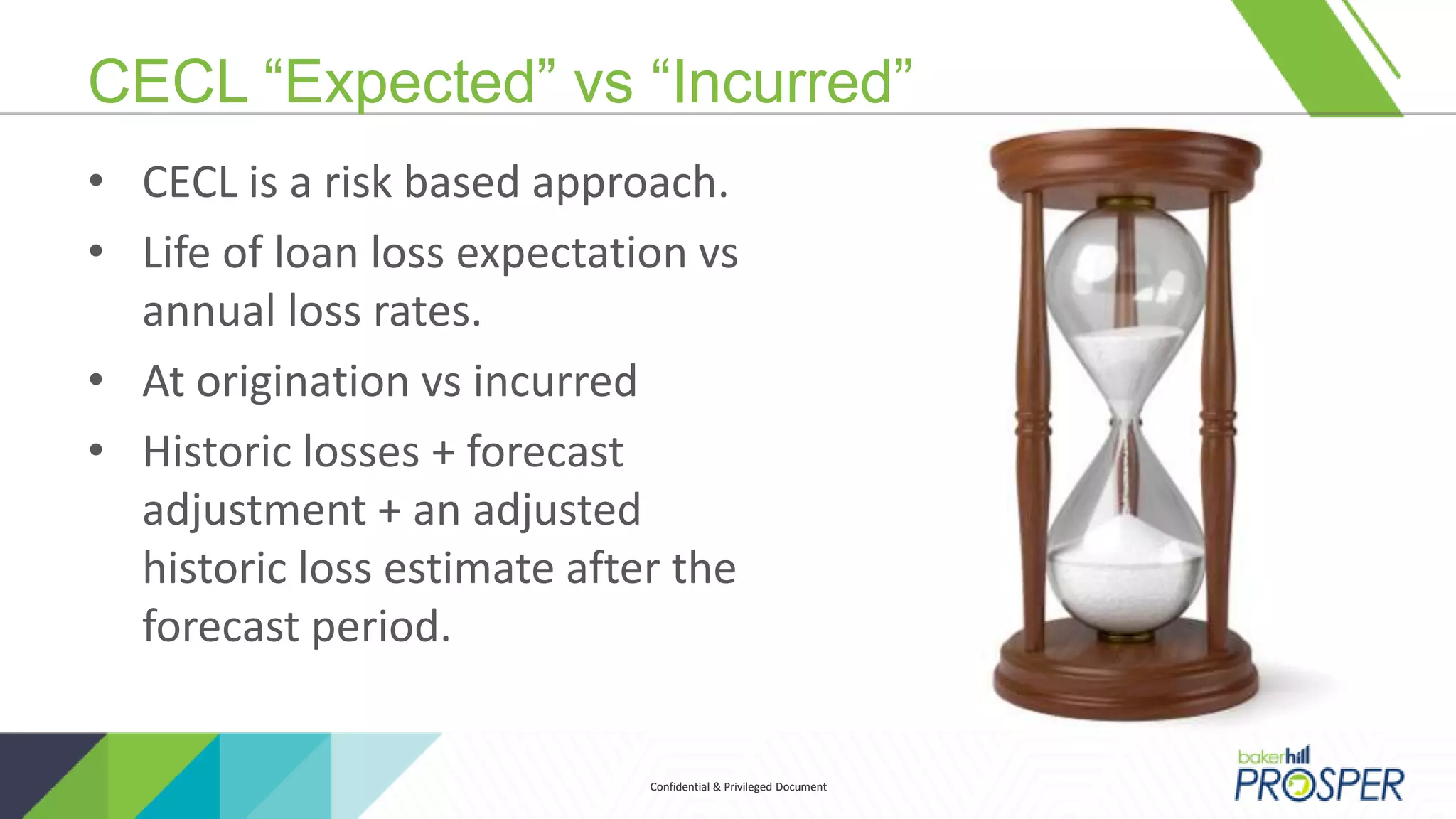
CECL “Expected” vs “Incurred”
• CECL is a risk based approach.
• Life of loan loss expectation vs
annual loss rates.
• At origination vs incurred
• Historic losses + forecast
adjustment + an adjusted
historic loss estimate after the
forecast period.
Confidential & Privileged DocumentConfidential & Privileged Document
CECL effective dates
Type US GAAP
Effective Date
Call Report
Effective Date
PBE SEC Filers After 12/15/2019 3/31/2020
Other PBEs After 12/15/2020 3/31/2021
Non-PBEs After 12/15/2020 12/31/2021
Confidential & Privileged DocumentConfidential & Privileged Document
Electronic signatures
• E-Sign Act (15 USC 7001) applies to electronic signatures
when federal law applies.
• States laws are often modeled after the Uniform Electronic
Transactions Act. (model law)
Confidential & Privileged DocumentConfidential & Privileged Document
ESIGN Act Notice (before consenting)
• Option to receive a paper copy.
• Right to withdraw consent and consequences if revoke
consent.
• Extent of consent.
• How to obtain a paper copy of an electronic record and
fees/repercussions if elect paper copies.
• Hardware and software requirements for access and retention
of the electronic disclosures.
Confidential & Privileged DocumentConfidential & Privileged Document
ESIGN ACT Consumer Consent
• Reasonably demonstrates
that the consumer will be
able to access required
notices or disclosures
electronically.
• Re-consent for changes to
hardware and software
requirements in a way that
demonstrates can access.
Confidential & Privileged DocumentConfidential & Privileged Document
Additional requirements with UETA – attribution
• Procedures applied to the determine the person who
“clicked” is the person who “signed.”
• Look at the context and the surrounding circumstances.
Confidential & Privileged DocumentConfidential & Privileged Document
Additional regulations & guidance
• National Banks:
– 12 CFR 7.5002, Furnishing of products and services by electronic
means and facilities.
– OCC Bulletin 99-20
• Federal Credit Unions
– NCUA Regulatory Alert 01-RA-03
• All Financial Institutions:
– FFIEC E-Banking Booklet
– NIST Digital Identity Guidelines, SP 800-63-3
3. FUTURE HOT TOPICS
Debt Collection
Small Business Lending and Recordkeeping
Bills to Change Dodd-Frank
Confidential & Privileged DocumentConfidential & Privileged Document
Debt collection
• CFPB Director Mulvaney’s memo statement.
– “More formal rulemaking and less regulations by enforcement.”
– “We will be prioritizing…almost a third of complaints into this office
related to debt collection.”
• 2017 Annual Report, types of complaints:
– Collecting the right amount from the consumer.
– Consumer’s understanding the debt collection process and their
rights.
– Consumer’s treatment during the collection process.
Confidential & Privileged DocumentConfidential & Privileged Document
Debt collection
Fair Debt Collection Practices Act, CFPB Annual Report 2018
Confidential & Privileged DocumentConfidential & Privileged Document
Debt collection
Fair Debt Collection Practices Act, CFPB Annual Report 2018
Confidential & Privileged DocumentConfidential & Privileged Document
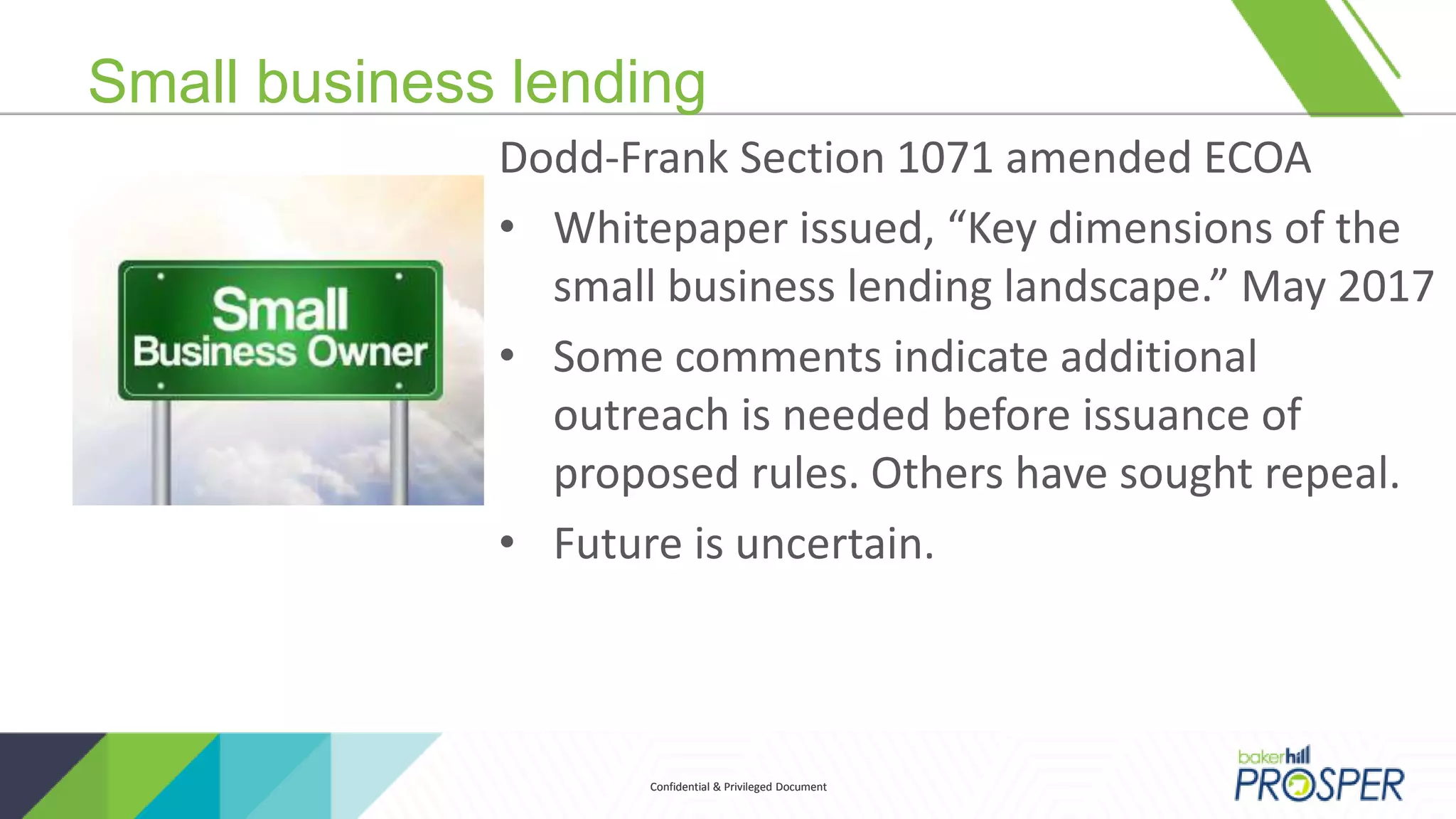
Small business lending
Dodd-Frank Section 1071 amended ECOA
• Whitepaper issued, “Key dimensions of the
small business lending landscape.” May 2017
• Some comments indicate additional
outreach is needed before issuance of
proposed rules. Others have sought repeal.
• Future is uncertain.
Confidential & Privileged DocumentConfidential & Privileged Document
Mortgage Choice Act of 2017 H.R.1153
• House passed the bill on February 8, 2018.
• Proposed amendment to qualified mortgage cap on points
and fees.
• Fee must be bona fide third-party charge not retained by the
mortgage originator, creditor, or an affiliate of the creditor or
mortgage originator.
• If becomes law, CFPB will have 90 days to issue final
regulations.
Confidential & Privileged DocumentConfidential & Privileged Document
Regulatory Relief, Senate Bill S.2155
• Senate passed the bill on March 16, 2018.
• Relief changes to Ability to Repay, Integrated Disclosure Rules
(“TRID”), HMDA, and Safe Act.
• Social Security Administration database tools.
• Assets size changes for Volker Rule ($10 billion and 5%)
• Expansion of the types of credit scores available for Fannie
Mae and Freddie Mac
• SIFI/Holding Company threshold changes ($3 billion and $50
billion)
Questions?

The 2018 Regulatory Update - Are You Ready?

  • 1.
    2018 REGULATORY UPDATE Presenters: DougJohnson and Melissa Sewell
  • 2.
    Confidential & PrivilegedDocumentConfidential & Privileged Document Introductions Doug Johnson Director of Product Management. Doug is responsible for directing and managing the Baker Hill product strategy, market research, as well as client user community interaction. Melissa Sewell, MBA, NCCO Studied Finance and Economics at Indiana University and is pursuing Doctor of Jurisprudence Degree from IU McKinney School of Law. Background is predominantly in the financial industry with a focus in areas of Internal Audit and Regulatory Compliance.
  • 3.
    Confidential & PrivilegedDocumentConfidential & Privileged Document Legal disclaimer The materials made available for or during this presentation are for informational purposes only and not for the purpose of providing legal advice. Neither of the presenters are attorneys. You should contact your attorney to obtain advice with respect to any particular issue or problem.
  • 4.
    AGENDA 1. New Regulations& Advisory Bulletins 2. New Solutions & Compliance 3. Future Compliance Hot Topics
  • 5.
    1. NEW REGULATIONS& ADVISORY BULLETINS HMDA Examiner Transaction Testing Guidelines Small Dollar Rule
  • 6.
    Confidential & PrivilegedDocumentConfidential & Privileged Document HMDA key fields interagency statements • Examiners identified 37 Key HMDA Data Fields for 2018 filings. • Fields selected were chosen as most important for CRA and HMDA examination purposes. • Also, considered likeliness of being recorded correctly based upon past examinations.
  • 7.
    Confidential & PrivilegedDocumentConfidential & Privileged Document 37 key HMDA fields Universal Loan Identifier (ULI) Application Date Loan Type Loan Purpose Occupancy Type Loan Amount Action Taken Action Taken Date Census Tract Income Race of Applicant or Borrower: 1 Race of Applicant or Borrower: 2 Race of Co-Applicant or Co-Borrower: 1 Race of Co-Applicant or Co-Borrower: 2 Ethnicity of Applicant or Borrower: 1 Sex of Applicant or Borrower Sex of Co-Applicant or Co-Borrower Age of Applicant or Borrower Age of Co-Applicant or Co-Borrower Ethnicity of Co- Applicant or Co- Borrower: 1 Lien Status Credit Score of Applicant or Borrower Credit Score of Co- Applicant or Co- Borrower Origination Charges Discount Points Lender Credits Interest Rate Debt-to-Income Ratio Total Units Loan Term Automated Underwriting System Result: 1 Manufactured Home Secured Property Type Combined Loan-To- Value Ratio Property Value Reverse Mortgage Open-End Line of Credit Business or Commercial Purpose
  • 8.
    Confidential & PrivilegedDocumentConfidential & Privileged Document FFIEC HMDA Examiner Transaction Guidelines • Thresholds for errors, size of sampling size, and tolerances for minor errors. • Discusses compliance management system and considerations to HMDA data errors. • Applies to all institutions
  • 9.
    Confidential & PrivilegedDocumentConfidential & Privileged Document FFIEC’s HMDA Sample Size and Error Thresholds LAR Count Stage 2 Sample Size Stage 1 Sample Size Stage 1 Error Threshold Resubmission Threshold (#/%) 25-50 30 15 2 3 10.0 51-100 30 20 2 3 10.0 101-130 47 29 2 3 6.4 131-190 56 29 2 3 5.4 191-500 59 30 2 3 5.1 501-100,000 79 35 2 4 5.1 100,000+ 159 61 2 4 2.5
  • 10.
    Confidential & PrivilegedDocumentConfidential & Privileged Document FFIEC Tolerance Statement But there is relief…. • 3 calendar days for date received vs date shown on application. • $1,000 for loan amount and gross annual income (rounding errors). • 3 calendar days for date action taken.
  • 11.
    Confidential & PrivilegedDocumentConfidential & Privileged Document FFIEC Ethnicity or Race Data Field Errors But wait, it gets better…. The group of Ethnicity or Race data field equate to one data field for error purposes. Statement: “If one or more of the six ethnicity of applicant or borrower fields have errors, they would count as one (and only one) error for that data field group.”
  • 12.
    Confidential & PrivilegedDocumentConfidential & Privileged Document HMDA & Compliance Management Update Compliance Management Systems: • Policy • Procedures • Compliance Audit Plan • Training • Board Oversight • Risk Assessment • Etc.
  • 13.
    Confidential & PrivilegedDocumentConfidential & Privileged Document Geocoding tool https://www.consumerfinance.gov/data- research/hmda/tech-preview
  • 14.
    Confidential & PrivilegedDocumentConfidential & Privileged Document CFPB announcement
  • 15.
    Confidential & PrivilegedDocumentConfidential & Privileged Document Small Dollar Rule implementation
  • 16.
    Confidential & PrivilegedDocumentConfidential & Privileged Document Small Dollar Rule Scope 12 CFR 1041 Short-term • Repay obligation within 45 days Longer-term balloon • Closed-end: At least one payment that is more than twice as large as any other payment • Open-end: Repay substantially the entire amount of an advance in a single payment more than 45 days after the advance is made or is required to make at least one payment on the advance that is more than twice as large as any other payment(s) Other longer-term • The cost of credit for the loan exceeds 36 percent per annum, and; • The lender or service provider obtains a leveraged payment mechanism.
  • 17.
    Confidential & PrivilegedDocumentConfidential & Privileged Document Excluded from Scope • Purchase money security interest loans (“sole-purpose”) • Real estate and dwelling secured loans • Credit card loans • Student loans • Overdraft services • No cost advances
  • 18.
    Confidential & PrivilegedDocumentConfidential & Privileged Document Conditional exclusions • Accommodation Loans: fewer than 2,500 loans in each of the current and previous years and less than 10 percent of revenues. • Alternative loans: P.A.L. previously approved by the NCUA for credit unions.
  • 19.
    Confidential & PrivilegedDocumentConfidential & Privileged Document UDAAP and Small Dollar Rule • Consumer’s ability to repay • Short-term or longer-term balloon-payment loans • Not imposing a ban on any “product” but instead is simply prescribing rules to prevent the acts or practices so identified
  • 20.
    Confidential & PrivilegedDocumentConfidential & Privileged Document Baker Hill and Small Dollar Rule • Reviewed the Rules • Considered the Rules and the implications to clients in designing NextGen • Monitoring Congress and CFPB actions
  • 21.
    2. CURRENT HOTTOPICS CECL Electronic Signatures
  • 22.
    Confidential & PrivilegedDocumentConfidential & Privileged Document CECL overview and purpose • CECL stands for Current Expected Credit Loss • Allows the leveraging of current internal credit risk systems to estimate expected credit losses. • Purpose is to provide more decision-useful information to users of financial statements.
  • 23.
    Confidential & PrivilegedDocumentConfidential & Privileged Document CECL changes • Changes the ALLL “probable” loss threshold to an “expected” threshold • Recognizes potential credit losses earlier in the life of the loan. • Does not change total amount of net charge-offs on loans or loan is placed in nonaccrual status.
  • 24.
    Confidential & PrivilegedDocumentConfidential & Privileged Document CECL “Expected” vs “Incurred” • CECL is a risk based approach. • Life of loan loss expectation vs annual loss rates. • At origination vs incurred • Historic losses + forecast adjustment + an adjusted historic loss estimate after the forecast period.
  • 25.
    Confidential & PrivilegedDocumentConfidential & Privileged Document CECL effective dates Type US GAAP Effective Date Call Report Effective Date PBE SEC Filers After 12/15/2019 3/31/2020 Other PBEs After 12/15/2020 3/31/2021 Non-PBEs After 12/15/2020 12/31/2021
  • 26.
    Confidential & PrivilegedDocumentConfidential & Privileged Document Electronic signatures • E-Sign Act (15 USC 7001) applies to electronic signatures when federal law applies. • States laws are often modeled after the Uniform Electronic Transactions Act. (model law)
  • 27.
    Confidential & PrivilegedDocumentConfidential & Privileged Document ESIGN Act Notice (before consenting) • Option to receive a paper copy. • Right to withdraw consent and consequences if revoke consent. • Extent of consent. • How to obtain a paper copy of an electronic record and fees/repercussions if elect paper copies. • Hardware and software requirements for access and retention of the electronic disclosures.
  • 28.
    Confidential & PrivilegedDocumentConfidential & Privileged Document ESIGN ACT Consumer Consent • Reasonably demonstrates that the consumer will be able to access required notices or disclosures electronically. • Re-consent for changes to hardware and software requirements in a way that demonstrates can access.
  • 29.
    Confidential & PrivilegedDocumentConfidential & Privileged Document Additional requirements with UETA – attribution • Procedures applied to the determine the person who “clicked” is the person who “signed.” • Look at the context and the surrounding circumstances.
  • 30.
    Confidential & PrivilegedDocumentConfidential & Privileged Document Additional regulations & guidance • National Banks: – 12 CFR 7.5002, Furnishing of products and services by electronic means and facilities. – OCC Bulletin 99-20 • Federal Credit Unions – NCUA Regulatory Alert 01-RA-03 • All Financial Institutions: – FFIEC E-Banking Booklet – NIST Digital Identity Guidelines, SP 800-63-3
  • 31.
    3. FUTURE HOTTOPICS Debt Collection Small Business Lending and Recordkeeping Bills to Change Dodd-Frank
  • 32.
    Confidential & PrivilegedDocumentConfidential & Privileged Document Debt collection • CFPB Director Mulvaney’s memo statement. – “More formal rulemaking and less regulations by enforcement.” – “We will be prioritizing…almost a third of complaints into this office related to debt collection.” • 2017 Annual Report, types of complaints: – Collecting the right amount from the consumer. – Consumer’s understanding the debt collection process and their rights. – Consumer’s treatment during the collection process.
  • 33.
    Confidential & PrivilegedDocumentConfidential & Privileged Document Debt collection Fair Debt Collection Practices Act, CFPB Annual Report 2018
  • 34.
    Confidential & PrivilegedDocumentConfidential & Privileged Document Debt collection Fair Debt Collection Practices Act, CFPB Annual Report 2018
  • 35.
    Confidential & PrivilegedDocumentConfidential & Privileged Document Small business lending Dodd-Frank Section 1071 amended ECOA • Whitepaper issued, “Key dimensions of the small business lending landscape.” May 2017 • Some comments indicate additional outreach is needed before issuance of proposed rules. Others have sought repeal. • Future is uncertain.
  • 36.
    Confidential & PrivilegedDocumentConfidential & Privileged Document Mortgage Choice Act of 2017 H.R.1153 • House passed the bill on February 8, 2018. • Proposed amendment to qualified mortgage cap on points and fees. • Fee must be bona fide third-party charge not retained by the mortgage originator, creditor, or an affiliate of the creditor or mortgage originator. • If becomes law, CFPB will have 90 days to issue final regulations.
  • 37.
    Confidential & PrivilegedDocumentConfidential & Privileged Document Regulatory Relief, Senate Bill S.2155 • Senate passed the bill on March 16, 2018. • Relief changes to Ability to Repay, Integrated Disclosure Rules (“TRID”), HMDA, and Safe Act. • Social Security Administration database tools. • Assets size changes for Volker Rule ($10 billion and 5%) • Expansion of the types of credit scores available for Fannie Mae and Freddie Mac • SIFI/Holding Company threshold changes ($3 billion and $50 billion)
  • 38.

Editor's Notes

  • #7 “For the purpose of evaluating financial institutions’ compliance with HMDA requirements, examiner staff will focus primary attention on the Designated Key HMDA Data Fields during transaction testing pursuant to HMDA for data collected on or after January 1, 2018.” FIL-51-2017
  • #10 Select a random sample from the LAR. Then verify the accuracy of the data entries in the LAR sample (Stage 1) against the corresponding loan files. If the number of errors identified in the Stage 1 Sample falls below the Stage 1 Error Threshold for each and every data field reviewed, no further sample review is required and the examiners may conclude the transaction testing. If the number of errors in any data field reviewed equals or exceeds the Stage 1 Sample Threshold, examiners should proceed to Stage 2 and review the remainder of the Total Sample. In Stage 2, examiners must review all data fields that had one or more errors in the Initial Sample and may review any or all Initial Sample data fields reviewed and found to have no errors in Stage 1. If, after reviewing the remainder of the Stage 2 Sample, the total number of errors in any data field equals or exceeds the Resubmission Threshold, examiners should direct the financial institution to correct any such data field in its full HMDA LAR and resubmit its HMDA LAR with the corrected data field(s). If examiners have a reasonable basis, a financial institution may be directed to correct one or more individual data fields and resubmit its HMDA LAR even if errors do not meet Resubmission threshold. For complete details refer to FIL-36-2017, pages 3-4
  • #11 “Examiners should not count the following differences between data in the HMDA LAR and in the loan files as errors: Three calendar days or less in the date the application was received or the date shown on the application form reported pursuant to 12 CFR 1003.4(a)(1)(ii); One thousand dollars or less in the amount of the covered loan or the amount applied for, as applicable, reported pursuant to 12 CFR 1003.4(a)(7); Three calendar days or less in the date of the action taken by the financial institution reported pursuant to 12 CFR 1003.4(a)(8)(ii), provided that such differences do not result in reporting data for the wrong calendar year; and Rounding errors in reporting the dollar amount, rounded to the nearest thousand, of the gross annual income relied on in making the credit decision or, if a credit decision was not made, the gross annual income relied on in processing the application, reported pursuant to 12 CFR 1003.4(a)(10)(iii).” FIL-36-2017, page 5
  • #12 For an applicant who indicates “Hispanic or Latino” and “Mexican” in response to the question of ethnicity, a financial institution reports the information in two FIG fields, for example, Ethnicity of Applicant or Borrower: 1 (1: Hispanic or Latino) and Ethnicity of Applicant or Borrower: 2 (11: Mexican). If one or more of the six Ethnicity of Applicant or Borrower FIG fields have errors, they would count as one (and only one) error for that data field group. If the Ethnicity of Applicant or Borrower data field group has errors in the Total Sample that meet or exceed the Resubmission Threshold in Column D of the HMDA Table, examiners should direct the institution to correct the six Ethnicity of Applicant or Borrower FIG fields and resubmit its HMDA LAR with those FIG fields corrected. FIL-36-2017, page 5
  • #13 “Examiners may direct the financial institution to make any appropriate changes in its policies, procedures, audit processes, or other aspects of its compliance management system needed to prevent the reoccurrence of errors identified within the sample that are—absent such changes—capable of repetition, even if number of errors does not equal or exceed either the Initial Sample Threshold or the Resubmission Threshold.”
  • #17 (c) Leveraged payment mechanism. For purposes of paragraph (b) of this section, a lender or service provider obtains a leveraged payment mechanism if it has the right to initiate a transfer of money, through any means, from a consumer's account to satisfy an obligation on a loan, except that the lender or service provider does not obtain a leveraged payment mechanism by initiating a single immediate payment transfer at the consumer's request. iv. Transfer by account-holding institution. A lender or service provider that is an account-holding institution has a right to initiate a transfer of funds between the consumer's account and an account of the lender or affiliate, including, but not limited to, an account-holding institution's right of set-off.
  • #30 UETA §9 “An electronic record or electronic signature is attributable to a person if it was the act of the person. The act of the person may be shown in any manner, including a showing of the efficacy of any security procedure applied to determine the person to which the electronic record or electronic signature was attributable…determined from the context and surrounding circumstances at the time of its creation, execution, or adoption…” www.uniformlaws.org
  • #33 1/3 of all complaints relate to debt collection. CFPB: 84,500 debt collection complaints.
  • #35 In 2017: credit card debt rose by $55 billion, student loan debt grew by $68 billion, and auto loan debt grew by $64 billion.
  • #36 The Consumer Financial Protection Bureau (CFPB or Bureau) seeks information about the small business lending market. Section 1071 of the Dodd-Frank Wall Street Reform and Consumer Protection Act (Dodd-Frank Act) amends the Equal Credit Opportunity Act (ECOA) to require financial institutions to compile, maintain, and report information concerning credit applications made by women-owned, minority-owned, and small businesses. In an effort to inform the Bureau’s work on the business lending data collection rulemaking to implement section 1071, the Bureau seeks to learn more about the small business financing market, including understanding more about the products that are offered to small businesses, including women-owned and minority-owned small businesses, as well as the financial institutions that offer such credit. 
  • #37 Govtrack provides a likelihood of being enacted at 34%
  • #38 Likelihood 61% of being enacted