Meet the UNESCO's
Greek Monuments
E T W I N N I N G :
B U I L D I N G B R I D G E S T H R O U G H C U L T U R A L H E R I T A G E
Greek sites included in the
World Heritage List
At the moment 18 sites are
included in the World Heritage List
14 sites are in the Tentative List
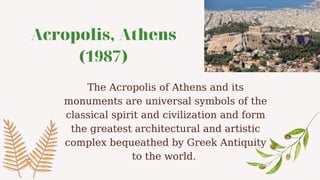
Acropolis, Athens
(1987)
The Acropolis of Athens and its
monuments are universal symbols of the
classical spirit and civilization and form
the greatest architectural and artistic
complex bequeathed by Greek Antiquity
to the world.
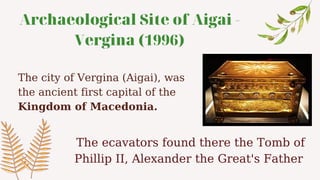
Archaeological Site of Aigai -
Vergina (1996)
The city of Vergina (Aigai), was
the ancient first capital of the
Kingdom of Macedonia.
The ecavators found there the Tomb of
Phillip II, Alexander the Great's Father
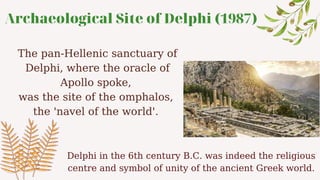
Archaeological Site of Delphi (1987)
The pan-Hellenic sanctuary of
Delphi, where the oracle of
Apollo spoke,
was the site of the omphalos,
the 'navel of the world'.
Delphi in the 6th century B.C. was indeed the religious
centre and symbol of unity of the ancient Greek world.
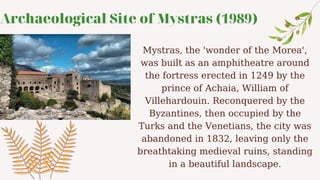
Archaeological Site of Mystras (1989)
Mystras, the 'wonder of the Morea',
was built as an amphitheatre around
the fortress erected in 1249 by the
prince of Achaia, William of
Villehardouin. Reconquered by the
Byzantines, then occupied by the
Turks and the Venetians, the city was
abandoned in 1832, leaving only the
breathtaking medieval ruins, standing
in a beautiful landscape.
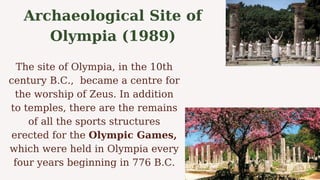
Archaeological Site of
Olympia (1989)
The site of Olympia, in the 10th
century B.C., became a centre for
the worship of Zeus. In addition
to temples, there are the remains
of all the sports structures
erected for the Olympic Games,
which were held in Olympia every
four years beginning in 776 B.C.
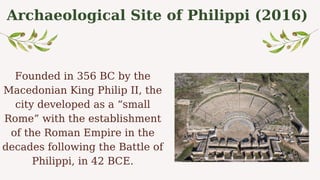
Archaeological Site of Philippi (2016)
Founded in 356 BC by the
Macedonian King Philip II, the
city developed as a “small
Rome” with the establishment
of the Roman Empire in the
decades following the Battle of
Philippi, in 42 BCE.
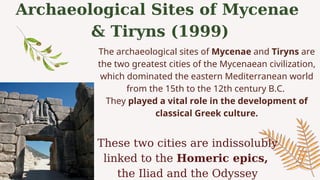
Archaeological Sites of Mycenae
& Tiryns (1999)
These two cities are indissolubly
linked to the Homeric epics,
the Iliad and the Odyssey
The archaeological sites of Mycenae and Tiryns are
the two greatest cities of the Mycenaean civilization,
which dominated the eastern Mediterranean world
from the 15th to the 12th century B.C.
They played a vital role in the development of
classical Greek culture.
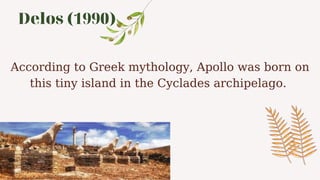
Delos (1990)
According to Greek mythology, Apollo was born on
this tiny island in the Cyclades archipelago.
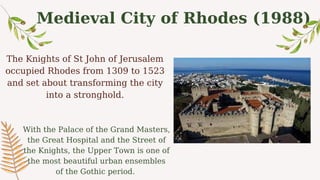
Medieval City of Rhodes (1988)
The Knights of St John of Jerusalem
occupied Rhodes from 1309 to 1523
and set about transforming the city
into a stronghold.
With the Palace of the Grand Masters,
the Great Hospital and the Street of
the Knights, the Upper Town is one of
the most beautiful urban ensembles
of the Gothic period.
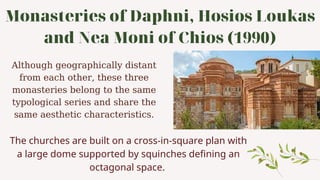
Monasteries of Daphni, Hosios Loukas
and Nea Moni of Chios (1990)
Although geographically distant
from each other, these three
monasteries belong to the same
typological series and share the
same aesthetic characteristics.
The churches are built on a cross-in-square plan with
a large dome supported by squinches defining an
octagonal space.
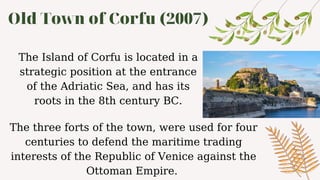
Old Town of Corfu (2007)
The Island of Corfu is located in a
strategic position at the entrance
of the Adriatic Sea, and has its
roots in the 8th century BC.
The three forts of the town, were used for four
centuries to defend the maritime trading
interests of the Republic of Venice against the
Ottoman Empire.
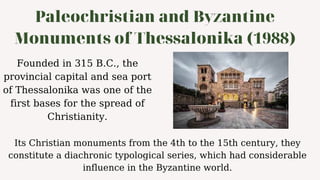
Paleochristian and Byzantine
Monuments of Thessalonika (1988)
Founded in 315 B.C., the
provincial capital and sea port
of Thessalonika was one of the
first bases for the spread of
Christianity.
Its Christian monuments from the 4th to the 15th century, they
constitute a diachronic typological series, which had considerable
influence in the Byzantine world.
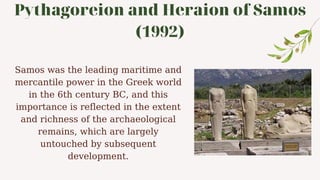
Pythagoreion and Heraion of Samos
(1992)
Samos was the leading maritime and
mercantile power in the Greek world
in the 6th century BC, and this
importance is reflected in the extent
and richness of the archaeological
remains, which are largely
untouched by subsequent
development.
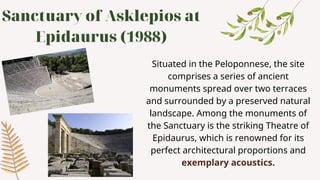
Sanctuary of Asklepios at
Epidaurus (1988)
Situated in the Peloponnese, the site
comprises a series of ancient
monuments spread over two terraces
and surrounded by a preserved natural
landscape. Among the monuments of
the Sanctuary is the striking Theatre of
Epidaurus, which is renowned for its
perfect architectural proportions and
exemplary acoustics.
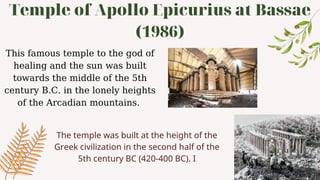
Temple of Apollo Epicurius at Bassae
(1986)
This famous temple to the god of
healing and the sun was built
towards the middle of the 5th
century B.C. in the lonely heights
of the Arcadian mountains.
The temple was built at the height of the
Greek civilization in the second half of the
5th century BC (420-400 BC). I
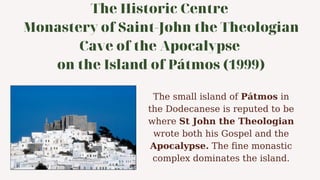
The Historic Centre
Monastery of Saint-John the Theologian
Cave of the Apocalypse
on the Island of Pátmos (1999)
The small island of Pátmos in
the Dodecanese is reputed to be
where St John the Theologian
wrote both his Gospel and the
Apocalypse. The fine monastic
complex dominates the island.
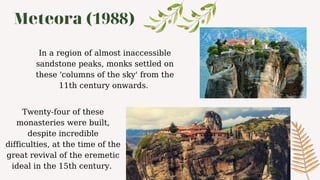
Meteora (1988)
Twenty-four of these
monasteries were built,
despite incredible
difficulties, at the time of the
great revival of the eremetic
ideal in the 15th century.
In a region of almost inaccessible
sandstone peaks, monks settled on
these 'columns of the sky' from the
11th century onwards.
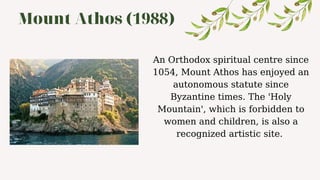
Mount Athos (1988)
An Orthodox spiritual centre since
1054, Mount Athos has enjoyed an
autonomous statute since
Byzantine times. The 'Holy
Mountain', which is forbidden to
women and children, is also a
recognized artistic site.
Source:
https://whc.unesco.org/en/statesparties/gr
Thank You!!!

Meet the greek

  • 1.
    Meet the UNESCO's GreekMonuments E T W I N N I N G : B U I L D I N G B R I D G E S T H R O U G H C U L T U R A L H E R I T A G E
  • 2.
    Greek sites includedin the World Heritage List At the moment 18 sites are included in the World Heritage List 14 sites are in the Tentative List
  • 3.
    Acropolis, Athens (1987) The Acropolisof Athens and its monuments are universal symbols of the classical spirit and civilization and form the greatest architectural and artistic complex bequeathed by Greek Antiquity to the world.
  • 4.
    Archaeological Site ofAigai - Vergina (1996) The city of Vergina (Aigai), was the ancient first capital of the Kingdom of Macedonia. The ecavators found there the Tomb of Phillip II, Alexander the Great's Father
  • 5.
    Archaeological Site ofDelphi (1987) The pan-Hellenic sanctuary of Delphi, where the oracle of Apollo spoke, was the site of the omphalos, the 'navel of the world'. Delphi in the 6th century B.C. was indeed the religious centre and symbol of unity of the ancient Greek world.
  • 6.
    Archaeological Site ofMystras (1989) Mystras, the 'wonder of the Morea', was built as an amphitheatre around the fortress erected in 1249 by the prince of Achaia, William of Villehardouin. Reconquered by the Byzantines, then occupied by the Turks and the Venetians, the city was abandoned in 1832, leaving only the breathtaking medieval ruins, standing in a beautiful landscape.
  • 7.
    Archaeological Site of Olympia(1989) The site of Olympia, in the 10th century B.C., became a centre for the worship of Zeus. In addition to temples, there are the remains of all the sports structures erected for the Olympic Games, which were held in Olympia every four years beginning in 776 B.C.
  • 8.
    Archaeological Site ofPhilippi (2016) Founded in 356 BC by the Macedonian King Philip II, the city developed as a “small Rome” with the establishment of the Roman Empire in the decades following the Battle of Philippi, in 42 BCE.
  • 9.
    Archaeological Sites ofMycenae & Tiryns (1999) These two cities are indissolubly linked to the Homeric epics, the Iliad and the Odyssey The archaeological sites of Mycenae and Tiryns are the two greatest cities of the Mycenaean civilization, which dominated the eastern Mediterranean world from the 15th to the 12th century B.C. They played a vital role in the development of classical Greek culture.
  • 10.
    Delos (1990) According toGreek mythology, Apollo was born on this tiny island in the Cyclades archipelago.
  • 11.
    Medieval City ofRhodes (1988) The Knights of St John of Jerusalem occupied Rhodes from 1309 to 1523 and set about transforming the city into a stronghold. With the Palace of the Grand Masters, the Great Hospital and the Street of the Knights, the Upper Town is one of the most beautiful urban ensembles of the Gothic period.
  • 12.
    Monasteries of Daphni,Hosios Loukas and Nea Moni of Chios (1990) Although geographically distant from each other, these three monasteries belong to the same typological series and share the same aesthetic characteristics. The churches are built on a cross-in-square plan with a large dome supported by squinches defining an octagonal space.
  • 13.
    Old Town ofCorfu (2007) The Island of Corfu is located in a strategic position at the entrance of the Adriatic Sea, and has its roots in the 8th century BC. The three forts of the town, were used for four centuries to defend the maritime trading interests of the Republic of Venice against the Ottoman Empire.
  • 14.
    Paleochristian and Byzantine Monumentsof Thessalonika (1988) Founded in 315 B.C., the provincial capital and sea port of Thessalonika was one of the first bases for the spread of Christianity. Its Christian monuments from the 4th to the 15th century, they constitute a diachronic typological series, which had considerable influence in the Byzantine world.
  • 15.
    Pythagoreion and Heraionof Samos (1992) Samos was the leading maritime and mercantile power in the Greek world in the 6th century BC, and this importance is reflected in the extent and richness of the archaeological remains, which are largely untouched by subsequent development.
  • 16.
    Sanctuary of Asklepiosat Epidaurus (1988) Situated in the Peloponnese, the site comprises a series of ancient monuments spread over two terraces and surrounded by a preserved natural landscape. Among the monuments of the Sanctuary is the striking Theatre of Epidaurus, which is renowned for its perfect architectural proportions and exemplary acoustics.
  • 17.
    Temple of ApolloEpicurius at Bassae (1986) This famous temple to the god of healing and the sun was built towards the middle of the 5th century B.C. in the lonely heights of the Arcadian mountains. The temple was built at the height of the Greek civilization in the second half of the 5th century BC (420-400 BC). I
  • 18.
    The Historic Centre Monasteryof Saint-John the Theologian Cave of the Apocalypse on the Island of Pátmos (1999) The small island of Pátmos in the Dodecanese is reputed to be where St John the Theologian wrote both his Gospel and the Apocalypse. The fine monastic complex dominates the island.
  • 19.
    Meteora (1988) Twenty-four ofthese monasteries were built, despite incredible difficulties, at the time of the great revival of the eremetic ideal in the 15th century. In a region of almost inaccessible sandstone peaks, monks settled on these 'columns of the sky' from the 11th century onwards.
  • 20.
    Mount Athos (1988) AnOrthodox spiritual centre since 1054, Mount Athos has enjoyed an autonomous statute since Byzantine times. The 'Holy Mountain', which is forbidden to women and children, is also a recognized artistic site.
  • 21.