I I
R E A D I N G P R I N C I P L E S
A N D T E A C H I N G
R I S A T R I A S S A N T I
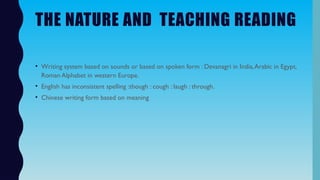
THE NATURE AND TEACHING READING
• Writing system based on sounds or based on spoken form : Devanagri in India,Arabic in Egypt,
Roman Alphabet in western Europe.
• English has inconsistent spelling :though : cough : laugh : through.
• Chinese writing form based on meaning
THE WHOLE WORD VS PHONIC
DECODING
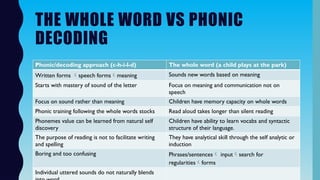
Phonic/decoding approach (c-h-i-l-d) The whole word (a child plays at the park)
Written forms speech formsmeaning Sounds new words based on meaning
Starts with mastery of sound of the letter Focus on meaning and communication not on
speech
Focus on sound rather than meaning Children have memory capacity on whole words
Phonic training following the whole words stocks Read aloud takes longer than silent reading
Phonemes value can be learned from natural self
discovery
Children have ability to learn vocabs and syntactic
structure of their language.
The purpose of reading is not to facilitate writing
and spelling
They have analytical skill through the self analytic or
induction
Boring and too confusing Phrases/sentences inputsearch for
regularitiesforms
Individual uttered sounds do not naturally blends
RESEARCH SUPPORTING INDUCTION
• Children learn letter sounds by induction (Gates,1928)
• Words are learned better than letters (Steinberg, 1975)
• Japanese learn Kanji learn faster in word whole than in meaningless sounds (Steinberg , 1977)
SUMMARY
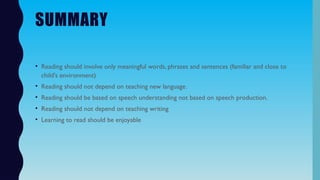
• Reading should involve only meaningful words, phrases and sentences (familiar and close to
child's environment)
• Reading should not depend on teaching new language.
• Reading should be based on speech understanding not based on speech production.
• Reading should not depend on teaching writing
• Learning to read should be enjoyable
FOUR PHASES IN TEACHING READING
• Reading familiarization : attach word card with object
• Word identification : show the word with associate object and place the words to the objects
• Phrase and sentence identification
• Paragraphs, story and book reading
EARLY READING IS BENEFICIAL
• Reading is source of pleasure
• Love of reading is established
• Young children learn quickly and easily
• The children grow up to be better learners

Meet 4 Reading and teaching principles.pptx

  • 1.
    I I R EA D I N G P R I N C I P L E S A N D T E A C H I N G R I S A T R I A S S A N T I
  • 2.
    THE NATURE ANDTEACHING READING • Writing system based on sounds or based on spoken form : Devanagri in India,Arabic in Egypt, Roman Alphabet in western Europe. • English has inconsistent spelling :though : cough : laugh : through. • Chinese writing form based on meaning
  • 3.
    THE WHOLE WORDVS PHONIC DECODING Phonic/decoding approach (c-h-i-l-d) The whole word (a child plays at the park) Written forms speech formsmeaning Sounds new words based on meaning Starts with mastery of sound of the letter Focus on meaning and communication not on speech Focus on sound rather than meaning Children have memory capacity on whole words Phonic training following the whole words stocks Read aloud takes longer than silent reading Phonemes value can be learned from natural self discovery Children have ability to learn vocabs and syntactic structure of their language. The purpose of reading is not to facilitate writing and spelling They have analytical skill through the self analytic or induction Boring and too confusing Phrases/sentences inputsearch for regularitiesforms Individual uttered sounds do not naturally blends
  • 4.
    RESEARCH SUPPORTING INDUCTION •Children learn letter sounds by induction (Gates,1928) • Words are learned better than letters (Steinberg, 1975) • Japanese learn Kanji learn faster in word whole than in meaningless sounds (Steinberg , 1977)
  • 6.
    SUMMARY • Reading shouldinvolve only meaningful words, phrases and sentences (familiar and close to child's environment) • Reading should not depend on teaching new language. • Reading should be based on speech understanding not based on speech production. • Reading should not depend on teaching writing • Learning to read should be enjoyable
  • 7.
    FOUR PHASES INTEACHING READING • Reading familiarization : attach word card with object • Word identification : show the word with associate object and place the words to the objects • Phrase and sentence identification • Paragraphs, story and book reading
  • 8.
    EARLY READING ISBENEFICIAL • Reading is source of pleasure • Love of reading is established • Young children learn quickly and easily • The children grow up to be better learners