Medical Device
                                                     Concessions:
TABLE OF CONTENTS                                    F R E E PAS S O R R E D F L A G
                                                     FOR YOUR QUALITY SYSTEM?
Nonconformance Possible at
Several Levels ............................ 2

Difference from a Deviation or                       BY MARTIN BROWNING
Variance...................................... 3     President and Co-Founder, EduQuest, Inc.

FDA Adopts ISO Concept of a
                                                     FORMER FDA INVESTIGATOR AND SPECIAL
Concession ................................. 4
                                                     ASSISTANT TO THE ASSOCIATE FDA
FDA Expects Concessions to be                        COMMISSIONER OF REGULATORY AFFAIRS
Limited ....................................... 4

Justifying a Concession .............. 5
                                                     FDA Expectations for Device Concessions
Reliance on Concessions Can
Backfire ....................................... 5
                                                     Under regulatory guidance not well understood within the
About the Author ......................... 7         industry, the U.S. FDA allows medical device manufacturers
                                                     to release “nonconforming products” (we’ll clarify that term
                                                     below) using what’s known as a concession.

                                                     The danger is that some manufacturers tend to rely on
                                                     concessions as fall-back remedies when they lose control of
                                                     their processes and produce out-of-spec products. Instead
                                                     of immediately identifying and correcting quality problems
                                                     at their source – which is what the FDA expects – these
           1896 Urbana Pike, Suite 14
                                                     manufacturers are quick to claim a concession and then
          Hyattstown, MD 20871 USA
                                                     move on with business-as-usual, hoping the problems are
                 (Near Washington, DC)
                                                     not serious and will eventually correct themselves.
             Phone: +1 (301) 874-6031
            Email: Info@EduQuest.net
                                                     But FDA is clear it doesn’t consider a concession the same
                   www.EduQuest.net
                                                     as a free pass for side-stepping quality issues. Instead, a
                         © EduQuest 2010             concession always should be:

                                                        Limited in time and quantity
Carefully controlled

                                  Appropriately authorized

                                  Well documented, and

                                  Claimed after identifying the nonconformance.

                               If not, FDA has instructed its investigators to regard
                               concessions as red flags signaling potential quality problems
                               worthy of further scrutiny and possible enforcement action.

In FDA’s world, the
 phrase “specified             Nonconformance Possible at Several Levels

    requirement”               To fully understand the concept of a concession, let’s start
                               with the definition of a nonconformance. You also need to
covers a multitude             understand that a nonconformance, deviation, and variance
                               are not the same thing, although the terms are sometimes
 of expectations...
                               used interchangeably in industry.

                               According to both ISO 13485:2003 and 21 CFR Part 820
                               (FDA’s Quality Systems Regulation), a nonconformance
                               is the failure to fulfill a specified requirement.
                               Sounds simple enough, but in FDA’s world, the phrase
                               “specified requirement” covers a multitude of expectations
                               and manufacturing levels, including requirements,
                               specifications, and process parameters that are stated –
                               explicitly and implicitly – by an organization, its customers,
                               or other interested parties.

                               A nonconformance, according to FDA, can be at the product,
                               process or quality system level. A nonconforming product
                               could include a finished device, in-process device, device
                               component, returned device, or specific manufacturing
                               material.

                               So a nonconformance might include any or all of the
                               following:


MEDICAL DEVICE CONCESSIONS: FREE PASS OR RED FLAG?           WWW.EDUQUEST.NET             2
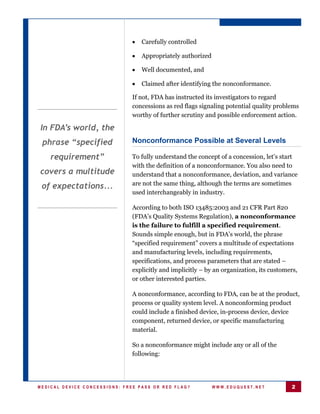
SIDEBAR 1:                                         Failing to meet a design specification
ISO 9001:2000
                                                   Not following a standard procedure
DEFINITIONS
                                                   Failing to control a validated process parameter
3.6.2 nonconformity: A non-fulfillment of
a requirement.                                     Ignoring a customer’s written requirements, or
3.6.11 concession: Permission to use or
                                                   Missing test limits – or not testing at all – just to name a
release a product that does not conform to
specified requirements.                         few examples.

NOTE: A concession is generally limited to
the delivery of a product that has non-
conforming characteristics within specified     Difference from a Deviation or Variance
limits for an agreed time or quantity of that
product.                                        Many people confuse a nonconformance with a deviation or
                                                variation, but they differ by an important degree of timing
3.6.12 deviation permit: Permission to
depart from the originally specified require-   and intent. Deviations are issued prior to performing the
ments of a product prior to realization.        operation and not in response to a nonconformance or
NOTE: A deviation permit is generally
                                                nonconforming activity. ISO 9001:2000 provides a
given for a limited quantity of product or      definition for a “deviation permit” that allows release prior
period of time, and for a specific use.         to what it calls “product realization” (see Sidebar 1).
                                                Deviations should be reviewed and approved in advance of
                                                the action to be deviated from – such as a purchasing
                                                decision, manufacturing change, or other operation under
                                                the quality system. An authorized signature, date, and
                                                written justification are required for each approved
                                                deviation.

                                                Instead of the term deviation, FDA uses a similar concept
                                                and calls it an “approved variance”. As described in 21 CFR
                                                820.1(e)(2), FDA can grant a variance from any device
                                                quality system requirement when the Agency determines the
                                                variance is in the best interest of public health. A
                                                manufacturer can seek a variance by petitioning FDA in
                                                advance of the activity, or the Agency itself can initiate a
                                                variance in response to a specific public health need.


MEDICAL DEVICE CONCESSIONS: FREE PASS OR RED FLAG?                            WWW.EDUQUEST.NET               3
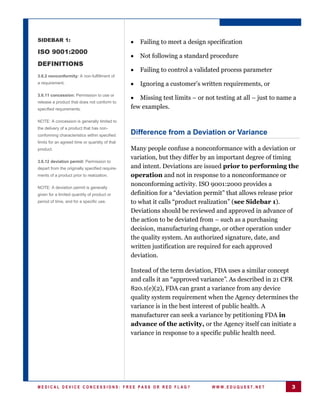
SIDEBAR 2:                                      FDA Adopts ISO Concept of a Concession
FROM THE PREAMBLE                               Now we can move on to concessions. FDA has no official
TO 21 CFR PART 820,                             definition of a concession, but in the preamble to 21 CFR
COMMENT 156:                                    Part 820 the Agency says it doesn’t define terms it thinks are
156. FDA has rewritten § 820.90(b)(1),          adequately covered by ISO standards or generally known
‘‘Nonconformity review and disposition,’’ to    within the industry.
make clear that the section requires proce-
dures that define the responsibility for
                                                The ISO standards define a concession as a means of
review and authority for disposition of
nonconforming product and that set forth
                                                releasing product for further manufacturing or commercial
the review and disposition process. FDA         use, even when the product doesn’t conform to a pre-
believes that proper disposition of noncon-     established requirement or specification (or the process by
forming product is essential for ensuring
                                                which it was manufactured doesn’t conform).
the safety and effectiveness of devices.
Manufacturers have made determinations
that nonconforming product may be used
                                                Like an ISO deviation or an FDA approved variance, the
which have resulted in defective devices        concession process is limited by time and condition. Note
being distributed. Thus, although it may be     also that a concession is issued after the finding of a
appropriate at times to use nonconforming
                                                nonconformance. And similar to a deviation or variance, a
products, the disposition process must be
adequately controlled.                          concession must be reviewed and approved prior to release
                                                of the product. Again, authorized signatures and dates are
The revision requires that disposition and
                                                required – as is the justification for each concession (see
justification for concessions be docu-
mented. FDA believes that the justification     Sidebar 2).
should be based on scientific evidence,
which a manufacturer should be prepared
to provide upon request. Concessions
should be closely monitored and not
                                                FDA Expects Concessions to be Limited
become accepted practice. [Editor’s
emphasis added] This section is consis-         In the FDA Guide to Inspections of Medical Device
tent with ISO 9001:1994, section 4.13.2.        Manufacturers (see Sidebar 3), the Agency says it
Several comments on the Working Draft
                                                expects concessions to be the exception, not the rule. If a
stated that the term ‘‘concession’’ should      manufacturer evaluates and releases one product lot, batch
be deleted because it is confusing. FDA         or shipment “on concession”, FDA expects the company will
has rewritten the sentence to ensure the
                                                not treat the next product lot, batch or shipment similarly.
meaning of this requirement is clear. The
sentence now reads, ‘‘Documentation shall       Instead, FDA expects the manufacturer to make some kind
include the justification for the use of non-   of change to correct the nonconformity from re-occurring.
conforming product and the signature of
the individual(s) authorizing the use.’’        The expected change could be to the product design, the
                                                manufacturing process or the acceptance criteria, to cite just
                                                a few examples. Furthermore, the change should be


MEDICAL DEVICE CONCESSIONS: FREE PASS OR RED FLAG?                           WWW.EDUQUEST.NET              4
SIDEBAR 3:                                        documented, scientifically justified and verified, and
                                                  validated as appropriate.
FROM THE FDA GUIDE
TO INSPECTIONS OF                                 No matter what the change, FDA insists that before the
MEDICAL DEVICE                                    product can be released into the marketplace, it still must:
MANUFACTURERS
                                                     Meet all essential outputs, and
Nonconformity Review and Dis-
position - 21 CFR 820.90(b)(1)                       Be safe and effective for its labeled and known intended
Review all records for the proper disposi-        uses.
tion of nonconforming products for assur-
ance that use of nonconforming product
has not resulted in the distribution of de-
                                                  Justifying a Concession
fective devices. The distribution and justifi-
cation for concessions (allowance to use
otherwise nonconforming product, often            Documentation and justification are essential to support a
done through a Material Review Board)             concession claim. If you have data from any design control
must be documented and based on scien-            effort that establishes the safety and efficacy of the product
tific evidence. Concessions should be
                                                  despite the specified nonconformance, show it. For validated
closely monitored and not become
normal practice. [Editor’s emphasis               processes, the nonconformance may be acceptable if it falls
added]                                            within the validated range, even if outside the operating or
Deficiencies would include a lack of scien-
                                                  optimized range. However, always be prepared to
tific evidence for justification of the conces-   demonstrate that a process-related nonconformance doesn’t
sion. If a concession resulted in a change        adversely impact the safety and efficacy of the product.
of product specifications (form, fit or func-
tion), the change should be evaluated for
                                                  Even with a concession, you still must meet all 510(k) and
possible 510(k) submission. At a minimum,
a risk analysis should always be consid-
                                                  PMA requirements. If a product or its manufacturing
ered for any changes.                             process fails to comply with those activities approved in a
                                                  510(k) or PMA, you may need to seek a new, cleared 510(k)
                                                  or an approved PMA supplement prior to release of the
                                                  product. For some 510(k)s, you may need only to change the
                                                  product’s intended uses. For a class II or III 510(k), your
                                                  change must specify any special controls you’re adding or
                                                  alterations you’re making to the manufacturing process.


                                                  Reliance on Concessions Can Backfire

                                                  Although the concept of a medical device concession may
                                                  seem like a loophole in the quality regulations, in reality a


MEDICAL DEVICE CONCESSIONS: FREE PASS OR RED FLAG?                              WWW.EDUQUEST.NET                  5
company with a large volume of concessions is waving a red
                               flag to regulators and its customers. You may as well signal
                               “we don’t have adequate control over our products or
                               processes”.

                               FDA equates frequent concessions with poor product design,
                               poor design transfer, poor manufacturing processes, poor
                               monitoring – or a toxic combination of all the above.
                               Overuse of concessions also may indicate the likelihood you
     FDA equates               have a poor vendor/supplier management process, which
                               has become one of the FDA’s top enforcement targets.
       frequent
                               FDA has given explicit instructions to its inspectors to look
  concessions with
                               for abuses to the concession process. To meet the Quality
     poor product              Systems Regulation as well as ISO standards, you need to
                               keep your concessions on a short leash, limiting them to very
  design, transfer,            narrow nonconformance conditions and supporting them
   manufacturing,              with thorough scientific justifications and proper
                               authorizations.
   and monitoring.
                               Otherwise, your presumed free pass may just earn you a 483,
                               Warning Letter, product recall, or worse.


                               For Additional Information:

                               EduQuest offers an eight-hour training class on QSR
                               Compliance Fundamentals: Complying with FDA’s
                               Medical Device 21 CFR 820 Quality Systems
                               Regulation. The course is available on-demand at your site
                               and presented nationally as an open enrollment class several
                               times each year. The class also can be accompanied by a 16-
                               hour class on Medical Device Design Control, a frequent
                               source of concessions when not handled properly. Contact
                               Martin Heavner at MartinHeavner@EduQuest.net or visit
                               www.EduQuest.net for course outlines and pricing.


MEDICAL DEVICE CONCESSIONS: FREE PASS OR RED FLAG?          WWW.EDUQUEST.NET             6
About the Author:

                              Martin Browning is the President and Co-Founder of
                              EduQuest, Inc., a global team of FDA compliance experts
                              based near Washington, D.C.

                              He has more than 30 years of regulatory experience at the
                              FDA and as a highly sought-after advisor to industry.
                              Martin’s 22-year career at FDA included work in the field
                              offices as an investigator and as a senior manager in the
M ARTIN BROWNING              Office of Regulatory Affairs at FDA headquarters. He capped
 President and Co-Founder     his FDA career by serving as a special assistant to the
            EduQuest, Inc.
                              Associate Commissioner for Regulatory Affairs. He also
                              served as vice chair of FDA’s electronic record and signature
                              working group, where he helped draft the original 21 CFR
                              Part 11 regulations. In addition, Martin served as the chair of
                              the U.S. government’s ISO 9000 committee and was a
                              member of the FDA committee that developed the medical
                              device Quality Systems Regulation (QSR).

                              At EduQuest, which has been serving medical device,
                              pharmaceutical, biologics companies since 1995, Martin
                              helps clients solve problems related to FDA regulation,
                              quality assurance, software and systems engineering, and
                              compliance auditing, including assessing vendors and
                              outsourced operations.
 1896 Urbana Pike, Suite 14
 Hyattstown, MD 20871 USA
     (Near Washington, DC)
  Phone: +1 (301) 874-6031
    Fax: +1 (301) 874-6033
 Email: Info@EduQuest.net
       www.EduQuest.net

          © EduQuest 2010

Medical Device Concessions - EduQuest Advisory

  • 1.
    Medical Device Concessions: TABLE OF CONTENTS F R E E PAS S O R R E D F L A G FOR YOUR QUALITY SYSTEM? Nonconformance Possible at Several Levels ............................ 2 Difference from a Deviation or BY MARTIN BROWNING Variance...................................... 3 President and Co-Founder, EduQuest, Inc. FDA Adopts ISO Concept of a FORMER FDA INVESTIGATOR AND SPECIAL Concession ................................. 4 ASSISTANT TO THE ASSOCIATE FDA FDA Expects Concessions to be COMMISSIONER OF REGULATORY AFFAIRS Limited ....................................... 4 Justifying a Concession .............. 5 FDA Expectations for Device Concessions Reliance on Concessions Can Backfire ....................................... 5 Under regulatory guidance not well understood within the About the Author ......................... 7 industry, the U.S. FDA allows medical device manufacturers to release “nonconforming products” (we’ll clarify that term below) using what’s known as a concession. The danger is that some manufacturers tend to rely on concessions as fall-back remedies when they lose control of their processes and produce out-of-spec products. Instead of immediately identifying and correcting quality problems at their source – which is what the FDA expects – these 1896 Urbana Pike, Suite 14 manufacturers are quick to claim a concession and then Hyattstown, MD 20871 USA move on with business-as-usual, hoping the problems are (Near Washington, DC) not serious and will eventually correct themselves. Phone: +1 (301) 874-6031 Email: Info@EduQuest.net But FDA is clear it doesn’t consider a concession the same www.EduQuest.net as a free pass for side-stepping quality issues. Instead, a © EduQuest 2010 concession always should be: Limited in time and quantity
  • 2.
    Carefully controlled Appropriately authorized Well documented, and Claimed after identifying the nonconformance. If not, FDA has instructed its investigators to regard concessions as red flags signaling potential quality problems worthy of further scrutiny and possible enforcement action. In FDA’s world, the phrase “specified Nonconformance Possible at Several Levels requirement” To fully understand the concept of a concession, let’s start with the definition of a nonconformance. You also need to covers a multitude understand that a nonconformance, deviation, and variance are not the same thing, although the terms are sometimes of expectations... used interchangeably in industry. According to both ISO 13485:2003 and 21 CFR Part 820 (FDA’s Quality Systems Regulation), a nonconformance is the failure to fulfill a specified requirement. Sounds simple enough, but in FDA’s world, the phrase “specified requirement” covers a multitude of expectations and manufacturing levels, including requirements, specifications, and process parameters that are stated – explicitly and implicitly – by an organization, its customers, or other interested parties. A nonconformance, according to FDA, can be at the product, process or quality system level. A nonconforming product could include a finished device, in-process device, device component, returned device, or specific manufacturing material. So a nonconformance might include any or all of the following: MEDICAL DEVICE CONCESSIONS: FREE PASS OR RED FLAG? WWW.EDUQUEST.NET 2
  • 3.
    SIDEBAR 1: Failing to meet a design specification ISO 9001:2000 Not following a standard procedure DEFINITIONS Failing to control a validated process parameter 3.6.2 nonconformity: A non-fulfillment of a requirement. Ignoring a customer’s written requirements, or 3.6.11 concession: Permission to use or Missing test limits – or not testing at all – just to name a release a product that does not conform to specified requirements. few examples. NOTE: A concession is generally limited to the delivery of a product that has non- conforming characteristics within specified Difference from a Deviation or Variance limits for an agreed time or quantity of that product. Many people confuse a nonconformance with a deviation or variation, but they differ by an important degree of timing 3.6.12 deviation permit: Permission to depart from the originally specified require- and intent. Deviations are issued prior to performing the ments of a product prior to realization. operation and not in response to a nonconformance or NOTE: A deviation permit is generally nonconforming activity. ISO 9001:2000 provides a given for a limited quantity of product or definition for a “deviation permit” that allows release prior period of time, and for a specific use. to what it calls “product realization” (see Sidebar 1). Deviations should be reviewed and approved in advance of the action to be deviated from – such as a purchasing decision, manufacturing change, or other operation under the quality system. An authorized signature, date, and written justification are required for each approved deviation. Instead of the term deviation, FDA uses a similar concept and calls it an “approved variance”. As described in 21 CFR 820.1(e)(2), FDA can grant a variance from any device quality system requirement when the Agency determines the variance is in the best interest of public health. A manufacturer can seek a variance by petitioning FDA in advance of the activity, or the Agency itself can initiate a variance in response to a specific public health need. MEDICAL DEVICE CONCESSIONS: FREE PASS OR RED FLAG? WWW.EDUQUEST.NET 3
  • 4.
    SIDEBAR 2: FDA Adopts ISO Concept of a Concession FROM THE PREAMBLE Now we can move on to concessions. FDA has no official TO 21 CFR PART 820, definition of a concession, but in the preamble to 21 CFR COMMENT 156: Part 820 the Agency says it doesn’t define terms it thinks are 156. FDA has rewritten § 820.90(b)(1), adequately covered by ISO standards or generally known ‘‘Nonconformity review and disposition,’’ to within the industry. make clear that the section requires proce- dures that define the responsibility for The ISO standards define a concession as a means of review and authority for disposition of nonconforming product and that set forth releasing product for further manufacturing or commercial the review and disposition process. FDA use, even when the product doesn’t conform to a pre- believes that proper disposition of noncon- established requirement or specification (or the process by forming product is essential for ensuring which it was manufactured doesn’t conform). the safety and effectiveness of devices. Manufacturers have made determinations that nonconforming product may be used Like an ISO deviation or an FDA approved variance, the which have resulted in defective devices concession process is limited by time and condition. Note being distributed. Thus, although it may be also that a concession is issued after the finding of a appropriate at times to use nonconforming nonconformance. And similar to a deviation or variance, a products, the disposition process must be adequately controlled. concession must be reviewed and approved prior to release of the product. Again, authorized signatures and dates are The revision requires that disposition and required – as is the justification for each concession (see justification for concessions be docu- mented. FDA believes that the justification Sidebar 2). should be based on scientific evidence, which a manufacturer should be prepared to provide upon request. Concessions should be closely monitored and not FDA Expects Concessions to be Limited become accepted practice. [Editor’s emphasis added] This section is consis- In the FDA Guide to Inspections of Medical Device tent with ISO 9001:1994, section 4.13.2. Manufacturers (see Sidebar 3), the Agency says it Several comments on the Working Draft expects concessions to be the exception, not the rule. If a stated that the term ‘‘concession’’ should manufacturer evaluates and releases one product lot, batch be deleted because it is confusing. FDA or shipment “on concession”, FDA expects the company will has rewritten the sentence to ensure the not treat the next product lot, batch or shipment similarly. meaning of this requirement is clear. The sentence now reads, ‘‘Documentation shall Instead, FDA expects the manufacturer to make some kind include the justification for the use of non- of change to correct the nonconformity from re-occurring. conforming product and the signature of the individual(s) authorizing the use.’’ The expected change could be to the product design, the manufacturing process or the acceptance criteria, to cite just a few examples. Furthermore, the change should be MEDICAL DEVICE CONCESSIONS: FREE PASS OR RED FLAG? WWW.EDUQUEST.NET 4
  • 5.
    SIDEBAR 3: documented, scientifically justified and verified, and validated as appropriate. FROM THE FDA GUIDE TO INSPECTIONS OF No matter what the change, FDA insists that before the MEDICAL DEVICE product can be released into the marketplace, it still must: MANUFACTURERS Meet all essential outputs, and Nonconformity Review and Dis- position - 21 CFR 820.90(b)(1) Be safe and effective for its labeled and known intended Review all records for the proper disposi- uses. tion of nonconforming products for assur- ance that use of nonconforming product has not resulted in the distribution of de- Justifying a Concession fective devices. The distribution and justifi- cation for concessions (allowance to use otherwise nonconforming product, often Documentation and justification are essential to support a done through a Material Review Board) concession claim. If you have data from any design control must be documented and based on scien- effort that establishes the safety and efficacy of the product tific evidence. Concessions should be despite the specified nonconformance, show it. For validated closely monitored and not become normal practice. [Editor’s emphasis processes, the nonconformance may be acceptable if it falls added] within the validated range, even if outside the operating or Deficiencies would include a lack of scien- optimized range. However, always be prepared to tific evidence for justification of the conces- demonstrate that a process-related nonconformance doesn’t sion. If a concession resulted in a change adversely impact the safety and efficacy of the product. of product specifications (form, fit or func- tion), the change should be evaluated for Even with a concession, you still must meet all 510(k) and possible 510(k) submission. At a minimum, a risk analysis should always be consid- PMA requirements. If a product or its manufacturing ered for any changes. process fails to comply with those activities approved in a 510(k) or PMA, you may need to seek a new, cleared 510(k) or an approved PMA supplement prior to release of the product. For some 510(k)s, you may need only to change the product’s intended uses. For a class II or III 510(k), your change must specify any special controls you’re adding or alterations you’re making to the manufacturing process. Reliance on Concessions Can Backfire Although the concept of a medical device concession may seem like a loophole in the quality regulations, in reality a MEDICAL DEVICE CONCESSIONS: FREE PASS OR RED FLAG? WWW.EDUQUEST.NET 5
  • 6.
    company with alarge volume of concessions is waving a red flag to regulators and its customers. You may as well signal “we don’t have adequate control over our products or processes”. FDA equates frequent concessions with poor product design, poor design transfer, poor manufacturing processes, poor monitoring – or a toxic combination of all the above. Overuse of concessions also may indicate the likelihood you FDA equates have a poor vendor/supplier management process, which has become one of the FDA’s top enforcement targets. frequent FDA has given explicit instructions to its inspectors to look concessions with for abuses to the concession process. To meet the Quality poor product Systems Regulation as well as ISO standards, you need to keep your concessions on a short leash, limiting them to very design, transfer, narrow nonconformance conditions and supporting them manufacturing, with thorough scientific justifications and proper authorizations. and monitoring. Otherwise, your presumed free pass may just earn you a 483, Warning Letter, product recall, or worse. For Additional Information: EduQuest offers an eight-hour training class on QSR Compliance Fundamentals: Complying with FDA’s Medical Device 21 CFR 820 Quality Systems Regulation. The course is available on-demand at your site and presented nationally as an open enrollment class several times each year. The class also can be accompanied by a 16- hour class on Medical Device Design Control, a frequent source of concessions when not handled properly. Contact Martin Heavner at MartinHeavner@EduQuest.net or visit www.EduQuest.net for course outlines and pricing. MEDICAL DEVICE CONCESSIONS: FREE PASS OR RED FLAG? WWW.EDUQUEST.NET 6
  • 7.
    About the Author: Martin Browning is the President and Co-Founder of EduQuest, Inc., a global team of FDA compliance experts based near Washington, D.C. He has more than 30 years of regulatory experience at the FDA and as a highly sought-after advisor to industry. Martin’s 22-year career at FDA included work in the field offices as an investigator and as a senior manager in the M ARTIN BROWNING Office of Regulatory Affairs at FDA headquarters. He capped President and Co-Founder his FDA career by serving as a special assistant to the EduQuest, Inc. Associate Commissioner for Regulatory Affairs. He also served as vice chair of FDA’s electronic record and signature working group, where he helped draft the original 21 CFR Part 11 regulations. In addition, Martin served as the chair of the U.S. government’s ISO 9000 committee and was a member of the FDA committee that developed the medical device Quality Systems Regulation (QSR). At EduQuest, which has been serving medical device, pharmaceutical, biologics companies since 1995, Martin helps clients solve problems related to FDA regulation, quality assurance, software and systems engineering, and compliance auditing, including assessing vendors and outsourced operations. 1896 Urbana Pike, Suite 14 Hyattstown, MD 20871 USA (Near Washington, DC) Phone: +1 (301) 874-6031 Fax: +1 (301) 874-6033 Email: Info@EduQuest.net www.EduQuest.net © EduQuest 2010