Download as PDF, PPTX

![Touchstone of
the convergence
Two-step flow model
Katz and Lazarsfeld’s
Personal Influence
(2006 [1955])
• Rejected linear model
Crossing various
boundaries
Introduction of digital media
and information technology
• Blurred boundary of production
and distribution
• e.g. Telephone, Videotex
• Included both modes of
communication in the
persuasion process
1950s
Defining condition of
contemporary
experience
1970s-80s
Domestication
• Technical refinements helped
routinize and domesticate
access to and use of the
Internet and other digital
communication technologies
among non-technical users
(Silverstone, 1999; 2002; 2005;
2006)
1990s-](https://image.slidesharecdn.com/mc408mt7mediationnoelv0-131120193309-phpapp01/85/Mediation-technology-and-mixed-reality-4-320.jpg)
![Touchstone of
the convergence
Two-step flow model
Katz and Lazarsfeld’s
Personal Influence
(2006 [1955])
• Rejected linear model
• Included both modes of
communication in the
persuasion process
1950s
Crossing various
boundaries
Defining condition of
contemporary
experience
Introduction of digital media
and information technology
• Blurred boundaries of
production and distribution of
media contents, information
processing and retrieval
• e.g. Telephone, Videotex
1970s-80s
Domestication
• Technical refinements helped
routinize and domesticate
access to and use of the
Internet and other digital
communication technologies
among non-technical users
(Silverstone, 1999; 2002; 2005;
2006)
1990s-](https://image.slidesharecdn.com/mc408mt7mediationnoelv0-131120193309-phpapp01/85/Mediation-technology-and-mixed-reality-5-320.jpg)
![Touchstone of
the convergence
Two-step flow model
Katz and Lazarsfeld’s
Personal Influence
(2006 [1955])
• Rejected linear model
Crossing various
boundaries
Introduction of digital media
and information technology
• Blurred boundary of production
and distribution
• e.g. Telephone, Videotex
• Included both modes of
communication in the
persuasion process
1950s
Defining condition of
contemporary
experience
1970s-80s
Domestication
• Technical refinements helped
routinize and domesticate
access to and use of the
Internet and other digital
communication technologies
among non-technical users
(Silverstone, 1999; 2002; 2005;
2006)
1990s-](https://image.slidesharecdn.com/mc408mt7mediationnoelv0-131120193309-phpapp01/85/Mediation-technology-and-mixed-reality-6-320.jpg)

![Characteristics of mediation
• Technology is the defining characteristic of
mediation, […]. Technologies involve
networks, skills and knowledge. Technology
is techne (Heidegger, 1977): endless matter
of unlocking, transforming, storing,
distributing, switching about and regulating
knowledges and practices. Technology is
also magic. (Silverstone, 2005, p.200)
• The boundaries around media technologies
may be visible when we look at the machine
or gaze at the screen, but they have become
entirely blurred in practice, in use and in
fantasy, and as they become incorporated
into, or unsettle, the rituals of everyday life.
As borders between real and imagined
worlds, between self and other, and between
the analysis of, and participation in, media
culture become increasingly problematic […].
(p.203)
The consequences for social life
• Interaction at distance
• Action at distance
• New forms of visibility
• Indeterminate consequences](https://image.slidesharecdn.com/mc408mt7mediationnoelv0-131120193309-phpapp01/85/Mediation-technology-and-mixed-reality-8-320.jpg)

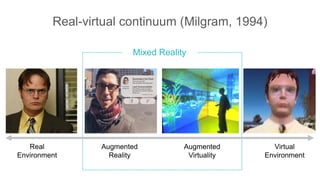
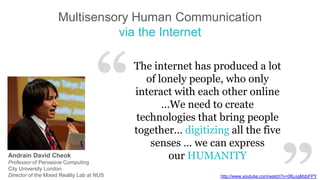

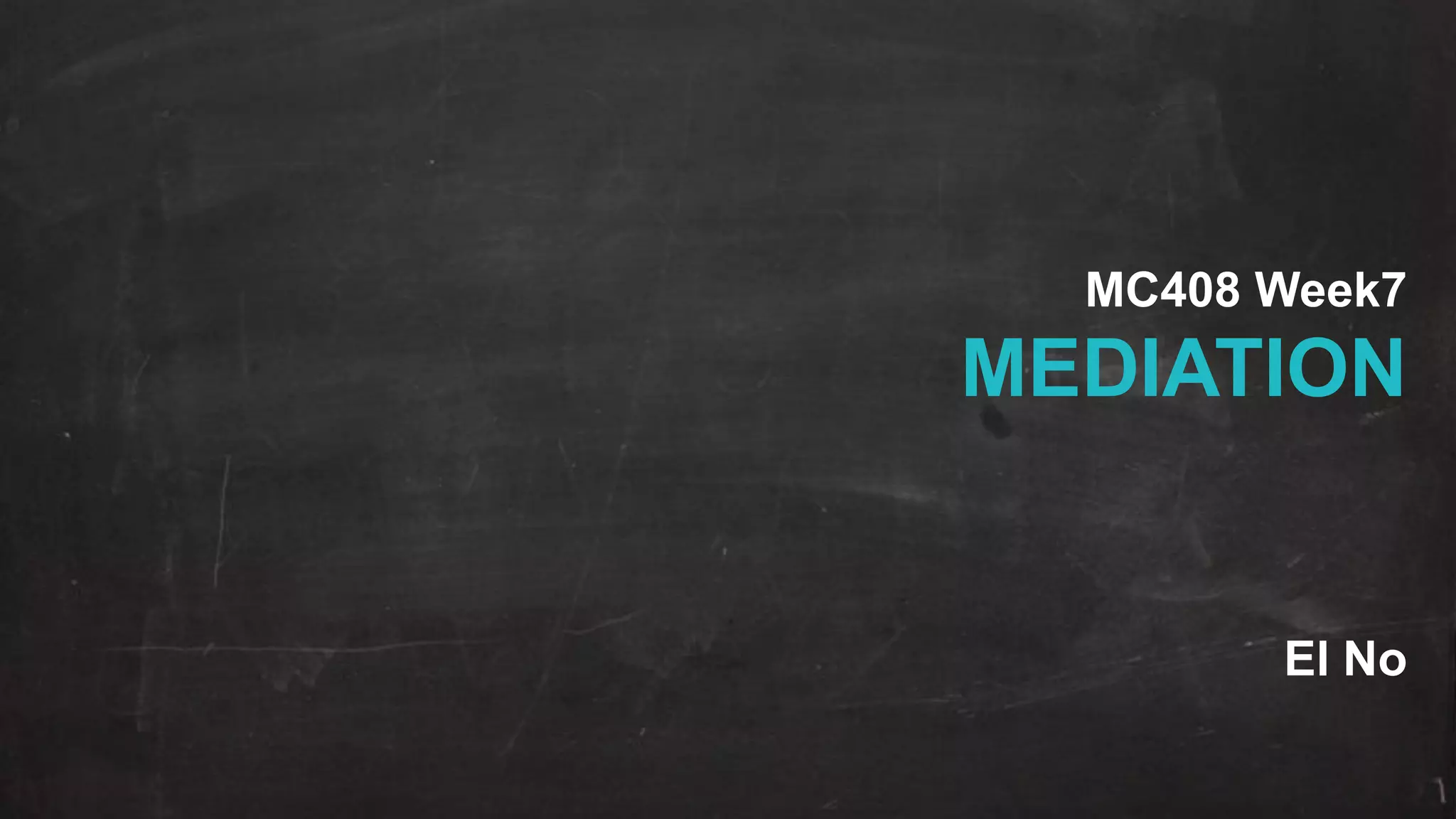
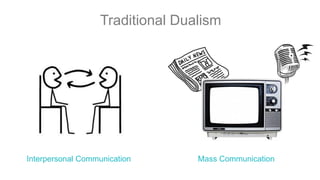
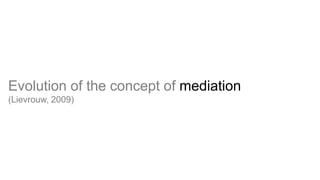
The document discusses the evolution of mediation in communication, particularly influenced by digital media and technology, which have blurred the lines between production and distribution. It highlights the transition from traditional models to the integration of mixed reality and new forms of visibility and interaction in social life. The text raises questions about the validity of the real-virtual dichotomy and the implications of technology on human interaction and community.


