MEDIATING MEDIA ART
Digital Visual Archives as Mediation-Tools
by Florian Wiencek, Jacobs University Bremen
Research Center „Visual Communication and Expertise“ (VisComX)17.03.2010
Outline
¨  Definitions
¨  Meaning Generation in Digital Archives
¨  Discussion of Current Mediation Strategies
¨  Conclusions
¨  Further Research
Florian Wiencek – Mediating Media Art @ „The Arts of Mediation“ 17.03.2010
Definition of the Term „Mediation“
17.03.2010Florian Wiencek – Mediating Media Art @ „The Arts of Mediation“
¨  use of the term “mediation” in the sense of the German
word „Vermittlung“ of content, which can be described
as the communication of content by different means
(tools, media, etc.)
à social-cognitive notion of mediation
¨  media are mediation interfaces (de Mul, 2009)
¨  mediation is about the „inbetween“ between recipient
and e.g. an artwork à display
Media Art
17.03.2010Florian Wiencek – Mediating Media Art @ „The Arts of Mediation“
¨  change from object to process
¨  example „Interactive Art“:
¤  the project is about the action it evokes in the user à
beyond the surface
¤  meaning is only generated in the interactive process
(Kluszczynski, 1997)
¤  it is important to understand the possibilities of the “realms
of experience” of a project and its configuration as well as
to grasp the media qualities
(cf. Daniels 2004, Wiencek 2009)
¨  for Media Art documentation and archiving are
important for its preservation and mediation
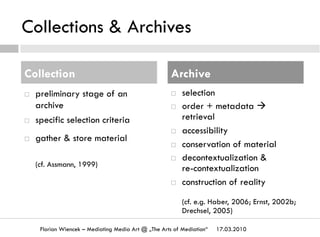
Collections & Archives
¨  preliminary stage of an
archive
¨  specific selection criteria
¨  gather & store material
(cf. Assmann, 1999)
¨  selection
¨  order + metadata à
retrieval
¨  accessibility
¨  conservation of material
¨  decontextualization &
re-contextualization
¨  construction of reality
(cf. e.g. Haber, 2006; Ernst, 2002b;
Drechsel, 2005)
17.03.2010Florian Wiencek – Mediating Media Art @ „The Arts of Mediation“
Collection Archive
Digital Archives
17.03.2010Florian Wiencek – Mediating Media Art @ „The Arts of Mediation“
¨  Michel Foucault (French Philosopher):
¤  archive as (institutional) site of discursive formation
(Foucault 1973 – Archaeology of Knowledge)
¨  Lev Manovich (Media Theorist, UCLA, USA)
¤  the archive becomes a database à enhanced functionality
¤  “[…] [A] computer database is quite different from a
traditional collection of documents: It allows one to quickly
access, sort and reorganize millions of records; it can contain
different media types, and it assumes multiple indexing of
data, since each record besides the data itself contains a
number of fields with user defined values.”
(Manovich, 2001, p. 214)
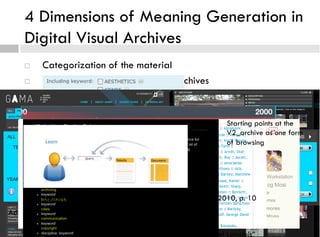
¨  Categorization of the material
¨  Interactive processes of digital archives
¨  Visualization and contextualization of archive material
¨  Retrieval
4 Dimensions of Meaning Generation in
Digital Visual Archives
main categories from virtualart.at
main categories from V2_archive
Semantic Map, netzspannung.orgTimeline of Audiovisual Culture; Ludwig Boltzmann Institute Media.Art.Research, 2009
http://vis.mediaartresearch.at/webarchive/public/view/mid:40 <17.11.2009>
Advanced Search at GAMA (gama-gateway.eu)
browsing through artworks: main page of „La Fondation Daniel Langlois“list of artists as one entrypoint to medienkunstnetz.de
Starting points at the
V2_archive as one form
of browsing
Learning through search. Source: Morville & Callender 2010, p. 10
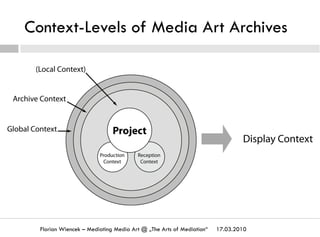
Context-Levels of Media Art Archives
17.03.2010Florian Wiencek – Mediating Media Art @ „The Arts of Mediation“
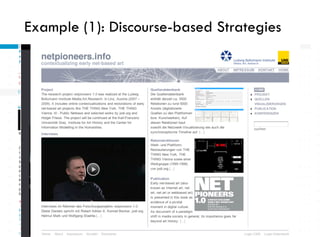
Example (1): Discourse-based Strategies
17.03.2010Florian Wiencek – Mediating Media Art @ „The Arts of Mediation“
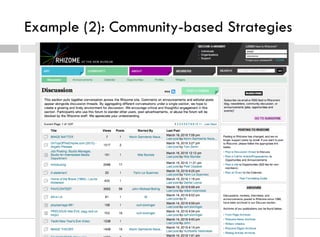
Example (2): Community-based Strategies
17.03.2010Florian Wiencek – Mediating Media Art @ „The Arts of Mediation“
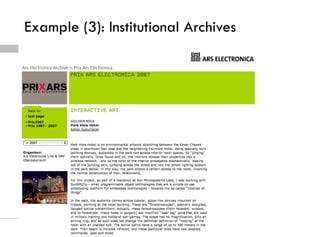
Example (3): Institutional Archives
17.03.2010Florian Wiencek – Mediating Media Art @ „The Arts of Mediation“
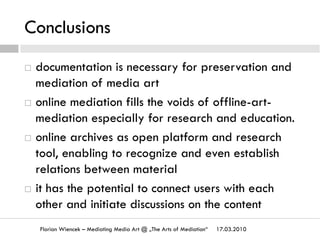
Conclusions
17.03.2010Florian Wiencek – Mediating Media Art @ „The Arts of Mediation“
¨  documentation is necessary for preservation and
mediation of media art
¨  online mediation fills the voids of offline-art-
mediation especially for research and education.
¨  online archives as open platform and research
tool, enabling to recognize and even establish
relations between material
¨  it has the potential to connect users with each
other and initiate discussions on the content
Further Research
17.03.2010Florian Wiencek – Mediating Media Art @ „The Arts of Mediation“
¨  Typology of online-mediation strategies
à in the moment in progress
¨  Multimodal analysis of the mediation strategies
Thank you for your attention!
17.03.2010Florian Wiencek – Mediating Media Art @ „The Arts of Mediation“
References (1):
Arnheim, R. (2007). The Coming and Going of Images. In O. Grau (Ed.), MediaArtHistories, Leonardo (pp. 15-17). Cambridge, Mass.
[u.a.]: MIT Press.
Assmann, A. (1999). Erinnerungsräume. Formen und Wandlungen des kulturellen Gedächtnisses. München.
Assmann, A. (2004). Zur Mediengeschichte des kulturellen Gedächtnisses. In A. Erll & A. Nünning (Eds.), Medien des kollektiven
Gedächtnisses – Konstruktivität - Historizität - Kulturspezifität. Berlin, New York.
Banse, G. (2005). Neue Kultur(en) durch Neue Medien(?) : das Beispiel Internet. e-Culture ; 1. Berlin: Trafo.
Batchen, G., & Schaffner, I. (Eds.). (1997). Deep storage : Arsenale der Erinnerung ; Sammeln, Speichern, Archivieren in der Kunst ;
[anläßlich der Ausstellung "Deep Storage - Arsenale der Erinnerung" im Haus der Kunst, München (3.8. - 12.10.1997), in der
Nationalgalerie SMPK, Sonderausstellungshalle am Kulturfo. München [u.a.]: Prestel.
Bateman, J., Herzog, O., Malaka, R., & Müller, M. G. (2009). Arbeitsgruppe Digitale Medien: Bild Film Diskurs. Retrieved October 25,
2009, from http://medien.informatik.uni-bremen.de/research/computervision/bfd/
Beck, K. (2009, January 28). Jacobs University Bremen: Revolution im Bildarchiv: Bremer Forscher entwickeln neue Methode der
visuellen Indizierung und automatischen Motiverkennung. Retrieved January 28, 2009, from http://www.jacobs-university.de/news/
media/pressreleases/16112/
Beck, R. (2006). The network(ed) economy the nature, adoption and diffusion of communication standards (1. ed.). Wiesbaden: Dt. Univ.-
Verl.
Bismarck, B. V., Feldmann, H., & Wuggenig, U. (Eds.). (2002). Interarchive : archivarische Praktiken und Handlungsräume im
zeitgenössischen Kunstfeld ; [dieses Buch dokumentiert und erweitert das Ausstellungsprojekt "Interarchive" des Kunstraums der Universität
Lüneburg in Zusammenarbeit mit Hans-Peter Feldmann und Hans Ulrich O. Köln: Buchhandlung Walter König.
Brouwer, J., Mulder, A., & Charlton, S. (Eds.). (2003). Information is alive : [art and theory on archiving and retrieving data] ; [published
on the occasion of the Dutch Electronic Art Festival 2003 on Data Knitting (25 February - 10 March 2003), organised by V2_].
Rotterdam: V2/NAi Publishers.
Bruhn, M. (2003). Bildwirtschaft : Verwaltung und Verwertung der Sichtbarkeit. Visual Intelligence ; 5. Weimar: VDG.
Burford, B., Briggs, P., & Eakins, J. P. (2003). A Taxonomy of the Image: On the Classification of Content for Image Retrieval. Visual
Communication, 2(2), 123-161.
Couchot, E. (2007). The Automatization of Figurative Techniques: Toward the Autonomous Image. In O. Grau (Ed.), MediaArtHistories,
Leonardo (pp. 181-191). Cambridge, Mass. [u.a.]: MIT Press.
Doruff, S., Lozano-Hemmer, R., Massumi, B., Manovich, L., Nigten, A., & Ryan, J. (2003). Making Art of Databases. (J. Brouwer & A.
Mulder, Eds.). Rotterdam: V2_Publishing/NAi Publishers.
17.03.2010Florian Wiencek – Mediating Media Art @ „The Arts of Mediation“
References (2):
Drechsel, B. (2005). Politik im Bild : wie politische Bilder entstehen und wie digitale Bildarchive arbeiten. Frankfurt am Main: Campus-
Verlag.
Ernst, W. (2002a). Archive im Übergang. In B. V. Bismarck, H. Feldmann, & U. Wuggenig (Eds.), Interarchive : archivarische Praktiken
und Handlungsräume im zeitgenössischen Kunstfeld ; [dieses Buch dokumentiert und erweitert das Ausstellungsprojekt "Interarchive" des
Kunstraums der Universität Lüneburg in Zusammenarbeit mit Hans-Peter Feldmann und Hans Ulrich O (pp. 137-146). Köln: Buchhandlung
Walter König.
Ernst, W. (2002b). Das Rumoren der Archive : Ordnung aus Unordnung. Internationaler Merve-Diskurs ; 243. Berlin: Merve-Verl.
Ernst, W., Heidenreich, S., & Holl, U. (Eds.). (2003). Suchbilder - Visuelle Kultur zwischen Algorithmen und Archiven. Berlin: Kulturverlag
Kadmos.
Foucault, M. (1973). Archäologie des Wissens. (U. Köppen, Tran.)Theorie. Frankfurt am Main: Suhrkamp.
Frosh, P. (2003). The image factory. New technologies/new cultures. Oxford [u.a.]: Berg.
Fuller, M. (2006). Software Studies Workshop. Retrieved October 5, 2009, from http://pzwart.wdka.hro.nl/mdr/Seminars2/
softstudworkshop
Haber, P. (2006). Gegenwart dokumentieren – Eine Annäherung aus historischer Sicht. In L. Reddeker (Ed.), Gegenwart dokumentieren.
Handbuch zur Erschließung moderner und zeitgenössischer Kunst in Archiven und Datenbanken (pp. 17-26). Wien: basis wien - Kunst,
Information und Archiv.
Hall, E. T., & Hall, M. (1983). Verborgene Signale. Hamburg.
Hillgärtner, H. (2008). Das Medium als Werkzeug. Hülsbusch.
Holschbach, S. (2009, June 6). Fotokritik in Permanenz - Flickr als praktische Bildwissenschaft. Presented at the Depot und Plattform.
Bildarchive im post-fotografischen Zeitalter, Duisburg.
Institute for Network Cultures. (2008). Call for Contributions | Video Vortex. Retrieved January 29, 2009, from http://
networkcultures.org/wpmu/videovortex/video-vortex-split/call-for-contributions
Kampman, M. (2009, April 9). YouTube's Flagging System. Retrieved October 25, 2009, from http://www.minkekampman.nl/
index.php/2009/09/04/index/
Kessler, F., & Schäfer, M. T. (2009). Navigating YouTube: Constituting a Hybrid Information Management System. In P. Snickars & P.
Vonderau (Eds.), The YouTube Reader (pp. 275-291). Stockholm: National Library of Sweden.
Krämer, H. (2001). Museumsinformatik und Digitale Sammlung. WUV-Univ.-Verl.
Krempl, S. (1998). Kultur-Definitionen. Retrieved January 28, 2009, from http://viadrina.euv-frankfurt-o.de/~sk/SS98/IK/def.html
Kwastek, K. (2003). Convergent Practices: New Approaches to Art and Visual Culture. Retrieved June 18, 2009, from http://
www.chart.ac.uk/chart2003/papers/kwastek.html
17.03.2010Florian Wiencek – Mediating Media Art @ „The Arts of Mediation“
References (3):
Lovink, G. (2008). The Art of Watching Databases – Introduction to the Video Vortex Reader. In G. Lovink & S. Niederer (Eds.), Video
Vortex Reader – Responses to Youtube (pp. 9-12). Amsterdam: Institute of Network Cultures. Retrieved December 1, 2008, from http://
networkcultures.org/wpmu/portal/files/2008/10/vv_reader_small.pdf
Lovink, G., & Niederer, S. (Eds.). (2008). Video Vortex Reader – Responses to Youtube. Amsterdam: Institute of Network Cultures.
Retrieved December 1, 2008, from http://networkcultures.org/wpmu/portal/files/2008/10/vv_reader_small.pdf
Lunenfeld, P. (2000). Snap to grid : a user's guide to digital arts, media, and cultures. Cambridge, Mass. [u.a.]: MIT Press.
Manovich, L. (2001). The language of new media. Leonardo. Cambridge, Mass. [u.a.]: MIT Press.
Manovich, L. (2008). The Practice of Everyday (Media) Life. In G. Lovink & S. Niederer (Eds.), Video Vortex Reader – Responses to
Youtube (pp. 33-44). Amsterdam: Institute of Network Cultures. Retrieved from http://networkcultures.org/wpmu/portal/files/
2008/10/vv_reader_small.pdf
Manovich, L. (2003). Metadating the Image. In J. Brouwer & A. Mulder (Eds.), Making Art of Databases (pp. 12-27). Rotterdam:
V2_Publishing/NAi Publishers.
Manovich, L. (2007). Abstraction and Complexity. In MediaArtHistories, Leonardo (pp. 340-354). Cambridge, Mass. [u.a.]: MIT Press.
Manovich, L. (2009, June 20). Software Studies: Cultural Analytics. Retrieved October 17, 2009, from http://lab.softwarestudies.com/
2008/09/cultural-analytics.html
Manovich, L. (2008). Cultural Analytics: Analysis and Visualization of Large Cultural Data Sets. Retrieved September 24, 2009, from
http://softwarestudies.com/cultural_analytics/cultural_analytics_2008.doc
Manovich, L. (2009a, January). Cultural Analytics: Visualing Cultural Patterns in the Era of “More Media”. Retrieved September 24,
2009, from http://softwarestudies.com/cultural_analytics/Manovich_DOMUS.doc
Manovich, L. (2009b, March). How to Follow Global Digital Cultures, or Cultural Analytics for Beginners. Retrieved September 24,
2009, from http://softwarestudies.com/cultural_analytics/cultural_analytics_overview_final.doc
Manovich, L. (2008, November 20). Software takes command. Retrieved April 28, 2009, from http://softwarestudies.com/softbook/
manovich_softbook_11_20_2008.doc
Manovich, L., & Douglass, J. (2009). Visualizing Temporal Patterns in Visual Media. Retrieved September 24, 2009, from http://
softwarestudies.com/cultural_analytics/visualizing_temporal_patterns.pdf
Marchand-Maillet, S., Müller, H., Müller, W., & Pun, T. (2003). Automatisierte inhaltsbasierte Image-Retrieval-Systeme. In W. Ernst, S.
Heidenreich, & U. Holl (Eds.), Suchbilder - Visuelle Kultur zwischen Algorithmen und Archiven. Berlin: Kulturverlag Kadmos.
Mitchell, W. J. T. (2007). There Are No Visual Media. In O. Grau (Ed.), MediaArtHistories, Leonardo (pp. 395-406). Cambridge, Mass.
[u.a.]: MIT Press.
17.03.2010Florian Wiencek – Mediating Media Art @ „The Arts of Mediation“
References (4):
Müller, M. G. (2003). Grundlagen der visuellen Kommunikation : Theorieansätze und Methoden. UTB ; 2414, Medien- und
Kommunikationswissenschaft. Konstanz: UVK Verl.-Ges.
Müller, W., Eckey, W., Klosa, A., & Drosdowski, G. (1985). Der Duden : das Standardwerk zur deutschen Sprache / herausgegeben vom
Wissenschaftlichen Rat der Dudenredaktion: Günther Drosdowski ...Bd. 10: T1 Duden, Bedeutungswörterbuch : [Wortbildung und
Wortschatz ; ein Lernwörterbuch mit Bedeutungsangaben, Anwendungsbeispielen ..., mit sinn- und sachverwandten Wörtern und den
Bausteinen des Wortschatzes]. Mannheim [u.a.]: Dudenverl.
O'Reilly, T. (2005, September 30). What is Web 2.0. Retrieved April 20, 2008, from http://oreilly.com/web2/archive/what-is-
web-20.html
Oreinstein, D. (2008). QuickStudy: Application Programming Interface (API). Retrieved January 30, 2009, from http://
www.computerworld.com/action/article.do?command=viewArticleBasic&articleId=43487
Pias, C. (2003a). Ordnen, was nicht zu sehen ist. In W. Ernst, S. Heidenreich, & U. Holl (Eds.), Suchbilder. Visuelle Kultur zwischen
Algorithmen und Archiven (pp. 99-108). Berlin: Kadmos.
Pias, C. (2003b). Das digitale Bild gibt es nicht - Über das (Nicht-)Wissen der Bilder und die informatische Illusion. zeitenblicke.
Retrieved June 15, 2009, from http://www.zeitenblicke.historicum.net/2003/01/pias/index.html
Pohflepp, S., & Schillinger, J. (2005). mirrr - projects on the construction of identity and flickr. Retrieved January 30, 2009, from
http://www.mirrr.net/
Prelinger, R. (2009). The Appearance of Archives. In P. Snickars & P. Vonderau (Eds.), The YouTube Reader (pp. 268-274). Stockholm:
National Library of Sweden.
Reddeker, L. (2006). gegenwart dokumentieren. handbuch zur erschließung moderner und zeitgenössischer kunst in archiven und
datenbanken. Wien: basis wien - Kunst, Information und Archiv.
Rehbein, J. (1985). Interkulturelle Kommunikation. Kommunikation und Institution, Untersuchungen ; 12. Tübingen: Narr.
Reichert, R. (2009). CFP: Amateure im Web 2.0 (Wien, 24-25 Apr 09) [Email sent via the mailing list H-Arthist. 06.01.2009, 11:35:25
+0000]. Retrieved from http://h-net.msu.edu/cgi-bin/logbrowse.pl?trx=vx&list=H-
ArtHist&month=0901&week=a&msg=YZNm9eRMg73%2boGqvWZ851w&user=&pw=
Richter, A., & Koch, M. (2007). Social Software – Status quo und Zukunft. München: Fakultät für Informatik, Universität der Bundeswehr
München. Retrieved from http://www.kooperationssysteme.de/wordpress/uploads/RichterKoch2007.pdf
Richter, R., & Schadler, C. (2009). New Media Review. Visual Studies, 24(2), 169-177. Rosen, M., Burgstaller, R., & Auzinger, J. (Eds.).
(2003). The chrono-files : from time-based art to database ; [ Jörg Auzinger ... Begleitpublikation zur Ausstellung in der] Lothringer13/
Halle, München, 8. Februar bis 9. März 2003. Frankfurt am Main: Revolver, Archiv für Aktuelle Kunst.
17.03.2010Florian Wiencek – Mediating Media Art @ „The Arts of Mediation“
References (5):
Rui, Y. (1999). Image Retrieval: Current Techniques, Promising Directions, and Open Issues. Journal of Visual Communication and Image
Representation, 10(1), 39-62. doi: 10.1006/jvci.1999.0413
Schetsche, M., & Lehmann, K. (2005). Die Google-Gesellschaft : vom digitalen Wandel des Wissens. Bielefeld: transcript-Verl.
Schoell-Glass, C., & Sears, E. (2008). Verzetteln als Methode : der humanistische Ikonologe William S. Heckscher 1904-1999. Berlin:
Akademie Verlag.
Schröter, J. (2009). On the Logic of the Digital Archive. In P. Snickars & P. Vonderau (Eds.), The YouTube Reader (pp. 330-346).
Stockholm: National Library of Sweden.
Simons, J. (2008). Another Take on Tags – What Tags Tell. In G. Lovink & S. Niederer (Eds.), Video Vortex Reader – Responses to
Youtube (pp. 239-254). Amsterdam: Institute of Network Cultures. Retrieved December 1, 2008, from http://networkcultures.org/
wpmu/portal/files/2008/10/vv_reader_small.pdf
Simons, J. (1999). What's A Digital Image? In Y. Spielmann & G. Winter (Eds.), Bild, Medium, Kunst (pp. 107-122). München: W. Fink.
Snickars, P. (2009). The Archival Cloud. In P. Snickars & P. Vonderau (Eds.), The YouTube Reader (pp. 292-313). Stockholm: National
Library of Sweden.
Snickars, P., & Vonderau, P. (Eds.). (2009). The YouTube Reader. Stockholm: National Library of Sweden.
Thalmair, F., Kargl, M., & Hochrieser, S. (2007). Curating media/net/art : circulating contexts. Norderstedt: Books on Demand.
Van Dijck, J. (2005). From shoebox to performative agent: the computer as personal memory machine. New Media & Society, 7(3),
311-332. doi: 10.1177/1461444805050765
Vander Wal, T. (2007). Folksonomy. Retrieved January 30, 2009, from http://www.vanderwal.net/folksonomy.html
Vesna, V. (Ed.). (2007). Database aesthetics : art in the age of information overflow. Minneapolis: University of Minnesota Press.
Vesna, V. (Ed.). (2000). AI & Society, 14(2).
Warnke, M. (2002). Digitale Archive. In H. Pompe & L. Scholz (Eds.), Archivprozesse : die Kommunikation der Aufbewahrung,
Mediologie ; 5 (pp. 269 - 281). Köln: DuMont Literatur und Kunst Verl.
Warnke, M. (2003). Bilder und Worte. In W. Ernst, S. Heidenreich, & U. Holl (Eds.), Suchbilder - Visuelle Kultur zwischen Algorithmen und
Archiven. Berlin: Kulturverlag Kadmos.
Weinberger, D. (2007). Everything is miscellaneous. New York, NY: Times Books.
Wiencek, F. (2008). Archiv – Medienkunst – Dispositiv. Digitale Archive als Vermittlungsmedien für Medienkunst am Beispiel der Ars
Electronica. FB 9, University of Bremen.
Wiencek, F. (2006). Medienkunst im Kontext – Ein Schema zur Dokumentation von interaktiven Installationen. FB 3, University of Bremen.
Retrieved from http://www.austrianflow.de/ba_report/BA_Report_Florian_Wiencek.zip

Mediating Media Art. Digital Visual Archives as Mediation-Tools

  • 1.
    MEDIATING MEDIA ART DigitalVisual Archives as Mediation-Tools by Florian Wiencek, Jacobs University Bremen Research Center „Visual Communication and Expertise“ (VisComX)17.03.2010
  • 2.
    Outline ¨  Definitions ¨  MeaningGeneration in Digital Archives ¨  Discussion of Current Mediation Strategies ¨  Conclusions ¨  Further Research Florian Wiencek – Mediating Media Art @ „The Arts of Mediation“ 17.03.2010
  • 3.
    Definition of theTerm „Mediation“ 17.03.2010Florian Wiencek – Mediating Media Art @ „The Arts of Mediation“ ¨  use of the term “mediation” in the sense of the German word „Vermittlung“ of content, which can be described as the communication of content by different means (tools, media, etc.) à social-cognitive notion of mediation ¨  media are mediation interfaces (de Mul, 2009) ¨  mediation is about the „inbetween“ between recipient and e.g. an artwork à display
  • 4.
    Media Art 17.03.2010Florian Wiencek– Mediating Media Art @ „The Arts of Mediation“ ¨  change from object to process ¨  example „Interactive Art“: ¤  the project is about the action it evokes in the user à beyond the surface ¤  meaning is only generated in the interactive process (Kluszczynski, 1997) ¤  it is important to understand the possibilities of the “realms of experience” of a project and its configuration as well as to grasp the media qualities (cf. Daniels 2004, Wiencek 2009) ¨  for Media Art documentation and archiving are important for its preservation and mediation
  • 5.
    Collections & Archives ¨ preliminary stage of an archive ¨  specific selection criteria ¨  gather & store material (cf. Assmann, 1999) ¨  selection ¨  order + metadata à retrieval ¨  accessibility ¨  conservation of material ¨  decontextualization & re-contextualization ¨  construction of reality (cf. e.g. Haber, 2006; Ernst, 2002b; Drechsel, 2005) 17.03.2010Florian Wiencek – Mediating Media Art @ „The Arts of Mediation“ Collection Archive
  • 6.
    Digital Archives 17.03.2010Florian Wiencek– Mediating Media Art @ „The Arts of Mediation“ ¨  Michel Foucault (French Philosopher): ¤  archive as (institutional) site of discursive formation (Foucault 1973 – Archaeology of Knowledge) ¨  Lev Manovich (Media Theorist, UCLA, USA) ¤  the archive becomes a database à enhanced functionality ¤  “[…] [A] computer database is quite different from a traditional collection of documents: It allows one to quickly access, sort and reorganize millions of records; it can contain different media types, and it assumes multiple indexing of data, since each record besides the data itself contains a number of fields with user defined values.” (Manovich, 2001, p. 214)
  • 7.
    ¨  Categorization ofthe material ¨  Interactive processes of digital archives ¨  Visualization and contextualization of archive material ¨  Retrieval 4 Dimensions of Meaning Generation in Digital Visual Archives main categories from virtualart.at main categories from V2_archive Semantic Map, netzspannung.orgTimeline of Audiovisual Culture; Ludwig Boltzmann Institute Media.Art.Research, 2009 http://vis.mediaartresearch.at/webarchive/public/view/mid:40 <17.11.2009> Advanced Search at GAMA (gama-gateway.eu) browsing through artworks: main page of „La Fondation Daniel Langlois“list of artists as one entrypoint to medienkunstnetz.de Starting points at the V2_archive as one form of browsing Learning through search. Source: Morville & Callender 2010, p. 10
  • 8.
    Context-Levels of MediaArt Archives 17.03.2010Florian Wiencek – Mediating Media Art @ „The Arts of Mediation“
  • 9.
    Example (1): Discourse-basedStrategies 17.03.2010Florian Wiencek – Mediating Media Art @ „The Arts of Mediation“
  • 10.
    Example (2): Community-basedStrategies 17.03.2010Florian Wiencek – Mediating Media Art @ „The Arts of Mediation“
  • 11.
    Example (3): InstitutionalArchives 17.03.2010Florian Wiencek – Mediating Media Art @ „The Arts of Mediation“
  • 12.
    Conclusions 17.03.2010Florian Wiencek –Mediating Media Art @ „The Arts of Mediation“ ¨  documentation is necessary for preservation and mediation of media art ¨  online mediation fills the voids of offline-art- mediation especially for research and education. ¨  online archives as open platform and research tool, enabling to recognize and even establish relations between material ¨  it has the potential to connect users with each other and initiate discussions on the content
  • 13.
    Further Research 17.03.2010Florian Wiencek– Mediating Media Art @ „The Arts of Mediation“ ¨  Typology of online-mediation strategies à in the moment in progress ¨  Multimodal analysis of the mediation strategies
  • 14.
    Thank you foryour attention! 17.03.2010Florian Wiencek – Mediating Media Art @ „The Arts of Mediation“
  • 15.
    17.03.2010Florian Wiencek –Mediating Media Art @ „The Arts of Mediation“ References (1): Arnheim, R. (2007). The Coming and Going of Images. In O. Grau (Ed.), MediaArtHistories, Leonardo (pp. 15-17). Cambridge, Mass. [u.a.]: MIT Press. Assmann, A. (1999). Erinnerungsräume. Formen und Wandlungen des kulturellen Gedächtnisses. München. Assmann, A. (2004). Zur Mediengeschichte des kulturellen Gedächtnisses. In A. Erll & A. Nünning (Eds.), Medien des kollektiven Gedächtnisses – Konstruktivität - Historizität - Kulturspezifität. Berlin, New York. Banse, G. (2005). Neue Kultur(en) durch Neue Medien(?) : das Beispiel Internet. e-Culture ; 1. Berlin: Trafo. Batchen, G., & Schaffner, I. (Eds.). (1997). Deep storage : Arsenale der Erinnerung ; Sammeln, Speichern, Archivieren in der Kunst ; [anläßlich der Ausstellung "Deep Storage - Arsenale der Erinnerung" im Haus der Kunst, München (3.8. - 12.10.1997), in der Nationalgalerie SMPK, Sonderausstellungshalle am Kulturfo. München [u.a.]: Prestel. Bateman, J., Herzog, O., Malaka, R., & Müller, M. G. (2009). Arbeitsgruppe Digitale Medien: Bild Film Diskurs. Retrieved October 25, 2009, from http://medien.informatik.uni-bremen.de/research/computervision/bfd/ Beck, K. (2009, January 28). Jacobs University Bremen: Revolution im Bildarchiv: Bremer Forscher entwickeln neue Methode der visuellen Indizierung und automatischen Motiverkennung. Retrieved January 28, 2009, from http://www.jacobs-university.de/news/ media/pressreleases/16112/ Beck, R. (2006). The network(ed) economy the nature, adoption and diffusion of communication standards (1. ed.). Wiesbaden: Dt. Univ.- Verl. Bismarck, B. V., Feldmann, H., & Wuggenig, U. (Eds.). (2002). Interarchive : archivarische Praktiken und Handlungsräume im zeitgenössischen Kunstfeld ; [dieses Buch dokumentiert und erweitert das Ausstellungsprojekt "Interarchive" des Kunstraums der Universität Lüneburg in Zusammenarbeit mit Hans-Peter Feldmann und Hans Ulrich O. Köln: Buchhandlung Walter König. Brouwer, J., Mulder, A., & Charlton, S. (Eds.). (2003). Information is alive : [art and theory on archiving and retrieving data] ; [published on the occasion of the Dutch Electronic Art Festival 2003 on Data Knitting (25 February - 10 March 2003), organised by V2_]. Rotterdam: V2/NAi Publishers. Bruhn, M. (2003). Bildwirtschaft : Verwaltung und Verwertung der Sichtbarkeit. Visual Intelligence ; 5. Weimar: VDG. Burford, B., Briggs, P., & Eakins, J. P. (2003). A Taxonomy of the Image: On the Classification of Content for Image Retrieval. Visual Communication, 2(2), 123-161. Couchot, E. (2007). The Automatization of Figurative Techniques: Toward the Autonomous Image. In O. Grau (Ed.), MediaArtHistories, Leonardo (pp. 181-191). Cambridge, Mass. [u.a.]: MIT Press. Doruff, S., Lozano-Hemmer, R., Massumi, B., Manovich, L., Nigten, A., & Ryan, J. (2003). Making Art of Databases. (J. Brouwer & A. Mulder, Eds.). Rotterdam: V2_Publishing/NAi Publishers.
  • 16.
    17.03.2010Florian Wiencek –Mediating Media Art @ „The Arts of Mediation“ References (2): Drechsel, B. (2005). Politik im Bild : wie politische Bilder entstehen und wie digitale Bildarchive arbeiten. Frankfurt am Main: Campus- Verlag. Ernst, W. (2002a). Archive im Übergang. In B. V. Bismarck, H. Feldmann, & U. Wuggenig (Eds.), Interarchive : archivarische Praktiken und Handlungsräume im zeitgenössischen Kunstfeld ; [dieses Buch dokumentiert und erweitert das Ausstellungsprojekt "Interarchive" des Kunstraums der Universität Lüneburg in Zusammenarbeit mit Hans-Peter Feldmann und Hans Ulrich O (pp. 137-146). Köln: Buchhandlung Walter König. Ernst, W. (2002b). Das Rumoren der Archive : Ordnung aus Unordnung. Internationaler Merve-Diskurs ; 243. Berlin: Merve-Verl. Ernst, W., Heidenreich, S., & Holl, U. (Eds.). (2003). Suchbilder - Visuelle Kultur zwischen Algorithmen und Archiven. Berlin: Kulturverlag Kadmos. Foucault, M. (1973). Archäologie des Wissens. (U. Köppen, Tran.)Theorie. Frankfurt am Main: Suhrkamp. Frosh, P. (2003). The image factory. New technologies/new cultures. Oxford [u.a.]: Berg. Fuller, M. (2006). Software Studies Workshop. Retrieved October 5, 2009, from http://pzwart.wdka.hro.nl/mdr/Seminars2/ softstudworkshop Haber, P. (2006). Gegenwart dokumentieren – Eine Annäherung aus historischer Sicht. In L. Reddeker (Ed.), Gegenwart dokumentieren. Handbuch zur Erschließung moderner und zeitgenössischer Kunst in Archiven und Datenbanken (pp. 17-26). Wien: basis wien - Kunst, Information und Archiv. Hall, E. T., & Hall, M. (1983). Verborgene Signale. Hamburg. Hillgärtner, H. (2008). Das Medium als Werkzeug. Hülsbusch. Holschbach, S. (2009, June 6). Fotokritik in Permanenz - Flickr als praktische Bildwissenschaft. Presented at the Depot und Plattform. Bildarchive im post-fotografischen Zeitalter, Duisburg. Institute for Network Cultures. (2008). Call for Contributions | Video Vortex. Retrieved January 29, 2009, from http:// networkcultures.org/wpmu/videovortex/video-vortex-split/call-for-contributions Kampman, M. (2009, April 9). YouTube's Flagging System. Retrieved October 25, 2009, from http://www.minkekampman.nl/ index.php/2009/09/04/index/ Kessler, F., & Schäfer, M. T. (2009). Navigating YouTube: Constituting a Hybrid Information Management System. In P. Snickars & P. Vonderau (Eds.), The YouTube Reader (pp. 275-291). Stockholm: National Library of Sweden. Krämer, H. (2001). Museumsinformatik und Digitale Sammlung. WUV-Univ.-Verl. Krempl, S. (1998). Kultur-Definitionen. Retrieved January 28, 2009, from http://viadrina.euv-frankfurt-o.de/~sk/SS98/IK/def.html Kwastek, K. (2003). Convergent Practices: New Approaches to Art and Visual Culture. Retrieved June 18, 2009, from http:// www.chart.ac.uk/chart2003/papers/kwastek.html
  • 17.
    17.03.2010Florian Wiencek –Mediating Media Art @ „The Arts of Mediation“ References (3): Lovink, G. (2008). The Art of Watching Databases – Introduction to the Video Vortex Reader. In G. Lovink & S. Niederer (Eds.), Video Vortex Reader – Responses to Youtube (pp. 9-12). Amsterdam: Institute of Network Cultures. Retrieved December 1, 2008, from http:// networkcultures.org/wpmu/portal/files/2008/10/vv_reader_small.pdf Lovink, G., & Niederer, S. (Eds.). (2008). Video Vortex Reader – Responses to Youtube. Amsterdam: Institute of Network Cultures. Retrieved December 1, 2008, from http://networkcultures.org/wpmu/portal/files/2008/10/vv_reader_small.pdf Lunenfeld, P. (2000). Snap to grid : a user's guide to digital arts, media, and cultures. Cambridge, Mass. [u.a.]: MIT Press. Manovich, L. (2001). The language of new media. Leonardo. Cambridge, Mass. [u.a.]: MIT Press. Manovich, L. (2008). The Practice of Everyday (Media) Life. In G. Lovink & S. Niederer (Eds.), Video Vortex Reader – Responses to Youtube (pp. 33-44). Amsterdam: Institute of Network Cultures. Retrieved from http://networkcultures.org/wpmu/portal/files/ 2008/10/vv_reader_small.pdf Manovich, L. (2003). Metadating the Image. In J. Brouwer & A. Mulder (Eds.), Making Art of Databases (pp. 12-27). Rotterdam: V2_Publishing/NAi Publishers. Manovich, L. (2007). Abstraction and Complexity. In MediaArtHistories, Leonardo (pp. 340-354). Cambridge, Mass. [u.a.]: MIT Press. Manovich, L. (2009, June 20). Software Studies: Cultural Analytics. Retrieved October 17, 2009, from http://lab.softwarestudies.com/ 2008/09/cultural-analytics.html Manovich, L. (2008). Cultural Analytics: Analysis and Visualization of Large Cultural Data Sets. Retrieved September 24, 2009, from http://softwarestudies.com/cultural_analytics/cultural_analytics_2008.doc Manovich, L. (2009a, January). Cultural Analytics: Visualing Cultural Patterns in the Era of “More Media”. Retrieved September 24, 2009, from http://softwarestudies.com/cultural_analytics/Manovich_DOMUS.doc Manovich, L. (2009b, March). How to Follow Global Digital Cultures, or Cultural Analytics for Beginners. Retrieved September 24, 2009, from http://softwarestudies.com/cultural_analytics/cultural_analytics_overview_final.doc Manovich, L. (2008, November 20). Software takes command. Retrieved April 28, 2009, from http://softwarestudies.com/softbook/ manovich_softbook_11_20_2008.doc Manovich, L., & Douglass, J. (2009). Visualizing Temporal Patterns in Visual Media. Retrieved September 24, 2009, from http:// softwarestudies.com/cultural_analytics/visualizing_temporal_patterns.pdf Marchand-Maillet, S., Müller, H., Müller, W., & Pun, T. (2003). Automatisierte inhaltsbasierte Image-Retrieval-Systeme. In W. Ernst, S. Heidenreich, & U. Holl (Eds.), Suchbilder - Visuelle Kultur zwischen Algorithmen und Archiven. Berlin: Kulturverlag Kadmos. Mitchell, W. J. T. (2007). There Are No Visual Media. In O. Grau (Ed.), MediaArtHistories, Leonardo (pp. 395-406). Cambridge, Mass. [u.a.]: MIT Press.
  • 18.
    17.03.2010Florian Wiencek –Mediating Media Art @ „The Arts of Mediation“ References (4): Müller, M. G. (2003). Grundlagen der visuellen Kommunikation : Theorieansätze und Methoden. UTB ; 2414, Medien- und Kommunikationswissenschaft. Konstanz: UVK Verl.-Ges. Müller, W., Eckey, W., Klosa, A., & Drosdowski, G. (1985). Der Duden : das Standardwerk zur deutschen Sprache / herausgegeben vom Wissenschaftlichen Rat der Dudenredaktion: Günther Drosdowski ...Bd. 10: T1 Duden, Bedeutungswörterbuch : [Wortbildung und Wortschatz ; ein Lernwörterbuch mit Bedeutungsangaben, Anwendungsbeispielen ..., mit sinn- und sachverwandten Wörtern und den Bausteinen des Wortschatzes]. Mannheim [u.a.]: Dudenverl. O'Reilly, T. (2005, September 30). What is Web 2.0. Retrieved April 20, 2008, from http://oreilly.com/web2/archive/what-is- web-20.html Oreinstein, D. (2008). QuickStudy: Application Programming Interface (API). Retrieved January 30, 2009, from http:// www.computerworld.com/action/article.do?command=viewArticleBasic&articleId=43487 Pias, C. (2003a). Ordnen, was nicht zu sehen ist. In W. Ernst, S. Heidenreich, & U. Holl (Eds.), Suchbilder. Visuelle Kultur zwischen Algorithmen und Archiven (pp. 99-108). Berlin: Kadmos. Pias, C. (2003b). Das digitale Bild gibt es nicht - Über das (Nicht-)Wissen der Bilder und die informatische Illusion. zeitenblicke. Retrieved June 15, 2009, from http://www.zeitenblicke.historicum.net/2003/01/pias/index.html Pohflepp, S., & Schillinger, J. (2005). mirrr - projects on the construction of identity and flickr. Retrieved January 30, 2009, from http://www.mirrr.net/ Prelinger, R. (2009). The Appearance of Archives. In P. Snickars & P. Vonderau (Eds.), The YouTube Reader (pp. 268-274). Stockholm: National Library of Sweden. Reddeker, L. (2006). gegenwart dokumentieren. handbuch zur erschließung moderner und zeitgenössischer kunst in archiven und datenbanken. Wien: basis wien - Kunst, Information und Archiv. Rehbein, J. (1985). Interkulturelle Kommunikation. Kommunikation und Institution, Untersuchungen ; 12. Tübingen: Narr. Reichert, R. (2009). CFP: Amateure im Web 2.0 (Wien, 24-25 Apr 09) [Email sent via the mailing list H-Arthist. 06.01.2009, 11:35:25 +0000]. Retrieved from http://h-net.msu.edu/cgi-bin/logbrowse.pl?trx=vx&list=H- ArtHist&month=0901&week=a&msg=YZNm9eRMg73%2boGqvWZ851w&user=&pw= Richter, A., & Koch, M. (2007). Social Software – Status quo und Zukunft. München: Fakultät für Informatik, Universität der Bundeswehr München. Retrieved from http://www.kooperationssysteme.de/wordpress/uploads/RichterKoch2007.pdf Richter, R., & Schadler, C. (2009). New Media Review. Visual Studies, 24(2), 169-177. Rosen, M., Burgstaller, R., & Auzinger, J. (Eds.). (2003). The chrono-files : from time-based art to database ; [ Jörg Auzinger ... Begleitpublikation zur Ausstellung in der] Lothringer13/ Halle, München, 8. Februar bis 9. März 2003. Frankfurt am Main: Revolver, Archiv für Aktuelle Kunst.
  • 19.
    17.03.2010Florian Wiencek –Mediating Media Art @ „The Arts of Mediation“ References (5): Rui, Y. (1999). Image Retrieval: Current Techniques, Promising Directions, and Open Issues. Journal of Visual Communication and Image Representation, 10(1), 39-62. doi: 10.1006/jvci.1999.0413 Schetsche, M., & Lehmann, K. (2005). Die Google-Gesellschaft : vom digitalen Wandel des Wissens. Bielefeld: transcript-Verl. Schoell-Glass, C., & Sears, E. (2008). Verzetteln als Methode : der humanistische Ikonologe William S. Heckscher 1904-1999. Berlin: Akademie Verlag. Schröter, J. (2009). On the Logic of the Digital Archive. In P. Snickars & P. Vonderau (Eds.), The YouTube Reader (pp. 330-346). Stockholm: National Library of Sweden. Simons, J. (2008). Another Take on Tags – What Tags Tell. In G. Lovink & S. Niederer (Eds.), Video Vortex Reader – Responses to Youtube (pp. 239-254). Amsterdam: Institute of Network Cultures. Retrieved December 1, 2008, from http://networkcultures.org/ wpmu/portal/files/2008/10/vv_reader_small.pdf Simons, J. (1999). What's A Digital Image? In Y. Spielmann & G. Winter (Eds.), Bild, Medium, Kunst (pp. 107-122). München: W. Fink. Snickars, P. (2009). The Archival Cloud. In P. Snickars & P. Vonderau (Eds.), The YouTube Reader (pp. 292-313). Stockholm: National Library of Sweden. Snickars, P., & Vonderau, P. (Eds.). (2009). The YouTube Reader. Stockholm: National Library of Sweden. Thalmair, F., Kargl, M., & Hochrieser, S. (2007). Curating media/net/art : circulating contexts. Norderstedt: Books on Demand. Van Dijck, J. (2005). From shoebox to performative agent: the computer as personal memory machine. New Media & Society, 7(3), 311-332. doi: 10.1177/1461444805050765 Vander Wal, T. (2007). Folksonomy. Retrieved January 30, 2009, from http://www.vanderwal.net/folksonomy.html Vesna, V. (Ed.). (2007). Database aesthetics : art in the age of information overflow. Minneapolis: University of Minnesota Press. Vesna, V. (Ed.). (2000). AI & Society, 14(2). Warnke, M. (2002). Digitale Archive. In H. Pompe & L. Scholz (Eds.), Archivprozesse : die Kommunikation der Aufbewahrung, Mediologie ; 5 (pp. 269 - 281). Köln: DuMont Literatur und Kunst Verl. Warnke, M. (2003). Bilder und Worte. In W. Ernst, S. Heidenreich, & U. Holl (Eds.), Suchbilder - Visuelle Kultur zwischen Algorithmen und Archiven. Berlin: Kulturverlag Kadmos. Weinberger, D. (2007). Everything is miscellaneous. New York, NY: Times Books. Wiencek, F. (2008). Archiv – Medienkunst – Dispositiv. Digitale Archive als Vermittlungsmedien für Medienkunst am Beispiel der Ars Electronica. FB 9, University of Bremen. Wiencek, F. (2006). Medienkunst im Kontext – Ein Schema zur Dokumentation von interaktiven Installationen. FB 3, University of Bremen. Retrieved from http://www.austrianflow.de/ba_report/BA_Report_Florian_Wiencek.zip