Initiation Of Mechanical
Ventilation
Before Connecting to
Ventilator
ET position and fixing
ET cuff pressure 30cm /7-10cc air
Air entry confirmation bilaterally
Good i.v. access
Sedation and Paralysis
NIBP/Mannual BP , Pulse Oxymeter
Assembled Ventilator electricity,O2
Before Connecting to
Ventilator(Contd…)
Assembled Ventilator Suction,
Compressed air, Vent. tubings, HMEF,
Catheter mount, Inline suction/Catheters
Basic Ventilatory settings already dialed
Basic Settings in Pressure
Control Mode
Peak Inspiratory/Airway Pressure- PIP /PAP
15 to 20 c m
PEEP – 0 - 5 c m
Respiratory Rate 16 to 20/min
FiO2 0.5 to 1
Inspiratory Time or I/E ratio 1sec or 1:2
Trigger
Rise time/Ramp/Ascend time
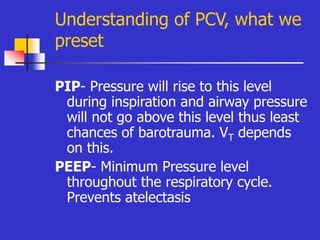
Understanding of PCV, what we
preset
PIP- Pressure will rise to this level
during inspiration and airway pressure
will not go above this level thus least
chances of barotrauma. VT depends
on this.
PEEP- Minimum Pressure level
throughout the respiratory cycle.
Prevents atelectasis
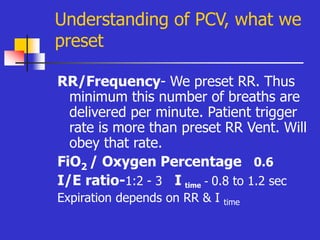
Understanding of PCV, what we
preset
RR/Frequency- We preset RR. Thus
minimum this number of breaths are
delivered per minute. Patient trigger
rate is more than preset RR Vent. Will
obey that rate.
FiO2 / Oxygen Percentage 0.6
I/E ratio-1:2 - 3 I time - 0.8 to 1.2 sec
Expiration depends on RR & I time
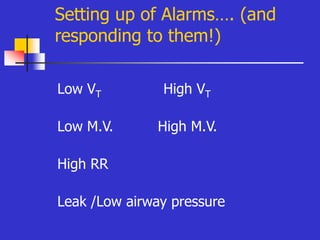
Setting up of Alarms…. (and
responding to them!)
Low VT High VT
Low M.V. High M.V.
High RR
Leak /Low airway pressure
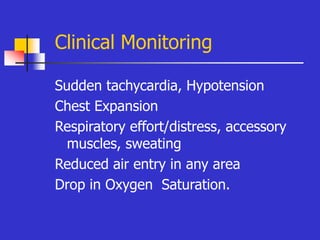
Clinical Monitoring
Sudden tachycardia, Hypotension
Chest Expansion
Respiratory effort/distress, accessory
muscles, sweating
Reduced air entry in any area
Drop in Oxygen Saturation.
Watch for actually delivered
parameters
VT - 6 to 8 ml/kg
Min.Ventilation. 5 to 10 lit /min
RR- > 25/min.Tachypnoea suggests
hypoventilation/agitation/central in
origin
Goals to be achieved in PCV
Deliver optimum VT 6 to 8ml/kg in
lowest possible PIP
Achievement of good oxygenation(PO2
or O2 Sats) with fiO2 < 0.6, Add PEEP
to achieve this.
Relieve Respiratory efforts completely
Think of weaning !
Normal Lung Ventilation
Post Op (Non Lung) patients
Neurological patients- CVA, Poisonings,
Meningo-encephalopathies, N-M causes
Post arrest status
‘Primum Non Nocere’
(First of all do no harm)
Lungs are diseased
Asthma, COPD exacerbations
Congestive Cardiac Failure
Lung Infections
Normal Lung Ventilation
‘Primum Non Nocere’
Tracheobronchial tree and alveolo-capillary gas
exchange surface are intact and healthy.
Minimum PIP, Lowest PEEP, Lowest fi02,
Physiological RR
Avoid repeated ABGs, Unnecessory suctions
and try your level best to avoid
VAP
Avoid P.A.L.I. (P…… Asso. Lung Injury)
Asthma & COPD exacerbs.
Optimisation of PEEP to keep airway open
during expiration. If Possible measure
intrinsic PEEP & dial PEEP to Splint it.
Judicious high PIP to deliver adequate VT
In COPDs- high enough to wash Pathological
Hypercapnoea but never aim for
normocapnoea
Higher RR to wash CO2
Higher I/E ratios
Congestive Cardiac Failures
Correct adjustment of PEEP is crucial
Low PEEP- inadequate resolution of
Pulmonary Edema and thus
inadequate ventilatory support.
High PEEP- Hypotension and
aggravation of CCF.
Relieve Respiratory distress completely
Lung Infections
Lowest possible PEEP to prevent injury
to normal lung zones
Ancillary therapy is equally important
Humidification, Nebulisation, Suctioning
Physiotherapy, Positioning,
Bronchoscopy.
Mechanical ventilation initiate.ppt

Mechanical ventilation initiate.ppt

  • 1.
  • 2.
    Before Connecting to Ventilator ETposition and fixing ET cuff pressure 30cm /7-10cc air Air entry confirmation bilaterally Good i.v. access Sedation and Paralysis NIBP/Mannual BP , Pulse Oxymeter Assembled Ventilator electricity,O2
  • 3.
    Before Connecting to Ventilator(Contd…) AssembledVentilator Suction, Compressed air, Vent. tubings, HMEF, Catheter mount, Inline suction/Catheters Basic Ventilatory settings already dialed
  • 4.
    Basic Settings inPressure Control Mode Peak Inspiratory/Airway Pressure- PIP /PAP 15 to 20 c m PEEP – 0 - 5 c m Respiratory Rate 16 to 20/min FiO2 0.5 to 1 Inspiratory Time or I/E ratio 1sec or 1:2 Trigger Rise time/Ramp/Ascend time
  • 5.
    Understanding of PCV,what we preset PIP- Pressure will rise to this level during inspiration and airway pressure will not go above this level thus least chances of barotrauma. VT depends on this. PEEP- Minimum Pressure level throughout the respiratory cycle. Prevents atelectasis
  • 6.
    Understanding of PCV,what we preset RR/Frequency- We preset RR. Thus minimum this number of breaths are delivered per minute. Patient trigger rate is more than preset RR Vent. Will obey that rate. FiO2 / Oxygen Percentage 0.6 I/E ratio-1:2 - 3 I time - 0.8 to 1.2 sec Expiration depends on RR & I time
  • 7.
    Setting up ofAlarms…. (and responding to them!) Low VT High VT Low M.V. High M.V. High RR Leak /Low airway pressure
  • 8.
    Clinical Monitoring Sudden tachycardia,Hypotension Chest Expansion Respiratory effort/distress, accessory muscles, sweating Reduced air entry in any area Drop in Oxygen Saturation.
  • 9.
    Watch for actuallydelivered parameters VT - 6 to 8 ml/kg Min.Ventilation. 5 to 10 lit /min RR- > 25/min.Tachypnoea suggests hypoventilation/agitation/central in origin
  • 10.
    Goals to beachieved in PCV Deliver optimum VT 6 to 8ml/kg in lowest possible PIP Achievement of good oxygenation(PO2 or O2 Sats) with fiO2 < 0.6, Add PEEP to achieve this. Relieve Respiratory efforts completely Think of weaning !
  • 11.
    Normal Lung Ventilation PostOp (Non Lung) patients Neurological patients- CVA, Poisonings, Meningo-encephalopathies, N-M causes Post arrest status ‘Primum Non Nocere’ (First of all do no harm)
  • 12.
    Lungs are diseased Asthma,COPD exacerbations Congestive Cardiac Failure Lung Infections
  • 13.
    Normal Lung Ventilation ‘PrimumNon Nocere’ Tracheobronchial tree and alveolo-capillary gas exchange surface are intact and healthy. Minimum PIP, Lowest PEEP, Lowest fi02, Physiological RR Avoid repeated ABGs, Unnecessory suctions and try your level best to avoid VAP Avoid P.A.L.I. (P…… Asso. Lung Injury)
  • 14.
    Asthma & COPDexacerbs. Optimisation of PEEP to keep airway open during expiration. If Possible measure intrinsic PEEP & dial PEEP to Splint it. Judicious high PIP to deliver adequate VT In COPDs- high enough to wash Pathological Hypercapnoea but never aim for normocapnoea Higher RR to wash CO2 Higher I/E ratios
  • 15.
    Congestive Cardiac Failures Correctadjustment of PEEP is crucial Low PEEP- inadequate resolution of Pulmonary Edema and thus inadequate ventilatory support. High PEEP- Hypotension and aggravation of CCF. Relieve Respiratory distress completely
  • 16.
    Lung Infections Lowest possiblePEEP to prevent injury to normal lung zones Ancillary therapy is equally important Humidification, Nebulisation, Suctioning Physiotherapy, Positioning, Bronchoscopy.