

PracticalArchitecture Analysis
1
Internal Presentation, September 2013, V1
Phil Huggins
 Security Architect for large
delivery programmes:
 Multiple projects
 Challenging stakeholders
 Large, complex systems
 Multi-year delivery
 100+ people customer
delivery teams
 200+ people supplier delivery
teams
 Security mattered
 Government
 Commercial
 AirportTerminal New Build
 Smart Metering for a Big6 UK Energy
Supplier
 7x UK Airports security refresh.
 UK Banking ecommerce
infrastructure
 Cloud Software as a Service Provider
2
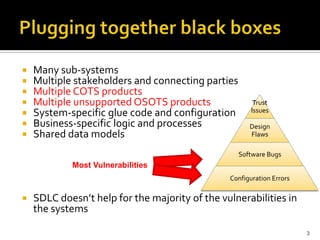
 Many sub-systems
 Multiple stakeholders and connecting parties
 Multiple COTS products
 Multiple unsupported OSOTS products
 System-specific glue code and configuration
 Business-specific logic and processes
 Shared data models
 SDLC doesn’t help for the majority of the vulnerabilities in
the systems
3
Trust
Issues
Design
Flaws
Software Bugs
Configuration Errors
Most Vulnerabilities
4
 A measure of attackability NOT of vulnerability.
 Doesn’t look inside the box.
Michael Howard at Microsoft (2003)
Michael Howard & JeanetteWing at Carnegie Mellon (2003)
 Relative Attack Surface Quotient
 20 AttackVectors (open sockets, weak ACLs, guest
accounts etc)
 Channels
 ProcessTargets
 DataTargets
 Process Enablers
Pretty informal model
Needs an expert to apply to software not previously analysed
5
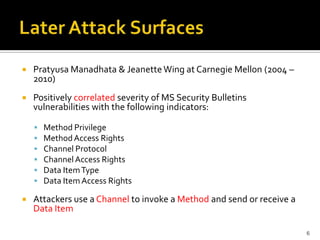
 Pratyusa Manadhata & JeanetteWing at Carnegie Mellon (2004 –
2010)
 Positively correlated severity of MS Security Bulletins
vulnerabilities with the following indicators:
 Method Privilege
 MethodAccess Rights
 Channel Protocol
 ChannelAccess Rights
 Data ItemType
 Data Item Access Rights
 Attackers use a Channel to invoke a Method and send or receive a
Data Item
6
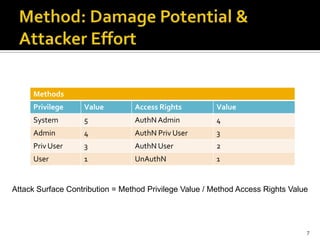
Methods
Privilege Value Access Rights Value
System 5 AuthNAdmin 4
Admin 4 AuthN Priv User 3
Priv User 3 AuthN User 2
User 1 UnAuthN 1
7
Attack Surface Contribution = Method Privilege Value / Method Access Rights Value
8
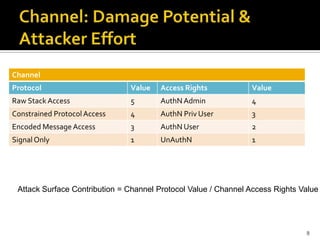
Channel
Protocol Value Access Rights Value
Raw Stack Access 5 AuthN Admin 4
Constrained Protocol Access 4 AuthN Priv User 3
Encoded MessageAccess 3 AuthN User 2
SignalOnly 1 UnAuthN 1
Attack Surface Contribution = Channel Protocol Value / Channel Access Rights Value
9
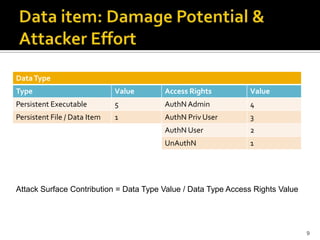
DataType
Type Value Access Rights Value
Persistent Executable 5 AuthN Admin 4
Persistent File / Data Item 1 AuthN Priv User 3
AuthN User 2
UnAuthN 1
Attack Surface Contribution = Data Type Value / Data Type Access Rights Value
 Attack Surface Measurement = Sum of all Attack Surface
Contributions
 Assumes probability of a exploitable vulnerability in a Method,
Channel or Data Item is 1
 Comparing two boxes against each other or against differently
configured versions of themselves is relatively easy.
 Beware: Similar attack surface scores may hide boxes with a small
attack surface but a very high damage potential!
 Only considers attackability no consideration of the impact of the
attack
 This is not risk
10
11
“The worst enemy of security is complexity.”
Bruce Schneier
“Connectedness and complexity are what cause security
disasters.”
Marcus Ranum
"Risk is a necessary consequence of dependence“
Dan Geer
“Left to themselves, creative engineers will deliver the
most complicated system they think they can debug.”
Mike O’Dell
12
 Coupling
 How fast cause and effect propagate through the system.
 Time dependent
 Rigid ordering
 Single path to successful outcome
 Complexity
 Number of interactions between components.
 Branching
 Feedback loops
 Un-planned sequences of events.
 Multiple component failures cause systemic cascade failures or
accidents.
 Accidents are inevitable in complex, tightly-coupled systems.
13
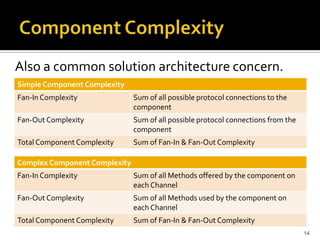
Also a common solution architecture concern.
14
Simple Component Complexity
Fan-In Complexity Sum of all possible protocol connections to the
component
Fan-Out Complexity Sum of all possible protocol connections from the
component
Total Component Complexity Sum of Fan-In & Fan-Out Complexity
Complex Component Complexity
Fan-In Complexity Sum of all Methods offered by the component on
each Channel
Fan-Out Complexity Sum of all Methods used by the component on
each Channel
Total Component Complexity Sum of Fan-In & Fan-Out Complexity
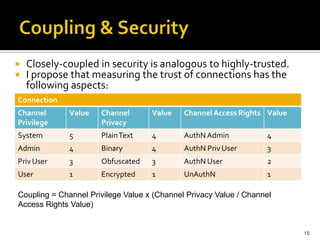
 Closely-coupled in security is analogous to highly-trusted.
 I propose that measuring the trust of connections has the
following aspects:
15
Connection
Channel
Privilege
Value Channel
Privacy
Value Channel Access Rights Value
System 5 PlainText 4 AuthN Admin 4
Admin 4 Binary 4 AuthN Priv User 3
Priv User 3 Obfuscated 3 AuthN User 2
User 1 Encrypted 1 UnAuthN 1
Coupling = Channel Privilege Value x (Channel Privacy Value / Channel
Access Rights Value)
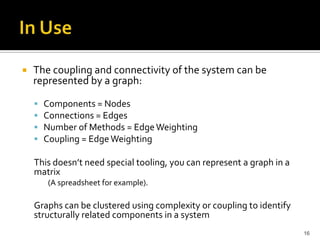
 The coupling and connectivity of the system can be
represented by a graph:
 Components = Nodes
 Connections = Edges
 Number of Methods = EdgeWeighting
 Coupling = EdgeWeighting
This doesn’t need special tooling, you can represent a graph in a
matrix
(A spreadsheet for example).
Graphs can be clustered using complexity or coupling to identify
structurally related components in a system
16
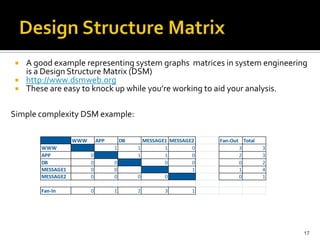
 A good example representing system graphs matrices in system engineering
is a Design Structure Matrix (DSM)
 http://www.dsmweb.org
 These are easy to knock up while you’re working to aid your analysis.
Simple complexity DSM example:
17
WWW APP DB MESSAGE1 MESSAGE2 Fan-Out Total
WWW 1 1 1 0 3 3
APP 0 1 1 0 2 3
DB 0 0 0 0 0 2
MESSAGE1 0 0 1 1 4
MESSAGE2 0 0 0 0 0 1
Fan-In 0 1 2 3 1
18
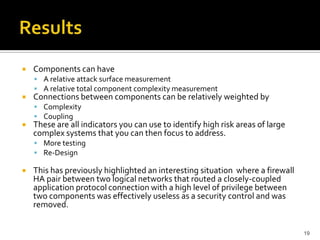
 Components can have
 A relative attack surface measurement
 A relative total component complexity measurement
 Connections between components can be relatively weighted by
 Complexity
 Coupling
 These are all indicators you can use to identify high risk areas of large
complex systems that you can then focus to address.
 More testing
 Re-Design
 This has previously highlighted an interesting situation where a firewall
HA pair between two logical networks that routed a closely-coupled
application protocol connection with a high level of privilege between
two components was effectively useless as a security control and was
removed.
19
20

Measuring black boxes

  • 1.
  • 2.
     Security Architectfor large delivery programmes:  Multiple projects  Challenging stakeholders  Large, complex systems  Multi-year delivery  100+ people customer delivery teams  200+ people supplier delivery teams  Security mattered  Government  Commercial  AirportTerminal New Build  Smart Metering for a Big6 UK Energy Supplier  7x UK Airports security refresh.  UK Banking ecommerce infrastructure  Cloud Software as a Service Provider 2
  • 3.
     Many sub-systems Multiple stakeholders and connecting parties  Multiple COTS products  Multiple unsupported OSOTS products  System-specific glue code and configuration  Business-specific logic and processes  Shared data models  SDLC doesn’t help for the majority of the vulnerabilities in the systems 3 Trust Issues Design Flaws Software Bugs Configuration Errors Most Vulnerabilities
  • 4.
  • 5.
     A measureof attackability NOT of vulnerability.  Doesn’t look inside the box. Michael Howard at Microsoft (2003) Michael Howard & JeanetteWing at Carnegie Mellon (2003)  Relative Attack Surface Quotient  20 AttackVectors (open sockets, weak ACLs, guest accounts etc)  Channels  ProcessTargets  DataTargets  Process Enablers Pretty informal model Needs an expert to apply to software not previously analysed 5
  • 6.
     Pratyusa Manadhata& JeanetteWing at Carnegie Mellon (2004 – 2010)  Positively correlated severity of MS Security Bulletins vulnerabilities with the following indicators:  Method Privilege  MethodAccess Rights  Channel Protocol  ChannelAccess Rights  Data ItemType  Data Item Access Rights  Attackers use a Channel to invoke a Method and send or receive a Data Item 6
  • 7.
    Methods Privilege Value AccessRights Value System 5 AuthNAdmin 4 Admin 4 AuthN Priv User 3 Priv User 3 AuthN User 2 User 1 UnAuthN 1 7 Attack Surface Contribution = Method Privilege Value / Method Access Rights Value
  • 8.
    8 Channel Protocol Value AccessRights Value Raw Stack Access 5 AuthN Admin 4 Constrained Protocol Access 4 AuthN Priv User 3 Encoded MessageAccess 3 AuthN User 2 SignalOnly 1 UnAuthN 1 Attack Surface Contribution = Channel Protocol Value / Channel Access Rights Value
  • 9.
    9 DataType Type Value AccessRights Value Persistent Executable 5 AuthN Admin 4 Persistent File / Data Item 1 AuthN Priv User 3 AuthN User 2 UnAuthN 1 Attack Surface Contribution = Data Type Value / Data Type Access Rights Value
  • 10.
     Attack SurfaceMeasurement = Sum of all Attack Surface Contributions  Assumes probability of a exploitable vulnerability in a Method, Channel or Data Item is 1  Comparing two boxes against each other or against differently configured versions of themselves is relatively easy.  Beware: Similar attack surface scores may hide boxes with a small attack surface but a very high damage potential!  Only considers attackability no consideration of the impact of the attack  This is not risk 10
  • 11.
  • 12.
    “The worst enemyof security is complexity.” Bruce Schneier “Connectedness and complexity are what cause security disasters.” Marcus Ranum "Risk is a necessary consequence of dependence“ Dan Geer “Left to themselves, creative engineers will deliver the most complicated system they think they can debug.” Mike O’Dell 12
  • 13.
     Coupling  Howfast cause and effect propagate through the system.  Time dependent  Rigid ordering  Single path to successful outcome  Complexity  Number of interactions between components.  Branching  Feedback loops  Un-planned sequences of events.  Multiple component failures cause systemic cascade failures or accidents.  Accidents are inevitable in complex, tightly-coupled systems. 13
  • 14.
    Also a commonsolution architecture concern. 14 Simple Component Complexity Fan-In Complexity Sum of all possible protocol connections to the component Fan-Out Complexity Sum of all possible protocol connections from the component Total Component Complexity Sum of Fan-In & Fan-Out Complexity Complex Component Complexity Fan-In Complexity Sum of all Methods offered by the component on each Channel Fan-Out Complexity Sum of all Methods used by the component on each Channel Total Component Complexity Sum of Fan-In & Fan-Out Complexity
  • 15.
     Closely-coupled insecurity is analogous to highly-trusted.  I propose that measuring the trust of connections has the following aspects: 15 Connection Channel Privilege Value Channel Privacy Value Channel Access Rights Value System 5 PlainText 4 AuthN Admin 4 Admin 4 Binary 4 AuthN Priv User 3 Priv User 3 Obfuscated 3 AuthN User 2 User 1 Encrypted 1 UnAuthN 1 Coupling = Channel Privilege Value x (Channel Privacy Value / Channel Access Rights Value)
  • 16.
     The couplingand connectivity of the system can be represented by a graph:  Components = Nodes  Connections = Edges  Number of Methods = EdgeWeighting  Coupling = EdgeWeighting This doesn’t need special tooling, you can represent a graph in a matrix (A spreadsheet for example). Graphs can be clustered using complexity or coupling to identify structurally related components in a system 16
  • 17.
     A goodexample representing system graphs matrices in system engineering is a Design Structure Matrix (DSM)  http://www.dsmweb.org  These are easy to knock up while you’re working to aid your analysis. Simple complexity DSM example: 17 WWW APP DB MESSAGE1 MESSAGE2 Fan-Out Total WWW 1 1 1 0 3 3 APP 0 1 1 0 2 3 DB 0 0 0 0 0 2 MESSAGE1 0 0 1 1 4 MESSAGE2 0 0 0 0 0 1 Fan-In 0 1 2 3 1
  • 18.
  • 19.
     Components canhave  A relative attack surface measurement  A relative total component complexity measurement  Connections between components can be relatively weighted by  Complexity  Coupling  These are all indicators you can use to identify high risk areas of large complex systems that you can then focus to address.  More testing  Re-Design  This has previously highlighted an interesting situation where a firewall HA pair between two logical networks that routed a closely-coupled application protocol connection with a high level of privilege between two components was effectively useless as a security control and was removed. 19
  • 20.