






Meaningful Use Stage 1 Changes
for Eligible Professionals in 2014
Michelle Brunsen, Sr. Health IT Advisor
Today’s Objectives







ARRA Background and Incentive Program Statistics
2014 Timelines for EHR Vendors and Eligible Professionals
Changes to Stage 1 Meaningful Use
Clinical Quality Measures
Payment Adjustments and Hardships
Medicaid Program Specific Changes

2
BACKGROUND AND STATISTICS

3
Where Did Meaningful Use Begin?
American Reinvestment and Recovery Act of 2009
“Stimulus Bill”
 HITECH Act: All healthcare providers must adopt electronic
health records by 2015
 CMS EHR Incentive Program established for Meaningful Use
 Office of the National Coordinator Funded 60+ RECs
 ONC Funded the creation of Health Information
Exchanges in every state
 ONC website: www.healthit.hhs.gov

4
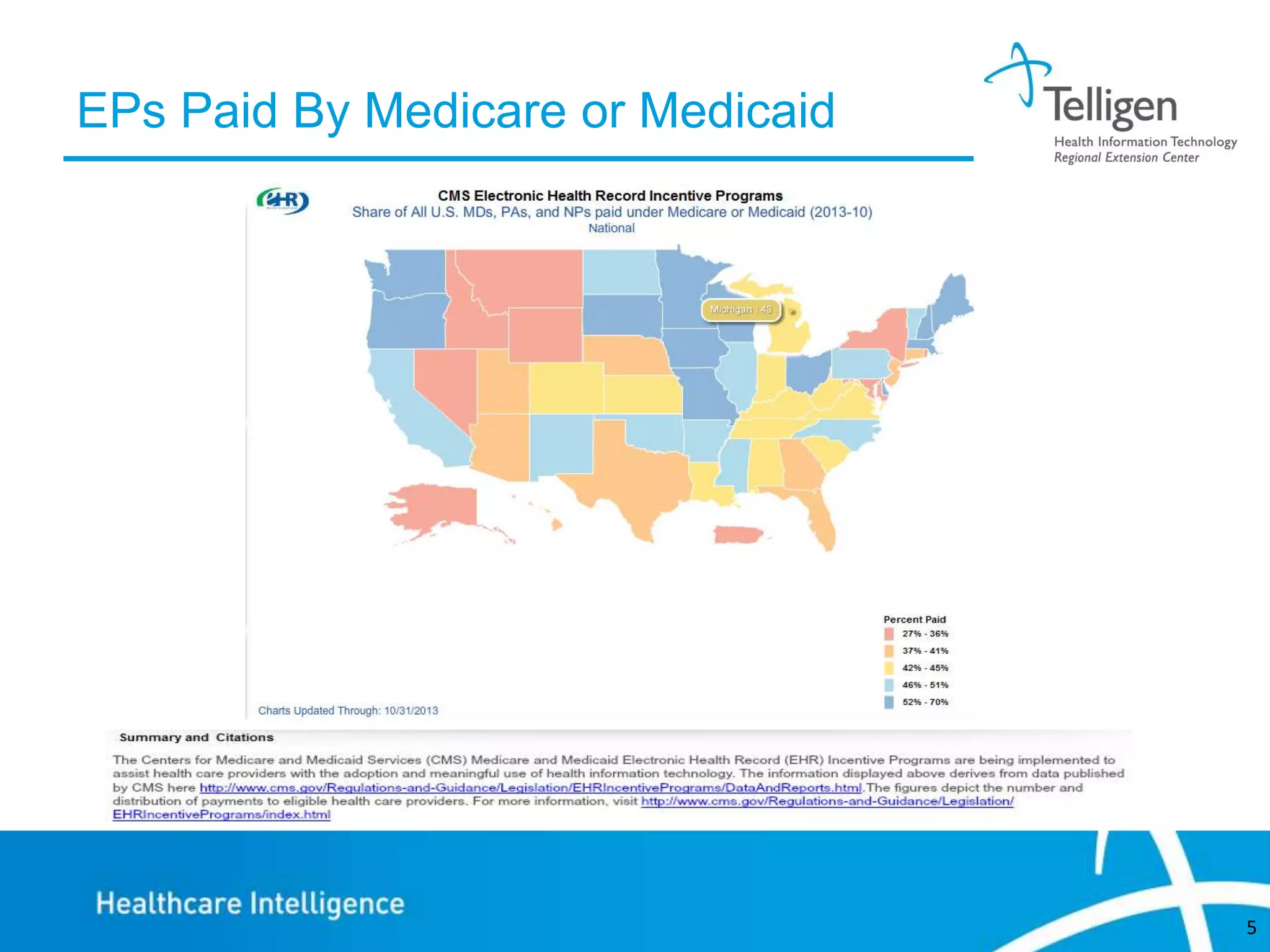
EPs Paid By Medicare or Medicaid

5
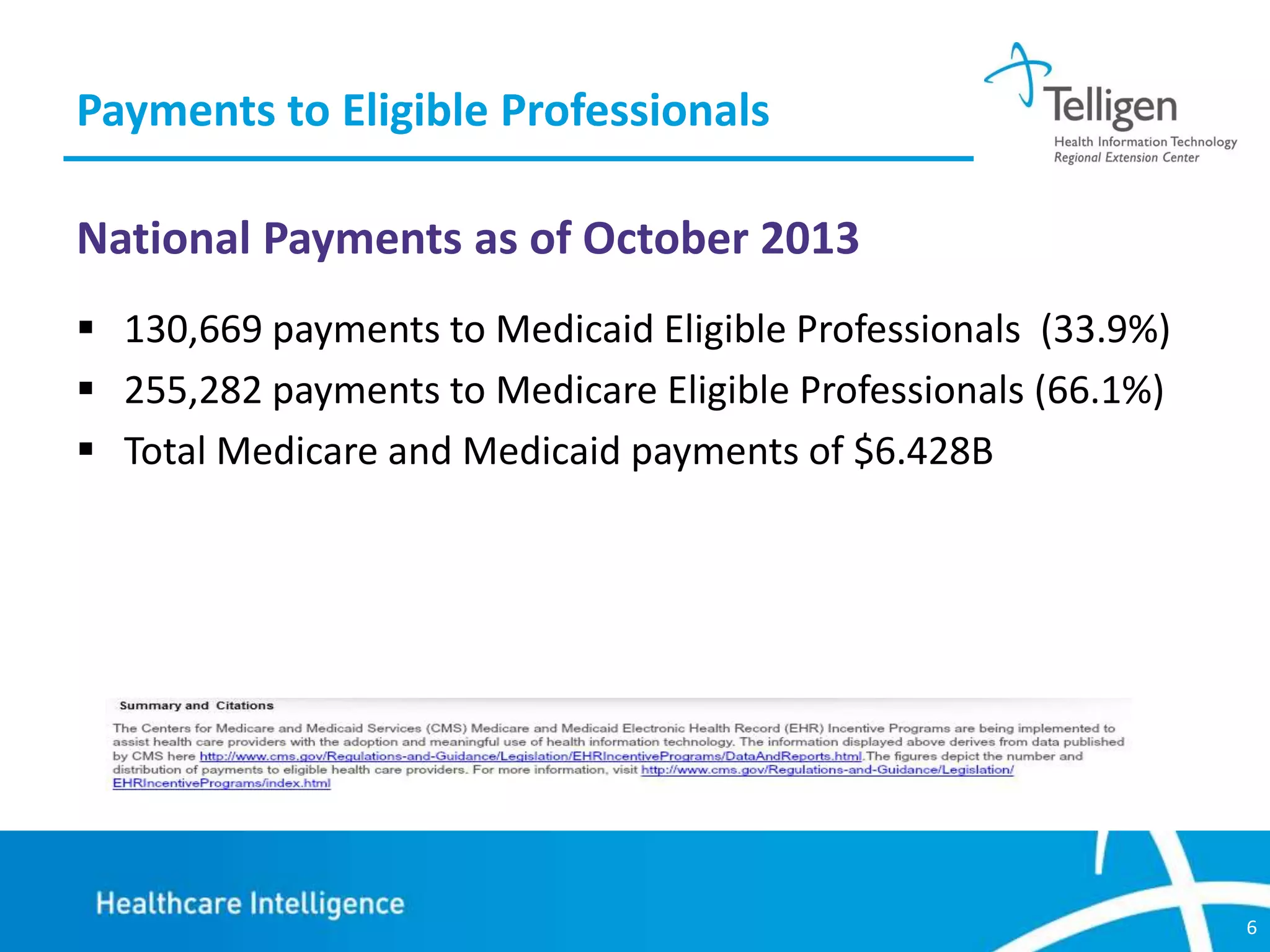
Payments to Eligible Professionals
National Payments as of October 2013
 130,669 payments to Medicaid Eligible Professionals (33.9%)
 255,282 payments to Medicare Eligible Professionals (66.1%)
 Total Medicare and Medicaid payments of $6.428B

6
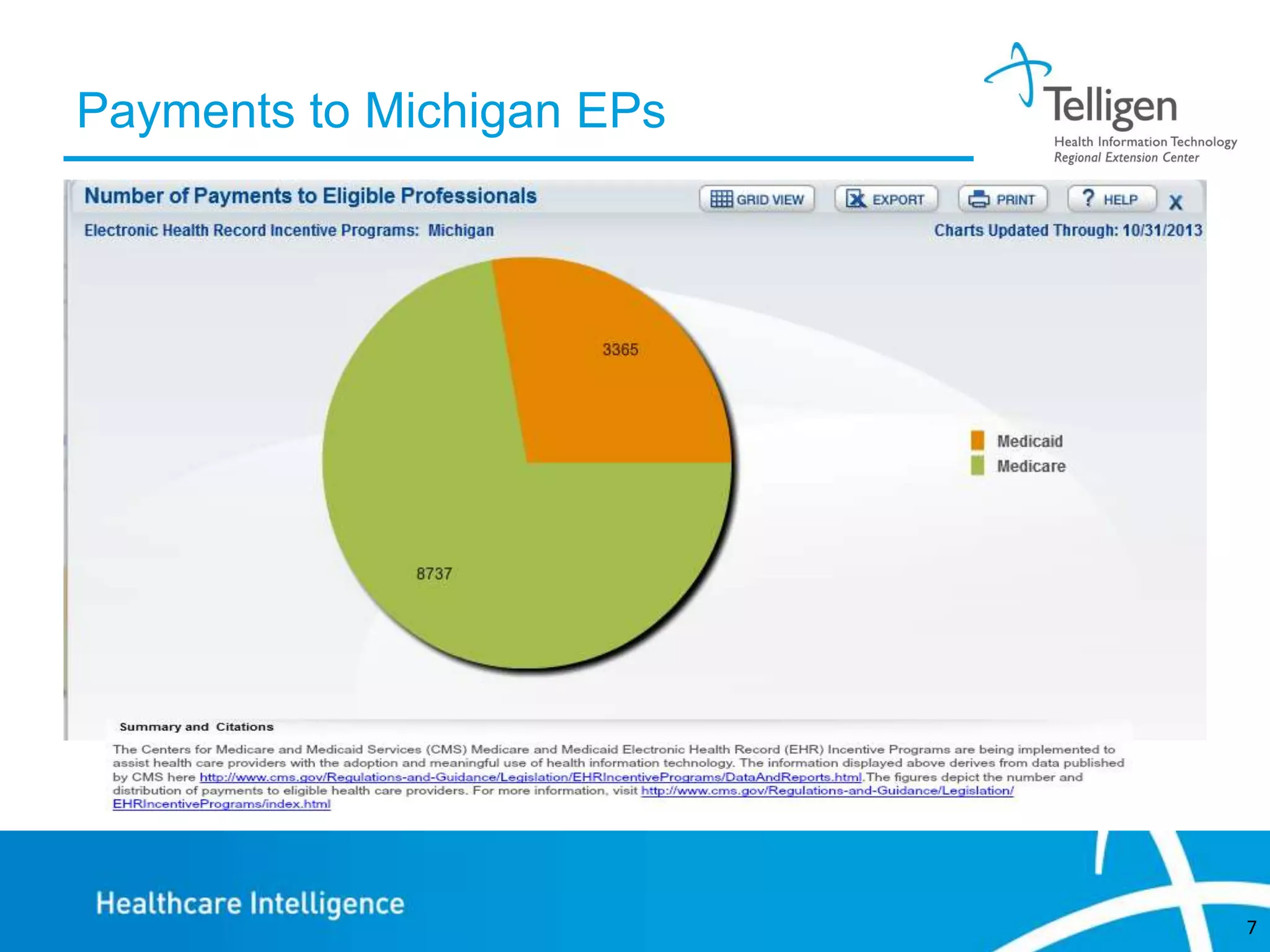
Payments to Michigan EPs

7
Payments to Eligible Professionals
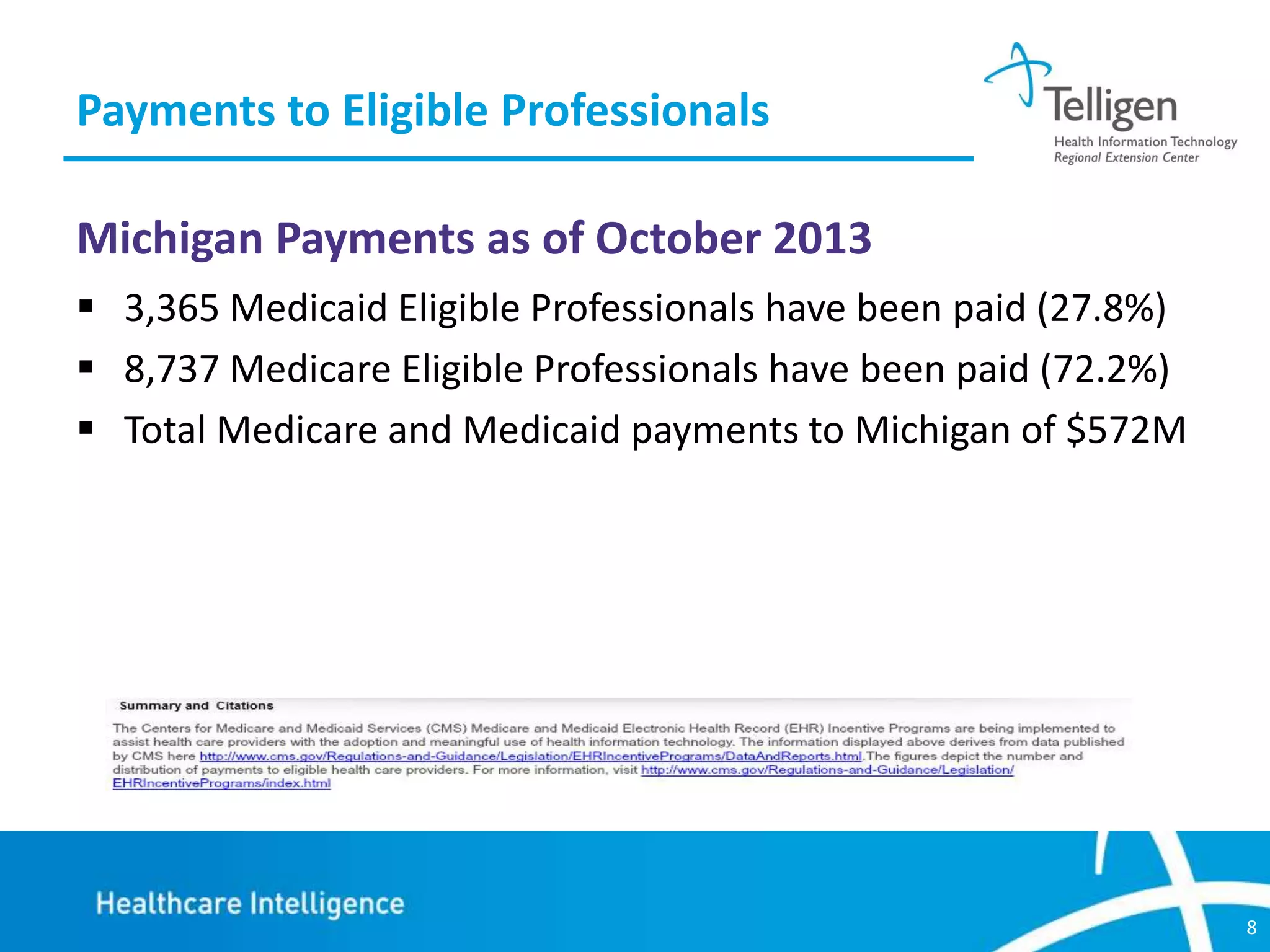
Michigan Payments as of October 2013
 3,365 Medicaid Eligible Professionals have been paid (27.8%)
 8,737 Medicare Eligible Professionals have been paid (72.2%)
 Total Medicare and Medicaid payments to Michigan of $572M

8
2014 TIMELINES FOR EHR VENDORS
AND ELIGIBLE PROFESSIONALS

9
Point to Remember
 Stage 1 is a stepping stone to Stage 2
which is a stepping stone to Stage 3

10
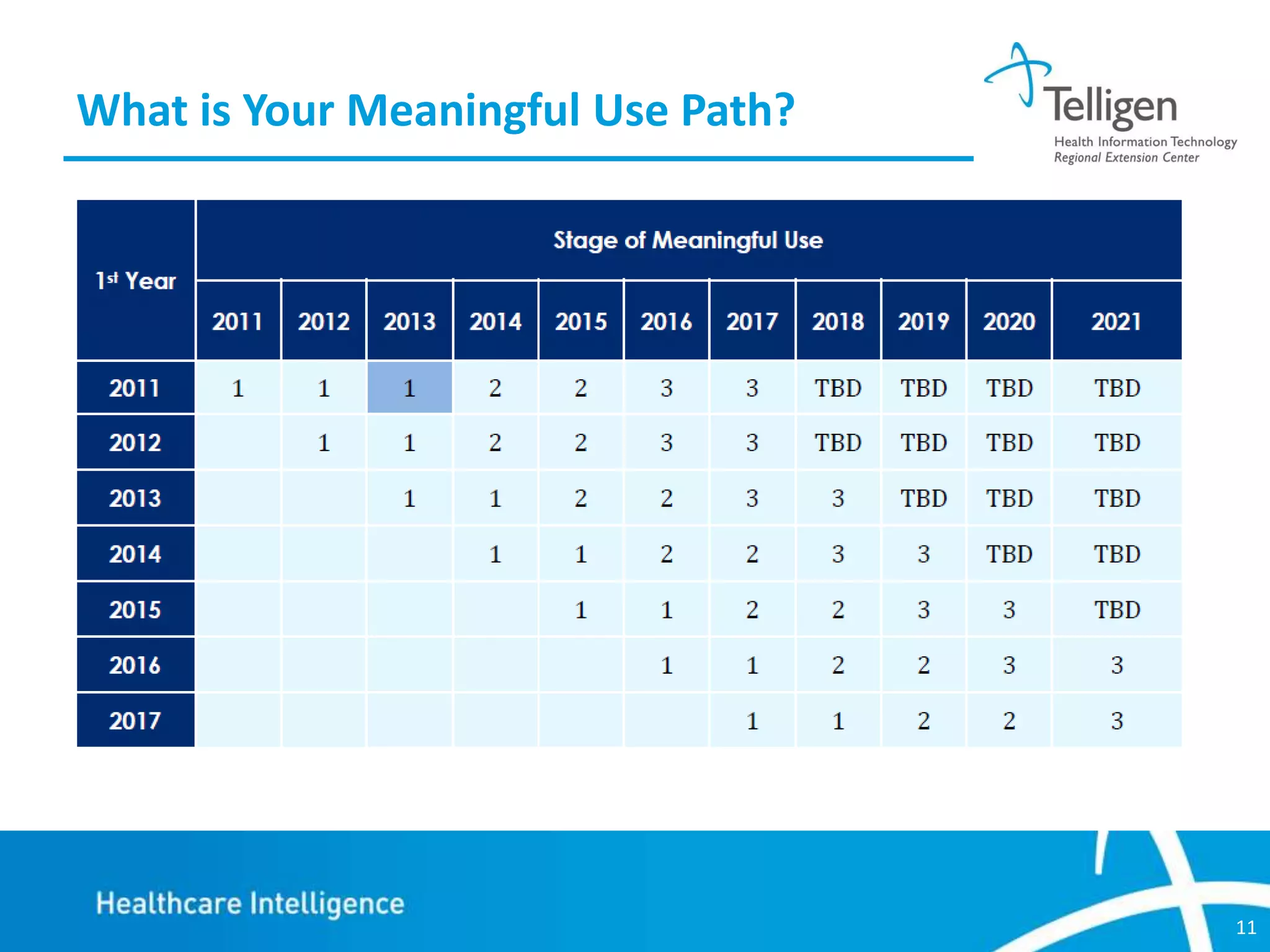
What is Your Meaningful Use Path?

11
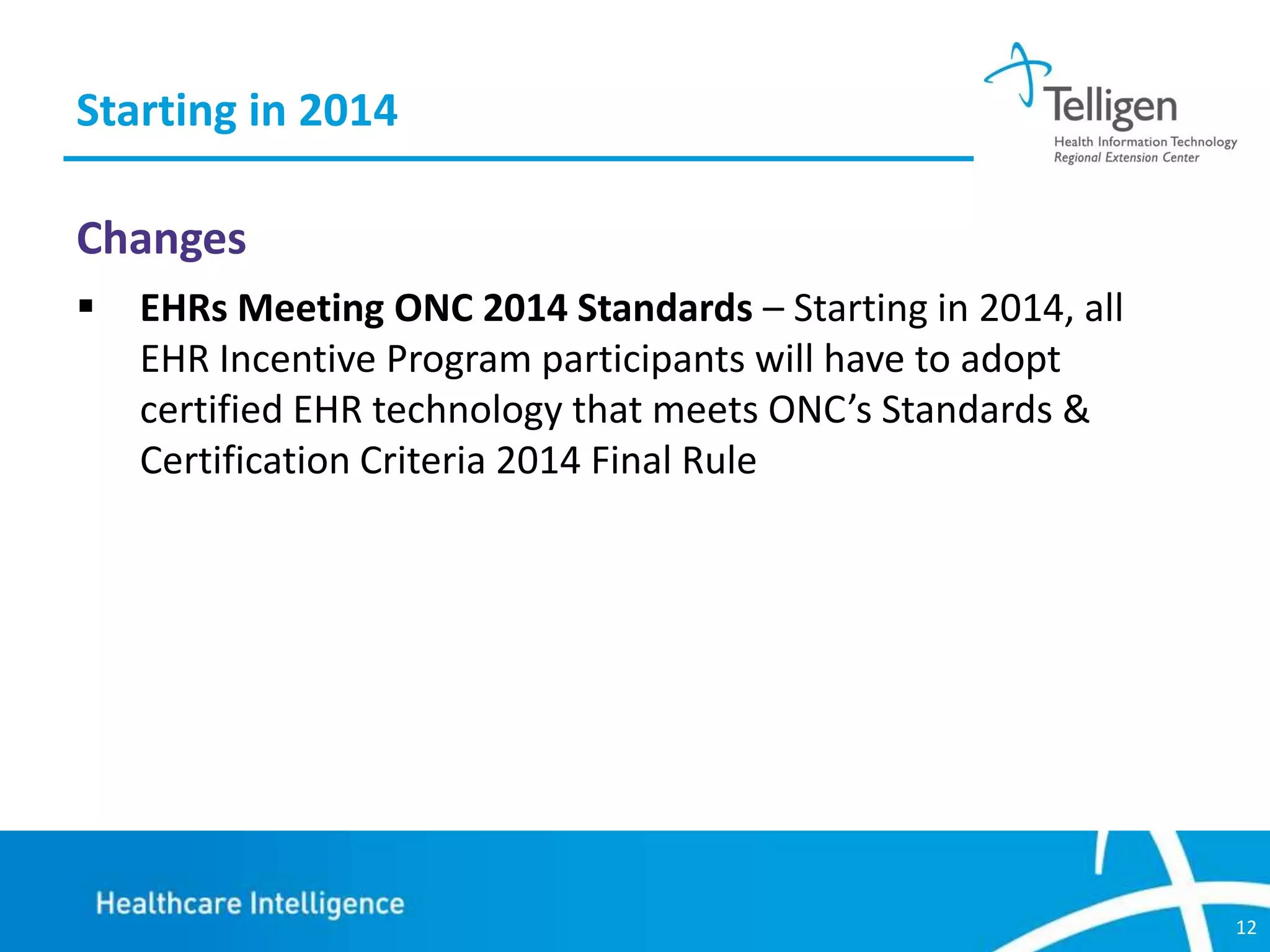
Starting in 2014
Changes


EHRs Meeting ONC 2014 Standards – Starting in 2014, all
EHR Incentive Program participants will have to adopt
certified EHR technology that meets ONC’s Standards &
Certification Criteria 2014 Final Rule

12
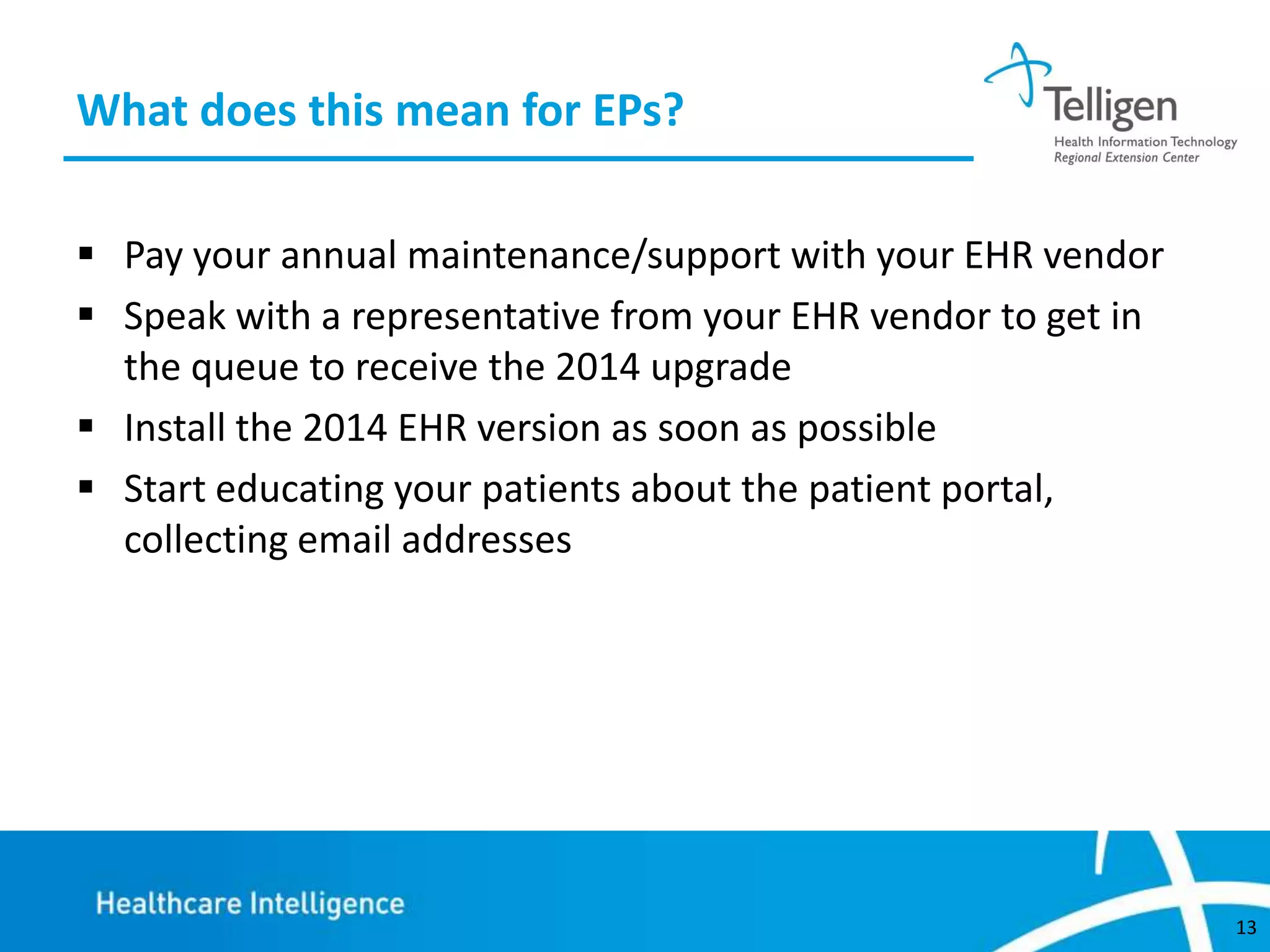
What does this mean for EPs?
 Pay your annual maintenance/support with your EHR vendor
 Speak with a representative from your EHR vendor to get in
the queue to receive the 2014 upgrade
 Install the 2014 EHR version as soon as possible
 Start educating your patients about the patient portal,
collecting email addresses

13
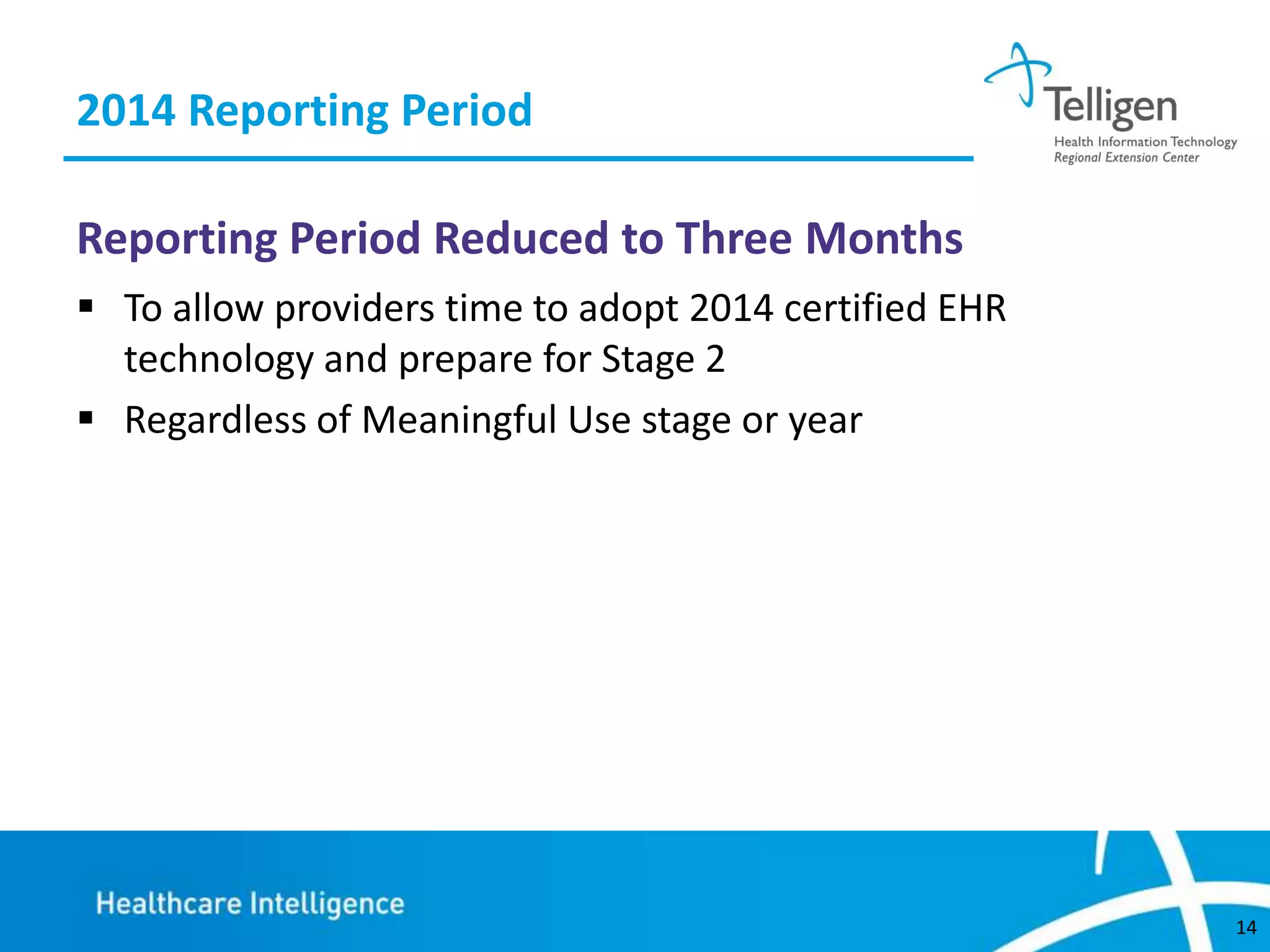
2014 Reporting Period
Reporting Period Reduced to Three Months
 To allow providers time to adopt 2014 certified EHR
technology and prepare for Stage 2
 Regardless of Meaningful Use stage or year

14
What does this mean for EPs?
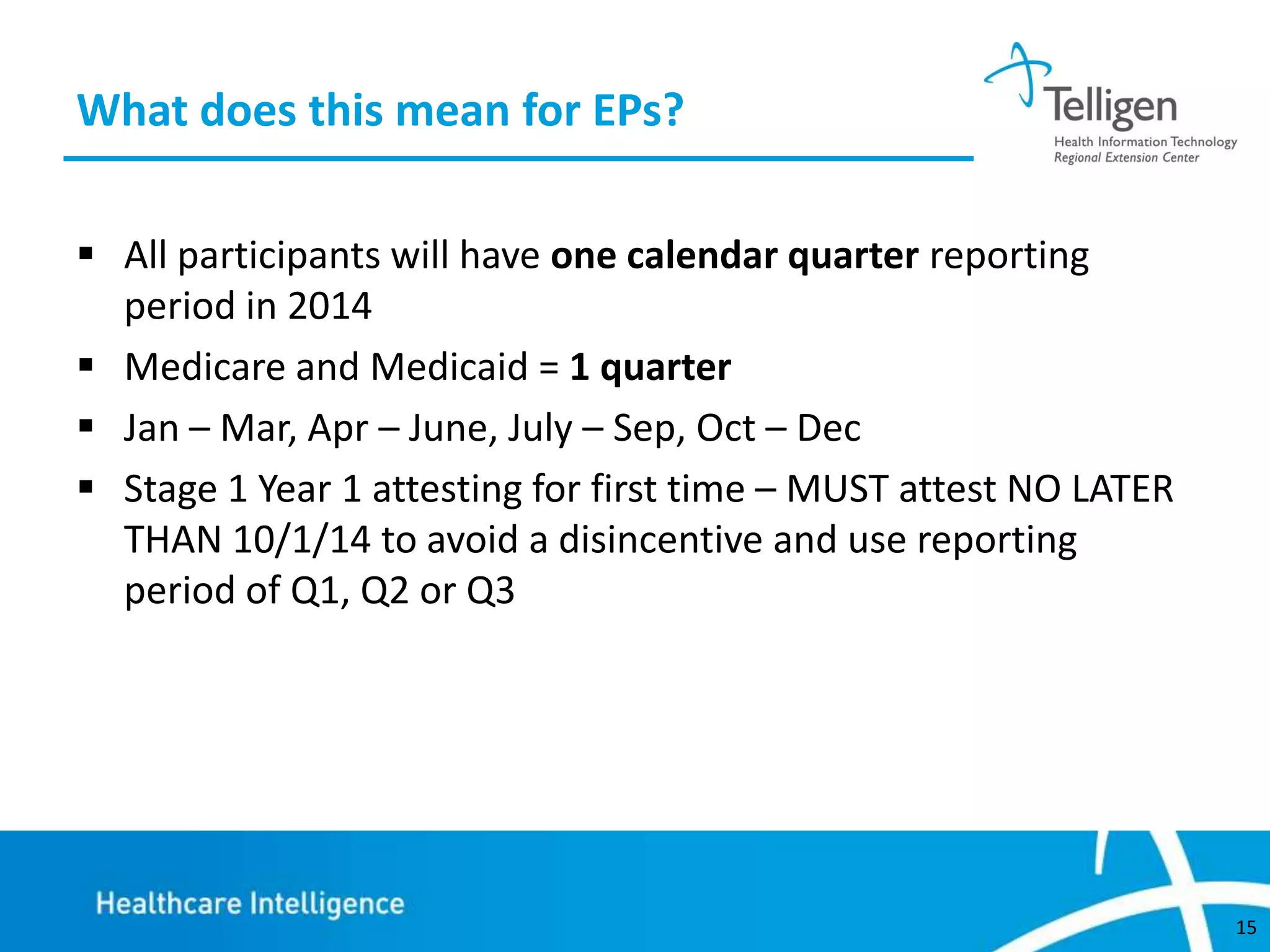
 All participants will have one calendar quarter reporting
period in 2014
 Medicare and Medicaid = 1 quarter
 Jan – Mar, Apr – June, July – Sep, Oct – Dec
 Stage 1 Year 1 attesting for first time – MUST attest NO LATER
THAN 10/1/14 to avoid a disincentive and use reporting
period of Q1, Q2 or Q3

15
CHANGES TO STAGE 1 MEANINGFUL USE

16
Meaningful Use: Stage 1 in 2014
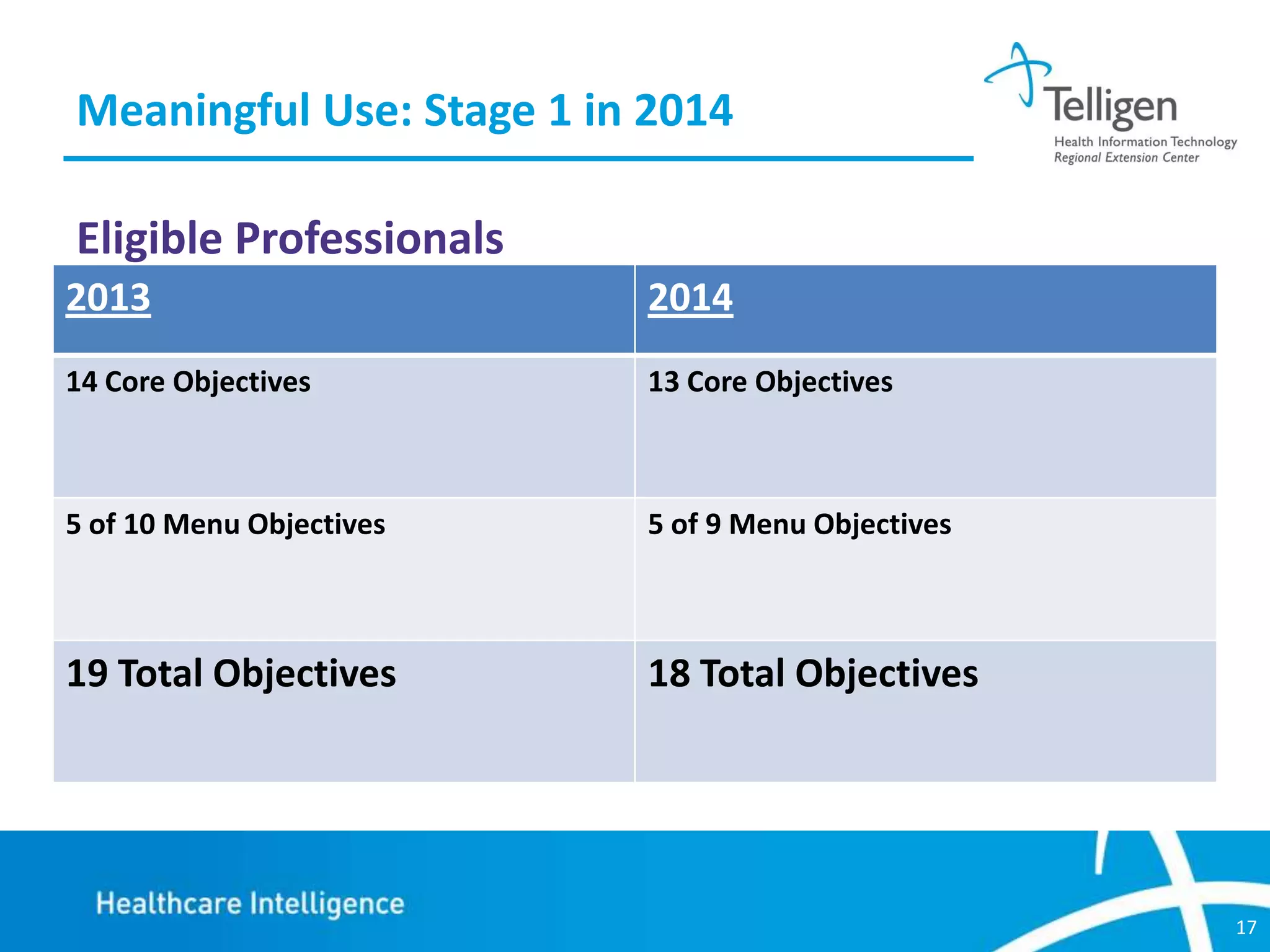
Eligible Professionals
2013

2014

14 Core Objectives

13 Core Objectives

5 of 10 Menu Objectives

5 of 9 Menu Objectives

19 Total Objectives

18 Total Objectives

17
Stage 1 Meaningful Use Core Objectives - 2014

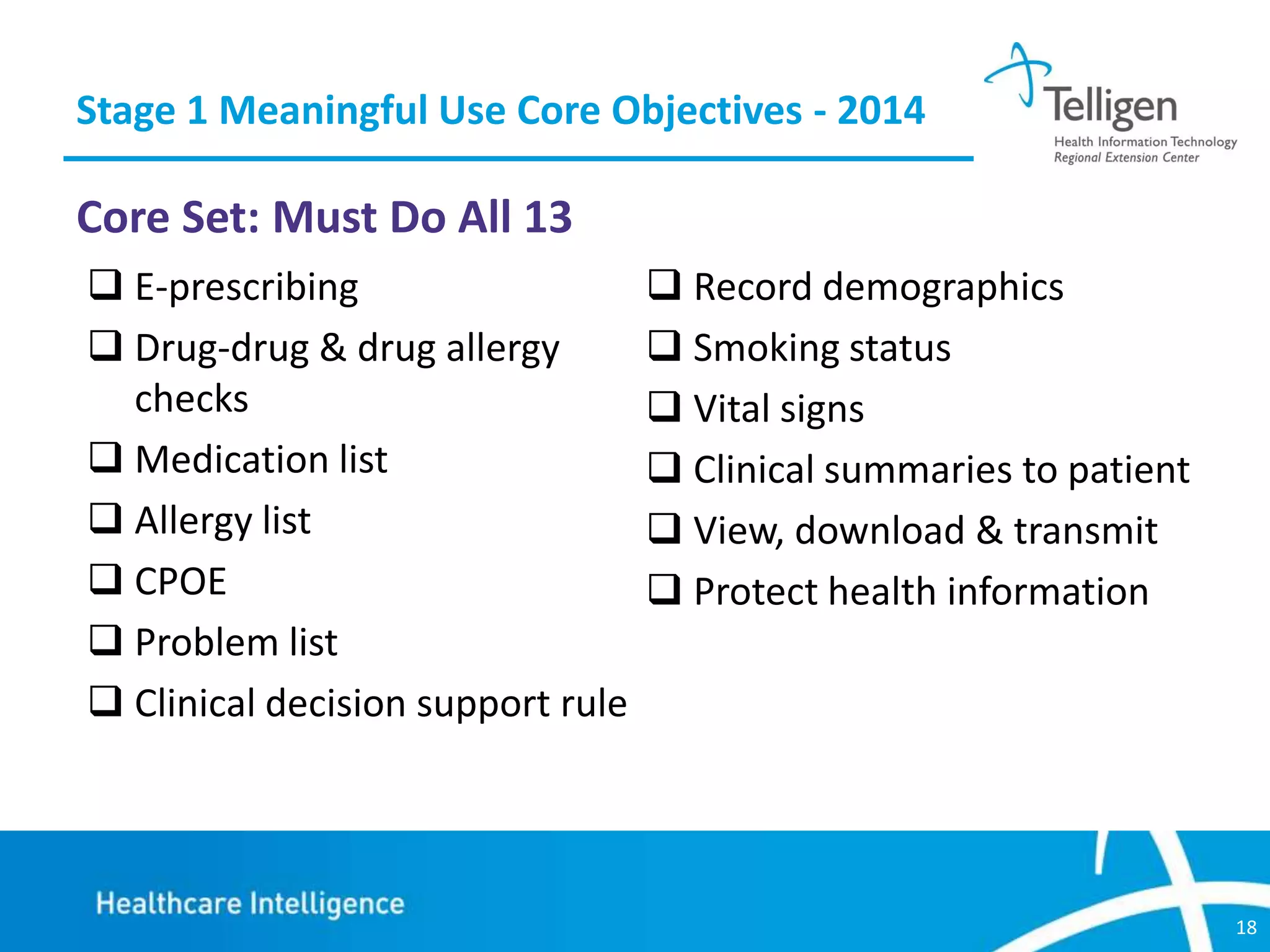
Core Set: Must Do All 13
 E-prescribing
 Drug-drug & drug allergy
checks
 Medication list
 Allergy list
 CPOE
 Problem list
 Clinical decision support rule

 Record demographics
 Smoking status
 Vital signs
 Clinical summaries to patient
 View, download & transmit
 Protect health information

18
Changes to Stage 1: CPOE
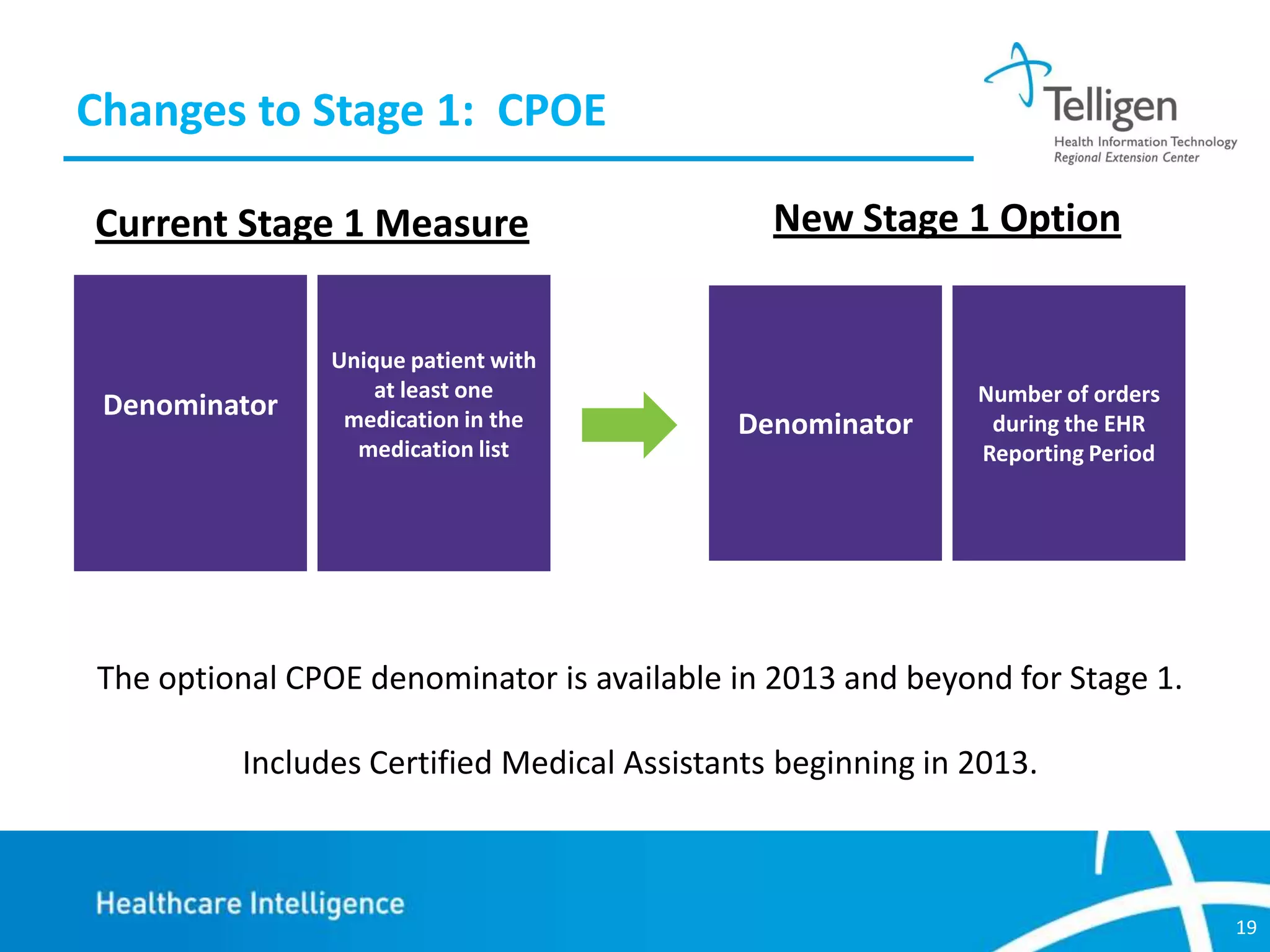
Current Stage 1 Measure

Denominator

Unique patient with
at least one
medication in the
medication list

New Stage 1 Option

Denominator

Number of orders
during the EHR
Reporting Period

The optional CPOE denominator is available in 2013 and beyond for Stage 1.

Includes Certified Medical Assistants beginning in 2013.

19
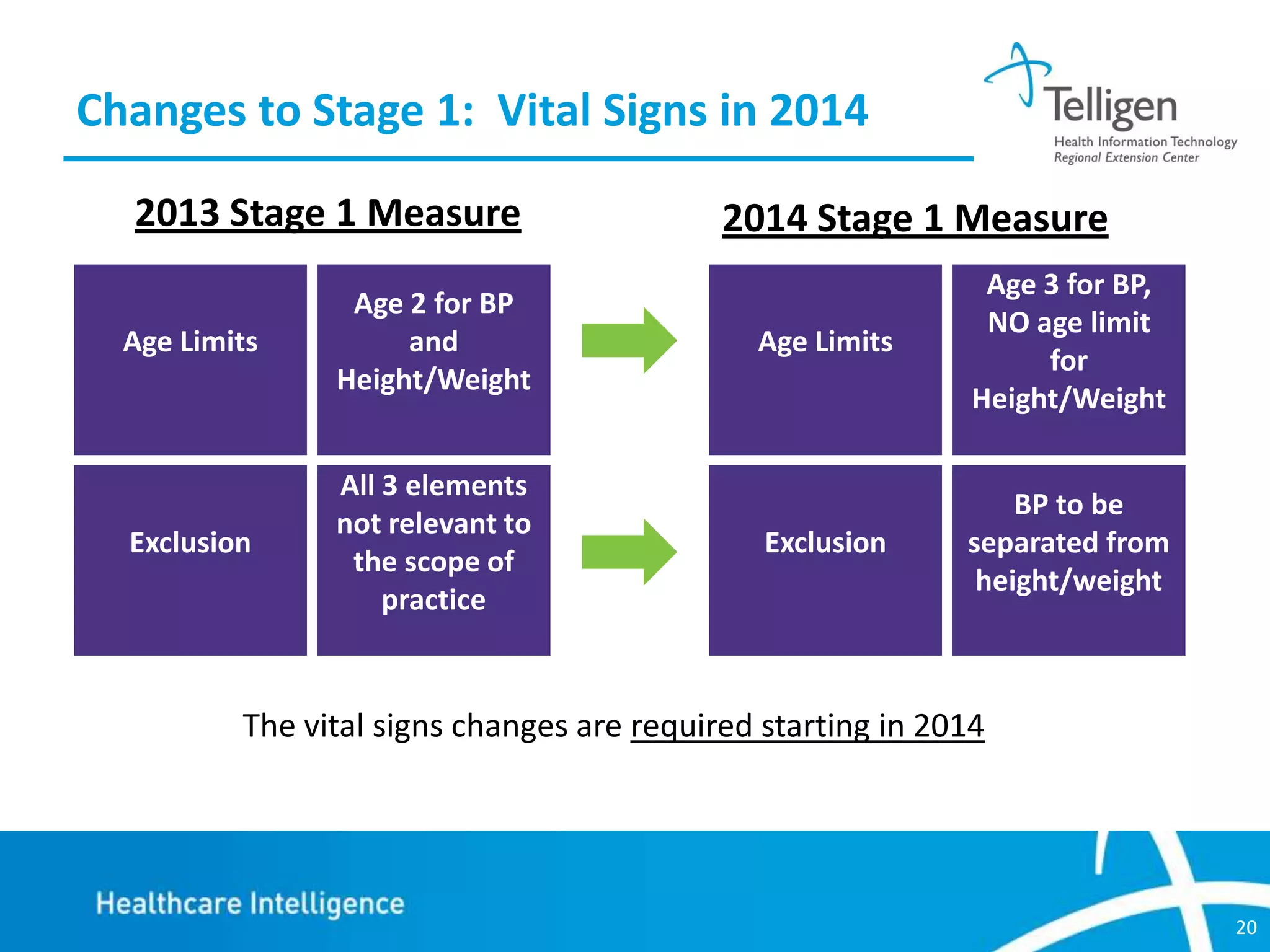
Changes to Stage 1: Vital Signs in 2014
2013 Stage 1 Measure
Age Limits

Age 2 for BP
and
Height/Weight

Exclusion

All 3 elements
not relevant to
the scope of
practice

2014 Stage 1 Measure
Age Limits

Age 3 for BP,
NO age limit
for
Height/Weight

Exclusion

BP to be
separated from
height/weight

The vital signs changes are required starting in 2014

20
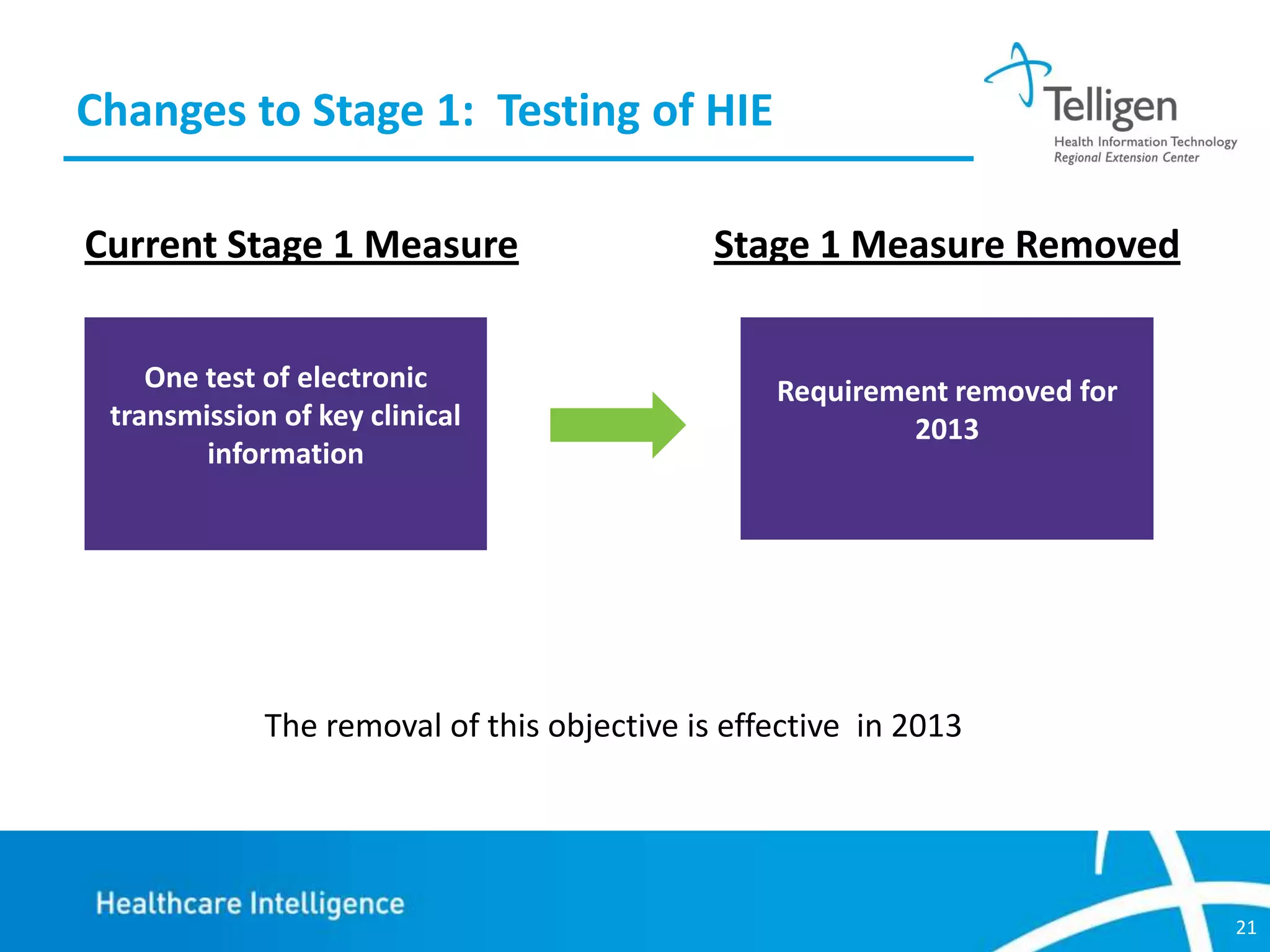
Changes to Stage 1: Testing of HIE
Current Stage 1 Measure
One test of electronic
transmission of key clinical
information

Stage 1 Measure Removed

Requirement removed for
2013

The removal of this objective is effective in 2013

21
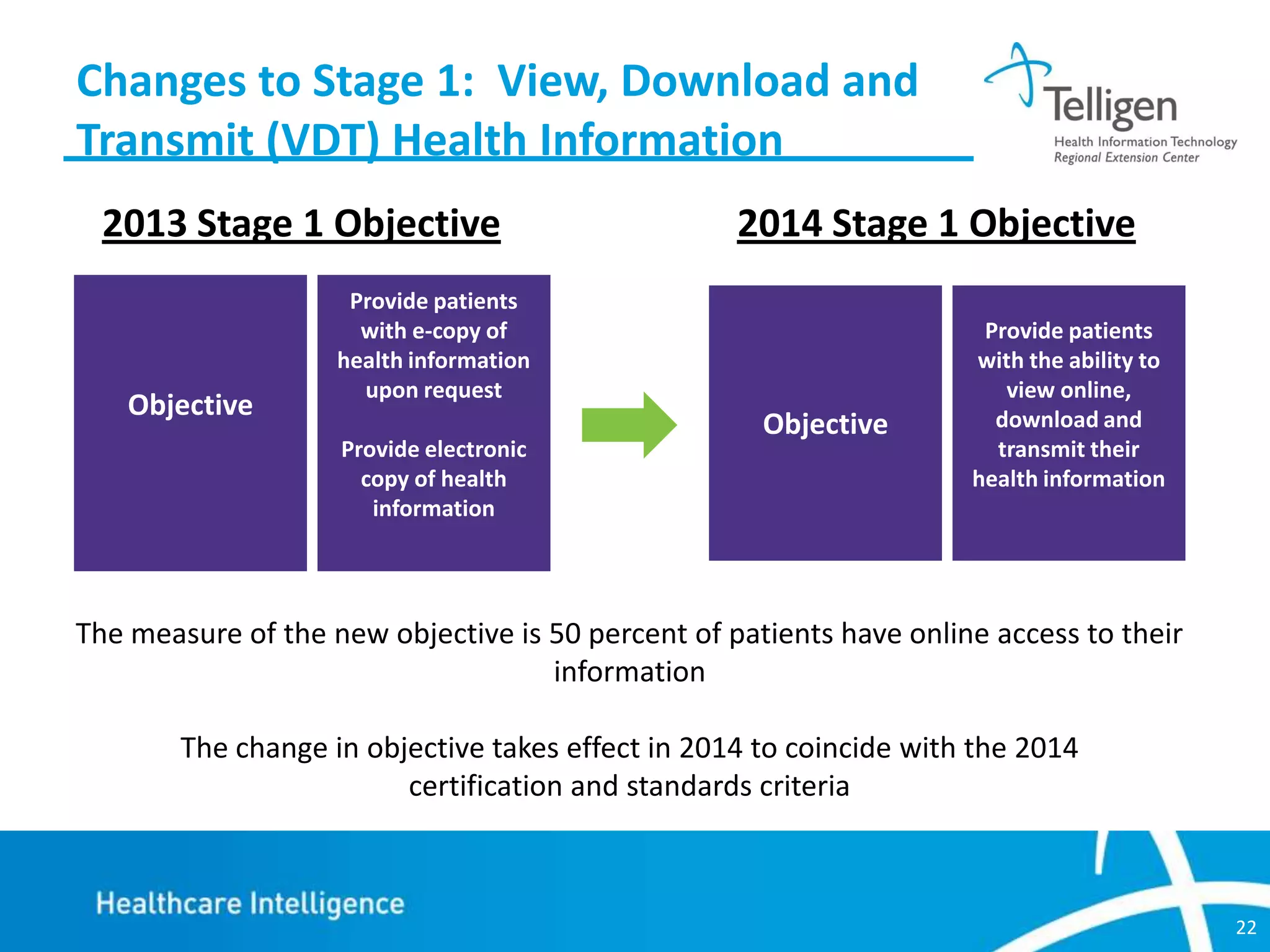
Changes to Stage 1: View, Download and
Transmit (VDT) Health Information
2013 Stage 1 Objective

Objective

2014 Stage 1 Objective

Provide patients
with e-copy of
health information
upon request
Provide electronic
copy of health
information

Objective

Provide patients
with the ability to
view online,
download and
transmit their
health information

The measure of the new objective is 50 percent of patients have online access to their
information

The change in objective takes effect in 2014 to coincide with the 2014
certification and standards criteria

22
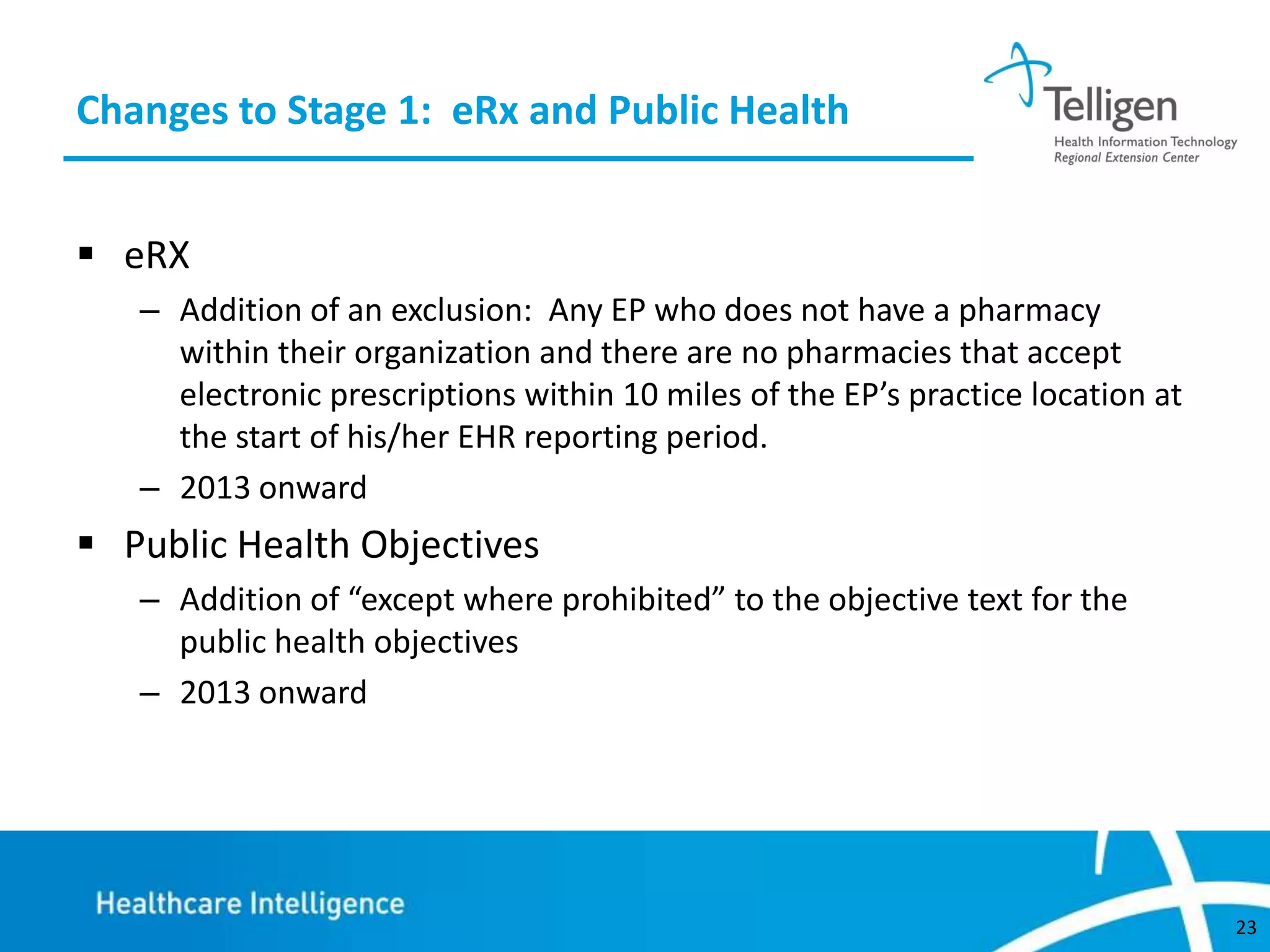
Changes to Stage 1: eRx and Public Health
 eRX
– Addition of an exclusion: Any EP who does not have a pharmacy
within their organization and there are no pharmacies that accept
electronic prescriptions within 10 miles of the EP’s practice location at
the start of his/her EHR reporting period.
– 2013 onward

 Public Health Objectives
– Addition of “except where prohibited” to the objective text for the
public health objectives
– 2013 onward

23
Stage 1 Meaningful Use Menu Objectives - 2014

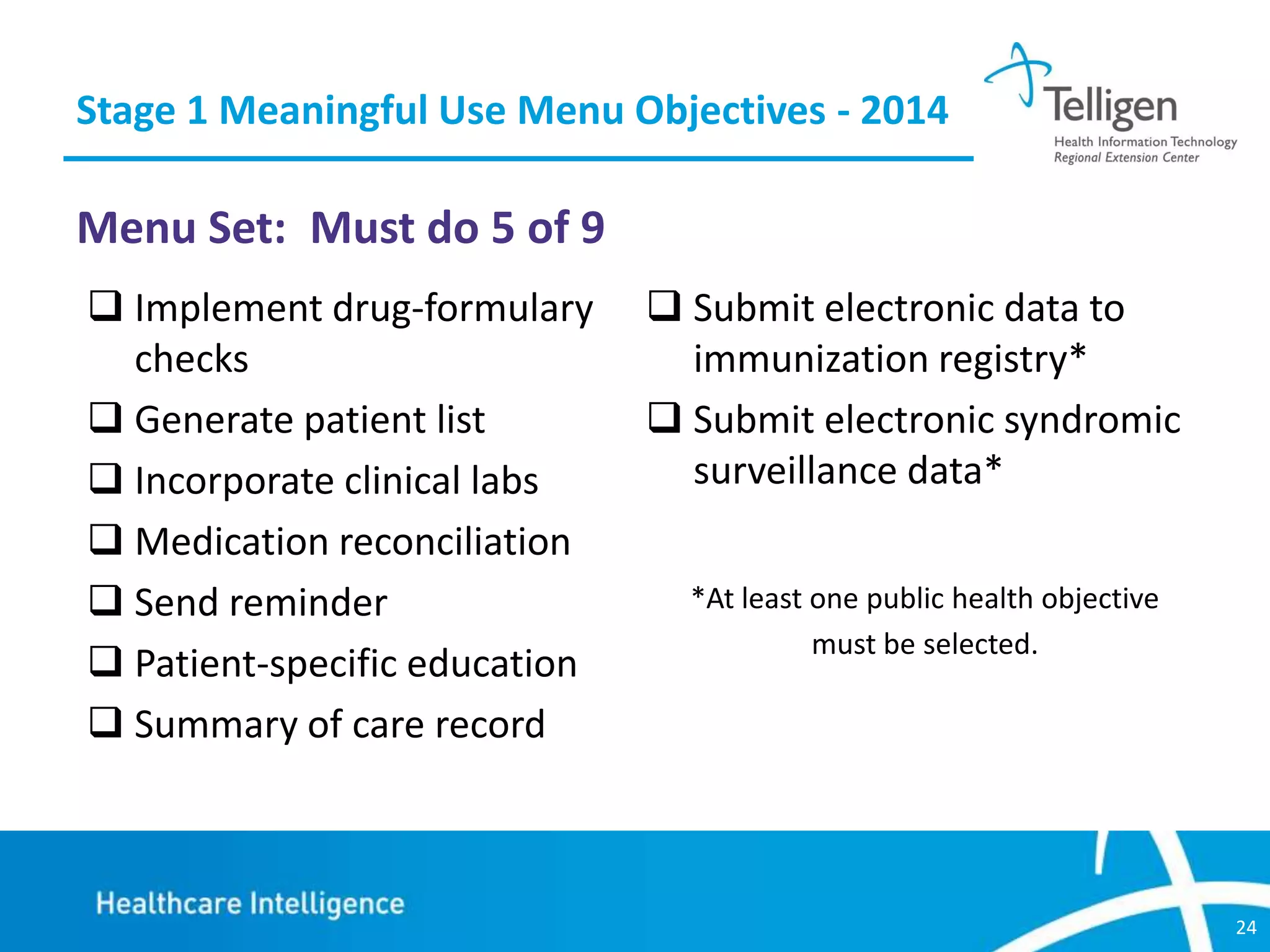
Menu Set: Must do 5 of 9
 Implement drug-formulary
checks
 Generate patient list
 Incorporate clinical labs
 Medication reconciliation
 Send reminder
 Patient-specific education
 Summary of care record

 Submit electronic data to
immunization registry*
 Submit electronic syndromic
surveillance data*
*At least one public health objective
must be selected.

24
CLINICAL QUALITY MEASURES

25
How Do CQMs Relate to the CMS
Incentive Programs?
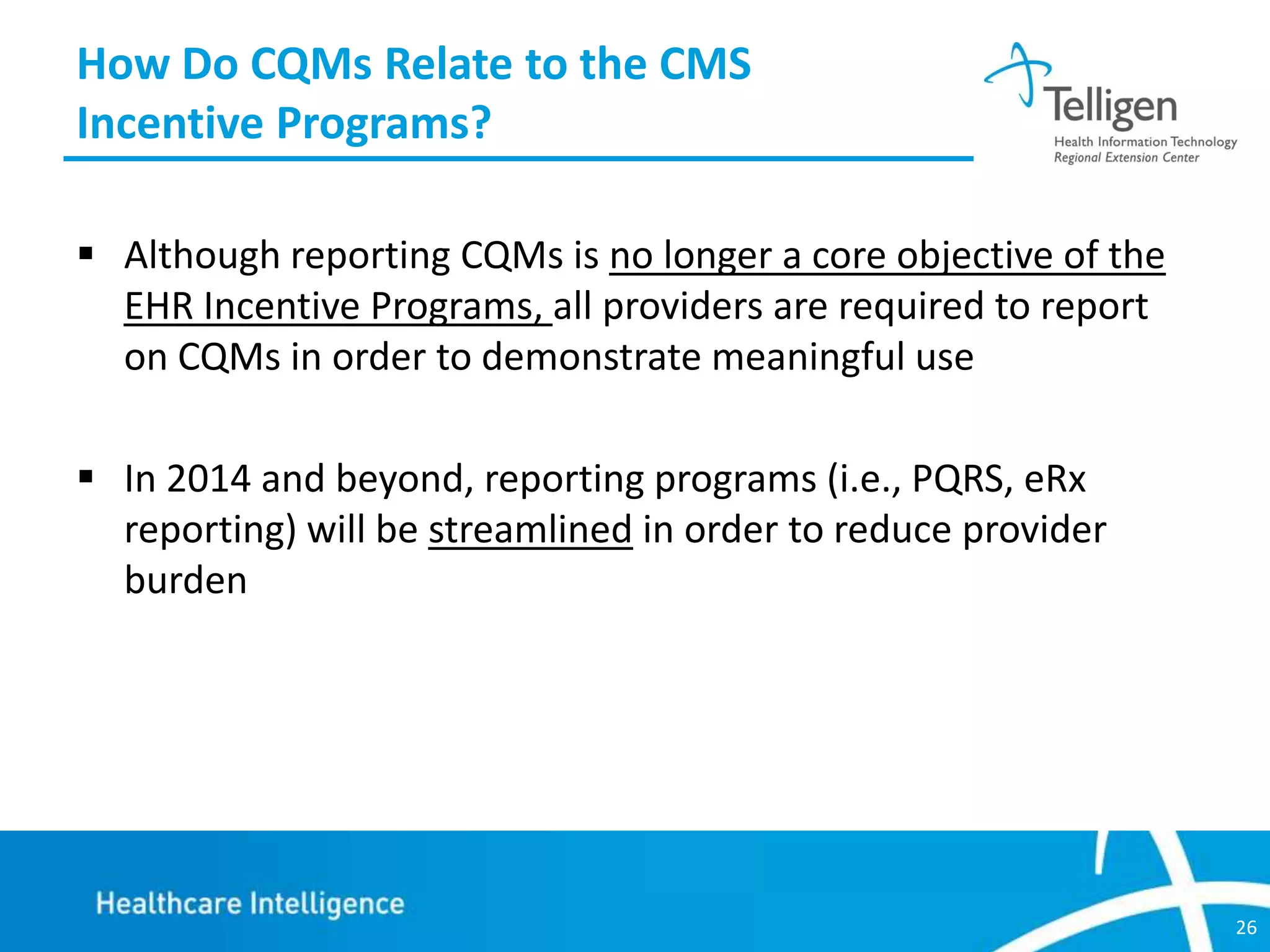
 Although reporting CQMs is no longer a core objective of the
EHR Incentive Programs, all providers are required to report
on CQMs in order to demonstrate meaningful use
 In 2014 and beyond, reporting programs (i.e., PQRS, eRx
reporting) will be streamlined in order to reduce provider
burden

26
CQMs in 2014 and Beyond
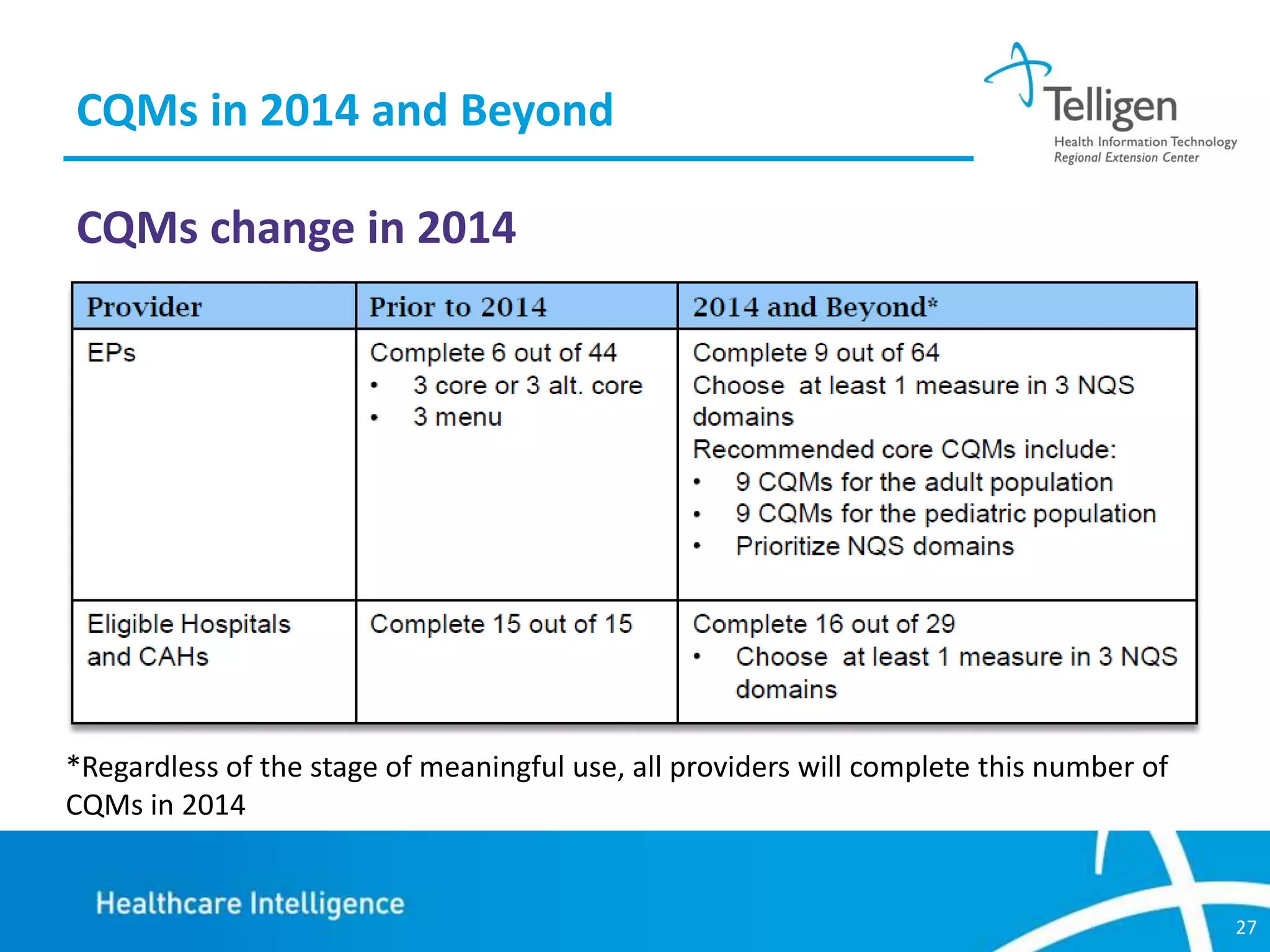
CQMs change in 2014

*Regardless of the stage of meaningful use, all providers will complete this number of
CQMs in 2014

27
CQM Alignment with HHS Priorities
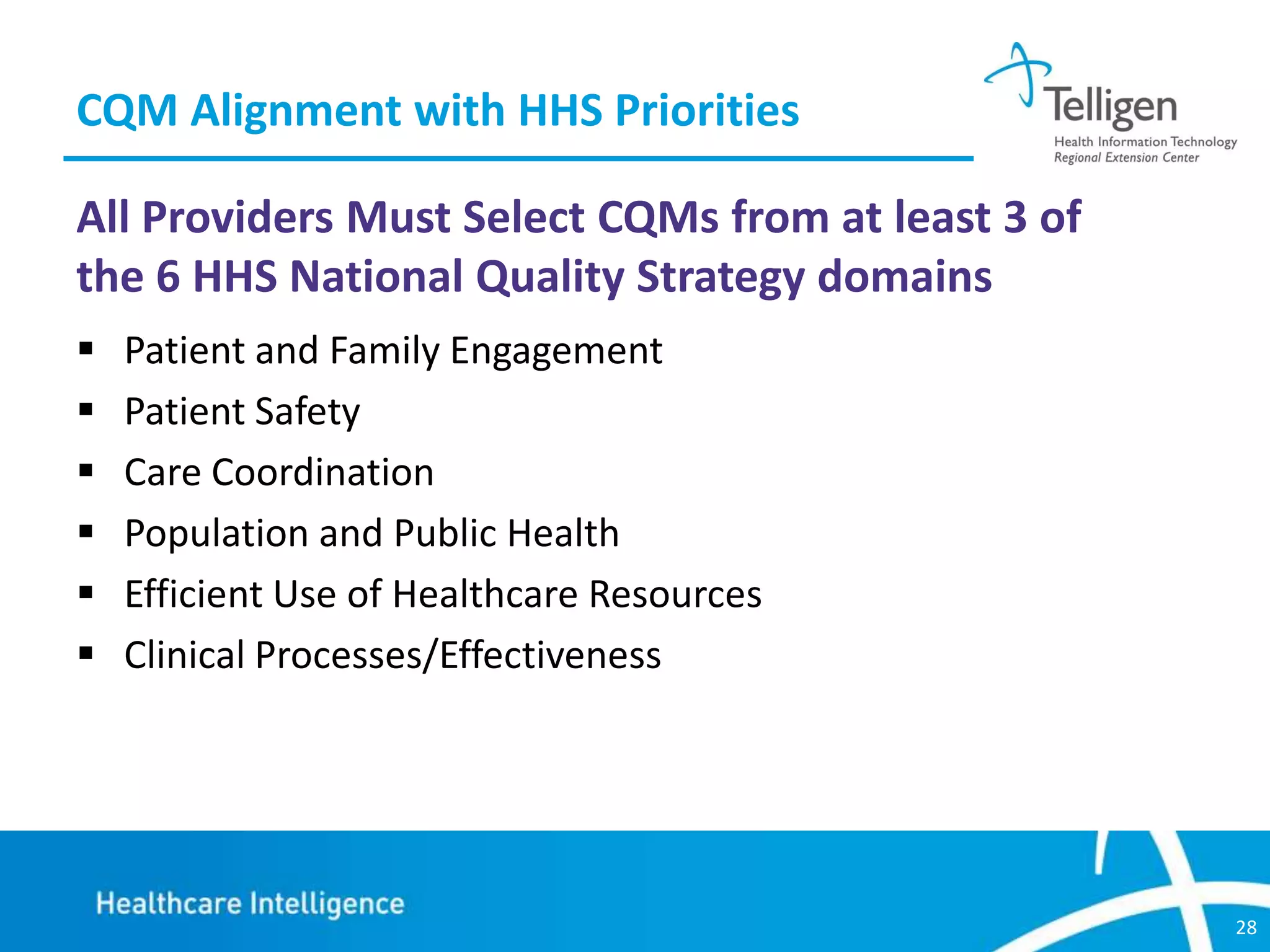
All Providers Must Select CQMs from at least 3 of
the 6 HHS National Quality Strategy domains







Patient and Family Engagement
Patient Safety
Care Coordination
Population and Public Health
Efficient Use of Healthcare Resources
Clinical Processes/Effectiveness

28
CQMs in 2014 and Beyond
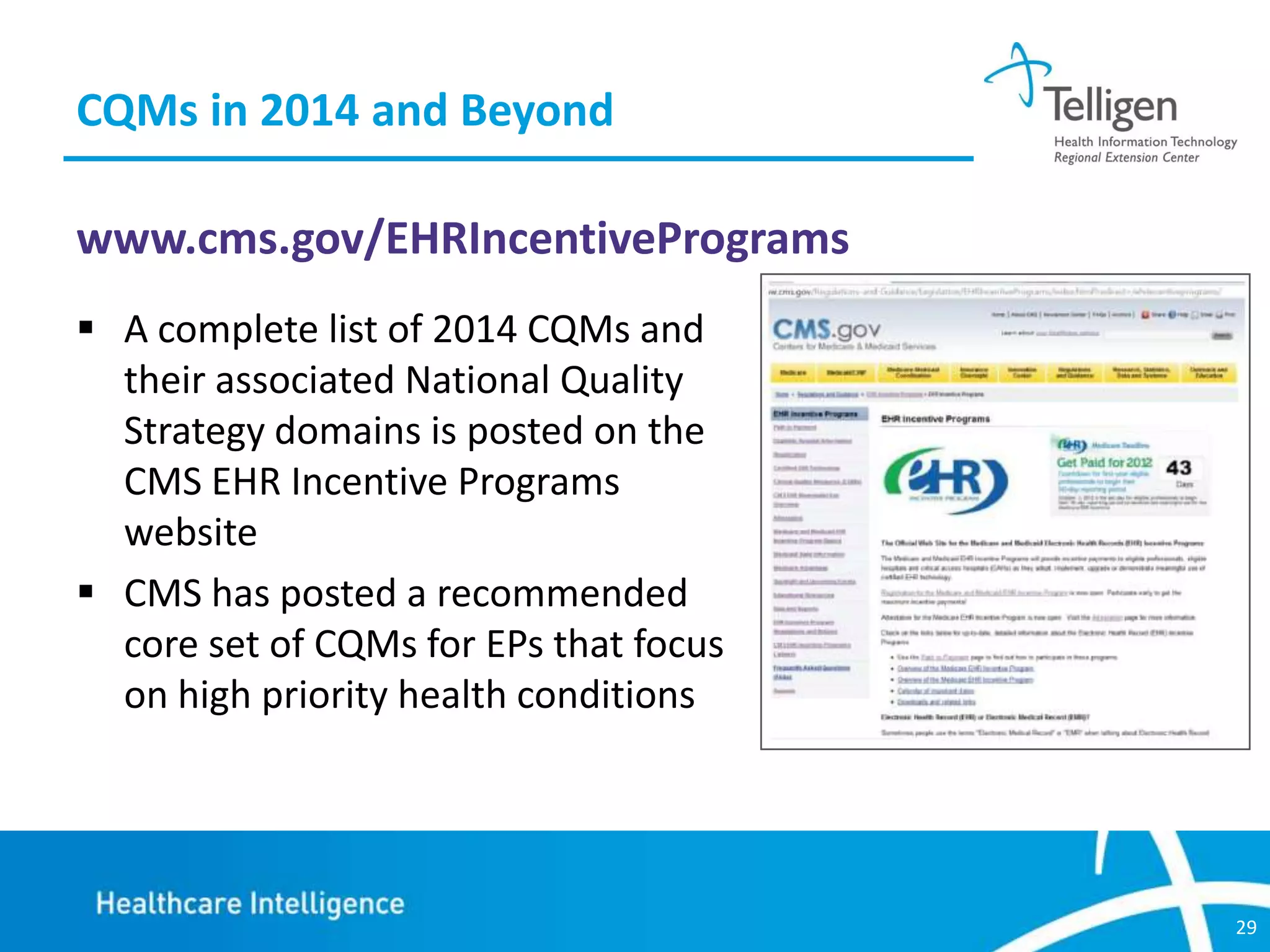
www.cms.gov/EHRIncentivePrograms
 A complete list of 2014 CQMs and
their associated National Quality
Strategy domains is posted on the
CMS EHR Incentive Programs
website
 CMS has posted a recommended
core set of CQMs for EPs that focus
on high priority health conditions

29
CLINICAL QUALITY MEASURES
REPORTING MECHANISMS

30
Reporting CQMs in 2014 and Beyond
 Beginning in 2014, all Medicare-eligible providers in
their second year and beyond of demonstrating
meaningful use must electronically report their CQM
data to CMS
 Michigan Medicaid providers will possibly electronically
report their CQM data to their state in 2015.

31
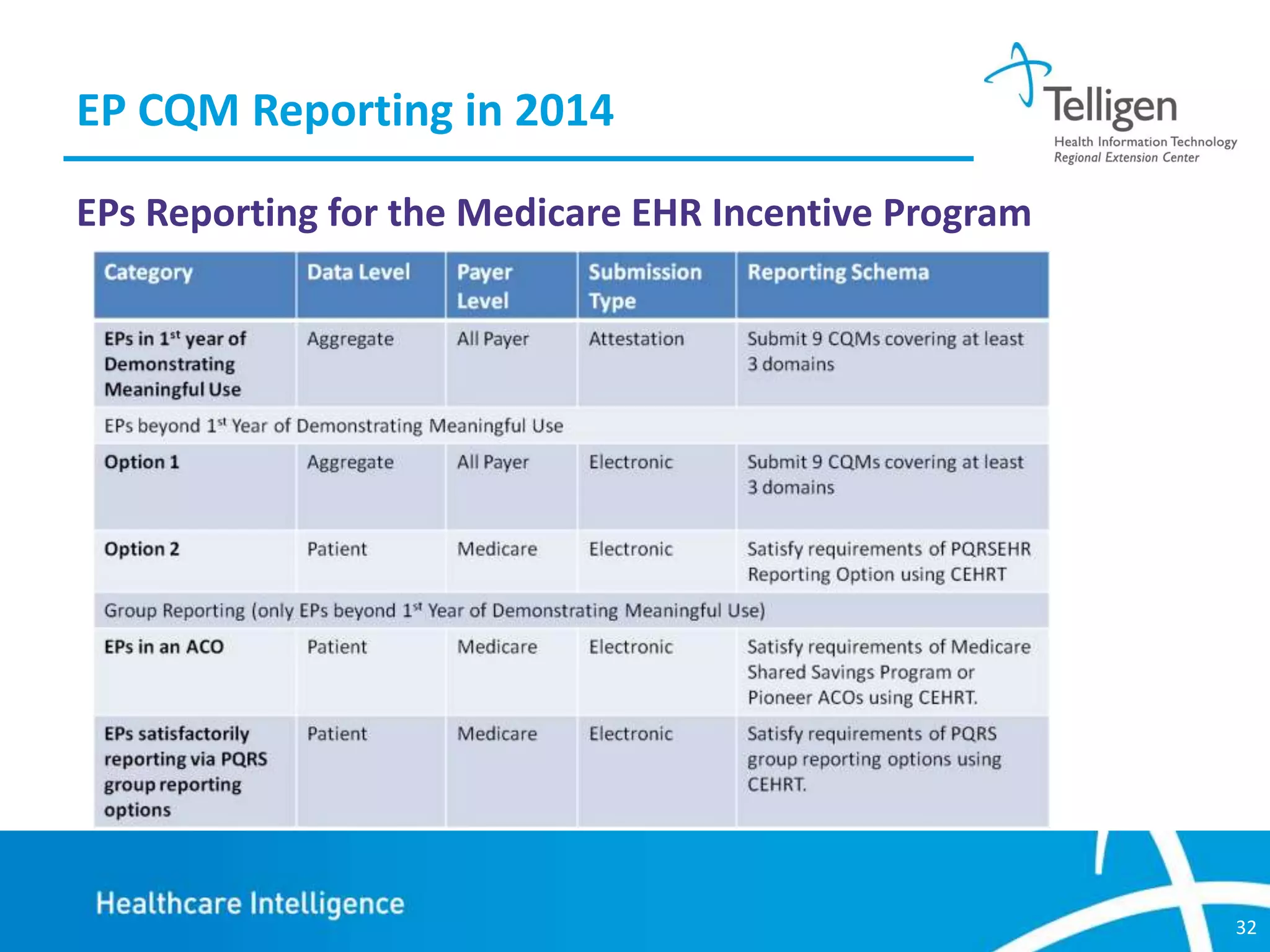
EP CQM Reporting in 2014
EPs Reporting for the Medicare EHR Incentive Program

32
PAYMENT ADJUSTMENTS AND
HARDSHIP EXEMPTIONS
(MEDICARE ONLY)

33
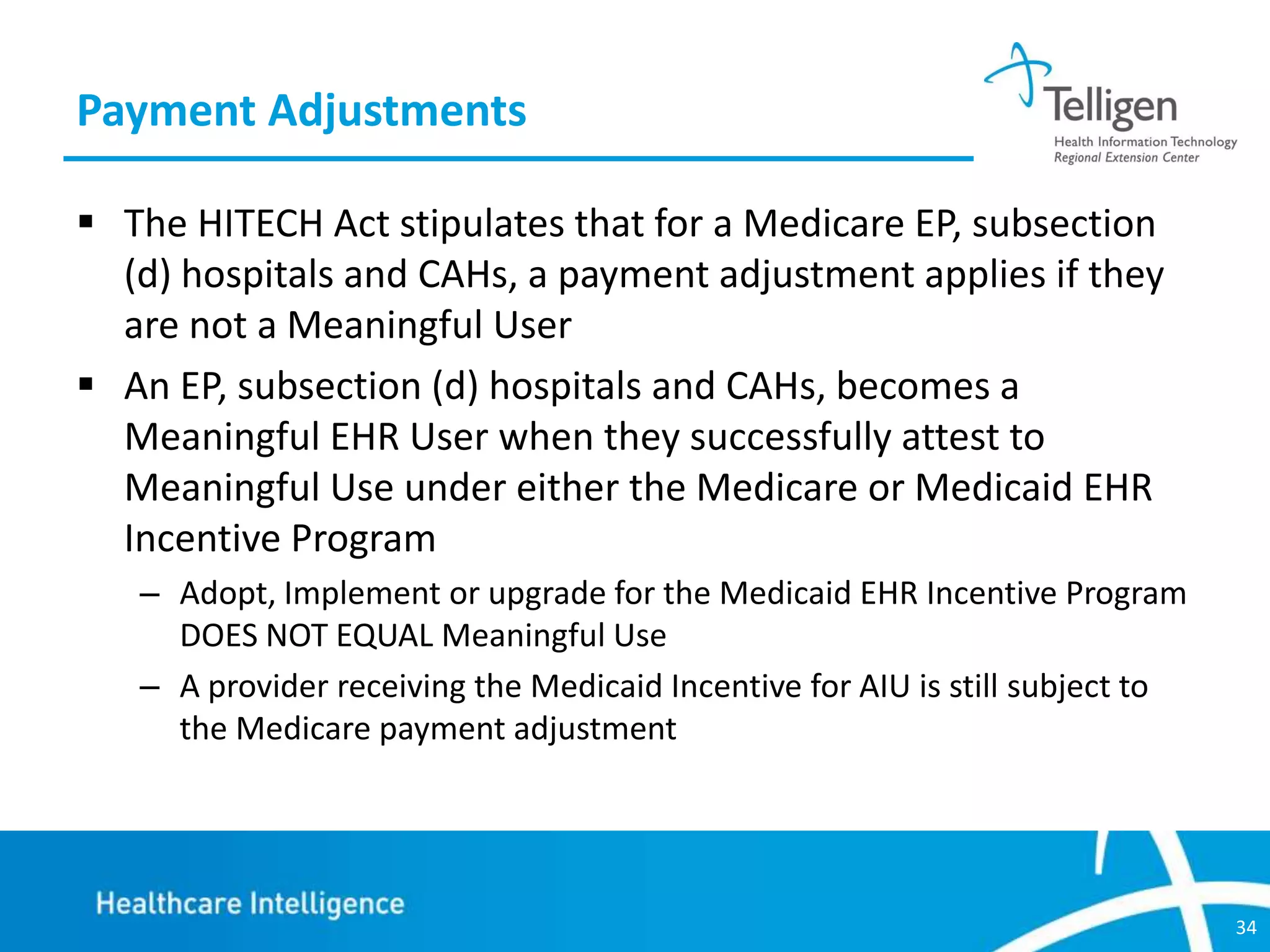
Payment Adjustments
 The HITECH Act stipulates that for a Medicare EP, subsection
(d) hospitals and CAHs, a payment adjustment applies if they
are not a Meaningful User
 An EP, subsection (d) hospitals and CAHs, becomes a
Meaningful EHR User when they successfully attest to
Meaningful Use under either the Medicare or Medicaid EHR
Incentive Program
– Adopt, Implement or upgrade for the Medicaid EHR Incentive Program
DOES NOT EQUAL Meaningful Use
– A provider receiving the Medicaid Incentive for AIU is still subject to
the Medicare payment adjustment

34
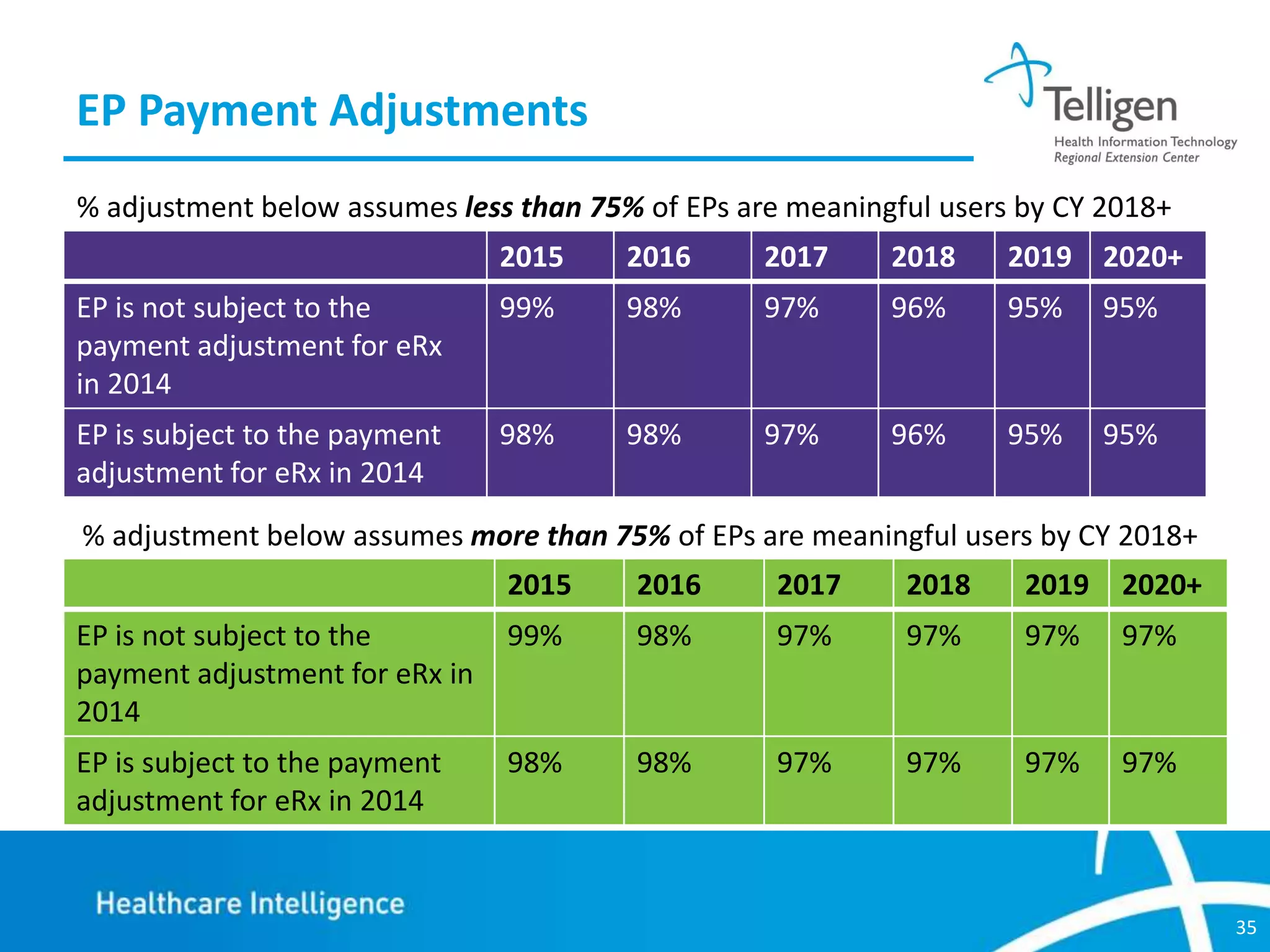
EP Payment Adjustments
% adjustment below assumes less than 75% of EPs are meaningful users by CY 2018+
2015

2016

2017

2018

2019 2020+

EP is not subject to the
payment adjustment for eRx
in 2014

99%

98%

97%

96%

95%

95%

EP is subject to the payment
adjustment for eRx in 2014

98%

98%

97%

96%

95%

95%

% adjustment below assumes more than 75% of EPs are meaningful users by CY 2018+
2015

2016

2017

2018

2019

2020+

EP is not subject to the
payment adjustment for eRx in
2014

99%

98%

97%

97%

97%

97%

EP is subject to the payment
adjustment for eRx in 2014

98%

98%

97%

97%

97%

97%

35
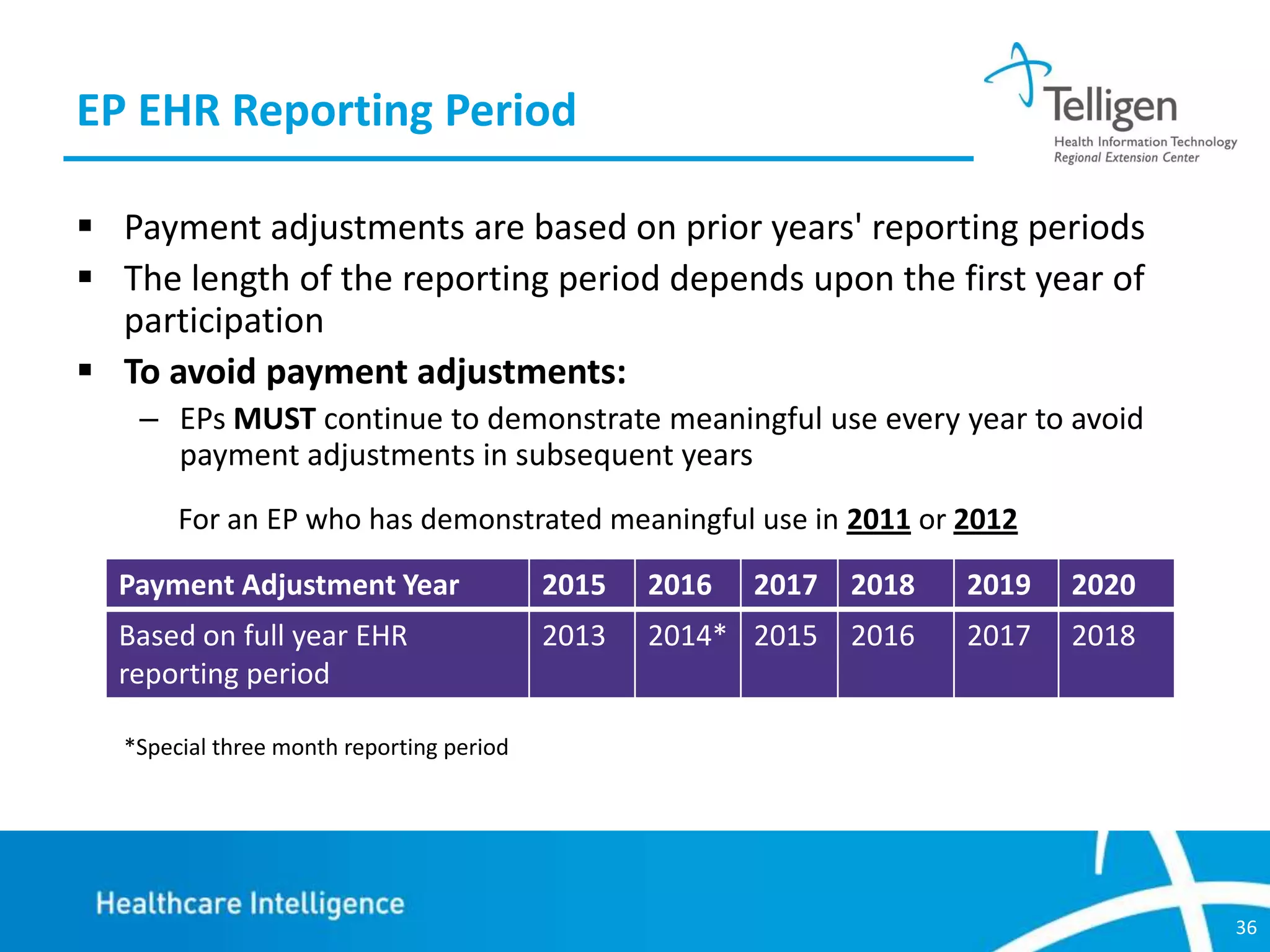
EP EHR Reporting Period
 Payment adjustments are based on prior years' reporting periods
 The length of the reporting period depends upon the first year of
participation
 To avoid payment adjustments:
– EPs MUST continue to demonstrate meaningful use every year to avoid
payment adjustments in subsequent years
For an EP who has demonstrated meaningful use in 2011 or 2012
Payment Adjustment Year

2015

2016

2017

2018

2019

2020

Based on full year EHR
reporting period

2013

2014* 2015

2016

2017

2018

*Special three month reporting period

36
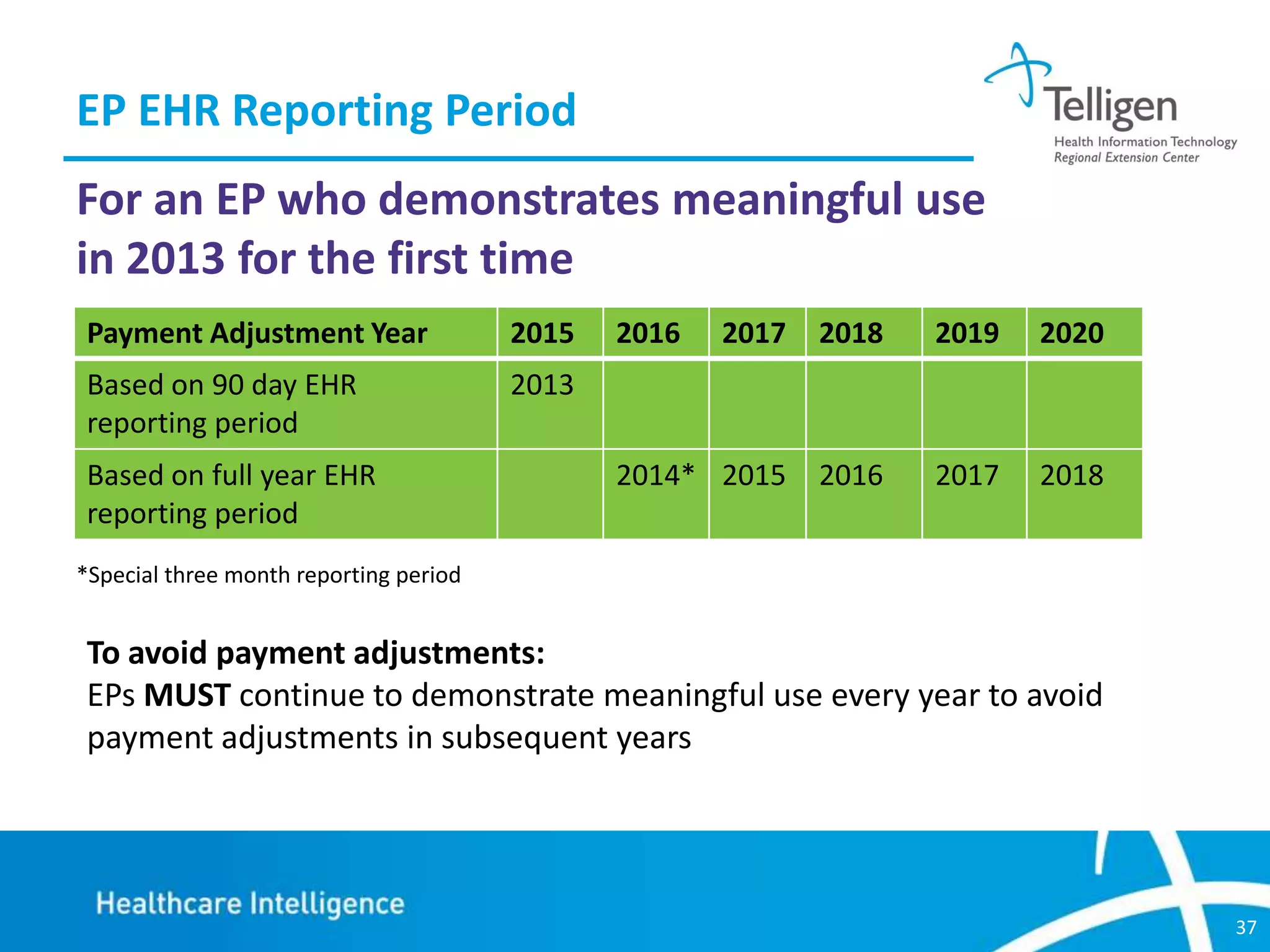
EP EHR Reporting Period
For an EP who demonstrates meaningful use
in 2013 for the first time
Payment Adjustment Year

2015

Based on 90 day EHR
reporting period

2013

Based on full year EHR
reporting period

2016

2017

2018

2019

2020

2014* 2015

2016

2017

2018

*Special three month reporting period

To avoid payment adjustments:
EPs MUST continue to demonstrate meaningful use every year to avoid
payment adjustments in subsequent years

37
EP EHR Reporting Period
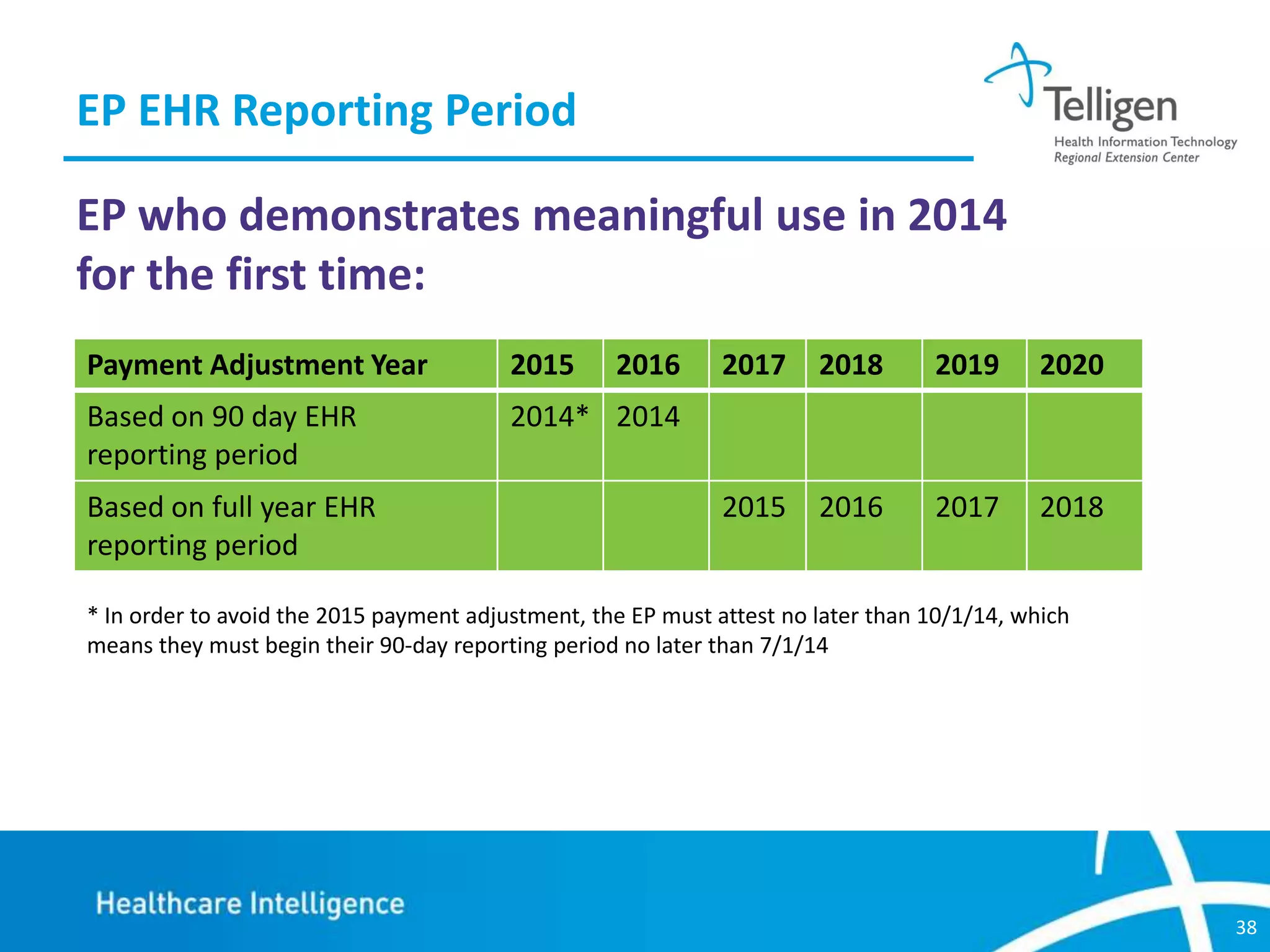
EP who demonstrates meaningful use in 2014
for the first time:
Payment Adjustment Year

2015

Based on 90 day EHR
reporting period

2014* 2014

Based on full year EHR
reporting period

2016

2017

2018

2019

2020

2015

2016

2017

2018

* In order to avoid the 2015 payment adjustment, the EP must attest no later than 10/1/14, which
means they must begin their 90-day reporting period no later than 7/1/14

38
Payment Adjustments for Providers
Eligible for Both Programs
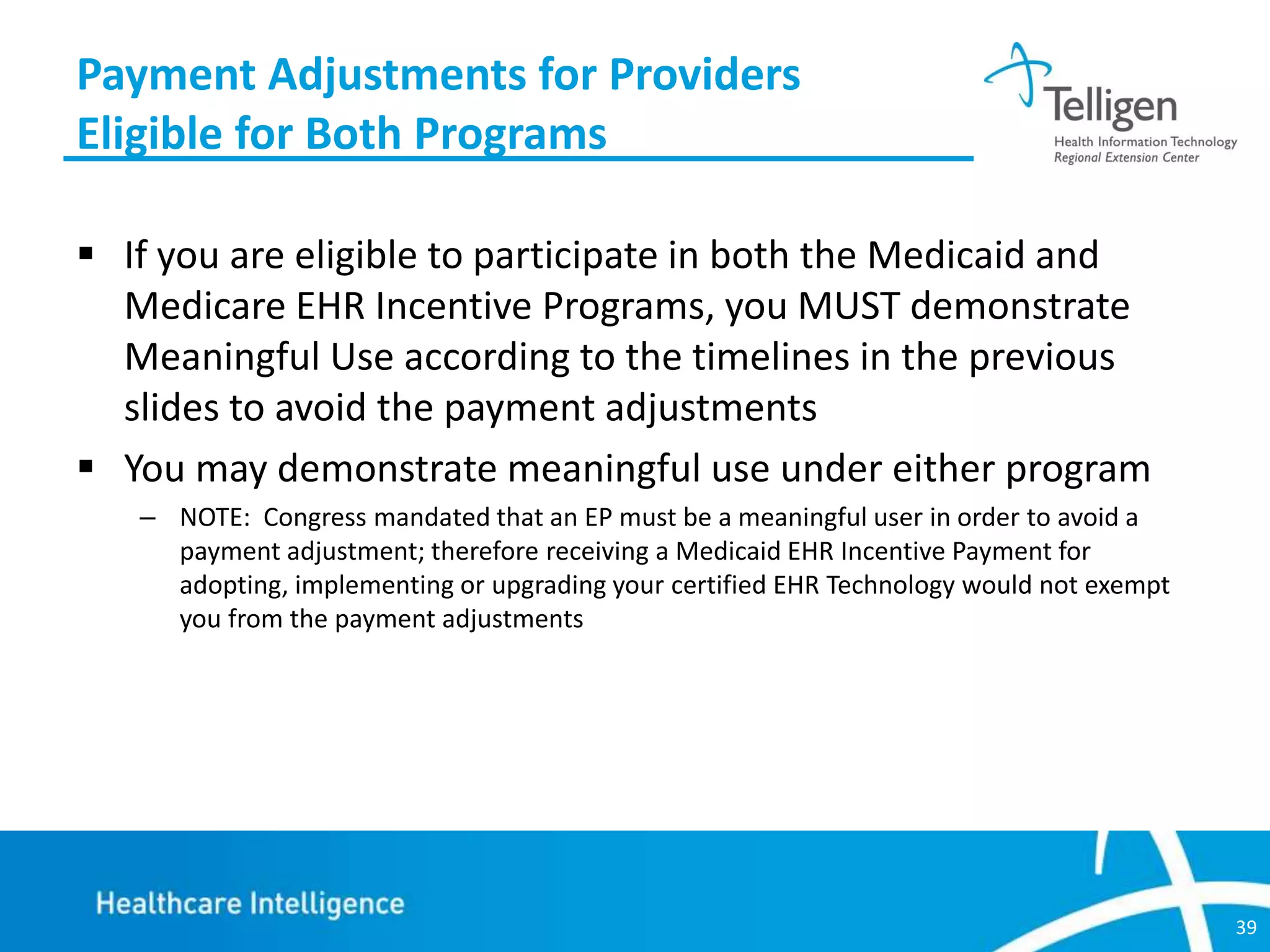
 If you are eligible to participate in both the Medicaid and
Medicare EHR Incentive Programs, you MUST demonstrate
Meaningful Use according to the timelines in the previous
slides to avoid the payment adjustments
 You may demonstrate meaningful use under either program
– NOTE: Congress mandated that an EP must be a meaningful user in order to avoid a
payment adjustment; therefore receiving a Medicaid EHR Incentive Payment for
adopting, implementing or upgrading your certified EHR Technology would not exempt
you from the payment adjustments

39
EP Hardship Exceptions
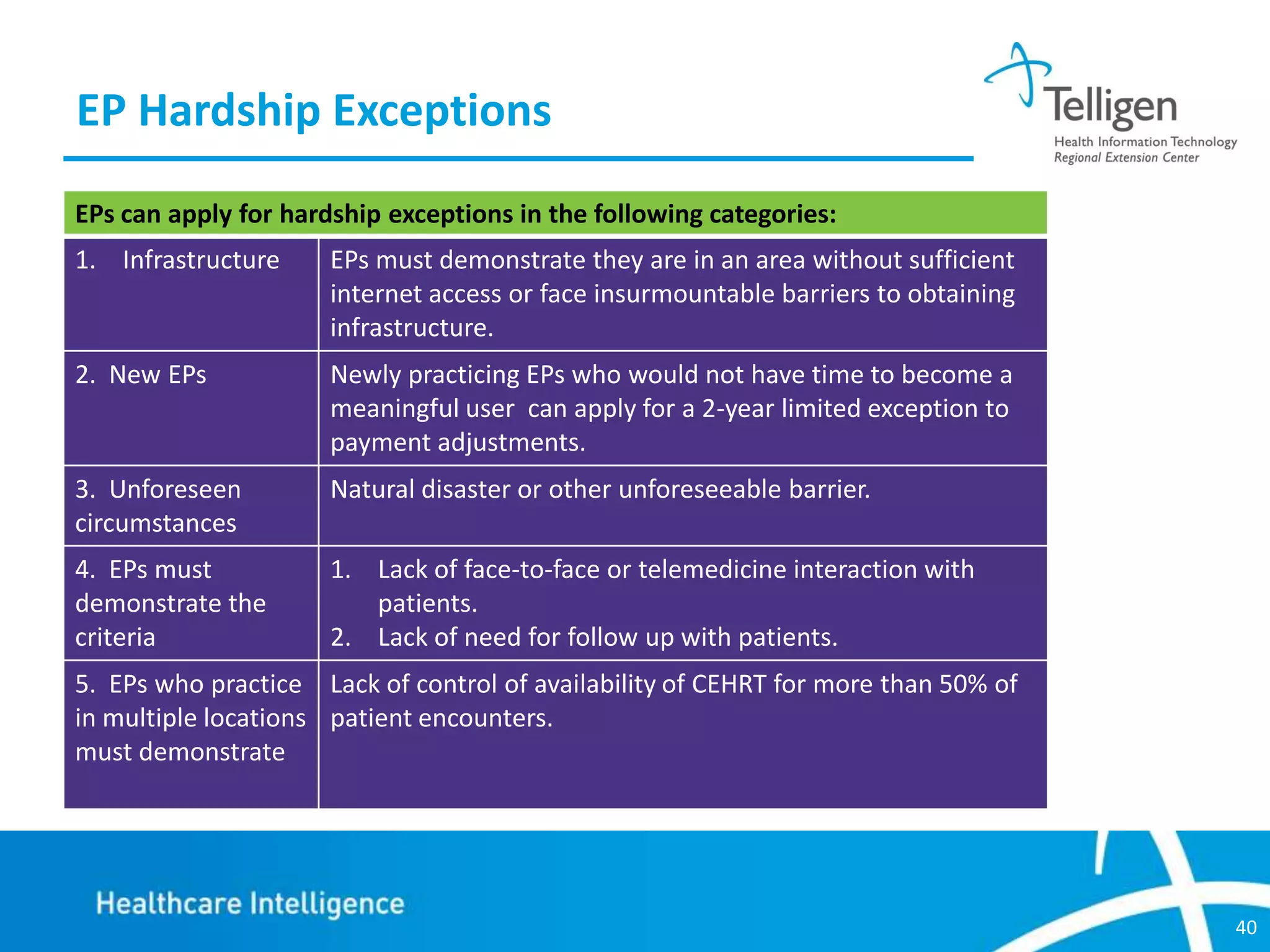
EPs can apply for hardship exceptions in the following categories:
1. Infrastructure

EPs must demonstrate they are in an area without sufficient
internet access or face insurmountable barriers to obtaining
infrastructure.

2. New EPs

Newly practicing EPs who would not have time to become a
meaningful user can apply for a 2-year limited exception to
payment adjustments.

3. Unforeseen
circumstances

Natural disaster or other unforeseeable barrier.

4. EPs must
demonstrate the
criteria

1. Lack of face-to-face or telemedicine interaction with
patients.
2. Lack of need for follow up with patients.

5. EPs who practice Lack of control of availability of CEHRT for more than 50% of
in multiple locations patient encounters.
must demonstrate

40
Applying for Hardship Exceptions
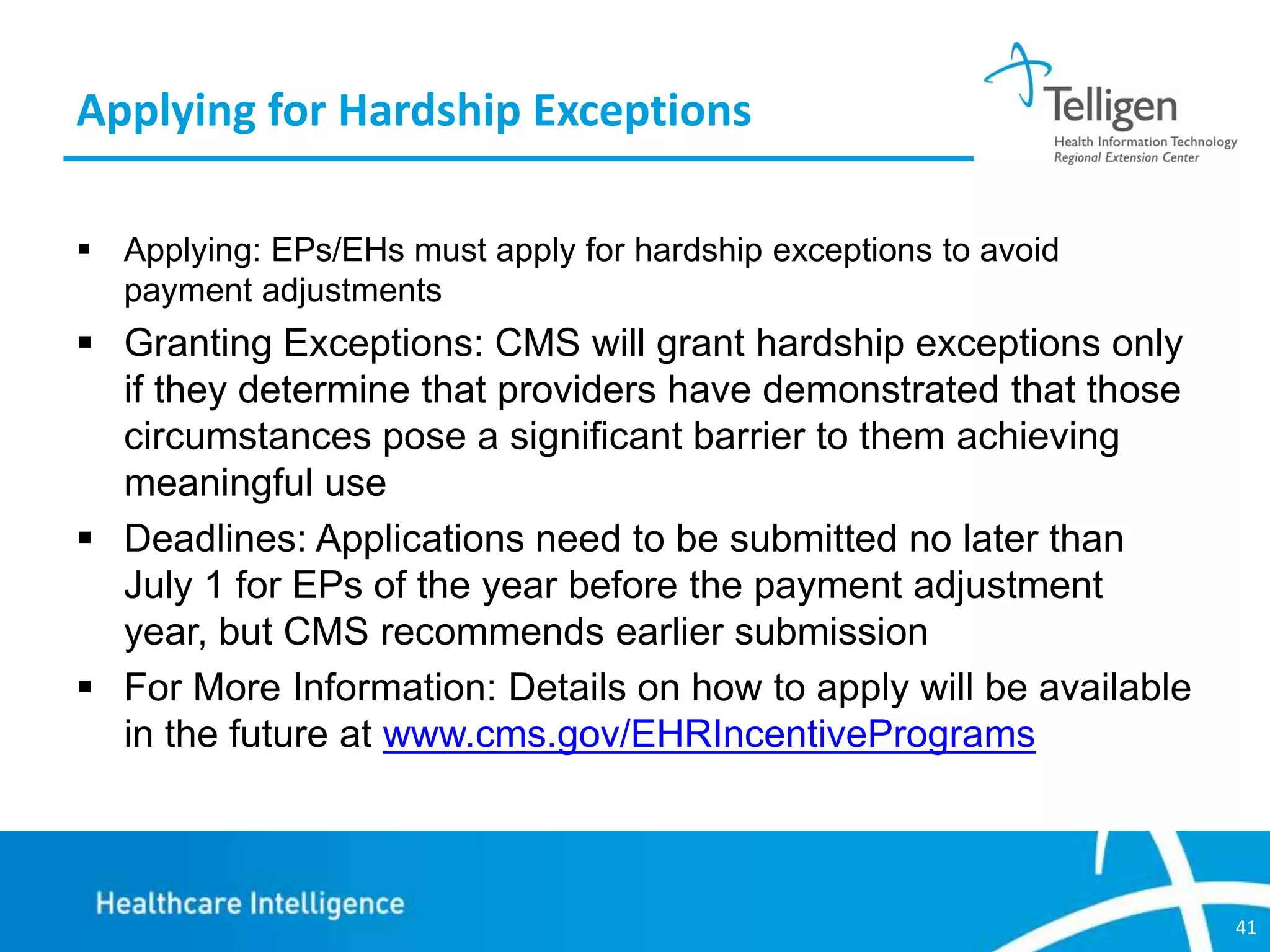
 Applying: EPs/EHs must apply for hardship exceptions to avoid
payment adjustments

 Granting Exceptions: CMS will grant hardship exceptions only
if they determine that providers have demonstrated that those
circumstances pose a significant barrier to them achieving
meaningful use
 Deadlines: Applications need to be submitted no later than
July 1 for EPs of the year before the payment adjustment
year, but CMS recommends earlier submission
 For More Information: Details on how to apply will be available
in the future at www.cms.gov/EHRIncentivePrograms

41
MEDICAID PROGRAM SPECIFIC CHANGES

42
Medicaid Eligibility Expansion
Patient Encounters
 Definition of patient encounter has changed
 The rule includes encounters for anyone enrolled in the
Medicaid program, including Medicaid expansion encounters
(except stand-alone Title 21) and those with zero-pay claims
 The rule adds flexibility in the look-back period for overall
patient volume

43
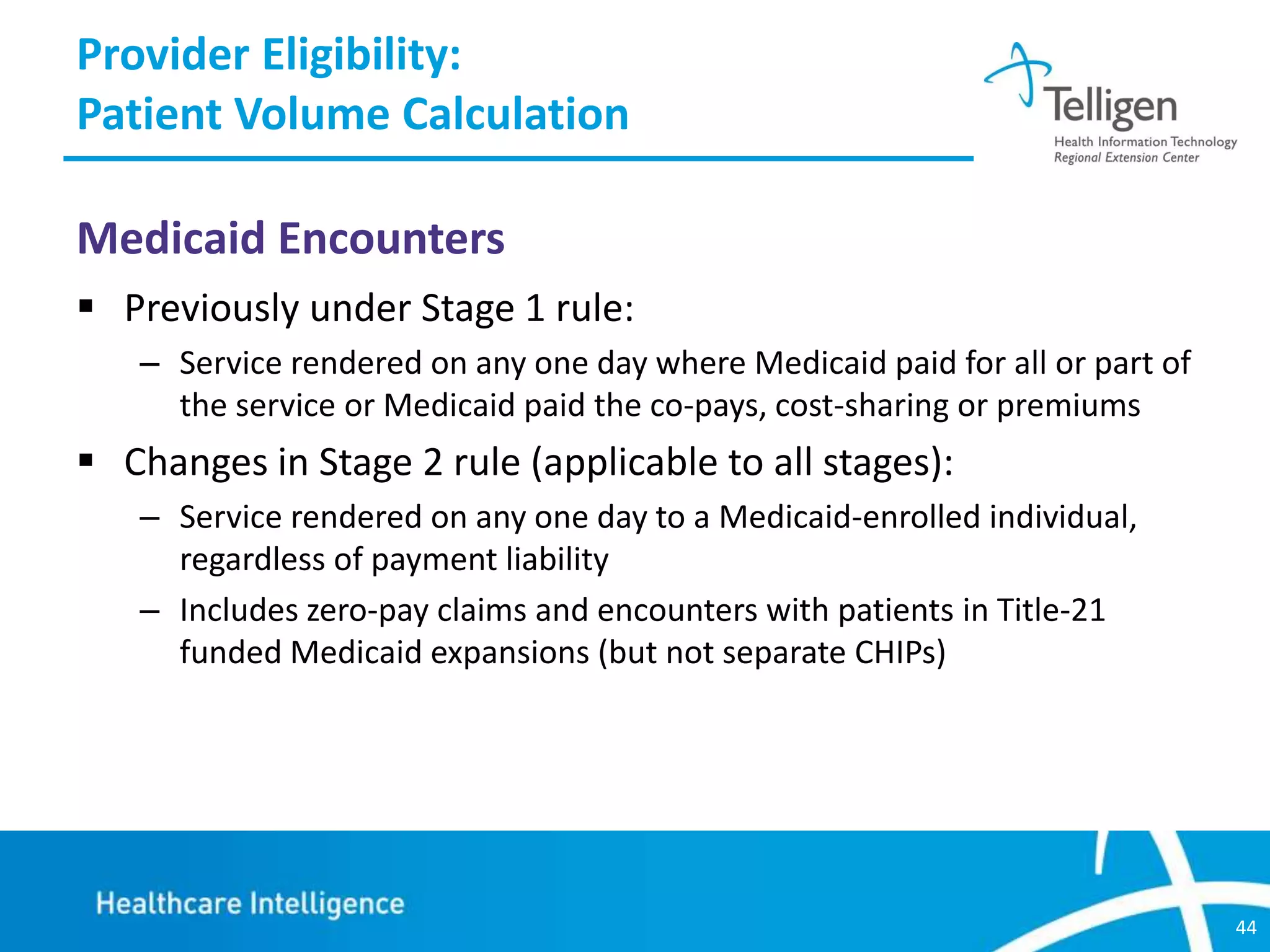
Provider Eligibility:
Patient Volume Calculation
Medicaid Encounters
 Previously under Stage 1 rule:
– Service rendered on any one day where Medicaid paid for all or part of
the service or Medicaid paid the co-pays, cost-sharing or premiums

 Changes in Stage 2 rule (applicable to all stages):
– Service rendered on any one day to a Medicaid-enrolled individual,
regardless of payment liability
– Includes zero-pay claims and encounters with patients in Title-21
funded Medicaid expansions (but not separate CHIPs)

44
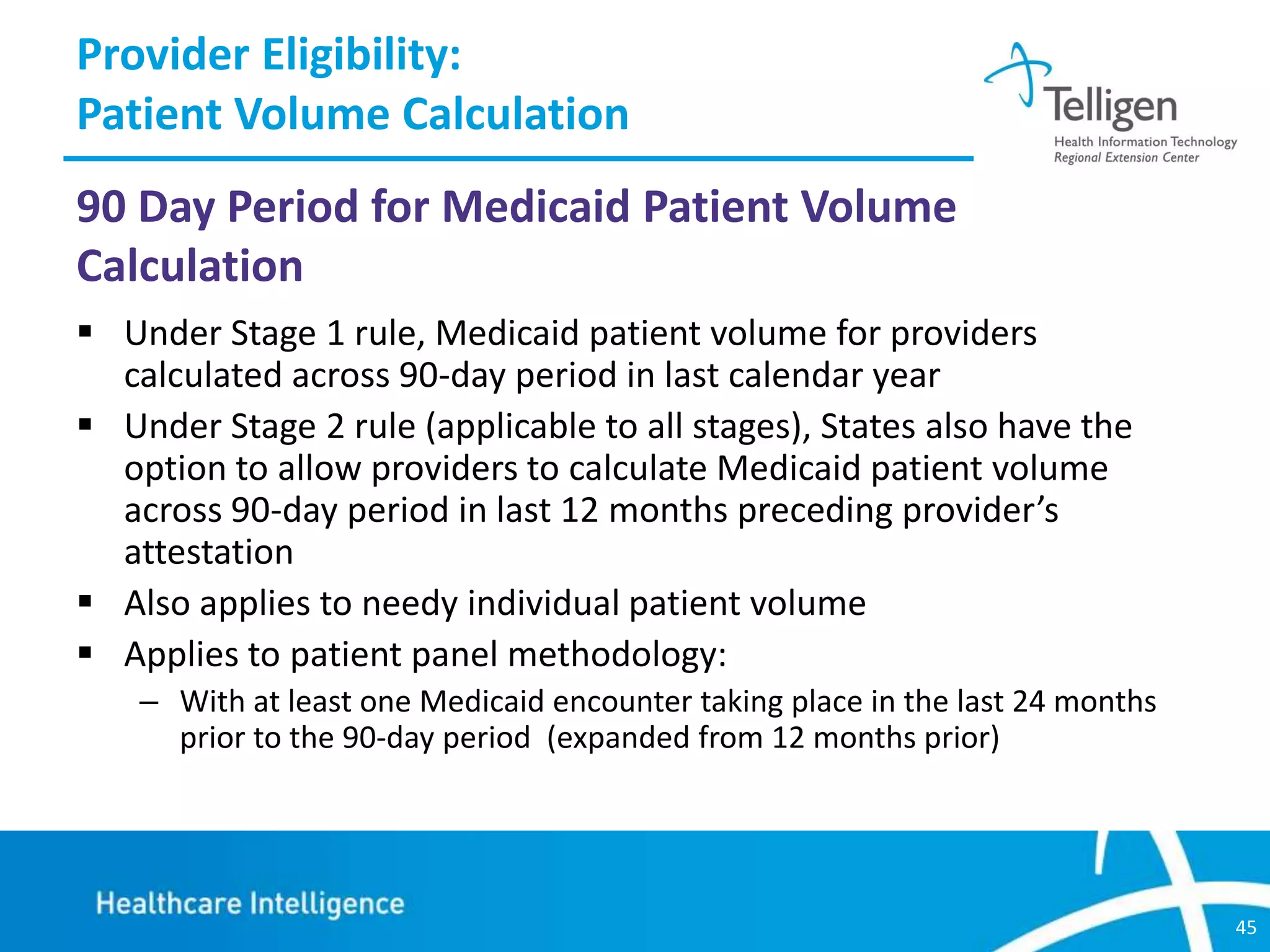
Provider Eligibility:
Patient Volume Calculation
90 Day Period for Medicaid Patient Volume
Calculation
 Under Stage 1 rule, Medicaid patient volume for providers
calculated across 90-day period in last calendar year
 Under Stage 2 rule (applicable to all stages), States also have the
option to allow providers to calculate Medicaid patient volume
across 90-day period in last 12 months preceding provider’s
attestation
 Also applies to needy individual patient volume
 Applies to patient panel methodology:
– With at least one Medicaid encounter taking place in the last 24 months
prior to the 90-day period (expanded from 12 months prior)

45
RESOURCES

46
Stage 2 Resources
CMS Stage 2 Website
 http://www.cms.gov/Regulations-and
Guidance/Legislation/EHRIncentivePrograms/Stage_2.html
 Links to the Federal Register
 Tip Sheets:
– Stage 1 Changes
– 2014 Clinical Quality Measures
– Payment Adjustments & Hardship Exceptions

47
Contact Us
Michelle Brunsen
Sr. Health IT Advisor
mbrunsen@telligen.org
(515) 453-8180

www.telligenhitrec.org
@TelligenHITREC

In Partnership with: The Office of the National Coordinator for Health Information Technology (ONC) U.S. Department of
Health and Human Services grant 90RC0004/01.
IA-HITREC-05/13-794

48

Meaningful Use Stage 1 Changes for Eligible Professionals in 2014

  • 1.
    Meaningful Use Stage1 Changes for Eligible Professionals in 2014 Michelle Brunsen, Sr. Health IT Advisor
  • 2.
    Today’s Objectives       ARRA Backgroundand Incentive Program Statistics 2014 Timelines for EHR Vendors and Eligible Professionals Changes to Stage 1 Meaningful Use Clinical Quality Measures Payment Adjustments and Hardships Medicaid Program Specific Changes 2
  • 3.
  • 4.
    Where Did MeaningfulUse Begin? American Reinvestment and Recovery Act of 2009 “Stimulus Bill”  HITECH Act: All healthcare providers must adopt electronic health records by 2015  CMS EHR Incentive Program established for Meaningful Use  Office of the National Coordinator Funded 60+ RECs  ONC Funded the creation of Health Information Exchanges in every state  ONC website: www.healthit.hhs.gov 4
  • 5.
    EPs Paid ByMedicare or Medicaid 5
  • 6.
    Payments to EligibleProfessionals National Payments as of October 2013  130,669 payments to Medicaid Eligible Professionals (33.9%)  255,282 payments to Medicare Eligible Professionals (66.1%)  Total Medicare and Medicaid payments of $6.428B 6
  • 7.
  • 8.
    Payments to EligibleProfessionals Michigan Payments as of October 2013  3,365 Medicaid Eligible Professionals have been paid (27.8%)  8,737 Medicare Eligible Professionals have been paid (72.2%)  Total Medicare and Medicaid payments to Michigan of $572M 8
  • 9.
    2014 TIMELINES FOREHR VENDORS AND ELIGIBLE PROFESSIONALS 9
  • 10.
    Point to Remember Stage 1 is a stepping stone to Stage 2 which is a stepping stone to Stage 3 10
  • 11.
    What is YourMeaningful Use Path? 11
  • 12.
    Starting in 2014 Changes  EHRsMeeting ONC 2014 Standards – Starting in 2014, all EHR Incentive Program participants will have to adopt certified EHR technology that meets ONC’s Standards & Certification Criteria 2014 Final Rule 12
  • 13.
    What does thismean for EPs?  Pay your annual maintenance/support with your EHR vendor  Speak with a representative from your EHR vendor to get in the queue to receive the 2014 upgrade  Install the 2014 EHR version as soon as possible  Start educating your patients about the patient portal, collecting email addresses 13
  • 14.
    2014 Reporting Period ReportingPeriod Reduced to Three Months  To allow providers time to adopt 2014 certified EHR technology and prepare for Stage 2  Regardless of Meaningful Use stage or year 14
  • 15.
    What does thismean for EPs?  All participants will have one calendar quarter reporting period in 2014  Medicare and Medicaid = 1 quarter  Jan – Mar, Apr – June, July – Sep, Oct – Dec  Stage 1 Year 1 attesting for first time – MUST attest NO LATER THAN 10/1/14 to avoid a disincentive and use reporting period of Q1, Q2 or Q3 15
  • 16.
    CHANGES TO STAGE1 MEANINGFUL USE 16
  • 17.
    Meaningful Use: Stage1 in 2014 Eligible Professionals 2013 2014 14 Core Objectives 13 Core Objectives 5 of 10 Menu Objectives 5 of 9 Menu Objectives 19 Total Objectives 18 Total Objectives 17
  • 18.
    Stage 1 MeaningfulUse Core Objectives - 2014 Core Set: Must Do All 13  E-prescribing  Drug-drug & drug allergy checks  Medication list  Allergy list  CPOE  Problem list  Clinical decision support rule  Record demographics  Smoking status  Vital signs  Clinical summaries to patient  View, download & transmit  Protect health information 18
  • 19.
    Changes to Stage1: CPOE Current Stage 1 Measure Denominator Unique patient with at least one medication in the medication list New Stage 1 Option Denominator Number of orders during the EHR Reporting Period The optional CPOE denominator is available in 2013 and beyond for Stage 1. Includes Certified Medical Assistants beginning in 2013. 19
  • 20.
    Changes to Stage1: Vital Signs in 2014 2013 Stage 1 Measure Age Limits Age 2 for BP and Height/Weight Exclusion All 3 elements not relevant to the scope of practice 2014 Stage 1 Measure Age Limits Age 3 for BP, NO age limit for Height/Weight Exclusion BP to be separated from height/weight The vital signs changes are required starting in 2014 20
  • 21.
    Changes to Stage1: Testing of HIE Current Stage 1 Measure One test of electronic transmission of key clinical information Stage 1 Measure Removed Requirement removed for 2013 The removal of this objective is effective in 2013 21
  • 22.
    Changes to Stage1: View, Download and Transmit (VDT) Health Information 2013 Stage 1 Objective Objective 2014 Stage 1 Objective Provide patients with e-copy of health information upon request Provide electronic copy of health information Objective Provide patients with the ability to view online, download and transmit their health information The measure of the new objective is 50 percent of patients have online access to their information The change in objective takes effect in 2014 to coincide with the 2014 certification and standards criteria 22
  • 23.
    Changes to Stage1: eRx and Public Health  eRX – Addition of an exclusion: Any EP who does not have a pharmacy within their organization and there are no pharmacies that accept electronic prescriptions within 10 miles of the EP’s practice location at the start of his/her EHR reporting period. – 2013 onward  Public Health Objectives – Addition of “except where prohibited” to the objective text for the public health objectives – 2013 onward 23
  • 24.
    Stage 1 MeaningfulUse Menu Objectives - 2014 Menu Set: Must do 5 of 9  Implement drug-formulary checks  Generate patient list  Incorporate clinical labs  Medication reconciliation  Send reminder  Patient-specific education  Summary of care record  Submit electronic data to immunization registry*  Submit electronic syndromic surveillance data* *At least one public health objective must be selected. 24
  • 25.
  • 26.
    How Do CQMsRelate to the CMS Incentive Programs?  Although reporting CQMs is no longer a core objective of the EHR Incentive Programs, all providers are required to report on CQMs in order to demonstrate meaningful use  In 2014 and beyond, reporting programs (i.e., PQRS, eRx reporting) will be streamlined in order to reduce provider burden 26
  • 27.
    CQMs in 2014and Beyond CQMs change in 2014 *Regardless of the stage of meaningful use, all providers will complete this number of CQMs in 2014 27
  • 28.
    CQM Alignment withHHS Priorities All Providers Must Select CQMs from at least 3 of the 6 HHS National Quality Strategy domains       Patient and Family Engagement Patient Safety Care Coordination Population and Public Health Efficient Use of Healthcare Resources Clinical Processes/Effectiveness 28
  • 29.
    CQMs in 2014and Beyond www.cms.gov/EHRIncentivePrograms  A complete list of 2014 CQMs and their associated National Quality Strategy domains is posted on the CMS EHR Incentive Programs website  CMS has posted a recommended core set of CQMs for EPs that focus on high priority health conditions 29
  • 30.
  • 31.
    Reporting CQMs in2014 and Beyond  Beginning in 2014, all Medicare-eligible providers in their second year and beyond of demonstrating meaningful use must electronically report their CQM data to CMS  Michigan Medicaid providers will possibly electronically report their CQM data to their state in 2015. 31
  • 32.
    EP CQM Reportingin 2014 EPs Reporting for the Medicare EHR Incentive Program 32
  • 33.
    PAYMENT ADJUSTMENTS AND HARDSHIPEXEMPTIONS (MEDICARE ONLY) 33
  • 34.
    Payment Adjustments  TheHITECH Act stipulates that for a Medicare EP, subsection (d) hospitals and CAHs, a payment adjustment applies if they are not a Meaningful User  An EP, subsection (d) hospitals and CAHs, becomes a Meaningful EHR User when they successfully attest to Meaningful Use under either the Medicare or Medicaid EHR Incentive Program – Adopt, Implement or upgrade for the Medicaid EHR Incentive Program DOES NOT EQUAL Meaningful Use – A provider receiving the Medicaid Incentive for AIU is still subject to the Medicare payment adjustment 34
  • 35.
    EP Payment Adjustments %adjustment below assumes less than 75% of EPs are meaningful users by CY 2018+ 2015 2016 2017 2018 2019 2020+ EP is not subject to the payment adjustment for eRx in 2014 99% 98% 97% 96% 95% 95% EP is subject to the payment adjustment for eRx in 2014 98% 98% 97% 96% 95% 95% % adjustment below assumes more than 75% of EPs are meaningful users by CY 2018+ 2015 2016 2017 2018 2019 2020+ EP is not subject to the payment adjustment for eRx in 2014 99% 98% 97% 97% 97% 97% EP is subject to the payment adjustment for eRx in 2014 98% 98% 97% 97% 97% 97% 35
  • 36.
    EP EHR ReportingPeriod  Payment adjustments are based on prior years' reporting periods  The length of the reporting period depends upon the first year of participation  To avoid payment adjustments: – EPs MUST continue to demonstrate meaningful use every year to avoid payment adjustments in subsequent years For an EP who has demonstrated meaningful use in 2011 or 2012 Payment Adjustment Year 2015 2016 2017 2018 2019 2020 Based on full year EHR reporting period 2013 2014* 2015 2016 2017 2018 *Special three month reporting period 36
  • 37.
    EP EHR ReportingPeriod For an EP who demonstrates meaningful use in 2013 for the first time Payment Adjustment Year 2015 Based on 90 day EHR reporting period 2013 Based on full year EHR reporting period 2016 2017 2018 2019 2020 2014* 2015 2016 2017 2018 *Special three month reporting period To avoid payment adjustments: EPs MUST continue to demonstrate meaningful use every year to avoid payment adjustments in subsequent years 37
  • 38.
    EP EHR ReportingPeriod EP who demonstrates meaningful use in 2014 for the first time: Payment Adjustment Year 2015 Based on 90 day EHR reporting period 2014* 2014 Based on full year EHR reporting period 2016 2017 2018 2019 2020 2015 2016 2017 2018 * In order to avoid the 2015 payment adjustment, the EP must attest no later than 10/1/14, which means they must begin their 90-day reporting period no later than 7/1/14 38
  • 39.
    Payment Adjustments forProviders Eligible for Both Programs  If you are eligible to participate in both the Medicaid and Medicare EHR Incentive Programs, you MUST demonstrate Meaningful Use according to the timelines in the previous slides to avoid the payment adjustments  You may demonstrate meaningful use under either program – NOTE: Congress mandated that an EP must be a meaningful user in order to avoid a payment adjustment; therefore receiving a Medicaid EHR Incentive Payment for adopting, implementing or upgrading your certified EHR Technology would not exempt you from the payment adjustments 39
  • 40.
    EP Hardship Exceptions EPscan apply for hardship exceptions in the following categories: 1. Infrastructure EPs must demonstrate they are in an area without sufficient internet access or face insurmountable barriers to obtaining infrastructure. 2. New EPs Newly practicing EPs who would not have time to become a meaningful user can apply for a 2-year limited exception to payment adjustments. 3. Unforeseen circumstances Natural disaster or other unforeseeable barrier. 4. EPs must demonstrate the criteria 1. Lack of face-to-face or telemedicine interaction with patients. 2. Lack of need for follow up with patients. 5. EPs who practice Lack of control of availability of CEHRT for more than 50% of in multiple locations patient encounters. must demonstrate 40
  • 41.
    Applying for HardshipExceptions  Applying: EPs/EHs must apply for hardship exceptions to avoid payment adjustments  Granting Exceptions: CMS will grant hardship exceptions only if they determine that providers have demonstrated that those circumstances pose a significant barrier to them achieving meaningful use  Deadlines: Applications need to be submitted no later than July 1 for EPs of the year before the payment adjustment year, but CMS recommends earlier submission  For More Information: Details on how to apply will be available in the future at www.cms.gov/EHRIncentivePrograms 41
  • 42.
  • 43.
    Medicaid Eligibility Expansion PatientEncounters  Definition of patient encounter has changed  The rule includes encounters for anyone enrolled in the Medicaid program, including Medicaid expansion encounters (except stand-alone Title 21) and those with zero-pay claims  The rule adds flexibility in the look-back period for overall patient volume 43
  • 44.
    Provider Eligibility: Patient VolumeCalculation Medicaid Encounters  Previously under Stage 1 rule: – Service rendered on any one day where Medicaid paid for all or part of the service or Medicaid paid the co-pays, cost-sharing or premiums  Changes in Stage 2 rule (applicable to all stages): – Service rendered on any one day to a Medicaid-enrolled individual, regardless of payment liability – Includes zero-pay claims and encounters with patients in Title-21 funded Medicaid expansions (but not separate CHIPs) 44
  • 45.
    Provider Eligibility: Patient VolumeCalculation 90 Day Period for Medicaid Patient Volume Calculation  Under Stage 1 rule, Medicaid patient volume for providers calculated across 90-day period in last calendar year  Under Stage 2 rule (applicable to all stages), States also have the option to allow providers to calculate Medicaid patient volume across 90-day period in last 12 months preceding provider’s attestation  Also applies to needy individual patient volume  Applies to patient panel methodology: – With at least one Medicaid encounter taking place in the last 24 months prior to the 90-day period (expanded from 12 months prior) 45
  • 46.
  • 47.
    Stage 2 Resources CMSStage 2 Website  http://www.cms.gov/Regulations-and Guidance/Legislation/EHRIncentivePrograms/Stage_2.html  Links to the Federal Register  Tip Sheets: – Stage 1 Changes – 2014 Clinical Quality Measures – Payment Adjustments & Hardship Exceptions 47
  • 48.
    Contact Us Michelle Brunsen Sr.Health IT Advisor mbrunsen@telligen.org (515) 453-8180 www.telligenhitrec.org @TelligenHITREC In Partnership with: The Office of the National Coordinator for Health Information Technology (ONC) U.S. Department of Health and Human Services grant 90RC0004/01. IA-HITREC-05/13-794 48