National Co-Chairs:
Best Practices & Lessons Learned in
Mobilizing Local Networks to Screen
Older Adults for Diabetes:
A Guide for Policymakers and Future Prevention Programs
December 2013
WHAT NEEDS TO BE DONE
The experience of MDSP suggests that policymakers, providers and communities should consider the following policy issues
to help find Medicare beneficiaries at risk for diabetes or prediabetes:
• Centers for Medicare & Medicaid Services (CMS) should cover the Hemoglobin A1C test as a screening tool for diabetes;
• The United States Preventive Services Task Force (USPSTF) should revise and expand its diabetes screening
recommendation;
• CMS should cover evidence-based, lifestyle interventions of physical activity and proper nutrition for diabetes prevention—
such as those recognized by the National Diabetes Prevention Program—for beneficiaries with prediabetes;
• The U.S. Department of Health and Human Services (HHS), including CMS and the Centers for Disease Control and
Prevention (CDC), and state and local health departments should develop aggressive strategies and devote resources to
promote more widespread diabetes screening and prevention opportunities (e.g., physical activity and nutrition education)
for older adults; and,
• Incentives should be explored for providers and healthcare systems to make screening, prevention and quality diabetes
care a priority for treating older adults.
Communities, policymakers, public health organizations, senior-serving organizations and healthcare providers play an essential role
and need to give older adults the tools and support they need to be successful in the fight against diabetes. Diabetes prevention and
improved care are proven and possible through collaboration among policymakers, providers, communities and patients.
How can millions of older adults—
more than half of all Medicare
beneficiaries—have undiagnosed
diabetes or prediabetes? Especially
after Medicare started to cover screening
for those at risk for diabetes with no co-pay
and no deductible in 2005?
That is the singular, startling fact that drove
the creation of the Medicare Diabetes
Screening Project (MDSP) in 2006 and
has guided its work. The challenge was to
identify networks, strategies and actions
at the local and national level to help close
that gap and to build momentum for policies
to help find the undiagnosed. A driving
principle is that screening is the gateway to
prevention and successful management of
prediabetes or undiagnosed diabetes.
The MDSP was co-chaired by the American
Diabetes Association (ADA), the Healthcare
Leadership Council (HLC) and Novo Nordisk
Inc. In 2006, Novo Nordisk made a 3-year,
$1 million commitment to the Clinton Global
Initiative to support the work of MDSP. Since
that time, MDSP partnered with more than
20 national, and hundreds of grassroots
healthcare provider, senior-serving, industry
and diabetes advocacy organizations to
find ways to promote diabetes screening
for Medicare beneficiaries and to identify
policy changes that could help find the
undiagnosed.
MDSP implemented projects to develop
effective messages, identify and activate
concerned national and local networks,
and test community organizing strategies.
Based on feedback from seniors, providers
and community organizations, we realized
that the screening message was necessary
but not sufficient. Screening is a pathway
to prevention and care—and that needed
to be part of our message and operations.
Older adults were not motivated to be
screened to “just get more bad news.” But
they were attentive to messages that told
them screening and early diagnosis were
important for successful self-management
of undiagnosed diabetes. Those older adults
at risk for diabetes were motivated to be
screened when they learned that diabetes
can be prevented—and that those 60
and older were particularly successful at
prevention.
The examples and stories featured in this
document, based on the MDSP experience,
can help guide efforts to screen older adults
for diabetes and therefore help them get
the care or preventive services they need to
fight diabetes. Through increased utilization
of the Medicare diabetes screening benefit,
individuals can improve the quality of their
own health, while reducing the burden of
diabetes on the healthcare system.
Screening: The Gateway to Prevention
and Care
Jay Hedlund
Director
Medicare Diabetes Screening Project
33
What Was the Medicare Diabetes
Screening Project?
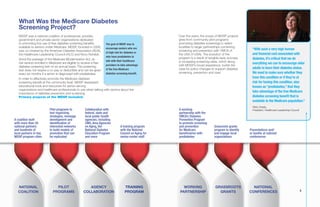
MDSP was a national coalition of professional, provider,
government and private sector organizations dedicated
to promoting the use of free diabetes screening benefits
available to seniors under Medicare. MDSP, founded in 2006,
was co-chaired by the American Diabetes Association (ADA),
the Healthcare Leadership Council (HLC) and Novo Nordisk.
Since the passage of the Medicare Modernization Act, at-
risk seniors enrolled in Medicare are eligible to receive a free
diabetes screening test on an annual basis. The screening
test does not require a co-pay or deductible and can be given
every six months if a senior is diagnosed with prediabetes.
In order to effectively promote the Medicare diabetes
screening benefit at the community level, MDSP developed
educational tools and resources for senior-serving
organizations and healthcare professionals to use when talking with seniors about the
importance of diabetes prevention and screening.
Primary projects of the MDSP included:
Over the years, the scope of MDSP projects
grew from community pilot programs
promoting diabetes screenings in select
localities to larger partnerships combining
screening and prevention with YMCA of
the USA (Y-USA). The evolution of the
program is a result of tangible early success
in increasing screening rates, which along
with MDSP’s broad experience, builds the
case for policy changes to support diabetes
screening, prevention and care.
“With such a very high human
and financial cost associated with
diabetes, it’s critical that we do
everything we can to encourage older
adults to learn their diabetes status.
We need to make sure whether they
have this condition or if they’re at
risk for having this condition, also
known as “prediabetes,” that they
take advantage of the free Medicare
diabetes screening benefit that is
available to the Medicare population.”
Mary Grealy,
President, Healthcare Leadership Council
NATIONAL
COALITION
A coalition built
with more than 20
national partners
and hundreds of
local partners in key
MDSP program cities
AGENCY
COLLABORATION
Collaboration with
federal, state and
local public health
agencies, including
CMS, Area Agencies
on Aging, the
National Diabetes
Education Program
and more
PILOT
PROGRAMS
Pilot programs to
test organizing
strategies, message
development and
identification of
interested networks
to build models of
promotion that can
be replicated
NATIONAL
CONFERENCES
Presentations and/
or booths at national
conferences
WORKING
PARTNERSHIP
A working
partnership with the
YMCA’s Diabetes
Prevention Program
to promote screening
and prevention
for Medicare
beneficiaries with
prediabetes
GRASSROOTS
GRANTS
Grassroots grants
program to identify
and engage local
organizations
TRAINING
PROGRAM
A training program
with the National
Council on Aging for
senior-center staff
The goal of MDSP was to
encourage seniors who are
at high risk for diabetes or
who have prediabetes to
talk with their healthcare
providers to take advantage
of the free Medicare
diabetes screening benefit.
54
2012
2003
2006
2007
2008
2009
2010
2011
Timeline:
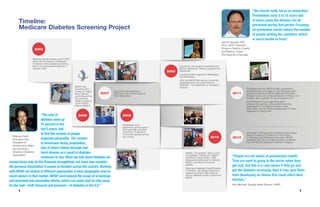
Medicare Diabetes Screening Project
“The cost of
diabetes went up
41 percent in the
last 5 years; add
to that the number of people
impacted personally. The number
of Americans facing amputation,
loss of vision, kidney damage and
heart disease as a result of diabetes
continues to rise. When we talk about diabetes we
cannot focus only on the financial stranglehold, but must also consider
the personal devastation it causes to families across the country. Working
with MDSP, we looked at different approaches in each geographic area to
reach seniors in that market. MDSP went beyond the scope of screenings
and branched into prevention efforts, which can really start to chip away
on the cost—both financial and personal—of diabetes in the U.S.”
Shereen Arent
Executive Vice
President of
Government Affairs
and Advocacy,
American Diabetes
Association
Medicare Modernization Act of 2003
allows at-risk seniors in Medicare
to receive a free diabetes screening
test on an annual basis starting in
January 2005
Atlanta, GA program “Get a Jump
on Diabetes” kicked off in March
with Mayor Kasim Reed, CMS
Regional Administrator Dr. Renard
Murray and other community
leaders
Maricopa Integrated Health System
in Phoenix, AZ adjusted electronic
medical records to flag those at
risk for diabetes under a grant from
MDSP
MDSP was
founded with a
3-year, $1 million
Novo Nordisk
commitment that
the company
made in support
of the Clinton
Global Initiative
Established local
grassroots grant program
that eventually provided
more than 70 grants to
community groups across
the country
Launched pilot projects in
Columbus, GA and the state of
New Hampshire
Columbus, GA program expanded into
Macon, Savannah, Albany, Augusta and
Gainesville
Launched pilot programs in Mississippi
and Minnesota
ADA and MDSP Minnesota conducted
presentations at the world-famous
“BODIES...The Exhibition” at the Mall of
America
Partnered with the YMCA to offer scholarships
donated by Novo Nordisk for 400 Medicare-aged
seniors to enter the YMCA’s Diabetes Prevention
Program at no cost to the participant in Atlanta, GA;
Phoenix, AZ; Louisville, KY; and Lexington, KY
Administered its local organizing grant
program through two national senior-serving
organizations—the National Senior Corps
Association and the National Association of Area
Agencies on Aging (n4a)
When the Y-USA received a Healthcare Innovation
Award of nearly $12 million from the Center
for Medicare and Medicaid Innovation, MDSP
partnered with the Y to help stimulate enrollment
into the YMCA’s Diabetes Prevention Program
If so, you may be eligible
to participate for free in a
program at your local YMCA
that has been proven to
help older adults reduce
their risk for type 2 diabetes.
Through the Get a Jump
on Diabetes campaign
in Atlanta, the first 200
adults age 65 or older who
qualify, may participate in
the program for free.
Are you 65 or
older and at risk
for diabetes? GetAJumpOnDiabetes.org
“We should really focus on prevention.
Prediabetes lasts 5 to 10 years and
in some cases the disease can be
prevented during that period. Focusing
on prevention would reduce the number
of people getting the condition, which
is much harder to treat.”
James Hipkens, MD,
PhD, FACP, Physician
Program Director, Quality
and Metrics, Kaiser
Permanente of Georgia
“People are not aware of preventative health.
They are used to going to the doctor when they
get sick, but this is a case where if they go and
get the diabetes screening, then it may save them
from developing an illness that could affect their
lifestyle.”
Ken Mitchell, Georgia State Director, AARP
76
+
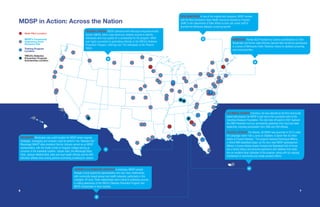
MDSP in Action: Across the Nation
MDSP’s Community
Organizing Grant
Recipient Site
State Pilot Location
Training Program
Location
YMCA’s Diabetes
Prevention Program
Scholarship Location
MINNESOTA Former ADA President for Science and Medicine Dr. Rich
Bergenstal and former state Attorney General Skip Humphrey participated
in a series of Minnesota Public Television shows on diabetes screening,
care and prevention.
+
COLUMBUS, GEORGIA Columbus, GA was selected as the first community-
based pilot program for MDSP in part due to the successful work of the
Columbus Research Foundation.The city’s kick-off event in 2007 featured
the CMS Prevention bus tour and keynote addresses from local and state
leadership, including participation from CMS and HHS officials.
ATLANTA, GEORGIA The Atlanta, GA MDSP was launched in 2010 under
the campaign name “Get a Jump on Diabetes: A Game Plan for Older
Adults to Prevent Diabetes.” The program featured Dominique Wilkins,
a retired NBA basketball player, as the city’s lead MDSP spokesperson.
Wilkins, a former Atlanta Hawks Forward and Basketball Hall of Famer,
has a family history and personal experience with diabetes that made
him an excellent local champion of the program, along with his ongoing
involvement in community and media outreach efforts.
+
NEW HAMPSHIRE In one of the original pilot programs, MDSP worked
with the New Hampshire State Health Insurance Assistance Program
(SHIP) in the Department of Elder Affairs to train call-center staff to
promote the Medicare diabetes screening benefit.
+
LOUISVILLE & LEXINGTON, KENTUCKY In Kentucky, MDSP worked
through a local organizing representative who had many relationships
with community-based groups and health networks, particularly in the
Lexington, KY area. These relationships were critical to achieving success
in raising awareness of the YMCA’s Diabetes Prevention Program and
MDSP scholarships in local markets.
+
MISSISSIPPI Mississippi was a pilot location for MDSP where ongoing
strategies, messaging and outreach could be tested in the “diabetes belt.”
Mississippi NAACP state president Derrick Johnson served as an MDSP
representative, with the health center at Tougaloo College serving as
convener of the statewide coalition. Gospel radio, the Mississippi Mass
Choir, Jackson Medical Mall, state and local health officials and the ABC
television affiliate were among partners promoting screening for seniors.
+
PHOENIX, ARIZONA MDSP partnered with Maricopa Integrated Health
System (MIHS), which used electronic medical records to identify
individuals who may qualify for a scholarship for the program. MIHS
was highly successful in generating referrals to the YMCA’s Diabetes
Prevention Program, referring over 150 individuals to the Phoenix
YMCA.
6 7
98
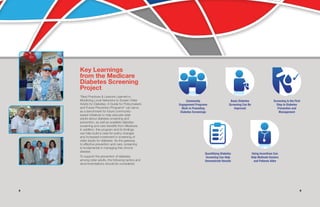
Key Learnings
from the Medicare
Diabetes Screening
Project
“Best Practices & Lessons Learned in
Mobilizing Local Networks to Screen Older
Adults for Diabetes: A Guide for Policymakers
and Future Prevention Programs” can serve
as a benchmark for future community-
based initiatives to help educate older
adults about diabetes screening and
prevention, as well as available diabetes
screening and care benefits from Medicare.
In addition, this program and its findings
can help build a case for policy changes
and increased investment in screening of
older adults for diabetes. As the gateway
to effective prevention and care, screening
is fundamental in managing this chronic
disease.
To support the prevention of diabetes
among older adults, the following tactics and
recommendations should be considered.
Community
Engagement Programs
Work in Promoting
Diabetes Screenings
Screening Is the First
Step to Diabetes
Prevention and
Management
Basic Diabetes
Screening Can Be
Improved
Using Incentives Can
Help Motivate Doctors
and Patients Alike
Quantifying Diabetes
Screening Can Help
Demonstrate Results
1110
Community Engagement
Programs Work in Promoting
Diabetes Screenings
MDSP successfully worked from the “ground up” in partnership with community
organizations to educate seniors about Medicare’s free screening benefit. The local,
community-based approach offered more flexibility with program strategy and
implementation, while allowing pilot programs the ability to adapt to outreach strategies
that worked specifically in their communities.
At the community level, diabetes strikes close to home. People
have a personal connection with the disease or know others in
the community living with diabetes. As a result, communities
see the urgency, need and benefits of promoting the Medicare
screening benefit. Because communities across the country
recognized diabetes as a serious and important issue for
seniors, the MDSP program saw many local organizations and
communities rally together for this common cause and find
creative ways to spread the word.
Providers, public health agencies such as HHS, CDC and
state and local health departments, as well as payers (in
this case, Medicare) have the opportunity to be much more
aggressive in informing, identifying and helping to get people
at risk for diabetes screened. In particular, the following
recommendations could be considered:
• CMS could promote more comprehensively the free
Medicare diabetes screening benefit to seniors and provide
funding for grassroots community engagement programs.
• Diabetes screening is already a free benefit to at-risk
individuals in Medicare, so those at-risk individuals
should be informed of and utilize that benefit.
• Greater education about “prediabetes,” in particular,
is needed for both physicians and patients alike to
understand how patients are at risk.
• Federal commitment to the funding and reimbursement of
the National Diabetes Prevention Program is critical to the
success of community-based prevention programs.
Successful evidence-based health and wellness programs are
an essential diabetes prevention tool for local organizations
and medical professionals who know their population and
community resources best.
“We are so blessed to
have the MDSP here
in Georgia. You are
reaching out to seniors
where they live,
where they shop and
where they worship.
We depend on this
program to catch
this disease early
and avoid the further
complications that
can develop without
treatment. Until we
can find a cure and
make diabetes a thing
of the past, we must
count on you to get our
seniors screened and
treated for diabetes.”
The Honorable John Lewis,
U.S. Representative (Georgia 5th
)
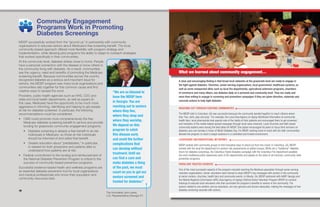
A clear and encouraging finding is that broad local networks at the grassroots level are ready to engage in
the fight against diabetes. Churches, senior-serving organizations, local government, healthcare systems, as
well as some unexpected allies such as local fire departments, agricultural extension programs, chambers
of commerce and many others, see diabetes daily on a personal and community level. They are ready and
more than willing to engage in screening and prevention campaigns if they are given direction, materials and
concrete actions to help fight diabetes.
REACHING OUT THROUGH EXISTING COMMUNITIES
The MDSP pilot in Columbus, GA was successful because the community banded together to reach citizens where
they “live, work, play and pray.” For example, the Local Area Agency on Aging distributed information at community
health fairs; local pharmacists took special note of the habits of their patients and encouraged them to get screened;
and members of the media helped spread messages through local news channels. Local churches and faith-based
community leaders were among the best allies for MDSP. One pastor encouraged his peers to focus their sermons on
diabetes care one Sunday in honor of World Diabetes Day. For MDSP, working hand-in-hand with the faith communities
allowed the program to reach a target audience in a controlled and trusted environment.
LEVERAGING UNCONVENTIONAL NETWORKS
MDSP worked with community groups to find innovative ways to stand out from the crowd. In Columbus, GA, MDSP
worked with the local fire department to conduct risk assessments at station houses. While not a “traditional” diabetes
forum for diabetes screenings, the Columbus Fights Diabetes campaign with the Columbus Fire Department parallels
the more traditional public-awareness work of fire departments and speaks to the value of all-inclusive, community-wide
prevention programs.
PEERS ARE TRUSTED SOURCES
One of the most successful aspects of the program included reaching the Medicare population through senior-serving
volunteer organizations. Senior volunteers were trained to share MDSP’s key messages with seniors in the community
at senior centers, churches, health fairs and community events. In Atlanta, GA, MDSP partnered with AARP Georgia and
the Atlanta Regional Commission (ARC) Area Agency on Aging’s Retired Senior Volunteer Program (RSVP) to conduct
trainings to educate local volunteers who then promoted the program’s benefits to seniors in the community. The
seniors related to one another, and as volunteers, are very genuine and sincere advocates, making the messages of free
diabetes screening resonate with seniors.
What we learned about community engagement…
1312
in the Columbus, GA area offered free
risk assessment tests and
diabetes-related brochures
In Columbus, GA,
distributed more than
MDSP church bulletin inserts for
World Diabetes Day
and low-income residents
VSP Vision Care
performed diabetes
risk assessment
eye exams on
nearly
The Area Agency on Aging distributed nearly
brochures at the mall
between the hours of
referring several hundred at-risk
residents to their doctors for
further diabetes screening
“MDSP affected changes one person at a time, working hand-in-hand with the
communities. They didn’t come in and “big-foot” anyone, they came in talking
to people and provided assistance that each community needed.”
Debbie Witchey, Executive Vice President,
Healthcare Leadership Council
“People are used to hearing me talk about the value of smoke detectors in our homes and how
they can warn us about a potential fire. But with diabetes, you often don’t get any warning at all,
because diabetes often has no signs or symptoms. That’s why my fire fighters and I are happy to
offer our stations as convenient places in the community for people to stop by and learn about
their risk for diabetes…When we were brought into the loop on this I said it’s a win/win, a no
brainer. If we can work something in that’s not really going to cost a whole lot, it’s something that
every fire department in the Unites States ought to be doing.”
Jeff Meyer, Fire Chief, Columbus, GA Fire & EMS
Basic Diabetes Screening Can Be
Improved
MDSP’s work also uncovered that the screening process is often cumbersome and
guidance can be confusing for older adults as well as providers. For adults aged 65
and older in Medicare, screening for diabetes is covered for those who also have one
additional risk factor for diabetes (including high blood pressure, high cholesterol,
overweight or obesity, family history of diabetes or a history of gestational diabetes).
Many health care providers, however, are guided by the screening recommendations
of the U.S. Preventive Services Task Force (USPSTF), which recommend screening for
asymptomatic adults only in one circumstance—the presence of high blood pressure.
Since the USPSTF recommendation misses millions of older adults, USPSTF should
expand its criteria for screening.
As for which screening test is acceptable to use, the American Diabetes Association
says that any one of three blood tests can be used: the hemoglobin A1C test; the fasting
plasma glucose test (FPG); or the oral glucose tolerance test (OGTT). But Medicare
covers only the use of the FPG and OGTT tests. Medicare should add the A1C test to
its list of covered screening tests because it is widely used by health care providers. This
test also does not require fasting, which makes it more practical.
In Atlanta, GA and other pilot program markets, it was often difficult to
convert patients from an initial risk assessment to physician visits for the
official plasma glucose screening test. The A1C test, unlike other tests for
diabetes, does not require fasting before administration. If A1C were an
accepted and covered screening test by Medicare, a qualified healthcare
provider could administer an A1C screening test as part of a regular office
visit. This could help to make the process less complicated and more
efficient for both patients and physicians.
A1C as a Covered Screening Test
1514
In 2011, the MDSP and Novo Nordisk partnered
with the Y-USA and four local YMCAs to offer
scholarships for 400 Medicare-aged seniors
to enter the YMCA’s Diabetes Prevention
Program at no cost to the participant. Novo
Nordisk provided a grant to the Y-USA to
fund the scholarships and to support the pilot
program. The goal was to learn how to identify
and help enroll people 65 and older who
have prediabetes into the YMCA’s Diabetes
Prevention Program.
In an effort to test which strategies for
recruitment and enrollment of seniors into the
program were the most successful, the models
for each of these pilot projects were slightly
different.The four pilot areas included:Atlanta,
GA; Phoenix,AZ; Louisville, KY; and
Lexington, KY.
Collaborating with the YMCA
Screening Is the First Step
to Diabetes Prevention and
Management
Research shows that diabetes can often be prevented or
delayed in seniors with prediabetes. Furthermore, early
detection of diabetes may help seniors avoid serious
complications such as heart disease, stroke, blindness,
kidney disease and amputation. The first step towards
prevention is actually identifying seniors with prediabetes.
The promotion of Medicare’s free screening benefit is
critically important to identifying these individuals. To ensure
seniors are aware of this benefit and can get the help they
need to prevent or delay the onset of diabetes, Congress
should allocate more funds for the National Diabetes
Prevention Program and support the Medicare Diabetes
Prevention Act, which would make community-based
diabetes intervention programs like the National Diabetes
Prevention Program a covered benefit.
The National Diabetes
Prevention Program is a
public-private partnership
of community organizations,
private insurers, employers,
healthcare organizations
and government agencies.
These partners are working
to establish local evidence-
based lifestyle change
programs for people at high
risk for type 2 diabetes.
“What [we tried] to do…in a sense, is start
at the grassroots level, start here at the state
level. And several other states [did] this as
well. And we want to make sure, basically
knocking right on doors…asking people
when they go to see their doctor if they have
any of these conditions that show up to
inform their physician that they would like to
have this test, which is covered.”
Hubert H. “Skip” Humphrey III, Former
Minnesota Attorney General
Based on research
funded by the National
Institutes of Health, the
YMCA’s
Diabetes
Prevention
Program
The percentage
was even greater
among adults aged
60 years or older.
type 2
diabetes
can achieve results similar to those
achieved in the original Diabetes
Prevention Program clinical trial, which
has been shown to
reduce the
risk of
developing
58%
by as much as
71%
1716
Quantifying Diabetes Screening Can
Help Demonstrate Results
There should be a mechanism in place to measure and track changes in diabetes screening
rates. Fostering an “outcomes focused” culture with tangible metrics will inspire future
programs and allow communities to track the results of their screening and prevention
campaigns.
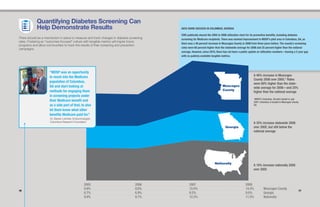
DATA SHOW SUCCESS IN COLUMBUS, GEORGIA
CMS publically shared the 2005 to 2008 utilization chart for its preventive benefits, including diabetes
screening for Medicare recipients. There was marked improvement in MDSP’s pilot area in Columbus, GA, as
there was a 46 percent increase in Muscogee County in 2008 from three years before. The county’s screening
rates were 60 percent higher than the statewide average for 2008 and 25 percent higher than the national
average. However, since 2010, there has not been a public update on utilization numbers—leaving a 5 year gap
with no publicly available tangible metrics.
A 46% increase in Muscogee
County 2008 over 2005.* Rates
were 60% higher than the state-
wide average for 2008—and 25%
higher than the national average
*MDSP's Columbus, GA pilot started in July
2007. Columbus is located in Muscogee County,
GA.
A 16% increase nationally 2008
over 2005
A 35% increase statewide 2008
over 2005, but still below the
national average
Nationally
Georgia
Muscogee
County
2005
9.9%
6.7%
9.9%
2006
9.6%
6.9%
9.7%
2007
15.0%
9.2%
12.2%
2008
14.4%
9.0%
11.5%
Muscogee County
Georgia
Nationally
“MDSP was an opportunity
to reach into the Medicare
population of Columbus,
GA and start looking at
methods for engaging them
in screening projects under
their Medicare benefit and
as a side part of that, to also
let them know what other
benefits Medicare paid for.”
Dr. Steven Leichter, Endocrinologist,
Columbus Research Foundation
1918
Utilizing Incentives to Motivate Doctors
and Patients Alike
Incentives can help a call-to-action stand out among the plethora of health messages
inundating consumers today and actually motivate people to take action. Seniors, in
particular, often just need a little extra motivation and encouragement to get onboard—and
the word “free” often seems to go a long way! In some cities, the YMCA was able to offer
free enrollment to the prevention program provided by Novo Nordisk Inc. Giving something
of value to seniors at no cost to them provided them with the extra motivation to commit.
With the older adult audience, doctors and nurses tend to be a highly trusted source of
information. In Atlanta, Louisville and Lexington, MDSP found that a personalized letter
from doctors to their patients about the YMCA’s Diabetes Prevention Program resonated
much more than a general brochure or flyer. Because healthcare providers continue to be
a top motivator for seniors to take charge of their health, primary care physicians should be
incentivized to screen for diabetes and refer patients to prevention or disease management
programs. In addition to the altruistic benefits of improving health outcomes and serving
as a trusted resource for patients, healthcare providers could receive tangible rewards.
Following a model similar to smoking cessation incentive programs, providers and
healthcare systems could be awarded certain benefits for encouraging and conducting
diabetes screenings among their older adult patients and referring their patients with
prediabetes to community-based prevention programs.
MDSP recognizes that it takes collective effort—personal responsibility, private and
community support, and a strong federal commitment—to change the human and
economic toll of diabetes. Individuals play a fundamental role in their own fight against
diabetes. While healthcare providers have a responsibility to help ensure at-risk seniors
are screened for diabetes and have access to prevention programs and care, older adults
need to know their risk for diabetes. They need to ask to be screened and take advantage
of available tools to prevent or manage their diabetes. As one of the pastors we worked
with told his parishioners when he urged them to talk to their doctor about diabetes
screening, “Good health is a blessing and a responsibility.” Instilling a sense of personal
responsibility can help seniors recognize the importance of taking control of their health,
not only for themselves, but also for their families.
Finding a local champion or advocate for the cause is critically important. It’s hard to keep a coalition or
campaign sustained if there isn’t someone motivating the group on a regular basis. For this approach to be
successful, the champion needs to be competent, have the capacity and be culturally aware. The champion
should live in and understand the local community, and be able to hold people accountable. It can’t just be one
more thing on the to-do list for them; it needs to be one of their top priorities. When you have these champions
who take on screening and prevention as their own cause, you have infinite power to motivate others and see
a project through to completion.
In Atlanta, GA, a particularly effective partnership with Kaiser Permanente of Georgia led to a significant bump
in enrollment in the local YMCA’s Diabetes Prevention Program. In an integrated approach using both physician
endorsement and personalized patient outreach, the health system used its existing electronic medical records to
identify patients who met the criteria for the program. Dr. James Hipkens, in collaboration with MDSP and the YMCA,
informed his fellow Kaiser colleagues on the benefits of the program and sent a personalized letter to all of the qualifying
members identified in their system. Patients were especially motivated when their primary care physician encouraged
them that this was a safe, beneficial activity to get involved in and provided them with an informative handout with the
YMCA program requirements and contact information.
The MDSP partners in Phoenix, AZ, the Maricopa Integrated Health System (MIHS), used electronic medical records
to identify lists of seniors who qualified for a scholarship to the program, and through phone calls and other
correspondence, the MIHS referred more than 150 individuals to the Phoenix YMCA. MIHS hired a bilingual program
manager who could effectively communicate with the region’s sizable Hispanic population and through prompt and
frequent follow up, they were able to generate a robust list of referrals to the local Y.
In Kentucky, the largest referral source of eligible participants for each of the YMCAs came from a highly engaged
physician in Louisville, KY, and another in Lexington, KY. Debbi Dean, Coordinator of the Diabetes Prevention Program
with the YMCA in Kentucky, said that “When the doctor tells them to do it, they did it.” The Kentucky YMCAs were also
able to offer a free YMCA membership for 12 weeks with individual trainers to encourage regular exercise in parallel
with the YMCA’s Diabetes Prevention Program classes.
Enlisting a Local Champion
Using Incentives Can Help Motivate
Doctors and Patients Alike
Incentives can help a call-to-action stand out among the plethora of health messages
inundating consumers today and motivate people to take action. Seniors often just need
a little extra motivation and encouragement to get on board—and the word “free” often
seems to go a long way! MDSP learned it was important to emphasize to older adults that
Medicare covered screening for diabetes with no co-pay, for those eligible for screening.
With an older adult audience, doctors and nurses tend to be a highly trusted source
of information. In Atlanta, GA; Louisville, KY; and Lexington, KY, MDSP found that a
personalized letter from doctors to their patients about the YMCA’s Diabetes Prevention
Program resonated much more than a general brochure or flyer. Because healthcare
providers continue to
be a top motivator for
seniors to take charge
of their health, primary
care physicians
could be incented
to screen high-risk
patients for diabetes
and refer patients
to prevention or
disease management
programs. In addition
to the altruistic
benefits of improving
health outcomes and serving as a trusted resource for patients, healthcare providers
might receive tangible rewards. Following a model similar to smoking cessation incentive
programs, providers and healthcare systems could be awarded certain benefits for
encouraging and conducting appropriate diabetes screenings among their older adult
patients and referring their patients with prediabetes to community-based prevention
programs.
MDSP recognizes that it takes collective effort—personal responsibility, private and
community support and a strong federal commitment—to change the human and
economic toll of diabetes. Individuals play a fundamental role in their own fight against
diabetes. While healthcare providers have a responsibility to help ensure at-risk seniors
are screened for diabetes and have access to prevention programs and care, older
adults need to know their risk for diabetes. They need to ask to be screened and take
advantage of available tools to prevent or manage their diabetes. As one of the pastors
MDSP worked with told his parishioners when he urged them to talk to their doctor about
diabetes screening, “Good health is a blessing and a responsibility.” Instilling a sense of
personal responsibility can help seniors recognize the importance of taking control of their
health, not only for themselves, but also for their families.
“When you go to your doctor, ask
him or her about [diabetes] testing. It
doesn’t cost you anything to do that.
What could it cost you for not doing it?
It could cost you your life.”
Renard Murray, D.M., Regional Administrator
Centers for Medicare and Medicaid Services
2120
The American Diabetes Association
(ADA) is leading the fight to
Stop Diabetes®
and its deadly
consequences and fighting for
those affected by diabetes.
The Association funds research
to prevent, cure and manage
diabetes; delivers services to
hundreds of communities; provides
objective and credible information;
and gives voice to those denied
their rights because of diabetes.
Founded in 1940, our mission is
to prevent and cure diabetes and
to improve the lives of all people
affected by diabetes.
The Healthcare Leadership Council
is a coalition of chief executives
from all disciplines within American
healthcare, and is the exclusive
forum for the nation’s healthcare
leaders to jointly develop policies,
plans and programs to achieve
their vision of a 21st century
system that makes affordable,
high-quality care accessible to all
Americans.
Novo Nordisk is a healthcare
company and a world leader
in diabetes care. In addition,
Novo Nordisk has a leading
position within areas such as
haemostasis management,
growth hormone therapy and
hormone replacement therapy.
Novo Nordisk manufactures and
markets pharmaceutical products
and services that make a significant
difference to patients, the medical
profession and society. With
headquarters in Denmark, Novo
Nordisk employs approximately
36,000 employees in 75 countries,
and markets its products in more
than 180 countries.
Academy of Nutrition and Dietetics
Administration on Aging
America’s Health Insurance Plans
American Academy of Family Physicians
American Academy of Nurse Practitioners
American Academy of Physician Assistants
American Association of Clinical Endocrinologists
American Association of Diabetes Educators
American Clinical Laboratory Association—
Results for Life
American College of Physicians
American Medical Association
American Optometric Association
Diabetes Advocacy Alliance
Healthways
National Association of Area Agencies on Aging
National Black Nurses Association
National Council on Aging
Partnership for Prevention
VSP Vision Care
Y-USA
XL Health
In addition to the National Co-Chairs, MDSP partners have included:
Our National Co-Chairs
A Success Story—How Prevention
Initiatives Can Make a Difference
The Medicare Diabetes Screening Project laid the groundwork for meaningful policy
changes and built a practical, grassroots case for broader diabetes screening of older
adults. As the gateway to effective prevention and care, screening is fundamental in
managing this disease that impacts more than half of our Medicare population and
consumes one-third of the Medicare budget. MDSP partners across the country have
developed a rich portfolio of experience, relationships and best practices that can be
instructive for national policymakers, providers and patient advocacy groups who can, and
will, make diabetes screening a healthcare priority. As a true model of effective disease
prevention and community-based interventions of physical activity and proper nutrition,
MDSP ultimately hopes to inspire at-risk individuals to be screened for diabetes and give
them the infrastructure they need to improve their health.
“According to the Trust for America’s
Health, by simply investing $10 a
person [per year] in community-based
prevention programs, we could see
a net savings of $2.8 billion in less
than two years and $18 billion in ten
[to twenty] years. An extraordinary
illustration of the power of prevention,
the power of addressing good primary
care in a meaningful way through
public policy.”
The Honorable Tom
Daschle, Former
U.S. Senate Majority
Leader

MDSP_Booklet_Jan2014

  • 1.
    National Co-Chairs: Best Practices& Lessons Learned in Mobilizing Local Networks to Screen Older Adults for Diabetes: A Guide for Policymakers and Future Prevention Programs December 2013
  • 2.
    WHAT NEEDS TOBE DONE The experience of MDSP suggests that policymakers, providers and communities should consider the following policy issues to help find Medicare beneficiaries at risk for diabetes or prediabetes: • Centers for Medicare & Medicaid Services (CMS) should cover the Hemoglobin A1C test as a screening tool for diabetes; • The United States Preventive Services Task Force (USPSTF) should revise and expand its diabetes screening recommendation; • CMS should cover evidence-based, lifestyle interventions of physical activity and proper nutrition for diabetes prevention— such as those recognized by the National Diabetes Prevention Program—for beneficiaries with prediabetes; • The U.S. Department of Health and Human Services (HHS), including CMS and the Centers for Disease Control and Prevention (CDC), and state and local health departments should develop aggressive strategies and devote resources to promote more widespread diabetes screening and prevention opportunities (e.g., physical activity and nutrition education) for older adults; and, • Incentives should be explored for providers and healthcare systems to make screening, prevention and quality diabetes care a priority for treating older adults. Communities, policymakers, public health organizations, senior-serving organizations and healthcare providers play an essential role and need to give older adults the tools and support they need to be successful in the fight against diabetes. Diabetes prevention and improved care are proven and possible through collaboration among policymakers, providers, communities and patients. How can millions of older adults— more than half of all Medicare beneficiaries—have undiagnosed diabetes or prediabetes? Especially after Medicare started to cover screening for those at risk for diabetes with no co-pay and no deductible in 2005? That is the singular, startling fact that drove the creation of the Medicare Diabetes Screening Project (MDSP) in 2006 and has guided its work. The challenge was to identify networks, strategies and actions at the local and national level to help close that gap and to build momentum for policies to help find the undiagnosed. A driving principle is that screening is the gateway to prevention and successful management of prediabetes or undiagnosed diabetes. The MDSP was co-chaired by the American Diabetes Association (ADA), the Healthcare Leadership Council (HLC) and Novo Nordisk Inc. In 2006, Novo Nordisk made a 3-year, $1 million commitment to the Clinton Global Initiative to support the work of MDSP. Since that time, MDSP partnered with more than 20 national, and hundreds of grassroots healthcare provider, senior-serving, industry and diabetes advocacy organizations to find ways to promote diabetes screening for Medicare beneficiaries and to identify policy changes that could help find the undiagnosed. MDSP implemented projects to develop effective messages, identify and activate concerned national and local networks, and test community organizing strategies. Based on feedback from seniors, providers and community organizations, we realized that the screening message was necessary but not sufficient. Screening is a pathway to prevention and care—and that needed to be part of our message and operations. Older adults were not motivated to be screened to “just get more bad news.” But they were attentive to messages that told them screening and early diagnosis were important for successful self-management of undiagnosed diabetes. Those older adults at risk for diabetes were motivated to be screened when they learned that diabetes can be prevented—and that those 60 and older were particularly successful at prevention. The examples and stories featured in this document, based on the MDSP experience, can help guide efforts to screen older adults for diabetes and therefore help them get the care or preventive services they need to fight diabetes. Through increased utilization of the Medicare diabetes screening benefit, individuals can improve the quality of their own health, while reducing the burden of diabetes on the healthcare system. Screening: The Gateway to Prevention and Care Jay Hedlund Director Medicare Diabetes Screening Project
  • 3.
    33 What Was theMedicare Diabetes Screening Project? MDSP was a national coalition of professional, provider, government and private sector organizations dedicated to promoting the use of free diabetes screening benefits available to seniors under Medicare. MDSP, founded in 2006, was co-chaired by the American Diabetes Association (ADA), the Healthcare Leadership Council (HLC) and Novo Nordisk. Since the passage of the Medicare Modernization Act, at- risk seniors enrolled in Medicare are eligible to receive a free diabetes screening test on an annual basis. The screening test does not require a co-pay or deductible and can be given every six months if a senior is diagnosed with prediabetes. In order to effectively promote the Medicare diabetes screening benefit at the community level, MDSP developed educational tools and resources for senior-serving organizations and healthcare professionals to use when talking with seniors about the importance of diabetes prevention and screening. Primary projects of the MDSP included: Over the years, the scope of MDSP projects grew from community pilot programs promoting diabetes screenings in select localities to larger partnerships combining screening and prevention with YMCA of the USA (Y-USA). The evolution of the program is a result of tangible early success in increasing screening rates, which along with MDSP’s broad experience, builds the case for policy changes to support diabetes screening, prevention and care. “With such a very high human and financial cost associated with diabetes, it’s critical that we do everything we can to encourage older adults to learn their diabetes status. We need to make sure whether they have this condition or if they’re at risk for having this condition, also known as “prediabetes,” that they take advantage of the free Medicare diabetes screening benefit that is available to the Medicare population.” Mary Grealy, President, Healthcare Leadership Council NATIONAL COALITION A coalition built with more than 20 national partners and hundreds of local partners in key MDSP program cities AGENCY COLLABORATION Collaboration with federal, state and local public health agencies, including CMS, Area Agencies on Aging, the National Diabetes Education Program and more PILOT PROGRAMS Pilot programs to test organizing strategies, message development and identification of interested networks to build models of promotion that can be replicated NATIONAL CONFERENCES Presentations and/ or booths at national conferences WORKING PARTNERSHIP A working partnership with the YMCA’s Diabetes Prevention Program to promote screening and prevention for Medicare beneficiaries with prediabetes GRASSROOTS GRANTS Grassroots grants program to identify and engage local organizations TRAINING PROGRAM A training program with the National Council on Aging for senior-center staff The goal of MDSP was to encourage seniors who are at high risk for diabetes or who have prediabetes to talk with their healthcare providers to take advantage of the free Medicare diabetes screening benefit.
  • 4.
    54 2012 2003 2006 2007 2008 2009 2010 2011 Timeline: Medicare Diabetes ScreeningProject “The cost of diabetes went up 41 percent in the last 5 years; add to that the number of people impacted personally. The number of Americans facing amputation, loss of vision, kidney damage and heart disease as a result of diabetes continues to rise. When we talk about diabetes we cannot focus only on the financial stranglehold, but must also consider the personal devastation it causes to families across the country. Working with MDSP, we looked at different approaches in each geographic area to reach seniors in that market. MDSP went beyond the scope of screenings and branched into prevention efforts, which can really start to chip away on the cost—both financial and personal—of diabetes in the U.S.” Shereen Arent Executive Vice President of Government Affairs and Advocacy, American Diabetes Association Medicare Modernization Act of 2003 allows at-risk seniors in Medicare to receive a free diabetes screening test on an annual basis starting in January 2005 Atlanta, GA program “Get a Jump on Diabetes” kicked off in March with Mayor Kasim Reed, CMS Regional Administrator Dr. Renard Murray and other community leaders Maricopa Integrated Health System in Phoenix, AZ adjusted electronic medical records to flag those at risk for diabetes under a grant from MDSP MDSP was founded with a 3-year, $1 million Novo Nordisk commitment that the company made in support of the Clinton Global Initiative Established local grassroots grant program that eventually provided more than 70 grants to community groups across the country Launched pilot projects in Columbus, GA and the state of New Hampshire Columbus, GA program expanded into Macon, Savannah, Albany, Augusta and Gainesville Launched pilot programs in Mississippi and Minnesota ADA and MDSP Minnesota conducted presentations at the world-famous “BODIES...The Exhibition” at the Mall of America Partnered with the YMCA to offer scholarships donated by Novo Nordisk for 400 Medicare-aged seniors to enter the YMCA’s Diabetes Prevention Program at no cost to the participant in Atlanta, GA; Phoenix, AZ; Louisville, KY; and Lexington, KY Administered its local organizing grant program through two national senior-serving organizations—the National Senior Corps Association and the National Association of Area Agencies on Aging (n4a) When the Y-USA received a Healthcare Innovation Award of nearly $12 million from the Center for Medicare and Medicaid Innovation, MDSP partnered with the Y to help stimulate enrollment into the YMCA’s Diabetes Prevention Program If so, you may be eligible to participate for free in a program at your local YMCA that has been proven to help older adults reduce their risk for type 2 diabetes. Through the Get a Jump on Diabetes campaign in Atlanta, the first 200 adults age 65 or older who qualify, may participate in the program for free. Are you 65 or older and at risk for diabetes? GetAJumpOnDiabetes.org “We should really focus on prevention. Prediabetes lasts 5 to 10 years and in some cases the disease can be prevented during that period. Focusing on prevention would reduce the number of people getting the condition, which is much harder to treat.” James Hipkens, MD, PhD, FACP, Physician Program Director, Quality and Metrics, Kaiser Permanente of Georgia “People are not aware of preventative health. They are used to going to the doctor when they get sick, but this is a case where if they go and get the diabetes screening, then it may save them from developing an illness that could affect their lifestyle.” Ken Mitchell, Georgia State Director, AARP
  • 5.
    76 + MDSP in Action:Across the Nation MDSP’s Community Organizing Grant Recipient Site State Pilot Location Training Program Location YMCA’s Diabetes Prevention Program Scholarship Location MINNESOTA Former ADA President for Science and Medicine Dr. Rich Bergenstal and former state Attorney General Skip Humphrey participated in a series of Minnesota Public Television shows on diabetes screening, care and prevention. + COLUMBUS, GEORGIA Columbus, GA was selected as the first community- based pilot program for MDSP in part due to the successful work of the Columbus Research Foundation.The city’s kick-off event in 2007 featured the CMS Prevention bus tour and keynote addresses from local and state leadership, including participation from CMS and HHS officials. ATLANTA, GEORGIA The Atlanta, GA MDSP was launched in 2010 under the campaign name “Get a Jump on Diabetes: A Game Plan for Older Adults to Prevent Diabetes.” The program featured Dominique Wilkins, a retired NBA basketball player, as the city’s lead MDSP spokesperson. Wilkins, a former Atlanta Hawks Forward and Basketball Hall of Famer, has a family history and personal experience with diabetes that made him an excellent local champion of the program, along with his ongoing involvement in community and media outreach efforts. + NEW HAMPSHIRE In one of the original pilot programs, MDSP worked with the New Hampshire State Health Insurance Assistance Program (SHIP) in the Department of Elder Affairs to train call-center staff to promote the Medicare diabetes screening benefit. + LOUISVILLE & LEXINGTON, KENTUCKY In Kentucky, MDSP worked through a local organizing representative who had many relationships with community-based groups and health networks, particularly in the Lexington, KY area. These relationships were critical to achieving success in raising awareness of the YMCA’s Diabetes Prevention Program and MDSP scholarships in local markets. + MISSISSIPPI Mississippi was a pilot location for MDSP where ongoing strategies, messaging and outreach could be tested in the “diabetes belt.” Mississippi NAACP state president Derrick Johnson served as an MDSP representative, with the health center at Tougaloo College serving as convener of the statewide coalition. Gospel radio, the Mississippi Mass Choir, Jackson Medical Mall, state and local health officials and the ABC television affiliate were among partners promoting screening for seniors. + PHOENIX, ARIZONA MDSP partnered with Maricopa Integrated Health System (MIHS), which used electronic medical records to identify individuals who may qualify for a scholarship for the program. MIHS was highly successful in generating referrals to the YMCA’s Diabetes Prevention Program, referring over 150 individuals to the Phoenix YMCA. 6 7
  • 6.
    98 Key Learnings from theMedicare Diabetes Screening Project “Best Practices & Lessons Learned in Mobilizing Local Networks to Screen Older Adults for Diabetes: A Guide for Policymakers and Future Prevention Programs” can serve as a benchmark for future community- based initiatives to help educate older adults about diabetes screening and prevention, as well as available diabetes screening and care benefits from Medicare. In addition, this program and its findings can help build a case for policy changes and increased investment in screening of older adults for diabetes. As the gateway to effective prevention and care, screening is fundamental in managing this chronic disease. To support the prevention of diabetes among older adults, the following tactics and recommendations should be considered. Community Engagement Programs Work in Promoting Diabetes Screenings Screening Is the First Step to Diabetes Prevention and Management Basic Diabetes Screening Can Be Improved Using Incentives Can Help Motivate Doctors and Patients Alike Quantifying Diabetes Screening Can Help Demonstrate Results
  • 7.
    1110 Community Engagement Programs Workin Promoting Diabetes Screenings MDSP successfully worked from the “ground up” in partnership with community organizations to educate seniors about Medicare’s free screening benefit. The local, community-based approach offered more flexibility with program strategy and implementation, while allowing pilot programs the ability to adapt to outreach strategies that worked specifically in their communities. At the community level, diabetes strikes close to home. People have a personal connection with the disease or know others in the community living with diabetes. As a result, communities see the urgency, need and benefits of promoting the Medicare screening benefit. Because communities across the country recognized diabetes as a serious and important issue for seniors, the MDSP program saw many local organizations and communities rally together for this common cause and find creative ways to spread the word. Providers, public health agencies such as HHS, CDC and state and local health departments, as well as payers (in this case, Medicare) have the opportunity to be much more aggressive in informing, identifying and helping to get people at risk for diabetes screened. In particular, the following recommendations could be considered: • CMS could promote more comprehensively the free Medicare diabetes screening benefit to seniors and provide funding for grassroots community engagement programs. • Diabetes screening is already a free benefit to at-risk individuals in Medicare, so those at-risk individuals should be informed of and utilize that benefit. • Greater education about “prediabetes,” in particular, is needed for both physicians and patients alike to understand how patients are at risk. • Federal commitment to the funding and reimbursement of the National Diabetes Prevention Program is critical to the success of community-based prevention programs. Successful evidence-based health and wellness programs are an essential diabetes prevention tool for local organizations and medical professionals who know their population and community resources best. “We are so blessed to have the MDSP here in Georgia. You are reaching out to seniors where they live, where they shop and where they worship. We depend on this program to catch this disease early and avoid the further complications that can develop without treatment. Until we can find a cure and make diabetes a thing of the past, we must count on you to get our seniors screened and treated for diabetes.” The Honorable John Lewis, U.S. Representative (Georgia 5th ) A clear and encouraging finding is that broad local networks at the grassroots level are ready to engage in the fight against diabetes. Churches, senior-serving organizations, local government, healthcare systems, as well as some unexpected allies such as local fire departments, agricultural extension programs, chambers of commerce and many others, see diabetes daily on a personal and community level. They are ready and more than willing to engage in screening and prevention campaigns if they are given direction, materials and concrete actions to help fight diabetes. REACHING OUT THROUGH EXISTING COMMUNITIES The MDSP pilot in Columbus, GA was successful because the community banded together to reach citizens where they “live, work, play and pray.” For example, the Local Area Agency on Aging distributed information at community health fairs; local pharmacists took special note of the habits of their patients and encouraged them to get screened; and members of the media helped spread messages through local news channels. Local churches and faith-based community leaders were among the best allies for MDSP. One pastor encouraged his peers to focus their sermons on diabetes care one Sunday in honor of World Diabetes Day. For MDSP, working hand-in-hand with the faith communities allowed the program to reach a target audience in a controlled and trusted environment. LEVERAGING UNCONVENTIONAL NETWORKS MDSP worked with community groups to find innovative ways to stand out from the crowd. In Columbus, GA, MDSP worked with the local fire department to conduct risk assessments at station houses. While not a “traditional” diabetes forum for diabetes screenings, the Columbus Fights Diabetes campaign with the Columbus Fire Department parallels the more traditional public-awareness work of fire departments and speaks to the value of all-inclusive, community-wide prevention programs. PEERS ARE TRUSTED SOURCES One of the most successful aspects of the program included reaching the Medicare population through senior-serving volunteer organizations. Senior volunteers were trained to share MDSP’s key messages with seniors in the community at senior centers, churches, health fairs and community events. In Atlanta, GA, MDSP partnered with AARP Georgia and the Atlanta Regional Commission (ARC) Area Agency on Aging’s Retired Senior Volunteer Program (RSVP) to conduct trainings to educate local volunteers who then promoted the program’s benefits to seniors in the community. The seniors related to one another, and as volunteers, are very genuine and sincere advocates, making the messages of free diabetes screening resonate with seniors. What we learned about community engagement…
  • 8.
    1312 in the Columbus,GA area offered free risk assessment tests and diabetes-related brochures In Columbus, GA, distributed more than MDSP church bulletin inserts for World Diabetes Day and low-income residents VSP Vision Care performed diabetes risk assessment eye exams on nearly The Area Agency on Aging distributed nearly brochures at the mall between the hours of referring several hundred at-risk residents to their doctors for further diabetes screening “MDSP affected changes one person at a time, working hand-in-hand with the communities. They didn’t come in and “big-foot” anyone, they came in talking to people and provided assistance that each community needed.” Debbie Witchey, Executive Vice President, Healthcare Leadership Council “People are used to hearing me talk about the value of smoke detectors in our homes and how they can warn us about a potential fire. But with diabetes, you often don’t get any warning at all, because diabetes often has no signs or symptoms. That’s why my fire fighters and I are happy to offer our stations as convenient places in the community for people to stop by and learn about their risk for diabetes…When we were brought into the loop on this I said it’s a win/win, a no brainer. If we can work something in that’s not really going to cost a whole lot, it’s something that every fire department in the Unites States ought to be doing.” Jeff Meyer, Fire Chief, Columbus, GA Fire & EMS Basic Diabetes Screening Can Be Improved MDSP’s work also uncovered that the screening process is often cumbersome and guidance can be confusing for older adults as well as providers. For adults aged 65 and older in Medicare, screening for diabetes is covered for those who also have one additional risk factor for diabetes (including high blood pressure, high cholesterol, overweight or obesity, family history of diabetes or a history of gestational diabetes). Many health care providers, however, are guided by the screening recommendations of the U.S. Preventive Services Task Force (USPSTF), which recommend screening for asymptomatic adults only in one circumstance—the presence of high blood pressure. Since the USPSTF recommendation misses millions of older adults, USPSTF should expand its criteria for screening. As for which screening test is acceptable to use, the American Diabetes Association says that any one of three blood tests can be used: the hemoglobin A1C test; the fasting plasma glucose test (FPG); or the oral glucose tolerance test (OGTT). But Medicare covers only the use of the FPG and OGTT tests. Medicare should add the A1C test to its list of covered screening tests because it is widely used by health care providers. This test also does not require fasting, which makes it more practical. In Atlanta, GA and other pilot program markets, it was often difficult to convert patients from an initial risk assessment to physician visits for the official plasma glucose screening test. The A1C test, unlike other tests for diabetes, does not require fasting before administration. If A1C were an accepted and covered screening test by Medicare, a qualified healthcare provider could administer an A1C screening test as part of a regular office visit. This could help to make the process less complicated and more efficient for both patients and physicians. A1C as a Covered Screening Test
  • 9.
    1514 In 2011, theMDSP and Novo Nordisk partnered with the Y-USA and four local YMCAs to offer scholarships for 400 Medicare-aged seniors to enter the YMCA’s Diabetes Prevention Program at no cost to the participant. Novo Nordisk provided a grant to the Y-USA to fund the scholarships and to support the pilot program. The goal was to learn how to identify and help enroll people 65 and older who have prediabetes into the YMCA’s Diabetes Prevention Program. In an effort to test which strategies for recruitment and enrollment of seniors into the program were the most successful, the models for each of these pilot projects were slightly different.The four pilot areas included:Atlanta, GA; Phoenix,AZ; Louisville, KY; and Lexington, KY. Collaborating with the YMCA Screening Is the First Step to Diabetes Prevention and Management Research shows that diabetes can often be prevented or delayed in seniors with prediabetes. Furthermore, early detection of diabetes may help seniors avoid serious complications such as heart disease, stroke, blindness, kidney disease and amputation. The first step towards prevention is actually identifying seniors with prediabetes. The promotion of Medicare’s free screening benefit is critically important to identifying these individuals. To ensure seniors are aware of this benefit and can get the help they need to prevent or delay the onset of diabetes, Congress should allocate more funds for the National Diabetes Prevention Program and support the Medicare Diabetes Prevention Act, which would make community-based diabetes intervention programs like the National Diabetes Prevention Program a covered benefit. The National Diabetes Prevention Program is a public-private partnership of community organizations, private insurers, employers, healthcare organizations and government agencies. These partners are working to establish local evidence- based lifestyle change programs for people at high risk for type 2 diabetes. “What [we tried] to do…in a sense, is start at the grassroots level, start here at the state level. And several other states [did] this as well. And we want to make sure, basically knocking right on doors…asking people when they go to see their doctor if they have any of these conditions that show up to inform their physician that they would like to have this test, which is covered.” Hubert H. “Skip” Humphrey III, Former Minnesota Attorney General Based on research funded by the National Institutes of Health, the YMCA’s Diabetes Prevention Program The percentage was even greater among adults aged 60 years or older. type 2 diabetes can achieve results similar to those achieved in the original Diabetes Prevention Program clinical trial, which has been shown to reduce the risk of developing 58% by as much as 71%
  • 10.
    1716 Quantifying Diabetes ScreeningCan Help Demonstrate Results There should be a mechanism in place to measure and track changes in diabetes screening rates. Fostering an “outcomes focused” culture with tangible metrics will inspire future programs and allow communities to track the results of their screening and prevention campaigns. DATA SHOW SUCCESS IN COLUMBUS, GEORGIA CMS publically shared the 2005 to 2008 utilization chart for its preventive benefits, including diabetes screening for Medicare recipients. There was marked improvement in MDSP’s pilot area in Columbus, GA, as there was a 46 percent increase in Muscogee County in 2008 from three years before. The county’s screening rates were 60 percent higher than the statewide average for 2008 and 25 percent higher than the national average. However, since 2010, there has not been a public update on utilization numbers—leaving a 5 year gap with no publicly available tangible metrics. A 46% increase in Muscogee County 2008 over 2005.* Rates were 60% higher than the state- wide average for 2008—and 25% higher than the national average *MDSP's Columbus, GA pilot started in July 2007. Columbus is located in Muscogee County, GA. A 16% increase nationally 2008 over 2005 A 35% increase statewide 2008 over 2005, but still below the national average Nationally Georgia Muscogee County 2005 9.9% 6.7% 9.9% 2006 9.6% 6.9% 9.7% 2007 15.0% 9.2% 12.2% 2008 14.4% 9.0% 11.5% Muscogee County Georgia Nationally “MDSP was an opportunity to reach into the Medicare population of Columbus, GA and start looking at methods for engaging them in screening projects under their Medicare benefit and as a side part of that, to also let them know what other benefits Medicare paid for.” Dr. Steven Leichter, Endocrinologist, Columbus Research Foundation
  • 11.
    1918 Utilizing Incentives toMotivate Doctors and Patients Alike Incentives can help a call-to-action stand out among the plethora of health messages inundating consumers today and actually motivate people to take action. Seniors, in particular, often just need a little extra motivation and encouragement to get onboard—and the word “free” often seems to go a long way! In some cities, the YMCA was able to offer free enrollment to the prevention program provided by Novo Nordisk Inc. Giving something of value to seniors at no cost to them provided them with the extra motivation to commit. With the older adult audience, doctors and nurses tend to be a highly trusted source of information. In Atlanta, Louisville and Lexington, MDSP found that a personalized letter from doctors to their patients about the YMCA’s Diabetes Prevention Program resonated much more than a general brochure or flyer. Because healthcare providers continue to be a top motivator for seniors to take charge of their health, primary care physicians should be incentivized to screen for diabetes and refer patients to prevention or disease management programs. In addition to the altruistic benefits of improving health outcomes and serving as a trusted resource for patients, healthcare providers could receive tangible rewards. Following a model similar to smoking cessation incentive programs, providers and healthcare systems could be awarded certain benefits for encouraging and conducting diabetes screenings among their older adult patients and referring their patients with prediabetes to community-based prevention programs. MDSP recognizes that it takes collective effort—personal responsibility, private and community support, and a strong federal commitment—to change the human and economic toll of diabetes. Individuals play a fundamental role in their own fight against diabetes. While healthcare providers have a responsibility to help ensure at-risk seniors are screened for diabetes and have access to prevention programs and care, older adults need to know their risk for diabetes. They need to ask to be screened and take advantage of available tools to prevent or manage their diabetes. As one of the pastors we worked with told his parishioners when he urged them to talk to their doctor about diabetes screening, “Good health is a blessing and a responsibility.” Instilling a sense of personal responsibility can help seniors recognize the importance of taking control of their health, not only for themselves, but also for their families. Finding a local champion or advocate for the cause is critically important. It’s hard to keep a coalition or campaign sustained if there isn’t someone motivating the group on a regular basis. For this approach to be successful, the champion needs to be competent, have the capacity and be culturally aware. The champion should live in and understand the local community, and be able to hold people accountable. It can’t just be one more thing on the to-do list for them; it needs to be one of their top priorities. When you have these champions who take on screening and prevention as their own cause, you have infinite power to motivate others and see a project through to completion. In Atlanta, GA, a particularly effective partnership with Kaiser Permanente of Georgia led to a significant bump in enrollment in the local YMCA’s Diabetes Prevention Program. In an integrated approach using both physician endorsement and personalized patient outreach, the health system used its existing electronic medical records to identify patients who met the criteria for the program. Dr. James Hipkens, in collaboration with MDSP and the YMCA, informed his fellow Kaiser colleagues on the benefits of the program and sent a personalized letter to all of the qualifying members identified in their system. Patients were especially motivated when their primary care physician encouraged them that this was a safe, beneficial activity to get involved in and provided them with an informative handout with the YMCA program requirements and contact information. The MDSP partners in Phoenix, AZ, the Maricopa Integrated Health System (MIHS), used electronic medical records to identify lists of seniors who qualified for a scholarship to the program, and through phone calls and other correspondence, the MIHS referred more than 150 individuals to the Phoenix YMCA. MIHS hired a bilingual program manager who could effectively communicate with the region’s sizable Hispanic population and through prompt and frequent follow up, they were able to generate a robust list of referrals to the local Y. In Kentucky, the largest referral source of eligible participants for each of the YMCAs came from a highly engaged physician in Louisville, KY, and another in Lexington, KY. Debbi Dean, Coordinator of the Diabetes Prevention Program with the YMCA in Kentucky, said that “When the doctor tells them to do it, they did it.” The Kentucky YMCAs were also able to offer a free YMCA membership for 12 weeks with individual trainers to encourage regular exercise in parallel with the YMCA’s Diabetes Prevention Program classes. Enlisting a Local Champion Using Incentives Can Help Motivate Doctors and Patients Alike Incentives can help a call-to-action stand out among the plethora of health messages inundating consumers today and motivate people to take action. Seniors often just need a little extra motivation and encouragement to get on board—and the word “free” often seems to go a long way! MDSP learned it was important to emphasize to older adults that Medicare covered screening for diabetes with no co-pay, for those eligible for screening. With an older adult audience, doctors and nurses tend to be a highly trusted source of information. In Atlanta, GA; Louisville, KY; and Lexington, KY, MDSP found that a personalized letter from doctors to their patients about the YMCA’s Diabetes Prevention Program resonated much more than a general brochure or flyer. Because healthcare providers continue to be a top motivator for seniors to take charge of their health, primary care physicians could be incented to screen high-risk patients for diabetes and refer patients to prevention or disease management programs. In addition to the altruistic benefits of improving health outcomes and serving as a trusted resource for patients, healthcare providers might receive tangible rewards. Following a model similar to smoking cessation incentive programs, providers and healthcare systems could be awarded certain benefits for encouraging and conducting appropriate diabetes screenings among their older adult patients and referring their patients with prediabetes to community-based prevention programs. MDSP recognizes that it takes collective effort—personal responsibility, private and community support and a strong federal commitment—to change the human and economic toll of diabetes. Individuals play a fundamental role in their own fight against diabetes. While healthcare providers have a responsibility to help ensure at-risk seniors are screened for diabetes and have access to prevention programs and care, older adults need to know their risk for diabetes. They need to ask to be screened and take advantage of available tools to prevent or manage their diabetes. As one of the pastors MDSP worked with told his parishioners when he urged them to talk to their doctor about diabetes screening, “Good health is a blessing and a responsibility.” Instilling a sense of personal responsibility can help seniors recognize the importance of taking control of their health, not only for themselves, but also for their families. “When you go to your doctor, ask him or her about [diabetes] testing. It doesn’t cost you anything to do that. What could it cost you for not doing it? It could cost you your life.” Renard Murray, D.M., Regional Administrator Centers for Medicare and Medicaid Services
  • 12.
    2120 The American DiabetesAssociation (ADA) is leading the fight to Stop Diabetes® and its deadly consequences and fighting for those affected by diabetes. The Association funds research to prevent, cure and manage diabetes; delivers services to hundreds of communities; provides objective and credible information; and gives voice to those denied their rights because of diabetes. Founded in 1940, our mission is to prevent and cure diabetes and to improve the lives of all people affected by diabetes. The Healthcare Leadership Council is a coalition of chief executives from all disciplines within American healthcare, and is the exclusive forum for the nation’s healthcare leaders to jointly develop policies, plans and programs to achieve their vision of a 21st century system that makes affordable, high-quality care accessible to all Americans. Novo Nordisk is a healthcare company and a world leader in diabetes care. In addition, Novo Nordisk has a leading position within areas such as haemostasis management, growth hormone therapy and hormone replacement therapy. Novo Nordisk manufactures and markets pharmaceutical products and services that make a significant difference to patients, the medical profession and society. With headquarters in Denmark, Novo Nordisk employs approximately 36,000 employees in 75 countries, and markets its products in more than 180 countries. Academy of Nutrition and Dietetics Administration on Aging America’s Health Insurance Plans American Academy of Family Physicians American Academy of Nurse Practitioners American Academy of Physician Assistants American Association of Clinical Endocrinologists American Association of Diabetes Educators American Clinical Laboratory Association— Results for Life American College of Physicians American Medical Association American Optometric Association Diabetes Advocacy Alliance Healthways National Association of Area Agencies on Aging National Black Nurses Association National Council on Aging Partnership for Prevention VSP Vision Care Y-USA XL Health In addition to the National Co-Chairs, MDSP partners have included: Our National Co-Chairs A Success Story—How Prevention Initiatives Can Make a Difference The Medicare Diabetes Screening Project laid the groundwork for meaningful policy changes and built a practical, grassroots case for broader diabetes screening of older adults. As the gateway to effective prevention and care, screening is fundamental in managing this disease that impacts more than half of our Medicare population and consumes one-third of the Medicare budget. MDSP partners across the country have developed a rich portfolio of experience, relationships and best practices that can be instructive for national policymakers, providers and patient advocacy groups who can, and will, make diabetes screening a healthcare priority. As a true model of effective disease prevention and community-based interventions of physical activity and proper nutrition, MDSP ultimately hopes to inspire at-risk individuals to be screened for diabetes and give them the infrastructure they need to improve their health. “According to the Trust for America’s Health, by simply investing $10 a person [per year] in community-based prevention programs, we could see a net savings of $2.8 billion in less than two years and $18 billion in ten [to twenty] years. An extraordinary illustration of the power of prevention, the power of addressing good primary care in a meaningful way through public policy.” The Honorable Tom Daschle, Former U.S. Senate Majority Leader