Homeschool Collection for
Manchester District Library
Chris Bulin, Lauren Day, Erin
Kinnee and Amy Scott
April 18, 2014
This work is licensed under the Creative Commons Attribution-NonCommercial-ShareAlike 4.0 International
License. To view a copy of this license, visit http://creativecommons.org/licenses/by-nc-sa/4.0/deed.en_US.
What to expect:
• An introduction to Manchester District
Library (MDL)
• Research questions and findings
• Team’s recommendations to tailor the
homeschool collection to the community
Presented by:
• Chris Bulin
– Introduction
• Amy Scott
– Established Best
Practices
• Lauren Day
– Sample Homeschool
Collection
• Erin Kinnee
– Research Methods
Purpose
• Introduce you to MDL
• Explore best practices and trends in
homeschooling
• Discuss a model for a superb homeschool
collection
• Describe recommendations for MDL
MDL Particulars: Location
• Washtenaw County near the border with
Jackson County, south of Chelsea
• District consists of several townships and
the village of Manchester
• Largely rural
MDL Particulars:
Population
• Total population of the District: ~5,300
• Median age 46 years
• Income levels higher than average for
Michigan; ~$87,000 annually
• Overwhelmingly Caucasian population (98%)
MDL Particulars: Unique
Attributes
• Recently Incorporated (2000)
• New Director hired in September 2013
• Requesting funds through millage in
November
• Lack of strategic scaffolding
HOMESCHOOL TRENDS AND
BEST PRACTICES
Amy Scott
Research Questions
• How can MDL provide the best experience for community
members who homeschool?
– What are the best resources for finding new homeschool
material?
– How does MDL determine which materials are best for its
community?
– Does the collection meet the needs of homeschooling patrons?
– What services best support the needs of patrons who are
homeschooling?
Research Findings: Nat’l
Trends in Homeschooling
• Increase of 0.08% in number of
homeschooled children from 1999-2007
• Children before fourth grade most likely to be
homeschooled
• Greatest percentage in rural areas
• 78% of homeschooled families obtained
materials through their public library
Research Findings: Best
Practices
• Keep copies of catalogs of homeschool
materials
• Have a brochure highlighting materials
and services for homeschoolers
Research Findings:
Materials Likely in Demand
• Biographies (Cambpell, 2002)
• Encyclopedias (Marquam, 2008)
• Historical fiction (Marquam, 2008)
• Historical re-enactment guides, plans, and recipes (Paradise,
2008)
• Science documentaries (Cambpell, 2002)
• Teacher resources (Marquam, 2008)
• Topical curriculum kits (Furness, 2008)
CASE STUDY
Lauren Day
Research Findings: Case
Study – Johnsburg Library
• Demographics
• Grant
• Survey
Research Findings: Case
Study – Johnsburg Library
• Loan of kits and science paraphernalia
• Increased use, including out of towners
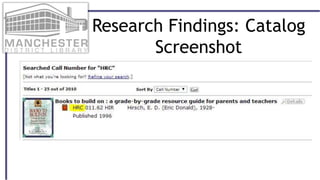
• HRC prefix in catalog
Research Findings: Catalog
Screenshot
RECOMMENDATIONS
Erin Kinnee
Recommendations for
MDL
• Community Assessment
– Survey
– Focus Groups
• Advisory Committee
• Goal Setting
Community Assessment
• Survey
– Creation and Distribution
• Focus Groups
– Composition and Barriers to Participation
Advisory Committee
• Purpose
• Composition
• Acquisition of Members
Goal Setting
• Role of Advisory Committee
• Role of Library Director
• Role of Board of Trustees
• Data Analysis and Application
SUMMARY
Chris Bulin
Review
• Introduce you to MDL
• Explore best practices and trends in
homeschooling
• Discuss a model for a superb homeschool
collection
• Describe recommendations for MDL
Take Aways
• Community Needs Assessment
• Ongoing Community Feedback
• Strategic Planning
Thank you!
Questions?
Contact Us:
Team.MDL.SI.620@umich.edu
• Campbell, Caralyn Bayne. "Shelby County Public Libraries and Homeschooling Parents." Alabama
Librarian 52, no. 1 (January 2002): 11-12. Library Literature & Information Science Full Text (H.W.
Wilson), EBSCOhost (accessed March 12, 2014).
• Furness, A. (2008). Curriculum Kits for Homeschoolers. Public Libraries, 47 (3), 23-24.
• Marquam, T. (2008). Fable and Fact: Serving the Homeschool Population in Public Libraries. Indiana
Libraries, 27 (1), 12-18.
• National Center for Education Statistics 2011. (2012). Number and Percentage of Homeschooled Students
Ages 5 through 17 with a Grade Equivalent of Kindergarten through 12th Grade, by Selected Child, Parent,
and Household Characteristics: 1999, 2003, and 2007. Digest of Education Statistics. Accessed March 13,
2014. http://nces.ed.gov/programs/digest/d11/tables/dt11_040.asp
• Paradise, C. (2008). Our Homeschool Alliance is a Winner. Public Libraries, 47 (3) 21-22.
• Princiotta, D., Bielick, S., and Chapman, C. (2006) Homeschooling in the United States: 2003: Statistical
Analysis Report. U.S. Department of Education Institute of Education Sciences. Accessed April 5, 2014,
from http://nces.ed.gov/pubs2006/2006042.pdf
References

Mdl homeschool collection presentation - SI 620

  • 1.
    Homeschool Collection for ManchesterDistrict Library Chris Bulin, Lauren Day, Erin Kinnee and Amy Scott April 18, 2014 This work is licensed under the Creative Commons Attribution-NonCommercial-ShareAlike 4.0 International License. To view a copy of this license, visit http://creativecommons.org/licenses/by-nc-sa/4.0/deed.en_US.
  • 2.
    What to expect: •An introduction to Manchester District Library (MDL) • Research questions and findings • Team’s recommendations to tailor the homeschool collection to the community
  • 3.
    Presented by: • ChrisBulin – Introduction • Amy Scott – Established Best Practices • Lauren Day – Sample Homeschool Collection • Erin Kinnee – Research Methods
  • 4.
    Purpose • Introduce youto MDL • Explore best practices and trends in homeschooling • Discuss a model for a superb homeschool collection • Describe recommendations for MDL
  • 5.
    MDL Particulars: Location •Washtenaw County near the border with Jackson County, south of Chelsea • District consists of several townships and the village of Manchester • Largely rural
  • 6.
    MDL Particulars: Population • Totalpopulation of the District: ~5,300 • Median age 46 years • Income levels higher than average for Michigan; ~$87,000 annually • Overwhelmingly Caucasian population (98%)
  • 7.
    MDL Particulars: Unique Attributes •Recently Incorporated (2000) • New Director hired in September 2013 • Requesting funds through millage in November • Lack of strategic scaffolding
  • 8.
    HOMESCHOOL TRENDS AND BESTPRACTICES Amy Scott
  • 9.
    Research Questions • Howcan MDL provide the best experience for community members who homeschool? – What are the best resources for finding new homeschool material? – How does MDL determine which materials are best for its community? – Does the collection meet the needs of homeschooling patrons? – What services best support the needs of patrons who are homeschooling?
  • 10.
    Research Findings: Nat’l Trendsin Homeschooling • Increase of 0.08% in number of homeschooled children from 1999-2007 • Children before fourth grade most likely to be homeschooled • Greatest percentage in rural areas • 78% of homeschooled families obtained materials through their public library
  • 11.
    Research Findings: Best Practices •Keep copies of catalogs of homeschool materials • Have a brochure highlighting materials and services for homeschoolers
  • 12.
    Research Findings: Materials Likelyin Demand • Biographies (Cambpell, 2002) • Encyclopedias (Marquam, 2008) • Historical fiction (Marquam, 2008) • Historical re-enactment guides, plans, and recipes (Paradise, 2008) • Science documentaries (Cambpell, 2002) • Teacher resources (Marquam, 2008) • Topical curriculum kits (Furness, 2008)
  • 13.
  • 14.
    Research Findings: Case Study– Johnsburg Library • Demographics • Grant • Survey
  • 15.
    Research Findings: Case Study– Johnsburg Library • Loan of kits and science paraphernalia • Increased use, including out of towners • HRC prefix in catalog
  • 16.
  • 17.
  • 18.
    Recommendations for MDL • CommunityAssessment – Survey – Focus Groups • Advisory Committee • Goal Setting
  • 19.
    Community Assessment • Survey –Creation and Distribution • Focus Groups – Composition and Barriers to Participation
  • 20.
    Advisory Committee • Purpose •Composition • Acquisition of Members
  • 21.
    Goal Setting • Roleof Advisory Committee • Role of Library Director • Role of Board of Trustees • Data Analysis and Application
  • 22.
  • 23.
    Review • Introduce youto MDL • Explore best practices and trends in homeschooling • Discuss a model for a superb homeschool collection • Describe recommendations for MDL
  • 24.
    Take Aways • CommunityNeeds Assessment • Ongoing Community Feedback • Strategic Planning
  • 25.
  • 26.
    • Campbell, CaralynBayne. "Shelby County Public Libraries and Homeschooling Parents." Alabama Librarian 52, no. 1 (January 2002): 11-12. Library Literature & Information Science Full Text (H.W. Wilson), EBSCOhost (accessed March 12, 2014). • Furness, A. (2008). Curriculum Kits for Homeschoolers. Public Libraries, 47 (3), 23-24. • Marquam, T. (2008). Fable and Fact: Serving the Homeschool Population in Public Libraries. Indiana Libraries, 27 (1), 12-18. • National Center for Education Statistics 2011. (2012). Number and Percentage of Homeschooled Students Ages 5 through 17 with a Grade Equivalent of Kindergarten through 12th Grade, by Selected Child, Parent, and Household Characteristics: 1999, 2003, and 2007. Digest of Education Statistics. Accessed March 13, 2014. http://nces.ed.gov/programs/digest/d11/tables/dt11_040.asp • Paradise, C. (2008). Our Homeschool Alliance is a Winner. Public Libraries, 47 (3) 21-22. • Princiotta, D., Bielick, S., and Chapman, C. (2006) Homeschooling in the United States: 2003: Statistical Analysis Report. U.S. Department of Education Institute of Education Sciences. Accessed April 5, 2014, from http://nces.ed.gov/pubs2006/2006042.pdf References