Process Fluid Flow (PFF260S)
Semester 1, 2020
-Dr. Buntu Godongwana
Introduction (PFF260S)
Students in the first course of Process Fluid Flow might ask:
• What is Fluid Flow?
• What I will be studying in it?
• Why?
2
Dr B. Godongwana, Semester 1 2020
Introduction (PFF260S)
3
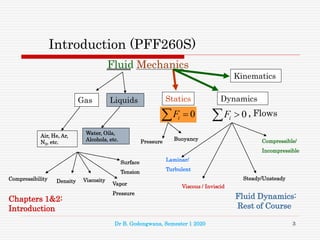
0

 i
F
Gas Liquids Statics Dynamics
Air, He, Ar,
N2, etc.
Water, Oils,
Alcohols, etc.
0

 i
F
Viscous / Inviscid
Steady/Unsteady
Compressible/
Incompressible
Laminar/
Turbulent
, Flows
Compressibility Viscosity
Vapor
Pressure
Density
Pressure
Buoyancy
Chapters 1&2:
Introduction
Fluid Dynamics:
Rest of Course
Surface
Tension
Fluid Mechanics
Kinematics
Dr B. Godongwana, Semester 1 2020
Introduction (PFF260S)
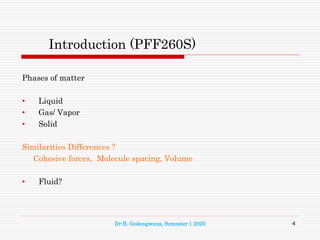
Phases of matter
• Liquid
• Gas/ Vapor
• Solid
Similarities Differences ?
Cohesive forces, Molecule spacing, Volume
• Fluid?
4
Dr B. Godongwana, Semester 1 2020
Introduction (PFF260S)
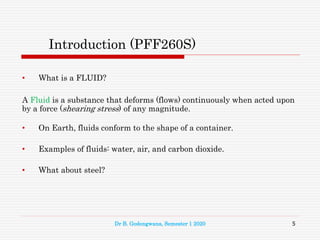
• What is a FLUID?
A Fluid is a substance that deforms (flows) continuously when acted upon
by a force (shearing stress) of any magnitude.
• On Earth, fluids conform to the shape of a container.
• Examples of fluids: water, air, and carbon dioxide.
• What about steel?
5
Dr B. Godongwana, Semester 1 2020
Introduction (PFF260S)
• Why study Fluid Flow?
 Two of three states of matter are fluids.
 Solids can behave like fluids under many conditions.
 Earth’s atmosphere contains fluids.
 Profitable industries are based on fluids.
 Models and equations can predict the behavior of fluids.
 The human body is 80% water.
6
Dr B. Godongwana, Semester 1 2020
Introduction (PFF260S)
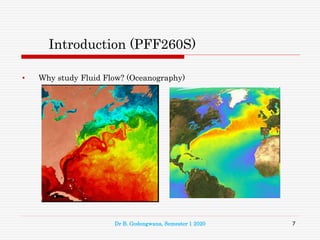
• Why study Fluid Flow? (Oceanography)
7
Dr B. Godongwana, Semester 1 2020
Introduction (PFF260S)
• Why study Fluid Flow? (Meteorology)
8
Dr B. Godongwana, Semester 1 2020
Introduction (PFF260S)
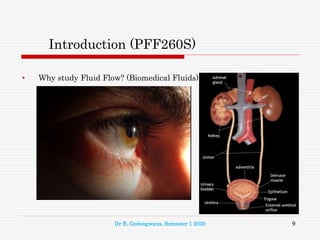
• Why study Fluid Flow? (Biomedical Fluids)
9
Dr B. Godongwana, Semester 1 2020
Introduction (PFF260S)
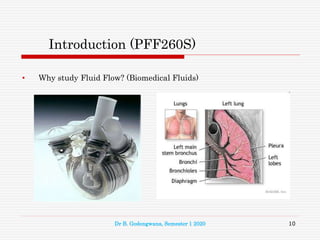
• Why study Fluid Flow? (Biomedical Fluids)
10
Dr B. Godongwana, Semester 1 2020
Introduction (PFF260S)
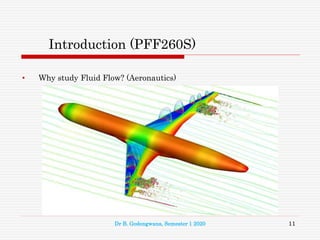
• Why study Fluid Flow? (Aeronautics)
11
Dr B. Godongwana, Semester 1 2020
Introduction (PFF260S)
• Why study Fluid Flow? (Aeronautics)
12
Dr B. Godongwana, Semester 1 2020
Introduction (PFF260S)
• Why study Fluid Flow? (Turbulence)
13
Dr B. Godongwana, Semester 1 2020
Introduction (PFF260S)
14
Faces of Fluid Mechanics
Archimedes
287 BC - 212 BC
Da Vinci
1452 - 1519
Newton
1642 - 1726
Leibniz
1646 - 1716
Euler
1707 - 1783
Bernoulli
1700–1782
Navier
1785 - 1836
Stokes
1819 - 1903
Reynolds
1842 - 1912
Prandtl
1875 - 1953
Dr B. Godongwana, Semester 1 2020
Introduction (PFF260S)
15
Faces of Fluid Mechanics
???
Dr B. Godongwana, Semester 1 2020
Introduction (PFF260S)
• Fluid Flow Research
Fluids researchers seeks insight into:
 Flow through turbo-machinery,
 Flow in porous media
 Convective, diffusional and chemical reaction processes
 Fluids containing particles and gas bubbles
 Fluids interacting with solid boundaries
 Fluids changing phases
 Equations and models to predict motions
 Innovative measurement techniques
16
Dr B. Godongwana, Semester 1 2020
Introduction (PFF260S)
• Syllabus
 Introduction to Fluid Mechanics and its Basic Concepts
• Properties of Fluids
• Pressure and Fluid Statics
• Mass, Bernoulli and Energy Equations
• Flow in Pipes
• Losses in Piping System
• Piping Network and Pump Selection
17
Dr B. Godongwana, Semester 1 2020
References (PFF260S)
• Munson, B. R., Young, D. F., and Okiishi, T. H. 2006.
Fundamentals of Fluid Mechanics. 5th ed. Wiley: New York.
• White, F.M. 1998. Fluid Mechanics. 4th edition. McGraw-Hill: New
York.
• Geankoplis. C.J. 1993. Transport Processes and Unit Operations.
Prentice Hall: New Jersey.
• Fox, R.W., McDonald, A.T. & Pritchard, P.J. 2004. Introduction to
Fluid Mechanics. 6th edition. Wiley: New York.
• Holland, F.A. 1995. Fluid Flow for Chem. Engineers. 2nd edition.
Edward Arnold: London.
• Welty, J.R., Wicks, C. E., Wilson, R. E. 2001. Fundamentals of
Momentum, Heat and Mass Transfer. 4th ed. John Wiley: New
York.
18
Dr B. Godongwana, Semester 1 2020
References (PFF260S)
• Perry, R.H., Green, D.W. & Maloney, J.O. (eds). 1998. Perry’s
chemical engineer’s handbook. 7th ed. McGraw Hill: New York.
• Anderson, J.D. 1995. Computational fluid dynamics: the basics
with applications. New York: McGraw-Hill.
19
Dr B. Godongwana, Semester 1 2020

Process Fluid Flow (Slide show 1).pptx

  • 1.
    Process Fluid Flow(PFF260S) Semester 1, 2020 -Dr. Buntu Godongwana
  • 2.
    Introduction (PFF260S) Students inthe first course of Process Fluid Flow might ask: • What is Fluid Flow? • What I will be studying in it? • Why? 2 Dr B. Godongwana, Semester 1 2020
  • 3.
    Introduction (PFF260S) 3 0   i F GasLiquids Statics Dynamics Air, He, Ar, N2, etc. Water, Oils, Alcohols, etc. 0   i F Viscous / Inviscid Steady/Unsteady Compressible/ Incompressible Laminar/ Turbulent , Flows Compressibility Viscosity Vapor Pressure Density Pressure Buoyancy Chapters 1&2: Introduction Fluid Dynamics: Rest of Course Surface Tension Fluid Mechanics Kinematics Dr B. Godongwana, Semester 1 2020
  • 4.
    Introduction (PFF260S) Phases ofmatter • Liquid • Gas/ Vapor • Solid Similarities Differences ? Cohesive forces, Molecule spacing, Volume • Fluid? 4 Dr B. Godongwana, Semester 1 2020
  • 5.
    Introduction (PFF260S) • Whatis a FLUID? A Fluid is a substance that deforms (flows) continuously when acted upon by a force (shearing stress) of any magnitude. • On Earth, fluids conform to the shape of a container. • Examples of fluids: water, air, and carbon dioxide. • What about steel? 5 Dr B. Godongwana, Semester 1 2020
  • 6.
    Introduction (PFF260S) • Whystudy Fluid Flow?  Two of three states of matter are fluids.  Solids can behave like fluids under many conditions.  Earth’s atmosphere contains fluids.  Profitable industries are based on fluids.  Models and equations can predict the behavior of fluids.  The human body is 80% water. 6 Dr B. Godongwana, Semester 1 2020
  • 7.
    Introduction (PFF260S) • Whystudy Fluid Flow? (Oceanography) 7 Dr B. Godongwana, Semester 1 2020
  • 8.
    Introduction (PFF260S) • Whystudy Fluid Flow? (Meteorology) 8 Dr B. Godongwana, Semester 1 2020
  • 9.
    Introduction (PFF260S) • Whystudy Fluid Flow? (Biomedical Fluids) 9 Dr B. Godongwana, Semester 1 2020
  • 10.
    Introduction (PFF260S) • Whystudy Fluid Flow? (Biomedical Fluids) 10 Dr B. Godongwana, Semester 1 2020
  • 11.
    Introduction (PFF260S) • Whystudy Fluid Flow? (Aeronautics) 11 Dr B. Godongwana, Semester 1 2020
  • 12.
    Introduction (PFF260S) • Whystudy Fluid Flow? (Aeronautics) 12 Dr B. Godongwana, Semester 1 2020
  • 13.
    Introduction (PFF260S) • Whystudy Fluid Flow? (Turbulence) 13 Dr B. Godongwana, Semester 1 2020
  • 14.
    Introduction (PFF260S) 14 Faces ofFluid Mechanics Archimedes 287 BC - 212 BC Da Vinci 1452 - 1519 Newton 1642 - 1726 Leibniz 1646 - 1716 Euler 1707 - 1783 Bernoulli 1700–1782 Navier 1785 - 1836 Stokes 1819 - 1903 Reynolds 1842 - 1912 Prandtl 1875 - 1953 Dr B. Godongwana, Semester 1 2020
  • 15.
    Introduction (PFF260S) 15 Faces ofFluid Mechanics ??? Dr B. Godongwana, Semester 1 2020
  • 16.
    Introduction (PFF260S) • FluidFlow Research Fluids researchers seeks insight into:  Flow through turbo-machinery,  Flow in porous media  Convective, diffusional and chemical reaction processes  Fluids containing particles and gas bubbles  Fluids interacting with solid boundaries  Fluids changing phases  Equations and models to predict motions  Innovative measurement techniques 16 Dr B. Godongwana, Semester 1 2020
  • 17.
    Introduction (PFF260S) • Syllabus Introduction to Fluid Mechanics and its Basic Concepts • Properties of Fluids • Pressure and Fluid Statics • Mass, Bernoulli and Energy Equations • Flow in Pipes • Losses in Piping System • Piping Network and Pump Selection 17 Dr B. Godongwana, Semester 1 2020
  • 18.
    References (PFF260S) • Munson,B. R., Young, D. F., and Okiishi, T. H. 2006. Fundamentals of Fluid Mechanics. 5th ed. Wiley: New York. • White, F.M. 1998. Fluid Mechanics. 4th edition. McGraw-Hill: New York. • Geankoplis. C.J. 1993. Transport Processes and Unit Operations. Prentice Hall: New Jersey. • Fox, R.W., McDonald, A.T. & Pritchard, P.J. 2004. Introduction to Fluid Mechanics. 6th edition. Wiley: New York. • Holland, F.A. 1995. Fluid Flow for Chem. Engineers. 2nd edition. Edward Arnold: London. • Welty, J.R., Wicks, C. E., Wilson, R. E. 2001. Fundamentals of Momentum, Heat and Mass Transfer. 4th ed. John Wiley: New York. 18 Dr B. Godongwana, Semester 1 2020
  • 19.
    References (PFF260S) • Perry,R.H., Green, D.W. & Maloney, J.O. (eds). 1998. Perry’s chemical engineer’s handbook. 7th ed. McGraw Hill: New York. • Anderson, J.D. 1995. Computational fluid dynamics: the basics with applications. New York: McGraw-Hill. 19 Dr B. Godongwana, Semester 1 2020