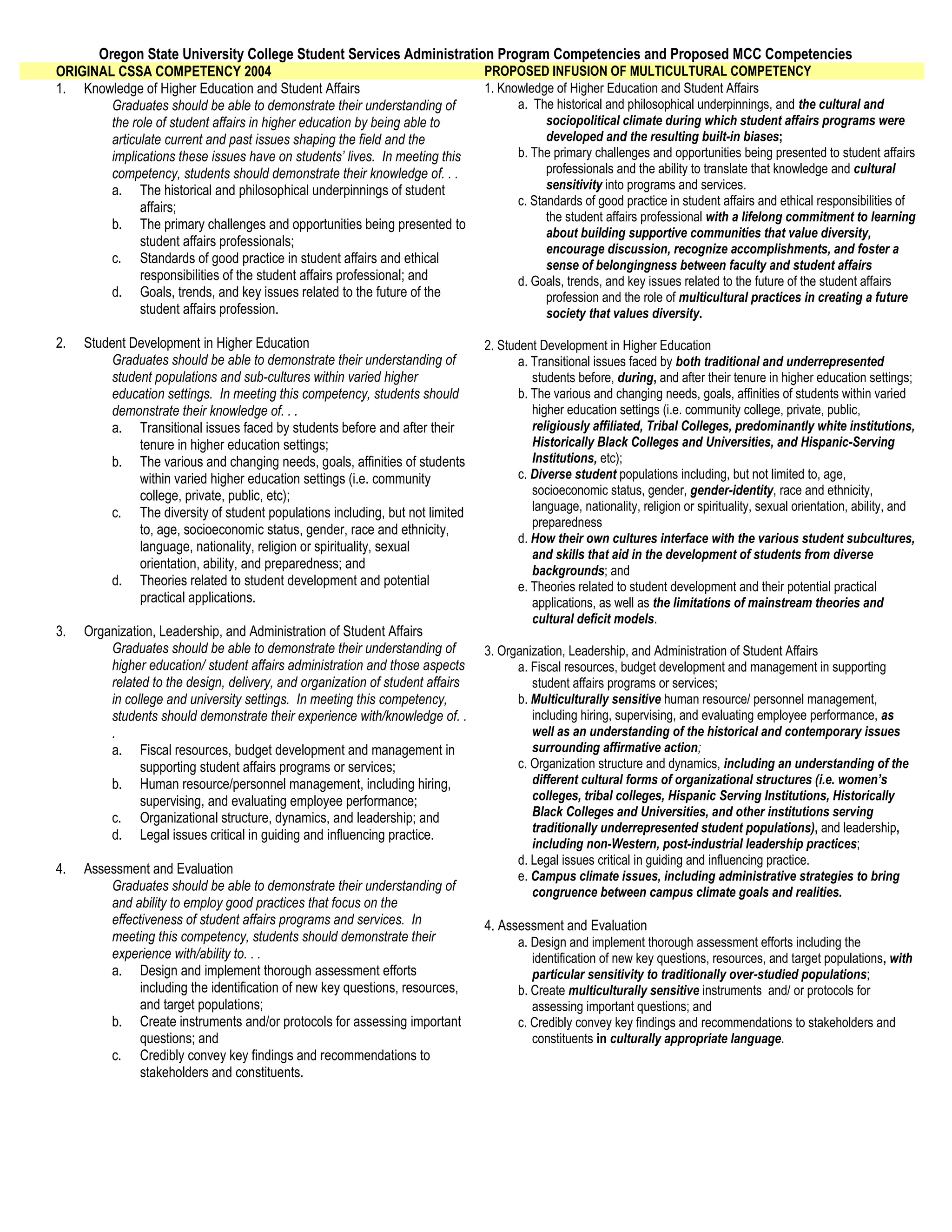
Oregon State University College Student Services Administration Program Competencies and Proposed MCC Competencies
ORIGINAL CSSA COMPETENCY 2004                                                   PROPOSED INFUSION OF MULTICULTURAL COMPETENCY
1. Knowledge of Higher Education and Student Affairs                            1. Knowledge of Higher Education and Student Affairs
        Graduates should be able to demonstrate their understanding of                a. The historical and philosophical underpinnings, and the cultural and
        the role of student affairs in higher education by being able to                    sociopolitical climate during which student affairs programs were
        articulate current and past issues shaping the field and the                        developed and the resulting built-in biases;
        implications these issues have on students’ lives. In meeting this            b. The primary challenges and opportunities being presented to student affairs
        competency, students should demonstrate their knowledge of. . .                     professionals and the ability to translate that knowledge and cultural
        a. The historical and philosophical underpinnings of student                        sensitivity into programs and services.
              affairs;                                                                c. Standards of good practice in student affairs and ethical responsibilities of
                                                                                            the student affairs professional with a lifelong commitment to learning
        b. The primary challenges and opportunities being presented to
                                                                                            about building supportive communities that value diversity,
              student affairs professionals;
                                                                                            encourage discussion, recognize accomplishments, and foster a
        c. Standards of good practice in student affairs and ethical                        sense of belongingness between faculty and student affairs
              responsibilities of the student affairs professional; and               d. Goals, trends, and key issues related to the future of the student affairs
        d. Goals, trends, and key issues related to the future of the                       profession and the role of multicultural practices in creating a future
              student affairs profession.                                                   society that values diversity.

2.   Student Development in Higher Education                                    2. Student Development in Higher Education
         Graduates should be able to demonstrate their understanding of                a. Transitional issues faced by both traditional and underrepresented
         student populations and sub-cultures within varied higher                        students before, during, and after their tenure in higher education settings;
         education settings. In meeting this competency, students should               b. The various and changing needs, goals, affinities of students within varied
         demonstrate their knowledge of. . .                                              higher education settings (i.e. community college, private, public,
         a. Transitional issues faced by students before and after their                  religiously affiliated, Tribal Colleges, predominantly white institutions,
              tenure in higher education settings;                                        Historically Black Colleges and Universities, and Hispanic-Serving
         b. The various and changing needs, goals, affinities of students                 Institutions, etc);
              within varied higher education settings (i.e. community                  c. Diverse student populations including, but not limited to, age,
              college, private, public, etc);                                             socioeconomic status, gender, gender-identity, race and ethnicity,
         c. The diversity of student populations including, but not limited               language, nationality, religion or spirituality, sexual orientation, ability, and
                                                                                          preparedness
              to, age, socioeconomic status, gender, race and ethnicity,
                                                                                       d. How their own cultures interface with the various student subcultures,
              language, nationality, religion or spirituality, sexual
                                                                                          and skills that aid in the development of students from diverse
              orientation, ability, and preparedness; and                                 backgrounds; and
         d. Theories related to student development and potential                      e. Theories related to student development and their potential practical
              practical applications.                                                     applications, as well as the limitations of mainstream theories and
                                                                                          cultural deficit models.
3.   Organization, Leadership, and Administration of Student Affairs
         Graduates should be able to demonstrate their understanding of         3. Organization, Leadership, and Administration of Student Affairs
         higher education/ student affairs administration and those aspects           a. Fiscal resources, budget development and management in supporting
         related to the design, delivery, and organization of student affairs            student affairs programs or services;
         in college and university settings. In meeting this competency,              b. Multiculturally sensitive human resource/ personnel management,
         students should demonstrate their experience with/knowledge of. .               including hiring, supervising, and evaluating employee performance, as
         .                                                                               well as an understanding of the historical and contemporary issues
         a. Fiscal resources, budget development and management in                       surrounding affirmative action;
               supporting student affairs programs or services;                       c. Organization structure and dynamics, including an understanding of the
         b. Human resource/personnel management, including hiring,                       different cultural forms of organizational structures (i.e. women’s
               supervising, and evaluating employee performance;                         colleges, tribal colleges, Hispanic Serving Institutions, Historically
         c. Organizational structure, dynamics, and leadership; and                      Black Colleges and Universities, and other institutions serving
                                                                                         traditionally underrepresented student populations), and leadership,
         d. Legal issues critical in guiding and influencing practice.
                                                                                         including non-Western, post-industrial leadership practices;
                                                                                      d. Legal issues critical in guiding and influencing practice.
4.   Assessment and Evaluation                                                        e. Campus climate issues, including administrative strategies to bring
         Graduates should be able to demonstrate their understanding of                  congruence between campus climate goals and realities.
         and ability to employ good practices that focus on the
         effectiveness of student affairs programs and services. In             4. Assessment and Evaluation
         meeting this competency, students should demonstrate their                    a. Design and implement thorough assessment efforts including the
         experience with/ability to. . .                                                  identification of new key questions, resources, and target populations, with
         a. Design and implement thorough assessment efforts                              particular sensitivity to traditionally over-studied populations;
               including the identification of new key questions, resources,           b. Create multiculturally sensitive instruments and/ or protocols for
               and target populations;                                                    assessing important questions; and
         b. Create instruments and/or protocols for assessing important                c. Credibly convey key findings and recommendations to stakeholders and
               questions; and                                                             constituents in culturally appropriate language.
         c. Credibly convey key findings and recommendations to
               stakeholders and constituents.
5.   Program Planning                                                            5. Program Planning
          Graduates should be able to demonstrate their understanding of               a. Design original programs including the identification of resources, needs, and
          and ability to design and execute high quality programs (i.e.                   goals, with careful consideration of underrepresented student
          seminars, workshops, trainings or other similar experiences that                populations;
          are meant to facilitate development and learning that are                    b. Market programs appropriately, and inclusively;
          thoughtful, engaging, and learner-centered). In meeting this                 c. Facilitate the implementation of culturally sensitive programs; and
          competency, students should demonstrate their experience                     d. Evaluate the effectiveness and inclusivity of programs in meeting desired
          with/ability to. . .                                                            goals and outcomes,
          a. Design original programs including the identification of
                                                                                 6. Teaching/Presentation/Publication
               resources, needs, and goals;
                                                                                       a. Develop and share ideas and concepts to students, staff, or faculty groups
          b. Market programs appropriately;                                               outside of the CSSA classroom in a culturally sensitive manner;
          c. Facilitate the implementation of programs; and                            b. Incorporate original and innovative techniques that are appropriate in sharing
          d. Evaluate the effectiveness of programs in meeting desired                    these ideas;
               goals and outcomes.                                                     c. Consider and incorporate the varied learning styles other than one’s
                                                                                          own; and
6.   Teaching/Presentation/Publication                                                 d. Consider the cultural contexts, ensuring that all voices have the
         Graduates should be able to demonstrate their ability to                         opportunity for participation;
         disseminate scholarly work through public forums. In meeting this             e. Reflect on the experience and make constructive changes and
         competency, students should demonstrate their experience                         improvements.
         with/ability to. . .
         a. Develop and share ideas and concepts to students, staff, or          7. Individual, Group, and Organizational Communication
              faculty groups outside of the CSSA classroom;                             a. Positively manage, develop, and engage in working relationships with faculty,
         b. Incorporate original and innovative techniques that are                        staff, and students across functional and institutional boundaries, practice
              appropriate and engaging in sharing these ideas; and                         culturally sensitive communication, and distinguish between the
         c. Reflect on the experience and make constructive changes                        person and the performance;
              and improvements.                                                         b. Initiate working alliance initiatives across functional boundaries, invest in
                                                                                           relationships with colleagues and students from dominant and non-
                                                                                           dominant cultural backgrounds, take steps to make the campus
7.   Individual, Group, and Organizational Communication
                                                                                           environment inclusive, and ensure that all the voices are heard;
           Graduates should be able to demonstrate effective interpersonal              c. Take on key leadership roles though these partnerships and collaborations,
           communication skills with students and colleagues and their ability             and cultivate fluid views of leadership that allow honoring of
           to develop and maintain effective partnerships with individuals                 individualistic and collectivistic cultures.
           from the campus and local community. In meeting this                         d. Serve as advocate, counselor, and/or advisor to students or student groups,
           competency, students should demonstrate their experience                        engaging in culturally sensitive practices; and
           with/ability to. . .                                                         e. Manage and/or mediate conflict, crisis, or problematic circumstances, paying
           a. Positively manage, develop, and engage in working                            attention to the needs and issues faced by underrepresented groups.
                relationships with faculty, staff, and students across
                functional and institutional boundaries;                         8. The Developing Professional
           b. Initiate and participate in working alliances and teams with a           a. Seek out a multiculturally comprehensive graduate and professional
                wide range of people across cultural boundaries;                          experience;
           c. Take on key leadership roles though these partnerships and               b. Develop an understanding of the value of community involvement and
                collaborations;                                                           participation beyond the OSU campus to communities that may have
           d. Serve as advocate, counselor, and/or advisor to students or                 different cultural orientation from self;
                student groups; and                                                    c. Reflect on graduate, professional, and personal development experiences
           e. Manage and/or mediate conflict, crisis, or problematic                      toward greater self-understanding with a commitment to life-long learning,
                                                                                          especially the development of multicultural self;
                circumstances.
                                                                                       d. Examine and question their “fit” within profession by clearly articulating
8.   The Developing Professional
                                                                                          personal strengths and potential contributions to the field; and
           Graduates should be able to demonstrate their ability to carefully          e. Engage in thoughtful career planning and decision making exercises while
           examine and challenge their own personal and professional                      continually examining and assessing areas of growth in one’s own
           values, worldviews, assumptions and biases. In meeting this                    learning.
           competency, students should demonstrate their experience
           with/ability to. . .                                                  9. Multicultural awareness, knowledge and skills –graduates of the CSSA Program
           a. Seek out a comprehensive and well-rounded graduate and             should be able to demonstrate multicultural awareness, knowledge and skills. In
                professional experience;                                         meeting this competency, students should demonstrate their
           b. Develop an understanding of the value of community                        a. Awareness of their own cultural heritage and how it affects their worldviews,
                involvement and participation beyond the OSU campus;                        values, and assumptions.
           c. Reflect on graduate, professional, and personal development               b. Knowledge of systems of privilege and oppression as well as knowledge of
                experiences toward greater self-understanding;                              groups and individuals who are different from self.
           d. Examine and question their “fit” within profession by clearly             c. Skills to challenge and support individuals in a manner that maximizes
                articulating personal strengths and potential contributions to              multiculturally sensitive and develop appropriate interventions, rooted in
                the field; and                                                              multicultural awareness and knowledge, that influence the organizational
           e. Engage in thoughtful career planning and decision making                      performance.
                exercises                                                               d. Ability to identify areas of personal growth and develop a lifelong commitment
                                                                                        to improving one’s own multicultural competence
                                                                                                             Alemán, Akkaraju, Martel, McGraw , 2004-2005
                                Result: From the proposed competencies, CSSA faculty adopted number 9 and incorporated it as number 4 for the current cohort.
                                                                        Discussion around adopted the proposed changes to the other competencies continues

mcc

  • 1.
    Oregon State UniversityCollege Student Services Administration Program Competencies and Proposed MCC Competencies ORIGINAL CSSA COMPETENCY 2004 PROPOSED INFUSION OF MULTICULTURAL COMPETENCY 1. Knowledge of Higher Education and Student Affairs 1. Knowledge of Higher Education and Student Affairs Graduates should be able to demonstrate their understanding of a. The historical and philosophical underpinnings, and the cultural and the role of student affairs in higher education by being able to sociopolitical climate during which student affairs programs were articulate current and past issues shaping the field and the developed and the resulting built-in biases; implications these issues have on students’ lives. In meeting this b. The primary challenges and opportunities being presented to student affairs competency, students should demonstrate their knowledge of. . . professionals and the ability to translate that knowledge and cultural a. The historical and philosophical underpinnings of student sensitivity into programs and services. affairs; c. Standards of good practice in student affairs and ethical responsibilities of the student affairs professional with a lifelong commitment to learning b. The primary challenges and opportunities being presented to about building supportive communities that value diversity, student affairs professionals; encourage discussion, recognize accomplishments, and foster a c. Standards of good practice in student affairs and ethical sense of belongingness between faculty and student affairs responsibilities of the student affairs professional; and d. Goals, trends, and key issues related to the future of the student affairs d. Goals, trends, and key issues related to the future of the profession and the role of multicultural practices in creating a future student affairs profession. society that values diversity. 2. Student Development in Higher Education 2. Student Development in Higher Education Graduates should be able to demonstrate their understanding of a. Transitional issues faced by both traditional and underrepresented student populations and sub-cultures within varied higher students before, during, and after their tenure in higher education settings; education settings. In meeting this competency, students should b. The various and changing needs, goals, affinities of students within varied demonstrate their knowledge of. . . higher education settings (i.e. community college, private, public, a. Transitional issues faced by students before and after their religiously affiliated, Tribal Colleges, predominantly white institutions, tenure in higher education settings; Historically Black Colleges and Universities, and Hispanic-Serving b. The various and changing needs, goals, affinities of students Institutions, etc); within varied higher education settings (i.e. community c. Diverse student populations including, but not limited to, age, college, private, public, etc); socioeconomic status, gender, gender-identity, race and ethnicity, c. The diversity of student populations including, but not limited language, nationality, religion or spirituality, sexual orientation, ability, and preparedness to, age, socioeconomic status, gender, race and ethnicity, d. How their own cultures interface with the various student subcultures, language, nationality, religion or spirituality, sexual and skills that aid in the development of students from diverse orientation, ability, and preparedness; and backgrounds; and d. Theories related to student development and potential e. Theories related to student development and their potential practical practical applications. applications, as well as the limitations of mainstream theories and cultural deficit models. 3. Organization, Leadership, and Administration of Student Affairs Graduates should be able to demonstrate their understanding of 3. Organization, Leadership, and Administration of Student Affairs higher education/ student affairs administration and those aspects a. Fiscal resources, budget development and management in supporting related to the design, delivery, and organization of student affairs student affairs programs or services; in college and university settings. In meeting this competency, b. Multiculturally sensitive human resource/ personnel management, students should demonstrate their experience with/knowledge of. . including hiring, supervising, and evaluating employee performance, as . well as an understanding of the historical and contemporary issues a. Fiscal resources, budget development and management in surrounding affirmative action; supporting student affairs programs or services; c. Organization structure and dynamics, including an understanding of the b. Human resource/personnel management, including hiring, different cultural forms of organizational structures (i.e. women’s supervising, and evaluating employee performance; colleges, tribal colleges, Hispanic Serving Institutions, Historically c. Organizational structure, dynamics, and leadership; and Black Colleges and Universities, and other institutions serving traditionally underrepresented student populations), and leadership, d. Legal issues critical in guiding and influencing practice. including non-Western, post-industrial leadership practices; d. Legal issues critical in guiding and influencing practice. 4. Assessment and Evaluation e. Campus climate issues, including administrative strategies to bring Graduates should be able to demonstrate their understanding of congruence between campus climate goals and realities. and ability to employ good practices that focus on the effectiveness of student affairs programs and services. In 4. Assessment and Evaluation meeting this competency, students should demonstrate their a. Design and implement thorough assessment efforts including the experience with/ability to. . . identification of new key questions, resources, and target populations, with a. Design and implement thorough assessment efforts particular sensitivity to traditionally over-studied populations; including the identification of new key questions, resources, b. Create multiculturally sensitive instruments and/ or protocols for and target populations; assessing important questions; and b. Create instruments and/or protocols for assessing important c. Credibly convey key findings and recommendations to stakeholders and questions; and constituents in culturally appropriate language. c. Credibly convey key findings and recommendations to stakeholders and constituents.
  • 2.
    5. Program Planning 5. Program Planning Graduates should be able to demonstrate their understanding of a. Design original programs including the identification of resources, needs, and and ability to design and execute high quality programs (i.e. goals, with careful consideration of underrepresented student seminars, workshops, trainings or other similar experiences that populations; are meant to facilitate development and learning that are b. Market programs appropriately, and inclusively; thoughtful, engaging, and learner-centered). In meeting this c. Facilitate the implementation of culturally sensitive programs; and competency, students should demonstrate their experience d. Evaluate the effectiveness and inclusivity of programs in meeting desired with/ability to. . . goals and outcomes, a. Design original programs including the identification of 6. Teaching/Presentation/Publication resources, needs, and goals; a. Develop and share ideas and concepts to students, staff, or faculty groups b. Market programs appropriately; outside of the CSSA classroom in a culturally sensitive manner; c. Facilitate the implementation of programs; and b. Incorporate original and innovative techniques that are appropriate in sharing d. Evaluate the effectiveness of programs in meeting desired these ideas; goals and outcomes. c. Consider and incorporate the varied learning styles other than one’s own; and 6. Teaching/Presentation/Publication d. Consider the cultural contexts, ensuring that all voices have the Graduates should be able to demonstrate their ability to opportunity for participation; disseminate scholarly work through public forums. In meeting this e. Reflect on the experience and make constructive changes and competency, students should demonstrate their experience improvements. with/ability to. . . a. Develop and share ideas and concepts to students, staff, or 7. Individual, Group, and Organizational Communication faculty groups outside of the CSSA classroom; a. Positively manage, develop, and engage in working relationships with faculty, b. Incorporate original and innovative techniques that are staff, and students across functional and institutional boundaries, practice appropriate and engaging in sharing these ideas; and culturally sensitive communication, and distinguish between the c. Reflect on the experience and make constructive changes person and the performance; and improvements. b. Initiate working alliance initiatives across functional boundaries, invest in relationships with colleagues and students from dominant and non- dominant cultural backgrounds, take steps to make the campus 7. Individual, Group, and Organizational Communication environment inclusive, and ensure that all the voices are heard; Graduates should be able to demonstrate effective interpersonal c. Take on key leadership roles though these partnerships and collaborations, communication skills with students and colleagues and their ability and cultivate fluid views of leadership that allow honoring of to develop and maintain effective partnerships with individuals individualistic and collectivistic cultures. from the campus and local community. In meeting this d. Serve as advocate, counselor, and/or advisor to students or student groups, competency, students should demonstrate their experience engaging in culturally sensitive practices; and with/ability to. . . e. Manage and/or mediate conflict, crisis, or problematic circumstances, paying a. Positively manage, develop, and engage in working attention to the needs and issues faced by underrepresented groups. relationships with faculty, staff, and students across functional and institutional boundaries; 8. The Developing Professional b. Initiate and participate in working alliances and teams with a a. Seek out a multiculturally comprehensive graduate and professional wide range of people across cultural boundaries; experience; c. Take on key leadership roles though these partnerships and b. Develop an understanding of the value of community involvement and collaborations; participation beyond the OSU campus to communities that may have d. Serve as advocate, counselor, and/or advisor to students or different cultural orientation from self; student groups; and c. Reflect on graduate, professional, and personal development experiences e. Manage and/or mediate conflict, crisis, or problematic toward greater self-understanding with a commitment to life-long learning, especially the development of multicultural self; circumstances. d. Examine and question their “fit” within profession by clearly articulating 8. The Developing Professional personal strengths and potential contributions to the field; and Graduates should be able to demonstrate their ability to carefully e. Engage in thoughtful career planning and decision making exercises while examine and challenge their own personal and professional continually examining and assessing areas of growth in one’s own values, worldviews, assumptions and biases. In meeting this learning. competency, students should demonstrate their experience with/ability to. . . 9. Multicultural awareness, knowledge and skills –graduates of the CSSA Program a. Seek out a comprehensive and well-rounded graduate and should be able to demonstrate multicultural awareness, knowledge and skills. In professional experience; meeting this competency, students should demonstrate their b. Develop an understanding of the value of community a. Awareness of their own cultural heritage and how it affects their worldviews, involvement and participation beyond the OSU campus; values, and assumptions. c. Reflect on graduate, professional, and personal development b. Knowledge of systems of privilege and oppression as well as knowledge of experiences toward greater self-understanding; groups and individuals who are different from self. d. Examine and question their “fit” within profession by clearly c. Skills to challenge and support individuals in a manner that maximizes articulating personal strengths and potential contributions to multiculturally sensitive and develop appropriate interventions, rooted in the field; and multicultural awareness and knowledge, that influence the organizational e. Engage in thoughtful career planning and decision making performance. exercises d. Ability to identify areas of personal growth and develop a lifelong commitment to improving one’s own multicultural competence Alemán, Akkaraju, Martel, McGraw , 2004-2005 Result: From the proposed competencies, CSSA faculty adopted number 9 and incorporated it as number 4 for the current cohort. Discussion around adopted the proposed changes to the other competencies continues