Kepler’s Exoplanet Discoveries:
Implications for the Prevalence of
  Extra-Terrestrial Intelligence


       Robert McCann, Ph.D.
       NASA Ames Research Center

       Special Acknowledgments:
       Dr. Natalie Batalha         1
       Dr. Bill Borucki
Milky Way Galaxy


•   Large Barred Spiral
•   90K LY in Diameter
•   ~200B stars
•   ~20B FGK’s


    • <1995 CE:
       • 1 Planetary System
       • 1 Intelligent life form capable of putting together a ppt presentation
• Kepler Mission
    • Primary Goal: Detect Earth-sized planets in HZ of their star
    • Quantify how plentiful they are


•   Giant (95 MP) photometer in space   • 167K sun-like stars in FOV
•   Launched March 2009                 • 156K selected for monitoring
•   First Light: May 2009
Implications for ETI Drake
                                Equation
1961:
  • Frank Drake develops Drake Equation
        • Equation to calculate the number of civilizations in our
          galaxy that we could potentially receive a signal from.


N = R* x fPlanet x ne x fLife x fIntelligence x fCivilizations x L


N = the number of transmitting/communicating civilizations
R* = galactic birthrate of G/K/M type stars suitable for hosting life (~10/year)
fPlanet = the fraction of such stars having planets
ne = the number of those planets that are habitable
fLife = fraction of those planets on which life originated/evolved
fIntelligence = the fraction of inhabited worlds that developed intelligent life
fCivilizations = the fraction of inhabited worlds that developed civilizations
             capable of interstellar communication
L = lifetime of those communicating civilizations

•Kepler: Fraction of sun-like (FGK) stars with a habitable planet
   • Consolidation of terms fPlanet and ne
Kepler Modus Operandi: Transit Method
                              Kepler-16         (2)
                                                      Kepler-10

                    Kepler-15             Kepler-4

             HAT-p-11 Kepler-6 Kepler-22 TrES-2
                                         Kepler-14
             Kepler-17 KOI-428HAT-p-7
                                        Kepler-13
                   KOI-423
                                                             Kepler-8
                      Kepler-5

                                               Kepler-12
                                    Kepler-7
             Kepler-11 line-of-sight: Rs/Rorbit
• Proportion of planets in(6)
                                 Kepler-21         Kepler-18 (3)
• For Earth-sized planets in Earth-sized orbits:
                         Kepler-19       Kepler-9 (3)
  • .005 (1/200)                   (2)

  • If all 156K stars in Kepler FOV contain an Lissauer et al. 2011, Nature, 470, 53
    earth-analog:
    • Kepler would detect 780 of them                           5
Kepler-16         (2)
                                       Kepler-10
     Kepler-15               Kepler-4

HAT-p-11 Kepler-6 Kepler-22 TrES-2
                            Kepler-14
Kepler-17 KOI-428HAT-p-7
                           Kepler-13
     KOI-423
                                             Kepler-8
       Kepler-5

                                 Kepler-12
     Kepler-11(6)     Kepler-7

                       Kepler-21          Kepler-18     (3)


               Kepler-19 (2)   Kepler-9 (3)


                                                          6
Candidates as of June 2010
                                Q0-Q1: May-June 2009
                     Jun 2010   (No Earth-Sized Planets)
Size Relative to Earth


                                                           7
                                 Orbital Period in days
Candidates as of Feb 2011
                               Q0-Q5: May 2009 - Jun 2010
                          Jun 2010           Feb 2011
Size Relative to Earth


                                                              8
                                     Orbital Period in days
Improved Vetting Statistics


 9.1 arcsec source offset


                              9
 0.2 arcsec source offset
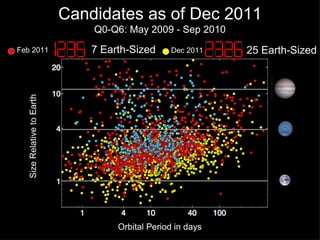
Candidates as of Dec 2011
                               Q0-Q6: May 2009 - Sep 2010
Feb 2011                       7 Earth-Sized     Dec 2011    25 Earth-Sized
  Size Relative to Earth


                                                                10
                                    Orbital Period in days
Kepler-16         (2)
                                      Kepler-10

     Kepler-15             Kepler-4
                Kepler-22
HAT-p-11 Kepler-6
                          TrES-2
                          Kepler-14
Kepler-17 KOI-428HAT-p-7
                         Kepler-13
    KOI-423
                                             Kepler-8
      Kepler-5

                                Kepler-12
     Kepler-11(6)    Kepler-7

                      Kepler-21             Kepler-18   (3)


              Kepler-19 (2)   Kepler-9 (3)


                                                         11
HZ Candidates
                48 with Teq between 185 and 303 K (Earth = 255 K)
                         Jun 2010              Feb 2011           Dec 2011
Size Relative to Earth


                                    Equilibrium Temperature [K]              12
HZ Candidates
                         Ten with Rp < 2 Re (185 K < Teq < 303 K)
                           Jun 2010              Feb 2011           Dec 2011
Size Relative to Earth


                                      Equilibrium Temperature [K]              13
Only a matter of time before discovery of “ηEarths”
     • 0 .95 AU < a < 1.37 AU (Kasting et al.,
       1993)
     • 0.8REarth < r < 2REarth
• Q0-Q6: May 2009 - Sep 2010
• As of May 2012: Will Double
  observation time from 18 to 36
  months
• 3 transits of ηEarth’s obtained


                                                      14
When will we know?


              ?
• Lower S/N ratio than
  originally designed for
     • More transits required


                                                         15
                                Nature 477, 142-143 (Sept 6, 2011)
Stellar Noise: simulation vs observation
   6.5-hr variability is stochastic and will average out over
                           multiple orbits

                                                            The goal of true
                                                            Earth-analogs is
  1.2-Re, P=365 d                       1.0-Re, P=365 d      reachable by
                                                             extending the
                                                            mission length

                                                          Jenkins et al.: Poster 19.14
                    1.0-Re, P=225 d

                                         30 ppm
   20-ppm


                            1.0-Re, P=365 d


                                                                     16
Extrapolation based on Existing Kepler Data   Feb 2011


• Catanzarite and Shao (2011):
  • Defined Earth Analog Planets
    (ηEarth):
       • .95 AU < a < 1.37 AU
           (Kasting et al., 1993)
       • .8REarth < r < 2REarth
  • How many should Kepler find?


                            ?
                                                    17
Q0-Q5: May 2009 - Jun 2010


       Size Relative to Earth


                                Orbital Period in days       18

• Planets cluster between orbital periods of 3 and 40 days
  • Mathematical extrapolation: Occurrence rate of ηEarth around
    sun-like stars is 1.1- 0.3 %
                         +0.6


  • If exactly 1.1%, Kepler should detect 9 ηEarths
Dec 2011
“The new (2012) Kepler
data set shows that the
'completeness' of the
February 2011 data set was
over-estimated.


                               Size Relative to Earth
For planets over twice the
size of Earth with orbital
periods shorter than 40
days, detections were
expected to be 100%
'complete', so that no more
planets remained to be
found in the new 2012 data
set.”
                                                        Orbital Period in days

  “The surprise is that a substantial number of planets with sizes and periods in that
  range were in fact found in the 2012 data release.
                                                                                 19

  At this point we can only say that the revised estimate will likely be higher than the
  number given in our paper.”

      - Joseph Catanzarite, Personal Communication, March 2012
Extrapolations


1.1 + 0.6 = 1.7% = 13                                         ηEarths


• 13*200 = 2604 ηEarths in Kepler’s sample of 153,196 FGK stars

    • 20 Billion FGK’s in Milky Way


• ~340 million η               Earths   in our Milky Way Alone!

                                                         20
Implications
                                  The Drake Equation
                                     Fermi ParadoxL
 N = R* x fPlanet x ne x fLife   x f     x f
                                   Intelligence x Civilizations


                 If ne = 1.7% (340 million ηEarths)
• Expect to have a large number of civilizations. It is only a matter of time before they
  develop the ability for intergalactic travel.

If:
-you could travel at 10% the speed of light, 0.1 c (3 x 10⁷ m/sec)
                                                                        Enrico Fermi
And:
The average distance between stars is 5 light years (50 years)

And:
After 150 years you can spread to the next system, sending new
craft to one or two other systems.

Then:
You could colonize the entire galaxy in 10 million years

If you travel at 0.01 c, and it takes 5,000 years between hops
it would only take 100 million years to colonize the entire galaxy.

So:   Where is Everybody (Fermi Paradox)?
Machine IntelligenceParadox
• In 1981, Frank Tipler used the idea of colonization by
self-replicating Von Neumann machines to argue that machines
would spread throughout the galaxy as soon as any civilization
reaches a level to build these machines.

• Because it doesn’t take much more technological capability
  than what we already have.

• If civilizations are common:

  • The universe should be overrun by self-replicating
    machines.
Implications
                                      The Drake Equation
                                        Fermi Paradox
N = R* x fPlanet x ne x fLife x fIntelligence x fCivilizations x L


fLife = fraction of those planets on which life originated/evolved
fIntelligence = the fraction of inhabited worlds that developed intelligent life
fCivilizations = the fraction of inhabited worlds that developed civilizations
             capable of interstellar communication
L = lifetime of those communicating civilizations

Answer to Paradox:
One or more of these terms must be close to zero

- Microbial life should be widespread in the universe
- Complex life such as plants and animal will be extremely rare
- Earth is “lucky”
- Complex Earth life is the result of an extraordinary set of conditions and
 random chance events
- Microbial life appeared quickly; complex life recently
- Earth is also special:
         -in the habitable zone
         -life-friendly atmosphere
         -Jupiter and the Moon beneficial
         -placid part of the galaxy
The Drake Equation

     Conclusion
We are not alone.
But we are very lonely.

Mc cann contact_2012_final

  • 1.
    Kepler’s Exoplanet Discoveries: Implicationsfor the Prevalence of Extra-Terrestrial Intelligence Robert McCann, Ph.D. NASA Ames Research Center Special Acknowledgments: Dr. Natalie Batalha 1 Dr. Bill Borucki
  • 2.
    Milky Way Galaxy • Large Barred Spiral • 90K LY in Diameter • ~200B stars • ~20B FGK’s • <1995 CE: • 1 Planetary System • 1 Intelligent life form capable of putting together a ppt presentation
  • 3.
    • Kepler Mission • Primary Goal: Detect Earth-sized planets in HZ of their star • Quantify how plentiful they are • Giant (95 MP) photometer in space • 167K sun-like stars in FOV • Launched March 2009 • 156K selected for monitoring • First Light: May 2009
  • 4.
    Implications for ETIDrake Equation 1961: • Frank Drake develops Drake Equation • Equation to calculate the number of civilizations in our galaxy that we could potentially receive a signal from. N = R* x fPlanet x ne x fLife x fIntelligence x fCivilizations x L N = the number of transmitting/communicating civilizations R* = galactic birthrate of G/K/M type stars suitable for hosting life (~10/year) fPlanet = the fraction of such stars having planets ne = the number of those planets that are habitable fLife = fraction of those planets on which life originated/evolved fIntelligence = the fraction of inhabited worlds that developed intelligent life fCivilizations = the fraction of inhabited worlds that developed civilizations capable of interstellar communication L = lifetime of those communicating civilizations •Kepler: Fraction of sun-like (FGK) stars with a habitable planet • Consolidation of terms fPlanet and ne
  • 5.
    Kepler Modus Operandi:Transit Method Kepler-16 (2) Kepler-10 Kepler-15 Kepler-4 HAT-p-11 Kepler-6 Kepler-22 TrES-2 Kepler-14 Kepler-17 KOI-428HAT-p-7 Kepler-13 KOI-423 Kepler-8 Kepler-5 Kepler-12 Kepler-7 Kepler-11 line-of-sight: Rs/Rorbit • Proportion of planets in(6) Kepler-21 Kepler-18 (3) • For Earth-sized planets in Earth-sized orbits: Kepler-19 Kepler-9 (3) • .005 (1/200) (2) • If all 156K stars in Kepler FOV contain an Lissauer et al. 2011, Nature, 470, 53 earth-analog: • Kepler would detect 780 of them 5
  • 6.
    Kepler-16 (2) Kepler-10 Kepler-15 Kepler-4 HAT-p-11 Kepler-6 Kepler-22 TrES-2 Kepler-14 Kepler-17 KOI-428HAT-p-7 Kepler-13 KOI-423 Kepler-8 Kepler-5 Kepler-12 Kepler-11(6) Kepler-7 Kepler-21 Kepler-18 (3) Kepler-19 (2) Kepler-9 (3) 6
  • 7.
    Candidates as ofJune 2010 Q0-Q1: May-June 2009 Jun 2010 (No Earth-Sized Planets) Size Relative to Earth 7 Orbital Period in days
  • 8.
    Candidates as ofFeb 2011 Q0-Q5: May 2009 - Jun 2010 Jun 2010 Feb 2011 Size Relative to Earth 8 Orbital Period in days
  • 9.
    Improved Vetting Statistics 9.1 arcsec source offset 9 0.2 arcsec source offset
  • 10.
    Candidates as ofDec 2011 Q0-Q6: May 2009 - Sep 2010 Feb 2011 7 Earth-Sized Dec 2011 25 Earth-Sized Size Relative to Earth 10 Orbital Period in days
  • 11.
    Kepler-16 (2) Kepler-10 Kepler-15 Kepler-4 Kepler-22 HAT-p-11 Kepler-6 TrES-2 Kepler-14 Kepler-17 KOI-428HAT-p-7 Kepler-13 KOI-423 Kepler-8 Kepler-5 Kepler-12 Kepler-11(6) Kepler-7 Kepler-21 Kepler-18 (3) Kepler-19 (2) Kepler-9 (3) 11
  • 12.
    HZ Candidates 48 with Teq between 185 and 303 K (Earth = 255 K) Jun 2010 Feb 2011 Dec 2011 Size Relative to Earth Equilibrium Temperature [K] 12
  • 13.
    HZ Candidates Ten with Rp < 2 Re (185 K < Teq < 303 K) Jun 2010 Feb 2011 Dec 2011 Size Relative to Earth Equilibrium Temperature [K] 13
  • 14.
    Only a matterof time before discovery of “ηEarths” • 0 .95 AU < a < 1.37 AU (Kasting et al., 1993) • 0.8REarth < r < 2REarth • Q0-Q6: May 2009 - Sep 2010 • As of May 2012: Will Double observation time from 18 to 36 months • 3 transits of ηEarth’s obtained 14
  • 15.
    When will weknow? ? • Lower S/N ratio than originally designed for • More transits required 15 Nature 477, 142-143 (Sept 6, 2011)
  • 16.
    Stellar Noise: simulationvs observation 6.5-hr variability is stochastic and will average out over multiple orbits The goal of true Earth-analogs is 1.2-Re, P=365 d 1.0-Re, P=365 d reachable by extending the mission length Jenkins et al.: Poster 19.14 1.0-Re, P=225 d 30 ppm 20-ppm 1.0-Re, P=365 d 16
  • 17.
    Extrapolation based onExisting Kepler Data Feb 2011 • Catanzarite and Shao (2011): • Defined Earth Analog Planets (ηEarth): • .95 AU < a < 1.37 AU (Kasting et al., 1993) • .8REarth < r < 2REarth • How many should Kepler find? ? 17
  • 18.
    Q0-Q5: May 2009- Jun 2010 Size Relative to Earth Orbital Period in days 18 • Planets cluster between orbital periods of 3 and 40 days • Mathematical extrapolation: Occurrence rate of ηEarth around sun-like stars is 1.1- 0.3 % +0.6 • If exactly 1.1%, Kepler should detect 9 ηEarths
  • 19.
    Dec 2011 “The new(2012) Kepler data set shows that the 'completeness' of the February 2011 data set was over-estimated. Size Relative to Earth For planets over twice the size of Earth with orbital periods shorter than 40 days, detections were expected to be 100% 'complete', so that no more planets remained to be found in the new 2012 data set.” Orbital Period in days “The surprise is that a substantial number of planets with sizes and periods in that range were in fact found in the 2012 data release. 19 At this point we can only say that the revised estimate will likely be higher than the number given in our paper.” - Joseph Catanzarite, Personal Communication, March 2012
  • 20.
    Extrapolations 1.1 + 0.6= 1.7% = 13 ηEarths • 13*200 = 2604 ηEarths in Kepler’s sample of 153,196 FGK stars • 20 Billion FGK’s in Milky Way • ~340 million η Earths in our Milky Way Alone! 20
  • 21.
    Implications The Drake Equation Fermi ParadoxL N = R* x fPlanet x ne x fLife x f x f Intelligence x Civilizations If ne = 1.7% (340 million ηEarths) • Expect to have a large number of civilizations. It is only a matter of time before they develop the ability for intergalactic travel. If: -you could travel at 10% the speed of light, 0.1 c (3 x 10⁷ m/sec) Enrico Fermi And: The average distance between stars is 5 light years (50 years) And: After 150 years you can spread to the next system, sending new craft to one or two other systems. Then: You could colonize the entire galaxy in 10 million years If you travel at 0.01 c, and it takes 5,000 years between hops it would only take 100 million years to colonize the entire galaxy. So: Where is Everybody (Fermi Paradox)?
  • 22.
    Machine IntelligenceParadox • In1981, Frank Tipler used the idea of colonization by self-replicating Von Neumann machines to argue that machines would spread throughout the galaxy as soon as any civilization reaches a level to build these machines. • Because it doesn’t take much more technological capability than what we already have. • If civilizations are common: • The universe should be overrun by self-replicating machines.
  • 23.
    Implications The Drake Equation Fermi Paradox N = R* x fPlanet x ne x fLife x fIntelligence x fCivilizations x L fLife = fraction of those planets on which life originated/evolved fIntelligence = the fraction of inhabited worlds that developed intelligent life fCivilizations = the fraction of inhabited worlds that developed civilizations capable of interstellar communication L = lifetime of those communicating civilizations Answer to Paradox: One or more of these terms must be close to zero - Microbial life should be widespread in the universe - Complex life such as plants and animal will be extremely rare - Earth is “lucky” - Complex Earth life is the result of an extraordinary set of conditions and random chance events - Microbial life appeared quickly; complex life recently - Earth is also special: -in the habitable zone -life-friendly atmosphere -Jupiter and the Moon beneficial -placid part of the galaxy
  • 24.
    The Drake Equation Conclusion We are not alone. But we are very lonely.