AZERBAIJAN REPUBLIC
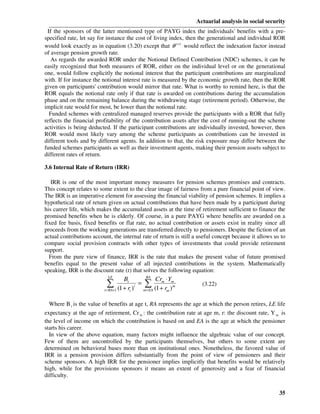
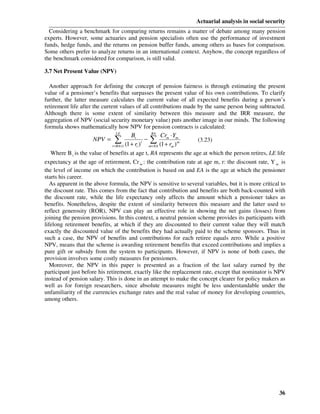
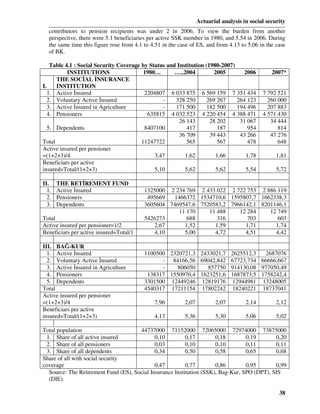
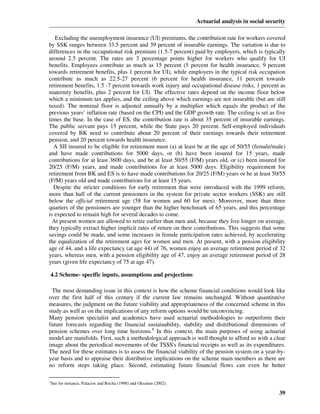
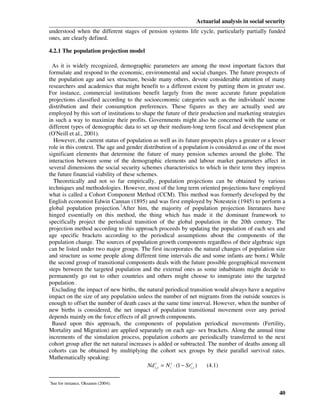
                        KHAZAR UNIVERSITY


  School :    Economics & Management
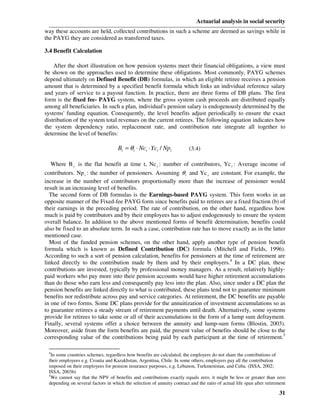
  Major :     Finance
  Student :   Hikmet Tagiyev Sakhavet


Supervisor: Dr. Oktay Ibrahimov Vahib


                                BAKU 2007
Actuarial analysis in social security


                                      Acknowledgments


    I would like to express my gratitude to my supervisor Dr.Oktay Ibrahimov, director of the
“Capacity Building for the State Social Protection Fund of Azerbaijan Republic” Project, for the
support, encouragement and of advices provided during my research activity.
    My deepest thanks go to Ms. Vafa Mutallimova, my dear instructor, whom I consider as one of
the perspective economist of Azerbaijan. She added a lot to my knowledge in Finance and
Econometrics and encouraging continue my studies.
   I profoundly thank my best friend Ilker Sirin (Actuary expert of Turkish Social Security System)
for all the help and support he provided during my stay in Turkey. My thanks go also to Prof.
Nazmi Guleyupoglu, Umut Gocmez and Salim Kiziloz.
   I would like to extent my sincere thanks to Ms. Anne Drouin at International Labour Organization
(Governance, Finance and Actuarial Service Coordinator) and Mr. Heikki Oksanen at European
Commission (Directorate General for Economic and Financial Affairs). In spite of the work load
they usually have provided invaluable assistance in improving of my actuarial analysis thesis.
   I am especially grateful to Patrick Wiese of Actuarial Solutions LLC who kindly shared with me
his Pension Reform Illustration & Simulation Model, PRISM, which I used for calculating the
scenarios, reported in this paper. I should never forget his useful and valuable comments on
actuarial calculations.
  I would like to give the assurances of my highest consideration to Ms. Alice Wade (Deputy Chief
Actuary of Social Security Administration of USA) that she has done a great favour for me in
Helsinki at “15th International Conference of Social Security Actuaries and Statisticians” on May
23-25, 2007. I listened to her very interesting topics “Mortality projections for social security
programs in Canada and the United States" and "Optimal Funding of Social Insurance Plans". Also
I would like to thank her for getting me their long-range projection methodology.
   Last but not least. I express my deepest regards and thanks for my instructors at Khazar
University: Prof.Mohammad Nouriev, Mr.Sakhavet Talibov, Ms.Nigar Ismaylova, Ms.Arzu
Iskenderova, Ms.Samira Sharifova, Mr.Gursel Aliyev, Mr.Yashar Naghiyev, Mr.Shukur
Houseynov, Mr.Eldar Hamidov, Mr.Namik Khalilov, Mr.Sohrab Farhadov, Ms.Leyla Muradkhanli.
A special thank you accompanied with my sincere apology for all the friends whom I forget to
mention in this acknowledgement.


                                                                                                 2
Actuarial analysis in social security


                                                        Table of contents


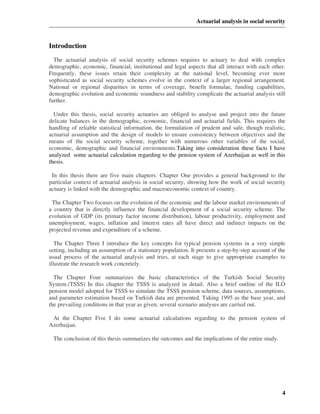
Introduction ..................................................................................................................................4
1. The role of actuaries in social security .....................................................................................5
   1.1 The goal of actuarial analysis..............................................................................................5
   1.2 Principles and techniques of actuarial analysis..................................................................6
2 Macro- economic parameters in actuarial calculations ..........................................................13
   2.1 Economic growth...............................................................................................................14
   2.2 Labour force, employment and unemployment ...............................................................14
   2.3 Wages .................................................................................................................................15
   2.4 Inflation..............................................................................................................................16
   2.5 Interest rate .......................................................................................................................16
   2.6 Taxes and other considerations.........................................................................................17
3. Financial Aspects of Social Security .......................................................................................18
   3.1 The basics of the pension systems .....................................................................................18
   3.2 Types of pension schemes..................................................................................................22
     3.2.1 Pay-as-you-go (PAYG) ...............................................................................................22
     3.2.2 Fully funding (FF).......................................................................................................23
     3.2.3 The respective merits of the PAYG and FF systems .................................................23
     3.2.4 Partial funding - NDC ................................................................................................26
   3.3 Pension financing...............................................................................................................30
   3.4 Benefit Calculation ............................................................................................................31
   3.5 Rate of Return (ROR) .......................................................................................................32
   3.6 Internal Rate of Return (IRR) ..........................................................................................35
   3.7 Net Present Value (NPV)...................................................................................................36
4. Actuarial practice in Social Security System of Turkey ........................................................37
   4.1 Characteristics of Turkish Social Security System (TSSS)..............................................37
   4.2 Scheme- specific inputs, assumptions and projections.....................................................39
     4.2.1 The population projection model ...............................................................................40
     4.2.2 Data and assumptions.................................................................................................42
     4.2.3 Actuarial projections ..................................................................................................45
   4.3 Sensitivity Analysis............................................................................................................51
     4.3.1 Pure scenarios .............................................................................................................51
     4.3.2 Mixed scenarios ..........................................................................................................53
5. Some actuarial calculations with regards to the pension system of Azerbaijan ..................55
Conclusion ...................................................................................................................................60
Appendix .....................................................................................................................................61
References....................................................................................................................................63


                                                                                                                                              3
Actuarial analysis in social security


Introduction
  The actuarial analysis of social security schemes requires to actuary to deal with complex
demographic, economic, financial, institutional and legal aspects that all interact with each other.
Frequently, these issues retain their complexity at the national level, becoming ever more
sophisticated as social security schemes evolve in the context of a larger regional arrangement.
National or regional disparities in terms of coverage, benefit formulae, funding capabilities,
demographic evolution and economic soundness and stability complicate the actuarial analysis still
further.

  Under this thesis, social security actuaries are obliged to analyse and project into the future
delicate balances in the demographic, economic, financial and actuarial fields. This requires the
handling of reliable statistical information, the formulation of prudent and safe, though realistic,
actuarial assumption and the design of models to ensure consistency between objectives and the
means of the social security scheme, together with numerous other variables of the social,
economic, demographic and financial environments.Taking into consideration these facts I have
analyzed some actuarial calculation regarding to the pension system of Azerbaijan as well in this
thesis.

 In this thesis there are five main chapters: Chapter One provides a general background to the
particular context of actuarial analysis in social security, showing how the work of social security
actuary is linked with the demographic and macroeconomic context of country.

 The Chapter Two focuses on the evolution of the economic and the labour market environments of
a country that is directly influence the financial development of a social security scheme. The
evolution of GDP (its primary factor income distribution), labour productivity, employment and
unemployment, wages, inflation and interest rates all have direct and indirect impacts on the
projected revenue and expenditure of a scheme.

   The Chapter Three I introduce the key concepts for typical pension systems in a very simple
setting, including an assumption of a stationary population. It presents a step-by-step account of the
usual process of the actuarial analysis and tries, at each stage to give appropriate examples to
illustrate the research work concretely.

  The Chapter Four summarizes the basic characteristics of the Turkish Social Security
System.(TSSS) In this chapter the TSSS is analyzed in detail. Also a brief outline of the ILO
pension model adopted for TSSS to simulate the TSSS pension scheme, data sources, assumptions,
and parameter estimation based on Turkish data are presented. Taking 1995 as the base year, and
the prevailing conditions in that year as given, several scenario analyses are carried out.

 At the Chapter Five I do some actuarial calculations regarding to the pension system of
Azerbaijan.

 The conclusion of this thesis summarizes the outcomes and the implications of the entire study.


                                                                                                    4
Actuarial analysis in social security


1. The role of actuaries in social security
  From the beginning of the operation of a social security scheme, the actuary plays a crucial role
in analyzing its financial status and recommending appropriate action to ensure its viability. More
specifically, the work of the actuary includes assessing the financial implications of establishing a
new scheme, regularly following up its financial status and estimating the effect of various
modifications that might have a bearing on the scheme during its existence.

   This chapter sets out the interrelationships between social security systems and their
environments as well as their relevance for actuarial work. Meaningful actuarial work, which in
itself is only one tool in financial, fiscal and social governance, has to be fully cognizant of the
economic, demographic and fiscal environments in which social security systems operate, which
have not always been the case.

1.1 The goal of actuarial analysis

    The actuarial analysis carried out at the inception of a scheme should answer one of the
following two questions: 1
     • How much protection can be provided with a given level of financial resources?
     • What financial resources are necessary to provide given level of protection?

   The uncertainties associated with the introduction of a social security scheme require the
intervention of, among other specialists, the actuary, which usually starts during the consultation
process that serves to set the legal bases of a scheme. This process may lengthy, as negotiations
take place among the various interest groups, i.e. the government, workers and employers. Usually
each interest group presents a set of requests relating to the extent of the benefit protection that
should be offered and to the amount of financial recourses that should be allocated to cover the
risks. This is where the work of the actuary becomes crucial, since it consists of estimating the long
–term financial implications of proposals, ultimately providing a solid quantitative framework that
will guide future policy decisions.

    1.1.1 Legal versus actual coverage

  “Who will be covered?” One preoccupation of the actuary concerns that definition of the covered
population and the way that the coverage is enforced. Coverage may vary according to the risk
covered. A number of countries have started by covering only government employees, gradually
extending coverage to private sector employees and eventually to the self-employed. A gradual
coverage allows the administrative structure to develop its ability to support a growing insured
population and to have real compliance with the payment of contributions. Some categories of
workers, such as government employees, present no real problem of compliance because the
employer’s administrative structure assures a regular and controlled payment of contributions. For
other groups of workers, the situation may be different. These issues will have an impact on the
basic data that the actuary will need to collect on the insured population and on the assumptions
that will have to be set on the future evolution of coverage and on the projected rate of companies.


1
See for instance, Pierre Plamandon, Anne Drouin (2002)”Actuarial practice in social security” ,International Labour Office

                                                                                                                             5
Actuarial analysis in social security

   1.1.2 Benefit provisions

    “What kind of benefit protection will be provided?” Social security schemes include complex
features and actuaries are usually required, along with policy analysts, to ensure consistency
between the various rules and figures. The following design elements will affect the cost of the
scheme and require the intervention of the actuary:
    • What part of workers’ earnings will be subject to contributions and used to compute
        benefits? (This refers to the floor and ceiling of earnings adopted for the scheme.)
    • What should be the earnings replacement rate in computing benefits?
    • Should the scheme allow for cross-subsidization between income groups through the benefit
        formula?
    • What will be the required period of contribution as regards eligibility for the various
        benefits?
    • What is the normal retirement age?
    • How should benefits be indexed?

  As the answers to these questions will each have a different impact on the cost of the scheme, the
actuary is asked to cost the various benefit packages. The actuary should ensure that discussions are
based on solid quantitative grounds and should try to reach the right balance between generous
benefits and pressure on the scheme’s costs.
  At this stage, it is usual to collect information on the approaches followed in other countries. Such
comparisons inform the policy analysts on the extent of possible design features. Furthermore,
mistakes made in other countries can, hopefully, be avoided.

   1.1.3 Financing provisions

    “Who pays and how much?” The financial resources of a social insurance scheme come from
contributions and sometimes from government subsidies. Contributions are generally shared
between employers and employees, except under employment schemes, which are normally fully
financed by employers.
    This issue is related to determining a funding objective for the scheme or, alternatively, the level
of reserves set aside to support the scheme’s future obligations. The funding objective may be set in
the law. If not, then the actuary will recommend one. In the case of a pension scheme, however, the
funding objective will be placed in a longer-term context and may consider, for example, the need
to smooth future contribution rate increases. Different financing mechanisms are available to match
these funding objectives. For example, the pension law may provide for a scaled contribution rate
to allow for a substantial accumulation of reserves during the first 20 years and thereafter a gradual
move towards a PAYG system with minimal long-term reserves. In the case of employment injury
schemes, transfers between different generations of employers tend to be avoided; hence, these
schemes require a higher level of funding.


1.2 Principles and techniques of actuarial analysis

  The actuarial analysis starts with a comparison of the scheme’s actual demographic and financial
experience against the projections. The experience analysis serves to identify items of revenue or
expenditure that have evolved differently than predicted in the assumptions and to assess the extent
of the gap. It focuses on the number of contributors and beneficiaries, average insurable earnings
and benefits and the level of administrative expenses. Each of these items is separated and analyzed
by its main components, showing, for example, a difference in the number of new retirees,
unexpected increases in average insurable earnings, higher indexing of pensions than projected, etc.

                                                                                                      6
Actuarial analysis in social security
   The experience analysis and the economic and demographic prospects indicate areas of
adjustment to the actuarial assumptions. For example, a recent change in retirement behaviour may
induce a new future expected retirement pattern. A slowdown in the economy will require a
database of the number of workers contributing to the scheme. However, as actuarial projections for
pensions are performed over a long period, a change in recently observed data will not necessarily
require any modifications to be made to long-term assumptions. The actuary looks primarily a
consistency between assumptions, and should not give undue weight to recent short-term
conjectural effects.
  There are 2 actuarial techniques for the analysis of a pension scheme: the projection technique
and the present value technique

1.2.1 – The projection technique

    There are different methodologies for social security pension scheme projections. These include:

      (a) actuarial methods,
      (b) econometric methods and
      (c) mixed methods.

  Methods classified under (a) have long been applied in the field of insurance and have also proved
valuable for social security projections.
   Methods classified under (b) are in effect extrapolations of past trends, using regression
techniques. Essentially the difference between the two is that actuarial methods depend on
endogenous (internal) factors, whereas econometric methods are based on exogenous factors.
Methods classified under (c) rely partly on endogenous and partly on exogenous factors.
   The first step in the projection technique is the demographic projections, production of estimates
of numbers of individuals in each of the principal population subgroups(active insured persons,
retirees, invalids, widows/widowers, orphans )at discrete time-points (t=1,2,..),starting from given
initial values (at t=0).
 The demographic projection procedure can be regarded as the iteration of a matrix multiplication
operation, typified as follows: 2
                                                  nt = nt −1 ⋅ Qt −1                        (1.1)
    in which nt is a row vector whose elements represent the demographic projection values at time t
and Qt −1 is a square matrix of transition probabilities for the interval (t-1, t) which take the form:

                                 nt = [A(t) R(t) I(t) W(t) O(t)]
                                                                                             (1.2)
                                  p q q q (aa)
                                                      q 
                                                   (ar)   (ai)   (aw)   (ao)

                                       (rr)                 
                                  0 p       0 q (rw) q (ro) 
                                                                         (1.3)
                            Qt = 0 0 p (ii) q (iw) q (io) 
                                                            
                                  0 0 0 p (ww) 0 
                                                            
                                  0 0 0 0
                                                     p (oo) 
                                                             
 The elements of the matrix and the symbols have the following significance:
 p (rr) denotes the probability of remaining in the same r;
 q (rs) denotes the probability of transition from status r to status s;
a, r , i , w and o respectively represent active lives , retirees, invalids, widows/widowers and
orphans .

2
See for instance, Subramaniam Iyer (1999)”Actuarial mathematics of social security pensions” ,International Labour Office

                                                                                                                            7
Actuarial analysis in social security
  The above procedure, however, is not applied, at the level of total numbers in the subpopulations.
In order to improve precision, each subpopulation is subdivided at least by sex and age. Preferably,
the active population would be further subdivided by past service. The procedure is applied at the
lowest level of subdivision and the results aggregated to give various subtotals and totals. The
matrix Q will be sex-age specific, it can also be varied over time if required. As regards survivors,
an additional procedure is required after each iteration to classify new widows/widowers and
orphans arising from the deaths of males/females aged x according to the age of the
widow/widower or of the orphan before proceeding to the next iteration.
   For carrying out the demographic projections it is necessary to adopt an actuarial basis,
consisting of the elements listed below. They should be understood to be sex specific. For brevity,
time is not indicated as a variable, but some or the entire basis may be varied over time.
    a - The active table l xa , b ≤ x ≤ r      , where b is the youngest entry age and the r the highest
retirement age. This is a double decrement table allowing for the decrements of death and invalidity
only. The associated dependent rates of decrement are denoted by q x (mortality) and i x (invalidity).
                                                                           a

Retirement is assumed to take place at exact integral ages, just before each birthday, r x denoting the
proportion retiring at age x.
                                     i
   b - The life table for invalids l x , b ≤ x < D and the associated independent mortality rate q xi.
   c - The life table for retired persons, l xp , r ≤ x < D (where r is the lowest retirement age and D is
                                                                         p
the death age) and the associated independent rate of mortality q x
  d - The double decrement table for widows/widowers, l y , y* ≤ y ≤ D (where y *is the lowest age
                                                                w
                                                                                         w
of a widow /widower) and the associated dependent rates of decrement q y (mortality) and
(remarriage) h y
                                                      o        *             *
 e - The single decrement table for orphans, l z , 0 ≤ z ≤ z where z is the age limit for orphans’
pensions and the associated independent mortality rate q o      z
 f - w,x the proportion of married persons among those dying at age x.
 g - y x , the average age of the spouse of a person dying at age x.
 h - n x , the average number of orphans of a person dying at age x.
 i - z x , the average age of the above orphans.

  The following expressions for the age and sex – specific one year transition probabilities are
based on the rules of addition and multiplication of probabilities:

Active to active              p (aa) = (1 - q a - i x ) ⋅ (1 - rx + 1 )
                                   x          x                                         (1.4)

Active to retiree             q (ar) = (1 - q a - i x ) ⋅ rx +1
                                   x          x
                                                                                        (1.5)
Active to invalid             q (ai) = (1 - 0,5 ⋅ q ix ) ⋅ i x
                                   x                                                    (1.6)
                                                                                        (1.7)
Active to widow/widower       q (aw)x = q (aw1)
                                          x            + q (aw2)
                                                           x
                                                                                        (1.7.a)
                                x         x           [
                              q (aw1) = q a w x +0,5 1 - 0,5(qwx + hyx )
                                                              y            ]
                                             1 i
                              q (aw2) = ix
                                x
                                             2
                                                             [
                                               q x w x +0,75 1 - 0,25(qwx + hyx )
                                                                       y            ]   (1.7b
                                                                                        )

Retiree to retiree              p (rr) = 1 - q p
                                     x         x                                        (1.8)

Retiree to widow/widower          x        x           [
                                q (rw) = q p w x +0,5 1 - 0,5(qwx + hyx )
                                                               y               ]        (1.9)


                                                                                                        8
Actuarial analysis in social security

Invalid to invalid                   p (rr) = 1 - q ix
                                          x                                                               (1.10)
Invalid to widow/widower
                                                              [
                                     q (iw) = q ix w x +0,5 1 - 0,5(qwx + hyx )
                                       x                             y                   ]                (1.11)
Widow/widower to widow/widower
                                               p (ww) = 1 - q w - h x
                                                 x            x                                           (1.12)
  Each iteration is assumed to operate immediately after the retirements (occurring at the end of
each year of age).Under the assumption of uniform distribution of decrements over each year of
age, the decrements affecting active persons, retirees and existing invalids –in (1.6),( 1.7a), (1.9)
and (1.11) are assumed to occur, on average at the of six months, new invalids dying before the end
of the year are assumed to die at the end of nine months in (1.7b).
  It will be noted that equation (1.7) has two components: (1.7a) relating to deaths of active insured
persons in the age range (x, x+1) and (1.7b) relating to active persons becoming invalid and then
dying at by age x+1. It is understood that the values of w x corresponding to fractional ages which
occur in the above formula would be obtained by interpolation between the values at adjacent
integral ages. Expressions for transition probabilities concerning orphans, corresponding to (1.7a),
(1.7b), (1.9), (1.11) and (1.12) can be derived on the same lines as for widows/widowers.
  Starting from the population data on the date of the valuation (t=0), the transition probabilities
are applied to successive projections by sex and age (and preferably by past service , in the new
entrants of the immediately preceding year have to be incorporated before proceeding to the next
iteration. The projection formula for the active insured populations are given below, the method of
projecting the beneficiary populations is illustrated with reference retirement pensioners.
   Notation
     • Act(x ,s ,t ) denotes the active population aged x nearest birthday , with curtate past service
        duration s years at time t, b ≤ x < r, s ≥ 0
     • Ac (x , t) denotes the active population aged x nearest birthday at time t. The corresponding
        beneficiary populations are denoted by Re(x, t), In (x, t) and Wi (x, t).
     • A(t) denotes the total active population at time t. The corresponding beneficiary populations
        are denoted by R( t), I (t) and W ( t).
     • The number of new entrants aged x next birthday in the projection year t, that is in the
        interval (t-1,t ) is denoted by N(x,t)
       The projection of the total active and beneficiary populations from time t-1 to time t is
     expressed by the equation
                 r
        A(t ) = ∑∑ Act ( x, s, t ) + Act ( x-1,s-1,t-1) ⋅ ( p (aa) − q xar ) − q xai ) − q xaw) − q x )
                                                              x-1
                                                                       (         (         (        a
                                                                                                              (1.13)
                x =b s > 0
                     D
        R (t ) = ∑ Ac(x − 1,t − 1) ⋅ q (ar) + Re(x − 1,t − 1) ⋅ (p (rr) − q x )
                                       x −1                        x −1
                                                                            r
                                                                                                              (1.14)
                  x =r
 After the demographic projections is the production of estimates of the total annual insured salary
bill and of the total annual amounts of the different categories of pensions “in force” at discrete
time points (t=1, 2…) starting from given initial values at t=0. These aggregates are obtained by
applying the appropriate per capita average amounts (of salaries or of pensions, as the case may be)
to each individual element of the demographic projections and the summing. The average amounts
are computed year by year in parallel with the progress of the corresponding demographic
projection. An average per capita amount (salary or pension, as the case may be) is computed for
each distinct population element generated by the demographic projection; if different elements are
aggregated in the demographic projection –for example, existing invalids surviving from age x to
x+1 and new invalids reaching age x+1 at the same time –a weighted per capita average amount is
computed to correspond to the aggregated population element.


                                                                                                                       9
Actuarial analysis in social security
    ILO-DIST method will be described below regard to the projection of the insured salary. This
method begins by modeling a variation over time in the age-related average salary structure and
then computes age and time –related average salaries allowing for general salary escalation.
Further, it models the salary distribution by age, which can increase the precision of the financial
projections.
    The basis for the financial projections would comprise assumptions in regard to the following
elements. They are specified as functions of age or time, the age-related elements should be
understood to be sex specific and may be further varied over time, if necessary.
    (a) The age –related salary scale function aged x at time t: ss(x,t)
    (b) The factor average per capita pension amount of the pensioners aged x at time t: b(x,t)
    (c) The rate of salary escalation (increase) in each projection year: γ t
    (d) The rate of pension indexation in each projection year: β t
    (e) The contribution density, that is, the fraction of the year during which contributions are
    effectively payable, dc(x)

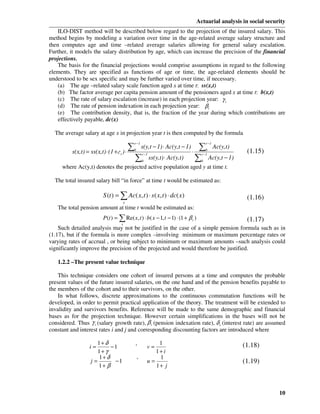
  The average salary at age x in projection year t is then computed by the formula

                                        ∑                                        ∑ Ac(y,t)
                                            r −1                                      r −1
                                                   s(y,t − 1) ⋅ Ac(y,t − 1)
          s(x,t) = ss(x,t) ⋅ (1 + г ) ⋅   b
                                                                              ⋅      b
                                                                                                     (1.15)
                                            ∑                                   ∑ Ac(y,t − 1)
                                  t                r −1                           r −1
                                                   b
                                                          ss(y,t) ⋅ Ac(y,t)       b
     where Ac(y,t) denotes the projected active population aged y at time t.

  The total insured salary bill “in force” at time t would be estimated as:

                         S (t ) = ∑ Ac( x, t ) ⋅ s ( x, t ) ⋅ dc( x)                                 (1.16)
                                      x
   The total pension amount at time t would be estimated as:
                         P(t ) = ∑ Re( x, t ) ⋅ b( x − 1, t − 1) ⋅ (1 + β t )                        (1.17)
                                   x
    Such detailed analysis may not be justified in the case of a simple pension formula such as in
(1.17), but if the formula is more complex –involving minimum or maximum percentage rates or
varying rates of accrual , or being subject to minimum or maximum amounts –such analysis could
significantly improve the precision of the projected and would therefore be justified.

   1.2.2 –The present value technique

    This technique considers one cohort of insured persons at a time and computes the probable
present values of the future insured salaries, on the one hand and of the pension benefits payable to
the members of the cohort and to their survivors, on the other.
    In what follows, discrete approximations to the continuous commutation functions will be
developed, in order to permit practical application of the theory. The treatment will be extended to
invalidity and survivors benefits. Reference will be made to the same demographic and financial
bases as for the projection technique. However certain simplifications in the bases will not be
considered. Thus γ t (salary growth rate), β t (pension indexation rate), δ t (interest rate) are assumed
constant and interest rates i and j and corresponding discounting factors are introduced where

                      1+ δ                  ,              1                                       (1.18)
                  i=       −1                          v=
                      1+ γ                                1+ i
                      1+ δ                    ,            1
                   j=       −1                         u=                                          (1.19)
                      1+ β                                1+ j


                                                                                                                  10
Actuarial analysis in social security
  The present value formulae will be developed for the simple case where the pension accrues at
1percent of the final salary per year of service.

Special commutation functions

   A series (sex-specific) special commutation functions are needed for applying the present value
technique. These are based on one or other of the decrement tables or on combinations of them.
Functions based on the active service table will be computed at interest rate i, while those based on
the other tables will be computed at rate j.
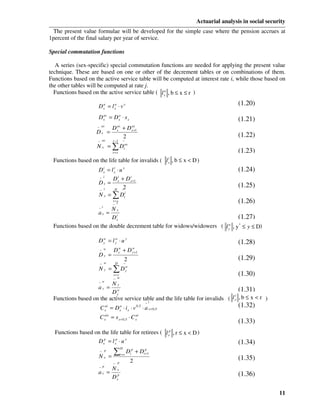
  Functions based on the active service table ( l xa , b ≤ x ≤ r )

                      D x = l xa ⋅ v x
                        a                                                                        (1.20)
                       as   a
                      Dx = Dx ⋅ s x                                                              (1.21)
                     − as            as
                                  D +D             as
                                     x             x +1
                     Dx =
                                    2                                                            (1.22)
                      − as        r −1       −
                     Nx = ∑D                 t
                                              as

                                  t=x                                                            (1.23)
                                                                            i
 Functions based on the life table for invalids ( l , b ≤ x < D )           x

                      Dx = l x ⋅ u x
                        i    i
                                                                                                 (1.24)
                      − i   D i + D x +1
                                     i
                      Dx = x                                                                     (1.25)
                      − i     D −  2
                      N x = ∑ Dti
                                  t =x
                                  − i
                                                                                                 (1.26)
                      −i Nx
                   ax = i
                         Dx                                                 (1.27)
 Functions based on the double decrement table for widows/widowers ( l y , y* ≤ y ≤ D)
                                                                       w


                      Dy = l y ⋅ u y
                       w     w
                                                                                                 (1.28)
                                         w         w
                      − w         D +D   y         y +1
                      Dy =
                                             2                                                   (1.29)
                       − w         D         −
                      N y = ∑ Dy
                               w

                                  t= y                                                           (1.30)
                                  − w
                      −w Ny
                      ay =  w                                                      (1.31)
                         Dy                                                      i
 Functions based on the active service table and the life table for invalids ( l x , b ≤ x < r )
                                                               −i
                       C   ai            a
                                 = D ⋅ ix ⋅ v          0,5
                                                             ⋅ a x + 0, 5                        (1.32)
                           x             x
                           ais
                      C    x     = s x + 0,5 ⋅ C xai
                                                                                                 (1.33)
  Functions based on the life table for retirees ( l xp , r ≤ x < D )
                   D xp = l xp ⋅ u x                                                             (1.34)
                                  ∑
                                         D         p           p
                       − p
                                         t =r
                                                 Dt + D       t +1
                      Nx =                                                                       (1.35)
                                  − p
                                                   2
                      − p         Nx
                      ax =                                                                       (1.36)
                                  D xp

                                                                                                                  11
Actuarial analysis in social security
 The above commutation and annuity functions relate to continuously payable salaries and
pensions and may be adequate if payments are made frequently, for example weekly. They can be
adjusted to correspond more exactly to any specific payment schedule. For example, if pensions are
payable monthly and in arrears, (1.27) should be replaced by
                                     i
                                11 N x +1 11                                  (1.37)
                a x(12) = a x +
                  i         i
                                   = i +
                                24  Dx    24


 Expressions for probable present values of insured salaries and benefits

  The following expressions relate to a cohort of a specific sex, aged x on the date of valuation and
refer to a unit insured salary on the date. The expressions for orphans are not indicated but can be
derived on the same lines as for widows/widowers.
  Present value of insured salaries ( b ≤ x < r )
                     − as      − as
                   Nx − Nr                                                           (1.38)
        PVS(x) =
                       D xas
 Present value of retirement pensions

                            Dras _p
          PVR(x) = p (r , x)      ar                                          (1.39)
                            D xas
  where p(r, x) denotes the retirement pension of the cohort aged x as a proportion of the final
salary.
  Present value of invalidity pensions ( b ≤ x < r )
                 ∑
                     r −1
                     r=x
                            p (t , x)C tais                                          (1.40)
        PVI(x) =
                           D xas
  where p(t,x) denotes the invalidity pension as a proportion of the salary, for an entrant at age x, if
invalidity is attained in the age (t,t+1)

 Present value of widows’/widowers’ pensions (death in service) ( b ≤ x < r )
                      ∑
                                      r −1
                                             p (t , x)C taws
        PVW1(x) = RWP           as
                                      r=x                                            (1.41)
                              Dx
 Present value of widows’/widowers’ pensions (death after invalidity) ( b ≤ x < r )
                      ∑
                                      r −1
                                             p (t , x )C tiws
        PVW2(x) = RWP                 r =x
                                                                                     (1.42)
                                             D xas


                                                                                                     12
Actuarial analysis in social security


2 Macro- economic parameters in actuarial calculations

   The evolution of the economic and the labour market environments of a country directly
influence the financial development of a social security scheme. The evolution of GDP (its primary
factor income distribution), labour productivity, employment and unemployment, wages, inflation
and interest rates all have direct and indirect impacts on the projected revenue and expenditure of a
scheme.
  The macro-economic frame for the actuarial calculation should ideally start from financial
projections. The use of just one source of both financial projections and the actuarial calculation
facilitates communications between the actuary and the financial counterparts and avoids
unnecessary discussions about assumptions. However, financial forecasts often do not extend for
more than 15 to 20 years, which is insufficient for the purposes of an actuarial calculation, which
requires projections of at least 50 years into the future. Hence, the actuary should extend financial
projections, when available, in order to satisfy the required length of time covered by an actuarial
calculation.
   The financial projections of a social security scheme depend on:
       • the number of people who will pay contributions to the scheme ;
       • the average earnings of these contributors ;
       • the number of people who will receive benefits;
       • the amount of benefits that will be paid, related to past earnings and possibly indexed;
       • the investment earnings on the reserve.

  All these factors depend on the economic environment in which the scheme will evolve.In order
to develop robust assumptions on the future economic environment, it is necessary to analyse past
trends. The core conclusions drawn from these observations are then used as a basis for the
developmentof consistent long-term economic and labour market projections serving as a basis for
the actuarial calculation of the scheme.
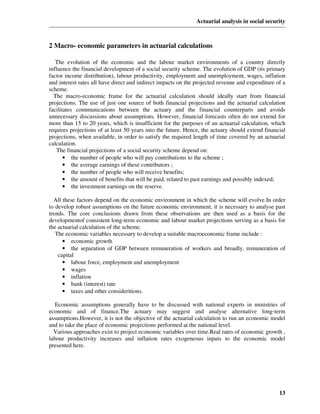
   The economic variables necessary to develop a suitable macroeconomic frame include :
      • economic growth
      • the separation of GDP between remuneration of workers and broadly, remuneration of
    capital
      • labour force, employment and unemployment
      • wages
      • inflation
      • bank (interest) rate
      • taxes and other consideritions.

   Economic assumptions generally have to be discussed with national experts in ministries of
economic and of finance.The actuary may suggest and analyse alternative long-term
assumptions.However, it is not the objective of the actuarial calculation to run an economic model
and to take the place of economic projections performed at the national level.
  Various approaches exist to project economic variables over time.Real rates of economic growth ,
labour productivity increases and inflation rates exogeneous inputs to the economic model
presented here.


                                                                                                  13
Actuarial analysis in social security


2.1 Economic growth

   The annual increase in GDP results from the increase in the number of workers, together with the
increase in productivity per worker. A choice must be made as to how each of these two factors will
affect the global GDP growth rate. As regards a social security scheme, a larger increase in the
number of workers affects the number of people who contribute to the scheme. In the long run, the
increase in productivity normally affects the level of wages and the payroll covered by the scheme.
Hence, the assumption on GDP growth has a direct impact on the revenue of the scheme.
   For the short term, the annual GDP growth rate may be based on the estimates published by
organizations specialized in economic projections. For the long term, an ultimate growth rate is
generally established by the actuary as an exogenous assumption. The short-term and ultimate rates
are then linked together, based on an interpolation technique. Nominal GDP is calculated by
multiplying real GDP for each and every year by the GDP deflator. The GDP deflator is ex post,
calculated by dividing nominal GDP by real GDP. Its future evolution is usually based on
exogenous assumptions on future GDP inflation rates.

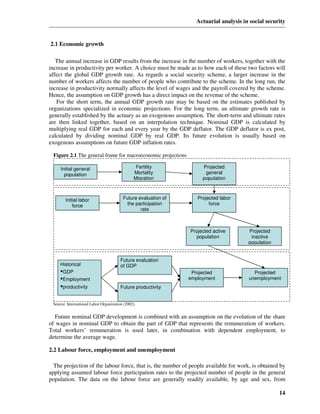
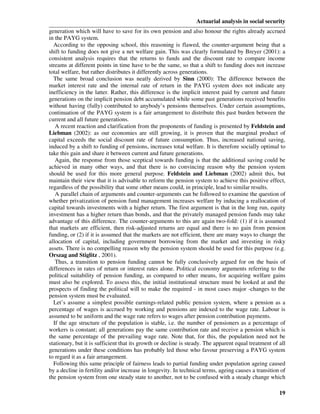
 Figure 2.1 The general frame for macroeconomic projections

     Initial general                            Fertility            Projected
       population                              Mortality              general
                                               Migration             population


        Initial labor                    Future evaluation of      Projected labor
            force                         the participation             force
                                                 rate


                                                                Projected active       Projected
                                                                  population            inactive
                                                                                       population


                                        Future evaluation
     Historical                         of GDP
     •GDP                                                        Projected               Projected
     •Employment                                                employment             unemployment
     •productivity                      Future productivity


 Source: International Labor Organization (2002).


  Future nominal GDP development is combined with an assumption on the evolution of the share
of wages in nominal GDP to obtain the part of GDP that represents the remuneration of workers.
Total workers’ remuneration is used later, in combination with dependent employment, to
determine the average wage.

2.2 Labour force, employment and unemployment

  The projection of the labour force, that is, the number of people available for work, is obtained by
applying assumed labour force participation rates to the projected number of people in the general
population. The data on the labour force are generally readily available, by age and sex, from

                                                                                                    14
Actuarial analysis in social security
national statistical offices. Recent past data should be sought and if available, the actuary should
consider national forecasts on participation rates performed by these offices. The same applies for
employment and unemployment data.
  To project the evolution of participation rates is no easy task. Data and national projections are
often non-existent. One common approach is to leave the age-specific participation rates constant
during the projection period. Any projected changes in the overall participation rate then only result
from changes in the population structure. In most economies, however, the participation rates of
women are significantly lower than those observed of men. It is common in such a situation to
assume that, over time, the participation rates of women will catch up, at least in part, with those of
men.
  Once the total labour force has been projected, aggregate employment can be obtained by
dividing real GDP (total output) by the average labour productivity (output per worker)
Unemployment is the measured as the difference between the projected labour force and total
employment.

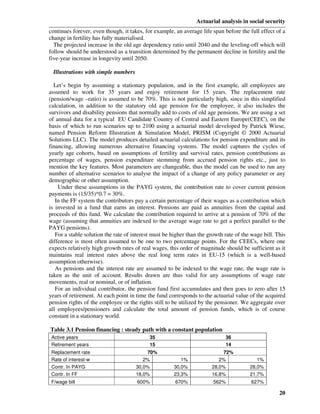
2.3 Wages

  Based on an allocation of total GDP between labour income and capital income, a starting
average wage is calculated by dividing total remuneration (GDP) times the share of wages (GDP)
by the total number of dependent employed persons. The share of wages in GDP is calculated from
the past factor income distribution in the economy and projected with regard to the probable future
evolution of the structure of the economy.
  In the medium term, real wage development is checked against labour productivity growth. In
specific labour market situations, wages might grow faster or slower than productivity. However,
owing to the long-term nature of an actuarial study, the real wage increase is often assumed to
merge, in the long run, into the rate of growth in real labour productivity .Wage growth is also
influenced by an assumed gradual annual increase in the total labour income share of GDP over the
projection period, concomitant with the assumed GDP growth.

 Figure 2.2 Determination of the average wage in the economy


                                                                                Labor force supply
                                                                                       model
                                                                                 (projected active
    Historical                                                                      population)
    •GDP
                                       Future productivity
    •Employment
    •productivity                                              Projected              Projected
                                                              employment            unemployment
                                       Future evaluation
                                       of GDP
   Historical share
   of wages in GDP
                                                             Projected total      Projected
                                                             remuneration         Average wage
                                        Projected share
                                        of wages in GDP
    Historical total
    remuneration


  Source: International Labor Organization (2002).


  Wage distribution assumptions are also needed to simulate the possible impact of the social
protection system on the distribution of income, for example, through minimum and maximum
                                                                                                     15
Actuarial analysis in social security
pension provisions. Assumptions on the differentiation of wages by age and sex must then be
established, as well as assumptions on the dispersion of wages between income groups.


2.4 Inflation

  Inflation represents the general increase in prices. This general rise is usually associated with an
average basket of goods, the price of which is followed at regular intervals. From time to time, the
contents, of the basket are changed to adapt to changes in the consumption patterns of the average
consumer. Various definitions of inflation are used in most economies, such as, for example, the
GDP deflator. However, for the purposes of the actuarial analysis, the consumer price index CPI) is
most often used as a statistical basis. In the long run, the GDP deflator and the CPI might be
assumed to converge.
  Assumptions on future inflation rates are necessary for the actuarial study to project the evolution
of pensions, in the case where pensions are periodically adjusted to reflect price increases in the
economy. Past data on inflation are generally available from national statistical offices. The data
may also be available on short and even long-term forecasts by these institutions or by other
government agencies.

2.5 Interest rate

  The interest rate as a random variable of great importance to the actuary is the rate of interest (or
more generally, the bank rate of investment return). Interest rates vary in many dimensions, from
time to time, from place to place, by degree of security risk, and by time to maturity. Financial
security systems are especially sensitive to the variation of interest rates over time, so actuaries
must be interested in the probability distributions, the means and variances, of a specified interest
rate as it varies over time.
  Historically, actuaries have used deterministic models in their treatment of the time value of
money, but not because they were unaware of interest rate variation. Many of the discussions at
actuarial gatherings over the years have centered on the prospects for interest rate rise or fall. The
difficulty has not been a lack of concern, but rather a lack of knowledge as to the complexities of
interest rate variation. The development of computers has opened up a range of techniques whereby
interest rate variation can be modeled. It appears that this is a direction in which actuarial interest
and knowledge may be expected to grow.
  The level of interest (bank) rates in the short term can be projected by looking at the level of rates
published by the central bank of the country in question. In the long term, bank rates may be
viewed as the ratio of profits over nominal investments in the economy. They are, therefore, linked
to the assumption made for GDP and its separation between workers’ remuneration and capital
income. The projected GDP multiplied by the assumption retained for the future share of wages in
GDP will provide a projection of the total projected workers’ remuneration in the country for each
future year. By subtracting the share of wages in GDP from the total GDP, we can isolate the
capital income component. From past observations, it is possible to estimate the share of “profits”
in capital income and to project that share in the future to determine a projected level of profits. To
project nominal investments in the private sector, it is necessary to project nominal GDP by its
demand components, using plausible assumptions on the future shares of private and government
assumptions, private and government investments, exports and imports. The projected ratio of
profits to nominal investments in the private sector thus gives an indication of future bank rate
levels.
   For determining the specific assumption regarding the investment return on a scheme’s reserve,
appropriate adjustments to the theoretical bank rates have to take into account the composition of
the portfolio of the scheme and its projected evolution.


                                                                                                     16
Actuarial analysis in social security
   Another consideration is the size of the social security reserves compared with the total savings in
 the country. In some small countries, social security reserves have a great influence on the level of
 bank rates. In that case, at least for the short to medium term, the actuary will determine the bank
 rate assumption for the scheme by referring directly to its investment policy.

  2.6 Taxes and other considerations

 Actuaries need to demonstrate awareness of the broader economic impact and may need to
supplement actuarial models of the social security scheme itself with simple macroeconomic models
to demonstrate the interactions of the social security, tax systems and to model the overall impact on
public expenditure.
 Generally, national statistical offices provide their own projections of the economically active
population, employment and unemployment levels and GDP. In addition ministries of finance usually
make short-term forecasts, for budgetary purposes, on the levels of employment, inflation and interest
rates and taxation. These sources of information should be considered by the actuary, particularly
when performing short-term actuarial projections. It is thus imperative that at least one of the
scenarios in the actuarial report reflects the economic assumptions of the government.


                                                                                                    17
Actuarial analysis in social security


3. Financial Aspects of Social Security
3.1 The basics of the pension systems

   The threat to the financial sustainability of the pension systems in most countries and elsewhere
has become a major concern. Briefly, the problem stems from the fact that the pension systems
established in many countries after WWII are now about to mature and bring a full pension to most
people covered, while at the same time the ratio of pensioners to contributors (ratio of population
60 + to 20–59 years old) will increase between 2005 and 2050. 3
   The objective here is to briefly summarize the very basic concepts needed to discuss pension
systems and to give a short review of the literature of the respective merits of the pay-as-you-go
(PAYG) and fully funded (FF) systems. The basics are presented with the help of figures that
resemble the orders of magnitude in many countries with relatively high replacement rates and high
and still increasing old age dependency ratios.
   Samuelson’s seminal paper of 1958 first stated the simple fact that, in a PAYG pension system
in a steadily growing economy, the rate of return to pension contributions is equal to the rate of
growth. He inferred that such a system improves welfare, contrasting it with an economy having no
effective store of value, where the storing of real goods by workers for their retirement would yield
a negative rate of return (which they would have to accept if there was no better alternative).
However, that in the very same paper he also introduced a case where the existence of money
solves the problem: with a zero nominal rate of return, workers can accumulate savings and use
them during retirement. Assuming that the nominal stock of money is constant, he further inferred
that the real rate of return on money balances is equal to the rate of growth of the economy, thus
providing this real rate of return as savings for pensions. Thus, Samuelson (1958) introduced the
basic elements of both a PAYG public pension system and a fully funded system (which could be
either voluntary or mandatory by law). Under his highly theoretical (and counterfactual) cases, both
systems produce the same welfare.
   Aaron (1966) extended Samuelson’s analysis to a modern economy where assets bearing a
positive rate of return are available. He correctly derived the result that if the rate of growth of the
economy (stemming from the rate of growth of population and wages) is higher than the rate of
interest, then “the introduction of some social insurance pensions on a pay-as-you-go basis will
improve the welfare position of each person”, as compared to a reserve system. Aaron may have
been partly right in considering that his result was relevant in the post-WWII growing economies,
but later research led economists to understand that in a dynamically efficient economy, the rate of
interest, in the long run, is equal to or higher than the rate of growth (this theorem of neoclassical
growth theory is attributed to Cass 1965). In this light the steady state described by Aaron is a
situation with an excessively large capital stock, which allows the economy to be adjusted to
another steady state with higher consumption.
   In more recent literature the question has shifted back to asking whether there is a case for
shifting from PAYG systems to funding and privatisation of pension financing. The assertion of the
neoclassical growth theory that the rate of return in a funded system (the rate of interest in the
financial market), is normally higher than the rate of growth of the wage bill, led many authors to
conclude that the funded system is more efficient. Therefore, a shift to funding would eventually
yield additional returns which could at least partly compensate for the extra burden suffered by a


3
 For population and pension expenditure projections, see Economic Policy Committee (2001), “Budgetary challenges
posed by ageing populations”.


                                                                                                             18
Actuarial analysis in social security
generation which will have to save for its own pension and also honour the rights already accrued
in the PAYG system.
  According to the opposing school, this reasoning is flawed, the counter-argument being that a
shift to funding does not give a net welfare gain. This was clearly formulated by Breyer (2001): a
consistent analysis requires that the returns to funds and the discount rate to compare income
streams at different points in time have to be the same, so that a shift to funding does not increase
total welfare, but rather distributes it differently across generations.
  The same broad conclusion was neatly derived by Sinn (2000): The difference between the
market interest rate and the internal rate of return in the PAYG system does not indicate any
inefficiency in the latter. Rather, this difference is the implicit interest paid by current and future
generations on the implicit pension debt accumulated while some past generations received benefits
without having (fully) contributed to anybody’s pensions themselves. Under certain assumptions,
continuation of the PAYG system is a fair arrangement to distribute this past burden between the
current and all future generations.
   A recent reaction and clarification from the proponents of funding is presented by Feldstein and
Liebman (2002): as our economies are still growing, it is proven that the marginal product of
capital exceeds the social discount rate of future consumption. Thus, increased national saving,
induced by a shift to funding of pensions, increases total welfare. It is therefore socially optimal to
take this gain and share it between current and future generations.
   Again, the response from those sceptical towards funding is that the additional saving could be
achieved in many other ways, and that there is no convincing reason why the pension system
should be used for this more general purpose. Feldstein and Liebman (2002) admit this, but
maintain their view that it is advisable to reform the pension system to achieve this positive effect,
regardless of the possibility that some other means could, in principle, lead to similar results.
   A parallel chain of arguments and counter-arguments can be followed to examine the question of
whether privatization of pension fund management increases welfare by inducing a reallocation of
capital towards investments with a higher return. The first argument is that in the long run, equity
investment has a higher return than bonds, and that the privately managed pension funds may take
advantage of this difference. The counter-arguments to this are again two-fold: (1) if it is assumed
that markets are efficient, then risk-adjusted returns are equal and there is no gain from pension
funding, or (2) if it is assumed that the markets are not efficient, there are many ways to change the
allocation of capital, including government borrowing from the market and investing in risky
assets. There is no compelling reason why the pension system should be used for this purpose (e.g.
Orszag and Stiglitz , 2001).
   Thus, a transition to pension funding cannot be fully conclusively argued for on the basis of
differences in rates of return or interest rates alone. Political economy arguments referring to the
political suitability of pension funding, as compared to other means, for acquiring welfare gains
must also be explored. To assess this, the initial institutional structure must be looked at and the
prospects of finding the political will to make the required - in most cases major -changes to the
pension system must be evaluated.
  Let’s assume a simplest possible earnings-related public pension system, where a pension as a
percentage of wages is accrued by working and pensions are indexed to the wage rate. Labour is
assumed to be uniform and the wage rate refers to wages after pension contribution payments.
  If the age structure of the population is stable, i.e. the number of pensioners as a percentage of
workers is constant; all generations pay the same contribution rate and receive a pension which is
the same percentage of the prevailing wage rate. Note that, for this, the population need not be
stationary, but it is sufficient that its growth or decline is steady. The apparent equal treatment of all
generations under these conditions has probably led those who favour preserving a PAYG system
to regard it as a fair arrangement.
  Following this same principle of fairness leads to partial funding under population ageing caused
by a decline in fertility and/or increase in longevity. In technical terms, ageing causes a transition of
the pension system from one steady state to another, not to be confused with a steady change which

                                                                                                       19
Actuarial analysis in social security
continues forever, even though, it takes, for example, an average life span before the full effect of a
change in fertility has fully materialised.
  The projected increase in the old age dependency ratio until 2040 and the leveling-off which will
follow should be understood as a transition determined by the permanent decline in fertility and the
five-year increase in longevity until 2050.

 Illustrations with simple numbers

  Let’s begin by assuming a stationary population, and in the first example, all employees are
assumed to work for 35 years and enjoy retirement for 15 years. The replacement rate
(pension/wage –ratio) is assumed to be 70%. This is not particularly high, since in this simplified
calculation, in addition to the statutory old age pension for the employee, it also includes the
survivors and disability pensions that normally add to costs of old age pensions. We are using a set
of annual data for a typical EU Candidate Country of Central and Eastern Europe(CEEC), on the
basis of which to run scenarios up to 2100 using a actuarial model developed by Patrick Wiese,
named Pension Reform Illustration & Simulation Model, PRISM (Copyright © 2000 Actuarial
Solutions LLC). The model produces detailed actuarial calculations for pension expenditure and its
financing, allowing numerous alternative financing systems. The model captures the cycles of
yearly age cohorts, based on assumptions of fertility and survival rates, pension contributions as
percentage of wages, pension expenditure stemming from accrued pension rights etc., just to
mention the key features. Most parameters are changeable, thus the model can be used to run any
number of alternative scenarios to analyse the impact of a change of any policy parameter or any
demographic or other assumption.
    Under these assumptions in the PAYG system, the contribution rate to cover current pension
payments is (15/35)*0.7 = 30%.
   In the FF system the contributors pay a certain percentage of their wages as a contribution which
is invested in a fund that earns an interest. Pensions are paid as annuities from the capital and
proceeds of this fund. We calculate the contribution required to arrive at a pension of 70% of the
wage (assuming that annuities are indexed to the average wage rate to get a perfect parallel to the
PAYG pensions).
   For a stable solution the rate of interest must be higher than the growth rate of the wage bill. This
difference is most often assumed to be one to two percentage points. For the CEECs, where one
expects relatively high growth rates of real wages, this order of magnitude should be sufficient as it
maintains real interest rates above the real long term rates in EU-15 (which is a well-based
assumption otherwise).
   As pensions and the interest rate are assumed to be indexed to the wage rate, the wage rate is
taken as the unit of account. Results drawn are thus valid for any assumptions of wage rate
movements, real or nominal, or of inflation.
   For an individual contributor, the pension fund first accumulates and then goes to zero after 15
years of retirement. At each point in time the fund corresponds to the actuarial value of the acquired
pension rights of the employee or the rights still to be utilized by the pensioner. We aggregate over
all employees/pensioners and calculate the total amount of pension funds, which is of course
constant in a stationary world.

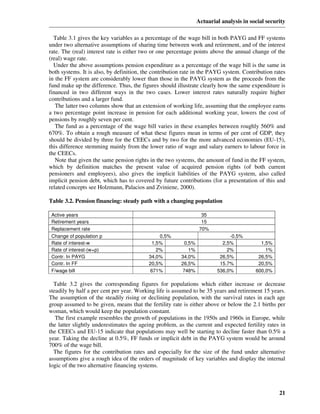
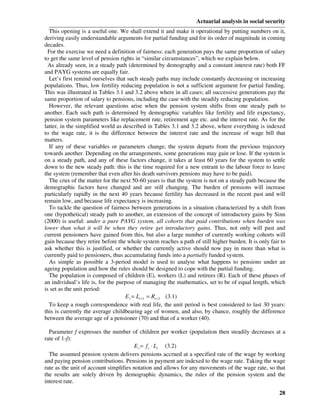
Table 3.1 Pension financing : steady path with a constant population
 Active years                               35                               36
 Retirement years                           15                               14
 Replacement rate                         70%                              72%
 Rate of interest-w                      2%              1%               2%               1%
 Contr. In PAYG                       30,0%           30,0%            28,0%            28,0%
 Contr. In FF                         18,0%           23,3%            16,8%            21,7%
 F/wage bill                          600%             670%             562%             627%

                                                                                                     20
Actuarial analysis in social security

  Table 3.1 gives the key variables as a percentage of the wage bill in both PAYG and FF systems
under two alternative assumptions of sharing time between work and retirement, and of the interest
rate. The (real) interest rate is either two or one percentage points above the annual change of the
(real) wage rate.
  Under the above assumptions pension expenditure as a percentage of the wage bill is the same in
both systems. It is also, by definition, the contribution rate in the PAYG system. Contribution rates
in the FF system are considerably lower than those in the PAYG system as the proceeds from the
fund make up the difference. Thus, the figures should illustrate clearly how the same expenditure is
financed in two different ways in the two cases. Lower interest rates naturally require higher
contributions and a larger fund.
   The latter two columns show that an extension of working life, assuming that the employee earns
a two percentage point increase in pension for each additional working year, lowers the cost of
pensions by roughly seven per cent.
   The fund as a percentage of the wage bill varies in these examples between roughly 560% and
670%. To obtain a rough measure of what these figures mean in terms of per cent of GDP, they
should be divided by three for the CEECs and by two for the more advanced economies (EU-15),
this difference stemming mainly from the lower ratio of wage and salary earners to labour force in
the CEECs.
   Note that given the same pension rights in the two systems, the amount of fund in the FF system,
which by definition matches the present value of acquired pension rights (of both current
pensioners and employees), also gives the implicit liabilities of the PAYG system, also called
implicit pension debt, which has to covered by future contributions (for a presentation of this and
related concepts see Holzmann, Palacios and Zviniene, 2000).

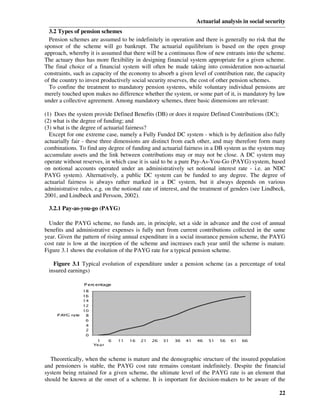
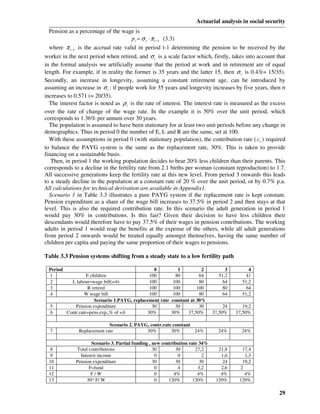
Table 3.2. Pension financing: steady path with a changing population

 Active years                                                      35
 Retirement years                                                  15
 Replacement rate                                                 70%
 Change of population p                        0,5%                           -0,5%
 Rate of interest-w                         1,5%          0,5%             2,5%            1,5%
 Rate of interest-(w+p)                       2%            1%               2%              1%
 Contr. In PAYG                           34,0%         34,0%             26,5%           26,5%
 Contr. In FF                             20,5%         26,5%             15.7%           20,5%
 F/wage bill                               671%          748%            536,0%          600,0%

  Table 3.2 gives the corresponding figures for populations which either increase or decrease
steadily by half a per cent per year. Working life is assumed to be 35 years and retirement 15 years.
The assumption of the steadily rising or declining population, with the survival rates in each age
group assumed to be given, means that the fertility rate is either above or below the 2.1 births per
woman, which would keep the population constant.
   The first example resembles the growth of populations in the 1950s and 1960s in Europe, while
the latter slightly underestimates the ageing problem, as the current and expected fertility rates in
the CEECs and EU-15 indicate that populations may well be starting to decline faster than 0.5% a
year. Taking the decline at 0.5%, FF funds or implicit debt in the PAYG system would be around
700% of the wage bill.
  The figures for the contribution rates and especially for the size of the fund under alternative
assumptions give a rough idea of the orders of magnitude of key variables and display the internal
logic of the two alternative financing systems.


                                                                                                   21
Actuarial analysis in social security
  3.2 Types of pension schemes
  Pension schemes are assumed to be indefinitely in operation and there is generally no risk that the
sponsor of the scheme will go bankrupt. The actuarial equilibrium is based on the open group
approach, whereby it is assumed that there will be a continuous flow of new entrants into the scheme.
The actuary thus has more flexibility in designing financial system appropriate for a given scheme.
The final choice of a financial system will often be made taking into consideration non-actuarial
constraints, such as capacity of the economy to absorb a given level of contribution rate, the capacity
of the country to invest productively social security reserves, the cost of other pension schemes.
  To confine the treatment to mandatory pension systems, while voluntary individual pensions are
merely touched upon makes no difference whether the system, or some part of it, is mandatory by law
under a collective agreement. Among mandatory schemes, three basic dimensions are relevant:

(1) Does the system provide Defined Benefits (DB) or does it require Defined Contributions (DC);
(2) what is the degree of funding; and
(3) what is the degree of actuarial fairness?
  Except for one extreme case, namely a Fully Funded DC system - which is by definition also fully
actuarially fair - these three dimensions are distinct from each other, and may therefore form many
combinations. To find any degree of funding and actuarial fairness in a DB system as the system may
accumulate assets and the link between contributions may or may not be close. A DC system may
operate without reserves, in which case it is said to be a pure Pay-As-You-Go (PAYG) system, based
on notional accounts operated under an administratively set notional interest rate - i.e. an NDC
PAYG system). Alternatively, a public DC system can be funded to any degree. The degree of
actuarial fairness is always rather marked in a DC system, but it always depends on various
administrative rules, e.g. on the notional rate of interest, and the treatment of genders (see Lindbeck,
2001, and Lindbeck and Persson, 2002).

 3.2.1 Pay-as-you-go (PAYG)

  Under the PAYG scheme, no funds are, in principle, set a side in advance and the cost of annual
benefits and administrative expenses is fully met from current contributions collected in the same
year. Given the pattern of rising annual expenditure in a social insurance pension scheme, the PAYG
cost rate is low at the inception of the scheme and increases each year until the scheme is mature.
Figure 3.1 shows the evolution of the PAYG rate for a typical pension scheme.

   Figure 3.1 Typical evolution of expenditure under a pension scheme (as a percentage of total
 insured earnings)

                 P ercentage
                18
                16
                14
                12
                10
     P AYG rate  8
                 6
                 4
                 2
                 0
                      1     6   11   16   21   26   31   36   41   46   51   56   61   66
                     Year


  Theoretically, when the scheme is mature and the demographic structure of the insured population
and pensioners is stable, the PAYG cost rate remains constant indefinitely. Despite the financial
system being retained for a given scheme, the ultimate level of the PAYG rate is an element that
should be known at the onset of a scheme. It is important for decision-makers to be aware of the

                                                                                                     22
Actuarial analysis in social security
ultimate cost of the benefit obligations so that the capacity of workers and employers to finance the
scheme in the long term can be estimated.
     Except from protecting against unanticipated inflation, other advantages of the PAYG system are;
the possibility to increase the real value of pensions in line with economic growth; minimization of
impediments to labour mobility; and a relatively quick build-up of pension rights. Another advantage
is the possibility of redistribution, which can insure a certain living standard for individuals who have
never been part of the work force and thus never have had the opportunity to save any income. A
feature of the system is the sensitivity to the worker-retiree ratio, because a declining ratio must either
raise the contribution rate to keep the replacement rate fixed, or reduce the replacement rate in order
to keep the contribution rate fixed.
     The two PAYG methods, Defined Contribution system (DC), where the contribution rate is
fixed and Defined Benefit (DB), where the benefit rate is fixed, have different implications to
changes in the worker-retiree ratio, and if no demographic changes occur the systems are
observationally equivalent. As such, the PAYG system is very sensitive to all sources of demographic
change, e.g. birth rates, mortality rates or length of life – current or expected ones.
     In a world with no uncertainty the PAYG system will have no real effects, but when uncertainty
is taken into consideration the system will generally not produce an equivalent amount of private
savings as would be the case without PAYG social security. If the pension system is purely financed
with a PAYG scheme, it is a perfect substitute for private bequests. Hence, a forced increase in social
security will reduce bequests by an equal amount.
     The risks associated with the PAYG system are primarily growth in national income and
demographics, as well as uncertainty about the level of pension benefits future generations will be
willing to finance. The rate of interest in the DC-PAYG system – the replacement rate – depends
directly on the rate of productivity and the rate of population growth. If government activity is
assumed to be limited to managing social security, then the rate of return to a DC-PAYG system is
affected by the growth in productivity, since this will raise national income for taxation. Hence, the
contribution revenue for pension benefits in a balanced budget will be larger, as well as the total level
of benefits to retirees. The other factor which influences the pay off to PAYG is the population
growth rate. If it increases, more people pay the assumed fixed level of taxes, thereby generating
larger contribution revenue to be shared by retirees.

 3.2.2 Fully funding (FF)

    The advantages of a funded pension system tend to mirror the disadvantages of the PAYG
system, e.g. it displays great transparency since individuals literally can keep track with their pension
savings. A funded system can be private or government-run, and can take many forms –for instance
occupational and supplementary schemes, but if it is not compulsory and no redistribution occurs, the
system is the same as private pension insurance. If the system is purely funded, it is a perfect
substitute for private savings. Consequently, a forced increase in social security will reduce private
savings by an equal amount.
    The rate of interest in this system is the real interest rate, and when social security is fully funded,
it can be defined as being neutral – meaning that the savings made by individuals are the same both
with and without the fully funded system.

 3.2.3 The respective merits of the PAYG and FF systems

 The respective merits of the PAYG and FF systems have recently been very heated indeed, as top
experts have felt the need to clarify their views and arguments. The cornerstone of analysis and most
influential for policy was the World Bank’s “Averting the Old Age Crisis, Policies to Protect the Old
and Promote Growth”, published in 1994. The key recommendation was to create a mandatory, fully
funded, privately managed, defined contribution, individual accounts based pillar, which would cover
a large proportion of occupational pensions and hence supplement the public PAYG defined benefit

                                                                                                         23
Actuarial analysis in social security
pillar, which would provide basic pension benefits. A third pillar of voluntary pension insurance,
obviously fully funded, would complement the system.
  The recommendation for the second pillar - the mandatory FF pensions - later became the object of
particularly critical assessments, of which we want to mention four: (1) the UN Economic
Commission for Europe Economic Survey 3/1999 containing papers from a seminar in May 1999, (2)
Hans-Werner Sinn’s paper “Why a Funded System is Useful and Why it is Not Useful” originally
presented in August 1999, (3) Peter Orszag’s and Joseph Stiglitz’ paper “Rethinking Pension Reform:
Ten Myths About Social Security Systems” from September 1999 and (4) Nicholas Barr’s paper
“Reforming Pensions: Myths, Truths, and Policy Choices”, IMF Working Paper 00/139 from August
2000.
  The criticisms triggered clarifying responses from those who advocate an introduction of a FF
pillar, e.g. in a paper by Robert Holzmann entitled “The World Bank’s Approach to Pension Reform”
from September 1999.
  Prior to these recent contributions, differences of opinion were often highlighted by making a
comparison of the pure forms of the two systems (and sometimes, as Diamond (1999) put it, by
comparing a well-designed system of one kind with a poorly designed system of the other). Thanks to
serious efforts by many discussants, many questions are now more clearly formulated and answered,
and the reasons behind remaining disagreements are now better understood. Thus, there is now more
consensus also on policy advise than a few years ago. The merits of each system have become
clearer, and consequently many economists now think that the best solution is a combination of the
two systems, where details depend on the institutional environment, notably on the capacity of the
public sector to administer a public pension system and to regulate a privately run system, and on the
scope and functioning the financial markets. This also means that a lot of detailed work on specific
aspects of designing these systems is still needed.
  A review of the various points covered by this discussion is worthwhile because setting up a multi-
tier system requires that the interaction of its various parts be understood to allow a coherent view of
how the entire system works.

1. A mandatory pension system

 Whether the system is PAYG or FF, we mainly refer to the mandatory parts of pension systems. For
the PAYG it is self-evident that a contract between successive cohorts to contribute to the pensions of
the elderly in exchange for benefits when the contributor reaches old age has to be enforced by law.
In the case of the FF system, this is not equally evident, but the argument shared by most is that it, or
some part of it, must also be mandatory to avoid free-riding of those who would not save voluntarily
but rather, would expect that in old age the (welfare) state would support them. Once the FF system is
mandatory, the state becomes involved in it in various ways, as a regulator and guarantor.

2. Defined benefits or defined contributions

  The PAYG system is often associated with defined benefit provisions, which normally means that
on top of a minimum amount the pension depends on the wage history of the individual (sometimes
up to a ceiling) and, during retirement, on average wage and/or inflation developments. The FF
system is mostly associated with defined contributions, where the ultimate pension will depend on the
contributions paid by the individual (or his employer on his behalf) and the proceeds of the invested
funds.
  This dichotomy is not entirely correct as the link between benefits and contributions at the level of
an individual in a PAYG system can be made rather tight, if desired, even mimicing a FF system by
creating a notional fund with a notional interest rate. Recent examples of this are the reformed
Swedish, Polish and Latvian systems, where defined contributions are put into a notional fund with a
rate of return equal to the increase in nominal wages. Also, some basically FF systems (like the
occupational pension funds in the Netherlands) are defined benefit systems, with contributions

                                                                                                      24
Actuarial analysis in social security
adjusted according to earnings acquired (as this can be done only afterwards, it does not work exactly
like a pure FF system, but roughly so). Also, if the state guarantees, as it often does, a minimum level
of benefits in an otherwise defined contribution system, the system de facto provides defined benefits
up to a certain level.

 3. Intra-generational redistribution

  PAYG systems normally include an important element of intra-generational redistribution e.g. a
minimum pension level that benefits the poorest. This might be partly neutralized however, by basing
the contributions on uniform survival rates for all groups while the low income retirees in reality have
a shorter life expectancy. Advocates of the FF system see it as an advantage that individual accounts
help to eliminate redistribution. This may be a valid argument, but one should also note that
redistribution can be reduced in the PAYG system by changing the parameters, and that a FF system,
if mandatory and therefore state regulated, may also include various elements of redistribution, e.g.
by setting uniform parameters for different groups, like gender.

4. Labour-market effects

  As contributions to PAYG system are often paid by employers and as the link between
contributions and pension at employee level is only loose, PAYG contributions are often treated like
any other taxes on wages, thus causing a tax wedge between the cost of labour and income received
by the employee, and a consequent loss of welfare. One of the most important arguments put forward
by advocates of the FF system is that contributions to these funds can be equated with individual
savings, thus avoiding any distortion of the labour market.
  This dichotomy gives an exaggerated picture. Often in the PAYG system there is also a link
between contributions and benefits, though not a perfect one, and it can perhaps be tightened.
Furthermore, a mandatory FF system probably also causes some labour market distortion as it covers
those who would not willingly save, and because uniform parameters may cause redistribution
between different groups (See Sinn, 2000, Orszag and Stiglitz, 1999 for more detailed analysis).

5. Administrative costs

  The efficiency of each system depends, among other things, on administrative costs. Not
surprisingly, they are considered to be higher in the FF system, and sometimes so high that efficiency
can be questioned (Orszag and Stiglitz, 1999). Obviously, results will vary between Western
countries and transition economies.

6. Does FF have higher rate of return than PAYG?

 The most important – and the most controversial - argument put forward by advocates of the FF
system is that a transition from a PAYG to a FF system increases welfare by improving allocation of
capital, in addition to the positive effect via the labour market (point 4 above) net of possibly higher
administrative costs (point 5).
 For sceptics, this is not so clear. They point out that the difference between the rate of return to
accumulated funds in the FF system and the implicit rate of return in the PAYG - which is equal to
the rate of increase of the wage bill - has misleadingly been given as a proof of the superiority of the
former. Sinn (2000, pp. 391-395) neatly develops the argument that (under certain conditions) this
difference only reflects the gains that previous generation(s) received when they did not (fully)
contribute to the newly established PAYG system but enjoyed the benefits. These ‘introductory
gains’, as Sinn calls them, led at the time to an accumulation of implicit debt, and the difference
between the two rates precisely covers the interest on this debt. The burden is either carried by all
future generations or by one or more future generations through reduction of the implicit debt by

                                                                                                     25
Actuarial analysis in social security
cutting future pension rights or increasing contributions. Thus, Sinn (2000) shows why the difference
in rates of return does not prove the superiority of the FF system over the PAYG (see also Sinn, 1997,
Orszag and Stiglitz, 1999).
  The above argument assumes a uniform rate of return on financial assets. Advocates of FF maintain
that transition to funding makes it possible to exploit the difference between returns on equity over
bonds. However, this improves general welfare only if the rates of return on capital are generally
higher with funding than without, i.e. if real capital as a whole is allocated and used more efficiently.
Advocates of the FF system tend to answer this positively, as they believe that pension funds (if
properly administered) improve the functioning of financial and capital markets more generally (e.g.
by providing liquidity).
  Sceptics do not find convincing arguments for improved allocation of capital under funding,
maintaining that the distribution of financial wealth between equity and bonds is a separate matter,
and that the individual accounts as such do not lead to welfare gains, as one form of debt, the implicit
pension debt under PAYG, is merely transformed to explicit government debt.
  The advocates of funding note that abstract models of capital markets do not provide an answer,
notably in transition economies, where markets are far from perfect and funding could cause shifts in
portfolios that involve pension liabilities equal to several times annual GDP (Holzmann, 1999a).
They thus maintain that establishing a multi-tier system can increase welfare if properly
implemented.
  In turn, sceptics may sarcastically ask why, if semi-public funds like mandatory pension funds are a
miracle, do governments not borrow regardless of pension financing and create trust funds that
contribute to general welfare in the same fashion. They may also doubt whether pension funds
contribute positively to better allocation of capital or improved governance of enterprises (e.g.
Eatwell, 1999). Interestingly, the said sceptics can come from quite different schools of thought.
Some neo-liberals may fear “pension fund socialism”, while some Keynesians may suspect that herd
behaviour among fund managers causes harmful instability in financial markets.

7. Each system is exposed to different risks: mixture is optimal

 Both systems have their relative merits in one more respect: the sustainability of the systems as a
whole and also individuals in those systems are liable for different types of risks. In short, the PAYG
system is vulnerable to demographic risks (i.e. burden increases if ageing shifts abruptly) and
political risks, whereby at some stage the young generation may abandon the commitment to pay and
leave the elderly without pensions (see Cremer and Pestieau, 2000).
  The FF system is naturally vulnerable to financial market risks (i.e. variations in rates of return that
might be affected by any exogenous shocks), but also internally to bad management or outright
corruption, a risk that should not be forgotten. It is often asserted that the FF isolates the system from
demographic risks. This is true if the rate of return on the funds does not depend on demographic
factors. This might be a relatively safe assumption, but in a closer analysis one should recognize that
as ageing affects savings, it should also affect rates of interest. Brooks (2000) has produced
simulations showing that the baby boom generation loses significantly in the FF system due to a fall
in interest rates due to population ageing. The same scenario was produced in Merrill Lynch report
“Demographics and the Funded Pension System” (2000).
  Thus, although the difference in exposure to different risks might not be so big, it still plays a role,
and a mixture of the two systems is therefore probably an optimal way to reduce aggregate risk. The
content and relative size of each pillar should then depend on various institutional factors and other
details.

3.2.4 Partial funding - NDC

 In this section a simple quantifiable rule according to which fairness between successive generations
leads to the need for partial funding. Thus, an aspect that should be inherent in the pension system

                                                                                                       26
Actuarial analysis in social security
itself is the driving force, without relying on contestable arguments related to development of
financial markets and improvement in allocation of resources or any other aspects outside the pension
system.
  The starting point is the analysis by Sinn (2000) who shows, as explained above, that the difference
between the rate of return in FF and the implicit rate of return in PAYG (the growth rate of the wage
bill) as such does not prove that the former is more efficient. This difference stems from the implicit
debt that accumulated when the previous generations were given ‘introductory gains’, i.e. they
received benefits while not having (fully) contributed to anybody’s pensions themselves. Had the first
generation to benefit from pensions first contributed fully, the result would have been a FF system.
   Based on this, continuation of the PAYG system can be regarded, says Sinn, as distributing the
burden of past introductory gains evenly over all future generations. He considers that the conditions
under which this holds are not particularly restrictive, and he criticizes various arguments put forward
for a transition to a FF system. In short, a rapid transition would put a heavy burden on the currently
active working population. The fairness of this is questionable (Sinn, 2000).
Sinn then moves to the demographic roots of the crisis of the PAYG pension systems: normally the
working generation pays for old age pensions and for raising children, who in turn pay for the
pensions of the previous generation. If the current working generation chooses not to raise as many
children as the previous generation did, it is only fair that it pays part of its own pensions by saving
now and reverting to those savings when retired, hence easing the burden otherwise put on the
following generation, which will be smaller. This is thus an argument for partial funding.
  A Notional Defined Contribution (NDC) system is one more set of rules for a pension system. It is
more recent than the other two main systems described above, but it has already been implemented in
Sweden, Latvia and Poland and in some non-European countries as a result of pension reforms in
1990s. The reforms in Italy in the 1990s also contain some NDC features. (Williamson, 2001).
  In an NDC system contributions are fixed, registered in notional individual accounts which are
remunerated by a administratively fixed rate of interest, and the capitalized value at retirement is
transformed to an annuity paid out as a pension. Applications may differ in practice, but if the
notional rate of interest is set as the rate of growth of the contribution base (which is the wage bill if
complete coverage is assumed), and if projections of life expectancy at retirement are continuously
updated, the system has the valuable property that pension expenditure equals contributions in the
long-run (though not necessarily in the short run).
  An NDC system is not supposed to possess reserves, or, should they exist, they have no relationship
to individual accounts. This is exactly what makes the system notional. This also means that an NDC
system is never developed so that a new system with these rules starts from scratch. Were it so, the
system would have accumulated funds like a FF DC system; the only difference being that the rate of
return would be determined administratively (and hence contain a rule for handling the surplus or
deficit stemming from the difference between the factual and the notional returns on the funds). Thus,
while DB PAYG and FF FC can exist and mature on the basis of their respective rules from the
beginning, NDC represents a transformation of a DB PAYG system. This has been the case also in
practice.
  NDC systems normally only cover old age pensions, while disability pensions are financed from the
state budget, though perhaps administratively integrated to the old age NDC system. Also, in an NDC
system, non-contributory periods like maternity leave are often covered by a contribution from the
government budget so that personal accounts continue to accumulate.
  The elementary case of a stationary population highlights the similarities between the DB PAYG
and NDC for old age pensions. Assume the DB PAYG above, and assume that it is transformed to an
NDC at a certain moment so that contributions remain at 30% of wages, but go to individual
accounts, and that previously accrued pension rights are honored. New pensions are then partly
determined by the old DB rights and partly by the NDC annuities, so that the proportion of the former
declines to zero after 35 years. Of course, the total replacement rate remains at 70%, and the system
maintains constant financial balance.


                                                                                                       27
Actuarial analysis in social security
  This opening is a useful one. We shall extend it and make it operational by putting numbers on it,
deriving easily understandable arguments for partial funding and for its order of magnitude in coming
decades.
  For the exercise we need a definition of fairness: each generation pays the same proportion of salary
to get the same level of pension rights in “similar circumstances”, which we explain below.
  As already seen, in a steady path (determined by demography and a constant interest rate) both FF
and PAYG systems are equally fair.
  Let’s first remind ourselves that such steady paths may include constantly decreasing or increasing
populations. Thus, low fertility reducing population is not a sufficient argument for partial funding.
This was illustrated in Tables 3.1 and 3.2 above where in all cases; all successive generations pay the
same proportion of salary to pensions, including the case with the steadily reducing population.
  However, the relevant questions arise when the pension system shifts from one steady path to
another. Each such path is determined by demographic variables like fertility and life expectancy,
pension system parameters like replacement rate, retirement age etc. and the interest rate. As for the
latter, in the simplified world as described in Tables 3.1 and 3.2 above, where everything is indexed
to the wage rate, it is the difference between the interest rate and the increase of wage bill that
matters.
  If any of these variables or parameters change, the system departs from the previous trajectory
towards another. Depending on the arrangements, some generations may gain or lose. If the system is
on a steady path, and any of these factors change, it takes at least 60 years for the system to settle
down to the new steady path: this is the time required for a new entrant to the labour force to leave
the system (remember that even after his death survivors pensions may have to be paid).
  The crux of the matter for the next 50-60 years is that the system is not on a steady path because the
demographic factors have changed and are still changing. The burden of pensions will increase
particularly rapidly in the next 40 years because fertility has decreased in the recent past and will
remain low, and because life expectancy is increasing.
  To tackle the question of fairness between generations in a situation characterized by a shift from
one (hypothetical) steady path to another, an extension of the concept of introductory gains by Sinn
(2000) is useful: under a pure PAYG system, all cohorts that paid contributions when burden was
lower than what it will be when they retire get introductory gains. Thus, not only will past and
current pensioners have gained from this, but also a large number of currently working cohorts will
gain because they retire before the whole system reaches a path of still higher burden. It is only fair to
ask whether this is justified, or whether the currently active should now pay in more than what is
currently paid to pensioners, thus accumulating funds into a partially funded system.
  As simple as possible a 3-period model is used to analyse what happens to pensions under an
ageing population and how the rules should be designed to cope with the partial funding.
  The population is composed of children (E), workers (L) and retirees (R). Each of these phases of
an individual’s life is, for the purpose of managing the mathematics, set to be of equal length, which
is set as the unit period:
                                    E t = Lt +1 = Rt + 2 (3.1)
  To keep a rough correspondence with real life, the unit period is best considered to last 30 years:
this is currently the average childbearing age of women, and also, by chance, roughly the difference
between the average age of a pensioner (70) and that of a worker (40).

  Parameter f expresses the number of children per worker (population then steadily decreases at a
rate of 1-f):
                                        E t = f t ⋅ Lt (3.2)
  The assumed pension system delivers pensions accrued at a specified rate of the wage by working
and paying pension contributions. Pensions in payment are indexed to the wage rate. Taking the wage
rate as the unit of account simplifies notation and allows for any movements of the wage rate, so that
the results are solely driven by demographic dynamics, the rules of the pension system and the
interest rate.
                                                                                                       28
Actuarial analysis in social security
  Pension as a percentage of the wage is
                                       p t = σ t ⋅ π t −1 (3.3)
  where π t −1 is the accrual rate valid in period t-1 determining the pension to be received by the
worker in the next period when retired, and σ t is a scale factor which, firstly, takes into account that
in the formal analysis we artificially assume that the period at work and in retirement are of equal
length. For example, if in reality the former is 35 years and the latter 15, then σ t is 0.43(= 15/35).
Secondly, an increase in longevity, assuming a constant retirement age, can be introduced by
assuming an increase in σ t : if people work for 35 years and longevity increases by five years, then σ
increases to 0.571 (= 20/35).
  The interest factor is noted as ρ t is the rate of interest. The interest rate is measured as the excess
over the rate of change of the wage rate. In the example it is 50% over the unit period, which
corresponds to 1.36% per annum over 30 years.
  The population is assumed to have been stationary for at least two unit periods before any change in
demographics. Thus in period 0 the number of E, L and R are the same, set at 100.
  With these assumptions in period 0 (with stationary population), the contribution rate ( ct ) required
to balance the PAYG system is the same as the replacement rate, 30%. This is taken to provide
financing on a sustainable basis.
   Then, in period 1 the working population decides to bear 20% less children than their parents. This
corresponds to a decline in the fertility rate from 2.1 births per woman (constant reproduction) to 1.7.
All successive generations keep the fertility rate at this new level. From period 3 onwards this leads
to a steady decline in the population at a constant rate of 20 % over the unit period, or by 0.7% p.a.
All calculations for technical derivation are available in Appendix1.
  Scenario 1 in Table 3.3 illustrates a pure PAYG system if the replacement rate is kept constant.
Pension expenditure as a share of the wage bill increases to 37.5% in period 2 and then stays at that
level. This is also the required contribution rate. In this scenario the adult generation in period 1
would pay 30% in contributions. Is this fair? Given their decision to have less children their
descendants would therefore have to pay 37.5% of their wages in pension contributions. The working
adults in period 1 would reap the benefits at the expense of the others, while all adult generations
from period 2 onwards would be treated equally amongst themselves, having the same number of
children per capita and paying the same proportion of their wages to pensions.

Table 3.3 Pension systems shifting from a steady state to a low fertility path

 Period                                           0            1          2           3         4
 1                  E children                  100           80         64        51,2        41
 2          L labour=wage bill(wb)              100          100         80          64      51,2
 3                   R retired                  100          100        100          80        64
 4                 W wage bill                  100          100         80          64      51,2
                        Scenario 1.PAYG, replacement rate   constant at 30%
  5           Pension expenditure                30           30         30          24      19,2
  6       Contr.rate=pens.exp.,% of wb         30%          30%     37,50%      37,50%    37,50%

                             Scenario 2. PAYG, contr.rate constant
  7            Replacement rate              30%         30%       24%            24%       24%

                      Scenario 3. Partial funding , new contribution rate 34%
  8           Total contributions                   30         30       27,2      21,8      17,4
  9             Interest income                      0          0          2       1,6       1,3
 10           Pension expenditure                   30         30         30        24      19,2
 11                 F=fund                           0          4        3,2       2,6     2
 12                  F/W                             0        4%         4%        4%        4%
 13                30* F/ W                          0     120%        120%      120%      120%

                                                                                                         29
Actuarial analysis in social security

Scenario 2 illustrates a fairer solution. In the pure PAYG system, if the contribution rate is kept
constant and the replacement rate decreased correspondingly, the working adult in period 1 receive
the same treatment as the successive generations: they get a lower pension because they initiated the
decline in fertility. In a typical PAYG system this requires that the accrual rate determining how
many percentage points of pension is earned per annum be adjusted downwards according to the
decline in fertility. This change should take place already in period 1.
  The decrease in the replacement rate is a straightforward solution to the ageing problem within a
pure PAYG system. However, it is not the solution chosen in most countries, as replacement rates are
not systematically decreased.
  Scenario 3 therefore assumes a constant replacement rate of 30% and answers the question of how
much the adults in period 1 should pay in order to be treated equally with all successive generations.
It shows that the fixed contribution rate that must be applied from period 1 onwards is 34%. The
adults in period 1 pay into the pension system 4% of their salaries on top of current pension
expenditure. This is put into a fund that produces interest from period 2 onwards. The newly created
fund alleviates the burden of all successive generations, which all pay 34% as contributions. The fund
as a percentage of the wage bill stays constant at 4% (or 120% of annual wage bill, to keep the simple
correspondence to annual figures). Full funding in this structure requires a fund of 20% of the wage
bill in the unit period (or 600% of the annual figure).

3.3 Pension financing

  Nearly half of the mandatory pension schemes around the globe are financed on the basis of Pay As
You Go (PAYG). In such schemes, current workers are responsible to pay the benefits of current
pensioners. The key parameter for this sort of funding scheme is that workers contribute a fraction of
their income which is capable to cover all the proceeds accrued toward current retirees. The
following funding equation simply shows how funds are transferred directly from the income base of
employed participants to the pockets of pensioners.
  It can evidently be ascertained from the above definitional equation that the financial features of a
pure PAYG system depends upon a five sets of variables in which some are determined exogenously
out of the funding equation and others might be set endogenously within the equilibrium condition of
this equation. For instance the employed population, that is the only contributor of a pure PAYG
scheme, affects the system balance more than vice versa. Such a conclusion is more applicable once
the degree of mandating the employed population is high, and the level of contribution rate is low
that it cannot have a substantial effect on the labor market stability. Other variables such as the level
of benefits and in most often cases the contribution charges are endogenously determined by the
funding equation.
  For fewer burdens on the working generation and more stable benefits for the retired one, PAYG
requires a continued rapid population and wage growth rates (Davis, 1998). The system dependency
ratio which is often defined as the ratio of retired population to the working one, and the system
replacement rate which reflects the ratio of average insured income to the average pension, puts
forward the stability of financing the system in a major view. The increase of either ratio implies
some extent of difficulties, unless proportionally, the increase of one is being offset by the fall of
another.
  However, in a fully funded scheme, pension benefits are always financed through the pensioners'
own assets. Contributions are invested either individually or centrally by the scheme sponsors and
afterward annuitised at the time of retirement to entirely cover the participant expected life span after
retirement. Thus, there is no explicit relation between the system dependency ratio and replacement
rate on the one hand, and the level of replaced benefits. Contrary to the former mentioned scheme, a
fully funded scheme is financed internally via the assets that have already accumulated in the pension
fund or in the participant's own account if contribution reserves are held individually. Despite the


                                                                                                      30
Actuarial analysis in social security
way these accounts are held, collected contributions in such a scheme are deemed as savings while in
the PAYG they are considered as transferred taxes.

3.4 Benefit Calculation

    After the short illustration on how pension systems meet their financial obligations, a view must
be shown on the approaches used to determine these obligations. Most commonly, PAYG schemes
depend ultimately on Defined Benefit (DB) formulas, in which an eligible retiree receives a pension
amount that is determined by a specified benefit formula which links an individual reference salary
and years of service to a payout function. In practice, there are three forms of DB plans. The first
form is the fixed fee- PAYG system, where the gross system cash proceeds are distributed equally
among all beneficiaries. In such a plan, individual's pension salary is endogenously determined by the
systems' funding equation. Consequently, the level benefits adjust periodically to ensure the exact
distribution of the system total revenues on the current retirees. The following equation indicates how
the system dependency ratio, replacement rate, and contribution rate integrate all together to
determine the level of benefits:

                                    Bt = θ t ⋅ Nct ⋅ Yct / Npt           (3.4)

   Where B t is the flat benefit at time t, Nc t : number of contributors, Yc t : Average income of
contributors. Np t : the number of pensioners. Assuming θ t and Yc t are constant. For example, the
increase in the number of contributors proportionally more than the increase of pensioner would
result in an increasing level of benefits.
  The second form of DB formulas is the Earnings-based PAYG system. This form works in an
opposite manner of the Fixed-fee PAYG form since benefits paid to retirees are a fixed fraction (b) of
their earnings in the preceding period. The rate of contribution, on the other hand, regardless how
much is paid by contributors and by their employees has to adjust endogenously to ensure the system
overall balance. In addition to the above mentioned forms of benefit determination, benefits could
also be fixed to an absolute term. In such a case, contribution rate has to move exactly as in the latter
mentioned case.
  Most of the funded pension schemes, on the other hand, apply another type of pension benefit
formula which is known as Defined Contribution (DC) formula (Mitchell and Fields, 1996).
According to such a sort of pension calculation, benefits for pensioners at the time of retirement are
linked directly to the contribution made by them and by their employers.4 In a DC plan, these
contributions are invested, typically by professional money managers. As a result, relatively highly-
paid workers who pay more into their pension accounts would have higher retirement accumulations
than do those who earn less and consequently pay less into the plan. Also, since under a DC plan the
pension benefits are linked directly to what is contributed, these plans tend not to guarantee minimum
benefits nor redistribute across pay and service categories. At retirement, the DC benefits are payable
in one of two forms. Some DC plans provide for the annuitization of investment accumulations so as
to guarantee retirees a steady stream of retirement payments until death. Alternatively, some systems
provide for retirees to take some or all of their accumulations in the form of a lump sum defrayment.
Finally, several systems offer a choice between the annuity and lump-sum forms (Blostin, 2003).
Moreover, aside from the form benefits are paid, the present value of benefits should be close to the
corresponding value of the contributions being paid by each participant at the time of retirement.5

 4
   In some countries schemes, regardless how benefits are calculated, the employers do not share the contributions of
 their employees e.g. Croatia and Kazakhstan, Argentina, Chile. In some others, employers pay all the contribution
 imposed on their employees for pension insurance purposes, e.g. Lebanon, Turkmenistan, and Cuba. (ISSA, 2002;
 ISSA, 2003b)
 5
   We cannot say that the NPV of benefits and contributions exactly equals zero. it might be less or greater than zero
 depending on several factors in which the selection of annuity contract and the ratio of actual life span after retirement

                                                                                                                       31
Actuarial analysis in social security
Thus, the Net Present Value (NPV) of benefits and contribution for each participant at any point of
time must equal zero or at least not far from it.

3.5 Rate of Return (ROR)

  As initially stated by Samuelson (1958) and Aaron (1966), the PAYG financed schemes
compensate the participants contribution with an implicit rate of return that equals the growth rate of
their total wage bill. However, one can show by simple mathematical instances that such a conclusion
might not always persist in the context of differently stylized PAYG schemes. For illustrative
purposes, assume that there are only two periods with two retiring and two working generations.
According to the fixed- Fee PAYG system, as being clarified in advance, the total receipts collected
from the working generation by an exogenously determined salary fraction are distributed equally
among pensioner. Putting that directly in our illustrative example, the working population (A) at the
first period pays a (Cr) fraction of his salary as pension contributions that are totally and directly
distributed to the retired generation (A) in that period. Mathematically speaking, the first step of our
derivation takes the following form:

                      TC A = CrA ⋅ NctA ⋅ YctA = NptA ⋅ YptA
                         t     t
                                                           (3.5)
              t                                                        t
  where: TC :Total contributions paid by generation A Nc : is the number of working generation
              A                                                        A
in period t. Yc: The working generation average Income. Np: The number of pensioners. Yp: the
average income of pensioners.
  Since the average pension in a Fixed-Fee scheme is endogenously determined by the funding
equation (3.5), YP can be calculated as follows:

                                                          Nc tA   
                               Yp tA = (Cr A ⋅ Yc tA ) ⋅ 
                                           t
                                                          Np t    
                                                                           (3.6)
                                                              A   

  The last parenthesized part of the above equation represents the inverse of Dependency Ratio (DR),
the fraction that indicates for the ratio of retired participants to the working generation. While the first
part of the same equation stands for the average contribution paid by each worker of the working
generation A in period t. Now imagine the situation where the working generation of period (t) to
retirement at period (1 + t). The pensions of this generation as our example assumes would be paid by
the new working generation (B).

                  TPA+! = CrA ⋅ NcB+1 ⋅ YcB+1 = NctA ⋅ YptA+1
                    t       t     t       t
                                                                           (3.7)

   The right side of the above equation comprises the number of contributors of generation A as they
were contributor in period t and got retired in the period directly after. The average pension of each
retiree of generation A would exactly be determined by the same way that average pension in the first
period is being calculated:
                                                   Nc B+1 
                                                       t
                       Yp   t +1        t
                                                  
                                               t +1
                                   = (Cr ⋅ Yc ) ⋅         
                                                    Nc tA 
                            A           A      B                           (3.8)
                                                          
  To simplify the understanding of our example, let us assume that the average income of generation
B in period 1 + t comprises the average income of generation A in period t indexed by its periodical
growth rate, and the sum of generation B is proportionally related to the sum of generation A:

 to the expected one are among them. If the scheme member chooses to get a lump sum amount at the time of
 retirement, however, NPV for benefits and contributions is likely to approach zero.


                                                                                                              32
Actuarial analysis in social security

                      YcB+1 = YctA ⋅ (1 + λt )
                        t
                                                                     (3.9)

                        NcB+1 = NctA ⋅ (1 + ρt )
                          t
                                                                    (3.10)

 where ρ t : The growth rate of working generation. λt : Wage growth rate.

  Before going through our derivations, two connotations of ROR should be distinguished in this
context. The first should reflect the generational rate of return that each generation gets over the total
contributions it has paid for the retired generation one period before:
                                    TP t +1 
                       RORG+,1A =  A t  − 1
                             t
                                    TC                             (3.11)
                                         A 


  Substituting mid of equation (3.5) and right side of (3.7) considering equations (3.9) and (3.10), the
generational ROR would take the following form:
                      ROR G+,1A = λt + ρ t + λt ⋅ ρ t = λt + ρ t
                          t
                                                                     (3.12)
                                             132
                                                   Neglible
   From the above equation, one can find that the generational ROR under a fixed-Fee PAYG
approximately equals the sum growth rates of participants' average wage and their size (number).
This simplified conclusion seems similar to Samuelson and Aaron attribute to the ROR awarded
under a PAYG schemes. The second concept of ROR, which is also necessary to be expressed here,
is the individual ROR which reflects the participant profitability when contributing to Fixed-Fee
PAYG scheme. Mathematically speaking, the individual ROR comprises the proportional difference
of what participant pay as contribution and the amount he gets as pension:
                                  Yp tA+1 
                   ROR   t +1
                         I ,A   = t
                                  Cr ⋅ Yc t  − 1
                                                                    (3.13)
                                  A       A 


  By substituting equations (3.8), (3.9) and (3.10) in the above, we get the following simplified
expression which symbolizes the implicit ROR awarded on the individual pension-oriented
contributions:
                           ROR It +1 = λt + ρ t
                                  ,A                                 (3.14)
   As being ascertained on the generational level, the individual's ROR that is implicitly given on his
contribution according to such a presided scheme comprises the growth rate of contributors wage bill.
From that on, it can be said that under a Fixed-Fee based PAYG system both concepts of ROR seem
to be consistent with the former view about the ROR accrued on the pension contributions paid under
a pure PAYG system.
   The next step of our analysis switches now to derive the same concepts considered for the fixed fee
PAYG based system to the Earning based one, where the individuals' pensions are exogenously
determined by their own historical earning levels and the contribution rate is endogenously and
periodically adjusted to restore the equilibrium of the PAYG funding equation.
  To do so, we have to reformulate our illustrative example to simply perform the latter case of
PAYG system. First, let us assume that there are two generations and two periods. At the first period,
the working generation B pays the benefits of the retired generation A. Thus, the funding condition in
period 1 can be formulated as follows:
               TCB = Crt ⋅ YcB ⋅ NcB = NptA ⋅ YptA
                 t           t     t
                                                                    (3.15)

  At the second period, generation (B) becomes retired and is paid by the subsequent working
generation (c) in period 2.

                                                                                                       33
Actuarial analysis in social security

           TpB+1 = Crt +1 ⋅ Ncc+1 ⋅ Ycc+1 = NcB ⋅ YpB+1
             t                t       t       t     t
                                                                             (3.16)

 Consequently, the implicit ROR given on generation B contributions can be performed as follows:
                                        Tp B+1 
                                            t
                     ROR      t +1
                              B      =  t  −1
                                        Tc                                 (3.17)
                                        B 
  By substituting the right end terms of equation (3.15) and the right end in equation (3.16) in
equation (3.17), the generational ROR can be expressed by the following term:
                                                        AveragePen sion
                                                        Growth Index
                                            678
                                             4 4
                              Nc   Yp 
                                      t      t +1
                                            (1 + θ t +1
               ROR B+1
                   t
                             
                            =    ⋅
                                   
                                      B
                                      t
                                         =
                                         
                                             B
                                               t                             (3.18)
                              Np   Yp 
                                      A       DRt
                                              {A
                                                        Dependency Ratio


  Where θ t : is the average pension growth rate in period t+1. DR t : Dependency ratio in period t.
  What can be followed from the above equation is that, the generational implicit rate of return
depends mainly on the lagged dependency ratio and also on the growth rate of average pensions. This
looks a bit different than the general view about the ROR accrued on contributions that are charged
under PAYG financed pension schemes.
  Regarding the individual ROR under such a scheme, one can derive it by imagining the
proportional rewards on the contributions paid during his employment through the benefits he gets as
pension. Simplifying that in the context of our example, each individual of generation (B) would be
supplemented with an extra amount of money which comprises the difference between his average
pension in period (t+1) and the contribution he has paid to finance the pensioners of period (t). To
rationally perform that, the ROR on the individual's level should be interpreted with respect to the
number of pensioners at period (t), their average pension and the number of contributors (generation
B) at period (t).
                                         Yp B+1
                                              t
                                                       
                            ROR It +B = 
                                   ,
                                     1
                                         Cr ⋅ Yc t     −1
                                                                          (3.19)
                                         t      B     

                          Np tA ⋅ Yp tA 
 Given that Crt ⋅ Yc B = 
                     t
                          Nc t           and by substituting it in the above equation, the individual
                                         
                                  B     
 ROR would take the following expression:
                                                      AveragePen sion
                                                      Growth Index
                                                   6 78
                                                    4 4
                              Nc B   Yp B+1 
                                  t         t
                                                   (1 + θ t +1
               ROR   t +1
                     I ,B   =
                              Np t  ⋅  Yp t  =
                                                                         (3.20)
                                 A         A     DRt
                                                     {
                                                      Dependency Ratio


  Equation (3.20) indicates that when the PAYG system is implementing the earning based approach
for calculating pensions, the Implicit ROR on pension contributions, either on the generational level
or on the individual one, would ultimately depend on the average pension growth and the system
dependency ratio. What is worth to mention here, is that the average pension growth rate under such
scheme, follows exogenously many factors at which the individual's historical earning profile is one.
However, if the individuals' benefits in a PAYG financed schemes are exogenously fixed by the
scheme sponsor, then the generational and individual ROR would identically take the following form:
                                                      1
                                     ROR It +1 , B =
                                            +G                   (3.21)
                                                     DRt

                                                                                                              34
Actuarial analysis in social security
 If the sponsors of the latter mentioned type of PAYG index the individuals' benefits with a pre-
specified rate, let say for instance the cost of living index, then the generational and individual ROR
would look exactly as in equation (3.20) except that θ t +1 would reflect the indexation factor instead
of average pension growth rate.
   As regards the awarded ROR under the Notional Defined Contribution (NDC) schemes, it can be
easily recognized that both measures of ROR, either on the individual level or on the generational
one, would follow explicitly the notional interest that the participant contributions are marginalized
with. If for instance the notional interest rate is measured by the economic growth rate, then the ROR
given on participants' contribution would mirror that rate. What is worthy to remind here, is that the
ROR equals the notional rate only if that rate is awarded on contributions during the accumulation
phase and on the remaining balance during the withdrawing stage (retirement period). Otherwise, the
implicit rate would for most, be lower than the notional rate.
  Funded schemes with centralized managed reserves provide the participants with a ROR that fully
reflects the financial profitability of the contribution assets after the cost of running-out the scheme
activities is being deducted. If the participant contributions are individually invested, however, then
ROR would most likely vary among the scheme participants as contributions can be invested in
different tools and by different agents. In addition to that, the risk exposure may differ between the
funded schemes participants as well as their investment agents, making their pension assets subject to
different rates of return.

3.6 Internal Rate of Return (IRR)

   IRR is one of the most important money measures for pension schemes promises and contracts.
This concept relates to some extent to the clear image of fairness from a pure financial point of view.
The IRR is an imperative element for assessing the financial viability of pension schemes. It implies a
hypothetical rate of return given on actual contributions that have been made by a participant during
his career life, which makes the accumulated assets at the time of retirement sufficient to finance the
promised benefits when he is elderly. Of course, in a pure PAYG where benefits are awarded on a
fixed fee basis, fixed benefits or flat rate, no actual contribution or assets exist in reality since all
proceeds from the working generations are transferred directly to pensioners. Despite the fiction of an
actual contributions account, the internal rate of return is still a useful concept because it allows us to
compare social provision contracts with other types of investments that could provide retirement
support.
  From the pure view of finance, IRR is the rate that makes the present value of future promised
benefits equal to the present value of all injected contributions in the system. Mathematically
speaking, IRR is the discount rate (r) that solves the following equation:
                            LE              RA
                                    Bt           Cr ⋅ Y
                             ∑+1 (1 + r )t m=EA (1 +mr )mm
                          t = RA
                                          = ∑                         (3.22)
                                       t              m


  Where B t is the value of benefits at age t, RA represents the age at which the person retires, LE life
expectancy at the age of retirement, Cr m : the contribution rate at age m, r: the discount rate, Y m is
the level of income on which the contribution is based on and EA is the age at which the pensioner
starts his career.
  In view of the above equation, many factors might influence the algebraic value of our concept.
Few of them are uncontrolled by the participants themselves, but others to some extent are
determined on behavioral bases more than on institutional ones. Nonetheless, the favored value of
IRR in a pension provision differs substantially from the point of view of pensioners and their
scheme sponsors. A high IRR for the pensioner implies implicitly that benefits would be relatively
high, while for the provisions sponsors it means an extent of generosity and a fear of financial
difficulty.


                                                                                                        35
Actuarial analysis in social security
  Considering a benchmark for comparing returns remains a matter of debate among many pension
experts. However, some actuaries and pension specialists often use the performance of investment
funds, hedge funds, and the returns on pension buffer funds, among others as bases for comparison.
Some others prefer to analyze returns in an international context. Anyhow, the concept regardless of
the benchmark considered for comparison, is still valid.

3.7 Net Present Value (NPV)

  Another approach for defining the concept of pension fairness is through estimating the present
value of a pensioner’s benefits that surpasses the present value of his own contributions. To clarify
further, the latter measure calculates the current value of all expected benefits during a person’s
retirement life after the current values of all contributions made by the same person being subtracted.
Although there is some extent of similarity between this measure and the IRR measure, the
aggregation of NPV (social security monetary value) puts another image in our minds. The following
formula shows mathematically how NPV for pension contracts is calculated:
                               LE             RA
                                      Bt           Cr ⋅ Y
                     NPV =     ∑+1 (1 + r )t m=EA (1 +mr )mm
                             t = RA
                                            −∑                     (3.23)
                                         t              m
   Where B t is the value of benefits at age t, RA represents the age at which the person retires, LE life
expectancy at the age of retirement, Cr m : the contribution rate at age m, r: the discount rate, Y m is
the level of income on which the contribution is based on and EA is the age at which the pensioner
starts his career.
   As apparent in the above formula, the NPV is sensitive to several variables, but it is more critical to
the discount rate. This comes from the fact that contribution and benefits are both back-counted with
the discount rate, while the life expectancy only affects the amount which a pensioner takes as
benefits. Nonetheless, despite the extent of similarity between this measure and the latter used to
reflect generosity (ROR), NPV can play an effective role in showing the net gains (losses) from
joining the pension provisions. In this context, a neutral pension scheme provides its participants with
lifelong retirement benefits, at which if they are discounted to their current value they will match
exactly the discounted value of the benefits they had actually paid to the scheme sponsors. Thus in
such a case, the NPV of benefits and contributions for each retiree equals zero. While a positive
NPV, means that the scheme is awarding retirement benefits that exceed contributions and implies a
pure gift or subsidy from the system to participants. However, if NPV is none of both cases, the
provision involves some costly measures for pensioners.
   Moreover, the NPV in this paper is presented as a fraction of the last salary earned by the
participant just before his retirement, exactly like the replacement rate, except that nominator is NPV
instead of pension salary. This is done in an attempt to make the concept clearer for policy makers as
well as for foreign researchers, since absolute measures might be less understandable under the
unfamiliarity of the currencies exchange rates and the real value of money for developing countries,
among others.


                                                                                                       36
Actuarial analysis in social security


4. Actuarial practice in Social Security System of Turkey

  During the last decade, the publicly managed pay-as-you-go (PAYG) pension (old-age insurance)
system in Turkey began to face serious financial difficulties due to generosity of pension benefits
relative to contributions, combined with unrealistically low statutory entitlement ages. When the
deficits generated by the system exceeded tolerable limits, a major pension reform bill was
prepared to set key program parameters straight.
  Taking 1995 as the base year, and the prevailing conditions in that year as given, several scenario
analyses are carried out. A pension model that is based on the contribution and pension
characteristics of Turkey, such as the minimum retirement age, minimum contribution period,
replacement ratio, contribution rate, etc., and Turkish demographic and labor market data are used
in system simulation. Scenario analysis indicates that even with scenarios, with no shocks
introduced to the system, it is financially possible for the system to be viable.

4.1 Characteristics of Turkish Social Security System (TSSS)

  Old-age insurance operations of the publicly managed social security system in Turkey were set
up in the 1940s to offer universal coverage to workers employed by public and private sectors alike.
The system is made up of three different and distinct branches, each providing pension benefits in
return for compulsory participation in retirement plans run on a pay-as-you-go (PAYG) basis. Prior
to 2003, additional coverage on a voluntary basis was only available through a number of private
pension funds set up by some companies, banks etc. to provide optional coverage to their own
employees. Following the completion of legal and regulatory framework to allow working
individuals to voluntarily purchase optional retirement plans from private companies in 2002, most
insurance companies began to sell optional coverage through money purchase schemes in 2003.
  The initial TSSS law allows providing five types of insurance:

 I- Insurance against natural disability old age and death.
II- Insurance against work injuries and occupational diseases.
III- Insurance against temporary disability due to sickness or motherhood.
IV- Health insurance for the worker and his/her dependent.
V- Unemployment.

  Although the TSSS provides only the first two types of insurance coverage, the attention toward
this corporation has increased substantially from the time it was established especially if the
substitute provisions are absent and the private insurance system in Turkey is still immature and
needs imminent reform.
 According to State Planning Organization of Republic of Turkey, 48-50 percent of the workers in
Turkey have social security coverage. There are three major publicly administered social security
institutions, with a combined pool of over 14.3 million active participants in 2006. These are the
Social Insurance Institution [Sosyal Sigortalar Kurumu (SSK)], which is open to private sector
employees and workers in the public sector, Retirement Fund [Emekli Sandigi(ES)], which covers
civil servants, and Bag-Kur (BK), which is a fund for the self-employed. Approximately 59 percent
of the insured population is covered by SSK, 17 percent by ES, and 24 percent by BK. The share of
privately insured individuals is a trivial 0.5 percent in the population.
 The data in Table 1 provide additional information on the three main components, and trace out
the evolution of the system. In 1980 there were close to 1.3 million pensioners, implying
approximately one pension recipient for 3.65 contributors to the pay-as-you-go system. In 2006 the
number of pensioners exceeded 7.7 million, and the number of contributors per pensioner was
down to 2. The situation is especially acute in the case of SSK and ES, where the ratio of

                                                                                                  37
Actuarial analysis in social security
  contributors to pension recipients was under 2 in 2006. To view the burden from another
  perspective, there were 5.1 beneficiaries per active SSK member in 1980, and 5.54 in 2006. During
  the same time this figure rose from 4.1 to 4.51 in the case of ES, and from 4.13 to 5.06 in the case
  of BK.

    Table 4.1 : Social Security Coverage by Status and Institution (1980-2007)
           INSTITUTIONS                   1980…       …..2004          2005       2006           2007*
      THE SOC AL NSURANCE
I.    INSTITUTION
   1. Active nsured                       2204807 6 033 875 6 569 159 7 351 434              7 792 521
   2. Voluntary Active nsured                    -    328 250       269 267    264 123         260 000
   3. Active nsured in Agriculture               -    171 500       182 500    194 496         207 883
   4. Pensioners                           635815 4 032 523 4 220 454 4 388 471              4 571 430
                                                        26 143       28 202     31 067          34 444
   5. Dependents                          8407100          417          187        954             814
                                                        36 709       39 443     43 266          47 276
Total                                    11247722          565          567        478             648
Active insured per pensioner
=(1+2+3)/4                                    3,47        1,62         1,66       1,78             1,81
Beneficiars per active
insured=Total/(1+2+3)                         5,10        5,62         5,62       5,54             5,72

II.    THE RET REMENT FUND
  1.   Active nsured                      1325000 2 234 769 2 433 022 2 722 753 2 886 119
  2.   Pensioners                          495669  1466372 1534710,6 1595807,7 1662338,3
  3.   Dependents                         3605604 7469547,6 7520583,2 7966142,1 8201146,1
                                                     11 170    11 488    12 284    12 749
Total                                     5426273       688       316       703       603
Active insured per pensioner=1/2             2,67      1,52      1,59      1,71      1,74
Beneficiars per active insured=Total/1       4,10      5,00      4,72      4,51      4,42

III. BAĞ-KUR
  1. Active nsured                        1100500 2320721,3 2433021,7 2625512,3  2687076
  2. Voluntary Active nsured                    - 84166,56 69042,842 67723,734 66666,667
  3. Active nsured in Agriculture               -   806050    857750 914130,08 977050,49
  4. Pensioners                            138317 1550970,4 1623251,6 1687873,5 1758242,4
  5. Dependents                           3301500 12449246 12819176 12944981 13248005
Total                                     4540317 17211154 17802242 18240221 18737041
Active insured per pensioner
=(1+2+3)/4                                    7,96         2,07          2,07         2,14         2,12
Beneficiars per active
insured=Total/(1+2+3)                         4,13         5,36          5,30         5,06         5,02

Total population                      44737000 71152000 72065000 72974000 73875000
 1. Share of all active insured              0,10         0,17        0,18        0,19       0,20
 2. Share of all pensioners                  0,03         0,10        0,10        0,11       0,11
 3. Share of all dependents                  0,34         0,50        0,58        0,65       0,68
Share of all with social security
coverage                                     0,47         0,77        0,86        0,95       0,99
  Source: The Retirement Fund (ES), Social Insurance Institution (SSK), Bag-Kur, SPO (DPT), SIS
  (DIE).

                                                                                                    38
Actuarial analysis in social security

   Excluding the unemployment insurance (UI) premiums, the contribution rate for workers covered
by SSK ranges between 33.5 percent and 39 percent of insurable earnings. The variation is due to
differences in the occupational risk premium (1.5-7 percent) paid by employers, which is typically
around 2.5 percent. The rates are 3 percentage points higher for workers who qualify for UI
benefits. Employees contribute as much as 15 percent (5 percent for health insurance, 9 percent
towards retirement benefits, plus 1 percent for UI), while employers in the typical risk occupation
contribute as much as 22.5-27 percent (6 percent for health insurance, 11 percent towards
retirement benefits, 1.5 -7 percent towards work injury and occupational disease risks, 1 percent as
maternity benefits, plus 2 percent for UI). The effective rates depend on the income floor below
which a minimum tax applies, and the ceiling above which earnings are not insurable (but are still
taxed). The nominal floor is adjusted annually by a multiplier which equals the product of the
previous years’ inflation rate (based on the CPI) and the GDP growth rate. The ceiling is set as five
times the base. In the case of ES, the contribution rate is about 35 percent of insurable earnings.
The public servant pays 15 percent, while the State pays 20 percent. Self-employed individuals
covered by BK need to contribute about 20 percent of their earnings towards their retirement
pension, and 20 percent towards health insurance.
  A SII insured to be eligible for retirement must (a) at least be at the age of 50/55 (female/male)
and have made contributions for 5000 days, or (b) have been insured for 15 years, made
contributions for at least 3600 days, and be at least 50/55 (F/M) years old, or (c) been insured for
20/25 (F/M) years, and made contributions for at least 5000 days. Eligibility requirement for
retirement from BK and ES is to have made contributions for 20/25 (F/M) years or be at least 50/55
(F/M) years old and made contributions for at least 15 years.
  Despite the stricter conditions for early retirement that were introduced with the 1999 reform,
more than half of the current pensioners in the system for private sector workers (SSK) are still
below the official retirement age (58 for women and 60 for men). Moreover, more than three
quarters of the pensioners are younger than the higher benchmark of 65 years, and this percentage
is expected to remain high for several decades to come.
  At present women are allowed to retire earlier than men and, because they live longer on average,
they typically extract higher implicit rates of return on their contributions. This suggests that some
savings could be made, and some increases in female participation rates achieved, by accelerating
the equalization of the retirement ages for women and men. At present, with a pension eligibility
age of 44, and a life expectancy (at age 44) of 76, women enjoy an average retirement period of 32
years, whereas men, with a pension eligibility age of 47, enjoy an average retirement period of 28
years (given life expectancy of 75 at age 47).

4.2 Scheme- specific inputs, assumptions and projections

 The most demanding issue in this context is how the scheme financial conditions would look like
over the first half of this century if the current law remains unchanged. Without quantitative
measures, the judgment on the future viability and appropriateness of the concerned scheme in this
study as well as on the implications of any reform options would be unconvincing.
Many pension specialist and academics have used actuarial methodologies to outperform their
future forecasts regarding the financial sustainability, stability and distributional dimensions of
pension schemes over long time horizons.6 In this context, the main purposes of using actuarial
model are manifolds. First, such a methodological approach is well thought to afford us with a clear
image about the periodical movements of the TSSS's financial receipts as well as its expenditures.
The need for these estimates is to assess the financial viability of the pension system on a year-by-
year basis and to appraise their distributive implications on the scheme main members as there are
no reform steps taking place. Second, estimating future financial flows can even be better

6
See for instance, Palacios and Rocha (1998) and Oksanen (2002).

                                                                                                    39
Actuarial analysis in social security
understood when the different stages of pension systems life cycle, particularly partially funded
ones, are clearly defined.

4.2.1 The population projection model

 As it is widely recognized, demographic parameters are among the most important factors that
formulate and respond to the economic, environmental and social changes. The future prospects of
the population age and sex structure, beside many others, devote considerable attention of many
researchers and academics that might benefit to a different extent by putting them in greater use.
For instance, commercial institutions benefit largely from the more accurate future population
projections classified according to the socioeconomic categories such as the individuals' income
distribution and their consumption preferences. These figures as they are actually used are
employed by this sort of institutions to shape the future of their production and marketing strategies
in such a way to maximize their profits. Governments might also be concerned with the same or
different types of demographic data to set up their medium-long term fiscal and development plan
(O'Neill et al., 2001).
  However, the current status of population as well as its future prospects plays a greater or a lesser
role in this context. The age and gender distribution of a population is considered as one of the most
significant elements that determine the future of many pension schemes around the globe. The
interaction between some of the demographic elements and labour market parameters affect in
several dimensions the social security schemes characteristics to which in their term they impress
the future financial viability of these schemes.
  Theoretically and not so far empirically, population projections can be obtained by various
techniques and methodologies. However, most of the long term oriented projections have employed
what is called a Cohort Component Method (CCM). This method was formerly developed by the
English economist Edwin Cannan (1895) and was first employed by Notestein (1945) to perform a
global population projection.7After him, the majority of population projection literatures have
hinged essentially on this method, the thing which has made it the dominant framework to
specifically project the periodical transition of the global population in the 20th century. The
projection method according to this approach proceeds by updating the population of each sex and
age specific brackets according to the periodical assumptions about the components of the
population change. The sources of population growth components regardless of their algebraic sign
can be listed under two major groups. The first incorporates the natural changes of population size
and structure as some people along different time intervals die and some infants are born.( While
the second group of transitional components deals with the future possible geographical movement
steps between the targeted population and the external ones as some inhabitants might decide to
permanently go out to other countries and others might choose to immigrate into the targeted
population .
 Excluding the impact of new births, the natural periodical transition would always have a negative
impact on the size of any population unless the number of net migrants from the outside sources is
enough to offset the number of death cases at the same time interval. However, when the number of
new births is considered, the net impact of population transitional movement over any period
depends mainly on the force effects of all growth components.
 Based upon this approach, the components of population periodical movements (Fertility,
Mortality and Migration) are applied separately on each age- sex brackets. Along the annual time
increments of the simulation process, population cohorts are periodically transferred to the next
cohort group after the net natural increases is added or subtracted. The number of deaths among all
cohorts can be obtained by multiplying the cohort sex groups by their parallel survival rates.
Mathematically speaking:
                                            Nd it, s = N it ⋅ (1 − Srit, s ) (4.1)

7
See for instance, Oksanen (2004).

                                                                                                    40
Actuarial analysis in social security


Where Nd it, s denotes the number of deaths of age (i) in period t
N it : Total population of age (i) in period t
 Srit, s : Age-Time specific survival rate
s:         The gender status - s ∈ (male, female )
  On the other hand, the number of new births is generated by applying the cohort specific fertility
rates on the female population at childbearing ages. The representative age rang for childbearing
females as often used by corresponding literatures starts at the age of 15 and ends up at the age of
49. The following formula depicts how new births are calculated in our model according to (CCM):
                                               49
                                        B t = ∑ N it, f ⋅ Frit      (4.2)
                                              i =15

Where B t : New births in year t
N it, f : Female population of age (i) at time t
Frit : Age-Time specific fertility rate

 The net count for children aged below one can be obtained via applying extra ordinary steps. First,
new births are distributed among both genders by the presumed sex allocation factor of new birth.
Secondly, after sexual distribution of new birth being obtained, the resulted figures are adjusted by
applying the corresponding survival and net migration rate. (Takahashi, 2002). Figure 4.1 shows in
a simple manner the general methodological process for estimating the future population according
to the (CCM):

                                   Base population in year t
                                       by sex and age

   Rates of survival
   by sex and age


                                    Population in year t+1
    Net migration
   by sex and age
                                                                                 Population in year t+1
   Rates of fertility                                                              by sex and age
  by age of mothers

                                      Number of newborn
     Sex ratio of
     the newborn


                                 Number of newborn by sex


                               Population of age 0 in year t+1 by
                                              sex


Source: The international Financial and Actuarial Services (2002).
Figure 4.1: The general framework of CCM


                                                                                                          41
Actuarial analysis in social security
4.2.2 Data and assumptions

 As a first attempt to implement this approach to projecting the Turkish population over the entire
simulation period, the required data is being obtained from their different national and international
sources. The initial one-year-age and gender increments of the Turkish population in 2001 were
acquired from the State Planning Organization (SPO) of Turkey. The mortality rates used in the
model are essentially based on the International Labour Organization (ILO) prospects about the
future age- gender specific survival rates of the Turkish population. Future assumptions regarding
fertility and net migration rates are based to large extent on the United Nation (UN) population
prospects country specific estimations (UN, 2000). The model relies basically on the "main variant"
forecasts concerning fertility, mortality and migration rates, since they are based on the most likely
evolution of each of them in the light of the trends observed in recent years. These sources as
Figure 4.2 depicts, estimate that Total Fertility Rate (TFR) will decline from currently 172% to
133% by the end of this decade. Afterward, TFR continues to decline until it reaches the level of
118% by the year 2050. Consequently, the average number of babies born to a Turkish woman
would almost half over the first five decades of this century. The following figure shows the
estimated age specific fertility rates over the simulation period.
   200,0

   180,0

   160,0

   140,0

   120,0

   100,0

    80,0

    60,0

    40,0

    20,0

     0,0
            15-19        20-24       25-29       30-34        35-39      40-44       45-49

                         1995-2000                2020-2025                 2045-2050


Source : United Nation’s world population prospects, 2000
Figure 4.2: Age specific fertility rate for 1995- 2050

 As one of the consequences of improving life and health standards, the ILO vision of the future
development in mortality rates seems quit optimistic. The average mortality rate for females as the
ILO expect would continue its declination until it reaches half of its current level by 2050. The
average mortality rate for males is assumed to decrease as well but in a lower extent when
compared with their counterpart females, since that is assumed to place on 17% by 2050 which is
more than half its level in 2000 (28%). Figure 4.3 shows how the proportion of those who deceased
at a peculiar age and year would fall over the period of simulation.
  No less important, life expectancies for both genders at each one-year age increments are
crucially needed in this context as one of the inputs the model utilizes to canvass the implications of
reform scenarios, since they pertain directly to the estimated life expectancies. Once survival and
hence mortality rates being assumed or projected, the corresponding age-sex specific life
expectancies can be computed accordingly. Since mortality rates at each age bracket are higher for
males when compared with their counterpart females, the age specific remaining life expectancy for
women always exceeds that of men. Aside from the sexual divergence of life expectancies, the
male life expectancy at birth, as ILO projection model finds, would increase from 66.5 in 2000 up
to 76 years in 2050.


                                                                                                    42
Actuarial analysis in social security

  40%

  35%

  30%

  25%

  20%

  15%

  10%

   5%

   0%
        Age   0     5   10    15   20     25   30   35    40   45   50   55   60     65     70   75
                                                    Age


                  Male-2000             Male-2050          Female-2000             Female-2050

Source: ILO’s prospects, 2000
Figure 4.3: Age –Sex based mortality rates (2000- 2050)

 The female life expectancy at birth, on the other hand, most likely would jump up to 81.2 by the
year 2050, which is roughly 9.5 years above its level in 2000. By looking at Table 4.2 one can
recognize that in both terms the actual and relative ones, the life expectancies over the entire
prediction period would improve for both genders but relatively larger for those of women. This
can be clearly attributed to the future prospects regarding the probability of dying for both genders,
at which it is expected to decrease at each age after birth more proportionally for females than
males. Concerning the remaining life expectancy at the normal age of retirement, the men who
reached the age of 60 at year 2000 are expected to live for another 19.61 years until their death,
while at the same year a women who has reached this age may live for another 21.98 years. Along
the simulation, at the age of 60, both men and women are most likely to survive longer as time
passes up. Again, the increase in the remaining life expectancies for females would surpass their
male counterpart in absolute and proportional terms.

Table 4.2 Gender life expectancy at birth and normal retirement age
 Year                   2000         2010          2020      2030                      2040           2050
                                          At Birth
 Male                   66,5         69,2          71,4       73,4                          75          76
 Female                 71,7         74,4          76,6       78,3                        79,9        81,2
 Both sexes             68,5         71,2          73,4       75,3                        76,9          78
                    At Normal Retirement Age, 60 for male and female
 Male                  19,61           20          20,5         21                        21,6          22
 Female                21,98         22,6          23,4       24,5                        25,5        26,4
 Both sexes             20,3         20,9          21,5       22,3                          23        23,7

  The general approach of Cohort Component Method (CCM) as defined in advance, is being
superseded by an adjusted technical methodology. This methodology is well thought out to
contemplate the characteristic manner of the data that has been obtained from their different
sources. The model uses a one- year cohort based matrices or both genders, in an attempt to have

                                                                                                             43
Actuarial analysis in social security
the needed sort of future population outcomes. The population for each gender during the
simulation time interval is modeled according to a one- year step by step transition mechanism. The
model transmits the cohorts that have already been born in year (t) to the following estimated year
by applying the corresponding survival and migration rates.
 Figure 4.4 displays a general overview of the foreseeable development of the Turkish population
structure all along the simulation period. The population of young people for those who are aged 15
years and below commences to decline over the rest of the simulation period. However, the
working age population continues to increase rapidly during the coming next years and afterward
starts to grow steadily with a few fold of decline during the early years of the first half of the
second decade. After 2020, the aggregate population commences to decline over the rest of the
simulation period. Such an optimistic view should not continue as it is initially seen as the
simulations also depict an increasing trend of the old age population along the same interval of the
increase in working age population. The net offset of both trends on the population dependency
ratio is shown clearly in Figure 4.4. The total impact of the transition process of the Turkish
population has resulted in the tripling of the ratio of old age people to the working one by the end of
the simulation period. This rationalized apparently in the same figure, the concavity and convexity
of the working age population and old aged population time trends, respectively, indicates that the
former is most likely to grow in decreasing rates while the growth of the latter would be in
increasing rates.

                     Young people (0-15)                                        Working age people (16-59)

 35%
                                                                66%
 30%                                                            64%
 25%                                                            62%
 20%                                                            60%
 15%                                                            58%
 10%                                                            56%
  5%                                                            54%

  0%                                                            52%
       2000 2005 2010 2015 2020 2025 2030 2035 2040 2045 2050         2000 2005 2010 2015 2020 2025 2030 2035 2040 2045 2050
                               Year                                                           Year


                   Old-age population (>59)                                Population dependency ratio (>59/
                                                                                                           16-59)

 25%
                                                                45%
                                                                40%
 20%
                                                                35%
                                                                30%
 15%
                                                                25%
                                                                20%
 10%
                                                                15%
                                                                10%
  5%
                                                                5%
  0%                                                            0%
       2000 2005 2010 2015 2020 2025 2030 2035 2040 2045 2050         2000 2005 2010 2015 2020 2025 2030 2035 2040 2045 2050
                                Year                                                           Year


Figure 4.4 The estimated development in population size and parameters

  The development of age and sex distribution of the whole Turkish population as shown by the
population pyramids in Figure 4.5 indicates a gentle transition from a classical pyramid shape that
reflects a young population to wide-top pyramid which indicates a relatively older one. This of


                                                                                                                               44
Actuarial analysis in social security
 course comes to the space as the consequences of the anticipated mix of low births coinciding with
 continued improvements in life expectancies start to appear on the population structure.

                                              2000                                                                            2015
                Males
                               Year : 2 0
                                       0 0                                           Males
                                                                                                       Year : 2 1
                                                                                                               0 5
                                                            Females                                                            Females

        100+                                                                  100+


        90-94                                                                90-94


        80-84                                                                80-84


        70-74                                                                70-74


        60-64                                                                60-64


   Age 50-54                                                            Age 50-54


        40-44                                                                40-44


        30-34                                                                30-34


        20-24                                                                20-24


        10-14                                                                10-14


          0-4                                                                  0-4

           10,0%        5,0%           0,0%          5,0%       10,0%           10,0%          5,0%            0,0%    5,0%        10,0%


                                     2030                                                                             2050
                Males          Year : 2 3
                                       0 0                                          Males             Year : 2 5
                                                                                                              0 0
                                                            Females                                                           Females

        100+                                                                 100+


       90-94                                                                90-94


       80-84                                                                80-84


       70-74                                                                70-74


       60-64                                                                60-64


   Age 50-54                                                            Age 50-54


       40-44                                                                40-44


       30-34                                                                30-34


       20-24                                                                20-24


       10-14                                                                10-14


         0-4                                                                  0-4

           10,0%        5,0%           0,0%      5,0%           10,0%          10,0%          5,0%           0,0%     5,0%        10,0%


 Figure 4.5 The development of the Turkish population pyramids

  Expected total population and total labor force are two important determinants of the financial
 projection of the system. The economically active population is determined by applying labor force
 participation rates to active age groups. Total employment is calculated on the basis of growth
 assumptions. To the employed labor force, coverage rates are applied to reflect the actual insured
 population under TSSS

 4.2.3 Actuarial projections

The TSSS Pension Model, Data Sources and Assumptions

  The model is based on actuarial techniques and simulates the behaviour of the TSSS pension
scheme based on demographic and financial projections.
  While actuarial valuation assesses the long-term viability of the pension plan at a valuation date,
pension projections provide insight on the expected cash flows of contribution income and benefit
expenditure based on demographic trends. The model provides deterministic projections of pensions
determined on a defined-benefit basis, based on a set of initial data and projection assumptions over
time. Demographic data used and assumptions made in estimating the parameters of the actuarial
model are summarized below.


                                                                                                                                           45
Actuarial analysis in social security

(a) Calculation of the value of the accrued liabilities of a pension scheme

  This calculation was made to calculate the total liability of TSSS for pension rights accrued at
31.12.2002.
  Mortality rates provide the basis for aging the insured population and are very important for
actuarial models. There are no officially prepared ‘Turkish Life and Mortality Tables’. Old age
pensioners and survivors are assumed to experience the same mortality as the general population,
whereas the mortality rates of the invalids below retirement age are assumed to be higher than those
of the general population.
  The assumed annual growth rates of real pensions are calculated based on TSSS’s real pension
expenditures between 1965 and 2004. The average growth rate of real pensions in this period is found
to be 1.84%.

a.1) Assumptions male/female by age

1. Investment income (Inv) – 0%-12%
2. Inflation rate (Inf.) -        0%
3- Technical rate of interest = (1+Inv)/ (1+inf.) -1, (0%- 12%)
4- Survivor’s benefit: This liability is assumed to be a percentage of the liability for old age pension
– 30%
5- Retirement age: Variable (Averages depending on transition rules)

  Table 4.3     Mortality table used for males (All rates are per 1000 lives)
                                    Male
     Age          l(x)          q(x)           D(x)             N(x)
     20          99690           0,00170         99 690             299 540
     30          97843           0,00190         97 843           1 286 520
     40          95121           0,00330         95 121           2 251 294
     50          89443           0,00860         89 443           3 175 285
     55          83782           0,01390         83 782           3 606 541
     60          75150           0,02140         75 150           4 001 105
     65          63040           0,03280         63 040           4 341 912
      70         47310           0,05250         47 310            4 610 079
      80         16628           0,13010         16 628            4 906 129
      90         2003,4          0,27420          2 003            4 976 374
       100        0,0576          1,00000              0           4 980 095
where
l(x): is the number of survivors at age x of 1,000,000 births
q(x) : is the mortality rates
D(x), N(x): are the commutation functions


                                                                                                      46
Actuarial analysis in social security

Table 4.4 Mortality table used for females (All rates are per 1000 lives)

                                        Female
   Age             q(y)          l(y)            D(y)                N(y)
                     0,00080
    20                             99 181          99 181                     598 221
                    0,00120
    30                             98 207          98 207                 2 571 677
                    0,00210
    40                             96 507          96 507                 4 519 082
                    0,00480
    50                             92 950          92 950                 6 414 988
                    0,00710
    55                             89 731          89 731                 7 326 084
                    0,01150
    60                             84 948          84 948                 8 196 467
                    0,01950
    65                             76 969          76 969                 9 001 054
                    0,03490
    70                             65 768          65 768                 9 707 327
                    0,10250
    80                             30 327          30 327               10 647 942
                    0,25040
    90                              4 941           4 941               10 936 890
   100              1,00000               0                0            10 956 655


a.2) Present value factors

Present value factors are calculated on the basis of the assumptions per unit of annual benefit.

Table 4.5 Present value factors

                      Active                         Pensioner
 Age           Male               Female        Age Male      Female
         Ret.Age PV factor   Ret. Age PV factor    PV factor PV factor
    20        57          0,84            55        1,20        20    15,25        15,56
    30        52          2,59            49        3,74        30    14,61        15,04
    40        47          7,70            48        7,73        40    13,48        14,16
    50        53          8,97            57        7,00        50    11,76        12,75
    60        70          2,66            68        4,43        60     9,56        10,63
    65        74          2,15            74        2,82        65     8,29         9,30
    70        80          1,05            81        1,20        70     6,97         7,85
    80        80          4,71            92        0,10        80     4,71         5,26
    90        90          2,62            92        1,04        90     2,62         2,74
   100       100                                               100

a.3) Liabilities

  Liabilities are calculated on the basis of the present value factors and the total pension (old age,
mortality, survivors) amount by sex and age. If the interest rate increases, then total liability will be
decrease. (Table 4.6)


                                                                                                       47
Actuarial analysis in social security

Table 4.6 Total liability
                                      TOTAL LIABILITY PER 31-12-2001 IN TL 1.000.000
 Technıcal ınterest rate                           0%     %                          6%     %           12%     %
  Actıve insureds                      346 030 144 765 69%                65 450 816 224 89% 28 686 362 148 84%
  Pensioners                           152 573 772 622 31%                 7 732 068 204 11% 5 278 595 965 16%
 TOTAL                                 498 603 917 387 100%               73 182 884 429 100% 33 964 958 112 100%

Table 4.7 Liabilities by sex and age
 Age                                    Actives                                                   Pensioners
              Male                  Female                  Total                Male           Female              Total
              1 233 856             1 901 485
  20   025                    645                        3 135 341 669                                                      -
              9 271 971             3 090 588
  30   002                    636                      12 362 559 638                        141 303                  141 303
             13 026 507             1 599 810                                     721 382           888
  40   650                    644                      14 626 318 294      678               059 331             1 609 442 009
              2 568 154              209 969                                     5 589 744        1 238
  50   313                    959                        2 778 124 272     535               716 352             6 828 460 888
                    72 651            12 989                                     3 005 460          602
  60   175                    629                           85 640 804     332               789 225             3 608 249 557
                      8 013             1 252                                     975 736           163
  70   134                    361                             9 265 494    364               935 193             1 139 671 557
                    10 355                 36                                      99 769            21
  80   202                    400                           10 391 603     447               895 953              121 665 401
                                                                                    4 182             1
  90                                                                -      350               716 368                 5 898 718

 100                                                                -                                                       -
         278 004 791     68 025 353                                          121 217 860     31 355
 Total 385           381                              346 030 144 765      599           912 022               152 573 772 622

Note: For detailed actuarial calculations see section 1.2 (Chapter 1)

(b) Projection of social insurance income and expenditure of Turkey

               80
  TPG t =     ∑ PG
              x =13
                         t
                         x


  TH t = TPG t * Contribution collection factor (82, 26%)

     t          t                       S xt −1 + S xt
                                             −1
  PG x = ( PEGK x )(%PO)(                              )( Gьn x )
                                                2
  PEGK x = ( PEGK x−1 ) (1+ π t )(1+ r t )
       t          t
                                                            if PEGK x−1 < PEGKT t ,
                                                                    t


             = ( PEGK x−1 ) (1+ π t )
                      t
                                                            if PEGK x−1 ≥ PEGKT t ,
                                                                    t


  PEGKT t = ( PEGKT t −1 )(1+ π t )(1+ r t )
  r t : GDP growth rate in year t-1 and t
  π t : Inflation rate in year t-1 and t
  PEGKT t : Daily earning based on defined contribution in year t

                                                                                                                                 48
Actuarial analysis in social security
     t
PEGK x : Earning of group at age x based on defined contribution in year t
   t
 S x : Number of population at age x

Gьn x : Number of days of annual contribution of group at age x
%PO: contribution rate, typical category of insured persons under a social insurance scheme
   t
PG x : Insurable earnings of group at age x in year t

TPG t : Total insurable earnings in year t
 In 2004 annual inflation rate and GDP growth rate was around accordingly 12% of CPI and 5%
and expected to decrease to 5% of CPI and 2 % in year 2015, if no intervention is made.

Table 4.8 Inflation and GDP growth rate
                      2004 2005 2006 2007 2008 2009 2010 2011 2012 2013 2014 2015
Annual CPI
(%)                   12        10,25 8,5       6,75 5   5      5          5        5      5       5   5
Annual GDP
growth rate
(%)                   5         2     2         2    2   2      2          2        2      2       2   2

Reserve fund income
 Contribution revenue accumulated at the reserve fund approximately 15 days in every month. The
interest rate linked to the assumption made for GDP growth rate and inflation rate (CPI)
F t = (TH t )(i15 )
               t


i15 = 24 (1 + r t )(1 + π t )
 t


F t : Reserve at the end of year t
 t
i15 : Interest rate in year t


Table 4.9 Active contributor / Pensioner ratio
                                                                               Actives/pensioner
                           # of contributors             # of pensioners
          Year                                                                       ratio
          2004                      6.654.047                 3.407.707                   1,953
          2005                      6.787.087                 3.504.030                   1,937
          2006                      6.911.672                 3.593.810                   1,923
          2007                      7.004.613                 3.696.338                   1,895
          2008                      7.123.767                 3.771.852                   1,889
          2009                      7.208.110                 3.863.085                   1,866
          2010                      7.277.679                 3.959.870                   1,838
          2011                      7.392.357                 4.010.998                   1,843
          2012                      7.451.928                 4.096.315                   1,819
          2013                      7.574.706                 4.128.472                   1,835
          2014                      7.641.378                 4.199.935                   1,819
          2015                      7.716.121                 4.264.991                   1,809

                                                                                                           49
Actuarial analysis in social security


Figure 4.6 Expected total insurable earnings (2004-2015)

                                         45 000 000
                                         40 000 000
                                         35 000 000
                                         30 000 000
                          Billion TL


                                         25 000 000
                                         20 000 000
                                         15 000 000
                                         10 000 000
                                          5 000 000
                                                  0
                                                        2004     2005     2006     2007         2008    2009     2010     2011    2012    2013    2014   2015
                                                                                                           Years


Figure 4.7 Expected total insurable earnings and expenditures

                                         45 000
                                         40 000
                                         35 000
                                         30 000
                           Trillion TL


                                         25 000
                                         20 000
                                         15 000
                                         10 000
                                          5 000
                                              0
                                                  2004 2005 2006 2007 2008 2009 2010 2011 2012 2013 2014 2015
                                                                                        Years

                                                                          income                expenditurei


Figure 4.8 Required contribution rate keeping target balance ratio


                          35


                          34
 Contribution rate (% )


                                                                                32,93                  32,97
                          33                                                                                            32,81
                                                              32,27                        32,84
                                          31,81                         32,67                                  32,78                     31,84
                          32
                                                                                                                                 32,23
                                                      32,07
                                                                                                                                                 31,71
                          31


                          30
                                          2004    2005        2006    2007       2008      2009    2010        2011     2012     2013    2014    2015
                                                                                             Years


                                                                                                                                                                50
Actuarial analysis in social security


4.3 Sensitivity Analysis
  The aim of this sensitivity analysis is to find out how deficits of the system react when a
parameter is changed or a policy intervention is introduced into the system. By studying which pure
or mixed parameters or policy changes will offset deficits (no matter how unrealistic they are) the
objective is to help policy makers assess the implementability of the policies.
 In this respect, a Base Case which simulates the natural course of the current system is created and
then from the mildest to the most radical, pure and mixed scenarios are analised.
 Expenditure/revenue ratio is used as the performance measure in evaluating the performance of
the scenarios and comparing the Base Case with some other projections.
 Since the overall effect of change or a policy intervention starts to emerge in 20- 30 years’ time in
such a pension model, the projections are carried out over the period 1995 and 2050. However,
since the environment is very uncertain and no long-term or even medium-term official plans or
projections are available for Turkey the results of the model over the period 1995 to 2030 should be
taken into account. ILO pension model, was used in the simulations. However, almost all of the
demographic and economic assumptions were updated based on SPO data.


 4.3.1 Pure scenarios

  The scenarios in which only one parameter is changed and the other parameters and assumptions
are kept the same are called “pure” scenarios. In order to determine what is necessary to bring the
ratio down to 1.00 several values for certain parameters were tried, that were pointed out as
symptoms of problems.
 In Scenarios 1-5, instead of 38/43 which are the minimum retirement ages specified for females
and males, ages of 40/45, 45/50, 50/55, 55/60, and 60/65 (F/M) are tried. The results for selected
years are reported in Table 4.10.
 The results indicate that the longer the period the higher is the impact of the minimum retirement
age scenarios. It should be pointed out that the not most radical minimum retirement age
arrangement, 50/55 and 55/60 are sufficient to offset the deficits in the short and medium term.
 Scenarios 6-10 assess the effect of replacement rates of 55%, 50%, 45%, 40% and 20%,
respectively on expenditure/revenue ratio, over the years.

Table 4.10 Ratios for Minimum Retirement Ages and Different Replacement Ratios

 Scenario                  1995     2000       2010      2020        2030      2040      2050
 Base
 Case         38/43        2,38      2,78      2,75       2,42       2,72      3,21      3,64
         1    40/45        2,38      2,64      2,62       2,34       2,52      2,99      3,44
         2    45/50        2,38      2,34      2,15       1,93       2,04      2,35      2,78
         3    50/55        2,38      2,12      1,75       1,49       1,62       1,8      2,08
         4    55/60        2,38      1,97      1,42       1,07       1,15      1,31       1,5
         5    60/65        2,38      1,88      1,21       0,79       0,75      0,88      0,97
         6    55%          2,38      2,74      2,67       2,34       2,62      3,09       3,5
         7    50%          2,38       2,7       2,6       2,26       2,52      2,97      3,37
         8    45%          2,38      2,66      2,53       2,18       2,42      2,85      3,23
         9    40%          2,38      2,62      2,46        2,1       2,38      2,73      3,09
       10     20%          2,38      2,52      2,23       1,85       1,99      2,32      2,62

 All of the respective ratios are better (lower) than the Base Case as shown in Table 4.10. However,
the ratio for Scenario 10, which is quite unrealistic, is seen to be ineffective in bringing the
expenditure/revenue ratio down to 1.00. Even with the most drastic change this parameter can only
                                                                                                   51
Actuarial analysis in social security
lower the ratio to 1.84. Furthermore, the additive effect of each decrement of 5% is found to be
almost the same.
 Scenarios 11 to 15 have contribution periods ranging between 6,000 and 10,000 days with an
increment of 1,000 days for each consecutive scenario while Scenarios 16-18 have contribution
period of 12,000, 14,000, and 20,000 days, respectively. The ratios for the scenarios are tabulated in
Table 4.11 for the selected years.

Table 4.11 Ratios for Different Contribution Periods

 Scenario     Days        1995       2000      2010        2020       2030       2040      2050
 Base
 Case          5000        2,38      2,78       2,75       2,42       2,72       3,21      3,64
       11      6000        2,38      2,63       2,65       2,33        2,6       3,08       3,5
       12      7000        2,38      2,39       2,54       2,16       2,36       2,82      3,26
       13      8000        2,38      2,14       2,17       1,79       2,04       2,43      2,85
       14      9000        2,38      2,06       1,78       1,47       1,69       1,94      2,33
       15     10000        2,38      2,01        1,6       1,35       1,45       1,68      1,97
       16     12000        2,38         2       1,51       1,24       1,32       1,47       1,7
       17     14000        2,38      1,99       1,48        1,2       1,25       1,39      1,61
       18     20000        2,38      1,99       1,45       1,12       1,15       1,28      1,47

  Even the most radical and the most unrealistic scenario, namely Scenario 18, cannot eliminate the
deficits altogether but lowers the ratio to 1.12 by year 2020.
 Scenario 19 assumes that contribution collection rate will increase to 95% by year 2030 whereas
Scenario 20 foresees that it will increase to 95% by year 2005.
 Especially Scenario 20 slows down the deterioration of the financial status since its impact will be
in the short and medium term. However, after 2020, the ratio for this scenario increases steadily.
 Scenario 21 assumes that the share of the active contributors of TSSS in the total employed
population (the coverage rate) reaches 50% in year 2010 and increases at a rate of 0.5% per year.
Scenario 22, on the other hand, envisages that the coverage rate will increase to 67% by year 2050.
 Scenario 22 yields results better than the Base Case for all projection years while the other
scenario produces results worse than the Base Case for the period between 2030 and early 2040s
although it has dramatic improvement in the medium term. The reason for this is that the new
contributors as a result of the sudden increase in the coverage in the early years will start to retire
after the late 2020s and hence the number of pensioners will increase dramatically in that period.
 Scenario 23 assumes that annual real pension growth rate (3%) is faster than annual real growth
rate of wages (2.81%). Scenario 24 assumes that annual real pension and wage increase are equal
(2.81%). Lastly, Scenario 25 assumes no real pension increase.
 As Table 4.12 implies deficits are highly sensitive to changes in both real wages and pensions
since the revenues and expenditures of the system are directly linked to these factors.

Table 4.12 Ratios for Different Contribution Collection and Coverage Wage and Pension Increases

 Scenario                                          2000       2010       2020       2030      2040
 Base
 Case                 85% Forever                   2,78      2,75        2,42      2,72      3,21
       19             95% by 2030                   2,55      2,48        2,26      2,38      2,85
       20             95% by 2005                   2,45      2,34        2,19      2,38      2,85
       21             50% by 2010                   2,57      1,89        1,99      2,79      3,37
       22             67% by 2050                   2,66       2,6         2,4      2,51      2,55
       23       Faster pension increase             2,94      3,25        3,21      4,03      5,33
                Equal wage and pension
        24              increase                    2,92      3,16        3,06      3,78       4,9
        25      No real pension increase            2,54      2,09        1,54      1,44      1,43

                                                                                                     52
Actuarial analysis in social security

  Scenario 26 assumes that the ceiling of the contribution base equal 5 times the minimum wage.
Scenario 27 envisages that the probability of taking widow(er) s’ pensions for the spouses of the
insured people will be halved by year 2050. Moreover, it assumes that the maximum number of
children eligible to orphans’ pension will be halved. Furthermore, the labor force participation rate
for females will increase to 70% by year 2050.
 Scenario 28 assumes that the State will contribute to the system regularly 1% of GDP every year.

Table 4.13 Ratios for Other Parameters

 Scenario                                         2000        2010      2020          2030    2040
 Base
 Case           1,8 Times minimum wage            2,78        2,75          2,42      2,72    3,21
        26     Ceiling:5 Times min. wage          2,35        2,46           2,2      2,47    2,92
        27     Social parameters changed           2,7        2,54          2,15      2,33    2,74
        28    State Contribution 1%0f GDP         1,21        1,29          1,35      1,54    1,92

 It is seen that Scenario 27 is better than Scenario 26 between 1995 and 2010, but the reverse is true
for 2020-2050. The improved ratio in 1995 steadily deteriorates over the period for Scenario 28.

 4.3.2 Mixed scenarios
   Scenarios in which two or more parameters are changed are called “mixed” scenarios. To see the
additive effect of each parameter, the analysis starts with the change of two parameters and at each
stage one more parameter is changed.
 In mixed Scenario 1 the minimum retirement age is 50/55 (F/M) and the replacement rate is 50%.
Mixed Scenario 2 is the same as Mixed scenario 1 but contribution period is 6000 days. In mixed
Scenario 3, as well as the assumptions in Mixed Scenario 2, contribution collection rate is assumed
to increase to 95% by year 2030.
  Mixed Scenario 4 is the same as Mixed Scenario 3, but the ceiling of the contribution base is
assumed to be 5 times the minimum wage, when the assumption that the coverage rate of TSSS will
be 50% by year 2010 is added to Mixed Scenario 4, Mixed Scenario 5 is obtained. As well as the
assumptions in Mixed Scenario 5, Mixed Scenario 6 envisages that the probability of taking
widow(er) s’ pensions for the spouses of the insured people will be halvened by year 2050.
Moreover, it assumes that the maximum number of children eligible to orphans’ pension will be
halvened, and that the labor force participation rate for females will increase to 70% by year 2050.
  Mixed Scenario 7 is the same as Mixed Scenario 6 but state contribution which is 1% of GDP is
introduced. Mixed Scenario 8 is independent of Mixed Scenarios 1-7 and assumes that the
minimum retirement age is 50/55 and the ceiling for the contribution base equal 5 times minimum
wage. Mixed Scenario 9, is the same as Mixed Scenario 8, and assumes that the State contributes to
the system regularly by 1% of GDP annually.

Table 4.14 Ratios for Mixed Scenarios
 Scenario          1995        2000       2010        2020           2030          2040      2050
 Base Case         2,38         2,78       2,75        2,42          2,72          3,21      3,64
 Mixed 1           2,38         2,09       1,69        1,43          1,54            1,7     1,97
 Mixed 2           2,38         2,08       1,67         1,4           1,5          1,66      1,92
 Mixed 3           2,38         2,05       1,59         1,3          1,34          1,49      1,72
 Mixed 4           2,38         1,63       1,26        1,03          1,07          1,19      1,38
 Mixed 5           2,38         1,51       0,87        0,85             1          1,22      1,37
 Mixed 6           2,38          1,5       0,86        0,84          0,97          1,18       1,3
 Mixed 7           2,38         0,83       0,57        0,58          0,72          0,89      1,04
 Mixed 8           2,38         2,12        1,7        1,44          1,54            1,7     1,97
 Mixed 9           2,38         0,88       0,77        0,78           0,9          1,03      1,23


                                                                                                     53
Actuarial analysis in social security
  For year 2010, the most dramatical impact of the additional parametric change is caused by both
increasing the minimum retirement age to 50/55 (F/M) and decreasing the replacement rate to 50%
as observed from Table 4.14. The impacts by Mixed Scenario 1, 4 and 5 are much more than the
others. The least additional effect is borne by the change in social parameters mentioned above. In
the long run, the additional impact of Mixed Scenario 1, is much more than the others. The least
additional effect is borne by the change in the social parameters. Mixed Scenario 7 enables the
system to have surplus at the very beginning and leads to an average improvement of 72.9% over
the ratio of the Base Case for the period between years 2000 and 2030. It is important to note that it
is the only scenario for which the ratio is below 1 until year 2050.
  The results show that regular State contribution to the system as much as 1% of the GDP annually,
in any case, results in substantial improvement in the financial status of the system.
  Several scenario analysis are carried out and all pure and mixed scenarios are compared with the
Base Case simulating the natural course of the system. Expenditure/revenue ratios are used as the
performance measures in comparing scenarios.
  The results indicate that among the pure scenarios, only the scenario with minimum retirement age
of 60/65 (F/M) and the one which envisages significantly higher real wage increase than real
pension increase are found to bring the expenditure/revenue ratio down to 1. However, the mixed
scenario which assumes minimum retirement age of 50/55 (F/M), replacement rate of 50%, 6000
days of contribution, contribution collection rate of 95% until year 2030 and coverage rate of 50%
until year 2010 results in the ratio to decrease below 1.00. Each added parametric change improves
the financial status of the system.
  So the findings as a whole are much more optimistic than public and international financial
institution forecasts, deeming the system financially unviable by 2025. It should be noted that when
the policies are put into effect together with reorganization of the TSSS itself, the expected benefits
would be even higher.


                                                                                                    54
Actuarial analysis in social security


5. Some actuarial calculations with regards to the pension system of Azerbaijan

    After regaining its independence in 1991, Azerbaijan experienced a difficult transition to a
market economy, marked by a steep fall in GDP, high inflation, population loss, and continuing low
fertility rates. Today the Azerbaijani demographic situation is improving, and this will probably
continue for several years.
   The betterment of the social condition of the population has also endured, so that the economic
growth rate in the country has sped up more in 2006. 35.1 % increase in the key macroeconomic
indicator of economy, GDP, has happened. (In 2005 was 26%)
    The average monthly wage has amounted to AZN 182.8 manats, and its growth rate has
constituted 26.4%. (Income growth was 37%) The average labor pension was around 33 percent of
the average wage in August, 2007. The increase in the population’s income causing a raise in the
purchasing ability has been a factor paving the way for the development of the real sector.
   Consequently, the inflation that has started to increase since the end of 2004 had annually
exceeded 16% in August 2007. The passing of the inflation into the double-digits course posed a
threat to establishing new working places, negatively influencing the economic and non-oil sector
development, and began to effect the daily life of all sections of the population.
   The state pension system has managed to keep the majority of pensioners above the poverty level
(Poverty rate was 20% in August 2007), but the average net replacement rate – about 40 percent –
is rather low in the European context, leaving the majority pensioners in the lower-middle range of
the income continuum.
  In the longer time, the country faces demographic ageing, which will pose a challenge for pension
financing, regardless of the pension system’s design.

Actuarial calculations

  Azerbaijan’s population stood at 7, 1 million in 1990, but had risen to 8, 5 million by 2006, the
population growth rate approximately 1, 1 percent a year. As UN projection model finds, total
population would increase up to approximately 10, 5 million in 2050. (Figure 5.1)

Figure 5.1 Total population
                           T otal Population (1990-2050)

  12 000


  10 000


   8 000


   6 000


   4 000


   2 000


      0
      1990   1995   2000   2005   2010   2015   2020   2025   2030   2035   2040   2045   2050


                     Medium              High          Low           Constant

 Source: UN’s World population projection model

                                                                                                 55
Actuarial analysis in social security

 The fertility rates are low by international standards. The total fertility rate dropped from 2.6 in
1990 to a low point of 1.8 in 2006. As UN projection model finds, total fertility rate would increase
up to approximately 1, 94 in 2050. (Figure 5.2)

Figure 5.2 Total fertility rate


                                       T otal Fertility Rate

  3,0


  2,5


  2,0


  1,5


  1,0


  0,5


  0,0
    1990-     1995-   2000-    2005-   2010-   2015-   2020-   2025-    2030-   2035-   2040-   2045-
    1995      2000    2005     2010    2015    2020    2025    2030     2035    2040    2045    2050

                              Medium            High           Low              Constant

  Source: UN’s World population projection model

  Life expectancy has varied considerably during recent years. Life expectancies, for the male at
birth, as UN projection model finds, would increase from 67, 2 in 2000 up to 76.2 years in 2050.
The female life expectancy at birth, on the other hand, would jump up to 81.8 by the year 2050,
which is roughly 7.3 years above its level in 2000

Figure 5.3 Life expectancy

                                  Expected life expectancy

         90
         80
                                                                                  Male At birth
         70
         60                                                                       Male at age 60
    Ae


         50                                                                       Male at age 65
     g


         40                                                                       F emale At birth
         30                                                                       F emale at age 60
         20
                                                                                  F emale at age 65
         10
          0
              2000      2010       2020        2030    2040      2050
                                        Years


                                                                                                        56
Actuarial analysis in social security

    By looking at Table 5.1 one can recognize that in both terms the actual and relative ones, the life
  expectancies over the entire prediction period would improve for both genders but relatively larger
  for those of women. This can be clearly attributed to the future prospects regarding the probability
  of dying for both genders, at which it is expected to decrease at each age after birth more
  proportionally for females than males. Concerning the remaining life expectancy at the normal age
  of retirement, the men who reached the age of 60 at year 2000 are expected to live for another 19.7
  years until their death, while at the same year a women who has reached this age may live for
  another 23.8 years. Along the simulation, at the age of 60, both men and women are most likely to
  survive longer as time passes up. At the age of 65 men are expected to live 16.7 years, but women
  20.1 years.

  Table 5.1 Life expectancy

                              2000 2005 2010 2015 2020 2025 2030 2035 2040 2045 2050
       At birth               67,21 68,71 69,71 70,71 71,51 72,31 73,31 74,11 74,91 75,71 76,21
Male   at age 60               19,7 20,2 20,5 20,9 21,2 21,5 21,9 22,3 22,6 23,0 23,2
       at age 65               16,7 17,1 17,3 17,6 17,9 18,1 18,5 18,8 19,0 19,4 19,6
       At birth               74,47 75,47 76,27 77,07 77,87 78,37 79,17 79,97 80,77 81,27 81,77
Female at age 60               23,8 24,2 24,5 24,9 25,2 25,5 25,9 26,3 26,7 27,0 27,2
       at age 65               20,1 20,4 20,7 21,0 21,3 21,5 21,9 22,2 22,6 22,8 23,1

   The age and gender structures have been severely distorted, so that ageing will take place both
  from the bottom of the population pyramid (as a result of decreased fertility) and from the top (due
  to the increase in the number of elderly).


                                    2000                                              2050
                       Population Pyramid                                          Population Pyramid
               Males
                              Year : 2000                                  Males          Year : 2050
                                                    Females                                                    Females

        100+                                                        100+


       90-94                                                       90-94


       80-84                                                       80-84


       70-74                                                       70-74


       60-64                                                       60-64


   Age 50-54                                                   Age 50-54


       40-44                                                       40-44


       30-34                                                       30-34


       20-24                                                       20-24


       10-14                                                       10-14


         0-4                                                         0-4

          10,0%        5,0%           0,0%   5,0%      10,0%          10,0%        5,0%          0,0%   5,0%      10,0%


  Figure 5.4 The development of the population pyramids

   Comparing 2000 and 2050 data we can see the 0-44 age groups will decline, but 45 and over age
  groups will increase. (Table 5.2)


                                                                                                                            57
Actuarial analysis in social security

Table 5.2 Population breakdown by age groups
                Composition (as a % of total)             Composition (as a % of total)
                           2000                                     2050
 Age class     Total       Males     Females             Total      Males       Females
    0-4           7,6%       7,9%          7,2%            5,2%        5,4%          4,9%
    5-9          10,6%      11,1%        10,1%             5,1%        5,4%          4,9%
  10-14          10,8%      11,2%        10,4%             4,9%        5,1%          4,6%
  15-19           9,8%      10,2%          9,5%            4,8%        5,0%          4,5%
  20-24           8,5%       8,8%          8,3%            5,1%        5,3%          4,8%
  25-29           7,8%       8,3%          7,4%            5,6%        5,9%          5,4%
  30-34           8,2%       8,4%          8,1%            6,0%        6,2%          5,7%
  35-39           8,5%       8,1%          8,8%            5,8%        6,1%          5,6%
  40-44           7,3%       7,1%          7,5%            5,3%        5,6%          5,1%
  45-49           4,9%       4,8%          5,1%            5,3%        5,5%          5,1%
  50-54           3,2%       3,0%          3,3%            6,3%        6,5%          6,1%
  55-59           2,2%       2,1%          2,3%            8,6%        8,9%          8,4%
  60-64           3,7%       3,4%          4,0%            8,4%        8,4%          8,4%
  65-69           2,8%       2,5%          3,0%            7,1%        6,9%          7,2%
  70-74           2,0%       1,8%          2,3%            5,5%        5,1%          5,8%
  75-79           1,0%       0,7%          1,2%            4,2%        3,9%          4,5%
  80-84           0,5%       0,2%          0,7%            3,3%        2,7%          3,9%
  85-89           0,3%       0,2%          0,5%            2,3%        1,5%          3,0%
  90-94           0,1%       0,1%          0,2%            1,0%        0,6%          1,5%
  95-99           0,1%       0,0%          0,1%            0,3%        0,1%          0,4%
   100+           0,0%       0,0%          0,0%            0,1%        0,0%          0,1%
  Total        100,0%      49,2%         50,8%           100,0%     100,0%        100,0%

  The size of the Dependency Ratio (Population aged 60 and over to working-age (15-59)
population) is a critical factor in the pension system. Based on UN’s projection results, the
Dependency ratio in Azerbaijan will increase by 2050. (Figure 5.5) However, over the 50 years, the
portion of the population that is of working age has fallen from 60.5 percent (2000) to 52.8 percent
(end of 2050). But the portion of population aged 60 and over has risen from 10.5 percent (2000) to
32.1 percent (end of 2050).Indeed; the dependency ratio is projected to improve from 17.3 percent
in 2000 to almost 60.9 percent end of 2050. The dependency ratio will be effect after 2015 year.

Figure 5.5 Dependency ratio
                        Population aged 60 and over /Population aged 15-59


  70,0%

  60,0%

  50,0%                                                                                Medium
                                                                                       High
  40,0%                                                                                Low
  30,0%                                                                                Constant

  20,0%

  10,0%

   0,0%
       2000   2005   2010   2015   2020   2025   2030   2035   2040   2045   2050


 Source: UN’s World population projection model

                                                                                                   58
Actuarial analysis in social security

  Everybody understands that this degree of change in population structure must effect the
economy in many ways. A harder question is to determine precisely what these effects will be. We
have very little empirical data on changes in the age structure of the population. This means that,
when we study this issue, we have to rely to a great extent on theoretical analysis and models.

 Figure 5.6 Employees vs labor pension beneficiaries in 2006*


                                                3,34
                                      3,97


                                                   1,19


                     - Employees, m people
                                   ln.
                     - Labor pension beneficiaries, m people
                                                     ln.

* The ratio employees vs labour pension beneficiaries is equal to 3.34.

  As a result, today we have 334 employees per 100 retired people, and by 2050 their number will
drop to down because of population aging.
   Due to the unfavorable “employee-retired persons” ratio, in order to sustain financial stability the
State Social Protection Fund(SSPF) should increase the retirement age in order to reduce the period
when labor pensions are payable, and to establish a statistically grounded duration of the period
when labor pensions are payable, instead of a fixed one.
  In accordance with ILO actuarial projection, for the current year the duration of the expected
period when old age labor pensions are payable should be set as equal to 21.9 years (19.7 and 24.2
for men and women respectively).
  However, extremely low life expectancy, especially for men, makes it impossible to introduce
this figure into a retirement formula. In 2006, this period was set as 12 years and this was a
compelled measure
  Under these conditions there is no way one can associate the pension system with insurance. This
is why SSPF should either rebuild the system so as to base it on entirely non-insurance principles,
which is on providing pension, or should implement coordinated demographic and macroeconomic
measures which will only pay in mid-term perspective.
  One can quote a number of other examples of how demographic and macroeconomic factors
impact the financial state of the SSPF, however, the key conclusion is self-evident: any public
measures to regulate the financial sustainability of the SSPF should not only be aimed at increasing
the birth rate, which will make it possible to improve the employment situation long-term, that is,
no sooner than in 10 years time, but to also ensure sustainable positive dynamics in terms of all
demographic parameters.


                                                                                                    59
Actuarial analysis in social security


Conclusion


  The study is devoted to the mechanisms of the actuarial analysis being applied in various
countries. The objective of the study is determine how the social security system react when a
change in fundamental parameters or policies occur and which policy intervention will offset or
decrease the deficits so as to aid policy makers in formulating policies that are implementable
(economically and politically feasible). The influence of the mentioned parameters has been learned
in more details on the examples of the Turkish and Azerbaijan pension schemes.
  EU model (PRISM), ILO pension model and Turkish pension model were used for the
simulations. However, almost all of the demographic and economic assumptions were updated
based on UN’s statistical data.
  A number of different actuarial calculations have been done on the effects of population ageing.
One thing is however: the world is facing demographic changes that will have considerable
implications for the economy and the financial markets. Even when a common methodology has
been applied, differences in demographic and economic assumptions have been observed. The
change in population structure will tend to reduce the flow of savings and the supply of finance. At
the same time, lengthening life spans and especially more years spent in retirement will increase the
need to finance social security. The actuary retains control of the quantitative choice of the
assumptions. Eve if this appears to be a logical way forward; the question arises as to whether
future standards or guidelines governing actuarial analysis of social security system should consider
the question of quantifying certain assumptions.
  Management of the economic and social consequences of population ageing will require three
mutually supportive elements. In the first place, the volumes needed for financing pensions mean
the system will always have to be based on a public pay-as-you-go scheme. On top of this there will
also be a need for a solid funded element to balance out disturbances, spread the burden between
generations and thus help the economy adapt to the demographic changes. As a third pillar , we will
also need to provide a clear framework for private pension savings that will provide scope for
personal planning and fill any gaps that remain in the public system.
  Finally, consideration should be given as to whether there should be greater integration of
demographic and economic assumptions; in other words, should greater consideration be given to
their interdependencies since, in the long term at least, the demographic situation of a country is
closely linked to its economic situation.
  This thesis has been limited to several factors only and it would, of course, be interesting to widen
its scope to include a comparison of how the demographic and economic assumptions of the
different scenarios presented within a study were arrived at. It would also be extremely interesting
(and almost an obligation) to compare the different assumptions made for several successive
actuarial analysis of the same scheme.


                                                                                                    60
Actuarial analysis in social security


                                                          Appendix


      Derivation of the formulas for the fair pension contribution rate and pre-funding

  The population is composed of children (E), adult labour (L) and retirees (R). The wage rate is
taken as the unit of account. Each of these phases of an individual’s life are of equal length, which
is set as the unit period.
  Fairness means that all future generations are treated equally with the generation active when a
change in any parameter takes place.
  Parameters with subscripts o refer to values until period 0 and with subscript n to those from
period 1 onwards.
  The replacement rate (p) captures both the replacement rate proper and the time spent on
retirement (affected by a change in longevity. Note that the new value becomes effective in period
1 if it is realized that those working in that period will live longer, or if it is decided that the
replacement rate for them is increased (even though in both cases an increase in pension
expenditure starts from period 2 onwards).

The parameters are:

c = contribution rate,
p = replacement rate,
f = parameter such that 1-f indicates the number of children per adult labour (on a steady path
population decreases at a rate of f),
q = assets of the pension fund as a proportion of the wage bill, and
 ρ = rate of interest over the unit period.

It holds

                      E t = Lt +1 = Rt + 2 , for all periods                (1)

                      E t = (1 − f 0 ) ⋅ Lt , for t ≤ 0                     (2)

                      E t = (1 − f n ) ⋅ Lt , for t ≥ 1                     (3)


 Any of the parameters p, f or ρ may change in period 1. For period 1, total revenue of the pension
system (contributions and interest income) is equal to pension expenditure and accumulation of
funds, thus

                    c n ⋅ L1 + ρ 0 q 0 L0 = p 0 R 1 + q n L1 −q 0 L0        (4)

 For period 2 onwards this equality reads as
                c n ⋅ Lt + ρ n q n Lt −1 = p n R t + q n ( Lt − Lt −1 )     (5)


                                                                                                            61
Actuarial analysis in social security

From these equations we obtain for the new contribution rate

                 1               fn + ρn               ( f + ρ n )(1 + ρ 0 )
       cn =          ⋅ pn +                      ⋅ p0 − n                    ⋅q 0 (6)
              1 + ρn        (1 − f 0 )(1 + ρ n )        (1 − f 0 )(1 + ρ n )

 and for the degree of funding

                 1               1− fn                  (1 − f n )(1 + ρ 0 )
       qn =          ⋅ pn −                      ⋅ p0 +                      ⋅q 0   (7)
              1 + ρn        (1 − f 0 )(1 + ρ n )        (1 − f 0 )(1 + ρ n )

  The special case in Table 3 in the text, Scenario 3, can be obtained by setting
 p n = p 0 = 30%, f 0 = 0, f n = 0,2, q 0 = 0 and ρ n = ρ 0 = 50% . The case of increased longevity
referred in the text can be obtained with these same parameters except by setting p n = 33% and
 f0 = fn = 0
                                                                                p
                                                                            q0 = 0
  The extreme case of full funding is derived by setting the initial fund          (1 + ρ 0 ) . This leads

to simple expressions for c n and q n , which do not depend on fertility. Correspondingly, it shows
that with less than full funding the contribution rate and the degree of funding should always
change with a change in fertility, if the current and future generations are treated equally.


                                                                                                               62
Actuarial analysis in social security


References


1-Aaron, H. (1966): “The Social Insurance Paradox,” Canadian Journal of Economics
2-Anderson, R. (2001): “United States Life Tables, 1998,” Centers for Disease Control and
Prevention, Natural Center for Health Statistics, National Vital Statistics System, National Vital
Statistics Reports
3-Auerbach, A. and L. Kotlikoff (1985): “The Efficiency Gains from Social Security Benefit - Tax
Linkage,” National Bureau of Economic Research
4- Barr, Nicholas (2000), “Reforming Pensions: Myths, Truths, and Policy Choices”, IMF
WP/00/139
5-Börsch-Supan , A. (2003): “ What are NDC Pension Systems? What Do They Bring to Reform
Strategies?” Mannheim Research Institute for the Economics of Aging, University of Mannheim,
6-David Collinson MA FIA (2001) “Actuarial Methods and Assumptions used in the Valuation of
Retirement Benefits in the EU and other European countries” European Actuarial Consultative
Group, www.gcactuaries.org
7-Disney, R. (1999): “Notional Accounts as a Pension Reform Strategy: An Evaluation,” The
World Bank, Social Protection Unit, Social Protection Discussion Paper
8-Elaine Fultz (2006) “Pension Reform in the Baltic States” International Labour Office
9- Feldstein, M. and Liebman J. B. (2002), "Social Security", NBER Working Papers, No.8451
10-Feldstein, M. and A. Samwick (1996): “The Transition Path in Privatizing Social Security,”
National Bureau of Economic Research, NBER Working Papers No. 5761
11-Hazim Tayseer Saleh Rahahleh (2005) “The Financial Implications of Sustainable Pension
Reform: Theory and Scheme Specific-Options for the Jordanian Social Security Corporation”
Darmstadt University of Technology
12-International Monetary Fund (IMF) (2004): “World Economic Outlook, World economic and
Financial Survey: The Global Demographic Transition,” A Survey by the Staff of IMF
13-International Social Security Association (ISSA) (2002): “Social Security Programs Throughout
the World: Asia and the Pacific, 2002,”
14- International Social Security Association (ISSA) (2002): “Social Security Programs
Throughout the World: Europe, 2004,”
15-International Social Security Association (ISSA) (2003a): “Social Security Programs
Throughout the World: Africa, 2003,”
16-International Social Security Association (ISSA) (2003b): “Social Security Programs
Throughout the World: The Americas, 2003,”
17-International Social Security Association (ISSA) (2007): “Demographic and economic
assumptions used in actuarial valuations of social security and pension schemes”
18-International Social Security Association (ISSA) (2007):”Optimizing pension financing under a
changing demography and a volatile economy”
19- International Social Security Association (ISSA) (2007): Projecting methods for pension and
social security financing “
20- International Social Security Association (ISSA) (2007): Methods used in drawing up mortality
projections”
21-James, E. (1999): “Pension Reform: Is There a Tradeoff between Efficiency and Equity?” The
World Bank, Policy Research Working Paper No. 1767
22-Lindbeck, A. (2002): “Pension and Contemporary Socioeconomic Change,” The National
Bureau of Economic Research
23- Lindbeck, A. and M. Persson (2003): “The Gains from Pension Reform,” American Economic
Association, Journal of Economic Literature

                                                                                               63
Actuarial analysis in social security
24- Miles, D. (2000): “Funded and Unfunded Pension Schemes: Risk, Return and Welfare,” CESifo
Working Paper No. 239
25- Office of Chief Actuary (2000): “The 18th Actuarial Report on Canada Pension Plan,” Office
of the Superintendent Bureau of Financial Institutions, www.osfi-bsif.gc.ca
26-Oksanen, H. (2001): “A Case for Partial Funding of Pensions with an Application to the EU
Candidate Countries,” European Commission Directorate-General for Economic and Financial
Affairs, Economic Papers No. 149
27-Oksanen, H. (2002): “Pension Reforms: Key Issues Illustrated with an Actuarial Model,”
European Commission, Directorate General for Economic and Financial Affairs, Economic Papers
28-Ole Jorgensen (2003) “Demographic Uncertainty and the Risk Sharing Properties of Fiscal
Policy”, Center for Economic and Business Research
29-Orszag, P and J. Stiglitz (2001): " New Ideas about Old Age Security: Toward Sustainable
Pension Systems in the 21st Century” World Bank
30-Palacios, R. and M. Pallares-Miralles (2000): “International Patterns of Pension Provision,”
Social Protection Discussion Paper Series, No.0009.
31- Pierre Plamandon, Anne Drouin (2002) “Actuarial practice in social security”, International
Labour Office.
32-Robert Holzmann (1997) “Fiscal Alternatives of Moving From Unfunded to Funded Pensions,
Organisation for Economic Co-operation and Development (OECD) Working Papers
33-Samuelson, P. (1958): “An Exact Consumption-Loan Model of Interest with or without the
Social Contrivance of Money,” Journal of Political Economy
34-Schmidt-Hebbel, K. (1999): “Latin America’s Pension Revolution: A Review of Approaches
and Experience,” Central Bank of Chile
35- Sinn, Y. (2002): “Minimum Pension Guarantees,” International Social Security Association,
Seminar for Social Security Actuaries and Statisticians: Actuarial Aspects of Pension Reform
Moscow, Russian Federation, July.
36-Sinn, H. (2000): “Why a Funded Pension System is Useful and Why It is Not Useful,” Int. Tax
and Public Finance
37-State Planning Organization (2007) “2007 Annual Program, Development plan (2007-2013)”
http://www.spo.gov.tr
38- Subramaniam Iyer (1999) “Actuarial mathematics of social security pensions”, International
Labour Office
39- Takahashi, S., A. Ishikawa, H. Kato, M. Iwasawa, R. Komatsu, R. Kaneko, M. Ikenoue, F.
Mita, A. Tsuji and R. Moriizumi (2002): “ Population Projections for Japan 2001- 2050: With
Long-Range Population Projections: 2051-2100,” Journal of Population and Social Security
40-Teksoz, A.T., and Sayan, S. (2002). “Simulation of Risks and Benefits from a Private Pension
Scheme for Turkey” Under secretariat of Treasury, Ankara
41- United Nation (2004): “World Population Prospects: The 2004 Revision and World
Urbanization Prospects,” United Nations Secretariat, Population Division, Department of Economic
and Social Affairs.
42-Valdes-Prieto, S. (1998): “Risks in Pensions and Annuities: Efficient Designs,” Human
Development Network Social Protection Group
43-Williamson, J. (2004): “Assessing the Notional Defined Contribution Model,” Boston College,
Center for Retirement Research, An Issue in Brief No. 24
44-Wolfgang Scholz, Krzystof Hagemeyer and Michael Chichon (2000)“ Social Budgeting”,
International Labour Office.
45- www.azstat.org official site of State Statistical Committee of Azerbaijan Republic.


                                                                                             64

MBA thesis

  • 1.
    AZERBAIJAN REPUBLIC KHAZAR UNIVERSITY School : Economics & Management Major : Finance Student : Hikmet Tagiyev Sakhavet Supervisor: Dr. Oktay Ibrahimov Vahib BAKU 2007
  • 2.
    Actuarial analysis insocial security Acknowledgments I would like to express my gratitude to my supervisor Dr.Oktay Ibrahimov, director of the “Capacity Building for the State Social Protection Fund of Azerbaijan Republic” Project, for the support, encouragement and of advices provided during my research activity. My deepest thanks go to Ms. Vafa Mutallimova, my dear instructor, whom I consider as one of the perspective economist of Azerbaijan. She added a lot to my knowledge in Finance and Econometrics and encouraging continue my studies. I profoundly thank my best friend Ilker Sirin (Actuary expert of Turkish Social Security System) for all the help and support he provided during my stay in Turkey. My thanks go also to Prof. Nazmi Guleyupoglu, Umut Gocmez and Salim Kiziloz. I would like to extent my sincere thanks to Ms. Anne Drouin at International Labour Organization (Governance, Finance and Actuarial Service Coordinator) and Mr. Heikki Oksanen at European Commission (Directorate General for Economic and Financial Affairs). In spite of the work load they usually have provided invaluable assistance in improving of my actuarial analysis thesis. I am especially grateful to Patrick Wiese of Actuarial Solutions LLC who kindly shared with me his Pension Reform Illustration & Simulation Model, PRISM, which I used for calculating the scenarios, reported in this paper. I should never forget his useful and valuable comments on actuarial calculations. I would like to give the assurances of my highest consideration to Ms. Alice Wade (Deputy Chief Actuary of Social Security Administration of USA) that she has done a great favour for me in Helsinki at “15th International Conference of Social Security Actuaries and Statisticians” on May 23-25, 2007. I listened to her very interesting topics “Mortality projections for social security programs in Canada and the United States" and "Optimal Funding of Social Insurance Plans". Also I would like to thank her for getting me their long-range projection methodology. Last but not least. I express my deepest regards and thanks for my instructors at Khazar University: Prof.Mohammad Nouriev, Mr.Sakhavet Talibov, Ms.Nigar Ismaylova, Ms.Arzu Iskenderova, Ms.Samira Sharifova, Mr.Gursel Aliyev, Mr.Yashar Naghiyev, Mr.Shukur Houseynov, Mr.Eldar Hamidov, Mr.Namik Khalilov, Mr.Sohrab Farhadov, Ms.Leyla Muradkhanli. A special thank you accompanied with my sincere apology for all the friends whom I forget to mention in this acknowledgement. 2
  • 3.
    Actuarial analysis insocial security Table of contents Introduction ..................................................................................................................................4 1. The role of actuaries in social security .....................................................................................5 1.1 The goal of actuarial analysis..............................................................................................5 1.2 Principles and techniques of actuarial analysis..................................................................6 2 Macro- economic parameters in actuarial calculations ..........................................................13 2.1 Economic growth...............................................................................................................14 2.2 Labour force, employment and unemployment ...............................................................14 2.3 Wages .................................................................................................................................15 2.4 Inflation..............................................................................................................................16 2.5 Interest rate .......................................................................................................................16 2.6 Taxes and other considerations.........................................................................................17 3. Financial Aspects of Social Security .......................................................................................18 3.1 The basics of the pension systems .....................................................................................18 3.2 Types of pension schemes..................................................................................................22 3.2.1 Pay-as-you-go (PAYG) ...............................................................................................22 3.2.2 Fully funding (FF).......................................................................................................23 3.2.3 The respective merits of the PAYG and FF systems .................................................23 3.2.4 Partial funding - NDC ................................................................................................26 3.3 Pension financing...............................................................................................................30 3.4 Benefit Calculation ............................................................................................................31 3.5 Rate of Return (ROR) .......................................................................................................32 3.6 Internal Rate of Return (IRR) ..........................................................................................35 3.7 Net Present Value (NPV)...................................................................................................36 4. Actuarial practice in Social Security System of Turkey ........................................................37 4.1 Characteristics of Turkish Social Security System (TSSS)..............................................37 4.2 Scheme- specific inputs, assumptions and projections.....................................................39 4.2.1 The population projection model ...............................................................................40 4.2.2 Data and assumptions.................................................................................................42 4.2.3 Actuarial projections ..................................................................................................45 4.3 Sensitivity Analysis............................................................................................................51 4.3.1 Pure scenarios .............................................................................................................51 4.3.2 Mixed scenarios ..........................................................................................................53 5. Some actuarial calculations with regards to the pension system of Azerbaijan ..................55 Conclusion ...................................................................................................................................60 Appendix .....................................................................................................................................61 References....................................................................................................................................63 3
  • 4.
    Actuarial analysis insocial security Introduction The actuarial analysis of social security schemes requires to actuary to deal with complex demographic, economic, financial, institutional and legal aspects that all interact with each other. Frequently, these issues retain their complexity at the national level, becoming ever more sophisticated as social security schemes evolve in the context of a larger regional arrangement. National or regional disparities in terms of coverage, benefit formulae, funding capabilities, demographic evolution and economic soundness and stability complicate the actuarial analysis still further. Under this thesis, social security actuaries are obliged to analyse and project into the future delicate balances in the demographic, economic, financial and actuarial fields. This requires the handling of reliable statistical information, the formulation of prudent and safe, though realistic, actuarial assumption and the design of models to ensure consistency between objectives and the means of the social security scheme, together with numerous other variables of the social, economic, demographic and financial environments.Taking into consideration these facts I have analyzed some actuarial calculation regarding to the pension system of Azerbaijan as well in this thesis. In this thesis there are five main chapters: Chapter One provides a general background to the particular context of actuarial analysis in social security, showing how the work of social security actuary is linked with the demographic and macroeconomic context of country. The Chapter Two focuses on the evolution of the economic and the labour market environments of a country that is directly influence the financial development of a social security scheme. The evolution of GDP (its primary factor income distribution), labour productivity, employment and unemployment, wages, inflation and interest rates all have direct and indirect impacts on the projected revenue and expenditure of a scheme. The Chapter Three I introduce the key concepts for typical pension systems in a very simple setting, including an assumption of a stationary population. It presents a step-by-step account of the usual process of the actuarial analysis and tries, at each stage to give appropriate examples to illustrate the research work concretely. The Chapter Four summarizes the basic characteristics of the Turkish Social Security System.(TSSS) In this chapter the TSSS is analyzed in detail. Also a brief outline of the ILO pension model adopted for TSSS to simulate the TSSS pension scheme, data sources, assumptions, and parameter estimation based on Turkish data are presented. Taking 1995 as the base year, and the prevailing conditions in that year as given, several scenario analyses are carried out. At the Chapter Five I do some actuarial calculations regarding to the pension system of Azerbaijan. The conclusion of this thesis summarizes the outcomes and the implications of the entire study. 4
  • 5.
    Actuarial analysis insocial security 1. The role of actuaries in social security From the beginning of the operation of a social security scheme, the actuary plays a crucial role in analyzing its financial status and recommending appropriate action to ensure its viability. More specifically, the work of the actuary includes assessing the financial implications of establishing a new scheme, regularly following up its financial status and estimating the effect of various modifications that might have a bearing on the scheme during its existence. This chapter sets out the interrelationships between social security systems and their environments as well as their relevance for actuarial work. Meaningful actuarial work, which in itself is only one tool in financial, fiscal and social governance, has to be fully cognizant of the economic, demographic and fiscal environments in which social security systems operate, which have not always been the case. 1.1 The goal of actuarial analysis The actuarial analysis carried out at the inception of a scheme should answer one of the following two questions: 1 • How much protection can be provided with a given level of financial resources? • What financial resources are necessary to provide given level of protection? The uncertainties associated with the introduction of a social security scheme require the intervention of, among other specialists, the actuary, which usually starts during the consultation process that serves to set the legal bases of a scheme. This process may lengthy, as negotiations take place among the various interest groups, i.e. the government, workers and employers. Usually each interest group presents a set of requests relating to the extent of the benefit protection that should be offered and to the amount of financial recourses that should be allocated to cover the risks. This is where the work of the actuary becomes crucial, since it consists of estimating the long –term financial implications of proposals, ultimately providing a solid quantitative framework that will guide future policy decisions. 1.1.1 Legal versus actual coverage “Who will be covered?” One preoccupation of the actuary concerns that definition of the covered population and the way that the coverage is enforced. Coverage may vary according to the risk covered. A number of countries have started by covering only government employees, gradually extending coverage to private sector employees and eventually to the self-employed. A gradual coverage allows the administrative structure to develop its ability to support a growing insured population and to have real compliance with the payment of contributions. Some categories of workers, such as government employees, present no real problem of compliance because the employer’s administrative structure assures a regular and controlled payment of contributions. For other groups of workers, the situation may be different. These issues will have an impact on the basic data that the actuary will need to collect on the insured population and on the assumptions that will have to be set on the future evolution of coverage and on the projected rate of companies. 1 See for instance, Pierre Plamandon, Anne Drouin (2002)”Actuarial practice in social security” ,International Labour Office 5
  • 6.
    Actuarial analysis insocial security 1.1.2 Benefit provisions “What kind of benefit protection will be provided?” Social security schemes include complex features and actuaries are usually required, along with policy analysts, to ensure consistency between the various rules and figures. The following design elements will affect the cost of the scheme and require the intervention of the actuary: • What part of workers’ earnings will be subject to contributions and used to compute benefits? (This refers to the floor and ceiling of earnings adopted for the scheme.) • What should be the earnings replacement rate in computing benefits? • Should the scheme allow for cross-subsidization between income groups through the benefit formula? • What will be the required period of contribution as regards eligibility for the various benefits? • What is the normal retirement age? • How should benefits be indexed? As the answers to these questions will each have a different impact on the cost of the scheme, the actuary is asked to cost the various benefit packages. The actuary should ensure that discussions are based on solid quantitative grounds and should try to reach the right balance between generous benefits and pressure on the scheme’s costs. At this stage, it is usual to collect information on the approaches followed in other countries. Such comparisons inform the policy analysts on the extent of possible design features. Furthermore, mistakes made in other countries can, hopefully, be avoided. 1.1.3 Financing provisions “Who pays and how much?” The financial resources of a social insurance scheme come from contributions and sometimes from government subsidies. Contributions are generally shared between employers and employees, except under employment schemes, which are normally fully financed by employers. This issue is related to determining a funding objective for the scheme or, alternatively, the level of reserves set aside to support the scheme’s future obligations. The funding objective may be set in the law. If not, then the actuary will recommend one. In the case of a pension scheme, however, the funding objective will be placed in a longer-term context and may consider, for example, the need to smooth future contribution rate increases. Different financing mechanisms are available to match these funding objectives. For example, the pension law may provide for a scaled contribution rate to allow for a substantial accumulation of reserves during the first 20 years and thereafter a gradual move towards a PAYG system with minimal long-term reserves. In the case of employment injury schemes, transfers between different generations of employers tend to be avoided; hence, these schemes require a higher level of funding. 1.2 Principles and techniques of actuarial analysis The actuarial analysis starts with a comparison of the scheme’s actual demographic and financial experience against the projections. The experience analysis serves to identify items of revenue or expenditure that have evolved differently than predicted in the assumptions and to assess the extent of the gap. It focuses on the number of contributors and beneficiaries, average insurable earnings and benefits and the level of administrative expenses. Each of these items is separated and analyzed by its main components, showing, for example, a difference in the number of new retirees, unexpected increases in average insurable earnings, higher indexing of pensions than projected, etc. 6
  • 7.
    Actuarial analysis insocial security The experience analysis and the economic and demographic prospects indicate areas of adjustment to the actuarial assumptions. For example, a recent change in retirement behaviour may induce a new future expected retirement pattern. A slowdown in the economy will require a database of the number of workers contributing to the scheme. However, as actuarial projections for pensions are performed over a long period, a change in recently observed data will not necessarily require any modifications to be made to long-term assumptions. The actuary looks primarily a consistency between assumptions, and should not give undue weight to recent short-term conjectural effects. There are 2 actuarial techniques for the analysis of a pension scheme: the projection technique and the present value technique 1.2.1 – The projection technique There are different methodologies for social security pension scheme projections. These include: (a) actuarial methods, (b) econometric methods and (c) mixed methods. Methods classified under (a) have long been applied in the field of insurance and have also proved valuable for social security projections. Methods classified under (b) are in effect extrapolations of past trends, using regression techniques. Essentially the difference between the two is that actuarial methods depend on endogenous (internal) factors, whereas econometric methods are based on exogenous factors. Methods classified under (c) rely partly on endogenous and partly on exogenous factors. The first step in the projection technique is the demographic projections, production of estimates of numbers of individuals in each of the principal population subgroups(active insured persons, retirees, invalids, widows/widowers, orphans )at discrete time-points (t=1,2,..),starting from given initial values (at t=0). The demographic projection procedure can be regarded as the iteration of a matrix multiplication operation, typified as follows: 2 nt = nt −1 ⋅ Qt −1 (1.1) in which nt is a row vector whose elements represent the demographic projection values at time t and Qt −1 is a square matrix of transition probabilities for the interval (t-1, t) which take the form: nt = [A(t) R(t) I(t) W(t) O(t)] (1.2) p q q q (aa) q  (ar) (ai) (aw) (ao)  (rr)  0 p 0 q (rw) q (ro)  (1.3) Qt = 0 0 p (ii) q (iw) q (io)    0 0 0 p (ww) 0    0 0 0 0  p (oo)   The elements of the matrix and the symbols have the following significance: p (rr) denotes the probability of remaining in the same r; q (rs) denotes the probability of transition from status r to status s; a, r , i , w and o respectively represent active lives , retirees, invalids, widows/widowers and orphans . 2 See for instance, Subramaniam Iyer (1999)”Actuarial mathematics of social security pensions” ,International Labour Office 7
  • 8.
    Actuarial analysis insocial security The above procedure, however, is not applied, at the level of total numbers in the subpopulations. In order to improve precision, each subpopulation is subdivided at least by sex and age. Preferably, the active population would be further subdivided by past service. The procedure is applied at the lowest level of subdivision and the results aggregated to give various subtotals and totals. The matrix Q will be sex-age specific, it can also be varied over time if required. As regards survivors, an additional procedure is required after each iteration to classify new widows/widowers and orphans arising from the deaths of males/females aged x according to the age of the widow/widower or of the orphan before proceeding to the next iteration. For carrying out the demographic projections it is necessary to adopt an actuarial basis, consisting of the elements listed below. They should be understood to be sex specific. For brevity, time is not indicated as a variable, but some or the entire basis may be varied over time. a - The active table l xa , b ≤ x ≤ r , where b is the youngest entry age and the r the highest retirement age. This is a double decrement table allowing for the decrements of death and invalidity only. The associated dependent rates of decrement are denoted by q x (mortality) and i x (invalidity). a Retirement is assumed to take place at exact integral ages, just before each birthday, r x denoting the proportion retiring at age x. i b - The life table for invalids l x , b ≤ x < D and the associated independent mortality rate q xi. c - The life table for retired persons, l xp , r ≤ x < D (where r is the lowest retirement age and D is p the death age) and the associated independent rate of mortality q x d - The double decrement table for widows/widowers, l y , y* ≤ y ≤ D (where y *is the lowest age w w of a widow /widower) and the associated dependent rates of decrement q y (mortality) and (remarriage) h y o * * e - The single decrement table for orphans, l z , 0 ≤ z ≤ z where z is the age limit for orphans’ pensions and the associated independent mortality rate q o z f - w,x the proportion of married persons among those dying at age x. g - y x , the average age of the spouse of a person dying at age x. h - n x , the average number of orphans of a person dying at age x. i - z x , the average age of the above orphans. The following expressions for the age and sex – specific one year transition probabilities are based on the rules of addition and multiplication of probabilities: Active to active p (aa) = (1 - q a - i x ) ⋅ (1 - rx + 1 ) x x (1.4) Active to retiree q (ar) = (1 - q a - i x ) ⋅ rx +1 x x (1.5) Active to invalid q (ai) = (1 - 0,5 ⋅ q ix ) ⋅ i x x (1.6) (1.7) Active to widow/widower q (aw)x = q (aw1) x + q (aw2) x (1.7.a) x x [ q (aw1) = q a w x +0,5 1 - 0,5(qwx + hyx ) y ] 1 i q (aw2) = ix x 2 [ q x w x +0,75 1 - 0,25(qwx + hyx ) y ] (1.7b ) Retiree to retiree p (rr) = 1 - q p x x (1.8) Retiree to widow/widower x x [ q (rw) = q p w x +0,5 1 - 0,5(qwx + hyx ) y ] (1.9) 8
  • 9.
    Actuarial analysis insocial security Invalid to invalid p (rr) = 1 - q ix x (1.10) Invalid to widow/widower [ q (iw) = q ix w x +0,5 1 - 0,5(qwx + hyx ) x y ] (1.11) Widow/widower to widow/widower p (ww) = 1 - q w - h x x x (1.12) Each iteration is assumed to operate immediately after the retirements (occurring at the end of each year of age).Under the assumption of uniform distribution of decrements over each year of age, the decrements affecting active persons, retirees and existing invalids –in (1.6),( 1.7a), (1.9) and (1.11) are assumed to occur, on average at the of six months, new invalids dying before the end of the year are assumed to die at the end of nine months in (1.7b). It will be noted that equation (1.7) has two components: (1.7a) relating to deaths of active insured persons in the age range (x, x+1) and (1.7b) relating to active persons becoming invalid and then dying at by age x+1. It is understood that the values of w x corresponding to fractional ages which occur in the above formula would be obtained by interpolation between the values at adjacent integral ages. Expressions for transition probabilities concerning orphans, corresponding to (1.7a), (1.7b), (1.9), (1.11) and (1.12) can be derived on the same lines as for widows/widowers. Starting from the population data on the date of the valuation (t=0), the transition probabilities are applied to successive projections by sex and age (and preferably by past service , in the new entrants of the immediately preceding year have to be incorporated before proceeding to the next iteration. The projection formula for the active insured populations are given below, the method of projecting the beneficiary populations is illustrated with reference retirement pensioners. Notation • Act(x ,s ,t ) denotes the active population aged x nearest birthday , with curtate past service duration s years at time t, b ≤ x < r, s ≥ 0 • Ac (x , t) denotes the active population aged x nearest birthday at time t. The corresponding beneficiary populations are denoted by Re(x, t), In (x, t) and Wi (x, t). • A(t) denotes the total active population at time t. The corresponding beneficiary populations are denoted by R( t), I (t) and W ( t). • The number of new entrants aged x next birthday in the projection year t, that is in the interval (t-1,t ) is denoted by N(x,t) The projection of the total active and beneficiary populations from time t-1 to time t is expressed by the equation r A(t ) = ∑∑ Act ( x, s, t ) + Act ( x-1,s-1,t-1) ⋅ ( p (aa) − q xar ) − q xai ) − q xaw) − q x ) x-1 ( ( ( a (1.13) x =b s > 0 D R (t ) = ∑ Ac(x − 1,t − 1) ⋅ q (ar) + Re(x − 1,t − 1) ⋅ (p (rr) − q x ) x −1 x −1 r (1.14) x =r After the demographic projections is the production of estimates of the total annual insured salary bill and of the total annual amounts of the different categories of pensions “in force” at discrete time points (t=1, 2…) starting from given initial values at t=0. These aggregates are obtained by applying the appropriate per capita average amounts (of salaries or of pensions, as the case may be) to each individual element of the demographic projections and the summing. The average amounts are computed year by year in parallel with the progress of the corresponding demographic projection. An average per capita amount (salary or pension, as the case may be) is computed for each distinct population element generated by the demographic projection; if different elements are aggregated in the demographic projection –for example, existing invalids surviving from age x to x+1 and new invalids reaching age x+1 at the same time –a weighted per capita average amount is computed to correspond to the aggregated population element. 9
  • 10.
    Actuarial analysis insocial security ILO-DIST method will be described below regard to the projection of the insured salary. This method begins by modeling a variation over time in the age-related average salary structure and then computes age and time –related average salaries allowing for general salary escalation. Further, it models the salary distribution by age, which can increase the precision of the financial projections. The basis for the financial projections would comprise assumptions in regard to the following elements. They are specified as functions of age or time, the age-related elements should be understood to be sex specific and may be further varied over time, if necessary. (a) The age –related salary scale function aged x at time t: ss(x,t) (b) The factor average per capita pension amount of the pensioners aged x at time t: b(x,t) (c) The rate of salary escalation (increase) in each projection year: γ t (d) The rate of pension indexation in each projection year: β t (e) The contribution density, that is, the fraction of the year during which contributions are effectively payable, dc(x) The average salary at age x in projection year t is then computed by the formula ∑ ∑ Ac(y,t) r −1 r −1 s(y,t − 1) ⋅ Ac(y,t − 1) s(x,t) = ss(x,t) ⋅ (1 + г ) ⋅ b ⋅ b (1.15) ∑ ∑ Ac(y,t − 1) t r −1 r −1 b ss(y,t) ⋅ Ac(y,t) b where Ac(y,t) denotes the projected active population aged y at time t. The total insured salary bill “in force” at time t would be estimated as: S (t ) = ∑ Ac( x, t ) ⋅ s ( x, t ) ⋅ dc( x) (1.16) x The total pension amount at time t would be estimated as: P(t ) = ∑ Re( x, t ) ⋅ b( x − 1, t − 1) ⋅ (1 + β t ) (1.17) x Such detailed analysis may not be justified in the case of a simple pension formula such as in (1.17), but if the formula is more complex –involving minimum or maximum percentage rates or varying rates of accrual , or being subject to minimum or maximum amounts –such analysis could significantly improve the precision of the projected and would therefore be justified. 1.2.2 –The present value technique This technique considers one cohort of insured persons at a time and computes the probable present values of the future insured salaries, on the one hand and of the pension benefits payable to the members of the cohort and to their survivors, on the other. In what follows, discrete approximations to the continuous commutation functions will be developed, in order to permit practical application of the theory. The treatment will be extended to invalidity and survivors benefits. Reference will be made to the same demographic and financial bases as for the projection technique. However certain simplifications in the bases will not be considered. Thus γ t (salary growth rate), β t (pension indexation rate), δ t (interest rate) are assumed constant and interest rates i and j and corresponding discounting factors are introduced where 1+ δ , 1 (1.18) i= −1 v= 1+ γ 1+ i 1+ δ , 1 j= −1 u= (1.19) 1+ β 1+ j 10
  • 11.
    Actuarial analysis insocial security The present value formulae will be developed for the simple case where the pension accrues at 1percent of the final salary per year of service. Special commutation functions A series (sex-specific) special commutation functions are needed for applying the present value technique. These are based on one or other of the decrement tables or on combinations of them. Functions based on the active service table will be computed at interest rate i, while those based on the other tables will be computed at rate j. Functions based on the active service table ( l xa , b ≤ x ≤ r ) D x = l xa ⋅ v x a (1.20) as a Dx = Dx ⋅ s x (1.21) − as as D +D as x x +1 Dx = 2 (1.22) − as r −1 − Nx = ∑D t as t=x (1.23) i Functions based on the life table for invalids ( l , b ≤ x < D ) x Dx = l x ⋅ u x i i (1.24) − i D i + D x +1 i Dx = x (1.25) − i D − 2 N x = ∑ Dti t =x − i (1.26) −i Nx ax = i Dx (1.27) Functions based on the double decrement table for widows/widowers ( l y , y* ≤ y ≤ D) w Dy = l y ⋅ u y w w (1.28) w w − w D +D y y +1 Dy = 2 (1.29) − w D − N y = ∑ Dy w t= y (1.30) − w −w Ny ay = w (1.31) Dy i Functions based on the active service table and the life table for invalids ( l x , b ≤ x < r ) −i C ai a = D ⋅ ix ⋅ v 0,5 ⋅ a x + 0, 5 (1.32) x x ais C x = s x + 0,5 ⋅ C xai (1.33) Functions based on the life table for retirees ( l xp , r ≤ x < D ) D xp = l xp ⋅ u x (1.34) ∑ D p p − p t =r Dt + D t +1 Nx = (1.35) − p 2 − p Nx ax = (1.36) D xp 11
  • 12.
    Actuarial analysis insocial security The above commutation and annuity functions relate to continuously payable salaries and pensions and may be adequate if payments are made frequently, for example weekly. They can be adjusted to correspond more exactly to any specific payment schedule. For example, if pensions are payable monthly and in arrears, (1.27) should be replaced by i 11 N x +1 11 (1.37) a x(12) = a x + i i = i + 24 Dx 24 Expressions for probable present values of insured salaries and benefits The following expressions relate to a cohort of a specific sex, aged x on the date of valuation and refer to a unit insured salary on the date. The expressions for orphans are not indicated but can be derived on the same lines as for widows/widowers. Present value of insured salaries ( b ≤ x < r ) − as − as Nx − Nr (1.38) PVS(x) = D xas Present value of retirement pensions Dras _p PVR(x) = p (r , x) ar (1.39) D xas where p(r, x) denotes the retirement pension of the cohort aged x as a proportion of the final salary. Present value of invalidity pensions ( b ≤ x < r ) ∑ r −1 r=x p (t , x)C tais (1.40) PVI(x) = D xas where p(t,x) denotes the invalidity pension as a proportion of the salary, for an entrant at age x, if invalidity is attained in the age (t,t+1) Present value of widows’/widowers’ pensions (death in service) ( b ≤ x < r ) ∑ r −1 p (t , x)C taws PVW1(x) = RWP as r=x (1.41) Dx Present value of widows’/widowers’ pensions (death after invalidity) ( b ≤ x < r ) ∑ r −1 p (t , x )C tiws PVW2(x) = RWP r =x (1.42) D xas 12
  • 13.
    Actuarial analysis insocial security 2 Macro- economic parameters in actuarial calculations The evolution of the economic and the labour market environments of a country directly influence the financial development of a social security scheme. The evolution of GDP (its primary factor income distribution), labour productivity, employment and unemployment, wages, inflation and interest rates all have direct and indirect impacts on the projected revenue and expenditure of a scheme. The macro-economic frame for the actuarial calculation should ideally start from financial projections. The use of just one source of both financial projections and the actuarial calculation facilitates communications between the actuary and the financial counterparts and avoids unnecessary discussions about assumptions. However, financial forecasts often do not extend for more than 15 to 20 years, which is insufficient for the purposes of an actuarial calculation, which requires projections of at least 50 years into the future. Hence, the actuary should extend financial projections, when available, in order to satisfy the required length of time covered by an actuarial calculation. The financial projections of a social security scheme depend on: • the number of people who will pay contributions to the scheme ; • the average earnings of these contributors ; • the number of people who will receive benefits; • the amount of benefits that will be paid, related to past earnings and possibly indexed; • the investment earnings on the reserve. All these factors depend on the economic environment in which the scheme will evolve.In order to develop robust assumptions on the future economic environment, it is necessary to analyse past trends. The core conclusions drawn from these observations are then used as a basis for the developmentof consistent long-term economic and labour market projections serving as a basis for the actuarial calculation of the scheme. The economic variables necessary to develop a suitable macroeconomic frame include : • economic growth • the separation of GDP between remuneration of workers and broadly, remuneration of capital • labour force, employment and unemployment • wages • inflation • bank (interest) rate • taxes and other consideritions. Economic assumptions generally have to be discussed with national experts in ministries of economic and of finance.The actuary may suggest and analyse alternative long-term assumptions.However, it is not the objective of the actuarial calculation to run an economic model and to take the place of economic projections performed at the national level. Various approaches exist to project economic variables over time.Real rates of economic growth , labour productivity increases and inflation rates exogeneous inputs to the economic model presented here. 13
  • 14.
    Actuarial analysis insocial security 2.1 Economic growth The annual increase in GDP results from the increase in the number of workers, together with the increase in productivity per worker. A choice must be made as to how each of these two factors will affect the global GDP growth rate. As regards a social security scheme, a larger increase in the number of workers affects the number of people who contribute to the scheme. In the long run, the increase in productivity normally affects the level of wages and the payroll covered by the scheme. Hence, the assumption on GDP growth has a direct impact on the revenue of the scheme. For the short term, the annual GDP growth rate may be based on the estimates published by organizations specialized in economic projections. For the long term, an ultimate growth rate is generally established by the actuary as an exogenous assumption. The short-term and ultimate rates are then linked together, based on an interpolation technique. Nominal GDP is calculated by multiplying real GDP for each and every year by the GDP deflator. The GDP deflator is ex post, calculated by dividing nominal GDP by real GDP. Its future evolution is usually based on exogenous assumptions on future GDP inflation rates. Figure 2.1 The general frame for macroeconomic projections Initial general Fertility Projected population Mortality general Migration population Initial labor Future evaluation of Projected labor force the participation force rate Projected active Projected population inactive population Future evaluation Historical of GDP •GDP Projected Projected •Employment employment unemployment •productivity Future productivity Source: International Labor Organization (2002). Future nominal GDP development is combined with an assumption on the evolution of the share of wages in nominal GDP to obtain the part of GDP that represents the remuneration of workers. Total workers’ remuneration is used later, in combination with dependent employment, to determine the average wage. 2.2 Labour force, employment and unemployment The projection of the labour force, that is, the number of people available for work, is obtained by applying assumed labour force participation rates to the projected number of people in the general population. The data on the labour force are generally readily available, by age and sex, from 14
  • 15.
    Actuarial analysis insocial security national statistical offices. Recent past data should be sought and if available, the actuary should consider national forecasts on participation rates performed by these offices. The same applies for employment and unemployment data. To project the evolution of participation rates is no easy task. Data and national projections are often non-existent. One common approach is to leave the age-specific participation rates constant during the projection period. Any projected changes in the overall participation rate then only result from changes in the population structure. In most economies, however, the participation rates of women are significantly lower than those observed of men. It is common in such a situation to assume that, over time, the participation rates of women will catch up, at least in part, with those of men. Once the total labour force has been projected, aggregate employment can be obtained by dividing real GDP (total output) by the average labour productivity (output per worker) Unemployment is the measured as the difference between the projected labour force and total employment. 2.3 Wages Based on an allocation of total GDP between labour income and capital income, a starting average wage is calculated by dividing total remuneration (GDP) times the share of wages (GDP) by the total number of dependent employed persons. The share of wages in GDP is calculated from the past factor income distribution in the economy and projected with regard to the probable future evolution of the structure of the economy. In the medium term, real wage development is checked against labour productivity growth. In specific labour market situations, wages might grow faster or slower than productivity. However, owing to the long-term nature of an actuarial study, the real wage increase is often assumed to merge, in the long run, into the rate of growth in real labour productivity .Wage growth is also influenced by an assumed gradual annual increase in the total labour income share of GDP over the projection period, concomitant with the assumed GDP growth. Figure 2.2 Determination of the average wage in the economy Labor force supply model (projected active Historical population) •GDP Future productivity •Employment •productivity Projected Projected employment unemployment Future evaluation of GDP Historical share of wages in GDP Projected total Projected remuneration Average wage Projected share of wages in GDP Historical total remuneration Source: International Labor Organization (2002). Wage distribution assumptions are also needed to simulate the possible impact of the social protection system on the distribution of income, for example, through minimum and maximum 15
  • 16.
    Actuarial analysis insocial security pension provisions. Assumptions on the differentiation of wages by age and sex must then be established, as well as assumptions on the dispersion of wages between income groups. 2.4 Inflation Inflation represents the general increase in prices. This general rise is usually associated with an average basket of goods, the price of which is followed at regular intervals. From time to time, the contents, of the basket are changed to adapt to changes in the consumption patterns of the average consumer. Various definitions of inflation are used in most economies, such as, for example, the GDP deflator. However, for the purposes of the actuarial analysis, the consumer price index CPI) is most often used as a statistical basis. In the long run, the GDP deflator and the CPI might be assumed to converge. Assumptions on future inflation rates are necessary for the actuarial study to project the evolution of pensions, in the case where pensions are periodically adjusted to reflect price increases in the economy. Past data on inflation are generally available from national statistical offices. The data may also be available on short and even long-term forecasts by these institutions or by other government agencies. 2.5 Interest rate The interest rate as a random variable of great importance to the actuary is the rate of interest (or more generally, the bank rate of investment return). Interest rates vary in many dimensions, from time to time, from place to place, by degree of security risk, and by time to maturity. Financial security systems are especially sensitive to the variation of interest rates over time, so actuaries must be interested in the probability distributions, the means and variances, of a specified interest rate as it varies over time. Historically, actuaries have used deterministic models in their treatment of the time value of money, but not because they were unaware of interest rate variation. Many of the discussions at actuarial gatherings over the years have centered on the prospects for interest rate rise or fall. The difficulty has not been a lack of concern, but rather a lack of knowledge as to the complexities of interest rate variation. The development of computers has opened up a range of techniques whereby interest rate variation can be modeled. It appears that this is a direction in which actuarial interest and knowledge may be expected to grow. The level of interest (bank) rates in the short term can be projected by looking at the level of rates published by the central bank of the country in question. In the long term, bank rates may be viewed as the ratio of profits over nominal investments in the economy. They are, therefore, linked to the assumption made for GDP and its separation between workers’ remuneration and capital income. The projected GDP multiplied by the assumption retained for the future share of wages in GDP will provide a projection of the total projected workers’ remuneration in the country for each future year. By subtracting the share of wages in GDP from the total GDP, we can isolate the capital income component. From past observations, it is possible to estimate the share of “profits” in capital income and to project that share in the future to determine a projected level of profits. To project nominal investments in the private sector, it is necessary to project nominal GDP by its demand components, using plausible assumptions on the future shares of private and government assumptions, private and government investments, exports and imports. The projected ratio of profits to nominal investments in the private sector thus gives an indication of future bank rate levels. For determining the specific assumption regarding the investment return on a scheme’s reserve, appropriate adjustments to the theoretical bank rates have to take into account the composition of the portfolio of the scheme and its projected evolution. 16
  • 17.
    Actuarial analysis insocial security Another consideration is the size of the social security reserves compared with the total savings in the country. In some small countries, social security reserves have a great influence on the level of bank rates. In that case, at least for the short to medium term, the actuary will determine the bank rate assumption for the scheme by referring directly to its investment policy. 2.6 Taxes and other considerations Actuaries need to demonstrate awareness of the broader economic impact and may need to supplement actuarial models of the social security scheme itself with simple macroeconomic models to demonstrate the interactions of the social security, tax systems and to model the overall impact on public expenditure. Generally, national statistical offices provide their own projections of the economically active population, employment and unemployment levels and GDP. In addition ministries of finance usually make short-term forecasts, for budgetary purposes, on the levels of employment, inflation and interest rates and taxation. These sources of information should be considered by the actuary, particularly when performing short-term actuarial projections. It is thus imperative that at least one of the scenarios in the actuarial report reflects the economic assumptions of the government. 17
  • 18.
    Actuarial analysis insocial security 3. Financial Aspects of Social Security 3.1 The basics of the pension systems The threat to the financial sustainability of the pension systems in most countries and elsewhere has become a major concern. Briefly, the problem stems from the fact that the pension systems established in many countries after WWII are now about to mature and bring a full pension to most people covered, while at the same time the ratio of pensioners to contributors (ratio of population 60 + to 20–59 years old) will increase between 2005 and 2050. 3 The objective here is to briefly summarize the very basic concepts needed to discuss pension systems and to give a short review of the literature of the respective merits of the pay-as-you-go (PAYG) and fully funded (FF) systems. The basics are presented with the help of figures that resemble the orders of magnitude in many countries with relatively high replacement rates and high and still increasing old age dependency ratios. Samuelson’s seminal paper of 1958 first stated the simple fact that, in a PAYG pension system in a steadily growing economy, the rate of return to pension contributions is equal to the rate of growth. He inferred that such a system improves welfare, contrasting it with an economy having no effective store of value, where the storing of real goods by workers for their retirement would yield a negative rate of return (which they would have to accept if there was no better alternative). However, that in the very same paper he also introduced a case where the existence of money solves the problem: with a zero nominal rate of return, workers can accumulate savings and use them during retirement. Assuming that the nominal stock of money is constant, he further inferred that the real rate of return on money balances is equal to the rate of growth of the economy, thus providing this real rate of return as savings for pensions. Thus, Samuelson (1958) introduced the basic elements of both a PAYG public pension system and a fully funded system (which could be either voluntary or mandatory by law). Under his highly theoretical (and counterfactual) cases, both systems produce the same welfare. Aaron (1966) extended Samuelson’s analysis to a modern economy where assets bearing a positive rate of return are available. He correctly derived the result that if the rate of growth of the economy (stemming from the rate of growth of population and wages) is higher than the rate of interest, then “the introduction of some social insurance pensions on a pay-as-you-go basis will improve the welfare position of each person”, as compared to a reserve system. Aaron may have been partly right in considering that his result was relevant in the post-WWII growing economies, but later research led economists to understand that in a dynamically efficient economy, the rate of interest, in the long run, is equal to or higher than the rate of growth (this theorem of neoclassical growth theory is attributed to Cass 1965). In this light the steady state described by Aaron is a situation with an excessively large capital stock, which allows the economy to be adjusted to another steady state with higher consumption. In more recent literature the question has shifted back to asking whether there is a case for shifting from PAYG systems to funding and privatisation of pension financing. The assertion of the neoclassical growth theory that the rate of return in a funded system (the rate of interest in the financial market), is normally higher than the rate of growth of the wage bill, led many authors to conclude that the funded system is more efficient. Therefore, a shift to funding would eventually yield additional returns which could at least partly compensate for the extra burden suffered by a 3 For population and pension expenditure projections, see Economic Policy Committee (2001), “Budgetary challenges posed by ageing populations”. 18
  • 19.
    Actuarial analysis insocial security generation which will have to save for its own pension and also honour the rights already accrued in the PAYG system. According to the opposing school, this reasoning is flawed, the counter-argument being that a shift to funding does not give a net welfare gain. This was clearly formulated by Breyer (2001): a consistent analysis requires that the returns to funds and the discount rate to compare income streams at different points in time have to be the same, so that a shift to funding does not increase total welfare, but rather distributes it differently across generations. The same broad conclusion was neatly derived by Sinn (2000): The difference between the market interest rate and the internal rate of return in the PAYG system does not indicate any inefficiency in the latter. Rather, this difference is the implicit interest paid by current and future generations on the implicit pension debt accumulated while some past generations received benefits without having (fully) contributed to anybody’s pensions themselves. Under certain assumptions, continuation of the PAYG system is a fair arrangement to distribute this past burden between the current and all future generations. A recent reaction and clarification from the proponents of funding is presented by Feldstein and Liebman (2002): as our economies are still growing, it is proven that the marginal product of capital exceeds the social discount rate of future consumption. Thus, increased national saving, induced by a shift to funding of pensions, increases total welfare. It is therefore socially optimal to take this gain and share it between current and future generations. Again, the response from those sceptical towards funding is that the additional saving could be achieved in many other ways, and that there is no convincing reason why the pension system should be used for this more general purpose. Feldstein and Liebman (2002) admit this, but maintain their view that it is advisable to reform the pension system to achieve this positive effect, regardless of the possibility that some other means could, in principle, lead to similar results. A parallel chain of arguments and counter-arguments can be followed to examine the question of whether privatization of pension fund management increases welfare by inducing a reallocation of capital towards investments with a higher return. The first argument is that in the long run, equity investment has a higher return than bonds, and that the privately managed pension funds may take advantage of this difference. The counter-arguments to this are again two-fold: (1) if it is assumed that markets are efficient, then risk-adjusted returns are equal and there is no gain from pension funding, or (2) if it is assumed that the markets are not efficient, there are many ways to change the allocation of capital, including government borrowing from the market and investing in risky assets. There is no compelling reason why the pension system should be used for this purpose (e.g. Orszag and Stiglitz , 2001). Thus, a transition to pension funding cannot be fully conclusively argued for on the basis of differences in rates of return or interest rates alone. Political economy arguments referring to the political suitability of pension funding, as compared to other means, for acquiring welfare gains must also be explored. To assess this, the initial institutional structure must be looked at and the prospects of finding the political will to make the required - in most cases major -changes to the pension system must be evaluated. Let’s assume a simplest possible earnings-related public pension system, where a pension as a percentage of wages is accrued by working and pensions are indexed to the wage rate. Labour is assumed to be uniform and the wage rate refers to wages after pension contribution payments. If the age structure of the population is stable, i.e. the number of pensioners as a percentage of workers is constant; all generations pay the same contribution rate and receive a pension which is the same percentage of the prevailing wage rate. Note that, for this, the population need not be stationary, but it is sufficient that its growth or decline is steady. The apparent equal treatment of all generations under these conditions has probably led those who favour preserving a PAYG system to regard it as a fair arrangement. Following this same principle of fairness leads to partial funding under population ageing caused by a decline in fertility and/or increase in longevity. In technical terms, ageing causes a transition of the pension system from one steady state to another, not to be confused with a steady change which 19
  • 20.
    Actuarial analysis insocial security continues forever, even though, it takes, for example, an average life span before the full effect of a change in fertility has fully materialised. The projected increase in the old age dependency ratio until 2040 and the leveling-off which will follow should be understood as a transition determined by the permanent decline in fertility and the five-year increase in longevity until 2050. Illustrations with simple numbers Let’s begin by assuming a stationary population, and in the first example, all employees are assumed to work for 35 years and enjoy retirement for 15 years. The replacement rate (pension/wage –ratio) is assumed to be 70%. This is not particularly high, since in this simplified calculation, in addition to the statutory old age pension for the employee, it also includes the survivors and disability pensions that normally add to costs of old age pensions. We are using a set of annual data for a typical EU Candidate Country of Central and Eastern Europe(CEEC), on the basis of which to run scenarios up to 2100 using a actuarial model developed by Patrick Wiese, named Pension Reform Illustration & Simulation Model, PRISM (Copyright © 2000 Actuarial Solutions LLC). The model produces detailed actuarial calculations for pension expenditure and its financing, allowing numerous alternative financing systems. The model captures the cycles of yearly age cohorts, based on assumptions of fertility and survival rates, pension contributions as percentage of wages, pension expenditure stemming from accrued pension rights etc., just to mention the key features. Most parameters are changeable, thus the model can be used to run any number of alternative scenarios to analyse the impact of a change of any policy parameter or any demographic or other assumption. Under these assumptions in the PAYG system, the contribution rate to cover current pension payments is (15/35)*0.7 = 30%. In the FF system the contributors pay a certain percentage of their wages as a contribution which is invested in a fund that earns an interest. Pensions are paid as annuities from the capital and proceeds of this fund. We calculate the contribution required to arrive at a pension of 70% of the wage (assuming that annuities are indexed to the average wage rate to get a perfect parallel to the PAYG pensions). For a stable solution the rate of interest must be higher than the growth rate of the wage bill. This difference is most often assumed to be one to two percentage points. For the CEECs, where one expects relatively high growth rates of real wages, this order of magnitude should be sufficient as it maintains real interest rates above the real long term rates in EU-15 (which is a well-based assumption otherwise). As pensions and the interest rate are assumed to be indexed to the wage rate, the wage rate is taken as the unit of account. Results drawn are thus valid for any assumptions of wage rate movements, real or nominal, or of inflation. For an individual contributor, the pension fund first accumulates and then goes to zero after 15 years of retirement. At each point in time the fund corresponds to the actuarial value of the acquired pension rights of the employee or the rights still to be utilized by the pensioner. We aggregate over all employees/pensioners and calculate the total amount of pension funds, which is of course constant in a stationary world. Table 3.1 Pension financing : steady path with a constant population Active years 35 36 Retirement years 15 14 Replacement rate 70% 72% Rate of interest-w 2% 1% 2% 1% Contr. In PAYG 30,0% 30,0% 28,0% 28,0% Contr. In FF 18,0% 23,3% 16,8% 21,7% F/wage bill 600% 670% 562% 627% 20
  • 21.
    Actuarial analysis insocial security Table 3.1 gives the key variables as a percentage of the wage bill in both PAYG and FF systems under two alternative assumptions of sharing time between work and retirement, and of the interest rate. The (real) interest rate is either two or one percentage points above the annual change of the (real) wage rate. Under the above assumptions pension expenditure as a percentage of the wage bill is the same in both systems. It is also, by definition, the contribution rate in the PAYG system. Contribution rates in the FF system are considerably lower than those in the PAYG system as the proceeds from the fund make up the difference. Thus, the figures should illustrate clearly how the same expenditure is financed in two different ways in the two cases. Lower interest rates naturally require higher contributions and a larger fund. The latter two columns show that an extension of working life, assuming that the employee earns a two percentage point increase in pension for each additional working year, lowers the cost of pensions by roughly seven per cent. The fund as a percentage of the wage bill varies in these examples between roughly 560% and 670%. To obtain a rough measure of what these figures mean in terms of per cent of GDP, they should be divided by three for the CEECs and by two for the more advanced economies (EU-15), this difference stemming mainly from the lower ratio of wage and salary earners to labour force in the CEECs. Note that given the same pension rights in the two systems, the amount of fund in the FF system, which by definition matches the present value of acquired pension rights (of both current pensioners and employees), also gives the implicit liabilities of the PAYG system, also called implicit pension debt, which has to covered by future contributions (for a presentation of this and related concepts see Holzmann, Palacios and Zviniene, 2000). Table 3.2. Pension financing: steady path with a changing population Active years 35 Retirement years 15 Replacement rate 70% Change of population p 0,5% -0,5% Rate of interest-w 1,5% 0,5% 2,5% 1,5% Rate of interest-(w+p) 2% 1% 2% 1% Contr. In PAYG 34,0% 34,0% 26,5% 26,5% Contr. In FF 20,5% 26,5% 15.7% 20,5% F/wage bill 671% 748% 536,0% 600,0% Table 3.2 gives the corresponding figures for populations which either increase or decrease steadily by half a per cent per year. Working life is assumed to be 35 years and retirement 15 years. The assumption of the steadily rising or declining population, with the survival rates in each age group assumed to be given, means that the fertility rate is either above or below the 2.1 births per woman, which would keep the population constant. The first example resembles the growth of populations in the 1950s and 1960s in Europe, while the latter slightly underestimates the ageing problem, as the current and expected fertility rates in the CEECs and EU-15 indicate that populations may well be starting to decline faster than 0.5% a year. Taking the decline at 0.5%, FF funds or implicit debt in the PAYG system would be around 700% of the wage bill. The figures for the contribution rates and especially for the size of the fund under alternative assumptions give a rough idea of the orders of magnitude of key variables and display the internal logic of the two alternative financing systems. 21
  • 22.
    Actuarial analysis insocial security 3.2 Types of pension schemes Pension schemes are assumed to be indefinitely in operation and there is generally no risk that the sponsor of the scheme will go bankrupt. The actuarial equilibrium is based on the open group approach, whereby it is assumed that there will be a continuous flow of new entrants into the scheme. The actuary thus has more flexibility in designing financial system appropriate for a given scheme. The final choice of a financial system will often be made taking into consideration non-actuarial constraints, such as capacity of the economy to absorb a given level of contribution rate, the capacity of the country to invest productively social security reserves, the cost of other pension schemes. To confine the treatment to mandatory pension systems, while voluntary individual pensions are merely touched upon makes no difference whether the system, or some part of it, is mandatory by law under a collective agreement. Among mandatory schemes, three basic dimensions are relevant: (1) Does the system provide Defined Benefits (DB) or does it require Defined Contributions (DC); (2) what is the degree of funding; and (3) what is the degree of actuarial fairness? Except for one extreme case, namely a Fully Funded DC system - which is by definition also fully actuarially fair - these three dimensions are distinct from each other, and may therefore form many combinations. To find any degree of funding and actuarial fairness in a DB system as the system may accumulate assets and the link between contributions may or may not be close. A DC system may operate without reserves, in which case it is said to be a pure Pay-As-You-Go (PAYG) system, based on notional accounts operated under an administratively set notional interest rate - i.e. an NDC PAYG system). Alternatively, a public DC system can be funded to any degree. The degree of actuarial fairness is always rather marked in a DC system, but it always depends on various administrative rules, e.g. on the notional rate of interest, and the treatment of genders (see Lindbeck, 2001, and Lindbeck and Persson, 2002). 3.2.1 Pay-as-you-go (PAYG) Under the PAYG scheme, no funds are, in principle, set a side in advance and the cost of annual benefits and administrative expenses is fully met from current contributions collected in the same year. Given the pattern of rising annual expenditure in a social insurance pension scheme, the PAYG cost rate is low at the inception of the scheme and increases each year until the scheme is mature. Figure 3.1 shows the evolution of the PAYG rate for a typical pension scheme. Figure 3.1 Typical evolution of expenditure under a pension scheme (as a percentage of total insured earnings) P ercentage 18 16 14 12 10 P AYG rate 8 6 4 2 0 1 6 11 16 21 26 31 36 41 46 51 56 61 66 Year Theoretically, when the scheme is mature and the demographic structure of the insured population and pensioners is stable, the PAYG cost rate remains constant indefinitely. Despite the financial system being retained for a given scheme, the ultimate level of the PAYG rate is an element that should be known at the onset of a scheme. It is important for decision-makers to be aware of the 22
  • 23.
    Actuarial analysis insocial security ultimate cost of the benefit obligations so that the capacity of workers and employers to finance the scheme in the long term can be estimated. Except from protecting against unanticipated inflation, other advantages of the PAYG system are; the possibility to increase the real value of pensions in line with economic growth; minimization of impediments to labour mobility; and a relatively quick build-up of pension rights. Another advantage is the possibility of redistribution, which can insure a certain living standard for individuals who have never been part of the work force and thus never have had the opportunity to save any income. A feature of the system is the sensitivity to the worker-retiree ratio, because a declining ratio must either raise the contribution rate to keep the replacement rate fixed, or reduce the replacement rate in order to keep the contribution rate fixed. The two PAYG methods, Defined Contribution system (DC), where the contribution rate is fixed and Defined Benefit (DB), where the benefit rate is fixed, have different implications to changes in the worker-retiree ratio, and if no demographic changes occur the systems are observationally equivalent. As such, the PAYG system is very sensitive to all sources of demographic change, e.g. birth rates, mortality rates or length of life – current or expected ones. In a world with no uncertainty the PAYG system will have no real effects, but when uncertainty is taken into consideration the system will generally not produce an equivalent amount of private savings as would be the case without PAYG social security. If the pension system is purely financed with a PAYG scheme, it is a perfect substitute for private bequests. Hence, a forced increase in social security will reduce bequests by an equal amount. The risks associated with the PAYG system are primarily growth in national income and demographics, as well as uncertainty about the level of pension benefits future generations will be willing to finance. The rate of interest in the DC-PAYG system – the replacement rate – depends directly on the rate of productivity and the rate of population growth. If government activity is assumed to be limited to managing social security, then the rate of return to a DC-PAYG system is affected by the growth in productivity, since this will raise national income for taxation. Hence, the contribution revenue for pension benefits in a balanced budget will be larger, as well as the total level of benefits to retirees. The other factor which influences the pay off to PAYG is the population growth rate. If it increases, more people pay the assumed fixed level of taxes, thereby generating larger contribution revenue to be shared by retirees. 3.2.2 Fully funding (FF) The advantages of a funded pension system tend to mirror the disadvantages of the PAYG system, e.g. it displays great transparency since individuals literally can keep track with their pension savings. A funded system can be private or government-run, and can take many forms –for instance occupational and supplementary schemes, but if it is not compulsory and no redistribution occurs, the system is the same as private pension insurance. If the system is purely funded, it is a perfect substitute for private savings. Consequently, a forced increase in social security will reduce private savings by an equal amount. The rate of interest in this system is the real interest rate, and when social security is fully funded, it can be defined as being neutral – meaning that the savings made by individuals are the same both with and without the fully funded system. 3.2.3 The respective merits of the PAYG and FF systems The respective merits of the PAYG and FF systems have recently been very heated indeed, as top experts have felt the need to clarify their views and arguments. The cornerstone of analysis and most influential for policy was the World Bank’s “Averting the Old Age Crisis, Policies to Protect the Old and Promote Growth”, published in 1994. The key recommendation was to create a mandatory, fully funded, privately managed, defined contribution, individual accounts based pillar, which would cover a large proportion of occupational pensions and hence supplement the public PAYG defined benefit 23
  • 24.
    Actuarial analysis insocial security pillar, which would provide basic pension benefits. A third pillar of voluntary pension insurance, obviously fully funded, would complement the system. The recommendation for the second pillar - the mandatory FF pensions - later became the object of particularly critical assessments, of which we want to mention four: (1) the UN Economic Commission for Europe Economic Survey 3/1999 containing papers from a seminar in May 1999, (2) Hans-Werner Sinn’s paper “Why a Funded System is Useful and Why it is Not Useful” originally presented in August 1999, (3) Peter Orszag’s and Joseph Stiglitz’ paper “Rethinking Pension Reform: Ten Myths About Social Security Systems” from September 1999 and (4) Nicholas Barr’s paper “Reforming Pensions: Myths, Truths, and Policy Choices”, IMF Working Paper 00/139 from August 2000. The criticisms triggered clarifying responses from those who advocate an introduction of a FF pillar, e.g. in a paper by Robert Holzmann entitled “The World Bank’s Approach to Pension Reform” from September 1999. Prior to these recent contributions, differences of opinion were often highlighted by making a comparison of the pure forms of the two systems (and sometimes, as Diamond (1999) put it, by comparing a well-designed system of one kind with a poorly designed system of the other). Thanks to serious efforts by many discussants, many questions are now more clearly formulated and answered, and the reasons behind remaining disagreements are now better understood. Thus, there is now more consensus also on policy advise than a few years ago. The merits of each system have become clearer, and consequently many economists now think that the best solution is a combination of the two systems, where details depend on the institutional environment, notably on the capacity of the public sector to administer a public pension system and to regulate a privately run system, and on the scope and functioning the financial markets. This also means that a lot of detailed work on specific aspects of designing these systems is still needed. A review of the various points covered by this discussion is worthwhile because setting up a multi- tier system requires that the interaction of its various parts be understood to allow a coherent view of how the entire system works. 1. A mandatory pension system Whether the system is PAYG or FF, we mainly refer to the mandatory parts of pension systems. For the PAYG it is self-evident that a contract between successive cohorts to contribute to the pensions of the elderly in exchange for benefits when the contributor reaches old age has to be enforced by law. In the case of the FF system, this is not equally evident, but the argument shared by most is that it, or some part of it, must also be mandatory to avoid free-riding of those who would not save voluntarily but rather, would expect that in old age the (welfare) state would support them. Once the FF system is mandatory, the state becomes involved in it in various ways, as a regulator and guarantor. 2. Defined benefits or defined contributions The PAYG system is often associated with defined benefit provisions, which normally means that on top of a minimum amount the pension depends on the wage history of the individual (sometimes up to a ceiling) and, during retirement, on average wage and/or inflation developments. The FF system is mostly associated with defined contributions, where the ultimate pension will depend on the contributions paid by the individual (or his employer on his behalf) and the proceeds of the invested funds. This dichotomy is not entirely correct as the link between benefits and contributions at the level of an individual in a PAYG system can be made rather tight, if desired, even mimicing a FF system by creating a notional fund with a notional interest rate. Recent examples of this are the reformed Swedish, Polish and Latvian systems, where defined contributions are put into a notional fund with a rate of return equal to the increase in nominal wages. Also, some basically FF systems (like the occupational pension funds in the Netherlands) are defined benefit systems, with contributions 24
  • 25.
    Actuarial analysis insocial security adjusted according to earnings acquired (as this can be done only afterwards, it does not work exactly like a pure FF system, but roughly so). Also, if the state guarantees, as it often does, a minimum level of benefits in an otherwise defined contribution system, the system de facto provides defined benefits up to a certain level. 3. Intra-generational redistribution PAYG systems normally include an important element of intra-generational redistribution e.g. a minimum pension level that benefits the poorest. This might be partly neutralized however, by basing the contributions on uniform survival rates for all groups while the low income retirees in reality have a shorter life expectancy. Advocates of the FF system see it as an advantage that individual accounts help to eliminate redistribution. This may be a valid argument, but one should also note that redistribution can be reduced in the PAYG system by changing the parameters, and that a FF system, if mandatory and therefore state regulated, may also include various elements of redistribution, e.g. by setting uniform parameters for different groups, like gender. 4. Labour-market effects As contributions to PAYG system are often paid by employers and as the link between contributions and pension at employee level is only loose, PAYG contributions are often treated like any other taxes on wages, thus causing a tax wedge between the cost of labour and income received by the employee, and a consequent loss of welfare. One of the most important arguments put forward by advocates of the FF system is that contributions to these funds can be equated with individual savings, thus avoiding any distortion of the labour market. This dichotomy gives an exaggerated picture. Often in the PAYG system there is also a link between contributions and benefits, though not a perfect one, and it can perhaps be tightened. Furthermore, a mandatory FF system probably also causes some labour market distortion as it covers those who would not willingly save, and because uniform parameters may cause redistribution between different groups (See Sinn, 2000, Orszag and Stiglitz, 1999 for more detailed analysis). 5. Administrative costs The efficiency of each system depends, among other things, on administrative costs. Not surprisingly, they are considered to be higher in the FF system, and sometimes so high that efficiency can be questioned (Orszag and Stiglitz, 1999). Obviously, results will vary between Western countries and transition economies. 6. Does FF have higher rate of return than PAYG? The most important – and the most controversial - argument put forward by advocates of the FF system is that a transition from a PAYG to a FF system increases welfare by improving allocation of capital, in addition to the positive effect via the labour market (point 4 above) net of possibly higher administrative costs (point 5). For sceptics, this is not so clear. They point out that the difference between the rate of return to accumulated funds in the FF system and the implicit rate of return in the PAYG - which is equal to the rate of increase of the wage bill - has misleadingly been given as a proof of the superiority of the former. Sinn (2000, pp. 391-395) neatly develops the argument that (under certain conditions) this difference only reflects the gains that previous generation(s) received when they did not (fully) contribute to the newly established PAYG system but enjoyed the benefits. These ‘introductory gains’, as Sinn calls them, led at the time to an accumulation of implicit debt, and the difference between the two rates precisely covers the interest on this debt. The burden is either carried by all future generations or by one or more future generations through reduction of the implicit debt by 25
  • 26.
    Actuarial analysis insocial security cutting future pension rights or increasing contributions. Thus, Sinn (2000) shows why the difference in rates of return does not prove the superiority of the FF system over the PAYG (see also Sinn, 1997, Orszag and Stiglitz, 1999). The above argument assumes a uniform rate of return on financial assets. Advocates of FF maintain that transition to funding makes it possible to exploit the difference between returns on equity over bonds. However, this improves general welfare only if the rates of return on capital are generally higher with funding than without, i.e. if real capital as a whole is allocated and used more efficiently. Advocates of the FF system tend to answer this positively, as they believe that pension funds (if properly administered) improve the functioning of financial and capital markets more generally (e.g. by providing liquidity). Sceptics do not find convincing arguments for improved allocation of capital under funding, maintaining that the distribution of financial wealth between equity and bonds is a separate matter, and that the individual accounts as such do not lead to welfare gains, as one form of debt, the implicit pension debt under PAYG, is merely transformed to explicit government debt. The advocates of funding note that abstract models of capital markets do not provide an answer, notably in transition economies, where markets are far from perfect and funding could cause shifts in portfolios that involve pension liabilities equal to several times annual GDP (Holzmann, 1999a). They thus maintain that establishing a multi-tier system can increase welfare if properly implemented. In turn, sceptics may sarcastically ask why, if semi-public funds like mandatory pension funds are a miracle, do governments not borrow regardless of pension financing and create trust funds that contribute to general welfare in the same fashion. They may also doubt whether pension funds contribute positively to better allocation of capital or improved governance of enterprises (e.g. Eatwell, 1999). Interestingly, the said sceptics can come from quite different schools of thought. Some neo-liberals may fear “pension fund socialism”, while some Keynesians may suspect that herd behaviour among fund managers causes harmful instability in financial markets. 7. Each system is exposed to different risks: mixture is optimal Both systems have their relative merits in one more respect: the sustainability of the systems as a whole and also individuals in those systems are liable for different types of risks. In short, the PAYG system is vulnerable to demographic risks (i.e. burden increases if ageing shifts abruptly) and political risks, whereby at some stage the young generation may abandon the commitment to pay and leave the elderly without pensions (see Cremer and Pestieau, 2000). The FF system is naturally vulnerable to financial market risks (i.e. variations in rates of return that might be affected by any exogenous shocks), but also internally to bad management or outright corruption, a risk that should not be forgotten. It is often asserted that the FF isolates the system from demographic risks. This is true if the rate of return on the funds does not depend on demographic factors. This might be a relatively safe assumption, but in a closer analysis one should recognize that as ageing affects savings, it should also affect rates of interest. Brooks (2000) has produced simulations showing that the baby boom generation loses significantly in the FF system due to a fall in interest rates due to population ageing. The same scenario was produced in Merrill Lynch report “Demographics and the Funded Pension System” (2000). Thus, although the difference in exposure to different risks might not be so big, it still plays a role, and a mixture of the two systems is therefore probably an optimal way to reduce aggregate risk. The content and relative size of each pillar should then depend on various institutional factors and other details. 3.2.4 Partial funding - NDC In this section a simple quantifiable rule according to which fairness between successive generations leads to the need for partial funding. Thus, an aspect that should be inherent in the pension system 26
  • 27.
    Actuarial analysis insocial security itself is the driving force, without relying on contestable arguments related to development of financial markets and improvement in allocation of resources or any other aspects outside the pension system. The starting point is the analysis by Sinn (2000) who shows, as explained above, that the difference between the rate of return in FF and the implicit rate of return in PAYG (the growth rate of the wage bill) as such does not prove that the former is more efficient. This difference stems from the implicit debt that accumulated when the previous generations were given ‘introductory gains’, i.e. they received benefits while not having (fully) contributed to anybody’s pensions themselves. Had the first generation to benefit from pensions first contributed fully, the result would have been a FF system. Based on this, continuation of the PAYG system can be regarded, says Sinn, as distributing the burden of past introductory gains evenly over all future generations. He considers that the conditions under which this holds are not particularly restrictive, and he criticizes various arguments put forward for a transition to a FF system. In short, a rapid transition would put a heavy burden on the currently active working population. The fairness of this is questionable (Sinn, 2000). Sinn then moves to the demographic roots of the crisis of the PAYG pension systems: normally the working generation pays for old age pensions and for raising children, who in turn pay for the pensions of the previous generation. If the current working generation chooses not to raise as many children as the previous generation did, it is only fair that it pays part of its own pensions by saving now and reverting to those savings when retired, hence easing the burden otherwise put on the following generation, which will be smaller. This is thus an argument for partial funding. A Notional Defined Contribution (NDC) system is one more set of rules for a pension system. It is more recent than the other two main systems described above, but it has already been implemented in Sweden, Latvia and Poland and in some non-European countries as a result of pension reforms in 1990s. The reforms in Italy in the 1990s also contain some NDC features. (Williamson, 2001). In an NDC system contributions are fixed, registered in notional individual accounts which are remunerated by a administratively fixed rate of interest, and the capitalized value at retirement is transformed to an annuity paid out as a pension. Applications may differ in practice, but if the notional rate of interest is set as the rate of growth of the contribution base (which is the wage bill if complete coverage is assumed), and if projections of life expectancy at retirement are continuously updated, the system has the valuable property that pension expenditure equals contributions in the long-run (though not necessarily in the short run). An NDC system is not supposed to possess reserves, or, should they exist, they have no relationship to individual accounts. This is exactly what makes the system notional. This also means that an NDC system is never developed so that a new system with these rules starts from scratch. Were it so, the system would have accumulated funds like a FF DC system; the only difference being that the rate of return would be determined administratively (and hence contain a rule for handling the surplus or deficit stemming from the difference between the factual and the notional returns on the funds). Thus, while DB PAYG and FF FC can exist and mature on the basis of their respective rules from the beginning, NDC represents a transformation of a DB PAYG system. This has been the case also in practice. NDC systems normally only cover old age pensions, while disability pensions are financed from the state budget, though perhaps administratively integrated to the old age NDC system. Also, in an NDC system, non-contributory periods like maternity leave are often covered by a contribution from the government budget so that personal accounts continue to accumulate. The elementary case of a stationary population highlights the similarities between the DB PAYG and NDC for old age pensions. Assume the DB PAYG above, and assume that it is transformed to an NDC at a certain moment so that contributions remain at 30% of wages, but go to individual accounts, and that previously accrued pension rights are honored. New pensions are then partly determined by the old DB rights and partly by the NDC annuities, so that the proportion of the former declines to zero after 35 years. Of course, the total replacement rate remains at 70%, and the system maintains constant financial balance. 27
  • 28.
    Actuarial analysis insocial security This opening is a useful one. We shall extend it and make it operational by putting numbers on it, deriving easily understandable arguments for partial funding and for its order of magnitude in coming decades. For the exercise we need a definition of fairness: each generation pays the same proportion of salary to get the same level of pension rights in “similar circumstances”, which we explain below. As already seen, in a steady path (determined by demography and a constant interest rate) both FF and PAYG systems are equally fair. Let’s first remind ourselves that such steady paths may include constantly decreasing or increasing populations. Thus, low fertility reducing population is not a sufficient argument for partial funding. This was illustrated in Tables 3.1 and 3.2 above where in all cases; all successive generations pay the same proportion of salary to pensions, including the case with the steadily reducing population. However, the relevant questions arise when the pension system shifts from one steady path to another. Each such path is determined by demographic variables like fertility and life expectancy, pension system parameters like replacement rate, retirement age etc. and the interest rate. As for the latter, in the simplified world as described in Tables 3.1 and 3.2 above, where everything is indexed to the wage rate, it is the difference between the interest rate and the increase of wage bill that matters. If any of these variables or parameters change, the system departs from the previous trajectory towards another. Depending on the arrangements, some generations may gain or lose. If the system is on a steady path, and any of these factors change, it takes at least 60 years for the system to settle down to the new steady path: this is the time required for a new entrant to the labour force to leave the system (remember that even after his death survivors pensions may have to be paid). The crux of the matter for the next 50-60 years is that the system is not on a steady path because the demographic factors have changed and are still changing. The burden of pensions will increase particularly rapidly in the next 40 years because fertility has decreased in the recent past and will remain low, and because life expectancy is increasing. To tackle the question of fairness between generations in a situation characterized by a shift from one (hypothetical) steady path to another, an extension of the concept of introductory gains by Sinn (2000) is useful: under a pure PAYG system, all cohorts that paid contributions when burden was lower than what it will be when they retire get introductory gains. Thus, not only will past and current pensioners have gained from this, but also a large number of currently working cohorts will gain because they retire before the whole system reaches a path of still higher burden. It is only fair to ask whether this is justified, or whether the currently active should now pay in more than what is currently paid to pensioners, thus accumulating funds into a partially funded system. As simple as possible a 3-period model is used to analyse what happens to pensions under an ageing population and how the rules should be designed to cope with the partial funding. The population is composed of children (E), workers (L) and retirees (R). Each of these phases of an individual’s life is, for the purpose of managing the mathematics, set to be of equal length, which is set as the unit period: E t = Lt +1 = Rt + 2 (3.1) To keep a rough correspondence with real life, the unit period is best considered to last 30 years: this is currently the average childbearing age of women, and also, by chance, roughly the difference between the average age of a pensioner (70) and that of a worker (40). Parameter f expresses the number of children per worker (population then steadily decreases at a rate of 1-f): E t = f t ⋅ Lt (3.2) The assumed pension system delivers pensions accrued at a specified rate of the wage by working and paying pension contributions. Pensions in payment are indexed to the wage rate. Taking the wage rate as the unit of account simplifies notation and allows for any movements of the wage rate, so that the results are solely driven by demographic dynamics, the rules of the pension system and the interest rate. 28
  • 29.
    Actuarial analysis insocial security Pension as a percentage of the wage is p t = σ t ⋅ π t −1 (3.3) where π t −1 is the accrual rate valid in period t-1 determining the pension to be received by the worker in the next period when retired, and σ t is a scale factor which, firstly, takes into account that in the formal analysis we artificially assume that the period at work and in retirement are of equal length. For example, if in reality the former is 35 years and the latter 15, then σ t is 0.43(= 15/35). Secondly, an increase in longevity, assuming a constant retirement age, can be introduced by assuming an increase in σ t : if people work for 35 years and longevity increases by five years, then σ increases to 0.571 (= 20/35). The interest factor is noted as ρ t is the rate of interest. The interest rate is measured as the excess over the rate of change of the wage rate. In the example it is 50% over the unit period, which corresponds to 1.36% per annum over 30 years. The population is assumed to have been stationary for at least two unit periods before any change in demographics. Thus in period 0 the number of E, L and R are the same, set at 100. With these assumptions in period 0 (with stationary population), the contribution rate ( ct ) required to balance the PAYG system is the same as the replacement rate, 30%. This is taken to provide financing on a sustainable basis. Then, in period 1 the working population decides to bear 20% less children than their parents. This corresponds to a decline in the fertility rate from 2.1 births per woman (constant reproduction) to 1.7. All successive generations keep the fertility rate at this new level. From period 3 onwards this leads to a steady decline in the population at a constant rate of 20 % over the unit period, or by 0.7% p.a. All calculations for technical derivation are available in Appendix1. Scenario 1 in Table 3.3 illustrates a pure PAYG system if the replacement rate is kept constant. Pension expenditure as a share of the wage bill increases to 37.5% in period 2 and then stays at that level. This is also the required contribution rate. In this scenario the adult generation in period 1 would pay 30% in contributions. Is this fair? Given their decision to have less children their descendants would therefore have to pay 37.5% of their wages in pension contributions. The working adults in period 1 would reap the benefits at the expense of the others, while all adult generations from period 2 onwards would be treated equally amongst themselves, having the same number of children per capita and paying the same proportion of their wages to pensions. Table 3.3 Pension systems shifting from a steady state to a low fertility path Period 0 1 2 3 4 1 E children 100 80 64 51,2 41 2 L labour=wage bill(wb) 100 100 80 64 51,2 3 R retired 100 100 100 80 64 4 W wage bill 100 100 80 64 51,2 Scenario 1.PAYG, replacement rate constant at 30% 5 Pension expenditure 30 30 30 24 19,2 6 Contr.rate=pens.exp.,% of wb 30% 30% 37,50% 37,50% 37,50% Scenario 2. PAYG, contr.rate constant 7 Replacement rate 30% 30% 24% 24% 24% Scenario 3. Partial funding , new contribution rate 34% 8 Total contributions 30 30 27,2 21,8 17,4 9 Interest income 0 0 2 1,6 1,3 10 Pension expenditure 30 30 30 24 19,2 11 F=fund 0 4 3,2 2,6 2 12 F/W 0 4% 4% 4% 4% 13 30* F/ W 0 120% 120% 120% 120% 29
  • 30.
    Actuarial analysis insocial security Scenario 2 illustrates a fairer solution. In the pure PAYG system, if the contribution rate is kept constant and the replacement rate decreased correspondingly, the working adult in period 1 receive the same treatment as the successive generations: they get a lower pension because they initiated the decline in fertility. In a typical PAYG system this requires that the accrual rate determining how many percentage points of pension is earned per annum be adjusted downwards according to the decline in fertility. This change should take place already in period 1. The decrease in the replacement rate is a straightforward solution to the ageing problem within a pure PAYG system. However, it is not the solution chosen in most countries, as replacement rates are not systematically decreased. Scenario 3 therefore assumes a constant replacement rate of 30% and answers the question of how much the adults in period 1 should pay in order to be treated equally with all successive generations. It shows that the fixed contribution rate that must be applied from period 1 onwards is 34%. The adults in period 1 pay into the pension system 4% of their salaries on top of current pension expenditure. This is put into a fund that produces interest from period 2 onwards. The newly created fund alleviates the burden of all successive generations, which all pay 34% as contributions. The fund as a percentage of the wage bill stays constant at 4% (or 120% of annual wage bill, to keep the simple correspondence to annual figures). Full funding in this structure requires a fund of 20% of the wage bill in the unit period (or 600% of the annual figure). 3.3 Pension financing Nearly half of the mandatory pension schemes around the globe are financed on the basis of Pay As You Go (PAYG). In such schemes, current workers are responsible to pay the benefits of current pensioners. The key parameter for this sort of funding scheme is that workers contribute a fraction of their income which is capable to cover all the proceeds accrued toward current retirees. The following funding equation simply shows how funds are transferred directly from the income base of employed participants to the pockets of pensioners. It can evidently be ascertained from the above definitional equation that the financial features of a pure PAYG system depends upon a five sets of variables in which some are determined exogenously out of the funding equation and others might be set endogenously within the equilibrium condition of this equation. For instance the employed population, that is the only contributor of a pure PAYG scheme, affects the system balance more than vice versa. Such a conclusion is more applicable once the degree of mandating the employed population is high, and the level of contribution rate is low that it cannot have a substantial effect on the labor market stability. Other variables such as the level of benefits and in most often cases the contribution charges are endogenously determined by the funding equation. For fewer burdens on the working generation and more stable benefits for the retired one, PAYG requires a continued rapid population and wage growth rates (Davis, 1998). The system dependency ratio which is often defined as the ratio of retired population to the working one, and the system replacement rate which reflects the ratio of average insured income to the average pension, puts forward the stability of financing the system in a major view. The increase of either ratio implies some extent of difficulties, unless proportionally, the increase of one is being offset by the fall of another. However, in a fully funded scheme, pension benefits are always financed through the pensioners' own assets. Contributions are invested either individually or centrally by the scheme sponsors and afterward annuitised at the time of retirement to entirely cover the participant expected life span after retirement. Thus, there is no explicit relation between the system dependency ratio and replacement rate on the one hand, and the level of replaced benefits. Contrary to the former mentioned scheme, a fully funded scheme is financed internally via the assets that have already accumulated in the pension fund or in the participant's own account if contribution reserves are held individually. Despite the 30
  • 31.
    Actuarial analysis insocial security way these accounts are held, collected contributions in such a scheme are deemed as savings while in the PAYG they are considered as transferred taxes. 3.4 Benefit Calculation After the short illustration on how pension systems meet their financial obligations, a view must be shown on the approaches used to determine these obligations. Most commonly, PAYG schemes depend ultimately on Defined Benefit (DB) formulas, in which an eligible retiree receives a pension amount that is determined by a specified benefit formula which links an individual reference salary and years of service to a payout function. In practice, there are three forms of DB plans. The first form is the fixed fee- PAYG system, where the gross system cash proceeds are distributed equally among all beneficiaries. In such a plan, individual's pension salary is endogenously determined by the systems' funding equation. Consequently, the level benefits adjust periodically to ensure the exact distribution of the system total revenues on the current retirees. The following equation indicates how the system dependency ratio, replacement rate, and contribution rate integrate all together to determine the level of benefits: Bt = θ t ⋅ Nct ⋅ Yct / Npt (3.4) Where B t is the flat benefit at time t, Nc t : number of contributors, Yc t : Average income of contributors. Np t : the number of pensioners. Assuming θ t and Yc t are constant. For example, the increase in the number of contributors proportionally more than the increase of pensioner would result in an increasing level of benefits. The second form of DB formulas is the Earnings-based PAYG system. This form works in an opposite manner of the Fixed-fee PAYG form since benefits paid to retirees are a fixed fraction (b) of their earnings in the preceding period. The rate of contribution, on the other hand, regardless how much is paid by contributors and by their employees has to adjust endogenously to ensure the system overall balance. In addition to the above mentioned forms of benefit determination, benefits could also be fixed to an absolute term. In such a case, contribution rate has to move exactly as in the latter mentioned case. Most of the funded pension schemes, on the other hand, apply another type of pension benefit formula which is known as Defined Contribution (DC) formula (Mitchell and Fields, 1996). According to such a sort of pension calculation, benefits for pensioners at the time of retirement are linked directly to the contribution made by them and by their employers.4 In a DC plan, these contributions are invested, typically by professional money managers. As a result, relatively highly- paid workers who pay more into their pension accounts would have higher retirement accumulations than do those who earn less and consequently pay less into the plan. Also, since under a DC plan the pension benefits are linked directly to what is contributed, these plans tend not to guarantee minimum benefits nor redistribute across pay and service categories. At retirement, the DC benefits are payable in one of two forms. Some DC plans provide for the annuitization of investment accumulations so as to guarantee retirees a steady stream of retirement payments until death. Alternatively, some systems provide for retirees to take some or all of their accumulations in the form of a lump sum defrayment. Finally, several systems offer a choice between the annuity and lump-sum forms (Blostin, 2003). Moreover, aside from the form benefits are paid, the present value of benefits should be close to the corresponding value of the contributions being paid by each participant at the time of retirement.5 4 In some countries schemes, regardless how benefits are calculated, the employers do not share the contributions of their employees e.g. Croatia and Kazakhstan, Argentina, Chile. In some others, employers pay all the contribution imposed on their employees for pension insurance purposes, e.g. Lebanon, Turkmenistan, and Cuba. (ISSA, 2002; ISSA, 2003b) 5 We cannot say that the NPV of benefits and contributions exactly equals zero. it might be less or greater than zero depending on several factors in which the selection of annuity contract and the ratio of actual life span after retirement 31
  • 32.
    Actuarial analysis insocial security Thus, the Net Present Value (NPV) of benefits and contribution for each participant at any point of time must equal zero or at least not far from it. 3.5 Rate of Return (ROR) As initially stated by Samuelson (1958) and Aaron (1966), the PAYG financed schemes compensate the participants contribution with an implicit rate of return that equals the growth rate of their total wage bill. However, one can show by simple mathematical instances that such a conclusion might not always persist in the context of differently stylized PAYG schemes. For illustrative purposes, assume that there are only two periods with two retiring and two working generations. According to the fixed- Fee PAYG system, as being clarified in advance, the total receipts collected from the working generation by an exogenously determined salary fraction are distributed equally among pensioner. Putting that directly in our illustrative example, the working population (A) at the first period pays a (Cr) fraction of his salary as pension contributions that are totally and directly distributed to the retired generation (A) in that period. Mathematically speaking, the first step of our derivation takes the following form: TC A = CrA ⋅ NctA ⋅ YctA = NptA ⋅ YptA t t (3.5) t t where: TC :Total contributions paid by generation A Nc : is the number of working generation A A in period t. Yc: The working generation average Income. Np: The number of pensioners. Yp: the average income of pensioners. Since the average pension in a Fixed-Fee scheme is endogenously determined by the funding equation (3.5), YP can be calculated as follows:  Nc tA  Yp tA = (Cr A ⋅ Yc tA ) ⋅  t  Np t   (3.6)  A  The last parenthesized part of the above equation represents the inverse of Dependency Ratio (DR), the fraction that indicates for the ratio of retired participants to the working generation. While the first part of the same equation stands for the average contribution paid by each worker of the working generation A in period t. Now imagine the situation where the working generation of period (t) to retirement at period (1 + t). The pensions of this generation as our example assumes would be paid by the new working generation (B). TPA+! = CrA ⋅ NcB+1 ⋅ YcB+1 = NctA ⋅ YptA+1 t t t t (3.7) The right side of the above equation comprises the number of contributors of generation A as they were contributor in period t and got retired in the period directly after. The average pension of each retiree of generation A would exactly be determined by the same way that average pension in the first period is being calculated:  Nc B+1  t Yp t +1 t  t +1 = (Cr ⋅ Yc ) ⋅   Nc tA  A A B (3.8)   To simplify the understanding of our example, let us assume that the average income of generation B in period 1 + t comprises the average income of generation A in period t indexed by its periodical growth rate, and the sum of generation B is proportionally related to the sum of generation A: to the expected one are among them. If the scheme member chooses to get a lump sum amount at the time of retirement, however, NPV for benefits and contributions is likely to approach zero. 32
  • 33.
    Actuarial analysis insocial security YcB+1 = YctA ⋅ (1 + λt ) t (3.9) NcB+1 = NctA ⋅ (1 + ρt ) t (3.10) where ρ t : The growth rate of working generation. λt : Wage growth rate. Before going through our derivations, two connotations of ROR should be distinguished in this context. The first should reflect the generational rate of return that each generation gets over the total contributions it has paid for the retired generation one period before:  TP t +1  RORG+,1A =  A t  − 1 t  TC  (3.11)  A  Substituting mid of equation (3.5) and right side of (3.7) considering equations (3.9) and (3.10), the generational ROR would take the following form: ROR G+,1A = λt + ρ t + λt ⋅ ρ t = λt + ρ t t (3.12) 132 Neglible From the above equation, one can find that the generational ROR under a fixed-Fee PAYG approximately equals the sum growth rates of participants' average wage and their size (number). This simplified conclusion seems similar to Samuelson and Aaron attribute to the ROR awarded under a PAYG schemes. The second concept of ROR, which is also necessary to be expressed here, is the individual ROR which reflects the participant profitability when contributing to Fixed-Fee PAYG scheme. Mathematically speaking, the individual ROR comprises the proportional difference of what participant pay as contribution and the amount he gets as pension:  Yp tA+1  ROR t +1 I ,A = t  Cr ⋅ Yc t  − 1  (3.13)  A A  By substituting equations (3.8), (3.9) and (3.10) in the above, we get the following simplified expression which symbolizes the implicit ROR awarded on the individual pension-oriented contributions: ROR It +1 = λt + ρ t ,A (3.14) As being ascertained on the generational level, the individual's ROR that is implicitly given on his contribution according to such a presided scheme comprises the growth rate of contributors wage bill. From that on, it can be said that under a Fixed-Fee based PAYG system both concepts of ROR seem to be consistent with the former view about the ROR accrued on the pension contributions paid under a pure PAYG system. The next step of our analysis switches now to derive the same concepts considered for the fixed fee PAYG based system to the Earning based one, where the individuals' pensions are exogenously determined by their own historical earning levels and the contribution rate is endogenously and periodically adjusted to restore the equilibrium of the PAYG funding equation. To do so, we have to reformulate our illustrative example to simply perform the latter case of PAYG system. First, let us assume that there are two generations and two periods. At the first period, the working generation B pays the benefits of the retired generation A. Thus, the funding condition in period 1 can be formulated as follows: TCB = Crt ⋅ YcB ⋅ NcB = NptA ⋅ YptA t t t (3.15) At the second period, generation (B) becomes retired and is paid by the subsequent working generation (c) in period 2. 33
  • 34.
    Actuarial analysis insocial security TpB+1 = Crt +1 ⋅ Ncc+1 ⋅ Ycc+1 = NcB ⋅ YpB+1 t t t t t (3.16) Consequently, the implicit ROR given on generation B contributions can be performed as follows:  Tp B+1  t ROR t +1 B =  t  −1  Tc  (3.17)  B  By substituting the right end terms of equation (3.15) and the right end in equation (3.16) in equation (3.17), the generational ROR can be expressed by the following term: AveragePen sion Growth Index 678 4 4  Nc   Yp  t t +1 (1 + θ t +1 ROR B+1 t  = ⋅   B t =  B t (3.18)  Np   Yp  A DRt {A Dependency Ratio Where θ t : is the average pension growth rate in period t+1. DR t : Dependency ratio in period t. What can be followed from the above equation is that, the generational implicit rate of return depends mainly on the lagged dependency ratio and also on the growth rate of average pensions. This looks a bit different than the general view about the ROR accrued on contributions that are charged under PAYG financed pension schemes. Regarding the individual ROR under such a scheme, one can derive it by imagining the proportional rewards on the contributions paid during his employment through the benefits he gets as pension. Simplifying that in the context of our example, each individual of generation (B) would be supplemented with an extra amount of money which comprises the difference between his average pension in period (t+1) and the contribution he has paid to finance the pensioners of period (t). To rationally perform that, the ROR on the individual's level should be interpreted with respect to the number of pensioners at period (t), their average pension and the number of contributors (generation B) at period (t).  Yp B+1 t  ROR It +B =  , 1  Cr ⋅ Yc t  −1  (3.19)  t B   Np tA ⋅ Yp tA  Given that Crt ⋅ Yc B =  t  Nc t  and by substituting it in the above equation, the individual   B  ROR would take the following expression: AveragePen sion Growth Index 6 78 4 4  Nc B   Yp B+1  t t (1 + θ t +1 ROR t +1 I ,B =  Np t  ⋅  Yp t  =    (3.20)  A   A  DRt { Dependency Ratio Equation (3.20) indicates that when the PAYG system is implementing the earning based approach for calculating pensions, the Implicit ROR on pension contributions, either on the generational level or on the individual one, would ultimately depend on the average pension growth and the system dependency ratio. What is worth to mention here, is that the average pension growth rate under such scheme, follows exogenously many factors at which the individual's historical earning profile is one. However, if the individuals' benefits in a PAYG financed schemes are exogenously fixed by the scheme sponsor, then the generational and individual ROR would identically take the following form: 1 ROR It +1 , B = +G (3.21) DRt 34
  • 35.
    Actuarial analysis insocial security If the sponsors of the latter mentioned type of PAYG index the individuals' benefits with a pre- specified rate, let say for instance the cost of living index, then the generational and individual ROR would look exactly as in equation (3.20) except that θ t +1 would reflect the indexation factor instead of average pension growth rate. As regards the awarded ROR under the Notional Defined Contribution (NDC) schemes, it can be easily recognized that both measures of ROR, either on the individual level or on the generational one, would follow explicitly the notional interest that the participant contributions are marginalized with. If for instance the notional interest rate is measured by the economic growth rate, then the ROR given on participants' contribution would mirror that rate. What is worthy to remind here, is that the ROR equals the notional rate only if that rate is awarded on contributions during the accumulation phase and on the remaining balance during the withdrawing stage (retirement period). Otherwise, the implicit rate would for most, be lower than the notional rate. Funded schemes with centralized managed reserves provide the participants with a ROR that fully reflects the financial profitability of the contribution assets after the cost of running-out the scheme activities is being deducted. If the participant contributions are individually invested, however, then ROR would most likely vary among the scheme participants as contributions can be invested in different tools and by different agents. In addition to that, the risk exposure may differ between the funded schemes participants as well as their investment agents, making their pension assets subject to different rates of return. 3.6 Internal Rate of Return (IRR) IRR is one of the most important money measures for pension schemes promises and contracts. This concept relates to some extent to the clear image of fairness from a pure financial point of view. The IRR is an imperative element for assessing the financial viability of pension schemes. It implies a hypothetical rate of return given on actual contributions that have been made by a participant during his career life, which makes the accumulated assets at the time of retirement sufficient to finance the promised benefits when he is elderly. Of course, in a pure PAYG where benefits are awarded on a fixed fee basis, fixed benefits or flat rate, no actual contribution or assets exist in reality since all proceeds from the working generations are transferred directly to pensioners. Despite the fiction of an actual contributions account, the internal rate of return is still a useful concept because it allows us to compare social provision contracts with other types of investments that could provide retirement support. From the pure view of finance, IRR is the rate that makes the present value of future promised benefits equal to the present value of all injected contributions in the system. Mathematically speaking, IRR is the discount rate (r) that solves the following equation: LE RA Bt Cr ⋅ Y ∑+1 (1 + r )t m=EA (1 +mr )mm t = RA = ∑ (3.22) t m Where B t is the value of benefits at age t, RA represents the age at which the person retires, LE life expectancy at the age of retirement, Cr m : the contribution rate at age m, r: the discount rate, Y m is the level of income on which the contribution is based on and EA is the age at which the pensioner starts his career. In view of the above equation, many factors might influence the algebraic value of our concept. Few of them are uncontrolled by the participants themselves, but others to some extent are determined on behavioral bases more than on institutional ones. Nonetheless, the favored value of IRR in a pension provision differs substantially from the point of view of pensioners and their scheme sponsors. A high IRR for the pensioner implies implicitly that benefits would be relatively high, while for the provisions sponsors it means an extent of generosity and a fear of financial difficulty. 35
  • 36.
    Actuarial analysis insocial security Considering a benchmark for comparing returns remains a matter of debate among many pension experts. However, some actuaries and pension specialists often use the performance of investment funds, hedge funds, and the returns on pension buffer funds, among others as bases for comparison. Some others prefer to analyze returns in an international context. Anyhow, the concept regardless of the benchmark considered for comparison, is still valid. 3.7 Net Present Value (NPV) Another approach for defining the concept of pension fairness is through estimating the present value of a pensioner’s benefits that surpasses the present value of his own contributions. To clarify further, the latter measure calculates the current value of all expected benefits during a person’s retirement life after the current values of all contributions made by the same person being subtracted. Although there is some extent of similarity between this measure and the IRR measure, the aggregation of NPV (social security monetary value) puts another image in our minds. The following formula shows mathematically how NPV for pension contracts is calculated: LE RA Bt Cr ⋅ Y NPV = ∑+1 (1 + r )t m=EA (1 +mr )mm t = RA −∑ (3.23) t m Where B t is the value of benefits at age t, RA represents the age at which the person retires, LE life expectancy at the age of retirement, Cr m : the contribution rate at age m, r: the discount rate, Y m is the level of income on which the contribution is based on and EA is the age at which the pensioner starts his career. As apparent in the above formula, the NPV is sensitive to several variables, but it is more critical to the discount rate. This comes from the fact that contribution and benefits are both back-counted with the discount rate, while the life expectancy only affects the amount which a pensioner takes as benefits. Nonetheless, despite the extent of similarity between this measure and the latter used to reflect generosity (ROR), NPV can play an effective role in showing the net gains (losses) from joining the pension provisions. In this context, a neutral pension scheme provides its participants with lifelong retirement benefits, at which if they are discounted to their current value they will match exactly the discounted value of the benefits they had actually paid to the scheme sponsors. Thus in such a case, the NPV of benefits and contributions for each retiree equals zero. While a positive NPV, means that the scheme is awarding retirement benefits that exceed contributions and implies a pure gift or subsidy from the system to participants. However, if NPV is none of both cases, the provision involves some costly measures for pensioners. Moreover, the NPV in this paper is presented as a fraction of the last salary earned by the participant just before his retirement, exactly like the replacement rate, except that nominator is NPV instead of pension salary. This is done in an attempt to make the concept clearer for policy makers as well as for foreign researchers, since absolute measures might be less understandable under the unfamiliarity of the currencies exchange rates and the real value of money for developing countries, among others. 36
  • 37.
    Actuarial analysis insocial security 4. Actuarial practice in Social Security System of Turkey During the last decade, the publicly managed pay-as-you-go (PAYG) pension (old-age insurance) system in Turkey began to face serious financial difficulties due to generosity of pension benefits relative to contributions, combined with unrealistically low statutory entitlement ages. When the deficits generated by the system exceeded tolerable limits, a major pension reform bill was prepared to set key program parameters straight. Taking 1995 as the base year, and the prevailing conditions in that year as given, several scenario analyses are carried out. A pension model that is based on the contribution and pension characteristics of Turkey, such as the minimum retirement age, minimum contribution period, replacement ratio, contribution rate, etc., and Turkish demographic and labor market data are used in system simulation. Scenario analysis indicates that even with scenarios, with no shocks introduced to the system, it is financially possible for the system to be viable. 4.1 Characteristics of Turkish Social Security System (TSSS) Old-age insurance operations of the publicly managed social security system in Turkey were set up in the 1940s to offer universal coverage to workers employed by public and private sectors alike. The system is made up of three different and distinct branches, each providing pension benefits in return for compulsory participation in retirement plans run on a pay-as-you-go (PAYG) basis. Prior to 2003, additional coverage on a voluntary basis was only available through a number of private pension funds set up by some companies, banks etc. to provide optional coverage to their own employees. Following the completion of legal and regulatory framework to allow working individuals to voluntarily purchase optional retirement plans from private companies in 2002, most insurance companies began to sell optional coverage through money purchase schemes in 2003. The initial TSSS law allows providing five types of insurance: I- Insurance against natural disability old age and death. II- Insurance against work injuries and occupational diseases. III- Insurance against temporary disability due to sickness or motherhood. IV- Health insurance for the worker and his/her dependent. V- Unemployment. Although the TSSS provides only the first two types of insurance coverage, the attention toward this corporation has increased substantially from the time it was established especially if the substitute provisions are absent and the private insurance system in Turkey is still immature and needs imminent reform. According to State Planning Organization of Republic of Turkey, 48-50 percent of the workers in Turkey have social security coverage. There are three major publicly administered social security institutions, with a combined pool of over 14.3 million active participants in 2006. These are the Social Insurance Institution [Sosyal Sigortalar Kurumu (SSK)], which is open to private sector employees and workers in the public sector, Retirement Fund [Emekli Sandigi(ES)], which covers civil servants, and Bag-Kur (BK), which is a fund for the self-employed. Approximately 59 percent of the insured population is covered by SSK, 17 percent by ES, and 24 percent by BK. The share of privately insured individuals is a trivial 0.5 percent in the population. The data in Table 1 provide additional information on the three main components, and trace out the evolution of the system. In 1980 there were close to 1.3 million pensioners, implying approximately one pension recipient for 3.65 contributors to the pay-as-you-go system. In 2006 the number of pensioners exceeded 7.7 million, and the number of contributors per pensioner was down to 2. The situation is especially acute in the case of SSK and ES, where the ratio of 37
  • 38.
    Actuarial analysis insocial security contributors to pension recipients was under 2 in 2006. To view the burden from another perspective, there were 5.1 beneficiaries per active SSK member in 1980, and 5.54 in 2006. During the same time this figure rose from 4.1 to 4.51 in the case of ES, and from 4.13 to 5.06 in the case of BK. Table 4.1 : Social Security Coverage by Status and Institution (1980-2007) INSTITUTIONS 1980… …..2004 2005 2006 2007* THE SOC AL NSURANCE I. INSTITUTION 1. Active nsured 2204807 6 033 875 6 569 159 7 351 434 7 792 521 2. Voluntary Active nsured - 328 250 269 267 264 123 260 000 3. Active nsured in Agriculture - 171 500 182 500 194 496 207 883 4. Pensioners 635815 4 032 523 4 220 454 4 388 471 4 571 430 26 143 28 202 31 067 34 444 5. Dependents 8407100 417 187 954 814 36 709 39 443 43 266 47 276 Total 11247722 565 567 478 648 Active insured per pensioner =(1+2+3)/4 3,47 1,62 1,66 1,78 1,81 Beneficiars per active insured=Total/(1+2+3) 5,10 5,62 5,62 5,54 5,72 II. THE RET REMENT FUND 1. Active nsured 1325000 2 234 769 2 433 022 2 722 753 2 886 119 2. Pensioners 495669 1466372 1534710,6 1595807,7 1662338,3 3. Dependents 3605604 7469547,6 7520583,2 7966142,1 8201146,1 11 170 11 488 12 284 12 749 Total 5426273 688 316 703 603 Active insured per pensioner=1/2 2,67 1,52 1,59 1,71 1,74 Beneficiars per active insured=Total/1 4,10 5,00 4,72 4,51 4,42 III. BAĞ-KUR 1. Active nsured 1100500 2320721,3 2433021,7 2625512,3 2687076 2. Voluntary Active nsured - 84166,56 69042,842 67723,734 66666,667 3. Active nsured in Agriculture - 806050 857750 914130,08 977050,49 4. Pensioners 138317 1550970,4 1623251,6 1687873,5 1758242,4 5. Dependents 3301500 12449246 12819176 12944981 13248005 Total 4540317 17211154 17802242 18240221 18737041 Active insured per pensioner =(1+2+3)/4 7,96 2,07 2,07 2,14 2,12 Beneficiars per active insured=Total/(1+2+3) 4,13 5,36 5,30 5,06 5,02 Total population 44737000 71152000 72065000 72974000 73875000 1. Share of all active insured 0,10 0,17 0,18 0,19 0,20 2. Share of all pensioners 0,03 0,10 0,10 0,11 0,11 3. Share of all dependents 0,34 0,50 0,58 0,65 0,68 Share of all with social security coverage 0,47 0,77 0,86 0,95 0,99 Source: The Retirement Fund (ES), Social Insurance Institution (SSK), Bag-Kur, SPO (DPT), SIS (DIE). 38
  • 39.
    Actuarial analysis insocial security Excluding the unemployment insurance (UI) premiums, the contribution rate for workers covered by SSK ranges between 33.5 percent and 39 percent of insurable earnings. The variation is due to differences in the occupational risk premium (1.5-7 percent) paid by employers, which is typically around 2.5 percent. The rates are 3 percentage points higher for workers who qualify for UI benefits. Employees contribute as much as 15 percent (5 percent for health insurance, 9 percent towards retirement benefits, plus 1 percent for UI), while employers in the typical risk occupation contribute as much as 22.5-27 percent (6 percent for health insurance, 11 percent towards retirement benefits, 1.5 -7 percent towards work injury and occupational disease risks, 1 percent as maternity benefits, plus 2 percent for UI). The effective rates depend on the income floor below which a minimum tax applies, and the ceiling above which earnings are not insurable (but are still taxed). The nominal floor is adjusted annually by a multiplier which equals the product of the previous years’ inflation rate (based on the CPI) and the GDP growth rate. The ceiling is set as five times the base. In the case of ES, the contribution rate is about 35 percent of insurable earnings. The public servant pays 15 percent, while the State pays 20 percent. Self-employed individuals covered by BK need to contribute about 20 percent of their earnings towards their retirement pension, and 20 percent towards health insurance. A SII insured to be eligible for retirement must (a) at least be at the age of 50/55 (female/male) and have made contributions for 5000 days, or (b) have been insured for 15 years, made contributions for at least 3600 days, and be at least 50/55 (F/M) years old, or (c) been insured for 20/25 (F/M) years, and made contributions for at least 5000 days. Eligibility requirement for retirement from BK and ES is to have made contributions for 20/25 (F/M) years or be at least 50/55 (F/M) years old and made contributions for at least 15 years. Despite the stricter conditions for early retirement that were introduced with the 1999 reform, more than half of the current pensioners in the system for private sector workers (SSK) are still below the official retirement age (58 for women and 60 for men). Moreover, more than three quarters of the pensioners are younger than the higher benchmark of 65 years, and this percentage is expected to remain high for several decades to come. At present women are allowed to retire earlier than men and, because they live longer on average, they typically extract higher implicit rates of return on their contributions. This suggests that some savings could be made, and some increases in female participation rates achieved, by accelerating the equalization of the retirement ages for women and men. At present, with a pension eligibility age of 44, and a life expectancy (at age 44) of 76, women enjoy an average retirement period of 32 years, whereas men, with a pension eligibility age of 47, enjoy an average retirement period of 28 years (given life expectancy of 75 at age 47). 4.2 Scheme- specific inputs, assumptions and projections The most demanding issue in this context is how the scheme financial conditions would look like over the first half of this century if the current law remains unchanged. Without quantitative measures, the judgment on the future viability and appropriateness of the concerned scheme in this study as well as on the implications of any reform options would be unconvincing. Many pension specialist and academics have used actuarial methodologies to outperform their future forecasts regarding the financial sustainability, stability and distributional dimensions of pension schemes over long time horizons.6 In this context, the main purposes of using actuarial model are manifolds. First, such a methodological approach is well thought to afford us with a clear image about the periodical movements of the TSSS's financial receipts as well as its expenditures. The need for these estimates is to assess the financial viability of the pension system on a year-by- year basis and to appraise their distributive implications on the scheme main members as there are no reform steps taking place. Second, estimating future financial flows can even be better 6 See for instance, Palacios and Rocha (1998) and Oksanen (2002). 39
  • 40.
    Actuarial analysis insocial security understood when the different stages of pension systems life cycle, particularly partially funded ones, are clearly defined. 4.2.1 The population projection model As it is widely recognized, demographic parameters are among the most important factors that formulate and respond to the economic, environmental and social changes. The future prospects of the population age and sex structure, beside many others, devote considerable attention of many researchers and academics that might benefit to a different extent by putting them in greater use. For instance, commercial institutions benefit largely from the more accurate future population projections classified according to the socioeconomic categories such as the individuals' income distribution and their consumption preferences. These figures as they are actually used are employed by this sort of institutions to shape the future of their production and marketing strategies in such a way to maximize their profits. Governments might also be concerned with the same or different types of demographic data to set up their medium-long term fiscal and development plan (O'Neill et al., 2001). However, the current status of population as well as its future prospects plays a greater or a lesser role in this context. The age and gender distribution of a population is considered as one of the most significant elements that determine the future of many pension schemes around the globe. The interaction between some of the demographic elements and labour market parameters affect in several dimensions the social security schemes characteristics to which in their term they impress the future financial viability of these schemes. Theoretically and not so far empirically, population projections can be obtained by various techniques and methodologies. However, most of the long term oriented projections have employed what is called a Cohort Component Method (CCM). This method was formerly developed by the English economist Edwin Cannan (1895) and was first employed by Notestein (1945) to perform a global population projection.7After him, the majority of population projection literatures have hinged essentially on this method, the thing which has made it the dominant framework to specifically project the periodical transition of the global population in the 20th century. The projection method according to this approach proceeds by updating the population of each sex and age specific brackets according to the periodical assumptions about the components of the population change. The sources of population growth components regardless of their algebraic sign can be listed under two major groups. The first incorporates the natural changes of population size and structure as some people along different time intervals die and some infants are born.( While the second group of transitional components deals with the future possible geographical movement steps between the targeted population and the external ones as some inhabitants might decide to permanently go out to other countries and others might choose to immigrate into the targeted population . Excluding the impact of new births, the natural periodical transition would always have a negative impact on the size of any population unless the number of net migrants from the outside sources is enough to offset the number of death cases at the same time interval. However, when the number of new births is considered, the net impact of population transitional movement over any period depends mainly on the force effects of all growth components. Based upon this approach, the components of population periodical movements (Fertility, Mortality and Migration) are applied separately on each age- sex brackets. Along the annual time increments of the simulation process, population cohorts are periodically transferred to the next cohort group after the net natural increases is added or subtracted. The number of deaths among all cohorts can be obtained by multiplying the cohort sex groups by their parallel survival rates. Mathematically speaking: Nd it, s = N it ⋅ (1 − Srit, s ) (4.1) 7 See for instance, Oksanen (2004). 40
  • 41.
    Actuarial analysis insocial security Where Nd it, s denotes the number of deaths of age (i) in period t N it : Total population of age (i) in period t Srit, s : Age-Time specific survival rate s: The gender status - s ∈ (male, female ) On the other hand, the number of new births is generated by applying the cohort specific fertility rates on the female population at childbearing ages. The representative age rang for childbearing females as often used by corresponding literatures starts at the age of 15 and ends up at the age of 49. The following formula depicts how new births are calculated in our model according to (CCM): 49 B t = ∑ N it, f ⋅ Frit (4.2) i =15 Where B t : New births in year t N it, f : Female population of age (i) at time t Frit : Age-Time specific fertility rate The net count for children aged below one can be obtained via applying extra ordinary steps. First, new births are distributed among both genders by the presumed sex allocation factor of new birth. Secondly, after sexual distribution of new birth being obtained, the resulted figures are adjusted by applying the corresponding survival and net migration rate. (Takahashi, 2002). Figure 4.1 shows in a simple manner the general methodological process for estimating the future population according to the (CCM): Base population in year t by sex and age Rates of survival by sex and age Population in year t+1 Net migration by sex and age Population in year t+1 Rates of fertility by sex and age by age of mothers Number of newborn Sex ratio of the newborn Number of newborn by sex Population of age 0 in year t+1 by sex Source: The international Financial and Actuarial Services (2002). Figure 4.1: The general framework of CCM 41
  • 42.
    Actuarial analysis insocial security 4.2.2 Data and assumptions As a first attempt to implement this approach to projecting the Turkish population over the entire simulation period, the required data is being obtained from their different national and international sources. The initial one-year-age and gender increments of the Turkish population in 2001 were acquired from the State Planning Organization (SPO) of Turkey. The mortality rates used in the model are essentially based on the International Labour Organization (ILO) prospects about the future age- gender specific survival rates of the Turkish population. Future assumptions regarding fertility and net migration rates are based to large extent on the United Nation (UN) population prospects country specific estimations (UN, 2000). The model relies basically on the "main variant" forecasts concerning fertility, mortality and migration rates, since they are based on the most likely evolution of each of them in the light of the trends observed in recent years. These sources as Figure 4.2 depicts, estimate that Total Fertility Rate (TFR) will decline from currently 172% to 133% by the end of this decade. Afterward, TFR continues to decline until it reaches the level of 118% by the year 2050. Consequently, the average number of babies born to a Turkish woman would almost half over the first five decades of this century. The following figure shows the estimated age specific fertility rates over the simulation period. 200,0 180,0 160,0 140,0 120,0 100,0 80,0 60,0 40,0 20,0 0,0 15-19 20-24 25-29 30-34 35-39 40-44 45-49 1995-2000 2020-2025 2045-2050 Source : United Nation’s world population prospects, 2000 Figure 4.2: Age specific fertility rate for 1995- 2050 As one of the consequences of improving life and health standards, the ILO vision of the future development in mortality rates seems quit optimistic. The average mortality rate for females as the ILO expect would continue its declination until it reaches half of its current level by 2050. The average mortality rate for males is assumed to decrease as well but in a lower extent when compared with their counterpart females, since that is assumed to place on 17% by 2050 which is more than half its level in 2000 (28%). Figure 4.3 shows how the proportion of those who deceased at a peculiar age and year would fall over the period of simulation. No less important, life expectancies for both genders at each one-year age increments are crucially needed in this context as one of the inputs the model utilizes to canvass the implications of reform scenarios, since they pertain directly to the estimated life expectancies. Once survival and hence mortality rates being assumed or projected, the corresponding age-sex specific life expectancies can be computed accordingly. Since mortality rates at each age bracket are higher for males when compared with their counterpart females, the age specific remaining life expectancy for women always exceeds that of men. Aside from the sexual divergence of life expectancies, the male life expectancy at birth, as ILO projection model finds, would increase from 66.5 in 2000 up to 76 years in 2050. 42
  • 43.
    Actuarial analysis insocial security 40% 35% 30% 25% 20% 15% 10% 5% 0% Age 0 5 10 15 20 25 30 35 40 45 50 55 60 65 70 75 Age Male-2000 Male-2050 Female-2000 Female-2050 Source: ILO’s prospects, 2000 Figure 4.3: Age –Sex based mortality rates (2000- 2050) The female life expectancy at birth, on the other hand, most likely would jump up to 81.2 by the year 2050, which is roughly 9.5 years above its level in 2000. By looking at Table 4.2 one can recognize that in both terms the actual and relative ones, the life expectancies over the entire prediction period would improve for both genders but relatively larger for those of women. This can be clearly attributed to the future prospects regarding the probability of dying for both genders, at which it is expected to decrease at each age after birth more proportionally for females than males. Concerning the remaining life expectancy at the normal age of retirement, the men who reached the age of 60 at year 2000 are expected to live for another 19.61 years until their death, while at the same year a women who has reached this age may live for another 21.98 years. Along the simulation, at the age of 60, both men and women are most likely to survive longer as time passes up. Again, the increase in the remaining life expectancies for females would surpass their male counterpart in absolute and proportional terms. Table 4.2 Gender life expectancy at birth and normal retirement age Year 2000 2010 2020 2030 2040 2050 At Birth Male 66,5 69,2 71,4 73,4 75 76 Female 71,7 74,4 76,6 78,3 79,9 81,2 Both sexes 68,5 71,2 73,4 75,3 76,9 78 At Normal Retirement Age, 60 for male and female Male 19,61 20 20,5 21 21,6 22 Female 21,98 22,6 23,4 24,5 25,5 26,4 Both sexes 20,3 20,9 21,5 22,3 23 23,7 The general approach of Cohort Component Method (CCM) as defined in advance, is being superseded by an adjusted technical methodology. This methodology is well thought out to contemplate the characteristic manner of the data that has been obtained from their different sources. The model uses a one- year cohort based matrices or both genders, in an attempt to have 43
  • 44.
    Actuarial analysis insocial security the needed sort of future population outcomes. The population for each gender during the simulation time interval is modeled according to a one- year step by step transition mechanism. The model transmits the cohorts that have already been born in year (t) to the following estimated year by applying the corresponding survival and migration rates. Figure 4.4 displays a general overview of the foreseeable development of the Turkish population structure all along the simulation period. The population of young people for those who are aged 15 years and below commences to decline over the rest of the simulation period. However, the working age population continues to increase rapidly during the coming next years and afterward starts to grow steadily with a few fold of decline during the early years of the first half of the second decade. After 2020, the aggregate population commences to decline over the rest of the simulation period. Such an optimistic view should not continue as it is initially seen as the simulations also depict an increasing trend of the old age population along the same interval of the increase in working age population. The net offset of both trends on the population dependency ratio is shown clearly in Figure 4.4. The total impact of the transition process of the Turkish population has resulted in the tripling of the ratio of old age people to the working one by the end of the simulation period. This rationalized apparently in the same figure, the concavity and convexity of the working age population and old aged population time trends, respectively, indicates that the former is most likely to grow in decreasing rates while the growth of the latter would be in increasing rates. Young people (0-15) Working age people (16-59) 35% 66% 30% 64% 25% 62% 20% 60% 15% 58% 10% 56% 5% 54% 0% 52% 2000 2005 2010 2015 2020 2025 2030 2035 2040 2045 2050 2000 2005 2010 2015 2020 2025 2030 2035 2040 2045 2050 Year Year Old-age population (>59) Population dependency ratio (>59/ 16-59) 25% 45% 40% 20% 35% 30% 15% 25% 20% 10% 15% 10% 5% 5% 0% 0% 2000 2005 2010 2015 2020 2025 2030 2035 2040 2045 2050 2000 2005 2010 2015 2020 2025 2030 2035 2040 2045 2050 Year Year Figure 4.4 The estimated development in population size and parameters The development of age and sex distribution of the whole Turkish population as shown by the population pyramids in Figure 4.5 indicates a gentle transition from a classical pyramid shape that reflects a young population to wide-top pyramid which indicates a relatively older one. This of 44
  • 45.
    Actuarial analysis insocial security course comes to the space as the consequences of the anticipated mix of low births coinciding with continued improvements in life expectancies start to appear on the population structure. 2000 2015 Males Year : 2 0 0 0 Males Year : 2 1 0 5 Females Females 100+ 100+ 90-94 90-94 80-84 80-84 70-74 70-74 60-64 60-64 Age 50-54 Age 50-54 40-44 40-44 30-34 30-34 20-24 20-24 10-14 10-14 0-4 0-4 10,0% 5,0% 0,0% 5,0% 10,0% 10,0% 5,0% 0,0% 5,0% 10,0% 2030 2050 Males Year : 2 3 0 0 Males Year : 2 5 0 0 Females Females 100+ 100+ 90-94 90-94 80-84 80-84 70-74 70-74 60-64 60-64 Age 50-54 Age 50-54 40-44 40-44 30-34 30-34 20-24 20-24 10-14 10-14 0-4 0-4 10,0% 5,0% 0,0% 5,0% 10,0% 10,0% 5,0% 0,0% 5,0% 10,0% Figure 4.5 The development of the Turkish population pyramids Expected total population and total labor force are two important determinants of the financial projection of the system. The economically active population is determined by applying labor force participation rates to active age groups. Total employment is calculated on the basis of growth assumptions. To the employed labor force, coverage rates are applied to reflect the actual insured population under TSSS 4.2.3 Actuarial projections The TSSS Pension Model, Data Sources and Assumptions The model is based on actuarial techniques and simulates the behaviour of the TSSS pension scheme based on demographic and financial projections. While actuarial valuation assesses the long-term viability of the pension plan at a valuation date, pension projections provide insight on the expected cash flows of contribution income and benefit expenditure based on demographic trends. The model provides deterministic projections of pensions determined on a defined-benefit basis, based on a set of initial data and projection assumptions over time. Demographic data used and assumptions made in estimating the parameters of the actuarial model are summarized below. 45
  • 46.
    Actuarial analysis insocial security (a) Calculation of the value of the accrued liabilities of a pension scheme This calculation was made to calculate the total liability of TSSS for pension rights accrued at 31.12.2002. Mortality rates provide the basis for aging the insured population and are very important for actuarial models. There are no officially prepared ‘Turkish Life and Mortality Tables’. Old age pensioners and survivors are assumed to experience the same mortality as the general population, whereas the mortality rates of the invalids below retirement age are assumed to be higher than those of the general population. The assumed annual growth rates of real pensions are calculated based on TSSS’s real pension expenditures between 1965 and 2004. The average growth rate of real pensions in this period is found to be 1.84%. a.1) Assumptions male/female by age 1. Investment income (Inv) – 0%-12% 2. Inflation rate (Inf.) - 0% 3- Technical rate of interest = (1+Inv)/ (1+inf.) -1, (0%- 12%) 4- Survivor’s benefit: This liability is assumed to be a percentage of the liability for old age pension – 30% 5- Retirement age: Variable (Averages depending on transition rules) Table 4.3 Mortality table used for males (All rates are per 1000 lives) Male Age l(x) q(x) D(x) N(x) 20 99690 0,00170 99 690 299 540 30 97843 0,00190 97 843 1 286 520 40 95121 0,00330 95 121 2 251 294 50 89443 0,00860 89 443 3 175 285 55 83782 0,01390 83 782 3 606 541 60 75150 0,02140 75 150 4 001 105 65 63040 0,03280 63 040 4 341 912 70 47310 0,05250 47 310 4 610 079 80 16628 0,13010 16 628 4 906 129 90 2003,4 0,27420 2 003 4 976 374 100 0,0576 1,00000 0 4 980 095 where l(x): is the number of survivors at age x of 1,000,000 births q(x) : is the mortality rates D(x), N(x): are the commutation functions 46
  • 47.
    Actuarial analysis insocial security Table 4.4 Mortality table used for females (All rates are per 1000 lives) Female Age q(y) l(y) D(y) N(y) 0,00080 20 99 181 99 181 598 221 0,00120 30 98 207 98 207 2 571 677 0,00210 40 96 507 96 507 4 519 082 0,00480 50 92 950 92 950 6 414 988 0,00710 55 89 731 89 731 7 326 084 0,01150 60 84 948 84 948 8 196 467 0,01950 65 76 969 76 969 9 001 054 0,03490 70 65 768 65 768 9 707 327 0,10250 80 30 327 30 327 10 647 942 0,25040 90 4 941 4 941 10 936 890 100 1,00000 0 0 10 956 655 a.2) Present value factors Present value factors are calculated on the basis of the assumptions per unit of annual benefit. Table 4.5 Present value factors Active Pensioner Age Male Female Age Male Female Ret.Age PV factor Ret. Age PV factor PV factor PV factor 20 57 0,84 55 1,20 20 15,25 15,56 30 52 2,59 49 3,74 30 14,61 15,04 40 47 7,70 48 7,73 40 13,48 14,16 50 53 8,97 57 7,00 50 11,76 12,75 60 70 2,66 68 4,43 60 9,56 10,63 65 74 2,15 74 2,82 65 8,29 9,30 70 80 1,05 81 1,20 70 6,97 7,85 80 80 4,71 92 0,10 80 4,71 5,26 90 90 2,62 92 1,04 90 2,62 2,74 100 100 100 a.3) Liabilities Liabilities are calculated on the basis of the present value factors and the total pension (old age, mortality, survivors) amount by sex and age. If the interest rate increases, then total liability will be decrease. (Table 4.6) 47
  • 48.
    Actuarial analysis insocial security Table 4.6 Total liability TOTAL LIABILITY PER 31-12-2001 IN TL 1.000.000 Technıcal ınterest rate 0% % 6% % 12% % Actıve insureds 346 030 144 765 69% 65 450 816 224 89% 28 686 362 148 84% Pensioners 152 573 772 622 31% 7 732 068 204 11% 5 278 595 965 16% TOTAL 498 603 917 387 100% 73 182 884 429 100% 33 964 958 112 100% Table 4.7 Liabilities by sex and age Age Actives Pensioners Male Female Total Male Female Total 1 233 856 1 901 485 20 025 645 3 135 341 669 - 9 271 971 3 090 588 30 002 636 12 362 559 638 141 303 141 303 13 026 507 1 599 810 721 382 888 40 650 644 14 626 318 294 678 059 331 1 609 442 009 2 568 154 209 969 5 589 744 1 238 50 313 959 2 778 124 272 535 716 352 6 828 460 888 72 651 12 989 3 005 460 602 60 175 629 85 640 804 332 789 225 3 608 249 557 8 013 1 252 975 736 163 70 134 361 9 265 494 364 935 193 1 139 671 557 10 355 36 99 769 21 80 202 400 10 391 603 447 895 953 121 665 401 4 182 1 90 - 350 716 368 5 898 718 100 - - 278 004 791 68 025 353 121 217 860 31 355 Total 385 381 346 030 144 765 599 912 022 152 573 772 622 Note: For detailed actuarial calculations see section 1.2 (Chapter 1) (b) Projection of social insurance income and expenditure of Turkey 80 TPG t = ∑ PG x =13 t x TH t = TPG t * Contribution collection factor (82, 26%) t t S xt −1 + S xt −1 PG x = ( PEGK x )(%PO)( )( Gьn x ) 2 PEGK x = ( PEGK x−1 ) (1+ π t )(1+ r t ) t t if PEGK x−1 < PEGKT t , t = ( PEGK x−1 ) (1+ π t ) t if PEGK x−1 ≥ PEGKT t , t PEGKT t = ( PEGKT t −1 )(1+ π t )(1+ r t ) r t : GDP growth rate in year t-1 and t π t : Inflation rate in year t-1 and t PEGKT t : Daily earning based on defined contribution in year t 48
  • 49.
    Actuarial analysis insocial security t PEGK x : Earning of group at age x based on defined contribution in year t t S x : Number of population at age x Gьn x : Number of days of annual contribution of group at age x %PO: contribution rate, typical category of insured persons under a social insurance scheme t PG x : Insurable earnings of group at age x in year t TPG t : Total insurable earnings in year t In 2004 annual inflation rate and GDP growth rate was around accordingly 12% of CPI and 5% and expected to decrease to 5% of CPI and 2 % in year 2015, if no intervention is made. Table 4.8 Inflation and GDP growth rate 2004 2005 2006 2007 2008 2009 2010 2011 2012 2013 2014 2015 Annual CPI (%) 12 10,25 8,5 6,75 5 5 5 5 5 5 5 5 Annual GDP growth rate (%) 5 2 2 2 2 2 2 2 2 2 2 2 Reserve fund income Contribution revenue accumulated at the reserve fund approximately 15 days in every month. The interest rate linked to the assumption made for GDP growth rate and inflation rate (CPI) F t = (TH t )(i15 ) t i15 = 24 (1 + r t )(1 + π t ) t F t : Reserve at the end of year t t i15 : Interest rate in year t Table 4.9 Active contributor / Pensioner ratio Actives/pensioner # of contributors # of pensioners Year ratio 2004 6.654.047 3.407.707 1,953 2005 6.787.087 3.504.030 1,937 2006 6.911.672 3.593.810 1,923 2007 7.004.613 3.696.338 1,895 2008 7.123.767 3.771.852 1,889 2009 7.208.110 3.863.085 1,866 2010 7.277.679 3.959.870 1,838 2011 7.392.357 4.010.998 1,843 2012 7.451.928 4.096.315 1,819 2013 7.574.706 4.128.472 1,835 2014 7.641.378 4.199.935 1,819 2015 7.716.121 4.264.991 1,809 49
  • 50.
    Actuarial analysis insocial security Figure 4.6 Expected total insurable earnings (2004-2015) 45 000 000 40 000 000 35 000 000 30 000 000 Billion TL 25 000 000 20 000 000 15 000 000 10 000 000 5 000 000 0 2004 2005 2006 2007 2008 2009 2010 2011 2012 2013 2014 2015 Years Figure 4.7 Expected total insurable earnings and expenditures 45 000 40 000 35 000 30 000 Trillion TL 25 000 20 000 15 000 10 000 5 000 0 2004 2005 2006 2007 2008 2009 2010 2011 2012 2013 2014 2015 Years income expenditurei Figure 4.8 Required contribution rate keeping target balance ratio 35 34 Contribution rate (% ) 32,93 32,97 33 32,81 32,27 32,84 31,81 32,67 32,78 31,84 32 32,23 32,07 31,71 31 30 2004 2005 2006 2007 2008 2009 2010 2011 2012 2013 2014 2015 Years 50
  • 51.
    Actuarial analysis insocial security 4.3 Sensitivity Analysis The aim of this sensitivity analysis is to find out how deficits of the system react when a parameter is changed or a policy intervention is introduced into the system. By studying which pure or mixed parameters or policy changes will offset deficits (no matter how unrealistic they are) the objective is to help policy makers assess the implementability of the policies. In this respect, a Base Case which simulates the natural course of the current system is created and then from the mildest to the most radical, pure and mixed scenarios are analised. Expenditure/revenue ratio is used as the performance measure in evaluating the performance of the scenarios and comparing the Base Case with some other projections. Since the overall effect of change or a policy intervention starts to emerge in 20- 30 years’ time in such a pension model, the projections are carried out over the period 1995 and 2050. However, since the environment is very uncertain and no long-term or even medium-term official plans or projections are available for Turkey the results of the model over the period 1995 to 2030 should be taken into account. ILO pension model, was used in the simulations. However, almost all of the demographic and economic assumptions were updated based on SPO data. 4.3.1 Pure scenarios The scenarios in which only one parameter is changed and the other parameters and assumptions are kept the same are called “pure” scenarios. In order to determine what is necessary to bring the ratio down to 1.00 several values for certain parameters were tried, that were pointed out as symptoms of problems. In Scenarios 1-5, instead of 38/43 which are the minimum retirement ages specified for females and males, ages of 40/45, 45/50, 50/55, 55/60, and 60/65 (F/M) are tried. The results for selected years are reported in Table 4.10. The results indicate that the longer the period the higher is the impact of the minimum retirement age scenarios. It should be pointed out that the not most radical minimum retirement age arrangement, 50/55 and 55/60 are sufficient to offset the deficits in the short and medium term. Scenarios 6-10 assess the effect of replacement rates of 55%, 50%, 45%, 40% and 20%, respectively on expenditure/revenue ratio, over the years. Table 4.10 Ratios for Minimum Retirement Ages and Different Replacement Ratios Scenario 1995 2000 2010 2020 2030 2040 2050 Base Case 38/43 2,38 2,78 2,75 2,42 2,72 3,21 3,64 1 40/45 2,38 2,64 2,62 2,34 2,52 2,99 3,44 2 45/50 2,38 2,34 2,15 1,93 2,04 2,35 2,78 3 50/55 2,38 2,12 1,75 1,49 1,62 1,8 2,08 4 55/60 2,38 1,97 1,42 1,07 1,15 1,31 1,5 5 60/65 2,38 1,88 1,21 0,79 0,75 0,88 0,97 6 55% 2,38 2,74 2,67 2,34 2,62 3,09 3,5 7 50% 2,38 2,7 2,6 2,26 2,52 2,97 3,37 8 45% 2,38 2,66 2,53 2,18 2,42 2,85 3,23 9 40% 2,38 2,62 2,46 2,1 2,38 2,73 3,09 10 20% 2,38 2,52 2,23 1,85 1,99 2,32 2,62 All of the respective ratios are better (lower) than the Base Case as shown in Table 4.10. However, the ratio for Scenario 10, which is quite unrealistic, is seen to be ineffective in bringing the expenditure/revenue ratio down to 1.00. Even with the most drastic change this parameter can only 51
  • 52.
    Actuarial analysis insocial security lower the ratio to 1.84. Furthermore, the additive effect of each decrement of 5% is found to be almost the same. Scenarios 11 to 15 have contribution periods ranging between 6,000 and 10,000 days with an increment of 1,000 days for each consecutive scenario while Scenarios 16-18 have contribution period of 12,000, 14,000, and 20,000 days, respectively. The ratios for the scenarios are tabulated in Table 4.11 for the selected years. Table 4.11 Ratios for Different Contribution Periods Scenario Days 1995 2000 2010 2020 2030 2040 2050 Base Case 5000 2,38 2,78 2,75 2,42 2,72 3,21 3,64 11 6000 2,38 2,63 2,65 2,33 2,6 3,08 3,5 12 7000 2,38 2,39 2,54 2,16 2,36 2,82 3,26 13 8000 2,38 2,14 2,17 1,79 2,04 2,43 2,85 14 9000 2,38 2,06 1,78 1,47 1,69 1,94 2,33 15 10000 2,38 2,01 1,6 1,35 1,45 1,68 1,97 16 12000 2,38 2 1,51 1,24 1,32 1,47 1,7 17 14000 2,38 1,99 1,48 1,2 1,25 1,39 1,61 18 20000 2,38 1,99 1,45 1,12 1,15 1,28 1,47 Even the most radical and the most unrealistic scenario, namely Scenario 18, cannot eliminate the deficits altogether but lowers the ratio to 1.12 by year 2020. Scenario 19 assumes that contribution collection rate will increase to 95% by year 2030 whereas Scenario 20 foresees that it will increase to 95% by year 2005. Especially Scenario 20 slows down the deterioration of the financial status since its impact will be in the short and medium term. However, after 2020, the ratio for this scenario increases steadily. Scenario 21 assumes that the share of the active contributors of TSSS in the total employed population (the coverage rate) reaches 50% in year 2010 and increases at a rate of 0.5% per year. Scenario 22, on the other hand, envisages that the coverage rate will increase to 67% by year 2050. Scenario 22 yields results better than the Base Case for all projection years while the other scenario produces results worse than the Base Case for the period between 2030 and early 2040s although it has dramatic improvement in the medium term. The reason for this is that the new contributors as a result of the sudden increase in the coverage in the early years will start to retire after the late 2020s and hence the number of pensioners will increase dramatically in that period. Scenario 23 assumes that annual real pension growth rate (3%) is faster than annual real growth rate of wages (2.81%). Scenario 24 assumes that annual real pension and wage increase are equal (2.81%). Lastly, Scenario 25 assumes no real pension increase. As Table 4.12 implies deficits are highly sensitive to changes in both real wages and pensions since the revenues and expenditures of the system are directly linked to these factors. Table 4.12 Ratios for Different Contribution Collection and Coverage Wage and Pension Increases Scenario 2000 2010 2020 2030 2040 Base Case 85% Forever 2,78 2,75 2,42 2,72 3,21 19 95% by 2030 2,55 2,48 2,26 2,38 2,85 20 95% by 2005 2,45 2,34 2,19 2,38 2,85 21 50% by 2010 2,57 1,89 1,99 2,79 3,37 22 67% by 2050 2,66 2,6 2,4 2,51 2,55 23 Faster pension increase 2,94 3,25 3,21 4,03 5,33 Equal wage and pension 24 increase 2,92 3,16 3,06 3,78 4,9 25 No real pension increase 2,54 2,09 1,54 1,44 1,43 52
  • 53.
    Actuarial analysis insocial security Scenario 26 assumes that the ceiling of the contribution base equal 5 times the minimum wage. Scenario 27 envisages that the probability of taking widow(er) s’ pensions for the spouses of the insured people will be halved by year 2050. Moreover, it assumes that the maximum number of children eligible to orphans’ pension will be halved. Furthermore, the labor force participation rate for females will increase to 70% by year 2050. Scenario 28 assumes that the State will contribute to the system regularly 1% of GDP every year. Table 4.13 Ratios for Other Parameters Scenario 2000 2010 2020 2030 2040 Base Case 1,8 Times minimum wage 2,78 2,75 2,42 2,72 3,21 26 Ceiling:5 Times min. wage 2,35 2,46 2,2 2,47 2,92 27 Social parameters changed 2,7 2,54 2,15 2,33 2,74 28 State Contribution 1%0f GDP 1,21 1,29 1,35 1,54 1,92 It is seen that Scenario 27 is better than Scenario 26 between 1995 and 2010, but the reverse is true for 2020-2050. The improved ratio in 1995 steadily deteriorates over the period for Scenario 28. 4.3.2 Mixed scenarios Scenarios in which two or more parameters are changed are called “mixed” scenarios. To see the additive effect of each parameter, the analysis starts with the change of two parameters and at each stage one more parameter is changed. In mixed Scenario 1 the minimum retirement age is 50/55 (F/M) and the replacement rate is 50%. Mixed Scenario 2 is the same as Mixed scenario 1 but contribution period is 6000 days. In mixed Scenario 3, as well as the assumptions in Mixed Scenario 2, contribution collection rate is assumed to increase to 95% by year 2030. Mixed Scenario 4 is the same as Mixed Scenario 3, but the ceiling of the contribution base is assumed to be 5 times the minimum wage, when the assumption that the coverage rate of TSSS will be 50% by year 2010 is added to Mixed Scenario 4, Mixed Scenario 5 is obtained. As well as the assumptions in Mixed Scenario 5, Mixed Scenario 6 envisages that the probability of taking widow(er) s’ pensions for the spouses of the insured people will be halvened by year 2050. Moreover, it assumes that the maximum number of children eligible to orphans’ pension will be halvened, and that the labor force participation rate for females will increase to 70% by year 2050. Mixed Scenario 7 is the same as Mixed Scenario 6 but state contribution which is 1% of GDP is introduced. Mixed Scenario 8 is independent of Mixed Scenarios 1-7 and assumes that the minimum retirement age is 50/55 and the ceiling for the contribution base equal 5 times minimum wage. Mixed Scenario 9, is the same as Mixed Scenario 8, and assumes that the State contributes to the system regularly by 1% of GDP annually. Table 4.14 Ratios for Mixed Scenarios Scenario 1995 2000 2010 2020 2030 2040 2050 Base Case 2,38 2,78 2,75 2,42 2,72 3,21 3,64 Mixed 1 2,38 2,09 1,69 1,43 1,54 1,7 1,97 Mixed 2 2,38 2,08 1,67 1,4 1,5 1,66 1,92 Mixed 3 2,38 2,05 1,59 1,3 1,34 1,49 1,72 Mixed 4 2,38 1,63 1,26 1,03 1,07 1,19 1,38 Mixed 5 2,38 1,51 0,87 0,85 1 1,22 1,37 Mixed 6 2,38 1,5 0,86 0,84 0,97 1,18 1,3 Mixed 7 2,38 0,83 0,57 0,58 0,72 0,89 1,04 Mixed 8 2,38 2,12 1,7 1,44 1,54 1,7 1,97 Mixed 9 2,38 0,88 0,77 0,78 0,9 1,03 1,23 53
  • 54.
    Actuarial analysis insocial security For year 2010, the most dramatical impact of the additional parametric change is caused by both increasing the minimum retirement age to 50/55 (F/M) and decreasing the replacement rate to 50% as observed from Table 4.14. The impacts by Mixed Scenario 1, 4 and 5 are much more than the others. The least additional effect is borne by the change in social parameters mentioned above. In the long run, the additional impact of Mixed Scenario 1, is much more than the others. The least additional effect is borne by the change in the social parameters. Mixed Scenario 7 enables the system to have surplus at the very beginning and leads to an average improvement of 72.9% over the ratio of the Base Case for the period between years 2000 and 2030. It is important to note that it is the only scenario for which the ratio is below 1 until year 2050. The results show that regular State contribution to the system as much as 1% of the GDP annually, in any case, results in substantial improvement in the financial status of the system. Several scenario analysis are carried out and all pure and mixed scenarios are compared with the Base Case simulating the natural course of the system. Expenditure/revenue ratios are used as the performance measures in comparing scenarios. The results indicate that among the pure scenarios, only the scenario with minimum retirement age of 60/65 (F/M) and the one which envisages significantly higher real wage increase than real pension increase are found to bring the expenditure/revenue ratio down to 1. However, the mixed scenario which assumes minimum retirement age of 50/55 (F/M), replacement rate of 50%, 6000 days of contribution, contribution collection rate of 95% until year 2030 and coverage rate of 50% until year 2010 results in the ratio to decrease below 1.00. Each added parametric change improves the financial status of the system. So the findings as a whole are much more optimistic than public and international financial institution forecasts, deeming the system financially unviable by 2025. It should be noted that when the policies are put into effect together with reorganization of the TSSS itself, the expected benefits would be even higher. 54
  • 55.
    Actuarial analysis insocial security 5. Some actuarial calculations with regards to the pension system of Azerbaijan After regaining its independence in 1991, Azerbaijan experienced a difficult transition to a market economy, marked by a steep fall in GDP, high inflation, population loss, and continuing low fertility rates. Today the Azerbaijani demographic situation is improving, and this will probably continue for several years. The betterment of the social condition of the population has also endured, so that the economic growth rate in the country has sped up more in 2006. 35.1 % increase in the key macroeconomic indicator of economy, GDP, has happened. (In 2005 was 26%) The average monthly wage has amounted to AZN 182.8 manats, and its growth rate has constituted 26.4%. (Income growth was 37%) The average labor pension was around 33 percent of the average wage in August, 2007. The increase in the population’s income causing a raise in the purchasing ability has been a factor paving the way for the development of the real sector. Consequently, the inflation that has started to increase since the end of 2004 had annually exceeded 16% in August 2007. The passing of the inflation into the double-digits course posed a threat to establishing new working places, negatively influencing the economic and non-oil sector development, and began to effect the daily life of all sections of the population. The state pension system has managed to keep the majority of pensioners above the poverty level (Poverty rate was 20% in August 2007), but the average net replacement rate – about 40 percent – is rather low in the European context, leaving the majority pensioners in the lower-middle range of the income continuum. In the longer time, the country faces demographic ageing, which will pose a challenge for pension financing, regardless of the pension system’s design. Actuarial calculations Azerbaijan’s population stood at 7, 1 million in 1990, but had risen to 8, 5 million by 2006, the population growth rate approximately 1, 1 percent a year. As UN projection model finds, total population would increase up to approximately 10, 5 million in 2050. (Figure 5.1) Figure 5.1 Total population T otal Population (1990-2050) 12 000 10 000 8 000 6 000 4 000 2 000 0 1990 1995 2000 2005 2010 2015 2020 2025 2030 2035 2040 2045 2050 Medium High Low Constant Source: UN’s World population projection model 55
  • 56.
    Actuarial analysis insocial security The fertility rates are low by international standards. The total fertility rate dropped from 2.6 in 1990 to a low point of 1.8 in 2006. As UN projection model finds, total fertility rate would increase up to approximately 1, 94 in 2050. (Figure 5.2) Figure 5.2 Total fertility rate T otal Fertility Rate 3,0 2,5 2,0 1,5 1,0 0,5 0,0 1990- 1995- 2000- 2005- 2010- 2015- 2020- 2025- 2030- 2035- 2040- 2045- 1995 2000 2005 2010 2015 2020 2025 2030 2035 2040 2045 2050 Medium High Low Constant Source: UN’s World population projection model Life expectancy has varied considerably during recent years. Life expectancies, for the male at birth, as UN projection model finds, would increase from 67, 2 in 2000 up to 76.2 years in 2050. The female life expectancy at birth, on the other hand, would jump up to 81.8 by the year 2050, which is roughly 7.3 years above its level in 2000 Figure 5.3 Life expectancy Expected life expectancy 90 80 Male At birth 70 60 Male at age 60 Ae 50 Male at age 65 g 40 F emale At birth 30 F emale at age 60 20 F emale at age 65 10 0 2000 2010 2020 2030 2040 2050 Years 56
  • 57.
    Actuarial analysis insocial security By looking at Table 5.1 one can recognize that in both terms the actual and relative ones, the life expectancies over the entire prediction period would improve for both genders but relatively larger for those of women. This can be clearly attributed to the future prospects regarding the probability of dying for both genders, at which it is expected to decrease at each age after birth more proportionally for females than males. Concerning the remaining life expectancy at the normal age of retirement, the men who reached the age of 60 at year 2000 are expected to live for another 19.7 years until their death, while at the same year a women who has reached this age may live for another 23.8 years. Along the simulation, at the age of 60, both men and women are most likely to survive longer as time passes up. At the age of 65 men are expected to live 16.7 years, but women 20.1 years. Table 5.1 Life expectancy 2000 2005 2010 2015 2020 2025 2030 2035 2040 2045 2050 At birth 67,21 68,71 69,71 70,71 71,51 72,31 73,31 74,11 74,91 75,71 76,21 Male at age 60 19,7 20,2 20,5 20,9 21,2 21,5 21,9 22,3 22,6 23,0 23,2 at age 65 16,7 17,1 17,3 17,6 17,9 18,1 18,5 18,8 19,0 19,4 19,6 At birth 74,47 75,47 76,27 77,07 77,87 78,37 79,17 79,97 80,77 81,27 81,77 Female at age 60 23,8 24,2 24,5 24,9 25,2 25,5 25,9 26,3 26,7 27,0 27,2 at age 65 20,1 20,4 20,7 21,0 21,3 21,5 21,9 22,2 22,6 22,8 23,1 The age and gender structures have been severely distorted, so that ageing will take place both from the bottom of the population pyramid (as a result of decreased fertility) and from the top (due to the increase in the number of elderly). 2000 2050 Population Pyramid Population Pyramid Males Year : 2000 Males Year : 2050 Females Females 100+ 100+ 90-94 90-94 80-84 80-84 70-74 70-74 60-64 60-64 Age 50-54 Age 50-54 40-44 40-44 30-34 30-34 20-24 20-24 10-14 10-14 0-4 0-4 10,0% 5,0% 0,0% 5,0% 10,0% 10,0% 5,0% 0,0% 5,0% 10,0% Figure 5.4 The development of the population pyramids Comparing 2000 and 2050 data we can see the 0-44 age groups will decline, but 45 and over age groups will increase. (Table 5.2) 57
  • 58.
    Actuarial analysis insocial security Table 5.2 Population breakdown by age groups Composition (as a % of total) Composition (as a % of total) 2000 2050 Age class Total Males Females Total Males Females 0-4 7,6% 7,9% 7,2% 5,2% 5,4% 4,9% 5-9 10,6% 11,1% 10,1% 5,1% 5,4% 4,9% 10-14 10,8% 11,2% 10,4% 4,9% 5,1% 4,6% 15-19 9,8% 10,2% 9,5% 4,8% 5,0% 4,5% 20-24 8,5% 8,8% 8,3% 5,1% 5,3% 4,8% 25-29 7,8% 8,3% 7,4% 5,6% 5,9% 5,4% 30-34 8,2% 8,4% 8,1% 6,0% 6,2% 5,7% 35-39 8,5% 8,1% 8,8% 5,8% 6,1% 5,6% 40-44 7,3% 7,1% 7,5% 5,3% 5,6% 5,1% 45-49 4,9% 4,8% 5,1% 5,3% 5,5% 5,1% 50-54 3,2% 3,0% 3,3% 6,3% 6,5% 6,1% 55-59 2,2% 2,1% 2,3% 8,6% 8,9% 8,4% 60-64 3,7% 3,4% 4,0% 8,4% 8,4% 8,4% 65-69 2,8% 2,5% 3,0% 7,1% 6,9% 7,2% 70-74 2,0% 1,8% 2,3% 5,5% 5,1% 5,8% 75-79 1,0% 0,7% 1,2% 4,2% 3,9% 4,5% 80-84 0,5% 0,2% 0,7% 3,3% 2,7% 3,9% 85-89 0,3% 0,2% 0,5% 2,3% 1,5% 3,0% 90-94 0,1% 0,1% 0,2% 1,0% 0,6% 1,5% 95-99 0,1% 0,0% 0,1% 0,3% 0,1% 0,4% 100+ 0,0% 0,0% 0,0% 0,1% 0,0% 0,1% Total 100,0% 49,2% 50,8% 100,0% 100,0% 100,0% The size of the Dependency Ratio (Population aged 60 and over to working-age (15-59) population) is a critical factor in the pension system. Based on UN’s projection results, the Dependency ratio in Azerbaijan will increase by 2050. (Figure 5.5) However, over the 50 years, the portion of the population that is of working age has fallen from 60.5 percent (2000) to 52.8 percent (end of 2050). But the portion of population aged 60 and over has risen from 10.5 percent (2000) to 32.1 percent (end of 2050).Indeed; the dependency ratio is projected to improve from 17.3 percent in 2000 to almost 60.9 percent end of 2050. The dependency ratio will be effect after 2015 year. Figure 5.5 Dependency ratio Population aged 60 and over /Population aged 15-59 70,0% 60,0% 50,0% Medium High 40,0% Low 30,0% Constant 20,0% 10,0% 0,0% 2000 2005 2010 2015 2020 2025 2030 2035 2040 2045 2050 Source: UN’s World population projection model 58
  • 59.
    Actuarial analysis insocial security Everybody understands that this degree of change in population structure must effect the economy in many ways. A harder question is to determine precisely what these effects will be. We have very little empirical data on changes in the age structure of the population. This means that, when we study this issue, we have to rely to a great extent on theoretical analysis and models. Figure 5.6 Employees vs labor pension beneficiaries in 2006* 3,34 3,97 1,19 - Employees, m people ln. - Labor pension beneficiaries, m people ln. * The ratio employees vs labour pension beneficiaries is equal to 3.34. As a result, today we have 334 employees per 100 retired people, and by 2050 their number will drop to down because of population aging. Due to the unfavorable “employee-retired persons” ratio, in order to sustain financial stability the State Social Protection Fund(SSPF) should increase the retirement age in order to reduce the period when labor pensions are payable, and to establish a statistically grounded duration of the period when labor pensions are payable, instead of a fixed one. In accordance with ILO actuarial projection, for the current year the duration of the expected period when old age labor pensions are payable should be set as equal to 21.9 years (19.7 and 24.2 for men and women respectively). However, extremely low life expectancy, especially for men, makes it impossible to introduce this figure into a retirement formula. In 2006, this period was set as 12 years and this was a compelled measure Under these conditions there is no way one can associate the pension system with insurance. This is why SSPF should either rebuild the system so as to base it on entirely non-insurance principles, which is on providing pension, or should implement coordinated demographic and macroeconomic measures which will only pay in mid-term perspective. One can quote a number of other examples of how demographic and macroeconomic factors impact the financial state of the SSPF, however, the key conclusion is self-evident: any public measures to regulate the financial sustainability of the SSPF should not only be aimed at increasing the birth rate, which will make it possible to improve the employment situation long-term, that is, no sooner than in 10 years time, but to also ensure sustainable positive dynamics in terms of all demographic parameters. 59
  • 60.
    Actuarial analysis insocial security Conclusion The study is devoted to the mechanisms of the actuarial analysis being applied in various countries. The objective of the study is determine how the social security system react when a change in fundamental parameters or policies occur and which policy intervention will offset or decrease the deficits so as to aid policy makers in formulating policies that are implementable (economically and politically feasible). The influence of the mentioned parameters has been learned in more details on the examples of the Turkish and Azerbaijan pension schemes. EU model (PRISM), ILO pension model and Turkish pension model were used for the simulations. However, almost all of the demographic and economic assumptions were updated based on UN’s statistical data. A number of different actuarial calculations have been done on the effects of population ageing. One thing is however: the world is facing demographic changes that will have considerable implications for the economy and the financial markets. Even when a common methodology has been applied, differences in demographic and economic assumptions have been observed. The change in population structure will tend to reduce the flow of savings and the supply of finance. At the same time, lengthening life spans and especially more years spent in retirement will increase the need to finance social security. The actuary retains control of the quantitative choice of the assumptions. Eve if this appears to be a logical way forward; the question arises as to whether future standards or guidelines governing actuarial analysis of social security system should consider the question of quantifying certain assumptions. Management of the economic and social consequences of population ageing will require three mutually supportive elements. In the first place, the volumes needed for financing pensions mean the system will always have to be based on a public pay-as-you-go scheme. On top of this there will also be a need for a solid funded element to balance out disturbances, spread the burden between generations and thus help the economy adapt to the demographic changes. As a third pillar , we will also need to provide a clear framework for private pension savings that will provide scope for personal planning and fill any gaps that remain in the public system. Finally, consideration should be given as to whether there should be greater integration of demographic and economic assumptions; in other words, should greater consideration be given to their interdependencies since, in the long term at least, the demographic situation of a country is closely linked to its economic situation. This thesis has been limited to several factors only and it would, of course, be interesting to widen its scope to include a comparison of how the demographic and economic assumptions of the different scenarios presented within a study were arrived at. It would also be extremely interesting (and almost an obligation) to compare the different assumptions made for several successive actuarial analysis of the same scheme. 60
  • 61.
    Actuarial analysis insocial security Appendix Derivation of the formulas for the fair pension contribution rate and pre-funding The population is composed of children (E), adult labour (L) and retirees (R). The wage rate is taken as the unit of account. Each of these phases of an individual’s life are of equal length, which is set as the unit period. Fairness means that all future generations are treated equally with the generation active when a change in any parameter takes place. Parameters with subscripts o refer to values until period 0 and with subscript n to those from period 1 onwards. The replacement rate (p) captures both the replacement rate proper and the time spent on retirement (affected by a change in longevity. Note that the new value becomes effective in period 1 if it is realized that those working in that period will live longer, or if it is decided that the replacement rate for them is increased (even though in both cases an increase in pension expenditure starts from period 2 onwards). The parameters are: c = contribution rate, p = replacement rate, f = parameter such that 1-f indicates the number of children per adult labour (on a steady path population decreases at a rate of f), q = assets of the pension fund as a proportion of the wage bill, and ρ = rate of interest over the unit period. It holds E t = Lt +1 = Rt + 2 , for all periods (1) E t = (1 − f 0 ) ⋅ Lt , for t ≤ 0 (2) E t = (1 − f n ) ⋅ Lt , for t ≥ 1 (3) Any of the parameters p, f or ρ may change in period 1. For period 1, total revenue of the pension system (contributions and interest income) is equal to pension expenditure and accumulation of funds, thus c n ⋅ L1 + ρ 0 q 0 L0 = p 0 R 1 + q n L1 −q 0 L0 (4) For period 2 onwards this equality reads as c n ⋅ Lt + ρ n q n Lt −1 = p n R t + q n ( Lt − Lt −1 ) (5) 61
  • 62.
    Actuarial analysis insocial security From these equations we obtain for the new contribution rate 1 fn + ρn ( f + ρ n )(1 + ρ 0 ) cn = ⋅ pn + ⋅ p0 − n ⋅q 0 (6) 1 + ρn (1 − f 0 )(1 + ρ n ) (1 − f 0 )(1 + ρ n ) and for the degree of funding 1 1− fn (1 − f n )(1 + ρ 0 ) qn = ⋅ pn − ⋅ p0 + ⋅q 0 (7) 1 + ρn (1 − f 0 )(1 + ρ n ) (1 − f 0 )(1 + ρ n ) The special case in Table 3 in the text, Scenario 3, can be obtained by setting p n = p 0 = 30%, f 0 = 0, f n = 0,2, q 0 = 0 and ρ n = ρ 0 = 50% . The case of increased longevity referred in the text can be obtained with these same parameters except by setting p n = 33% and f0 = fn = 0 p q0 = 0 The extreme case of full funding is derived by setting the initial fund (1 + ρ 0 ) . This leads to simple expressions for c n and q n , which do not depend on fertility. Correspondingly, it shows that with less than full funding the contribution rate and the degree of funding should always change with a change in fertility, if the current and future generations are treated equally. 62
  • 63.
    Actuarial analysis insocial security References 1-Aaron, H. (1966): “The Social Insurance Paradox,” Canadian Journal of Economics 2-Anderson, R. (2001): “United States Life Tables, 1998,” Centers for Disease Control and Prevention, Natural Center for Health Statistics, National Vital Statistics System, National Vital Statistics Reports 3-Auerbach, A. and L. Kotlikoff (1985): “The Efficiency Gains from Social Security Benefit - Tax Linkage,” National Bureau of Economic Research 4- Barr, Nicholas (2000), “Reforming Pensions: Myths, Truths, and Policy Choices”, IMF WP/00/139 5-Börsch-Supan , A. (2003): “ What are NDC Pension Systems? What Do They Bring to Reform Strategies?” Mannheim Research Institute for the Economics of Aging, University of Mannheim, 6-David Collinson MA FIA (2001) “Actuarial Methods and Assumptions used in the Valuation of Retirement Benefits in the EU and other European countries” European Actuarial Consultative Group, www.gcactuaries.org 7-Disney, R. (1999): “Notional Accounts as a Pension Reform Strategy: An Evaluation,” The World Bank, Social Protection Unit, Social Protection Discussion Paper 8-Elaine Fultz (2006) “Pension Reform in the Baltic States” International Labour Office 9- Feldstein, M. and Liebman J. B. (2002), "Social Security", NBER Working Papers, No.8451 10-Feldstein, M. and A. Samwick (1996): “The Transition Path in Privatizing Social Security,” National Bureau of Economic Research, NBER Working Papers No. 5761 11-Hazim Tayseer Saleh Rahahleh (2005) “The Financial Implications of Sustainable Pension Reform: Theory and Scheme Specific-Options for the Jordanian Social Security Corporation” Darmstadt University of Technology 12-International Monetary Fund (IMF) (2004): “World Economic Outlook, World economic and Financial Survey: The Global Demographic Transition,” A Survey by the Staff of IMF 13-International Social Security Association (ISSA) (2002): “Social Security Programs Throughout the World: Asia and the Pacific, 2002,” 14- International Social Security Association (ISSA) (2002): “Social Security Programs Throughout the World: Europe, 2004,” 15-International Social Security Association (ISSA) (2003a): “Social Security Programs Throughout the World: Africa, 2003,” 16-International Social Security Association (ISSA) (2003b): “Social Security Programs Throughout the World: The Americas, 2003,” 17-International Social Security Association (ISSA) (2007): “Demographic and economic assumptions used in actuarial valuations of social security and pension schemes” 18-International Social Security Association (ISSA) (2007):”Optimizing pension financing under a changing demography and a volatile economy” 19- International Social Security Association (ISSA) (2007): Projecting methods for pension and social security financing “ 20- International Social Security Association (ISSA) (2007): Methods used in drawing up mortality projections” 21-James, E. (1999): “Pension Reform: Is There a Tradeoff between Efficiency and Equity?” The World Bank, Policy Research Working Paper No. 1767 22-Lindbeck, A. (2002): “Pension and Contemporary Socioeconomic Change,” The National Bureau of Economic Research 23- Lindbeck, A. and M. Persson (2003): “The Gains from Pension Reform,” American Economic Association, Journal of Economic Literature 63
  • 64.
    Actuarial analysis insocial security 24- Miles, D. (2000): “Funded and Unfunded Pension Schemes: Risk, Return and Welfare,” CESifo Working Paper No. 239 25- Office of Chief Actuary (2000): “The 18th Actuarial Report on Canada Pension Plan,” Office of the Superintendent Bureau of Financial Institutions, www.osfi-bsif.gc.ca 26-Oksanen, H. (2001): “A Case for Partial Funding of Pensions with an Application to the EU Candidate Countries,” European Commission Directorate-General for Economic and Financial Affairs, Economic Papers No. 149 27-Oksanen, H. (2002): “Pension Reforms: Key Issues Illustrated with an Actuarial Model,” European Commission, Directorate General for Economic and Financial Affairs, Economic Papers 28-Ole Jorgensen (2003) “Demographic Uncertainty and the Risk Sharing Properties of Fiscal Policy”, Center for Economic and Business Research 29-Orszag, P and J. Stiglitz (2001): " New Ideas about Old Age Security: Toward Sustainable Pension Systems in the 21st Century” World Bank 30-Palacios, R. and M. Pallares-Miralles (2000): “International Patterns of Pension Provision,” Social Protection Discussion Paper Series, No.0009. 31- Pierre Plamandon, Anne Drouin (2002) “Actuarial practice in social security”, International Labour Office. 32-Robert Holzmann (1997) “Fiscal Alternatives of Moving From Unfunded to Funded Pensions, Organisation for Economic Co-operation and Development (OECD) Working Papers 33-Samuelson, P. (1958): “An Exact Consumption-Loan Model of Interest with or without the Social Contrivance of Money,” Journal of Political Economy 34-Schmidt-Hebbel, K. (1999): “Latin America’s Pension Revolution: A Review of Approaches and Experience,” Central Bank of Chile 35- Sinn, Y. (2002): “Minimum Pension Guarantees,” International Social Security Association, Seminar for Social Security Actuaries and Statisticians: Actuarial Aspects of Pension Reform Moscow, Russian Federation, July. 36-Sinn, H. (2000): “Why a Funded Pension System is Useful and Why It is Not Useful,” Int. Tax and Public Finance 37-State Planning Organization (2007) “2007 Annual Program, Development plan (2007-2013)” http://www.spo.gov.tr 38- Subramaniam Iyer (1999) “Actuarial mathematics of social security pensions”, International Labour Office 39- Takahashi, S., A. Ishikawa, H. Kato, M. Iwasawa, R. Komatsu, R. Kaneko, M. Ikenoue, F. Mita, A. Tsuji and R. Moriizumi (2002): “ Population Projections for Japan 2001- 2050: With Long-Range Population Projections: 2051-2100,” Journal of Population and Social Security 40-Teksoz, A.T., and Sayan, S. (2002). “Simulation of Risks and Benefits from a Private Pension Scheme for Turkey” Under secretariat of Treasury, Ankara 41- United Nation (2004): “World Population Prospects: The 2004 Revision and World Urbanization Prospects,” United Nations Secretariat, Population Division, Department of Economic and Social Affairs. 42-Valdes-Prieto, S. (1998): “Risks in Pensions and Annuities: Efficient Designs,” Human Development Network Social Protection Group 43-Williamson, J. (2004): “Assessing the Notional Defined Contribution Model,” Boston College, Center for Retirement Research, An Issue in Brief No. 24 44-Wolfgang Scholz, Krzystof Hagemeyer and Michael Chichon (2000)“ Social Budgeting”, International Labour Office. 45- www.azstat.org official site of State Statistical Committee of Azerbaijan Republic. 64