Is Gold a good bet?
If we take heed of many the doomsday scenarios many investors are floating one of the
principal recommendations is to buy gold. The huge surge in central bank provided liquidity
across the globe- they say, can only lead to the debasement of currencies and- in those
circumstances, gold is the best bet. Gold proponents have always been convinced that it is
one of the best assets to hold in the long run given that it- as a store of value, has outlasted
every currency in existence.
The literature on gold is far too large to go into in depth. It’s best- for the sake of this article,
to limit the focus to the question: Is gold a good bet now? The short answer is yes: as part of
a diversified portfolio.
The recent history of gold is intimately tied up with the renunciation of the metal as the
backing for currencies. Previously, one could theoretically exchange currency for a fixed
amount of gold. Once currencies went off the Gold Standard the link between the two was
severed. Now, of course, exchanging currency for gold is only possible at the prevailing price
as of that day. The move towards Fiat currency- untethered to any underlying physical gold
holding has created a new branch of economics which is moving beyond conventional
monetarist theory which linked money supply to inflation (more money in circulation led to
devaluation). This offers us an insight into the thinking behind central banks and the more
conventional response of traditional gold investors.
One of the biggest arguments for holding gold now is the almost regular decadal financial
crisis the world seems to undergo. And the response has become stock: flood the system
with liquidity through fiat currency expansion and drop interest rates. We’re seeing that
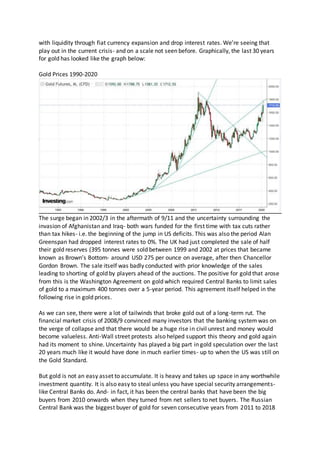
play out in the current crisis- and on a scale not seen before. Graphically, the last 30 years
for gold has looked like the graph below:
Gold Prices 1990-2020
The surge began in 2002/3 in the aftermath of 9/11 and the uncertainty surrounding the
invasion of Afghanistan and Iraq- both wars funded for the first time with tax cuts rather
than tax hikes- i.e. the beginning of the jump in US deficits. This was also the period Alan
Greenspan had dropped interest rates to 0%. The UK had just completed the sale of half
their gold reserves (395 tonnes were sold between 1999 and 2002 at prices that became
known as Brown’s Bottom- around USD 275 per ounce on average, after then Chancellor
Gordon Brown. The sale itself was badly conducted with prior knowledge of the sales
leading to shorting of gold by players ahead of the auctions. The positive for gold that arose
from this is the Washington Agreement on gold which required Central Banks to limit sales
of gold to a maximum 400 tonnes over a 5-year period. This agreement itself helped in the
following rise in gold prices.
As we can see, there were a lot of tailwinds that broke gold out of a long-term rut. The
financial market crisis of 2008/9 convinced many investors that the banking systemwas on
the verge of collapse and that there would be a huge rise in civil unrest and money would
become valueless. Anti-Wall street protests also helped support this theory and gold again
had its moment to shine. Uncertainty has played a big part in gold speculation over the last
20 years much like it would have done in much earlier times- up to when the US was still on
the Gold Standard.
But gold is not an easy asset to accumulate. It is heavy and takes up space in any worthwhile
investment quantity. It is also easy to steal unless you have special security arrangements-
like Central Banks do. And- in fact, it has been the central banks that have been the big
buyers from 2010 onwards when they turned from net sellers to net buyers. The Russian
Central Bank was the biggest buyer of gold for seven consecutive years from 2011 to 2018
and is now one of the largest holders of gold in the world. This included buying 274 tonnes
in 2018; partly to move away from US Dollar reserves after relations went sour following
their annexation of Crimea. The huge additions to reserves by central banks- including
Kazakhstan and Poland, has kept gold prices from collapsing once it became apparent that
the world would not descend into chaos after massive central bank intervention and
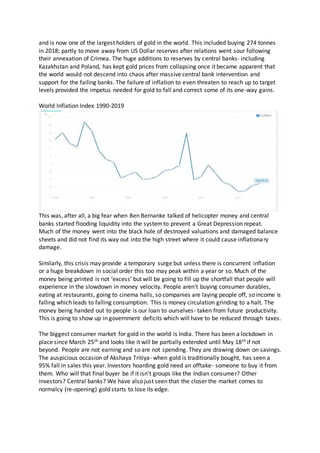
support for the failing banks. The failure of inflation to even threaten to reach up to target
levels provided the impetus needed for gold to fall and correct some of its one-way gains.
World Inflation Index 1990-2019
This was, after all, a big fear when Ben Bernanke talked of helicopter money and central
banks started flooding liquidity into the systemto prevent a Great Depression repeat.
Much of the money went into the black hole of destroyed valuations and damaged balance
sheets and did not find its way out into the high street where it could cause inflationary
damage.
Similarly, this crisis may provide a temporary surge but unless there is concurrent inflation
or a huge breakdown in social order this too may peak within a year or so. Much of the
money being printed is not ‘excess’ but will be going to fill up the shortfall that people will
experience in the slowdown in money velocity. People aren’t buying consumer durables,
eating at restaurants, going to cinema halls, so companies are laying people off, so income is
falling which leads to falling consumption. This is money circulation grinding to a halt. The
money being handed out to people is our loan to ourselves- taken from future productivity.
This is going to show up in government deficits which will have to be reduced through taxes.
The biggest consumer market for gold in the world is India. There has been a lockdown in
place since March 25th and looks like it will be partially extended until May 18th if not
beyond. People are not earning and so are not spending. They are drawing down on savings.
The auspicious occasion of Akshaya Tritiya- when gold is traditionally bought, has seen a
95% fall in sales this year. Investors hoarding gold need an offtake- someone to buy it from
them. Who will that final buyer be if it isn’t groups like the Indian consumer? Other
investors? Central banks? We have also just seen that the closer the market comes to
normalcy (re-opening) gold starts to lose its edge.
This is not an investment that is likely to give ‘multi-bagger’ returns. It may give
supernormal returns for a brief period in comparison to debt or equity (especially in the
near future with near zero rates and poor quarterly earnings numbers), but gold remains a
clumsy investment and if the conditions aren’t right it has little retail support. In a scenario
with depleted savings amongst global households, low inflation (huge supply overhang in
almost all consumption categories) and central bank participation required to buy in bulk
(unlikely in the near future with their other commitments) a long-term rally seems unlikely.
Even now, gold is still to reach its 2011 peaks.
For hedging purposes, it makes sense to maintain gold in an investment portfolio. It does
offer a form of protection for unforeseen events. But it cannot be the primary component.
It is open to heavy speculative interest when it isn’t dependant upon central bank favour.
The Indian central bank has been launching schemes to obtain gold through Gold bonds
offered to the Indian public- offering them a link to the physical gold without the hassle of
holding it- even offering returns on the bonds. This is as close to a return to the gold
standard as likely. Investors often use the ETF route which is also backed by physical
holdings even though prices and liquidity can be an issue at times.

Is gold a good bet

  • 1.
    Is Gold agood bet? If we take heed of many the doomsday scenarios many investors are floating one of the principal recommendations is to buy gold. The huge surge in central bank provided liquidity across the globe- they say, can only lead to the debasement of currencies and- in those circumstances, gold is the best bet. Gold proponents have always been convinced that it is one of the best assets to hold in the long run given that it- as a store of value, has outlasted every currency in existence. The literature on gold is far too large to go into in depth. It’s best- for the sake of this article, to limit the focus to the question: Is gold a good bet now? The short answer is yes: as part of a diversified portfolio. The recent history of gold is intimately tied up with the renunciation of the metal as the backing for currencies. Previously, one could theoretically exchange currency for a fixed amount of gold. Once currencies went off the Gold Standard the link between the two was severed. Now, of course, exchanging currency for gold is only possible at the prevailing price as of that day. The move towards Fiat currency- untethered to any underlying physical gold holding has created a new branch of economics which is moving beyond conventional monetarist theory which linked money supply to inflation (more money in circulation led to devaluation). This offers us an insight into the thinking behind central banks and the more conventional response of traditional gold investors. One of the biggest arguments for holding gold now is the almost regular decadal financial crisis the world seems to undergo. And the response has become stock: flood the system
  • 2.
    with liquidity throughfiat currency expansion and drop interest rates. We’re seeing that play out in the current crisis- and on a scale not seen before. Graphically, the last 30 years for gold has looked like the graph below: Gold Prices 1990-2020 The surge began in 2002/3 in the aftermath of 9/11 and the uncertainty surrounding the invasion of Afghanistan and Iraq- both wars funded for the first time with tax cuts rather than tax hikes- i.e. the beginning of the jump in US deficits. This was also the period Alan Greenspan had dropped interest rates to 0%. The UK had just completed the sale of half their gold reserves (395 tonnes were sold between 1999 and 2002 at prices that became known as Brown’s Bottom- around USD 275 per ounce on average, after then Chancellor Gordon Brown. The sale itself was badly conducted with prior knowledge of the sales leading to shorting of gold by players ahead of the auctions. The positive for gold that arose from this is the Washington Agreement on gold which required Central Banks to limit sales of gold to a maximum 400 tonnes over a 5-year period. This agreement itself helped in the following rise in gold prices. As we can see, there were a lot of tailwinds that broke gold out of a long-term rut. The financial market crisis of 2008/9 convinced many investors that the banking systemwas on the verge of collapse and that there would be a huge rise in civil unrest and money would become valueless. Anti-Wall street protests also helped support this theory and gold again had its moment to shine. Uncertainty has played a big part in gold speculation over the last 20 years much like it would have done in much earlier times- up to when the US was still on the Gold Standard. But gold is not an easy asset to accumulate. It is heavy and takes up space in any worthwhile investment quantity. It is also easy to steal unless you have special security arrangements- like Central Banks do. And- in fact, it has been the central banks that have been the big buyers from 2010 onwards when they turned from net sellers to net buyers. The Russian Central Bank was the biggest buyer of gold for seven consecutive years from 2011 to 2018
  • 3.
    and is nowone of the largest holders of gold in the world. This included buying 274 tonnes in 2018; partly to move away from US Dollar reserves after relations went sour following their annexation of Crimea. The huge additions to reserves by central banks- including Kazakhstan and Poland, has kept gold prices from collapsing once it became apparent that the world would not descend into chaos after massive central bank intervention and support for the failing banks. The failure of inflation to even threaten to reach up to target levels provided the impetus needed for gold to fall and correct some of its one-way gains. World Inflation Index 1990-2019 This was, after all, a big fear when Ben Bernanke talked of helicopter money and central banks started flooding liquidity into the systemto prevent a Great Depression repeat. Much of the money went into the black hole of destroyed valuations and damaged balance sheets and did not find its way out into the high street where it could cause inflationary damage. Similarly, this crisis may provide a temporary surge but unless there is concurrent inflation or a huge breakdown in social order this too may peak within a year or so. Much of the money being printed is not ‘excess’ but will be going to fill up the shortfall that people will experience in the slowdown in money velocity. People aren’t buying consumer durables, eating at restaurants, going to cinema halls, so companies are laying people off, so income is falling which leads to falling consumption. This is money circulation grinding to a halt. The money being handed out to people is our loan to ourselves- taken from future productivity. This is going to show up in government deficits which will have to be reduced through taxes. The biggest consumer market for gold in the world is India. There has been a lockdown in place since March 25th and looks like it will be partially extended until May 18th if not beyond. People are not earning and so are not spending. They are drawing down on savings. The auspicious occasion of Akshaya Tritiya- when gold is traditionally bought, has seen a 95% fall in sales this year. Investors hoarding gold need an offtake- someone to buy it from them. Who will that final buyer be if it isn’t groups like the Indian consumer? Other investors? Central banks? We have also just seen that the closer the market comes to normalcy (re-opening) gold starts to lose its edge.
  • 4.
    This is notan investment that is likely to give ‘multi-bagger’ returns. It may give supernormal returns for a brief period in comparison to debt or equity (especially in the near future with near zero rates and poor quarterly earnings numbers), but gold remains a clumsy investment and if the conditions aren’t right it has little retail support. In a scenario with depleted savings amongst global households, low inflation (huge supply overhang in almost all consumption categories) and central bank participation required to buy in bulk (unlikely in the near future with their other commitments) a long-term rally seems unlikely. Even now, gold is still to reach its 2011 peaks. For hedging purposes, it makes sense to maintain gold in an investment portfolio. It does offer a form of protection for unforeseen events. But it cannot be the primary component. It is open to heavy speculative interest when it isn’t dependant upon central bank favour. The Indian central bank has been launching schemes to obtain gold through Gold bonds offered to the Indian public- offering them a link to the physical gold without the hassle of holding it- even offering returns on the bonds. This is as close to a return to the gold standard as likely. Investors often use the ETF route which is also backed by physical holdings even though prices and liquidity can be an issue at times.