Presented By:
T. ARUN KUMAR
(133120)
Under the guidance of :
Prof. G.V. MARUTHESWAR
MAXIMUM POWER POINT TRACKING ALGORITHMS
APPLIED TO WIND-SOLAR HYBRID SYSTEM
DEPARTMENT OF ELECTRICAL AND ELECTRONICS
ENGINEERING
SV UNIVERSITY COLLEGE OF ENGINEERING, TIRUPATI
CONTENTS
 ABSTRACT
 INTRODUCTION
 WIND ENERGY SYSTEM
 SOLAR PV SYSTEM
 MPPT ALGORITHMS
 FUZZY LOGIC CONTROLLER
 SIMULATION MODELS
 RESULTS
 CONCLUSION
 REFERENCES
ABSTRACT
 The production of electricity from renewable energy sources like solar, wind energy increases in recent years
due to environmental problems and the shortage of traditional energy sources in the near future.
 This Thesis presents modeling, simulation, and performance study of Hybrid generation system with PI and
MPPT controller.
 The Wind power generation system uses Wind Turbine(WT), a Permanent Magnet Synchronous
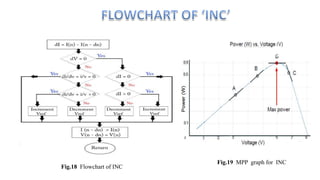
Generator(PMSG), a three phase controlled rectifier bridge with PI controller, a dc bus with a capacitor and a
current regulated PWM voltage source inverter.
 The PV cell model is developed including the effects of changing solar irradiation and temperature and
Maximum power from PV cell is obtained by using MPPT controller.
 This Thesis reports the development of wind/photovoltaic power generation system and also describes the
Wind-Solar Hybrid system for supplying electricity to the Load and describe various MPPT techniques namely
Perturb and Observe(P&O), Incremental Conductance(INC) and Fuzzy Logic based MPPT controller and their
performance.
 Simulation results of Hybrid system using various MPPT techniques are provided.
INTRODUCTION
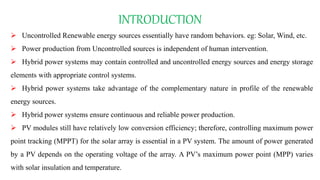
 Uncontrolled Renewable energy sources essentially have random behaviors. eg: Solar, Wind, etc.
 Power production from Uncontrolled sources is independent of human intervention.
 Hybrid power systems may contain controlled and uncontrolled energy sources and energy storage
elements with appropriate control systems.
 Hybrid power systems take advantage of the complementary nature in profile of the renewable
energy sources.
 Hybrid power systems ensure continuous and reliable power production.
 PV modules still have relatively low conversion efficiency; therefore, controlling maximum power
point tracking (MPPT) for the solar array is essential in a PV system. The amount of power generated
by a PV depends on the operating voltage of the array. A PV’s maximum power point (MPP) varies
with solar insulation and temperature.
INTRODUCTION TO
WIND ENERGY SYSTEM
WIND POWER - WHAT IS IT?
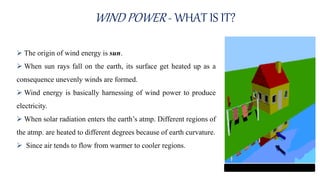
 The origin of wind energy is sun.
 When sun rays fall on the earth, its surface get heated up as a
consequence unevenly winds are formed.
 Wind energy is basically harnessing of wind power to produce
electricity.
 When solar radiation enters the earth’s atmp. Different regions of
the atmp. are heated to different degrees because of earth curvature.
 Since air tends to flow from warmer to cooler regions.
Modelling OF ‘WIND TURBINE’
 For a variable speed wind turbine, the output mechanical power available from a end turbine
could be expressed as
3
^
)
,
(
5
.
0 Vw
ACp
P 



 The relation between rotor speed and wind speed can be given by
Vw
mR/

 
 The wind turbine torque on the shaft can be calculated from the power
   



 ,
3
^
/
5
^
5
.
0
/ Cp
Wm
R
Wm
Pm
Tm 

  




 0068
.
0
)
/
21
(
^
5
4
.
0
116
5176
.
0
, 

















 i
e
i
Cp
1
)]^
1
3
^
/(
035
.
0
)
08
.
0
(
1
[ 




 


i
Where,
Cont...
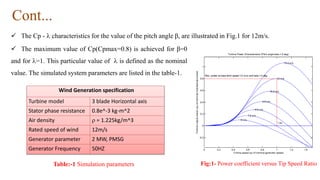
 The Cp -  characteristics for the value of the pitch angle β, are illustrated in Fig.1 for 12m/s.
 The maximum value of Cp(Cpmax=0.8) is achieved for β=0
and for =1. This particular value of  is defined as the nominal
value. The simulated system parameters are listed in the table-1.
Fig:1- Power coefficient versus Tip Speed Ratio
Wind Generation specification
Turbine model 3 blade Horizontal axis
Stator phase resistance 0.8e^-3 kg-m^2
Air density  = 1.225kg/m^3
Rated speed of wind 12m/s
Generator parameter 2 MW, PMSG
Generator Frequency 50HZ
Table:-1 Simulation parameters
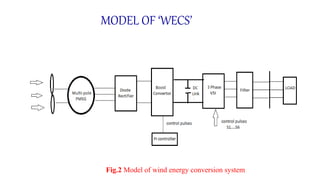
MODEL OF ‘WECS’
Fig.2 Model of wind energy conversion system
SOLAR PV SYSTEM
INTRODUCTION TO
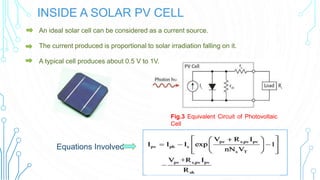
INSIDE A SOLAR PV CELL
An ideal solar cell can be considered as a current source.
The current produced is proportional to solar irradiation falling on it.
A typical cell produces about 0.5 V to 1V.
Equations Involved
Fig.3 Equivalent Circuit of Photovoltaic
Cell
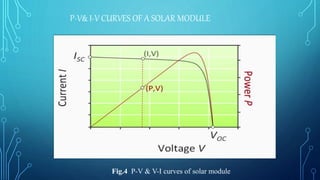
P-V& I-V CURVES OF A SOLAR MODULE
Fig.4 P-V & V-I curves of solar module
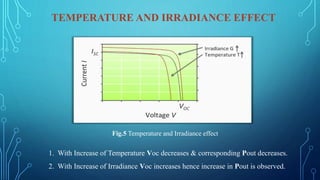
TEMPERATURE AND IRRADIANCE EFFECT
1. With Increase of Temperature Voc decreases & corresponding Pout decreases.
2. With Increase of Irradiance Voc increases hence increase in Pout is observed.
Fig.5 Temperature and Irradiance effect
SOLAR PARAMETERS
• Short Circuit Current (Isc): Short circuit current is max current produced by a solar
cell when its terminals are short circuited.
• Open Circuit Voltage (Voc): Open circuit voltage is the max voltage that can be
obtained from a solar cell when its terminals are left open.
• Fill Factor (FF): Fill Factor is defined as ratio of maximum power to the product of Voc
and Isc. FF is 1 for ideal case. Practically its value ranges from 0.8 to 0.89.
• FF = Vm x Im
Voc x Isc
• Efficiency : Efficiency is defined as ratio of maximum power of module to power
delivered by solar irradiance or it can be defined as ratio of product of Voc ,Isc and FF to
solar irradiance .
• Efficiency = Voc x Isc x FF
solar irradiance
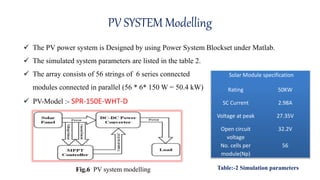
PV SYSTEM Modelling
 The PV power system is Designed by using Power System Blockset under Matlab.
 The simulated system parameters are listed in the table 2.
 The array consists of 56 strings of 6 series connected
modules connected in parallel (56 * 6* 150 W = 50.4 kW)
 PV-Model :- SPR-150E-WHT-D
Solar Module specification
Rating 50KW
SC Current 2.98A
Voltage at peak 27.35V
Open circuit
voltage
32.2V
No. cells per
module(Np)
56
Table:-2 Simulation parameters
Fig.6 PV system modelling
CONTROLLER
MPPT
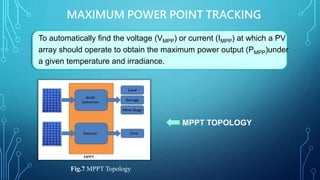
MAXIMUM POWER POINT TRACKING
To automatically find the voltage (VMPP) or current (IMPP) at which a PV
array should operate to obtain the maximum power output (PMPP)under
a given temperature and irradiance.
MPPT TOPOLOGY
Fig.7 MPPT Topology
CHOICE OF MPPT TECHNIQUE
IMPLEMENTATION
COMPLEXITY
SENSORS
REQUIRED
ABILITY TO
DETECT
MULTIPLE LOCAL
MAXIMA
RESPONSE TIME
COST APPLICATION
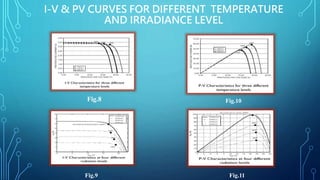
I-V & PV CURVES FOR DIFFERENT TEMPERATURE
AND IRRADIANCE LEVEL
Fig.8
Fig.9
Fig.10
Fig.11
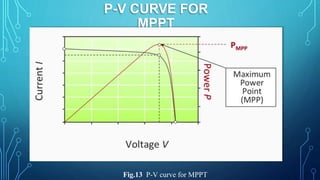
P-V CURVE FOR
MPPT
Fig.13 P-V curve for MPPT
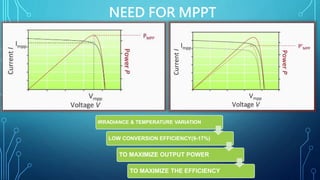
NEED FOR MPPT
IRRADIANCE & TEMPERATURE VARIATION
LOW CONVERSION EFFICIENCY(9-17%)
TO MAXIMIZE OUTPUT POWER
TO MAXIMIZE THE EFFICIENCY
 The most obvious source of RE is the solar energy, therefore, a
huge number of projects and researches have been adopted worldwide
to utilize the indispensable sunlight as a sustainable source of energy.
 PV solar cells have relatively low efficiency ratings; thus
operating at the MPP is desired because it is at this point array will
operate at the highest efficiency.
MPPT TECHNIQUES
MPP
Techniques
Indirect
Fixed Voltage
Method
Fractional
Open Circuit
Voltage Method
Direct
Perturb &
Observe
Method
Incremental
Conduction
Method
PERTURB & OBSERVE (P&O)/HILL CLIMBING
METHOD
Direct measurement
of current, voltage
and power.
Faster and accurate
response
Incrementing the voltage
increases
the power when operating on
the
left of the MPP and decreases
the
power when on the right of the
MPP.
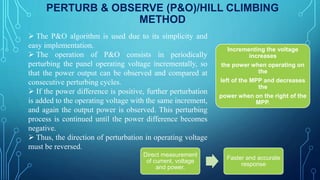
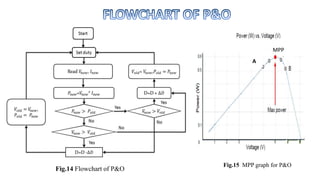
 The P&O algorithm is used due to its simplicity and
easy implementation.
 The operation of P&O consists in periodically
perturbing the panel operating voltage incrementally, so
that the power output can be observed and compared at
consecutive perturbing cycles.
 If the power difference is positive, further perturbation
is added to the operating voltage with the same increment,
and again the output power is observed. This perturbing
process is continued until the power difference becomes
negative.
 Thus, the direction of perturbation in operating voltage
must be reversed.
A
MPP
Fig.14 Flowchart of P&O
Fig.15 MPP graph for P&O
DRAWBACKS OF P&O METHOD
• Hill climbing and P&O methods can fail under rapidly changing
atmospheric conditions.
• The process is repeated periodically until the MPP is reached.
• The system oscillates about the MPP.
• Smaller perturbation size slows down the MPPT
• If the irradiance fluctuates
and shifts the power curve
within one sampling period,
the operating point will
fluctuate
Fig.16 MPP graph for P&O
INCREMENTAL CONDUCTANCE METHOD
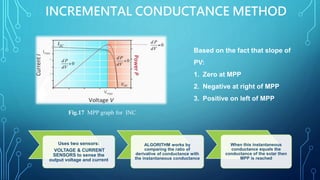
Based on the fact that slope of
PV:
1. Zero at MPP
2. Negative at right of MPP
3. Positive on left of MPP
.
.
Uses two sensors:
VOLTAGE & CURRENT
SENSORS to sense the
output voltage and current
ALGORITHM works by
comparing the ratio of
derivative of conductance with
the instantaneous conductance
When this instantaneous
conductance equals the
conductance of the solar then
MPP is reached
Fig.17 MPP graph for INC
Fig.18 Flowchart of INC
Fig.19 MPP graph for INC
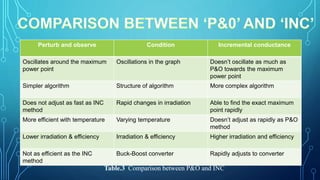
Perturb and observe Condition Incremental conductance
Oscillates around the maximum
power point
Oscillations in the graph Doesn’t oscillate as much as
P&O towards the maximum
power point
Simpler algorithm Structure of algorithm More complex algorithm
Does not adjust as fast as INC
method
Rapid changes in irradiation Able to find the exact maximum
point rapidly
More efficient with temperature Varying temperature Doesn’t adjust as rapidly as P&O
method
Lower irradiation & efficiency Irradiation & efficiency Higher irradiation and efficiency
Not as efficient as the INC
method
Buck-Boost converter Rapidly adjusts to converter
Table.3 Comparison between P&O and INC
FUZZY CONTROLLER IN PV
Artificial intelligent tool
which computes output
based on expert
knowledge.
faster response
using the expert
knowledge and
measured data
base.
FL Algorithm is
chosen for PV
because of its fast
and accurate
response
Fuzzy logic
controller
algorithm is based
on three steps
1-expert knowledge,
2-fuzzification &
inference diagram
3-defuzzification.
FUZZY LOGIC MPPT
CONTROLLER
FUZZIFICATIO
N
INFERENC
E
DEFUZZIFICATI
ON
RULES
Fig.21 Fuzzy Logic Controller
MODELLING OF FUZZY IN MPPT
FUZZIFICATIO
N
INFEREN
CE
ENGINE
DEFUZZIFICATI
ON
FUZZY
RULE
BOX
FUZZY LOGIC CONTROLLER
PV
MODEL
BUCK
BOOST
CONVERTE
R
LOAD
Duty Ratio Command
Fig.22 Modelling of FUZZY in MPPT
FUZZY LOGIC RULES TABLE
NB NS PS PB
NB PB PB NB NB
NS PS PS NS NS
PS NS NS PS PS
PB NB NB PB PB
Table shows the rule table of the fuzzy controller
where all the entries of the matrix are fuzzy sets of
change of power and change of current and duty
ratio D to the boost converter. The variable inputs
and outputs are divided into four fuzzy subsets:
PB(Positive Big), PS(Positive Small), NB(Negative
Big), NS(Negative Small). Therefore, the fuzzy
algorithm requires 16 fuzzy control rules.
Ex:-  If input 1 is NB and input 2 is NB then output is PB
 If input 1 is NB and input 2 is NS then output is PB
 If input 1 is NB and input 2 is PS then output is NB
Table.4 Fuzzy rules
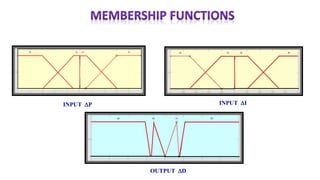
INPUT P INPUT I
OUTPUT D
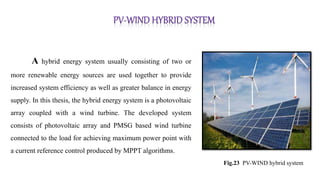
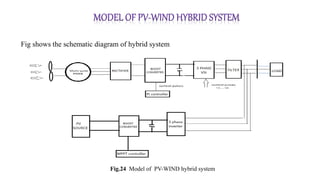
A hybrid energy system usually consisting of two or
more renewable energy sources are used together to provide
increased system efficiency as well as greater balance in energy
supply. In this thesis, the hybrid energy system is a photovoltaic
array coupled with a wind turbine. The developed system
consists of photovoltaic array and PMSG based wind turbine
connected to the load for achieving maximum power point with
a current reference control produced by MPPT algorithms.
Fig.23 PV-WIND hybrid system
Fig shows the schematic diagram of hybrid system
Fig.24 Model of PV-WIND hybrid system
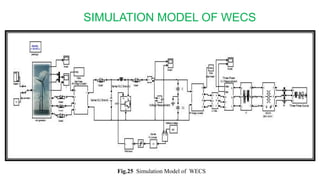
SIMULATION MODEL OF WECS
Fig.25 Simulation Model of WECS
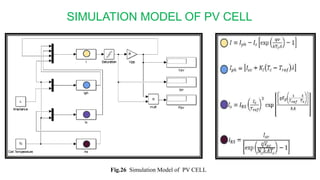
SIMULATION MODEL OF PV CELL
Fig.26 Simulation Model of PV CELL
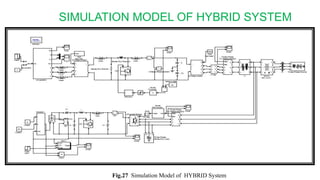
SIMULATION MODEL OF HYBRID SYSTEM
Fig.27 Simulation Model of HYBRID System
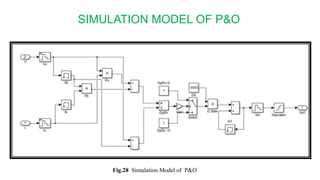
SIMULATION MODEL OF P&O
Fig.28 Simulation Model of P&O
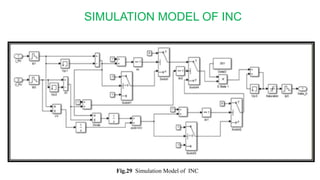
SIMULATION MODEL OF INC
Fig.29 Simulation Model of INC
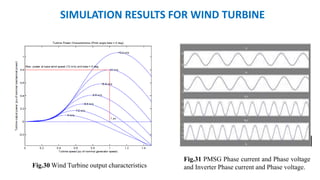
SIMULATION RESULTS FOR WIND TURBINE
Fig.31 PMSG Phase current and Phase voltage
and Inverter Phase current and Phase voltage.
Fig.30 Wind Turbine output characteristics
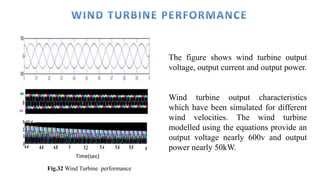
Time(sec)
The figure shows wind turbine output
voltage, output current and output power.
Wind turbine output characteristics
which have been simulated for different
wind velocities. The wind turbine
modelled using the equations provide an
output voltage nearly 600v and output
power nearly 50kW.
Fig.32 Wind Turbine performance
50
-50
Time(s)
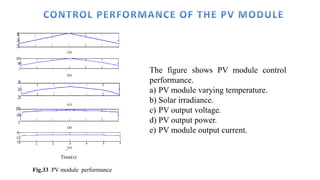
The figure shows PV module control
performance.
a) PV module varying temperature.
b) Solar irradiance.
c) PV output voltage.
d) PV output power.
e) PV module output current.
Fig.33 PV module performance
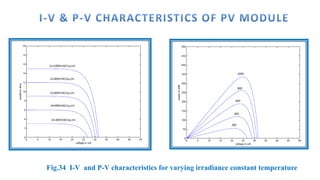
Fig.34 I-V and P-V characteristics for varying irradiance constant temperature
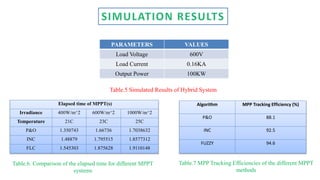
PARAMETERS VALUES
Load Voltage 600V
Load Current 0.16KA
Output Power 100KW
Table.5 Simulated Results of Hybrid System
Elapsed time of MPPT(s)
Irradiance 400W/m^2 600W/m^2 1000W/m^2
Temperature 21C 23C 25C
P&O 1.350743 1.66736 1.7038632
INC 1.48879 1.795515 1.8577312
FLC 1.545303 1.875628 1.9110148
Table.6 Comparison of the elapsed time for different MPPT
systems
Algorithm MPP Tracking Efficiency (%)
P&O 88.1
INC 92.5
FUZZY 94.6
Table.7 MPP Tracking Efficiencies of the different MPPT
methods
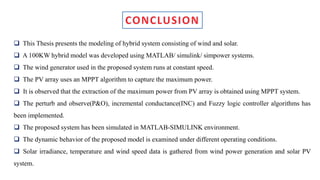
 This Thesis presents the modeling of hybrid system consisting of wind and solar.
 A 100KW hybrid model was developed using MATLAB/ simulink/ simpower systems.
 The wind generator used in the proposed system runs at constant speed.
 The PV array uses an MPPT algorithm to capture the maximum power.
 It is observed that the extraction of the maximum power from PV array is obtained using MPPT system.
 The perturb and observe(P&O), incremental conductance(INC) and Fuzzy logic controller algorithms has
been implemented.
 The proposed system has been simulated in MATLAB-SIMULINK environment.
 The dynamic behavior of the proposed model is examined under different operating conditions.
 Solar irradiance, temperature and wind speed data is gathered from wind power generation and solar PV
system.
PAPER publishing
REFERENCES
[1] Theodoros L. Kottas, “New Maximum Power Point Tracker For PV Arrays using Fuzzy Controller”, IEEE Transactions On Energy
Conversion, VOL.21, NO.3, SEPT 2006.
[2] Jayalakshmi N.S., D.N.Gaonkar, ”Maximum Power Point Tracking for Grid Integrated Variable Speed Wind based Distributed Generation
system with Dynamic Load”, International Journal Of Renewable Energy Research, Vol.4, No.2, 2014.
[3] Bader N.Alajmi, Khaled H. Ahmed, Stephen J. Finney, and Barry W. Williams, “Fuzzy Logic Control approach of a modified Hill-
Climbing method for Maximum power point in Microgrid standalone Photovoltaic system”, IEEE Transactions On Power Electronics, Vol.26,
No.4, April 2011.
[4] M.A. Mahmud, H.R .Pota and M.J. Hossain, “Nonlinear Current Control Scheme for a Single-Phase Grid- Connected PV system”, IEEE
Transactions On Sustainable Energy, Vol.5, No.1, Jan 2014.
[5] Ting-Chung Yu, Yu-Cheng Lin, “ A study on maximum power point tracking algorithms for photovoltaic systems”, IEEE Transactions On
Industrial Electronics, Vol.53, No.4, June 2006.
[6] Bader N. Alajmi, Khaled H. Ahmed,”Single-Phase Single-Stage Transformer less Grid-Connected PV system”, IEEE Transactions On
Power Electronics, Vol.28,No.6 June 2013.
[7] Monica Chinchilla, Santiago Arnaltes and Juan Carlos Burgos, “Control of Permanent-Magnet Generators Applied to Variable-Speed
Wind-Energy Systems Connected to the Grid” IEEE Transactions On Energy Conversion, Vol 21, NO, 1, March 2006 Pp. 130-135.
[8] C.Y Won, D.H. kim, W.S. Kim, ” A new maximum power point tracker of PV arrays using Fuzzy Logic Controller”, IEEE 25th Annu.
Power Electron. Spec. Conf., 1994, vol.1, pp. 396-403.
[9] Ashish Pandey, Nivedita Dasgupta,”High-Performance Alogorithms for Drift Avoidance and Fast Tracking in Solar MPPT System”, IEEE
Transaactions On Energy Conversion, Vol.23, No.2, June 2008.
[10] Fangrui Liu, Shanxu Duan,” A Variable Step Size Inc Mppt Method For Pv Systems”, IEEE Transaactions On Industrial Electronics,
Vol.55, No.7 July 2008.
MAXIMUM POWER POINT TRACKING ALGORITHMS APPLIED TO WIND-SOLAR HYBRID SYSTEM

MAXIMUM POWER POINT TRACKING ALGORITHMS APPLIED TO WIND-SOLAR HYBRID SYSTEM

  • 1.
    Presented By: T. ARUNKUMAR (133120) Under the guidance of : Prof. G.V. MARUTHESWAR MAXIMUM POWER POINT TRACKING ALGORITHMS APPLIED TO WIND-SOLAR HYBRID SYSTEM DEPARTMENT OF ELECTRICAL AND ELECTRONICS ENGINEERING SV UNIVERSITY COLLEGE OF ENGINEERING, TIRUPATI
  • 2.
    CONTENTS  ABSTRACT  INTRODUCTION WIND ENERGY SYSTEM  SOLAR PV SYSTEM  MPPT ALGORITHMS  FUZZY LOGIC CONTROLLER  SIMULATION MODELS  RESULTS  CONCLUSION  REFERENCES
  • 3.
    ABSTRACT  The productionof electricity from renewable energy sources like solar, wind energy increases in recent years due to environmental problems and the shortage of traditional energy sources in the near future.  This Thesis presents modeling, simulation, and performance study of Hybrid generation system with PI and MPPT controller.  The Wind power generation system uses Wind Turbine(WT), a Permanent Magnet Synchronous Generator(PMSG), a three phase controlled rectifier bridge with PI controller, a dc bus with a capacitor and a current regulated PWM voltage source inverter.  The PV cell model is developed including the effects of changing solar irradiation and temperature and Maximum power from PV cell is obtained by using MPPT controller.  This Thesis reports the development of wind/photovoltaic power generation system and also describes the Wind-Solar Hybrid system for supplying electricity to the Load and describe various MPPT techniques namely Perturb and Observe(P&O), Incremental Conductance(INC) and Fuzzy Logic based MPPT controller and their performance.  Simulation results of Hybrid system using various MPPT techniques are provided.
  • 4.
    INTRODUCTION  Uncontrolled Renewableenergy sources essentially have random behaviors. eg: Solar, Wind, etc.  Power production from Uncontrolled sources is independent of human intervention.  Hybrid power systems may contain controlled and uncontrolled energy sources and energy storage elements with appropriate control systems.  Hybrid power systems take advantage of the complementary nature in profile of the renewable energy sources.  Hybrid power systems ensure continuous and reliable power production.  PV modules still have relatively low conversion efficiency; therefore, controlling maximum power point tracking (MPPT) for the solar array is essential in a PV system. The amount of power generated by a PV depends on the operating voltage of the array. A PV’s maximum power point (MPP) varies with solar insulation and temperature.
  • 5.
  • 6.
    WIND POWER -WHAT IS IT?  The origin of wind energy is sun.  When sun rays fall on the earth, its surface get heated up as a consequence unevenly winds are formed.  Wind energy is basically harnessing of wind power to produce electricity.  When solar radiation enters the earth’s atmp. Different regions of the atmp. are heated to different degrees because of earth curvature.  Since air tends to flow from warmer to cooler regions.
  • 7.
    Modelling OF ‘WINDTURBINE’  For a variable speed wind turbine, the output mechanical power available from a end turbine could be expressed as 3 ^ ) , ( 5 . 0 Vw ACp P      The relation between rotor speed and wind speed can be given by Vw mR/     The wind turbine torque on the shaft can be calculated from the power         , 3 ^ / 5 ^ 5 . 0 / Cp Wm R Wm Pm Tm           0068 . 0 ) / 21 ( ^ 5 4 . 0 116 5176 . 0 ,                    i e i Cp 1 )]^ 1 3 ^ /( 035 . 0 ) 08 . 0 ( 1 [          i Where,
  • 8.
    Cont...  The Cp-  characteristics for the value of the pitch angle β, are illustrated in Fig.1 for 12m/s.  The maximum value of Cp(Cpmax=0.8) is achieved for β=0 and for =1. This particular value of  is defined as the nominal value. The simulated system parameters are listed in the table-1. Fig:1- Power coefficient versus Tip Speed Ratio Wind Generation specification Turbine model 3 blade Horizontal axis Stator phase resistance 0.8e^-3 kg-m^2 Air density  = 1.225kg/m^3 Rated speed of wind 12m/s Generator parameter 2 MW, PMSG Generator Frequency 50HZ Table:-1 Simulation parameters
  • 9.
    MODEL OF ‘WECS’ Fig.2Model of wind energy conversion system
  • 10.
  • 11.
    INSIDE A SOLARPV CELL An ideal solar cell can be considered as a current source. The current produced is proportional to solar irradiation falling on it. A typical cell produces about 0.5 V to 1V. Equations Involved Fig.3 Equivalent Circuit of Photovoltaic Cell
  • 12.
    P-V& I-V CURVESOF A SOLAR MODULE Fig.4 P-V & V-I curves of solar module
  • 13.
    TEMPERATURE AND IRRADIANCEEFFECT 1. With Increase of Temperature Voc decreases & corresponding Pout decreases. 2. With Increase of Irradiance Voc increases hence increase in Pout is observed. Fig.5 Temperature and Irradiance effect
  • 14.
    SOLAR PARAMETERS • ShortCircuit Current (Isc): Short circuit current is max current produced by a solar cell when its terminals are short circuited. • Open Circuit Voltage (Voc): Open circuit voltage is the max voltage that can be obtained from a solar cell when its terminals are left open. • Fill Factor (FF): Fill Factor is defined as ratio of maximum power to the product of Voc and Isc. FF is 1 for ideal case. Practically its value ranges from 0.8 to 0.89. • FF = Vm x Im Voc x Isc • Efficiency : Efficiency is defined as ratio of maximum power of module to power delivered by solar irradiance or it can be defined as ratio of product of Voc ,Isc and FF to solar irradiance . • Efficiency = Voc x Isc x FF solar irradiance
  • 15.
    PV SYSTEM Modelling The PV power system is Designed by using Power System Blockset under Matlab.  The simulated system parameters are listed in the table 2.  The array consists of 56 strings of 6 series connected modules connected in parallel (56 * 6* 150 W = 50.4 kW)  PV-Model :- SPR-150E-WHT-D Solar Module specification Rating 50KW SC Current 2.98A Voltage at peak 27.35V Open circuit voltage 32.2V No. cells per module(Np) 56 Table:-2 Simulation parameters Fig.6 PV system modelling
  • 16.
  • 17.
    MAXIMUM POWER POINTTRACKING To automatically find the voltage (VMPP) or current (IMPP) at which a PV array should operate to obtain the maximum power output (PMPP)under a given temperature and irradiance. MPPT TOPOLOGY Fig.7 MPPT Topology
  • 18.
    CHOICE OF MPPTTECHNIQUE IMPLEMENTATION COMPLEXITY SENSORS REQUIRED ABILITY TO DETECT MULTIPLE LOCAL MAXIMA RESPONSE TIME COST APPLICATION
  • 19.
    I-V & PVCURVES FOR DIFFERENT TEMPERATURE AND IRRADIANCE LEVEL Fig.8 Fig.9 Fig.10 Fig.11
  • 20.
    P-V CURVE FOR MPPT Fig.13P-V curve for MPPT
  • 21.
    NEED FOR MPPT IRRADIANCE& TEMPERATURE VARIATION LOW CONVERSION EFFICIENCY(9-17%) TO MAXIMIZE OUTPUT POWER TO MAXIMIZE THE EFFICIENCY
  • 22.
     The mostobvious source of RE is the solar energy, therefore, a huge number of projects and researches have been adopted worldwide to utilize the indispensable sunlight as a sustainable source of energy.  PV solar cells have relatively low efficiency ratings; thus operating at the MPP is desired because it is at this point array will operate at the highest efficiency.
  • 23.
    MPPT TECHNIQUES MPP Techniques Indirect Fixed Voltage Method Fractional OpenCircuit Voltage Method Direct Perturb & Observe Method Incremental Conduction Method
  • 24.
    PERTURB & OBSERVE(P&O)/HILL CLIMBING METHOD Direct measurement of current, voltage and power. Faster and accurate response Incrementing the voltage increases the power when operating on the left of the MPP and decreases the power when on the right of the MPP.  The P&O algorithm is used due to its simplicity and easy implementation.  The operation of P&O consists in periodically perturbing the panel operating voltage incrementally, so that the power output can be observed and compared at consecutive perturbing cycles.  If the power difference is positive, further perturbation is added to the operating voltage with the same increment, and again the output power is observed. This perturbing process is continued until the power difference becomes negative.  Thus, the direction of perturbation in operating voltage must be reversed.
  • 25.
    A MPP Fig.14 Flowchart ofP&O Fig.15 MPP graph for P&O
  • 26.
    DRAWBACKS OF P&OMETHOD • Hill climbing and P&O methods can fail under rapidly changing atmospheric conditions. • The process is repeated periodically until the MPP is reached. • The system oscillates about the MPP. • Smaller perturbation size slows down the MPPT • If the irradiance fluctuates and shifts the power curve within one sampling period, the operating point will fluctuate Fig.16 MPP graph for P&O
  • 27.
    INCREMENTAL CONDUCTANCE METHOD Basedon the fact that slope of PV: 1. Zero at MPP 2. Negative at right of MPP 3. Positive on left of MPP . . Uses two sensors: VOLTAGE & CURRENT SENSORS to sense the output voltage and current ALGORITHM works by comparing the ratio of derivative of conductance with the instantaneous conductance When this instantaneous conductance equals the conductance of the solar then MPP is reached Fig.17 MPP graph for INC
  • 28.
    Fig.18 Flowchart ofINC Fig.19 MPP graph for INC
  • 29.
    Perturb and observeCondition Incremental conductance Oscillates around the maximum power point Oscillations in the graph Doesn’t oscillate as much as P&O towards the maximum power point Simpler algorithm Structure of algorithm More complex algorithm Does not adjust as fast as INC method Rapid changes in irradiation Able to find the exact maximum point rapidly More efficient with temperature Varying temperature Doesn’t adjust as rapidly as P&O method Lower irradiation & efficiency Irradiation & efficiency Higher irradiation and efficiency Not as efficient as the INC method Buck-Boost converter Rapidly adjusts to converter Table.3 Comparison between P&O and INC
  • 30.
    FUZZY CONTROLLER INPV Artificial intelligent tool which computes output based on expert knowledge. faster response using the expert knowledge and measured data base. FL Algorithm is chosen for PV because of its fast and accurate response Fuzzy logic controller algorithm is based on three steps 1-expert knowledge, 2-fuzzification & inference diagram 3-defuzzification.
  • 31.
  • 32.
    MODELLING OF FUZZYIN MPPT FUZZIFICATIO N INFEREN CE ENGINE DEFUZZIFICATI ON FUZZY RULE BOX FUZZY LOGIC CONTROLLER PV MODEL BUCK BOOST CONVERTE R LOAD Duty Ratio Command Fig.22 Modelling of FUZZY in MPPT
  • 33.
    FUZZY LOGIC RULESTABLE NB NS PS PB NB PB PB NB NB NS PS PS NS NS PS NS NS PS PS PB NB NB PB PB Table shows the rule table of the fuzzy controller where all the entries of the matrix are fuzzy sets of change of power and change of current and duty ratio D to the boost converter. The variable inputs and outputs are divided into four fuzzy subsets: PB(Positive Big), PS(Positive Small), NB(Negative Big), NS(Negative Small). Therefore, the fuzzy algorithm requires 16 fuzzy control rules. Ex:-  If input 1 is NB and input 2 is NB then output is PB  If input 1 is NB and input 2 is NS then output is PB  If input 1 is NB and input 2 is PS then output is NB Table.4 Fuzzy rules
  • 34.
    INPUT P INPUTI OUTPUT D
  • 35.
    A hybrid energysystem usually consisting of two or more renewable energy sources are used together to provide increased system efficiency as well as greater balance in energy supply. In this thesis, the hybrid energy system is a photovoltaic array coupled with a wind turbine. The developed system consists of photovoltaic array and PMSG based wind turbine connected to the load for achieving maximum power point with a current reference control produced by MPPT algorithms. Fig.23 PV-WIND hybrid system
  • 36.
    Fig shows theschematic diagram of hybrid system Fig.24 Model of PV-WIND hybrid system
  • 37.
    SIMULATION MODEL OFWECS Fig.25 Simulation Model of WECS
  • 38.
    SIMULATION MODEL OFPV CELL Fig.26 Simulation Model of PV CELL
  • 39.
    SIMULATION MODEL OFHYBRID SYSTEM Fig.27 Simulation Model of HYBRID System
  • 40.
    SIMULATION MODEL OFP&O Fig.28 Simulation Model of P&O
  • 41.
    SIMULATION MODEL OFINC Fig.29 Simulation Model of INC
  • 42.
    SIMULATION RESULTS FORWIND TURBINE Fig.31 PMSG Phase current and Phase voltage and Inverter Phase current and Phase voltage. Fig.30 Wind Turbine output characteristics
  • 43.
    Time(sec) The figure showswind turbine output voltage, output current and output power. Wind turbine output characteristics which have been simulated for different wind velocities. The wind turbine modelled using the equations provide an output voltage nearly 600v and output power nearly 50kW. Fig.32 Wind Turbine performance 50 -50
  • 44.
    Time(s) The figure showsPV module control performance. a) PV module varying temperature. b) Solar irradiance. c) PV output voltage. d) PV output power. e) PV module output current. Fig.33 PV module performance
  • 45.
    Fig.34 I-V andP-V characteristics for varying irradiance constant temperature
  • 46.
    PARAMETERS VALUES Load Voltage600V Load Current 0.16KA Output Power 100KW Table.5 Simulated Results of Hybrid System Elapsed time of MPPT(s) Irradiance 400W/m^2 600W/m^2 1000W/m^2 Temperature 21C 23C 25C P&O 1.350743 1.66736 1.7038632 INC 1.48879 1.795515 1.8577312 FLC 1.545303 1.875628 1.9110148 Table.6 Comparison of the elapsed time for different MPPT systems Algorithm MPP Tracking Efficiency (%) P&O 88.1 INC 92.5 FUZZY 94.6 Table.7 MPP Tracking Efficiencies of the different MPPT methods
  • 47.
     This Thesispresents the modeling of hybrid system consisting of wind and solar.  A 100KW hybrid model was developed using MATLAB/ simulink/ simpower systems.  The wind generator used in the proposed system runs at constant speed.  The PV array uses an MPPT algorithm to capture the maximum power.  It is observed that the extraction of the maximum power from PV array is obtained using MPPT system.  The perturb and observe(P&O), incremental conductance(INC) and Fuzzy logic controller algorithms has been implemented.  The proposed system has been simulated in MATLAB-SIMULINK environment.  The dynamic behavior of the proposed model is examined under different operating conditions.  Solar irradiance, temperature and wind speed data is gathered from wind power generation and solar PV system.
  • 48.
  • 49.
    REFERENCES [1] Theodoros L.Kottas, “New Maximum Power Point Tracker For PV Arrays using Fuzzy Controller”, IEEE Transactions On Energy Conversion, VOL.21, NO.3, SEPT 2006. [2] Jayalakshmi N.S., D.N.Gaonkar, ”Maximum Power Point Tracking for Grid Integrated Variable Speed Wind based Distributed Generation system with Dynamic Load”, International Journal Of Renewable Energy Research, Vol.4, No.2, 2014. [3] Bader N.Alajmi, Khaled H. Ahmed, Stephen J. Finney, and Barry W. Williams, “Fuzzy Logic Control approach of a modified Hill- Climbing method for Maximum power point in Microgrid standalone Photovoltaic system”, IEEE Transactions On Power Electronics, Vol.26, No.4, April 2011. [4] M.A. Mahmud, H.R .Pota and M.J. Hossain, “Nonlinear Current Control Scheme for a Single-Phase Grid- Connected PV system”, IEEE Transactions On Sustainable Energy, Vol.5, No.1, Jan 2014. [5] Ting-Chung Yu, Yu-Cheng Lin, “ A study on maximum power point tracking algorithms for photovoltaic systems”, IEEE Transactions On Industrial Electronics, Vol.53, No.4, June 2006. [6] Bader N. Alajmi, Khaled H. Ahmed,”Single-Phase Single-Stage Transformer less Grid-Connected PV system”, IEEE Transactions On Power Electronics, Vol.28,No.6 June 2013. [7] Monica Chinchilla, Santiago Arnaltes and Juan Carlos Burgos, “Control of Permanent-Magnet Generators Applied to Variable-Speed Wind-Energy Systems Connected to the Grid” IEEE Transactions On Energy Conversion, Vol 21, NO, 1, March 2006 Pp. 130-135. [8] C.Y Won, D.H. kim, W.S. Kim, ” A new maximum power point tracker of PV arrays using Fuzzy Logic Controller”, IEEE 25th Annu. Power Electron. Spec. Conf., 1994, vol.1, pp. 396-403. [9] Ashish Pandey, Nivedita Dasgupta,”High-Performance Alogorithms for Drift Avoidance and Fast Tracking in Solar MPPT System”, IEEE Transaactions On Energy Conversion, Vol.23, No.2, June 2008. [10] Fangrui Liu, Shanxu Duan,” A Variable Step Size Inc Mppt Method For Pv Systems”, IEEE Transaactions On Industrial Electronics, Vol.55, No.7 July 2008.