The Thriller Genre
BY MAX ELMORE
Narrative Conventions
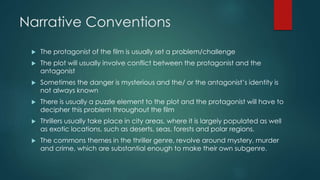
 The protagonist of the film is usually set a problem/challenge
 The plot will usually involve conflict between the protagonist and the
antagonist
 Sometimes the danger is mysterious and the/ or the antagonist’s identity is
not always known
 There is usually a puzzle element to the plot and the protagonist will have to
decipher this problem throughout the film
 Thrillers usually take place in city areas, where it is largely populated as well
as exotic locations, such as deserts, seas, forests and polar regions.
 The commons themes in the thriller genre, revolve around mystery, murder
and crime, which are substantial enough to make their own subgenre.
Sub Genres
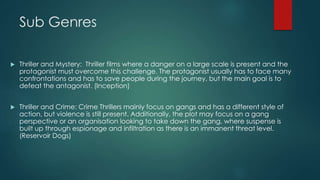
 Thriller and Mystery: Thriller films where a danger on a large scale is present and the
protagonist must overcome this challenge. The protagonist usually has to face many
confrontations and has to save people during the journey, but the main goal is to
defeat the antagonist. (Inception)
 Thriller and Crime: Crime Thrillers mainly focus on gangs and has a different style of
action, but violence is still present. Additionally, the plot may focus on a gang
perspective or an organisation looking to take down the gang, where suspense is
built up through espionage and infiltration as there is an immanent threat level.
(Reservoir Dogs)
Characters
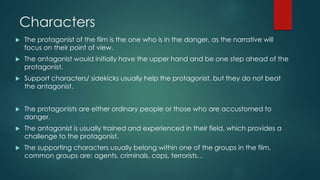
 The protagonist of the film is the one who is in the danger, as the narrative will
focus on their point of view.
 The antagonist would initially have the upper hand and be one step ahead of the
protagonist.
 Support characters/ sidekicks usually help the protagonist, but they do not beat
the antagonist.
 The protagonists are either ordinary people or those who are accustomed to
danger.
 The antagonist is usually trained and experienced in their field, which provides a
challenge to the protagonist.
 The supporting characters usually belong within one of the groups in the film,
common groups are: agents, criminals, cops, terrorists…
Thrillers
 Soundtrack: the soundtrack usually starts off slow however, when the action starts, it
becomes fast paced and atmospheric as many scenes are full of suspense and tension
 Editing: a lot of cuts are used in thriller films as they help convey the action, as well as
parallel editing where different viewpoints are shown as it adds to the tension and make
the film flow better
 Camerawork: many close ups are used in thrillers to portray characters emotions, as well
as long shots to show the action and sometimes pans and extreme close ups with the
antagonist, in order to not give away their identity
 Mise en scene: the lighting is usually quite dark as it is used to convey a serious matter,
as well as the props will be relative to the type of film, e.g. agents: gadgets.
Furthermore, the protagonist would likely wear everyday clothes as Ii make them more
relatable and the antagonist will have a costume that stands out from the crowd.
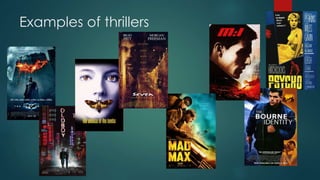
Examples of thrillers

Max Elmore Thriller

  • 1.
  • 2.
    Narrative Conventions  Theprotagonist of the film is usually set a problem/challenge  The plot will usually involve conflict between the protagonist and the antagonist  Sometimes the danger is mysterious and the/ or the antagonist’s identity is not always known  There is usually a puzzle element to the plot and the protagonist will have to decipher this problem throughout the film  Thrillers usually take place in city areas, where it is largely populated as well as exotic locations, such as deserts, seas, forests and polar regions.  The commons themes in the thriller genre, revolve around mystery, murder and crime, which are substantial enough to make their own subgenre.
  • 3.
    Sub Genres  Thrillerand Mystery: Thriller films where a danger on a large scale is present and the protagonist must overcome this challenge. The protagonist usually has to face many confrontations and has to save people during the journey, but the main goal is to defeat the antagonist. (Inception)  Thriller and Crime: Crime Thrillers mainly focus on gangs and has a different style of action, but violence is still present. Additionally, the plot may focus on a gang perspective or an organisation looking to take down the gang, where suspense is built up through espionage and infiltration as there is an immanent threat level. (Reservoir Dogs)
  • 4.
    Characters  The protagonistof the film is the one who is in the danger, as the narrative will focus on their point of view.  The antagonist would initially have the upper hand and be one step ahead of the protagonist.  Support characters/ sidekicks usually help the protagonist, but they do not beat the antagonist.  The protagonists are either ordinary people or those who are accustomed to danger.  The antagonist is usually trained and experienced in their field, which provides a challenge to the protagonist.  The supporting characters usually belong within one of the groups in the film, common groups are: agents, criminals, cops, terrorists…
  • 5.
    Thrillers  Soundtrack: thesoundtrack usually starts off slow however, when the action starts, it becomes fast paced and atmospheric as many scenes are full of suspense and tension  Editing: a lot of cuts are used in thriller films as they help convey the action, as well as parallel editing where different viewpoints are shown as it adds to the tension and make the film flow better  Camerawork: many close ups are used in thrillers to portray characters emotions, as well as long shots to show the action and sometimes pans and extreme close ups with the antagonist, in order to not give away their identity  Mise en scene: the lighting is usually quite dark as it is used to convey a serious matter, as well as the props will be relative to the type of film, e.g. agents: gadgets. Furthermore, the protagonist would likely wear everyday clothes as Ii make them more relatable and the antagonist will have a costume that stands out from the crowd.
  • 6.