SECTION
A
INTRO.
MUSIC VIDEOS
A2 MEDIA STUDIES EXAM – SECTION A:
THEORETICAL EVALUATION OF COURSEWORK
In Section A you answer both 1(a) and 1(b).
Question 1(a) will ask you to discuss the development of your skills from AS to A2
in relation to one or two of the following aspects:
Digital Technology
Creativity
Research and Planning
Post-production
Using conventions from real media texts
1(A)
In the exam you should spend about 30
minutes answering question 1(a). In order
to do well on this question you must
remember to:
Discuss both your AS and A2 coursework
Demonstrate progress from AS to A2
Refer to specific examples from your
coursework productions
Use terminology
1(B)
Question 1(b) will ask you to select one of your
coursework products, either AS or A2 and analyse
it relation to one of the following specified
theoretical concepts:
Narrative
Audience
Genre
Representation
Media Language
1(B)
You will need to spend about 30 minutes
answering question 1(b) in the exam. In
order to do well you should:
Demonstrate your understanding of media
theory
Relate theory to a range of specific
examples from your coursework product
Use theoretical and production terminology
well
GENRE
THEORY
MUSIC VIDEOS
MUSIC VIDEO GENRE THEORY
Katie Wales, 'genre is... an intertextual concept', and nowhere is this more appropriate
than with music videos
Andrew Goodwin - music videos follow the following conventions:
1. Conventions depend on the genre of the music
2. Star persona is important and companies use close ups to sell them to the
audience
3. Voyeuristic images are used to attract an audience
4. They often contain intertextual references to other media
5. There is a link between the lyrics and the visuals
6. There is a link between the visuals and the music / pace etc
ANDREW GOODWIN
‘DANCING IN THE DISTRACTION FACTORY’
Certain music genres contain conventions that audiences wish to see:
• Rock bands traditionally will have performances of the band energetically singing the
track – perhaps in front of an audience, drummers emphatically drumming, singers
scowling down the mic – all to show how tough they are
• Girl bands traditionally have a focus on heavily choreography dance routines,
fashion, attitude, independence
SVEN E CARLSSON
Music videos mostly fall under 2 categories:
• Performance (dance, song or instrumental focus)
• Conceptual (abstract ideas the artist wants to promote through their song)
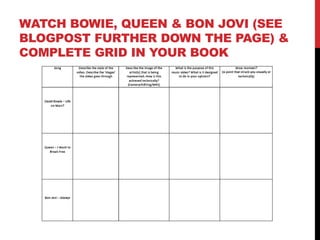
WATCH BOWIE, QUEEN & BON JOVI (SEE
BLOGPOST FURTHER DOWN THE PAGE) &
COMPLETE GRID IN YOUR BOOK
REPRESENTATION
THEORY
MUSIC VIDEOS
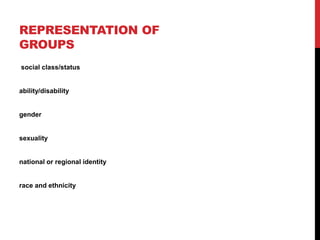
REPRESENTATION OF
GROUPS
social class/status
ability/disability
gender
sexuality
national or regional identity
race and ethnicity
REPRESENTATION OF
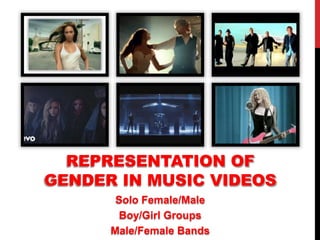
GENDER IN MUSIC VIDEOS
Solo Female/Male
Boy/Girl Groups
Male/Female Bands
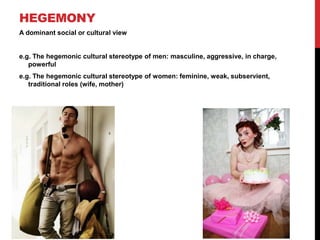
HEGEMONY
A dominant social or cultural view
e.g. The hegemonic cultural stereotype of men: masculine, aggressive, in charge,
powerful
e.g. The hegemonic cultural stereotype of women: feminine, weak, subservient,
traditional roles (wife, mother)
STEREOTYPES – RICHARD
DYER
Stereotype (first used as a term by Walter Lippmann in 1956)
Has come to be defined as a negative representation or over-simplification of a
category of people in a group
Dyer explains that stereotypes reinforce ideas of differences between people
which are natural – i.e. Criminals are represented as low-lifes, untrustworthy...
COUNTER ARGUMENT –
TESSA PERKINS (1979)
Stereotypes are not always negative
Are not always about minority groups
Stereotypes are not always false
Apply this to your characters in your videos
• E.g. What social group(s) do your characters belong to? How is this made clear?
• What age group do your characters belong to (e.g. Nervous, unsure teenagers...)
COUNTER ARGUMENT –
DAVID GAUNTLETT AND
MARTIN BARKER
Identities are not given but are constructed and negotiated (Gauntlett)
Martin Barker condemns stereotypes for mis-representing the real world by
reinforcing false stereotypes
David Gauntlett acknowledges pluralistic change (e.g. stereotypes can be varied)
but suggests a hegemonic framework still exists in society but also in media
representations – This can act as a positive point to help audiences decode
meaning quickly from media texts
MARGINALISED?
Consider using Levi-Strauss – binary oppositions
Mainstream vs. Marginalised
Counter-culture vs. Dominant cultural hegemony
USE REPRESENTATION GRID IN YOUR
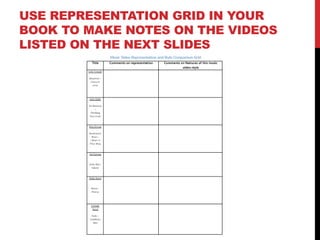
BOOK TO MAKE NOTES ON THE VIDEOS
LISTED ON THE NEXT SLIDES
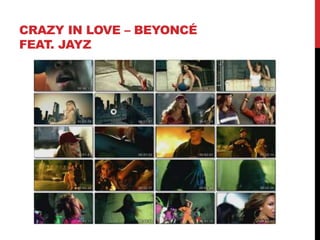
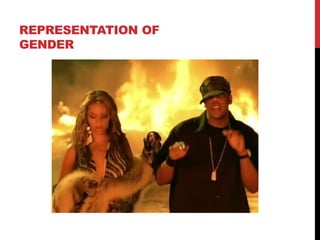
CRAZY IN LOVE – BEYONCÉ
FEAT. JAYZ
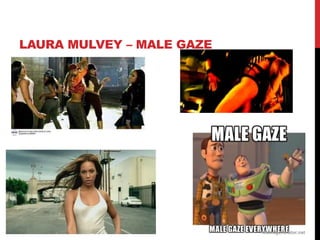
LAURA MULVEY – MALE GAZE
REPRESENTATION OF
GENDER
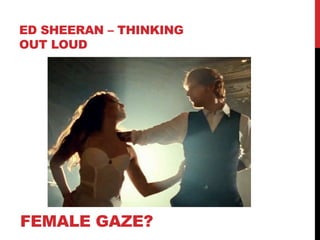
ED SHEERAN – THINKING
OUT LOUD
FEMALE GAZE?
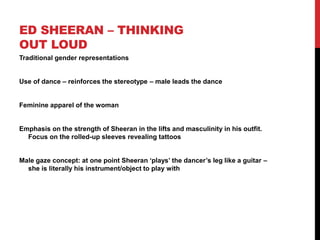
ED SHEERAN – THINKING
OUT LOUD
Traditional gender representations
Use of dance – reinforces the stereotype – male leads the dance
Feminine apparel of the woman
Emphasis on the strength of Sheeran in the lifts and masculinity in his outfit.
Focus on the rolled-up sleeves revealing tattoos
Male gaze concept: at one point Sheeran ‘plays’ the dancer’s leg like a guitar –
she is literally his instrument/object to play with
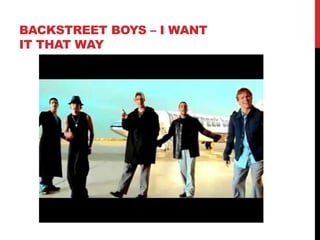
BACKSTREET BOYS – I WANT
IT THAT WAY
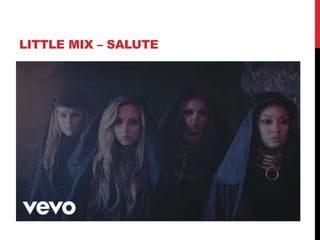
LITTLE MIX – SALUTE
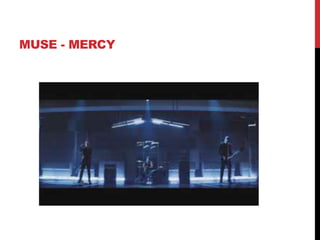
MUSE - MERCY
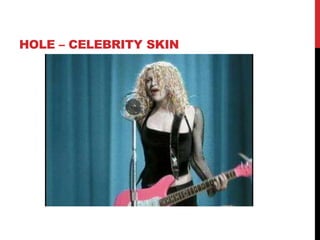
HOLE – CELEBRITY SKIN
REPRESENTATION -
RESEARCH
What representations have you discovered in your case studies? Dominant?
Marginalised? Stereotypes? Demographics (Gender, Age, Ethnicity, Sexuality,
National Identity etc…) Sociographics (teen culture, professions, social
groups, interests/activities)
What are you coming to recognise as the conventional stereotype in your
research and how might you adapt this to conform or challenge the stereotype
in your own production?
HOMEWORK – NEXT WEEK
Explore theories of representation in
one music video.

John theory

  • 2.
  • 3.
    A2 MEDIA STUDIESEXAM – SECTION A: THEORETICAL EVALUATION OF COURSEWORK In Section A you answer both 1(a) and 1(b). Question 1(a) will ask you to discuss the development of your skills from AS to A2 in relation to one or two of the following aspects: Digital Technology Creativity Research and Planning Post-production Using conventions from real media texts
  • 4.
    1(A) In the examyou should spend about 30 minutes answering question 1(a). In order to do well on this question you must remember to: Discuss both your AS and A2 coursework Demonstrate progress from AS to A2 Refer to specific examples from your coursework productions Use terminology
  • 5.
    1(B) Question 1(b) willask you to select one of your coursework products, either AS or A2 and analyse it relation to one of the following specified theoretical concepts: Narrative Audience Genre Representation Media Language
  • 6.
    1(B) You will needto spend about 30 minutes answering question 1(b) in the exam. In order to do well you should: Demonstrate your understanding of media theory Relate theory to a range of specific examples from your coursework product Use theoretical and production terminology well
  • 7.
  • 8.
    MUSIC VIDEO GENRETHEORY Katie Wales, 'genre is... an intertextual concept', and nowhere is this more appropriate than with music videos Andrew Goodwin - music videos follow the following conventions: 1. Conventions depend on the genre of the music 2. Star persona is important and companies use close ups to sell them to the audience 3. Voyeuristic images are used to attract an audience 4. They often contain intertextual references to other media 5. There is a link between the lyrics and the visuals 6. There is a link between the visuals and the music / pace etc
  • 9.
    ANDREW GOODWIN ‘DANCING INTHE DISTRACTION FACTORY’ Certain music genres contain conventions that audiences wish to see: • Rock bands traditionally will have performances of the band energetically singing the track – perhaps in front of an audience, drummers emphatically drumming, singers scowling down the mic – all to show how tough they are • Girl bands traditionally have a focus on heavily choreography dance routines, fashion, attitude, independence
  • 10.
    SVEN E CARLSSON Musicvideos mostly fall under 2 categories: • Performance (dance, song or instrumental focus) • Conceptual (abstract ideas the artist wants to promote through their song)
  • 11.
    WATCH BOWIE, QUEEN& BON JOVI (SEE BLOGPOST FURTHER DOWN THE PAGE) & COMPLETE GRID IN YOUR BOOK
  • 12.
  • 13.
  • 14.
    REPRESENTATION OF GENDER INMUSIC VIDEOS Solo Female/Male Boy/Girl Groups Male/Female Bands
  • 15.
    HEGEMONY A dominant socialor cultural view e.g. The hegemonic cultural stereotype of men: masculine, aggressive, in charge, powerful e.g. The hegemonic cultural stereotype of women: feminine, weak, subservient, traditional roles (wife, mother)
  • 16.
    STEREOTYPES – RICHARD DYER Stereotype(first used as a term by Walter Lippmann in 1956) Has come to be defined as a negative representation or over-simplification of a category of people in a group Dyer explains that stereotypes reinforce ideas of differences between people which are natural – i.e. Criminals are represented as low-lifes, untrustworthy...
  • 17.
    COUNTER ARGUMENT – TESSAPERKINS (1979) Stereotypes are not always negative Are not always about minority groups Stereotypes are not always false Apply this to your characters in your videos • E.g. What social group(s) do your characters belong to? How is this made clear? • What age group do your characters belong to (e.g. Nervous, unsure teenagers...)
  • 18.
    COUNTER ARGUMENT – DAVIDGAUNTLETT AND MARTIN BARKER Identities are not given but are constructed and negotiated (Gauntlett) Martin Barker condemns stereotypes for mis-representing the real world by reinforcing false stereotypes David Gauntlett acknowledges pluralistic change (e.g. stereotypes can be varied) but suggests a hegemonic framework still exists in society but also in media representations – This can act as a positive point to help audiences decode meaning quickly from media texts
  • 19.
    MARGINALISED? Consider using Levi-Strauss– binary oppositions Mainstream vs. Marginalised Counter-culture vs. Dominant cultural hegemony
  • 20.
    USE REPRESENTATION GRIDIN YOUR BOOK TO MAKE NOTES ON THE VIDEOS LISTED ON THE NEXT SLIDES
  • 21.
    CRAZY IN LOVE– BEYONCÉ FEAT. JAYZ
  • 22.
  • 23.
  • 24.
    ED SHEERAN –THINKING OUT LOUD FEMALE GAZE?
  • 25.
    ED SHEERAN –THINKING OUT LOUD Traditional gender representations Use of dance – reinforces the stereotype – male leads the dance Feminine apparel of the woman Emphasis on the strength of Sheeran in the lifts and masculinity in his outfit. Focus on the rolled-up sleeves revealing tattoos Male gaze concept: at one point Sheeran ‘plays’ the dancer’s leg like a guitar – she is literally his instrument/object to play with
  • 26.
    BACKSTREET BOYS –I WANT IT THAT WAY
  • 27.
  • 28.
  • 29.
  • 30.
    REPRESENTATION - RESEARCH What representationshave you discovered in your case studies? Dominant? Marginalised? Stereotypes? Demographics (Gender, Age, Ethnicity, Sexuality, National Identity etc…) Sociographics (teen culture, professions, social groups, interests/activities) What are you coming to recognise as the conventional stereotype in your research and how might you adapt this to conform or challenge the stereotype in your own production?
  • 31.
    HOMEWORK – NEXTWEEK Explore theories of representation in one music video.