Einführung in das
MOF
Matthias Gessenay
matthias.gessenay@corporatesoftware.ch

© Crown Copyright Material (all Diagrams) reproduced under licence from Microsoft
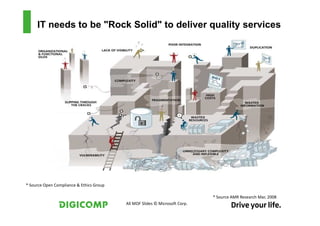
IT needs to be "Rock Solid" to deliver quality services


         IT needs to think and act as a “Service Provider”
         IT needs to accept and embrace “Ubiquitous
         Computing”
            Consumer-driven demands
            Social Computing
            Commoditization of IT Services
         IT needs to run effectively and efficiently
            Remove complexity
            Increase discretionary spend
            Practice good governance


* Source Open Compliance & Ethics Group

                                                                             * Source AMR Research Mar, 2008
                                          All MOF Slides © Microsoft Corp.
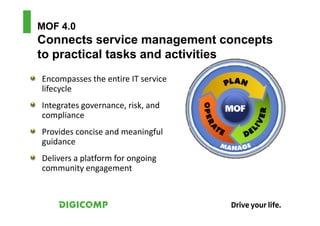
MOF 4.0
Connects service management concepts
to practical tasks and activities
Encompasses the entire IT service
lifecycle
Integrates governance, risk, and
compliance
Provides concise and meaningful
guidance
Delivers a platform for ongoing
community engagement
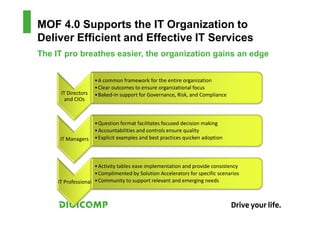
MOF 4.0 Supports the IT Organization to
Deliver Efficient and Effective IT Services
The IT pro breathes easier, the organization gains an edge
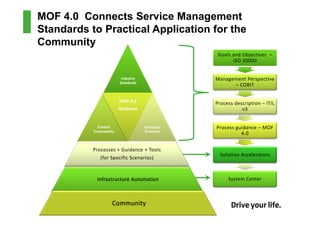
MOF 4.0 Connects Service Management
Standards to Practical Application for the
Community
                                                 Goals and Objectives –
                                                       ISO 20000


                         Industry               Management Perspective
                        Standards
                                                      – COBIT


                        MOF 4.0                 Process description – ITIL
                        Guidance                           v3


             Control                Concepts,   Process guidance – MOF
           Frameworks               Practices
                                                          4.0


           Processes + Guidance + Tools
                                                  Solution Accelerators
              (for Specific Scenarios)


            Infrastructure Automation                System Center


                    Community
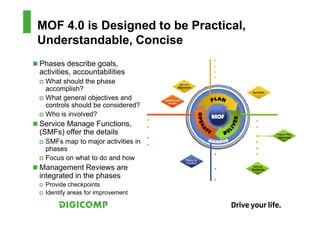
MOF 4.0 is Designed to be Practical,
Understandable, Concise
Phases describe goals,
activities, accountabilities
 What should the phase
 accomplish?
 What general objectives and
 controls should be considered?
 Who is involved?
Service Manage Functions,
(SMFs) offer the details
 SMFs map to major activities in
 phases
 Focus on what to do and how
Management Reviews are
integrated in the phases
 Provide checkpoints
 Identify areas for improvement
IT Deploys Virtualization
Virtualization supports Service Management
improvement by making it easier and cost effective
to achieve higher levels of capacity, availability and
continuity but sometimes there are challenges…

  IT deploys virtual servers to improve
  Cost savings through consolidation
  Better recovery, performance

Two months go by and problems start to appear….
  Business applications are unavailable
    Application servers not aligned on physical server, too many applications
    requiring heavy IO
  Virtual servers are everywhere
    Service desk cannot accurately determine impact analysis
    Business is looking for the ROI evidence
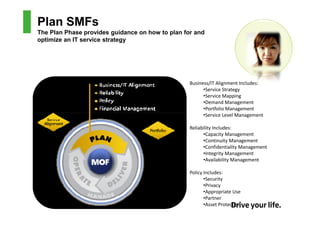
Plan SMFs
The Plan Phase provides guidance on how to plan for and
optimize an IT service strategy


                                                  Business/IT Alignment Includes:
                                                        •Service Strategy
                                                        •Service Mapping
                                                        •Demand Management
                                                        •Portfolio Management
                                                        •Service Level Management

                                                  Reliability Includes:
                                                        •Capacity Management
                                                        •Continuity Management
                                                        •Confidentiality Management
                                                        •Integrity Management
                                                        •Availability Management

                                                  Policy Includes:
                                                         •Security
                                                         •Privacy
                                                         •Appropriate Use
                                                         •Partner
                                                         •Asset Protection
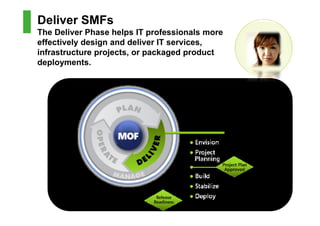
Deliver SMFs
The Deliver Phase helps IT professionals more
effectively design and deliver IT services,
infrastructure projects, or packaged product
deployments.
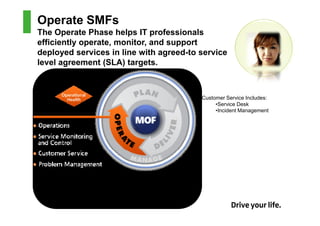
Operate SMFs
The Operate Phase helps IT professionals
efficiently operate, monitor, and support
deployed services in line with agreed-to service
level agreement (SLA) targets.


                                         Customer Service Includes:
                                              •Service Desk
                                              •Incident Management
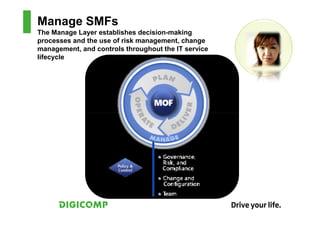
Manage SMFs
The Manage Layer establishes decision-making
processes and the use of risk management, change
management, and controls throughout the IT service
lifecycle
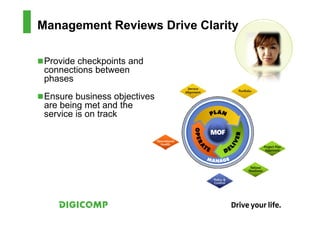
Management Reviews Drive Clarity

 Provide checkpoints and
 connections between
 phases
 Ensure business objectives
 are being met and the
 service is on track
Governance, Risk, and Compliance

Deliverable
 IT objectives achieved, change and risk managed and documented
Purpose
 Support, sustain, and grow the organization while managing risks and
 constraints
Outcome
 IT services are managed to achieve the business strategy and objectives
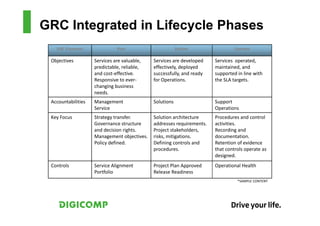
GRC Integrated in Lifecycle Phases
   GRC Elements               Plan                       Deliver               Operate

 Objectives         Services are valuable,   Services are developed    Services operated,
                    predictable, reliable,   effectively, deployed     maintained, and
                    and cost-effective.      successfully, and ready   supported in line with
                    Responsive to ever-      for Operations.           the SLA targets.
                    changing business
                    needs.
 Accountabilities   Management               Solutions                 Support
                    Service                                            Operations
 Key Focus          Strategy transfer.       Solution architecture     Procedures and control
                    Governance structure     addresses requirements.   activities.
                    and decision rights.     Project stakeholders,     Recording and
                    Management objectives.   risks, mitigations.       documentation.
                    Policy defined.          Defining controls and     Retention of evidence
                                             procedures.               that controls operate as
                                                                       designed.
 Controls           Service Alignment        Project Plan Approved     Operational Health
                    Portfolio                Release Readiness
                                                                                 *SAMPLE CONTENT
Change and Configuration
 Deliverable
  Known configurations and predictable adaptations
 Purpose
  Ensure that changes are planned, that unplanned changes are minimal, and
  that IT services are robust
 Outcome
  IT services are predictable, reliable, and trustworthy
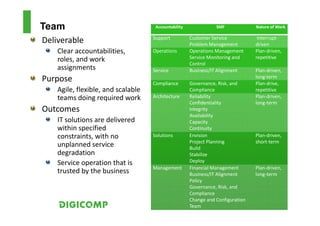
Team                                 Accountability              SMF             Nature of Work

                                    Support           Customer Service            Interrupt-
Deliverable                                           Problem Management         driven
    Clear accountabilities,         Operations        Operations Management      Plan-driven,
    roles, and work                                   Service Monitoring and     repetitive
                                                      Control
    assignments                     Service           Business/IT Alignment      Plan-driven,
                                                                                 long-term
Purpose                             Compliance        Governance, Risk, and      Plan-drive,
    Agile, flexible, and scalable                     Compliance                 repetitive
    teams doing required work       Architecture      Reliability                Plan-driven,
                                                      Confidentiality            long-term
Outcomes                                              Integrity
                                                      Availability
    IT solutions are delivered                        Capacity
    within specified                                  Continuity
    constraints, with no            Solutions         Envision                   Plan-driven,
                                                      Project Planning           short-term
    unplanned service                                 Build
    degradation                                       Stabilize
    Service operation that is                         Deploy
                                    Management        Financial Management       Plan-driven,
    trusted by the business                           Business/IT Alignment      long-term
                                                      Policy
                                                      Governance, Risk, and
                                                      Compliance
                                                      Change and Configuration
                                                      Team
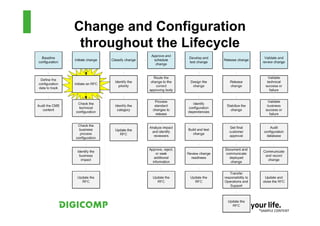
Change and Configuration
 throughout the Lifecycle


                            *SAMPLE CONTENT
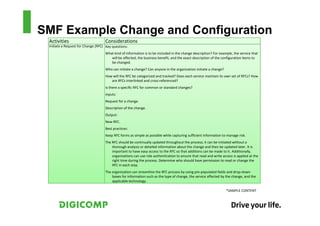
SMF Example Change and Configuration
 Activities                         Considerations
 Initiate a Request for Change (RFC) Key questions:
                                    What kind of information is to be included in the change description? For example, the service that
                                       will be affected, the business benefit, and the exact description of the configuration items to
                                       be changed.
                                    Who can initiate a change? Can anyone in the organization initiate a change?
                                    How will the RFC be categorized and tracked? Does each service maintain its own set of RFCs? How
                                       are RFCs interlinked and cross-referenced?
                                    Is there a specific RFC for common or standard changes?
                                    Inputs:
                                    Request for a change.
                                    Description of the change.
                                    Output:
                                    New RFC.
                                    Best practices:
                                    Keep RFC forms as simple as possible while capturing sufficient information to manage risk.
                                    The RFC should be continually updated throughout the process; it can be initiated without a
                                        thorough analysis or detailed information about the change and then be updated later. It is
                                        important to have easy access to the RFC so that additions can be made to it. Additionally,
                                        organizations can use role authentication to ensure that read and write access is applied at the
                                        right time during the process. Determine who should have permission to read or change the
                                        RFC in each step.
                                    The organization can streamline the RFC process by using pre-populated fields and drop-down
                                        boxes for information such as the type of change, the service affected by the change, and the
                                        applicable technology.

                                                                                                                   *SAMPLE CONTENT
Support ideas with examples
Request for Change Template
           Information Required                                    Specific Details
    Description                           Provide a complete description of the nature of the change. Include:
                                          The services affected.
                                          The configuration items (CI) to be changed.
                                          Current version of the item to be changed.
                                          For complex changes, any supporting project documents should be
                                          referenced and linked to the RFC.
   Date that the change is requested      Define and control a set date format:
                                          For example, 30_Dec_2004
   Change initiator: person who submits   Include:
   the request                            Name.
                                          Position.
                                          Contact information, such as e-mail address and phone number.

    Business reason for change            Reason for the change
                                          Include business impact statement
                                          Identify customer that change impacts


                                                                                              *SAMPLE CONTENT
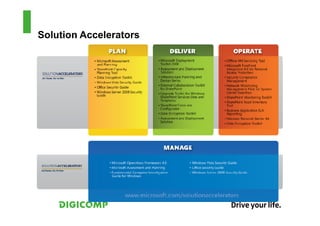
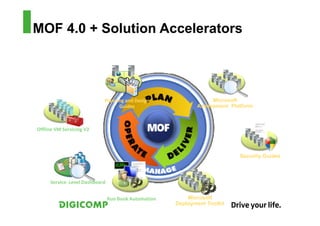
Solution Accelerators
MOF 4.0 + Solution Accelerators

                                                        Business Continuity & Disaster
                                                        Recovery Assessment + Planning

        Terminal Services Guide
        SCVMM Guide


                                  Planning and Design                           Microsoft
                                        Guides                             Assessment Platform


Offline VM Servicing V2
Windows Server 2008,
WSUS 3.0 SP1 SCCM SP1,
Vnext
Hyper-V and NAP
                                                                                                   Security Guides
                                                                                                    Hyper-V Security Guide
                                                                                                    SCVMM Security Guide

     Service Level Dashboard
          LOB Monitoring
                                                                                         Hyper-V
                                   Run Book Automation               Microsoft
                                     Backup & Restore
                                                                 Deployment Toolkit
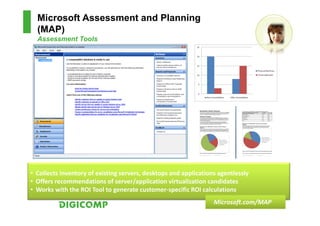
Microsoft Assessment and Planning
  (MAP)
  Assessment Tools


• Collects inventory of existing servers, desktops and applications agentlessly
• Offers recommendations of server/application virtualization candidates
• Works with the ROI Tool to generate customer-specific ROI calculations
                                                                  Microsoft.com/MAP
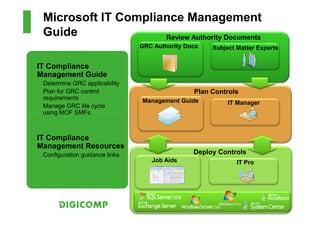
Microsoft IT Compliance Management
 Guide               Review Authority Documents
                                GRC Authority Docs   Subject Matter Experts


IT Compliance
Management Guide
 Determine GRC applicability
 Plan for GRC control                           Plan Controls
 requirements                   Management Guide          IT Manager
 Manage GRC life cycle
 using MOF SMFs.


IT Compliance
Management Resources
 Configuration guidance links                   Deploy Controls
                                   Job Aids                  IT Pro
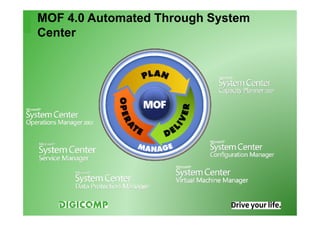
MOF 4.0 Automated Through System
Center
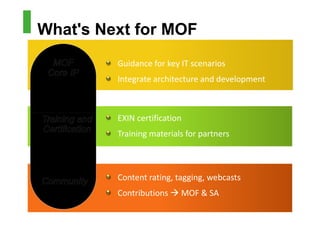
What's Next for MOF
         Guidance for key IT scenarios
         Integrate architecture and development


         EXIN certification
         Training materials for partners


         Content rating, tagging, webcasts
         Contributions    MOF & SA
MOF & ITIL
Fragen?
Useful Links
 www.microsoft.com/MOF

ITIL® im Microsoft-Umfeld: Einführung in das MOF

  • 1.
  • 2.
    Matthias Gessenay matthias.gessenay@corporatesoftware.ch © CrownCopyright Material (all Diagrams) reproduced under licence from Microsoft
  • 3.
    IT needs tobe "Rock Solid" to deliver quality services IT needs to think and act as a “Service Provider” IT needs to accept and embrace “Ubiquitous Computing” Consumer-driven demands Social Computing Commoditization of IT Services IT needs to run effectively and efficiently Remove complexity Increase discretionary spend Practice good governance * Source Open Compliance & Ethics Group * Source AMR Research Mar, 2008 All MOF Slides © Microsoft Corp.
  • 4.
    MOF 4.0 Connects servicemanagement concepts to practical tasks and activities Encompasses the entire IT service lifecycle Integrates governance, risk, and compliance Provides concise and meaningful guidance Delivers a platform for ongoing community engagement
  • 5.
    MOF 4.0 Supportsthe IT Organization to Deliver Efficient and Effective IT Services The IT pro breathes easier, the organization gains an edge
  • 6.
    MOF 4.0 ConnectsService Management Standards to Practical Application for the Community Goals and Objectives – ISO 20000 Industry Management Perspective Standards – COBIT MOF 4.0 Process description – ITIL Guidance v3 Control Concepts, Process guidance – MOF Frameworks Practices 4.0 Processes + Guidance + Tools Solution Accelerators (for Specific Scenarios) Infrastructure Automation System Center Community
  • 7.
    MOF 4.0 isDesigned to be Practical, Understandable, Concise Phases describe goals, activities, accountabilities What should the phase accomplish? What general objectives and controls should be considered? Who is involved? Service Manage Functions, (SMFs) offer the details SMFs map to major activities in phases Focus on what to do and how Management Reviews are integrated in the phases Provide checkpoints Identify areas for improvement
  • 8.
    IT Deploys Virtualization Virtualizationsupports Service Management improvement by making it easier and cost effective to achieve higher levels of capacity, availability and continuity but sometimes there are challenges… IT deploys virtual servers to improve Cost savings through consolidation Better recovery, performance Two months go by and problems start to appear…. Business applications are unavailable Application servers not aligned on physical server, too many applications requiring heavy IO Virtual servers are everywhere Service desk cannot accurately determine impact analysis Business is looking for the ROI evidence
  • 9.
    Plan SMFs The PlanPhase provides guidance on how to plan for and optimize an IT service strategy Business/IT Alignment Includes: •Service Strategy •Service Mapping •Demand Management •Portfolio Management •Service Level Management Reliability Includes: •Capacity Management •Continuity Management •Confidentiality Management •Integrity Management •Availability Management Policy Includes: •Security •Privacy •Appropriate Use •Partner •Asset Protection
  • 10.
    Deliver SMFs The DeliverPhase helps IT professionals more effectively design and deliver IT services, infrastructure projects, or packaged product deployments.
  • 11.
    Operate SMFs The OperatePhase helps IT professionals efficiently operate, monitor, and support deployed services in line with agreed-to service level agreement (SLA) targets. Customer Service Includes: •Service Desk •Incident Management
  • 12.
    Manage SMFs The ManageLayer establishes decision-making processes and the use of risk management, change management, and controls throughout the IT service lifecycle
  • 13.
    Management Reviews DriveClarity Provide checkpoints and connections between phases Ensure business objectives are being met and the service is on track
  • 14.
    Governance, Risk, andCompliance Deliverable IT objectives achieved, change and risk managed and documented Purpose Support, sustain, and grow the organization while managing risks and constraints Outcome IT services are managed to achieve the business strategy and objectives
  • 15.
    GRC Integrated inLifecycle Phases GRC Elements Plan Deliver Operate Objectives Services are valuable, Services are developed Services operated, predictable, reliable, effectively, deployed maintained, and and cost-effective. successfully, and ready supported in line with Responsive to ever- for Operations. the SLA targets. changing business needs. Accountabilities Management Solutions Support Service Operations Key Focus Strategy transfer. Solution architecture Procedures and control Governance structure addresses requirements. activities. and decision rights. Project stakeholders, Recording and Management objectives. risks, mitigations. documentation. Policy defined. Defining controls and Retention of evidence procedures. that controls operate as designed. Controls Service Alignment Project Plan Approved Operational Health Portfolio Release Readiness *SAMPLE CONTENT
  • 16.
    Change and Configuration Deliverable Known configurations and predictable adaptations Purpose Ensure that changes are planned, that unplanned changes are minimal, and that IT services are robust Outcome IT services are predictable, reliable, and trustworthy
  • 17.
    Team Accountability SMF Nature of Work Support Customer Service Interrupt- Deliverable Problem Management driven Clear accountabilities, Operations Operations Management Plan-driven, roles, and work Service Monitoring and repetitive Control assignments Service Business/IT Alignment Plan-driven, long-term Purpose Compliance Governance, Risk, and Plan-drive, Agile, flexible, and scalable Compliance repetitive teams doing required work Architecture Reliability Plan-driven, Confidentiality long-term Outcomes Integrity Availability IT solutions are delivered Capacity within specified Continuity constraints, with no Solutions Envision Plan-driven, Project Planning short-term unplanned service Build degradation Stabilize Service operation that is Deploy Management Financial Management Plan-driven, trusted by the business Business/IT Alignment long-term Policy Governance, Risk, and Compliance Change and Configuration Team
  • 18.
    Change and Configuration throughout the Lifecycle *SAMPLE CONTENT
  • 19.
    SMF Example Changeand Configuration Activities Considerations Initiate a Request for Change (RFC) Key questions: What kind of information is to be included in the change description? For example, the service that will be affected, the business benefit, and the exact description of the configuration items to be changed. Who can initiate a change? Can anyone in the organization initiate a change? How will the RFC be categorized and tracked? Does each service maintain its own set of RFCs? How are RFCs interlinked and cross-referenced? Is there a specific RFC for common or standard changes? Inputs: Request for a change. Description of the change. Output: New RFC. Best practices: Keep RFC forms as simple as possible while capturing sufficient information to manage risk. The RFC should be continually updated throughout the process; it can be initiated without a thorough analysis or detailed information about the change and then be updated later. It is important to have easy access to the RFC so that additions can be made to it. Additionally, organizations can use role authentication to ensure that read and write access is applied at the right time during the process. Determine who should have permission to read or change the RFC in each step. The organization can streamline the RFC process by using pre-populated fields and drop-down boxes for information such as the type of change, the service affected by the change, and the applicable technology. *SAMPLE CONTENT
  • 20.
    Support ideas withexamples Request for Change Template Information Required Specific Details Description Provide a complete description of the nature of the change. Include: The services affected. The configuration items (CI) to be changed. Current version of the item to be changed. For complex changes, any supporting project documents should be referenced and linked to the RFC. Date that the change is requested Define and control a set date format: For example, 30_Dec_2004 Change initiator: person who submits Include: the request Name. Position. Contact information, such as e-mail address and phone number. Business reason for change Reason for the change Include business impact statement Identify customer that change impacts *SAMPLE CONTENT
  • 21.
  • 22.
    MOF 4.0 +Solution Accelerators Business Continuity & Disaster Recovery Assessment + Planning Terminal Services Guide SCVMM Guide Planning and Design Microsoft Guides Assessment Platform Offline VM Servicing V2 Windows Server 2008, WSUS 3.0 SP1 SCCM SP1, Vnext Hyper-V and NAP Security Guides Hyper-V Security Guide SCVMM Security Guide Service Level Dashboard LOB Monitoring Hyper-V Run Book Automation Microsoft Backup & Restore Deployment Toolkit
  • 23.
    Microsoft Assessment andPlanning (MAP) Assessment Tools • Collects inventory of existing servers, desktops and applications agentlessly • Offers recommendations of server/application virtualization candidates • Works with the ROI Tool to generate customer-specific ROI calculations Microsoft.com/MAP
  • 24.
    Microsoft IT ComplianceManagement Guide Review Authority Documents GRC Authority Docs Subject Matter Experts IT Compliance Management Guide Determine GRC applicability Plan for GRC control Plan Controls requirements Management Guide IT Manager Manage GRC life cycle using MOF SMFs. IT Compliance Management Resources Configuration guidance links Deploy Controls Job Aids IT Pro
  • 25.
    MOF 4.0 AutomatedThrough System Center
  • 26.
    What's Next forMOF Guidance for key IT scenarios Integrate architecture and development EXIN certification Training materials for partners Content rating, tagging, webcasts Contributions MOF & SA
  • 27.
  • 28.
  • 29.