LESSON – 1
(MATTER)
Matter
Substances which has both mass and volume
and whose particles occupy space and also
can be felt by any one of our sense organs.
Examples: air, water, sun, electron, proton, earth,
mountain, book, pencil etc
 All the matter around us are made of tiny
particles. These tiny particles are called atoms
and molecules.
 The characteristics of these particles decides
the nature of the matter, that they are either
solids, liquids or gas
Non-matter:
 Substances which has neither mass nor
volume.
Their particles do not occupy any spaces.
They do not have any appearance but exists.
Basically any type of energy or any abstract
concept is an example of non-matter.
Examples: time, sound, electricity, magnetism,
memories, information, reflection, heat, gravity,
sunlight etc
Characteristics of particles of matter
i. Particles of matter are very small.
ii. Particles of matter continuously move
because they possess kinetic energy.
iii. Particles of matter have inter-particle space
between them.
iv. Particles of matter have inter-particle force
of attraction between them.
Particles of matter are called atoms and molecules. These
particles decides the nature of the matter.
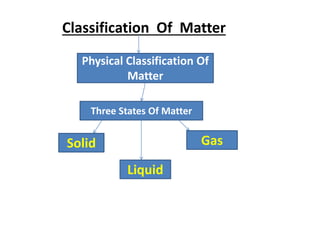
Classification Of Matter
Physical Classification Of
Matter
Three States Of Matter
Solid
Liquid
Gas
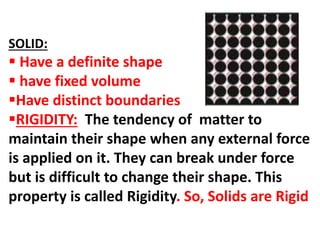
SOLID:
 Have a definite shape
 have fixed volume
Have distinct boundaries
RIGIDITY: The tendency of matter to
maintain their shape when any external force
is applied on it. They can break under force
but is difficult to change their shape. This
property is called Rigidity. So, Solids are Rigid
 COMPRESSIBILITY: When external pressure is
applied on matter, their particles can move close to
each other. This will reduce their volume(occupied
space).This is called Compressibility.
As in solids particles are already tightly packed, they
cannot further come close to each other. Therefore
Solids are Incompressible.
 Diffusion: Intermixing of particles of two or more
different types of matter on their own is called
diffusion.
As in solids, particles are fixed i.e they cannot move
from their place and have least kinetic energy .
Hence Solids cannot diffuse
A rubber band changes shape under force
and regains the same shape when the force
is removed. If excessive force is applied it
breaks.
• The shape of each individual sugar
or salt crystal remains fixed,
whether we take it in our hand, put
it in a plate or in a jar

Matter(notes).pptx

  • 1.
  • 2.
    Matter Substances which hasboth mass and volume and whose particles occupy space and also can be felt by any one of our sense organs. Examples: air, water, sun, electron, proton, earth, mountain, book, pencil etc  All the matter around us are made of tiny particles. These tiny particles are called atoms and molecules.  The characteristics of these particles decides the nature of the matter, that they are either solids, liquids or gas
  • 3.
    Non-matter:  Substances whichhas neither mass nor volume. Their particles do not occupy any spaces. They do not have any appearance but exists. Basically any type of energy or any abstract concept is an example of non-matter. Examples: time, sound, electricity, magnetism, memories, information, reflection, heat, gravity, sunlight etc
  • 4.
    Characteristics of particlesof matter i. Particles of matter are very small. ii. Particles of matter continuously move because they possess kinetic energy. iii. Particles of matter have inter-particle space between them. iv. Particles of matter have inter-particle force of attraction between them. Particles of matter are called atoms and molecules. These particles decides the nature of the matter.
  • 5.
    Classification Of Matter PhysicalClassification Of Matter Three States Of Matter Solid Liquid Gas
  • 6.
    SOLID:  Have adefinite shape  have fixed volume Have distinct boundaries RIGIDITY: The tendency of matter to maintain their shape when any external force is applied on it. They can break under force but is difficult to change their shape. This property is called Rigidity. So, Solids are Rigid
  • 7.
     COMPRESSIBILITY: Whenexternal pressure is applied on matter, their particles can move close to each other. This will reduce their volume(occupied space).This is called Compressibility. As in solids particles are already tightly packed, they cannot further come close to each other. Therefore Solids are Incompressible.  Diffusion: Intermixing of particles of two or more different types of matter on their own is called diffusion. As in solids, particles are fixed i.e they cannot move from their place and have least kinetic energy . Hence Solids cannot diffuse
  • 8.
    A rubber bandchanges shape under force and regains the same shape when the force is removed. If excessive force is applied it breaks.
  • 9.
    • The shapeof each individual sugar or salt crystal remains fixed, whether we take it in our hand, put it in a plate or in a jar