Name:______________
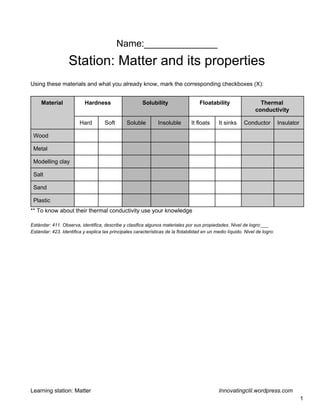
Station: Matter and its properties
Using these materials and what you already know, mark the corresponding checkboxes (X):
Material Hardness Solubility Floatability Thermal
conductivity
Hard Soft Soluble Insoluble It floats It sinks Conductor Insulator
Wood
Metal
Modelling clay
Salt
Sand
Plastic
** To know about their thermal conductivity use your knowledge
Estándar: 411. Observa, identifica, describe y clasifica algunos materiales por sus propiedades. Nivel de logro:___
Estándar: 423. Identifica y explica las principales características de la flotabilidad en un medio líquido. Nivel de logro:
Learning station: Matter Innovatingclil.wordpress.com
1
Station: Changes in the state of matter and chemical reactions
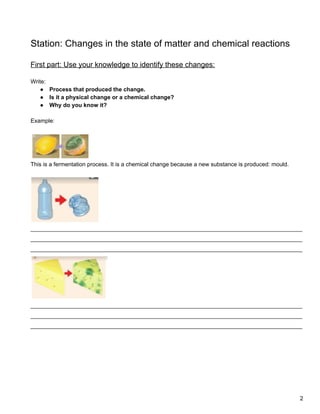
First part: Use your knowledge to identify these changes:
Write:
● Process that produced the change.
● Is it a physical change or a chemical change?
● Why do you know it?
Example:
This is a fermentation process. It is a chemical change because a new substance is produced: mould.
_____________________________________________________________________________________
_____________________________________________________________________________________
_____________________________________________________________________________________
_____________________________________________________________________________________
_____________________________________________________________________________________
_____________________________________________________________________________________
2
_____________________________________________________________________________________
_____________________________________________________________________________________
_____________________________________________________________________________________
_____________________________________________________________________________________
_____________________________________________________________________________________
_____________________________________________________________________________________
_____________________________________________________________________________________
_____________________________________________________________________________________
_____________________________________________________________________________________
_____________________________________________________________________________________
_____________________________________________________________________________________
_____________________________________________________________________________________
3
Second part: Experiment using these materials (a balloon, water and a stone) and
find out the characteristics of matter in its different states.
Solids:​ Research question: What type of shape and volume do solids have?
Hypothesis:
Will it have a ​definite ​shape?_____________
Will it have a ​definite ​volume?____________
Check it out.
Results:
Does it have a ​definite ​shape?_____________
Does it have a ​definite ​volume?____________
Conclusions ​(Was you hypothesis correct? What did you find out?):
_____________________________________________________________________________
_____________________________________________________________________________
_____________________________________________________________________________
Liquids:​ Research question: What type of shape and volume do liquidshave?
Hypothesis:
Will it have a ​definite ​shape?_____________
Will it have a ​definite ​volume?____________
Check it out.
Results:
Does it have a ​definite ​shape?_____________
Does it have a ​definite ​volume?____________
Conclusions ​(Was you hypothesis correct? What did you find out?):
_____________________________________________________________________________
_____________________________________________________________________________
_____________________________________________________________________________
4
Gases:​ Research question: What type of shape and volume do gases have?
Hypothesis:
Will it have a ​definite ​shape?_____________
Will it have a ​definite ​volume?____________
Check it out.
Results:
Does it have a ​definite ​shape?_____________
Does it have a ​definite ​volume?____________
Conclusions ​(Was you hypothesis correct? What did you find out?):
_____________________________________________________________________________
_____________________________________________________________________________
_____________________________________________________________________________
THIRD PART:
What change is happening??
_________________________________________
Is it a reversible or irreversible change? __________________
Why? ___________________________________________
____________________________________________________
Estándares:
131. Utiliza de manera adecuada el vocabulario. Nivel de logro:___
112. Utiliza medios propios de la observación. Nivel de logro:___
432. Conoce las leyes básicas que rigen el cambio de estado y las reacciones químicas. Nivel de logro:___
454. Identifica, experimenta y ejemplifica argumentando algunos cambios de estado y su reversibilidad.Nivel de logro:__
5
Station: Mass and volume
Materials: a measuring jug, water, a plastic cup , a potato, a scale.
1. Think
How can you find the volume of the potato?
________________________________________________________________________________________
How can you find the mass of the water in the cup?
________________________________________________________________________________________
2. Find out:
Volume (ml) Mass (gr)
A cup full of water
A potato
Estándares:
341. Usa medios tecnológicos en los diferentes trabajos que realiza. Nivel de logro:___
343. Respeta las normas de uso, de seguridad y de mantenimiento de los instrumentos de observación y de los materiales de
trabajo. Nivel de logro:___
421. Utiliza procedimientos directos e indirectos para la medida de la masa y el volumen de un cuerpo.Nivel de logro:___
6
Station: Homogeneous and heterogeneous mixtures
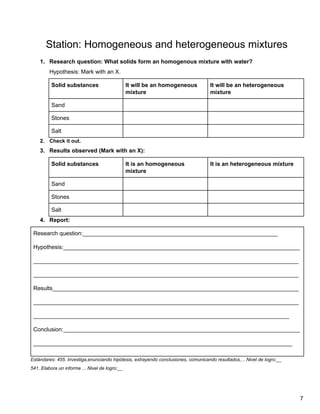
1. Research question: What solids form an homogenous mixture with water?
Hypothesis: Mark with an X.
Solid substances It will be an homogeneous
mixture
It will be an heterogeneous
mixture
Sand
Stones
Salt
2. Check it out.
3. Results observed (Mark with an X):
Solid substances It is an homogeneous
mixture
It is an heterogeneous mixture
Sand
Stones
Salt
4. Report:
Research question:_____________________________________________________________
Hypothesis:__________________________________________________________________________
___________________________________________________________________________________
___________________________________________________________________________________
Results_____________________________________________________________________________
___________________________________________________________________________________
________________________________________________________________________________
Conclusion:__________________________________________________________________________
_________________________________________________________________________________
Estándares: 455. Investiga,enunciando hipótesis, extrayendo conclusiones, comunicando resultados,... Nivel de logro:__
541. Elabora un informe ... Nivel de logro:__
7
Station: Separating heterogeneous mixtures
Research question: Can you separate the substances in an heterogeneous mixture?
1. Hypothesis:
Substances Will you be able to separate
the substances? Yes or no?
How? (Procedure)
Sand + water
Stones + water
Oil + water
2. Check it out
3. Resultados:
Substances Did you separate the
substances?
How? By….
Sand + water
Stones + water
Oil+ water
4. Conclusion:
_____________________________________________________________________________________
_____________________________________________________________________________________
_____________________________________________________________________________________
Estándares:
145. Conoce y respeta las normas de uso y de seguridad de los instrumentos y de los materiales de trabajo. Nivel de logro:___
452. Separa los componentes de una mezcla. Nivel de logro:___
8

Matter experiment

  • 1.
    Name:______________ Station: Matter andits properties Using these materials and what you already know, mark the corresponding checkboxes (X): Material Hardness Solubility Floatability Thermal conductivity Hard Soft Soluble Insoluble It floats It sinks Conductor Insulator Wood Metal Modelling clay Salt Sand Plastic ** To know about their thermal conductivity use your knowledge Estándar: 411. Observa, identifica, describe y clasifica algunos materiales por sus propiedades. Nivel de logro:___ Estándar: 423. Identifica y explica las principales características de la flotabilidad en un medio líquido. Nivel de logro: Learning station: Matter Innovatingclil.wordpress.com 1
  • 2.
    Station: Changes inthe state of matter and chemical reactions First part: Use your knowledge to identify these changes: Write: ● Process that produced the change. ● Is it a physical change or a chemical change? ● Why do you know it? Example: This is a fermentation process. It is a chemical change because a new substance is produced: mould. _____________________________________________________________________________________ _____________________________________________________________________________________ _____________________________________________________________________________________ _____________________________________________________________________________________ _____________________________________________________________________________________ _____________________________________________________________________________________ 2
  • 3.
    _____________________________________________________________________________________ _____________________________________________________________________________________ _____________________________________________________________________________________ _____________________________________________________________________________________ _____________________________________________________________________________________ _____________________________________________________________________________________ _____________________________________________________________________________________ _____________________________________________________________________________________ _____________________________________________________________________________________ _____________________________________________________________________________________ _____________________________________________________________________________________ _____________________________________________________________________________________ 3
  • 4.
    Second part: Experimentusing these materials (a balloon, water and a stone) and find out the characteristics of matter in its different states. Solids:​ Research question: What type of shape and volume do solids have? Hypothesis: Will it have a ​definite ​shape?_____________ Will it have a ​definite ​volume?____________ Check it out. Results: Does it have a ​definite ​shape?_____________ Does it have a ​definite ​volume?____________ Conclusions ​(Was you hypothesis correct? What did you find out?): _____________________________________________________________________________ _____________________________________________________________________________ _____________________________________________________________________________ Liquids:​ Research question: What type of shape and volume do liquidshave? Hypothesis: Will it have a ​definite ​shape?_____________ Will it have a ​definite ​volume?____________ Check it out. Results: Does it have a ​definite ​shape?_____________ Does it have a ​definite ​volume?____________ Conclusions ​(Was you hypothesis correct? What did you find out?): _____________________________________________________________________________ _____________________________________________________________________________ _____________________________________________________________________________ 4
  • 5.
    Gases:​ Research question:What type of shape and volume do gases have? Hypothesis: Will it have a ​definite ​shape?_____________ Will it have a ​definite ​volume?____________ Check it out. Results: Does it have a ​definite ​shape?_____________ Does it have a ​definite ​volume?____________ Conclusions ​(Was you hypothesis correct? What did you find out?): _____________________________________________________________________________ _____________________________________________________________________________ _____________________________________________________________________________ THIRD PART: What change is happening?? _________________________________________ Is it a reversible or irreversible change? __________________ Why? ___________________________________________ ____________________________________________________ Estándares: 131. Utiliza de manera adecuada el vocabulario. Nivel de logro:___ 112. Utiliza medios propios de la observación. Nivel de logro:___ 432. Conoce las leyes básicas que rigen el cambio de estado y las reacciones químicas. Nivel de logro:___ 454. Identifica, experimenta y ejemplifica argumentando algunos cambios de estado y su reversibilidad.Nivel de logro:__ 5
  • 6.
    Station: Mass andvolume Materials: a measuring jug, water, a plastic cup , a potato, a scale. 1. Think How can you find the volume of the potato? ________________________________________________________________________________________ How can you find the mass of the water in the cup? ________________________________________________________________________________________ 2. Find out: Volume (ml) Mass (gr) A cup full of water A potato Estándares: 341. Usa medios tecnológicos en los diferentes trabajos que realiza. Nivel de logro:___ 343. Respeta las normas de uso, de seguridad y de mantenimiento de los instrumentos de observación y de los materiales de trabajo. Nivel de logro:___ 421. Utiliza procedimientos directos e indirectos para la medida de la masa y el volumen de un cuerpo.Nivel de logro:___ 6
  • 7.
    Station: Homogeneous andheterogeneous mixtures 1. Research question: What solids form an homogenous mixture with water? Hypothesis: Mark with an X. Solid substances It will be an homogeneous mixture It will be an heterogeneous mixture Sand Stones Salt 2. Check it out. 3. Results observed (Mark with an X): Solid substances It is an homogeneous mixture It is an heterogeneous mixture Sand Stones Salt 4. Report: Research question:_____________________________________________________________ Hypothesis:__________________________________________________________________________ ___________________________________________________________________________________ ___________________________________________________________________________________ Results_____________________________________________________________________________ ___________________________________________________________________________________ ________________________________________________________________________________ Conclusion:__________________________________________________________________________ _________________________________________________________________________________ Estándares: 455. Investiga,enunciando hipótesis, extrayendo conclusiones, comunicando resultados,... Nivel de logro:__ 541. Elabora un informe ... Nivel de logro:__ 7
  • 8.
    Station: Separating heterogeneousmixtures Research question: Can you separate the substances in an heterogeneous mixture? 1. Hypothesis: Substances Will you be able to separate the substances? Yes or no? How? (Procedure) Sand + water Stones + water Oil + water 2. Check it out 3. Resultados: Substances Did you separate the substances? How? By…. Sand + water Stones + water Oil+ water 4. Conclusion: _____________________________________________________________________________________ _____________________________________________________________________________________ _____________________________________________________________________________________ Estándares: 145. Conoce y respeta las normas de uso y de seguridad de los instrumentos y de los materiales de trabajo. Nivel de logro:___ 452. Separa los componentes de una mezcla. Nivel de logro:___ 8