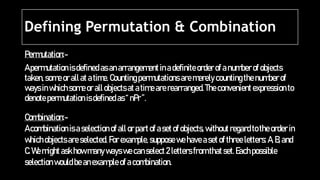
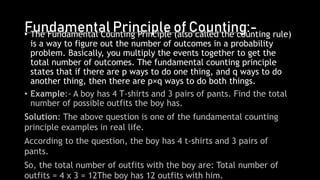
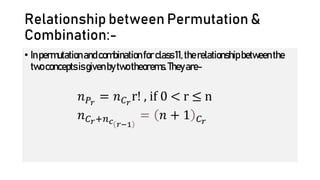
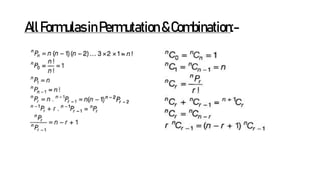
This document discusses permutation, combination, and the fundamental principle of counting. It defines a permutation as an arrangement of objects in a definite order, while a combination is a selection of objects without regard to order. The fundamental counting principle states that if there are p ways to do one thing and q ways to do another, there are p×q total ways to do both. An example shows a boy has 4 shirts and 3 pants, giving him 4×3=12 total outfits. Formulas for permutation, combination, and their relationships are also presented.