Permutation and
combination
Prepared by: Angela Clarito
Counting Principles
● PRODUCT RULE
➔ a procedure can be broken down into first and second
stages
➔ there are m possible outcomes for the first stage for
each of these outcomes,
➔ there are n possible outcomes for the second stage
➔ the total procedure can be carried out in m · n ways
Counting Principles
● PRODUCT RULE EXAMPLE
➔ If i have 4 different tshirt and 3
different trouser. How many different
outfits do i have?
➔ 4 * 3 = 12
Tree Diagram
A Visual strategy we can use to represent counting problems.
➔ If i have 4 different tshirt and 3
different trouser. How many different
outfits do i have?
Tree Diagram
➔ If i have 4 different tshirt and 3 different
trouser. How many different outfits do i have?
ts1
ts2
ts3
ts4
t1
t2
t3
ts1 t1
ts1 t2
ts1 t3
ts1 t4
.
.
.
12 Outfits
t1
t2
t3
t1
t2
t3
t1
t2
t3
Counting Principles
● SUM RULE
➔ a first task can be performed in m (distinct) ways
➔ a second task can be performed in n (distinct) ways
➔ the two tasks cannot be performed simultaneously
➔ performing either task can be accomplished in any one
of m + n ways
Counting Principles
● SUM RULE EXAMPLE
➔ If i want to take a trip. I can travel to
one of 37 international places or one of
the 12 domestic places. How many trip
vacation choices do i have?
➔ 37 + 14 = 51
Counting Principles
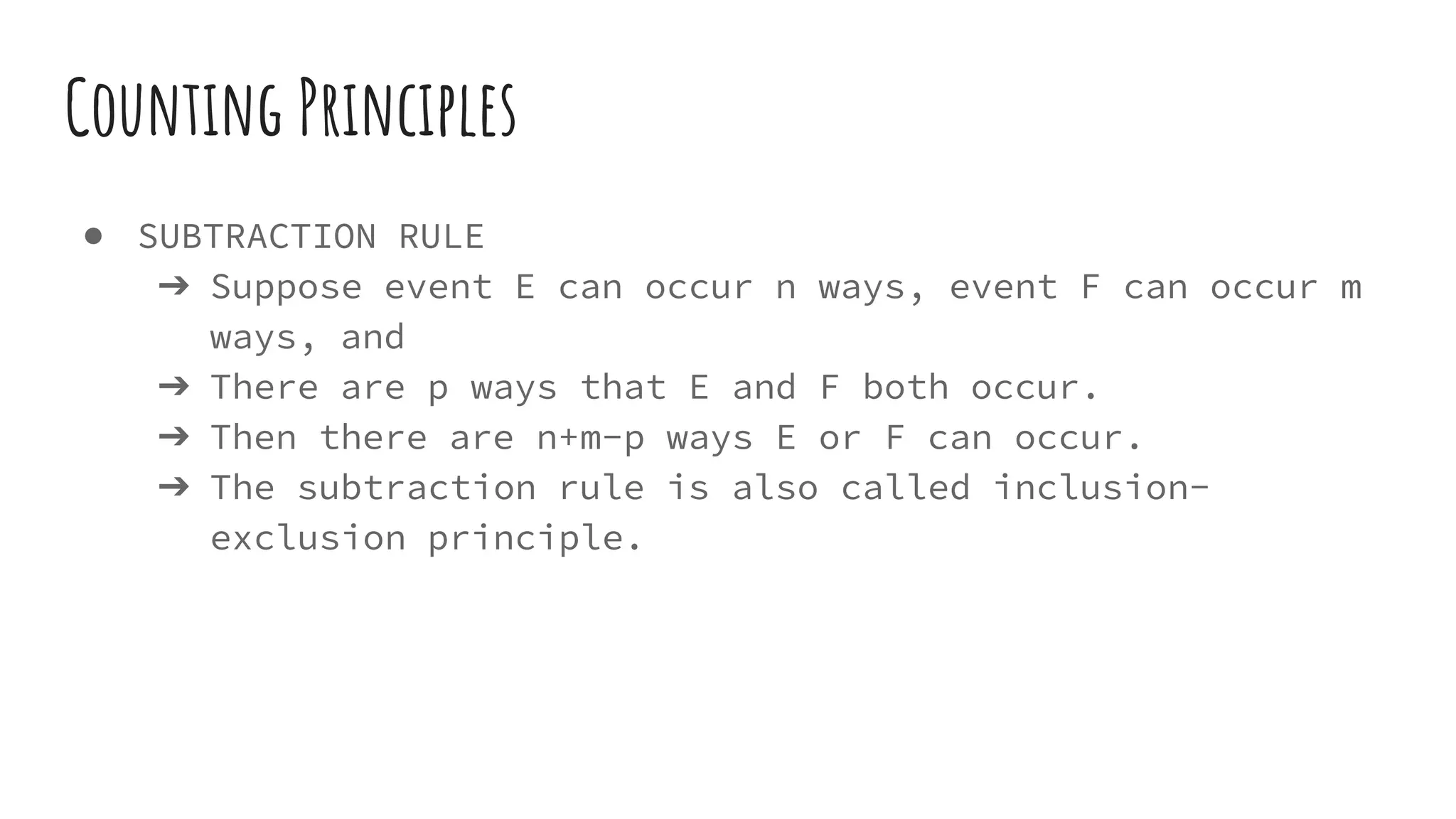
● SUBTRACTION RULE
➔ Suppose event E can occur n ways, event F can occur m
ways, and
➔ There are p ways that E and F both occur.
➔ Then there are n+m-p ways E or F can occur.
➔ The subtraction rule is also called inclusion-
exclusion principle.
Counting Principles
● SUBTRACTION RULE EXAMPLE
Counting Principles
● SUBTRACTION RULE EXAMPLE
➔ If a card is drawn from a standard 52-card
deck, how many cards are Kings or Hearts?
KINGS HEARTS
# of Kings + # of Hearts - # of (kings
and hearts)
4 + 13 - 1 = 16 that are kings or are
hearts
Permutation
● An ordered arrangement of
distinct objects. An r-
permutation is the
arrangement of r-elements
of a set .
● Mathematical technique that
determines the number of
possible arrangements in a
set when the order of the
arrangements matters.
ORDER IS IMPORTANT
PERMUTATION Formula
P(n,r) = n!
(n-r)!
Denotes as permutation of n objects taken r
at a time .
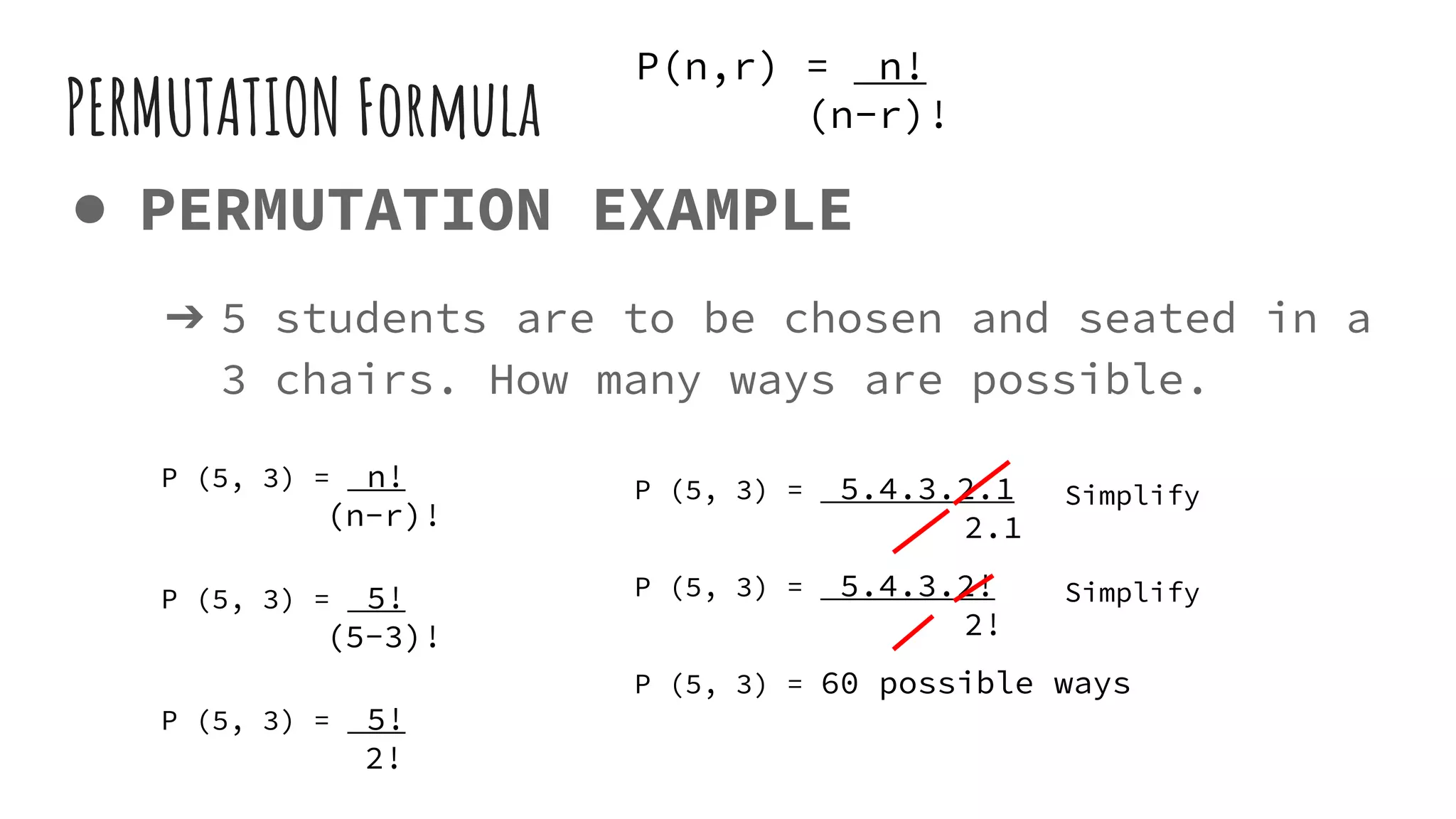
● PERMUTATION EXAMPLE
➔ 5 students are to be chosen and seated in a
3 chairs. How many ways are possible.
PERMUTATION Formula
P(n,r) = n!
(n-r)!
● PERMUTATION EXAMPLE
➔ 5 students are to be chosen and seated in a
3 chairs. How many ways are possible.
P (5, 3) = n!
(n-r)!
P (5, 3) = 5!
(5-3)!
P (5, 3) = 5!
2!
P (5, 3) = 5.4.3.2.1
2.1
Simplify
P (5, 3) = 5.4.3.2!
2!
Simplify
P (5, 3) = 60 possible ways
PERMUTATION Formula
P(n,r) = n!
(n-r)!
● PERMUTATION EXAMPLE
➔ Suppose we have 6 different stuffed toys
and we wish to arrange 4 of them in a row.
How many ways can this be done?
P (6, 4) = n!
(n-r)!
P (6, 4) = 6!
(6-4)!
P (6, 4) = 6!
2!
P (6, 4) = 6.5.4.3.2.1
2.1
Simplify
P (6, 4) = 6.5.4.3.2!
2!
Simplify
P (6, 4) = 360 possible ways
COMBINATION
● An unordered arrangement of
set. An r-combination is a
subset of the set with r
elements.
● Mathematical technique that
determines the number of
possible arrangements in a
collection of items where
the order of selection does
not matter.
ORDER IS NOT IMPORTANT
COMBINATION Formula
C(n,r) = n!
r!(n-r)!
Denotes as combination of n objects taken
r at a time .
● PERMUTATION EXAMPLE
➔ Evaluate C(4, 3)
COMBINATION Formula
C(n,r) = n!
r!(n-r)!
● COMBINATION EXAMPLE
C (4, 3) = n!
r!(n-r)!
P (4, 3) = 4!
3!(4-3)!
P (4, 3) = 4!
3! 1!
P (4, 3) = 4.3!
3! 1
Simplify
P (4, 3) = 4
1
Simplify
P (4, 3) = 4
➔ Evaluate C(4, 3)
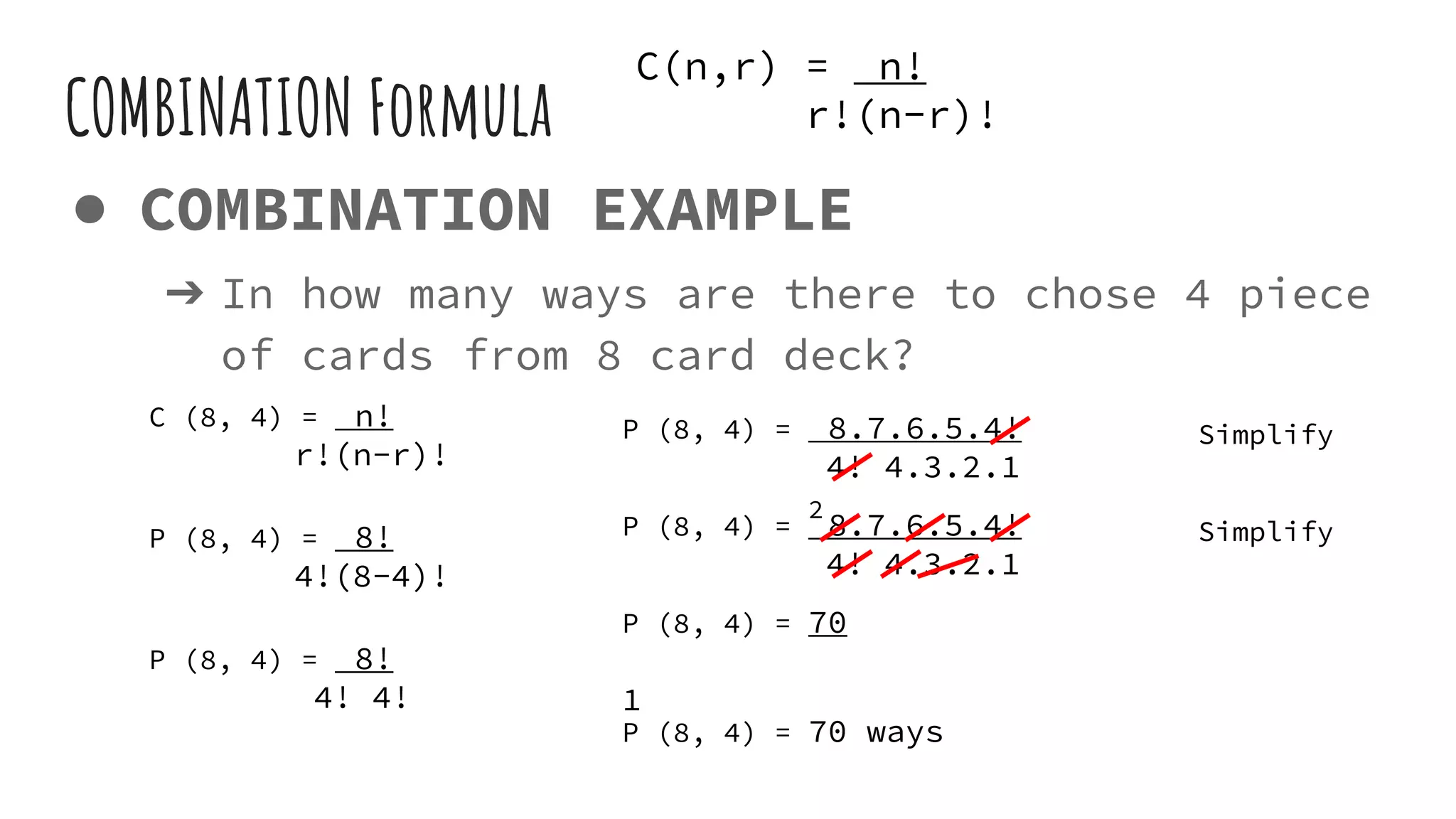
● COMBINATION EXAMPLE
➔ In how many ways are there to chose 4 piece
of cards from 8 card deck?
COMBINATION Formula
C(n,r) = n!
r!(n-r)!
C (8, 4) = n!
r!(n-r)!
P (8, 4) = 8!
4!(8-4)!
P (8, 4) = 8!
4! 4!
P (8, 4) = 8.7.6.5.4!
4! 4.3.2.1
Simplify
P (8, 4) = 8.7.6.5.4!
4! 4.3.2.1
Simplify
P (8, 4) = 70
1
2
P (8, 4) = 70 ways
Thank you!!!

Permutation and combination.pptx

  • 1.
  • 2.
    Counting Principles ● PRODUCTRULE ➔ a procedure can be broken down into first and second stages ➔ there are m possible outcomes for the first stage for each of these outcomes, ➔ there are n possible outcomes for the second stage ➔ the total procedure can be carried out in m · n ways
  • 3.
    Counting Principles ● PRODUCTRULE EXAMPLE ➔ If i have 4 different tshirt and 3 different trouser. How many different outfits do i have? ➔ 4 * 3 = 12
  • 4.
    Tree Diagram A Visualstrategy we can use to represent counting problems. ➔ If i have 4 different tshirt and 3 different trouser. How many different outfits do i have?
  • 5.
    Tree Diagram ➔ Ifi have 4 different tshirt and 3 different trouser. How many different outfits do i have? ts1 ts2 ts3 ts4 t1 t2 t3 ts1 t1 ts1 t2 ts1 t3 ts1 t4 . . . 12 Outfits t1 t2 t3 t1 t2 t3 t1 t2 t3
  • 6.
    Counting Principles ● SUMRULE ➔ a first task can be performed in m (distinct) ways ➔ a second task can be performed in n (distinct) ways ➔ the two tasks cannot be performed simultaneously ➔ performing either task can be accomplished in any one of m + n ways
  • 7.
    Counting Principles ● SUMRULE EXAMPLE ➔ If i want to take a trip. I can travel to one of 37 international places or one of the 12 domestic places. How many trip vacation choices do i have? ➔ 37 + 14 = 51
  • 8.
    Counting Principles ● SUBTRACTIONRULE ➔ Suppose event E can occur n ways, event F can occur m ways, and ➔ There are p ways that E and F both occur. ➔ Then there are n+m-p ways E or F can occur. ➔ The subtraction rule is also called inclusion- exclusion principle.
  • 9.
  • 10.
    Counting Principles ● SUBTRACTIONRULE EXAMPLE ➔ If a card is drawn from a standard 52-card deck, how many cards are Kings or Hearts? KINGS HEARTS # of Kings + # of Hearts - # of (kings and hearts) 4 + 13 - 1 = 16 that are kings or are hearts
  • 11.
    Permutation ● An orderedarrangement of distinct objects. An r- permutation is the arrangement of r-elements of a set . ● Mathematical technique that determines the number of possible arrangements in a set when the order of the arrangements matters. ORDER IS IMPORTANT
  • 12.
    PERMUTATION Formula P(n,r) =n! (n-r)! Denotes as permutation of n objects taken r at a time . ● PERMUTATION EXAMPLE ➔ 5 students are to be chosen and seated in a 3 chairs. How many ways are possible.
  • 13.
    PERMUTATION Formula P(n,r) =n! (n-r)! ● PERMUTATION EXAMPLE ➔ 5 students are to be chosen and seated in a 3 chairs. How many ways are possible. P (5, 3) = n! (n-r)! P (5, 3) = 5! (5-3)! P (5, 3) = 5! 2! P (5, 3) = 5.4.3.2.1 2.1 Simplify P (5, 3) = 5.4.3.2! 2! Simplify P (5, 3) = 60 possible ways
  • 14.
    PERMUTATION Formula P(n,r) =n! (n-r)! ● PERMUTATION EXAMPLE ➔ Suppose we have 6 different stuffed toys and we wish to arrange 4 of them in a row. How many ways can this be done? P (6, 4) = n! (n-r)! P (6, 4) = 6! (6-4)! P (6, 4) = 6! 2! P (6, 4) = 6.5.4.3.2.1 2.1 Simplify P (6, 4) = 6.5.4.3.2! 2! Simplify P (6, 4) = 360 possible ways
  • 15.
    COMBINATION ● An unorderedarrangement of set. An r-combination is a subset of the set with r elements. ● Mathematical technique that determines the number of possible arrangements in a collection of items where the order of selection does not matter. ORDER IS NOT IMPORTANT
  • 16.
    COMBINATION Formula C(n,r) =n! r!(n-r)! Denotes as combination of n objects taken r at a time . ● PERMUTATION EXAMPLE ➔ Evaluate C(4, 3)
  • 17.
    COMBINATION Formula C(n,r) =n! r!(n-r)! ● COMBINATION EXAMPLE C (4, 3) = n! r!(n-r)! P (4, 3) = 4! 3!(4-3)! P (4, 3) = 4! 3! 1! P (4, 3) = 4.3! 3! 1 Simplify P (4, 3) = 4 1 Simplify P (4, 3) = 4 ➔ Evaluate C(4, 3)
  • 18.
    ● COMBINATION EXAMPLE ➔In how many ways are there to chose 4 piece of cards from 8 card deck? COMBINATION Formula C(n,r) = n! r!(n-r)! C (8, 4) = n! r!(n-r)! P (8, 4) = 8! 4!(8-4)! P (8, 4) = 8! 4! 4! P (8, 4) = 8.7.6.5.4! 4! 4.3.2.1 Simplify P (8, 4) = 8.7.6.5.4! 4! 4.3.2.1 Simplify P (8, 4) = 70 1 2 P (8, 4) = 70 ways
  • 19.