The words and phrases to form compound
statements are called connectives.
There are five basic connectives :-
1) Conjunction
2) Disjunction
3) Negation
4) Implication or Conditional
5) Equivalence or Biconditional
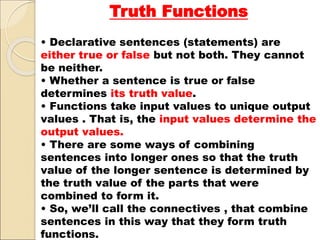
Truth Functions
• Declarative sentences (statements) are
either true or false but not both. They cannot
be neither.
• Whether a sentence is true or false
determines its truth value.
• Functions take input values to unique output
values . That is, the input values determine the
output values.
• There are some ways of combining
sentences into longer ones so that the truth
value of the longer sentence is determined by
the truth value of the parts that were
combined to form it.
• So, we’ll call the connectives , that combine
sentences in this way that they form truth
functions.
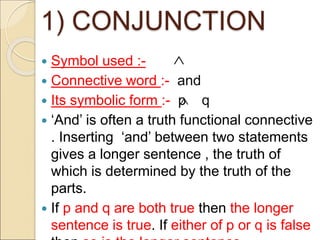
1) CONJUNCTION
 Symbol used :-
 Connective word :- and
 Its symbolic form :- p q
 ‘And’ is often a truth functional connective
. Inserting ‘and’ between two statements
gives a longer sentence , the truth of
which is determined by the truth of the
parts.
 If p and q are both true then the longer
sentence is true. If either of p or q is false


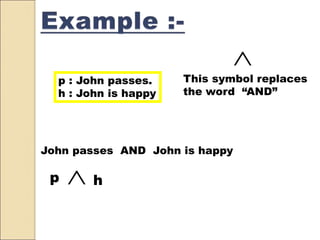
p : John passes.
h : John is happy

This symbol replaces
the word “AND”
John passes AND John is happy
p h
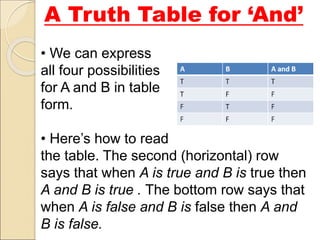
• We can express
all four possibilities
for A and B in table
form.
• Here’s how to read
the table. The second (horizontal) row
says that when A is true and B is true then
A and B is true . The bottom row says that
when A is false and B is false then A and
B is false.
A Truth Table for ‘And’
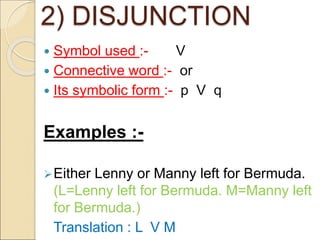
2) DISJUNCTION
 Symbol used :- V
 Connective word :- or
 Its symbolic form :- p V q
Examples :-
Either Lenny or Manny left for Bermuda.
(L=Lenny left for Bermuda. M=Manny left
for Bermuda.)
Translation : L V M
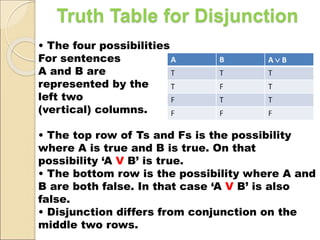
Truth Table for Disjunction
• The four possibilities
For sentences
A and B are
represented by the
left two
(vertical) columns.
• The top row of Ts and Fs is the possibility
where A is true and B is true. On that
possibility ‘A V B’ is true.
• The bottom row is the possibility where A and
B are both false. In that case ‘A V B’ is also
false.
• Disjunction differs from conjunction on the
middle two rows.
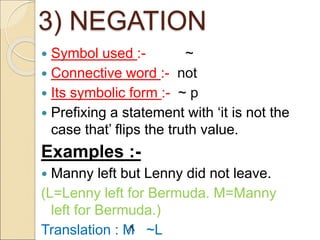
3) NEGATION
 Symbol used :- ~
 Connective word :- not
 Its symbolic form :- ~ p
 Prefixing a statement with ‘it is not the
case that’ flips the truth value.
Examples :-
 Manny left but Lenny did not leave.
(L=Lenny left for Bermuda. M=Manny
left for Bermuda.)
Translation : M ~L
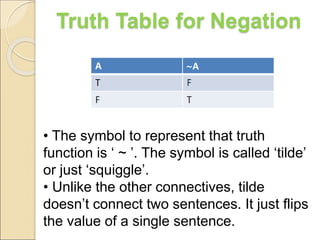
Truth Table for Negation
• The symbol to represent that truth
function is ‘ ~ ’. The symbol is called ‘tilde’
or just ‘squiggle’.
• Unlike the other connectives, tilde
doesn’t connect two sentences. It just flips
the value of a single sentence.
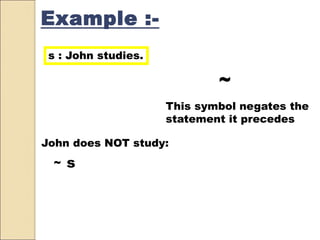
s : John studies.
John does NOT study:
s
This symbol negates the
statement it precedes
~
~
Example :-
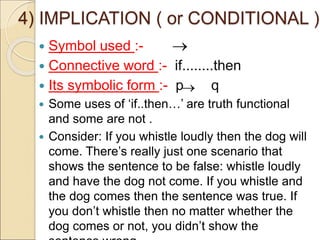
4) IMPLICATION ( or CONDITIONAL )
 Symbol used :-
 Connective word :- if........then
 Its symbolic form :- p q
 Some uses of ‘if..then…’ are truth functional
and some are not .
 Consider: If you whistle loudly then the dog will
come. There’s really just one scenario that
shows the sentence to be false: whistle loudly
and have the dog not come. If you whistle and
the dog comes then the sentence was true. If
you don’t whistle then no matter whether the
dog comes or not, you didn’t show the


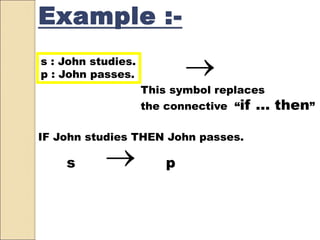
s : John studies.
p : John passes. 
This symbol replaces
the connective “if … then”
IF John studies THEN John passes.
s p
Example :-
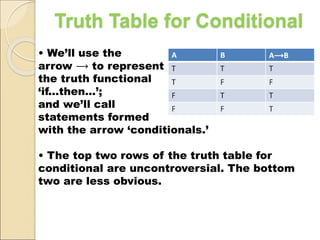
Truth Table for Conditional
• We’ll use the
arrow ⟶ to represent
the truth functional
‘if...then…’;
and we’ll call
statements formed
with the arrow ‘conditionals.’
• The top two rows of the truth table for
conditional are uncontroversial. The bottom
two are less obvious.
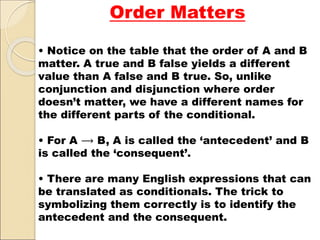
Order Matters
• Notice on the table that the order of A and B
matter. A true and B false yields a different
value than A false and B true. So, unlike
conjunction and disjunction where order
doesn’t matter, we have a different names for
the different parts of the conditional.
• For A ⟶ B, A is called the ‘antecedent’ and B
is called the ‘consequent’.
• There are many English expressions that can
be translated as conditionals. The trick to
symbolizing them correctly is to identify the
antecedent and the consequent.
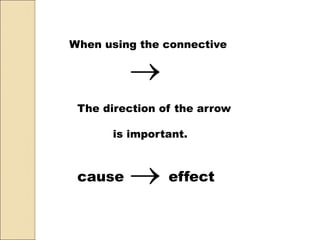
When using the connective

The direction of the arrow
is important.
cause effect
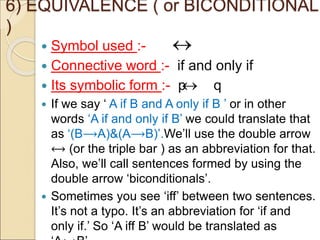
6) EQUIVALENCE ( or BICONDITIONAL
)
 Symbol used :-
 Connective word :- if and only if
 Its symbolic form :- p q
 If we say ‘ A if B and A only if B ’ or in other
words ‘A if and only if B’ we could translate that
as ‘(B⟶A)&(A⟶B)’.We’ll use the double arrow
⟷ (or the triple bar ) as an abbreviation for that.
Also, we’ll call sentences formed by using the
double arrow ‘biconditionals’.
 Sometimes you see ‘iff’ between two sentences.
It’s not a typo. It’s an abbreviation for ‘if and
only if.’ So ‘A iff B’ would be translated as


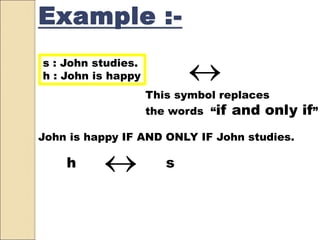
s : John studies.
h : John is happy 
This symbol replaces
the words “if and only if”
John is happy IF AND ONLY IF John studies.
h s
Example :-
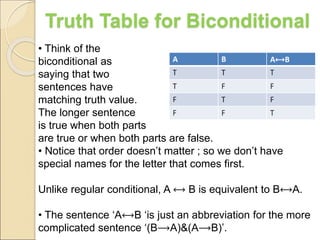
Truth Table for Biconditional
• Think of the
biconditional as
saying that two
sentences have
matching truth value.
The longer sentence
is true when both parts
are true or when both parts are false.
• Notice that order doesn’t matter ; so we don’t have
special names for the letter that comes first.
Unlike regular conditional, A ⟷ B is equivalent to B⟷A.
• The sentence ‘A⟷B ‘is just an abbreviation for the more
complicated sentence ‘(B⟶A)&(A⟶B)’.
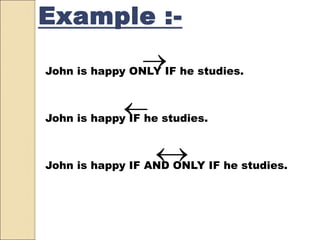
John is happy ONLY IF he studies.
John is happy IF he studies.
John is happy IF AND ONLY IF he studies.



Example :-
Maths P.P.T. Connectives

Maths P.P.T. Connectives

  • 2.
    The words andphrases to form compound statements are called connectives. There are five basic connectives :- 1) Conjunction 2) Disjunction 3) Negation 4) Implication or Conditional 5) Equivalence or Biconditional
  • 3.
    Truth Functions • Declarativesentences (statements) are either true or false but not both. They cannot be neither. • Whether a sentence is true or false determines its truth value. • Functions take input values to unique output values . That is, the input values determine the output values. • There are some ways of combining sentences into longer ones so that the truth value of the longer sentence is determined by the truth value of the parts that were combined to form it. • So, we’ll call the connectives , that combine sentences in this way that they form truth functions.
  • 4.
    1) CONJUNCTION  Symbolused :-  Connective word :- and  Its symbolic form :- p q  ‘And’ is often a truth functional connective . Inserting ‘and’ between two statements gives a longer sentence , the truth of which is determined by the truth of the parts.  If p and q are both true then the longer sentence is true. If either of p or q is false  
  • 5.
    p : Johnpasses. h : John is happy  This symbol replaces the word “AND” John passes AND John is happy p h
  • 6.
    • We canexpress all four possibilities for A and B in table form. • Here’s how to read the table. The second (horizontal) row says that when A is true and B is true then A and B is true . The bottom row says that when A is false and B is false then A and B is false. A Truth Table for ‘And’
  • 7.
    2) DISJUNCTION  Symbolused :- V  Connective word :- or  Its symbolic form :- p V q Examples :- Either Lenny or Manny left for Bermuda. (L=Lenny left for Bermuda. M=Manny left for Bermuda.) Translation : L V M
  • 8.
    Truth Table forDisjunction • The four possibilities For sentences A and B are represented by the left two (vertical) columns. • The top row of Ts and Fs is the possibility where A is true and B is true. On that possibility ‘A V B’ is true. • The bottom row is the possibility where A and B are both false. In that case ‘A V B’ is also false. • Disjunction differs from conjunction on the middle two rows.
  • 9.
    3) NEGATION  Symbolused :- ~  Connective word :- not  Its symbolic form :- ~ p  Prefixing a statement with ‘it is not the case that’ flips the truth value. Examples :-  Manny left but Lenny did not leave. (L=Lenny left for Bermuda. M=Manny left for Bermuda.) Translation : M ~L
  • 10.
    Truth Table forNegation • The symbol to represent that truth function is ‘ ~ ’. The symbol is called ‘tilde’ or just ‘squiggle’. • Unlike the other connectives, tilde doesn’t connect two sentences. It just flips the value of a single sentence.
  • 11.
    s : Johnstudies. John does NOT study: s This symbol negates the statement it precedes ~ ~ Example :-
  • 12.
    4) IMPLICATION (or CONDITIONAL )  Symbol used :-  Connective word :- if........then  Its symbolic form :- p q  Some uses of ‘if..then…’ are truth functional and some are not .  Consider: If you whistle loudly then the dog will come. There’s really just one scenario that shows the sentence to be false: whistle loudly and have the dog not come. If you whistle and the dog comes then the sentence was true. If you don’t whistle then no matter whether the dog comes or not, you didn’t show the  
  • 13.
    s : Johnstudies. p : John passes.  This symbol replaces the connective “if … then” IF John studies THEN John passes. s p Example :-
  • 14.
    Truth Table forConditional • We’ll use the arrow ⟶ to represent the truth functional ‘if...then…’; and we’ll call statements formed with the arrow ‘conditionals.’ • The top two rows of the truth table for conditional are uncontroversial. The bottom two are less obvious.
  • 15.
    Order Matters • Noticeon the table that the order of A and B matter. A true and B false yields a different value than A false and B true. So, unlike conjunction and disjunction where order doesn’t matter, we have a different names for the different parts of the conditional. • For A ⟶ B, A is called the ‘antecedent’ and B is called the ‘consequent’. • There are many English expressions that can be translated as conditionals. The trick to symbolizing them correctly is to identify the antecedent and the consequent.
  • 16.
    When using theconnective  The direction of the arrow is important. cause effect
  • 17.
    6) EQUIVALENCE (or BICONDITIONAL )  Symbol used :-  Connective word :- if and only if  Its symbolic form :- p q  If we say ‘ A if B and A only if B ’ or in other words ‘A if and only if B’ we could translate that as ‘(B⟶A)&(A⟶B)’.We’ll use the double arrow ⟷ (or the triple bar ) as an abbreviation for that. Also, we’ll call sentences formed by using the double arrow ‘biconditionals’.  Sometimes you see ‘iff’ between two sentences. It’s not a typo. It’s an abbreviation for ‘if and only if.’ So ‘A iff B’ would be translated as  
  • 18.
    s : Johnstudies. h : John is happy  This symbol replaces the words “if and only if” John is happy IF AND ONLY IF John studies. h s Example :-
  • 19.
    Truth Table forBiconditional • Think of the biconditional as saying that two sentences have matching truth value. The longer sentence is true when both parts are true or when both parts are false. • Notice that order doesn’t matter ; so we don’t have special names for the letter that comes first. Unlike regular conditional, A ⟷ B is equivalent to B⟷A. • The sentence ‘A⟷B ‘is just an abbreviation for the more complicated sentence ‘(B⟶A)&(A⟶B)’.
  • 20.
    John is happyONLY IF he studies. John is happy IF he studies. John is happy IF AND ONLY IF he studies.    Example :-