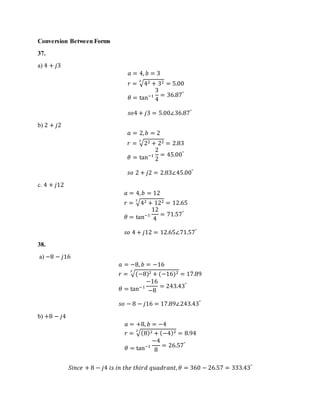
Conversion Between Forms
37.
a) 4 + 𝑗3
𝑎 = 4, 𝑏 = 3
𝑟 = √42 + 322
= 5.00
𝜃 = tan−1
3
4
= 36.87°
𝑠𝑜4 + 𝑗3 = 5.00∠36.87°
b) 2 + 𝑗2
𝑎 = 2, 𝑏 = 2
𝑟 = √22 + 222
= 2.83
𝜃 = tan−1
2
2
= 45.00°
𝑠𝑜 2 + 𝑗2 = 2.83∠45.00°
c. 4 + 𝑗12
𝑎 = 4, 𝑏 = 12
𝑟 = √42 + 1222
= 12.65
𝜃 = tan−1
12
4
= 71.57°
𝑠𝑜 4 + 𝑗12 = 12.65∠71.57°
38.
a) −8 − 𝑗16
𝑎 = −8, 𝑏 = −16
𝑟 = √(−8)2 + (−16)22
= 17.89
𝜃 = tan−1
−16
−8
= 243.43°
𝑠𝑜 − 8 − 𝑗16 = 17.89∠243.43°
b) +8 − 𝑗4
𝑎 = +8, 𝑏 = −4
𝑟 = √(8)2 + (−4)22
= 8.94
𝜃 = tan−1
−4
8
= 26.57°
𝑆𝑖𝑛𝑐𝑒 + 8 − 𝑗4 𝑖𝑠 𝑖𝑛 𝑡ℎ𝑒 𝑡ℎ𝑖𝑟𝑑 𝑞𝑢𝑎𝑑𝑟𝑎𝑛𝑡, 𝜃 = 360 − 26.57 = 333.43°
𝑠𝑜 + 8 − 𝑗4 = 8.94∠333.43°
c) 0.02−𝑗0.003
𝑎 = 0.02, 𝑏 = −0.003
𝑟 = √(0.02)2 + (−0.003)22
= 0.0202
𝜃 = tan−1
−0.003
0.02
= 8.53°
𝑠𝑜 0.02 − 𝑗0.003 = 0.0202∠8.53°
39. Convert from polar to rectangular
a) 6∠40°
6.00(cos40°
+ 𝑗 sin 40°
)
= (6.00 cos40°
)+ (𝑗6.00sin 40°
)
= 4.60 + 𝑗3.86
b) 12∠120°
12.00(cos120°
+ 𝑗 sin 120°
)
= (12.00cos120°
)+ (𝑗12.00sin 120°
)
= −6.00 + 𝑗10.39
c) 2000∠−90°
2000(cos270°
+ 𝑗 sin 270°
)
= (2000cos270°
)+ (𝑗2000sin 270°
)
= 0.00 − 𝑗2000
40. Convert from polar to rectangular
a) 42∠0.15°
42.00(cos0.15°
+ 𝑗 sin 0.15°
)
= (42.00cos0.15°
)+ (𝑗42.00sin 0.15°
)
= 42 + 𝑗0.11
b) 2002∠−60°
2002(cos300°
+ 𝑗 sin 300°
)
= (2002cos300°
)+ (𝑗2002sin 300°
)
= 1001 + −𝑗1733.78
c) 0.006∠−120°
0.006(cos240°
+ 𝑗 sin 240°
)
= (0.006cos240°
)+ (𝑗0.006sin 240°
)
= −0.003 + −𝑗5.2 × 10⁻³
Section 14.9
41.
a) (4.2 + 𝑗6.8) + (7.6 + 𝑗0.2)
𝑌𝑜𝑢 𝑎𝑑𝑑 𝑡ℎ𝑒 𝑟𝑒𝑎𝑙 𝑝𝑎𝑟𝑡𝑠 𝑠𝑒𝑝𝑎𝑟𝑎𝑡𝑒𝑙𝑦 𝑡ℎ𝑒𝑛 𝑎𝑑𝑑 𝑡ℎ𝑒 𝑖𝑚𝑎𝑔𝑖𝑛𝑎𝑟𝑦 𝑝𝑎𝑟𝑡𝑠
= (4.2 + 7.6) + 𝑗(6.8 + 0.2)
= 11.8 + 𝑗7.00
b) (142 + 𝑗7)+ (9.8 + 𝑗42)+ (0.1 + 𝑗0.9)
= (142 + 9.8 + 0.1) + 𝑗(7 + 42 + 0.9)
= 151.9 + 𝑗49.9
c) (4 × 10⁻⁶
+ 𝑗76)+ (7.2 × 10⁻⁷
− 𝑗5)
= (4 × 10⁻⁶
+ 7.2 × 10⁻⁷) + 𝑗(76 − 5)
= 4.72 × 10⁻⁶
+ 𝑗71
42.
a) (9.8 + 𝑗6.2) − (4.6 + 𝑗4.6)
= (9.8 − 4.6) + 𝑗(6.2 − 4.6)
= 5.2 + 𝑗1.6
b) (167 + 𝑗243)− (−42.3 − 𝑗68)
= (167 + 42.3) + 𝑗(243 + 68)
= 209.3 + 𝑗311
c) (−36 + 𝑗78)− (−4 − 𝑗6) + (10.8 − 𝑗72)
= (−36 + 4 + 10.8) + 𝑗(78 + 6 − 72)
= −21.2 + 𝑗12
43.
a) 6∠20°
+ 8∠80°
= 12.16∠54.72°
b) 42∠45°
+ 62∠60°
− 70∠120°
= 146.3∠79.88°
c) 20∠−120°
− 10∠−150°
+ 8∠−210°
+ 8∠+240°
= 38.89∠139.53°
44. Perform the following multiplication in rectangular form
a) (2 + 𝑗3)(6+ 𝑗8)
= (2 × 6 − 3 × 8) + 𝑗(6 × 3 + 2 × 8)
= −12 + 𝑗34
b) (7.8 + 𝑗1)(4+ 𝑗2)(7+ 𝑗6)
= 86.8 + 𝑗312.4
c) (400 − 𝑗200)(−0.01 − 𝑗0.5)(−1 + 𝑗3)
= 698 + 𝑗114
45. Perform the following multiplications in polar form
a) (2∠60°
)(4∠ − 40°
)
= (2 × 4)∠(60− 40)
8∠20°
b) (6.9∠8°
)(7.2∠ − 72°
= (6.9 × 7.2)∠(8− 72)
849.68∠−62°
c) (0.002∠120°
)(0.5∠200°
)(40∠80°
= (0.002 × 0.5 × 40)∠(120+ 200 + 80)
0.04∠400°
46. Perform the following divisions in polar
a)
42∠10°
7∠ 60°
=
42
7
∠10 − 60
6∠−50°
b)
0.006∠120°
30∠ 60°
=
0.006
30
∠120 − 60
2 × 10⁻⁴
∠60°
c)
4360∠−20°
40∠−210°
=
4360
40
∠ − 20 + 210
109∠190°
47. Perform the following divisions and leave the answer in rectangular form
a)
(8+𝑗8)
(2+𝑗2)
(8 + 𝑗8)
(2 + 𝑗2)
= 4
Section 14.11 Phasors
52. Express the following in phasor form
a) √2(160)sin( 𝜔𝑡 + 30°)
= 226.27∠30°
b) √2(25 × 10−3)sin(157𝑡 − 40°)
= 0.0354∠−40°
c) 100 sin( 𝜔𝑡 − 90°)
= 100∠270°
53. Express the following in phasor form
a) 20 sin(377𝑡 − 180°)
= 20∠−180°
b) 6 × 10⁻⁶
cos 𝜔𝑡
6 × 10⁻⁶
c) 3.6 × 10⁻⁶
cos(745𝑡 − 20°)
= 3.6 × 10⁻⁶
∠−20°
54. Express the following phasor currents and voltages as sine waves if the frequency is 60 Hz.
a) 𝐼 = 40𝐴∠20°
𝐼 = 40cos(2𝜋 × 60𝑡 + 20°)
𝐼 = 40cos(120𝜋𝑡 + 20°) 𝐴
b) 𝑉 = 120𝑉∠10°
𝑉 = 120cos(2𝜋 × 60𝑡 + 10°)
𝐼 = 120cos(120𝜋𝑡 + 10°) 𝑉
c) 𝐼 = 8 × 10⁻³
𝐴∠−110°
𝐼 = 40sin(2𝜋 × 60𝑡 − 110°)
𝐼 = 40sin(120𝜋𝑡 − 110°) 𝐴
d) 𝑉 =
6000
√2
𝑉∠ − 180°
𝑉 = 4242.64sin(2𝜋 × 60𝑡 − 180°)
𝐼 = 4242.64cos(120𝜋𝑡 − 180°) 𝑉
Maths

Maths

  • 1.
    Conversion Between Forms 37. a)4 + 𝑗3 𝑎 = 4, 𝑏 = 3 𝑟 = √42 + 322 = 5.00 𝜃 = tan−1 3 4 = 36.87° 𝑠𝑜4 + 𝑗3 = 5.00∠36.87° b) 2 + 𝑗2 𝑎 = 2, 𝑏 = 2 𝑟 = √22 + 222 = 2.83 𝜃 = tan−1 2 2 = 45.00° 𝑠𝑜 2 + 𝑗2 = 2.83∠45.00° c. 4 + 𝑗12 𝑎 = 4, 𝑏 = 12 𝑟 = √42 + 1222 = 12.65 𝜃 = tan−1 12 4 = 71.57° 𝑠𝑜 4 + 𝑗12 = 12.65∠71.57° 38. a) −8 − 𝑗16 𝑎 = −8, 𝑏 = −16 𝑟 = √(−8)2 + (−16)22 = 17.89 𝜃 = tan−1 −16 −8 = 243.43° 𝑠𝑜 − 8 − 𝑗16 = 17.89∠243.43° b) +8 − 𝑗4 𝑎 = +8, 𝑏 = −4 𝑟 = √(8)2 + (−4)22 = 8.94 𝜃 = tan−1 −4 8 = 26.57° 𝑆𝑖𝑛𝑐𝑒 + 8 − 𝑗4 𝑖𝑠 𝑖𝑛 𝑡ℎ𝑒 𝑡ℎ𝑖𝑟𝑑 𝑞𝑢𝑎𝑑𝑟𝑎𝑛𝑡, 𝜃 = 360 − 26.57 = 333.43°
  • 2.
    𝑠𝑜 + 8− 𝑗4 = 8.94∠333.43° c) 0.02−𝑗0.003 𝑎 = 0.02, 𝑏 = −0.003 𝑟 = √(0.02)2 + (−0.003)22 = 0.0202 𝜃 = tan−1 −0.003 0.02 = 8.53° 𝑠𝑜 0.02 − 𝑗0.003 = 0.0202∠8.53° 39. Convert from polar to rectangular a) 6∠40° 6.00(cos40° + 𝑗 sin 40° ) = (6.00 cos40° )+ (𝑗6.00sin 40° ) = 4.60 + 𝑗3.86 b) 12∠120° 12.00(cos120° + 𝑗 sin 120° ) = (12.00cos120° )+ (𝑗12.00sin 120° ) = −6.00 + 𝑗10.39 c) 2000∠−90° 2000(cos270° + 𝑗 sin 270° ) = (2000cos270° )+ (𝑗2000sin 270° ) = 0.00 − 𝑗2000 40. Convert from polar to rectangular a) 42∠0.15° 42.00(cos0.15° + 𝑗 sin 0.15° ) = (42.00cos0.15° )+ (𝑗42.00sin 0.15° ) = 42 + 𝑗0.11 b) 2002∠−60° 2002(cos300° + 𝑗 sin 300° ) = (2002cos300° )+ (𝑗2002sin 300° ) = 1001 + −𝑗1733.78 c) 0.006∠−120° 0.006(cos240° + 𝑗 sin 240° ) = (0.006cos240° )+ (𝑗0.006sin 240° ) = −0.003 + −𝑗5.2 × 10⁻³ Section 14.9
  • 3.
    41. a) (4.2 +𝑗6.8) + (7.6 + 𝑗0.2) 𝑌𝑜𝑢 𝑎𝑑𝑑 𝑡ℎ𝑒 𝑟𝑒𝑎𝑙 𝑝𝑎𝑟𝑡𝑠 𝑠𝑒𝑝𝑎𝑟𝑎𝑡𝑒𝑙𝑦 𝑡ℎ𝑒𝑛 𝑎𝑑𝑑 𝑡ℎ𝑒 𝑖𝑚𝑎𝑔𝑖𝑛𝑎𝑟𝑦 𝑝𝑎𝑟𝑡𝑠 = (4.2 + 7.6) + 𝑗(6.8 + 0.2) = 11.8 + 𝑗7.00 b) (142 + 𝑗7)+ (9.8 + 𝑗42)+ (0.1 + 𝑗0.9) = (142 + 9.8 + 0.1) + 𝑗(7 + 42 + 0.9) = 151.9 + 𝑗49.9 c) (4 × 10⁻⁶ + 𝑗76)+ (7.2 × 10⁻⁷ − 𝑗5) = (4 × 10⁻⁶ + 7.2 × 10⁻⁷) + 𝑗(76 − 5) = 4.72 × 10⁻⁶ + 𝑗71 42. a) (9.8 + 𝑗6.2) − (4.6 + 𝑗4.6) = (9.8 − 4.6) + 𝑗(6.2 − 4.6) = 5.2 + 𝑗1.6 b) (167 + 𝑗243)− (−42.3 − 𝑗68) = (167 + 42.3) + 𝑗(243 + 68) = 209.3 + 𝑗311 c) (−36 + 𝑗78)− (−4 − 𝑗6) + (10.8 − 𝑗72) = (−36 + 4 + 10.8) + 𝑗(78 + 6 − 72) = −21.2 + 𝑗12 43. a) 6∠20° + 8∠80° = 12.16∠54.72° b) 42∠45° + 62∠60° − 70∠120° = 146.3∠79.88° c) 20∠−120° − 10∠−150° + 8∠−210° + 8∠+240° = 38.89∠139.53° 44. Perform the following multiplication in rectangular form a) (2 + 𝑗3)(6+ 𝑗8) = (2 × 6 − 3 × 8) + 𝑗(6 × 3 + 2 × 8) = −12 + 𝑗34 b) (7.8 + 𝑗1)(4+ 𝑗2)(7+ 𝑗6)
  • 4.
    = 86.8 +𝑗312.4 c) (400 − 𝑗200)(−0.01 − 𝑗0.5)(−1 + 𝑗3) = 698 + 𝑗114 45. Perform the following multiplications in polar form a) (2∠60° )(4∠ − 40° ) = (2 × 4)∠(60− 40) 8∠20° b) (6.9∠8° )(7.2∠ − 72° = (6.9 × 7.2)∠(8− 72) 849.68∠−62° c) (0.002∠120° )(0.5∠200° )(40∠80° = (0.002 × 0.5 × 40)∠(120+ 200 + 80) 0.04∠400° 46. Perform the following divisions in polar a) 42∠10° 7∠ 60° = 42 7 ∠10 − 60 6∠−50° b) 0.006∠120° 30∠ 60° = 0.006 30 ∠120 − 60 2 × 10⁻⁴ ∠60° c) 4360∠−20° 40∠−210° = 4360 40 ∠ − 20 + 210 109∠190° 47. Perform the following divisions and leave the answer in rectangular form a) (8+𝑗8) (2+𝑗2) (8 + 𝑗8) (2 + 𝑗2) = 4
  • 5.
    Section 14.11 Phasors 52.Express the following in phasor form a) √2(160)sin( 𝜔𝑡 + 30°) = 226.27∠30° b) √2(25 × 10−3)sin(157𝑡 − 40°) = 0.0354∠−40° c) 100 sin( 𝜔𝑡 − 90°) = 100∠270° 53. Express the following in phasor form a) 20 sin(377𝑡 − 180°) = 20∠−180° b) 6 × 10⁻⁶ cos 𝜔𝑡 6 × 10⁻⁶ c) 3.6 × 10⁻⁶ cos(745𝑡 − 20°) = 3.6 × 10⁻⁶ ∠−20° 54. Express the following phasor currents and voltages as sine waves if the frequency is 60 Hz. a) 𝐼 = 40𝐴∠20° 𝐼 = 40cos(2𝜋 × 60𝑡 + 20°) 𝐼 = 40cos(120𝜋𝑡 + 20°) 𝐴 b) 𝑉 = 120𝑉∠10° 𝑉 = 120cos(2𝜋 × 60𝑡 + 10°) 𝐼 = 120cos(120𝜋𝑡 + 10°) 𝑉 c) 𝐼 = 8 × 10⁻³ 𝐴∠−110° 𝐼 = 40sin(2𝜋 × 60𝑡 − 110°) 𝐼 = 40sin(120𝜋𝑡 − 110°) 𝐴 d) 𝑉 = 6000 √2 𝑉∠ − 180° 𝑉 = 4242.64sin(2𝜋 × 60𝑡 − 180°) 𝐼 = 4242.64cos(120𝜋𝑡 − 180°) 𝑉