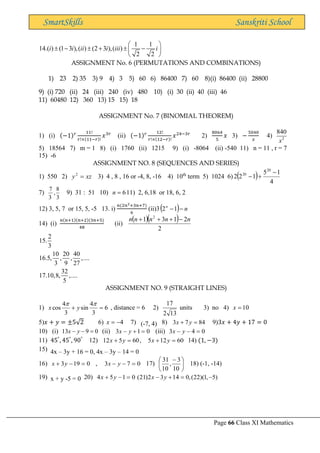
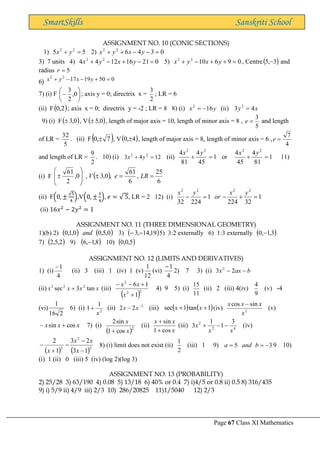
Mathematics XI assignment chapter wise important questions for maths.pdf
1.
Page 1 ClassXI Mathematics
SmartSkills Sanskriti School
CONTENTS
A. Syllabus 2
B. Project Work 6
C. Assignments and Practice Questions
(1) Sets 8
(2) Assignment - Sets 9
(3) Relations and Functions
(4)
11
(4) Assignment- Relations and Functions 15
(5) Trigonometric Functions 17
(6) Assignment- Trigonometric Functions 22
(7) Linear Inequalities 24
(8) Assignment- Linear Inequalities 25
(9) Assignment-Complex Numbers and Quadratic Equations 26
(10) Permutations and Combinations 27
(11) Assignment-Permutations and Combinations 30
(12) Assignment-Binomial Theorem 32
(13) Sequences and Series 34
(14) Assignment- Sequences and Series 35
(15) Assignment- Straight Lines 37
(16) Assignment- Conic Sections 39
(17) Assignment- Three-Dimensional Geometry 41
(18) Limits 42
(19) Derivatives 45
(20) Assignment- Limits and Derivatives 46
(21) Probability 48
(22) Assignment- Probability 52
D. Question Bank
E. Do’s and Don’ts of Project presentation
54
F. Do’s and Don’ts of Project Presentation 61
G. Case Study 63
H. Answers 64
2.
Page 2 ClassXI Mathematics
SmartSkills Sanskriti School
Syllabus
TERM I
July
Sets:
Sets and their representations, Empty set, finite & infinite sets, equal sets. Subsets-
Subsets of the set of real numbers especially intervals (with notations), Power set,
Universal set, Venn diagrams, Union, Intersection, Difference and Complement of a set.
Linear Inequalities:
Linear inequalities. Algebraic solutions of linear inequalities in one variable and their
representation on the number line. Graphical solution of linear inequalities in two
variables. Solution of system of linear inequalities in two variables- graphically.
Principle of Mathematical Induction:
Processes of the proof by induction, motivating the application of the method by looking
at natural numbers as the least inductive subset of real numbers. The principle of
Mathematical induction and simple applications.
Relations & Functions:
Ordered pairs, Cartesian product of sets. Number of elements in the cartesian product of
two finite sets. Cartesian product of the set of real numbers with itself (upto R
R
R
).
Definition of relation, pictorial diagrams, domain, co-domain and range of a relation.
August
Relations & Functions(continued):
Function as a special kind of relation from one set to another. Pictorial representation of a
function, domain, co-domain & range of a function. Real valued function of the real
variable, domain and range of these functions, constant, identity, polynomial, rational,
modulus, signum and greatest integer functions with their graphs. Sum, difference,
product and quotients of functions.
3.
Page 3 ClassXI Mathematics
SmartSkills Sanskriti School
Trigonometric Functions:
Positive and negative angles. Measuring angles in radians & in degrees and conversion
from one measure to another. Definition of trigonometric functions with the help of a
unit circle. Truth of the identity 2 2
sin cos 1
x x
+ = , for all x . Signs of trigonometric
functions and sketch of their graphs. Expressing ( ) ( )
sin and cos
x y x y
+ + in terms of
sin ,sin ,cos ,cos
x y x y .
Deducing the identities like following:
2
sin
2
sin
2
cos
cos
2
cos
2
cos
2
cos
cos
2
sin
2
cos
2
sin
sin
2
cos
2
sin
2
sin
sin
cot
cot
1
cot
cot
)
cot(
,
cot
cot
1
cot
cot
)
cot(
tan
tan
1
tan
tan
)
tan(
,
tan
tan
1
tan
tan
)
tan(
y
x
y
x
y
x
y
x
y
x
y
x
y
x
y
x
y
x
y
x
y
x
y
x
y
x
y
x
y
x
y
x
y
x
y
x
y
x
y
x
y
x
y
x
y
x
y
x
−
+
−
=
−
−
+
=
+
−
+
=
−
−
+
=
+
−
+
=
−
+
−
=
+
+
−
=
−
−
+
=
+
Identities related to sin 2 ,cos2 ,tan 2 ,sin3 ,cos3 ,tan3
x x x x x x . General solution of
trigonometric equations of the type
tan
tan
,
cos
cos
,
sin
sin =
=
=
September: First Term Examination
TERM II
September - October
Permutations & Combinations:
Fundamental principle of counting. Factorial n. Permutations and combinations,
derivation of formulae and their connections, simple applications.
Binomial Theorem:
History, statement and proof of the binomial theorem for positive integral indices.
Pascal’s triangle, general and middle term in binomial expansion, simple applications.
November
Sequences and Series:
Sequence and Series. Arithmetic progression (A. P.), arithmetic mean (A.M.).Geometric
progression (G.P.), general term of a G. P., sum of n terms of a G.P., geometric mean
4.
Page 4 ClassXI Mathematics
SmartSkills Sanskriti School
(G.M.), relation between A.M. and G.M. Sum to infinity of a G.P. Sum to n terms of the
special series: 2 3
, ,
n n n
Straight Lines:
Brief recall of 2D from earlier classes. Slope of a line and angle between two lines.
Various forms of equations of a line: parallel to axes, point-slope form, slope-intercept
form, two -point form, intercepts form and normal form.
December
Straight Lines (Continued):
General equation of a line. Distance of a point from a line.
Conic Sections:
Sections of a cone: circles, ellipse, parabola, hyperbola, a point, a straight line and pair of
intersecting lines as a degenerated case of a conic section. Standard equations and simple
properties of parabola, ellipse and hyperbola. Standard equation of a circle.
Introduction to Three -dimensional Geometry:
Coordinate axes and coordinate planes in three dimensions. Coordinates of a point.
Distance between two points and section formula
January
Limits and Derivatives:
Derivative introduced as rate of change both as that of distance function and
geometrically, intuitive idea of limit. Definition of derivative, relate it to slope of tangent
of the curve, derivative of sum, difference, product and quotient of functions.
Derivatives of polynomial and trigonometric functions. Some important Limits:
( )
( )
1
0 0 0 0 0
log 1
1 1 1 1 1
( )lim ,( )lim ,( )lim 1 ,( )lim 1 ,( )lim ,( )lim ,( )lim , 0
x x x
x
x x x x x x x
x e a
i ii iii iv x v vi vii a
x x x x x x
→ → → → → → →
+ − −
+ +
5.
Page 5 ClassXI Mathematics
SmartSkills Sanskriti School
February
Probability:
Random experiments: outcomes, sample spaces (set representation). Events: occurrence
of events, ‘not’, ‘and’ & ‘or’ events, exhaustive events, mutually exclusive events.
Axiomatic (set theoretic) probability, connections with the theories of earlier classes.
Probability of an event, probability of ‘not’, ‘and’ & ‘or’ events.
Complex Numbers and Quadratic Equations:
Need for complex numbers, especially 1
− , to be motivated by inability to solve every
quadratic equation. Brief description of algebraic properties of complex numbers.
Argand plane and polar representation of complex numbers. Statement of Fundamental
Theorem of Algebra, solution of quadratic equations in the complex number system.
Square root of a complex number.
6.
Page 6 ClassXI Mathematics
SmartSkills Sanskriti School
Mathematics Project Work
Prepare a project on any of the following topics. You may work in groups of not more than
four students. Each selected topic must be investigated thoroughly. Relevant information
must be collected and understood. Group will be required to make a presentation (not
necessarily PowerPoint show, handmade charts or simple displays will also be
appreciated).
The assessment will be done at in the second term. The marks will be included in the
second term assessment.
The project will be assessed on the basis of mathematical content, depth and clarity of
understanding, explanation, neatness and organization, group presentation, coordination,
creativity and completion. The final presentation should not exceed ten minutes of time.
Please refer to the do’s and don’ts of making a digital presentation on page 61.
Topics:
1. Encryption: Encryption has been playing a very important role in our lives. From
secret messages passed in the ancient wars to the safety of our Gmail account it has
been used extensively. Understand the theory behind these systems, how and why
of it. Try creating something you can call your own.
2. Mathematics in Forensics :Put on your gloves, take out your magnifying glasses
and get ready to become a crime scene investigator.They Apply deductive
reasoning skills to make sense of the relationships between events, suspects,
motives, evidences and ultimately solve this “Who did it”
3. Queuing Theory: How is the time and frequency of the metro trains decided? How
come the traffic light at one crossing stays red precisely for 3 minutes, while another
stays red for merely 40 seconds? Delve into the Queuing theory and find answers
to these and other related observations.
4. Prisoner’s Dilemma: Investigate prisoner’ Dilemma and explore its use in
marketing strategies.
5. Mathematical Biology: What distinguishes us from the others? The answer lies in
our genes. Is there anything common between your DNA structure and say,
Ramanujan’s? Investigate
7.
Page 7 ClassXI Mathematics
SmartSkills Sanskriti School
6. Konigsberg Bridge Problem: Understand the problem, its known solution and the
theory behind the solution. Can you think of another solution for this problem and
its application, for example, in deciding evacuation routes of a hotel or school?
7. Fractals: What are Fractals? What are a Sierpinski Triangle and Koch Curve?
Discover how to construct the Koch or “Snowflake” Curve and Sierpinski. Learn
how to make Fractal Cards – make at least two Fractal Cards.
8. Let’s graph it!: Explore graphs of various functions, equations and inequalities
using Desmos. Think, visualize, create and blend Math with Art.
8.
Page 8 ClassXI Mathematics
SmartSkills Sanskriti School
Sets
1. Let
10
than
less
no.
prime
is
and
:
B
,
50
x
5
and
:
A
,
8
and
: 2
x
N
x
x
N
x
x
x
N
x
x
U
=
=
=
Verify that C
B
A
B
-
A
=
2. Draw Venn diagram of the following sets:
(i) 𝐴′⋂(𝐵⋃𝐶) (ii) 𝐴′⋂(𝐶 − 𝐵)
3. If U = {𝑥: 𝑥 ∈ 𝑁, 𝑎𝑛𝑑 𝑥 ≤ 10}, A= {𝑥 ∶ 𝑥 𝑖𝑠 𝑝𝑟𝑖𝑚𝑒, 𝑥 ∈ 𝑁} and
B={𝑥 ∶ 𝑥 𝑖𝑠 𝑎 𝑓𝑎𝑐𝑡𝑜𝑟 𝑜𝑓 24, 𝑥 ∈ 𝑁}.
Verify that (i) 𝐴 − 𝐵 = 𝐴 ∩ 𝐵′ (ii) (𝐴 ∪ 𝐵)′
= 𝐴′
∩ 𝐵′
4. Name the shaded region in the following Venn Diagrams:
5. Out of 100 students, 15 passed in English, 12 passed in Mathematics, 8 in
Science, 6 in English and Mathematics, 7 in Mathematics and Science, 4 in
English and Science, 4 in all the three. Find how many passed
(i) in English and Mathematics but not Science
(ii) in Mathematics and Science but not English
(iii) in Mathematics only
(iv) in more than one subject
6. A school organised Sports Week during the month of November. Many
activities like Athletics, Yoga and Gymnastics were held. Out of 100 students
of class XI, 30 participated in Athletics, 35 participated in Yoga and 20
participated in Gymnastics. 12 participated in Athletics and Gymnastics, 8
participated on Yoga and Gymnastics and 10 participated in Yoga and
Athletics, while none participated in all three activities. Find
(i) The number of students who did not participate in any of the three activities.
(ii) Number of students who participated in Yoga only
(iii) Number of students who participated in Athletics and Yoga but Gymnastics.
7. In a survey of 100 car owners it was found that 67 owned car A, 46 owned
carB and 40 owned car C. 28 owned both A and B, 8 owned both B and C, 26
owned both A and C and 2 owned all the three cars. Find the number of
people who owned
(i) car A but not B and C
(ii) only two of the cars
(iii) none of the cars
9.
Page 9 ClassXI Mathematics
SmartSkills Sanskriti School
Assignment No. 1
Sets
Q. No. 1 - 10 are very short answer type questions:
1. Write the set
217
6
,
126
5
,
65
4
,
28
3
,
9
2
,
2
1
in set builder form.
2. Write the set
1 3 5 7 9 11
, , , , , ,
3 5 7 9 11 13
in set builder form.
3. Write the set A =
30
,
: 2
x
Z
x
x in roster form.
4. Describe the set { : is a two digit number such that the sum of its digits is 8}
A x x
= in
roster form .
5. Find the pairs of equal sets and equivalent sets from the following : A = ,
: , 10 and 6
B x x R x x
= ,
: , 1 0
C x x R x
= − =
2
: , 36
D x x R x
= = ,
2
: is an integral root of 8 12 0
E x x x x
= + + =
6. Write whether the set is empty, finite or infinite?
(a) { : 200}
x N x
(b) { ,0 1}
x R x
(c){ : 4 5, }
x x x N
(d) 2
{ : Z and is even}
x x x
(e) 2
{ : 5 0 and is rational}
x x x
− =
(f) {Set of circles passing through three non – collinear points}
7. If
: 5 ,
A x x n n Z
= = and
: 3 ,
B x x n n Z
= = , find A B
.
8. If
1, 2 , 3,4
A = , find ( )
P A .
9. Draw Venn diagrams to represent:
(a) ( )
B
C
A −
(b)( ) ( )
B
C
C
B −
− (c) ( )
C
B
A
− (d) ' '
B A
−
10. Let { , ,{ , }, }
A a b c d e
= . Which of the following statements are false and why?
(i){ , }
c d A
(ii) { , , }
a b c A
(iii) A
(iv) {{ , }}
c d A
(v) A
(vi) { , , }
a b e A
(vii) b A
(viii) { } A
11. If
, , , , , ,
U a b c d e f g
= ,
, ,
A b e f
= and
,
B a g
= ,show that '
B A B A
− = .
12. If
1,2,3,4,5,6,7,8,9
U = ,
2,4,6,8
A = ,
3,5,7
B = and
1,2,4,5,7
C = find
(i) ( )'
A B C
(ii) ( )
' '
A B C
(iii) ( ) ( )
−
C
A
B
A (iv) ( ) ( )
B A A C
− −
(Show steps)
1
10.
Page 10 ClassXI Mathematics
SmartSkills Sanskriti School
13. In a group of 50 people, 30 like cricket, 25 like football and 32 like hockey. Assume
that each one likes at least one of the three games. If 15 people like both cricket and
football, 11 like football and hockey and 18 like cricket and hockey, then find how
many like (i) all three games (ii) Only football(iii) only hockey
14. In a survey of 100 students, the number of students studying various languages is
as follows: only English 18, English but not Hindi 23, English and Sanskrit 8, English
26, Sanskrit 48, Sanskrit and Hindi 8, no language 24. Find (i) how many students
are studying Hindi? (ii) how many students are studying Hindi and English?
15. In a university, out of 100 students 15 offered Mathematics only; 12 offered statistics
only; 8 offered only Physics; 40 offered Physics and Mathematics; 20 offered Physics
and Statistics; 10 offered Mathematics and Statistics, 65 offered Physics. Find the
number of students who (i) offered Mathematics (ii) offered Statistics (iii) did not
offer any of the above three subjects.
16. In a survey 18 people liked Channel A; 23 liked Channel B and 24 liked Channel C.
Of these, 13 liked both Channel B and C; 12 Liked Channel A and B; 11 liked
Channel C and A and 6 liked all the three Channels. Assuming that everyone liked
at least one channel. Find:
a. how many people were surveyed?
b. how many people liked Channel C but not B?
c. how many people liked exactly one of the three channels?
17. Let
1,2,3,........,10 , 1,2,4,5 , 2,4,6,8,10 and C = 2,3,4,5,6,7
X A B
= = =
Verify the following results:
(i) ( ) ( ) ( )
A B C A B A C
= (ii) ( )' ' '
A B A B
=
Learning Objectives
At the end of this unit the student will be able to:
• define a set mathematically and represent it in two different ways.
• identify an empty set, finite and infinite set.
• differentiate between equal sets and equivalent sets.
• write the subsets, power sets and universal set of a given set.
• find the union and intersection of two or more sets.
• appreciate the extensive use and convenience of representing a set and operations on
sets pictorially by means of diagrams called Venn diagrams.
• differentiate between difference of two sets and complement of a set.
• state De Morgan’s laws and Complement laws.
• apply the concept of set theory and operations on sets to solve real life situations.
11.
Page 11 ClassXI Mathematics
SmartSkills Sanskriti School
Relations and Functions
Q1. Plot the following functions using GeoGebra/ Desmos and explore the
following functions:
S. No FUNCTION ROUGH SKETCH DOMAIN RANGE CHARACTERISTICS
1
𝑓(𝑥) = 𝑥
2
𝑓(𝑥) = 𝑘
(k: constant)
3
𝑓(𝑥) =
1
𝑥
4
𝑓(𝑥) = 𝑥2
5
𝑓(𝑥) = −𝑥2
6
𝑓(𝑥) = (𝑥 − 1)2
+ 3
7
𝑓(𝑥) = √𝑥
Page 15 ClassXI Mathematics
SmartSkills Sanskriti School
Assignment No. 2
Relations and Functions
Q. No. 1 - 13 are very short answer type questions:
1. If A= {2,3}, B= {4,5} and C= {5,6}, find 𝐴 × (𝐵 ∩ 𝐶).
2. Is the following graph, the graph of a function of x ? Justify.
3. Is the following graph, the graph of a function of x ? Justify.
4. Let
2,3 , 4,5
A B
= = .Find the total number of relations from A into B.
5. Determine the domain and range of the relation R defined by
( )
{ , : 1 , and 3}
R a b b a a Z a
= = −
6. Draw the graph of the function 3
y x
= − .
7. Determine the domain and range of the relation R defined by
( )
{ 1, 1 : {1,2,3,4,5,6}}
R x x x
= + −
8. If
, 1,2,3,4
x y , then is ( )
, : 4
f x y x y
= + a function? Justify.
9. Find the range of the function ( )
3
.
3
x
f x
x
−
=
−
16.
Page 16 ClassXI Mathematics
SmartSkills Sanskriti School
10. Let :
f R R
→ , be defined as ( ) 2
1
f x x
= + , then find the pre-image of 17.
11. If ( ) 2
3 1
f x x x
= − + and ( ) ( )
2 2
f f
= , then find the value of .
12. Let
2,3,4,5,6
A = .Let R be the relation on A defined by the rule “
( ) y
divides
x
iff
, R
y
x ”. Find R as a subset of A A
.
13. Let : and g :
f R R N N
→ → be two functions defined as
( ) ( )
2 2
and g
f x x x x
= = . Are they equal functions?
14. Find the domain and range of the following functions:
(i) 1- 3
x − (ii) 2
3
2 x
−
(iii) 2
9 x
− (iv)
1
3
x −
15. If f is the identity function and g is the modulus function, find , , . ,
f
f g f g f g
g
+ −
16. Let ,
f g be two real functions defined by ( ) ( )
2
4 1
f x x
= − and ( ) 2
4
g x x
= . Then
describe each of the following functions (NOTE: Do mention domains of new
functions described).
(i) g f
− (ii)
f
g
(iii) 2 f g
− (iv)
4
g
17.Draw the graph of the following function
−
+
−
−
−
=
1
3
1
2
1
2
i
1
)
(
x
if
x
if
x
x
f
x
x
f
Learning Objectives
At the end of this unit the student will be able to:
• define an ordered pair and write the Cartesian product of two sets and extend it to n sets.
• define a relation between two sets, find the domain, range and codomain of the relation and
represent the relation pictorially with the help of arrow diagrams.
• define a function from one set to another set.
• identify some standard functions, draw the graphs of the functions.
• find the domain, range and co domain of the functions by drawing the graphs of the
functions.
• find the domain, range and co domain of the functions algebraically.
• find the sum, difference, product and quotient of the two functions.
17.
Page 17 ClassXI Mathematics
SmartSkills Sanskriti School
Trigonometric Functions
1. If
2
3
2
,
2
1
tan
,
5
3
sin
=
= then find the value of
sec
5
tan
8 − .
−
=
2
7
A
2. If
2
3
,
13
12
cos
,
2
0
,
5
3
sin
−
=
= B
B
A
A , find the value of
( ) ( ) ( )
B
A
B
A
B
A −
+
− tan
,
cos
,
sin
3. If A lies in the fourth quadrant and
13
5
cos =
A , find the value of
ecA
A
A
A
cos
6
tan
5
sec
5
sin
13
+
+
4. If
2
1
cos
−
=
and
2
3
, find the value of
2
2
cos
3
tan
4 −
5. If
2
0
,
5
3
sin
= A
A and
2
3
,
13
12
cos
−
= B
B then find the following:
(i) ( )
B
A −
sin (ii) ( )
B
A+
cos (iii) ( )
B
A−
tan
−
−
=
63
16
,
65
33
,
65
16
A
6. Find the value of ( ),
tan B
A+ given that
−
=
= B
A
B
A
2
,
2
3
,
3
5
sec
,
2
1
cot
7. Prove the following:
a) ( ) ( ) 0
390
cos
330
sin
510
sin
570
cos =
−
−
+
b)
( ) ( )
( ) ( )
1
cot
cos
2
sec
2
tan
2
cos
2
cos
=
+
+
+
+
+
ec
c)
( ) ( ) ( )
( ) ( ) ( )
1
90
cot
180
sin
360
sec
180
tan
sec
90
cos
−
=
−
+
−
−
−
+
d) 2
4
7
sin
4
5
sin
4
3
sin
4
sin 2
2
2
2
=
+
+
+
e) ( ) ( )
2
3
945
cot
840
sec
690
tan
600
sin =
−
+
−
f) 0
18
cos
162
cos
234
cos
306
cos =
+
+
+
g)
−
=
−
36
sin
18
sin
72
sin
54
sin 2
2
2
2
8. In any quadrilateral ABCD, prove that: ( ) ( ) 0
sin
sin =
+
+
+ D
C
B
A
9. Prove that:
a) ( ) ( ) 2
585
tan
495
cot
405
cot
315
tan =
−
+
−
b) 1
120
cos
390
sin
330
cos
510
cos −
=
+
c)
2
1
6
35
sin
3
13
cos
6
23
cos
3
8
sin =
+
d) ( ) ( ) 0
390
cos
330
sin
510
sin
570
cos =
−
−
+
18.
Page 18 ClassXI Mathematics
SmartSkills Sanskriti School
e) 1
4
cot
6
5
sin
4
3
sec
6
sin
3 =
−
f)
( ) ( )
( ) ( )
1
cot
cos
2
sec
2
tan
4
cos
2
cos
=
+
−
+
+
+
+
ec
10. In any cyclic quadrilateral ABCD, prove:
a) 0
tan
tan
tan
tan =
+
+
+ D
C
B
A
b) ( ) ( ) ( ) ( ) 0
90
sin
180
cos
180
cos
180
cos =
+
−
+
+
+
+
−
D
C
B
A
11. Find x from the following equation: ( ) ( ) ( )
+
=
+
+
+
90
sin
90
cot
cos
90
cos x
ec
12. If A,B,C,D are angles of a cyclic quadrilateral, prove that:
0
cos
cos
cos
cos =
+
+
+ D
C
B
A
13. Find x from the following equation:
a) ( ) ( ) ( ) ( )
A
A
x
A
A
ec +
+
+
+
=
+
270
cot
90
sin
180
cos
270
cos
b) ( ) ( ) ( ) 0
90
cos
sin
90
tan
90
cot =
+
+
+
+
+
A
ec
A
A
A
x
14. Prove that:
a)
2
tan
6
tan
8
tan
2
tan
6
tan
8
tan =
−
−
b)
+
=
50
tan
2
20
tan
70
tan
c)
=
−
+
56
tan
11
sin
11
cos
11
sin
11
cos
d)
3
1
15
sin
15
cos
15
sin
15
cos
=
+
−
15. If
4
=
+ B
A , prove that ( )( ) 2
tan
1
tan
1 =
+
+ B
A
16. Evaluate : a) ( )
−1125
cos b)
6
11
tan
c) ( )
−1200
cosec
17. Prove that :
a)
( ) ( )
( ) ( )
A
B
A
B
A
B
A
B
A
tan
cos
cos
sin
sin
=
−
+
+
−
+
+
b)
( ) ( ) ( ) 0
cos
cos
sin
cos
cos
sin
cos
cos
sin
=
−
+
−
+
−
A
C
A
C
C
B
C
B
B
A
B
A
c)
4
tan
9
tan
13
tan
4
tan
9
tan
13
tan =
−
−
d) 1
30
tan
15
tan
30
tan
15
tan =
+
+
e) 1
9
tan
36
tan
9
tan
36
tan =
+
+
f)
=
+
−
37
tan
8
sin
8
cos
8
sin
8
cos
g)
=
−
+
54
tan
9
sin
9
cos
9
sin
9
cos
h)
+
=
10
tan
2
40
tan
50
tan
i) 1
4
tan
4
tan =
−
+ A
A
19.
Page 19 ClassXI Mathematics
SmartSkills Sanskriti School
j) ( )( )
4
B
-
A
,
tan
2
tan
1
tan
1
=
=
+
+ where
A
B
A
k) 1
30
tan
75
tan
30
tan
75
tan =
−
−
18. If 3
3
2
tan
3
tan
tan =
+
+
+
+
x
x
x , the prove that : 1
tan
3
1
tan
tan
3
2
3
=
−
−
x
x
x
19. Prove that:
a)
cot
2
cos
2
sin
1
2
cos
2
sin
1
=
−
+
+
+
b)
−
=
+
4
tan
2
sin
1
2
cos
c)
2
cot
1
cos
cot
1
cos
cot
=
+
−
−
+
ec
ec
d) If
m
n
x
=
2
tan , find the value of x
n
x
m sin
cos +
20. Show that:
cos
2
8
cos
2
2
2
2 =
+
+
+
21. Prove that :
a)
cot
2
cos
1
2
sin
=
−
b)
2
tan
cos
sin
1
cos
sin
1
=
+
+
−
+
c)
tan
2
cos
1
2
cos
1
=
+
−
d)
cos
2
4
cos
2
2
2 =
+
+
e)
tan
2
cos
cos
1
sin
2
sin
=
+
+
+
f)
4
2
sin
8
sin
8
1
4
cos +
−
=
22. If
3
5
sin =
x and
x
2
, find the value of
2
tan
,
2
cos
,
2
sin
x
x
x
.
23. Prove that :
2
3
8
7
cos
8
5
cos
8
3
cos
8
cos 4
4
4
4
=
+
+
+
24. Prove that:
8
1
8
7
cos
1
8
5
cos
1
8
3
cos
1
8
cos
1 =
+
+
+
+
25. Prove that :
2
3
8
7
sin
8
5
sin
8
3
sin
8
sin 4
4
4
4
=
+
+
+
26. Prove that: A
A
A
A cos
5
cos
20
cos
16
5
cos 3
5
+
−
=
27. Prove that :
a) x
x
x
x
x
4
tan
3
cos
5
cos
3
sin
5
sin
=
+
+
20.
Page 20 ClassXI Mathematics
SmartSkills Sanskriti School
b)
−
=
+
−
2
tan
cos
cos
sin
sin y
x
y
x
y
x
c) x
x
x
x
x
x
x
2
cot
3
sin
2
sin
sin
3
cos
2
cos
cos
=
+
−
+
−
d)
( )( )
( )( )
1
6
cos
4
cos
sin
5
sin
2
sin
8
sin
3
cos
cos
=
−
−
+
−
x
x
x
x
x
x
x
x
e)
A
A
A
A
A
A
A
A
5
sin
3
sin
7
sin
5
sin
2
3
sin
5
sin
3
sin
2
sin
=
+
+
+
+
f) A
A
A
A
A
A
A
A
A
6
tan
9
cos
7
cos
5
cos
3
cos
9
sin
7
sin
5
sin
3
sin
=
+
+
+
+
+
+
g)
( ) ( )
( ) ( )
x
y
x
x
y
x
y
x
x
y
x
tan
cos
cos
2
cos
sin
sin
2
sin
=
−
+
−
+
−
+
−
+
h)
+
=
+
+
+
20
cos
10
cos
80
cos
70
cos
50
cos
40
cos
i)
2
cos
4
sin
sin
4
7
cos
5
cos
3
cos
cos =
−
+
−
j) 0
3
4
sin
3
2
sin
sin =
+
+
+
+
k) ,
cos
sin
b
x
a
x
If = prove that b
x
b
x
a =
+ 2
cos
2
sin
28. Prove that: A
A
A
A
A
A
A
A
A
4
tan
9
sin
12
cos
5
cos
8
sin
9
cos
12
cos
5
cos
8
cos
=
+
−
29. Prove that:
16
1
70
sin
50
sin
30
sin
10
sin =
30. Prove that:
16
3
70
cos
50
cos
30
cos
10
cos =
31. Prove the following :
a)
A
A
A
A
A
A
A
A
A
A
cos
3
sin
3
cos
2
cos
2
sin
sin
cos
6
sin
2
cos
3
sin
=
−
−
b) A
A
A
A
A
A
A
A
A
2
tan
cos
6
cos
sin
4
sin
2
cos
sin
4
cos
3
sin
=
+
−
c) A
A
A
A
A
A
A
A
A
A
A
A
A
A
3
tan
4
tan
2
cos
5
cos
6
cos
3
cos
5
cos
4
cos
2
sin
5
sin
4
sin
sin
3
sin
2
sin
=
+
−
+
−
d)
16
1
80
cos
60
cos
40
cos
20
cos =
e)
16
3
70
sin
60
sin
50
sin
10
sin =
f) 1
80
tan
40
tan
30
tan
20
tan =
32. Find the general solutions of the following equations :
(i) 2
sin
cos
3 =
+
(ii) 2
sin
cos =
+ x
x
21.
Page 21 ClassXI Mathematics
SmartSkills Sanskriti School
(iii) 3
cos
cot =
+
ec
(iv) x
x 3
cos
2
sin =
(v) x
x
x tan
sec
3
cos
4 =
−
(vi) 1
2
tan
tan
2
tan
tan =
+
+ x
x
x
x
(vii) 0
2
cos
2
3
cos
cos =
−
+ x
x
x
33. Find the general solutions of the following equations :
a)
2
1
3
cos −
=
b) 3
3
2
tan =
c) ( ) 0
3
tan
3
1
tan2
=
−
−
+
d) x
x
x
x
x
x 3
tan
2
tan
tan
3
tan
2
tan
tan =
+
+
e) 0
1
cos
3
sin
2 2
=
+
+ x
x f) 0
3
sin
2
sin
sin =
+
+ x
x
x
g) 0
2
cos
3
cos
cos =
−
+ x
x
x h) 1
sin
cos
3 =
+ x
x
i) x
ecx cot
1
cos +
=
22.
Page 22 ClassXI Mathematics
SmartSkills Sanskriti School
Assignment No. 3
Trigonometric Functions
Q. No. 1 - 8 are very short answer type questions:
1. Find the degree measure of an angle through which a pendulum swings if its length
is 50 cm and the tip describes an arc of length 16 cm
22
Take
7
=
.
2. Find the value of
−
3
19
cos
ec .
3. Prove that
+
=
−
4
cos
2
sin
cos
4. Find the general solution to the equation
2
1
cos −
=
.
5. Find the principal solution to the equation 3
cot −
=
.
6. Prove that
A
A
A
sin
cos
1
2
tan
−
= .
7. Find the value of
37
cot
12
.
8. Prove the following:
sin11 sin sin 7 sin3
( ) tan8
cos11 sin cos7 sin3
2 4
( )cos cos cos 0
3 3
sin sin3 sin5 sin 7
( ) tan 4
cos cos3 cos5 cos7
A A A A
i A
A A A A
ii
A A A A
iii A
A A A A
+
=
+
+ + + + =
+ + +
=
+ + +
( ) tan 11 -tan7 -tan4 =tan11 tan7 tan4
iv
(v)
A
A
A
A
A
A
A
A
A
A
A
A
A
A
5
cot
6
cot
7
sin
4
sin
5
sin
2
sin
3
sin
4
sin
10
cos
cos
7
cos
2
cos
3
cos
2
cos
=
+
−
+
−
9. If
24 4 3 3
cos and sin = ,where <A< and 2
25 5 2 2
A B B
− −
= , find the following:
(i) ( )
sin A B
+ (ii) ( )
tan A B
−
10. Prove that:
3
cos10 cos50 cos60 cos70
16
=
23.
Page 23 ClassXI Mathematics
SmartSkills Sanskriti School
11. Find the general solution for each of the following equations :
2
( )sin 2 sin 4 sin 6 0
( ) 2 sec tan 1
3
( )cot 3 0
sin
( )sin3 cos2 0
i x x x
ii
iii
iv
+ + =
+ =
+ + =
+ =
12. Prove the following:
( ) ( )
2 2 2
2 2 2 2
3
( )cos cos 120 cos 120
2
tan tan
4 4
( ) cos 2
tan tan
4 4
sec8 1 tan8
( )
sec4 1 tan 2
3 5 7
( )cos cos cos cos 2
8 8 8 8
i A A A
ii ec
iii
iv
+ + + − =
+ + −
=
+ − −
−
=
−
+ + + =
13. If
2
tan
,
2
cos
,
2
x
sin
of
values
the
find
,
2
3
x
and
3
4
tan
x
x
x
=
14. If ( ) ( ) .
1
2
tan
that
show
,
tan
and
tan
mn
n
m
B
n
B
A
m
B
A
+
−
=
=
−
=
+
Learning Objectives
At the end of this unit the student will be able to:
• define negative angle, radian measure and convert angles from radians to degree and vice
versa.
• extend the definition of trigonometric ratios to any angle in terms of radian measure and
study them as trigonometric functions with the help of a unit circle.
• determine the sign of trigonometric functions.
• find the domain and range of trigonometric functions.
• draw the graphs of trigonometric functions.
• find the values of trigonometric functions in different quadrants.
• find trigonometric functions of sum and difference of two angles and derive cos (x +y).
• deduce identities of the form sin (x + y), sin 2x, sin 3x and so on using cos (x +y).
• solve problems based on the above deduced identities.
• define principal solution and general solution of a trigonometric equation.
• solve a trigonometric equation.
• deduce half angle formula and solve problems based on them.
24.
Page 24 ClassXI Mathematics
SmartSkills Sanskriti School
Linear Inequalities
1) Solve: -12x > 30, when (i) x is a natural number (ii) x is an integer
2) Given set A=
10
0
:
x
Z
x . Solve the inequality 4
5
6
2 −
+
− x
x in set A.
3) Find the greatest value of x which satisfies the inequality:
11
3
2
+
+
x
x
x , where Z
x
4) Solve: a) 5
1
−
x b)
1
𝑥−2
< 0, R
x
5) Solve:
(i) 0
2
5
+
−
x
x
(ii) 5
5
3
+
+
x
x
(iii)
2
1
2
3
−
x (iv)
3
5
3
5
4
−
x
2
4
8
5
)
(
−
+
x
x
v 5
1
4
2
)
(
−
+
x
x
vi 6
5
2
3
4
)
(
−
+
x
x
vii 1
3
5
2
)
(
−
x
viii
6) Solve the following system of inequalities and represent the solution on number line
(i) ( ) ( )
3
4
2
6
4
3
2
,
2
6
10
3
2
2
x
x
x
x +
+
−
−
−
+
(ii) x
x
x
x
x
+
−
−
+
−
6
2
7
3
1
7
,
4
3
4
9
3
4
25.
Page 25 ClassXI Mathematics
SmartSkills Sanskriti School
Assignment No. 4
Linear Inequalities
Each part of Q. No 1 and Q. No. 2- 4 are very short answer type questions:
1. If , ,
a b c are real numbers such that , 0
a b c
, then:
(i) ac bc
(ii) ac <bc (iii)ac >bc (iv) ac bc
. (Choose the correct option)
2. Solve for x: 3 9 19
x x
+ − +
3. Solve: 3 4 7
x − ,when x Z
4. Solve the following system of inequalities: 2 3 7,2 4
x x
− −
5. How many litres of a 30% acid solution must be added to 500 litres of a 12%
solution so that acid content in the resulting mixture will be more than 14% but
less than 20%.
6. Solve: 6 2 4 7
x x
+ + , when (i) x is a natural number (ii) x is an integer
(iii) x is a real number and represent solution for each part on the number line.
7. Find all pairs of consecutive even positive integers, both of which are larger
than 7, such that their sum is less than 30.
8. The water acidity in a pool is considered normal when the average pH reading
of three daily measurements is between 7.2 and 7.8. If the first two pH readings
are 7.48 and 7.85, find the range of pH value for the third reading that will result
in the acidity level being normal.
9. Solve the following linear inequalities and show the graph of solution in each
case on the number line :( x R
)
(i)
2 3 4
3 2
4 3
x x
+ −
− − (ii) 3 7 4
x − (iii)
5 8
2
4
x
x
+
−
(iv)
3 4 5
2 12
x −
(v)
4
3 2 3
3
x
x x
−
− +
10. Solve the following system of inequalities:
(i) ( )
3
5 7 3 3 , 1- 4
2
x
x x x
− + −
(ii)
5 3 39 2 1 11 3 1
,
4 8 8 12 3 4
x x x x x
− − +
+ −
11. Solve the following system of inequalities graphically:
(i) 3 4 12, 4 7 28, 1, 0, 0
x y x y y x y
+ +
(ii) 0
y
0,
x
0,
y
-
x
1,
y
x
,
10
2
+
+ y
x
(iii) 0
y
0,
x
60,
3y
4x
30,
y
3x
,
40
2
+
+
+ y
x
Learning Objectives
At the end of this unit the student will be able to:
• solve a linear inequality in one variable algebraically and represent the solution on a number line.
• find the graphical solution of a linear inequality in two variables.
• find solution of a system of linear inequalities in two variables graphically.
• solve simple word problems related to real life situations using the concept of inequalities.
26.
Page 26 ClassXI Mathematics
SmartSkills Sanskriti School
Assignment No. 5
Complex Numbers and Quadratic Equations
Q. No. 1 - 5 are very short answer type questions:
1. Find the value of ( )
and y , if
x x y R
: ( )
2 3 5 2
y x y i i
+ − = −
2. Express 3 16 29 27
3 6 7 4 in the form where ,
i i i i x iy x y R
+ − + + .
3. Evaluate :
9
41
257
1
i
i
+
4. If 1 2
1 2
1
1 , 2 4 , find Im
Z Z
Z i Z i
Z
= − = − +
.
5. Find the conjugate of the complex number:
1
2 3i
−
6. Write the following complex numbers in the polar form:
(i) 2 2i
− − (ii)
1
1 i
+
7. Find the complex conjugate of
( )( )
8 3 6
2 2
i i
i
− −
−
.
8. Find the multiplicative inverse of
3 4
4 5
i
i
+
−
9. Find the modulus and argument of
1 2
1 3
i
i
+
−
10. If ( ) ( ) ( ) ( )
2
2 2 2 2 2
, prove that
a ib x iy a b x y
+ = + + = +
11. Find x and y if
( ) ( )
1 2 2 3
3 3
i x i i y i
i
i i
+ − − +
+ =
+ −
12. For what values of x and y are the numbers - 2
3 ix y
+ and 2
4
x y i
+ + complex
conjugates? ( x , y are real numbers.)
13. Solve the following quadratic equations:
(i) 2
6 17 12 0
x ix
− − =
(ii) 2
3 7 6 0
x ix
+ + =
( )
( )
( )
2
2
2
( ) 7 18 0
( ) 3 2 2 6 2 0
( )2 3 7 9 3 0
iii x i x i
iv x i x i
v x ix x i
− − + − =
− − − =
− + + − =
14. Find the square root of: ( ) 8 6 ,( ) 5 12 ,( )
i i ii i iii i
− − − + −
Learning Objectives
At the end of this chapter the student will be able to:
• define complex number.
• understand Algebra of Complex Number.
• find modulus and conjugate of a complex number.
• understand Argand Plane and Polar Representation.
27.
Page 27 ClassXI Mathematics
SmartSkills Sanskriti School
Permutations and Combinations
Permutations
1. How many even numbers of 3 digits can be formed with the digits 1,2,3,4,6 if no digit is
repeated?
2. How many numbers of six digits can be formed from the digits 0,1,3,5,7 and 9, which are
divisible by 10 and no digit is repeated?
3. Find the number of different signals that can be generated by arranging at least 2 flags in
order (one below the other) on a vertical staff, if five different flags are available.
4. How many numbers greater than 1000 and less than 4000 can be formed with the digits
0,1,2,3,4 if (a) repetition of digits is allowed (b) repetition of digits is not allowed?
5. How many odd numbers greater than 80000 can be formed using the digits 2,3,4,5 and 8 if
each digit is used only once in a number?
6. Three dice are rolled. Find the number of possible outcomes in which at least one die shows
a 5.
7. Evaluate: (a) !
10
!
12− (b)
!
4
!
5
!
9
8. Which of the following is true? (a) ( ) !
3
!
2
!
3
2 +
=
+ (b) ( ) !
3
!
2
!
3
2
=
9. Find x, if :
!
11
!
10
1
!
9
1 x
=
+
10. If 1
12
11
−
= r
r P
P , find r.
11. Find r, if 1
5
4
6
5 −
= r
r P
P
12. If 7
:
22
: 1
1
2
1
2
=
−
+
−
n
n
n
n
P
P , find n.
13. How many words can be made from the letters of the word MONDAY assuming that no
letter is repeated if (a) 4 letters are used at a time (b) All letters are used at a time? (c)
All letters are used but the first letter is a vowel?
14. The letters of the word TRIANGLE are arranged in such a way that vowel and consonants
remain together. How many different arrangements will be obtained?
15. Four different mathematics books, six different physics books and two different chemistry
books are to be arranged on a shelf. How many different arrangements are possible if (a) the
book in a particular subject must all stand together (b) only the mathematics books must
stand together?
16. In how many ways can 5 children be arranged in a row such that two boys Akash and Samir
are (a) always together (b) never together?
17. How many different 8 letter words can be formed out of the letters of the word DAUGHTER
so that (a) The word starts with D and ends with R (b) Position of H remains unchanged (c)
Relative position of vowels and consonants remain unaltered (d) No two vowels are
together (e) All vowels never occur together?
18. How many words can be formed with the letters of the word EQUATION? In how many of
them (a) vowels occur together (b) the vowels never occur together (c) the vowels and the
consonants are together?
19. In how many ways can 5 boys and 3 girls be seated in a row so that no two girls are
together?
28.
Page 28 ClassXI Mathematics
SmartSkills Sanskriti School
20. In how many ways can 6 girls and 4 boys be arranged in a queue if no two boys are to stand
together?
21. How many words can be formed out of the letters of the word ORIENTAL so that A and E
occupies odd places?
22. There are 8 candidates appearing in a test. 3 of them have to appear in Mathematics and the
remaining in 5 different subjects. How many seating arrangements are possible if they are to
sit in a row and no two Mathematics students sit together?
23. The letters of the word RANDOM are written in all possible orders and these words are
written out as in a dictionary. Find the rank of the word RANDOM. What is the 50th word?
24. If the different permutations of all the letter of the word EXAMINATION are listed as in a
dictionary, how many words are there in this list before the first word starting with E?
25. In how many ways can 3 yellow and 2 green discs be arranged in a row if the discs of the
same colour are indistinguishable?
26. A coin is tossed 6 times. In how many ways can we obtain 4 heads and 2 tails?
27. How many number of arrangements are possible with the letters of the word
(a) PINEAPPLE (b) INDEPENDENCE?
28. In how many different ways the letters of the word ALGEBRA can be arranged in a row
if(a) the two A’s are together (b) the two A’s are not together ?
29. In how many ways can the letters of the word PERMUTATIONS be arranged such that
(a) there is no restriction (b) words start with P and end with S (c) T’s are together
(d) vowels are together (e) there are always 4 letters between P and S?
30. Find the number of arrangements that can be made of the letters of the word
MATHEMATICS. In how many of them (a) M is at both the extremes (b) vowels always
occur together (c) vowels are never together (d) no two vowels are together?
31. How many permutations of the letters of the word MADHUBANI do not begin with M but
end with I?
32. How many numbers greater than 10,00,000 can be formed from the digits 1,2,0,2,4,2,4?
33. In how many of the distinct permutations of the letters in MISSISSIPPI do four I’s not come
together?
34. In how many ways can the letters of the word ASSASSINATION be arranged so that all the
S’s occur together?
35. Five boys and five girls form a line with the boys and girls sitting alternately. In how many
ways can they be seated?
29.
Page 29 ClassXI Mathematics
SmartSkills Sanskriti School
Combinations
36. If 12
18 C
C n
n
= , then find the value of n
C
32
37. If 2
18
18
+
= r
r C
C , find 5
C
r
38. If 720
=
r
n
P and 120
=
r
n
C , find r.
39. From a group of 15 cricket players, a team of 11 players is to be chosen. In how many ways
can this be done?
40. How many different selection of 4 books can be made from 10 different books, if (a) there is
no restriction (b) two particular books are always selected (c) two particular books are never
selected?
41. A student has to answer 10 questions, choosing at least 4 from each of part A and part B. If
there are 6 questions in part A and 7 in part B, in how many ways can the student choose 10
questions?
42. Find the number of diagonals of a (a) hexagon (b) a polygon of 16 sides
43. There are 15 points in a plane, no three of which are in the same straight line except four
which are collinear. Find the number of a) straight lines b) triangles formed by joining
them.
44. In how many ways can a committee of 5 persons be formed out of 6 men and 4 women
when (a) at least two women has to be selected (b) at most 2 women are selected (c)
exactly two women are selected?
45. From 4 officers and 8 jawans, in how many ways can 6 be chosen if (a) it has to include
exactly one officer (b) it has to include at least one officer?
46. How many different words, each containing 2 vowels and 3 consonants can be formed with
5 vowels and 17 consonants?
47. A tea party is arranged for 16 people along two sides of a long table with 8 chairs on each
side. Four men wish to sit on one particular side and two on the other side. In how many
ways can they be seated?
48. What is the number of ways of choosing 4 cards from a pack of 52 playing cards? In how
many of these :
(a) four cards are of the same suit (b) four cards belong to four different suits (c) are face cards
(d) two are red cards and two are black cards (e) cards are of the same colour.
30.
Page 30 ClassXI Mathematics
SmartSkills Sanskriti School
Assignment No. 6
Permutations and Combinations
Q. No. 1- 5 are very short answer type questions:
1. If
23
10 12 , find .
n n
n
C C C
=
2. If
16 16
2 4
, find .
r
r r
C C C
+
=
3. If
11 12
1, find .
r r
P P r
−
=
4. In an examination, a student is to answer 4 questions out of 5. Question 1 and 2 are,
however compulsory. Determine the number of ways in which the student can make
the choice.
5. How many three-digit numbers are there, with distinct digits, with each digit odd?
6. In how many ways can the 6 boys and 5 girls be arranged for a group photograph if the
girls are to sit on chairs in a row and the boys are to stand in a row behind them?
7. How many numbers between 400 and 1000 can be formed with the digits 0, 2, 3, 5, 6, 7
if no digit is repeated in the same number?
8. Find the number of ways in which 5 boys and 5 girls be seated in a row so that :
(i) no two girls may sit together.
(ii) all the girls sit together and all the boys sit together.
9. How many permutations can be formed by the letters of the VOWELS, when
(i) there is no restriction on letters?
(ii) each word starts with O and ends with L?
(iii) all vowels come together?
(iv) all vowels never come together?
10. Out of 5 boys and 3 girls, a committee of 5 is to be formed. In how many ways can it be
done if the committee contains
(i) exactly two girls?
(ii) at least two girls?
(iii) at most two girls?
11. How many words can be formed with the letters of the word UNIVERSITY, the vowels
remaining together?
12. How many numbers greater than a million can be formed with the digits 2, 3, 0, 7, 7, 3,
7?
13. In an examination a candidate has to pass in each of the four subjects. In how many
ways can he fail?
31.
Page 31 ClassXI Mathematics
SmartSkills Sanskriti School
14. If the letters of the word SACHIN are arranged in all possible ways and these words
are written out as in a dictionary. Prove that the word SACHIN appears at serial
number 601.
15. How many numbers can be formed with the digits 1, 2, 3, 4, 3, 2, 1 so that the odd digits
always occupy the odd places?
Learning Objectives
At the end of this unit the student will be able to:
• define the fundamental principle of counting.
• define factorial n.
• define permutation mathematically and simple application based on permutation.
• define combination and understand the difference between permutation and
combination.
• simple applications on combination.
32.
Page 32 ClassXI Mathematics
SmartSkills Sanskriti School
Assignment No. 7
Binomial Theorem
Each part of Q. No. 1 & 2 and Q. No. 3- 8 are very short answer type questions:
1. Write down the general term in the expansion of
( )
12
11
3 2 1
( ) 1 ,( ) .
i x ii x
x
− −
2. Find the middle term(s) in the expansion of
9
4 5
5 2
x
x
−
.
3. Find the 5th term from the end in the expansion of
10
2
2
x
x
+
.
4. Find the 13th term in the expansion of
18
1
9
3
x
x
−
.
5. In the expansion of ( ) n
x
2
1+ the coefficients of ( )th
p 1
+ and ( )th
p 3
+
terms are equal, prove that 1
−
= n
p .
6. For what value of m , the coefficients of the ( )
2 m th
+ and ( )
4 5
m th
+ terms in
the expansion of ( )
10
1 x
+ are equal.
7. Find the coefficient of:
(i) 3
x−
in the expansion of
12
2 1
2x
x
+
(ii) 2
x in the expansion of
6
1
3x
x
−
.
8. Find the term independent of x in the expansion of:
(i)
10
1
2x
x
−
(ii)
6
1
3x
x
−
10. Show that the ratio of the coefficients of 10
x in the expansion of ( )10
2
1 x
−
and the absolute term in the expansion
10
2
−
x
x is 1:32.
11. If the coefficients of the three successive terms in the expansion of ( )n
x
+
1
are 462, 330 and 165, find n.
12. Using Binomial Theorem, show that 9
8
3 2
2
−
−
+
n
n
is divisible by 64 for all
Natural numbers n .
33.
Page 33 ClassXI Mathematics
SmartSkills Sanskriti School
13. If the coefficients of 2nd, 3rd and 4th terms in the expansion of ( ) n
x
2
1+ are in
A.P., show that .
0
7
9
2 2
=
+
− n
n
14. Prove that there is no term involving 1
−
x in the expansion of .
1
2
12
2
+
x
x
15. Find the coefficient of 5
x in the expansion of ( ) ( ) .
1
1
6
3
x
x −
+
Learning Objectives
At the end of the chapter the student will be able to:
• expand a binomial expression raised to the power of a natural number.
• write the general term, term independent of x and specific terms of an expansion.
• establish relation between coefficients between terms and find missing values.
• prove the binomial theorem using the Principle of Mathematical Induction.
34.
Page 34 ClassXI Mathematics
SmartSkills Sanskriti School
Sequences and Series
1. If , ,
a b c are in A.P. show that
( ) ( ) ( )
, ,
a b c b c a c a b
bc ca ab
+ + +
are in A.P.
2. If
1 1 1 1 1 1
, ,
a b c
b c c a a b
+ + +
are in A.P. show that , ,
a b c are in A.P.
3. Show that if the positive numbers 𝑎, 𝑏, 𝑐 are in A.P., so are the numbers
1
√𝑏+√𝑐
,
1
√𝑐+√𝑎
,
1
√𝑎+√𝑏
.
4. If 𝑎, 𝑏, 𝑐, 𝑑 are in G.P, prove that (𝑎 − 𝑏)2
, (𝑏 − 𝑐)2
, (𝑐 − 𝑑)2
are in G.P.
5. If 𝑎, 𝑏, 𝑐, 𝑑 are in G.P, prove that 𝑎2
+ 𝑏2
, 𝑏2
+ 𝑐2
, 𝑐2
+ 𝑑2
are in G.P.
6. Find the sum to n terms of the series:
i. 5 + 11 + 19 + 29 + 41………..
ii. 3+ 7 +13 +21 +31 +…………….
iii. 1+ 3 + 7 + 15 + 31 + …………..
iv. 3 + 15 + 35 + 63 + …………….
v. 5 + 7 + 13 + 31 + 85+ ………….
35.
Page 35 ClassXI Mathematics
SmartSkills Sanskriti School
Assignment No. 8
Sequences and Series
Q. No 1- 7 are very short answer type questions:
1. Write the value of the 10th term of the sequence: ( ) ( ) ( )
1 1 2 1 2 3 1 2 3 .....
+ + + + + +
2. The 4th term a G.P. is x , the 10th term is y and the 16th term is z . Write the relation
between , and
x y z .
3. Insert three geometric means between 2 and 32.
4. Which term of the series:
1 1 1 1
1 ..... is ?
2 4 8 512
+ + + +
5. The third term of a G. P. is 4, find the product of first 5 terms.
6. Evaluate: ( )
20
1
1
2 5 .
n n−
+
7. Insert two A.M.’s between 2 and 3.
8. (i) If 2 2 2
, ,
a b c are in A.P., then show that
1 1 1
, ,
b c c a a b
+ + +
are also in A.P.
(ii)
𝑏+𝑐−𝑎
𝑎
,
𝑐+𝑎−𝑏
𝑏
,
𝑎+𝑏−𝑐
𝑐
are in A.P., then prove that
1
𝑎
,
1
𝑏
,
1
𝑐
are also in A.P.
9. The ratio of the sum of n terms two A.P.’s is ( ) ( )
3 4 : 5 6 ,
n n
+ + , find the ratio of their
5th terms.
10. There are n A.M.’s between 3 and 17. The ratio of the last mean to the first mean is
3:1. Find the value of n .
11. The product of three numbers in a G.P. is 216 and the sum of the product of the
numbers taken in pairs is 156. Find the numbers.
12. Three numbers are in A.P. and their sum is 15. If 1, 3, 9 be added to them
respectively, they form a G.P. Find the numbers.
36.
Page 36 ClassXI Mathematics
SmartSkills Sanskriti School
13. Find the sum to n terms of the series:
( )2 5 10 17 26 .....
( )2 5 11 23 47 .....
i
ii
+ + + + +
+ + + + +
14. Find the sum to n terms of the series:
3 3 3 3 3 3
2 2 2 2
1 1 2 1 2 3
( ) .....
1 2 3
( )1.2 3.3 5.4 7.5 .....
i
ii
+ + +
+ + +
+ + + +
15. The first term of a G.P. is 2 and sum to infinity is 6. Find the common ratio.
16. The sum of an infinite G.P. is 15 and the sum of their squares is 45. Find the G.P.
17. The first term of G.P. exceeds the 2nd term by 2 and the sum to infinity is 50. Find
the G.P.
Learning Objectives
At the end of the chapter the student will be able to:
• define a sequence, series and progression, finite and infinite series.
• find specific terms and nth term of a given sequence.
• find the nth term and specific terms of an AP.
• find the sum to n terms of an AP.
• insert arithmetic means between two numbers.
• show a given set of three numbers to be in AP when three other numbers are in AP.
• define GP and find the terms of a GP.
• find sum to n terms of a GP.
• insert GM between numbers and find the sum to infinite numbers which are in GP.
• show a given set of three numbers to be in GP when three other numbers are in GP.
• solve problems based on AP and GP and relation between AM and GM.
• find the sum of first ‘n natural numbers, sum of squares of first ‘n natural numbers and
sum of cubes of first ‘n’ natural numbers.
• find the sum of n terms of series involving sum of first ‘n natural numbers, sum of
squares of first ‘n natural numbers and sum of cubes of first ‘n’ natural numbers.
37.
Page 37 ClassXI Mathematics
SmartSkills Sanskriti School
Assignment No. 9
Straight Lines
Q. No. 1 - 7 are very short answer type questions:
1. Reduce 3 12 0
x y
+ + = to the normal form and hence find the distance of the line
from the origin.
2. Find the distance between the parallel lines 0
1
6
4
and
0
9
3
2 =
+
−
=
+
− y
x
y
x .
3. A line passes through the points ( )
6
,
4 − and( )
5
,
2 −
− . Does it make an acute angle with
the positive direction of x -axis?
4. Determine x so that the inclination of the line containing the points ( )
3
,−
x and ( )
5
,
2
is
135 .
5. Find the equation of the line with slope -1 and whose perpendicular distance from
the origin is equal to 5.
6. Find the equation of the line passing through the point ( )
3
,
4
− and parallel to y-axis.
7. At what point must the origin be shifted, if the coordinates of a point (-4,2) becomes
(3,-2)?
8. A line passes through (7, 9) and the portion of it intercepted between the axes is
divided by this point in the ratio 3 : 1. Find the equation of the line.
9. Find the equation of the line which passes through the point (-3, -2) and cuts off
intercepts on x and y axes which are in the ratio 4:3
10. If ( ) ( ) ( )
1,4 , 2, 3 , 1, 2
A B C
− − − are the vertices of ABC
, find the equation of: (i) the
median through A . (ii) the altitude through A . (iii) right bisector of BC .
11. Find the angles of a triangle whose sides are x + 2y – 8 = 0; 3x + y – 1 = 0 and x – 3y +
7 = 0.
12. Find the equation of the line such that the area of the triangle formed by the line and
the coordinate axes in the first quadrant is 30 and length of the hypotenuse is 13.
13. Prove that line 5x – 2y – 1 = 0 is mid parallel to the lines 5x – 2y – 9 = 0 and
5x – 2y + 7 – 0.
14. Find the circumcenter of the triangle whose vertices are ( ) ( ) ( )
3,0 , 1, 6 and 4, 1
− − − .
38.
Page 38 ClassXI Mathematics
SmartSkills Sanskriti School
15. Find the equations of straight lines which are perpendicular to the line
3x + 4y – 7 = 0 and are at a distance of 3 units from (2, 3).
16. Find the equations of the lines which pass through ( )
4,5 and make an angle of 45
with the line 2 1 0.
x y
+ + =
17. Find the coordinates of the foot of the perpendicular from the point ( )
2,3 on the line
3 4.
x y
= +
18. Find the image of the point (4, -13) in the line mirror 5x + y +6 = 0 .
19. If the image of the point ( )
2,1 in a line is (4, 3), then find the equation of the line.
20. Find the equation of the line passing through the intersection of the lines
0
7
3
4
and
0
9
3 =
−
+
=
−
+ y
x
y
x and perpendicular to the line .
0
1
4
5 =
+
− y
x
21. If the origin is shifted to the point ( )
3, 1
− , find the new equation of the straight line
2 3 5 0
x y
− + = .
22. The line 2x – 3y = 4 is the perpendicular bisector of the line segment AB. If coordinates
of A are (-3, 1), find coordinates of B.
Learning Objectives
At the end of this chapter the student will be able to:
• define slope of a line.
• find slope of a line given its inclination; given two points on the line.
• determine condition for two lines to be perpendicular/parallel of in terms of slope.
• find condition of collinearity of three points.
• find angle between two intersecting lines.
• to form equation of a line given: (i) a point and slope (ii) two points (iii) slope and y-
intercept (iv)x and y intercepts (v) distance of origin from the line and angle made by
the perpendicular with origin.
• find Distance of a point from a line.
• find Distance between two parallel lines.
• solve related problems from exercises and miscellaneous exercise.
39.
Page 39 ClassXI Mathematics
SmartSkills Sanskriti School
Assignment No.10
Conic Sections
Q. No. 1- 3 are very short answer type questions:
1. Find the equation of the ellipse whose end points of major axis are ( )
5
,
0 and of
minor axis are( )
0
,
1
.
2. Find the equation of the circle with centre ( )
2
,
3
− and radius 4.
3. Find the radius of the circle 0
8
10
8
2
2
=
−
+
+
+ y
x
y
x .
4. Find the equation of a circle concentric with the circle 2 2
2 2 6 8 1 0
x y x y
+ − + + = and
of double its area.
5. Show that the points ( ) ( ) ( ) ( )
1,0 , 2, 7 , 8,1 and D 9, 6
A B C
− − all lie on the same circle.
Find the equation of this circle, its centre and radius.
6. Find the equation of the circle circumscribing the triangle formed by the lines
6,2 4, 2 5
x y x y x y
+ = + = + =
7. Find the coordinates of the focus, axis of the parabola, the equation of the directrix
and the length of the latus rectum:
(i) 2
6
y x
= − (ii) 2
8
x y
=
8. Find the equation of the parabola that satisfies the given conditions:
(i) Focus is( )
0, 4
− ; directrix is 4
y =
(ii)Vertex is( )
0,0 and it passes through the point ( )
3,2 and is symmetric with
respect to x -axis.
9. Find the coordinates of the foci, the vertices, the length of major axis, the minor axis,
the eccentricity and the length of the latus rectum of the ellipse:
(i) 2 2
16 25 400
x y
+ = (ii) 2 2
16 9 144
x y
+ =
10. Find the equation for the ellipse with centre at (0,0) that satisfies the given
conditions:
(i)
1
2
e = and foci are( )
2,0
.
(ii)
2
3
e = , major axis along x -axis and length of latus rectum = 5.
40.
Page 40 ClassXI Mathematics
SmartSkills Sanskriti School
11. Find the coordinates of the foci, the vertices , the eccentricity and the length of the
latus rectum of the hyperbolas:
(i) 2 2
25 36 225
x y
− = (ii) 2 2
16 4 1
y x
− =
12. Find the equation for the hyperbola with center at (0,0) that satisfies the given
conditions:
(i) distance between whose foci is 32 and whose eccentricity is 2 2 .
(ii) 3
e = , transverse axis along x -axis and length of latus rectum is 4 units.
Learning Objectives
At the end of the chapter the student will be able to:
• define a circle, parabola, ellipse and hyperbola using the definition of locus of a moving
point.
• visualise each of the above as a conic section.
• derive the general second-degree equation of a circle and find equation of circles with
given conditions.
• derive the equation of a parabola symmetric to x or y axes and find out the focus and
equation of directrix.
• derive the equation of an ellipse and find out lengths of major axis, minor axis, latus
rectum, the foci, the vertices and value of eccentricity.
• derive the equation of a hyperbola and find out lengths of conjugate axis, transverse
axis, latus rectum, the foci, the vertices and value of eccentricity.
41.
Page 41 ClassXI Mathematics
SmartSkills Sanskriti School
Assignment No. 11
Three Dimensional Geometry
Q. No. 1- 5 are very short answer type questions:
1. The points ( ) ( ) ( )
1,-2,1
-
and
4
,
3
,
2
,
8
,
7
,
4 are the three vertices of a parallelogram. The
fourth vertex of the parallelogram is : (a) ( )
5
,
2
,
1 − (b) ( )
5
,
2
,
1 (c) ( )
5
,
2
,
1 − (d) ( )
5
,
2
,
1
−
2. Find the points on the y-axis which are at a distance of 3 units from the point( )
1
,
3
,
2 −
.
3. Find the coordinates of the point which divides the join of( ) ( )
3,4,-5
and
3
,
2
,
1 − in the
ratio 2 : 3 externally.
4. Show that the points( ) ( )
8
,
0
,
3
,
2
,
3
,
1 and ( )
5
,
2
,
9 − are the vertices of an isosceles right
angled triangle.
5. Show that the points ( ) ( ) ( )
2,3,5 , 1,2,3 and 7,0, 1
A B C
− − are collinear. Find the ratio
in which C divides AB .
6. Find the ratio in which the YZ -plane divides the segment joining the points
( ) ( )
1,2,4 and 3,8,6 .Also find the coordinates of the point of intersection.
7. Two vertices of a triangle are ( ) ( )
4, 6,3 and 2, 2,1 and its centroid is
− −
8
, 1,2 .
3
−
Find the third vertex.
8. Show that the points ( ) ( ) ( ) ( )
2,3, 2 , 6,9, 4 , 7,0, 1 and 3, 6,1
A B C D
− − − − taken in order
are the vertices of a parallelogram.
9. A point C with z-coordinate 8 lies on the line segment joining the points
( ) ( )
2, 3,4 and 8,0,10 .
A B
− Find its coordinates.
10. Find the point on the z -axis which is equidistant from the points
( ) ( )
3,2,1 and 5,2,5 .
Learning Objectives
At the end of this unit the student will be able to:
• understand Coordinate axes and Coordinate Planes in Three-Dimensional Space.
• appreciate coordinates of a point in space.
• find distance between two points in space.
• apply Section Formula in space.
42.
Page 42 ClassXI Mathematics
SmartSkills Sanskriti School
Limits
1.
1
1
3
3
1
lim −
+
−
−
→ x
x
x
x
2.
1
16
1
8
4
3
2
1
lim −
−
→
x
x
x
3.
−
−
−
+
→ 1
2
1
3
2
1
lim x
x
x
x
x
4. ( )
−
+
+
−
→ 3
1
3
1
9
2
3
lim x
x
x
x
5.
1
1
1
2
2
2
lim
+
−
+
−
→ x
x
x
x
6.
x
x
x −
−
+
−
→ 5
1
5
3
lim
4
7.
( )( )
3
2
1
3
2
2
1
lim −
+
−
−
→ x
x
x
x
x
8.
x
x
x
x
3
1
3
1
lim
0
−
−
+
→
9.
−
−
→
n
n
m
m
a
x a
x
a
x
lim
10. 405
5
5
lim =
−
−
→ a
x
a
x
a
x
, find all possible values of a. 11.
−
−
→ 8
32
3
5
2
lim x
x
x
12.
( ) ( )
a
x
a
x
a
x −
+
−
+
→
2
3
2
3
2
2
lim 13.
x
x
x
x
−
−
+
→
1
1
lim
0
14.
3
2
3
1
1
1
1
lim −
−
→
−
−
x
x
x
15.
1
2
1
4
lim
4
1 −
−
→
x
x
x
16.
b
b
x
a
a
x
x −
+
−
+
→
2
2
2
2
0
lim 17.
9
27
2
3
9
lim −
−
→ x
x
x
18.
x
x
x −
−
−
→ 13
3
4
lim
4
19.
1
2
1
8 3
2
1
lim +
+
−
→
x
x
x
20.
( )
5
32
3
5
5
lim −
−
−
→ x
x
x
21.
1
3
5
2
3
2
3
3
4
1
lim +
+
−
+
−
→ x
x
x
x
x
x
22.
1
3
3
2
6
3
2
3
2
3
1
lim −
−
+
+
−
+
→ x
x
x
x
x
x
x
23.
1
2
1
lim −
−
→ x
x
x
x
24.
4
2
3
9
2
3
lim +
−
−
−
→ x
x
x
x
25.
−
−
−
+
→ 1
2
1
3
2
1
lim x
x
x
x
x
26.
−
−
−
→ 1
2
1
1
2
1
lim x
x
x
27.
x
x
x
x
x +
−
+
+
−
+
→ 1
1
1
1
3
2
0
lim 28.
x
x
a
x
x
a
a
x 2
3
3
2
lim −
+
−
+
→
29.
→ bx
ax
x sin
sin
lim
0
30.
→ x
x
x 3
tan
5
sin
lim
0
31.
−
→
2
0
cos
1
lim x
x
x
32.
nx
mx
x 2
cos
1
2
cos
1
lim
0 −
−
→
33. 3
0
sin
tan
lim x
x
x
x
−
→
34.
x
x
x
x
x 3
sin
5
sin
6
sin
2
sin
lim
0 −
+
→
35.
x
x
x
x
x sec
3
sec
2
sec
4
sec
lim
0 −
−
→
36.
x
x
x
x
x
5
sin
3
sin
2
sin
lim
0
+
−
→
37.
x
x
x
x
x 3
tan
2
3
2
2
sin
3
lim
0 +
+
→
38.
x
x
x
x
x 2
sin
4
7
3
sin
lim
0 +
+
→
39.
x
x
x
x 2
cos
1
tan
lim
0 −
→
40. 3
0
2
sin
2
tan
lim x
x
x
x
−
→
41.
x
x
ecx
x
cot
cos
lim
0
−
→
42. 3
0 sin
sin
tan
lim x
x
x
x
−
→
43.
x
x
x
x sin
2
1
2
1
lim
0
−
−
+
→
44. 3
0
3
sin
sin
3
lim x
x
x
x
−
→
45. 2
2
2
0 3
sin
2
sin
3
lim x
x
x
x
−
→
46.
x
x
x
x
sin
1
sin
1
lim
0
−
−
+
→ x
x
x
x
x
2
0 sin
3
2
3
tan
.
47 lim −
−
→
48.
( )2
2
2
2
cos
1
lim x
x
x
−
+
→
49.
4
cos
sin
lim
4
−
−
→ x
x
x
x
50.
( )3
sin
3
3
sin
lim x
x
x
x −
−
→
43.
Page 43 ClassXI Mathematics
SmartSkills Sanskriti School
51.
( )2
2
2
sin
1
lim x
x
x
−
−
→
52.
x
x
x
x
2
cos
sin
cos
lim
4
−
→
53.
6
cos
sin
3
lim
6
−
−
→ x
x
x
x
54.
a
x
a
x
a
x −
−
→
cos
cos
lim 55.
4
tan
1
lim
4
−
−
→ x
x
x
56.
1
sin
3
sin
2
1
sin
sin
2
2
2
6
lim +
−
−
+
→
x
x
x
x
x
57.
( )2
6
6
sin
cos
3
2
lim
−
−
−
→
x
x
x
x
58. 2
0
2
cos
cos
1
lim x
x
x
x
−
→
59 3
0
5
sin
3
sin
2
sin
lim x
x
x
x
x
+
−
→
60.
( ) ( )
h
x
x
h
x
h
x
h
sin
sin 2
2
0
lim
−
+
+
→
61.
( ) ( )
y
x
x
y
x
y
x
y
sec
sec
lim
0
−
+
+
→
62.
2
cos
3
cot2
6
lim −
−
→
ecx
x
x
63. ( )
x
x
x
tan
sec
lim
2
−
→
64.
+
−
→
4
cos
tan
tan3
4
lim
x
x
x
x
65.
− −
→ x
e
e x
x
x
5
3
0
lim 66.
−
+ −
→
2
0
2
lim x
e
e x
x
x
67.
−
→ x
e x
x
1
3
0
lim
68.
−
−
→ 2
2
2
lim x
e
ex
x
69.
− −
→ x
e
e x
x
x
lim
0
70.
−
→ x
x
x
x tan
2
3
lim
0
71.
( )
x
x
x
2
1
log
lim
0
+
→
72.
−
−
→ 1
2
1
3
3
2
0
lim x
x
x
73.
( )
x
e
x x
x cos
1
1
lim
0 −
−
→
74.
( )
x
x
x
3
3
0 sin
1
log
lim
+
→
75.
( ) ( )
x
bx
ax
x
−
−
+
→
1
log
1
log
lim
0
76.
( )
+
−
→
3
1
log
4
sin
1
4
2
3
0
lim x
x
x
x
77. ( )
−
−
−
=
1
,
1
1
,
1
2
2
x
x
x
x
x
f Does ( )
x
f
x
lim
1
→
exist ?
78. Find ( )
x
f
x
lim
0
→
and ( )
x
f
x
lim
1
→
where ( )
( )
+
+
=
0
,
1
3
0
,
3
2
x
x
x
x
x
f
79. Find k, so that ( )
x
f
x
lim
1
−
→
may exist where ( )
−
+
−
+
−
=
1
,
3
1
,
7
3
3
x
k
x
x
x
x
x
f
80. ( )
−
=
+
=
1
,
1
,
4
1
,
x
ax
b
x
x
bx
a
x
f If ( ) ( )
1
lim
1
f
x
f
x
=
→
, what are the possible values of a and b?
81. Let f be a function defined by ( )
=
=
0
,
0
0
,
x
x
x
x
x
f Does ( )
x
f
x
lim
0
→
exist?
82. ( )
=
−
=
0
,
0
0
,
2
5
2
x
x
x
x
x
x
f Does ( )
x
f
x
lim
0
→
exist?
44.
Page 44 ClassXI Mathematics
SmartSkills Sanskriti School
83. ( )
−
=
+
=
0
,
1
0
,
0
0
,
1
x
x
x
x
x
x
f For what values of a does ( )
x
f
a
x
lim
→
exist?
84. ( )
−
+
=
1
,
2
1
0
,
1 2
x
x
x
x
x
f Does ( )
x
f
x
lim
1
→
exist?
85. ( )
−
=
=
1
2
1
,
1
2
1
,
0
2
1
0
,
x
x
x
x
x
x
f Show that ( )
x
f
x
lim
2
1
→
does not exist.
86. Evaluate: (i)
x
x
lim
2
5
→
(ii)
x
x
lim
2
→
87. Evaluate ( )
x
f
x
lim
2
→
, where ( )
−
=
−
=
2
,
5
3
2
,
4
2
,
x
x
x
x
x
x
x
f
88. Find the values of a and b for which both the limits ( )
x
f
x
lim
2
→
and ( )
x
f
x
lim
3
→
exist where
( )
−
+
+
=
5
3
,
3
3
2
,
2
0
,
5
10
2
x
bx
a
x
bx
a
x
x
x
f
89. If ( )
=
−
−
=
0
,
2
0
,
x
x
x
x
x
x
f Does ( )
x
f
x
lim
0
→
exist?
90. Find the value of a for which ( )
x
f
x
lim
0
→
exist where ( )
( )
−
+
=
0
,
sin
tan
0
,
1
2
sin
3
x
x
x
x
x
x
a
x
f
91. Find a relation between a and b so that f defined by ( )
+
+
=
3
,
3
3
,
1
x
bx
x
ax
x
f is such that
( )
x
f
x
lim
3
→
exist.
92. Find a if ( )
−
+
=
−
=
0
,
4
16
0
,
0
,
4
cos
1
2
x
x
x
x
a
x
x
x
x
f given that ( ) ( )
0
lim
0
f
x
f
x
=
→
45.
Page 45 ClassXI Mathematics
SmartSkills Sanskriti School
Derivatives
1. Find the derivative of the following functions w.r.t x using first principle:
(i)
n
x (ii) x
sin (iii) x
cos (iv) x
tan (v) x
cot (vi) x
sec
(vii) ecx
cos (viii) 3
2 +
x (ix)
2
3
3
2
+
+
x
x
(x) x
xsin (xi) x
x cos
2
(xii) 2
2
1
x
x −
(xiii)
1
1
2
+
+
x
x
(xiv)
x
x
tan
(xv) x
3
cos
( xvi)( )( )
1
2 +
− x
x (xvii) ( )n
b
ax +
2. Find the derivatives of the following functions w.r.t x :
(i)
2
3
3
2
+
+
x
x
(ii)
1
1
2
+
+
x
x
(iii)
x
x
1
1
1
1
−
+
(iv)
1
2
1
3 3
+
−
− x
x
x
x
(v) x
x cos
sin (vi) ( )( )
1
1
3
5 3
−
−
+ x
x
x (vii) ecx
x cos
5
cot
3 +
(viii) ( )( )
x
x
x
x tan
sec −
+ (ix) ( )( )
x
x
x
x tan
cos −
+ (x) ( )( )
x
q
p
x
ax cos
sin
2
+
+
(xi)
x
x
x
x
cos
sin
cos
sin
−
+
(xii)
x
x
x
x
x
x
cos
sin
cos
sin
+
−
(xiii)
x
x
x
x
tan
sec
tan
+
(xiv)
x
x
sin
4
cos
2
(xv) e
x
x
x 6
tan
3
2
4
2
2
+
−
+ (xvi)
x
x
x
sin
cos
5
−
(xvii)
x
x
x 5
2
3 2
+
+
(xviii)
x
x
x
cos
1
sin
+
(xix)
2
tan
1
2
tan
1
2
2
x
x
+
−
3. If
x
x
y
tan
1
tan
1
+
−
= , show that
( )
x
dx
dy
2
sin
1
2
+
−
=
46.
Page 46 ClassXI Mathematics
SmartSkills Sanskriti School
Assignment No. 12
Limits and Derivatives
Each part of Q. No.1 & 2 and Q. No. 3- 4 are very short answer type questions:
1. Evaluate the following:
3
3 2
2 1 2 0
1 1 1 1 1 4 1 1
( ) lim ,( ) lim ,( )lim ,( )lim
2 2 1 2 2
x x x x
x x x
i ii iii iv
x x x x x x x
→− →− → →
+ + − −
+ −
+ + − −
( )
x
x
v
2
8
lim
)
(
3
1
0
x
−
+
→ x
x
vi
−
−
+
−
→ 8
1
9
4
lim
)
(
7
x
2. If 2
( ) 1, find (4).
f x x x f
= − +
3. Differentiate, w. r. to x , the following functions:
( )( )
2 3
2
3
( ) ,( ) tan ,( ) .
1
x
i x a x b ii x x iii
x
+
− −
+
4. If for the function 𝑓,given by 𝑓(𝑥) = 𝑘𝑥2
+ 7𝑥 − 4, 𝑓′
(5)=97, find 𝑘.
5. Evaluate the following limits:
( )
3 2
3 2 3
2 0 0
3
0
3 9 2 cos sin tan 2 sin 2
( )lim ,( )lim ,( )lim ,
6 tan
1 cos4 sin3 3sin
( )lim ,( )lim .
1 cos6
x x x
x x
x x x x x x x x
i ii iii
x x x x x
x x x
iv v
x x
→ → →
→ →
+ − − + −
− − +
− −
− −
( )2
4
x 4
sin
cos
2
lim
)
(
−
−
−
→ x
x
x
vi
6. Differentiate the following functions w. r. to x from the first principles:
( )
2
2
1 1 sin
( ) ,( ) ,( ) 1 ,( ) ,( ) cos .
x
i x ii x iii sec x iv v x x
x x x
− + +
7. Differentiate, w. r. to x , the following functions:
2
2
2
sec 1 sin 1 1 2
( ) ,( ) ,( ) ,( ) .
sec 1 1 cos 1 3 1
x x x x
i ii iii x x vi
x x x x x x
−
− − −
+ + + −
47.
Page 47 ClassXI Mathematics
SmartSkills Sanskriti School
8. Evaluate the following limits, if they exist:
( ) ( )
( ) ( )
( ) ( )
0
1
2
2
3
, 0
2
( )lim where ,
0, 0
1
,0
2
1 1
, ,
( )lim where 2 2
1
1 , 1
2
, 2
( )lim where 4, 2 .
3 5, 2
x
x
x
x
x
x x
i f x f x
x
x x
x
ii f x f x
x x
x x x
iii f x f x x
x x
→
→
→
+
=
=
=
=
−
−
= =
−
9. Let ( ) ( ) ( )
1
2
4, 1
1, 1 and if lim 1 ,
4 , 1
x
ax x
f x x f x f
x bx x
→
−
= = =
+
what are the possible values of a
and b ?
10. Evaluate the following limits:
(𝒊)𝒍𝒊𝒎
𝒙→𝟎
𝑒2𝑥−2𝑒𝑥+1
𝑥2
, (𝒊𝒊)𝒍𝒊𝒎
𝒙→𝟎
𝒆𝟓𝒙−𝒆𝟑𝒙
𝒙
, (𝒊𝒊𝒊)𝒍𝒊𝒎
𝒙→𝟎
𝒍𝒐𝒈(𝟏+𝟓𝒙)
𝒔𝒊𝒏 𝒙
, (𝒊𝒗)𝒍𝒊𝒎
𝒙→𝟎
𝟔𝒙−𝟐𝒙−𝟑𝒙+𝟏
𝒙𝟐
Learning Objectives
At the end of this unit the student will be able to:
• define Limit of a function.
• determine the condition for existence of limits.
• derive limits formulae and evaluate limits.
• derivative of a function at a point from the first principle.
• derivatives of various functions from the first principles.
• establish various rules for differentiation.
• differentiate various functions using rules for differentiation.
48.
Page 48 ClassXI Mathematics
SmartSkills Sanskriti School
Probability
Definitions:
1. Random Experiment: When a coin is tossed it may turn up a head or a tail, but we are not
sure which one of these results will actually be obtained. Such experiments are called
random experiments. An experiment is called a random experiment if it has more than
one possible outcome and if it is not possible to predict the outcome in advance.
2. Outcomes and Sample space: A possible result of a random experiment is called its
outcome. The set of outcomes is called the sample space. For example in the experiment
of tossing a die the outcomes are 1, 2, 3, 4, 5 and 6. The sample space is {1, 2, 3, 4, 5, 6}.
Each element of the sample space is called a sample point.
3. Event: Subset E of a sample space is called an event. For example in the tossing of two
coins the sample space is {HT, TH, HH, TT}. Event E is the occurrence of exactly one
head. The event E {HT,TH} is the subset of the given sample space.
4. Occurrence of event: Consider the experiment of throwing of a die. Let the event be `a
number less than 3’. If on throwing the die we get a 2, then we say that the event has
occurred.
5. Types of events:
a) Impossible event: ∅ ⊆ 𝑆 is an impossible event, as it contains no elements and hence
cannot take place. For example E = getting a number less than 0 in a single throw of a die
is an impossible event.
b) Sure event: 𝑆 ⊆ 𝑆 is sure event as it always occurs. For example E = getting a
number greater than 0 in a throw of a die is a sure event.
c) Simple event or an elementary event: Event containing one sample point are
called simple event. For example in tossing of a coin {H}, {T} are simple events.
d) Compound event: Event containing more than one sample point is called a
compound event. For example in tossing a coin twice, the event of getting exactly one head
is a compound event.
e) Mutually exclusive events: Two or more events are said to be mutually
exclusive if the occurrence of one restricts the occurrence of the other. If A and B are
mutually exclusive then 𝐴 ∩ 𝐵 = ∅.
f) Exhaustive events: Events A, B, C,……..,H of S are said to be exhaustive if 𝐴 ∪ 𝐵 ∪
𝐶 ∪ … … .∪ 𝐻 = 𝑆.
g) Mutually exclusive and Exhaustive events:
h) Equally likely events: Events are said to be equally likely, if under the given circumstances,
we cannot prefer one event to other event. For example, in tossing a coin, the coming up of
the head or the tail is equally likely.
6. Algebra of events: Let A and B be two events of S. Then:
i. 𝐴 ∪ 𝐵 = event that either A or B or both occur.
= event that at least one of them occurs.
ii. 𝐴 ∩ 𝐵 = event that both A and B occur simultaneously.
iii. 𝐴′
𝑜𝑟 𝐴 = complementary event is an event that A does not occur.
49.
Page 49 ClassXI Mathematics
SmartSkills Sanskriti School
Classical definition of probability: If an experiment results in `n’ mutually exclusive,
equally likely and exhaustive outcomes out of which `m’ outcomes are favourable to the
occurrence of an event E, then the probability of occurrence of E, denoted by P(E) is
given by:
𝑃(𝐸) =
𝑛𝑜. 𝑜𝑓 𝑜𝑢𝑡𝑐𝑜𝑚𝑒𝑠 𝑓𝑎𝑣𝑜𝑢𝑟𝑎𝑏𝑙𝑒 𝑡𝑜 𝐸
𝑛𝑜. 𝑜𝑓 𝑝𝑜𝑠𝑠𝑖𝑏𝑙𝑒 𝑜𝑢𝑡𝑐𝑜𝑚𝑒𝑠
=
𝑚
𝑛
⇒ 𝑃(𝐸) =
𝑛(𝐸)
𝑛(𝑆)
Probability of non-occurrence of an event: Probability of non-occurrence of an event E is
given by:
𝑃(𝐸) =
𝑛(𝐸)
𝑛(𝑆)
=
𝑛(𝑆)−𝑛(𝐸)
𝑛(𝑆)
= 1 − 𝑃(𝐸). Therefore, 𝑃(𝐸) + 𝑃(𝐸) = 1.
Results on Probability
1. 𝑃(𝐴 ∪ 𝐵) = 𝑃(𝐴) + 𝑃(𝐵) − 𝑃(𝐴 ∩ 𝐵)
2. If A and B are mutually exclusive then, 𝐴 ∩ 𝐵 = ∅ ⟹ 𝑃(𝐴 ∩ 𝐵) = 0. Hence if A and B are
mutually exclusive 𝑃(𝐴 ∪ 𝐵) = 𝑃(𝐴) + 𝑃(𝐵).
3. If A and B are mutually exclusive and exhaustive events, then 𝑃(𝐴) + 𝑃(𝐵) = 1.
4. Since 𝐴 𝑎𝑛𝑑 𝐴 are mutually exclusive and exhaustive events 𝑃(𝐴) + 𝑃(𝐴) = 1.
5. If A and B ⊆ 𝑆, then the following events are:
a. Only A occurs= 𝐴 ∩ 𝐵 = 𝐴 − 𝐵
b. Only B occurs= 𝐴 ∩ 𝐵 = 𝐵 − 𝐴
c. Either A or B occurs = 𝐴 ∪ 𝐵
d. Neither A nor B occurs = Not A and Not B = 𝐴 ∩ 𝐵 = (𝐴 ∪ 𝐵) (by De Morgan’s Law)
6. P(Neither A nor B occurs) = 𝑃(𝐴 ∩ 𝐵) = 𝑃(𝐴 ∪ 𝐵) = 1 − P(𝐴 ∪ 𝐵) = 1 − 𝑃(𝐴 𝑜𝑟 𝐵)
7. P(only A occurs) = 𝑃(𝐴 − 𝐵) = 𝑃(𝐴) − 𝑃(𝐴 ∩ 𝐵).
Similarly, P(only B occurs) = 𝑃(𝐵 − 𝐴) = 𝑃(𝐵) − 𝑃(𝐴 ∩ 𝐵)
Exercise
1. A die is thrown. If the die shows an even number, a coin is thrown. If the coin shows a
head, a ball is drawn from a bag containing 2 red and 1 black ball. Find the sample space of
this experiment. Find also the subset of the event when 1 red ball is selected.
2. A coin is tossed. If the result is a tail, the coin is tossed again. Otherwise a die is rolled.
Describe the following events:
a. Getting at least one tail
b. Getting a head
c. Getting a head and an even number
d. Getting an odd number
3. An experiment involves tossing a coin and rolling a die recording the outcomes that
come up. Describe the following events:
A: getting a head and even number
B : getting a prime number
C : getting a tail and an odd number
D : getting a head or tail.
Which pairs of the events are mutually exclusive?
4. Two dice are thrown. The events A, B, C and D are given below:
A: getting an odd number on the first die
B: getting an even number on the second die.
C: getting the product on the dice ≥ 20
D: getting the product on the dice between 15 and 24
50.
Page 50 ClassXI Mathematics
SmartSkills Sanskriti School
a. Describe the events 𝐴, 𝐵 𝑜𝑟 𝐶, 𝐴 𝑎𝑛𝑑 𝐷.
b. Are A and B mutually exclusive; C and D mutually exclusive; B and C mutually
exclusive and exhaustive?
c. Is 𝐴 = 𝐵?
5. In a single throw of two dice, what is the probability of getting a) doublet b) a total of
more than 10 c) an odd number on one and a multiple of 3 on the other d) a multiple of 2
on one and a multiple of 3 on the other e) the sum as a prime number.
6. In a single throw of three dice, determine the probability of a) getting a total of 5 b) a
total of at most 5.
7. A bag contains 6 white and 4 red balls. 3 balls are drawn from the bag. Find the
probability that a) all the balls are white b) 2 white and 1 red ball is drawn.
8. A bag contains 20 tickets bearing 1 to 20. Two tickets are drawn from a bag. Find the
probability that both numbers on the tickets are prime.
9. Find the probability that in a random arrangement of the letters of the word `COURSE’
all the vowels do not come together.
10. Find the probability that in a random arrangement of the letters of the word
`VARANASI’, the three A’s come together.
11. Two unbiased dice are thrown. Find the probability of getting a total of a) 5 b) either 9 or
11 c) neither 9 nor 11
12. A five-digit number is formed by the digits 1, 2, 3, 4, 5 without repetition. Find the
probability that the number is divisible by 4.
13. Two unbiased dice are thrown. Find the probability that neither a doublet nor a total of 10
will appear.
14. A card is drawn from a deck of cards. Find the probability of getting a king or a heart or a
red card.
15. A box contains cards numbered 1 to 100. A card is drawn. Find the probability that the
number on the card is a multiple of 5 or 8.
16. A bag contains 3 red, 4 black and 2 green balls. Two balls are drawn at random from the
bag. Find the probability that both the balls are of different colours.
17. Two cards are drawn from a well-shuffled pack of 52 cards without replacement. Find the
probability that neither a jack nor a card of spade is drawn.
18. Two students A and B appeared in an examination. The probability that A will qualify the
examination is 0.05 and that B will qualify the examination is 0.10. The probability that
both will qualify the examination is 0.02. Find the probability that a) both A and B will not
qualify the examination b) at least one of them will not qualify the examination c) only
one of them will qualify the examination.
19. Find the probability that when a hand of 7 cards is drawn from a well-shuffled deck of 52
cards, it has a) all kings b) 3 kings c) at least 3 kings.
20. An integer is chosen at random from the first 200 positive integers. Find the probability
that the integer is divisible by 6 or 8.
21. Probability that Salma passes in Mathematics is
2
3
and the probability she passes in
English is
4
9
. If the probability of passing both courses is
1
4
, what is the probability that she
will pass in at least one of these subjects.
22. Six boys and six girls sit in a row at random. Find the probability that the six girls sit
together. Also find the probability that boys and girls sit alternately.
23. Out of 9 outstanding students in a college, there are 4 boys and 5 girls. A team of four
students is to be selected for a quiz programme. Find the probability that two are boys
and two are girls.
51.
Page 51 ClassXI Mathematics
SmartSkills Sanskriti School
24. An urn contains 9 red, 7 white and 4 black balls. If two balls are drawn at random find the
probability that a) both the balls are red b) one ball is white c) the balls are of same colour
d) one is white the other is red.
25. Four cards are drawn at random from a pack of 52 cards. Find the probability of getting a)
all the four cards of the same suit b) all the four cards of the same number c) one card
from each suit d) two red cards and two black cards e) all cards of the same colour f) all
face cards.
26. A class contains 10 boys and 8 girls. Three students are selected at random. What is the
probability that the selected group has a) all boys b) all girls?
27. The probability that at least one of A and B occur is 0.6. If A and B occur simultaneously
with a probability 0.2. Find 𝑃(𝐴) + 𝑃(𝐵).
28. 𝑃(𝐴 ∩ 𝐵) =
1
2
, 𝑃(𝐴′ ∩ 𝐵′) =
1
3
, 𝑃(𝐴) = 𝑝, 𝑃(𝐵) = 2𝑝, then find the value of 𝑝.
29. If 𝑃(𝐴) =
1
2
, 𝑃(𝐵) = 𝑝, 𝑃(𝐴 ∪ 𝐵) =
3
5
, then find 𝑝, if A and B are mutually exclusive.
30. A committee of 5 principals is to be selected from a group of 6 male principals and 8
female principals. If the section is made randomly, find the probability that there are 3
female principals and two male principals.
52.
Page 52 ClassXI Mathematics
SmartSkills Sanskriti School
Assignment No. 13
Probability
1. An experiment involves rolling a pair of dice and recording the numbers
that come up. Consider the following events:
A = The sum is even
B = The sum is a multiple of 3
C = The sum is less than 4
D = The sum is greater than 11
Prove that
(i) A and B are not mutually exclusive.
(ii) A andC are not mutually exclusive.
(iii) A and D are not mutually exclusive.
(iv) B andC are not mutually exclusive.
(v) B and D are not mutually exclusive.
(vi) C and D are mutually exclusive.
2. Find the probability that in a random arrangement of the letters of the word
REPUBLIC, the vowels do not come together.
3. An urn contains 9 red, 7 white and and 4 black balls. If two balls are drawn at
random, find the probability that the balls are of the same colour.
4. The probability that a person visiting a dentist will have his teeth cleaned is 0.44,
the probability that he will have a cavity filled is 0.24. The probability that he
will have his teeth cleaned or a cavity filled is 0.60. What is the probability that
a person visiting the dentist will have his teeth cleaned and cavity filled?
5. In a single throw of two dice, find the probability that neither a doublet nor a
total of 9 will appear.
6. Of the students attending a lecture, 50% could not see what was written on the
board and 40% could not hear what the lecture was saying. Most unfortunate
30% fell into both of these categories. What is the probability that a student
picked at random was able to see and hear satisfactorily?
53.
Page 53 ClassXI Mathematics
SmartSkills Sanskriti School
7. In a class of 100 students, 60 drink tea, 50 drink coffee and 30 drink both. A
student from this class is selected at random. Find the probability that the
student takes (i) at least one of two drinks. (ii) only one of two drinks.
8. A basket contains 20 apples and 10 oranges out of which 5 apples and 3 oranges
are defective. If a person takes out 2 at random, what is the probability that either
both are apples or both are good?
9. Two dice are thrown together. What is the probability that the sum of the
numbers on the two faces is (i) divisible by 3 or 4? (ii) neither divisible by 3 nor
4? (iii) either a multiple of 3 or 2?
10. 4 cards are drawn from a well-shuffled deck of cards. What is the probability of
obtaining 3 diamonds and one spade?
11. The number lock of a suitcase has 4 wheels, each labeled with ten digits i.e. 0 to
9. The lock opens with a sequence of four digits with no repeats. What is the
probability of a person getting the right sequence to open the suitcase?
12. Three letters are dictated to three persons and an envelope is addressed to each
of them, the letters are inserted into the envelopes at random so that the envelope
contains exactly one letter. Find the probability that at least one letter is in its
proper envelope.
Learning Objectives
At the end of this chapter the student will be able to:
• define the Random Experiment, outcomes, sample space.
• define Events, Occurrence of events, “not”, “and”, “or” event.
• define Probability of an Event.
• apply the concept to solve simple problems.
54.
Page 54 ClassXI Mathematics
SmartSkills Sanskriti School
QUESTION BANK
Q. No. 1- 42 are very short answer type questions:
1.Write the set
8
14
,
7
12
,
6
10
,
5
8
,
4
6
,
3
4
,
2
2
in set builder form.
2.Find the domain of the real valued function 2
1
( )
3 2
f x
x x
=
− +
3.Let n (A) =2 &n (B) =3, then find the number of relations from A to B.
4.Write the relation ( )
3
, : is a prime number less than 6
R x x x
= in roster form.
5.Find the domain and the range of the relation ( )
, : , 5
x y x N x y
+ =
6. ( ) ( ) ( )
If 1,2,3 & 4,5,6 , is 4,2 , 1,4 , 1,6 a relation from to .
A B R A B
= = = Justify.
7.Write the value of 1
15
cos
2 2
−
.
8.Prove that
2
tan
cos
1
cos
1 2 A
A
A
=
+
−
9.Solve 5 3 3 1
x x
− + when (i) x is an integer (ii) x is a real number
10.What does the shaded portion in the figure represent?
11.If the ordered pairs ( ) ( )
, 1 and 5,
a b
− belong to ( )
, : 2 3
x y y x
= − . Find the values of a
and b.
12.Find the real values of x and y if :
1 1
3 3
x y
i
i i
− −
+ =
+ −
13.Express complex number
2 4 6 7
2 3
1
i i i i
i i
+ + +
+ +
in the forma ib
+
14.Find the mirror image of point ( )
7,2, 1
− − in the ZX -plane.
15.Find y if the slope of the line joining ( ) ( )
8,11 , 2, y
− is
4
3
−
.
16.Find the distance of the point ( )
1,1
P − , from the line ( ) ( )
12 6 5 2
x y
+ = − .
17.For the parabola 2
9
x y
= − ,find the length of the latus rectum
18.Find the center and radius of the circle 2 2
4 8 45 0
x y x y
+ − − − =
55.
Page 55 ClassXI Mathematics
SmartSkills Sanskriti School
19.Is the following graph, the graph of a function of x? Justify
20.Is the following graph, the graph of a function of x ? Justify
21.Find the 7th term in the expansion of
9
2 2
x
x
+
.
22.Write down the general term in the expansion of .
1
10
3
− x
x
23.Find the coefficient of ( )
6
5
in the expansion of 5 .
a a +
24.Find the 4th term from the end in the expansion of
9
3
2
2
2
x
x
−
.
25.Find the sum of all numbers with two digits.
26.If A is the A. M. between a and b , prove that( ) ( ) ( )
2 2 2
1
2
A a A b a b
− + − = − .
27.If G is the G. M. between two distinct positive numbers a and b , then show that
1 1 1
G a G b G
+ =
− −
.
28.Evaluate ( )
10
1
2 1 .
n
−
29.Find the n th term of the series: ( ) ( )
2 2 2 2 2 2
1 1 2 1 2 3 ....
+ + + + + +
30.Find the sum: 3 3 3 8
5 6 7 .... 10
+ + + + .
31.If ( ) ( )
1 ! 12 1 !, find
n n n
+ = − .
56.
Page 56 ClassXI Mathematics
SmartSkills Sanskriti School
32.Prove that ( ) ( )
! 1 ! 2 !
n n n n
+ + = +
33.How many different numbers of three digits can be formed without using the digits 0, 2, 3, 4, 5
and 6?
34.Two cards are drawn from a deck of 52 cards one by one with replacement. Find the number of
ways in which it can be done.
35. There are 12 doors in a hall. In how many ways can a person enter the hall through a door and
leave it by a different door?
36.Evaluate:
1
lim 1.
x
x
+
→−
+ What can you say about
1
lim 1?
x
x
−
→−
+
37.Evaluate the following limit: 2
1
1 2
lim
1 1
x x x
→
−
− −
38. If 2
( ) 2 1, find (0).
f x x f
= +
39.Differentiate, w. r. to x , the following function: .
cot
5
sin
2 2
x
x
x +
40.If A and B are two mutually exclusive events.
If ( ) ( ) ( )
1 2 1
, and .
4 5 2
P A P B P A B
= = = Find the value of ( ).
P A B
41.The probabilities that at least one of the events A and B occurs is 0.6. If A and B occur
simultaneously with probability 0.2, find ( ) ( ).
P A P B
+
42. ( ) ( )
3
3
1 1
If , then find the value of
f x x f x f
x x
= − +
43. Let
1 ,2 ,3 ,4 ,.........10
U = ,
1, 2 ,3 , 4,5
A = ,
1 ,2 , 3, 4 , 6,8 ,10
B =
1 ,3 ,5 ,7 ,9
C = , find (a) ( )
B
A (b) ( )
− C
B (c) ( ) ( )
−
C
A
B
A
44.Prove the following:
cos5 cos3
( ) cot .
sin5 sin3
x x
i x
x x
+
=
−
( )
ii 2 2 2 3
cos cos cos
3 3 2
x x x
+ + + − =
(iii)
sin8 cos sin 6 cos3
tan 2
cos2 cos sin3 sin 4
x x x x
x
x x x x
−
=
−
45. ( )
3 9 3
tan ,cos , where and 0 , then find the value of tan .
4 11 2 2
A B A B A B
= = +
46.Find the equations of the lines which passes through the point ( )
3,4 and the sum of its
intercepts on the axes is 14
47.If origin is the centroid of the triangle PQR with vertices P( )
2 ,2,6
a ,Q( )
4,3 , 10
b
− − and
R( )
8,14,2c , then find the values of , ,
a b c
48.Find the equation of the line midway between parallel lines
9 6 7 0 and 3 2 6 0
x y x y
+ − = + + =
49.Simplify each of the following:
57.
Page 57 ClassXI Mathematics
SmartSkills Sanskriti School
( ) ( ) ( )
( ) ( ) ( )
( ) ( )
( )
.
cot
cos
2
sec
2
tan
2
cos
2
cos
)
(
.
270
sin
tan
90
sec
270
tan
360
cos
180
sin
)
( 2
+
+
+
+
+
−
−
+
−
−
+
ec
ii
i
50.Prove that: ( ) 1
( )cos cos(60 )cos 60 cos3 .
4
i A A A A
− + =
(ii) ( )
2 4 4
1 cos 2 2 cos sin
x x x
+ = +
51.Find the general solution:
(i) tan sec 3
x x
+ =
(ii) cos3 cos 2cos2 0
x x x
+ − =
(iii) 2
4cos 4sin 1 0
x x
− − =
52.In a town of 10000 families, it was found that 4000 families read newspaper A,2000
families read newspaper B, 1000 families read newspaper C, 500 families read both A
and B, 300 families read both B and C and 400 read both A and C. 4000 families read
neither A nor B nor C. Find the number of families that read (i) all the three (ii) exactly
two newspapers (iii) A and C but not B (iv) do not read A.
53.Solve the following quadratic equations:
(i) 2 20
3 4 0
3
x x
− + = (ii) 2
5 5 0
x x
+ + =
54. 1 2
1 2
1 1 1
1
If 2 and 2 ,find (i) Re ( ) Im
Z Z
Z i Z i ii
Z Z Z
= − = − +
55.Find the modulus of
( )
2
2
4 1
i
i i
+
+ +
56.Convert the complex number
5
3 cos sin
3 6
i
−
into polar form.
57.Find the equation of the circle whose centre is ( )
2, 3
− and passes through the
intersection of the lines 3 2 1 0 and 4 27 0
x y x y
− − = + − =
58.Find the equation of the ellipse with eccentricity
3
4
, foci on y -axis, center at the origin
and passing through the point ( )
6,4 .
59.Find the coordinates of the foci, the vertices , the eccentricity and the length of the latus
rectum of the hyperbola: 2 2
5 9 36
y x
− =
58.
Page 58 ClassXI Mathematics
SmartSkills Sanskriti School
60.Find the equation of the line on which the perpendicular from origin makes an angle of
30 with the x-axis and which forms a triangle of area
50
3
square units with the axes
61.One diagonal of a square lies along the line 2 2 0
x y
− + = and one vertex of the square
is ( )
1,4 . Find the equations of all the sides and the other diagonal of the square.
62.If the image of the point ( )
2,1 in a line is( )
4,3 , find the equation of the line.
63.A ray of light is sent along the line 2 3 0.
x y
− − = Upon reaching the line 3 2 5 0
x y
− − =
the ray is reflected from it. Find the equation of the line containing the reflected ray.
64.If the points ( ) ( ) ( )
0, 11,4 , 4, , 2 and 2, 3,1
P Q p R
− − − are collinear, find the value of p .
65.Find the domain and range of ( ) 2
1
4
f x
x
=
−
.
66.Find the equation of the circle that passes through ( ) ( )
2, 2 , 3,4
− and has center on the
line 2 2 7
x y
+ = .Find the center and radius.
67.Find the equation of the line passing through the intersection of the lines
3 9 0 and 4 3 7 0
x y x y
+ − = + − = and perpendicular to the line 5 4 1 0
x y
− + =
68.Solve the following system of linear inequalities, and represent the solution( if it exists) on the
number line:
( ) ( )
2 3 4
2 2 3 10 6 2 , 6 4
4 3
x x
x x
−
+ − − + +
69.Solve the following system of linear inequalities graphically:
3 2 4, 3 3, 5, 4
y x x y x y y
− + +
5,4 4, 5 5, 4, 3
x y x y x y x y
+ + +
70.Write the following complex numbers in polar form:
(i)
5
2 3
i
i
−
−
(ii)
2 6 3
5 3
i
i
+
+
71.
5
If sin , lies in the third quadrant,then find thevalue of sin ,cos ,tan
3 2 2 2
x x x
x x
= − .
72. Find the coefficient of 2
x−
in the expansion of
11
3
1
x
x
+
.
73.Find the term independent of x in the expansion of:
5
2
3
2
x
x
−
.
74.Find the coefficient of
11
7 2 1
in
x ax
bx
+
and that of
11
7
2
1
in
x ax
bx
−
−
and then find the
relation between and
a b so that these coefficients are equal.
75.Find the middle terms in the expansion of
7
3
3
6
x
x
−
.
59.
Page 59 ClassXI Mathematics
SmartSkills Sanskriti School
76.If the coefficients of the three successive terms in the expansion of ( )
1
n
x
+ are in the ratio 1: 7:
42, find n .
77.If in the expansion of ( )
2 1
1
n
x
−
− ,the coefficient of is denoted by
r
r
x a , then prove that
1 2 0.
r n r
a a
− −
+ =
78.If the 3rd, 4th, 5th and 6th terms in the expansion of ( )
n
x a
+ respectively are , , and
a b c d . Prove
that
2
2
5
3
b ac a
c bd c
−
=
−
.
79.Prove that the term independent of x in the expansion of ( ) 1
1 1 is
n
m m n
n
x C
x
+
+ +
.
80.If , ,
a b c are in A. P., prove that
1 1 1 1 1 1
, ,
a b c
b c c a a b
+ + +
are also in A. P.
81.If 1 2 3
, ,
S S S be the sums of n terms, 2n terms and 3n terms respectively of a G.P., then
prove that ( )
2 2
1 2 1 2 3
S S S S S
+ = + .
82.If ( ) ( ) ( )
2 2 2
, ,
b c c a a b
− − − are in A. P., prove that
1 1 1
, ,
b c c b a b
− − −
are also in A. P.
83.Find four numbers in G. P. whose sum is 85 and the product is 4096.
84.If
1 1 1
, ,
2
a b b b c
+ +
are three consecutive terms of an A. P., prove that , ,
a b c are three consecutive
terms of a G. P.
85.If , , ,
a b c d are in G. P., show that a + b, b + c, c + d are also in G. P.
86.How many 7 digit numbers can be formed using the digits 1, 2, 2, 0, 4, 2, 4?
87.If the letters of the word SACHIN are arranged in all possible ways and these words are written
out as in dictionary, prove that the word SACHIN appears at serial number 601.
88.A hockey team of 11 players is to be selected from two groups of 6 and 10 respectively. In how
many ways can the selection be made if the group of 6 shall contribute at least 4 players?
89.Evaluate the following limit, if it exists:
( ) ( ) 2
0
, 0
lim where .
0, 0
x
x
x
x x
f x f x
x
→
+
=
=
90.Evaluate the following limit, if it exists: .
4
5
5
2
3
)
(
where
),
(
lim 2
5
x
x
x
x
x
f
x
f
x
+
−
−
−
+
=
→
91.Differentiate w. r. to x , the following functions: ( )
2
3
1
1
)
(
,
5
3
cot
cos
)
( x
x
x
ii
x
x
x
x
i
+
−
+
+
92.Evaluate the following limit (if it exists):
0
2
2 1,
lim ( ), where ( ) , 0
1, 0
x
x x o
f x f x o x
x x
→
−
= =
+
93.Evaluate the following limit (if it exists):
0
2
,
lim ( ), where ( ) , 0
, 0
x
x x o
f x f x o x
x x
→
= =
60.
Page 60 ClassXI Mathematics
SmartSkills Sanskriti School
94.Evaluate the following limit:
( ) ( )
.
sec
sec
lim
0 y
x
x
y
x
y
x
y
−
+
+
→
95.There are three red and three black balls in a bag. 3 balls are taken out at random from
the bag. Find the probability of getting 2 red and 1 black balls or 1 red and 2 black balls.
96. Find the probability of 4 turning up for at least once in two tosses of a fair die.
97.A drawer contains 50 bolts and 150 nuts. Half of the bolts and half of the nuts are
rusted. If one of them are chosen at random, what is the probability that it is
rusted or a bolt?
98.A box contains 100 bolts and 50 nuts. It is given that 50% bolts and 50% nuts are
rusted. Two objects are selected from the box at random. Find the probability that
both are bolts or both are rusted.
99.The probability that a patient visiting a dentist will have a tooth extracted is 0.06,
the probability that he will have a cavity filled is 0.2 and the probability that he
will have a tooth extracted as well as cavity filled is 0.03. What is the probability
that a patient has either a tooth extracted, or a cavity filled?
100.A card is drawn from a well shuffled pack of 52 cards. Find the probability that
the card is either a jack or a king or a queen.
61.
Page 61 ClassXI Mathematics
SmartSkills Sanskriti School
Do’s and Don’ts for making a Presentation
When used effectively, Google Slides/ PowerPoint/Prezi are powerful tools which can help you
create professional presentations. However, it is worth reminding ourselves of some basic dos and
don'ts when designing slides.
Get to the point
Try not to put too much of your presentation script in your slide show. It's not a good idea to use
lots of text over too many lines; this makes your slides look cramped, as well as being difficult to
follow. If you do have too much text on a slide, there is the danger that you'll be tempted to start
reading from the screen rather than communicate with your audience. This makes it difficult to
engage or interact with them.
Do not make your audience read the slide rather than listen to what you are saying. The slides
should support what you're saying - not say it all for you. The text on the slides should be used as
prompts or to back up your messages. Try not to let one point run for more than two lines. A good
guide is if a point has lots of punctuation, you are probably trying to say too much. Do make sure
that there's lots of white space on your slide, so that text doesn't look cramped or cluttered.
Special effects
Do not confuse your audience by having text and images appearing from the left, right, top, bottom
and diagonally on a slide. When used selectively, animation features can be very effective. Do use
the odd animated effect, but consider if your presentation really needs it. Keep to a simple style to
present your text and retain the same effect throughout your presentation.
Colour codes
Your slides will be very difficult to read if you use too much colour, and they'll also look less
professional. Do choose a background colour that's easy on the eye, and make sure your text colour
is a suitable contrast. Dark colours on a light background work well. Softwares have tools to ensure
that you always pick complementary colour schemes to create a professional look and feel.
Text size
Do make sure the size of your slide headings doesn't dominate the rest of your text. Don't use large
text (eg 72 points) with much smaller body text (eg 20 point), as it will look mismatched. At the
same time, you need to make sure your text is large enough to read on screen - think of the people
viewing from the back of the room. A point size of 20 or above is a good size to ensure your
audience can comfortably read the text, with headings set in a larger size.
Don’t use fonts with serifs (thin lines) like Times New Roman. Fonts without serifs, like
Arial, are easier to read. Don’t mix fonts within your presentation - a lack of consistency
62.
Page 62 ClassXI Mathematics
SmartSkills Sanskriti School
looks un-professional. Use left justification - it is easier to read than centered, right or
fully justified text
(both edges). Words/paragraphs in capital letters, italics or underlined are harder to
read.
Best use of images
If you are going to use images, make sure they're appropriate to the points you're trying to make
and don't place images on the slide so that they overshadow everything else. Remember to give
credit to the source from where the image is taken
Transition slides
Don't make your audience feel uncomfortable by selecting one of the more outlandish transition
styles to move from slide to slide - especially if you opt for a different style each time. For a
standard presentation, do use a transition effect that is unobtrusive and subtle. The effect transition
slides should only be used if you are trying to make a point.
Is your layout clear?
Do chose one layout style for every slide, such as a main heading with bullet points underneath -
it's easy to read and follow. Take advantage of the Themes and Quick Styles available in
PowerPoint 2007 to ensure a professional looking layout that has continuity with colour and type
face.
Don't be caught out - preview your slide show to ensure you know the final content of each slide.
Charts, graphs and diagrams
Do use the tools to add charts, graphs and diagrams into your presentations, but keep these
straightforward and to the point. The SmartArt tool can be used to help present complex
information in a simple, easy to understand way. It's a good idea to ensure that these elements are
properly labelled with a reference so that people can understand their relevance.
63.
Page 63 ClassXI Mathematics
SmartSkills Sanskriti School
CASE STUDY
Scan the QR CODE to access the Google forms:
CASE STUDY 1: Permutations and Combinations
CASE STUDY 2: Limits
CASE STUDY 3: Derivatives
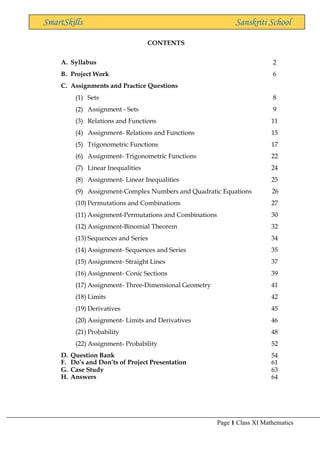
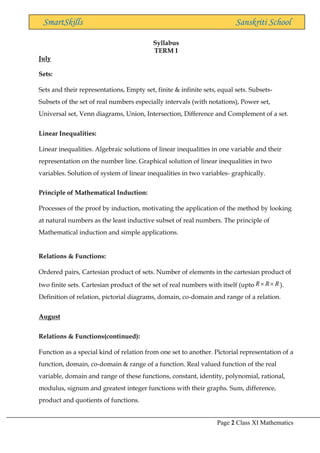
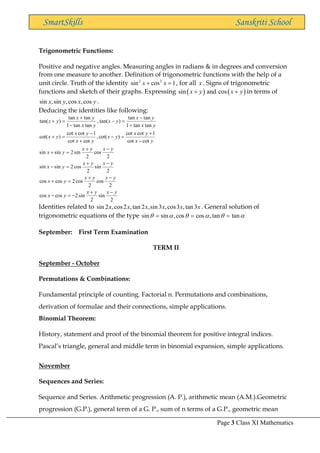
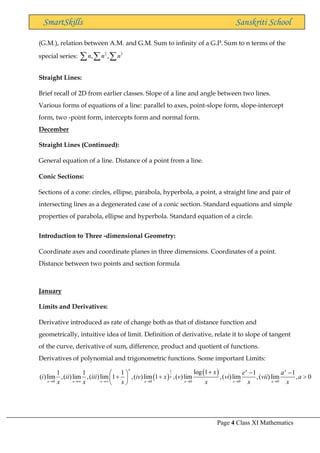
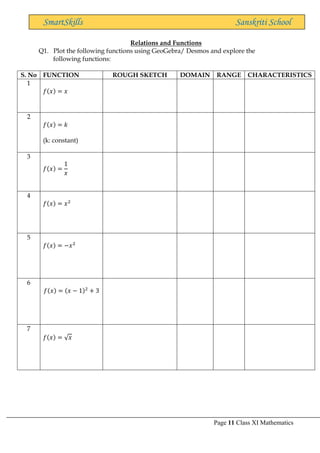
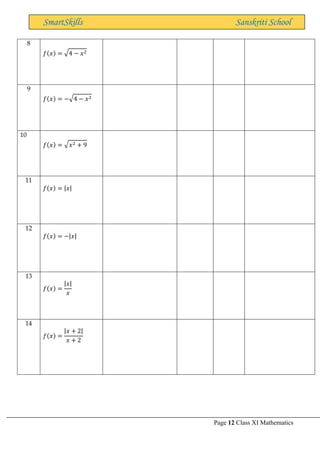
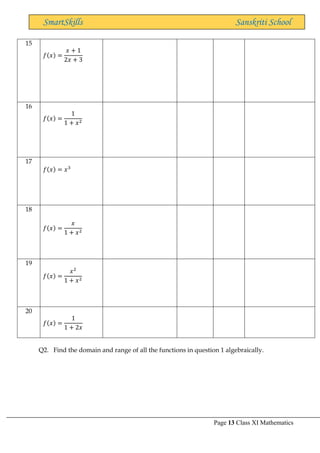
![Page 14 Class XI Mathematics
SmartSkills Sanskriti School
Q3. Draw the rough sketch of the following functions:
i) 𝑓(𝑥) =
{
𝑥 + 1, −1 ≤ 𝑥 ≤ 1
3 − 𝑥, 1 ≤ 𝑥 ≤ 3
6 − 2𝑥, 3 ≤ 𝑥 ≤ 4
ii) 𝑓(𝑥) = {
𝑥 − 1, 𝑥 < 2
2𝑥 + 3, 𝑥 ≥ 2
iii) 𝑓(𝑥) = |1 + 𝑥| + |1 − 𝑥| , 𝑥 ∈ [−2,2]
iv) 𝑓(𝑥) = |𝑥 + 3|
v) 𝑓(𝑥) = {
3 + 2𝑥, 𝑥 ≥ 0
𝑥 + 3, 𝑥 < 0
vi) 𝑓(𝑥) = {
𝑥 − 1, 𝑥 ≥ 0
3𝑥, 𝑥 < 0
vii) 𝑓(𝑥) =
{
𝑥 + 1, 𝑥 > 2
4, 𝑥 = 2
2𝑥 + 1, 𝑥 < 2
viii) 𝑓(𝑥) = {
2𝑥 + 1, 𝑥 ≥ 3
𝑥2
, 𝑥 < 3
ix) 𝑓(𝑥) =
{
1 − 𝑥, 𝑥 < −3
𝑥2
, −3 ≤ 𝑥 ≤ 4
4𝑥, 𝑥 ≥ 4
x) 𝑓(𝑥) =
{
5 − 𝑥, 𝑥 < −1
𝑥2
, −1 ≤ 𝑥 < 2
2𝑥, 𝑥 ≥ 2
xi) 𝑓(𝑥) = 2𝑥 − |𝑥|
xii) 𝑓(𝑥) = |𝑥 − 2| − 1](https://image.slidesharecdn.com/mathematicsxi-251009070449-75b9233d/85/Mathematics-XI-assignment-chapter-wise-important-questions-for-maths-pdf-14-320.jpg)
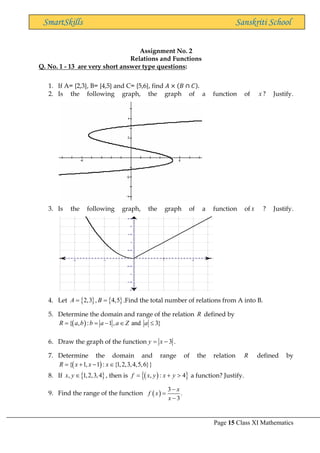
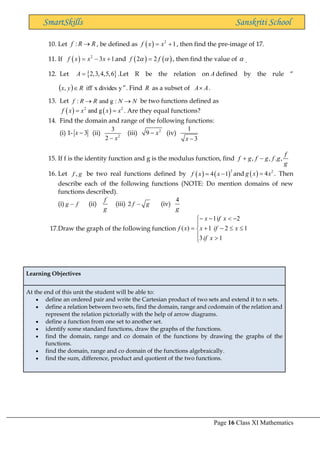
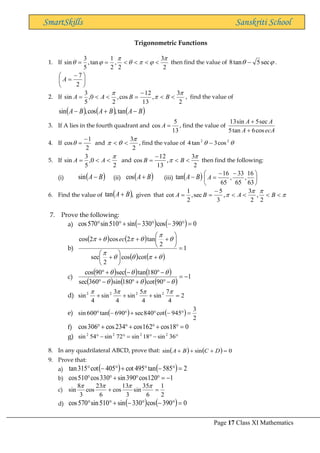
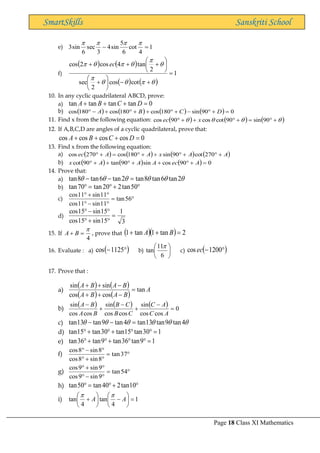
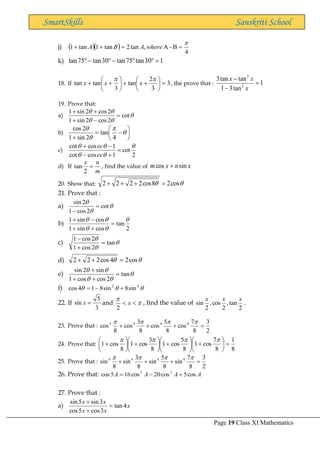
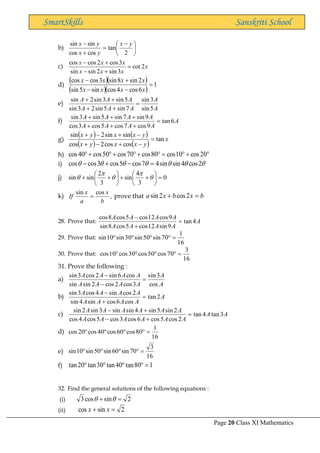
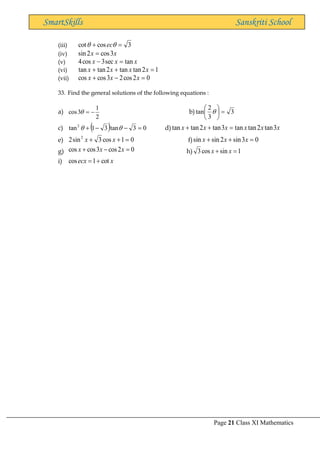
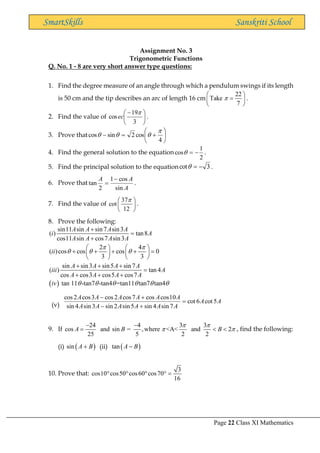
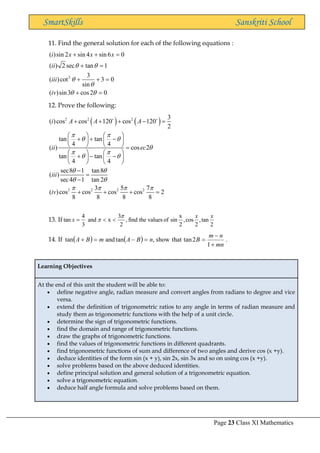
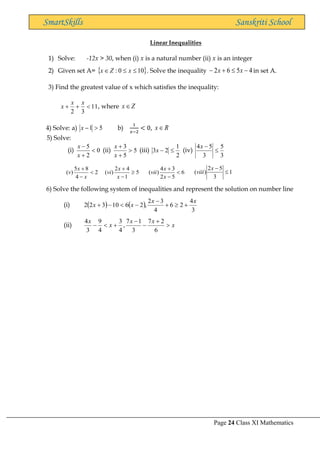
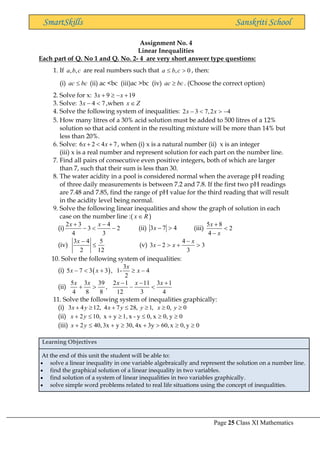
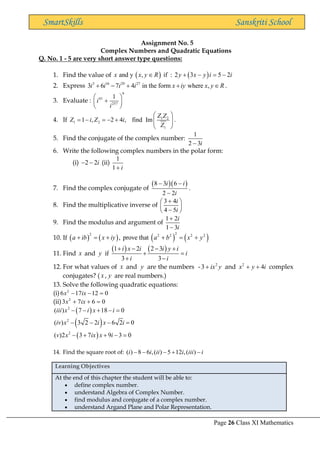
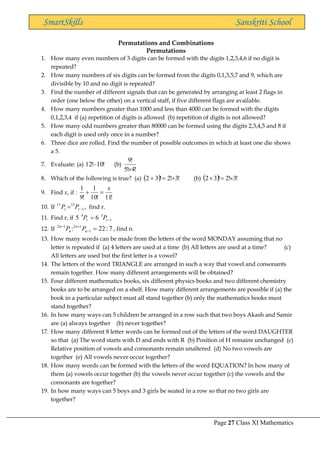
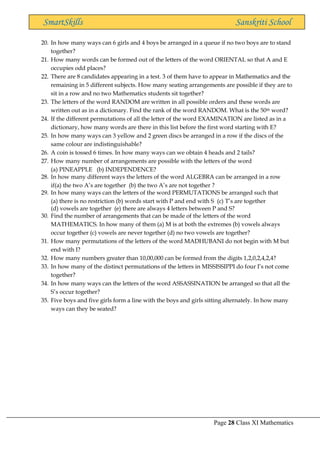
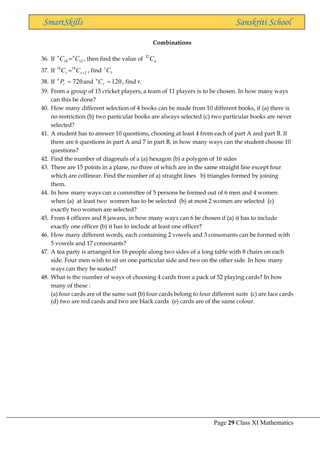
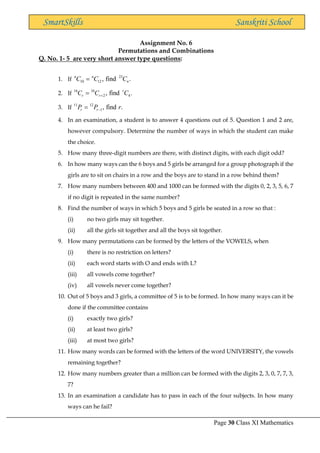
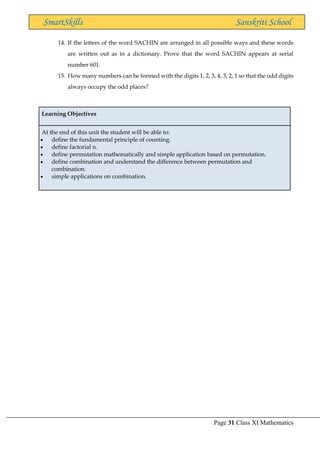
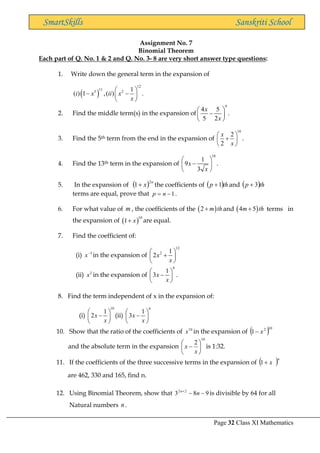
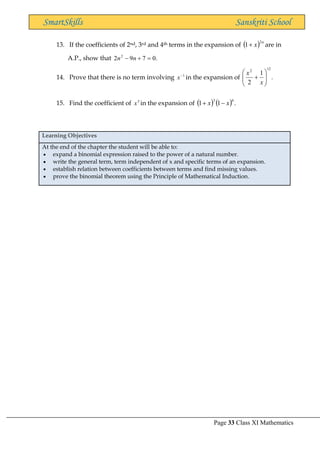
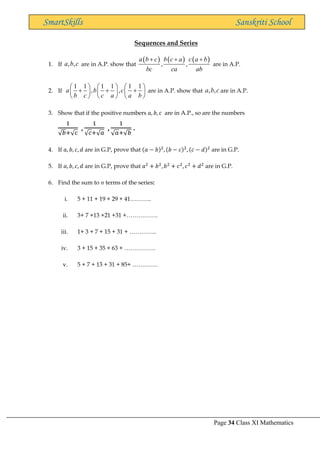
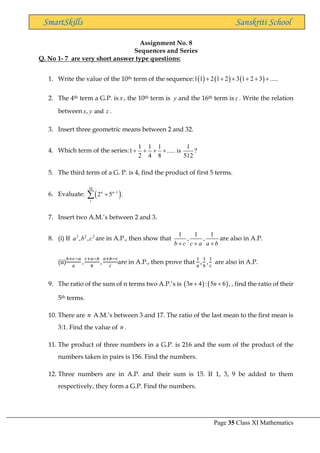
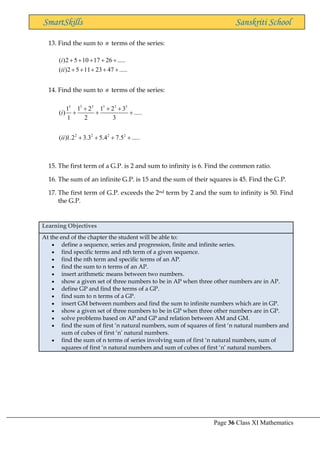
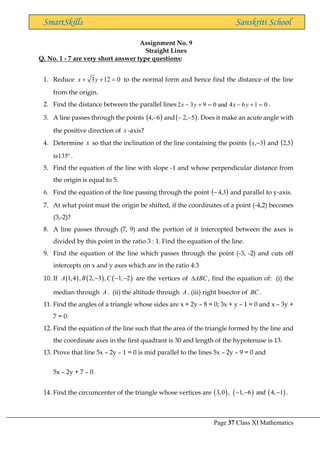
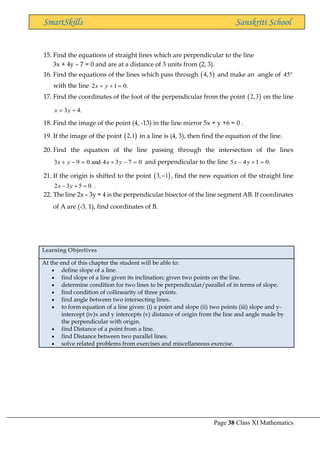
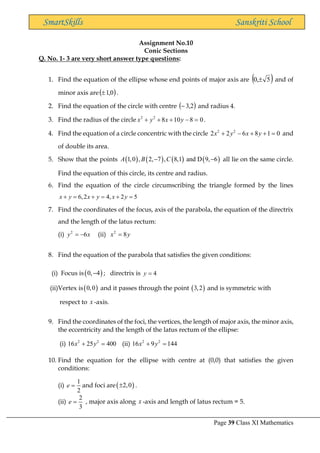
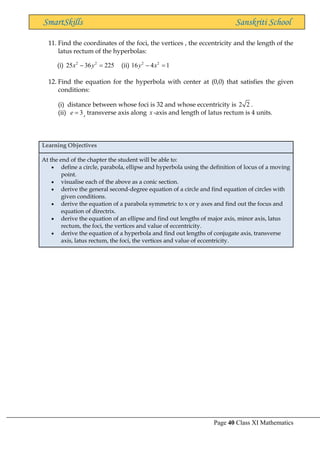
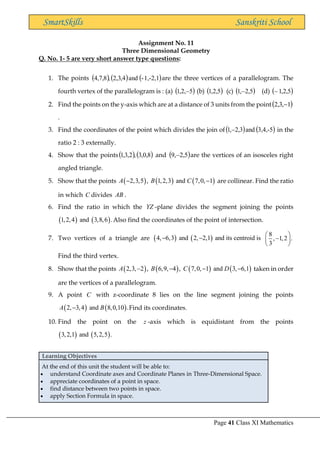
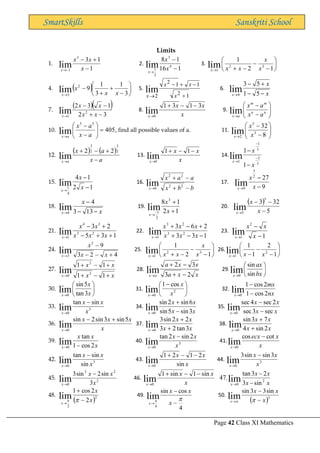
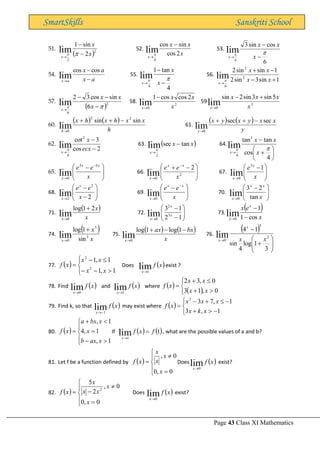
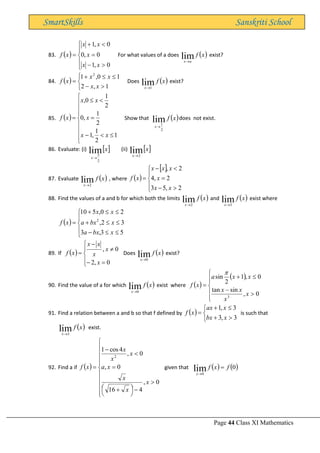
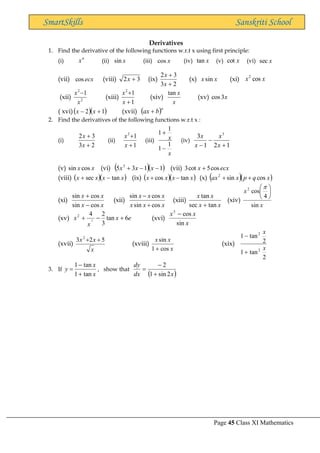
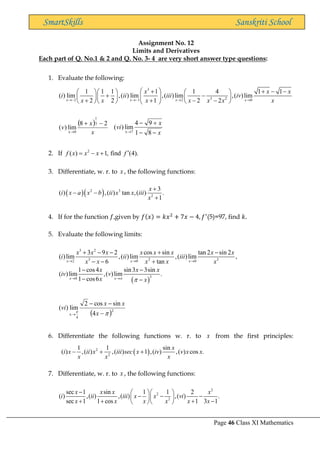
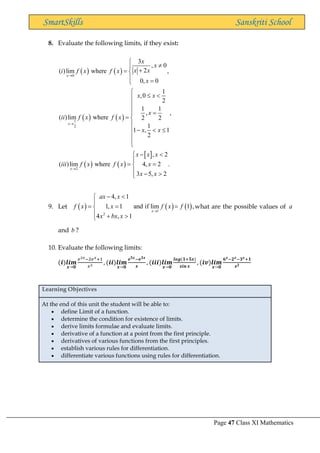
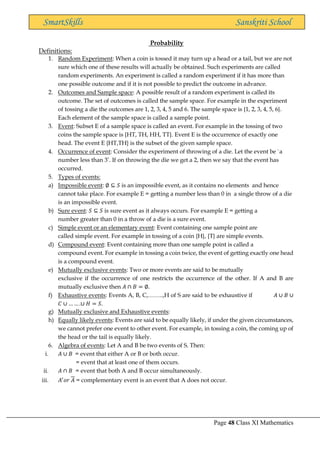
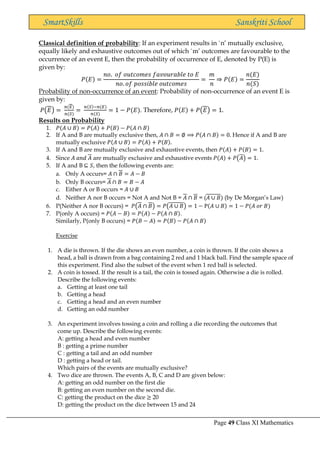
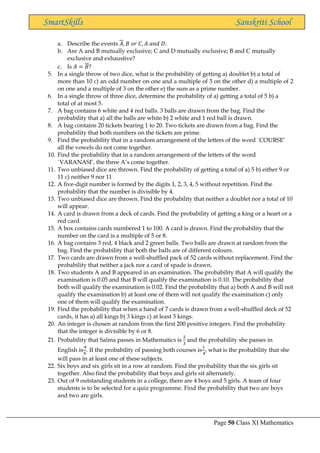
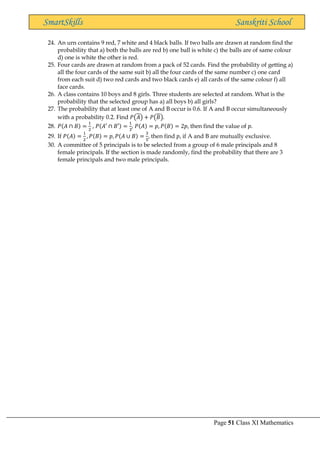
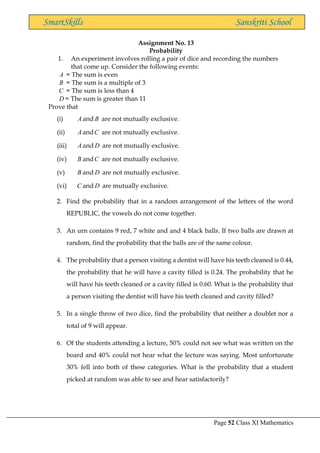
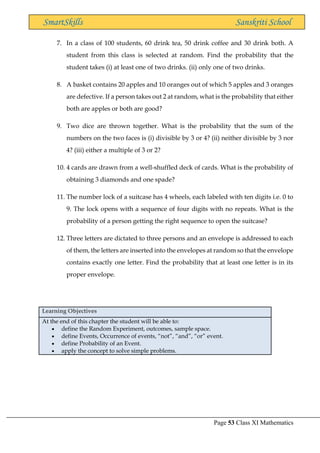
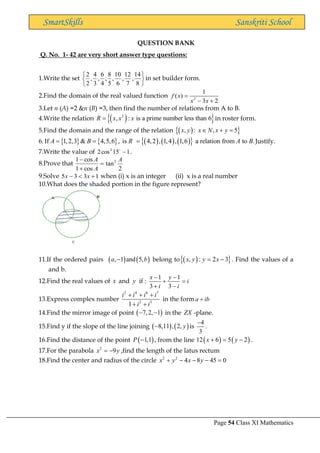
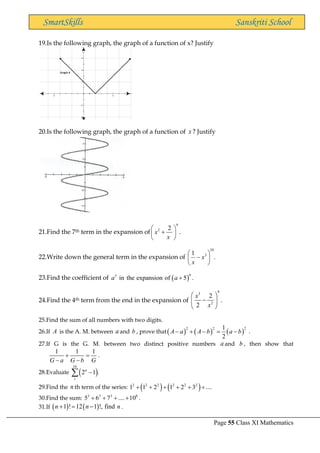
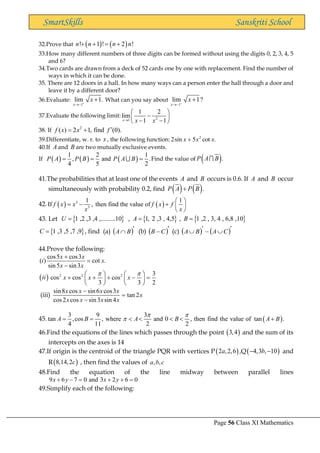
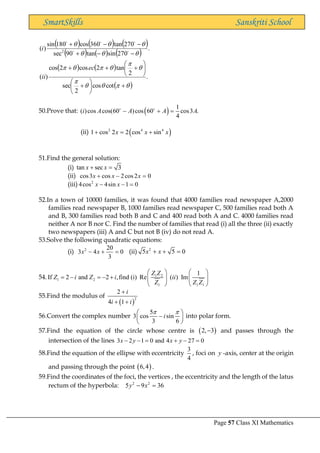
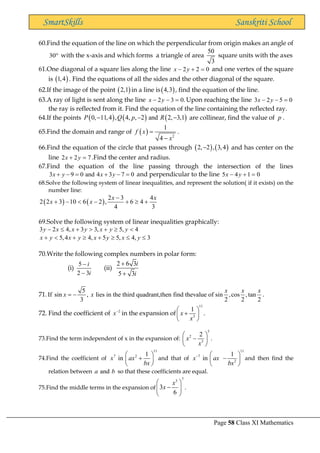
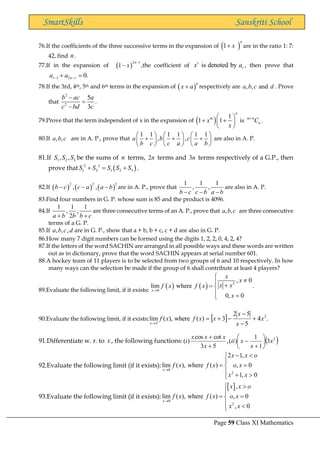
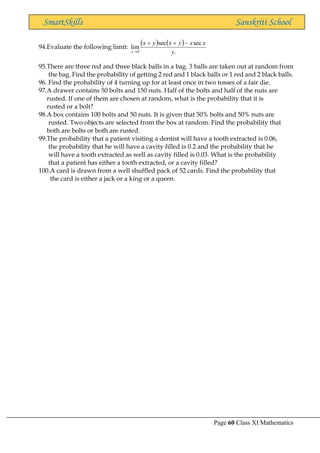
![Page 64 Class XI Mathematics
SmartSkills Sanskriti School
ANSWERS OF THE ASSIGNMENTS
ASSIGNMENT NO. 1 (SETS)
1. {𝑥: 𝑥 =
𝑛
𝑛3+1
, 𝑛 ≤ 6, 𝑛є𝑁}
2. {𝑥: 𝑥 =
𝑛
𝑛+2
, 𝑛 𝑖𝑠 𝑎𝑛 𝑜𝑑𝑑 𝑛𝑎𝑡𝑢𝑟𝑎𝑙 𝑛𝑢𝑚𝑏𝑒𝑟 ≤ 11 }
3. {0, ±1, ±2, ±3, ±4, ±5}
4. {17, 26, 35, 44, 53, 62, 71, 80}
5. 𝐴 = 𝐶 ; 𝐴𝑎𝑛𝑑𝐶, 𝐷𝑎𝑛𝑑𝐸 𝑎𝑟𝑒 𝑒𝑞𝑢𝑖𝑣𝑎𝑙𝑒𝑛𝑡
6. (a) finite (b) infinite (c) empty (d) infinite (e) empty (f) finite
7. 𝐴 ∩ 𝐵 = {𝑥 ∶ 𝑥 = 15𝑛 , 𝑛є𝑍}
8. 𝑃(𝐴) = {∅, {1}, {2}, {{3,4}}, {1,2}, {1, {3,4}}, {2, {3,4}}, 𝐴}
10. False (i) , (ii) ,(iii) , (vi) , (viii) True (iv) , (v) , (vii)
12. (i) {6,8} (ii) {1,3,5,7,9} (iii) {1} (iv) {3,5,6,7,8}
13. (i) 7 (ii) 6 (iii) 10
14. (i) 18 (ii) 3
15. (i) 62 (ii) 39 (iii) 1
16. (i) 35 (ii) 11 (iii) 11
ASSIGNMENT NO. 2 (RELATIONS AND FUNCTIONS)
1. {(2,5), (3,5)}
2. Not a function
3. Yes it’s a function
4. 24
5. 𝐷𝑜𝑚𝑎𝑖𝑛 = {−3, −2, −1, 0, 1, 2, 3} , Range = {0 , 1 , 2 , 3, 4}
7. D = {2 , 3 , 4 , 5 , 6 , 7}𝑅 = {0 , 1 , 2 , 3, 4 , 5}
8. Not a function
9. 𝑅 = {−1}
10. ±4
11. ±
1
√2
12. 𝑅 = {(2,2), (2,4), (2,6), (3,3), (3,6), (4,4), (5,5), (6,6)}
13. Not equal because their domains are not equal
14. (i) 𝐷𝑓 = 𝑅 , 𝑅𝑓 = (−∞, 1] (ii) 𝐷𝑓 = 𝑅 − {±√2} , 𝑅𝑓 = (−∞, 0) ∪ [
3
2
, ∞)
(iii) 𝐷𝑓 = [−3,3] , 𝑅𝑓 = [0,3] (iv) 𝐷𝑓 = (3, ∞) , 𝑅𝑓 = (0, ∞)
15. (𝑓 + 𝑔)(𝑥) = {
2𝑥, 𝑥 ≥ 0
0, 𝑥 < 0
,(𝑓 − 𝑔)(𝑥) = {
0, 𝑥 ≥ 0
2𝑥, 𝑥 < 0
,
(𝑓𝑔)(𝑥) = {
𝑥2
, 𝑥 ≥ 0
−𝑥2
, 𝑥 < 0
,(
𝑓
𝑔
) (𝑥) = {
1, 𝑥 > 0
−1, 𝑥 < 0
16. (𝑖)(𝑔 − 𝑓)(𝑥) = −4 + 8𝑥, 𝐷𝑔−𝑓 = 𝑅 (𝑖𝑖)
𝑓
𝑔
(𝑥) = (
𝑥−1
𝑥
)
2
, 𝐷𝑓
𝑔
= 𝑅 − {0}
(iii)8𝑥2
− 18𝑥 + 8, 𝑥 ≥ 0; 8𝑥2
− 14𝑥 + 8, 𝑥 < 0
(𝑖𝑣)
4
𝑔
(𝑥) =
1
𝑥2,𝐷4
𝑔
= 𝑅 − {0} 17. − 4](https://image.slidesharecdn.com/mathematicsxi-251009070449-75b9233d/85/Mathematics-XI-assignment-chapter-wise-important-questions-for-maths-pdf-64-320.jpg)
![Page 65 Class XI Mathematics
SmartSkills Sanskriti School
ASSIGNMENT NO. 3 (TRIGONOMETRIC FUNCTIONS)
(1). 8
3
9
1
18
(2)
3
3
2
− (4) Z
n
n
= ;
3
2
2
(5)
6
11
,
6
5
3
2
)
7
( + (9)
44
117
,
5
3
(11)(i) Z
n
;
3
n
or
4
n
(ii) ( ) Z
n
;
4
2
1
-
n
Z
n
;
4
2
+
−
+
−
n
or
n (𝑖𝑖𝑖)𝑛𝜋 + (−1)𝑛+1 𝜋
6
𝑜𝑟 𝑚𝜋 +
(−1)𝑚+1 𝜋
2
, 𝑚, 𝑛 𝜖 𝑍
(𝑖𝑣)
2𝑛𝜋
5
−
𝜋
10
𝑜𝑟 2𝑚𝜋 −
𝜋
2
, 𝑚, 𝑛 𝜖 𝑍 (13) 2
-
,
5
5
-
,
5
5
2
ASSIGNMENT NO. 4 (LINEAR INEQUALITIES)
1. (i)
2.
2
5
x
3.
3
,
2
,
1
,
0
,
1
,
2
........, −
−
4. )
( 5
,
2
−
5. 5
.
62 x 400
6. i) {1,2} ii) {…….,0,1,2} iii) (−∞, 5/2)
7. 8 and 10; 10 and 12; 12 and 14;
8. 6.27 x 8.07
9. (i) x
2
13
− (ii) x 1 or x 11/3 (iii) x < 0 or x > 4 (iv)
18
29
18
19
x (v) x
2
5
10. (i) 2
x (ii) x
11
40
ASSIGNMENT No. 5 (COMPLEX NUMBERS AND QUADRATIC EQUATIONS)
1. x = 1/6 , y = 5/2
2. 6 − 4𝑖
3. 0
4. 2
5.
2
13
−
3
13
𝑖
6. (𝑖)2√2 [𝑐𝑜𝑠 (−
3𝜋
4
) + 𝑖𝑠𝑖𝑛 (−
3𝜋
4
)] (ii)
1
√2
[𝑐𝑜𝑠 (−
𝜋
4
) + 𝑖𝑠𝑖𝑛 (−
𝜋
4
)]
7.
71
4
−
19
4
𝑖
8. −
8
25
−
31
25
𝑖
9.
1
√2
,
3𝜋
4
10.
11. x = 3 , y = -1
12. x = 1 , y = -4 or x = -1 , y = -4
13. (i)
3
2
𝑖 ,
4
3
𝑖 (ii) −3𝑖 ,
2
3
𝑖
3
( )4 3 ,3 2 ,( ) 2 , 2 ( ) ,3
2
i
iii i i iv i i v i
+
− + −](https://image.slidesharecdn.com/mathematicsxi-251009070449-75b9233d/85/Mathematics-XI-assignment-chapter-wise-important-questions-for-maths-pdf-65-320.jpg)