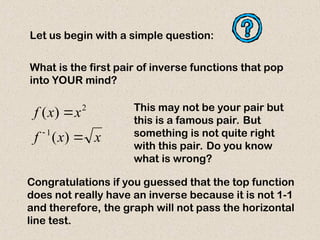
Let us beginwith a simple question:
x
x
f
x
x
f
)
(
)
(
1
2
What is the first pair of inverse functions that pop
into YOUR mind?
This may not be your pair but
this is a famous pair. But
something is not quite right
with this pair. Do you know
what is wrong?
Congratulations if you guessed that the top function
does not really have an inverse because it is not 1-1
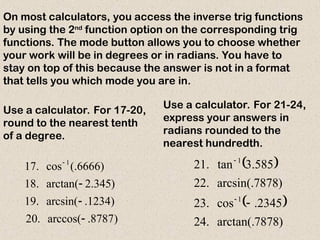
and therefore, the graph will not pass the horizontal
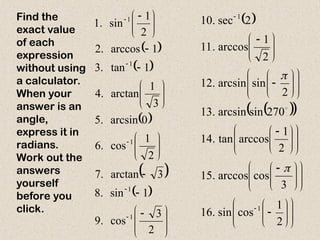
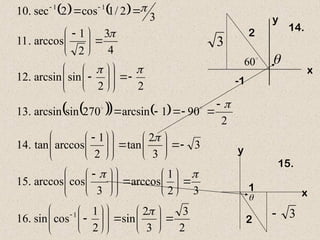
line test.
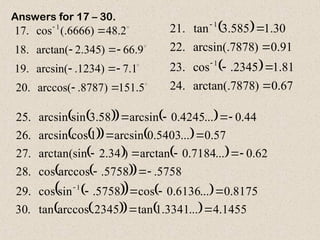
3.
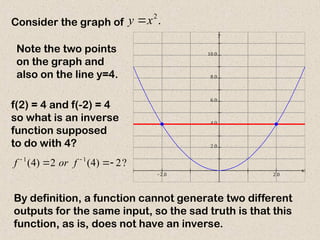
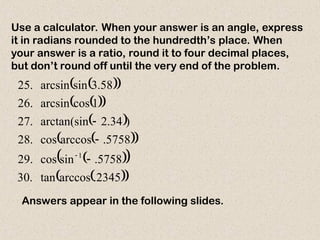
Consider the graphof .
2
x
y
x
y
Note the two points
on the graph and
also on the line y=4.
f(2) = 4 and f(-2) = 4
so what is an inverse
function supposed
to do with 4?
?
2
)
4
(
2
)
4
( 1
1
f
or
f
By definition, a function cannot generate two different
outputs for the same input, so the sad truth is that this
function, as is, does not have an inverse.
4.
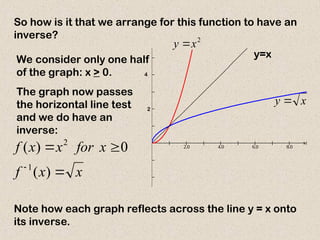
So how isit that we arrange for this function to have an
inverse?
We consider only one half
of the graph: x > 0.
The graph now passes
the horizontal line test
and we do have an
inverse:
x
x
f
x
for
x
x
f
)
(
0
)
(
1
2
Note how each graph reflects across the line y = x onto
its inverse.
x
y
x
4
y=x
2
x
y
2
5.
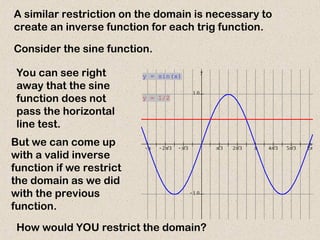
A similar restrictionon the domain is necessary to
create an inverse function for each trig function.
Consider the sine function.
You can see right
away that the sine
function does not
pass the horizontal
line test.
But we can come up
with a valid inverse
function if we restrict
the domain as we did
with the previous
function.
How would YOU restrict the domain?
x
y
y = sin(x)
y = 1/2
6.
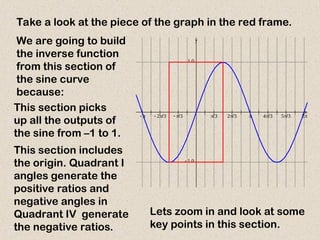
Take a lookat the piece of the graph in the red frame.
x
y
We are going to build
the inverse function
from this section of
the sine curve
because:
This section picks
up all the outputs of
the sine from –1 to 1.
This section includes
the origin. Quadrant I
angles generate the
positive ratios and
negative angles in
Quadrant IV generate
the negative ratios.
Lets zoom in and look at some
key points in this section.
7.
x
y
y = sin(x)
1
2
2
3
3
2
2
4
2
1
6
0
0
2
1
6
2
2
4
2
3
3
1
2
)
(
x
f
x
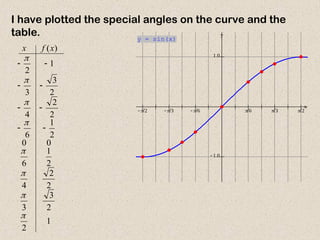
I have plotted the special angles on the curve and the
table.
8.
2
1
3
2
3
4
2
2
6
2
1
0
0
6
2
1
4
2
2
3
2
3
2
1
)
(
sin 1
x
x
The newtable generates the graph of the inverse.
1
2
2
3
3
2
2
4
2
1
6
0
0
2
1
6
2
2
4
2
3
3
1
2
)
sin(
x
x
To get a good
look at the
graph of the
inverse
function, we
will “turn the
tables” on
the sine
function.
The domain
of the chosen
section of the
sine is
So the range
of the arcsin
is
2
,
2
2
,
2
The range of
the chosen
section of the
sine is [-1 ,1]
so the domain
of the arcsin is
[-1, 1].
9.
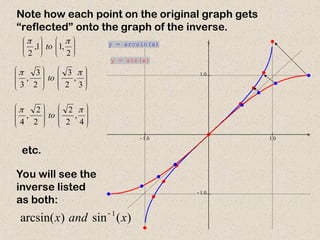
Note how eachpoint on the original graph gets
“reflected” onto the graph of the inverse.
2
,
1
1
,
2
to
3
,
2
3
2
3
,
3
to
4
,
2
2
2
2
,
4
to
etc.
You will see the
inverse listed
as both:
)
(
sin
)
arcsin( 1
x
and
x
x
y
y = arcsin(x)
y = sin(x)
10.
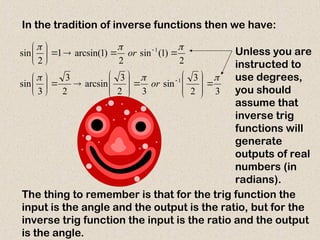
In the traditionof inverse functions then we have:
3
2
3
sin
3
2
3
arcsin
2
3
3
sin
2
)
1
(
sin
2
)
1
arcsin(
1
2
sin
1
1
or
or
The thing to remember is that for the trig function the
input is the angle and the output is the ratio, but for the
inverse trig function the input is the ratio and the output
is the angle.
Unless you are
instructed to
use degrees,
you should
assume that
inverse trig
functions will
generate
outputs of real
numbers (in
radians).
11.
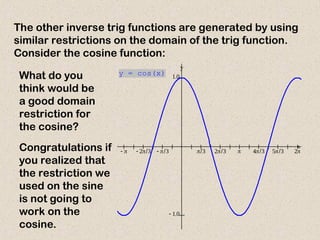
The other inversetrig functions are generated by using
similar restrictions on the domain of the trig function.
Consider the cosine function:
x
y
y = cos(x)
What do you
think would be
a good domain
restriction for
the cosine?
Congratulations if
you realized that
the restriction we
used on the sine
is not going to
work on the
cosine.
12.
x
y
y = cos(x)
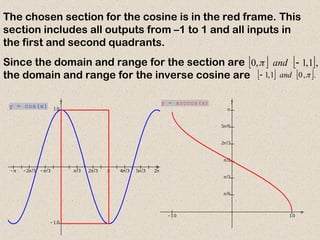
The chosen section for the cosine is in the red frame. This
section includes all outputs from –1 to 1 and all inputs in
the first and second quadrants.
Since the domain and range for the section are
the domain and range for the inverse cosine are
,
1
,
1
,
0
and
.
,
0
1
,
1
and
x
y
y = arccos(x)
13.
x
y
x
y
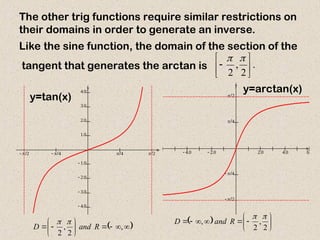
The other trig functions require similar restrictions on
their domains in order to generate an inverse.
Like the sine function, the domain of the section of the
tangent that generates the arctan is .
2
,
2
,
2
,
2
R
and
D
2
,
2
,
R
and
D
y=tan(x)
y=arctan(x)
14.
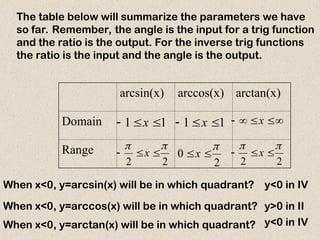
The table belowwill summarize the parameters we have
so far. Remember, the angle is the input for a trig function
and the ratio is the output. For the inverse trig functions
the ratio is the input and the angle is the output.
arcsin(x) arccos(x) arctan(x)
Domain
Range
1
1
x 1
1
x
x
2
2
x
2
0
x
2
2
x
When x<0, y=arccos(x) will be in which quadrant?
When x<0, y=arcsin(x) will be in which quadrant?
When x<0, y=arctan(x) will be in which quadrant?
y<0 in IV
y>0 in II
y<0 in IV
15.
1
2
3
30
60
45
45 1
2
2
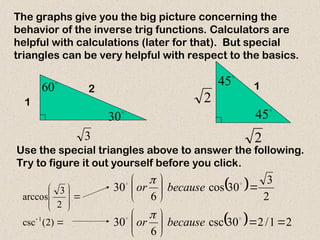
The graphsgive you the big picture concerning the
behavior of the inverse trig functions. Calculators are
helpful with calculations (later for that). But special
triangles can be very helpful with respect to the basics.
Use the special triangles above to answer the following.
Try to figure it out yourself before you click.
)
2
(
csc
2
3
arccos
1
2
1
/
2
30
csc
6
30
2
3
30
cos
6
30
because
or
because
or
16.
1
2
3
30
60
45
45 1
2
2
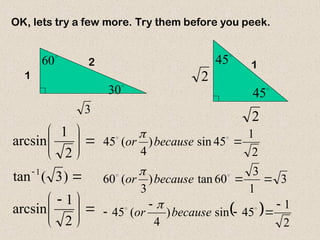
OK, letstry a few more. Try them before you peek.
2
1
arcsin
)
3
(
tan
2
1
arcsin
1
2
1
45
sin
)
4
(
45
3
1
3
60
tan
)
3
(
60
2
1
45
sin
)
4
(
45
because
or
because
or
because
or
17.
1
2
3
30
60
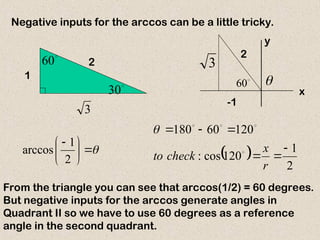
Negative inputs forthe arccos can be a little tricky.
2
1
arccos
From the triangle you can see that arccos(1/2) = 60 degrees.
But negative inputs for the arccos generate angles in
Quadrant II so we have to use 60 degrees as a reference
angle in the second quadrant.
2
1
120
cos
:
120
60
180
r
x
check
to
60
y
x
-1
2
3
18.
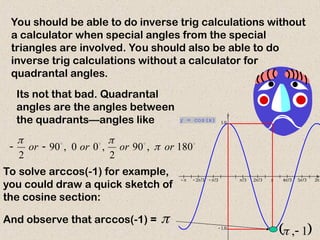
You should beable to do inverse trig calculations without
a calculator when special angles from the special
triangles are involved. You should also be able to do
inverse trig calculations without a calculator for
quadrantal angles.
Its not that bad. Quadrantal
angles are the angles between
the quadrants—angles like
180
,
90
2
,
0
0
,
90
2
or
or
or
or
To solve arccos(-1) for example,
you could draw a quick sketch of
the cosine section:
x
y
y = cos(x)
And observe that arccos(-1) =
1
,
19.
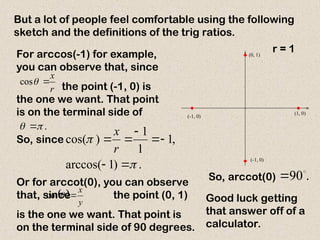
But a lotof people feel comfortable using the following
sketch and the definitions of the trig ratios.
For arccos(-1) for example,
you can observe that, since
the point (-1, 0) is
the one we want. That point
is on the terminal side of
r
x
cos
.
Or for arccot(0), you can observe
that, since the point (0, 1)
is the one we want. That point is
on the terminal side of 90 degrees.
y
x
cot
.
)
1
arccos(
,
1
1
1
)
cos(
r
x
So, since
x
y
(0, 1)
(1, 0)
(-1, 0)
(-1, 0)
r = 1
.
90
So, arccot(0)
Good luck getting
that answer off of a
calculator.
20.
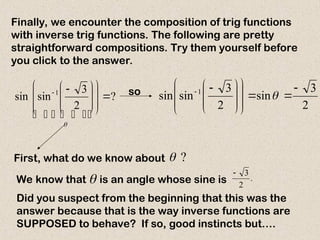
Finally, we encounterthe composition of trig functions
with inverse trig functions. The following are pretty
straightforward compositions. Try them yourself before
you click to the answer.
?
2
3
sin
sin 1
First, what do we know about ?
We know that is an angle whose sine is
.
2
3
so
2
3
sin
2
3
sin
sin 1
Did you suspect from the beginning that this was the
answer because that is the way inverse functions are
SUPPOSED to behave? If so, good instincts but….
21.
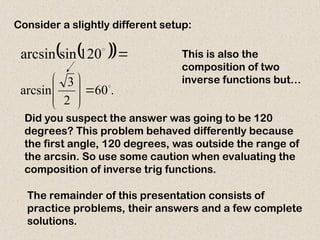
Consider a slightlydifferent setup:
120
sin
arcsin This is also the
composition of two
inverse functions but…
.
60
2
3
arcsin
Did you suspect the answer was going to be 120
degrees? This problem behaved differently because
the first angle, 120 degrees, was outside the range of
the arcsin. So use some caution when evaluating the
composition of inverse trig functions.
The remainder of this presentation consists of
practice problems, their answers and a few complete
solutions.
22.
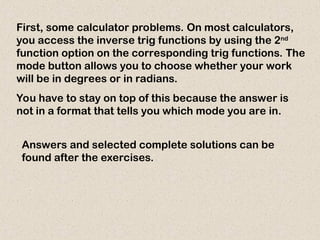
First, some calculatorproblems. On most calculators,
you access the inverse trig functions by using the 2nd
function option on the corresponding trig functions. The
mode button allows you to choose whether your work
will be in degrees or in radians.
You have to stay on top of this because the answer is
not in a format that tells you which mode you are in.
Answers and selected complete solutions can be
found after the exercises.
23.
Find the
exact value
ofeach
expression
without using
a calculator.
When your
answer is an
angle,
express it in
radians.
Work out the
answers
yourself
before you
click.
2
3
cos
.
9
1
sin
.
8
3
arctan
.
7
2
1
cos
.
6
0
arcsin
.
5
3
1
arctan
.
4
1
tan
.
3
1
arccos
.
2
2
1
sin
.
1
1
1
1
1
1
2
1
cos
sin
.
16
3
cos
arccos
.
15
2
1
arccos
tan
.
14
270
sin
arcsin
.
13
2
sin
arcsin
.
12
2
1
arccos
.
11
2
sec
.
10
1
1
24.
Use a calculator.For 17-20,
round to the nearest tenth
of a degree.
)
8787
.
arccos(
.
20
)
1234
.
arcsin(
.
19
)
345
.
2
arctan(
.
18
)
6666
(.
cos
.
17 1
Use a calculator. For 21-24,
express your answers in
radians rounded to the
nearest hundredth.
)
7878
arctan(.
.
24
2345
.
cos
.
23
)
7878
arcsin(.
.
22
585
.
3
tan
.
21
1
1
On most calculators, you access the inverse trig functions
by using the 2nd
function option on the corresponding trig
functions. The mode button allows you to choose whether
your work will be in degrees or in radians. You have to
stay on top of this because the answer is not in a format
that tells you which mode you are in.
25.
Use a calculator.When your answer is an angle, express
it in radians rounded to the hundredth’s place. When
your answer is a ratio, round it to four decimal places,
but don’t round off until the very end of the problem.
2345
.
arccos
tan
.
30
5758
.
sin
cos
.
29
5758
.
arccos
cos
.
28
)
34
.
2
arctan(sin
.
27
1
cos
arcsin
.
26
58
.
3
sin
arcsin
.
25
1
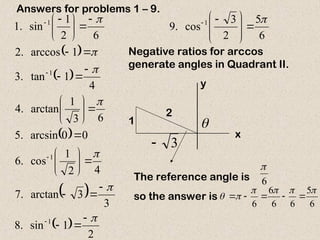
Answers appear in the following slides.


![2
1
3
2
3
4
2
2
6
2
1
0
0
6
2
1
4
2
2
3
2
3
2
1
)
(
sin 1
x
x
The new table generates the graph of the inverse.
1
2
2
3
3
2
2
4
2
1
6
0
0
2
1
6
2
2
4
2
3
3
1
2
)
sin(
x
x
To get a good
look at the
graph of the
inverse
function, we
will “turn the
tables” on
the sine
function.
The domain
of the chosen
section of the
sine is
So the range
of the arcsin
is
2
,
2
2
,
2
The range of
the chosen
section of the
sine is [-1 ,1]
so the domain
of the arcsin is
[-1, 1].](https://image.slidesharecdn.com/inversetrigfunctions1-250711170554-78317a99/85/inverse_trig_functions-class-12th-1-ppt-8-320.jpg)


![Inverse trigonometric functions xii[1]](https://cdn.slidesharecdn.com/ss_thumbnails/inversetrigonometricfunctionsxii1-110816104305-phpapp01-thumbnail.jpg?width=640&height=640&fit=bounds)


