MathematicsasaTool
Chapter1.DataManagement
RHEA C. GATON, MAT
Course Facilitator
DATA
MANAGEMEN
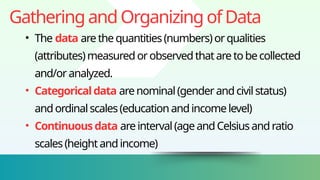
GatheringandOrganizingofData
• The data arethequantities(numbers)orqualities
(attributes)measuredorobservedthataretobecollected
and/oranalyzed.
• Categoricaldata arenominal(genderandcivilstatus)
andordinalscales(educationandincomelevel)
• Continuousdata areinterval(ageandCelsiusandratio
scales(heightandincome)
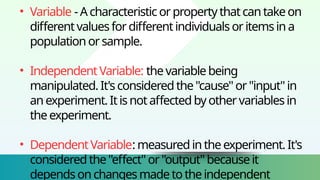
• Variable -Acharacteristicorpropertythatcantakeon
differentvaluesfordifferentindividualsoritemsina
populationorsample.
• IndependentVariable: thevariablebeing
manipulated.It'sconsideredthe"cause"or"input"in
anexperiment.Itisnotaffectedbyothervariablesin
theexperiment.
• DependentVariable:measuredintheexperiment.It's
consideredthe"effect"or"output"becauseit
dependsonchangesmadetotheindependent
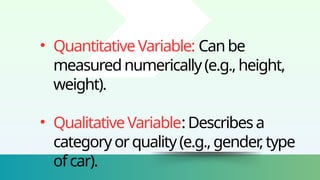
• QuantitativeVariable: Canbe
measurednumerically(e.g.,height,
weight).
• QualitativeVariable:Describesa
categoryorquality(e.g.,gender
,type
ofcar).
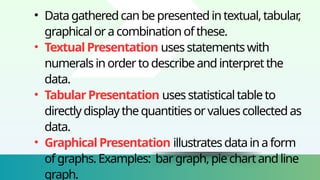
• Datagatheredcanbepresentedintextual,tabular
,
graphicaloracombinationofthese.
• TextualPresentation usesstatementswith
numeralsinordertodescribeandinterpretthe
data.
• TabularPresentation usesstatisticaltableto
directlydisplaythequantitiesorvaluescollectedas
data.
• GraphicalPresentation illustratesdatainaform
ofgraphs.Examples: bargraph,piechartandline
graph.
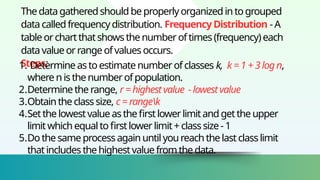
Thedatagatheredshouldbe properlyorganizedintogrouped
datacalledfrequency distribution. FrequencyDistribution - A
tableorchartthatshowsthe number oftimes(frequency) each
datavalueor rangeofvalues occurs.
Steps:
1. Determine astoestimatenumberofclasses k, k=1 +3 logn,
where nis the numberofpopulation.
2.Determinethe range, r= highestvalue -lowestvalue
3.Obtainthe class size, c=rangek
4.Setthe lowestvalue asthefirstlowerlimitand getthe upper
limitwhich equal to firstlowerlimit+classsize- 1
5.Dothe same processagainuntil youreach thelastclasslimit
thatincludes the highestvaluefromthe data.
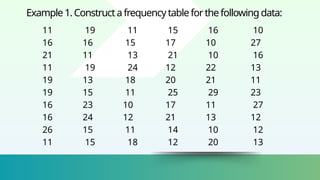
Example1.Constructafrequencytableforthefollowing data:
11 19 11 15 16 10
16 16 15 17 10 27
21 11 13 21 10 16
11 19 24 12 22 13
19 13 18 20 21 11
19 15 11 25 29 23
16 23 10 17 11 27
16 24 12 21 13 12
26 15 11 14 10 12
11 15 18 12 20 13
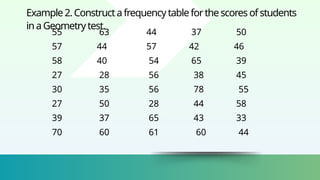
Example2.Constructafrequencytableforthescoresofstudents
in aGeometrytest.
55 63 44 37 50
57 44 57 42 46
58 40 54 65 39
27 28 56 38 45
30 35 56 78 55
27 50 28 44 58
39 37 65 43 33
70 60 61 60 44
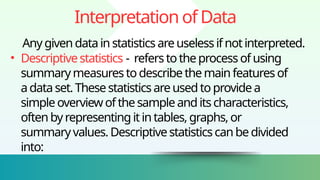
InterpretationofData
Anygivendatainstatisticsareuselessifnotinterpreted.
• Descriptivestatistics - referstotheprocessofusing
summarymeasurestodescribethemainfeaturesof
adataset.Thesestatisticsareusedtoprovidea
simpleoverviewof thesampleanditscharacteristics,
oftenbyrepresentingitintables,graphs,or
summaryvalues.Descriptivestatisticscanbedivided
into:
• Measuresofcentraltendency -Thesesummarizethe
centerofadatasetandinclude:Mean,Median,andMode.
• Measuresofvariability (ordispersion)-Thesedescribehow
spreadoutthedataisandinclude:Range,Variance,
Standarddeviation.
• Measuresofdistributionshape -Thesedescribetheoverall
patternofthedata,including:SkewnessandKurtosis
• CentralTendency -Ameasurethatrepresents
thecenterortypicalvalueofadataset.The
mostcommonmeasuresare:
• Mean:Thearithmeticaverage.
• Median:Themiddlevalueofanordereddata
set.
• Mode:Themostfrequentlyoccurringvalue.
MeasuresofCentralTendencyofUngroupedData
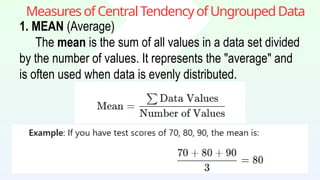
1. MEAN (Average)
The mean is the sum of all values in a data set divided
by the number of values. It represents the "average" and
is often used when data is evenly distributed.
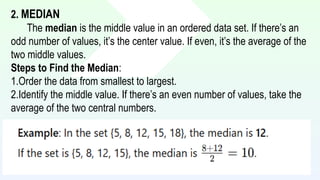
2. MEDIAN
The median is the middle value in an ordered data set. If there’s an
odd number of values, it’s the center value. If even, it’s the average of the
two middle values.
Steps to Find the Median:
1.Order the data from smallest to largest.
2.Identify the middle value. If there’s an even number of values, take the
average of the two central numbers.
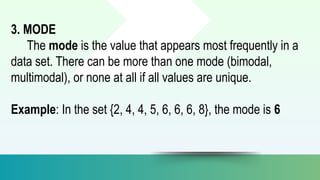
3. MODE
The mode is the value that appears most frequently in a
data set. There can be more than one mode (bimodal,
multimodal), or none at all if all values are unique.
Example: In the set {2, 4, 4, 5, 6, 6, 6, 8}, the mode is 6
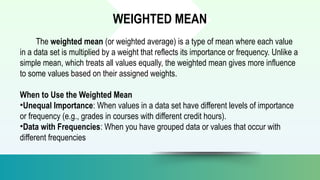
WEIGHTED MEAN
The weighted mean (or weighted average) is a type of mean where each value
in a data set is multiplied by a weight that reflects its importance or frequency. Unlike a
simple mean, which treats all values equally, the weighted mean gives more influence
to some values based on their assigned weights.
When to Use the Weighted Mean
•Unequal Importance: When values in a data set have different levels of importance
or frequency (e.g., grades in courses with different credit hours).
•Data with Frequencies: When you have grouped data or values that occur with
different frequencies
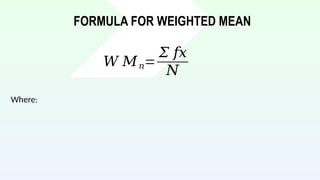
𝑊 𝑀𝑛=
𝛴 𝑓𝑥
𝑁
FORMULA FOR WEIGHTED MEAN
Where:
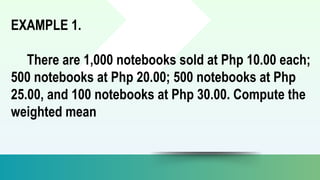
EXAMPLE 1.
There are 1,000 notebooks sold at Php 10.00 each;
500 notebooks at Php 20.00; 500 notebooks at Php
25.00, and 100 notebooks at Php 30.00. Compute the
weighted mean
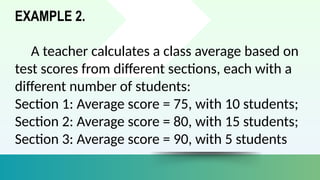
EXAMPLE 2.
A teacher calculates a class average based on
test scores from different sections, each with a
different number of students:
Section 1: Average score = 75, with 10 students;
Section 2: Average score = 80, with 15 students;
Section 3: Average score = 90, with 5 students
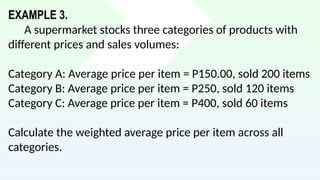
EXAMPLE 3.
A supermarket stocks three categories of products with
different prices and sales volumes:
Category A: Average price per item = P150.00, sold 200 items
Category B: Average price per item = P250, sold 120 items
Category C: Average price per item = P400, sold 60 items
Calculate the weighted average price per item across all
categories.
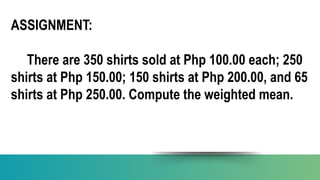
ASSIGNMENT:
There are 350 shirts sold at Php 100.00 each; 250
shirts at Php 150.00; 150 shirts at Php 200.00, and 65
shirts at Php 250.00. Compute the weighted mean.
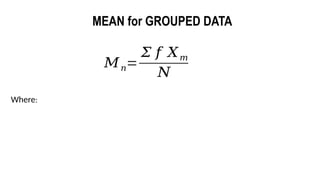
𝑀𝑛=
𝛴 𝑓 𝑋𝑚
𝑁
MEAN for GROUPED DATA
Where:
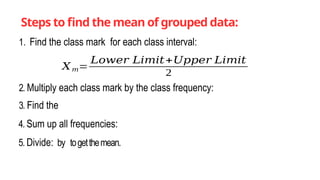
Steps to find the mean of grouped data:
1. Find the class mark for each class interval:
𝑋𝑚=
𝐿𝑜𝑤𝑒𝑟 𝐿𝑖𝑚𝑖𝑡+𝑈𝑝𝑝𝑒𝑟 𝐿𝑖𝑚𝑖𝑡
2
2. Multiply each class mark by the class frequency:
3. Find the
4. Sum up all frequencies:
5. Divide: by togetthemean.
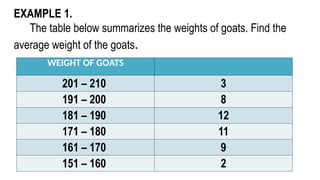
EXAMPLE 1.
The table below summarizes the weights of goats. Find the
average weight of the goats.
WEIGHT OF GOATS
201 – 210 3
191 – 200 8
181 – 190 12
171 – 180 11
161 – 170 9
151 – 160 2
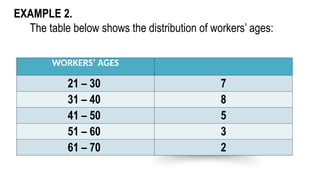
EXAMPLE 2.
The table below shows the distribution of workers’ ages:
WORKERS’ AGES
21 – 30 7
31 – 40 8
41 – 50 5
51 – 60 3
61 – 70 2
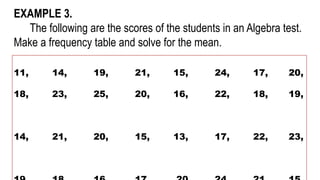
EXAMPLE 3.
The following are the scores of the students in an Algebra test.
Make a frequency table and solve for the mean.
11, 14, 19, 21, 15, 24, 17, 20,
18, 23, 25, 20, 16, 22, 18, 19,
14, 21, 20, 15, 13, 17, 22, 23,
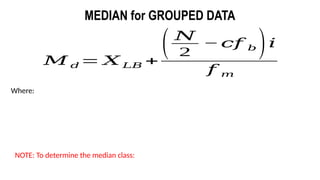
𝑀 𝑑 = 𝑋 𝐿𝐵 +
( 𝑁
2
−𝑐𝑓 𝑏 )𝑖
𝑓 𝑚
MEDIAN for GROUPED DATA
Where:
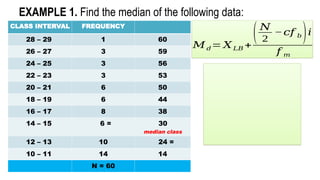
NOTE: To determine the median class:
CLASS INTERVAL FREQUENCY
28 – 29 1 60
26 – 27 3 59
24 – 25 3 56
22 – 23 3 53
20 – 21 6 50
18 – 19 6 44
16 – 17 8 38
14 – 15 6 = 30
median class
12 – 13 10 24 =
10 – 11 14 14
N = 60
EXAMPLE 1. Find the median of the following data:
𝑀𝑑= 𝑋𝐿𝐵 +
(𝑁
2
−𝑐𝑓 𝑏)𝑖
𝑓 𝑚
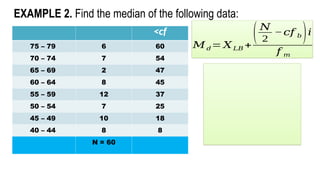
EXAMPLE 2. Find the median of the following data:
<cf
75 – 79 6 60
70 – 74 7 54
65 – 69 2 47
60 – 64 8 45
55 – 59 12 37
50 – 54 7 25
45 – 49 10 18
40 – 44 8 8
N = 60
𝑀𝑑= 𝑋𝐿𝐵 +
(𝑁
2
−𝑐𝑓 𝑏)𝑖
𝑓 𝑚
𝑀 𝑜= 𝑋 𝐿𝐵+
[ 𝑑 𝑓 1
𝑑 𝑓 1 + 𝑑 𝑓 2
]𝑖
MODE for GROUPED DATA
Where:
NOTE: The modal class is the class with the highest frequency
CLASS INTERVAL FREQUENCY
28 – 29 1
26 – 27 3
24 – 25 3
22 – 23 3
20 – 21 6
18 – 19 6
16 – 17 8
14 – 15 6
12 – 13 10
10 – 11 14
modal class
N = 60
EXAMPLE 1. Find the mode of the following data:
𝑀𝑜= 𝑋 𝐿𝐵+
[ 𝑑 𝑓 1
𝑑 𝑓 1 +𝑑 𝑓 2
]𝑖
Scores in Algebra FREQUENCY
75 – 79 6
70 – 74 7
65 – 69 2
60 – 64 8
55 – 59 12
50 – 54 7
45 – 49 10
40 – 44 8
N = 60
EXAMPLE 2. Find the mode of the following data:
𝑀𝑜= 𝑋 𝐿𝐵+
[ 𝑑 𝑓 1
𝑑 𝑓 1 +𝑑 𝑓 2
]𝑖
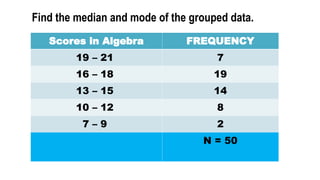
Scores in Algebra FREQUENCY
19 – 21 7
16 – 18 19
13 – 15 14
10 – 12 8
7 – 9 2
N = 50
Find the median and mode of the grouped data.
Measure of Relative Position
The measure of relative position helps us understand
how a particular data point compares to the other
values in a dataset. Commonly used measures include
percentiles, quartiles and deciles. These measures
allow us to see how high or low a value is in relation to
the rest of the data.
1. Percentiles
Percentiles are used to describe the position of a value
relative to the entire dataset. They tell you what
percentage of data values fall below a certain point.
•Definition:
•A percentile divides a dataset into 100 equal parts.
•Example: If you are at the 75th percentile, this means
you scored better than 75% of the people
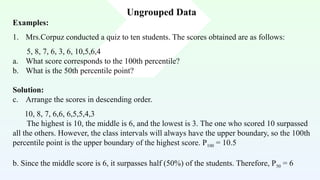
Ungrouped Data
Examples:
1. Mrs.Corpuz conducted a quiz to ten students. The scores obtained are as follows:
5, 8, 7, 6, 3, 6, 10,5,6,4
a. What score corresponds to the 100th percentile?
b. What is the 50th percentile point?
Solution:
c. Arrange the scores in descending order.
10, 8, 7, 6,6, 6,5,5,4,3
The highest is 10, the middle is 6, and the lowest is 3. The one who scored 10 surpassed
all the others. However, the class intervals will always have the upper boundary, so the 100th
percentile point is the upper boundary of the highest score. P100 = 10.5
b. Since the middle score is 6, it surpasses half (50%) of the students. Therefore, P50 = 6
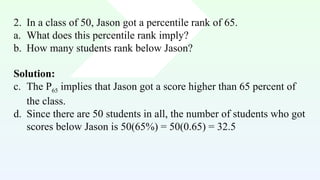
2. In a class of 50, Jason got a percentile rank of 65.
a. What does this percentile rank imply?
b. How many students rank below Jason?
Solution:
c. The P65 implies that Jason got a score higher than 65 percent of
the class.
d. Since there are 50 students in all, the number of students who got
scores below Jason is 50(65%) = 50(0.65) = 32.5
𝑃𝑛= 𝑋 𝐿𝐵 +𝑖
[𝑛𝑁 − 𝐹
𝑓 ]
PERCENTILE for GROUPED DATA
Where:
NOTE: To determine the percentile class:
CLASS INTERVAL FREQUENCY
28 – 29 1 60
26 – 27 3 59
24 – 25 3 56
22 – 23 3 53
20 – 21 6 50
18 – 19 6 44
16 – 17 8 38
14 – 15 6 30
12 – 13 10 24
10 – 11 14 14
N = 60
EXAMPLE 1. Find the
𝑃𝑛= 𝑋𝐿𝐵 +𝑖
[𝑛𝑁 − 𝐹
𝑓 ]
Scores in Algebra FREQUENCY
75 – 79 6
70 – 74 7
65 – 69 2
60 – 64 8
55 – 59 12
50 – 54 7
45 – 49 10
40 – 44 8
N = 60
EXAMPLE 2. Find the
𝑃𝑛= 𝑋𝐿𝐵 +𝑖
[𝑛𝑁 − 𝐹
𝑓 ]
2. Quartiles
Quartiles divide a dataset into four equal parts. There are three
main quartiles:
Q1 (First Quartile): The 25th percentile, or the value that separates
the lowest 25% of data.
Q2 (Second Quartile): The 50th percentile, or the median of the
dataset.
Q3 (Third Quartile): The 75th percentile, or the value that separates
the top 25% of data.
𝑄𝑛 = 𝑋 𝐿𝐵+𝑖 [
𝑁
4
− 𝐹
𝑓 ]
QUARTILES for GROUPED DATA
Where:
NOTE: To determine the quartile class: ; ;
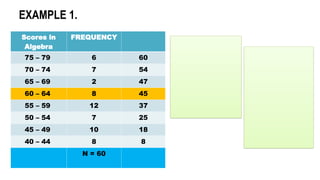
Scores in
Algebra
FREQUENCY
75 – 79 6 60
70 – 74 7 54
65 – 69 2 47
60 – 64 8 45
55 – 59 12 37
50 – 54 7 25
45 – 49 10 18
40 – 44 8 8
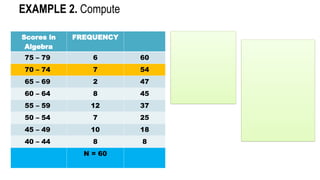
N = 60
EXAMPLE 1. Compute
𝑄𝑛= 𝑋 𝐿𝐵+𝑖 [
𝑁
4
− 𝐹
𝑓 ]
Scores in
Algebra
FREQUENCY
75 – 79 6 60
70 – 74 7 54
65 – 69 2 47
60 – 64 8 45
55 – 59 12 37
50 – 54 7 25
45 – 49 10 18
40 – 44 8 8
N = 60
EXAMPLE 2. Compute
𝑄𝑛= 𝑋 𝐿𝐵+𝑖 [
𝑁
4
− 𝐹
𝑓 ]
Scores in
Algebra
FREQUENCY
75 – 79 6 60
70 – 74 7 54
65 – 69 2 47
60 – 64 8 45
55 – 59 12 37
50 – 54 7 25
45 – 49 10 18
40 – 44 8 8
N = 60
EXAMPLE 1.
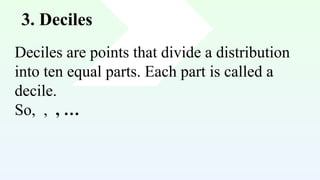
3. Deciles
Deciles are points that divide a distribution
into ten equal parts. Each part is called a
decile.
So, , , …
𝐷𝑛 = 𝑋 𝐿𝐵+𝑖 [
𝑁
10
− 𝐹
𝑓 ]
DECILES for GROUPED DATA
Where:
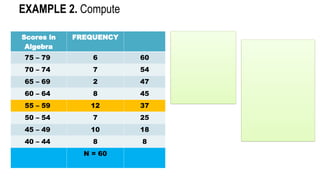
NOTE: To determine the decile class: ; ;
Scores in
Algebra
FREQUENCY
75 – 79 6 60
70 – 74 7 54
65 – 69 2 47
60 – 64 8 45
55 – 59 12 37
50 – 54 7 25
45 – 49 10 18
40 – 44 8 8
N = 60
EXAMPLE 2. Compute
𝐷𝑛 = 𝑋 𝐿𝐵+𝑖 [
𝑁
10
− 𝐹
𝑓 ]
Scores in
Algebra
FREQUENCY
75 – 79 6 60
70 – 74 7 54
65 – 69 2 47
60 – 64 8 45
55 – 59 12 37
50 – 54 7 25
45 – 49 10 18
40 – 44 8 8
N = 60
EXAMPLE 2. Compute
Scores in
Algebra
FREQUENCY
75 – 79 6 60
70 – 74 7 54
65 – 69 2 47
60 – 64 8 45
55 – 59 12 37
50 – 54 7 25
45 – 49 10 18
40 – 44 8 8
N = 60
EXAMPLE 2. Compute
Measure of Variation
Measures of variation describe the spread or dispersion
of a dataset. They indicate how much the data values
differ from each other or from the central tendency. The
key measures of variation include range, variance,
standard deviation, mean deviation, quartile
deviation and interquartile range (IQR).
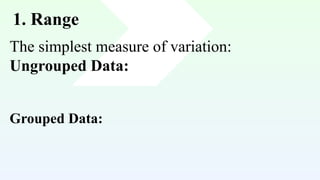
1. Range
The simplest measure of variation:
Ungrouped Data:
Grouped Data:
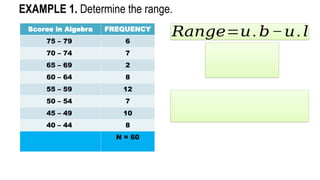
Scores in Algebra FREQUENCY
75 – 79 6
70 – 74 7
65 – 69 2
60 – 64 8
55 – 59 12
50 – 54 7
45 – 49 10
40 – 44 8
N = 60
EXAMPLE 1. Determine the range.
𝑅𝑎𝑛𝑔𝑒=𝑢.𝑏−𝑢.𝑙
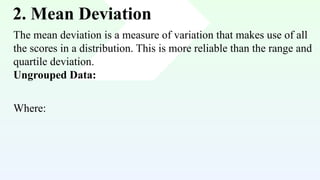
2. Mean Deviation
The mean deviation is a measure of variation that makes use of all
the scores in a distribution. This is more reliable than the range and
quartile deviation.
Ungrouped Data:
Where:
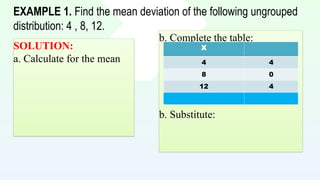
EXAMPLE 1. Find the mean deviation of the following ungrouped
distribution: 4 , 8, 12.
SOLUTION:
a. Calculate for the mean
b. Complete the table:
b. Substitute:
X
4 4
8 0
12 4
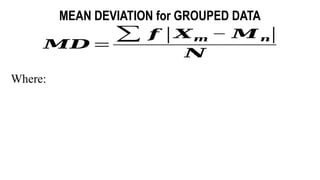
𝑴𝑫 =
∑ 𝒇 |𝑿𝒎 − 𝑴 𝒏|
𝑵
MEAN DEVIATION for GROUPED DATA
Where:
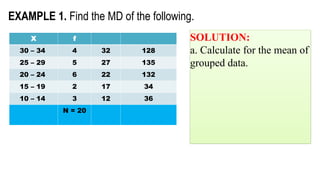
X f
30 – 34 4 32 128
25 – 29 5 27 135
20 – 24 6 22 132
15 – 19 2 17 34
10 – 14 3 12 36
N = 20
EXAMPLE 1. Find the MD of the following.
SOLUTION:
a. Calculate for the mean of
grouped data.
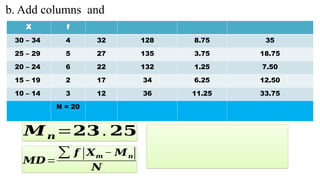
X f
30 – 34 4 32 128 8.75 35
25 – 29 5 27 135 3.75 18.75
20 – 24 6 22 132 1.25 7.50
15 – 19 2 17 34 6.25 12.50
10 – 14 3 12 36 11.25 33.75
N = 20
b. Add columns and
𝑴𝒏 =𝟐𝟑 . 𝟐𝟓
𝑴𝑫=
∑ 𝒇 |𝑿𝒎 − 𝑴𝒏|
𝑵
2. Variance and Standard Deviation
• The standard deviation, SD is the most important and
useful measure of variation. It is the square root of the
variance, SD2
• It is an average to the degree to which each set of scores in
the distribution deviates from the mean value.
• It is a more stable measure of variance because it involves
all the scores in a distribution rather than the range.
• The standard deviation is the square root of the
variance, showing the dispersion in the same units as the
data.
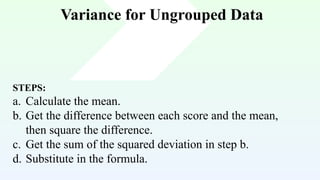
Variance for Ungrouped Data
STEPS:
a. Calculate the mean.
b. Get the difference between each score and the mean,
then square the difference.
c. Get the sum of the squared deviation in step b.
d. Substitute in the formula.
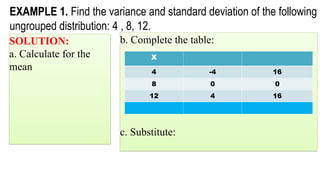
EXAMPLE 1. Find the variance and standard deviation of the following
ungrouped distribution: 4 , 8, 12.
SOLUTION:
a. Calculate for the
mean
b. Complete the table:
c. Substitute:
X
4 -4 16
8 0 0
12 4 16
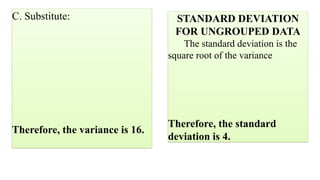
C. Substitute:
Therefore, the variance is 16.
STANDARD DEVIATION
FOR UNGROUPED DATA
The standard deviation is the
square root of the variance
Therefore, the standard
deviation is 4.
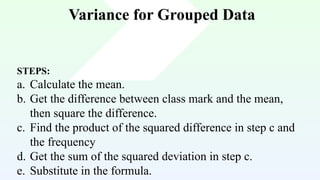
Variance for Grouped Data
STEPS:
a. Calculate the mean.
b. Get the difference between class mark and the mean,
then square the difference.
c. Find the product of the squared difference in step c and
the frequency
d. Get the sum of the squared deviation in step c.
e. Substitute in the formula.
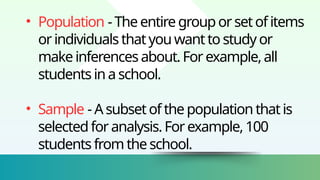
• Population - The entire grouporsetofitems
orindividuals thatyouwantto studyor
makeinferences about.For example,all
students ina school.
• Sample - Asubset ofthe populationthatis
selectedforanalysis.For example,100
students from the school.
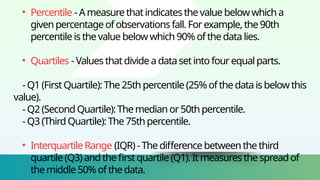
• Percentile -Ameasurethatindicatesthevaluebelowwhicha
givenpercentage ofobservationsfall.Forexample,the 90th
percentile isthevalue belowwhich 90% ofthedatalies.
• Quartiles -Valuesthatdivide adatasetintofourequal parts.
-Q1 (First Quartile):The 25th percentile (25%ofthe dataisbelowthis
value).
-Q2 (SecondQuartile):The medianor50th percentile.
-Q3 (ThirdQuartile):The75thpercentile.
• InterquartileRange (IQR)- Thedifference betweenthe third
quartile (Q3) andthe firstquartile(Q1).Itmeasuresthespreadof
themiddle 50% ofthedata.
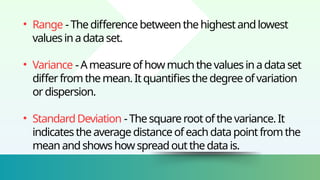
• Range -Thedifferencebetweenthehighestandlowest
valuesinadataset.
• Variance -Ameasureofhowmuchthevaluesinadataset
differfromthemean.Itquantifiesthedegreeofvariation
ordispersion.
• StandardDeviation -Thesquarerootofthevariance.It
indicatestheaveragedistanceofeachdatapointfromthe
meanandshowshowspreadoutthedatais.
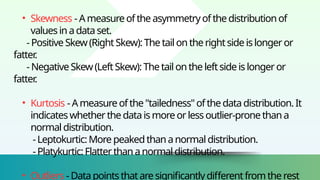
• Skewness - A measureofthe asymmetryofthe distributionof
valuesin adataset.
-Positive Skew(RightSkew):The tail on therightside islongeror
fatter
.
-NegativeSkew (LeftSkew):Thetail onthe leftsideis longeror
fatter
.
• Kurtosis -Ameasure ofthe"tailedness"ofthedatadistribution.It
indicates whetherthe dataismoreorlessoutlier-pronethan a
normal distribution.
-Leptokurtic:More peakedthananormal distribution.
-Platykurtic:Flatterthan anormaldistribution.
• Outliers -Datapointsthatare significantlydifferentfromtherest
• Histogram -Agraphicalrepresentationofthe
frequencydistributionofnumericaldata.Thedatais
dividedintointervals(bins),andtheheightofeach
barrepresentsthefrequency ofvaluesinthatdata
interval.
• BoxPlot (Box-and-WhiskerPlot)-Avisualsummaryof
dathemedian,quartiles,andpotentialoutliers.It
highlightsthecentraltendency andvariabilityina
dataset.
mathematics as a tool major in Elementary Education

mathematics as a tool major in Elementary Education

  • 1.
  • 2.
  • 3.
    GatheringandOrganizingofData • The dataarethequantities(numbers)orqualities (attributes)measuredorobservedthataretobecollected and/oranalyzed. • Categoricaldata arenominal(genderandcivilstatus) andordinalscales(educationandincomelevel) • Continuousdata areinterval(ageandCelsiusandratio scales(heightandincome)
  • 4.
    • Variable -Acharacteristicorpropertythatcantakeon differentvaluesfordifferentindividualsoritemsina populationorsample. •IndependentVariable: thevariablebeing manipulated.It'sconsideredthe"cause"or"input"in anexperiment.Itisnotaffectedbyothervariablesin theexperiment. • DependentVariable:measuredintheexperiment.It's consideredthe"effect"or"output"becauseit dependsonchangesmadetotheindependent
  • 5.
    • QuantitativeVariable: Canbe measurednumerically(e.g.,height, weight). •QualitativeVariable:Describesa categoryorquality(e.g.,gender ,type ofcar).
  • 6.
    • Datagatheredcanbepresentedintextual,tabular , graphicaloracombinationofthese. • TextualPresentationusesstatementswith numeralsinordertodescribeandinterpretthe data. • TabularPresentation usesstatisticaltableto directlydisplaythequantitiesorvaluescollectedas data. • GraphicalPresentation illustratesdatainaform ofgraphs.Examples: bargraph,piechartandline graph.
  • 7.
    Thedatagatheredshouldbe properlyorganizedintogrouped datacalledfrequency distribution.FrequencyDistribution - A tableorchartthatshowsthe number oftimes(frequency) each datavalueor rangeofvalues occurs. Steps: 1. Determine astoestimatenumberofclasses k, k=1 +3 logn, where nis the numberofpopulation. 2.Determinethe range, r= highestvalue -lowestvalue 3.Obtainthe class size, c=rangek 4.Setthe lowestvalue asthefirstlowerlimitand getthe upper limitwhich equal to firstlowerlimit+classsize- 1 5.Dothe same processagainuntil youreach thelastclasslimit thatincludes the highestvaluefromthe data.
  • 8.
    Example1.Constructafrequencytableforthefollowing data: 11 1911 15 16 10 16 16 15 17 10 27 21 11 13 21 10 16 11 19 24 12 22 13 19 13 18 20 21 11 19 15 11 25 29 23 16 23 10 17 11 27 16 24 12 21 13 12 26 15 11 14 10 12 11 15 18 12 20 13
  • 9.
    Example2.Constructafrequencytableforthescoresofstudents in aGeometrytest. 55 6344 37 50 57 44 57 42 46 58 40 54 65 39 27 28 56 38 45 30 35 56 78 55 27 50 28 44 58 39 37 65 43 33 70 60 61 60 44
  • 10.
    InterpretationofData Anygivendatainstatisticsareuselessifnotinterpreted. • Descriptivestatistics -referstotheprocessofusing summarymeasurestodescribethemainfeaturesof adataset.Thesestatisticsareusedtoprovidea simpleoverviewof thesampleanditscharacteristics, oftenbyrepresentingitintables,graphs,or summaryvalues.Descriptivestatisticscanbedivided into:
  • 11.
    • Measuresofcentraltendency -Thesesummarizethe centerofadatasetandinclude:Mean,Median,andMode. •Measuresofvariability (ordispersion)-Thesedescribehow spreadoutthedataisandinclude:Range,Variance, Standarddeviation. • Measuresofdistributionshape -Thesedescribetheoverall patternofthedata,including:SkewnessandKurtosis
  • 12.
    • CentralTendency -Ameasurethatrepresents thecenterortypicalvalueofadataset.The mostcommonmeasuresare: •Mean:Thearithmeticaverage. • Median:Themiddlevalueofanordereddata set. • Mode:Themostfrequentlyoccurringvalue.
  • 13.
    MeasuresofCentralTendencyofUngroupedData 1. MEAN (Average) Themean is the sum of all values in a data set divided by the number of values. It represents the "average" and is often used when data is evenly distributed.
  • 14.
    2. MEDIAN The medianis the middle value in an ordered data set. If there’s an odd number of values, it’s the center value. If even, it’s the average of the two middle values. Steps to Find the Median: 1.Order the data from smallest to largest. 2.Identify the middle value. If there’s an even number of values, take the average of the two central numbers.
  • 15.
    3. MODE The modeis the value that appears most frequently in a data set. There can be more than one mode (bimodal, multimodal), or none at all if all values are unique. Example: In the set {2, 4, 4, 5, 6, 6, 6, 8}, the mode is 6
  • 16.
    WEIGHTED MEAN The weightedmean (or weighted average) is a type of mean where each value in a data set is multiplied by a weight that reflects its importance or frequency. Unlike a simple mean, which treats all values equally, the weighted mean gives more influence to some values based on their assigned weights. When to Use the Weighted Mean •Unequal Importance: When values in a data set have different levels of importance or frequency (e.g., grades in courses with different credit hours). •Data with Frequencies: When you have grouped data or values that occur with different frequencies
  • 17.
  • 18.
    EXAMPLE 1. There are1,000 notebooks sold at Php 10.00 each; 500 notebooks at Php 20.00; 500 notebooks at Php 25.00, and 100 notebooks at Php 30.00. Compute the weighted mean
  • 19.
    EXAMPLE 2. A teachercalculates a class average based on test scores from different sections, each with a different number of students: Section 1: Average score = 75, with 10 students; Section 2: Average score = 80, with 15 students; Section 3: Average score = 90, with 5 students
  • 20.
    EXAMPLE 3. A supermarketstocks three categories of products with different prices and sales volumes: Category A: Average price per item = P150.00, sold 200 items Category B: Average price per item = P250, sold 120 items Category C: Average price per item = P400, sold 60 items Calculate the weighted average price per item across all categories.
  • 21.
    ASSIGNMENT: There are 350shirts sold at Php 100.00 each; 250 shirts at Php 150.00; 150 shirts at Php 200.00, and 65 shirts at Php 250.00. Compute the weighted mean.
  • 22.
  • 23.
    Steps to findthe mean of grouped data: 1. Find the class mark for each class interval: 𝑋𝑚= 𝐿𝑜𝑤𝑒𝑟 𝐿𝑖𝑚𝑖𝑡+𝑈𝑝𝑝𝑒𝑟 𝐿𝑖𝑚𝑖𝑡 2 2. Multiply each class mark by the class frequency: 3. Find the 4. Sum up all frequencies: 5. Divide: by togetthemean.
  • 24.
    EXAMPLE 1. The tablebelow summarizes the weights of goats. Find the average weight of the goats. WEIGHT OF GOATS 201 – 210 3 191 – 200 8 181 – 190 12 171 – 180 11 161 – 170 9 151 – 160 2
  • 25.
    EXAMPLE 2. The tablebelow shows the distribution of workers’ ages: WORKERS’ AGES 21 – 30 7 31 – 40 8 41 – 50 5 51 – 60 3 61 – 70 2
  • 26.
    EXAMPLE 3. The followingare the scores of the students in an Algebra test. Make a frequency table and solve for the mean. 11, 14, 19, 21, 15, 24, 17, 20, 18, 23, 25, 20, 16, 22, 18, 19, 14, 21, 20, 15, 13, 17, 22, 23,
  • 27.
    𝑀 𝑑 =𝑋 𝐿𝐵 + ( 𝑁 2 −𝑐𝑓 𝑏 )𝑖 𝑓 𝑚 MEDIAN for GROUPED DATA Where: NOTE: To determine the median class:
  • 28.
    CLASS INTERVAL FREQUENCY 28– 29 1 60 26 – 27 3 59 24 – 25 3 56 22 – 23 3 53 20 – 21 6 50 18 – 19 6 44 16 – 17 8 38 14 – 15 6 = 30 median class 12 – 13 10 24 = 10 – 11 14 14 N = 60 EXAMPLE 1. Find the median of the following data: 𝑀𝑑= 𝑋𝐿𝐵 + (𝑁 2 −𝑐𝑓 𝑏)𝑖 𝑓 𝑚
  • 29.
    EXAMPLE 2. Findthe median of the following data: <cf 75 – 79 6 60 70 – 74 7 54 65 – 69 2 47 60 – 64 8 45 55 – 59 12 37 50 – 54 7 25 45 – 49 10 18 40 – 44 8 8 N = 60 𝑀𝑑= 𝑋𝐿𝐵 + (𝑁 2 −𝑐𝑓 𝑏)𝑖 𝑓 𝑚
  • 30.
    𝑀 𝑜= 𝑋𝐿𝐵+ [ 𝑑 𝑓 1 𝑑 𝑓 1 + 𝑑 𝑓 2 ]𝑖 MODE for GROUPED DATA Where: NOTE: The modal class is the class with the highest frequency
  • 31.
    CLASS INTERVAL FREQUENCY 28– 29 1 26 – 27 3 24 – 25 3 22 – 23 3 20 – 21 6 18 – 19 6 16 – 17 8 14 – 15 6 12 – 13 10 10 – 11 14 modal class N = 60 EXAMPLE 1. Find the mode of the following data: 𝑀𝑜= 𝑋 𝐿𝐵+ [ 𝑑 𝑓 1 𝑑 𝑓 1 +𝑑 𝑓 2 ]𝑖
  • 32.
    Scores in AlgebraFREQUENCY 75 – 79 6 70 – 74 7 65 – 69 2 60 – 64 8 55 – 59 12 50 – 54 7 45 – 49 10 40 – 44 8 N = 60 EXAMPLE 2. Find the mode of the following data: 𝑀𝑜= 𝑋 𝐿𝐵+ [ 𝑑 𝑓 1 𝑑 𝑓 1 +𝑑 𝑓 2 ]𝑖
  • 33.
    Scores in AlgebraFREQUENCY 19 – 21 7 16 – 18 19 13 – 15 14 10 – 12 8 7 – 9 2 N = 50 Find the median and mode of the grouped data.
  • 34.
    Measure of RelativePosition The measure of relative position helps us understand how a particular data point compares to the other values in a dataset. Commonly used measures include percentiles, quartiles and deciles. These measures allow us to see how high or low a value is in relation to the rest of the data.
  • 35.
    1. Percentiles Percentiles areused to describe the position of a value relative to the entire dataset. They tell you what percentage of data values fall below a certain point. •Definition: •A percentile divides a dataset into 100 equal parts. •Example: If you are at the 75th percentile, this means you scored better than 75% of the people
  • 36.
    Ungrouped Data Examples: 1. Mrs.Corpuzconducted a quiz to ten students. The scores obtained are as follows: 5, 8, 7, 6, 3, 6, 10,5,6,4 a. What score corresponds to the 100th percentile? b. What is the 50th percentile point? Solution: c. Arrange the scores in descending order. 10, 8, 7, 6,6, 6,5,5,4,3 The highest is 10, the middle is 6, and the lowest is 3. The one who scored 10 surpassed all the others. However, the class intervals will always have the upper boundary, so the 100th percentile point is the upper boundary of the highest score. P100 = 10.5 b. Since the middle score is 6, it surpasses half (50%) of the students. Therefore, P50 = 6
  • 37.
    2. In aclass of 50, Jason got a percentile rank of 65. a. What does this percentile rank imply? b. How many students rank below Jason? Solution: c. The P65 implies that Jason got a score higher than 65 percent of the class. d. Since there are 50 students in all, the number of students who got scores below Jason is 50(65%) = 50(0.65) = 32.5
  • 38.
    𝑃𝑛= 𝑋 𝐿𝐵+𝑖 [𝑛𝑁 − 𝐹 𝑓 ] PERCENTILE for GROUPED DATA Where: NOTE: To determine the percentile class:
  • 39.
    CLASS INTERVAL FREQUENCY 28– 29 1 60 26 – 27 3 59 24 – 25 3 56 22 – 23 3 53 20 – 21 6 50 18 – 19 6 44 16 – 17 8 38 14 – 15 6 30 12 – 13 10 24 10 – 11 14 14 N = 60 EXAMPLE 1. Find the 𝑃𝑛= 𝑋𝐿𝐵 +𝑖 [𝑛𝑁 − 𝐹 𝑓 ]
  • 40.
    Scores in AlgebraFREQUENCY 75 – 79 6 70 – 74 7 65 – 69 2 60 – 64 8 55 – 59 12 50 – 54 7 45 – 49 10 40 – 44 8 N = 60 EXAMPLE 2. Find the 𝑃𝑛= 𝑋𝐿𝐵 +𝑖 [𝑛𝑁 − 𝐹 𝑓 ]
  • 41.
    2. Quartiles Quartiles dividea dataset into four equal parts. There are three main quartiles: Q1 (First Quartile): The 25th percentile, or the value that separates the lowest 25% of data. Q2 (Second Quartile): The 50th percentile, or the median of the dataset. Q3 (Third Quartile): The 75th percentile, or the value that separates the top 25% of data.
  • 42.
    𝑄𝑛 = 𝑋𝐿𝐵+𝑖 [ 𝑁 4 − 𝐹 𝑓 ] QUARTILES for GROUPED DATA Where: NOTE: To determine the quartile class: ; ;
  • 43.
    Scores in Algebra FREQUENCY 75 –79 6 60 70 – 74 7 54 65 – 69 2 47 60 – 64 8 45 55 – 59 12 37 50 – 54 7 25 45 – 49 10 18 40 – 44 8 8 N = 60 EXAMPLE 1. Compute 𝑄𝑛= 𝑋 𝐿𝐵+𝑖 [ 𝑁 4 − 𝐹 𝑓 ]
  • 45.
    Scores in Algebra FREQUENCY 75 –79 6 60 70 – 74 7 54 65 – 69 2 47 60 – 64 8 45 55 – 59 12 37 50 – 54 7 25 45 – 49 10 18 40 – 44 8 8 N = 60 EXAMPLE 2. Compute 𝑄𝑛= 𝑋 𝐿𝐵+𝑖 [ 𝑁 4 − 𝐹 𝑓 ]
  • 47.
    Scores in Algebra FREQUENCY 75 –79 6 60 70 – 74 7 54 65 – 69 2 47 60 – 64 8 45 55 – 59 12 37 50 – 54 7 25 45 – 49 10 18 40 – 44 8 8 N = 60 EXAMPLE 1.
  • 49.
    3. Deciles Deciles arepoints that divide a distribution into ten equal parts. Each part is called a decile. So, , , …
  • 50.
    𝐷𝑛 = 𝑋𝐿𝐵+𝑖 [ 𝑁 10 − 𝐹 𝑓 ] DECILES for GROUPED DATA Where: NOTE: To determine the decile class: ; ;
  • 51.
    Scores in Algebra FREQUENCY 75 –79 6 60 70 – 74 7 54 65 – 69 2 47 60 – 64 8 45 55 – 59 12 37 50 – 54 7 25 45 – 49 10 18 40 – 44 8 8 N = 60 EXAMPLE 2. Compute 𝐷𝑛 = 𝑋 𝐿𝐵+𝑖 [ 𝑁 10 − 𝐹 𝑓 ]
  • 53.
    Scores in Algebra FREQUENCY 75 –79 6 60 70 – 74 7 54 65 – 69 2 47 60 – 64 8 45 55 – 59 12 37 50 – 54 7 25 45 – 49 10 18 40 – 44 8 8 N = 60 EXAMPLE 2. Compute
  • 55.
    Scores in Algebra FREQUENCY 75 –79 6 60 70 – 74 7 54 65 – 69 2 47 60 – 64 8 45 55 – 59 12 37 50 – 54 7 25 45 – 49 10 18 40 – 44 8 8 N = 60 EXAMPLE 2. Compute
  • 57.
    Measure of Variation Measuresof variation describe the spread or dispersion of a dataset. They indicate how much the data values differ from each other or from the central tendency. The key measures of variation include range, variance, standard deviation, mean deviation, quartile deviation and interquartile range (IQR).
  • 58.
    1. Range The simplestmeasure of variation: Ungrouped Data: Grouped Data:
  • 59.
    Scores in AlgebraFREQUENCY 75 – 79 6 70 – 74 7 65 – 69 2 60 – 64 8 55 – 59 12 50 – 54 7 45 – 49 10 40 – 44 8 N = 60 EXAMPLE 1. Determine the range. 𝑅𝑎𝑛𝑔𝑒=𝑢.𝑏−𝑢.𝑙
  • 60.
    2. Mean Deviation Themean deviation is a measure of variation that makes use of all the scores in a distribution. This is more reliable than the range and quartile deviation. Ungrouped Data: Where:
  • 61.
    EXAMPLE 1. Findthe mean deviation of the following ungrouped distribution: 4 , 8, 12. SOLUTION: a. Calculate for the mean b. Complete the table: b. Substitute: X 4 4 8 0 12 4
  • 62.
    𝑴𝑫 = ∑ 𝒇|𝑿𝒎 − 𝑴 𝒏| 𝑵 MEAN DEVIATION for GROUPED DATA Where:
  • 63.
    X f 30 –34 4 32 128 25 – 29 5 27 135 20 – 24 6 22 132 15 – 19 2 17 34 10 – 14 3 12 36 N = 20 EXAMPLE 1. Find the MD of the following. SOLUTION: a. Calculate for the mean of grouped data.
  • 64.
    X f 30 –34 4 32 128 8.75 35 25 – 29 5 27 135 3.75 18.75 20 – 24 6 22 132 1.25 7.50 15 – 19 2 17 34 6.25 12.50 10 – 14 3 12 36 11.25 33.75 N = 20 b. Add columns and 𝑴𝒏 =𝟐𝟑 . 𝟐𝟓 𝑴𝑫= ∑ 𝒇 |𝑿𝒎 − 𝑴𝒏| 𝑵
  • 65.
    2. Variance andStandard Deviation • The standard deviation, SD is the most important and useful measure of variation. It is the square root of the variance, SD2 • It is an average to the degree to which each set of scores in the distribution deviates from the mean value. • It is a more stable measure of variance because it involves all the scores in a distribution rather than the range. • The standard deviation is the square root of the variance, showing the dispersion in the same units as the data.
  • 66.
    Variance for UngroupedData STEPS: a. Calculate the mean. b. Get the difference between each score and the mean, then square the difference. c. Get the sum of the squared deviation in step b. d. Substitute in the formula.
  • 67.
    EXAMPLE 1. Findthe variance and standard deviation of the following ungrouped distribution: 4 , 8, 12. SOLUTION: a. Calculate for the mean b. Complete the table: c. Substitute: X 4 -4 16 8 0 0 12 4 16
  • 68.
    C. Substitute: Therefore, thevariance is 16. STANDARD DEVIATION FOR UNGROUPED DATA The standard deviation is the square root of the variance Therefore, the standard deviation is 4.
  • 69.
    Variance for GroupedData STEPS: a. Calculate the mean. b. Get the difference between class mark and the mean, then square the difference. c. Find the product of the squared difference in step c and the frequency d. Get the sum of the squared deviation in step c. e. Substitute in the formula.
  • 70.
    • Population -The entire grouporsetofitems orindividuals thatyouwantto studyor makeinferences about.For example,all students ina school. • Sample - Asubset ofthe populationthatis selectedforanalysis.For example,100 students from the school.
  • 71.
    • Percentile -Ameasurethatindicatesthevaluebelowwhicha givenpercentageofobservationsfall.Forexample,the 90th percentile isthevalue belowwhich 90% ofthedatalies. • Quartiles -Valuesthatdivide adatasetintofourequal parts. -Q1 (First Quartile):The 25th percentile (25%ofthe dataisbelowthis value). -Q2 (SecondQuartile):The medianor50th percentile. -Q3 (ThirdQuartile):The75thpercentile. • InterquartileRange (IQR)- Thedifference betweenthe third quartile (Q3) andthe firstquartile(Q1).Itmeasuresthespreadof themiddle 50% ofthedata.
  • 72.
    • Range -Thedifferencebetweenthehighestandlowest valuesinadataset. •Variance -Ameasureofhowmuchthevaluesinadataset differfromthemean.Itquantifiesthedegreeofvariation ordispersion. • StandardDeviation -Thesquarerootofthevariance.It indicatestheaveragedistanceofeachdatapointfromthe meanandshowshowspreadoutthedatais.
  • 73.
    • Skewness -A measureofthe asymmetryofthe distributionof valuesin adataset. -Positive Skew(RightSkew):The tail on therightside islongeror fatter . -NegativeSkew (LeftSkew):Thetail onthe leftsideis longeror fatter . • Kurtosis -Ameasure ofthe"tailedness"ofthedatadistribution.It indicates whetherthe dataismoreorlessoutlier-pronethan a normal distribution. -Leptokurtic:More peakedthananormal distribution. -Platykurtic:Flatterthan anormaldistribution. • Outliers -Datapointsthatare significantlydifferentfromtherest
  • 74.
    • Histogram -Agraphicalrepresentationofthe frequencydistributionofnumericaldata.Thedatais dividedintointervals(bins),andtheheightofeach barrepresentsthefrequencyofvaluesinthatdata interval. • BoxPlot (Box-and-WhiskerPlot)-Avisualsummaryof dathemedian,quartiles,andpotentialoutliers.It highlightsthecentraltendency andvariabilityina dataset.