GRADE 1 to 12
DAILY
LESSON LOG
School Caloocan Central Elementary School Grade Level
Teacher Day W1
Date Quarter 3rd QUARTER
SUBJECT Mathematics Mathematics Mathematics Mathematics Mathematics
TIME
OBJECTIVES
A. Content Standard Demonstrates
understanding of division
of whole numbers up to
1000 including money.
2. demonstrates
understanding of unit
fractions.
Demonstrates
understanding of
division of whole
numbers up to 1000
including money.
2. demonstrates
understanding of unit
fractions.
Demonstrates
understanding of division
of whole numbers up to
1000 including money.
2. demonstrates
understanding of unit
fractions.
Demonstrates understanding
of division of whole numbers
up to 1000 including money.
2. demonstrates understanding
of unit fractions.
Demonstrates understanding of
division of whole numbers up to
1000 including money.
2. demonstrates understanding
of unit fractions.
B. Performance
Standard
is able to apply division of
whole numbers up to 1000
including money in
mathematical problems
and real life situations.
is able to recognize and
represent unit fractions in
various forms and contexts
is able to apply division
of whole numbers up to
1000 including money in
mathematical problems
and real life situations.
is able to recognize and
represent unit fractions
in various forms and
contexts
is able to apply division
of whole numbers up to
1000 including money in
mathematical problems
and real life situations.
is able to recognize and
represent unit fractions
in various forms and
contexts
is able to apply division of
whole numbers up to 1000
including money in
mathematical problems and
real life situations.
is able to recognize and
represent unit fractions in
various forms and contexts
is able to apply division of whole
numbers up to 1000 including
money in mathematical
problems and real life situations.
is able to recognize and
represent unit fractions in
various forms and contexts
C. Learning
Competency/
Objectives
Write the LC code for
each.
Visualizes and represents
division, and writes a
related equation for each
type of situation: equal
sharing, repeated
subtraction, equal jumps
on the number line, and
formation of equal groups
of objects.
Visualizes and represents
division, and writes a
related equation for each
type of situation: equal
sharing, repeated
subtraction, equal jumps
on the number line, and
formation of equal
groups of objects.
Visualizes and represents
division, and writes a
related equation for each
type of situation: equal
sharing, repeated
subtraction, equal jumps
on the number line, and
formation of equal
groups of objects.
Visualizes and represents
division, and writes a related
equation for each type of
situation: equal sharing,
repeated subtraction, equal
jumps on the number line, and
formation of equal groups of
objects.
Visualizes division of numbers
up to 100 by 2,3,4,5, and 10
(multiplication table of 2, 3, 4, 5
and 10). (M2NS-IIIb-51.1)
II. CONTENT Day 1: Identifies the parts
of division sentence and
visualizes, represents
Day 2: Visualizes and
represents division, and
writes a related equation
Day 3: Visualizes and
represents division, and
writes a related equation
Day 4: Visualizes and
represents division, and writes
a related equation for
Day 5: Visualizes division of
numbers up to 100 by 5 and 10
(multiplication table of 5 and
division, and writes a
related equation for equal
sharing
for repeated subtraction, for equal jumps on the
number line
formation of equal groups of
objects.
10).
III. LEARNING
RESOURCES
A. References DBOW in Mathematics 2
Module Week 6
MELC K-12
DBOW in Mathematics 2
Module Week 6
MELC K-12
DBOW in Mathematics 2
Module Week 6
MELC K-12
DBOW in Mathematics 2
Module Week 6
MELC K-12
DBOW in Mathematics 2
Module Week 6
MELC K-12
1. Teacher’s Guide
pages
Teachers Guide
Mathemtics 2
Teachers Guide
Mathematics 2
Teachers Guide
Mathematics 2
Teachers Guide Mathematics 2 Teachers Guide Mathematics 2
2. Learner’s
Materials pages
Caloocan SLM
Mathematics 2 Kuwarter 2-
Ika anim na Linggo
Caloocan SLM
Mathematics 2 Kuwarter
2-Ika anim na Linggo
Caloocan SLM
Mathematics 2 Kuwarter
2-Ika anim na Linggo
Caloocan SLM Mathematics 2
Kuwarter 2-Ika anim na Linggo
Caloocan SLM Mathematics 2
Kuwarter 2-Ika anim na Linggo
3. Textbook pages
4. Additional
Materials from
Learning
Resource (LR)
portal
Longs, flat, ones
Popsicle sticks
Longs, flat, ones
Popsicle sticks
Longs, flat, ones
Popsicle sticks
Longs, flat, ones
Popsicle sticks
Longs, flat, ones
Popsicle sticks
B. Other Learning
Resource
IV. PROCEDURES
A. Reviewing
previous lesson or
presenting the new
lesson
Isulat ang letra ng tamang
sagot.
1. Ito ay tinatawag na
repeated addition.
A. subtraction B.
multiplication C. division
2. Alin ang angkop na
pagpaparami as repeated
addition para sa larawan?
A. 3 + 3 + 3 + 3 B. 4 + 4 +
4 C. 6 + 6
B. Establishing a
purpose for the
lesson
Mayroong 24 na
piraso ng lapis si Marnie
na ipamimigay o
ipamamahagi sa kanyang 6
na kaibigan.
Tanong: Ilang piraso ng
lapis ang matatanggap ng
bawat kaibigan ni
Marnie? Paano natin
ipapakita at ilalarawan ang
bilang ng lapis na
natanggap ng bawat isa?
Paano isusulat ang
kaugnay na division
equation ng sitwasyong
ito?
.
Sa pagsulat ng kaugnay na
equation nito, sundin ang
sumusunod na
pamamaraan:
mga bagay o object ay ang
dividend.
object sa bawat pangkat ay
ang
divisor.
mga pangkat ang magiging
quotient.
C. Presenting
examples/
instances of the
new lesson
Mayroong 30 na piraso ng
holen si Emman na
ipamimigay o
ipamamahagi sa kanyang 5
na kaibigan.
Tanong: Ilang piraso ng
holen ang matatanggap
ng bawat kaibigan ni
Emman? Paano natin
ipapakita at ilalarawan ang
bilang ng holen na
natanggap ng bawat isa?
Paano isusulat ang
kaugnay na division
equation ng sitwasyong
ito?
D. Discussing new
concepts and
practicing new
skills #1
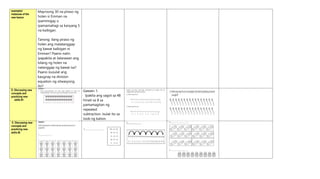
Gawain 1:
Ipakita ang sagot sa 48
hinati sa 8 sa
pamamagitan ng
repeated
subtraction. Isulat ito sa
loob ng kahon.
E. Discussing new
concepts and
practicing new
skills #2
F. Developing
mastery (leads to
Formative
Assessment 3)
G. Finding practical
application of
concepts and skills
in daily living
H.Making
generalizations
and abstractions
about the lesson
Ang division ay maaaring
maipakita at mailarawan
gamit
ang mga sumusunod:
equal sharing, repeated
subtraction, equal
jumps on the number line
at formation of equal
groups of objects.
Ang division ay maaaring
maipakita at mailarawan
gamit
ang mga sumusunod:
equal sharing, repeated
subtraction, equal
jumps on the number
line at formation of equal
groups of objects.
. Ang division ay
maaaring maipakita at
mailarawan gamit
ang mga sumusunod:
equal sharing, repeated
subtraction, equal
jumps on the number
line at formation of equal
groups of objects.
Ang division ay maaaring
maipakita at mailarawan gamit
ang mga sumusunod: equal
sharing, repeated subtraction,
equal
jumps on the number line at
formation of equal groups of
objects.
.
I. Evaluating
learning
. .
J. Additional
activities for
application or
remediation
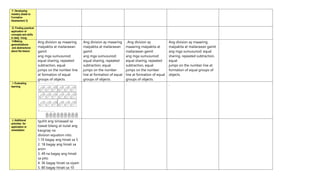
Iguhit ang isinasaad sa
bawat bilang at isulat ang
kaugnay na
division equation nito.
1.10 bagay ang hinati sa 5
2. 18 bagay ang hinati sa
anim
3. 49 na bagay ang hinati
sa pito
4. 36 bagay hinati sa siyam
5. 80 bagay hinati sa 10
IV. REMARKS
V. REFLECTION
A..No. of learners who
earned 80% in the
evaluation
___ of Learners who earned 80%
above
___ of Learners who earned 80%
above
___ of Learners who earned 80%
above
___ of Learners who earned 80% above ___ of Learners who earned 80% above
B.No. of learners
who require additional
activities for remediation
who scored below 80%
___ of Learners who require
additional activities for remediation
___ of Learners who require
additional activities for
remediation
___ of Learners who require
additional activities for
remediation
___ of Learners who require additional
activities for remediation
___ of Learners who require additional
activities for remediation
C. Did the remedial
lessons work?
No. of learners who have
caught up with
the lesson
___Yes ___No
____ of Learners who caught up the
lesson
___Yes ___No
____ of Learners who caught up
the lesson
___Yes ___No
____ of Learners who caught up
the lesson
___Yes ___No
____ of Learners who caught up the
lesson
___Yes ___No
____ of Learners who caught up the lesson
D. No. of learners who
continue to require
remediation
___ of Learners who continue to
require remediation
___ of Learners who continue to
require remediation
___ of Learners who continue to
require remediation
___ of Learners who continue to require
remediation
___ of Learners who continue to require
remediation
E. Which of my teaching
strategies worked well?
Why
did these work?
Strategies used that work well:
___ Group collaboration
___ Games
___ Solving Puzzles/Jigsaw
___ Answering preliminary
activities/exercises
___ Carousel
___ Diads
___ Think-Pair-Share (TPS)
___ Rereading of Paragraphs/
Poems/Stories
___ Differentiated Instruction
___ Role Playing/Drama
___ Discovery Method
___ Lecture Method
Why?
___ Complete IMs
___ Availability of Materials
___ Pupils’ eagerness to learn
___ Group member’s Cooperation
in
doing their tasks
Strategies used that work well:
___ Group collaboration
___ Games
___ Solving Puzzles/Jigsaw
___ Answering preliminary
activities/exercises
___ Carousel
___ Diads
___ Think-Pair-Share (TPS)
___ Rereading of Paragraphs/
Poems/Stories
___ Differentiated Instruction
___ Role Playing/Drama
___ Discovery Method
___ Lecture Method
Why?
___ Complete IMs
___ Availability of Materials
___ Pupils’ eagerness to learn
___ Group member’s
Cooperation in
doing their tasks
Strategies used that work well:
___ Group collaboration
___ Games
___ Solving Puzzles/Jigsaw
___ Answering preliminary
activities/exercises
___ Carousel
___ Diads
___ Think-Pair-Share (TPS)
___ Rereading of Paragraphs/
Poems/Stories
___ Differentiated Instruction
___ Role Playing/Drama
___ Discovery Method
___ Lecture Method
Why?
___ Complete IMs
___ Availability of Materials
___ Pupils’ eagerness to learn
___ Group member’s Cooperation
in
doing their tasks
Strategies used that work well:
___ Group collaboration
___ Games
___ Solving Puzzles/Jigsaw
___ Answering preliminary
activities/exercises
___ Carousel
___ Diads
___ Think-Pair-Share (TPS)
___ Rereading of Paragraphs/
Poems/Stories
___ Differentiated Instruction
___ Role Playing/Drama
___ Discovery Method
___ Lecture Method
Why?
___ Complete IMs
___ Availability of Materials
___ Pupils’ eagerness to learn
___ Group member’s Cooperation in
doing their tasks
Strategies used that work well:
___ Group collaboration
___ Games
___ Solving Puzzles/Jigsaw
___ Answering preliminary
activities/exercises
___ Carousel
___ Diads
___ Think-Pair-Share (TPS)
___ Rereading of Paragraphs/
Poems/Stories
___ Differentiated Instruction
___ Role Playing/Drama
___ Discovery Method
___ Lecture Method
Why?
___ Complete IMs
___ Availability of Materials
___ Pupils’ eagerness to learn
___ Group member’s Cooperation in
doing their tasks
F. What difficulties did I
encounter which my
principal or supervisor
can help me solve?
__ Bullying among pupils
__ Pupils’ behavior/attitude
__ Colorful IMs
__ Unavailable Technology
Equipment (AVR/LCD)
__ Science/ Computer/
Internet Lab
__ Additional Clerical works
__ Bullying among pupils
__ Pupils’ behavior/attitude
__ Colorful IMs
__ Unavailable Technology
Equipment (AVR/LCD)
__ Science/ Computer/
Internet Lab
__ Additional Clerical works
__ Bullying among pupils
__ Pupils’ behavior/attitude
__ Colorful IMs
__ Unavailable Technology
Equipment (AVR/LCD)
__ Science/ Computer/
Internet Lab
__ Additional Clerical works
__ Bullying among pupils
__ Pupils’ behavior/attitude
__ Colorful IMs
__ Unavailable Technology
Equipment (AVR/LCD)
__ Science/ Computer/
Internet Lab
__ Additional Clerical works
__ Bullying among pupils
__ Pupils’ behavior/attitude
__ Colorful IMs
__ Unavailable Technology
Equipment (AVR/LCD)
__ Science/ Computer/
Internet Lab
__ Additional Clerical works
G. What innovation or
localized materials did I
Planned Innovations: Planned Innovations: Planned Innovations: Planned Innovations: Planned Innovations:
use/discover which I wish
to share with other
teachers?
__ Localized Videos
__ Making big books from
views of the locality
__ Recycling of plastics to be used
as Instructional Materials
__ local poetical composition
__ Localized Videos
__ Making big books from
views of the locality
__ Recycling of plastics to be
used as Instructional Materials
__ local poetical composition
__ Localized Videos
__ Making big books from
views of the locality
__ Recycling of plastics to be
used as Instructional Materials
__ local poetical composition
__ Localized Videos
__ Making big books from
views of the locality
__ Recycling of plastics to be used as
Instructional Materials
__ local poetical composition
__ Localized Videos
__ Making big books from
views of the locality
__ Recycling of plastics to be used as
Instructional Materials
__ local poetical composition
DBOW-Q3W1.docx

DBOW-Q3W1.docx

  • 1.
    GRADE 1 to12 DAILY LESSON LOG School Caloocan Central Elementary School Grade Level Teacher Day W1 Date Quarter 3rd QUARTER SUBJECT Mathematics Mathematics Mathematics Mathematics Mathematics TIME OBJECTIVES A. Content Standard Demonstrates understanding of division of whole numbers up to 1000 including money. 2. demonstrates understanding of unit fractions. Demonstrates understanding of division of whole numbers up to 1000 including money. 2. demonstrates understanding of unit fractions. Demonstrates understanding of division of whole numbers up to 1000 including money. 2. demonstrates understanding of unit fractions. Demonstrates understanding of division of whole numbers up to 1000 including money. 2. demonstrates understanding of unit fractions. Demonstrates understanding of division of whole numbers up to 1000 including money. 2. demonstrates understanding of unit fractions. B. Performance Standard is able to apply division of whole numbers up to 1000 including money in mathematical problems and real life situations. is able to recognize and represent unit fractions in various forms and contexts is able to apply division of whole numbers up to 1000 including money in mathematical problems and real life situations. is able to recognize and represent unit fractions in various forms and contexts is able to apply division of whole numbers up to 1000 including money in mathematical problems and real life situations. is able to recognize and represent unit fractions in various forms and contexts is able to apply division of whole numbers up to 1000 including money in mathematical problems and real life situations. is able to recognize and represent unit fractions in various forms and contexts is able to apply division of whole numbers up to 1000 including money in mathematical problems and real life situations. is able to recognize and represent unit fractions in various forms and contexts C. Learning Competency/ Objectives Write the LC code for each. Visualizes and represents division, and writes a related equation for each type of situation: equal sharing, repeated subtraction, equal jumps on the number line, and formation of equal groups of objects. Visualizes and represents division, and writes a related equation for each type of situation: equal sharing, repeated subtraction, equal jumps on the number line, and formation of equal groups of objects. Visualizes and represents division, and writes a related equation for each type of situation: equal sharing, repeated subtraction, equal jumps on the number line, and formation of equal groups of objects. Visualizes and represents division, and writes a related equation for each type of situation: equal sharing, repeated subtraction, equal jumps on the number line, and formation of equal groups of objects. Visualizes division of numbers up to 100 by 2,3,4,5, and 10 (multiplication table of 2, 3, 4, 5 and 10). (M2NS-IIIb-51.1) II. CONTENT Day 1: Identifies the parts of division sentence and visualizes, represents Day 2: Visualizes and represents division, and writes a related equation Day 3: Visualizes and represents division, and writes a related equation Day 4: Visualizes and represents division, and writes a related equation for Day 5: Visualizes division of numbers up to 100 by 5 and 10 (multiplication table of 5 and
  • 2.
    division, and writesa related equation for equal sharing for repeated subtraction, for equal jumps on the number line formation of equal groups of objects. 10). III. LEARNING RESOURCES A. References DBOW in Mathematics 2 Module Week 6 MELC K-12 DBOW in Mathematics 2 Module Week 6 MELC K-12 DBOW in Mathematics 2 Module Week 6 MELC K-12 DBOW in Mathematics 2 Module Week 6 MELC K-12 DBOW in Mathematics 2 Module Week 6 MELC K-12 1. Teacher’s Guide pages Teachers Guide Mathemtics 2 Teachers Guide Mathematics 2 Teachers Guide Mathematics 2 Teachers Guide Mathematics 2 Teachers Guide Mathematics 2 2. Learner’s Materials pages Caloocan SLM Mathematics 2 Kuwarter 2- Ika anim na Linggo Caloocan SLM Mathematics 2 Kuwarter 2-Ika anim na Linggo Caloocan SLM Mathematics 2 Kuwarter 2-Ika anim na Linggo Caloocan SLM Mathematics 2 Kuwarter 2-Ika anim na Linggo Caloocan SLM Mathematics 2 Kuwarter 2-Ika anim na Linggo 3. Textbook pages 4. Additional Materials from Learning Resource (LR) portal Longs, flat, ones Popsicle sticks Longs, flat, ones Popsicle sticks Longs, flat, ones Popsicle sticks Longs, flat, ones Popsicle sticks Longs, flat, ones Popsicle sticks B. Other Learning Resource IV. PROCEDURES A. Reviewing previous lesson or presenting the new lesson Isulat ang letra ng tamang sagot. 1. Ito ay tinatawag na repeated addition. A. subtraction B. multiplication C. division 2. Alin ang angkop na pagpaparami as repeated addition para sa larawan? A. 3 + 3 + 3 + 3 B. 4 + 4 + 4 C. 6 + 6
  • 3.
    B. Establishing a purposefor the lesson Mayroong 24 na piraso ng lapis si Marnie na ipamimigay o ipamamahagi sa kanyang 6 na kaibigan. Tanong: Ilang piraso ng lapis ang matatanggap ng bawat kaibigan ni Marnie? Paano natin ipapakita at ilalarawan ang bilang ng lapis na natanggap ng bawat isa? Paano isusulat ang kaugnay na division equation ng sitwasyong ito? . Sa pagsulat ng kaugnay na equation nito, sundin ang sumusunod na pamamaraan: mga bagay o object ay ang dividend. object sa bawat pangkat ay ang divisor. mga pangkat ang magiging quotient. C. Presenting
  • 4.
    examples/ instances of the newlesson Mayroong 30 na piraso ng holen si Emman na ipamimigay o ipamamahagi sa kanyang 5 na kaibigan. Tanong: Ilang piraso ng holen ang matatanggap ng bawat kaibigan ni Emman? Paano natin ipapakita at ilalarawan ang bilang ng holen na natanggap ng bawat isa? Paano isusulat ang kaugnay na division equation ng sitwasyong ito? D. Discussing new concepts and practicing new skills #1 Gawain 1: Ipakita ang sagot sa 48 hinati sa 8 sa pamamagitan ng repeated subtraction. Isulat ito sa loob ng kahon. E. Discussing new concepts and practicing new skills #2
  • 5.
    F. Developing mastery (leadsto Formative Assessment 3) G. Finding practical application of concepts and skills in daily living H.Making generalizations and abstractions about the lesson Ang division ay maaaring maipakita at mailarawan gamit ang mga sumusunod: equal sharing, repeated subtraction, equal jumps on the number line at formation of equal groups of objects. Ang division ay maaaring maipakita at mailarawan gamit ang mga sumusunod: equal sharing, repeated subtraction, equal jumps on the number line at formation of equal groups of objects. . Ang division ay maaaring maipakita at mailarawan gamit ang mga sumusunod: equal sharing, repeated subtraction, equal jumps on the number line at formation of equal groups of objects. Ang division ay maaaring maipakita at mailarawan gamit ang mga sumusunod: equal sharing, repeated subtraction, equal jumps on the number line at formation of equal groups of objects. . I. Evaluating learning . . J. Additional activities for application or remediation Iguhit ang isinasaad sa bawat bilang at isulat ang kaugnay na division equation nito. 1.10 bagay ang hinati sa 5 2. 18 bagay ang hinati sa anim 3. 49 na bagay ang hinati sa pito 4. 36 bagay hinati sa siyam 5. 80 bagay hinati sa 10
  • 6.
    IV. REMARKS V. REFLECTION A..No.of learners who earned 80% in the evaluation ___ of Learners who earned 80% above ___ of Learners who earned 80% above ___ of Learners who earned 80% above ___ of Learners who earned 80% above ___ of Learners who earned 80% above B.No. of learners who require additional activities for remediation who scored below 80% ___ of Learners who require additional activities for remediation ___ of Learners who require additional activities for remediation ___ of Learners who require additional activities for remediation ___ of Learners who require additional activities for remediation ___ of Learners who require additional activities for remediation C. Did the remedial lessons work? No. of learners who have caught up with the lesson ___Yes ___No ____ of Learners who caught up the lesson ___Yes ___No ____ of Learners who caught up the lesson ___Yes ___No ____ of Learners who caught up the lesson ___Yes ___No ____ of Learners who caught up the lesson ___Yes ___No ____ of Learners who caught up the lesson D. No. of learners who continue to require remediation ___ of Learners who continue to require remediation ___ of Learners who continue to require remediation ___ of Learners who continue to require remediation ___ of Learners who continue to require remediation ___ of Learners who continue to require remediation E. Which of my teaching strategies worked well? Why did these work? Strategies used that work well: ___ Group collaboration ___ Games ___ Solving Puzzles/Jigsaw ___ Answering preliminary activities/exercises ___ Carousel ___ Diads ___ Think-Pair-Share (TPS) ___ Rereading of Paragraphs/ Poems/Stories ___ Differentiated Instruction ___ Role Playing/Drama ___ Discovery Method ___ Lecture Method Why? ___ Complete IMs ___ Availability of Materials ___ Pupils’ eagerness to learn ___ Group member’s Cooperation in doing their tasks Strategies used that work well: ___ Group collaboration ___ Games ___ Solving Puzzles/Jigsaw ___ Answering preliminary activities/exercises ___ Carousel ___ Diads ___ Think-Pair-Share (TPS) ___ Rereading of Paragraphs/ Poems/Stories ___ Differentiated Instruction ___ Role Playing/Drama ___ Discovery Method ___ Lecture Method Why? ___ Complete IMs ___ Availability of Materials ___ Pupils’ eagerness to learn ___ Group member’s Cooperation in doing their tasks Strategies used that work well: ___ Group collaboration ___ Games ___ Solving Puzzles/Jigsaw ___ Answering preliminary activities/exercises ___ Carousel ___ Diads ___ Think-Pair-Share (TPS) ___ Rereading of Paragraphs/ Poems/Stories ___ Differentiated Instruction ___ Role Playing/Drama ___ Discovery Method ___ Lecture Method Why? ___ Complete IMs ___ Availability of Materials ___ Pupils’ eagerness to learn ___ Group member’s Cooperation in doing their tasks Strategies used that work well: ___ Group collaboration ___ Games ___ Solving Puzzles/Jigsaw ___ Answering preliminary activities/exercises ___ Carousel ___ Diads ___ Think-Pair-Share (TPS) ___ Rereading of Paragraphs/ Poems/Stories ___ Differentiated Instruction ___ Role Playing/Drama ___ Discovery Method ___ Lecture Method Why? ___ Complete IMs ___ Availability of Materials ___ Pupils’ eagerness to learn ___ Group member’s Cooperation in doing their tasks Strategies used that work well: ___ Group collaboration ___ Games ___ Solving Puzzles/Jigsaw ___ Answering preliminary activities/exercises ___ Carousel ___ Diads ___ Think-Pair-Share (TPS) ___ Rereading of Paragraphs/ Poems/Stories ___ Differentiated Instruction ___ Role Playing/Drama ___ Discovery Method ___ Lecture Method Why? ___ Complete IMs ___ Availability of Materials ___ Pupils’ eagerness to learn ___ Group member’s Cooperation in doing their tasks F. What difficulties did I encounter which my principal or supervisor can help me solve? __ Bullying among pupils __ Pupils’ behavior/attitude __ Colorful IMs __ Unavailable Technology Equipment (AVR/LCD) __ Science/ Computer/ Internet Lab __ Additional Clerical works __ Bullying among pupils __ Pupils’ behavior/attitude __ Colorful IMs __ Unavailable Technology Equipment (AVR/LCD) __ Science/ Computer/ Internet Lab __ Additional Clerical works __ Bullying among pupils __ Pupils’ behavior/attitude __ Colorful IMs __ Unavailable Technology Equipment (AVR/LCD) __ Science/ Computer/ Internet Lab __ Additional Clerical works __ Bullying among pupils __ Pupils’ behavior/attitude __ Colorful IMs __ Unavailable Technology Equipment (AVR/LCD) __ Science/ Computer/ Internet Lab __ Additional Clerical works __ Bullying among pupils __ Pupils’ behavior/attitude __ Colorful IMs __ Unavailable Technology Equipment (AVR/LCD) __ Science/ Computer/ Internet Lab __ Additional Clerical works G. What innovation or localized materials did I Planned Innovations: Planned Innovations: Planned Innovations: Planned Innovations: Planned Innovations:
  • 7.
    use/discover which Iwish to share with other teachers? __ Localized Videos __ Making big books from views of the locality __ Recycling of plastics to be used as Instructional Materials __ local poetical composition __ Localized Videos __ Making big books from views of the locality __ Recycling of plastics to be used as Instructional Materials __ local poetical composition __ Localized Videos __ Making big books from views of the locality __ Recycling of plastics to be used as Instructional Materials __ local poetical composition __ Localized Videos __ Making big books from views of the locality __ Recycling of plastics to be used as Instructional Materials __ local poetical composition __ Localized Videos __ Making big books from views of the locality __ Recycling of plastics to be used as Instructional Materials __ local poetical composition