Mathematics Reviewer
      WORD PROBLEMS IN ALGEBRA


           Solving Word Problems
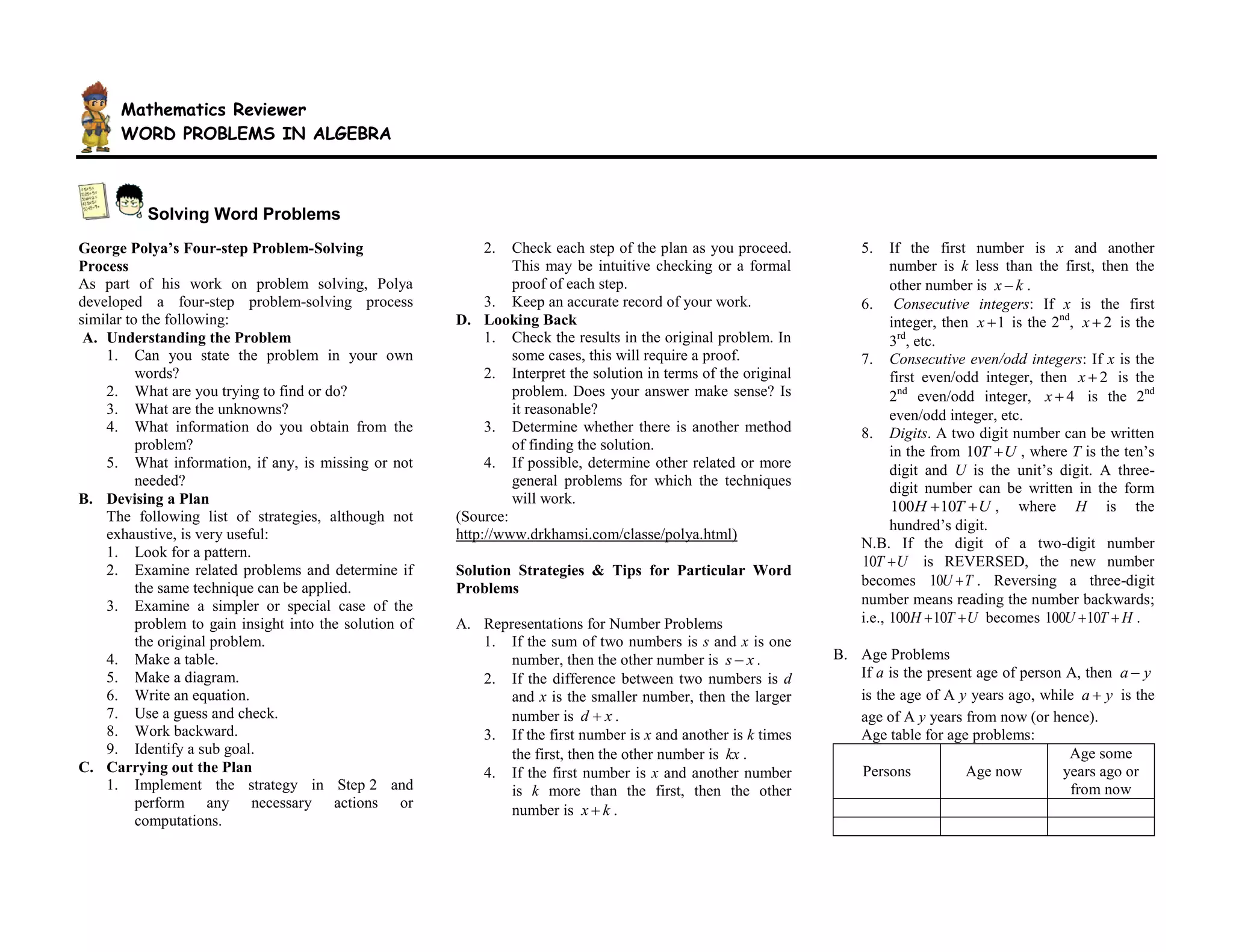
George Polya’s Four-step Problem-Solving                     2.   Check each step of the plan as you proceed.          5.    If the first number is x and another
Process                                                           This may be intuitive checking or a formal                 number is k less than the first, then the
As part of his work on problem solving, Polya                     proof of each step.                                        other number is x  k .
developed a four-step problem-solving process                 3. Keep an accurate record of your work.                 6. Consecutive integers: If x is the first
similar to the following:                                D. Looking Back                                                     integer, then x  1 is the 2nd, x  2 is the
 A. Understanding the Problem                                 1. Check the results in the original problem. In               3rd, etc.
    1. Can you state the problem in your own                      some cases, this will require a proof.               7. Consecutive even/odd integers: If x is the
          words?                                              2. Interpret the solution in terms of the original             first even/odd integer, then x  2 is the
    2. What are you trying to find or do?                         problem. Does your answer make sense? Is                   2nd even/odd integer, x  4 is the 2nd
    3. What are the unknowns?                                     it reasonable?                                             even/odd integer, etc.
    4. What information do you obtain from the                3. Determine whether there is another method             8. Digits. A two digit number can be written
          problem?                                                of finding the solution.                                   in the from 10T  U , where T is the ten’s
    5. What information, if any, is missing or not            4. If possible, determine other related or more                digit and U is the unit’s digit. A three-
          needed?                                                 general problems for which the techniques                  digit number can be written in the form
B. Devising a Plan                                                will work.
                                                                                                                             100H  10T  U , where H is the
    The following list of strategies, although not       (Source:
                                                                                                                             hundred’s digit.
    exhaustive, is very useful:                          http://www.drkhamsi.com/classe/polya.html)
                                                                                                                       N.B. If the digit of a two-digit number
    1. Look for a pattern.
                                                                                                                       10T  U is REVERSED, the new number
    2. Examine related problems and determine if         Solution Strategies & Tips for Particular Word
          the same technique can be applied.                                                                           becomes 10U  T . Reversing a three-digit
                                                         Problems
    3. Examine a simpler or special case of the                                                                        number means reading the number backwards;
          problem to gain insight into the solution of   A. Representations for Number Problems                        i.e., 100H  10T  U becomes 100U  10T  H .
          the original problem.                             1. If the sum of two numbers is s and x is one
    4. Make a table.                                            number, then the other number is s  x .           B. Age Problems
    5. Make a diagram.                                      2. If the difference between two numbers is d             If a is the present age of person A, then a  y
    6. Write an equation.                                       and x is the smaller number, then the larger          is the age of A y years ago, while a  y is the
    7. Use a guess and check.                                   number is d  x .                                     age of A y years from now (or hence).
    8. Work backward.                                       3. If the first number is x and another is k times        Age table for age problems:
    9. Identify a sub goal.                                     the first, then the other number is kx .                                                Age some
C. Carrying out the Plan                                    4. If the first number is x and another number            Persons           Age now        years ago or
    1. Implement the strategy in Step 2 and                     is k more than the first, then the other                                                from now
          perform any necessary actions or                      number is x  k .
          computations.
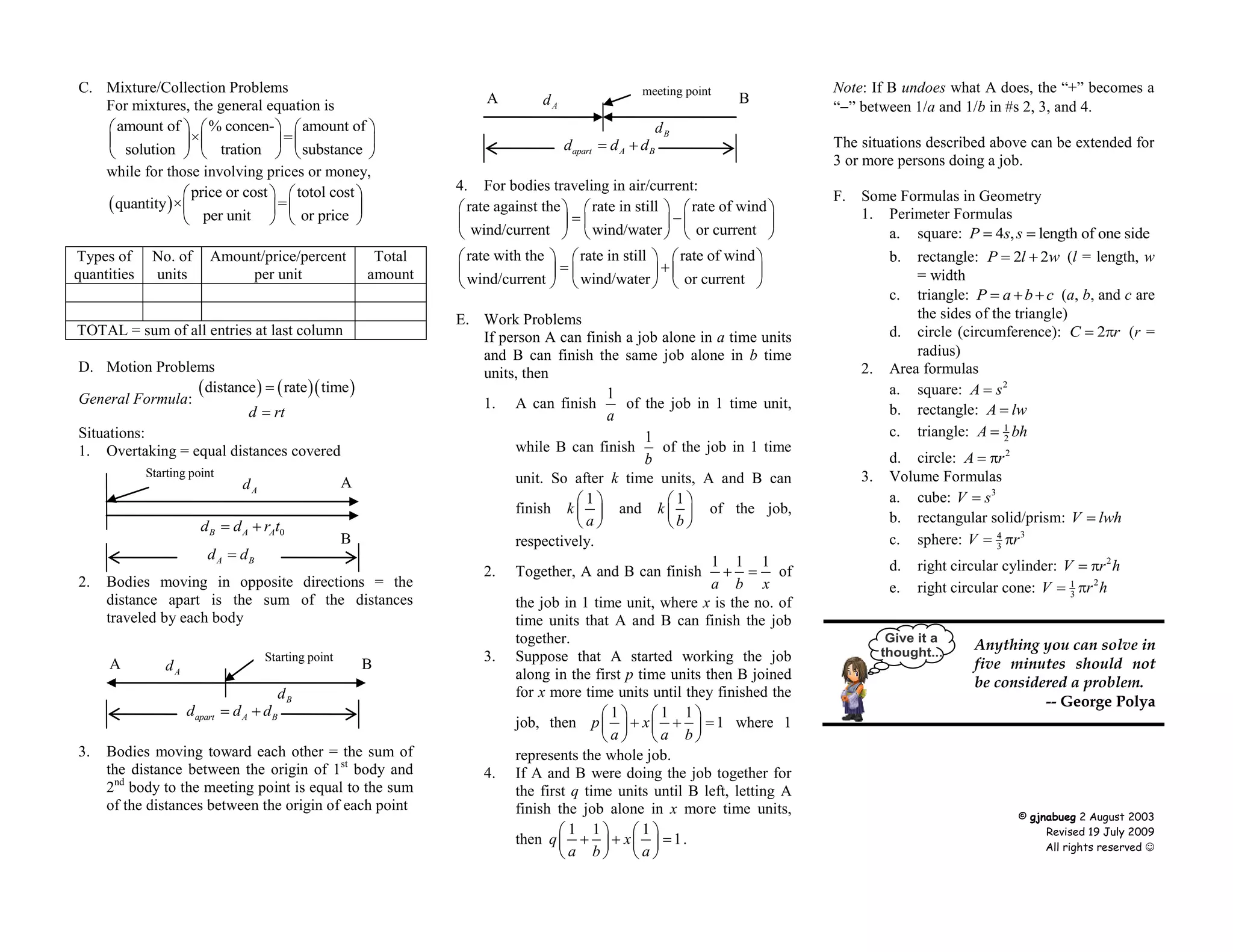
C. Mixture/Collection Problems                                                                       meeting point           Note: If B undoes what A does, the “+” becomes a
                                                                        A         dA                                 B
   For mixtures, the general equation is                                                                                     “” between 1/a and 1/b in #s 2, 3, and 4.
    amount of   % concen-   amount of                                                              dB
                 ×              =                                                dapart  d A  d B                    The situations described above can be extended for
    solution   tration   substance                                                                                     3 or more persons doing a job.
   while for those involving prices or money,
                                                                   4. For bodies traveling in air/current:
                   price or cost   totol cost 
    quantity  ×                =                              rate against the   rate in still   rate of wind 
                                                                                                                             F.   Some Formulas in Geometry
                                                                                                     
                   per unit   or price                                                                                        1. Perimeter Formulas
                                                                                                                        
                                                                    wind/current   wind/water   or current                     a. square: P  4s, s  length of one side
Types of      No. of      Amount/price/percent             Total    rate with the   rate in still   rate of wind               b. rectangle: P  2l  2w (l = length, w
quantities    units            per unit                   amount                                                                 = width
                                                                    wind/current   wind/water   or current 
                                                                                                                                     c. triangle: P  a  b  c (a, b, and c are
                                                                   E. Work Problems                                                      the sides of the triangle)
TOTAL = sum of all entries at last column                             If person A can finish a job alone in a time units             d. circle (circumference): C  2r (r =
                                                                      and B can finish the same job alone in b time                      radius)
D. Motion Problems                                                    units, then                                                 2. Area formulas
                  distance    rate  time                                            1                                         a. square: A  s 2
General Formula:                                                      1. A can finish         of the job in 1 time unit,
                          d  rt                                                           a                                         b. rectangle: A  lw
Situations:                                                                                       1                                  c. triangle: A  1 bh
                                                                                                                                                        2
1. Overtaking = equal distances covered                                    while B can finish       of the job in 1 time
                                                                                                  b                                    d. circle: A  r 2
             Starting point                                                unit. So after k time units, A and B can               3.   Volume Formulas
                                dA                    A
                                                                                      1            1                               a. cube: V  s3
                                                                           finish k   and k   of the job,
                                                                                      a            b                               b. rectangular solid/prism: V  lwh
                        d B  d A  rAt0
                                                      B                    respectively.                                               c. sphere: V  3 r 3
                                                                                                                                                       4

                         d A  dB
                                                                      2. Together, A and B can finish   of
                                                                                                            1 1 1                      d.   right circular cylinder: V  r 2 h
2.   Bodies moving in opposite directions = the                                                             a b x                      e.   right circular cone: V  1 r 2 h
                                                                                                                                                                      3
     distance apart is the sum of the distances                            the job in 1 time unit, where x is the no. of
     traveled by each body                                                 time units that A and B can finish the job
                                                                           together.                                                                 Anything you can solve in
                                     Starting point                   3. Suppose that A started working the job                                      five minutes should not
     A           dA                                       B
                                                                           along in the first p time units then B joined
                                                                                                                                                     be considered a problem.
                                        dB                                 for x more time units until they finished the
                                                                                                                                                               -- George Polya
                      dapart  d A  d B                                                  1      1 1
                                                                           job, then p    x     1 where 1
                                                                                           a     a b
3.   Bodies moving toward each other = the sum of                          represents the whole job.
     the distance between the origin of 1st body and                  4. If A and B were doing the job together for
     2nd body to the meeting point is equal to the sum                     the first q time units until B left, letting A
     of the distances between the origin of each point                     finish the job alone in x more time units,                                        © gjnabueg 2 August 2003
                                                                                   1 1       1                                                                Revised 19 July 2009
                                                                           then q     x    1 .                                                             All rights reserved 
                                                                                   a b       a

Math Reviewer - Word Problems in Algebra

  • 1.
    Mathematics Reviewer WORD PROBLEMS IN ALGEBRA Solving Word Problems George Polya’s Four-step Problem-Solving 2. Check each step of the plan as you proceed. 5. If the first number is x and another Process This may be intuitive checking or a formal number is k less than the first, then the As part of his work on problem solving, Polya proof of each step. other number is x  k . developed a four-step problem-solving process 3. Keep an accurate record of your work. 6. Consecutive integers: If x is the first similar to the following: D. Looking Back integer, then x  1 is the 2nd, x  2 is the A. Understanding the Problem 1. Check the results in the original problem. In 3rd, etc. 1. Can you state the problem in your own some cases, this will require a proof. 7. Consecutive even/odd integers: If x is the words? 2. Interpret the solution in terms of the original first even/odd integer, then x  2 is the 2. What are you trying to find or do? problem. Does your answer make sense? Is 2nd even/odd integer, x  4 is the 2nd 3. What are the unknowns? it reasonable? even/odd integer, etc. 4. What information do you obtain from the 3. Determine whether there is another method 8. Digits. A two digit number can be written problem? of finding the solution. in the from 10T  U , where T is the ten’s 5. What information, if any, is missing or not 4. If possible, determine other related or more digit and U is the unit’s digit. A three- needed? general problems for which the techniques digit number can be written in the form B. Devising a Plan will work. 100H  10T  U , where H is the The following list of strategies, although not (Source: hundred’s digit. exhaustive, is very useful: http://www.drkhamsi.com/classe/polya.html) N.B. If the digit of a two-digit number 1. Look for a pattern. 10T  U is REVERSED, the new number 2. Examine related problems and determine if Solution Strategies & Tips for Particular Word the same technique can be applied. becomes 10U  T . Reversing a three-digit Problems 3. Examine a simpler or special case of the number means reading the number backwards; problem to gain insight into the solution of A. Representations for Number Problems i.e., 100H  10T  U becomes 100U  10T  H . the original problem. 1. If the sum of two numbers is s and x is one 4. Make a table. number, then the other number is s  x . B. Age Problems 5. Make a diagram. 2. If the difference between two numbers is d If a is the present age of person A, then a  y 6. Write an equation. and x is the smaller number, then the larger is the age of A y years ago, while a  y is the 7. Use a guess and check. number is d  x . age of A y years from now (or hence). 8. Work backward. 3. If the first number is x and another is k times Age table for age problems: 9. Identify a sub goal. the first, then the other number is kx . Age some C. Carrying out the Plan 4. If the first number is x and another number Persons Age now years ago or 1. Implement the strategy in Step 2 and is k more than the first, then the other from now perform any necessary actions or number is x  k . computations.
  • 2.
    C. Mixture/Collection Problems meeting point Note: If B undoes what A does, the “+” becomes a A dA B For mixtures, the general equation is “” between 1/a and 1/b in #s 2, 3, and 4.  amount of   % concen-   amount of  dB  × =  dapart  d A  d B The situations described above can be extended for  solution   tration   substance  3 or more persons doing a job. while for those involving prices or money, 4. For bodies traveling in air/current:  price or cost   totol cost   quantity  ×  =   rate against the   rate in still   rate of wind  F. Some Formulas in Geometry    per unit   or price  1. Perimeter Formulas    wind/current   wind/water   or current  a. square: P  4s, s  length of one side Types of No. of Amount/price/percent Total  rate with the   rate in still   rate of wind  b. rectangle: P  2l  2w (l = length, w quantities units per unit amount     = width  wind/current   wind/water   or current  c. triangle: P  a  b  c (a, b, and c are E. Work Problems the sides of the triangle) TOTAL = sum of all entries at last column If person A can finish a job alone in a time units d. circle (circumference): C  2r (r = and B can finish the same job alone in b time radius) D. Motion Problems units, then 2. Area formulas  distance    rate  time  1 a. square: A  s 2 General Formula: 1. A can finish of the job in 1 time unit, d  rt a b. rectangle: A  lw Situations: 1 c. triangle: A  1 bh 2 1. Overtaking = equal distances covered while B can finish of the job in 1 time b d. circle: A  r 2 Starting point unit. So after k time units, A and B can 3. Volume Formulas dA A 1 1 a. cube: V  s3 finish k   and k   of the job, a b b. rectangular solid/prism: V  lwh d B  d A  rAt0 B respectively. c. sphere: V  3 r 3 4 d A  dB 2. Together, A and B can finish   of 1 1 1 d. right circular cylinder: V  r 2 h 2. Bodies moving in opposite directions = the a b x e. right circular cone: V  1 r 2 h 3 distance apart is the sum of the distances the job in 1 time unit, where x is the no. of traveled by each body time units that A and B can finish the job together. Anything you can solve in Starting point 3. Suppose that A started working the job five minutes should not A dA B along in the first p time units then B joined be considered a problem. dB for x more time units until they finished the -- George Polya dapart  d A  d B 1 1 1 job, then p    x     1 where 1  a a b 3. Bodies moving toward each other = the sum of represents the whole job. the distance between the origin of 1st body and 4. If A and B were doing the job together for 2nd body to the meeting point is equal to the sum the first q time units until B left, letting A of the distances between the origin of each point finish the job alone in x more time units, © gjnabueg 2 August 2003 1 1 1 Revised 19 July 2009 then q     x    1 . All rights reserved  a b a