2-1-linear-functions
2.1 Linear Functions
• Represent a linear function
• Determine whether a linear function is increasing, decreasing, or
constant
• Calculate and interpret slope
• Write the point-slope form of an equation
• Write and interpret a linear function
2.1 Linear Functions
• The train’s distance from the station is a function of the time during
which the train moves at a constant speed plus its original distance
from the station when it began moving at constant speed
Can the input in the previous example be any
real number?
• The input represents time, so while nonnegative rational and
irrational numbers are possible, negative real numbers are not
possible for this example
• The input consists of non-negative real numbers
• Another way to represent linear functions is visually, using a graph
• The domain is comprised of all real numbers because any number
may be doubled, and then have one added to the product
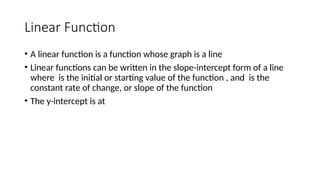
Linear Function
• A linear function is a function whose graph is a line
• Linear functions can be written in the slope-intercept form of a line
where is the initial or starting value of the function , and is the
constant rate of change, or slope of the function
• The y-intercept is at
Example 1
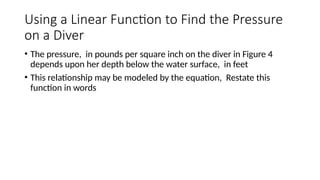
Using a Linear Function to Find the Pressure
on a Diver
• The pressure, in pounds per square inch on the diver in Figure 4
depends upon her depth below the water surface, in feet
• This relationship may be modeled by the equation, Restate this
function in words
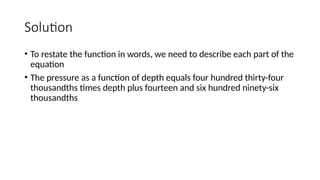
Solution
• To restate the function in words, we need to describe each part of the
equation
• The pressure as a function of depth equals four hundred thirty-four
thousandths times depth plus fourteen and six hundred ninety-six
thousandths
Analysis
• The initial value, 14.696, is the pressure in PSI on the diver at a depth
of 0 feet, which is the surface of the water
• This tells us that the pressure on the diver increases 0.434 PSI for
each foot her depth increases
• The linear functions we used in the two previous examples increased
over time, but not every linear function does
• A linear function may be increasing, decreasing, or constant
Increasing and Decreasing
Functions
Example 2
Deciding whether a Function Is Increasing,
Decreasing, or Constant
• ⓐ The total number of texts a teen sends is considered a function of
time in days
• ⓑ A person has a limit of 500 texts per month in their data plan
• ⓒ A person has an unlimited number of texts in their data plan for a
cost of $50 per month
Solution
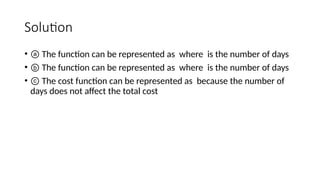
• ⓐ The function can be represented as where is the number of days
• ⓑ The function can be represented as where is the number of days
• ⓒ The cost function can be represented as because the number of
days does not affect the total cost
Are the units for slope always ?
• Think of the units as the change of output value for each unit of
change in input value
• An example of slope could be miles per hour or dollars per day
• Notice the units appear as a ratio of units for the output per units for
the input
Calculate Slope
• The slope, or rate of change, of a function can be calculated
according to the following: where and are input values, and are
output values
How To
• Given two points from a linear function, calculate and interpret the
slope
• Determine the units for output and input values
• Calculate the change of output values and change of input values
• Interpret the slope as the change in output values per unit of the
input value
Example 3
• If is a linear function, and and are points on the line, find the slope
• Is this function increasing or decreasing?
Solution
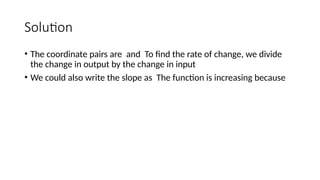
• The coordinate pairs are and To find the rate of change, we divide
the change in output by the change in input
• We could also write the slope as The function is increasing because
Analysis
• As noted earlier, the order in which we write the points does not
matter when we compute the slope of the line as long as the first
output value, or y-coordinate, used corresponds with the first input
value, or x-coordinate, used
Try It #1
• If is a linear function, and and are points on the line, find the slope
• Is this function increasing or decreasing?
Example 4
Finding the Population Change from a Linear
Function
• The population of a city increased from 23,400 to 27,800 between
2008 and
• Find the change of population per year if we assume the change was
constant from 2008 to
Solution
• The rate of change relates the change in population to the change in
time
• The population increased by people over the four-year time interval
• To find the rate of change, divide the change in the number of people
by the number of years
Analysis
• Because we are told that the population increased, we would expect
the slope to be positive
• This positive slope we calculated is therefore reasonable
Try It #2
• The population of a small town increased from 1,442 to 1,868
between 2009 and
• Up until now, we have been using the slope-intercept form of a linear
equation to describe linear functions
• The point-slope form is derived from the slope formula
Point-Slope Form of a Linear Equation
• The point-slope form of a linear equation takes the form where is the
slope, are the coordinates of a specific point through which the line
passes
• The point-slope form is particularly useful if we know one point and
the slope of a line
• If we wanted to then rewrite the equation in slope-intercept form, we
apply algebraic techniques
Example 5
• Write the point-slope form of an equation of a line with a slope of 3
that passes through the point Then rewrite it in the slope-intercept
form
Solution
• Let’s figure out what we know from the given information
• The slope is 3, so We also know one point, so we know and Now we
can substitute these values into the general point-slope equation
• Then we use algebra to find the slope-intercept form
Try It #3
• Write the point-slope form of an equation of a line with a slope of
that passes through the point Then rewrite it in the slope-intercept
form
• The point-slope form of an equation is also useful if we know any two
points through which a line passes
• Both equations describe the line shown in Figure
Example 6
Writing Linear Equations Using Two Points
• Write the point-slope form of an equation of a line that passes
through the points and
• Then rewrite it in the slope-intercept form
Solution
• So Next, we substitute the slope and the coordinates for one of the
points into the general point-slope equation
• We can choose either point, but we will use The point-slope equation
of the line is To rewrite the equation in slope-intercept form, we use
algebra
• The slope-intercept equation of the line is
Try It #4
• Write the point-slope form of an equation of a line that passes
through the points and Then rewrite it in the slope-intercept form
• Now that we have written equations for linear functions in both the
slope-intercept form and the point-slope form, we can choose which
method to use based on the information we are given
• If we want to rewrite the equation in the slope-intercept form, we
would find If we wanted to find the slope-intercept form without first
writing the point-slope form, we could have recognized that the line
crosses the y-axis when the output value is
How To
• Given the graph of a linear function, write an equation to represent
the function
• Identify two points on the line
• Use the two points to calculate the slope
• Determine where the line crosses the y-axis to identify the y-intercept
by visual inspection
• Substitute the slope and y-intercept into the slope-intercept form of a
line equation
Example 7
Writing an Equation for a Linear Function
• Write an equation for a linear function given a graph of shown in
Figure
Solution
• Identify two points on the line, such as and Use the points to
calculate the slope
• Substitute the slope and the coordinates of one of the points into the
point-slope form
• We can use algebra to rewrite the equation in the slope-intercept
form
Analysis
• This makes sense because we can see from Figure 11 that the line
crosses the y-axis at the point , which is the y-intercept, so
Example 8
Writing an Equation for a Linear Cost Function
• Suppose Ben starts a company in which he incurs a fixed cost of
$1,250 per month for the overhead, which includes his office rent
• His production costs are $37.50 per item
• Write a linear function where is the cost for items produced in a
given month
Solution
• The fixed cost is present every month, $1
• The costs that can vary include the cost to produce each item, which
is $37.50 for Ben
• The variable cost, called the marginal cost, is represented by The cost
Ben incurs is the sum of these two costs, represented by
Analysis
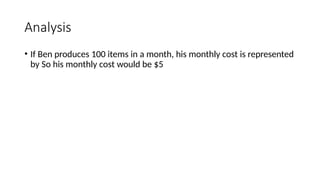
• If Ben produces 100 items in a month, his monthly cost is represented
by So his monthly cost would be $5
Example 9
Writing an Equation for a Linear Function
Given Two Points
• If is a linear function, with , and , find an equation for the function in
slope-intercept form
Solution
• We can write the given points using coordinates
• Substitute the slope and the coordinates of one of the points into the
point-slope form
• We can use algebra to rewrite the equation in the slope-intercept
form
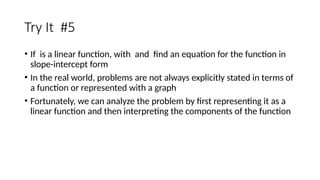
Try It #5
• If is a linear function, with and find an equation for the function in
slope-intercept form
• In the real world, problems are not always explicitly stated in terms of
a function or represented with a graph
• Fortunately, we can analyze the problem by first representing it as a
linear function and then interpreting the components of the function
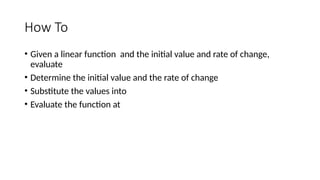
How To
• Given a linear function and the initial value and rate of change,
evaluate
• Determine the initial value and the rate of change
• Substitute the values into
• Evaluate the function at
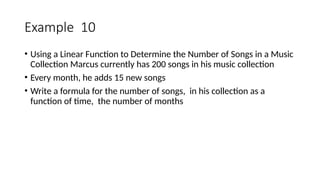
Example 10
• Using a Linear Function to Determine the Number of Songs in a Music
Collection Marcus currently has 200 songs in his music collection
• Every month, he adds 15 new songs
• Write a formula for the number of songs, in his collection as a
function of time, the number of months
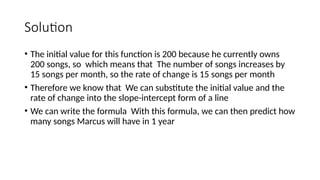
Solution
• The initial value for this function is 200 because he currently owns
200 songs, so which means that The number of songs increases by
15 songs per month, so the rate of change is 15 songs per month
• Therefore we know that We can substitute the initial value and the
rate of change into the slope-intercept form of a line
• We can write the formula With this formula, we can then predict how
many songs Marcus will have in 1 year
Analysis
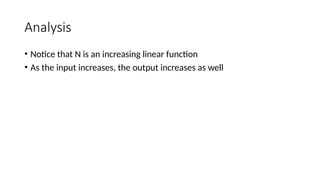
• Notice that N is an increasing linear function
• As the input increases, the output increases as well
Example 11
Using a Linear Function to Calculate Salary
Plus Commission
• Working as an insurance salesperson, Ilya earns a base salary plus a
commission on each new policy
• Therefore, Ilya’s weekly income, depends on the number of new
policies, he sells during the week
• Last week he sold 3 new policies, and earned $760 for the week
Solution
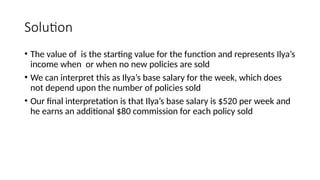
• The value of is the starting value for the function and represents Ilya’s
income when or when no new policies are sold
• We can interpret this as Ilya’s base salary for the week, which does
not depend upon the number of policies sold
• Our final interpretation is that Ilya’s base salary is $520 per week and
he earns an additional $80 commission for each policy sold
Example 12
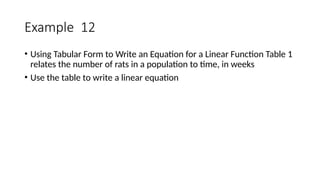
• Using Tabular Form to Write an Equation for a Linear Function Table 1
relates the number of rats in a population to time, in weeks
• Use the table to write a linear equation
Solution
• Is the initial value always provided in a table of values like Table 1?
Try It #6
• A new plant food was introduced to a young tree to test its effect on
the height of the tree
• Table 2 shows the height of the tree, in feet, months since the
measurements began
• Write a linear function, where is the number of months since the
start of the experiment
Media
• Linear Functions

linear functions and precalculus, algebra 2 mathematcs. Fundamentals

  • 1.
  • 2.
    2.1 Linear Functions •Represent a linear function • Determine whether a linear function is increasing, decreasing, or constant • Calculate and interpret slope • Write the point-slope form of an equation • Write and interpret a linear function
  • 3.
    2.1 Linear Functions •The train’s distance from the station is a function of the time during which the train moves at a constant speed plus its original distance from the station when it began moving at constant speed
  • 4.
    Can the inputin the previous example be any real number? • The input represents time, so while nonnegative rational and irrational numbers are possible, negative real numbers are not possible for this example • The input consists of non-negative real numbers • Another way to represent linear functions is visually, using a graph • The domain is comprised of all real numbers because any number may be doubled, and then have one added to the product
  • 5.
    Linear Function • Alinear function is a function whose graph is a line • Linear functions can be written in the slope-intercept form of a line where is the initial or starting value of the function , and is the constant rate of change, or slope of the function • The y-intercept is at
  • 6.
  • 7.
    Using a LinearFunction to Find the Pressure on a Diver • The pressure, in pounds per square inch on the diver in Figure 4 depends upon her depth below the water surface, in feet • This relationship may be modeled by the equation, Restate this function in words
  • 8.
    Solution • To restatethe function in words, we need to describe each part of the equation • The pressure as a function of depth equals four hundred thirty-four thousandths times depth plus fourteen and six hundred ninety-six thousandths
  • 9.
    Analysis • The initialvalue, 14.696, is the pressure in PSI on the diver at a depth of 0 feet, which is the surface of the water • This tells us that the pressure on the diver increases 0.434 PSI for each foot her depth increases • The linear functions we used in the two previous examples increased over time, but not every linear function does • A linear function may be increasing, decreasing, or constant
  • 10.
  • 11.
  • 12.
    Deciding whether aFunction Is Increasing, Decreasing, or Constant • ⓐ The total number of texts a teen sends is considered a function of time in days • ⓑ A person has a limit of 500 texts per month in their data plan • ⓒ A person has an unlimited number of texts in their data plan for a cost of $50 per month
  • 13.
    Solution • ⓐ Thefunction can be represented as where is the number of days • ⓑ The function can be represented as where is the number of days • ⓒ The cost function can be represented as because the number of days does not affect the total cost
  • 14.
    Are the unitsfor slope always ? • Think of the units as the change of output value for each unit of change in input value • An example of slope could be miles per hour or dollars per day • Notice the units appear as a ratio of units for the output per units for the input
  • 15.
    Calculate Slope • Theslope, or rate of change, of a function can be calculated according to the following: where and are input values, and are output values
  • 16.
    How To • Giventwo points from a linear function, calculate and interpret the slope • Determine the units for output and input values • Calculate the change of output values and change of input values • Interpret the slope as the change in output values per unit of the input value
  • 17.
    Example 3 • Ifis a linear function, and and are points on the line, find the slope • Is this function increasing or decreasing?
  • 18.
    Solution • The coordinatepairs are and To find the rate of change, we divide the change in output by the change in input • We could also write the slope as The function is increasing because
  • 19.
    Analysis • As notedearlier, the order in which we write the points does not matter when we compute the slope of the line as long as the first output value, or y-coordinate, used corresponds with the first input value, or x-coordinate, used
  • 20.
    Try It #1 •If is a linear function, and and are points on the line, find the slope • Is this function increasing or decreasing?
  • 21.
  • 22.
    Finding the PopulationChange from a Linear Function • The population of a city increased from 23,400 to 27,800 between 2008 and • Find the change of population per year if we assume the change was constant from 2008 to
  • 23.
    Solution • The rateof change relates the change in population to the change in time • The population increased by people over the four-year time interval • To find the rate of change, divide the change in the number of people by the number of years
  • 24.
    Analysis • Because weare told that the population increased, we would expect the slope to be positive • This positive slope we calculated is therefore reasonable
  • 25.
    Try It #2 •The population of a small town increased from 1,442 to 1,868 between 2009 and • Up until now, we have been using the slope-intercept form of a linear equation to describe linear functions • The point-slope form is derived from the slope formula
  • 26.
    Point-Slope Form ofa Linear Equation • The point-slope form of a linear equation takes the form where is the slope, are the coordinates of a specific point through which the line passes • The point-slope form is particularly useful if we know one point and the slope of a line • If we wanted to then rewrite the equation in slope-intercept form, we apply algebraic techniques
  • 27.
    Example 5 • Writethe point-slope form of an equation of a line with a slope of 3 that passes through the point Then rewrite it in the slope-intercept form
  • 28.
    Solution • Let’s figureout what we know from the given information • The slope is 3, so We also know one point, so we know and Now we can substitute these values into the general point-slope equation • Then we use algebra to find the slope-intercept form
  • 29.
    Try It #3 •Write the point-slope form of an equation of a line with a slope of that passes through the point Then rewrite it in the slope-intercept form • The point-slope form of an equation is also useful if we know any two points through which a line passes • Both equations describe the line shown in Figure
  • 30.
  • 31.
    Writing Linear EquationsUsing Two Points • Write the point-slope form of an equation of a line that passes through the points and • Then rewrite it in the slope-intercept form
  • 32.
    Solution • So Next,we substitute the slope and the coordinates for one of the points into the general point-slope equation • We can choose either point, but we will use The point-slope equation of the line is To rewrite the equation in slope-intercept form, we use algebra • The slope-intercept equation of the line is
  • 33.
    Try It #4 •Write the point-slope form of an equation of a line that passes through the points and Then rewrite it in the slope-intercept form • Now that we have written equations for linear functions in both the slope-intercept form and the point-slope form, we can choose which method to use based on the information we are given • If we want to rewrite the equation in the slope-intercept form, we would find If we wanted to find the slope-intercept form without first writing the point-slope form, we could have recognized that the line crosses the y-axis when the output value is
  • 34.
    How To • Giventhe graph of a linear function, write an equation to represent the function • Identify two points on the line • Use the two points to calculate the slope • Determine where the line crosses the y-axis to identify the y-intercept by visual inspection • Substitute the slope and y-intercept into the slope-intercept form of a line equation
  • 35.
  • 36.
    Writing an Equationfor a Linear Function • Write an equation for a linear function given a graph of shown in Figure
  • 37.
    Solution • Identify twopoints on the line, such as and Use the points to calculate the slope • Substitute the slope and the coordinates of one of the points into the point-slope form • We can use algebra to rewrite the equation in the slope-intercept form
  • 38.
    Analysis • This makessense because we can see from Figure 11 that the line crosses the y-axis at the point , which is the y-intercept, so
  • 39.
  • 40.
    Writing an Equationfor a Linear Cost Function • Suppose Ben starts a company in which he incurs a fixed cost of $1,250 per month for the overhead, which includes his office rent • His production costs are $37.50 per item • Write a linear function where is the cost for items produced in a given month
  • 41.
    Solution • The fixedcost is present every month, $1 • The costs that can vary include the cost to produce each item, which is $37.50 for Ben • The variable cost, called the marginal cost, is represented by The cost Ben incurs is the sum of these two costs, represented by
  • 42.
    Analysis • If Benproduces 100 items in a month, his monthly cost is represented by So his monthly cost would be $5
  • 43.
  • 44.
    Writing an Equationfor a Linear Function Given Two Points • If is a linear function, with , and , find an equation for the function in slope-intercept form
  • 45.
    Solution • We canwrite the given points using coordinates • Substitute the slope and the coordinates of one of the points into the point-slope form • We can use algebra to rewrite the equation in the slope-intercept form
  • 46.
    Try It #5 •If is a linear function, with and find an equation for the function in slope-intercept form • In the real world, problems are not always explicitly stated in terms of a function or represented with a graph • Fortunately, we can analyze the problem by first representing it as a linear function and then interpreting the components of the function
  • 47.
    How To • Givena linear function and the initial value and rate of change, evaluate • Determine the initial value and the rate of change • Substitute the values into • Evaluate the function at
  • 48.
    Example 10 • Usinga Linear Function to Determine the Number of Songs in a Music Collection Marcus currently has 200 songs in his music collection • Every month, he adds 15 new songs • Write a formula for the number of songs, in his collection as a function of time, the number of months
  • 49.
    Solution • The initialvalue for this function is 200 because he currently owns 200 songs, so which means that The number of songs increases by 15 songs per month, so the rate of change is 15 songs per month • Therefore we know that We can substitute the initial value and the rate of change into the slope-intercept form of a line • We can write the formula With this formula, we can then predict how many songs Marcus will have in 1 year
  • 50.
    Analysis • Notice thatN is an increasing linear function • As the input increases, the output increases as well
  • 51.
  • 52.
    Using a LinearFunction to Calculate Salary Plus Commission • Working as an insurance salesperson, Ilya earns a base salary plus a commission on each new policy • Therefore, Ilya’s weekly income, depends on the number of new policies, he sells during the week • Last week he sold 3 new policies, and earned $760 for the week
  • 53.
    Solution • The valueof is the starting value for the function and represents Ilya’s income when or when no new policies are sold • We can interpret this as Ilya’s base salary for the week, which does not depend upon the number of policies sold • Our final interpretation is that Ilya’s base salary is $520 per week and he earns an additional $80 commission for each policy sold
  • 54.
    Example 12 • UsingTabular Form to Write an Equation for a Linear Function Table 1 relates the number of rats in a population to time, in weeks • Use the table to write a linear equation
  • 55.
    Solution • Is theinitial value always provided in a table of values like Table 1?
  • 56.
    Try It #6 •A new plant food was introduced to a young tree to test its effect on the height of the tree • Table 2 shows the height of the tree, in feet, months since the measurements began • Write a linear function, where is the number of months since the start of the experiment
  • 57.