MATERIALS
REQUIREMENT
PLANNING
In 1964, Joseph Orlicky developed MRP
Black & Decker in 1964 used MRP
MRP is an Inventory Management
System
Suits to manufacturing industries
System based as well as hand based
 MRP says
a) What you need?
b) What you have to get and when?
 MRP uses Master Production Schedule, Bills of Material
& Inventory Records as Inputs.
 Outputs
a) When to release new orders
b) When to reschedule open orders
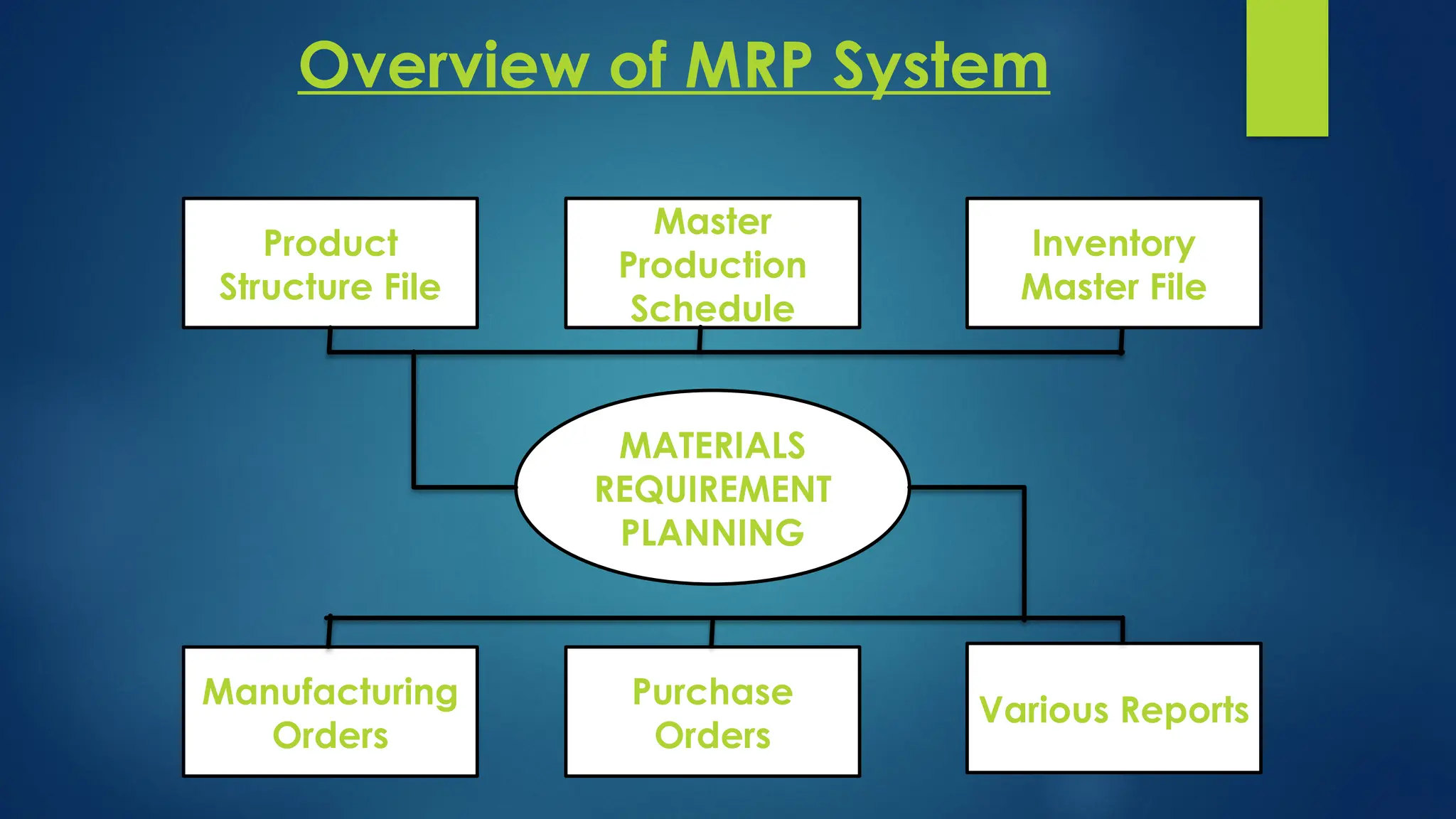
Overview of MRP System
Product
Structure File
Inventory
Master File
Master
Production
Schedule
Purchase
Orders
Manufacturing
Orders
Various Reports
MATERIALS
REQUIREMENT
PLANNING
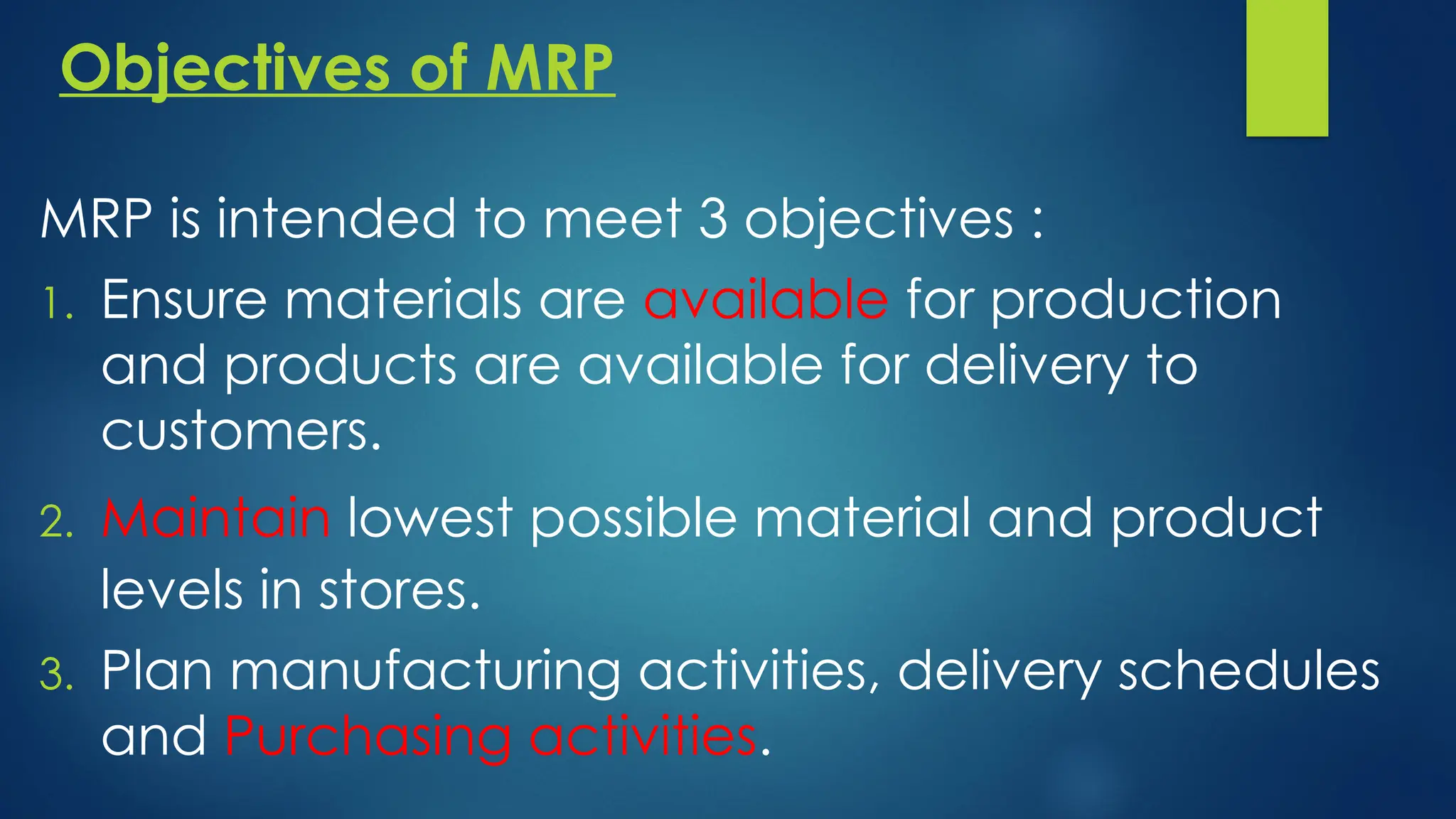
Objectives of MRP
MRP is intended to meet 3 objectives :
1. Ensure materials are available for production
and products are available for delivery to
customers.
2. Maintain lowest possible material and product
levels in stores.
3. Plan manufacturing activities, delivery schedules
and Purchasing activities.
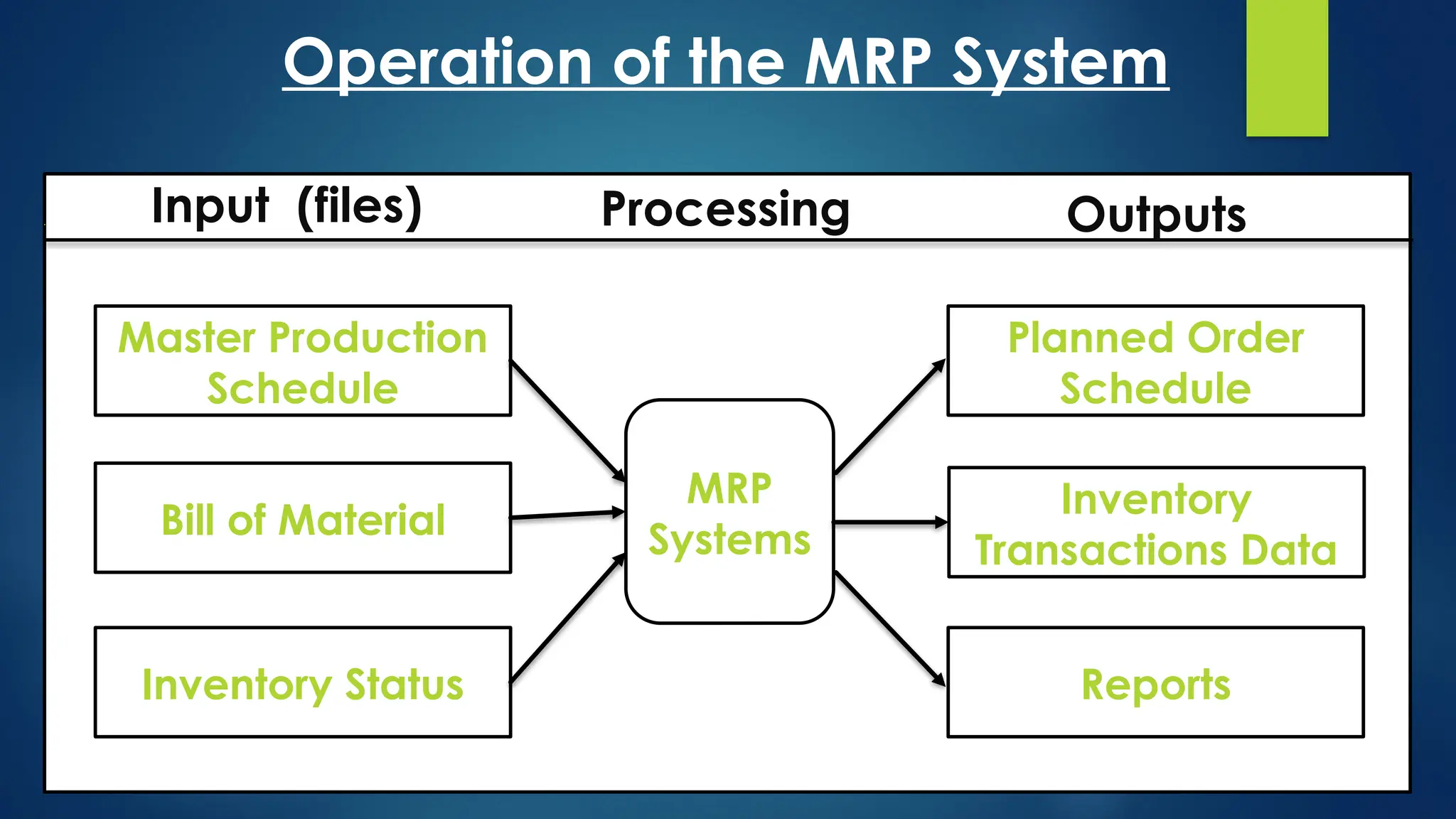
Operation of the MRP System
Master Production
Schedule
Inventory Status
Bill of Material
Reports
Inventory
Transactions Data
Planned Order
Schedule
MRP
Systems
Input (files) Processing Outputs
Issues in MRP
 Lot-Sizing
 Safety Stock
 Scrap Allowance
 Pegging
 Cycle Counting
 Updating
 Time Fence
1. Lot-Sizing
Meaning: Lot sizing is the process of determining the quantity of units to be
ordered or produced in one batch.
Example:
A company receives orders for 1,000 pens every week, but instead of
producing 1,000 pens daily, they decide to produce 5,000 pens in one batch
every 5 days. This is lot-sizing.
2. Safety Stock
Meaning: Extra inventory kept to prevent stockouts caused by demand or
supply fluctuations.
Example:
 A shop normally sells 100 units of a product per week. To avoid running out
of stock in case of delay from the supplier, it keeps an extra 50 units as
safety stock.
3. Scrap Allowance
 Meaning: Extra materials or parts included in planning to account for
expected loss or damage during production.
Example:
 If a company needs to produce 1,000 glass bottles and knows that 5%
might break during production, it plans to produce 1,050 bottles. The extra
50 is the scrap allowance.
4. Pegging
 Meaning: Tracing the parent item for which a component or material is
required in the production process.
Example:
 If screw A is used in products X and Y, and there’s a shortage of screw A,
pegging helps identify whether the shortage affects X, Y, or both.
5. Cycle Counting
 Meaning: A method of auditing inventory where items are counted on a rotating
schedule rather than all at once. Instead of shutting down the warehouse to count all
items once a year, a business counts 10% of inventory every week. This is cycle
counting.
6. Updating
 Meaning: Making changes or corrections in records to reflect current and accurate
information.
If 50 new units of an item are received but not recorded in the system, updating the
inventory record is necessary to show correct stock levels.
 7. Time Fence
Meaning: A point in the future beyond which changes to a production schedule are not
allowed or are tightly controlled.
If a production plan is set for the next 2 weeks, and no changes can be made to it after
3 days from now, the time fence is 3 days.
Requirements
A Computer and necessary Software Programs
Accurate and Up to Date
(i) Master Schedules
(ii) Bills Of Materials
(iii) Inventory Records
Integrity of File Data
Benefits
Minimizing the inventory level
Determining the material requirement and its
management
Choosing the most economical way
Allocation of production time
Information by MRP
Useful for employers, workers, production
managers, plant foreman, customer
representative
Problems in using MRP
Preparation of MPS
Maintaining accurate BOM files
Incorrect stock status
Unrealistic lead times
Problems in designing the MRP
system
Inadequacies of software chosen
Deficient system design
Improper and untimely information flow
 MRP is more useful in Process-Focused systems which have
long process times and multi-stage production steps.
 MRP offers advantages in inventory planning when the lot
sizes are small and demand is highly variable.
 Basically MRP is a computerized information system for
POM.
It is best applied when production systems are well
managed and when a comprehensive production and
inventory planning is needed.

materials requirement planning in material

  • 1.
  • 2.
    In 1964, JosephOrlicky developed MRP Black & Decker in 1964 used MRP MRP is an Inventory Management System Suits to manufacturing industries System based as well as hand based
  • 3.
     MRP says a)What you need? b) What you have to get and when?  MRP uses Master Production Schedule, Bills of Material & Inventory Records as Inputs.  Outputs a) When to release new orders b) When to reschedule open orders
  • 4.
    Overview of MRPSystem Product Structure File Inventory Master File Master Production Schedule Purchase Orders Manufacturing Orders Various Reports MATERIALS REQUIREMENT PLANNING
  • 5.
    Objectives of MRP MRPis intended to meet 3 objectives : 1. Ensure materials are available for production and products are available for delivery to customers. 2. Maintain lowest possible material and product levels in stores. 3. Plan manufacturing activities, delivery schedules and Purchasing activities.
  • 6.
    Operation of theMRP System Master Production Schedule Inventory Status Bill of Material Reports Inventory Transactions Data Planned Order Schedule MRP Systems Input (files) Processing Outputs
  • 7.
    Issues in MRP Lot-Sizing  Safety Stock  Scrap Allowance  Pegging  Cycle Counting  Updating  Time Fence
  • 8.
    1. Lot-Sizing Meaning: Lotsizing is the process of determining the quantity of units to be ordered or produced in one batch. Example: A company receives orders for 1,000 pens every week, but instead of producing 1,000 pens daily, they decide to produce 5,000 pens in one batch every 5 days. This is lot-sizing. 2. Safety Stock Meaning: Extra inventory kept to prevent stockouts caused by demand or supply fluctuations. Example:  A shop normally sells 100 units of a product per week. To avoid running out of stock in case of delay from the supplier, it keeps an extra 50 units as safety stock.
  • 9.
    3. Scrap Allowance Meaning: Extra materials or parts included in planning to account for expected loss or damage during production. Example:  If a company needs to produce 1,000 glass bottles and knows that 5% might break during production, it plans to produce 1,050 bottles. The extra 50 is the scrap allowance. 4. Pegging  Meaning: Tracing the parent item for which a component or material is required in the production process. Example:  If screw A is used in products X and Y, and there’s a shortage of screw A, pegging helps identify whether the shortage affects X, Y, or both.
  • 10.
    5. Cycle Counting Meaning: A method of auditing inventory where items are counted on a rotating schedule rather than all at once. Instead of shutting down the warehouse to count all items once a year, a business counts 10% of inventory every week. This is cycle counting. 6. Updating  Meaning: Making changes or corrections in records to reflect current and accurate information. If 50 new units of an item are received but not recorded in the system, updating the inventory record is necessary to show correct stock levels.  7. Time Fence Meaning: A point in the future beyond which changes to a production schedule are not allowed or are tightly controlled. If a production plan is set for the next 2 weeks, and no changes can be made to it after 3 days from now, the time fence is 3 days.
  • 11.
    Requirements A Computer andnecessary Software Programs Accurate and Up to Date (i) Master Schedules (ii) Bills Of Materials (iii) Inventory Records Integrity of File Data
  • 12.
    Benefits Minimizing the inventorylevel Determining the material requirement and its management Choosing the most economical way Allocation of production time Information by MRP Useful for employers, workers, production managers, plant foreman, customer representative
  • 13.
    Problems in usingMRP Preparation of MPS Maintaining accurate BOM files Incorrect stock status Unrealistic lead times
  • 14.
    Problems in designingthe MRP system Inadequacies of software chosen Deficient system design Improper and untimely information flow
  • 15.
     MRP ismore useful in Process-Focused systems which have long process times and multi-stage production steps.  MRP offers advantages in inventory planning when the lot sizes are small and demand is highly variable.  Basically MRP is a computerized information system for POM. It is best applied when production systems are well managed and when a comprehensive production and inventory planning is needed.