
Cooperative Negotiation
                    The 7 principles of Harvard
                    Negotiation Metholodogy


     Guadalupe de la Mata
                                                  1
www.innovationforsocialchange.org
TODAY’S CLASS

  The Seven Principles       of     cooperative               neogotiation   (Harvard
  Methodology)

      Main concepts

      Keys to prepare for negotiation considering each of them

      Real Examples (short videos)

  Lets experience it!: the Ugly Orange Case Study


                               Guadalupe de la Mata
                                                                                        2
                          www.innovationforsocialchange.org
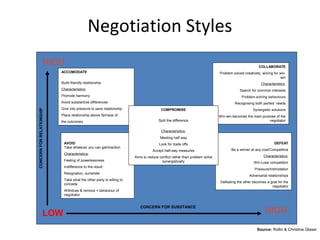
Negotiation Styles
                   HIGH                                                                                                                           COLLABORATE
                           ACCOMODATE                                                                                     Problem solved creatively, aiming for win-
                                                                                                                                                                win
                           Build friendly relationship                                                                                              Characteristics:
                           Characteristics:                                                                                           Search for common interests
                           Promote harmony                                                                                              Problem-solving behaviours
                           Avoid substantive differences                                                                           Recognising both parties’ needs
                           Give into pressure to save relationship                    COMPROMISE                                               Synergistic solutions
CONCERN FOR RELATIONSHIP


                           Place relationship above fairness of                                                           Win-win becomes the main purpose of the
                           the outcomes                                              Split the difference                                              negotiator

                                                                                      Characteristics:
                                                                                      Meeting half way
                            AVOID                                                    Look for trade offs                                                    DEFEAT
                            Take whatever you can get/Inaction
                                                                                 Accept half-way measures                        Be a winner at any cost/Competitive
                            Characteristics:
                                                                      Aims to reduce conflict rather than problem solve                              Characteristics:
                            Feeling of powerlessness                                  synergistically                                          Win-Lose competition
                            Indifference to the result
                                                                                                                                                Pressure/Intimidation
                            Resignation, surrender
                                                                                                                                            Adversarial relationships
                            Take what the other party is willing to
                                                                                                                           Defeating the other becomes a goal for the
                            concede
                                                                                                                                                          negotiator
                            Withdraw & remove = behaviour of
                            negotiator


                                                                         CONCERN FOR SUBSTANCE
                   LOW                                                                                                                                HIGH
                                                                                                                                                 Source: Rollin & Christine Glaser
Harvard Negotiation Project


                      • Began in 1983


                      • In conjunction with
                        MIT and Tufts

                      • Negotiation art and
                        a science
         Guadalupe de la Mata
    www.innovationforsocialchange.org
                                              4
Getting to Yes Authors


Roger Fisher


     Bruce Patton
                                                        William Ury
                         Guadalupe de la Mata
                                                                      5
                    www.innovationforsocialchange.org
Negotiation Styles
                   HIGH                                                                                                                           COLLABORATE
                           ACCOMODATE                                                                                     Problem solved creatively, aiming for win-
                                                                                                                                                                win
                           Build friendly relationship                                                                                              Characteristics:
                           Characteristics:                                                                                           Search for common interests
                           Promote harmony                                                                                              Problem-solving behaviours
                           Avoid substantive differences                                                                           Recognising both parties’ needs
                           Give into pressure to save relationship                    COMPROMISE                                               Synergistic solutions
CONCERN FOR RELATIONSHIP


                           Place relationship above fairness of                                                           Win-win becomes the main purpose of the
                           the outcomes                                              Split the difference                                              negotiator

                                                                                      Characteristics:
                                                                                      Meeting half way
                            AVOID                                                    Look for trade offs                                                    DEFEAT
                            Take whatever you can get/Inaction
                                                                                 Accept half-way measures                        Be a winner at any cost/Competitive
                            Characteristics:
                                                                      Aims to reduce conflict rather than problem solve                              Characteristics:
                            Feeling of powerlessness                                  synergistically                                          Win-Lose competition
                            Indifference to the result
                                                                                                                                                Pressure/Intimidation
                            Resignation, surrender
                                                                                                                                            Adversarial relationships
                            Take what the other party is willing to
                                                                                                                           Defeating the other becomes a goal for the
                            concede
                                                                                                                                                          negotiator
                            Withdraw & remove = behaviour of
                            negotiator


                                                                         CONCERN FOR SUBSTANCE
                   LOW                                                                                                                                HIGH
                                                                                                                                                 Source: Rollin & Christine Glaser
Getting to Yes: 7 PRINCIPLES

                                          What do you really care about?
                                  The needs, concerns, goals, hopes and fears that
                                                motivate the parties


                                                                                        Ideas about how the parties might meet
Promises made to build or                                                                       their interests together.
   finalise agreement.


                                                   Basic building
                                                blocks of negotiation
How do you deal with
   people issues?                                                                            Steps each party could take to satisfy
                                                                                             their own interests outside the current
                                                                                                      negotiation (BATNA)


   Prepare to communicate efficiently
         during the negotiation                                         How can I persuade them they are being fairly treated?
                                                                      Criteria that the parties use to legitimise their perspectives.
                                                    Guadalupe de la Mata
                                                                                                                              7
                                               www.innovationforsocialchange.org
INTERESTS
Starting point
 Starting point
• Don’t Bargain Over Positions
   – Arguing over positions produces unwise outcomes
   – Arguing over positions is inefficient
   – Arguing over positions endangers an ongoing relationship
   – When there are many parties, positional bargaining is
     even worse
   – Being nice is no answer
   – There is an alternative…


                           Guadalupe de la Mata
                                                                9
                      www.innovationforsocialchange.org
1. Interests
1. Interests
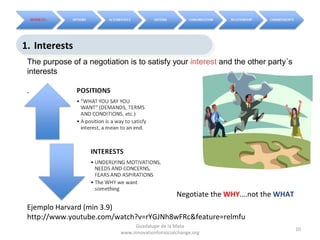
 The purpose of a negotiation is to satisfy your interest and the other party´s
 interests

 .


                                                   Negotiate the WHY….not the WHAT
 Ejemplo Harvard (min 3.9)
 http://www.youtube.com/watch?v=rYGJNh8wFRc&feature=relmfu
                                 Guadalupe de la Mata
                                                                                     10
                            www.innovationforsocialchange.org
1. Interest vs. positions
 Positional vs. Cooperative Negotiations
 Focusing on positions can lead to sub-optimal agreements

                              Position B                             Positions A and B are too far
                                                                     away for a mutually
                                                                     beneficial agreement
  Interests A                  Interests B

                                                                     Interests A and B, as a
     Position A                                                      broader concept, allow for a
                                                                     common ground for
                  Zone of                                            agreement
                  potential
                  agreement

   Cooperative negotiations

  The purpose of a negotiation is to satisfy your interest and the other parties
  interests
  Side-by-side problem solving: Both parties share the problem of trying to find an
  agreement that both can live with
  Finding a good agreement, that does not leave potential joint gains on the table
                                      Guadalupe de la Mata
                                                                                                11
                                 www.innovationforsocialchange.org
Cooperative negotiation: Negotiating is not
             Compromising
                       It is joint problem solving

                       Our goal is to efficiently reach a
                       satisfying agreement for both parties, and
                       to conclude on a positive note.

                       Fisher and Ury define negotiations as
                       “Back and forth communication to reach
                       agreement where some interests are
                       shared and some interests are opposed.
                       “Getting to Yes”


                  Guadalupe de la Mata
                                                             12
             www.innovationforsocialchange.org
1. Interests preparation


                          Guadalupe de la Mata
                                                         13
                     www.innovationforsocialchange.org
OPTIONS
2. Options
2. Options


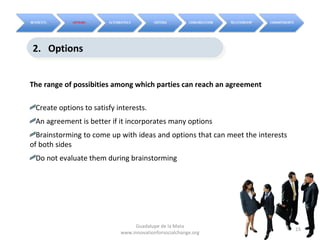
The range of possibities among which parties can reach an agreement

 Create options to satisfy interests.
 An agreement is better if it incorporates many options
  Brainstorming to come up with ideas and options that can meet the interests
of both sides
 Do not evaluate them during brainstorming


                                 Guadalupe de la Mata
                                                                                15
                            www.innovationforsocialchange.org
2. Options preparation

 Find ways to work together to maximize common benefits
 Separate inventing from judging.
 Broaden the options on the table, rather than look for a single answer.
 BE CREATIVE!
 Search for mutual gains.
 Invent ways to make their decision easy.


                                 Guadalupe de la Mata
                                                                           16
                            www.innovationforsocialchange.org
Invent options for mutual gain

AVOID
– Premature judgment
– Searching for the single answer
– The assumption of a fixed pie
– Thinking that ‘solving their problem is their
  problem’


                      Guadalupe de la Mata
                                                     17
                 www.innovationforsocialchange.org
Invent options for mutual gain II
Encourage
• Separate inventing from deciding
   – (brainstorming)
   – Consider brainstorming with the other side


                           Guadalupe de la Mata
                                                          18
                      www.innovationforsocialchange.org
Invent options for mutual gain III
• Look for mutual gain
   – Identify shared interests
   – Dovetail different interests
      •   Any difference in interests?
      •   Different beliefs?
      •   Different values placed on time?
      •   Different forecasts?
      •   Differences in aversion to risk?
   – Ask for their preferences
   – Make their decision easy
      • Whose shoes?
      • What decision?
      • Making threats is not enough?

                               Guadalupe de la Mata
                                                              19
                          www.innovationforsocialchange.org
ALTERNATIVES
3. Alternatives
3. Alternatives
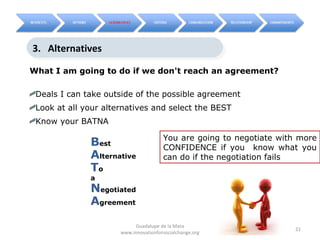
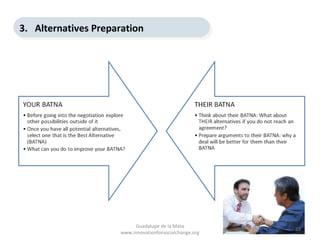
What I am going to do if we don't reach an agreement?

 Deals I can take outside of the possible agreement
 Look at all your alternatives and select the BEST
 Know your BATNA

                                       You are going to negotiate with more
              Best                     CONFIDENCE if you know what you
              Alternative              can do if the negotiation fails
              To
              a
              Negotiated
              Agreement
                           Guadalupe de la Mata
                                                                      21
                      www.innovationforsocialchange.org
3. Alternatives Preparation


                          Guadalupe de la Mata
                                                         22
                     www.innovationforsocialchange.org
CRITERIA
4. Criteria
4. Criteria

 What are the standards to convince each other that what we
 propose is fair?
 To resolve conflicting interest use independent standards: (market
 value, precedent or industry practice)
 Standars should be relevant and widely accepted
 Is an argument based on objective criteria, independent of the
 parties will.
 There are more than one objective criteria for an agreement


                          Guadalupe de la Mata
                                                                      24
                     www.innovationforsocialchange.org
4. Criteria Preparation

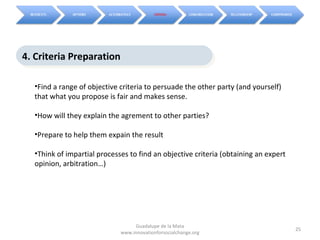
  •Find a range of objective criteria to persuade the other party (and yourself)
  that what you propose is fair and makes sense.

  •How will they explain the agrement to other parties?

  •Prepare to help them expain the result

  •Think of impartial processes to find an objective criteria (obtaining an expert
  opinion, arbitration…)


                                  Guadalupe de la Mata
                                                                                     25
                             www.innovationforsocialchange.org
Insist on using objective criteria
• Deciding on the basis of will is costly
• The case for using objective criteria:
   – Principled negotiation produces wise agreements amicably
     & efficiently
• Developing objective criteria:
   – Fair standards
   – Fair procedures
• Negotiating with objective criteria:
   –   Frame each issue as a joint search for objective criteria
   –   Ask “What’s your theory?”
   –   Reason and be open to reason
   –   Never yield to pressure
                              Guadalupe de la Mata
                                                                   26
                         www.innovationforsocialchange.org
COMUNICATION


      Guadalupe de la Mata
                                     27
 www.innovationforsocialchange.org
COMUNICATION
5. Comunication
5. Comunication

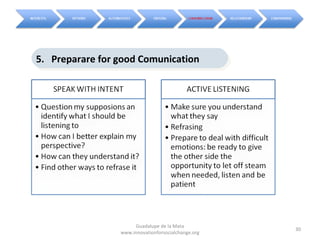
¿Am I ready to listen and talk in an efficient way?
Both side communication

ACTIVE LISTENING:
 In a respective way, clarifying ambiguities and making
sure you have been understood.

SPEAK WITH INTENT:
Clearly and with the objective of making yourself understood
and with a purpose linked to your interests.


                               Guadalupe de la Mata
                                                               29
                          www.innovationforsocialchange.org
5. Preparare for good Comunication
 5. Preparare for good Comunication


                      Guadalupe de la Mata
                                                     30
                 www.innovationforsocialchange.org
Guadalupe de la Mata
                                    31
www.innovationforsocialchange.org
Listening is your most powerful negotiating tool
But before you can listen, you
  have to be skilled at asking
  questions:

Three critical questioning skills
1. Know where your questions
   are going
2. Ask for permission to ask
   questions
3. State why you want to ask
   questions

                            Guadalupe de la Mata
                                                           32
                       www.innovationforsocialchange.org
Active Listening Techniques (1)


                                                            Guadalupe de la Mata
Centre for Conflict Resolution, Cape Town, South Africa, 1999                              33
                                                       www.innovationforsocialchange.org
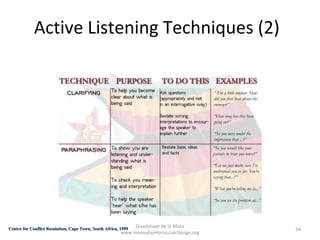
Active Listening Techniques (2)


                                                              Guadalupe de la Mata
Centre for Conflict Resolution, Cape Town, South Africa, 1999                                34
                                                         www.innovationforsocialchange.org
Active Listening Techniques (3)


                                                           Guadalupe de la Mata
Centre for Conflict Resolution, Cape Town, South Africa, 1999                             35
                                                      www.innovationforsocialchange.org
Active Listening Techniques (4)


                                                                Guadalupe de la Mata
Centre for Conflict Resolution, Cape Town, South Africa, 1999                                  36
                                                           www.innovationforsocialchange.org
RELATIONSHIP
6. Relationship
6. Relationship
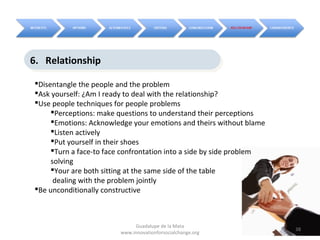
Disentangle the people and the problem
Ask yourself: ¿Am I ready to deal with the relationship?
Use people techniques for people problems
     Perceptions: make questions to understand their perceptions
     Emotions: Acknowledge your emotions and theirs without blame
     Listen actively
     Put yourself in their shoes
     Turn a face-to face confrontation into a side by side problem
     solving
     Your are both sitting at the same side of the table
      dealing with the problem jointly
Be unconditionally constructive


                             Guadalupe de la Mata
                                                                      38
                        www.innovationforsocialchange.org
COMMITMENT
7. Commitments
7. Commitments


                      Guadalupe de la Mata
                                                     40
                 www.innovationforsocialchange.org
7. Commitments preparation


                       Guadalupe de la Mata
                                                      41
                  www.innovationforsocialchange.org
APPLYING THE MODEL
Applying the model
Applying the model


     Focus on VALUE CREATION
      Focus on VALUE CREATION


     COMBINING THE RESOURCES
      COMBINING THE RESOURCES
      TO SATISFY MUTUAL NEEDS
       TO SATISFY MUTUAL NEEDS


        CLARIFYING INTEREST
         CLARIFYING INTEREST


   COMUNICATION AND RELATIONSHIP
    COMUNICATION AND RELATIONSHIP
                                    Guadalupe de la Mata
                                                                   43
                               www.innovationforsocialchange.org
MEASURING SUCCESS
 BATNA


    Satisfy interests


          The BEST of various options


                        The results are considered
                                legitimate

                                     The compromises are clear
                                           and operative

                                                   Comunication is efective


                                                            Improves the working
                        Guadalupe de la Mata
                                                                relationship       44
                   www.innovationforsocialchange.org
ANNEXES
• Videos:
• Getting to YES Video (part 1 of 3)
  – http://www.youtube.com/watch?
    v=rYGJNh8wFRc&feature=relmfu
• Getting to YES Video (part 2 of 3)
  – http://www.youtube.com/watch?
    v=Cchpf7IK5nY&feature=relmfu
• Getting to YES Video (part 3 of 3)
  – http://www.youtube.com/watch?v=ILeXnpPZfrw&feat
                       Guadalupe de la Mata
                                                      45
                  www.innovationforsocialchange.org
11


  The Four Phases of Negotiation

                 BARGAIN

       PROPOSE

   DEBATE


PLAN
                 Guadalupe de la Mata
                                                46
            www.innovationforsocialchange.org
Step One - Prepare
• Research
• LIST your objectives and their objectives
• Those you INTEND to get
• Those you MUST get


                      Guadalupe de la Mata
                                                     47
                 www.innovationforsocialchange.org
Step Two - Debate
• Listen carefully
• Ask questions
• Clarify
• Summarise
• Don’t argue, interrupt or assume
 ...BUT


                      Guadalupe de la Mata
                                                     48
                 www.innovationforsocialchange.org
Step Three - Propose
•   Make proposals
•   State conditions
•   Express concerns
•   Search for common interests

• ANDpositive body language
  Use


                       Guadalupe de la Mata
                                                      49
                  www.innovationforsocialchange.org
Step Four - Bargain
• Key words are IF and THEN
• Start making concession:
  – Every concession should have a condition
       (IF you … THEN I will … )
  – Conserve your concessions - don’t give
    everything away too soon
  – You don’t have to share every piece of
    information with the opposing side!
  – Don’t be afraid to say no
                       Guadalupe de la Mata
                                                      50
                  www.innovationforsocialchange.org
Step Five - Agree
• Usually final concession :
  “IF you do that, THEN we have a deal!”
• Gain commitment
• Record and agree results
• Leave satisfied


                      Guadalupe de la Mata
                                                     51
                 www.innovationforsocialchange.org
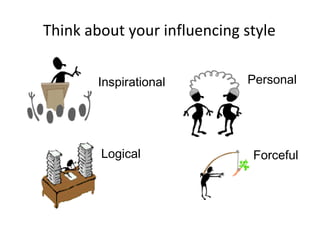
Think about your influencing style

        Inspirational        Personal


        Logical               Forceful
7 Deadly Sins of Negotiating

• Pride - Be prepared to compromise
• Gluttony - Don’t bite off more than you can
  chew
• Anger - Handle objections calmly
• Covetousness - Prioritise needs/wants
• Envy - Know competitors strengths &
  weaknesses… AND your own
• Sloth - Do your homework
                       Guadalupe de la Mata
                                                      53
•                 www.innovationforsocialchange.org
An Unconditionally Constructive Strategy

 Do only those things that are both good for the relationship and good for us
                       - whether or not they reciprocate

            RATIONALITY       Even if they are acting emotionally, balance emotions with reason

        UNDERSTANDING Even if they misunderstand us, try to understand them
        COMMUNICATION Even if they are not listening, consult them before deciding on matters that
                              affect them

              RELIABILITY      Even if they are trying to deceive us, neither trust them nor deceive them:
                               be reliable

NON-COERCIVE MODES OF          Even if they are trying to coerce us, neither yield to that coercion nor try to
           INFLUENCES          coerce them, be open to persuasion and try to persuade them

            ACCEPTANCE         Even if they reject us and our concerns as unworthy of their consideration,
                               accept them as worthy of consideration, care about them and be open to
                               learning from them
                                     Guadalupe de la Mata
                                                                                                          54
                                                                                         "Getting Together" Fisher
                                www.innovationforsocialchange.org
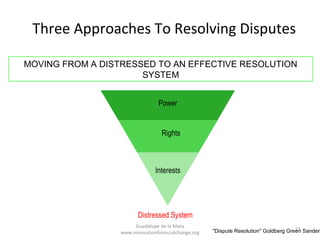
Three Approaches To Resolving Disputes

MOVING FROM A DISTRESSED TO AN EFFECTIVE RESOLUTION
                      SYSTEM


                                 Power


                                   Rights


                                Interests


                         Distressed System
                       Guadalupe de la Mata
                                                                                       55
                                                      "Dispute Resolution" Goldberg Green Sander
                  www.innovationforsocialchange.org
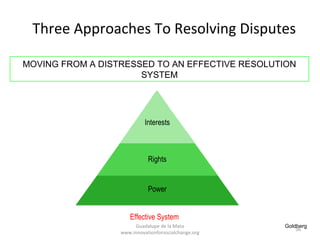
Three Approaches To Resolving Disputes

MOVING FROM A DISTRESSED TO AN EFFECTIVE RESOLUTION
                      SYSTEM


                            Interests


                             Rights


                             Power


                     Effective System
                       Guadalupe de la Mata           Goldberg
                                                          56
                  www.innovationforsocialchange.org
Stages in negotiation

    Sessions 11&12
The stages in the negotiation

• It is important to understand that negotiation
  is a process that begins before we sit down at
  the table and does not end if we do not know
  how to make the agreements reached
  effective.


                       Guadalupe de la Mata
                                                      58
                  www.innovationforsocialchange.org
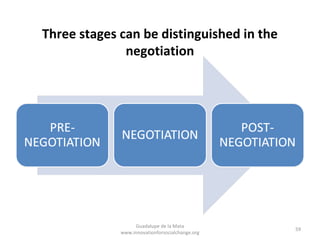
Three stages can be distinguished in the
              negotiation


                  Guadalupe de la Mata
                                                 59
             www.innovationforsocialchange.org
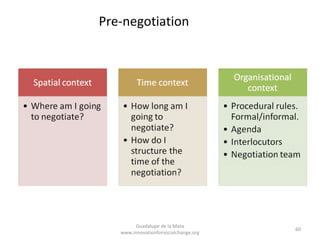
Pre-negotiation


        Guadalupe de la Mata
                                       60
   www.innovationforsocialchange.org
Negotiation


     Guadalupe de la Mata
                                    61
www.innovationforsocialchange.org
Post-negotiation


         Guadalupe de la Mata
                                        62
    www.innovationforsocialchange.org
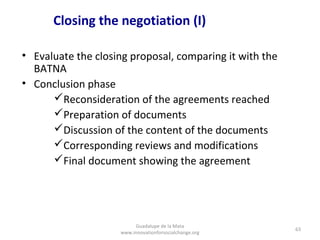
Closing the negotiation (I)

• Evaluate the closing proposal, comparing it with the
  BATNA
• Conclusion phase
      Reconsideration of the agreements reached
      Preparation of documents
      Discussion of the content of the documents
      Corresponding reviews and modifications
      Final document showing the agreement


                         Guadalupe de la Mata
                                                         63
                    www.innovationforsocialchange.org
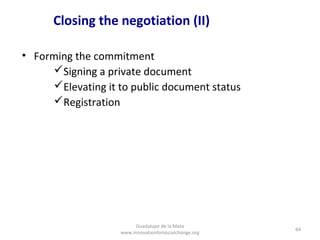
Closing the negotiation (II)

• Forming the commitment
     Signing a private document
     Elevating it to public document status
     Registration


                        Guadalupe de la Mata
                                                       64
                   www.innovationforsocialchange.org
42


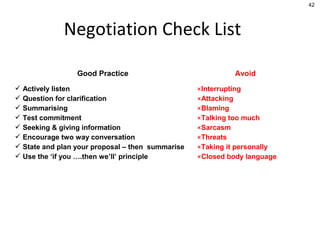
             Negotiation Check List

                 Good Practice                              Avoid
 Actively listen                                 ×Interrupting
 Question for clarification                      ×Attacking
 Summarising                                     ×Blaming
 Test commitment                                 ×Talking too much
 Seeking & giving information                    ×Sarcasm
 Encourage two way conversation                  ×Threats
 State and plan your proposal – then summarise   ×Taking it personally
 Use the ‘if you ….then we’ll’ principle         ×Closed body language

Material ciff negotiation presentation guadalupe

  • 1.
    Cooperative Negotiation The 7 principles of Harvard Negotiation Metholodogy Guadalupe de la Mata 1 www.innovationforsocialchange.org
  • 2.
    TODAY’S CLASS The Seven Principles of cooperative neogotiation (Harvard Methodology) Main concepts Keys to prepare for negotiation considering each of them Real Examples (short videos) Lets experience it!: the Ugly Orange Case Study Guadalupe de la Mata 2 www.innovationforsocialchange.org
  • 3.
    Negotiation Styles HIGH COLLABORATE ACCOMODATE Problem solved creatively, aiming for win- win Build friendly relationship Characteristics: Characteristics: Search for common interests Promote harmony Problem-solving behaviours Avoid substantive differences Recognising both parties’ needs Give into pressure to save relationship COMPROMISE Synergistic solutions CONCERN FOR RELATIONSHIP Place relationship above fairness of Win-win becomes the main purpose of the the outcomes Split the difference negotiator Characteristics: Meeting half way AVOID Look for trade offs DEFEAT Take whatever you can get/Inaction Accept half-way measures Be a winner at any cost/Competitive Characteristics: Aims to reduce conflict rather than problem solve Characteristics: Feeling of powerlessness synergistically Win-Lose competition Indifference to the result Pressure/Intimidation Resignation, surrender Adversarial relationships Take what the other party is willing to Defeating the other becomes a goal for the concede negotiator Withdraw & remove = behaviour of negotiator CONCERN FOR SUBSTANCE LOW HIGH Source: Rollin & Christine Glaser
  • 4.
    Harvard Negotiation Project • Began in 1983 • In conjunction with MIT and Tufts • Negotiation art and a science Guadalupe de la Mata www.innovationforsocialchange.org 4
  • 5.
    Getting to YesAuthors Roger Fisher Bruce Patton William Ury Guadalupe de la Mata 5 www.innovationforsocialchange.org
  • 6.
    Negotiation Styles HIGH COLLABORATE ACCOMODATE Problem solved creatively, aiming for win- win Build friendly relationship Characteristics: Characteristics: Search for common interests Promote harmony Problem-solving behaviours Avoid substantive differences Recognising both parties’ needs Give into pressure to save relationship COMPROMISE Synergistic solutions CONCERN FOR RELATIONSHIP Place relationship above fairness of Win-win becomes the main purpose of the the outcomes Split the difference negotiator Characteristics: Meeting half way AVOID Look for trade offs DEFEAT Take whatever you can get/Inaction Accept half-way measures Be a winner at any cost/Competitive Characteristics: Aims to reduce conflict rather than problem solve Characteristics: Feeling of powerlessness synergistically Win-Lose competition Indifference to the result Pressure/Intimidation Resignation, surrender Adversarial relationships Take what the other party is willing to Defeating the other becomes a goal for the concede negotiator Withdraw & remove = behaviour of negotiator CONCERN FOR SUBSTANCE LOW HIGH Source: Rollin & Christine Glaser
  • 7.
    Getting to Yes:7 PRINCIPLES What do you really care about? The needs, concerns, goals, hopes and fears that motivate the parties Ideas about how the parties might meet Promises made to build or their interests together. finalise agreement. Basic building blocks of negotiation How do you deal with people issues? Steps each party could take to satisfy their own interests outside the current negotiation (BATNA) Prepare to communicate efficiently during the negotiation How can I persuade them they are being fairly treated? Criteria that the parties use to legitimise their perspectives. Guadalupe de la Mata 7 www.innovationforsocialchange.org
  • 8.
  • 9.
    Starting point Startingpoint • Don’t Bargain Over Positions – Arguing over positions produces unwise outcomes – Arguing over positions is inefficient – Arguing over positions endangers an ongoing relationship – When there are many parties, positional bargaining is even worse – Being nice is no answer – There is an alternative… Guadalupe de la Mata 9 www.innovationforsocialchange.org
  • 10.
    1. Interests 1. Interests The purpose of a negotiation is to satisfy your interest and the other party´s interests . Negotiate the WHY….not the WHAT Ejemplo Harvard (min 3.9) http://www.youtube.com/watch?v=rYGJNh8wFRc&feature=relmfu Guadalupe de la Mata 10 www.innovationforsocialchange.org
  • 11.
    1. Interest vs.positions 1. Interest vs. positions Positional vs. Cooperative Negotiations Focusing on positions can lead to sub-optimal agreements Position B Positions A and B are too far away for a mutually beneficial agreement Interests A Interests B Interests A and B, as a Position A broader concept, allow for a common ground for Zone of agreement potential agreement Cooperative negotiations The purpose of a negotiation is to satisfy your interest and the other parties interests Side-by-side problem solving: Both parties share the problem of trying to find an agreement that both can live with Finding a good agreement, that does not leave potential joint gains on the table Guadalupe de la Mata 11 www.innovationforsocialchange.org
  • 12.
    Cooperative negotiation: Negotiatingis not Compromising It is joint problem solving Our goal is to efficiently reach a satisfying agreement for both parties, and to conclude on a positive note. Fisher and Ury define negotiations as “Back and forth communication to reach agreement where some interests are shared and some interests are opposed. “Getting to Yes” Guadalupe de la Mata 12 www.innovationforsocialchange.org
  • 13.
    1. Interests preparation 1.Interests preparation Guadalupe de la Mata 13 www.innovationforsocialchange.org
  • 14.
  • 15.
    2. Options 2. Options Therange of possibities among which parties can reach an agreement Create options to satisfy interests. An agreement is better if it incorporates many options Brainstorming to come up with ideas and options that can meet the interests of both sides Do not evaluate them during brainstorming Guadalupe de la Mata 15 www.innovationforsocialchange.org
  • 16.
    2. Options preparation 2.Options preparation Find ways to work together to maximize common benefits Separate inventing from judging. Broaden the options on the table, rather than look for a single answer. BE CREATIVE! Search for mutual gains. Invent ways to make their decision easy. Guadalupe de la Mata 16 www.innovationforsocialchange.org
  • 17.
    Invent options formutual gain AVOID – Premature judgment – Searching for the single answer – The assumption of a fixed pie – Thinking that ‘solving their problem is their problem’ Guadalupe de la Mata 17 www.innovationforsocialchange.org
  • 18.
    Invent options formutual gain II Encourage • Separate inventing from deciding – (brainstorming) – Consider brainstorming with the other side Guadalupe de la Mata 18 www.innovationforsocialchange.org
  • 19.
    Invent options formutual gain III • Look for mutual gain – Identify shared interests – Dovetail different interests • Any difference in interests? • Different beliefs? • Different values placed on time? • Different forecasts? • Differences in aversion to risk? – Ask for their preferences – Make their decision easy • Whose shoes? • What decision? • Making threats is not enough? Guadalupe de la Mata 19 www.innovationforsocialchange.org
  • 20.
  • 21.
    3. Alternatives 3. Alternatives WhatI am going to do if we don't reach an agreement? Deals I can take outside of the possible agreement Look at all your alternatives and select the BEST Know your BATNA You are going to negotiate with more Best CONFIDENCE if you know what you Alternative can do if the negotiation fails To a Negotiated Agreement Guadalupe de la Mata 21 www.innovationforsocialchange.org
  • 22.
    3. Alternatives Preparation 3.Alternatives Preparation Guadalupe de la Mata 22 www.innovationforsocialchange.org
  • 23.
  • 24.
    4. Criteria 4. Criteria What are the standards to convince each other that what we propose is fair? To resolve conflicting interest use independent standards: (market value, precedent or industry practice) Standars should be relevant and widely accepted Is an argument based on objective criteria, independent of the parties will. There are more than one objective criteria for an agreement Guadalupe de la Mata 24 www.innovationforsocialchange.org
  • 25.
    4. Criteria Preparation 4.Criteria Preparation •Find a range of objective criteria to persuade the other party (and yourself) that what you propose is fair and makes sense. •How will they explain the agrement to other parties? •Prepare to help them expain the result •Think of impartial processes to find an objective criteria (obtaining an expert opinion, arbitration…) Guadalupe de la Mata 25 www.innovationforsocialchange.org
  • 26.
    Insist on usingobjective criteria • Deciding on the basis of will is costly • The case for using objective criteria: – Principled negotiation produces wise agreements amicably & efficiently • Developing objective criteria: – Fair standards – Fair procedures • Negotiating with objective criteria: – Frame each issue as a joint search for objective criteria – Ask “What’s your theory?” – Reason and be open to reason – Never yield to pressure Guadalupe de la Mata 26 www.innovationforsocialchange.org
  • 27.
    COMUNICATION Guadalupe de la Mata 27 www.innovationforsocialchange.org
  • 28.
  • 29.
    5. Comunication 5. Comunication ¿AmI ready to listen and talk in an efficient way? Both side communication ACTIVE LISTENING: In a respective way, clarifying ambiguities and making sure you have been understood. SPEAK WITH INTENT: Clearly and with the objective of making yourself understood and with a purpose linked to your interests. Guadalupe de la Mata 29 www.innovationforsocialchange.org
  • 30.
    5. Preparare forgood Comunication 5. Preparare for good Comunication Guadalupe de la Mata 30 www.innovationforsocialchange.org
  • 31.
    Guadalupe de laMata 31 www.innovationforsocialchange.org
  • 32.
    Listening is yourmost powerful negotiating tool But before you can listen, you have to be skilled at asking questions: Three critical questioning skills 1. Know where your questions are going 2. Ask for permission to ask questions 3. State why you want to ask questions Guadalupe de la Mata 32 www.innovationforsocialchange.org
  • 33.
    Active Listening Techniques(1) Guadalupe de la Mata Centre for Conflict Resolution, Cape Town, South Africa, 1999 33 www.innovationforsocialchange.org
  • 34.
    Active Listening Techniques(2) Guadalupe de la Mata Centre for Conflict Resolution, Cape Town, South Africa, 1999 34 www.innovationforsocialchange.org
  • 35.
    Active Listening Techniques(3) Guadalupe de la Mata Centre for Conflict Resolution, Cape Town, South Africa, 1999 35 www.innovationforsocialchange.org
  • 36.
    Active Listening Techniques(4) Guadalupe de la Mata Centre for Conflict Resolution, Cape Town, South Africa, 1999 36 www.innovationforsocialchange.org
  • 37.
  • 38.
    6. Relationship 6. Relationship Disentanglethe people and the problem Ask yourself: ¿Am I ready to deal with the relationship? Use people techniques for people problems Perceptions: make questions to understand their perceptions Emotions: Acknowledge your emotions and theirs without blame Listen actively Put yourself in their shoes Turn a face-to face confrontation into a side by side problem solving Your are both sitting at the same side of the table dealing with the problem jointly Be unconditionally constructive Guadalupe de la Mata 38 www.innovationforsocialchange.org
  • 39.
  • 40.
    7. Commitments 7. Commitments Guadalupe de la Mata 40 www.innovationforsocialchange.org
  • 41.
    7. Commitments preparation 7.Commitments preparation Guadalupe de la Mata 41 www.innovationforsocialchange.org
  • 42.
  • 43.
    Applying the model Applyingthe model Focus on VALUE CREATION Focus on VALUE CREATION COMBINING THE RESOURCES COMBINING THE RESOURCES TO SATISFY MUTUAL NEEDS TO SATISFY MUTUAL NEEDS CLARIFYING INTEREST CLARIFYING INTEREST COMUNICATION AND RELATIONSHIP COMUNICATION AND RELATIONSHIP Guadalupe de la Mata 43 www.innovationforsocialchange.org
  • 44.
    MEASURING SUCCESS BATNA Satisfy interests The BEST of various options The results are considered legitimate The compromises are clear and operative Comunication is efective Improves the working Guadalupe de la Mata relationship 44 www.innovationforsocialchange.org
  • 45.
    ANNEXES • Videos: • Gettingto YES Video (part 1 of 3) – http://www.youtube.com/watch? v=rYGJNh8wFRc&feature=relmfu • Getting to YES Video (part 2 of 3) – http://www.youtube.com/watch? v=Cchpf7IK5nY&feature=relmfu • Getting to YES Video (part 3 of 3) – http://www.youtube.com/watch?v=ILeXnpPZfrw&feat Guadalupe de la Mata 45 www.innovationforsocialchange.org
  • 46.
    11 TheFour Phases of Negotiation BARGAIN PROPOSE DEBATE PLAN Guadalupe de la Mata 46 www.innovationforsocialchange.org
  • 47.
    Step One -Prepare • Research • LIST your objectives and their objectives • Those you INTEND to get • Those you MUST get Guadalupe de la Mata 47 www.innovationforsocialchange.org
  • 48.
    Step Two -Debate • Listen carefully • Ask questions • Clarify • Summarise • Don’t argue, interrupt or assume ...BUT Guadalupe de la Mata 48 www.innovationforsocialchange.org
  • 49.
    Step Three -Propose • Make proposals • State conditions • Express concerns • Search for common interests • ANDpositive body language Use Guadalupe de la Mata 49 www.innovationforsocialchange.org
  • 50.
    Step Four -Bargain • Key words are IF and THEN • Start making concession: – Every concession should have a condition (IF you … THEN I will … ) – Conserve your concessions - don’t give everything away too soon – You don’t have to share every piece of information with the opposing side! – Don’t be afraid to say no Guadalupe de la Mata 50 www.innovationforsocialchange.org
  • 51.
    Step Five -Agree • Usually final concession : “IF you do that, THEN we have a deal!” • Gain commitment • Record and agree results • Leave satisfied Guadalupe de la Mata 51 www.innovationforsocialchange.org
  • 52.
    Think about yourinfluencing style Inspirational Personal Logical Forceful
  • 53.
    7 Deadly Sinsof Negotiating • Pride - Be prepared to compromise • Gluttony - Don’t bite off more than you can chew • Anger - Handle objections calmly • Covetousness - Prioritise needs/wants • Envy - Know competitors strengths & weaknesses… AND your own • Sloth - Do your homework Guadalupe de la Mata 53 • www.innovationforsocialchange.org
  • 54.
    An Unconditionally ConstructiveStrategy Do only those things that are both good for the relationship and good for us - whether or not they reciprocate RATIONALITY Even if they are acting emotionally, balance emotions with reason UNDERSTANDING Even if they misunderstand us, try to understand them COMMUNICATION Even if they are not listening, consult them before deciding on matters that affect them RELIABILITY Even if they are trying to deceive us, neither trust them nor deceive them: be reliable NON-COERCIVE MODES OF Even if they are trying to coerce us, neither yield to that coercion nor try to INFLUENCES coerce them, be open to persuasion and try to persuade them ACCEPTANCE Even if they reject us and our concerns as unworthy of their consideration, accept them as worthy of consideration, care about them and be open to learning from them Guadalupe de la Mata 54 "Getting Together" Fisher www.innovationforsocialchange.org
  • 55.
    Three Approaches ToResolving Disputes MOVING FROM A DISTRESSED TO AN EFFECTIVE RESOLUTION SYSTEM Power Rights Interests Distressed System Guadalupe de la Mata 55 "Dispute Resolution" Goldberg Green Sander www.innovationforsocialchange.org
  • 56.
    Three Approaches ToResolving Disputes MOVING FROM A DISTRESSED TO AN EFFECTIVE RESOLUTION SYSTEM Interests Rights Power Effective System Guadalupe de la Mata Goldberg 56 www.innovationforsocialchange.org
  • 57.
    Stages in negotiation Sessions 11&12
  • 58.
    The stages inthe negotiation • It is important to understand that negotiation is a process that begins before we sit down at the table and does not end if we do not know how to make the agreements reached effective. Guadalupe de la Mata 58 www.innovationforsocialchange.org
  • 59.
    Three stages canbe distinguished in the negotiation Guadalupe de la Mata 59 www.innovationforsocialchange.org
  • 60.
    Pre-negotiation Guadalupe de la Mata 60 www.innovationforsocialchange.org
  • 61.
    Negotiation Guadalupe de la Mata 61 www.innovationforsocialchange.org
  • 62.
    Post-negotiation Guadalupe de la Mata 62 www.innovationforsocialchange.org
  • 63.
    Closing the negotiation(I) • Evaluate the closing proposal, comparing it with the BATNA • Conclusion phase Reconsideration of the agreements reached Preparation of documents Discussion of the content of the documents Corresponding reviews and modifications Final document showing the agreement Guadalupe de la Mata 63 www.innovationforsocialchange.org
  • 64.
    Closing the negotiation(II) • Forming the commitment Signing a private document Elevating it to public document status Registration Guadalupe de la Mata 64 www.innovationforsocialchange.org
  • 65.
    42 Negotiation Check List Good Practice Avoid  Actively listen ×Interrupting  Question for clarification ×Attacking  Summarising ×Blaming  Test commitment ×Talking too much  Seeking & giving information ×Sarcasm  Encourage two way conversation ×Threats  State and plan your proposal – then summarise ×Taking it personally  Use the ‘if you ….then we’ll’ principle ×Closed body language

Editor's Notes

  • #3 JULIO GÓMEZ-POMAR
  • #12 JULIO GÓMEZ-POMAR
  • #53 We use a range of techniques to influence people and get others on side.
  • #59 JULIO GÓMEZ-POMAR
  • #61 JULIO GÓMEZ-POMAR
  • #62 JULIO GÓMEZ-POMAR
  • #63 JULIO GÓMEZ-POMAR
  • #64 JULIO GÓMEZ-POMAR
  • #65 JULIO GÓMEZ-POMAR