Disusun oleh: Noviyanti
Definition of Sound 
Sound is a result of vibration. 
Every vibration produces sound, 
but human hearing is limited. 
Sound needs a medium to 
propagate.
The requirements of audible sound 
a. The availability of the source of 
sound (vibrating object); 
b. The availability of a medium; 
c. The availability of ears (hearing 
instruments)
1.Speed of Sound 
Speed of sound is the distance to be 
covered starting from the source 
of the sound to the receiver within 
a certain time interval. 
The speed of sound depends on the 
density of the medium. The best 
medium is solid, while the worst is 
gas.
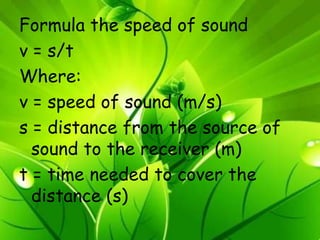
Formula the speed of sound 
v = s/t 
Where: 
v = speed of sound (m/s) 
s = distance from the source of 
sound to the receiver (m) 
t = time needed to cover the 
distance (s)
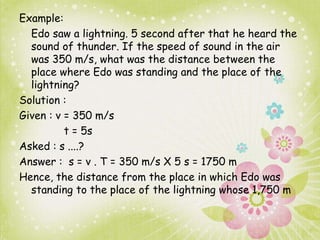
Example: 
Edo saw a lightning. 5 second after that he heard the 
sound of thunder. If the speed of sound in the air 
was 350 m/s, what was the distance between the 
place where Edo was standing and the place of the 
lightning? 
Solution : 
Given : v = 350 m/s 
t = 5s 
Asked : s ....? 
Answer : s = v . T = 350 m/s X 5 s = 1750 m 
Hence, the distance from the place in which Edo was 
standing to the place of the lightning whose 1,750 m
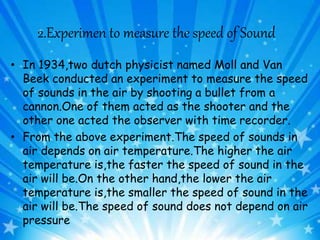
2.Experimen to measure the speed of Sound 
• In 1934,two dutch physicist named Moll and Van 
Beek conducted an experiment to measure the speed 
of sounds in the air by shooting a bullet from a 
cannon.One of them acted as the shooter and the 
other one acted the observer with time recorder. 
• From the above experiment.The speed of sounds in 
air depends on air temperature.The higher the air 
temperature is,the faster the speed of sound in the 
air will be.On the other hand,the lower the air 
temperature is,the smaller the speed of sound in the 
air will be.The speed of sound does not depend on air 
pressure
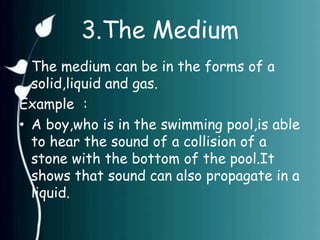
3.The Medium 
• The medium can be in the forms of a 
solid,liquid and gas. 
Example : 
• A boy,who is in the swimming pool,is able 
to hear the sound of a collision of a 
stone with the bottom of the pool.It 
shows that sound can also propagate in a 
liquid.
4.Limit of human hearing 
• Humans are only able to hear sound with a frequency 
between 20 to 20.000 Hz so object which vibrate less than 
20 Hz and or more than 20.000 Hz in one second cannot be 
heard by human’s ears. 
• Based on the limits of human hearing,sounds can be 
classified into 3 categories they are as follow : 
a) Infrasonic,which is sound with a frequency below 20 
Hz.This sounds can be heard by crickets and dogs. 
b) Audiosonic,which is sound with a frequency within 20 to 
20.000 Hz.This is sound can be heard by human. 
c) Ultrasonic,which is sound with a frequency above 20.000 
Hz this sound can be heard by dogs and bats.
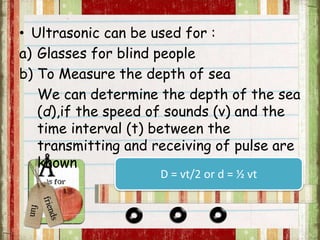
• Ultrasonic can be used for : 
a) Glasses for blind people 
b) To Measure the depth of sea 
We can determine the depth of the sea 
(d),if the speed of sounds (v) and the 
time interval (t) between the 
transmitting and receiving of pulse are 
known 
D = vt/2 or d = ½ vt
c. Medical instruments 
Ultrasonic sound is also useful in the 
medical field, for example in USG 
(ultrasonography) inspection.
Factor Affecting Sounds 
1. Frequency of sound 
frequency is the number of vibration in every 
second it has units of vibration per second or 
hearts and symbolized as Hz. 
so, sound depends on the frequency of the source 
of sound. 
2. Intensity of sound and amplitude 
amplitude is the distance of displacement. 
the softness and strengthness affected by the 
amplitude and can also be affected by one’s 
distances from the source of sound
3. Timbre or the quality of sound 
timbre is two sound with the same 
frequency, but heard differently. 
Timbre is generated due to the 
overtones acompanying the keynote. 
It produce a tone which is called 
the keynote.
Tone 
Tone is a reguler sound produce by a source of sound. 
Tone is a sound in which the number of its vibration in 
every second is the same. A sigh is a sound in which the 
number of its vibration in every second is not the same. 
1. Gamut and tone interval 
the comparison of the frequency of each tone is 
called the tone interval. The comparison of each 
individual tone interval produce the tone spacing. The 
arrangement of tone based on their frequencies is 
made in the formof a gamut. Such a gamut is called 
diatonic.
2. mersenne’s law 
mersenne’s law they are follows: 
a. The frequency of a vibrating string is 
inversely proportional the lenght of the 
string (i) a longer string will result in a 
lower frequency. 
b. The frequency of a vibrating string is 
inversely prpotional to the square root 
of the mass per unit length of the 
string (p) a light string (low destiny) 
has a high frequency,while heavy string 
(high destiny) has a low frequency.
C.The frequency of a vibration string inversely 
propotional to the square root of the cross-sectional 
area of the string (a).a thick string has 
a low frequency while a thin string has a high 
frequency. 
D.The frequency of a vibrating string is directly 
propotional to the square root of the tension of 
the string (T).A tense string (higher tension of 
string) has a higher frequency,while a loose string 
(lower tension of string) has a lower frequency.
E.Resonance 
1.Understanding the resonance. 
• Resonance is that two or more object 
which has same frequency will follow 
vibration when another object with the 
same frequency is vibrating. 
• The requipment of resonance are as 
follows : 
a. The frequency of the resonating 
object has to be the same has 
frequency of the source of vibration 
b. The high of the air columns is odd 
multiplication of ¼ wavelength. 
c. The instrument have thin membranes 
which are able to vibrate.
2.Problem caused by resonance 
• Resonance may cause problem in daily life.a 
goblet can be broken when it is placed close to 
a singing singer.this may happen if a goblet 
(made of glass) has the same the natural 
frequency as the frequency of the voice from 
the singer,sounf the glass experiences 
resonance and is broken.
3.The advantages of resonance 
A Resonance of sounds in an air column can 
be use to produce sounds. People make many 
kinds of musical instruments.example of such 
as kind of musical instruments are the flute 
guitar, drum, bedug, violin, and ketipung.
f. Reflection of sounds 
1. The law of reflection of sound 
a. The incident sound, normal line, and 
reflected sound are located at the same 
plane. 
b. The reflected angle is the same as the 
incident angle.
2. Kinds of sound reflection 
Echo and referberation are example of the 
sound reflection. Principally, the sound 
reflection can be distinguidhed into 3 types : 
There are reflected sound which is reinforcing 
the original sound echo and referberation. 
a. Reflected sound which is reinforcing the 
original sound. 
b. Echo 
c. Reverberation
3. The advantages of sounds reflection 
a. To define the speed of sound 
b. To do a geophysical survei

materi kelas 8 Sound

  • 1.
  • 2.
    Definition of Sound Sound is a result of vibration. Every vibration produces sound, but human hearing is limited. Sound needs a medium to propagate.
  • 3.
    The requirements ofaudible sound a. The availability of the source of sound (vibrating object); b. The availability of a medium; c. The availability of ears (hearing instruments)
  • 4.
    1.Speed of Sound Speed of sound is the distance to be covered starting from the source of the sound to the receiver within a certain time interval. The speed of sound depends on the density of the medium. The best medium is solid, while the worst is gas.
  • 5.
    Formula the speedof sound v = s/t Where: v = speed of sound (m/s) s = distance from the source of sound to the receiver (m) t = time needed to cover the distance (s)
  • 6.
    Example: Edo sawa lightning. 5 second after that he heard the sound of thunder. If the speed of sound in the air was 350 m/s, what was the distance between the place where Edo was standing and the place of the lightning? Solution : Given : v = 350 m/s t = 5s Asked : s ....? Answer : s = v . T = 350 m/s X 5 s = 1750 m Hence, the distance from the place in which Edo was standing to the place of the lightning whose 1,750 m
  • 7.
    2.Experimen to measurethe speed of Sound • In 1934,two dutch physicist named Moll and Van Beek conducted an experiment to measure the speed of sounds in the air by shooting a bullet from a cannon.One of them acted as the shooter and the other one acted the observer with time recorder. • From the above experiment.The speed of sounds in air depends on air temperature.The higher the air temperature is,the faster the speed of sound in the air will be.On the other hand,the lower the air temperature is,the smaller the speed of sound in the air will be.The speed of sound does not depend on air pressure
  • 8.
    3.The Medium •The medium can be in the forms of a solid,liquid and gas. Example : • A boy,who is in the swimming pool,is able to hear the sound of a collision of a stone with the bottom of the pool.It shows that sound can also propagate in a liquid.
  • 9.
    4.Limit of humanhearing • Humans are only able to hear sound with a frequency between 20 to 20.000 Hz so object which vibrate less than 20 Hz and or more than 20.000 Hz in one second cannot be heard by human’s ears. • Based on the limits of human hearing,sounds can be classified into 3 categories they are as follow : a) Infrasonic,which is sound with a frequency below 20 Hz.This sounds can be heard by crickets and dogs. b) Audiosonic,which is sound with a frequency within 20 to 20.000 Hz.This is sound can be heard by human. c) Ultrasonic,which is sound with a frequency above 20.000 Hz this sound can be heard by dogs and bats.
  • 10.
    • Ultrasonic canbe used for : a) Glasses for blind people b) To Measure the depth of sea We can determine the depth of the sea (d),if the speed of sounds (v) and the time interval (t) between the transmitting and receiving of pulse are known D = vt/2 or d = ½ vt
  • 11.
    c. Medical instruments Ultrasonic sound is also useful in the medical field, for example in USG (ultrasonography) inspection.
  • 12.
    Factor Affecting Sounds 1. Frequency of sound frequency is the number of vibration in every second it has units of vibration per second or hearts and symbolized as Hz. so, sound depends on the frequency of the source of sound. 2. Intensity of sound and amplitude amplitude is the distance of displacement. the softness and strengthness affected by the amplitude and can also be affected by one’s distances from the source of sound
  • 13.
    3. Timbre orthe quality of sound timbre is two sound with the same frequency, but heard differently. Timbre is generated due to the overtones acompanying the keynote. It produce a tone which is called the keynote.
  • 14.
    Tone Tone isa reguler sound produce by a source of sound. Tone is a sound in which the number of its vibration in every second is the same. A sigh is a sound in which the number of its vibration in every second is not the same. 1. Gamut and tone interval the comparison of the frequency of each tone is called the tone interval. The comparison of each individual tone interval produce the tone spacing. The arrangement of tone based on their frequencies is made in the formof a gamut. Such a gamut is called diatonic.
  • 15.
    2. mersenne’s law mersenne’s law they are follows: a. The frequency of a vibrating string is inversely proportional the lenght of the string (i) a longer string will result in a lower frequency. b. The frequency of a vibrating string is inversely prpotional to the square root of the mass per unit length of the string (p) a light string (low destiny) has a high frequency,while heavy string (high destiny) has a low frequency.
  • 16.
    C.The frequency ofa vibration string inversely propotional to the square root of the cross-sectional area of the string (a).a thick string has a low frequency while a thin string has a high frequency. D.The frequency of a vibrating string is directly propotional to the square root of the tension of the string (T).A tense string (higher tension of string) has a higher frequency,while a loose string (lower tension of string) has a lower frequency.
  • 17.
    E.Resonance 1.Understanding theresonance. • Resonance is that two or more object which has same frequency will follow vibration when another object with the same frequency is vibrating. • The requipment of resonance are as follows : a. The frequency of the resonating object has to be the same has frequency of the source of vibration b. The high of the air columns is odd multiplication of ¼ wavelength. c. The instrument have thin membranes which are able to vibrate.
  • 18.
    2.Problem caused byresonance • Resonance may cause problem in daily life.a goblet can be broken when it is placed close to a singing singer.this may happen if a goblet (made of glass) has the same the natural frequency as the frequency of the voice from the singer,sounf the glass experiences resonance and is broken.
  • 19.
    3.The advantages ofresonance A Resonance of sounds in an air column can be use to produce sounds. People make many kinds of musical instruments.example of such as kind of musical instruments are the flute guitar, drum, bedug, violin, and ketipung.
  • 20.
    f. Reflection ofsounds 1. The law of reflection of sound a. The incident sound, normal line, and reflected sound are located at the same plane. b. The reflected angle is the same as the incident angle.
  • 21.
    2. Kinds ofsound reflection Echo and referberation are example of the sound reflection. Principally, the sound reflection can be distinguidhed into 3 types : There are reflected sound which is reinforcing the original sound echo and referberation. a. Reflected sound which is reinforcing the original sound. b. Echo c. Reverberation
  • 22.
    3. The advantagesof sounds reflection a. To define the speed of sound b. To do a geophysical survei