MS Teams
February 28, 2023
KAPIHAN with
REGIONAL OFFICES
OFFICIALS
MS Teams
February 28, 2023
KAPIHAN with
REGIONAL OFFICES OFFICIALS
Dir. Roger B. Masapol
Planning Service
ALIGNMENT of MATATAG Education
Agenda to the BEDP 2030
BEDP-MATATAG
Alignment
4
Initial Attempt to align BEDP
with MATATAG 4-Point Agenda
5
International
National
Region
Division
School
BEDP – Basic Education Development Plan
CLC – Community Learning Center
DEDP – Division Education Development Plan
REDP – Regional Education Development Plan
SDG – Sustainable Development Goal
SIP – School Improvement Plan
SDG 2030
AmBisyon Natin 2040
Philippine Development
Plan 2022-2028
BEDP 2022-2030
Regional Development Plan
REDP 2022-2028
DEDP 2022-2028
SIP 2022-2028*
MAINSTREAMING
BEDP STRATEGIES
IN DEPED
6
The Filipino Learner: Competencies and Aspirations
7
4. RESILIENCY &
WELL-BEING
1. ACCESS 2. EQUITY 3. QUALITY
INTERMEDIATE
OUTCOMES
SECTOR
OUTCOME
GOAL
All school-age children,
out-of-school youth, and
adults accessed relevant
basic learning
opportunities
Disadvantaged school-age
children and youth, and
adults benefited from
appropriate equity
initiatives
Learners complete K-12 basic
education having attained all learning
standards that equip them with the
necessary skills and attributes to
pursue their chosen paths
Learners are resilient and know their
rights, and have the life skills to protect
themselves and exercise their education
related rights, while being aware of their
responsibilities as individuals and as
members of society
Efficient, nimble and resilient governance and management processes
All Filipinos are able to realize their full potential and contribute
meaningfully in building a cohesive nation
Basic education Filipino learners have the physical, cognitive, socio-emotional and moral
preparation for civic participation and engagement in post-secondary
opportunities in their local, national, and global communities.
ENABLING MECHANISMS -
GOVERNANCE
Results Framework
Source: DO 24, s22
8
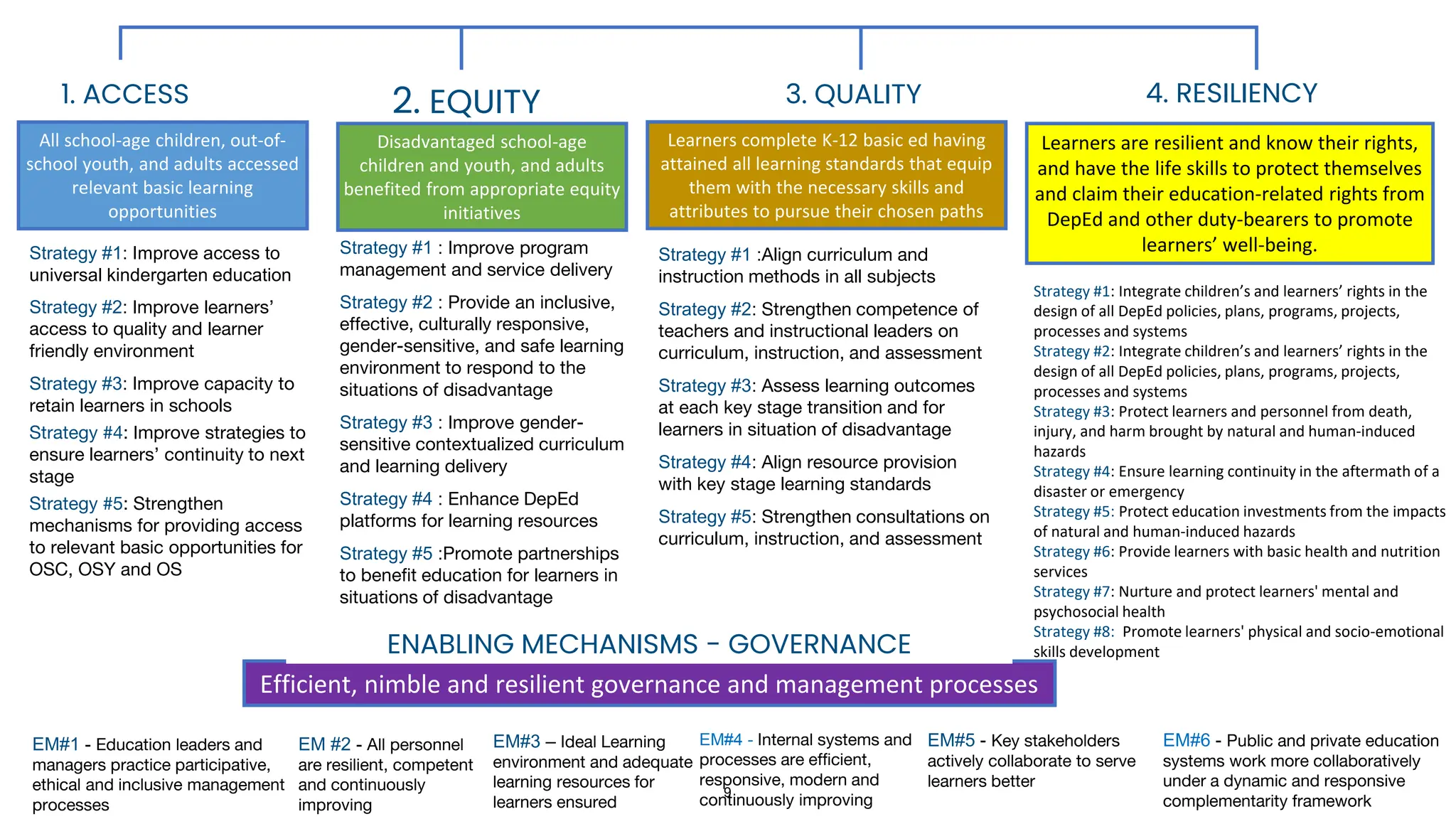
1. ACCESS 2. EQUITY 3. QUALITY 4. RESILIENCY
Strategy #1: Improve access to
universal kindergarten education
Strategy #2: Improve learners’
access to quality and learner
friendly environment
Strategy #3: Improve capacity to
retain learners in schools
Strategy #4: Improve strategies to
ensure learners’ continuity to next
stage
Strategy #5: Strengthen
mechanisms for providing access
to relevant basic opportunities for
OSC, OSY and OS
Strategy #1 : Improve program
management and service delivery
Strategy #2 : Provide an inclusive,
effective, culturally responsive,
gender-sensitive, and safe learning
environment to respond to the
situations of disadvantage
Strategy #3 : Improve gender-
sensitive contextualized curriculum
and learning delivery
Strategy #4 : Enhance DepEd
platforms for learning resources
Strategy #5 :Promote partnerships
to benefit education for learners in
situations of disadvantage
Strategy #1 :Align curriculum and
instruction methods in all subjects
Strategy #2: Strengthen competence of
teachers and instructional leaders on
curriculum, instruction, and assessment
Strategy #3: Assess learning outcomes
at each key stage transition and for
learners in situation of disadvantage
Strategy #4: Align resource provision
with key stage learning standards
Strategy #5: Strengthen consultations on
curriculum, instruction, and assessment
All school-age children, out-of-
school youth, and adults accessed
relevant basic learning
opportunities
Disadvantaged school-age
children and youth, and adults
benefited from appropriate equity
initiatives
Learners complete K-12 basic ed having
attained all learning standards that equip
them with the necessary skills and
attributes to pursue their chosen paths
Learners are resilient and know their rights,
and have the life skills to protect themselves
and claim their education-related rights from
DepEd and other duty-bearers to promote
learners’ well-being.
Strategy #1: Integrate children’s and learners’ rights in the
design of all DepEd policies, plans, programs, projects,
processes and systems
Strategy #2: Integrate children’s and learners’ rights in the
design of all DepEd policies, plans, programs, projects,
processes and systems
Strategy #3: Protect learners and personnel from death,
injury, and harm brought by natural and human-induced
hazards
Strategy #4: Ensure learning continuity in the aftermath of a
disaster or emergency
Strategy #5: Protect education investments from the impacts
of natural and human-induced hazards
Strategy #6: Provide learners with basic health and nutrition
services
Strategy #7: Nurture and protect learners' mental and
psychosocial health
Strategy #8: Promote learners' physical and socio-emotional
skills development
Efficient, nimble and resilient governance and management processes
ENABLING MECHANISMS - GOVERNANCE
EM#1 - Education leaders and
managers practice participative,
ethical and inclusive management
processes
EM#3 – Ideal Learning
environment and adequate
learning resources for
learners ensured
EM #2 - All personnel
are resilient, competent
and continuously
improving
EM#4 - Internal systems and
processes are efficient,
responsive, modern and
continuously improving
EM#5 - Key stakeholders
actively collaborate to serve
learners better
EM#6 - Public and private education
systems work more collaboratively
under a dynamic and responsive
complementarity framework
9
PHASE 1
2022-2025
Response to the immediate impacts of the pandemic on
learning and participation and address issues on quality of
basic education
Post COVID-19 Recovery and Transition –
Addressing and mitigating the impacts of
sudden shift in delivery modalities, bridging
the learning gaps and introduce innovations.
Accelerate the co-creation of an integrated
concept of learning spaces for the future;
Focus on Quality:
1) Strengthen programs on reading, numeracy,
socio-emotional learning, and 21st century skills,
2) Sharpen skillsets of teachers in
contextualization to address the concerns of
diverse learners and
3) Strengthen instructional leadership and
supervision to improve teaching quality;
Capacity development on policy
development and implementation,
strategic planning, education futures,
M&E research and technical assistance;
Strengthen DepEd’s capability on
assessment with focus on classroom level
assessment;
Partnership Building with community-based
partners, the private sector and cross sector
government services for children;
Phases of Implementation
10
PHASE 2
2026-2030
Sustaining gains, introducing innovations and
evaluating policies and programs
Continuation of programs and
projects on access, quality, equity
and resiliency;
Acceleration, deepening and
scaling-up of innovations and best
practices;
Maintenance and enhancement
of systems, processes
information systems;
Evaluation of programs and
projects;
Development and implementation
of emerging new programs;
End of Plan assessment and
evaluation
Phases of Implementation
11
Make the curriculum
relevant to produce job-
ready, active and
responsible citizens
1. Revise the K to 12 Curriculum to
make them more responsive to our
aspiration as a nation
2. Strengthen our literacy and
numeracy programs
3. Revitalize our Reading, Science
and Technology, and Math
programs
4. Improve English proficiency while
recognizing linguistic diversity
5. Review the implementation of the
Mother Tongue-based Multilingual
Education Policy
6. Intensify the values formation of
learners in curriculum and teaching
7. Embed the culture of peace in our
curriculum
8. Be transparent with curriculum
guides and test scores
9. Share test items with schools and
teachers to strengthen the use of
assessment
10. Engage with CHED and TESDA,
and various industry partners to
address the issue of skills
mismatch
Take steps to accelerate
delivery of basic
education facilities and
services
1. Created the School Infrastructure
and Facilities Strand
2. Build more resilient schools and
classrooms
3. Close the remaining gaps in school
infrastructure with policies to
eliminate corruption
4. Establish fully-functional library hubs
5. Provide schools with electricity
6. Provide e-classroom packages for
teaching and learning
7. Digitize our essential processes,
including our national assessments
8. Launch our National Education Portal
9. Strengthen the complementarity
between public and private schools
10. Work closely with Congress in
pushing for the expansion of
GASTPE coverage to include
kindergarten and elementary
learners.
11. Support BARMM School Building
Program and GASTPE direction.
12. Creation of the Procurement Strand
Take good care of
learners by promoting
learner well-being,
inclusive education and
positive learning
environment
1. Provide education to children and youth
in situations of disadvantage
2. Strengthen and institutionalize the
reintegration program for adolescent
mothers, Children at Risk (CAR), and
Children in Conflict with the Law (CICL)
3. Strengthen the mechanism in
safeguarding our learners against all
forms of discrimination and dangers
4. Seek out mental wellness experts to
form interventions at the school level
5. Strengthen inclusive education
programs, including the alternative
learning system, last mile schools, and
programs for IP learners and learners
with disabilities
6. Establish of Inclusive Learning
Resource Centers
7. Provide assessment assistive
mechanisms to students with
disabilities
8. Eradicate illiteracy through relevant
policy issuances, and community
literacy program interventions.
9. Involve our parents and guardians in
the education of our children.
Give support for teachers to
teach better
1. Provide professional development programs
2. Provide support in terms of innovative,
responsive, and inclusive teaching approaches
following the Philippine Professional Standards
for Teachers (PPST).
3. Capacitate our teachers and learners in utilizing
technology in remote learning to maximize the
benefits of digital learning.
4. Provide training and other learning and
development interventions for school leaders
5. Fast-track the implementation of the career
progression policy
6. Implement the Merit Selection Policy
7. Make the new Teacher Education Council and
Secretariat fully functional
8. Advocate for additional benefits for our teachers
9. Implement the policy on the distribution of
teacher workload and payment of teaching
overload
10. Expand the coverage for the grant of Special
Hardship Allowances
11. Address issues affecting the net take-home pay
of teachers
12. Work with DOH for free annual physical
examinations for teachers
13. Coordinate with the GSIS for an improved and
superior benefits package for all DepEd
personnel
14. Provide a free legal assistance facility for
teachers on matters concerning loan contracts
and obligations.
45 key initiatives
12
4. RESILIENCY & WELL-BEING
1. ACCESS 2. EQUITY 3. QUALITY
INTERMEDIATE
OUTCOMES
SECTOR
OUTCOME
GO
AL
All school-age children,
out-of-school youth, and
adults accessed relevant
basic learning
opportunities
Disadvantaged school-age
children and youth, and
adults benefited from
appropriate equity
initiatives
Learners complete K-12 basic
education having attained all learning
standards that equip them with the
necessary skills and attributes to
pursue their chosen paths
Learners are resilient and know their rights,
and have the life skills to protect themselves
and exercise their education related rights,
while being aware of their responsibilities as
individuals and as members of society
Efficient, nimble and resilient
governance and management
processes
All Filipinos are able to realize their full potential and contribute
meaningfully in building a cohesive nation
Basic education Filipino learners have the physical, cognitive, socio-emotional and moral
preparation for civic participation and engagement in post-secondary
opportunities in their local, national, and global communities.
ENABLING
MECHANISMS -
GOVERNANCE
BEDP
Framework
•TAke steps to accelerate delivery of
basic education facilities and services;
• MAke the curriculum relevant to produce competent and job-ready,
active, and responsible citizens;
• TAke good care of learners by promoting
learner well-being, inclusive education, and a
positive learning environment; and
•Give support to
teachers to teach better
13
MATATAG in BEDP Strategies
14
INTERMEDIATE
OUTCOMES
SECTOR
OUTCOME
Basic education Filipino learners have the physical, cognitive, socio-emotional and
moral preparation for civic participation and engagement in post-secondary
opportunities in their local, national, and global communities.
1. ACCESS
All school-age children, out-of-school youth, and
adults accessed relevant basic learning
opportunities
Outcomes
and
Strategies
•TAke good care of learners by promoting learner well-being, inclusive
education, and a positive learning environment;
Strategy #1: Improve access to universal kindergarten
education
Strategy #2: Improve learners’ access to quality and
learner friendly environment
Strategy #3: Improve capacity to retain learners in
schools
Strategy #4: Improve strategies to ensure learners’
continuity to next stage
Strategy #5: Strengthen mechanisms for providing
access to relevant basic opportunities for OSC, OSY and
OS
We will strengthen our inclusive education programs, including the alternative learning system, last mile
schools, and programs for IP learners and learners with disabilities. We will endeavor that all learners, no
matter what their backgrounds are, will be afforded quality learning opportunities and services
15
INTERMEDIATE
OUTCOMES
SECTOR
OUTCOME
Basic education Filipino learners have the physical, cognitive, socio-emotional and
moral preparation for civic participation and engagement in post-secondary
opportunities in their local, national, and global communities.
2. EQUITY
Disadvantaged school-age children and youth, and
adults benefited from appropriate equity initiatives
Outcomes
and
Strategies
•TAke good care of learners by promoting learner well-being, inclusive education, and a
positive learning environment; and
Strategy #1 : Improve program management and service
delivery
Strategy #2 : Provide an inclusive, effective, culturally
responsive, gender-sensitive, and safe learning
environment to respond to the situations of disadvantage
• DepEd reaffirms its pledge to ensure that all school- age children and youth, and adults in situations of
disadvantage are participating in inclusive basic learning opportunities and receiving appropriate quality
education
• We will undertake initiatives to provide schooling to many more children and youth in situations of
disadvantage, regardless of gender, abilities, psycho-emotional and physical conditions, cultural and religious
identity, and socio-economic standing
• We will strengthen our inclusive education programs, including the alternative learning system, last mile
schools, and programs for IP learners and learners with disabilities. We will endeavor that all learners, no
matter what their backgrounds are, will be afforded quality learning opportunities and services
Strategy #3 : Improve gender-sensitive contextualized
curriculum and learning delivery
We will strengthen and institutionalize the reintegration program for adolescent mothers, Children at Risk (CAR),
and Children in Conflict with the Law (CICL) by developing inclusive models and mechanisms applicable to both
formal and non-formal learning
Strategy #4 : Enhance DepEd platforms for learning
resources
Strategy #5 :Promote partnerships to benefit education
for learners in situations of disadvantage
16
INTERMEDIATE
OUTCOMES
SECTOR
OUTCOME
Basic education Filipino learners have the physical, cognitive, socio-emotional and
moral preparation for civic participation and engagement in post-secondary
opportunities in their local, national, and global communities.
3. QUALITY
Learners complete K-12 basic ed having
attained all learning standards that equip
them with the necessary skills and attributes
to pursue their chosen paths
Outcomes
and
Strategies
Strategy #1 :Align curriculum and
instruction methods in all subjects
• We will revise the K to 12 Curriculum to make them more responsive to our aspiration as a nation, to
develop lifelong learners who are imbued with 21st-century skills, discipline, and patriotism.
• We will reduce the number of learning areas in K to 3 from 7 to 5 to focus on foundational skills in
literacy and numeracy in the early grades, particularly among disadvantaged students.
• We will strengthen our literacy and numeracy programs
• We will improve English proficiency while recognizing linguistic diversity. We will work towards the
goal of English language proficiency within the context of a multilingual nation
• We will embed the culture of peace in our curriculum to develop learners who are peace builders in
communities
• We will integrate “peace competencies” such as social awareness responsibility, care for the
environment, value for diversity, self-esteem, positive character, resilience, and human security into
the various learning areas of the K to 12 Curriculum
Strategy #2: Strengthen competence
of teachers and instructional leaders
on curriculum, instruction, and
assessment
• We will revitalize our Reading, Science and Technology, and Math programs by utilizing the gains of
previous programs. The programs will be benchmarked with local and international best practices,
consulted with experts, and will be research or evidence-based
• We will further intensify the values formation of learners in curriculum and teaching, particularly
through the Good Manners and Right Conduct and Values Education in adherence to Republic Act
11476
•MAke the curriculum relevant to produce competent and job-ready, active, and responsible citizens;
17
INTERMEDIATE
OUTCOMES
SECTOR
OUTCOME
Basic education Filipino learners have the physical, cognitive, socio-emotional and
moral preparation for civic participation and engagement in post-secondary
opportunities in their local, national, and global communities.
3. QUALITY
Learners complete K-12 basic ed having
attained all learning standards that equip
them with the necessary skills and attributes
to pursue their chosen paths
Outcomes
and
Strategies
Strategy #3: Assess learning
outcomes at each key stage
transition and for learners in situation
of disadvantage
• We will review the implementation of the Mother Tongue-based Multilingual Education Policy, guided
by the basic principle that, among others, learners learn when taught in a language that they
understand
• We will be transparent about our test scores. We will make our test data available for researchers
and analysts to aid us in making evidence-based policy decisions
• We will share sample test items with schools and teachers to strengthen the use of assessment to
improve the teaching and learning process
Strategy #4: Align resource provision
with key stage learning standards
• We will provide assessment assistive mechanisms such as audio-assisted technology, Braille, and
large-print test materials to students with disabilities. We will introduce digital textbooks for certain
core subjects in Senior High School
• We will provide e-classroom packages for teaching and learning. Each package will consist of 46
laptops, 2 charging carts, 2 wireless routers, and 1 smart TV. This will accelerate the integration of
ICT in teaching and learning and institutionalize blended learning
Strategy #5: Strengthen consultations
on curriculum, instruction, and
assessment
We will be transparent with curriculum guides. We will share our draft curriculum guides with interested
education stakeholders to help us develop a robust curriculum
•MAke the curriculum relevant to produce competent and job-ready, active, and responsible citizens;
18
INTERMEDIATE
OUTCOMES
SECTOR
OUTCOME
Basic education Filipino learners have the physical, cognitive, socio-emotional and
moral preparation for civic participation and engagement in post-secondary
opportunities in their local, national, and global communities.
4. RESILIENCY
Learners are resilient and know their rights, and have the life skills to
protect themselves and claim their education-related rights from DepEd
and other duty-bearers to promote learners’ well-being.
Outcomes
and
Strategies
Strategy #1: Integrate children’s and learners’ rights in the
design of all DepEd policies, plans, programs, projects,
processes and systems
Strategy #2: Integrate children’s and learners’ rights in the
design of all DepEd policies, plans, programs, projects,
processes and systems
Strategy #3: Protect learners and personnel from death,
injury, and harm brought by natural and human-induced
hazards
• We will continue to strengthen the mechanism in safeguarding our learners against
all forms of discrimination and dangers. Our Learners Rights and Protection Office
(LRPO) has been acting on the reported cases ranging from all kinds of bullying,
many forms of abuse, corporal punishment, discrimination, and child neglect
• We will improve our learning environments to encourage support, discourage
bullying; strengthen the implementation of child protection policies; make students
feel safe and respected; and make them, including our IP learners and those with
disabilities, feel that they belong
Strategy #4: Ensure learning continuity in the aftermath of
a disaster or emergency
•TAke good care of learners by promoting learner well-being, inclusive
education, and a positive learning environment; and
19
INTERMEDIATE
OUTCOMES
SECTOR
OUTCOME
Basic education Filipino learners have the physical, cognitive, socio-emotional and
moral preparation for civic participation and engagement in post-secondary
opportunities in their local, national, and global communities.
4. RESILIENCY
Learners are resilient and know their rights, and have the life skills to
protect themselves and claim their education-related rights from DepEd
and other duty-bearers to promote learners’ well-being.
Outcomes
and
Strategies
Strategy #5: Protect education investments from the impacts of
natural and human-induced hazards
Strategy #6: Provide learners with basic health and nutrition
services
Strategy #7: Nurture and protect learners' mental and psychosocial
health
• We commit to seeking out mental wellness experts to form interventions at the school level
• We will also ensure that all learners have access to relevant guidance and psycho-social
services managed and delivered by mental health professionals. To achieve this, we will work
with the Department of Budget and Management to obtain higher salary grades for guidance
counselors and propose the creation of additional items that will focus on providing learner
support services, including guidance-related services in schools
Strategy #8: Promote learners' physical and socio-emotional skills
development
•TAke good care of learners by promoting learner well-being, inclusive
education, and a positive learning environment; and
20
INTERMEDIATE
OUTCOMES
SECTOR
OUTCOME
Basic education Filipino learners have the physical, cognitive, socio-emotional and
moral preparation for civic participation and engagement in post-secondary
opportunities in their local, national, and global communities.
Outcomes
and
Strategies
EM#1 - Ensure all education leaders and
managers practice participative, ethical,
and inclusive management processes
• We will provide training and other learning and development interventions for school leaders,
namely the school heads, supervisors, superintendents, and assistant superintendents, so that
they can better support our teachers to teach better
• We will strictly implement the Merit Selection Policy so that HR recruitment, selection, and appointment to vacant
positions in the DepEd are based on key knowledge, skills, attitudes and desired behaviors, and not due to any
form of intervention from other government personnel or similar entities outside of DepEd
EM #2 - Ensure human resources in all
governance levels are sufficient, resilient,
competent, and continuously improving
• We will continuously provide professional development programs, including graduate degree
scholarship programs to teachers focusing on their learning area specialization and graduate
certificate programs for non- majors
• We will provide support in terms of innovative, responsive, and inclusive teaching approaches
following the Philippine Professional Standards for Teachers (PPST).
• We will capacitate our teachers and learners in utilizing technology in remote learning to maximize
the benefits of digital learning
• We will fast-track the implementation of the career progression policy, so teachers get more opportunities for
promotion
• We will continuously advocate for additional benefits for our teachers
• We will implement the policy on the distribution of teacher workload and payment of teaching
overload, as provided in the Magna Carta for Public School Teachers
• We will work towards addressing issues affecting the net-take-home pay of teachers
• We are discussing with the Department of Health for the provision of free annual physical examinations for our
teachers
• Lastly, we are looking to provide free legal assistance facility for teachers on matters concerning
ENABLING MECHANISMS -
GOVERNANCE •TAke steps to accelerate delivery of basic education facilities and services;
Efficient, nimble and resilient governance and management processes •Give support to teachers to teach better
21
INTERMEDIATE
OUTCOMES
SECTOR
OUTCOME
Basic education Filipino learners have the physical, cognitive, socio-emotional and
moral preparation for civic participation and engagement in post-secondary
opportunities in their local, national, and global communities.
Outcomes
and
Strategies
EM#3 – Ensure ideal learning
environment are in place and adequate
and appropriate learning resources for
learners are provided
• We will continue with the establishment of Inclusive Learning Resource Centers (ILRCs).
• We will build more resilient schools and classrooms. For 2023, we have the budget to build around
6,000 classrooms
• We commit to closing the remaining gaps in school infrastructure with policies to eliminate
corruption, and insulate the allocation of school building funds from politicization
• We will establish fully-functional library hubs in our division offices
• We will provide schools with electricity. In the next 5 years, we will work towards providing
electricity especially in our last-mile schools
ENABLING MECHANISMS -
GOVERNANCE •TAke steps to accelerate delivery of basic education facilities and services;
Efficient, nimble and resilient governance and management processes •Give support to teachers to teach better
22
INTERMEDIATE
OUTCOMES
SECTOR
OUTCOME
Basic education Filipino learners have the physical, cognitive, socio-emotional and
moral preparation for civic participation and engagement in post-secondary
opportunities in their local, national, and global communities.
Outcomes
and
Strategies
EM#4 - Improve and modernize internal
systems and processes for a responsive
and efficient delivery of basic education
services
• We will optimize the use of technology, both online and offline, to ensure that learners have opportunities to learn even in the event of a
pandemic or other emergencies
• We will digitize our essential processes, including our national assessments
• We will launch our National Education Portal or NEP, which will provide a dynamic “one-stop-shop” platform available to all basic
education stakeholders, such as teachers, learners, and parents. The NEP will substantially cut down the manual process, reduce
transaction costs and eliminate errors due to human intervention
EM#5 - Strengthen active collaboration
with key stakeholders
• Working with private school organizations, we will also speed up the issuance of the Revised Manual of Regulation for Private Schools
• We will work closely with Congress in pushing for the expansion of GASTPE coverage to include kindergarten and elementary learners
• For our BARMM brothers, sisters and learners, we will always make ourselves available to provide technical expertise. We will fully
support your School Building Program and GASTPE direction
• We have also requested the Department of Budget and Management to expand the coverage for the grant of Special Hardship Allowances
• Within the year, we aim to make the new Teacher Education Council and Secretariat fully functional and start working on its mandates, including
setting minimum requirements for pre-service teacher education programs in the country
EM#6 - Enhance and strengthen Public
and private education complementarity
We will strengthen the complementarity between public and private schools through the seamless implementation of the Government
Assistance and Subsidies program of the DepEd with the creation of the Voucher Program Management Office
Others • We will remove non-teaching tasks and provide administrative officers in schools. We will provide adequate manpower complement in schools,
manage teachers' workload, and compensate teachers for unique school challenges (Part of the critical reforms identified in BEDP)
ENABLING MECHANISMS - GOVERNANCE •TAke steps to accelerate delivery of basic education facilities and services;
Efficient, nimble and resilient governance and management processes •Give support to teachers to teach better
23
MATATAG to BEDP Outcome Indicators
24
1. ACCESS 2. EQUITY 3. QUALITY 4. RESILIENCY
1. Percentage of school-age children in
school – Net Enrollment Rate (NER)
2. Percentage of learners in a cohort who
completed Grade 6/Grade 12 – Completion
Rate (CR)
4. Percentage of 5-year-olds in school – Net
Intake Rate (NIR)
5. Percentage of enrollees (Elementary, JHS,
SHS) in a given school year who continue to
be in school the following school year –
Retention Rate
6. Percentage of currently enrolled learners
but did not finish/complete the school year –
Dropout Rate (DR)
7. Percentage of Kindergarten/Grade
6/Grade 10 completers proceeded to next
key stage – Transition Rate
8. Percentage of OSC and OSY who
returned to school or participated in ALS –
Participation Rate of OSC and OSY
9. Percentage of completers in ALS –
Completed Sessions – ALS
1. Proportion of learners in situations
of disadvantage transition to next key
stage
2. Gender participation - disparity in
completion
3. Percentage of learners in situation
of disadvantage continue to
participate in basic education (Refer to
the enrollment data of Last Mile
Schools and Hardship Index)
4. Percentage of learners in situations
of disadvantage (disaggregated by
group) achieved at least a fixed level
of proficiency/mastery in (a) reading
literacy, (b) numeracy, and (c) 21st
century skills
1. Proportion of students in Grade 2 or 3
achieving at least a minimum proficiency
level in mathematics
2. Proportion of students in Grade 2 or 3
achieving at least a minimum proficiency
level in reading
3. Proportion of students at the end of
primary achieving at least a minimum
proficiency level in mathematics
4. Proportion of students at the end of
primary achieving at least a minimum
proficiency level in reading
5. Proportion of students at the end of lower
secondary achieving at least a minimum
proficiency level in mathematics
6. Proportion of students at the end of lower
secondary achieving at least a minimum
proficiency level in reading
All school-age children, out-of-
school youth, and adults accessed
relevant basic learning
opportunities
Disadvantaged school-age
children and youth, and adults
benefited from appropriate equity
initiatives
Learners complete K-12 basic ed having
attained all learning standards that equip
them with the necessary skills and
attributes to pursue their chosen paths
Learners are resilient and know their rights,
and have the life skills to protect themselves
and claim their education-related rights from
DepEd and other duty-bearers to promote
learners’ well-being.
Efficient, nimble and resilient governance and management processes
ENABLING MECHANISMS - GOVERNANCE
1. Percentage of affected and displaced
learners retained
2. Percentage of learners that feel safe and
protected in schools and CLCs
3. Percentage of learners that are happy with
their basic education experience per school
year
4. Percentage of learners that are aware of
their rights in education
5. Percentage of learners equipped with
capacities on what to do before, during, and
after a disaster/emergency
6. Percentage of learners in safe schools
7. Percentage of students with improved
health statistics
8. Percentage of learners with improved
physical fitness level
1. Proportion of schools achieving higher levels of SBM practice 2. Proportion of offices across governance levels with very satisfactory and higher rating in the Office Performance Commitment and Review
Form (OPCRF) 3. Proportion of schools achieving ideal ratio on classroom, teachers, textbooks, seats, science and math equipment and ICT package 4&5. Proportion of schools with functional library, connection
to electricity, and connection to internet functional library 6 Proportion of SDOs achieving ideal interquartile ratio (IQR) *on teacher deployment 7 Client satisfactory rating of DepEd offices' respective internal
and external stakeholders 8 Percentage of financial contribution of international and local grant development partners vis-a-vis national education budget 9 Proportion of schools with functional school
governing council (SGC) 10 Proportion of private schools receiving government assistance 11 Proportion of teachers in private schools receiving teacher subsidy
MATATAG HAS NO
DETAILED OUTCOME
INDICATORS
BUT…..
25
INTERMEDIATE
OUTCOMES
SECTOR
OUTCOME
Basic education Filipino learners have the physical, cognitive, socio-emotional and
moral preparation for civic participation and engagement in post-secondary
opportunities in their local, national, and global communities.
1. ACCESS
All school-age children, out-of-school youth, and
adults accessed relevant basic learning
opportunities
Outcomes
and
Strategies
•TAke good care of learners by promoting learner well-being, inclusive
education, and a positive learning environment; and
1. Percentage of school-age children in school – Net
Enrollment Rate (NER)
2. Percentage of learners in a cohort who completed Grade
6/Grade 12 – Completion Rate (CR)
3. Incidence of out-of-school children and youth
4. Percentage of 5-year-olds in school – Net Intake Rate
(NIR)
5. Percentage of enrollees (Elementary, JHS, SHS) in a given
school year who continue to be in school the following school
year – Retention Rate
26
INTERMEDIATE
OUTCOMES
SECTOR
OUTCOME
Basic education Filipino learners have the physical, cognitive, socio-emotional and
moral preparation for civic participation and engagement in post-secondary
opportunities in their local, national, and global communities.
1. ACCESS
All school-age children, out-of-school youth, and
adults accessed relevant basic learning
opportunities
Outcomes
and
Strategies
•TAke good care of learners by promoting learner well-being, inclusive
education, and a positive learning environment; and
6. Percentage of currently enrolled learners but did not
finish/complete the school year – Dropout Rate (DR)
7. Percentage of Kindergarten/Grade 6/Grade 10 completers
proceeded to next key stage – Transition Rate
8. Percentage of OSC and OSY who returned to school or
participated in ALS – Participation Rate of OSC and OSY
We will strengthen our inclusive education programs, including the alternative learning system, last mile
schools, and programs for IP learners and learners with disabilities. We will endeavor that all learners, no
matter what their backgrounds are, will be afforded quality learning opportunities and services
9. Percentage of completers in ALS – Completed Sessions -
ALS
27
INTERMEDIATE
OUTCOMES
SECTOR
OUTCOME
Basic education Filipino learners have the physical, cognitive, socio-emotional and
moral preparation for civic participation and engagement in post-secondary
opportunities in their local, national, and global communities.
2. EQUITY
Disadvantaged school-age children and youth, and
adults benefited from appropriate equity initiatives
Outcomes
and
Strategies
•TAke good care of learners by promoting learner well-being, inclusive education, and a
positive learning environment; and
1. Proportion of learners in situations of
disadvantage transition to next key stage
We will strengthen our inclusive education programs, including the alternative learning system, last mile schools,
and programs for IP learners and learners with disabilities. We will endeavor that all learners, no matter what
their backgrounds are, will be afforded quality learning opportunities and services
2. Gender participation - disparity in completion
28
INTERMEDIATE
OUTCOMES
SECTOR
OUTCOME
Basic education Filipino learners have the physical, cognitive, socio-emotional and
moral preparation for civic participation and engagement in post-secondary
opportunities in their local, national, and global communities.
2. EQUITY
Disadvantaged school-age children and youth, and
adults benefited from appropriate equity initiatives
Outcomes
and
Strategies
•TAke good care of learners by promoting learner well-being, inclusive education, and a
positive learning environment; and
3. Percentage of learners in situation of
disadvantage continue to participate in basic
education (Refer to the enrollment data of Last
Mile Schools and Hardship Index)
• DepEd reaffirms its pledge to ensure that all school- age children and youth, and adults in situations of
disadvantage are participating in inclusive basic learning opportunities and receiving appropriate quality
education
• We will undertake initiatives to provide schooling to many more children and youth in situations of
disadvantage, regardless of gender, abilities, psycho-emotional and physical conditions, cultural and religious
identity, and socio-economic standing
• We will strengthen our inclusive education programs, including the alternative learning system, last mile
schools, and programs for IP learners and learners with disabilities. We will endeavor that all learners, no
matter what their backgrounds are, will be afforded quality learning opportunities and services
• We will continue with the establishment of Inclusive Learning Resource Centers (ILRCs).
4. Percentage of learners in situations of
disadvantage (disaggregated by group)
achieved at least a fixed level of
proficiency/mastery in (a) reading literacy, (b)
numeracy, and (c) 21st century skills
29
INTERMEDIATE
OUTCOMES
SECTOR
OUTCOME
Basic education Filipino learners have the physical, cognitive, socio-emotional and
moral preparation for civic participation and engagement in post-secondary
opportunities in their local, national, and global communities.
3. QUALITY
Learners complete K-12 basic ed having
attained all learning standards that equip
them with the necessary skills and attributes
to pursue their chosen paths
Outcomes
and
Strategies
Proportion of students in Grade 2 or 3
achieving at least a minimum proficiency
level in mathematics
We will revise the K to 12 Curriculum to make them more responsive to our aspiration as a nation,
to develop lifelong learners who are imbued with 21st-century skills, discipline, and patriotism.
We will reduce the number of learning areas in K to 3 from 7 to 5 to focus on foundational skills in
literacy and numeracy in the early grades, particularly among disadvantaged students. We will
revitalize our Reading, Science and Technology, and Math programs by utilizing the gains of
previous programs. The programs will be benchmarked with local and international best practices,
consulted with experts, and will be research or evidence-based
Proportion of students in Grade 2 or 3
achieving at least a minimum proficiency
level in reading
We will revise the K to 12 Curriculum to make them more responsive to our aspiration as a nation,
to develop lifelong learners who are imbued with 21st-century skills, discipline, and patriotism.
We will reduce the number of learning areas in K to 3 from 7 to 5 to focus on foundational skills in
literacy and numeracy in the early grades, particularly among disadvantaged students.
We will improve English proficiency while recognizing linguistic diversity. We will work towards the
goal of English language proficiency within the context of a multilingual nation
We will revitalize our Reading, Science and Technology, and Math programs by utilizing the gains
of previous programs. The programs will be benchmarked with local and international best
practices, consulted with experts, and will be research or evidence-based
We will review the implementation of the Mother Tongue-based Multilingual Education Policy,
guided by the basic principle that, among others, learners learn when taught in a language that
they understand
•MAke the curriculum relevant to produce competent and job-ready, active, and responsible citizens;
30
INTERMEDIATE
OUTCOMES
SECTOR
OUTCOME
Basic education Filipino learners have the physical, cognitive, socio-emotional and
moral preparation for civic participation and engagement in post-secondary
opportunities in their local, national, and global communities.
3. QUALITY
Learners complete K-12 basic ed having
attained all learning standards that equip
them with the necessary skills and attributes
to pursue their chosen paths
Outcomes
and
Strategies
Proportion of students at the end of
primary achieving at least a minimum
proficiency level in mathematics
We will revise the K to 12 Curriculum to make them more responsive to our aspiration as a nation,
to develop lifelong learners who are imbued with 21st-century skills, discipline, and patriotism.
We will revitalize our Reading, Science and Technology, and Math programs by utilizing the gains
of previous programs. The programs will be benchmarked with local and international best
practices, consulted with experts, and will be research or evidence-based
Proportion of students at the end of
primary achieving at least a minimum
proficiency level in reading
We will revise the K to 12 Curriculum to make them more responsive to our aspiration as a nation,
to develop lifelong learners who are imbued with 21st-century skills, discipline, and patriotism.
We will strengthen our literacy and numeracy programs
We will improve English proficiency while recognizing linguistic diversity. We will work towards the
goal of English language proficiency within the context of a multilingual nation
We will revitalize our Reading, Science and Technology, and Math programs by utilizing the gains
of previous programs. The programs will be benchmarked with local and international best
practices, consulted with experts, and will be research or evidence-based
We will review the implementation of the Mother Tongue-based Multilingual Education Policy,
guided by the basic principle that, among others, learners learn when taught in a language that
they understand
•MAke the curriculum relevant to produce competent and job-ready, active, and responsible citizens;
31
INTERMEDIATE
OUTCOMES
SECTOR
OUTCOME
Basic education Filipino learners have the physical, cognitive, socio-emotional and
moral preparation for civic participation and engagement in post-secondary
opportunities in their local, national, and global communities.
3. QUALITY
Learners complete K-12 basic ed having
attained all learning standards that equip
them with the necessary skills and attributes
to pursue their chosen paths
Outcomes
and
Strategies
Proportion of students at the end of lower
secondary achieving at least a minimum
proficiency level in mathematics
We will revise the K to 12 Curriculum to make them more responsive to our aspiration as a nation,
to develop lifelong learners who are imbued with 21st-century skills, discipline, and patriotism.
We will strengthen our literacy and numeracy programs
We will revitalize our Reading, Science and Technology, and Math programs by utilizing the gains
of previous programs. The programs will be benchmarked with local and international best
practices, consulted with experts, and will be research or evidence-based
Proportion of students at the end of lower
secondary achieving at least a minimum
proficiency level in reading
We will revise the K to 12 Curriculum to make them more responsive to our aspiration as a nation,
to develop lifelong learners who are imbued with 21st-century skills, discipline, and patriotism.
We will revitalize our Reading, Science and Technology, and Math programs by utilizing the gains
of previous programs. The programs will be benchmarked with local and international best
practices, consulted with experts, and will be research or evidence-based
•MAke the curriculum relevant to produce competent and job-ready, active, and responsible citizens;
32
INTERMEDIATE
OUTCOMES
SECTOR
OUTCOME
Basic education Filipino learners have the physical, cognitive, socio-emotional and
moral preparation for civic participation and engagement in post-secondary
opportunities in their local, national, and global communities.
3. QUALITY
Learners complete K-12 basic ed having
attained all learning standards that equip
them with the necessary skills and attributes
to pursue their chosen paths
Outcomes
and
Strategies
Others We will further intensify the values formation of learners in curriculum and teaching, particularly
through the Good Manners and Right Conduct and Values Education in adherence to Republic
Act 11476
We will be transparent about our test scores. We will make our test data available for researchers
and analysts to aid us in making evidence-based policy decisions
We will share sample test items with schools and teachers to strengthen the use of assessment
to improve the teaching and learning process
We will be transparent with curriculum guides. We will share our draft curriculum guides with
interested education stakeholders to help us develop a robust curriculum
•MAke the curriculum relevant to produce competent and job-ready, active, and responsible citizens;
33
INTERMEDIATE
OUTCOMES
SECTOR
OUTCOME
Basic education Filipino learners have the physical, cognitive, socio-emotional and
moral preparation for civic participation and engagement in post-secondary
opportunities in their local, national, and global communities.
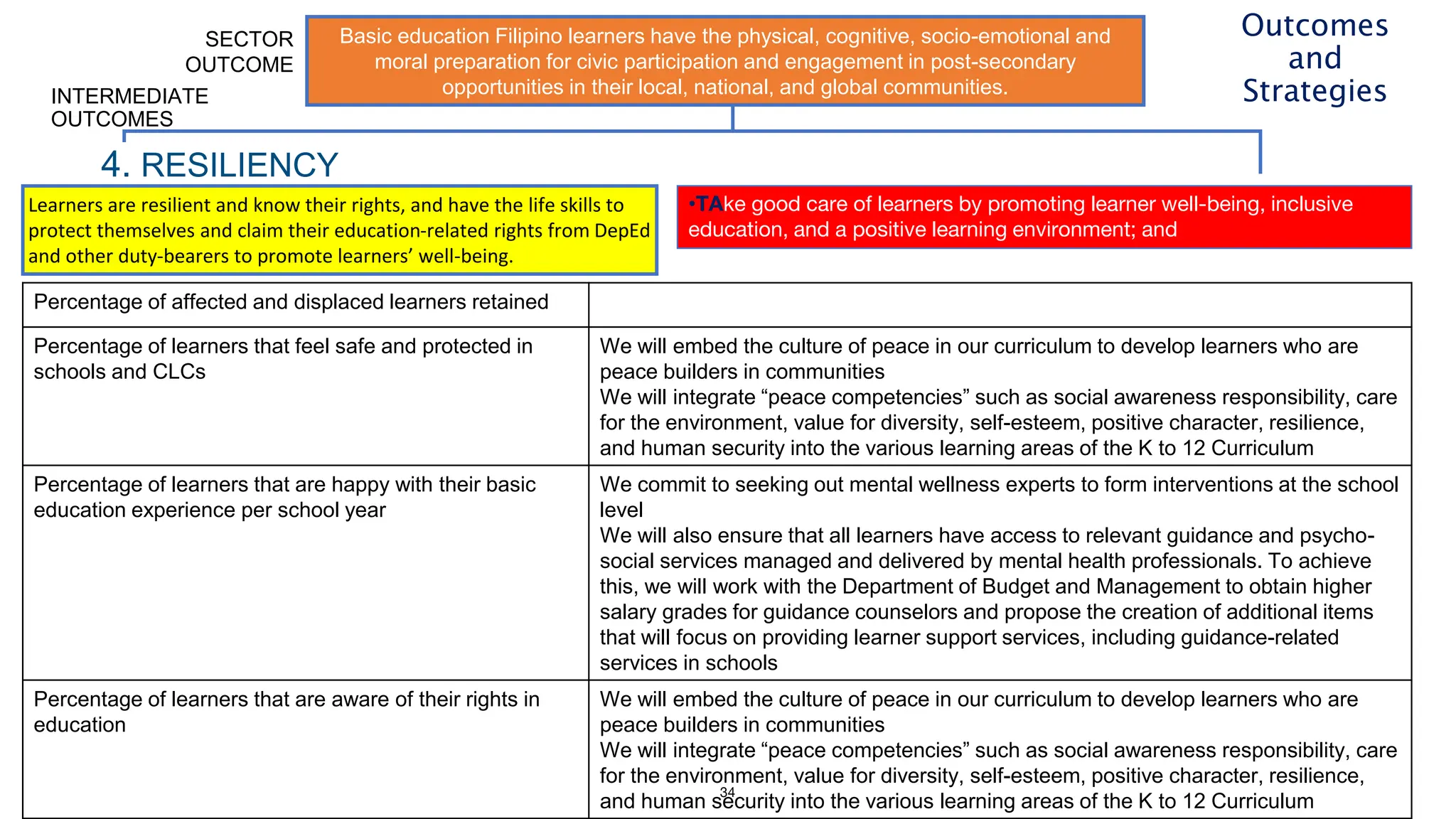
4. RESILIENCY
Learners are resilient and know their rights, and have the life skills to
protect themselves and claim their education-related rights from DepEd
and other duty-bearers to promote learners’ well-being.
Outcomes
and
Strategies
Percentage of affected and displaced learners retained
Percentage of learners that feel safe and protected in
schools and CLCs
We will embed the culture of peace in our curriculum to develop learners who are
peace builders in communities
We will integrate “peace competencies” such as social awareness responsibility, care
for the environment, value for diversity, self-esteem, positive character, resilience,
and human security into the various learning areas of the K to 12 Curriculum
Percentage of learners that are happy with their basic
education experience per school year
We commit to seeking out mental wellness experts to form interventions at the school
level
We will also ensure that all learners have access to relevant guidance and psycho-
social services managed and delivered by mental health professionals. To achieve
this, we will work with the Department of Budget and Management to obtain higher
salary grades for guidance counselors and propose the creation of additional items
that will focus on providing learner support services, including guidance-related
services in schools
Percentage of learners that are aware of their rights in
education
We will embed the culture of peace in our curriculum to develop learners who are
peace builders in communities
We will integrate “peace competencies” such as social awareness responsibility, care
for the environment, value for diversity, self-esteem, positive character, resilience,
and human security into the various learning areas of the K to 12 Curriculum
•TAke good care of learners by promoting learner well-being, inclusive
education, and a positive learning environment; and
34
INTERMEDIATE
OUTCOMES
SECTOR
OUTCOME
Basic education Filipino learners have the physical, cognitive, socio-emotional and
moral preparation for civic participation and engagement in post-secondary
opportunities in their local, national, and global communities.
4. RESILIENCY
Learners are resilient and know their rights, and have the life skills to
protect themselves and claim their education-related rights from DepEd
and other duty-bearers to promote learners’ well-being.
Outcomes
and
Strategies
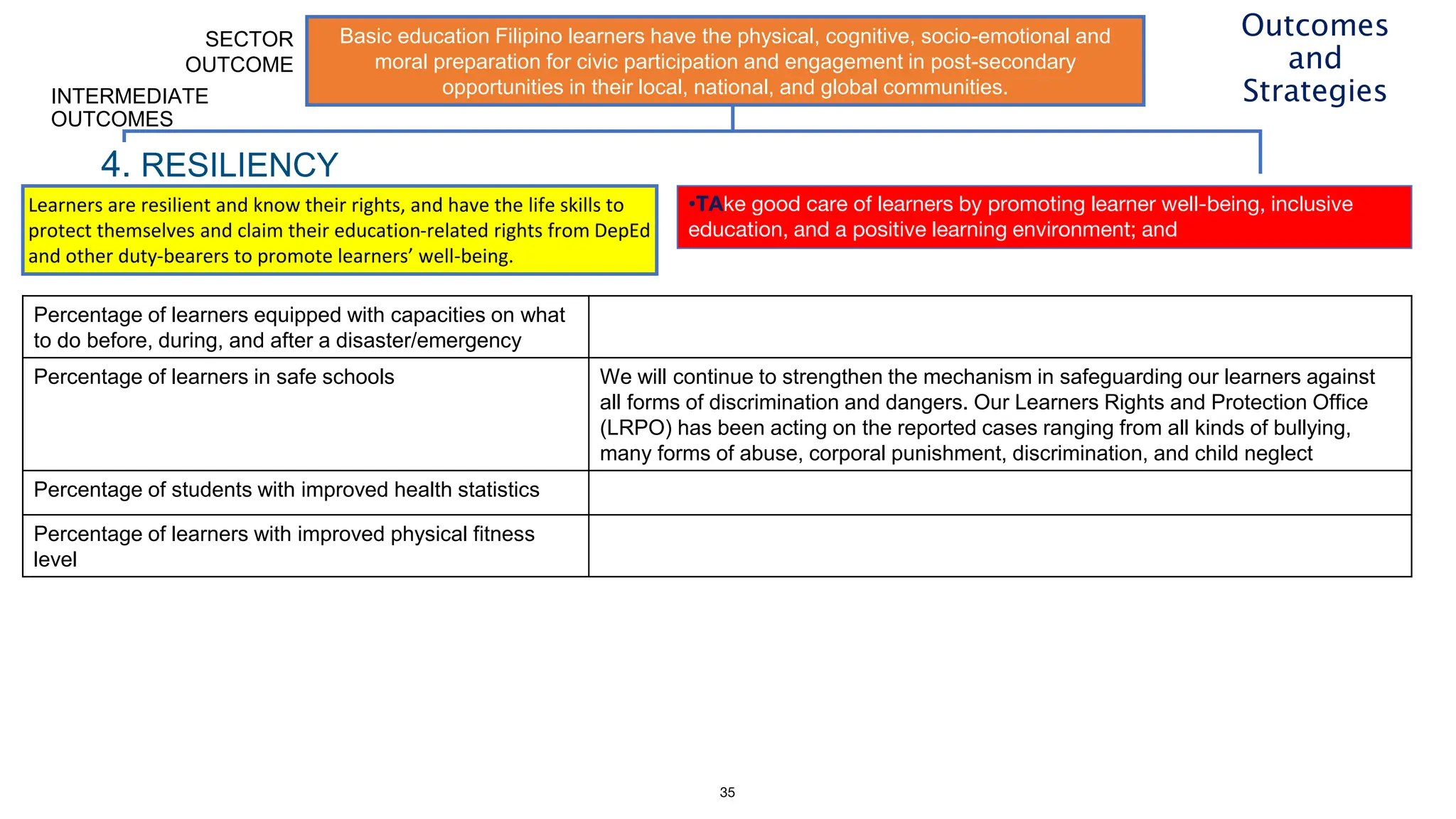
Percentage of learners equipped with capacities on what
to do before, during, and after a disaster/emergency
Percentage of learners in safe schools We will continue to strengthen the mechanism in safeguarding our learners against
all forms of discrimination and dangers. Our Learners Rights and Protection Office
(LRPO) has been acting on the reported cases ranging from all kinds of bullying,
many forms of abuse, corporal punishment, discrimination, and child neglect
Percentage of students with improved health statistics
Percentage of learners with improved physical fitness
level
•TAke good care of learners by promoting learner well-being, inclusive
education, and a positive learning environment; and
35
INTERMEDIATE
OUTCOMES
SECTOR
OUTCOME
Basic education Filipino learners have the physical, cognitive, socio-emotional and
moral preparation for civic participation and engagement in post-secondary
opportunities in their local, national, and global communities.
Outcomes
and
Strategies
Proportion of schools achieving higher levels
of SBM practice
We will provide training and other learning and development interventions for school leaders, namely the
school heads, supervisors, superintendents, and assistant superintendents, so that they can better
support our teachers to teach better
We will continuously provide professional development programs, including graduate degree
scholarship programs to teachers focusing on their learning area specialization and graduate certificate
programs for non- majors
We will provide support in terms of innovative, responsive, and inclusive teaching approaches following
the Philippine Professional Standards for Teachers (PPST).
Proportion of offices across governance
levels with very satisfactory and higher rating
in the Office Performance Commitment and
Review Form (OPCRF)
We will launch our National Education Portal or NEP, which will provide a dynamic “one-stop-shop” platform available to
all basic education stakeholders, such as teachers, learners, and parents. The NEP will substantially cut down the
manual process, reduce transaction costs and eliminate errors due to human intervention
We will implement the policy on the distribution of teacher workload and payment of teaching overload, as provided in the
Magna Carta for Public School Teachers
ENABLING MECHANISMS -
GOVERNANCE •TAke steps to accelerate delivery of basic education facilities and services;
Efficient, nimble and resilient governance and management processes •Give support to teachers to teach better
36
INTERMEDIATE
OUTCOMES
SECTOR
OUTCOME
Basic education Filipino learners have the physical, cognitive, socio-emotional and
moral preparation for civic participation and engagement in post-secondary
opportunities in their local, national, and global communities.
Outcomes
and
Strategies
Proportion of schools achieving ideal ratio on
classroom, teachers, textbooks, seats,
science and math equipment and ICT
package
We will provide assessment assistive mechanisms such as audio-assisted technology, Braille, and
large-print test materials to students with disabilities. We will introduce digital textbooks for certain core
subjects in Senior High School
We will provide e-classroom packages for teaching and learning. Each package will consist of 46
laptops, 2 charging carts, 2 wireless routers, and 1 smart TV. This will accelerate the integration of ICT
in teaching and learning and institutionalize blended learning
We will improve our learning environments to encourage support, discourage bullying; strengthen the
implementation of child protection policies; make students feel safe and respected; and make them,
including our IP learners and those with disabilities, feel that they belong
We will establish fully-functional library hubs in our division offices
We will provide schools with electricity. In the next 5 years, we will work towards providing electricity
especially in our last-mile schools
We will optimize the use of technology, both online and offline, to ensure that learners have
opportunities to learn even in the event of a pandemic or other emergencies
We commit to closing the remaining gaps in school infrastructure with policies to eliminate corruption,
and insulate the allocation of school building funds from politicization
For our BARMM brothers, sisters and learners, we will always make ourselves available to provide
technical expertise. We will fully support your School Building Program and GASTPE direction
Proportion of schools with functional library,
connection to electricity, and connection to
internet functional library
We will capacitate our teachers and learners in utilizing technology in remote learning to maximize the
benefits of digital learning
We will build more resilient schools and classrooms. For 2023, we have the budget to build around
6,000 classrooms
ENABLING MECHANISMS -
GOVERNANCE •TAke steps to accelerate delivery of basic education facilities and services;
Efficient, nimble and resilient governance and management processes •Give support to teachers to teach better
37
INTERMEDIATE
OUTCOMES
SECTOR
OUTCOME
Basic education Filipino learners have the physical, cognitive, socio-emotional and
moral preparation for civic participation and engagement in post-secondary
opportunities in their local, national, and global communities.
Outcomes
and
Strategies
Proportion of SDOs achieving ideal
interquartile ratio (IQR) *on teacher
deployment
Client satisfactory rating of DepEd offices'
respective internal and external
stakeholders
We will strengthen the complementarity between public and private schools through the seamless
implementation of the Government Assistance and Subsidies program of the DepEd with the
creation of the Voucher Program Management Office
Percentage of financial contribution of
international and local grant development
partners vis-a-vis national education
budget
We have also requested the Department of Budget and Management to expand the coverage for the
grant of Special Hardship Allowances
We will continuously advocate for additional benefits for our teachers
Proportion of schools with functional school
governing council (SGC)
Proportion of teachers in private schools
receiving teacher subsidy
Working with private school organizations, we will also speed up the issuance of the Revised
Manual of Regulation for Private Schools
ENABLING MECHANISMS -
GOVERNANCE •TAke steps to accelerate delivery of basic education facilities and services;
Efficient, nimble and resilient governance and management processes •Give support to teachers to teach better
38
INTERMEDIATE
OUTCOMES
SECTOR
OUTCOME
Basic education Filipino learners have the physical, cognitive, socio-emotional and
moral preparation for civic participation and engagement in post-secondary
opportunities in their local, national, and global communities.
Outcomes
and
Strategies
Others We are looking to provide free legal assistance facility for teachers on matters concerning loan
contracts, obligations, and cases
We will digitize our essential processes, including our national assessments
Working with private school organizations, we will also speed up the issuance of the Revised
Manual of Regulation for Private Schools
We will remove non-teaching tasks and provide administrative officers in schools. We will provide
adequate manpower complement in schools, manage teachers' workload, and compensate teachers
for unique school challenges
We will fast-track the implementation of the career progression policy, so teachers get more
opportunities for promotion
Within the year, we aim to make the new Teacher Education Council and Secretariat fully functional
and start working on its mandates, including setting minimum requirements for pre-service teacher
education programs in the country
We will work towards addressing issues affecting the net-take-home pay of teachers
We will work closely with Congress in pushing for the expansion of GASTPE coverage to include kindergarten and
elementary learners
We are discussing with the Department of Health for the provision of free annual physical examinations for our
teachers
ENABLING MECHANISMS -
GOVERNANCE •TAke steps to accelerate delivery of basic education facilities and services;
Efficient, nimble and resilient governance and management processes •Give support to teachers to teach better
39
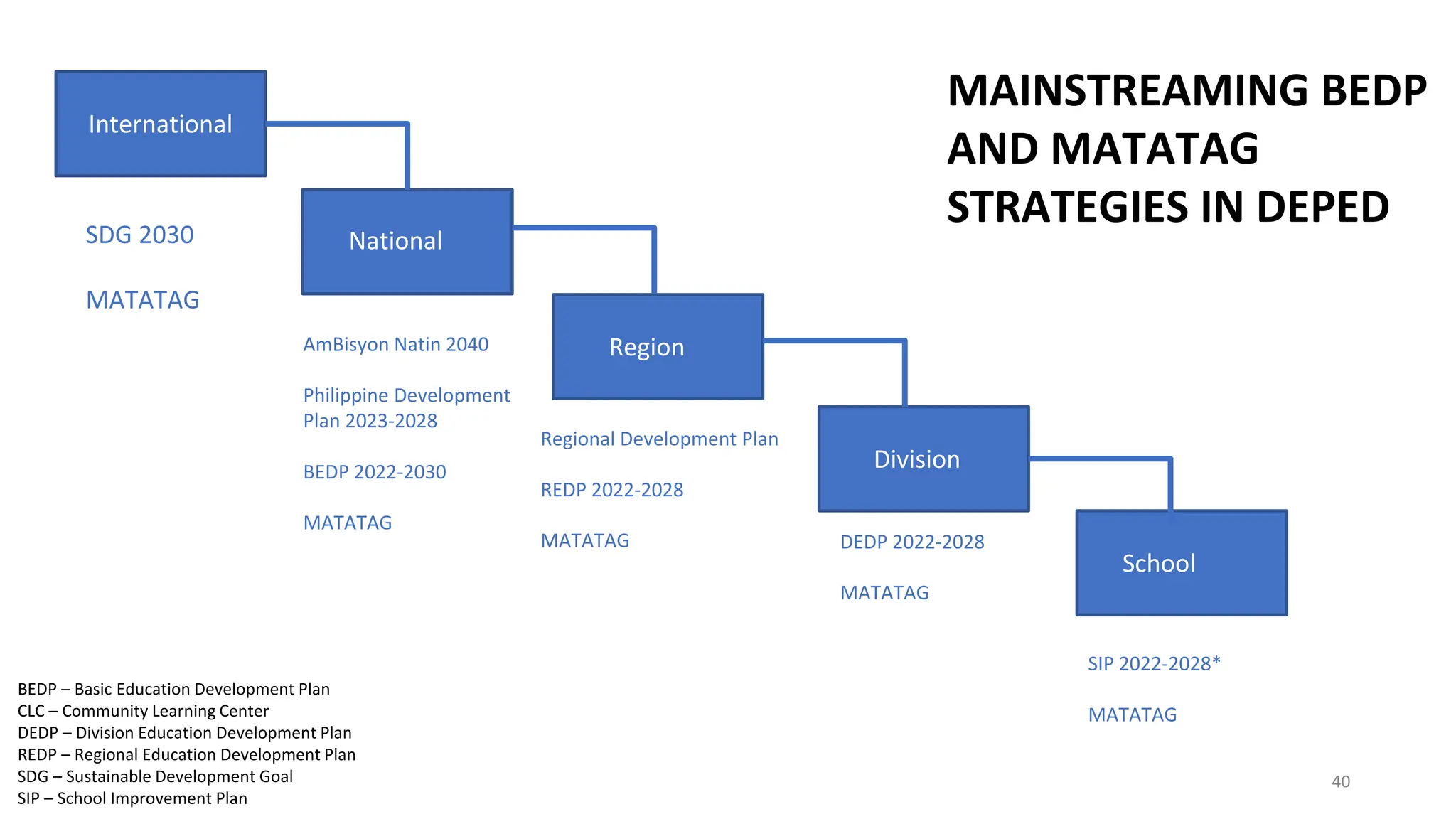
International
National
Region
Division
School
BEDP – Basic Education Development Plan
CLC – Community Learning Center
DEDP – Division Education Development Plan
REDP – Regional Education Development Plan
SDG – Sustainable Development Goal
SIP – School Improvement Plan
SDG 2030
MATATAG
AmBisyon Natin 2040
Philippine Development
Plan 2023-2028
BEDP 2022-2030
MATATAG
Regional Development Plan
REDP 2022-2028
MATATAG DEDP 2022-2028
MATATAG
SIP 2022-2028*
MATATAG
MAINSTREAMING BEDP
AND MATATAG
STRATEGIES IN DEPED
40
National
Situation
MA
TA
TA
G
Lead,
Complementary,
and Supplementary
Role of Strands
Outcomes
BEDP and PDP
Commitments
Key Programs
and Projects
Leadership
and
Governance
HIGH PERFORMING EXECOM
HIGH PERFORMING DEPED
Strategic and Priority
Line of Action
41
Other
Sources
GAA
Tier 1
MA
TA
TA
G
Lead,
Complementary,
and Supplementary
Role of Strands
Outcomes
BEDP and PDP
Commitments
Key Programs
and Projects
GAA
Tier 2
2023
2028
Resource Requirements
42
Planning Environment
Ensure inclusive and
equitable quality education
and promote lifelong
learning opportunities for all
Global Commitment
CHAPTER 2: Promote human and social
development
Quality, inclusive, adaptive, resilient,
and future-ready basic education for
all achieved
TE
S
Post pandemic recovery efforts aims to accelerate the
achievement of SDG Goals. It specifically aims to
ensure inclusive, equitable, safe and healthy schools.
Learning and skills for life, work and sustainable
development. Teachers, teaching and the teaching
profession. Digital learning and transformation
Basic education Filipino learners have the
physical, cognitive, socio-emotional and moral
preparation for civic participation and
engagement in post-secondary opportunities
in their local, national, and global
communities.
National Commitment
Sectoral Commitment: Basic Education
By 2040, the Philippines is a
prosperous middle class society
where no one is poor. People live
long and healthy lives and are
smart and innovative
Bansang Makabata, Batang Makabansa
• Sets the medium term direction of basic
education particularly in addressing the
learning poverty in the country.
• Aims to operationalize the Basic Education
Development Plan 2030 43
Major Highlights
and Agreements
of the One-Stop
Shop Workshop
44
General Agreements
Downloading of Funds
1. For Procurement of Resources
• Allowed. Will base on the proposed policy of BLR on the Identification and
Procurement of Supplementary Learning Resources (SLRs)
• Give at least three (3) months/ enough time for ROs/SDOs to procure. CO shall
supervise, if needed.
• Ensure legal cover for downloading of funds for procurement of resources.
2. For Central Office-initiated activities
• Allowed until end of March (1st Quarter). Afterwards, procurement shall be
done by the Central Office. Administration Strand will work on the “Concierge
System”.
Action Item: Planning to schedule CO-RO Interface (via Special MANCOM) to discuss proposed
downloading of funds to the field offices. 45
General Agreements
Direction for Learning Modality
The Vice President and Secretary Sara Duterte's directions are towards two
modalities:
1. Traditional Face to Face
2. Technological/Digital (Blended, Hybrid, Hyflex)
Study on re-engineering our alternative delivery modes, not just as alternatives, but
parallel to the traditional face to face
Multi-year Contractual/Obligational Authorities (MYCA/ MYOA)
1. All proposals for programs to be subjected to MYCA/MYOA shall be consolidated
and will be presented in a session with DBM.
46
Human Resource and Organizational
Development Strand
Undersecretary Gloria Jumamil-Mercado
One Stop Shop Workshop
47
Human Resource and Organizational Development
General Recommendations to HROD (for trainings)
1. HROD to craft and Human Resource Development Plan (HRDP) at
least within the quarter as required by Senate and HOR.
2. HROD to submit proposal for trainings by competency based on needs
of individual employees (training needs analysis)
3. Consider tapping other sources aside from GAA Budget. Source
out scholarships that may be provided by external partners, private
institutions, the National Economic Development Authority (NEDA), Civil
Service Commission (CSC), or the Development Academy of the
Philippines, among others.
4. Inclusion of Indigenous People (IPs) in the scholarship offerings
5. Considering blended/hybrid/hyflex approach in trainings to cut costs,
instead of face to face 48
Human Resource and Organizational Development
Organizational and Professional Development for Non Teaching Personnel
1. Capacity Building
• HROD shall conduct training for all Central Office personnel; cuts across the
whole Central Office (leadership, technology, etc.)
• Consider tapping CO-GMS (MOOE) for supplemental funding for essential
trainings which may no longer be covered by the OPDNTP Fund.
• HROD to submit list of trainings and timelines to Finance and Procurement
(cash requirements, programming of procurable items, etc.)
• Offering Executive Level Trainings for Third-level Officials
2. Scholarships
• HROD is currently reviewing the Scholarship Policy of DepEd to accommodate
non-teaching personnel who wishes to pursue higher education. Checking
the feasibility and legal anchor.
49
Human Resource and Organizational Development
Teacher Quality Development Program
1. 2023 is an "Incubation" Period; Transition Period. By 2024, the target is to
become an attached agency
• Teacher Education Council Secretariat (TECS) to submit proposal with
complete details to EXECOM
• Coordination with CHED on their formed technical panel
2. TECS Mandate
• Policies on Teacher Professional Development shall be developed by the
TECS
• TECS will become DepEd's representative in the EDCOM 2
50
Human Resource and Organizational Development
Human Resource Development (HRD) Program
1. Capacity Building
• Inclusion of LAC as a component of the program support fund (PSF) to be
downloaded
• Make Tier 2 proposal realistic based on absorptive capacity
• Include Curriculum and Teaching (CT) Strand in the review of the LAC policy
• Inclusion of trainings on Higher Order Teaching Skills (HOTS) in the training
program for teachers in recognition of it as one of our teachers' weak areas
2. Budget Line Item
• Explore possibility of having NEAP as the budget line item rather than HRD
• Consider having NEAP function like the DAP
51
Operations Strand
Undersecretary Revsee Escobedo
Assistant Secretary Dexter Galban
Assistant Secretary Christopher Lawrence Arnuco
One Stop Shop Workshop
52
Operations
School-Based Feeding Program
1. Operations to research on other possible funding mechanisms to extend
the feeding days to 220 days.
2. The EXECOM members will further discuss the strategy to stretch the
feeding days from 120 days to 220 days.
Disaster Preparedness and Risk Reduction Program
1. DRRMS to look into the feasibility of procuring go-bag and identify list of
beneficiaries.
2. All the regular programs be charged to the P129M fund and reprogram the
P2 billion that it be solely used for procurement of TLS and other disaster
response or preparedness.
53
Operations
Child Protection Program
1. ICTS to discuss with the LRPO on the development of its own chatbot and
other technology-based programs.
2. Review the outstanding balance of DepEd with Globe and Smart for the
request to use #33733 vanity number for the hotline.
54
School Infrastructure and
Facilities Strand
Undersecretary Epimaco V. Densing III
One Stop Shop Workshop
55
School Infrastructure and Facilities
Basic Education Facilities, Gabaldon, LMSP
1. Signatory/ies for the Request of SARO to DBM
• Will really have to pass through review of Finance since it has funding implications and
needs to be endorsed to DBM
• Draft a proposal addressed to the Office of the Secretary (OSEC) for the consent to use
"By the Authority of the Secretary" and have it signed by the Portfolio Manager (UED).
However this will still be subject to the approval of the legal and legislative affairs.
2. School Furniture
• BAC 1 is ready for the school furniture
3. Authorization of Engineers hired as COS/Consultant to sign project documents
Recommendations:
• Engineers will sign "recommended by". EFD for the approval
• Possibility of having a MOA/MOU with LGU, DPWH, or UP College of Engineering
• SIF – SIMO/EFD to submit proposal for staffing complement for inclusion in the
Management Review (MR) Structure proposal to be submitted to DBM by April 30, 2023
56
School Infrastructure and Facilities
1. Commitments from "CT Walks"
• SIF may accommodate but the CT Strand will have to provide /determine the parameters,
the data for the forward estimates
• BLR to coordinate and submit to SIF list of priority areas for the library hubs.
2. Accessibility Features for LWDs
• Ramps to reach at least the second (2nd) floor of the school building
• Inclusion of accessibility features starting from the School Gate towards the School
Buildings aside from ramps
3. Construction of at least one (1) High-Rise Building
4. The Future of Education vis-a-vis construction of school buildings
• SIF focuses on closing the remaining gaps. But is always ready to follow if the CT Strand's
direction (21st century schools, blended learning, etc.)
5. Submission of Non-energized schools and needs upgrading in compliance to
Special Provisions Nos. 6 and 8 57
School Infrastructure and Facilities
1. Quick Response Fund
• For schools affected by calamities and needing reconstruction, subject it under Repair and
Rehabilitation instead of QRF.
2. Tier 1 of Capital Outlay
• Discuss with the DBM to establish tier 1 in the Capital Outlay of Basic Education Facilities
Fund, Last Mile School, and other School Infrastructure Facilities fund.
58
Curriculum and Teaching
Undersecretary Gina Gonong
Assistant Secretary Alma Ruby Torio
Assistant Secretary GH Ambat
One Stop Shop Workshop
59
Curriculum and Teaching
Textbooks and Other Instructional Materials
1. With the new curriculum to be released by March 2023, EPA cannot be
done in consideration of the time needed by publishers to align.
2. New policy guidelines being proposed to cut down production time of
textbooks.
3. Coordination with publishers and the National Book Development Board
(NBDB) to solve issues that cause failures in the development of textbooks
• Publishers not knowledgeable on unpacking the curriculum contained
in the curriculum guides, spiral progression, and standards set by CT
4. Coordinate with the Procurement Strand and the Legal and Legislative
Affairs (LLA) Strand in the drafting of position paper on the concern raised
by Cong. Marcoleta that DepEd has no power to procure textbooks
60
Curriculum and Teaching
Technical Vocational Livelihood (TVL)
1. Procurement of TechVoc Equipment
• BLR shall validate data provided by the Learner Information System (LIS)
vs the actual needs of the schools
• BLR to hold a consultative conference this March to really determine
the gaps in the policy, the needs, new materials needed aligned in the
curriculum, introduce new products from suppliers.
2. Moratorium on the approval of NEW TVL offerings (before procurement of
equipment)
• The CT provides the standards. ROs shall validate first if the schools
have the capacity to carry out the offering
61
Curriculum and Teaching
Science and Math Equipment (SME)
1. Maps inside the Classroom
• We have policy encouraging schools to purchase globes, atlases, maps, etc.
• However, maps shall not bear the 9-dash line. This shall be in the technical
specifications shall we procure big-scale. BLR to check schools in Tagaytay using maps
with 9 dash line.
• This matter shall be taken into consideration when reviewing the proposed policy
on SLRs.
2. Possibility of having funds for the equipment/ vouchers for other tracks
• JDVP is partnered with the NCCA. We need an institution that accredits. NCCA
provides that they do not have it now. But will work on it if that is the direction of
DepEd.
Flexible Learning Options – Learning Resources (FLO-LRs)
1. BLR to submit FLO-LRs proposal for EXECOM review. Procurement of FLO-LRs is still
needed but on a smaller scale. 62
Curriculum and Teaching
Basic Education Curriculum
1. BEC shall be used for programs funds. Operational expenses to be proposed under CO-
GMS. Review activities relating to quarterly review, operational planning, mid-year,
year-end.
2. The CT strand's training activities will be moved to NEAP, but the training content will
still be provided by the CT strand. CT strand will continue to provide the funding, but
there will be discussions with NEAP to determine whether the funding will be coming
from NEAP or from CT strand
3. On the development of compendium of learning delivery guides, CT strand shall
consider getting consultants from outside DepEd instead of teachers
4. The CT strand will provide a matrix outlining their major outputs and how each bureau
will aid or contribute to each output. This will also allow the EXECOM to easily identify
how they can support each output.
5. Undersecretary Gina O. Gonong will review and endorse the proposed WFP of CT
strand for approval 63
Administration Strand
Undersecretary Kristian Ablan
Assistant Secretary Christopher Lawrence Arnuco
One Stop Shop Workshop
64
Administration
DepEd Computerization Program
1. Revise all projects for procurement including brand names and use general terms.
2. Even if the DCP is FLR, the procurement will be started.
3. Include the safety net in the policy for the accountable recipient of the DCP packages.
4. DepEd Logo and color modification will not be included in the packages.
5. There will be a discussion with NEAP and other possible partners for the training of
teachers on how to maximize the packages such as how to integrate in learning
delivery.
6. There will be a crafted policy setting the minimum technical specifications for all
donated laptops. The policy will also be applicable to the LGUs' funded laptops and
other learning devices.
7. Start crafting the information system for the GASTPE as ordered by the Vice President.
65
Finance Strand
Undersecretary Analyn M. Sevilla
One Stop Shop Workshop
66
Finance
MOOE
1. There is a 17% increase in the fixed and variable rate in the formula of computing the
school MOOE
2. It will be best to include the supplementary learning resources under the program funds
instead of MOOE due to MOOE is prone to deduction.
3. In order to deal with the problem of certain schools having more MOOE than others, a
new policy has been put in place that sets a minimum MOOE based on the size of the
school. The formula for this policy includes a fixed cost that remains constant regardless
of school size, while the variable cost will fluctuate depending on the size of the school.
GASTPE
1. Let's look into the MADRASAH, subsidy to private madaris. This will be studied this 2023.
2. Let's review the specs of the TVL so they can be utilized by the learners.
3. There's a composite meeting of the GASTPE team on February 23.
4. Finance Strand to review how JDVP will move forward 67
Finance
GASTPE
1. BHROD is the member of the TESDA Board.
2. Review DO 88 on the manual of operations of private schools with regards
provisions on graduates barred from graduating due to unsettled fees.
3. Review the JDVP as to the moving forward plan of DepEd.
• If the learner is already a recipient of JDVP, he/she will no longer be considered
in the LTE-TVL
68
What are the adjustments
needed?
69
Updates on Budget Execution
FY 2023 GAA
28 January 2023
DEPARTMENT OF EDUCATION
Outline of Presentation
71
• Overall Budget, FY 2023
• PAPs for FCR and FLR
• Updates on the Budget Execution Document
DEPARTMENT OF EDUCATION
OVERALL BUDGET, FY 2023
72
DEPARTMENT OF EDUCATION
FY 2023 GAA
73
PS
77.26%
MOOE
17.85%
CO
4.89%
FY 2023 DEPARTMENT OF EDUCATION BUDGET
EXPENSE CLASS
FY 2023
BUDGET
% SHARE
PS
555.97 B 77.26%
MOOE
128.46 B 17.85%
CO
35.16 B 4.89%
TOTAL 719.59 B 100%
DEPARTMENT OF EDUCATION
PAPS FOR FCR AND FLR
74
DEPARTMENT OF EDUCATION
Summary of PPAs with FCR – per strand
75
Curriculum and Teaching
National Assessment Systems for
Basic Education (NASBE)
P128,428M (MOOE)
Basic Education Curriculum (BEC)
P75,838M (MOOE)
Development and Promotion of
Campus Journalism (DPCJ)
P2,056M (MOOE)
National Literacy Policies and
Programs (NLPP)
P7,711M (MOOE)
Early Language Literacy and
Numeracy (ELLN)
P23,627M (MOOE)
Learning Tools and Equipment
(LTE)
P2,802,744B (MOOE)
Textbooks and other Instructional
Materials
P998,454M (MOOE)
Multigrade Education
P23,080M (MOOE)
IPEd
P53,359M (MOOE)
FLO (ADM/ALS/EiE)
P4,076B (MOOE)
Madrasah Education
P359,503M (MOOE)
SPEd
P485,625M (MOOE)
P96M (CO)
MALR
P9,927M (MOOE)
Finance
School MOOE (K-G6)
P15,795B (MOOE)
School MOOE (G7-G10)
P11,163B (MOOE)
School MOOE (G11-G12)
P4,538B
Dev’t & Mngt of Bilateral & Multi
Education Projects
P13,123M (MOOE)
Joint Delivery Voucher Program
P1,380B (MOOE)
ESC
P12,498B (MOOE)
SHS VP
P39,327B (MOOE)
HROD
OPDNTP
P63,825M (MOOE)
P47,525M (ROs) (MOOE)
HRDP
P895,213M (MOOE)
P80M (ROs) (MOOE)
P991M (SDOs) (MOOE)
TQDP
P643 (MOOE)
Osec-StratMa
Education Info & Com Services
P3,480M (MOOE)
Building Partnerships and Linkages
Program (BPLP)
P118,323M (MOOE)
SIF
Quick Response Fund
P2B (CO)
LLA
Legal Service & Dev’t
P19,400M (MOOE)
Improvement & Acquisition of School
Sites
P83,158M (MOOE)
P65M (CO)
Total:
P9.04B
7.9%
ADMIN
Policy & Research Program
P34,769M (MOOE)
PMIS
P39,479M (MOOE)
DepEd Computerization Program
P2,859B (MOOE)
P6,021B (CO)
Operations
Physical Fitness and School
Sports (PFSS)
P278,638M (MOOE)
Learner Support Programs
P125,748M (MOOE)
Disaster Preparedness and
Response Program
P127,963M (MOOE)
School-Based Feeding Program
(SBFP)
P5,689B (MOOE)
Child Protection Program
P4,747M (MOOE)
Total:
P6.23B
5.5%
Total:
P84.7B
74.4%
Total:
P2.72B
2.4%
Total:
P121.8M
0.1%
Total:
P8.9B
7.8%
Total:
P168M
0.1%
Total:
P2B
1.8%
*All amount in 000’
DEPARTMENT OF EDUCATION
PPAs with Direct Release to ROs
76
Curriculum and
Teaching
FLO (ADM/ALS/EiE)
P2,728,090B (MOOE)
Madrasah Education
P316,212M (MOOE)
OPS
Disaster Preparedness
and Response
Program
P37,528M (MOOE)
School-Based Feeding
Program (SBFP)
P5,472,575B (MOOE)
ADMIN
Policy and Research
Program
P16M (MOOE)
Total:
P3.04B
(35%)
Total:
P5.51B
(64%)
Total:
P16M
(1%)
*All amount in 000’
DEPARTMENT OF EDUCATION
Summary of PPAs with FLR – per strand
77
Curriculum and
Teaching
National Assessment
Systems for Basic Education
(NASBE)
P276, 271M (MOOE)
Basic Education Curriculum
(BEC)
P5,017,453B (MOOE)
Development and Promotion
of Campus Journalism
(DPCJ)
P44,848M (MOOE)
National Literacy Policies and
Programs (NLPP)
P12,289M (MOOE)
Indigenous Peoples
Education (IPEd) Program
P101,072M (MOOE)
Flexible Learning Option
P166,841M (MOOE)
P51,914M (CO)
Early Language Literacy and
Numeracy (ELLN)
P58,048M (MOOE)
HROD
New School Personnel
Positions (NSPP)
P100,000M (MOOE)
Teacher Quality and
Development Program
(TQDP)
P96,251M (MOOE)
Operations
Learner Support Program
(LSP)
P97,250M (MOOE)
Disaster Preparedness and
Response Program (DPRP)
P2B (MOOE)
P1,490M (CO)
Child Protection Program
(CPP)
P53,320M (MOOE)
SIF
BEF
• New Con
P15,604,176B (CO)
• Repair & Rehab
P4,911,251B(CO)
• Engineering & Admin
P565,955M (CO)
• School Furniture
P1,833,515B (MOOE)
• Electrification
P503,000M (CO)
Gabaldon
P383,965M (CO)
Last Mile School
P1.5B (CO)
ADMIN
DepEd Computerization
Program (DCP)
P2,458,601B (CO)
Total:
P5.73B
(16%)
Total:
P2.15B
(6%)
Total:
P196M
(1%)
Total:
P25.30B
(71%)
Total:
P2.46B
(7%)
*All amount in 000’
DEPARTMENT OF EDUCATION
UPDATES ON THE BUDGET
EXECUTION DOCUMENT
78
DEPARTMENT OF EDUCATION
Basic Education Inputs
79
Organizational Outcomes / Performance
Indicators
NEP to GAA
FY 2023 Target
Remarks
From To
Output Indicators
1. Number of:
a. new classrooms constructed 2,379 6,379 Increase in Physical Targets due to additional
P10B from congress
b. new classrooms on-going
construction
NDA NDA
2. Number of equipment procured for distribution:
a. Science and Math 11,016,797 11,016,797 The modification will have no effect on the
physical target
b. Technical and Vocational
Livelihood
427,438 427,438
c. ICT packages 82,090 3,700 Transfer of P2.459B from Flexible Learning
Options and reconfiguration of ICT packages
DEPARTMENT OF EDUCATION
Inclusive Education
80
Organizational Outcomes / Performance
Indicators
NEP to GAA
FY 2023 Target
Remarks
From To
Outcome Indicators
1. Percentage of learners enrolled in:
a. SPED (public) 0.48% 0.48% Transfer of P531.6M from Flexible Learning Options
137,828 137,828
c. IPED (public) 0.45% 0.47% No of IP learners directly benefitting from IPEd
implementation
129,100 133,935
e. ALS 2.23% 2.23% Additional P700M for a total of P1.2B alloted for ALS
638,929 638,929
2. Percentage of learners provided with
learning resources
85.00% 0.18% Reallocation P15.7B to other programs/ projects/
activities
24,495,703 50,310
Output Indicators
1. Number of schools offering the following programs:
b. IPED 3,070 3,089 Proposed Indicator: No of schools implementing the
IPEd Program
c. SPED 6,558 6,558 Transfer of P531.6M from Flexible Learning Options
2. Number of public schools provided with
learning resources
44,984 44,984 Reallocation P15.7B to other programs/ projects/
activities
DEPARTMENT OF EDUCATION
FY 2023 BED2, PREXC
81
DEPARTMENT OF EDUCATION
FY 2023 Physical Plan
82
Organizational Outcomes / Performance
Indicators
Physical Targets (2023 Budget Year) - GAA Targets
Concerned
Office
1st Quarter 2nd Quarter 3rd Quarter 4th Quarter TOTAL
EDUCATION POLICY DEVELOPMENT PROGRAM
Outcome Indicators
1.
Percentage of completed education
researches used for policy development
100% 100% CO
2.
Percentage of satisfactory feedback from
clients on issued policies
78% 78% CO
Output Indicators
1.
Number of policies formulated, reviewed, and
issued
10 15 10 17 52 CO
2. Number of education researches completed 70 490 560 CO, RO
3. Number of proposed policies reviewed 15 20 20 30 85 CO
DEPARTMENT OF EDUCATION
FY 2023 Physical Plan
83
Organizational Outcomes / Performance
Indicators
Physical Targets (2023 Budget Year) - GAA Targets
Concerned
Office
1st Quarter 2nd Quarter 3rd Quarter 4th Quarter TOTAL
BASIC EDUCATION INPUTS PROGRAM
Outcome Indicators
1. Percentage of public schools meeting the standard ratio for teachers
a. Elementary 99% 99% CO, RO
b. Junior High School 88% 88% CO, RO
c. Senor High School 91% 91% CO, RO
2. Percentage of public schools meeting the standard ratio for classrooms
a. Grades 1-10 79% 79% CO
b. Senor High School 62% 62% CO
3. Percentage of public schools provided with ICT package (schools with electricity)
a. Elementary 100% 100% CO
b. Junior High School 100% 100% CO
c. Senor High School 100% 100% CO
DEPARTMENT OF EDUCATION
FY 2023 Physical Plan
84
Organizational Outcomes / Performance
Indicators
Physical Targets (2023 Budget Year) - GAA Targets Concerned
Office
1st Quarter 2nd Quarter 3rd Quarter 4th Quarter TOTAL
BASIC EDUCATION INPUTS PROGRAM
Output Indicators
1. Number of:
a. New classrooms constructed 6,379 6,379
CO
b.
New classrooms on-going
construction
0
c.
Textbooks and Instructional/ learning
materials procured for printing and
delivery
4,628,245 4,628,245 CO
2. Number of equipment procured for distribution:
a. Science and Math 11,016,797 11,016,797 CO
b. Technical and Vocational Livelihood 427,438 427,438 CO
c.
Information Communication
Technology (ICT) packages
3,700 3,700 CO
3.
Number of newly-
created teaching positions filled up
10,000
created
10,000
created
CO
6,000
filled-up
4,000
filled-up
10,000
filled-up
RO
DEPARTMENT OF EDUCATION
FY 2023 Physical Plan
85
Organizational Outcomes /
Performance Indicators
Physical Targets (2023 Budget Year) - GAA Targets
Concerned
Office
1st Qtr. 2nd Qtr. 3rd Qtr. 4th Qtr. TOTAL
INCLUSIVE EDUCATION PROGRAM
Outcome Indicators
1. Percentage of learners enrolled in:
a. SPED (public)
0.48%
(137,828)
0.48%
(137,828)
CO, RO
b.
ALIVE (both public and
private)
0.63%
(180,423)
0.63%
(180,423)
CO, RO
c. IPED (public)
0.47%
(129,100)
0.47%
(129,100)
CO, RO
d. ALS
2.23%
(638,929)
2.23%
(638,929)
CO, RO
2.
Percentage of learners provided
with learning resources
0.18%
(50,310)
0.18%
(50,310)
CO, RO
DEPARTMENT OF EDUCATION
FY 2023 Physical Plan
86
Organizational Outcomes /
Performance Indicators
Physical Targets (2023 Budget Year) - GAA Targets
Concerned
Office
1st Qtr 2nd Qtr 3rd Qtr 4th Qtr TOTAL
INCLUSIVE EDUCATION PROGRAM
Output Indicators
1. Number of schools offering the following programs:
a. ALIVE 2,888 2,888 CO, RO
b. IPED 3,089 3,089 CO, RO
c. SPED 6,559 6,559 CO, RO
2.
Number of public schools provided
with learning resources
44,984 44,984 CO, RO
3.
Percentage of reported errors in
learning resources addressed
100% 100% CO
DEPARTMENT OF EDUCATION
FY 2023 Physical Plan
87
Organizational Outcomes / Performance
Indicators
Physical Targets (2023 Budget Year) - GAA Targets
Concerned Office
1st Quarter 2nd Quarter 3rd Quarter 4th Quarter TOTAL
SUPPORT TO SCHOOLS AND LEARNERS PROGRAM
Outcome Indicators
1. Retention rate
a. Elementary 98.91% 98.91% CO, RO
b. Secondary (Grade 7 to 12) 91.12% 91.12% CO, RO
2. Completion Rate
a. Elementary 79% 79% CO, RO
b. Secondary (Grade 7 to 12) 69% 69% CO, RO
3. Proportion of learners achieving at least nearly proficient in the National Achievement Test
a. Elementary (G6) 42% 42% CO, RO
b. Junior High School (G10) 18% 18% CO, RO
c. Senior High School (G12) 25% 25% CO, RO
DEPARTMENT OF EDUCATION
FY 2023 Physical Plan
88
Organizational Outcomes /
Performance Indicators
Physical Targets (2023 Budget Year) - GAA Targets
Concerned Office
1st Quarter 2nd Quarter 3rd Quarter 4th Quarter TOTAL
SUPPORT TO SCHOOLS AND LEARNERS PROGRAM
Output Indicators
1.
Number of learners benefittin
g from the “School Feeding
Program"
1,678,704 1,678,704 CO, RO
2.
Number of GAS slots
provided to learners
a.
Education Service
Contracting (ESC)
1,179,329 1,179,329 CO
b.
Senior High School
Voucher
1,132,155 1,132,155 CO
c. Joint Delivery TVL 109,233 109,233 CO
DEPARTMENT OF EDUCATION
FY 2023 Physical Plan
89
Organizational Outcomes / Performance
Indicators
Physical Targets (2023 Budget Year) - GAA Targets
Concerned
Office
1st Quarter 2nd Quarter 3rd Quarter 4th Quarter TOTAL
EDUCATION HUMAN RESOURCE DEVELOPMENT PROGRAM
Outcome Indicators
1.
Increase in percentage of public
schools conducting schools learning
action cell sessions
5% 5% CO, RO
Output Indicators
1.
Number of public school teachers and
teaching-related staff trained
311,100 311,100 CO, RO
Updates on Budget Execution
FY 2023 GAA
28 January 2023
MS Teams
February 28, 2023
KAPIHAN with
REGIONAL OFFICES OFFICIALS
Piolo Martin Moreno
Planning Service
UPDATES on the BUDGET EXECUTION
POLICY
PLANS AND BUDGET
EXECUTION
93
95
BASIC EDUCATION
PRIORITIES
96
ACCESS
EQUITY QUALITY
RESILIENCY &
WELL-BEING
GOVERNANCE
97
98
Basic Education Development Plan (BEDP) 2030
Results Framework
“One goal, Common Outcomes and Different Strategies”
99
The Department’s agenda remains to be consistent with the
thrusts of the national government through the BEDP 2030.
Moreover, the Department shall operate under the MATATAG basic
education agenda which aims to do the following:
MA – Make the curriculum simple but relevant to produce job-ready, active,
and responsible citizens
TA – Take steps to accelerate delivery of basic education facilities and services
TA – Take good care of learners by promoting learner well-being, inclusive
education, and a positive learning environment
G – Give support for teachers to teach better
Four-point Basic Education Agenda
MATATAG
PLAN
FORMULATION
100
101
1. It shall be noted that the Department employs a one vision, one goal, common
outcomes, and different strategies approach in planning and budgeting.
2. Strategic Planning exercise is conducted once every start of the new
administration to provide the strategic directions. CO, RO, SDO and school
levels shall formulate their respective strategic plans designed to address
challenges, identify key programs, projects and activities and the corresponding
resource requirements that are crucial in achieving the desired level of
performance. There will be no strategic planning activity after the strategic plan is
adopted in each governance levels until the end of 6 years.
Expected Output:
1. Strategic Plan (covering six years)
STRATEGIC PLANNING
102
1. Translates the strategic and investment plans to the target outputs to be delivered and
the corresponding inputs (activities) required. Conducted twice annually, one for the
start of the year and another at mid-term to allow purposive plan adjustment after the
second Program Implementation Review (PIR)
2. Three-year planning is meant to widen the horizon of planning, from the usual year
by year lens used. Likewise, this instills the idea of progression of plans as a means of
compelling continuous improvement of offices and programs.
3. Meanwhile, annual planning is the three-year plan broken down annually in
consideration of the national context and emerging priorities embedded in the National
Budget Call, National Budget Priorities Framework, internal deliberations, etc. It covers
a whole fiscal year in the form of the Work and Financial Plan (WFP) and the Project
Procurement Management Plan (PPMP).
OPERATIONAL PLANNING
103
4. Regions and School Divisions through their respective functional divisions and units;
school through its school planning team in the case of school shall translate their
respective strategic plans into operational plans capturing the unique conditions of each
region, division and school community. They are also allowed to conduct 1 operational
planning activity and 1 mid-year operational planning to adjust targets and activities
based on what were achieved in the first semester.
Expected Output:
1. Three-year Operational Plan
2. Annual Plan (in form of the WFP and the generated PPMP, if any, through the utilization
of the Program Management Information System (PMIS) through virtue of DepEd Order
11, s. 2021 entitled “Guidelines on the Operationalization of the Program Management
Information System”.
OPERATIONAL PLANNING
104
PLAN
EXECUTION
105
1. Mandatory expenses or overhead (administrative) costs such as a) other supplies b) water
expense, c) communication expense, d) representation expense, d) local travel expense, e) fuel, oil
and lubricants, f) representation expense, g) repair of office equipment, h) courier expense and i) legal
expense shall be processed based on actual expenses and liquidation.
2. For monitoring and proper accounting purposes, the offices are required to reflect the Activity Code
per approved WFP on the Obligation Request and Status (ORS) to facilitate payment of such
transactions.
3. If the offices in-charge for certification of availability of allotment (Budget Division/Finance
Division/Budget Unit) determines that the funds for the particular expense item are no longer sufficient,
the subsequent payments should be made through ATC.
4. Note that this does not include activities falling under program funds such as planning, assessments
and team-building which shall still be subjected to AR/ATC process.
MANDATORY (OVERHEAD) EXPENSES
106
MONITORING
AND EVALUATION
107
PROGRAM MANAGEMENT
INFORMATION SYSTEM (PMIS)
In accordance to DO 11, s. 2021 on the
Operationalization of the PMIS, all WFPs,
PPMPs, and APP-CSEs shall be uploaded to
the PMIS. It shall serve as a tool for the
Department to closely monitor the progress and
implementation of various programs, activities
and projects.
Project Procurement
Management Plan (PPMP)
Common-used Supplies and
Equipment (CSE)
Expenditure Matrix
Work and Financial Plan
Activity Request (AR) Authority to Conduct (ATC)
Physical Accomplishments
Financial Accomplishments
108
• All offices are required to update the physical accomplishments every end of the activity
or every end of the quarter before the 5th day of the succeeding month of each
quarter.
• All levels of governance may conduct quarterly in-house Program Implementation
Review (PIR). Meanwhile, PIR per program shall be conducted in hybrid or in full virtual
twice annually.
• A Year end assessment will be allowed 1 per strand/per governance level in
preparation for the annual Basic Education Report (BER). The purpose is to assess the
accomplishment of each strand which will be used as an input to the annual BER.
• The Finance/Budget offices at all governance levels shall upload the financial data on a
weekly basis, preferably first (1st) working day of every week covering all
transactions of previous week.
MONITORING AND EVALUATION
Open Forum
10
9
Planning and Programming Division
GENERAL GUIDELINES AND CONSIDERATIONS FOR
FY 2024-2026 PLANS AND BUDGET PREPARATION
DEPARTMENT OF EDUCATION
Timelines on the Plans and Budget Proposal
Preparation for Fiscal Year 2024
Department of Education- Regional Office Timeline Department of Budget and Management Timeline per NBM 145 s. 2023
Activity Regional Office (2023) Activity Dates (2023)
1. Kapihan with Regional Offices February 28 1. Issuance of NBM January
2. In-House Workshop: March 1-10 2. Budget Forum
a. Adjustment of FY 2023 Plans and Budget -DBM CO and RO Officials and Staf January 26
b. FY 2024 Plans and Budget Preparation -National Government Agencies January 27
3. Uploading of Expenditure Matrix (EM) to the
PMIS
Uploading of Expenditure Matrix (EM)
to the PMIS -Government Corporations January 27
4. Submission of FY 2024 Regional Plans and
Budget Proposal
on or before March 13, 2023 3. DBM-Regional Offices/ Agency ROs Budget Forum February
5. Evaluation of FY 2024 Regional Plans and
Budget Proposal by the Central Office
March 14-17 4. Consultation with:
February
6. CO-RO Interface (Convergence) March 21-24 -RDC with ACOs/ AROs
7. Submission of Tier 1 and Tier 2 thru OSBPS 3rd week of March -April 28 -Civil Society Organizations
8. Adjustments and Finalization based on
consultation from the CO-RO
April 3-4 -Student/ Faculty Associations and PASUC
9. Submission of Adjusted Plans and Budget to
PPD-PS
April 5 5. Encoding and submission (thru OSBPS) of:
February 1 - April 28
10. High Level Deliberation of FY 2024 Plans and
Budget Proposal
April 10 -Past year's actual obligations - B.P. form nos. 201, A, B, C, D
11. Packaging of Tier 1 and Tier 2 level Proposal April 11-14
- FY 2022 - 2026 Revenue program - B.P. form nos. 100, 100-A,
B, C
12. Submission of Overall FY 2024 Plans and
Budget Proposal (Tier 1 & Tier 2) to DBM
April 17 6. Issuance of NBM for Budget Priorities Framework 3rd week of March
DEPARTMENT OF EDUCATION
Timelines on the Plans and Budget Proposal
Preparation for Fiscal Year 2024
Department of Education Timeline Department of Budget and Management Timeline per NBM 145 s. 2023
Activity Dates (2023) Activity Dates (2023)
12. Encoding in URS April 17 - May 15
7. Encoding and submission of all BP formsfor FY 2024 Budget
Proposals (thru OSBPS) details of Tier 1 (FEs) and Tier 2 (New
Spending)
April 17 - May 15
13. Submission of other documents as required by the DBM April 17 - May 15
8. Submission of signed hard copies of FY 2024 Budget Proposals
through OSBPS
4th week of March-
April 30-2023
14. Attendance to Technical Budget Hearing April 17 - May 15
9. Conduct of Technical Budget Hearings for Tier 2 (new
Spending) proposals, including PCB
April 17 - May 15
15. Submission of other documents as required by the DBM May 26 - June 8 10. Conduct of Executive Review Board (ERB) hearings May 26 - June 8
16. Prioritization of PAPs and Preparation of "Appeal" letter June 13-14
11. Sending of Confirmation Letters to Agencies of the Total
Budget Levels (Tiers 1 and 2)
June 13-14
17. Confirmation of FY 2024 targets June 20-21
12. Presentation to the President and the Cabinet of the FY 2024
Proposed Budget Levels of Department/ Agency/ Special
Purpose Funds
June 20-21
18. Adjustments of Budget Execution Documents based on the draft
NEP
June 23 - July 1
13. Finalization of National Expenditure Program (NEP), Budget of
Expenditures and Sources of Financing (BESF) Tables, Staffing
Summary, President's Budget Message
June 23 - July 1
14. Printing of the Budget Documents July 1-17
15. Submission of the Budget Documents to the President July 20
16. Submission of the President's Budget to the Congress July 24
DEPARTMENT OF EDUCATION
Guidelines on the Plans and Budget Proposal Preparation for
FY 2024
• All offices shall prepare their FY 2024 plans consistent and aligned to the
directions and priorities of the Department under the BEDP 2030 and
MA.TA.TA.G Education Agenda.
• To realize these priorities, program implementers/functional units shall prepare
proposals that are relevant, feasible and implementation-ready.
• Adoption of two-tier budgeting approach.
DEPARTMENT OF EDUCATION
Expected Outputs as Agency
• Consolidated:
• Agency Tier 1 and 2 Proposals
• Prioritization List
• Agency APP
• Agency Physical and Financial Plans, PPMPs, CSEs
• Special Provisions
• Required BEDs and FARs/BAR
• Finalized 2024-2026 Plan and Budget Proposal
• Finalized Appeal Letter and Prioritization List
• Other documentary requirements listed in the Budget Call
for submission
DEPARTMENT OF EDUCATION
Schedules and Timelines of the Pre-Planning Activities for
the Regions
Activity and Outputs Expected Participants
1. “Kapihan" with Regional Offices Officials - February 28, 2023
Regional personnel oriented on the Department’s directions
and guidelines on the preparation of FY 2024 plans and
budget
• Regional Chiefs
• Planning Officers
• SEPS for Planning
2. In-House Planning Workshops – March 1-10, 2023
2.1. Adjustment of FY 2023 Plans and Budget (if necessary)
2.2. FY 2024 Plan and Budget Preparation
∙ Adjusted FY 2023 Plans and Budget
∙ FY 2024 Expenditure Matrix (EM)/ Work and Financial Plan
(WFP) aligned with the MATATAG basic education
agenda and the BEDP 2030
• All Operating Units of the Regions
2.3. Uploading of Expenditure Matrix for FY 2024 (Tier 1 level) between March 1-10, 2023
Uploaded EMs in the PMIS • All Operating Units of the Regions
Submission of FY 2024 Regional Plans and Budget Proposal - On or before March 13, 2023
DEPARTMENT OF EDUCATION
Schedules and Timelines of the Pre-Planning Activities for
the Regions
Activity and Outputs Expected Participants
3. Evaluation of FY 2024 Regional Plans and Budget Proposal by the Central Office - March 14-17, 2023
Evaluated Regional Budget proposal • EXECOM
• TWG -Program Proponents
4. CO-RO Interface (Convergence) - March 21-24, 2023
Regional Offices oriented and consulted with the
Department’s FY 2024 Agency Budget Proposal
• Selected EXECOM
• CO Bureau and Service Directors
• Regional Directors
• Regional Chiefs
• Planning Officers
• CO Program managers/focal persons
5 In-House: Encoding and Submission of Tier 1 and Tier 2 Budget Proposal through Online Submission of Budget Proposal
System (OSBPS)- 3rd week of March 202 to April 28, 2023
Submitted BP forms No. BP201*; 204* and BP 205
● Source of data: Central Office Budget Division`
OSBP Users
● Central Office; Regional Office and SDOs and IUs
DEPARTMENT OF EDUCATION
117
Planning Considerations
Basic Education Development Plan (BEDP) 2030
Results Framework “One goal, Common Outcomes and Different Strategies”
DEPARTMENT OF EDUCATION
Planning Considerations
The Department’s agenda remains to be consistent with the thrusts of the
national government through the BEDP 2030.
Moreover, the Department shall operate under the MATATAG principle as
the basic education agenda. By MATATAG, DepEd aims to do the following:
MA – Make the curriculum simple but relevant to produce job-ready,
active, and responsible citizens
TA – Take steps to accelerate delivery of basic education facilities and
services
TA – Take good care of learners by promoting learner well-being,
inclusive education, and a positive learning environment
G – Give support for teachers to teach better
118
DEPARTMENT OF EDUCATION
Planning Considerations
119
To realize the priorities, all program managers of the Department shall prepare proposals which are relevant,
FEASIBLE, and IMPLEMENTATION-READY in consideration of the following criteria:
Criteria Considerations
Relevant
∙ Increases access and quality of basic education; improve school environment and learner’s ratio
∙ Plans are based on the situational analysis and needs of the client to be served
∙ The PPAs must be within the offices mandate and functions
Feasible
∙ Plans can be realized/delivered within the year
∙ Historical performance for the past three (3) years, physical accomplishments are at least nearing 100%
Implementation-
Ready
∙ Implementable within the year
∙ Proposals have clear, comprehensive and complete submission of supporting documents
∙ Proposal has considered dependencies and ensures synchronicity with prerequisite outputs
and/processes from other offices
Procurement and
Implementation
Milestones
Previous year Budget
Utilization
Previous year
Performance
DEPARTMENT OF EDUCATION
Planning Considerations
Inflation Rate will be 4.6% in 2023; 3.1% in 2024-2026
Opening of School Year – last week of August of the year
End of School Year – July of the succeeding year
Modality
Traditional face to face -95%
Blended-learning under special cases/circumstances (calamity, shortages
of classrooms, teachers, arm conflict) -5%
Adoption of existing planning parameters
Increase of Enrolment by:
2024 – 1.65%
2025 - 1.60%
2026 - 1.49%
Scenarios for 3 Years
DEPARTMENT OF EDUCATION
Projected Enrolment
DEPARTMENT OF EDUCATION
Planning Considerations
• Programs under Operations related to the delivery of basic education are expected
to prepare plans in the form of a three-year rolling plan from FY 2024-2026 through
forward estimation. Offices should be able to identify which activities are
considered a priority in fulfilling the mandate of the unit.
• Per NBM 145 and as a national government policy, we would like to reiterate that
the two-tiered budgeting approach (2TBA) will still be implemented:
Budget Approach Definition
Tier 1 Ongoing PPAs and commitments at the same scope and quality
Tier 2 Any expansion of scope and quality of the PPA
DEPARTMENT OF EDUCATION
Tier 1
- Ongoing PAPs and
Commitments at
same scope and
quality
- Based on the budget
ceiling issued by the
DBM
Forward Estimates
Tier 2
- New Spending and
Expansion of scope
and quality of PPAs
For charging against the
available
Fiscal Space
Total Proposed
Budget
Two-Tiered Budgeting Approach (2TBA) - DBM
DEPARTMENT OF EDUCATION
FY 2024 Budget Ceiling_Regional Offices
124
Department of Education - Office of the Secretary
General Management and Supervision
Region Org Code Division
MOOE
(Amount in Pesos)
National Capital Region (NCR) 0300013 Regional Office - NCR 45,545,000
Region I - Ilocos 0300001 Regional Office - I 41,826,000
Cordillera Administrative Region (CAR) 0300014 Regional Office - CAR 32,949,000
Region II - Cagayan Valley 0300002 Regional Office - II 31,701,000
Region III - Central Luzon 0300003 Regional Office - III 57,634,000
Region IVA - CALABARZON 0300004 Regional Office - IVA 60,798,000
Region IVB - MIMAROPA 0300017 Regional Office - IVB 32,953,000
Region V - Bicol 0300005 Regional Office - V 43,500,000
Region VI - Western Visayas 0300006 Regional Office - VI 56,042,000
Region VII - Central Visayas 0300007 Regional Office - VII 53,644,000
Region VIII - Eastern Visayas 0300008 Regional Office - VIII 42,850,000
Region IX - Zamboanga Peninsula 0300009 Regional Office - IX 32,942,000
Region X - Northern Mindanao 0300010 Regional Office - X 39,872,000
Region XI - Davao 0300011 Regional Office - XI 35,786,000
Region XII - SOCCSKSARGEN 0300012 Regional Office - XII 34,556,000
Region XIII - CARAGA 0300016 Regional Office - XIII 34,353,000
DEPARTMENT OF EDUCATION
Existing Planning Parameters (K-Grade 6)
PARTICULARS Kindergarten Grade 1
Grades
2-3
Grade 4 Grades 5-6 Multigrade
Class size 25 max of 30 30 max of 35 30 max of 35 40 max of 45
At most 25 of 2 consecutive
grades
Shift/Session 2 sessions Single shift Single shift single shift
Teacher
1 teacher per
2 classes
1 teacher
per class
1 teacher per
class
1 teacher
per class
1 teacher per class
with specialization
factor 5:3 for Gr 5
&6 (5 teachers in
every 3 classes)
1 per class; Handles two (2)
consecutive grades
Learning materials TX
and SLM
1 TX per
learner
1 per learner
per learning
area
1:2 per
learner per
learning area
1 per learner per learning area
Self-Learning
Module- 1:2
Classrooms and seats
1 classroom
per class; 1
seat per
learner
1 classroom
per class; 1
set per
learner
1 classroom
per class
1 classroom per class with 1 set of school seats
125
DEPARTMENT OF EDUCATION
Existing Planning Parameters (K-Grade 6)
PARTICULARS Kindergarten Grade 1
Grades
2-3
Grade 4 Grades 5-6 Multigrade
ICT Equipment
Teacher 1 laptop and 1 External Hard Disk Drive
Classroom package:
1 laptop; 1 Smart TV and 1 Lapel per Classroom
E-Classroom Package
(Tablet PC) [2-in-1 Tablet
PC (50 units); 1 unit
Laptop; 1 unit smart TV; 1
unit Wireless Router; 3-in-1
Multifunction Inkjet Printer
(1 unit)]
1 package per classroom
1 Tablet PC package per 6 classrooms
used for G4-6
1 per school
Science and Math Kit Not applicable
1 SME package per 7 sections; 1 Teacher at 40 learners per section will handle 7 sections
a). 1 to 7 sections=1 package d. 20 to 28 sections = 4 packages
b). 8-14 section= 2 packages e. 29 to 35 sections = 5 packages
c). 13 to 21 sections = 3 packages f. 36 sections and above = 6 packages
126
DEPARTMENT OF EDUCATION
Existing Planning Parameters (JHS and SHS)
PARTICULARS JHS
Senior High School
Academic Track Tech Voc Track
Class size 40 learners max of 45 At most 40 learners
Shift/Session Single
Grade 11 (5.6 hrs per day) – single
Grade 12 (4 hrs per day) - double
Teacher
1 per class with specialization
factor (5 teachers in every
class)
9 teachers in every 6 classes
Learning Materials
1 per learner per subject 1 per learner per subject
Self Learning Modules 1:2
Classroom and Seats 1 classroom per class
ICT Equipment
Teacher 1 laptop and 1 External Hard Disk Drive
Classroom package:
1 laptop; 1 Smart TV and 1 Lapel per Classroom
E-Classroom Package (Tablet PC)
[2-in-1 Tablet PC (50 units); 1 unit Laptop; 1 unit smart TV; 1 unit
Wireless Router; 3-in-1 Multifunction Inkjet Printer (1 unit);
Charging Cart (2 units)]
1 Tablet PC package per 6 classrooms used for Grade 7-12
E-Classroom Package (Laptop PC) [Host Laptop (1 unit); 1
unit Wireless Router; 1 unit Smart TV; 50 units Laptop; 2 units
charging cart; 3-in-1 Multifunction Injet Printer (1 unit)]
1 laptop PC Package per 15 classrooms used for Grade 7-12
127
DEPARTMENT OF EDUCATION
Planning Parameters (JHS & SHS)
PARTICULARS JHS
Senior High School
Academic Track Tech Voc Track
Science and Math Equipment
1 SM package per 7 sections; 1 teacher ar 40 learners per section
a). 1 to 7 sections=1 package d. 20 to 28 sections = 4 packages
b). 8-14 section= 2 packages e. 29 to 35 sections = 5 packages
c). 13 to 21 sections = 3 packages f. 36 sections and above = 6 packages
TechVoc Equipment - 1 TVL Package per specializaiton
ICT Lab At least 1 per school composed of 2 classrooms
Science Lab At least 1 per school composed of 2 classrooms
Unique
1-5 workshops based on
Industrial and Agricultural
specialization offering
Regular
1-10 workshops based on the
number of specializations
offered. Composed of 2
classrooms.
128
DEPARTMENT OF EDUCATION
Planning Process
• Preparation of overall plans per functional unit
• Ranking of outputs and activities shall be imposed to determine the priority level of each PAP/Office
budget.
• Deliberation of the proposal to determine the threshold (Tier 1) & Tier 2 proposals
• Tier 2 – new and existing activities that exceed the threshold and any expansion of scope and quality
of the PPA.
• It is expected that the Tier 2 proposal will have substantial supporting documents, and justifications. In
the absence of documentary requirements, the tier 2 level may not be prioritized.
• All offices are instructed to prepare their FY 2024 EM. Further, uploading of the Tier 1 proposal (EM) to
the PMIS is advised including the corresponding PPMPs.
• All submissions shall be endorsed by the respective regional director with complete supporting
documents addressed to the Director of the Planning Service copy furnished to the Finance Service –
Budget division not later than March 13, 2023.
129
DEPARTMENT OF EDUCATION
Expected Submissions from the Regions
Documents Remarks
1. Situationaire/Rationale
Pressing concerns of the regions needed to be addressed on
the situational analysis
2. Objective/s Desired outcomes given the situation, priority areas (specific
areas of concern)
3. Intervention/s
Priority strategies, programs, projects, activities or policies as
reflected in their Tier 1 and Tier 2 proposals to address the
identified issues and concerns to meet the set targets
130
4. Tier 1 proposal based on the threshold 5. Tier 2 proposal
DEPARTMENT OF EDUCATION
Complete Staff Work
• Justification
• Basis/Study
• Implementation Plan
• Market Survey
• Technical Specification, Composition of packages
• Program of Works
131
DEPARTMENT OF EDUCATION
Budget Proposal (BP) Forms
132
BP Form Title
A Program Budget Matrix
B Agency Performance Measure
C Summary of RDC Inputs and Recommendations on Agency New and Expanded Programs and Projects
D Report of CSO’s Inputs on Ongoing and New Spending Projects and Activities
100 Statement of Revenues (General Fund)
100-A Statement of Revenues and Expenditures (Earmarked Revenues)
100-B Statement of Other Receipts/Expenditures (Off-Budgetary and Custodial Funds)
100-C Statement of Donations and Grants (In Cash or In Kind)
200 Comparison of Appropriations and Obligations
201 Summary of Obligations and Proposed Programs/Projects
201-A Obligations for Personnel Services (PS)
201-B Obligations for Maintenance and Oher Operating Expenditure (MOOE)
201-C Obligations for Financial Expenses (FinEx)
201-D Obligations for Capital Outlays (CO)
DEPARTMENT OF EDUCATION
Budget Proposal (BP) Forms
133
BP Form Title
202 Profile for Locally-Funded Projects
203 Profile for Foreign-Assisted Projects
204 Staffing Summary of Non-Permanent Positions
205 List of Retirees
206 Convergence Programs and Projects
207 Climate Change Expenditures
300 FY 2024 Proposed Provisions
DEPARTMENT OF EDUCATION
For Concerns and Clarifications
Office and Contact Details Assistance that can be Provided
Planning and Programming
Division – Planning Service
8633-7216
Planning concerns, PMIS,
Physical Performance, WFP
module, and overall process
Budget Division – Finance Service
8637-4214/ 8637-6203
Budget requirements, fund
release and utilization, OSBPS,
and PMIS verification concerns
134
Planning and Programming Division
GENERAL GUIDELINES AND CONSIDERATIONS FOR
FY 2024-2026 PLANS AND BUDGET PREPARATION
MS Teams
February 28, 2023
KAPIHAN with
REGIONAL OFFICES OFFICIALS
DEPARTMENT OF EDUCATION
Ms. Ma. Belen Demonteverde
Cost Parameters
Finance Service – Budget Division
137
DEPARTMENT OF EDUCATION
COST PARAMETERS FOR
EXPENDITURE MATRIX (EM)
Finance Service – Budget Divsion
DEPARTMENT OF EDUCATION
Meals
Board & Lodging
Transportation (TEV)
Extraordinary & Miscellaneous
Honorarium/Token
Communication Exp.
Other Cost Parameters
PRESENTATION
CONTENT
DEPARTMENT OF EDUCATION
ALLOCATION FOR VENUE, MEALS/SNACKS,
AND ROOM ACCOMODATION
DepEd Order No. 02, s. 2018
For activities utilizing DepEd training venues such as the Regional
Education Learning Centers (RELCs), Applied Nutrition Center, ECOTECH
Center, National Educators Academy of the Philippines (NEAP), and Baguio
Teachers Camp (BTC), the allowable rates for facilities, meals and snacks,
and room accommodation per participant per day shall not exceed One
Thousand Five Hundred Pesos (Pl,500.00).
Rates for activities, which
are less than one day or
for activities which do
not require three meals:
Meal Rate
Breakfast P200.00
Snacks (am/pm) P100.00
Lunch/Dinner P400.00
For activities utilizing
other training venues
or other service
providers:
Residential
(live-in)
Not exceeding
P2,000.00/pax/
day
Non-Residential
(live-out)
Not exceeding
P1,200.00/pax/
day
DEPARTMENT OF EDUCATION
Accomodations
DepEd Order No. 043, s. 2022
To ensure adequate but reasonably-priced services and amenities, the
workshops, seminars, trainings, conferences, and other official activities
organized and conducted by the Department shall use DepEd training venues
such as the office conference rooms, Regional Education Learning Centers
(RELCs), Applied Nutrition Center, ECOTECH Center, National Educators
Academy of the Philippines (NEAP), and Baguio Teachers Camp (BTC). It is also
encouraged to patronize DOT-accredited accommodations.
If the above facilities are not available on the basis of certification of the
authorized official from these venues, the selection of other venues and
facilities shall adhere to existing policies and guidelines on procurement.
DEPARTMENT OF EDUCATION
Maximum allowable Daily Travel Expenses (DTE) regardless of rank and
position:
*Claims for payment of DTE shall not be required to present bills and receipts.
LOCAL OFFICIAL TRAVEL
DepEd Order No. 043, s. 2022
Destination Maximum DTE
Cluster 1 Regions I, II, III, V, VIII, IX,
XII, XIII, BARMM
P1,500.00
Cluster 2 Regions VI, VII, X, XI, CAR P1,800.00
Cluster 3 Regions IV-A, IV-B, NCR P2,200.00
The allowable DTE for
travel beyond 50-
kilometer radius from
the permanent official
station shall be based
on the following
apportionment:
Particulars Particulars To Cover
Day of arrival at point of
destination (regardless of time) and
succeeding day/ s thereof on official
business
100% 50% - hotel/lodging
3O% - meals
2O% - incidental exp
Day of departure for
permanent official station (regardless of
time) if other than date of arrival
50% 3O% - meals
2O% - incidental exp
DEPARTMENT OF EDUCATION
EXTRAORDINARY AND
MISCELLANEOUS EXPENSES
GAA General Provisions
DEPARTMENT OF EDUCATION
EXTRAORDINARY AND
MISCELLANEOUS EXPENSES
GAA General Provisions
DEPARTMENT OF EDUCATION
Definition: An honorarium is a form of compensation given as token of
appreciation or reward for gratuitous services on account of one’s broad and
superior knowledge or expertise in a specific field for which, going by custom,
tradition or propriety, no fixed price is set.
Guidelines: Government personnel who act as lecturers, resource persons,
coordinators or facilitators in other government agencies which are outside
their mother agencies, may be paid honoraria as such rates may be
determined by the agency authorities concerned.
*Included also are private practitioners and those who are working in private
institutions.
GRANT OF HONORARIA TO
LECTURERS, RESOURCE PERSONS,
COORDINATORS, AND FACILITATORS
Budget Circular No. 2007-1
DEPARTMENT OF EDUCATION
In view of the expertise of lecturers, resource persons, coordinators or facilitators,
the minimum honoraria rate shall be two (2) times their hourly rates based on their
monthly salaries at 22 work days per month, and 8 work hours per day. Such
honoraria rates may be raised further but not exceeding the maximum honoraria
rates of two (2) times the hourly rate for a position of Professor VI, step 1 of SG 29,
depending on the difficulty and complexity of the subject matter, the professional
qualifications of the lecturers, resource persons, coordinators or facilitators, and the
position level of the participants.
GRANT OF HONORARIA TO
LECTURERS, RESOURCE PERSONS,
COORDINATORS, AND FACILITATORS
Budget Circular No. 2007-1
DEPARTMENT OF EDUCATION
MSRmin = monthly salary rate of the lecturer/resource person/coordinator/facilitator
MSRmax = monthly salary rate of a position of Professor VI, step 1 of SG 29
T = number of actual lecture/training hours
GRANT OF HONORARIA TO
LECTURERS, RESOURCE PERSONS,
COORDINATORS, AND FACILITATORS
Budget Circular No. 2007-1
Sample
Computation:
DEPARTMENT OF EDUCATION
USE OF OFFICIAL MOBILE PHONES,
POSTPAID LINES, AND PREPAID LOADS
DepEd Order No. 002, s. 2023
Designation Per DO 17, s2019 New Monthly Ceiling
Secretary 10,000.00 Actual expenses incurred
Undersecretary 6,000.00 P 8,000.00
Assistant Secretary 5,000.00 7,000.00
Director IV 4,000.00 6,000.00
Director III 3,000.00 5,000.00
Head Executive Assistant 5,000.00
Division Chief 2,500.00 3,500.00
Assistant Division Chief 1,000.00 2,000.00
Staff of the Office of the Secretary - Proper 5,000.00 10,000.00
Staff of the Office of the Undersecretary 3,000.00 5,000.00
Staff of the Office of the Assistant
Secretary
2,000.00 4,000.00
Staff of the Office of the Director 1,000.00 2,000.00
*All other provisions of DO 017, s.2019 and DO 004, s.2020 shall remain in effect.
DEPARTMENT OF EDUCATION
UPDATED COS WORK CATEGORY AND RATE
OO-OSEC-2023-023
Authorized Plantilla Item SG SSL 2022 Work Category Rate Premium
Technical Staff
Executive Assistant IV 22 P 69,963 Technical Assistant IV P 62,000 P 6,200
Executive Assistant III 20 55,799 Technical Assistant III 45,000 4,500
Executive Assistant II 17 41,508
Technical Assistant II 35,000 3,500
Senior Technical Assistant III 15 35,097
Project Development Officer II/
Administrative Officer IV
15
35,097
Project Development Officer I/
Administrative Officer II
11 25,439
Technical Assistant I
25,000 2,500
Administrative Support Staff
Administrative Assistant III 9
Administrative
Support II
20,000 2,000
Administrative Assistant I 8
Administrative
Support I
18,000 1,800
*This Office Order shall take effect on July 1, 2023.
Comparable Work Category and Rate
Division/Office/Unit:
Maximum of 30% of
the approved staffing
pattern by DBM
DEPARTMENT OF EDUCATION
Authorized Plantilla Item SG SSL 2022 Work Category Rate Premium
Skilled Professional Workers
Medical Officer III 21 P 62,449
Technical Assistant IV
(Medical Officer III)
P 62,000 P 6,200
Attorney III 21 62,449
Technical Assistant IV
(Attorney III)
62,000 6,200
Attorney II 18 45,203
Technical Assistant III
(Attorney III)
45,000 4,500
Engineer III/Architect III 19 49,835
Technical Assistant IV
(Engineer III/Architect
III)
49,000 4,900
Engineer II/ Architect II 16 38,150
Technical Assistant III
(Engineer III/Architect
III)
38,000 3,800
General Service Group
Administrative Aide IV 5 15,909
Driver, Skilled Worker,
Utility Worker, Ground
Maintenance, Caretaker,
Messenger
15,000 1,500
*This Office Order shall take effect on July 1, 2023.
Comparable Work Category and Rate
UPDATED COS WORK CATEGORY AND RATE
OO-OSEC-2023-023
Division/Office/Unit:
Maximum of 30% of
the approved staffing
pattern by DBM
DEPARTMENT OF EDUCATION
Other Cost Parameters
Transportation/Travelling Exp.
Plane Fare
Supplies and Materials
P300.00 or less per participant (depends on the
nature of activities = planning workshop, item
writing workshop, training of trainers, etc.)
*For activities held in Central Office, minimal
amount or no supplies will be allowed.
Existing economy rates per airline website and
historical data
Ordinary mode of transportation; with confirmed
list of participants (for board & lodging, traveling
expenses, supplies), TEVs of participants to be
downloaded to the Division/Regional Offices with
the exception of participants from BARMM which
is for direct payment.
DEPARTMENT OF EDUCATION
Other Cost Parameters
Contingency
Honoraria/professional Fees
Non-DepED resource person subject to DBM
Circulars.
Maximum of P5,000.00 for 100 participants and
above to cover other expenses not mentioned
in the budget estimate.
Hiring of private vehicle
During monitoring activities is allowed but
traveling expenses will be equivalent to the rate
taking the ordinary mode of transportation.
DEPARTMENT OF EDUCATION
Object Codes per Transactions
Training Exp. (5020201002)
Other Supplies and Materials
Expenses (5020399000)
Other Professional Services
(5021199000)
Technical Staff, Administrative Support Staff, and Skilled Professionals
Used to recognize the cost of inventories issued to end users not
otherwise classified under the specific inventory expense accounts
(i.e.Payment for Airfare/Airplane Ticket). Plane Fare = existing economy
rates per airline website and historical data
Used to recognize the costs incurred for the participation/
attendance in and conduct of trainings, conventions and
seminars/workshops. It includes training fees, honoraria of lecturers, cost
of handouts, supplies, materials, meals, snacks and all other training
related expenses. (i.e.Workshops/Trainings/Writeshop/Conference)
General Service Group (Driver, Skilled Worker, Ground Maintenance,
Caretaker, and Messenger)
General Service Group (Utility Worker)
Other General Services
(5021299099)
Janitorial Services
(5021202000)
DEPARTMENT OF EDUCATION
REFERENCES
Office Order OO-OSEC-2023 – Updated Implementing Guidelines on the Hiring and Renewal of Contract of Service
Workers in the Department of Education Central Office
DepEd Order No. 002, s. 2023 - Amendment to DepEd Order No. 017, s. 2019 (Guidelines on the Provision and Use
of Official Mobile Phones, Postpaid Lines and Prepaid Loads as Amended)
DepEd Order No. 043, s. 2022 - Omnibus Travel Guidelines for All Personnel Of The Department Of Education
Executive Order No. 77, s. 2019- Prescribing Rules And Regulations And Rates Of Expenses And Allowances For
Official Local And Foreign Travels of Government Personnel
DepEd Order No. 02, s. 2018 - Amendment To Deped Order No. 15, S. 2017 (Guidelines On The Allocation Of Funds
For Venue, Meals And Snacks, And Room Accommodation for Official Activities Organized And Conducted By The
Department Of Education)
Budget Circular No. 2007-1 - Guidelines On The Grant Of Honoraria To Lecturers, Resource Persons, Coordinators
And Facilitators
COA Circular No. 2012-001 - Prescribing the Revised Guidelines and Documentary Requirements for Common
Government Transactions
DEPARTMENT OF EDUCATION
QUICK LINKS
DepEd Orders/Memos/Circulars -- https://bit.ly/CP-REF_Issuances
Checklist of Requirements for Processing of
Budget Requests -
https://bit.ly/CP-Ref_Chk
Allowable Expenses with Sample Budget
Estimate and Itinerary of Travel -
https://bit.ly/CP-Ref_AllowExp
DEPARTMENT OF EDUCATION
Ms. Ma. Belen Demonteverde
Cost Parameters
Finance Service – Budget Division
156
DEPARTMENT OF EDUCATION
Open Forum
15
7
DEPARTMENT OF EDUCATION
Dir. Roger B. Masapol
CLOSING REMARKS
Planning Service
158
DEPARTMENT OF EDUCATION
FY 2024 Budget Ceiling_NCR
159
Department of Education - Office of the Secretary
General Management and Supervision
Region Org Code Division
MOOE
(Amount in Pesos)
National Capital Region (NCR) 0813001 Division of Caloocan 18,704,000
National Capital Region (NCR) 0813002 Division of Las Piñas 9,119,000
National Capital Region (NCR) 0813003 Division of Makati 8,973,000
National Capital Region (NCR) 0813004 Division of Malabon City 7,512,000
National Capital Region (NCR) 0813005 Division of Mandaluyong 6,748,000
National Capital Region (NCR) 0813006 Division of Manila 26,078,000
National Capital Region (NCR) 0813007 Division of Marikina 7,955,000
National Capital Region (NCR) 0813008 Division of Muntinlupa 7,462,000
National Capital Region (NCR) 0813009 Division of Parañaque 8,402,000
National Capital Region (NCR) 0813010 Division of Navotas City 5,994,000
National Capital Region (NCR) 0813011 Division of Pasay City 7,256,000
National Capital Region (NCR) 0813012 Division of Pasig City 10,987,000
National Capital Region (NCR) 0813013 Division of Quezon City 29,916,000
National Capital Region (NCR) 0813014 Division of San Juan City 3,588,000
National Capital Region (NCR) 0813015 Division of Taguig and Pateros 11,547,000
National Capital Region (NCR) 0813016 Division of Valenzuela 10,380,000
DEPARTMENT OF EDUCATION
FY 2024 Budget Ceiling_RO I
160
Department of Education - Office of the Secretary
General Management and Supervision
Region Org Code Division
MOOE
(Amount in Pesos)
Region I - Ilocos 0801001 Division of Ilocos Norte 11,196,000
Region I - Ilocos 0801002 Division of Ilocos Sur 13,613,000
Region I - Ilocos 0801003 Division of La Union 14,254,000
Region I - Ilocos 0801004 Division of Pangasinan I 27,486,000
Region I - Ilocos 0801005 Division of Pangasinan II 22,745,000
Region I - Ilocos 0801006 Division of Alaminos City 4,245,000
Region I - Ilocos 0801007 Division of Batac City 3,533,000
Region I - Ilocos 0801008 Division of Candon City 3,643,000
Region I - Ilocos 0801009 Division of Dagupan City 5,577,000
Region I - Ilocos 0801010 Division of Laoag City 4,785,000
Region I - Ilocos 0801011 Division of San Carlos City 6,223,000
Region I - Ilocos 0801012 Division of San Fernando City 4,131,000
Region I - Ilocos 0801013 Division of Urdaneta City 5,410,000
Region I - Ilocos 0801014 Division of Vigan City 3,760,000
DEPARTMENT OF EDUCATION
FY 2024 Budget Ceiling_CAR
161
Department of Education - Office of the Secretary
General Management and Supervision
Region Org Code Division
MOOE
(Amount in Pesos)
Cordillera Administrative Region (CAR) 0814001 Division of Abra 8,373,000
Cordillera Administrative Region (CAR) 0814002 Division of Apayao 6,134,000
Cordillera Administrative Region (CAR) 0814003 Division of Benguet 10,817,000
Cordillera Administrative Region (CAR) 0814004 Division of Ifugao 7,472,000
Cordillera Administrative Region (CAR) 0814005 Division of Kalinga 5,906,000
Cordillera Administrative Region (CAR) 0814006 Division of Mt. Province 7,621,000
Cordillera Administrative Region (CAR) 0814007 Division of Baguio City 7,053,000
Cordillera Administrative Region (CAR) 0814008 Division of Tabuk City 5,348,000
DEPARTMENT OF EDUCATION
FY 2024 Budget Ceiling_RO II
162
Department of Education - Office of the Secretary
General Management and Supervision
Region Org Code Division
MOOE
(Amount in Pesos)
Region II - Cagayan Valley 0802001 Division of Batanes 3,529,000
Region II - Cagayan Valley 0802002 Division of Cagayan 23,823,000
Region II - Cagayan Valley 0802003 Division of Isabela 26,281,000
Region II - Cagayan Valley 0802004 Division of Nueva Vizcaya 11,622,000
Region II - Cagayan Valley 0802005 Division of Quirino 7,224,000
Region II - Cagayan Valley 0802006 Division of Cauayan City 5,124,000
Region II - Cagayan Valley 0802007 Division of Santiago City 4,920,000
Region II - Cagayan Valley 0802008 Division of Tuguegarao City 5,228,000
Region II - Cagayan Valley 0802009 Division of Ilagan City 5,747,000
DEPARTMENT OF EDUCATION
FY 2024 Budget Ceiling_RO III
163
Department of Education - Office of the Secretary
General Management and Supervision
Region Org Code Division
MOOE
(Amount in Pesos)
Region III - Central Luzon 0803001 Division of Aurora 7,433,000
Region III - Central Luzon 0803002 Division of Bataan 12,826,000
Region III - Central Luzon 0803003 Division of Bulacan 33,635,000
Region III - Central Luzon 0803004 Division of Nueva Ecija 28,063,000
Region III - Central Luzon 0803005 Division of Pampanga 27,328,000
Region III - Central Luzon 0803006 Division of Tarlac 20,721,000
Region III - Central Luzon 0803007 Division of Zambales 13,422,000
Region III - Central Luzon 0803008 Division of Angeles City 8,098,000
Region III - Central Luzon 0803009 Division of Balanga City 4,020,000
Region III - Central Luzon 0803010 Division of Cabanatuan City 6,292,000
Region III - Central Luzon 0803011 Division of Gapan City 4,905,000
Region III - Central Luzon 0803012 Division of Malolos City 6,010,000
Region III - Central Luzon 0803013 Division of Muñoz Science City 4,087,000
Region III - Central Luzon 0803014 Division of Olongapo City 6,240,000
Region III - Central Luzon 0803015 Division of San Fernando City 6,872,000
Region III - Central Luzon 0803016 Division of San Jose City 4,998,000
Region III - Central Luzon 0803017 Division of San Jose del Monte City 9,700,000
Region III - Central Luzon 0803018 Division of Tarlac City 7,096,000
Region III - Central Luzon 0803019 Division of Meycauayan City 5,054,000
Region III - Central Luzon 0803020 Division of Mabalacat City 6,054,000
DEPARTMENT OF EDUCATION
FY 2024 Budget Ceiling_RO IV A
164
Department of Education - Office of the Secretary
General Management and Supervision
Region Org Code Division
MOOE
(Amount in Pesos)
Region IVA - CALABARZON 0804001 Division of Batangas 27,399,000
Region IVA - CALABARZON 0804002 Division of Cavite 27,069,000
Region IVA - CALABARZON 0804003 Division of Laguna 25,756,000
Region IVA - CALABARZON 0804004 Division of Quezon 36,735,000
Region IVA - CALABARZON 0804005 Division of Rizal 29,358,000
Region IVA - CALABARZON 0804006 Division of Antipolo City 12,512,000
Region IVA - CALABARZON 0804007 Division of Batangas City 7,164,000
Region IVA - CALABARZON 0804008 Division of Calamba City 8,163,000
Region IVA - CALABARZON 0804009 Division of Cavite City 4,242,000
Region IVA - CALABARZON 0804010 Division of Dasmariñas City 9,855,000
Region IVA - CALABARZON 0804011 Division of Lipa City 7,178,000
Region IVA - CALABARZON 0804012 Division of Lucena City 5,996,000
Region IVA - CALABARZON 0804013 Division of San Pablo City 6,572,000
Region IVA - CALABARZON 0804014 Division of Sta. Rosa City 6,065,000
Region IVA - CALABARZON 0804015 Division of Tanauan City 5,522,000
Region IVA - CALABARZON 0804016 Division of Tayabas City 4,019,000
Region IVA - CALABARZON 0804017 Division of Bacoor City 7,366,000
Region IVA - CALABARZON 0804018 Division of Imus City 6,842,000
Region IVA - CALABARZON 0804019 Division of Biñan City 6,335,000
Region IVA - CALABARZON 0804020 Division of Cabuyao City 5,838,000
Region IVA - CALABARZON 0804021 Division of General Trias City 6,252,000
Region IVA - CALABARZON 0804022 Division of San Pedro City 5,479,000
Region IVA - CALABARZON 0804023 Division of Sto. Tomas City 3,936,000
DEPARTMENT OF EDUCATION
FY 2024 Budget Ceiling_RO IV B
165
Department of Education - Office of the Secretary
General Management and Supervision
Region Org Code Division
MOOE
(Amount in Pesos)
Region IVB - MIMAROPA 0817001 Division of Marinduque 8,403,000
Region IVB - MIMAROPA 0817002 Division of Occidental Mindoro 13,000,000
Region IVB - MIMAROPA 0817003 Division of Oriental Mindoro 17,212,000
Region IVB - MIMAROPA 0817004 Division of Palawan 23,824,000
Region IVB - MIMAROPA 0817005 Division of Romblon 9,822,000
Region IVB - MIMAROPA 0817006 Division of Calapan City 5,235,000
Region IVB - MIMAROPA 0817007 Division of Puerto Princesa City 7,078,000
DEPARTMENT OF EDUCATION
FY 2024 Budget Ceiling_RO V
166
Department of Education - Office of the Secretary
General Management and Supervision
Region Org Code Division
MOOE
(Amount in Pesos)
Region V - Bicol 0805001 Division of Albay 21,062,000
Region V - Bicol 0805002 Division of Camarines Norte 14,441,000
Region V - Bicol 0805003 Division of Camarines Sur 39,532,000
Region V - Bicol 0805004 Division of Catanduanes 9,786,000
Region V - Bicol 0805005 Division of Masbate 22,998,000
Region V - Bicol 0805006 Division of Sorsogon 18,095,000
Region V - Bicol 0805007 Division of Iriga City 4,982,000
Region V - Bicol 0805008 Division of Legazpi City 5,831,000
Region V - Bicol 0805009 Division of Ligao City 5,272,000
Region V - Bicol 0805010 Division of Masbate City 4,981,000
Region V - Bicol 0805011 Division of Naga City 5,938,000
Region V - Bicol 0805012 Division of Sorsogon City 6,223,000
Region V - Bicol 0805013 Division of Tabaco City 5,572,000
DEPARTMENT OF EDUCATION
FY 2024 Budget Ceiling_RO VI
167
Department of Education - Office of the Secretary
General Management and Supervision
Region Org Code Division
MOOE
(Amount in Pesos)
Region VI - Western Visayas 0806001 Division of Aklan 13,444,000
Region VI - Western Visayas 0806002 Division of Antique 15,653,000
Region VI - Western Visayas 0806003 Division of Capiz 15,757,000
Region VI - Western Visayas 0806004 Division of Guimaras 6,173,000
Region VI - Western Visayas 0806005 Division of Iloilo 41,253,000
Region VI - Western Visayas 0806006 Division of Negros Occidental 28,444,000
Region VI - Western Visayas 0806007 Division of Bacolod City 9,644,000
Region VI - Western Visayas 0806008 Division of Bago City 5,916,000
Region VI - Western Visayas 0806009 Division of Cadiz City 5,738,000
Region VI - Western Visayas 0806010 Division of Escalante City 4,721,000
Region VI - Western Visayas 0806011 Division of Iloilo City 8,042,000
Region VI - Western Visayas 0806012 Division of Kabankalan City 6,403,000
Region VI - Western Visayas 0806013 Division of La Carlota City 4,096,000
Region VI - Western Visayas 0806014 Division of Passi City 4,288,000
Region VI - Western Visayas 0806015 Division of Roxas City 5,225,000
Region VI - Western Visayas 0806016 Division of Sagay City 5,659,000
Region VI - Western Visayas 0806017 Division of San Carlos City 5,351,000
Region VI - Western Visayas 0806018 Division of Silay City 5,191,000
Region VI - Western Visayas 0806019 Division of Himamaylan City 4,800,000
Region VI - Western Visayas 0806020 Division of Sipalay City 4,321,000
Region VI - Western Visayas 0806021 Division of Victorias City 3,778,000
DEPARTMENT OF EDUCATION
FY 2024 Budget Ceiling_RO VII
168
Department of Education - Office of the Secretary
General Management and Supervision
Region Org Code Division
MOOE
(Amount in Pesos)
Region VII - Central Visayas 0807001 Division of Bohol 30,607,000
Region VII - Central Visayas 0807002 Division of Cebu Province 45,507,000
Region VII - Central Visayas 0807003 Division of Negros Oriental 17,958,000
Region VII - Central Visayas 0807004 Division of Siquijor 5,026,000
Region VII - Central Visayas 0807005 Division of Bais City 4,223,000
Region VII - Central Visayas 0807006 Division of Bayawan City 5,817,000
Region VII - Central Visayas 0807007 Division of Bogo City 3,725,000
Region VII - Central Visayas 0807008 Division of Carcar City 4,879,000
Region VII - Central Visayas 0807009 Division of Cebu City 14,551,000
Region VII - Central Visayas 0807010 Division of Danao City 5,403,000
Region VII - Central Visayas 0807011 Division of Dumaguete City 4,106,000
Region VII - Central Visayas 0807012 Division of Guihulngan City 4,936,000
Region VII - Central Visayas 0807013 Division of Lapu-lapu City 8,661,000
Region VII - Central Visayas 0807014 Division of Mandaue City 6,991,000
Region VII - Central Visayas 0807015 Division of Naga City 4,868,000
Region VII - Central Visayas 0807016 Division of Tagbilaran City 3,977,000
Region VII - Central Visayas 0807017 Division of Talisay City 5,834,000
Region VII - Central Visayas 0807018 Division of Tanjay City 5,163,000
Region VII - Central Visayas 0807019 Division of Toledo City 5,993,000
Region VII - Central Visayas 0807020 Division of Canlaon City 2,098,000
DEPARTMENT OF EDUCATION
FY 2024 Budget Ceiling_VIII
169
Department of Education - Office of the Secretary
General Management and Supervision
Region Org Code Division
MOOE
(Amount in Pesos)
Region VIII - Eastern Visayas 0808001 Division of Biliran 6,896,000
Region VIII - Eastern Visayas 0808002 Division of Eastern Samar 12,822,000
Region VIII - Eastern Visayas 0808003 Division of Leyte 35,767,000
Region VIII - Eastern Visayas 0808004 Division of Northern Samar 18,292,000
Region VIII - Eastern Visayas 0808005 Division of Samar 16,979,000
Region VIII - Eastern Visayas 0808006 Division of Southern Leyte 10,270,000
Region VIII - Eastern Visayas 0808007 Division of Baybay City 5,112,000
Region VIII - Eastern Visayas 0808008 Division of Borongan City 4,242,000
Region VIII - Eastern Visayas 0808009 Division of Calbayog City 7,177,000
Region VIII - Eastern Visayas 0808010 Division of Catbalogan City 5,160,000
Region VIII - Eastern Visayas 0808011 Division of Maasin City 4,767,000
Region VIII - Eastern Visayas 0808012 Division of Ormoc City 6,716,000
Region VIII - Eastern Visayas 0808013 Division of Tacloban City 6,622,000
DEPARTMENT OF EDUCATION
FY 2024 Budget Ceiling_RO IX
170
Department of Education - Office of the Secretary
General Management and Supervision
Region Org Code Division
MOOE
(Amount in Pesos)
Region IX - Zamboanga Peninsula 0809001 Division of Zamboanga del Norte 21,630,000
Region IX - Zamboanga Peninsula 0809002 Division of Zamboanga del Sur 21,594,000
Region IX - Zamboanga Peninsula 0809003 Division of Zamboanga Sibugay 16,282,000
Region IX - Zamboanga Peninsula 0809004 Division of Dapitan City 4,734,000
Region IX - Zamboanga Peninsula 0809005 Division of Dipolog City 5,299,000
Region IX - Zamboanga Peninsula 0809006 Division of Isabela City 5,499,000
Region IX - Zamboanga Peninsula 0809007 Division of Pagadian City 6,113,000
Region IX - Zamboanga Peninsula 0809008 Division of Zamboanga City 17,180,000
DEPARTMENT OF EDUCATION
FY 2024 Budget Ceiling_RO X
171
Department of Education - Office of the Secretary
General Management and Supervision
Region Org Code Division
MOOE
(Amount in Pesos)
Region X - Northern Mindanao 0810001 Division of Bukidnon 22,754,000
Region X - Northern Mindanao 0810002 Division of Camiguin 4,966,000
Region X - Northern Mindanao 0810003 Division of Lanao del Norte 12,961,000
Region X - Northern Mindanao 0810004 Division of Misamis Occidental 9,613,000
Region X - Northern Mindanao 0810005 Division of Misamis Oriental 17,205,000
Region X - Northern Mindanao 0810006 Division of Cagayan de Oro City 11,479,000
Region X - Northern Mindanao 0810007 Division of El Salvador City 3,384,000
Region X - Northern Mindanao 0810008 Division of Gingoog City 5,507,000
Region X - Northern Mindanao 0810009 Division of Iligan City 8,209,000
Region X - Northern Mindanao 0810010 Division of Malaybalay City 6,240,000
Region X - Northern Mindanao 0810011 Division of Oroquieta City 4,285,000
Region X - Northern Mindanao 0810012 Division of Ozamiz City 5,337,000
Region X - Northern Mindanao 0810013 Division of Tangub City 4,168,000
Region X - Northern Mindanao 0810014 Division of Valencia City 5,842,000
DEPARTMENT OF EDUCATION
FY 2024 Budget Ceiling_RO XI
172
Department of Education - Office of the Secretary
General Management and Supervision
Region Org Code Division
MOOE
(Amount in Pesos)
Region XI - Davao 0811001 Division of Davao de Oro 17,034,000
Region XI - Davao 0811002 Division of Davao del Norte 11,490,000
Region XI - Davao 0811003 Division of Davao del Sur 11,446,000
Region XI - Davao 0811004 Division of Davao Oriental 11,611,000
Region XI - Davao 0811005 Division of Davao City 26,075,000
Region XI - Davao 0811006 Division of Digos City 5,519,000
Region XI - Davao 0811007 Division of Island Garden City of Samal 4,857,000
Region XI - Davao 0811008 Division of Mati City 5,522,000
Region XI - Davao 0811009 Division of Panabo City 5,724,000
Region XI - Davao 0811010 Division of Tagum City 6,667,000
Region XI - Davao 0811011 Division of Davao Occidental 9,524,000
DEPARTMENT OF EDUCATION
FY 2024 Budget Ceiling_RO XII
173
Department of Education - Office of the Secretary
General Management and Supervision
Region Org Code Division
MOOE
(Amount in Pesos)
Region XII - SOCCSKSARGEN 0812001 Division of Cotabato 25,128,000
Region XII - SOCCSKSARGEN 0812002 Division of Sarangani 14,030,000
Region XII - SOCCSKSARGEN 0812003 Division of South Cotabato 16,309,000
Region XII - SOCCSKSARGEN 0812004 Division of Sultan Kudarat 15,095,000
Region XII - SOCCSKSARGEN 0812006 Division of General Santos City 11,710,000
Region XII - SOCCSKSARGEN 0812007 Division of Kidapawan City 5,541,000
Region XII - SOCCSKSARGEN 0812008 Division of Koronadal City 5,546,000
Region XII - SOCCSKSARGEN 0812009 Division of Tacurong City 4,254,000
DEPARTMENT OF EDUCATION
FY 2024 Budget Ceiling_RO XIII
174
Department of Education - Office of the Secretary
General Management and Supervision
Region Org Code Division
MOOE
(Amount in Pesos)
Region XIII - CARAGA 0816001 Division of Agusan del Norte 8,695,000
Region XIII - CARAGA 0816002 Division of Agusan del Sur 16,872,000
Region XIII - CARAGA 0816003 Division of Dinagat Island 5,718,000
Region XIII - CARAGA 0816004 Division of Siargao 6,054,000
Region XIII - CARAGA 0816005 Division of Surigao del Norte 8,021,000
Region XIII - CARAGA 0816006 Division of Surigao del Sur 13,481,000
Region XIII - CARAGA 0816007 Division of Bayugan City 5,202,000
Region XIII - CARAGA 0816008 Division of Bislig City 4,984,000
Region XIII - CARAGA 0816009 Division of Butuan City 9,117,000
Region XIII - CARAGA 0816010 Division of Cabadbaran City 3,781,000
Region XIII - CARAGA 0816011 Division of Surigao City 5,533,000
Region XIII - CARAGA 0816012 Division of Tandag City 3,848,000

Matatag-2.pdf

  • 1.
    MS Teams February 28,2023 KAPIHAN with REGIONAL OFFICES OFFICIALS
  • 2.
    MS Teams February 28,2023 KAPIHAN with REGIONAL OFFICES OFFICIALS
  • 3.
    Dir. Roger B.Masapol Planning Service ALIGNMENT of MATATAG Education Agenda to the BEDP 2030
  • 4.
  • 5.
    Initial Attempt toalign BEDP with MATATAG 4-Point Agenda 5
  • 6.
    International National Region Division School BEDP – BasicEducation Development Plan CLC – Community Learning Center DEDP – Division Education Development Plan REDP – Regional Education Development Plan SDG – Sustainable Development Goal SIP – School Improvement Plan SDG 2030 AmBisyon Natin 2040 Philippine Development Plan 2022-2028 BEDP 2022-2030 Regional Development Plan REDP 2022-2028 DEDP 2022-2028 SIP 2022-2028* MAINSTREAMING BEDP STRATEGIES IN DEPED 6
  • 7.
    The Filipino Learner:Competencies and Aspirations 7
  • 8.
    4. RESILIENCY & WELL-BEING 1.ACCESS 2. EQUITY 3. QUALITY INTERMEDIATE OUTCOMES SECTOR OUTCOME GOAL All school-age children, out-of-school youth, and adults accessed relevant basic learning opportunities Disadvantaged school-age children and youth, and adults benefited from appropriate equity initiatives Learners complete K-12 basic education having attained all learning standards that equip them with the necessary skills and attributes to pursue their chosen paths Learners are resilient and know their rights, and have the life skills to protect themselves and exercise their education related rights, while being aware of their responsibilities as individuals and as members of society Efficient, nimble and resilient governance and management processes All Filipinos are able to realize their full potential and contribute meaningfully in building a cohesive nation Basic education Filipino learners have the physical, cognitive, socio-emotional and moral preparation for civic participation and engagement in post-secondary opportunities in their local, national, and global communities. ENABLING MECHANISMS - GOVERNANCE Results Framework Source: DO 24, s22 8
  • 9.
    1. ACCESS 2.EQUITY 3. QUALITY 4. RESILIENCY Strategy #1: Improve access to universal kindergarten education Strategy #2: Improve learners’ access to quality and learner friendly environment Strategy #3: Improve capacity to retain learners in schools Strategy #4: Improve strategies to ensure learners’ continuity to next stage Strategy #5: Strengthen mechanisms for providing access to relevant basic opportunities for OSC, OSY and OS Strategy #1 : Improve program management and service delivery Strategy #2 : Provide an inclusive, effective, culturally responsive, gender-sensitive, and safe learning environment to respond to the situations of disadvantage Strategy #3 : Improve gender- sensitive contextualized curriculum and learning delivery Strategy #4 : Enhance DepEd platforms for learning resources Strategy #5 :Promote partnerships to benefit education for learners in situations of disadvantage Strategy #1 :Align curriculum and instruction methods in all subjects Strategy #2: Strengthen competence of teachers and instructional leaders on curriculum, instruction, and assessment Strategy #3: Assess learning outcomes at each key stage transition and for learners in situation of disadvantage Strategy #4: Align resource provision with key stage learning standards Strategy #5: Strengthen consultations on curriculum, instruction, and assessment All school-age children, out-of- school youth, and adults accessed relevant basic learning opportunities Disadvantaged school-age children and youth, and adults benefited from appropriate equity initiatives Learners complete K-12 basic ed having attained all learning standards that equip them with the necessary skills and attributes to pursue their chosen paths Learners are resilient and know their rights, and have the life skills to protect themselves and claim their education-related rights from DepEd and other duty-bearers to promote learners’ well-being. Strategy #1: Integrate children’s and learners’ rights in the design of all DepEd policies, plans, programs, projects, processes and systems Strategy #2: Integrate children’s and learners’ rights in the design of all DepEd policies, plans, programs, projects, processes and systems Strategy #3: Protect learners and personnel from death, injury, and harm brought by natural and human-induced hazards Strategy #4: Ensure learning continuity in the aftermath of a disaster or emergency Strategy #5: Protect education investments from the impacts of natural and human-induced hazards Strategy #6: Provide learners with basic health and nutrition services Strategy #7: Nurture and protect learners' mental and psychosocial health Strategy #8: Promote learners' physical and socio-emotional skills development Efficient, nimble and resilient governance and management processes ENABLING MECHANISMS - GOVERNANCE EM#1 - Education leaders and managers practice participative, ethical and inclusive management processes EM#3 – Ideal Learning environment and adequate learning resources for learners ensured EM #2 - All personnel are resilient, competent and continuously improving EM#4 - Internal systems and processes are efficient, responsive, modern and continuously improving EM#5 - Key stakeholders actively collaborate to serve learners better EM#6 - Public and private education systems work more collaboratively under a dynamic and responsive complementarity framework 9
  • 10.
    PHASE 1 2022-2025 Response tothe immediate impacts of the pandemic on learning and participation and address issues on quality of basic education Post COVID-19 Recovery and Transition – Addressing and mitigating the impacts of sudden shift in delivery modalities, bridging the learning gaps and introduce innovations. Accelerate the co-creation of an integrated concept of learning spaces for the future; Focus on Quality: 1) Strengthen programs on reading, numeracy, socio-emotional learning, and 21st century skills, 2) Sharpen skillsets of teachers in contextualization to address the concerns of diverse learners and 3) Strengthen instructional leadership and supervision to improve teaching quality; Capacity development on policy development and implementation, strategic planning, education futures, M&E research and technical assistance; Strengthen DepEd’s capability on assessment with focus on classroom level assessment; Partnership Building with community-based partners, the private sector and cross sector government services for children; Phases of Implementation 10
  • 11.
    PHASE 2 2026-2030 Sustaining gains,introducing innovations and evaluating policies and programs Continuation of programs and projects on access, quality, equity and resiliency; Acceleration, deepening and scaling-up of innovations and best practices; Maintenance and enhancement of systems, processes information systems; Evaluation of programs and projects; Development and implementation of emerging new programs; End of Plan assessment and evaluation Phases of Implementation 11
  • 12.
    Make the curriculum relevantto produce job- ready, active and responsible citizens 1. Revise the K to 12 Curriculum to make them more responsive to our aspiration as a nation 2. Strengthen our literacy and numeracy programs 3. Revitalize our Reading, Science and Technology, and Math programs 4. Improve English proficiency while recognizing linguistic diversity 5. Review the implementation of the Mother Tongue-based Multilingual Education Policy 6. Intensify the values formation of learners in curriculum and teaching 7. Embed the culture of peace in our curriculum 8. Be transparent with curriculum guides and test scores 9. Share test items with schools and teachers to strengthen the use of assessment 10. Engage with CHED and TESDA, and various industry partners to address the issue of skills mismatch Take steps to accelerate delivery of basic education facilities and services 1. Created the School Infrastructure and Facilities Strand 2. Build more resilient schools and classrooms 3. Close the remaining gaps in school infrastructure with policies to eliminate corruption 4. Establish fully-functional library hubs 5. Provide schools with electricity 6. Provide e-classroom packages for teaching and learning 7. Digitize our essential processes, including our national assessments 8. Launch our National Education Portal 9. Strengthen the complementarity between public and private schools 10. Work closely with Congress in pushing for the expansion of GASTPE coverage to include kindergarten and elementary learners. 11. Support BARMM School Building Program and GASTPE direction. 12. Creation of the Procurement Strand Take good care of learners by promoting learner well-being, inclusive education and positive learning environment 1. Provide education to children and youth in situations of disadvantage 2. Strengthen and institutionalize the reintegration program for adolescent mothers, Children at Risk (CAR), and Children in Conflict with the Law (CICL) 3. Strengthen the mechanism in safeguarding our learners against all forms of discrimination and dangers 4. Seek out mental wellness experts to form interventions at the school level 5. Strengthen inclusive education programs, including the alternative learning system, last mile schools, and programs for IP learners and learners with disabilities 6. Establish of Inclusive Learning Resource Centers 7. Provide assessment assistive mechanisms to students with disabilities 8. Eradicate illiteracy through relevant policy issuances, and community literacy program interventions. 9. Involve our parents and guardians in the education of our children. Give support for teachers to teach better 1. Provide professional development programs 2. Provide support in terms of innovative, responsive, and inclusive teaching approaches following the Philippine Professional Standards for Teachers (PPST). 3. Capacitate our teachers and learners in utilizing technology in remote learning to maximize the benefits of digital learning. 4. Provide training and other learning and development interventions for school leaders 5. Fast-track the implementation of the career progression policy 6. Implement the Merit Selection Policy 7. Make the new Teacher Education Council and Secretariat fully functional 8. Advocate for additional benefits for our teachers 9. Implement the policy on the distribution of teacher workload and payment of teaching overload 10. Expand the coverage for the grant of Special Hardship Allowances 11. Address issues affecting the net take-home pay of teachers 12. Work with DOH for free annual physical examinations for teachers 13. Coordinate with the GSIS for an improved and superior benefits package for all DepEd personnel 14. Provide a free legal assistance facility for teachers on matters concerning loan contracts and obligations. 45 key initiatives 12
  • 13.
    4. RESILIENCY &WELL-BEING 1. ACCESS 2. EQUITY 3. QUALITY INTERMEDIATE OUTCOMES SECTOR OUTCOME GO AL All school-age children, out-of-school youth, and adults accessed relevant basic learning opportunities Disadvantaged school-age children and youth, and adults benefited from appropriate equity initiatives Learners complete K-12 basic education having attained all learning standards that equip them with the necessary skills and attributes to pursue their chosen paths Learners are resilient and know their rights, and have the life skills to protect themselves and exercise their education related rights, while being aware of their responsibilities as individuals and as members of society Efficient, nimble and resilient governance and management processes All Filipinos are able to realize their full potential and contribute meaningfully in building a cohesive nation Basic education Filipino learners have the physical, cognitive, socio-emotional and moral preparation for civic participation and engagement in post-secondary opportunities in their local, national, and global communities. ENABLING MECHANISMS - GOVERNANCE BEDP Framework •TAke steps to accelerate delivery of basic education facilities and services; • MAke the curriculum relevant to produce competent and job-ready, active, and responsible citizens; • TAke good care of learners by promoting learner well-being, inclusive education, and a positive learning environment; and •Give support to teachers to teach better 13
  • 14.
    MATATAG in BEDPStrategies 14
  • 15.
    INTERMEDIATE OUTCOMES SECTOR OUTCOME Basic education Filipinolearners have the physical, cognitive, socio-emotional and moral preparation for civic participation and engagement in post-secondary opportunities in their local, national, and global communities. 1. ACCESS All school-age children, out-of-school youth, and adults accessed relevant basic learning opportunities Outcomes and Strategies •TAke good care of learners by promoting learner well-being, inclusive education, and a positive learning environment; Strategy #1: Improve access to universal kindergarten education Strategy #2: Improve learners’ access to quality and learner friendly environment Strategy #3: Improve capacity to retain learners in schools Strategy #4: Improve strategies to ensure learners’ continuity to next stage Strategy #5: Strengthen mechanisms for providing access to relevant basic opportunities for OSC, OSY and OS We will strengthen our inclusive education programs, including the alternative learning system, last mile schools, and programs for IP learners and learners with disabilities. We will endeavor that all learners, no matter what their backgrounds are, will be afforded quality learning opportunities and services 15
  • 16.
    INTERMEDIATE OUTCOMES SECTOR OUTCOME Basic education Filipinolearners have the physical, cognitive, socio-emotional and moral preparation for civic participation and engagement in post-secondary opportunities in their local, national, and global communities. 2. EQUITY Disadvantaged school-age children and youth, and adults benefited from appropriate equity initiatives Outcomes and Strategies •TAke good care of learners by promoting learner well-being, inclusive education, and a positive learning environment; and Strategy #1 : Improve program management and service delivery Strategy #2 : Provide an inclusive, effective, culturally responsive, gender-sensitive, and safe learning environment to respond to the situations of disadvantage • DepEd reaffirms its pledge to ensure that all school- age children and youth, and adults in situations of disadvantage are participating in inclusive basic learning opportunities and receiving appropriate quality education • We will undertake initiatives to provide schooling to many more children and youth in situations of disadvantage, regardless of gender, abilities, psycho-emotional and physical conditions, cultural and religious identity, and socio-economic standing • We will strengthen our inclusive education programs, including the alternative learning system, last mile schools, and programs for IP learners and learners with disabilities. We will endeavor that all learners, no matter what their backgrounds are, will be afforded quality learning opportunities and services Strategy #3 : Improve gender-sensitive contextualized curriculum and learning delivery We will strengthen and institutionalize the reintegration program for adolescent mothers, Children at Risk (CAR), and Children in Conflict with the Law (CICL) by developing inclusive models and mechanisms applicable to both formal and non-formal learning Strategy #4 : Enhance DepEd platforms for learning resources Strategy #5 :Promote partnerships to benefit education for learners in situations of disadvantage 16
  • 17.
    INTERMEDIATE OUTCOMES SECTOR OUTCOME Basic education Filipinolearners have the physical, cognitive, socio-emotional and moral preparation for civic participation and engagement in post-secondary opportunities in their local, national, and global communities. 3. QUALITY Learners complete K-12 basic ed having attained all learning standards that equip them with the necessary skills and attributes to pursue their chosen paths Outcomes and Strategies Strategy #1 :Align curriculum and instruction methods in all subjects • We will revise the K to 12 Curriculum to make them more responsive to our aspiration as a nation, to develop lifelong learners who are imbued with 21st-century skills, discipline, and patriotism. • We will reduce the number of learning areas in K to 3 from 7 to 5 to focus on foundational skills in literacy and numeracy in the early grades, particularly among disadvantaged students. • We will strengthen our literacy and numeracy programs • We will improve English proficiency while recognizing linguistic diversity. We will work towards the goal of English language proficiency within the context of a multilingual nation • We will embed the culture of peace in our curriculum to develop learners who are peace builders in communities • We will integrate “peace competencies” such as social awareness responsibility, care for the environment, value for diversity, self-esteem, positive character, resilience, and human security into the various learning areas of the K to 12 Curriculum Strategy #2: Strengthen competence of teachers and instructional leaders on curriculum, instruction, and assessment • We will revitalize our Reading, Science and Technology, and Math programs by utilizing the gains of previous programs. The programs will be benchmarked with local and international best practices, consulted with experts, and will be research or evidence-based • We will further intensify the values formation of learners in curriculum and teaching, particularly through the Good Manners and Right Conduct and Values Education in adherence to Republic Act 11476 •MAke the curriculum relevant to produce competent and job-ready, active, and responsible citizens; 17
  • 18.
    INTERMEDIATE OUTCOMES SECTOR OUTCOME Basic education Filipinolearners have the physical, cognitive, socio-emotional and moral preparation for civic participation and engagement in post-secondary opportunities in their local, national, and global communities. 3. QUALITY Learners complete K-12 basic ed having attained all learning standards that equip them with the necessary skills and attributes to pursue their chosen paths Outcomes and Strategies Strategy #3: Assess learning outcomes at each key stage transition and for learners in situation of disadvantage • We will review the implementation of the Mother Tongue-based Multilingual Education Policy, guided by the basic principle that, among others, learners learn when taught in a language that they understand • We will be transparent about our test scores. We will make our test data available for researchers and analysts to aid us in making evidence-based policy decisions • We will share sample test items with schools and teachers to strengthen the use of assessment to improve the teaching and learning process Strategy #4: Align resource provision with key stage learning standards • We will provide assessment assistive mechanisms such as audio-assisted technology, Braille, and large-print test materials to students with disabilities. We will introduce digital textbooks for certain core subjects in Senior High School • We will provide e-classroom packages for teaching and learning. Each package will consist of 46 laptops, 2 charging carts, 2 wireless routers, and 1 smart TV. This will accelerate the integration of ICT in teaching and learning and institutionalize blended learning Strategy #5: Strengthen consultations on curriculum, instruction, and assessment We will be transparent with curriculum guides. We will share our draft curriculum guides with interested education stakeholders to help us develop a robust curriculum •MAke the curriculum relevant to produce competent and job-ready, active, and responsible citizens; 18
  • 19.
    INTERMEDIATE OUTCOMES SECTOR OUTCOME Basic education Filipinolearners have the physical, cognitive, socio-emotional and moral preparation for civic participation and engagement in post-secondary opportunities in their local, national, and global communities. 4. RESILIENCY Learners are resilient and know their rights, and have the life skills to protect themselves and claim their education-related rights from DepEd and other duty-bearers to promote learners’ well-being. Outcomes and Strategies Strategy #1: Integrate children’s and learners’ rights in the design of all DepEd policies, plans, programs, projects, processes and systems Strategy #2: Integrate children’s and learners’ rights in the design of all DepEd policies, plans, programs, projects, processes and systems Strategy #3: Protect learners and personnel from death, injury, and harm brought by natural and human-induced hazards • We will continue to strengthen the mechanism in safeguarding our learners against all forms of discrimination and dangers. Our Learners Rights and Protection Office (LRPO) has been acting on the reported cases ranging from all kinds of bullying, many forms of abuse, corporal punishment, discrimination, and child neglect • We will improve our learning environments to encourage support, discourage bullying; strengthen the implementation of child protection policies; make students feel safe and respected; and make them, including our IP learners and those with disabilities, feel that they belong Strategy #4: Ensure learning continuity in the aftermath of a disaster or emergency •TAke good care of learners by promoting learner well-being, inclusive education, and a positive learning environment; and 19
  • 20.
    INTERMEDIATE OUTCOMES SECTOR OUTCOME Basic education Filipinolearners have the physical, cognitive, socio-emotional and moral preparation for civic participation and engagement in post-secondary opportunities in their local, national, and global communities. 4. RESILIENCY Learners are resilient and know their rights, and have the life skills to protect themselves and claim their education-related rights from DepEd and other duty-bearers to promote learners’ well-being. Outcomes and Strategies Strategy #5: Protect education investments from the impacts of natural and human-induced hazards Strategy #6: Provide learners with basic health and nutrition services Strategy #7: Nurture and protect learners' mental and psychosocial health • We commit to seeking out mental wellness experts to form interventions at the school level • We will also ensure that all learners have access to relevant guidance and psycho-social services managed and delivered by mental health professionals. To achieve this, we will work with the Department of Budget and Management to obtain higher salary grades for guidance counselors and propose the creation of additional items that will focus on providing learner support services, including guidance-related services in schools Strategy #8: Promote learners' physical and socio-emotional skills development •TAke good care of learners by promoting learner well-being, inclusive education, and a positive learning environment; and 20
  • 21.
    INTERMEDIATE OUTCOMES SECTOR OUTCOME Basic education Filipinolearners have the physical, cognitive, socio-emotional and moral preparation for civic participation and engagement in post-secondary opportunities in their local, national, and global communities. Outcomes and Strategies EM#1 - Ensure all education leaders and managers practice participative, ethical, and inclusive management processes • We will provide training and other learning and development interventions for school leaders, namely the school heads, supervisors, superintendents, and assistant superintendents, so that they can better support our teachers to teach better • We will strictly implement the Merit Selection Policy so that HR recruitment, selection, and appointment to vacant positions in the DepEd are based on key knowledge, skills, attitudes and desired behaviors, and not due to any form of intervention from other government personnel or similar entities outside of DepEd EM #2 - Ensure human resources in all governance levels are sufficient, resilient, competent, and continuously improving • We will continuously provide professional development programs, including graduate degree scholarship programs to teachers focusing on their learning area specialization and graduate certificate programs for non- majors • We will provide support in terms of innovative, responsive, and inclusive teaching approaches following the Philippine Professional Standards for Teachers (PPST). • We will capacitate our teachers and learners in utilizing technology in remote learning to maximize the benefits of digital learning • We will fast-track the implementation of the career progression policy, so teachers get more opportunities for promotion • We will continuously advocate for additional benefits for our teachers • We will implement the policy on the distribution of teacher workload and payment of teaching overload, as provided in the Magna Carta for Public School Teachers • We will work towards addressing issues affecting the net-take-home pay of teachers • We are discussing with the Department of Health for the provision of free annual physical examinations for our teachers • Lastly, we are looking to provide free legal assistance facility for teachers on matters concerning ENABLING MECHANISMS - GOVERNANCE •TAke steps to accelerate delivery of basic education facilities and services; Efficient, nimble and resilient governance and management processes •Give support to teachers to teach better 21
  • 22.
    INTERMEDIATE OUTCOMES SECTOR OUTCOME Basic education Filipinolearners have the physical, cognitive, socio-emotional and moral preparation for civic participation and engagement in post-secondary opportunities in their local, national, and global communities. Outcomes and Strategies EM#3 – Ensure ideal learning environment are in place and adequate and appropriate learning resources for learners are provided • We will continue with the establishment of Inclusive Learning Resource Centers (ILRCs). • We will build more resilient schools and classrooms. For 2023, we have the budget to build around 6,000 classrooms • We commit to closing the remaining gaps in school infrastructure with policies to eliminate corruption, and insulate the allocation of school building funds from politicization • We will establish fully-functional library hubs in our division offices • We will provide schools with electricity. In the next 5 years, we will work towards providing electricity especially in our last-mile schools ENABLING MECHANISMS - GOVERNANCE •TAke steps to accelerate delivery of basic education facilities and services; Efficient, nimble and resilient governance and management processes •Give support to teachers to teach better 22
  • 23.
    INTERMEDIATE OUTCOMES SECTOR OUTCOME Basic education Filipinolearners have the physical, cognitive, socio-emotional and moral preparation for civic participation and engagement in post-secondary opportunities in their local, national, and global communities. Outcomes and Strategies EM#4 - Improve and modernize internal systems and processes for a responsive and efficient delivery of basic education services • We will optimize the use of technology, both online and offline, to ensure that learners have opportunities to learn even in the event of a pandemic or other emergencies • We will digitize our essential processes, including our national assessments • We will launch our National Education Portal or NEP, which will provide a dynamic “one-stop-shop” platform available to all basic education stakeholders, such as teachers, learners, and parents. The NEP will substantially cut down the manual process, reduce transaction costs and eliminate errors due to human intervention EM#5 - Strengthen active collaboration with key stakeholders • Working with private school organizations, we will also speed up the issuance of the Revised Manual of Regulation for Private Schools • We will work closely with Congress in pushing for the expansion of GASTPE coverage to include kindergarten and elementary learners • For our BARMM brothers, sisters and learners, we will always make ourselves available to provide technical expertise. We will fully support your School Building Program and GASTPE direction • We have also requested the Department of Budget and Management to expand the coverage for the grant of Special Hardship Allowances • Within the year, we aim to make the new Teacher Education Council and Secretariat fully functional and start working on its mandates, including setting minimum requirements for pre-service teacher education programs in the country EM#6 - Enhance and strengthen Public and private education complementarity We will strengthen the complementarity between public and private schools through the seamless implementation of the Government Assistance and Subsidies program of the DepEd with the creation of the Voucher Program Management Office Others • We will remove non-teaching tasks and provide administrative officers in schools. We will provide adequate manpower complement in schools, manage teachers' workload, and compensate teachers for unique school challenges (Part of the critical reforms identified in BEDP) ENABLING MECHANISMS - GOVERNANCE •TAke steps to accelerate delivery of basic education facilities and services; Efficient, nimble and resilient governance and management processes •Give support to teachers to teach better 23
  • 24.
    MATATAG to BEDPOutcome Indicators 24
  • 25.
    1. ACCESS 2.EQUITY 3. QUALITY 4. RESILIENCY 1. Percentage of school-age children in school – Net Enrollment Rate (NER) 2. Percentage of learners in a cohort who completed Grade 6/Grade 12 – Completion Rate (CR) 4. Percentage of 5-year-olds in school – Net Intake Rate (NIR) 5. Percentage of enrollees (Elementary, JHS, SHS) in a given school year who continue to be in school the following school year – Retention Rate 6. Percentage of currently enrolled learners but did not finish/complete the school year – Dropout Rate (DR) 7. Percentage of Kindergarten/Grade 6/Grade 10 completers proceeded to next key stage – Transition Rate 8. Percentage of OSC and OSY who returned to school or participated in ALS – Participation Rate of OSC and OSY 9. Percentage of completers in ALS – Completed Sessions – ALS 1. Proportion of learners in situations of disadvantage transition to next key stage 2. Gender participation - disparity in completion 3. Percentage of learners in situation of disadvantage continue to participate in basic education (Refer to the enrollment data of Last Mile Schools and Hardship Index) 4. Percentage of learners in situations of disadvantage (disaggregated by group) achieved at least a fixed level of proficiency/mastery in (a) reading literacy, (b) numeracy, and (c) 21st century skills 1. Proportion of students in Grade 2 or 3 achieving at least a minimum proficiency level in mathematics 2. Proportion of students in Grade 2 or 3 achieving at least a minimum proficiency level in reading 3. Proportion of students at the end of primary achieving at least a minimum proficiency level in mathematics 4. Proportion of students at the end of primary achieving at least a minimum proficiency level in reading 5. Proportion of students at the end of lower secondary achieving at least a minimum proficiency level in mathematics 6. Proportion of students at the end of lower secondary achieving at least a minimum proficiency level in reading All school-age children, out-of- school youth, and adults accessed relevant basic learning opportunities Disadvantaged school-age children and youth, and adults benefited from appropriate equity initiatives Learners complete K-12 basic ed having attained all learning standards that equip them with the necessary skills and attributes to pursue their chosen paths Learners are resilient and know their rights, and have the life skills to protect themselves and claim their education-related rights from DepEd and other duty-bearers to promote learners’ well-being. Efficient, nimble and resilient governance and management processes ENABLING MECHANISMS - GOVERNANCE 1. Percentage of affected and displaced learners retained 2. Percentage of learners that feel safe and protected in schools and CLCs 3. Percentage of learners that are happy with their basic education experience per school year 4. Percentage of learners that are aware of their rights in education 5. Percentage of learners equipped with capacities on what to do before, during, and after a disaster/emergency 6. Percentage of learners in safe schools 7. Percentage of students with improved health statistics 8. Percentage of learners with improved physical fitness level 1. Proportion of schools achieving higher levels of SBM practice 2. Proportion of offices across governance levels with very satisfactory and higher rating in the Office Performance Commitment and Review Form (OPCRF) 3. Proportion of schools achieving ideal ratio on classroom, teachers, textbooks, seats, science and math equipment and ICT package 4&5. Proportion of schools with functional library, connection to electricity, and connection to internet functional library 6 Proportion of SDOs achieving ideal interquartile ratio (IQR) *on teacher deployment 7 Client satisfactory rating of DepEd offices' respective internal and external stakeholders 8 Percentage of financial contribution of international and local grant development partners vis-a-vis national education budget 9 Proportion of schools with functional school governing council (SGC) 10 Proportion of private schools receiving government assistance 11 Proportion of teachers in private schools receiving teacher subsidy MATATAG HAS NO DETAILED OUTCOME INDICATORS BUT….. 25
  • 26.
    INTERMEDIATE OUTCOMES SECTOR OUTCOME Basic education Filipinolearners have the physical, cognitive, socio-emotional and moral preparation for civic participation and engagement in post-secondary opportunities in their local, national, and global communities. 1. ACCESS All school-age children, out-of-school youth, and adults accessed relevant basic learning opportunities Outcomes and Strategies •TAke good care of learners by promoting learner well-being, inclusive education, and a positive learning environment; and 1. Percentage of school-age children in school – Net Enrollment Rate (NER) 2. Percentage of learners in a cohort who completed Grade 6/Grade 12 – Completion Rate (CR) 3. Incidence of out-of-school children and youth 4. Percentage of 5-year-olds in school – Net Intake Rate (NIR) 5. Percentage of enrollees (Elementary, JHS, SHS) in a given school year who continue to be in school the following school year – Retention Rate 26
  • 27.
    INTERMEDIATE OUTCOMES SECTOR OUTCOME Basic education Filipinolearners have the physical, cognitive, socio-emotional and moral preparation for civic participation and engagement in post-secondary opportunities in their local, national, and global communities. 1. ACCESS All school-age children, out-of-school youth, and adults accessed relevant basic learning opportunities Outcomes and Strategies •TAke good care of learners by promoting learner well-being, inclusive education, and a positive learning environment; and 6. Percentage of currently enrolled learners but did not finish/complete the school year – Dropout Rate (DR) 7. Percentage of Kindergarten/Grade 6/Grade 10 completers proceeded to next key stage – Transition Rate 8. Percentage of OSC and OSY who returned to school or participated in ALS – Participation Rate of OSC and OSY We will strengthen our inclusive education programs, including the alternative learning system, last mile schools, and programs for IP learners and learners with disabilities. We will endeavor that all learners, no matter what their backgrounds are, will be afforded quality learning opportunities and services 9. Percentage of completers in ALS – Completed Sessions - ALS 27
  • 28.
    INTERMEDIATE OUTCOMES SECTOR OUTCOME Basic education Filipinolearners have the physical, cognitive, socio-emotional and moral preparation for civic participation and engagement in post-secondary opportunities in their local, national, and global communities. 2. EQUITY Disadvantaged school-age children and youth, and adults benefited from appropriate equity initiatives Outcomes and Strategies •TAke good care of learners by promoting learner well-being, inclusive education, and a positive learning environment; and 1. Proportion of learners in situations of disadvantage transition to next key stage We will strengthen our inclusive education programs, including the alternative learning system, last mile schools, and programs for IP learners and learners with disabilities. We will endeavor that all learners, no matter what their backgrounds are, will be afforded quality learning opportunities and services 2. Gender participation - disparity in completion 28
  • 29.
    INTERMEDIATE OUTCOMES SECTOR OUTCOME Basic education Filipinolearners have the physical, cognitive, socio-emotional and moral preparation for civic participation and engagement in post-secondary opportunities in their local, national, and global communities. 2. EQUITY Disadvantaged school-age children and youth, and adults benefited from appropriate equity initiatives Outcomes and Strategies •TAke good care of learners by promoting learner well-being, inclusive education, and a positive learning environment; and 3. Percentage of learners in situation of disadvantage continue to participate in basic education (Refer to the enrollment data of Last Mile Schools and Hardship Index) • DepEd reaffirms its pledge to ensure that all school- age children and youth, and adults in situations of disadvantage are participating in inclusive basic learning opportunities and receiving appropriate quality education • We will undertake initiatives to provide schooling to many more children and youth in situations of disadvantage, regardless of gender, abilities, psycho-emotional and physical conditions, cultural and religious identity, and socio-economic standing • We will strengthen our inclusive education programs, including the alternative learning system, last mile schools, and programs for IP learners and learners with disabilities. We will endeavor that all learners, no matter what their backgrounds are, will be afforded quality learning opportunities and services • We will continue with the establishment of Inclusive Learning Resource Centers (ILRCs). 4. Percentage of learners in situations of disadvantage (disaggregated by group) achieved at least a fixed level of proficiency/mastery in (a) reading literacy, (b) numeracy, and (c) 21st century skills 29
  • 30.
    INTERMEDIATE OUTCOMES SECTOR OUTCOME Basic education Filipinolearners have the physical, cognitive, socio-emotional and moral preparation for civic participation and engagement in post-secondary opportunities in their local, national, and global communities. 3. QUALITY Learners complete K-12 basic ed having attained all learning standards that equip them with the necessary skills and attributes to pursue their chosen paths Outcomes and Strategies Proportion of students in Grade 2 or 3 achieving at least a minimum proficiency level in mathematics We will revise the K to 12 Curriculum to make them more responsive to our aspiration as a nation, to develop lifelong learners who are imbued with 21st-century skills, discipline, and patriotism. We will reduce the number of learning areas in K to 3 from 7 to 5 to focus on foundational skills in literacy and numeracy in the early grades, particularly among disadvantaged students. We will revitalize our Reading, Science and Technology, and Math programs by utilizing the gains of previous programs. The programs will be benchmarked with local and international best practices, consulted with experts, and will be research or evidence-based Proportion of students in Grade 2 or 3 achieving at least a minimum proficiency level in reading We will revise the K to 12 Curriculum to make them more responsive to our aspiration as a nation, to develop lifelong learners who are imbued with 21st-century skills, discipline, and patriotism. We will reduce the number of learning areas in K to 3 from 7 to 5 to focus on foundational skills in literacy and numeracy in the early grades, particularly among disadvantaged students. We will improve English proficiency while recognizing linguistic diversity. We will work towards the goal of English language proficiency within the context of a multilingual nation We will revitalize our Reading, Science and Technology, and Math programs by utilizing the gains of previous programs. The programs will be benchmarked with local and international best practices, consulted with experts, and will be research or evidence-based We will review the implementation of the Mother Tongue-based Multilingual Education Policy, guided by the basic principle that, among others, learners learn when taught in a language that they understand •MAke the curriculum relevant to produce competent and job-ready, active, and responsible citizens; 30
  • 31.
    INTERMEDIATE OUTCOMES SECTOR OUTCOME Basic education Filipinolearners have the physical, cognitive, socio-emotional and moral preparation for civic participation and engagement in post-secondary opportunities in their local, national, and global communities. 3. QUALITY Learners complete K-12 basic ed having attained all learning standards that equip them with the necessary skills and attributes to pursue their chosen paths Outcomes and Strategies Proportion of students at the end of primary achieving at least a minimum proficiency level in mathematics We will revise the K to 12 Curriculum to make them more responsive to our aspiration as a nation, to develop lifelong learners who are imbued with 21st-century skills, discipline, and patriotism. We will revitalize our Reading, Science and Technology, and Math programs by utilizing the gains of previous programs. The programs will be benchmarked with local and international best practices, consulted with experts, and will be research or evidence-based Proportion of students at the end of primary achieving at least a minimum proficiency level in reading We will revise the K to 12 Curriculum to make them more responsive to our aspiration as a nation, to develop lifelong learners who are imbued with 21st-century skills, discipline, and patriotism. We will strengthen our literacy and numeracy programs We will improve English proficiency while recognizing linguistic diversity. We will work towards the goal of English language proficiency within the context of a multilingual nation We will revitalize our Reading, Science and Technology, and Math programs by utilizing the gains of previous programs. The programs will be benchmarked with local and international best practices, consulted with experts, and will be research or evidence-based We will review the implementation of the Mother Tongue-based Multilingual Education Policy, guided by the basic principle that, among others, learners learn when taught in a language that they understand •MAke the curriculum relevant to produce competent and job-ready, active, and responsible citizens; 31
  • 32.
    INTERMEDIATE OUTCOMES SECTOR OUTCOME Basic education Filipinolearners have the physical, cognitive, socio-emotional and moral preparation for civic participation and engagement in post-secondary opportunities in their local, national, and global communities. 3. QUALITY Learners complete K-12 basic ed having attained all learning standards that equip them with the necessary skills and attributes to pursue their chosen paths Outcomes and Strategies Proportion of students at the end of lower secondary achieving at least a minimum proficiency level in mathematics We will revise the K to 12 Curriculum to make them more responsive to our aspiration as a nation, to develop lifelong learners who are imbued with 21st-century skills, discipline, and patriotism. We will strengthen our literacy and numeracy programs We will revitalize our Reading, Science and Technology, and Math programs by utilizing the gains of previous programs. The programs will be benchmarked with local and international best practices, consulted with experts, and will be research or evidence-based Proportion of students at the end of lower secondary achieving at least a minimum proficiency level in reading We will revise the K to 12 Curriculum to make them more responsive to our aspiration as a nation, to develop lifelong learners who are imbued with 21st-century skills, discipline, and patriotism. We will revitalize our Reading, Science and Technology, and Math programs by utilizing the gains of previous programs. The programs will be benchmarked with local and international best practices, consulted with experts, and will be research or evidence-based •MAke the curriculum relevant to produce competent and job-ready, active, and responsible citizens; 32
  • 33.
    INTERMEDIATE OUTCOMES SECTOR OUTCOME Basic education Filipinolearners have the physical, cognitive, socio-emotional and moral preparation for civic participation and engagement in post-secondary opportunities in their local, national, and global communities. 3. QUALITY Learners complete K-12 basic ed having attained all learning standards that equip them with the necessary skills and attributes to pursue their chosen paths Outcomes and Strategies Others We will further intensify the values formation of learners in curriculum and teaching, particularly through the Good Manners and Right Conduct and Values Education in adherence to Republic Act 11476 We will be transparent about our test scores. We will make our test data available for researchers and analysts to aid us in making evidence-based policy decisions We will share sample test items with schools and teachers to strengthen the use of assessment to improve the teaching and learning process We will be transparent with curriculum guides. We will share our draft curriculum guides with interested education stakeholders to help us develop a robust curriculum •MAke the curriculum relevant to produce competent and job-ready, active, and responsible citizens; 33
  • 34.
    INTERMEDIATE OUTCOMES SECTOR OUTCOME Basic education Filipinolearners have the physical, cognitive, socio-emotional and moral preparation for civic participation and engagement in post-secondary opportunities in their local, national, and global communities. 4. RESILIENCY Learners are resilient and know their rights, and have the life skills to protect themselves and claim their education-related rights from DepEd and other duty-bearers to promote learners’ well-being. Outcomes and Strategies Percentage of affected and displaced learners retained Percentage of learners that feel safe and protected in schools and CLCs We will embed the culture of peace in our curriculum to develop learners who are peace builders in communities We will integrate “peace competencies” such as social awareness responsibility, care for the environment, value for diversity, self-esteem, positive character, resilience, and human security into the various learning areas of the K to 12 Curriculum Percentage of learners that are happy with their basic education experience per school year We commit to seeking out mental wellness experts to form interventions at the school level We will also ensure that all learners have access to relevant guidance and psycho- social services managed and delivered by mental health professionals. To achieve this, we will work with the Department of Budget and Management to obtain higher salary grades for guidance counselors and propose the creation of additional items that will focus on providing learner support services, including guidance-related services in schools Percentage of learners that are aware of their rights in education We will embed the culture of peace in our curriculum to develop learners who are peace builders in communities We will integrate “peace competencies” such as social awareness responsibility, care for the environment, value for diversity, self-esteem, positive character, resilience, and human security into the various learning areas of the K to 12 Curriculum •TAke good care of learners by promoting learner well-being, inclusive education, and a positive learning environment; and 34
  • 35.
    INTERMEDIATE OUTCOMES SECTOR OUTCOME Basic education Filipinolearners have the physical, cognitive, socio-emotional and moral preparation for civic participation and engagement in post-secondary opportunities in their local, national, and global communities. 4. RESILIENCY Learners are resilient and know their rights, and have the life skills to protect themselves and claim their education-related rights from DepEd and other duty-bearers to promote learners’ well-being. Outcomes and Strategies Percentage of learners equipped with capacities on what to do before, during, and after a disaster/emergency Percentage of learners in safe schools We will continue to strengthen the mechanism in safeguarding our learners against all forms of discrimination and dangers. Our Learners Rights and Protection Office (LRPO) has been acting on the reported cases ranging from all kinds of bullying, many forms of abuse, corporal punishment, discrimination, and child neglect Percentage of students with improved health statistics Percentage of learners with improved physical fitness level •TAke good care of learners by promoting learner well-being, inclusive education, and a positive learning environment; and 35
  • 36.
    INTERMEDIATE OUTCOMES SECTOR OUTCOME Basic education Filipinolearners have the physical, cognitive, socio-emotional and moral preparation for civic participation and engagement in post-secondary opportunities in their local, national, and global communities. Outcomes and Strategies Proportion of schools achieving higher levels of SBM practice We will provide training and other learning and development interventions for school leaders, namely the school heads, supervisors, superintendents, and assistant superintendents, so that they can better support our teachers to teach better We will continuously provide professional development programs, including graduate degree scholarship programs to teachers focusing on their learning area specialization and graduate certificate programs for non- majors We will provide support in terms of innovative, responsive, and inclusive teaching approaches following the Philippine Professional Standards for Teachers (PPST). Proportion of offices across governance levels with very satisfactory and higher rating in the Office Performance Commitment and Review Form (OPCRF) We will launch our National Education Portal or NEP, which will provide a dynamic “one-stop-shop” platform available to all basic education stakeholders, such as teachers, learners, and parents. The NEP will substantially cut down the manual process, reduce transaction costs and eliminate errors due to human intervention We will implement the policy on the distribution of teacher workload and payment of teaching overload, as provided in the Magna Carta for Public School Teachers ENABLING MECHANISMS - GOVERNANCE •TAke steps to accelerate delivery of basic education facilities and services; Efficient, nimble and resilient governance and management processes •Give support to teachers to teach better 36
  • 37.
    INTERMEDIATE OUTCOMES SECTOR OUTCOME Basic education Filipinolearners have the physical, cognitive, socio-emotional and moral preparation for civic participation and engagement in post-secondary opportunities in their local, national, and global communities. Outcomes and Strategies Proportion of schools achieving ideal ratio on classroom, teachers, textbooks, seats, science and math equipment and ICT package We will provide assessment assistive mechanisms such as audio-assisted technology, Braille, and large-print test materials to students with disabilities. We will introduce digital textbooks for certain core subjects in Senior High School We will provide e-classroom packages for teaching and learning. Each package will consist of 46 laptops, 2 charging carts, 2 wireless routers, and 1 smart TV. This will accelerate the integration of ICT in teaching and learning and institutionalize blended learning We will improve our learning environments to encourage support, discourage bullying; strengthen the implementation of child protection policies; make students feel safe and respected; and make them, including our IP learners and those with disabilities, feel that they belong We will establish fully-functional library hubs in our division offices We will provide schools with electricity. In the next 5 years, we will work towards providing electricity especially in our last-mile schools We will optimize the use of technology, both online and offline, to ensure that learners have opportunities to learn even in the event of a pandemic or other emergencies We commit to closing the remaining gaps in school infrastructure with policies to eliminate corruption, and insulate the allocation of school building funds from politicization For our BARMM brothers, sisters and learners, we will always make ourselves available to provide technical expertise. We will fully support your School Building Program and GASTPE direction Proportion of schools with functional library, connection to electricity, and connection to internet functional library We will capacitate our teachers and learners in utilizing technology in remote learning to maximize the benefits of digital learning We will build more resilient schools and classrooms. For 2023, we have the budget to build around 6,000 classrooms ENABLING MECHANISMS - GOVERNANCE •TAke steps to accelerate delivery of basic education facilities and services; Efficient, nimble and resilient governance and management processes •Give support to teachers to teach better 37
  • 38.
    INTERMEDIATE OUTCOMES SECTOR OUTCOME Basic education Filipinolearners have the physical, cognitive, socio-emotional and moral preparation for civic participation and engagement in post-secondary opportunities in their local, national, and global communities. Outcomes and Strategies Proportion of SDOs achieving ideal interquartile ratio (IQR) *on teacher deployment Client satisfactory rating of DepEd offices' respective internal and external stakeholders We will strengthen the complementarity between public and private schools through the seamless implementation of the Government Assistance and Subsidies program of the DepEd with the creation of the Voucher Program Management Office Percentage of financial contribution of international and local grant development partners vis-a-vis national education budget We have also requested the Department of Budget and Management to expand the coverage for the grant of Special Hardship Allowances We will continuously advocate for additional benefits for our teachers Proportion of schools with functional school governing council (SGC) Proportion of teachers in private schools receiving teacher subsidy Working with private school organizations, we will also speed up the issuance of the Revised Manual of Regulation for Private Schools ENABLING MECHANISMS - GOVERNANCE •TAke steps to accelerate delivery of basic education facilities and services; Efficient, nimble and resilient governance and management processes •Give support to teachers to teach better 38
  • 39.
    INTERMEDIATE OUTCOMES SECTOR OUTCOME Basic education Filipinolearners have the physical, cognitive, socio-emotional and moral preparation for civic participation and engagement in post-secondary opportunities in their local, national, and global communities. Outcomes and Strategies Others We are looking to provide free legal assistance facility for teachers on matters concerning loan contracts, obligations, and cases We will digitize our essential processes, including our national assessments Working with private school organizations, we will also speed up the issuance of the Revised Manual of Regulation for Private Schools We will remove non-teaching tasks and provide administrative officers in schools. We will provide adequate manpower complement in schools, manage teachers' workload, and compensate teachers for unique school challenges We will fast-track the implementation of the career progression policy, so teachers get more opportunities for promotion Within the year, we aim to make the new Teacher Education Council and Secretariat fully functional and start working on its mandates, including setting minimum requirements for pre-service teacher education programs in the country We will work towards addressing issues affecting the net-take-home pay of teachers We will work closely with Congress in pushing for the expansion of GASTPE coverage to include kindergarten and elementary learners We are discussing with the Department of Health for the provision of free annual physical examinations for our teachers ENABLING MECHANISMS - GOVERNANCE •TAke steps to accelerate delivery of basic education facilities and services; Efficient, nimble and resilient governance and management processes •Give support to teachers to teach better 39
  • 40.
    International National Region Division School BEDP – BasicEducation Development Plan CLC – Community Learning Center DEDP – Division Education Development Plan REDP – Regional Education Development Plan SDG – Sustainable Development Goal SIP – School Improvement Plan SDG 2030 MATATAG AmBisyon Natin 2040 Philippine Development Plan 2023-2028 BEDP 2022-2030 MATATAG Regional Development Plan REDP 2022-2028 MATATAG DEDP 2022-2028 MATATAG SIP 2022-2028* MATATAG MAINSTREAMING BEDP AND MATATAG STRATEGIES IN DEPED 40
  • 41.
    National Situation MA TA TA G Lead, Complementary, and Supplementary Role ofStrands Outcomes BEDP and PDP Commitments Key Programs and Projects Leadership and Governance HIGH PERFORMING EXECOM HIGH PERFORMING DEPED Strategic and Priority Line of Action 41
  • 42.
    Other Sources GAA Tier 1 MA TA TA G Lead, Complementary, and Supplementary Roleof Strands Outcomes BEDP and PDP Commitments Key Programs and Projects GAA Tier 2 2023 2028 Resource Requirements 42
  • 43.
    Planning Environment Ensure inclusiveand equitable quality education and promote lifelong learning opportunities for all Global Commitment CHAPTER 2: Promote human and social development Quality, inclusive, adaptive, resilient, and future-ready basic education for all achieved TE S Post pandemic recovery efforts aims to accelerate the achievement of SDG Goals. It specifically aims to ensure inclusive, equitable, safe and healthy schools. Learning and skills for life, work and sustainable development. Teachers, teaching and the teaching profession. Digital learning and transformation Basic education Filipino learners have the physical, cognitive, socio-emotional and moral preparation for civic participation and engagement in post-secondary opportunities in their local, national, and global communities. National Commitment Sectoral Commitment: Basic Education By 2040, the Philippines is a prosperous middle class society where no one is poor. People live long and healthy lives and are smart and innovative Bansang Makabata, Batang Makabansa • Sets the medium term direction of basic education particularly in addressing the learning poverty in the country. • Aims to operationalize the Basic Education Development Plan 2030 43
  • 44.
    Major Highlights and Agreements ofthe One-Stop Shop Workshop 44
  • 45.
    General Agreements Downloading ofFunds 1. For Procurement of Resources • Allowed. Will base on the proposed policy of BLR on the Identification and Procurement of Supplementary Learning Resources (SLRs) • Give at least three (3) months/ enough time for ROs/SDOs to procure. CO shall supervise, if needed. • Ensure legal cover for downloading of funds for procurement of resources. 2. For Central Office-initiated activities • Allowed until end of March (1st Quarter). Afterwards, procurement shall be done by the Central Office. Administration Strand will work on the “Concierge System”. Action Item: Planning to schedule CO-RO Interface (via Special MANCOM) to discuss proposed downloading of funds to the field offices. 45
  • 46.
    General Agreements Direction forLearning Modality The Vice President and Secretary Sara Duterte's directions are towards two modalities: 1. Traditional Face to Face 2. Technological/Digital (Blended, Hybrid, Hyflex) Study on re-engineering our alternative delivery modes, not just as alternatives, but parallel to the traditional face to face Multi-year Contractual/Obligational Authorities (MYCA/ MYOA) 1. All proposals for programs to be subjected to MYCA/MYOA shall be consolidated and will be presented in a session with DBM. 46
  • 47.
    Human Resource andOrganizational Development Strand Undersecretary Gloria Jumamil-Mercado One Stop Shop Workshop 47
  • 48.
    Human Resource andOrganizational Development General Recommendations to HROD (for trainings) 1. HROD to craft and Human Resource Development Plan (HRDP) at least within the quarter as required by Senate and HOR. 2. HROD to submit proposal for trainings by competency based on needs of individual employees (training needs analysis) 3. Consider tapping other sources aside from GAA Budget. Source out scholarships that may be provided by external partners, private institutions, the National Economic Development Authority (NEDA), Civil Service Commission (CSC), or the Development Academy of the Philippines, among others. 4. Inclusion of Indigenous People (IPs) in the scholarship offerings 5. Considering blended/hybrid/hyflex approach in trainings to cut costs, instead of face to face 48
  • 49.
    Human Resource andOrganizational Development Organizational and Professional Development for Non Teaching Personnel 1. Capacity Building • HROD shall conduct training for all Central Office personnel; cuts across the whole Central Office (leadership, technology, etc.) • Consider tapping CO-GMS (MOOE) for supplemental funding for essential trainings which may no longer be covered by the OPDNTP Fund. • HROD to submit list of trainings and timelines to Finance and Procurement (cash requirements, programming of procurable items, etc.) • Offering Executive Level Trainings for Third-level Officials 2. Scholarships • HROD is currently reviewing the Scholarship Policy of DepEd to accommodate non-teaching personnel who wishes to pursue higher education. Checking the feasibility and legal anchor. 49
  • 50.
    Human Resource andOrganizational Development Teacher Quality Development Program 1. 2023 is an "Incubation" Period; Transition Period. By 2024, the target is to become an attached agency • Teacher Education Council Secretariat (TECS) to submit proposal with complete details to EXECOM • Coordination with CHED on their formed technical panel 2. TECS Mandate • Policies on Teacher Professional Development shall be developed by the TECS • TECS will become DepEd's representative in the EDCOM 2 50
  • 51.
    Human Resource andOrganizational Development Human Resource Development (HRD) Program 1. Capacity Building • Inclusion of LAC as a component of the program support fund (PSF) to be downloaded • Make Tier 2 proposal realistic based on absorptive capacity • Include Curriculum and Teaching (CT) Strand in the review of the LAC policy • Inclusion of trainings on Higher Order Teaching Skills (HOTS) in the training program for teachers in recognition of it as one of our teachers' weak areas 2. Budget Line Item • Explore possibility of having NEAP as the budget line item rather than HRD • Consider having NEAP function like the DAP 51
  • 52.
    Operations Strand Undersecretary RevseeEscobedo Assistant Secretary Dexter Galban Assistant Secretary Christopher Lawrence Arnuco One Stop Shop Workshop 52
  • 53.
    Operations School-Based Feeding Program 1.Operations to research on other possible funding mechanisms to extend the feeding days to 220 days. 2. The EXECOM members will further discuss the strategy to stretch the feeding days from 120 days to 220 days. Disaster Preparedness and Risk Reduction Program 1. DRRMS to look into the feasibility of procuring go-bag and identify list of beneficiaries. 2. All the regular programs be charged to the P129M fund and reprogram the P2 billion that it be solely used for procurement of TLS and other disaster response or preparedness. 53
  • 54.
    Operations Child Protection Program 1.ICTS to discuss with the LRPO on the development of its own chatbot and other technology-based programs. 2. Review the outstanding balance of DepEd with Globe and Smart for the request to use #33733 vanity number for the hotline. 54
  • 55.
    School Infrastructure and FacilitiesStrand Undersecretary Epimaco V. Densing III One Stop Shop Workshop 55
  • 56.
    School Infrastructure andFacilities Basic Education Facilities, Gabaldon, LMSP 1. Signatory/ies for the Request of SARO to DBM • Will really have to pass through review of Finance since it has funding implications and needs to be endorsed to DBM • Draft a proposal addressed to the Office of the Secretary (OSEC) for the consent to use "By the Authority of the Secretary" and have it signed by the Portfolio Manager (UED). However this will still be subject to the approval of the legal and legislative affairs. 2. School Furniture • BAC 1 is ready for the school furniture 3. Authorization of Engineers hired as COS/Consultant to sign project documents Recommendations: • Engineers will sign "recommended by". EFD for the approval • Possibility of having a MOA/MOU with LGU, DPWH, or UP College of Engineering • SIF – SIMO/EFD to submit proposal for staffing complement for inclusion in the Management Review (MR) Structure proposal to be submitted to DBM by April 30, 2023 56
  • 57.
    School Infrastructure andFacilities 1. Commitments from "CT Walks" • SIF may accommodate but the CT Strand will have to provide /determine the parameters, the data for the forward estimates • BLR to coordinate and submit to SIF list of priority areas for the library hubs. 2. Accessibility Features for LWDs • Ramps to reach at least the second (2nd) floor of the school building • Inclusion of accessibility features starting from the School Gate towards the School Buildings aside from ramps 3. Construction of at least one (1) High-Rise Building 4. The Future of Education vis-a-vis construction of school buildings • SIF focuses on closing the remaining gaps. But is always ready to follow if the CT Strand's direction (21st century schools, blended learning, etc.) 5. Submission of Non-energized schools and needs upgrading in compliance to Special Provisions Nos. 6 and 8 57
  • 58.
    School Infrastructure andFacilities 1. Quick Response Fund • For schools affected by calamities and needing reconstruction, subject it under Repair and Rehabilitation instead of QRF. 2. Tier 1 of Capital Outlay • Discuss with the DBM to establish tier 1 in the Capital Outlay of Basic Education Facilities Fund, Last Mile School, and other School Infrastructure Facilities fund. 58
  • 59.
    Curriculum and Teaching UndersecretaryGina Gonong Assistant Secretary Alma Ruby Torio Assistant Secretary GH Ambat One Stop Shop Workshop 59
  • 60.
    Curriculum and Teaching Textbooksand Other Instructional Materials 1. With the new curriculum to be released by March 2023, EPA cannot be done in consideration of the time needed by publishers to align. 2. New policy guidelines being proposed to cut down production time of textbooks. 3. Coordination with publishers and the National Book Development Board (NBDB) to solve issues that cause failures in the development of textbooks • Publishers not knowledgeable on unpacking the curriculum contained in the curriculum guides, spiral progression, and standards set by CT 4. Coordinate with the Procurement Strand and the Legal and Legislative Affairs (LLA) Strand in the drafting of position paper on the concern raised by Cong. Marcoleta that DepEd has no power to procure textbooks 60
  • 61.
    Curriculum and Teaching TechnicalVocational Livelihood (TVL) 1. Procurement of TechVoc Equipment • BLR shall validate data provided by the Learner Information System (LIS) vs the actual needs of the schools • BLR to hold a consultative conference this March to really determine the gaps in the policy, the needs, new materials needed aligned in the curriculum, introduce new products from suppliers. 2. Moratorium on the approval of NEW TVL offerings (before procurement of equipment) • The CT provides the standards. ROs shall validate first if the schools have the capacity to carry out the offering 61
  • 62.
    Curriculum and Teaching Scienceand Math Equipment (SME) 1. Maps inside the Classroom • We have policy encouraging schools to purchase globes, atlases, maps, etc. • However, maps shall not bear the 9-dash line. This shall be in the technical specifications shall we procure big-scale. BLR to check schools in Tagaytay using maps with 9 dash line. • This matter shall be taken into consideration when reviewing the proposed policy on SLRs. 2. Possibility of having funds for the equipment/ vouchers for other tracks • JDVP is partnered with the NCCA. We need an institution that accredits. NCCA provides that they do not have it now. But will work on it if that is the direction of DepEd. Flexible Learning Options – Learning Resources (FLO-LRs) 1. BLR to submit FLO-LRs proposal for EXECOM review. Procurement of FLO-LRs is still needed but on a smaller scale. 62
  • 63.
    Curriculum and Teaching BasicEducation Curriculum 1. BEC shall be used for programs funds. Operational expenses to be proposed under CO- GMS. Review activities relating to quarterly review, operational planning, mid-year, year-end. 2. The CT strand's training activities will be moved to NEAP, but the training content will still be provided by the CT strand. CT strand will continue to provide the funding, but there will be discussions with NEAP to determine whether the funding will be coming from NEAP or from CT strand 3. On the development of compendium of learning delivery guides, CT strand shall consider getting consultants from outside DepEd instead of teachers 4. The CT strand will provide a matrix outlining their major outputs and how each bureau will aid or contribute to each output. This will also allow the EXECOM to easily identify how they can support each output. 5. Undersecretary Gina O. Gonong will review and endorse the proposed WFP of CT strand for approval 63
  • 64.
    Administration Strand Undersecretary KristianAblan Assistant Secretary Christopher Lawrence Arnuco One Stop Shop Workshop 64
  • 65.
    Administration DepEd Computerization Program 1.Revise all projects for procurement including brand names and use general terms. 2. Even if the DCP is FLR, the procurement will be started. 3. Include the safety net in the policy for the accountable recipient of the DCP packages. 4. DepEd Logo and color modification will not be included in the packages. 5. There will be a discussion with NEAP and other possible partners for the training of teachers on how to maximize the packages such as how to integrate in learning delivery. 6. There will be a crafted policy setting the minimum technical specifications for all donated laptops. The policy will also be applicable to the LGUs' funded laptops and other learning devices. 7. Start crafting the information system for the GASTPE as ordered by the Vice President. 65
  • 66.
    Finance Strand Undersecretary AnalynM. Sevilla One Stop Shop Workshop 66
  • 67.
    Finance MOOE 1. There isa 17% increase in the fixed and variable rate in the formula of computing the school MOOE 2. It will be best to include the supplementary learning resources under the program funds instead of MOOE due to MOOE is prone to deduction. 3. In order to deal with the problem of certain schools having more MOOE than others, a new policy has been put in place that sets a minimum MOOE based on the size of the school. The formula for this policy includes a fixed cost that remains constant regardless of school size, while the variable cost will fluctuate depending on the size of the school. GASTPE 1. Let's look into the MADRASAH, subsidy to private madaris. This will be studied this 2023. 2. Let's review the specs of the TVL so they can be utilized by the learners. 3. There's a composite meeting of the GASTPE team on February 23. 4. Finance Strand to review how JDVP will move forward 67
  • 68.
    Finance GASTPE 1. BHROD isthe member of the TESDA Board. 2. Review DO 88 on the manual of operations of private schools with regards provisions on graduates barred from graduating due to unsettled fees. 3. Review the JDVP as to the moving forward plan of DepEd. • If the learner is already a recipient of JDVP, he/she will no longer be considered in the LTE-TVL 68
  • 69.
    What are theadjustments needed? 69
  • 70.
    Updates on BudgetExecution FY 2023 GAA 28 January 2023
  • 71.
    DEPARTMENT OF EDUCATION Outlineof Presentation 71 • Overall Budget, FY 2023 • PAPs for FCR and FLR • Updates on the Budget Execution Document
  • 72.
  • 73.
    DEPARTMENT OF EDUCATION FY2023 GAA 73 PS 77.26% MOOE 17.85% CO 4.89% FY 2023 DEPARTMENT OF EDUCATION BUDGET EXPENSE CLASS FY 2023 BUDGET % SHARE PS 555.97 B 77.26% MOOE 128.46 B 17.85% CO 35.16 B 4.89% TOTAL 719.59 B 100%
  • 74.
    DEPARTMENT OF EDUCATION PAPSFOR FCR AND FLR 74
  • 75.
    DEPARTMENT OF EDUCATION Summaryof PPAs with FCR – per strand 75 Curriculum and Teaching National Assessment Systems for Basic Education (NASBE) P128,428M (MOOE) Basic Education Curriculum (BEC) P75,838M (MOOE) Development and Promotion of Campus Journalism (DPCJ) P2,056M (MOOE) National Literacy Policies and Programs (NLPP) P7,711M (MOOE) Early Language Literacy and Numeracy (ELLN) P23,627M (MOOE) Learning Tools and Equipment (LTE) P2,802,744B (MOOE) Textbooks and other Instructional Materials P998,454M (MOOE) Multigrade Education P23,080M (MOOE) IPEd P53,359M (MOOE) FLO (ADM/ALS/EiE) P4,076B (MOOE) Madrasah Education P359,503M (MOOE) SPEd P485,625M (MOOE) P96M (CO) MALR P9,927M (MOOE) Finance School MOOE (K-G6) P15,795B (MOOE) School MOOE (G7-G10) P11,163B (MOOE) School MOOE (G11-G12) P4,538B Dev’t & Mngt of Bilateral & Multi Education Projects P13,123M (MOOE) Joint Delivery Voucher Program P1,380B (MOOE) ESC P12,498B (MOOE) SHS VP P39,327B (MOOE) HROD OPDNTP P63,825M (MOOE) P47,525M (ROs) (MOOE) HRDP P895,213M (MOOE) P80M (ROs) (MOOE) P991M (SDOs) (MOOE) TQDP P643 (MOOE) Osec-StratMa Education Info & Com Services P3,480M (MOOE) Building Partnerships and Linkages Program (BPLP) P118,323M (MOOE) SIF Quick Response Fund P2B (CO) LLA Legal Service & Dev’t P19,400M (MOOE) Improvement & Acquisition of School Sites P83,158M (MOOE) P65M (CO) Total: P9.04B 7.9% ADMIN Policy & Research Program P34,769M (MOOE) PMIS P39,479M (MOOE) DepEd Computerization Program P2,859B (MOOE) P6,021B (CO) Operations Physical Fitness and School Sports (PFSS) P278,638M (MOOE) Learner Support Programs P125,748M (MOOE) Disaster Preparedness and Response Program P127,963M (MOOE) School-Based Feeding Program (SBFP) P5,689B (MOOE) Child Protection Program P4,747M (MOOE) Total: P6.23B 5.5% Total: P84.7B 74.4% Total: P2.72B 2.4% Total: P121.8M 0.1% Total: P8.9B 7.8% Total: P168M 0.1% Total: P2B 1.8% *All amount in 000’
  • 76.
    DEPARTMENT OF EDUCATION PPAswith Direct Release to ROs 76 Curriculum and Teaching FLO (ADM/ALS/EiE) P2,728,090B (MOOE) Madrasah Education P316,212M (MOOE) OPS Disaster Preparedness and Response Program P37,528M (MOOE) School-Based Feeding Program (SBFP) P5,472,575B (MOOE) ADMIN Policy and Research Program P16M (MOOE) Total: P3.04B (35%) Total: P5.51B (64%) Total: P16M (1%) *All amount in 000’
  • 77.
    DEPARTMENT OF EDUCATION Summaryof PPAs with FLR – per strand 77 Curriculum and Teaching National Assessment Systems for Basic Education (NASBE) P276, 271M (MOOE) Basic Education Curriculum (BEC) P5,017,453B (MOOE) Development and Promotion of Campus Journalism (DPCJ) P44,848M (MOOE) National Literacy Policies and Programs (NLPP) P12,289M (MOOE) Indigenous Peoples Education (IPEd) Program P101,072M (MOOE) Flexible Learning Option P166,841M (MOOE) P51,914M (CO) Early Language Literacy and Numeracy (ELLN) P58,048M (MOOE) HROD New School Personnel Positions (NSPP) P100,000M (MOOE) Teacher Quality and Development Program (TQDP) P96,251M (MOOE) Operations Learner Support Program (LSP) P97,250M (MOOE) Disaster Preparedness and Response Program (DPRP) P2B (MOOE) P1,490M (CO) Child Protection Program (CPP) P53,320M (MOOE) SIF BEF • New Con P15,604,176B (CO) • Repair & Rehab P4,911,251B(CO) • Engineering & Admin P565,955M (CO) • School Furniture P1,833,515B (MOOE) • Electrification P503,000M (CO) Gabaldon P383,965M (CO) Last Mile School P1.5B (CO) ADMIN DepEd Computerization Program (DCP) P2,458,601B (CO) Total: P5.73B (16%) Total: P2.15B (6%) Total: P196M (1%) Total: P25.30B (71%) Total: P2.46B (7%) *All amount in 000’
  • 78.
    DEPARTMENT OF EDUCATION UPDATESON THE BUDGET EXECUTION DOCUMENT 78
  • 79.
    DEPARTMENT OF EDUCATION BasicEducation Inputs 79 Organizational Outcomes / Performance Indicators NEP to GAA FY 2023 Target Remarks From To Output Indicators 1. Number of: a. new classrooms constructed 2,379 6,379 Increase in Physical Targets due to additional P10B from congress b. new classrooms on-going construction NDA NDA 2. Number of equipment procured for distribution: a. Science and Math 11,016,797 11,016,797 The modification will have no effect on the physical target b. Technical and Vocational Livelihood 427,438 427,438 c. ICT packages 82,090 3,700 Transfer of P2.459B from Flexible Learning Options and reconfiguration of ICT packages
  • 80.
    DEPARTMENT OF EDUCATION InclusiveEducation 80 Organizational Outcomes / Performance Indicators NEP to GAA FY 2023 Target Remarks From To Outcome Indicators 1. Percentage of learners enrolled in: a. SPED (public) 0.48% 0.48% Transfer of P531.6M from Flexible Learning Options 137,828 137,828 c. IPED (public) 0.45% 0.47% No of IP learners directly benefitting from IPEd implementation 129,100 133,935 e. ALS 2.23% 2.23% Additional P700M for a total of P1.2B alloted for ALS 638,929 638,929 2. Percentage of learners provided with learning resources 85.00% 0.18% Reallocation P15.7B to other programs/ projects/ activities 24,495,703 50,310 Output Indicators 1. Number of schools offering the following programs: b. IPED 3,070 3,089 Proposed Indicator: No of schools implementing the IPEd Program c. SPED 6,558 6,558 Transfer of P531.6M from Flexible Learning Options 2. Number of public schools provided with learning resources 44,984 44,984 Reallocation P15.7B to other programs/ projects/ activities
  • 81.
    DEPARTMENT OF EDUCATION FY2023 BED2, PREXC 81
  • 82.
    DEPARTMENT OF EDUCATION FY2023 Physical Plan 82 Organizational Outcomes / Performance Indicators Physical Targets (2023 Budget Year) - GAA Targets Concerned Office 1st Quarter 2nd Quarter 3rd Quarter 4th Quarter TOTAL EDUCATION POLICY DEVELOPMENT PROGRAM Outcome Indicators 1. Percentage of completed education researches used for policy development 100% 100% CO 2. Percentage of satisfactory feedback from clients on issued policies 78% 78% CO Output Indicators 1. Number of policies formulated, reviewed, and issued 10 15 10 17 52 CO 2. Number of education researches completed 70 490 560 CO, RO 3. Number of proposed policies reviewed 15 20 20 30 85 CO
  • 83.
    DEPARTMENT OF EDUCATION FY2023 Physical Plan 83 Organizational Outcomes / Performance Indicators Physical Targets (2023 Budget Year) - GAA Targets Concerned Office 1st Quarter 2nd Quarter 3rd Quarter 4th Quarter TOTAL BASIC EDUCATION INPUTS PROGRAM Outcome Indicators 1. Percentage of public schools meeting the standard ratio for teachers a. Elementary 99% 99% CO, RO b. Junior High School 88% 88% CO, RO c. Senor High School 91% 91% CO, RO 2. Percentage of public schools meeting the standard ratio for classrooms a. Grades 1-10 79% 79% CO b. Senor High School 62% 62% CO 3. Percentage of public schools provided with ICT package (schools with electricity) a. Elementary 100% 100% CO b. Junior High School 100% 100% CO c. Senor High School 100% 100% CO
  • 84.
    DEPARTMENT OF EDUCATION FY2023 Physical Plan 84 Organizational Outcomes / Performance Indicators Physical Targets (2023 Budget Year) - GAA Targets Concerned Office 1st Quarter 2nd Quarter 3rd Quarter 4th Quarter TOTAL BASIC EDUCATION INPUTS PROGRAM Output Indicators 1. Number of: a. New classrooms constructed 6,379 6,379 CO b. New classrooms on-going construction 0 c. Textbooks and Instructional/ learning materials procured for printing and delivery 4,628,245 4,628,245 CO 2. Number of equipment procured for distribution: a. Science and Math 11,016,797 11,016,797 CO b. Technical and Vocational Livelihood 427,438 427,438 CO c. Information Communication Technology (ICT) packages 3,700 3,700 CO 3. Number of newly- created teaching positions filled up 10,000 created 10,000 created CO 6,000 filled-up 4,000 filled-up 10,000 filled-up RO
  • 85.
    DEPARTMENT OF EDUCATION FY2023 Physical Plan 85 Organizational Outcomes / Performance Indicators Physical Targets (2023 Budget Year) - GAA Targets Concerned Office 1st Qtr. 2nd Qtr. 3rd Qtr. 4th Qtr. TOTAL INCLUSIVE EDUCATION PROGRAM Outcome Indicators 1. Percentage of learners enrolled in: a. SPED (public) 0.48% (137,828) 0.48% (137,828) CO, RO b. ALIVE (both public and private) 0.63% (180,423) 0.63% (180,423) CO, RO c. IPED (public) 0.47% (129,100) 0.47% (129,100) CO, RO d. ALS 2.23% (638,929) 2.23% (638,929) CO, RO 2. Percentage of learners provided with learning resources 0.18% (50,310) 0.18% (50,310) CO, RO
  • 86.
    DEPARTMENT OF EDUCATION FY2023 Physical Plan 86 Organizational Outcomes / Performance Indicators Physical Targets (2023 Budget Year) - GAA Targets Concerned Office 1st Qtr 2nd Qtr 3rd Qtr 4th Qtr TOTAL INCLUSIVE EDUCATION PROGRAM Output Indicators 1. Number of schools offering the following programs: a. ALIVE 2,888 2,888 CO, RO b. IPED 3,089 3,089 CO, RO c. SPED 6,559 6,559 CO, RO 2. Number of public schools provided with learning resources 44,984 44,984 CO, RO 3. Percentage of reported errors in learning resources addressed 100% 100% CO
  • 87.
    DEPARTMENT OF EDUCATION FY2023 Physical Plan 87 Organizational Outcomes / Performance Indicators Physical Targets (2023 Budget Year) - GAA Targets Concerned Office 1st Quarter 2nd Quarter 3rd Quarter 4th Quarter TOTAL SUPPORT TO SCHOOLS AND LEARNERS PROGRAM Outcome Indicators 1. Retention rate a. Elementary 98.91% 98.91% CO, RO b. Secondary (Grade 7 to 12) 91.12% 91.12% CO, RO 2. Completion Rate a. Elementary 79% 79% CO, RO b. Secondary (Grade 7 to 12) 69% 69% CO, RO 3. Proportion of learners achieving at least nearly proficient in the National Achievement Test a. Elementary (G6) 42% 42% CO, RO b. Junior High School (G10) 18% 18% CO, RO c. Senior High School (G12) 25% 25% CO, RO
  • 88.
    DEPARTMENT OF EDUCATION FY2023 Physical Plan 88 Organizational Outcomes / Performance Indicators Physical Targets (2023 Budget Year) - GAA Targets Concerned Office 1st Quarter 2nd Quarter 3rd Quarter 4th Quarter TOTAL SUPPORT TO SCHOOLS AND LEARNERS PROGRAM Output Indicators 1. Number of learners benefittin g from the “School Feeding Program" 1,678,704 1,678,704 CO, RO 2. Number of GAS slots provided to learners a. Education Service Contracting (ESC) 1,179,329 1,179,329 CO b. Senior High School Voucher 1,132,155 1,132,155 CO c. Joint Delivery TVL 109,233 109,233 CO
  • 89.
    DEPARTMENT OF EDUCATION FY2023 Physical Plan 89 Organizational Outcomes / Performance Indicators Physical Targets (2023 Budget Year) - GAA Targets Concerned Office 1st Quarter 2nd Quarter 3rd Quarter 4th Quarter TOTAL EDUCATION HUMAN RESOURCE DEVELOPMENT PROGRAM Outcome Indicators 1. Increase in percentage of public schools conducting schools learning action cell sessions 5% 5% CO, RO Output Indicators 1. Number of public school teachers and teaching-related staff trained 311,100 311,100 CO, RO
  • 90.
    Updates on BudgetExecution FY 2023 GAA 28 January 2023
  • 91.
    MS Teams February 28,2023 KAPIHAN with REGIONAL OFFICES OFFICIALS
  • 92.
    Piolo Martin Moreno PlanningService UPDATES on the BUDGET EXECUTION POLICY
  • 93.
  • 94.
  • 95.
  • 96.
  • 97.
    98 Basic Education DevelopmentPlan (BEDP) 2030 Results Framework “One goal, Common Outcomes and Different Strategies”
  • 98.
    99 The Department’s agendaremains to be consistent with the thrusts of the national government through the BEDP 2030. Moreover, the Department shall operate under the MATATAG basic education agenda which aims to do the following: MA – Make the curriculum simple but relevant to produce job-ready, active, and responsible citizens TA – Take steps to accelerate delivery of basic education facilities and services TA – Take good care of learners by promoting learner well-being, inclusive education, and a positive learning environment G – Give support for teachers to teach better Four-point Basic Education Agenda MATATAG
  • 99.
  • 100.
    101 1. It shallbe noted that the Department employs a one vision, one goal, common outcomes, and different strategies approach in planning and budgeting. 2. Strategic Planning exercise is conducted once every start of the new administration to provide the strategic directions. CO, RO, SDO and school levels shall formulate their respective strategic plans designed to address challenges, identify key programs, projects and activities and the corresponding resource requirements that are crucial in achieving the desired level of performance. There will be no strategic planning activity after the strategic plan is adopted in each governance levels until the end of 6 years. Expected Output: 1. Strategic Plan (covering six years) STRATEGIC PLANNING
  • 101.
    102 1. Translates thestrategic and investment plans to the target outputs to be delivered and the corresponding inputs (activities) required. Conducted twice annually, one for the start of the year and another at mid-term to allow purposive plan adjustment after the second Program Implementation Review (PIR) 2. Three-year planning is meant to widen the horizon of planning, from the usual year by year lens used. Likewise, this instills the idea of progression of plans as a means of compelling continuous improvement of offices and programs. 3. Meanwhile, annual planning is the three-year plan broken down annually in consideration of the national context and emerging priorities embedded in the National Budget Call, National Budget Priorities Framework, internal deliberations, etc. It covers a whole fiscal year in the form of the Work and Financial Plan (WFP) and the Project Procurement Management Plan (PPMP). OPERATIONAL PLANNING
  • 102.
    103 4. Regions andSchool Divisions through their respective functional divisions and units; school through its school planning team in the case of school shall translate their respective strategic plans into operational plans capturing the unique conditions of each region, division and school community. They are also allowed to conduct 1 operational planning activity and 1 mid-year operational planning to adjust targets and activities based on what were achieved in the first semester. Expected Output: 1. Three-year Operational Plan 2. Annual Plan (in form of the WFP and the generated PPMP, if any, through the utilization of the Program Management Information System (PMIS) through virtue of DepEd Order 11, s. 2021 entitled “Guidelines on the Operationalization of the Program Management Information System”. OPERATIONAL PLANNING
  • 103.
  • 104.
    105 1. Mandatory expensesor overhead (administrative) costs such as a) other supplies b) water expense, c) communication expense, d) representation expense, d) local travel expense, e) fuel, oil and lubricants, f) representation expense, g) repair of office equipment, h) courier expense and i) legal expense shall be processed based on actual expenses and liquidation. 2. For monitoring and proper accounting purposes, the offices are required to reflect the Activity Code per approved WFP on the Obligation Request and Status (ORS) to facilitate payment of such transactions. 3. If the offices in-charge for certification of availability of allotment (Budget Division/Finance Division/Budget Unit) determines that the funds for the particular expense item are no longer sufficient, the subsequent payments should be made through ATC. 4. Note that this does not include activities falling under program funds such as planning, assessments and team-building which shall still be subjected to AR/ATC process. MANDATORY (OVERHEAD) EXPENSES
  • 105.
  • 106.
    107 PROGRAM MANAGEMENT INFORMATION SYSTEM(PMIS) In accordance to DO 11, s. 2021 on the Operationalization of the PMIS, all WFPs, PPMPs, and APP-CSEs shall be uploaded to the PMIS. It shall serve as a tool for the Department to closely monitor the progress and implementation of various programs, activities and projects. Project Procurement Management Plan (PPMP) Common-used Supplies and Equipment (CSE) Expenditure Matrix Work and Financial Plan Activity Request (AR) Authority to Conduct (ATC) Physical Accomplishments Financial Accomplishments
  • 107.
    108 • All officesare required to update the physical accomplishments every end of the activity or every end of the quarter before the 5th day of the succeeding month of each quarter. • All levels of governance may conduct quarterly in-house Program Implementation Review (PIR). Meanwhile, PIR per program shall be conducted in hybrid or in full virtual twice annually. • A Year end assessment will be allowed 1 per strand/per governance level in preparation for the annual Basic Education Report (BER). The purpose is to assess the accomplishment of each strand which will be used as an input to the annual BER. • The Finance/Budget offices at all governance levels shall upload the financial data on a weekly basis, preferably first (1st) working day of every week covering all transactions of previous week. MONITORING AND EVALUATION
  • 108.
  • 109.
    Planning and ProgrammingDivision GENERAL GUIDELINES AND CONSIDERATIONS FOR FY 2024-2026 PLANS AND BUDGET PREPARATION
  • 110.
    DEPARTMENT OF EDUCATION DEPARTMENTOF EDUCATION Timelines on the Plans and Budget Proposal Preparation for Fiscal Year 2024 Department of Education- Regional Office Timeline Department of Budget and Management Timeline per NBM 145 s. 2023 Activity Regional Office (2023) Activity Dates (2023) 1. Kapihan with Regional Offices February 28 1. Issuance of NBM January 2. In-House Workshop: March 1-10 2. Budget Forum a. Adjustment of FY 2023 Plans and Budget -DBM CO and RO Officials and Staf January 26 b. FY 2024 Plans and Budget Preparation -National Government Agencies January 27 3. Uploading of Expenditure Matrix (EM) to the PMIS Uploading of Expenditure Matrix (EM) to the PMIS -Government Corporations January 27 4. Submission of FY 2024 Regional Plans and Budget Proposal on or before March 13, 2023 3. DBM-Regional Offices/ Agency ROs Budget Forum February 5. Evaluation of FY 2024 Regional Plans and Budget Proposal by the Central Office March 14-17 4. Consultation with: February 6. CO-RO Interface (Convergence) March 21-24 -RDC with ACOs/ AROs 7. Submission of Tier 1 and Tier 2 thru OSBPS 3rd week of March -April 28 -Civil Society Organizations 8. Adjustments and Finalization based on consultation from the CO-RO April 3-4 -Student/ Faculty Associations and PASUC 9. Submission of Adjusted Plans and Budget to PPD-PS April 5 5. Encoding and submission (thru OSBPS) of: February 1 - April 28 10. High Level Deliberation of FY 2024 Plans and Budget Proposal April 10 -Past year's actual obligations - B.P. form nos. 201, A, B, C, D 11. Packaging of Tier 1 and Tier 2 level Proposal April 11-14 - FY 2022 - 2026 Revenue program - B.P. form nos. 100, 100-A, B, C 12. Submission of Overall FY 2024 Plans and Budget Proposal (Tier 1 & Tier 2) to DBM April 17 6. Issuance of NBM for Budget Priorities Framework 3rd week of March
  • 111.
    DEPARTMENT OF EDUCATION DEPARTMENTOF EDUCATION Timelines on the Plans and Budget Proposal Preparation for Fiscal Year 2024 Department of Education Timeline Department of Budget and Management Timeline per NBM 145 s. 2023 Activity Dates (2023) Activity Dates (2023) 12. Encoding in URS April 17 - May 15 7. Encoding and submission of all BP formsfor FY 2024 Budget Proposals (thru OSBPS) details of Tier 1 (FEs) and Tier 2 (New Spending) April 17 - May 15 13. Submission of other documents as required by the DBM April 17 - May 15 8. Submission of signed hard copies of FY 2024 Budget Proposals through OSBPS 4th week of March- April 30-2023 14. Attendance to Technical Budget Hearing April 17 - May 15 9. Conduct of Technical Budget Hearings for Tier 2 (new Spending) proposals, including PCB April 17 - May 15 15. Submission of other documents as required by the DBM May 26 - June 8 10. Conduct of Executive Review Board (ERB) hearings May 26 - June 8 16. Prioritization of PAPs and Preparation of "Appeal" letter June 13-14 11. Sending of Confirmation Letters to Agencies of the Total Budget Levels (Tiers 1 and 2) June 13-14 17. Confirmation of FY 2024 targets June 20-21 12. Presentation to the President and the Cabinet of the FY 2024 Proposed Budget Levels of Department/ Agency/ Special Purpose Funds June 20-21 18. Adjustments of Budget Execution Documents based on the draft NEP June 23 - July 1 13. Finalization of National Expenditure Program (NEP), Budget of Expenditures and Sources of Financing (BESF) Tables, Staffing Summary, President's Budget Message June 23 - July 1 14. Printing of the Budget Documents July 1-17 15. Submission of the Budget Documents to the President July 20 16. Submission of the President's Budget to the Congress July 24
  • 112.
    DEPARTMENT OF EDUCATION DEPARTMENTOF EDUCATION Guidelines on the Plans and Budget Proposal Preparation for FY 2024 • All offices shall prepare their FY 2024 plans consistent and aligned to the directions and priorities of the Department under the BEDP 2030 and MA.TA.TA.G Education Agenda. • To realize these priorities, program implementers/functional units shall prepare proposals that are relevant, feasible and implementation-ready. • Adoption of two-tier budgeting approach.
  • 113.
    DEPARTMENT OF EDUCATION DEPARTMENTOF EDUCATION Expected Outputs as Agency • Consolidated: • Agency Tier 1 and 2 Proposals • Prioritization List • Agency APP • Agency Physical and Financial Plans, PPMPs, CSEs • Special Provisions • Required BEDs and FARs/BAR • Finalized 2024-2026 Plan and Budget Proposal • Finalized Appeal Letter and Prioritization List • Other documentary requirements listed in the Budget Call for submission
  • 114.
    DEPARTMENT OF EDUCATION DEPARTMENTOF EDUCATION Schedules and Timelines of the Pre-Planning Activities for the Regions Activity and Outputs Expected Participants 1. “Kapihan" with Regional Offices Officials - February 28, 2023 Regional personnel oriented on the Department’s directions and guidelines on the preparation of FY 2024 plans and budget • Regional Chiefs • Planning Officers • SEPS for Planning 2. In-House Planning Workshops – March 1-10, 2023 2.1. Adjustment of FY 2023 Plans and Budget (if necessary) 2.2. FY 2024 Plan and Budget Preparation ∙ Adjusted FY 2023 Plans and Budget ∙ FY 2024 Expenditure Matrix (EM)/ Work and Financial Plan (WFP) aligned with the MATATAG basic education agenda and the BEDP 2030 • All Operating Units of the Regions 2.3. Uploading of Expenditure Matrix for FY 2024 (Tier 1 level) between March 1-10, 2023 Uploaded EMs in the PMIS • All Operating Units of the Regions Submission of FY 2024 Regional Plans and Budget Proposal - On or before March 13, 2023
  • 115.
    DEPARTMENT OF EDUCATION DEPARTMENTOF EDUCATION Schedules and Timelines of the Pre-Planning Activities for the Regions Activity and Outputs Expected Participants 3. Evaluation of FY 2024 Regional Plans and Budget Proposal by the Central Office - March 14-17, 2023 Evaluated Regional Budget proposal • EXECOM • TWG -Program Proponents 4. CO-RO Interface (Convergence) - March 21-24, 2023 Regional Offices oriented and consulted with the Department’s FY 2024 Agency Budget Proposal • Selected EXECOM • CO Bureau and Service Directors • Regional Directors • Regional Chiefs • Planning Officers • CO Program managers/focal persons 5 In-House: Encoding and Submission of Tier 1 and Tier 2 Budget Proposal through Online Submission of Budget Proposal System (OSBPS)- 3rd week of March 202 to April 28, 2023 Submitted BP forms No. BP201*; 204* and BP 205 ● Source of data: Central Office Budget Division` OSBP Users ● Central Office; Regional Office and SDOs and IUs
  • 116.
    DEPARTMENT OF EDUCATION DEPARTMENTOF EDUCATION 117 Planning Considerations Basic Education Development Plan (BEDP) 2030 Results Framework “One goal, Common Outcomes and Different Strategies”
  • 117.
    DEPARTMENT OF EDUCATION DEPARTMENTOF EDUCATION Planning Considerations The Department’s agenda remains to be consistent with the thrusts of the national government through the BEDP 2030. Moreover, the Department shall operate under the MATATAG principle as the basic education agenda. By MATATAG, DepEd aims to do the following: MA – Make the curriculum simple but relevant to produce job-ready, active, and responsible citizens TA – Take steps to accelerate delivery of basic education facilities and services TA – Take good care of learners by promoting learner well-being, inclusive education, and a positive learning environment G – Give support for teachers to teach better 118
  • 118.
    DEPARTMENT OF EDUCATION DEPARTMENTOF EDUCATION Planning Considerations 119 To realize the priorities, all program managers of the Department shall prepare proposals which are relevant, FEASIBLE, and IMPLEMENTATION-READY in consideration of the following criteria: Criteria Considerations Relevant ∙ Increases access and quality of basic education; improve school environment and learner’s ratio ∙ Plans are based on the situational analysis and needs of the client to be served ∙ The PPAs must be within the offices mandate and functions Feasible ∙ Plans can be realized/delivered within the year ∙ Historical performance for the past three (3) years, physical accomplishments are at least nearing 100% Implementation- Ready ∙ Implementable within the year ∙ Proposals have clear, comprehensive and complete submission of supporting documents ∙ Proposal has considered dependencies and ensures synchronicity with prerequisite outputs and/processes from other offices Procurement and Implementation Milestones Previous year Budget Utilization Previous year Performance
  • 119.
    DEPARTMENT OF EDUCATION DEPARTMENTOF EDUCATION Planning Considerations Inflation Rate will be 4.6% in 2023; 3.1% in 2024-2026 Opening of School Year – last week of August of the year End of School Year – July of the succeeding year Modality Traditional face to face -95% Blended-learning under special cases/circumstances (calamity, shortages of classrooms, teachers, arm conflict) -5% Adoption of existing planning parameters Increase of Enrolment by: 2024 – 1.65% 2025 - 1.60% 2026 - 1.49% Scenarios for 3 Years
  • 120.
    DEPARTMENT OF EDUCATION DEPARTMENTOF EDUCATION Projected Enrolment
  • 121.
    DEPARTMENT OF EDUCATION DEPARTMENTOF EDUCATION Planning Considerations • Programs under Operations related to the delivery of basic education are expected to prepare plans in the form of a three-year rolling plan from FY 2024-2026 through forward estimation. Offices should be able to identify which activities are considered a priority in fulfilling the mandate of the unit. • Per NBM 145 and as a national government policy, we would like to reiterate that the two-tiered budgeting approach (2TBA) will still be implemented: Budget Approach Definition Tier 1 Ongoing PPAs and commitments at the same scope and quality Tier 2 Any expansion of scope and quality of the PPA
  • 122.
    DEPARTMENT OF EDUCATION DEPARTMENTOF EDUCATION Tier 1 - Ongoing PAPs and Commitments at same scope and quality - Based on the budget ceiling issued by the DBM Forward Estimates Tier 2 - New Spending and Expansion of scope and quality of PPAs For charging against the available Fiscal Space Total Proposed Budget Two-Tiered Budgeting Approach (2TBA) - DBM
  • 123.
    DEPARTMENT OF EDUCATION DEPARTMENTOF EDUCATION FY 2024 Budget Ceiling_Regional Offices 124 Department of Education - Office of the Secretary General Management and Supervision Region Org Code Division MOOE (Amount in Pesos) National Capital Region (NCR) 0300013 Regional Office - NCR 45,545,000 Region I - Ilocos 0300001 Regional Office - I 41,826,000 Cordillera Administrative Region (CAR) 0300014 Regional Office - CAR 32,949,000 Region II - Cagayan Valley 0300002 Regional Office - II 31,701,000 Region III - Central Luzon 0300003 Regional Office - III 57,634,000 Region IVA - CALABARZON 0300004 Regional Office - IVA 60,798,000 Region IVB - MIMAROPA 0300017 Regional Office - IVB 32,953,000 Region V - Bicol 0300005 Regional Office - V 43,500,000 Region VI - Western Visayas 0300006 Regional Office - VI 56,042,000 Region VII - Central Visayas 0300007 Regional Office - VII 53,644,000 Region VIII - Eastern Visayas 0300008 Regional Office - VIII 42,850,000 Region IX - Zamboanga Peninsula 0300009 Regional Office - IX 32,942,000 Region X - Northern Mindanao 0300010 Regional Office - X 39,872,000 Region XI - Davao 0300011 Regional Office - XI 35,786,000 Region XII - SOCCSKSARGEN 0300012 Regional Office - XII 34,556,000 Region XIII - CARAGA 0300016 Regional Office - XIII 34,353,000
  • 124.
    DEPARTMENT OF EDUCATION DEPARTMENTOF EDUCATION Existing Planning Parameters (K-Grade 6) PARTICULARS Kindergarten Grade 1 Grades 2-3 Grade 4 Grades 5-6 Multigrade Class size 25 max of 30 30 max of 35 30 max of 35 40 max of 45 At most 25 of 2 consecutive grades Shift/Session 2 sessions Single shift Single shift single shift Teacher 1 teacher per 2 classes 1 teacher per class 1 teacher per class 1 teacher per class 1 teacher per class with specialization factor 5:3 for Gr 5 &6 (5 teachers in every 3 classes) 1 per class; Handles two (2) consecutive grades Learning materials TX and SLM 1 TX per learner 1 per learner per learning area 1:2 per learner per learning area 1 per learner per learning area Self-Learning Module- 1:2 Classrooms and seats 1 classroom per class; 1 seat per learner 1 classroom per class; 1 set per learner 1 classroom per class 1 classroom per class with 1 set of school seats 125
  • 125.
    DEPARTMENT OF EDUCATION DEPARTMENTOF EDUCATION Existing Planning Parameters (K-Grade 6) PARTICULARS Kindergarten Grade 1 Grades 2-3 Grade 4 Grades 5-6 Multigrade ICT Equipment Teacher 1 laptop and 1 External Hard Disk Drive Classroom package: 1 laptop; 1 Smart TV and 1 Lapel per Classroom E-Classroom Package (Tablet PC) [2-in-1 Tablet PC (50 units); 1 unit Laptop; 1 unit smart TV; 1 unit Wireless Router; 3-in-1 Multifunction Inkjet Printer (1 unit)] 1 package per classroom 1 Tablet PC package per 6 classrooms used for G4-6 1 per school Science and Math Kit Not applicable 1 SME package per 7 sections; 1 Teacher at 40 learners per section will handle 7 sections a). 1 to 7 sections=1 package d. 20 to 28 sections = 4 packages b). 8-14 section= 2 packages e. 29 to 35 sections = 5 packages c). 13 to 21 sections = 3 packages f. 36 sections and above = 6 packages 126
  • 126.
    DEPARTMENT OF EDUCATION DEPARTMENTOF EDUCATION Existing Planning Parameters (JHS and SHS) PARTICULARS JHS Senior High School Academic Track Tech Voc Track Class size 40 learners max of 45 At most 40 learners Shift/Session Single Grade 11 (5.6 hrs per day) – single Grade 12 (4 hrs per day) - double Teacher 1 per class with specialization factor (5 teachers in every class) 9 teachers in every 6 classes Learning Materials 1 per learner per subject 1 per learner per subject Self Learning Modules 1:2 Classroom and Seats 1 classroom per class ICT Equipment Teacher 1 laptop and 1 External Hard Disk Drive Classroom package: 1 laptop; 1 Smart TV and 1 Lapel per Classroom E-Classroom Package (Tablet PC) [2-in-1 Tablet PC (50 units); 1 unit Laptop; 1 unit smart TV; 1 unit Wireless Router; 3-in-1 Multifunction Inkjet Printer (1 unit); Charging Cart (2 units)] 1 Tablet PC package per 6 classrooms used for Grade 7-12 E-Classroom Package (Laptop PC) [Host Laptop (1 unit); 1 unit Wireless Router; 1 unit Smart TV; 50 units Laptop; 2 units charging cart; 3-in-1 Multifunction Injet Printer (1 unit)] 1 laptop PC Package per 15 classrooms used for Grade 7-12 127
  • 127.
    DEPARTMENT OF EDUCATION DEPARTMENTOF EDUCATION Planning Parameters (JHS & SHS) PARTICULARS JHS Senior High School Academic Track Tech Voc Track Science and Math Equipment 1 SM package per 7 sections; 1 teacher ar 40 learners per section a). 1 to 7 sections=1 package d. 20 to 28 sections = 4 packages b). 8-14 section= 2 packages e. 29 to 35 sections = 5 packages c). 13 to 21 sections = 3 packages f. 36 sections and above = 6 packages TechVoc Equipment - 1 TVL Package per specializaiton ICT Lab At least 1 per school composed of 2 classrooms Science Lab At least 1 per school composed of 2 classrooms Unique 1-5 workshops based on Industrial and Agricultural specialization offering Regular 1-10 workshops based on the number of specializations offered. Composed of 2 classrooms. 128
  • 128.
    DEPARTMENT OF EDUCATION DEPARTMENTOF EDUCATION Planning Process • Preparation of overall plans per functional unit • Ranking of outputs and activities shall be imposed to determine the priority level of each PAP/Office budget. • Deliberation of the proposal to determine the threshold (Tier 1) & Tier 2 proposals • Tier 2 – new and existing activities that exceed the threshold and any expansion of scope and quality of the PPA. • It is expected that the Tier 2 proposal will have substantial supporting documents, and justifications. In the absence of documentary requirements, the tier 2 level may not be prioritized. • All offices are instructed to prepare their FY 2024 EM. Further, uploading of the Tier 1 proposal (EM) to the PMIS is advised including the corresponding PPMPs. • All submissions shall be endorsed by the respective regional director with complete supporting documents addressed to the Director of the Planning Service copy furnished to the Finance Service – Budget division not later than March 13, 2023. 129
  • 129.
    DEPARTMENT OF EDUCATION DEPARTMENTOF EDUCATION Expected Submissions from the Regions Documents Remarks 1. Situationaire/Rationale Pressing concerns of the regions needed to be addressed on the situational analysis 2. Objective/s Desired outcomes given the situation, priority areas (specific areas of concern) 3. Intervention/s Priority strategies, programs, projects, activities or policies as reflected in their Tier 1 and Tier 2 proposals to address the identified issues and concerns to meet the set targets 130 4. Tier 1 proposal based on the threshold 5. Tier 2 proposal
  • 130.
    DEPARTMENT OF EDUCATION DEPARTMENTOF EDUCATION Complete Staff Work • Justification • Basis/Study • Implementation Plan • Market Survey • Technical Specification, Composition of packages • Program of Works 131
  • 131.
    DEPARTMENT OF EDUCATION BudgetProposal (BP) Forms 132 BP Form Title A Program Budget Matrix B Agency Performance Measure C Summary of RDC Inputs and Recommendations on Agency New and Expanded Programs and Projects D Report of CSO’s Inputs on Ongoing and New Spending Projects and Activities 100 Statement of Revenues (General Fund) 100-A Statement of Revenues and Expenditures (Earmarked Revenues) 100-B Statement of Other Receipts/Expenditures (Off-Budgetary and Custodial Funds) 100-C Statement of Donations and Grants (In Cash or In Kind) 200 Comparison of Appropriations and Obligations 201 Summary of Obligations and Proposed Programs/Projects 201-A Obligations for Personnel Services (PS) 201-B Obligations for Maintenance and Oher Operating Expenditure (MOOE) 201-C Obligations for Financial Expenses (FinEx) 201-D Obligations for Capital Outlays (CO)
  • 132.
    DEPARTMENT OF EDUCATION BudgetProposal (BP) Forms 133 BP Form Title 202 Profile for Locally-Funded Projects 203 Profile for Foreign-Assisted Projects 204 Staffing Summary of Non-Permanent Positions 205 List of Retirees 206 Convergence Programs and Projects 207 Climate Change Expenditures 300 FY 2024 Proposed Provisions
  • 133.
    DEPARTMENT OF EDUCATION DEPARTMENTOF EDUCATION For Concerns and Clarifications Office and Contact Details Assistance that can be Provided Planning and Programming Division – Planning Service 8633-7216 Planning concerns, PMIS, Physical Performance, WFP module, and overall process Budget Division – Finance Service 8637-4214/ 8637-6203 Budget requirements, fund release and utilization, OSBPS, and PMIS verification concerns 134
  • 134.
    Planning and ProgrammingDivision GENERAL GUIDELINES AND CONSIDERATIONS FOR FY 2024-2026 PLANS AND BUDGET PREPARATION
  • 135.
    MS Teams February 28,2023 KAPIHAN with REGIONAL OFFICES OFFICIALS
  • 136.
    DEPARTMENT OF EDUCATION Ms.Ma. Belen Demonteverde Cost Parameters Finance Service – Budget Division 137
  • 137.
    DEPARTMENT OF EDUCATION COSTPARAMETERS FOR EXPENDITURE MATRIX (EM) Finance Service – Budget Divsion
  • 138.
    DEPARTMENT OF EDUCATION Meals Board& Lodging Transportation (TEV) Extraordinary & Miscellaneous Honorarium/Token Communication Exp. Other Cost Parameters PRESENTATION CONTENT
  • 139.
    DEPARTMENT OF EDUCATION ALLOCATIONFOR VENUE, MEALS/SNACKS, AND ROOM ACCOMODATION DepEd Order No. 02, s. 2018 For activities utilizing DepEd training venues such as the Regional Education Learning Centers (RELCs), Applied Nutrition Center, ECOTECH Center, National Educators Academy of the Philippines (NEAP), and Baguio Teachers Camp (BTC), the allowable rates for facilities, meals and snacks, and room accommodation per participant per day shall not exceed One Thousand Five Hundred Pesos (Pl,500.00). Rates for activities, which are less than one day or for activities which do not require three meals: Meal Rate Breakfast P200.00 Snacks (am/pm) P100.00 Lunch/Dinner P400.00 For activities utilizing other training venues or other service providers: Residential (live-in) Not exceeding P2,000.00/pax/ day Non-Residential (live-out) Not exceeding P1,200.00/pax/ day
  • 140.
    DEPARTMENT OF EDUCATION Accomodations DepEdOrder No. 043, s. 2022 To ensure adequate but reasonably-priced services and amenities, the workshops, seminars, trainings, conferences, and other official activities organized and conducted by the Department shall use DepEd training venues such as the office conference rooms, Regional Education Learning Centers (RELCs), Applied Nutrition Center, ECOTECH Center, National Educators Academy of the Philippines (NEAP), and Baguio Teachers Camp (BTC). It is also encouraged to patronize DOT-accredited accommodations. If the above facilities are not available on the basis of certification of the authorized official from these venues, the selection of other venues and facilities shall adhere to existing policies and guidelines on procurement.
  • 141.
    DEPARTMENT OF EDUCATION Maximumallowable Daily Travel Expenses (DTE) regardless of rank and position: *Claims for payment of DTE shall not be required to present bills and receipts. LOCAL OFFICIAL TRAVEL DepEd Order No. 043, s. 2022 Destination Maximum DTE Cluster 1 Regions I, II, III, V, VIII, IX, XII, XIII, BARMM P1,500.00 Cluster 2 Regions VI, VII, X, XI, CAR P1,800.00 Cluster 3 Regions IV-A, IV-B, NCR P2,200.00 The allowable DTE for travel beyond 50- kilometer radius from the permanent official station shall be based on the following apportionment: Particulars Particulars To Cover Day of arrival at point of destination (regardless of time) and succeeding day/ s thereof on official business 100% 50% - hotel/lodging 3O% - meals 2O% - incidental exp Day of departure for permanent official station (regardless of time) if other than date of arrival 50% 3O% - meals 2O% - incidental exp
  • 142.
    DEPARTMENT OF EDUCATION EXTRAORDINARYAND MISCELLANEOUS EXPENSES GAA General Provisions
  • 143.
    DEPARTMENT OF EDUCATION EXTRAORDINARYAND MISCELLANEOUS EXPENSES GAA General Provisions
  • 144.
    DEPARTMENT OF EDUCATION Definition:An honorarium is a form of compensation given as token of appreciation or reward for gratuitous services on account of one’s broad and superior knowledge or expertise in a specific field for which, going by custom, tradition or propriety, no fixed price is set. Guidelines: Government personnel who act as lecturers, resource persons, coordinators or facilitators in other government agencies which are outside their mother agencies, may be paid honoraria as such rates may be determined by the agency authorities concerned. *Included also are private practitioners and those who are working in private institutions. GRANT OF HONORARIA TO LECTURERS, RESOURCE PERSONS, COORDINATORS, AND FACILITATORS Budget Circular No. 2007-1
  • 145.
    DEPARTMENT OF EDUCATION Inview of the expertise of lecturers, resource persons, coordinators or facilitators, the minimum honoraria rate shall be two (2) times their hourly rates based on their monthly salaries at 22 work days per month, and 8 work hours per day. Such honoraria rates may be raised further but not exceeding the maximum honoraria rates of two (2) times the hourly rate for a position of Professor VI, step 1 of SG 29, depending on the difficulty and complexity of the subject matter, the professional qualifications of the lecturers, resource persons, coordinators or facilitators, and the position level of the participants. GRANT OF HONORARIA TO LECTURERS, RESOURCE PERSONS, COORDINATORS, AND FACILITATORS Budget Circular No. 2007-1
  • 146.
    DEPARTMENT OF EDUCATION MSRmin= monthly salary rate of the lecturer/resource person/coordinator/facilitator MSRmax = monthly salary rate of a position of Professor VI, step 1 of SG 29 T = number of actual lecture/training hours GRANT OF HONORARIA TO LECTURERS, RESOURCE PERSONS, COORDINATORS, AND FACILITATORS Budget Circular No. 2007-1 Sample Computation:
  • 147.
    DEPARTMENT OF EDUCATION USEOF OFFICIAL MOBILE PHONES, POSTPAID LINES, AND PREPAID LOADS DepEd Order No. 002, s. 2023 Designation Per DO 17, s2019 New Monthly Ceiling Secretary 10,000.00 Actual expenses incurred Undersecretary 6,000.00 P 8,000.00 Assistant Secretary 5,000.00 7,000.00 Director IV 4,000.00 6,000.00 Director III 3,000.00 5,000.00 Head Executive Assistant 5,000.00 Division Chief 2,500.00 3,500.00 Assistant Division Chief 1,000.00 2,000.00 Staff of the Office of the Secretary - Proper 5,000.00 10,000.00 Staff of the Office of the Undersecretary 3,000.00 5,000.00 Staff of the Office of the Assistant Secretary 2,000.00 4,000.00 Staff of the Office of the Director 1,000.00 2,000.00 *All other provisions of DO 017, s.2019 and DO 004, s.2020 shall remain in effect.
  • 148.
    DEPARTMENT OF EDUCATION UPDATEDCOS WORK CATEGORY AND RATE OO-OSEC-2023-023 Authorized Plantilla Item SG SSL 2022 Work Category Rate Premium Technical Staff Executive Assistant IV 22 P 69,963 Technical Assistant IV P 62,000 P 6,200 Executive Assistant III 20 55,799 Technical Assistant III 45,000 4,500 Executive Assistant II 17 41,508 Technical Assistant II 35,000 3,500 Senior Technical Assistant III 15 35,097 Project Development Officer II/ Administrative Officer IV 15 35,097 Project Development Officer I/ Administrative Officer II 11 25,439 Technical Assistant I 25,000 2,500 Administrative Support Staff Administrative Assistant III 9 Administrative Support II 20,000 2,000 Administrative Assistant I 8 Administrative Support I 18,000 1,800 *This Office Order shall take effect on July 1, 2023. Comparable Work Category and Rate Division/Office/Unit: Maximum of 30% of the approved staffing pattern by DBM
  • 149.
    DEPARTMENT OF EDUCATION AuthorizedPlantilla Item SG SSL 2022 Work Category Rate Premium Skilled Professional Workers Medical Officer III 21 P 62,449 Technical Assistant IV (Medical Officer III) P 62,000 P 6,200 Attorney III 21 62,449 Technical Assistant IV (Attorney III) 62,000 6,200 Attorney II 18 45,203 Technical Assistant III (Attorney III) 45,000 4,500 Engineer III/Architect III 19 49,835 Technical Assistant IV (Engineer III/Architect III) 49,000 4,900 Engineer II/ Architect II 16 38,150 Technical Assistant III (Engineer III/Architect III) 38,000 3,800 General Service Group Administrative Aide IV 5 15,909 Driver, Skilled Worker, Utility Worker, Ground Maintenance, Caretaker, Messenger 15,000 1,500 *This Office Order shall take effect on July 1, 2023. Comparable Work Category and Rate UPDATED COS WORK CATEGORY AND RATE OO-OSEC-2023-023 Division/Office/Unit: Maximum of 30% of the approved staffing pattern by DBM
  • 150.
    DEPARTMENT OF EDUCATION OtherCost Parameters Transportation/Travelling Exp. Plane Fare Supplies and Materials P300.00 or less per participant (depends on the nature of activities = planning workshop, item writing workshop, training of trainers, etc.) *For activities held in Central Office, minimal amount or no supplies will be allowed. Existing economy rates per airline website and historical data Ordinary mode of transportation; with confirmed list of participants (for board & lodging, traveling expenses, supplies), TEVs of participants to be downloaded to the Division/Regional Offices with the exception of participants from BARMM which is for direct payment.
  • 151.
    DEPARTMENT OF EDUCATION OtherCost Parameters Contingency Honoraria/professional Fees Non-DepED resource person subject to DBM Circulars. Maximum of P5,000.00 for 100 participants and above to cover other expenses not mentioned in the budget estimate. Hiring of private vehicle During monitoring activities is allowed but traveling expenses will be equivalent to the rate taking the ordinary mode of transportation.
  • 152.
    DEPARTMENT OF EDUCATION ObjectCodes per Transactions Training Exp. (5020201002) Other Supplies and Materials Expenses (5020399000) Other Professional Services (5021199000) Technical Staff, Administrative Support Staff, and Skilled Professionals Used to recognize the cost of inventories issued to end users not otherwise classified under the specific inventory expense accounts (i.e.Payment for Airfare/Airplane Ticket). Plane Fare = existing economy rates per airline website and historical data Used to recognize the costs incurred for the participation/ attendance in and conduct of trainings, conventions and seminars/workshops. It includes training fees, honoraria of lecturers, cost of handouts, supplies, materials, meals, snacks and all other training related expenses. (i.e.Workshops/Trainings/Writeshop/Conference) General Service Group (Driver, Skilled Worker, Ground Maintenance, Caretaker, and Messenger) General Service Group (Utility Worker) Other General Services (5021299099) Janitorial Services (5021202000)
  • 153.
    DEPARTMENT OF EDUCATION REFERENCES OfficeOrder OO-OSEC-2023 – Updated Implementing Guidelines on the Hiring and Renewal of Contract of Service Workers in the Department of Education Central Office DepEd Order No. 002, s. 2023 - Amendment to DepEd Order No. 017, s. 2019 (Guidelines on the Provision and Use of Official Mobile Phones, Postpaid Lines and Prepaid Loads as Amended) DepEd Order No. 043, s. 2022 - Omnibus Travel Guidelines for All Personnel Of The Department Of Education Executive Order No. 77, s. 2019- Prescribing Rules And Regulations And Rates Of Expenses And Allowances For Official Local And Foreign Travels of Government Personnel DepEd Order No. 02, s. 2018 - Amendment To Deped Order No. 15, S. 2017 (Guidelines On The Allocation Of Funds For Venue, Meals And Snacks, And Room Accommodation for Official Activities Organized And Conducted By The Department Of Education) Budget Circular No. 2007-1 - Guidelines On The Grant Of Honoraria To Lecturers, Resource Persons, Coordinators And Facilitators COA Circular No. 2012-001 - Prescribing the Revised Guidelines and Documentary Requirements for Common Government Transactions
  • 154.
    DEPARTMENT OF EDUCATION QUICKLINKS DepEd Orders/Memos/Circulars -- https://bit.ly/CP-REF_Issuances Checklist of Requirements for Processing of Budget Requests - https://bit.ly/CP-Ref_Chk Allowable Expenses with Sample Budget Estimate and Itinerary of Travel - https://bit.ly/CP-Ref_AllowExp
  • 155.
    DEPARTMENT OF EDUCATION Ms.Ma. Belen Demonteverde Cost Parameters Finance Service – Budget Division 156
  • 156.
  • 157.
    DEPARTMENT OF EDUCATION Dir.Roger B. Masapol CLOSING REMARKS Planning Service 158
  • 158.
    DEPARTMENT OF EDUCATION DEPARTMENTOF EDUCATION FY 2024 Budget Ceiling_NCR 159 Department of Education - Office of the Secretary General Management and Supervision Region Org Code Division MOOE (Amount in Pesos) National Capital Region (NCR) 0813001 Division of Caloocan 18,704,000 National Capital Region (NCR) 0813002 Division of Las Piñas 9,119,000 National Capital Region (NCR) 0813003 Division of Makati 8,973,000 National Capital Region (NCR) 0813004 Division of Malabon City 7,512,000 National Capital Region (NCR) 0813005 Division of Mandaluyong 6,748,000 National Capital Region (NCR) 0813006 Division of Manila 26,078,000 National Capital Region (NCR) 0813007 Division of Marikina 7,955,000 National Capital Region (NCR) 0813008 Division of Muntinlupa 7,462,000 National Capital Region (NCR) 0813009 Division of Parañaque 8,402,000 National Capital Region (NCR) 0813010 Division of Navotas City 5,994,000 National Capital Region (NCR) 0813011 Division of Pasay City 7,256,000 National Capital Region (NCR) 0813012 Division of Pasig City 10,987,000 National Capital Region (NCR) 0813013 Division of Quezon City 29,916,000 National Capital Region (NCR) 0813014 Division of San Juan City 3,588,000 National Capital Region (NCR) 0813015 Division of Taguig and Pateros 11,547,000 National Capital Region (NCR) 0813016 Division of Valenzuela 10,380,000
  • 159.
    DEPARTMENT OF EDUCATION DEPARTMENTOF EDUCATION FY 2024 Budget Ceiling_RO I 160 Department of Education - Office of the Secretary General Management and Supervision Region Org Code Division MOOE (Amount in Pesos) Region I - Ilocos 0801001 Division of Ilocos Norte 11,196,000 Region I - Ilocos 0801002 Division of Ilocos Sur 13,613,000 Region I - Ilocos 0801003 Division of La Union 14,254,000 Region I - Ilocos 0801004 Division of Pangasinan I 27,486,000 Region I - Ilocos 0801005 Division of Pangasinan II 22,745,000 Region I - Ilocos 0801006 Division of Alaminos City 4,245,000 Region I - Ilocos 0801007 Division of Batac City 3,533,000 Region I - Ilocos 0801008 Division of Candon City 3,643,000 Region I - Ilocos 0801009 Division of Dagupan City 5,577,000 Region I - Ilocos 0801010 Division of Laoag City 4,785,000 Region I - Ilocos 0801011 Division of San Carlos City 6,223,000 Region I - Ilocos 0801012 Division of San Fernando City 4,131,000 Region I - Ilocos 0801013 Division of Urdaneta City 5,410,000 Region I - Ilocos 0801014 Division of Vigan City 3,760,000
  • 160.
    DEPARTMENT OF EDUCATION DEPARTMENTOF EDUCATION FY 2024 Budget Ceiling_CAR 161 Department of Education - Office of the Secretary General Management and Supervision Region Org Code Division MOOE (Amount in Pesos) Cordillera Administrative Region (CAR) 0814001 Division of Abra 8,373,000 Cordillera Administrative Region (CAR) 0814002 Division of Apayao 6,134,000 Cordillera Administrative Region (CAR) 0814003 Division of Benguet 10,817,000 Cordillera Administrative Region (CAR) 0814004 Division of Ifugao 7,472,000 Cordillera Administrative Region (CAR) 0814005 Division of Kalinga 5,906,000 Cordillera Administrative Region (CAR) 0814006 Division of Mt. Province 7,621,000 Cordillera Administrative Region (CAR) 0814007 Division of Baguio City 7,053,000 Cordillera Administrative Region (CAR) 0814008 Division of Tabuk City 5,348,000
  • 161.
    DEPARTMENT OF EDUCATION DEPARTMENTOF EDUCATION FY 2024 Budget Ceiling_RO II 162 Department of Education - Office of the Secretary General Management and Supervision Region Org Code Division MOOE (Amount in Pesos) Region II - Cagayan Valley 0802001 Division of Batanes 3,529,000 Region II - Cagayan Valley 0802002 Division of Cagayan 23,823,000 Region II - Cagayan Valley 0802003 Division of Isabela 26,281,000 Region II - Cagayan Valley 0802004 Division of Nueva Vizcaya 11,622,000 Region II - Cagayan Valley 0802005 Division of Quirino 7,224,000 Region II - Cagayan Valley 0802006 Division of Cauayan City 5,124,000 Region II - Cagayan Valley 0802007 Division of Santiago City 4,920,000 Region II - Cagayan Valley 0802008 Division of Tuguegarao City 5,228,000 Region II - Cagayan Valley 0802009 Division of Ilagan City 5,747,000
  • 162.
    DEPARTMENT OF EDUCATION DEPARTMENTOF EDUCATION FY 2024 Budget Ceiling_RO III 163 Department of Education - Office of the Secretary General Management and Supervision Region Org Code Division MOOE (Amount in Pesos) Region III - Central Luzon 0803001 Division of Aurora 7,433,000 Region III - Central Luzon 0803002 Division of Bataan 12,826,000 Region III - Central Luzon 0803003 Division of Bulacan 33,635,000 Region III - Central Luzon 0803004 Division of Nueva Ecija 28,063,000 Region III - Central Luzon 0803005 Division of Pampanga 27,328,000 Region III - Central Luzon 0803006 Division of Tarlac 20,721,000 Region III - Central Luzon 0803007 Division of Zambales 13,422,000 Region III - Central Luzon 0803008 Division of Angeles City 8,098,000 Region III - Central Luzon 0803009 Division of Balanga City 4,020,000 Region III - Central Luzon 0803010 Division of Cabanatuan City 6,292,000 Region III - Central Luzon 0803011 Division of Gapan City 4,905,000 Region III - Central Luzon 0803012 Division of Malolos City 6,010,000 Region III - Central Luzon 0803013 Division of Muñoz Science City 4,087,000 Region III - Central Luzon 0803014 Division of Olongapo City 6,240,000 Region III - Central Luzon 0803015 Division of San Fernando City 6,872,000 Region III - Central Luzon 0803016 Division of San Jose City 4,998,000 Region III - Central Luzon 0803017 Division of San Jose del Monte City 9,700,000 Region III - Central Luzon 0803018 Division of Tarlac City 7,096,000 Region III - Central Luzon 0803019 Division of Meycauayan City 5,054,000 Region III - Central Luzon 0803020 Division of Mabalacat City 6,054,000
  • 163.
    DEPARTMENT OF EDUCATION DEPARTMENTOF EDUCATION FY 2024 Budget Ceiling_RO IV A 164 Department of Education - Office of the Secretary General Management and Supervision Region Org Code Division MOOE (Amount in Pesos) Region IVA - CALABARZON 0804001 Division of Batangas 27,399,000 Region IVA - CALABARZON 0804002 Division of Cavite 27,069,000 Region IVA - CALABARZON 0804003 Division of Laguna 25,756,000 Region IVA - CALABARZON 0804004 Division of Quezon 36,735,000 Region IVA - CALABARZON 0804005 Division of Rizal 29,358,000 Region IVA - CALABARZON 0804006 Division of Antipolo City 12,512,000 Region IVA - CALABARZON 0804007 Division of Batangas City 7,164,000 Region IVA - CALABARZON 0804008 Division of Calamba City 8,163,000 Region IVA - CALABARZON 0804009 Division of Cavite City 4,242,000 Region IVA - CALABARZON 0804010 Division of Dasmariñas City 9,855,000 Region IVA - CALABARZON 0804011 Division of Lipa City 7,178,000 Region IVA - CALABARZON 0804012 Division of Lucena City 5,996,000 Region IVA - CALABARZON 0804013 Division of San Pablo City 6,572,000 Region IVA - CALABARZON 0804014 Division of Sta. Rosa City 6,065,000 Region IVA - CALABARZON 0804015 Division of Tanauan City 5,522,000 Region IVA - CALABARZON 0804016 Division of Tayabas City 4,019,000 Region IVA - CALABARZON 0804017 Division of Bacoor City 7,366,000 Region IVA - CALABARZON 0804018 Division of Imus City 6,842,000 Region IVA - CALABARZON 0804019 Division of Biñan City 6,335,000 Region IVA - CALABARZON 0804020 Division of Cabuyao City 5,838,000 Region IVA - CALABARZON 0804021 Division of General Trias City 6,252,000 Region IVA - CALABARZON 0804022 Division of San Pedro City 5,479,000 Region IVA - CALABARZON 0804023 Division of Sto. Tomas City 3,936,000
  • 164.
    DEPARTMENT OF EDUCATION DEPARTMENTOF EDUCATION FY 2024 Budget Ceiling_RO IV B 165 Department of Education - Office of the Secretary General Management and Supervision Region Org Code Division MOOE (Amount in Pesos) Region IVB - MIMAROPA 0817001 Division of Marinduque 8,403,000 Region IVB - MIMAROPA 0817002 Division of Occidental Mindoro 13,000,000 Region IVB - MIMAROPA 0817003 Division of Oriental Mindoro 17,212,000 Region IVB - MIMAROPA 0817004 Division of Palawan 23,824,000 Region IVB - MIMAROPA 0817005 Division of Romblon 9,822,000 Region IVB - MIMAROPA 0817006 Division of Calapan City 5,235,000 Region IVB - MIMAROPA 0817007 Division of Puerto Princesa City 7,078,000
  • 165.
    DEPARTMENT OF EDUCATION DEPARTMENTOF EDUCATION FY 2024 Budget Ceiling_RO V 166 Department of Education - Office of the Secretary General Management and Supervision Region Org Code Division MOOE (Amount in Pesos) Region V - Bicol 0805001 Division of Albay 21,062,000 Region V - Bicol 0805002 Division of Camarines Norte 14,441,000 Region V - Bicol 0805003 Division of Camarines Sur 39,532,000 Region V - Bicol 0805004 Division of Catanduanes 9,786,000 Region V - Bicol 0805005 Division of Masbate 22,998,000 Region V - Bicol 0805006 Division of Sorsogon 18,095,000 Region V - Bicol 0805007 Division of Iriga City 4,982,000 Region V - Bicol 0805008 Division of Legazpi City 5,831,000 Region V - Bicol 0805009 Division of Ligao City 5,272,000 Region V - Bicol 0805010 Division of Masbate City 4,981,000 Region V - Bicol 0805011 Division of Naga City 5,938,000 Region V - Bicol 0805012 Division of Sorsogon City 6,223,000 Region V - Bicol 0805013 Division of Tabaco City 5,572,000
  • 166.
    DEPARTMENT OF EDUCATION DEPARTMENTOF EDUCATION FY 2024 Budget Ceiling_RO VI 167 Department of Education - Office of the Secretary General Management and Supervision Region Org Code Division MOOE (Amount in Pesos) Region VI - Western Visayas 0806001 Division of Aklan 13,444,000 Region VI - Western Visayas 0806002 Division of Antique 15,653,000 Region VI - Western Visayas 0806003 Division of Capiz 15,757,000 Region VI - Western Visayas 0806004 Division of Guimaras 6,173,000 Region VI - Western Visayas 0806005 Division of Iloilo 41,253,000 Region VI - Western Visayas 0806006 Division of Negros Occidental 28,444,000 Region VI - Western Visayas 0806007 Division of Bacolod City 9,644,000 Region VI - Western Visayas 0806008 Division of Bago City 5,916,000 Region VI - Western Visayas 0806009 Division of Cadiz City 5,738,000 Region VI - Western Visayas 0806010 Division of Escalante City 4,721,000 Region VI - Western Visayas 0806011 Division of Iloilo City 8,042,000 Region VI - Western Visayas 0806012 Division of Kabankalan City 6,403,000 Region VI - Western Visayas 0806013 Division of La Carlota City 4,096,000 Region VI - Western Visayas 0806014 Division of Passi City 4,288,000 Region VI - Western Visayas 0806015 Division of Roxas City 5,225,000 Region VI - Western Visayas 0806016 Division of Sagay City 5,659,000 Region VI - Western Visayas 0806017 Division of San Carlos City 5,351,000 Region VI - Western Visayas 0806018 Division of Silay City 5,191,000 Region VI - Western Visayas 0806019 Division of Himamaylan City 4,800,000 Region VI - Western Visayas 0806020 Division of Sipalay City 4,321,000 Region VI - Western Visayas 0806021 Division of Victorias City 3,778,000
  • 167.
    DEPARTMENT OF EDUCATION DEPARTMENTOF EDUCATION FY 2024 Budget Ceiling_RO VII 168 Department of Education - Office of the Secretary General Management and Supervision Region Org Code Division MOOE (Amount in Pesos) Region VII - Central Visayas 0807001 Division of Bohol 30,607,000 Region VII - Central Visayas 0807002 Division of Cebu Province 45,507,000 Region VII - Central Visayas 0807003 Division of Negros Oriental 17,958,000 Region VII - Central Visayas 0807004 Division of Siquijor 5,026,000 Region VII - Central Visayas 0807005 Division of Bais City 4,223,000 Region VII - Central Visayas 0807006 Division of Bayawan City 5,817,000 Region VII - Central Visayas 0807007 Division of Bogo City 3,725,000 Region VII - Central Visayas 0807008 Division of Carcar City 4,879,000 Region VII - Central Visayas 0807009 Division of Cebu City 14,551,000 Region VII - Central Visayas 0807010 Division of Danao City 5,403,000 Region VII - Central Visayas 0807011 Division of Dumaguete City 4,106,000 Region VII - Central Visayas 0807012 Division of Guihulngan City 4,936,000 Region VII - Central Visayas 0807013 Division of Lapu-lapu City 8,661,000 Region VII - Central Visayas 0807014 Division of Mandaue City 6,991,000 Region VII - Central Visayas 0807015 Division of Naga City 4,868,000 Region VII - Central Visayas 0807016 Division of Tagbilaran City 3,977,000 Region VII - Central Visayas 0807017 Division of Talisay City 5,834,000 Region VII - Central Visayas 0807018 Division of Tanjay City 5,163,000 Region VII - Central Visayas 0807019 Division of Toledo City 5,993,000 Region VII - Central Visayas 0807020 Division of Canlaon City 2,098,000
  • 168.
    DEPARTMENT OF EDUCATION DEPARTMENTOF EDUCATION FY 2024 Budget Ceiling_VIII 169 Department of Education - Office of the Secretary General Management and Supervision Region Org Code Division MOOE (Amount in Pesos) Region VIII - Eastern Visayas 0808001 Division of Biliran 6,896,000 Region VIII - Eastern Visayas 0808002 Division of Eastern Samar 12,822,000 Region VIII - Eastern Visayas 0808003 Division of Leyte 35,767,000 Region VIII - Eastern Visayas 0808004 Division of Northern Samar 18,292,000 Region VIII - Eastern Visayas 0808005 Division of Samar 16,979,000 Region VIII - Eastern Visayas 0808006 Division of Southern Leyte 10,270,000 Region VIII - Eastern Visayas 0808007 Division of Baybay City 5,112,000 Region VIII - Eastern Visayas 0808008 Division of Borongan City 4,242,000 Region VIII - Eastern Visayas 0808009 Division of Calbayog City 7,177,000 Region VIII - Eastern Visayas 0808010 Division of Catbalogan City 5,160,000 Region VIII - Eastern Visayas 0808011 Division of Maasin City 4,767,000 Region VIII - Eastern Visayas 0808012 Division of Ormoc City 6,716,000 Region VIII - Eastern Visayas 0808013 Division of Tacloban City 6,622,000
  • 169.
    DEPARTMENT OF EDUCATION DEPARTMENTOF EDUCATION FY 2024 Budget Ceiling_RO IX 170 Department of Education - Office of the Secretary General Management and Supervision Region Org Code Division MOOE (Amount in Pesos) Region IX - Zamboanga Peninsula 0809001 Division of Zamboanga del Norte 21,630,000 Region IX - Zamboanga Peninsula 0809002 Division of Zamboanga del Sur 21,594,000 Region IX - Zamboanga Peninsula 0809003 Division of Zamboanga Sibugay 16,282,000 Region IX - Zamboanga Peninsula 0809004 Division of Dapitan City 4,734,000 Region IX - Zamboanga Peninsula 0809005 Division of Dipolog City 5,299,000 Region IX - Zamboanga Peninsula 0809006 Division of Isabela City 5,499,000 Region IX - Zamboanga Peninsula 0809007 Division of Pagadian City 6,113,000 Region IX - Zamboanga Peninsula 0809008 Division of Zamboanga City 17,180,000
  • 170.
    DEPARTMENT OF EDUCATION DEPARTMENTOF EDUCATION FY 2024 Budget Ceiling_RO X 171 Department of Education - Office of the Secretary General Management and Supervision Region Org Code Division MOOE (Amount in Pesos) Region X - Northern Mindanao 0810001 Division of Bukidnon 22,754,000 Region X - Northern Mindanao 0810002 Division of Camiguin 4,966,000 Region X - Northern Mindanao 0810003 Division of Lanao del Norte 12,961,000 Region X - Northern Mindanao 0810004 Division of Misamis Occidental 9,613,000 Region X - Northern Mindanao 0810005 Division of Misamis Oriental 17,205,000 Region X - Northern Mindanao 0810006 Division of Cagayan de Oro City 11,479,000 Region X - Northern Mindanao 0810007 Division of El Salvador City 3,384,000 Region X - Northern Mindanao 0810008 Division of Gingoog City 5,507,000 Region X - Northern Mindanao 0810009 Division of Iligan City 8,209,000 Region X - Northern Mindanao 0810010 Division of Malaybalay City 6,240,000 Region X - Northern Mindanao 0810011 Division of Oroquieta City 4,285,000 Region X - Northern Mindanao 0810012 Division of Ozamiz City 5,337,000 Region X - Northern Mindanao 0810013 Division of Tangub City 4,168,000 Region X - Northern Mindanao 0810014 Division of Valencia City 5,842,000
  • 171.
    DEPARTMENT OF EDUCATION DEPARTMENTOF EDUCATION FY 2024 Budget Ceiling_RO XI 172 Department of Education - Office of the Secretary General Management and Supervision Region Org Code Division MOOE (Amount in Pesos) Region XI - Davao 0811001 Division of Davao de Oro 17,034,000 Region XI - Davao 0811002 Division of Davao del Norte 11,490,000 Region XI - Davao 0811003 Division of Davao del Sur 11,446,000 Region XI - Davao 0811004 Division of Davao Oriental 11,611,000 Region XI - Davao 0811005 Division of Davao City 26,075,000 Region XI - Davao 0811006 Division of Digos City 5,519,000 Region XI - Davao 0811007 Division of Island Garden City of Samal 4,857,000 Region XI - Davao 0811008 Division of Mati City 5,522,000 Region XI - Davao 0811009 Division of Panabo City 5,724,000 Region XI - Davao 0811010 Division of Tagum City 6,667,000 Region XI - Davao 0811011 Division of Davao Occidental 9,524,000
  • 172.
    DEPARTMENT OF EDUCATION DEPARTMENTOF EDUCATION FY 2024 Budget Ceiling_RO XII 173 Department of Education - Office of the Secretary General Management and Supervision Region Org Code Division MOOE (Amount in Pesos) Region XII - SOCCSKSARGEN 0812001 Division of Cotabato 25,128,000 Region XII - SOCCSKSARGEN 0812002 Division of Sarangani 14,030,000 Region XII - SOCCSKSARGEN 0812003 Division of South Cotabato 16,309,000 Region XII - SOCCSKSARGEN 0812004 Division of Sultan Kudarat 15,095,000 Region XII - SOCCSKSARGEN 0812006 Division of General Santos City 11,710,000 Region XII - SOCCSKSARGEN 0812007 Division of Kidapawan City 5,541,000 Region XII - SOCCSKSARGEN 0812008 Division of Koronadal City 5,546,000 Region XII - SOCCSKSARGEN 0812009 Division of Tacurong City 4,254,000
  • 173.
    DEPARTMENT OF EDUCATION DEPARTMENTOF EDUCATION FY 2024 Budget Ceiling_RO XIII 174 Department of Education - Office of the Secretary General Management and Supervision Region Org Code Division MOOE (Amount in Pesos) Region XIII - CARAGA 0816001 Division of Agusan del Norte 8,695,000 Region XIII - CARAGA 0816002 Division of Agusan del Sur 16,872,000 Region XIII - CARAGA 0816003 Division of Dinagat Island 5,718,000 Region XIII - CARAGA 0816004 Division of Siargao 6,054,000 Region XIII - CARAGA 0816005 Division of Surigao del Norte 8,021,000 Region XIII - CARAGA 0816006 Division of Surigao del Sur 13,481,000 Region XIII - CARAGA 0816007 Division of Bayugan City 5,202,000 Region XIII - CARAGA 0816008 Division of Bislig City 4,984,000 Region XIII - CARAGA 0816009 Division of Butuan City 9,117,000 Region XIII - CARAGA 0816010 Division of Cabadbaran City 3,781,000 Region XIII - CARAGA 0816011 Division of Surigao City 5,533,000 Region XIII - CARAGA 0816012 Division of Tandag City 3,848,000