Mastering Antenna Design:
The essential blueprint for all Application
Dr. D. Sugumar
Associate Professor/ECE
Karunya
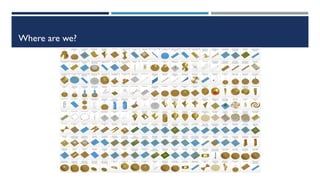
Where are we?
My Work Introduction Applications
 Design of Antennas up to 6 GHz
 Mobile communications (GSM, GPRS, UMTS, LTE, 5G,…)
 Satellite communication (GPS, GLONASS, Galileo….)
 Short range communication (NFC, RFID, Bluetooth, ZigBee, WLAN, EnOcean,Car2Car,….)
 Long range communication (LoRa, WiMOD, … and IoT antennas)
 Others (SDR based FM antennas, Circulators, Phase Shifters etc…)
 Design of Antennas above 6 GHz
 UWB
 X band Antennas
 Ka and KU band Antennas
 5G Antennas
 Telecommunication
 RF communication
 Automation
 Automotive
 Medical devices
 Space engineering
 Wearables, Sensors
 IoT
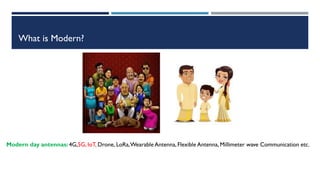
What is Modern?
Modern day antennas: 4G,5G, IoT, Drone, LoRa,Wearable Antenna, Flexible Antenna, Millimeter wave Communication etc.
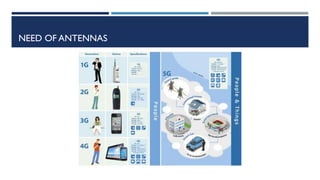
NEED OF ANTENNAS
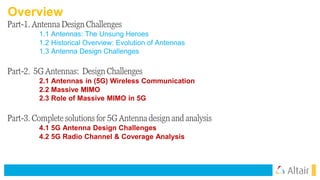
Part-1. Antenna Design Challenges
1.1 Antennas: The Unsung Heroes
1.2 Historical Overview: Evolution of Antennas
1.3 Antenna Design Challenges
Part-2. 5G Antennas: Design Challenges
2.1 Antennas in (5G) Wireless Communication
2.2 Massive MIMO
2.3 Role of Massive MIMO in 5G
Part-3. Complete solutionsfor 5G Antenna design and analysis
4.1 5G Antenna Design Challenges
4.2 5G Radio Channel & Coverage Analysis
Overview
Antennas: The Unsung
Heroes
Essential Blueprint
Part-1. Antenna Design Challenges
Antennas: The Unsung Heroes ofModernTechnology
•Antennas are essential components of modern technology, yet they are often overlooked.
•From their humble beginnings as simple metal rods to their current sophisticated designs, antennas
have come a long way.
•They are crucial in connecting people and devices across vast distances and are found in many
applications.
•Next time you use your cell phone or watch satellite TV, take a moment to appreciate the unsung
heroes of modern technology – antennas.
Antennas: The Unsung Heroes of ModernTechnology
1.Signal Transmission and Reception:
2.Enabling Wireless Communication:
3.Enhancing Range and Coverage
4.Overcoming Signal Interference
5.Supporting Multiple Frequencies and Standards:
6.Enabling Emerging Technologies:
7.Innovative Antenna Designs:
8.Miniaturization for Wearables and IoT:
9.Applications Beyond Communication:
In summary, antennas are indeed the "unsung heroes" of our connected world. They facilitate communication, support emerging technologies, and enable a wide range of
applications that have become integral to our daily lives. Without antennas, the wireless revolution that has shaped our modern society would not be possible.
Historical Overview:
Evolution of Antennas
Essential Blueprint
Part-1. Antenna Design Challenges
Historical Overview: Evolution of Antennas
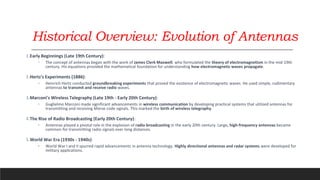
1.Early Beginnings (Late 19th Century):
◦ The concept of antennas began with the work of James Clerk Maxwell, who formulated the theory of electromagnetism in the mid-19th
century. His equations provided the mathematical foundation for understanding how electromagnetic waves propagate.
2.Hertz's Experiments (1886):
◦ Heinrich Hertz conducted groundbreaking experiments that proved the existence of electromagnetic waves. He used simple, rudimentary
antennas to transmit and receive radio waves.
3.Marconi's Wireless Telegraphy (Late 19th - Early 20th Century):
◦ Guglielmo Marconi made significant advancements in wireless communication by developing practical systems that utilized antennas for
transmitting and receiving Morse code signals. This marked the birth of wireless telegraphy.
4.The Rise of Radio Broadcasting (Early 20th Century):
◦ Antennas played a pivotal role in the explosion of radio broadcasting in the early 20th century. Large, high-frequency antennas became
common for transmitting radio signals over long distances.
5.World War Era (1930s - 1940s):
◦ World War I and II spurred rapid advancements in antenna technology. Highly directional antennas and radar systems were developed for
military applications.
Historical Overview: Evolution of Antennas
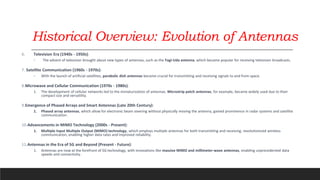
6. Television Era (1940s - 1950s):
◦ The advent of television brought about new types of antennas, such as the Yagi-Uda antenna, which became popular for receiving television broadcasts.
7. Satellite Communication (1960s - 1970s):
◦ With the launch of artificial satellites, parabolic dish antennas became crucial for transmitting and receiving signals to and from space.
8.Microwave and Cellular Communication (1970s - 1980s):
1. The development of cellular networks led to the miniaturization of antennas. Microstrip patch antennas, for example, became widely used due to their
compact size and versatility.
9.Emergence of Phased Arrays and Smart Antennas (Late 20th Century):
1. Phased array antennas, which allow for electronic beam steering without physically moving the antenna, gained prominence in radar systems and satellite
communication.
10.Advancements in MIMO Technology (2000s - Present):
1. Multiple Input Multiple Output (MIMO) technology, which employs multiple antennas for both transmitting and receiving, revolutionized wireless
communication, enabling higher data rates and improved reliability.
11.Antennas in the Era of 5G and Beyond (Present - Future):
1. Antennas are now at the forefront of 5G technology, with innovations like massive MIMO and millimeter-wave antennas, enabling unprecedented data
speeds and connectivity.
Antenna Design
Challenges
Essential Blueprint
Part-1. Antenna Design Challenges
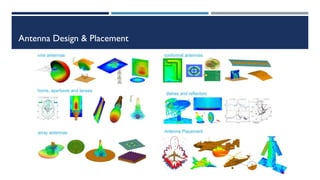
Antenna Design & Placement
Special Applications
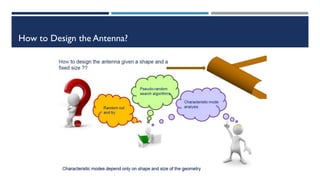
How to Design the Antenna?
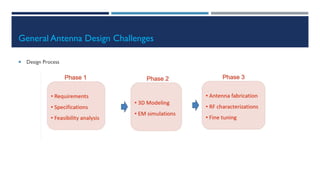
General Antenna Design Challenges
 Design Process
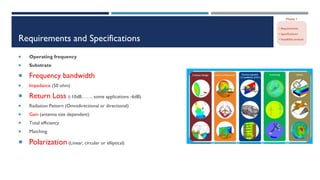
Requirements and Specifications
 Operating frequency
 Substrate
 Frequency bandwidth
 Impedance (50 ohm)
 Return Loss (-10dB……. some applications -6dB)
 Radiation Pattern (Omnidirectional or directional)
 Gain (antenna size dependent)
 Total efficiency
 Matching
 Polarization (Linear, circular or elliptical)
Requirements and Specifications
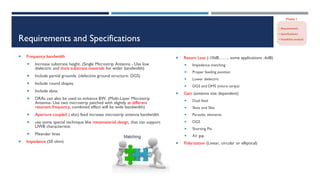
 Frequency bandwidth
 Increase substrate height. (Single Microstrip Antenna - Use low
dielectric and thick substrate materials for wider bandwidth)
 Include partial grounds. (defective ground structure: DGS)
 Include round shapes.
 Include slots.
 DRAs can also be used to enhance BW. (Multi-Layer Microstrip
Antenna- Use two microstrip patched with slightly at different
resonant frequency, combined effect will be wide bandwidth)
 Aperture coupled ( slot) feed increase microstrip antenna bandwidth
 use some special technique like metamaterial design, that can support
UWB characteristic
 Meander lines
 Impedance (50 ohm)
 Return Loss (-10dB……. some applications -6dB)
 Impedance matching
 Proper feeding position
 Lower dielectric
 DGS and DMS (micro strips)
 Gain (antenna size dependent)
 Dual feed
 Slots and Slits
 Parasitic elements
 DGS
 Shorting Pin
 Air gap
 Polarization (Linear, circular or elliptical)
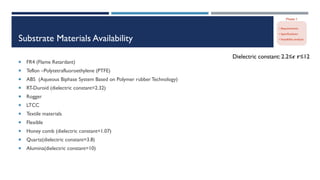
Substrate Materials Availability
 FR4 (Flame Retardant)
 Teflon –Polytetrafluoroethylene (PTFE)
 ABS (Aqueous Biphase System Based on Polymer rubber Technology)
 RT-Duroid (dielectric constant=2.32)
 Rogger
 LTCC
 Textile materials
 Flexible
 Honey comb (dielectric constant=1.07)
 Quartz(dielectric constant=3.8)
 Alumina(dielectric constant=10)
Dielectric constant: 2.2≤𝝐 𝒓≤12
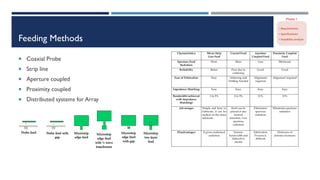
Feeding Methods
 Coaxial Probe
 Strip line
 Aperture coupled
 Proximity coupled
 Distributed systems for Array
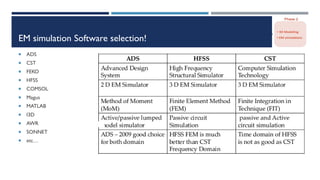
EM simulation Software selection!
 ADS
 CST
 FEKO
 HFSS
 COMSOL
 Magus
 MATLAB
 I3D
 AWR
 SONNET
 etc…
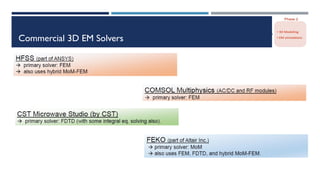
Commercial 3D EM Solvers
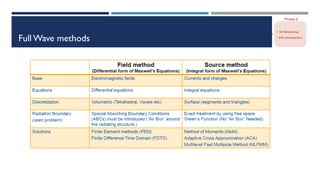
Full Wave methods
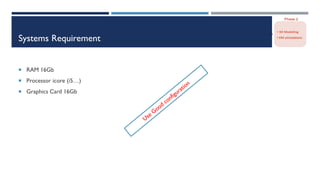
Systems Requirement
 RAM 16Gb
 Processor icore (i5…)
 Graphics Card 16Gb
Antennas in (5G) Wireless
Communication
Essential Blueprint
Part-2. 5G Antennas: Design Challenges
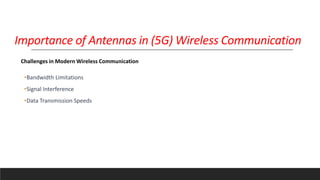
•Bandwidth Limitations
•Signal Interference
•Data Transmission Speeds
Challenges in Modern Wireless Communication
Importance of Antennas in (5G) Wireless Communication
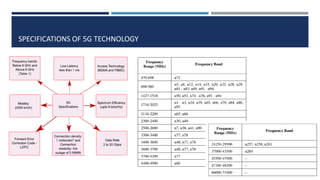
SPECIFICATIONS OF 5G TECHNOLOGY
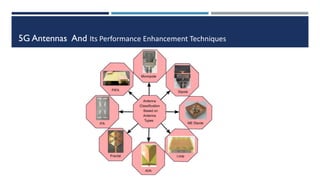
5G Antennas And Its Performance Enhancement Techniques
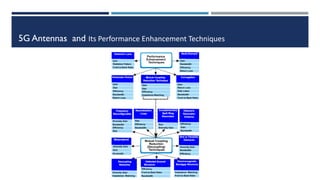
5G Antennas and Its Performance Enhancement Techniques
Getting Started: Ansoft HFSS 22
Part-3. Demo on HFSS
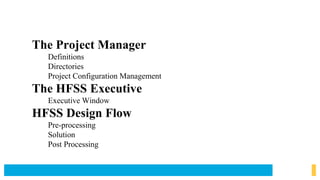
Synopsis
The Project Manager
Definitions
Directories
Project Configuration Management
The HFSS Executive Level
Executive Window
HFSS Design Flow Stages
Pre-processing
Solution
Post Processing
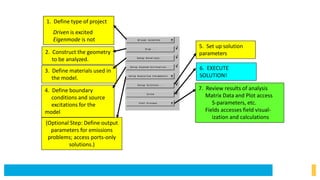
HFSS Design Checklist
1. Define type of project
Driven is excited
Eigenmode is not
2. Construct the geometry
to be analyzed.
3. Define materials used in
the model.
4. Define boundary
conditions and source
excitations for the
model
(Optional Step: Define output
parameters for emissions
problems; access ports-only
solutions.)
5. Set up solution
parameters
6. EXECUTE
SOLUTION!
7. Review results of analysis
Matrix Data and Plot access
S-parameters, etc.
Fields accesses field visual-
ization and calculations
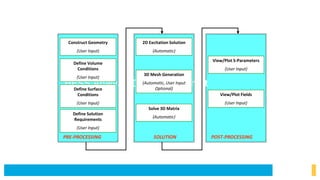
HFSS Analysis Design Flowchart
Construct Geometry
(User Input)
Define Volume
Conditions
(User Input)
Define Surface
Conditions
(User Input)
2D Excitation Solution
(Automatic)
3D Mesh Generation
(Automatic, User Input
Optional)
Solve 3D Matrix
(Automatic)
View/Plot S-Parameters
(User Input)
View/Plot Fields
(User Input)
PRE-PROCESSING SOLUTION POST-PROCESSING
Define Solution
Requirements
(User Input)
Q & A
Keep Learning & Happy Learning
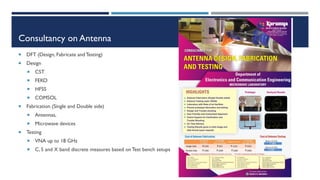
Consultancy on Antenna
 DFT (Design, Fabricate and Testing)
 Design
 CST
 FEKO
 HFSS
 COMSOL
 Fabrication (Single and Double side)
 Antennas,
 Microwave devices
 Testing
 VNA up to 18 GHz
 C, S and X band discrete measures based on Test bench setups
ThankYou
Phone Number: +91 96294 51775
Email ID:
sugumar@karunya.edu, (o)
sugumar.ssd@gmail.com, (p)
sugumar@ieee.org (o for IEEE related )

Mastering antenna design_The essential blueprint for all Application.pdf

  • 1.
    Mastering Antenna Design: Theessential blueprint for all Application Dr. D. Sugumar Associate Professor/ECE Karunya
  • 2.
  • 3.
    My Work IntroductionApplications  Design of Antennas up to 6 GHz  Mobile communications (GSM, GPRS, UMTS, LTE, 5G,…)  Satellite communication (GPS, GLONASS, Galileo….)  Short range communication (NFC, RFID, Bluetooth, ZigBee, WLAN, EnOcean,Car2Car,….)  Long range communication (LoRa, WiMOD, … and IoT antennas)  Others (SDR based FM antennas, Circulators, Phase Shifters etc…)  Design of Antennas above 6 GHz  UWB  X band Antennas  Ka and KU band Antennas  5G Antennas  Telecommunication  RF communication  Automation  Automotive  Medical devices  Space engineering  Wearables, Sensors  IoT
  • 4.
    What is Modern? Modernday antennas: 4G,5G, IoT, Drone, LoRa,Wearable Antenna, Flexible Antenna, Millimeter wave Communication etc.
  • 5.
  • 6.
    Part-1. Antenna DesignChallenges 1.1 Antennas: The Unsung Heroes 1.2 Historical Overview: Evolution of Antennas 1.3 Antenna Design Challenges Part-2. 5G Antennas: Design Challenges 2.1 Antennas in (5G) Wireless Communication 2.2 Massive MIMO 2.3 Role of Massive MIMO in 5G Part-3. Complete solutionsfor 5G Antenna design and analysis 4.1 5G Antenna Design Challenges 4.2 5G Radio Channel & Coverage Analysis Overview
  • 7.
    Antennas: The Unsung Heroes EssentialBlueprint Part-1. Antenna Design Challenges
  • 8.
    Antennas: The UnsungHeroes ofModernTechnology •Antennas are essential components of modern technology, yet they are often overlooked. •From their humble beginnings as simple metal rods to their current sophisticated designs, antennas have come a long way. •They are crucial in connecting people and devices across vast distances and are found in many applications. •Next time you use your cell phone or watch satellite TV, take a moment to appreciate the unsung heroes of modern technology – antennas.
  • 9.
    Antennas: The UnsungHeroes of ModernTechnology 1.Signal Transmission and Reception: 2.Enabling Wireless Communication: 3.Enhancing Range and Coverage 4.Overcoming Signal Interference 5.Supporting Multiple Frequencies and Standards: 6.Enabling Emerging Technologies: 7.Innovative Antenna Designs: 8.Miniaturization for Wearables and IoT: 9.Applications Beyond Communication: In summary, antennas are indeed the "unsung heroes" of our connected world. They facilitate communication, support emerging technologies, and enable a wide range of applications that have become integral to our daily lives. Without antennas, the wireless revolution that has shaped our modern society would not be possible.
  • 10.
    Historical Overview: Evolution ofAntennas Essential Blueprint Part-1. Antenna Design Challenges
  • 11.
    Historical Overview: Evolutionof Antennas 1.Early Beginnings (Late 19th Century): ◦ The concept of antennas began with the work of James Clerk Maxwell, who formulated the theory of electromagnetism in the mid-19th century. His equations provided the mathematical foundation for understanding how electromagnetic waves propagate. 2.Hertz's Experiments (1886): ◦ Heinrich Hertz conducted groundbreaking experiments that proved the existence of electromagnetic waves. He used simple, rudimentary antennas to transmit and receive radio waves. 3.Marconi's Wireless Telegraphy (Late 19th - Early 20th Century): ◦ Guglielmo Marconi made significant advancements in wireless communication by developing practical systems that utilized antennas for transmitting and receiving Morse code signals. This marked the birth of wireless telegraphy. 4.The Rise of Radio Broadcasting (Early 20th Century): ◦ Antennas played a pivotal role in the explosion of radio broadcasting in the early 20th century. Large, high-frequency antennas became common for transmitting radio signals over long distances. 5.World War Era (1930s - 1940s): ◦ World War I and II spurred rapid advancements in antenna technology. Highly directional antennas and radar systems were developed for military applications.
  • 12.
    Historical Overview: Evolutionof Antennas 6. Television Era (1940s - 1950s): ◦ The advent of television brought about new types of antennas, such as the Yagi-Uda antenna, which became popular for receiving television broadcasts. 7. Satellite Communication (1960s - 1970s): ◦ With the launch of artificial satellites, parabolic dish antennas became crucial for transmitting and receiving signals to and from space. 8.Microwave and Cellular Communication (1970s - 1980s): 1. The development of cellular networks led to the miniaturization of antennas. Microstrip patch antennas, for example, became widely used due to their compact size and versatility. 9.Emergence of Phased Arrays and Smart Antennas (Late 20th Century): 1. Phased array antennas, which allow for electronic beam steering without physically moving the antenna, gained prominence in radar systems and satellite communication. 10.Advancements in MIMO Technology (2000s - Present): 1. Multiple Input Multiple Output (MIMO) technology, which employs multiple antennas for both transmitting and receiving, revolutionized wireless communication, enabling higher data rates and improved reliability. 11.Antennas in the Era of 5G and Beyond (Present - Future): 1. Antennas are now at the forefront of 5G technology, with innovations like massive MIMO and millimeter-wave antennas, enabling unprecedented data speeds and connectivity.
  • 13.
  • 14.
  • 15.
  • 16.
    How to Designthe Antenna?
  • 17.
    General Antenna DesignChallenges  Design Process
  • 18.
    Requirements and Specifications Operating frequency  Substrate  Frequency bandwidth  Impedance (50 ohm)  Return Loss (-10dB……. some applications -6dB)  Radiation Pattern (Omnidirectional or directional)  Gain (antenna size dependent)  Total efficiency  Matching  Polarization (Linear, circular or elliptical)
  • 19.
    Requirements and Specifications Frequency bandwidth  Increase substrate height. (Single Microstrip Antenna - Use low dielectric and thick substrate materials for wider bandwidth)  Include partial grounds. (defective ground structure: DGS)  Include round shapes.  Include slots.  DRAs can also be used to enhance BW. (Multi-Layer Microstrip Antenna- Use two microstrip patched with slightly at different resonant frequency, combined effect will be wide bandwidth)  Aperture coupled ( slot) feed increase microstrip antenna bandwidth  use some special technique like metamaterial design, that can support UWB characteristic  Meander lines  Impedance (50 ohm)  Return Loss (-10dB……. some applications -6dB)  Impedance matching  Proper feeding position  Lower dielectric  DGS and DMS (micro strips)  Gain (antenna size dependent)  Dual feed  Slots and Slits  Parasitic elements  DGS  Shorting Pin  Air gap  Polarization (Linear, circular or elliptical)
  • 20.
    Substrate Materials Availability FR4 (Flame Retardant)  Teflon –Polytetrafluoroethylene (PTFE)  ABS (Aqueous Biphase System Based on Polymer rubber Technology)  RT-Duroid (dielectric constant=2.32)  Rogger  LTCC  Textile materials  Flexible  Honey comb (dielectric constant=1.07)  Quartz(dielectric constant=3.8)  Alumina(dielectric constant=10) Dielectric constant: 2.2≤𝝐 𝒓≤12
  • 21.
    Feeding Methods  CoaxialProbe  Strip line  Aperture coupled  Proximity coupled  Distributed systems for Array
  • 22.
    EM simulation Softwareselection!  ADS  CST  FEKO  HFSS  COMSOL  Magus  MATLAB  I3D  AWR  SONNET  etc…
  • 23.
  • 24.
  • 25.
    Systems Requirement  RAM16Gb  Processor icore (i5…)  Graphics Card 16Gb
  • 26.
    Antennas in (5G)Wireless Communication Essential Blueprint Part-2. 5G Antennas: Design Challenges
  • 27.
    •Bandwidth Limitations •Signal Interference •DataTransmission Speeds Challenges in Modern Wireless Communication Importance of Antennas in (5G) Wireless Communication
  • 28.
  • 29.
    5G Antennas AndIts Performance Enhancement Techniques
  • 30.
    5G Antennas andIts Performance Enhancement Techniques
  • 31.
    Getting Started: AnsoftHFSS 22 Part-3. Demo on HFSS
  • 32.
    Synopsis The Project Manager Definitions Directories ProjectConfiguration Management The HFSS Executive Level Executive Window HFSS Design Flow Stages Pre-processing Solution Post Processing
  • 33.
    HFSS Design Checklist 1.Define type of project Driven is excited Eigenmode is not 2. Construct the geometry to be analyzed. 3. Define materials used in the model. 4. Define boundary conditions and source excitations for the model (Optional Step: Define output parameters for emissions problems; access ports-only solutions.) 5. Set up solution parameters 6. EXECUTE SOLUTION! 7. Review results of analysis Matrix Data and Plot access S-parameters, etc. Fields accesses field visual- ization and calculations
  • 34.
    HFSS Analysis DesignFlowchart Construct Geometry (User Input) Define Volume Conditions (User Input) Define Surface Conditions (User Input) 2D Excitation Solution (Automatic) 3D Mesh Generation (Automatic, User Input Optional) Solve 3D Matrix (Automatic) View/Plot S-Parameters (User Input) View/Plot Fields (User Input) PRE-PROCESSING SOLUTION POST-PROCESSING Define Solution Requirements (User Input)
  • 35.
    Q & A KeepLearning & Happy Learning
  • 36.
    Consultancy on Antenna DFT (Design, Fabricate and Testing)  Design  CST  FEKO  HFSS  COMSOL  Fabrication (Single and Double side)  Antennas,  Microwave devices  Testing  VNA up to 18 GHz  C, S and X band discrete measures based on Test bench setups
  • 37.
    ThankYou Phone Number: +9196294 51775 Email ID: sugumar@karunya.edu, (o) sugumar.ssd@gmail.com, (p) sugumar@ieee.org (o for IEEE related )