






There are companies that make fortunes, but also those that vanish from existence, despite excellent products! Master thesis project overview - Remco de Kramer
"There is a tide in the affairs of men Which taken at the flood, leads on to fortune; Omitted, all the voyage of their life Is bound in shallows and in miseries.” William Shakespeare, Julius Caesar, Act IV, Scene 3: Within the tent of Brutus
Some companies succeed by getting their innovation adopted on a large scale and “Cross the Chasm”. However most do not! So what happens in the Chasm?
But first: what is the origin of this phenomena?
Discontinuous / disruptive product innovation in the high-technology sector (where innovation requires the adopter to change behavior) And in which context is this phenomenon most applicable?
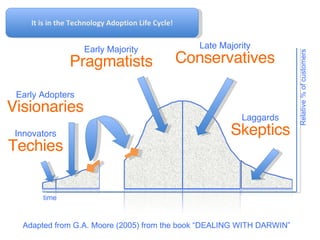
Adapted from G.A. Moore (2005) from the book “DEALING WITH DARWIN” Innovators Techies Early Majority Pragmatists Late Majority Conservatives Laggards Skeptics Early Adopters Visionaries It is in the Technology Adoption Life Cycle! time R elative % of customers
Look to adopt innovation to achieve revolutionary improvement Attracted by high-risk / high-reward projects Envision great gains from adopting innovation
Look for evolutionary changes to gain productivity enhancements Averse to disruptive change; want proven applications, reliable service Want to reduce risk in the adoption of the innovation
In order to be successful,  we need to move from the early market to the mainstream
Because that’s where the vast majority of customers are!
To cross the “Chasm”, a lot of internal …… needs to happen Which is influenced by the environment in which the company operates
How are we going to measure this change?
The internal factors are described through business model changes
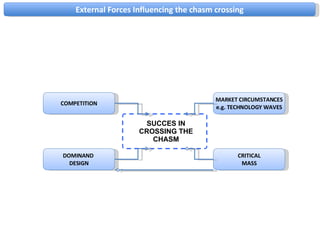
The external factors are the forces that  influence a chasm crossing which are outside or within limited company control
But first, let’s explore theoretical concepts to increase our understanding of the “chasm” phenomena  Notice the infliction points!
Technology Adoption Life Cycle (TALC)  Main authors: Moore (1991) Rogers (1962) Theory: The TALC is a means for classifying the market and its reaction to a high-tech product. Moore re-defined Rogers’ (1962) innovation diffusion theory, by introducing gaps between user adoption categories the major gap being "the Chasm".  The theory analyses the TALC from a marketing perspective.
Title: Sales Take-off Main Authors: Shermesh & Tellis (2002) Agarwal (2002) Theory: New products do not grow into maturity at a steady rate. The sales pattern is marked by a long introduction period when sales linger at low levels, followed by a period of rapid growth.  The theory analyses the TALC from various external perspectives; influence of competition, price, innovative opportunity.
Title: Disruptive Innovation Main author: Christensen (1997) Theory: A disruptive innovation is an innovation that eventually overturns the existing dominant technology paradigm in the market. Success depends on the ability to “reach” the mainstream market and become the dominant design.  The theory provides insight into how and where the technology in the TALC develops before it reaches the mainstream market.
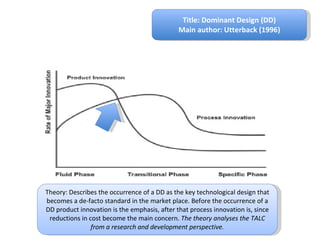
Title: Dominant Design (DD) Main author: Utterback (1996) Theory: Describes the occurrence of a DD as the key technological design that becomes a de-facto standard in the market place. Before the occurrence of a DD product innovation is the emphasis, after that process innovation is, since reductions in cost become the main concern.  The theory analyses the TALC from a research and development perspective.
Title: Technology- to Customer Centered Approach Main Author: Norman (1998) Theory: Integration of Moore's and Christensen's theories. Defines "the chasm" as a transition point where a technology satisfies basic needs and becomes a consumer commodity instead of high-technology.  The theory analyses the TALC from a human-centred product development approach by focusing on the needs of the consumer.
Title: Disruptive Technology S-Curve Main Author: Christensen (1997) Theory: A disruptive technology gets its commercial start in emerging value networks before invading established networks. The technology can invade if it professes to a point where it can satisfy the level of performance demanded in an other value network.  The theory analyses the TALC from a technical performance perspective related to conventional technologies.
Now we understand more… … But what changes?
Distilled from the work of G.A. Moore who describes changes in “the chasm” and the strategy to cross it…
Before generating a conceptual model it is critical to determine the location on the TALC for which the model had explanatory power… Based on: Sales levels / sales saddle (Moore, 2002, Goldengerg, et. al. ,2002, Modis 1998) Cumulative adoption (Meade and Rabello, 2003) Customer profile (Moore, 2002) Expert insights (Wieffels, 2002, p 98+) p re- post -
To structure the mapping process internal factors have been categorized through the perspective of the business model framework
VALUE PROPOSITION COST STRUCTURE CUSTOMER RELATIONSHIPS CUSTOMER SEGMENTS ACTIVITY CONFIGURATION CORE CAPABILITIES PARTNER NETWORK REVENUE STREAMS INFRASTRUCTURE CUSTOMER OFFER Business Model components -  Adapted from A. Osterwalder,  Business Model Ontology, proposition in design science approach (2008) A business model describes the value an organization offers to various customers and portrays capabilities & partners required for creating, marketing, and delivering this value and relationship capital with the goal of generating profitable and sustainable revenue streams COMM & DISTRI- BUTION CHANNELS The key resources we need to make our business model function The partners and suppliers we work with The most important activities that have to be performed to run our business model The costs we incur to run our business model A bundle of products and services that satisfies a specific  customer segment’s needs The types of relationships you entertain with each  customer segment The channels through which we communicate with our customers and through which we offer our value propositions Our groups of customers with distinct characteristics The streams through which we earn our revenues from our customers for value creating and customer facing activities FINANCIAL PERFORMANCE
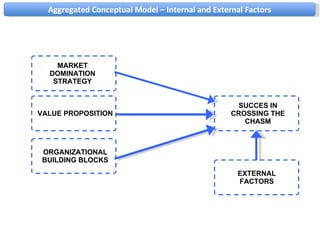
Aggregated Conceptual Model – Internal and External Factors VALUE PROPOSITION MARKET DOMINATION STRATEGY ORGANIZATIONAL BUILDING BLOCKS SUCCES IN CROSSING THE CHASM EXTERNAL FACTORS
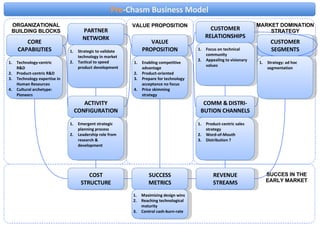
VALUE PROPOSITION COST STRUCTURE CUSTOMER RELATIONSHIPS CUSTOMER SEGMENTS ACTIVITY CONFIGURATION CORE CAPABILITIES PARTNER NETWORK REVENUE STREAMS ORGANIZATIONAL BUILDING BLOCKS MARKET DOMINATION STRATEGY VALUE PROPOSITION Pre -Chasm Business Model COMM & DISTRI- BUTION CHANNELS Technology-centric R&D Product-centric R&D Technology expertise in Human Resources Cultural archetype: Pioneers Strategic to validate technology in market  Tactical to speed product development Emergent strategic planning process Leadership role from research & development Enabling competitive advantage Product-oriented Prepare for technology acceptance no focus Price skimming strategy Focus on technical community Appealing to visionary values Product-centric sales strategy Word-of-Mouth Distribution ? Strategy: ad hoc segmentation SUCCESS METRICS Maximizing design wins Reaching technological maturity Control cash-burn-rate SUCCES IN THE EARLY MARKET
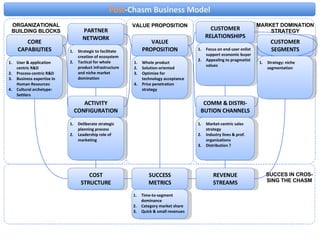
VALUE PROPOSITION COST STRUCTURE CUSTOMER RELATIONSHIPS CUSTOMER SEGMENTS ACTIVITY CONFIGURATION CORE CAPABILITIES PARTNER NETWORK REVENUE STREAMS ORGANIZATIONAL BUILDING BLOCKS MARKET DOMINATION STRATEGY VALUE PROPOSITION Post -Chasm Business Model COMM & DISTRI- BUTION CHANNELS User & application centric R&D Process-centric R&D Business expertise in Human Resources Cultural archetype: Settlers Strategic to facilitate creation of ecosystem Tactical for whole product infrastructure and niche market domination Deliberate strategic planning process Leadership role of marketing Whole product Solution-oriented Optimize for technology acceptance Price penetration strategy Focus on end-user enlist support economic buyer Appealing to pragmatist values Market-centric sales strategy Industry lines & prof. organizations Distribution ? Strategy: niche segmentation SUCCESS METRICS Time-to-segment dominance Category market share Quick & small revenues SUCCES IN CROS- SING THE CHASM
External Forces Influencing the chasm crossing SUCCES IN CROSSING THE CHASM COMPETITION DOMINAND  DESIGN CRITICAL MASS MARKET CIRCUMSTANCES e.g. TECHNOLOGY WAVES
Theoretical validation of the model by relating scholarly articles & management books to the factors
Empirical validation of the model by multiple case study research
Adjust the model if necessary to generate the definitive version NOTE: Generation and validation of the model is a cyclical iterative process!
Operationalize changes in the business model & forces: Through scoring change progression by: expert evaluation of the company and the industry t hrough: answering question sets resulting in: Business model building block ratings on 5 point likert-scales
Application for practitioners:  Analysis tool
Application for academics:  Contribute to validation of the Chasm theory
.ing Remco de Kramer Graduate Student Innovation Management RSM Erasmus University +31611276263 [email_address] www.linkedin.com/in/remcodekramer

Master Thesis Overview Remco de Kramer

  • 1.
    There are companiesthat make fortunes, but also those that vanish from existence, despite excellent products! Master thesis project overview - Remco de Kramer
  • 2.
    "There is atide in the affairs of men Which taken at the flood, leads on to fortune; Omitted, all the voyage of their life Is bound in shallows and in miseries.” William Shakespeare, Julius Caesar, Act IV, Scene 3: Within the tent of Brutus
  • 3.
    Some companies succeedby getting their innovation adopted on a large scale and “Cross the Chasm”. However most do not! So what happens in the Chasm?
  • 4.
    But first: whatis the origin of this phenomena?
  • 5.
    Discontinuous / disruptiveproduct innovation in the high-technology sector (where innovation requires the adopter to change behavior) And in which context is this phenomenon most applicable?
  • 6.
    Adapted from G.A.Moore (2005) from the book “DEALING WITH DARWIN” Innovators Techies Early Majority Pragmatists Late Majority Conservatives Laggards Skeptics Early Adopters Visionaries It is in the Technology Adoption Life Cycle! time R elative % of customers
  • 7.
    Look to adoptinnovation to achieve revolutionary improvement Attracted by high-risk / high-reward projects Envision great gains from adopting innovation
  • 8.
    Look for evolutionarychanges to gain productivity enhancements Averse to disruptive change; want proven applications, reliable service Want to reduce risk in the adoption of the innovation
  • 9.
    In order tobe successful, we need to move from the early market to the mainstream
  • 10.
    Because that’s wherethe vast majority of customers are!
  • 11.
    To cross the“Chasm”, a lot of internal …… needs to happen Which is influenced by the environment in which the company operates
  • 12.
    How are wegoing to measure this change?
  • 13.
    The internal factorsare described through business model changes
  • 14.
    The external factorsare the forces that influence a chasm crossing which are outside or within limited company control
  • 15.
    But first, let’sexplore theoretical concepts to increase our understanding of the “chasm” phenomena Notice the infliction points!
  • 16.
    Technology Adoption LifeCycle (TALC) Main authors: Moore (1991) Rogers (1962) Theory: The TALC is a means for classifying the market and its reaction to a high-tech product. Moore re-defined Rogers’ (1962) innovation diffusion theory, by introducing gaps between user adoption categories the major gap being "the Chasm". The theory analyses the TALC from a marketing perspective.
  • 17.
    Title: Sales Take-offMain Authors: Shermesh & Tellis (2002) Agarwal (2002) Theory: New products do not grow into maturity at a steady rate. The sales pattern is marked by a long introduction period when sales linger at low levels, followed by a period of rapid growth. The theory analyses the TALC from various external perspectives; influence of competition, price, innovative opportunity.
  • 18.
    Title: Disruptive InnovationMain author: Christensen (1997) Theory: A disruptive innovation is an innovation that eventually overturns the existing dominant technology paradigm in the market. Success depends on the ability to “reach” the mainstream market and become the dominant design. The theory provides insight into how and where the technology in the TALC develops before it reaches the mainstream market.
  • 19.
    Title: Dominant Design(DD) Main author: Utterback (1996) Theory: Describes the occurrence of a DD as the key technological design that becomes a de-facto standard in the market place. Before the occurrence of a DD product innovation is the emphasis, after that process innovation is, since reductions in cost become the main concern. The theory analyses the TALC from a research and development perspective.
  • 20.
    Title: Technology- toCustomer Centered Approach Main Author: Norman (1998) Theory: Integration of Moore's and Christensen's theories. Defines "the chasm" as a transition point where a technology satisfies basic needs and becomes a consumer commodity instead of high-technology. The theory analyses the TALC from a human-centred product development approach by focusing on the needs of the consumer.
  • 21.
    Title: Disruptive TechnologyS-Curve Main Author: Christensen (1997) Theory: A disruptive technology gets its commercial start in emerging value networks before invading established networks. The technology can invade if it professes to a point where it can satisfy the level of performance demanded in an other value network. The theory analyses the TALC from a technical performance perspective related to conventional technologies.
  • 22.
    Now we understandmore… … But what changes?
  • 23.
    Distilled from thework of G.A. Moore who describes changes in “the chasm” and the strategy to cross it…
  • 24.
    Before generating aconceptual model it is critical to determine the location on the TALC for which the model had explanatory power… Based on: Sales levels / sales saddle (Moore, 2002, Goldengerg, et. al. ,2002, Modis 1998) Cumulative adoption (Meade and Rabello, 2003) Customer profile (Moore, 2002) Expert insights (Wieffels, 2002, p 98+) p re- post -
  • 25.
    To structure themapping process internal factors have been categorized through the perspective of the business model framework
  • 26.
    VALUE PROPOSITION COSTSTRUCTURE CUSTOMER RELATIONSHIPS CUSTOMER SEGMENTS ACTIVITY CONFIGURATION CORE CAPABILITIES PARTNER NETWORK REVENUE STREAMS INFRASTRUCTURE CUSTOMER OFFER Business Model components - Adapted from A. Osterwalder, Business Model Ontology, proposition in design science approach (2008) A business model describes the value an organization offers to various customers and portrays capabilities & partners required for creating, marketing, and delivering this value and relationship capital with the goal of generating profitable and sustainable revenue streams COMM & DISTRI- BUTION CHANNELS The key resources we need to make our business model function The partners and suppliers we work with The most important activities that have to be performed to run our business model The costs we incur to run our business model A bundle of products and services that satisfies a specific customer segment’s needs The types of relationships you entertain with each customer segment The channels through which we communicate with our customers and through which we offer our value propositions Our groups of customers with distinct characteristics The streams through which we earn our revenues from our customers for value creating and customer facing activities FINANCIAL PERFORMANCE
  • 27.
    Aggregated Conceptual Model– Internal and External Factors VALUE PROPOSITION MARKET DOMINATION STRATEGY ORGANIZATIONAL BUILDING BLOCKS SUCCES IN CROSSING THE CHASM EXTERNAL FACTORS
  • 28.
    VALUE PROPOSITION COSTSTRUCTURE CUSTOMER RELATIONSHIPS CUSTOMER SEGMENTS ACTIVITY CONFIGURATION CORE CAPABILITIES PARTNER NETWORK REVENUE STREAMS ORGANIZATIONAL BUILDING BLOCKS MARKET DOMINATION STRATEGY VALUE PROPOSITION Pre -Chasm Business Model COMM & DISTRI- BUTION CHANNELS Technology-centric R&D Product-centric R&D Technology expertise in Human Resources Cultural archetype: Pioneers Strategic to validate technology in market Tactical to speed product development Emergent strategic planning process Leadership role from research & development Enabling competitive advantage Product-oriented Prepare for technology acceptance no focus Price skimming strategy Focus on technical community Appealing to visionary values Product-centric sales strategy Word-of-Mouth Distribution ? Strategy: ad hoc segmentation SUCCESS METRICS Maximizing design wins Reaching technological maturity Control cash-burn-rate SUCCES IN THE EARLY MARKET
  • 29.
    VALUE PROPOSITION COSTSTRUCTURE CUSTOMER RELATIONSHIPS CUSTOMER SEGMENTS ACTIVITY CONFIGURATION CORE CAPABILITIES PARTNER NETWORK REVENUE STREAMS ORGANIZATIONAL BUILDING BLOCKS MARKET DOMINATION STRATEGY VALUE PROPOSITION Post -Chasm Business Model COMM & DISTRI- BUTION CHANNELS User & application centric R&D Process-centric R&D Business expertise in Human Resources Cultural archetype: Settlers Strategic to facilitate creation of ecosystem Tactical for whole product infrastructure and niche market domination Deliberate strategic planning process Leadership role of marketing Whole product Solution-oriented Optimize for technology acceptance Price penetration strategy Focus on end-user enlist support economic buyer Appealing to pragmatist values Market-centric sales strategy Industry lines & prof. organizations Distribution ? Strategy: niche segmentation SUCCESS METRICS Time-to-segment dominance Category market share Quick & small revenues SUCCES IN CROS- SING THE CHASM
  • 30.
    External Forces Influencingthe chasm crossing SUCCES IN CROSSING THE CHASM COMPETITION DOMINAND DESIGN CRITICAL MASS MARKET CIRCUMSTANCES e.g. TECHNOLOGY WAVES
  • 31.
    Theoretical validation ofthe model by relating scholarly articles & management books to the factors
  • 32.
    Empirical validation ofthe model by multiple case study research
  • 33.
    Adjust the modelif necessary to generate the definitive version NOTE: Generation and validation of the model is a cyclical iterative process!
  • 34.
    Operationalize changes inthe business model & forces: Through scoring change progression by: expert evaluation of the company and the industry t hrough: answering question sets resulting in: Business model building block ratings on 5 point likert-scales
  • 35.
  • 36.
    Application for academics: Contribute to validation of the Chasm theory
  • 37.
    .ing Remco deKramer Graduate Student Innovation Management RSM Erasmus University +31611276263 [email_address] www.linkedin.com/in/remcodekramer