


Example 1 Webvan spent more than $1 billion to create an online grocery business, only to declare bankruptcy in July 2001 after failing to attract as many customers as it thought it would.
Example 2 •  In spite of gaining the support of Apple’s Steve Jobs, Amazon’s Jeff Bezos, and many highprofile investors, Segway sold a mere 6,000 scooters in the 18 months after its launch—a far cry from the 50,000 to 100,000 units projected.
Example 3 •  Although TiVo’s digital video recorder (DVR) has garnered rave reviews since the late 1990s from both industry experts and product adopters, the company had amassed $600 million in operating losses by 2005 because demand trailed expectations.
 
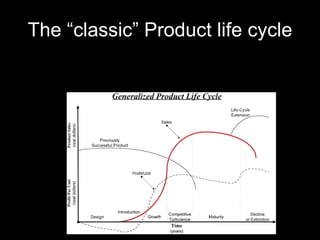
The “classic” Product life cycle
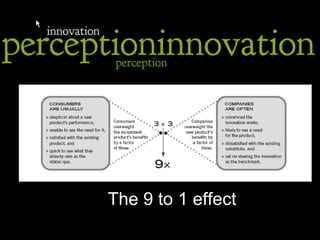
The 9 to 1 effect
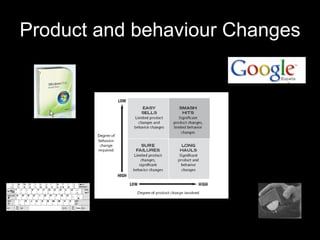
Product and behaviour Changes Ref: J.T.Gourville
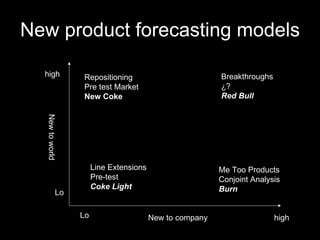
New product forecasting models Repositioning Pre test Market New Coke Me Too Products Conjoint Analysis Burn Breakthroughs ¿? Red Bull Line Extensions Pre-test Coke Light New to company New to world Lo high high Lo
 
Innovation & Diffusion models Why diffusion models are crucial on hi-tech / innovative /disruptive  Diffusion models Allow to quantify and predict the size and rate of adoption Can explain when  customers will adopt a New Product Can explain when sales will reach peak
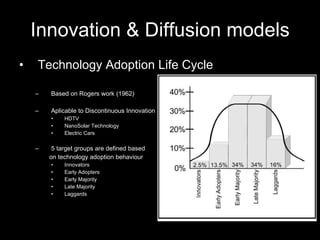
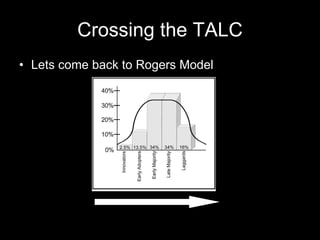
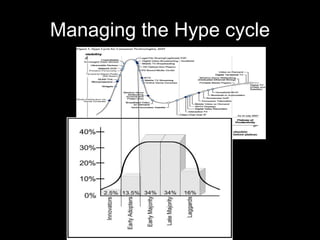
Innovation & Diffusion models Technology Adoption Life Cycle Based on Rogers work (1962) Aplicable to Discontinuous Innovation HDTV NanoSolar Technology Electric Cars 5 target groups are defined based on technology adoption behaviour Innovators Early Adopters Early Majority Late Majority Laggards
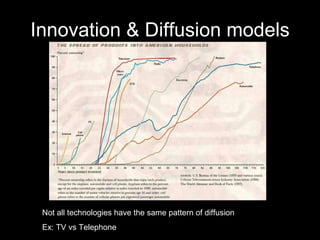
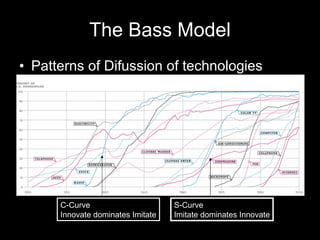
Innovation & Diffusion models Not all technologies have the same pattern of diffusion Ex: TV vs Telephone
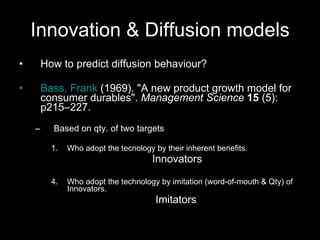
Innovation & Diffusion models How to predict diffusion behaviour? Bass, Frank  (1969). "A new product growth model for consumer durables".  Management Science   15  (5): p215–227.  Based on qty. of two targets Who adopt the tecnology by their inherent benefits. Innovators Who adopt the technology by imitation (word-of-mouth & Qty) of Innovators.  Imitators
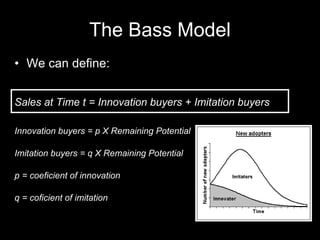
The Bass Model We can define: Sales at Time t = Innovation buyers + Imitation buyers Innovation buyers = p X Remaining Potential Imitation buyers = q X Remaining Potential p = coeficient of innovation q = coficient of imitation
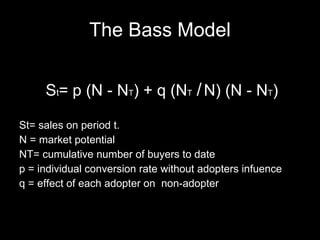
The Bass Model S t = p (N - N T ) + q ( N T  /   N) (N - N T )  St= sales on period t. N = market potential NT= cumulative number of buyers to date p = individual conversion rate without adopters infuence q = effect of each adopter on  non-adopter
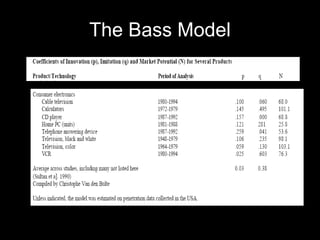
The Bass Model
Patterns of Difussion of technologies The Bass Model C-Curve Innovate dominates Imitate S-Curve Imitate dominates Innovate
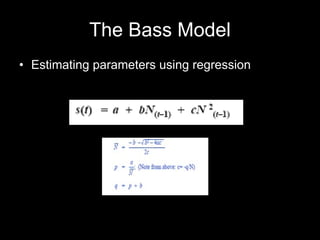
The Bass Model Estimating parameters using regression
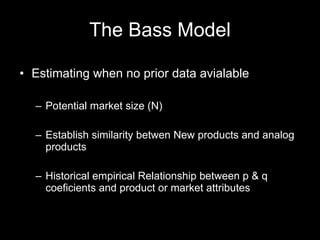
The Bass Model Estimating when no prior data avialable Potential market size (N) Establish similarity betwen New products and analog products Historical empirical Relationship between p & q coeficients and product or market attributes
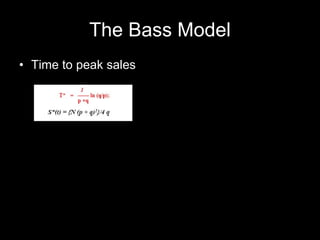
The Bass Model Time to peak sales
Why only few products reach Mainstream?
Crossing the TALC Lets come back to Rogers Model
Crossing the TALC Innovators : The Technolgy  enthusiasts The beachhead of TALC  Main interest is on Tecnology Appreciate the technology for its own sake Technology improves lives Big Influencers (Necessary to Imitators) Want truth, not sales pitch Need acces to most tech person in the company Source: G. A. Moore.
Crossing the TALC Innovators Marketing  Like white papers Free Demo Main channel of info is the web Techy forums
Crossing the TALC Early Adopters: The Visionaries They are buying a dream Looking for a  breakthrough Not just for an  improvement They see potential for an “order of magnitude” ROI No price sensitive Product oriented
Crossing the TALC Early Majority: The Pragmatists Believe in evolution not revolution Like to se competition Focus on standardization Vertically oriented Communicate with others like themselves Want to buy from proven market leaders Market Oriented
Crossing the TALC Late Majority: The Conservatives Against discontinuous innovation Believe far more in tradition than in progress Only invest at the end of life cycle Mature markets Low prices, high discounts Pre-asssambled Packages Commodities Products with one function ta a time Calculators, copiers, fax. Brand Oriented
Crossing the TALC Skeptics Do not participate on high tech
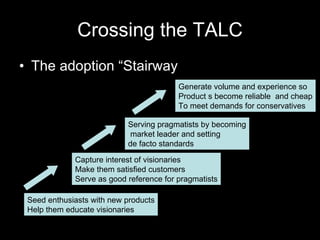
Crossing the TALC The adoption “Stairway ” Seed enthusiasts with new products Help them educate visionaries Capture interest of visionaries Make them satisfied customers Serve as good reference for pragmatists Serving pragmatists by becoming market leader and setting  de facto standards Generate volume and experience so Product s become reliable  and cheap To meet demands for conservatives
But… Why is so difficult to get succes…..
 
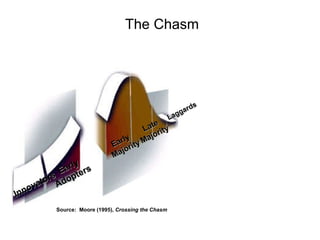
The Chasm Innovators Early Adopters Early  Majority Late Majority Laggards Source:  Moore (1995),  Crossing the Chasm
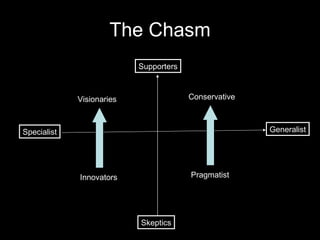
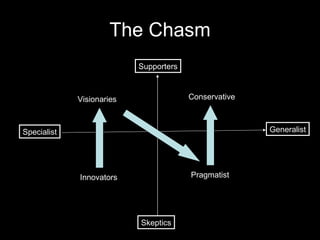
The Chasm Skeptics Supporters Specialist Generalist Innovators Visionaries Pragmatist Conservative
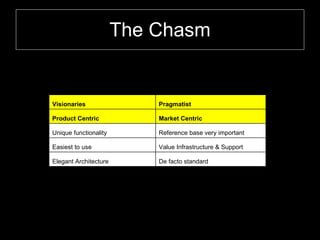
The Chasm De facto standard Elegant Architecture Value Infrastructure & Support Easiest to use Reference base very important Unique functionality Market Centric Product Centric Pragmatist Visionaries
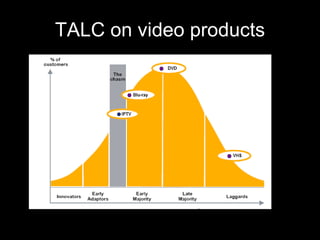
TALC on video products
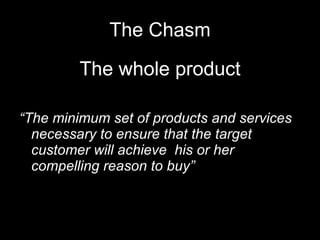
The Chasm The whole product “ The minimum set of products and services necessary to ensure that the target customer will achieve  his or her compelling reason to buy”
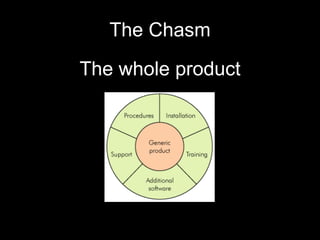
The Chasm The whole product
Crossing the chasm Pragmatist dont buy until the whole product is completly developed  (Not 70%, not 90%).
Crossing the Chasm STEP 1 Apply Hypersegmentation Segment, segment, segment until find a new category for the product.
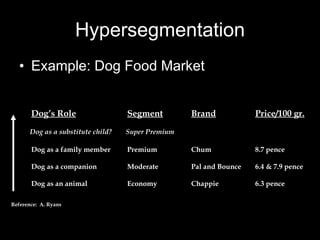
Example: Dog Food Market Hypersegmentation Dog’s Role Segment Brand Price/100 gr. Dog as a family member Premium Chum 8.7 pence Dog as a companion Moderate Pal and Bounce 6.4 & 7.9 pence Dog as an animal Economy Chappie 6.3 pence Reference:  A. Ryans Dog as a substitute child? Super Premium
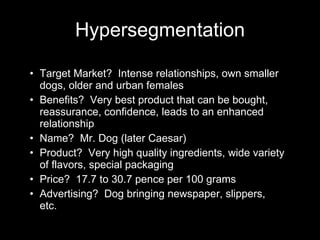
Target Market?  Intense relationships, own smaller dogs, older and urban females Benefits?  Very best product that can be bought, reassurance, confidence, leads to an enhanced relationship Name?  Mr. Dog (later Caesar) Product?  Very high quality ingredients, wide variety of flavors, special packaging Price?  17.7 to 30.7 pence per 100 grams Advertising?  Dog bringing newspaper, slippers, etc. Hypersegmentation
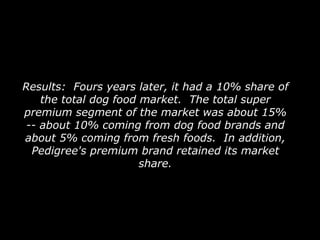
Results:  Fours years later, it had a 10% share of the total dog food market.  The total super premium segment of the market was about 15% -- about 10% coming from dog food brands and about 5% coming from fresh foods.  In addition, Pedigree's premium brand retained its market share.
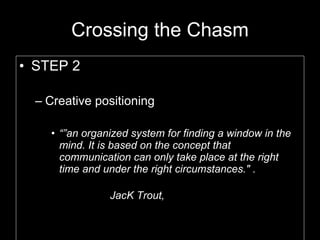
Crossing the Chasm STEP 2 Creative positioning “” an organized system for finding a window in the mind. It is based on the concept that communication can only take place at the right time and under the right circumstances." .  JacK Trout,
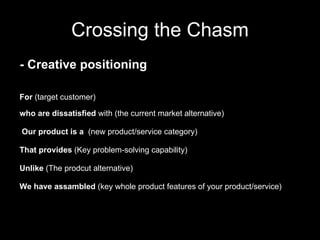
Crossing the Chasm For  (target customer) who are dissatisfied  with (the current market alternative) Our product is a   (new product/service category)  That provides  (Key problem-solving capability) Unlike  (The prodcut alternative) We have assambled  (key whole product features of your product/service) - Creative positioning
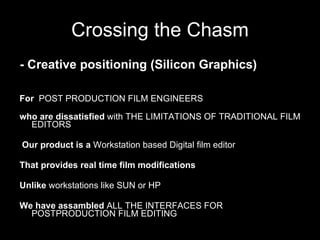
Crossing the Chasm For   POST PRODUCTION FILM ENGINEERS who are dissatisfied  with THE LIMITATIONS OF TRADITIONAL FILM EDITORS Our product is a  Workstation based Digital film editor  That provides real time film modifications Unlike  workstations like SUN or HP We have assambled  ALL THE INTERFACES FOR POSTPRODUCTION FILM EDITING - Creative positioning (Silicon Graphics)
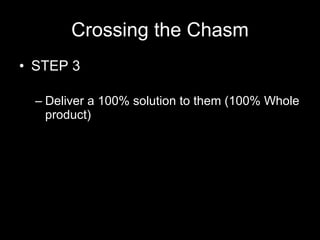
Crossing the Chasm STEP 3 Deliver a 100% solution to them (100% Whole product)
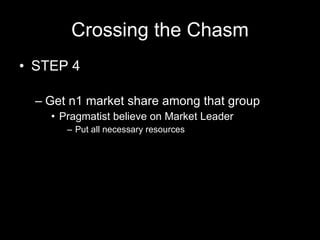
Crossing the Chasm STEP 4 Get n1 market share among that group Pragmatist believe on Market Leader Put all necessary resources
Managing the Hype cycle
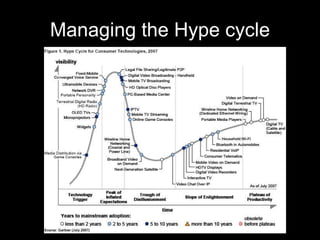
Managing the Hype cycle A hype cycle in Gartner's interpretation comprises 5 steps: " Technology Trigger " —  The first phase of a hype cycle is the "technology trigger“ or breakthrough, product launch or other event that generates significant press and interest.  " Peak of Inflated Expectations " —  In the next phase, a frenzy of publicity typically generates over-enthusiasm and unrealistic expectations.  " Trough of Disillusionment " —  Technologies enter the "trough of disillusionment" because they fail to meet expectations and quickly become unfashionable. Consequently, the press usually abandons the topic and the technology.  " Slope of Enlightenment " —  Although the press may have stopped covering the technology,  some businesses continue through the "slope of enlightenment"  and experiment to understand the benefits and practical application of the technology.  " Plateau of Productivity " —  A technology reaches the "plateau of productivity" as the benefits of it become widely demonstrated and accepted. The technology  becomes increasingly stable  and evolves in second and third generations. The final height of the plateau varies according to whether the technology is broadly applicable or benefits only a niche market.
Managing   the Hype cycle
 

High Tech MarketinG

  • 1.
  • 2.
  • 3.
    Example 1 Webvanspent more than $1 billion to create an online grocery business, only to declare bankruptcy in July 2001 after failing to attract as many customers as it thought it would.
  • 4.
    Example 2 • In spite of gaining the support of Apple’s Steve Jobs, Amazon’s Jeff Bezos, and many highprofile investors, Segway sold a mere 6,000 scooters in the 18 months after its launch—a far cry from the 50,000 to 100,000 units projected.
  • 5.
    Example 3 • Although TiVo’s digital video recorder (DVR) has garnered rave reviews since the late 1990s from both industry experts and product adopters, the company had amassed $600 million in operating losses by 2005 because demand trailed expectations.
  • 6.
  • 7.
  • 8.
    The 9 to1 effect
  • 9.
    Product and behaviourChanges Ref: J.T.Gourville
  • 10.
    New product forecastingmodels Repositioning Pre test Market New Coke Me Too Products Conjoint Analysis Burn Breakthroughs ¿? Red Bull Line Extensions Pre-test Coke Light New to company New to world Lo high high Lo
  • 11.
  • 12.
    Innovation & Diffusionmodels Why diffusion models are crucial on hi-tech / innovative /disruptive Diffusion models Allow to quantify and predict the size and rate of adoption Can explain when customers will adopt a New Product Can explain when sales will reach peak
  • 13.
    Innovation & Diffusionmodels Technology Adoption Life Cycle Based on Rogers work (1962) Aplicable to Discontinuous Innovation HDTV NanoSolar Technology Electric Cars 5 target groups are defined based on technology adoption behaviour Innovators Early Adopters Early Majority Late Majority Laggards
  • 14.
    Innovation & Diffusionmodels Not all technologies have the same pattern of diffusion Ex: TV vs Telephone
  • 15.
    Innovation & Diffusionmodels How to predict diffusion behaviour? Bass, Frank (1969). "A new product growth model for consumer durables". Management Science 15 (5): p215–227. Based on qty. of two targets Who adopt the tecnology by their inherent benefits. Innovators Who adopt the technology by imitation (word-of-mouth & Qty) of Innovators. Imitators
  • 16.
    The Bass ModelWe can define: Sales at Time t = Innovation buyers + Imitation buyers Innovation buyers = p X Remaining Potential Imitation buyers = q X Remaining Potential p = coeficient of innovation q = coficient of imitation
  • 17.
    The Bass ModelS t = p (N - N T ) + q ( N T / N) (N - N T ) St= sales on period t. N = market potential NT= cumulative number of buyers to date p = individual conversion rate without adopters infuence q = effect of each adopter on non-adopter
  • 18.
  • 19.
    Patterns of Difussionof technologies The Bass Model C-Curve Innovate dominates Imitate S-Curve Imitate dominates Innovate
  • 20.
    The Bass ModelEstimating parameters using regression
  • 21.
    The Bass ModelEstimating when no prior data avialable Potential market size (N) Establish similarity betwen New products and analog products Historical empirical Relationship between p & q coeficients and product or market attributes
  • 22.
    The Bass ModelTime to peak sales
  • 23.
    Why only fewproducts reach Mainstream?
  • 24.
    Crossing the TALCLets come back to Rogers Model
  • 25.
    Crossing the TALCInnovators : The Technolgy enthusiasts The beachhead of TALC Main interest is on Tecnology Appreciate the technology for its own sake Technology improves lives Big Influencers (Necessary to Imitators) Want truth, not sales pitch Need acces to most tech person in the company Source: G. A. Moore.
  • 26.
    Crossing the TALCInnovators Marketing Like white papers Free Demo Main channel of info is the web Techy forums
  • 27.
    Crossing the TALCEarly Adopters: The Visionaries They are buying a dream Looking for a breakthrough Not just for an improvement They see potential for an “order of magnitude” ROI No price sensitive Product oriented
  • 28.
    Crossing the TALCEarly Majority: The Pragmatists Believe in evolution not revolution Like to se competition Focus on standardization Vertically oriented Communicate with others like themselves Want to buy from proven market leaders Market Oriented
  • 29.
    Crossing the TALCLate Majority: The Conservatives Against discontinuous innovation Believe far more in tradition than in progress Only invest at the end of life cycle Mature markets Low prices, high discounts Pre-asssambled Packages Commodities Products with one function ta a time Calculators, copiers, fax. Brand Oriented
  • 30.
    Crossing the TALCSkeptics Do not participate on high tech
  • 31.
    Crossing the TALCThe adoption “Stairway ” Seed enthusiasts with new products Help them educate visionaries Capture interest of visionaries Make them satisfied customers Serve as good reference for pragmatists Serving pragmatists by becoming market leader and setting de facto standards Generate volume and experience so Product s become reliable and cheap To meet demands for conservatives
  • 32.
    But… Why isso difficult to get succes…..
  • 33.
  • 34.
    The Chasm InnovatorsEarly Adopters Early Majority Late Majority Laggards Source: Moore (1995), Crossing the Chasm
  • 35.
    The Chasm SkepticsSupporters Specialist Generalist Innovators Visionaries Pragmatist Conservative
  • 36.
    The Chasm SkepticsSupporters Specialist Generalist Innovators Visionaries Pragmatist Conservative
  • 37.
    The Chasm Defacto standard Elegant Architecture Value Infrastructure & Support Easiest to use Reference base very important Unique functionality Market Centric Product Centric Pragmatist Visionaries
  • 38.
    TALC on videoproducts
  • 39.
    The Chasm Thewhole product “ The minimum set of products and services necessary to ensure that the target customer will achieve his or her compelling reason to buy”
  • 40.
    The Chasm Thewhole product
  • 41.
    Crossing the chasmPragmatist dont buy until the whole product is completly developed (Not 70%, not 90%).
  • 42.
    Crossing the ChasmSTEP 1 Apply Hypersegmentation Segment, segment, segment until find a new category for the product.
  • 43.
    Example: Dog FoodMarket Hypersegmentation Dog’s Role Segment Brand Price/100 gr. Dog as a family member Premium Chum 8.7 pence Dog as a companion Moderate Pal and Bounce 6.4 & 7.9 pence Dog as an animal Economy Chappie 6.3 pence Reference: A. Ryans Dog as a substitute child? Super Premium
  • 44.
    Target Market? Intense relationships, own smaller dogs, older and urban females Benefits? Very best product that can be bought, reassurance, confidence, leads to an enhanced relationship Name? Mr. Dog (later Caesar) Product? Very high quality ingredients, wide variety of flavors, special packaging Price? 17.7 to 30.7 pence per 100 grams Advertising? Dog bringing newspaper, slippers, etc. Hypersegmentation
  • 45.
    Results: Foursyears later, it had a 10% share of the total dog food market. The total super premium segment of the market was about 15% -- about 10% coming from dog food brands and about 5% coming from fresh foods. In addition, Pedigree's premium brand retained its market share.
  • 46.
    Crossing the ChasmSTEP 2 Creative positioning “” an organized system for finding a window in the mind. It is based on the concept that communication can only take place at the right time and under the right circumstances." . JacK Trout,
  • 47.
    Crossing the ChasmFor (target customer) who are dissatisfied with (the current market alternative) Our product is a (new product/service category) That provides (Key problem-solving capability) Unlike (The prodcut alternative) We have assambled (key whole product features of your product/service) - Creative positioning
  • 48.
    Crossing the ChasmFor POST PRODUCTION FILM ENGINEERS who are dissatisfied with THE LIMITATIONS OF TRADITIONAL FILM EDITORS Our product is a Workstation based Digital film editor That provides real time film modifications Unlike workstations like SUN or HP We have assambled ALL THE INTERFACES FOR POSTPRODUCTION FILM EDITING - Creative positioning (Silicon Graphics)
  • 49.
    Crossing the ChasmSTEP 3 Deliver a 100% solution to them (100% Whole product)
  • 50.
    Crossing the ChasmSTEP 4 Get n1 market share among that group Pragmatist believe on Market Leader Put all necessary resources
  • 51.
  • 52.
    Managing the Hypecycle A hype cycle in Gartner's interpretation comprises 5 steps: " Technology Trigger " — The first phase of a hype cycle is the "technology trigger“ or breakthrough, product launch or other event that generates significant press and interest. " Peak of Inflated Expectations " — In the next phase, a frenzy of publicity typically generates over-enthusiasm and unrealistic expectations. " Trough of Disillusionment " — Technologies enter the "trough of disillusionment" because they fail to meet expectations and quickly become unfashionable. Consequently, the press usually abandons the topic and the technology. " Slope of Enlightenment " — Although the press may have stopped covering the technology, some businesses continue through the "slope of enlightenment" and experiment to understand the benefits and practical application of the technology. " Plateau of Productivity " — A technology reaches the "plateau of productivity" as the benefits of it become widely demonstrated and accepted. The technology becomes increasingly stable and evolves in second and third generations. The final height of the plateau varies according to whether the technology is broadly applicable or benefits only a niche market.
  • 53.
    Managing the Hype cycle
  • 54.