Delphi study on management goals for type 1 Gaucher disease
Final report research internship Master Medicine
Name student: A.I. Kiewiet
Student number: 1745514
Date of submission: February 2nd
2016
Number of words: 6,493
Name of placement organization: Academisch Medisch Centrum (AMC) Amsterdam
Address of placement organization: Meibergdreef 9, 1105 AZ, Amsterdam
On-site supervisor: Dr. M. Biegstraaten (m.biegstraaten@amc.uva.nl)
VU-supervisor: Dr. E.M.W. Eekhoff (emw.eekhoff@vumc.nl
Master programme: Master Medicine
Number of EC’s: 33
Abstract
Introduction: Gaucher Disease type 1 (GD1) is a lysosomal storage disorder leading to a variety of
symptoms, such as hepatomegaly, splenomegaly, anaemia, thrombocytopenia and bone
complications. The introduction of enzyme replacement therapy (ERT) has dramatically changed
the phenotype of the disease. Treatment with ERT leads to significant improvements in visceral
and haematological manifestations in GD1 patients. Since management of the disease for short
term complications is improved and and a near-normal life expectancy is supposed, long term
complicatons and diseases associated with GD1 received more attention. In general, patient
reported outcome measurements (PROMs) also gained more awareness. Therefore, we aim to
develop a rewened set of management goals, through a Delphi procedure among GD1 experts.
Methods: A modified Delphi procedure was performed to reach consensus on management goals
for GD1. All members of the European Working Group on Gaucher Disease (EWGGD) were invited to
participate. Sixty-four statements, all potential management goals, were formulated based on the
results of a literature review. Three rounds of surveys were sent out to discuss these statements.
Participants were asked to indicate on a 5-point Likert-scale whether or not they agreed to have
that statement be part of the management goals. Consensus was defined to be reached when 75%
of the participants agreed and no one disagreed.
Results: Consensus was reached on 39 statements in three rounds of surveys by 25 participants.
These management goals include previous therapeutic goals, mainly focused on short term
outcomes, and newly added goals that also involve improvement in PROMs (e.g. fatigue, social
participation, quality of life) and early detection of long term complications.
Conclusion and discussion: Consensus was reached on a new set of management goals for GD1, with
more attention towards long-term complications, associated conditions, and PROMs. When applying
this set of management goals in clinical practice the individual situation of each patient should be
taken into account.
1. Introduction
Gaucher disease (GD) is an autosomal recessively inherited lysosomal storage disorder with
prevalence of 1:57,000 at birth [1]. It is caused by mutations in the glucocerebrosidase (GBA) gene,
which leads to reduced activity of GBA and consequently to a build-up of glucosylceramide in the
lysosomes of macrophages (so called ‘Gaucher cells’) [2, 3]. This accumulation of glucosylceramide
can result in a multi-system disease, with a variety of symptoms. The disease is classically divided into
three types. Type 1 GD (GD1) is mainly characterized by visceral manifestations, including
splenomegaly, hepatomegaly, anaemia, thrombocytopenia, bone disease and growth retardation. In
type 2 and type 3 GD (GD2 and GD3, respectively) there are also neurological symptoms, ranging
from rapidly progressive neurological deterioration in GD2 leading to death in the first 2 years of
childhood, to slowed horizontal saccadic eye movements in GD3 [4-6]. In this Delphi study, we will
focus on GD1, the most common type, occurring in 95% of the GD cases [7].
Currently, two therapeutic approaches for the treatment of GD1 are used: enzyme replacement
therapy (ERT) and substrate reduction therapy (SRT). Intravenously administered ERT supplements
the deficient enzyme. It reaches the lysosomes from the extracellular space via endocytosis mediated
by the mannose receptor, resulting in degradation of the accumulated lipids [8]. Two enzyme
preparations are available in Europe: imiglucerase and velaglucerase alfa, while in the US a third
enzyme has been approved: taliglucerase alfa [9]. ERT has been proven to be very effective in the
treatment of the visceral complications of the disease [10]. Decreases in splenic and hepatic size and
improvement in cytopenia are already apparent after 6 months of treatment [11]. Treatment with
ERT is expensive, with yearly costs ranging from €124,000 to €258,000 per patient in the Netherlands
[12].
In contrast to ERT, which increases the breakdown of the accumulated lipids, SRT reduces the
amount of glucosylceramide by inhibiting its synthesis. Two compounds have been approved:
miglustat and eliglustat [13, 14]. The first is only approved for mildly affected patients for whom ERT
is unsuitable, e.g. in case of needle phobia or a way of life not compatible with regular intravenous
infusions [15]. Side effects, predominantly gastrointestinal disturbances, have limited the clinical use
of miglustat [16]. The results from the clinical trials on eliglustat are positive, and similar
effectiveness when compared to ERT is assumed [13].
Although ERT has been used for over 20 years, little is known about the effectiveness of therapy on
long term complications [17, 18]. Also, limited evidence is available on the effects on patient well-
being and survival of GD [19, 20]. An epidemiological study showed that the life expectancy at birth
in GD1 is 68.2 years, compared to 77.1 years for the reference population [20]. It should be noted,
however, that at the time this study was performed, ERT had been available for approximately 15
years, which implies that many patients were not optimally treated. Therefore, the current life-
expectancy is probably even higher. With a near-normal life expectancy and a good response of the
short term visceral and haematological complications to ERT, and the consequent change of the
disease’s phenotype, long term complications and associated disease, such as certain types of cancer
[21], pulmonary hypertension [22], Parkinson’s disease (PD) [23], and metabolic syndrome [24] have
gained more attention. Although conclusive studies have not yet been published, it is hypothesized
that ERT could prevent or postpone at least some of the long term complications and associated
diseases. It is therefore important to monitor their occurrence.
Traditionally, most studies on the effectiveness of ERT/SRT have used haemoglobin levels, platelet
counts and the reduction in spleen and liver volumes as primary outcome measures. Therapeutic
goals are also mainly based on these parameters; an essential example in this is the list of
therapeutic goals presented by Pastores et al [25]. Ideally, therapeutic goals include both primary
and secondary goals with quantitative as well as qualitative items. However, in the currently used
therapeutic goals the secondary, mainly qualitative health parameters that really matter to patients
are lacking, such as: the improvement of quality of life [26, 27], alleviating fatigue [28] and pain [29].
This is in line with current insights to focus more on patient reported outcome measurements
(PROMs). These PROMs reflect how a patient feels and functions (in contrast to laboratory values),
and it is increasingly recognised that this type of information is essential in the treatment of patients
[30].
With more awareness for long term complications, associated diseases and PROMs in GD1,
management goals in GD1 need to be redefined. With a modified Delphi procedure we aim to
develop consensus among GD1 experts on relevant management goals, with a specific focus on long-
term complications, associated conditions, and patient reported outcomes. An updated set of
management goals, with international agreement, is expected to serve as a basis for further research
on dosage and frequency of ERT and SRT, and ultimately to improve treatment guidelines.
2. Methods
2.1 Study design
A modified Delphi procedure was used to achieve consensus on management goals for GD1 [26]. The
Delphi procedure is a technique in which multiple rounds of online surveys aim at reaching
consensus on a certain subject [27]. For the first round, the study team (AK, MB, CH) compiled a
structured survey based on a non-systematic review of literature and a patient questionnaire. The
non-systematic review of literature and results of the patient questionnaire were presented as a
background document to all participants together with the first survey (see Appendix 1). By
distributing this document, we aimed to provide the expert panel with up-to-date information which
could be used throughout all rounds of the consensus procedure. All members of the European
Working Group on Gaucher Disease (EWGGD) were invited to participate in the Delphi procedure.
The surveys were administered as online questionnaires using SurveyMonkey and were repeated
until all statements either reached consensus or were adequately discussed to be removed. Usually,
in a modified Delphi procedure, 3 rounds of surveys are sufficient to reach consensus [26].
2.2 Literature search
A non-systematic review of the literature was performed on the basis of which the first survey was
compiled. A search for currently used management goals was done, as well as for potential new
management goals with specific focus on long term complications. For the currently used
management goals, the Cochrane Library and databases for guidelines were searched, and a search
in PubMed with the terms ‘Gaucher’, ‘consensus’ and ‘recommendation’ was done. A second search
with the terms ‘Gaucher disease’ and ‘long term’ was performed to obtain information on potential
new management goals. An additional search per complication was done for the identification of
further relevant studies. Both searches were done in August 2015. Synonyms and MeSH terms were
included in the search. Articles were assessed on title and abstract and included if they were
considered relevant for the definition of management goals of GD1, being articles on current or
recommended therapeutic goals, or articles which described complications of GD1 that were not part
of the current therapeutic goals. Only English written articles were included. Results from the
literature search can be found in Appendix 1.
2.3 Patient questionnaire
Patients were invited to give their view on what they considered clinically relevant management
goals. To this end, a questionnaire (see Appendix 2) was sent to the patient organisations known by
the European Gaucher Alliance (EGA) in the spring of 2015. The Dutch population was contacted
directly or through email in the same period. The answers from 17 respondents were analysed and
used as input for the first survey. No replies were received from outside the Netherlands. Results
from this patient questionnaire can also be found in Appendix 1.
2.4 Surveys
Three rounds of surveys were presented to the expert panel from November 2015 until January
2016. Time to respond for each survey was two weeks. Participants were asked to indicate on a 5-
point Likert-scale whether or not they agreed to include a specific statement in the management
goals. This scale included the following options: strongly agree, agree, neither agree nor disagree,
disagree and strongly disagree. We encouraged participants to add comments to support their vote.
In the first and second survey participants were invited to suggest additional, possibly relevant goals.
In the first survey a total of 64 statements (i.e. potential management goals) were presented,
including all therapeutic goals previously presented by Pastores et al [25]. The statements were
divided into the following 11 categories: general well-being, fatigue, bleeding tendency, mobility,
visceral complications, pulmonary complications, malignancies, metabolic complications,
neurological complications, disease severity scores and biochemical markers. In each survey, these
categories were divided into short term and long term complications.
After each round, the responses were analysed and statements were removed, amended or repeated
without revision; new statements were added as suggested by the participants. Statements were not
repeated if consensus to include the statement was reached. Statements were removed when the
study team thought it very unlikely, based on a significant number of participants who disagreed, or
the comments raised by one or more participants, that the panel would reach consensus on that
statement in the next round, even if the statement was amended. Although the removed statements
were not voted on in the next round, they were presented in the survey to give participants full
insight in choices made by the study team. Statements were amended based upon the comments
raised when considered beneficial. If the argumentation of the participants who disagreed was
considered insufficient to either remove or revise the statement, this statement was repeated
without amendment. Arguments used by the study team for this were: comments were unclear or
missing, or only one participant disagreed.
Along with the second and third round, participants were provided with anonymized results of the
previous round, consisting of absolute scores and comments, and argumentation used by the study
team to amend the survey. In the second round the argumentation was presented in an e-mail with
general remarks and in the third survey arguments were given per statement, including the most
important comments of the participants. Statements that did not reach consensus after the third
round were removed. Finally, the results were presented to the participants as a manuscript for
review and final approval.
2.5 Data analysis
Consensus was defined to be reached when 75% of the participants agreed on inclusion of that
statement in the management goals, and no one disagreed [31, 32]. To investigate whether there
was an effect of the number of patients the physician takes care of, a chi-squared test for trend was
performed. To this end, the data was split into three groups, based upon the number of patients
treated by the physicians. In the first survey 7 physicians indicated that they follow <15 patients in
their centre, 8 physicians reported 15-100 patients and another 8 physicians >100 patients. For the
analysis the answer options ‘strongly agree’ and ‘agree’ were combined as well as ‘strongly disagree’
and ‘disagree’. The groups were compared for how frequently they agreed or disagreed with a
statement. Participants were removed from this analysis if >10% of the values were missing. The chi-
squared test for trend was performed using SPSS Statistics 22.0 [33]. A p-value of less than 0.05 was
considered statistically significant.
3. Results
3.1 Participants
All 35 members of the EWGGD, physicians and scientists, were invited to participate in this
procedure and received the background document (see Appendix 1) together with a link to the first
online survey. Twenty-five of the 35 members participated in this consensus procedure. Nineteen
participants completed all 3 rounds, and 6 participants completed 2 out of 3 rounds. Participants
represented the following countries: Greece, Portugal, Germany, Israel, Spain, France, Italy, Sweden,
United States of America, United Kingdom, Norway, Bosnia and Herzegovina, Australia, Russia and
Poland. All participants indicated that therapeutic goals are necessary in daily clinical practice.
Participants from the first survey treat an average of 92 patients, ranging from 2 to 600, and 5 of the
23 participants are paediatricians.
3.2 Delphi procedure
The first survey consisted of 64 statements. Agreement was achieved on 15 out of 64 statements and
12 statements were removed for which agreement was not reached, because it was very unlikely
consensus would be reached in the next round. Twenty-nine statements were rephrased according
to the suggestions of the participants. Some statements were combined into one statement. Nine
statements were repeated without amendments. Participants’ suggestions included 8 new
statements which were also presented in the second survey. Finally, the second survey consisted of
40 statements.
In the second survey the panel reached consensus on 4 statements and 14 statements were
removed. Nine statements were amended based upon the comments given. Thirteen statements
were repeated without amendments. Three new statements, all proposed by the participants, were
added to the third survey. The third survey consisted of 25 statements. In the third survey, consensus
was reached for 20 statements and 5 statements were removed. There was agreement on a total of
39 statements after three surveys.
3.3 Comparing groups
In Table 1 mean percentages are given, per group and per survey, for how frequently each answer
options was given, with the answer options ‘strongly agree’ and ‘agree’ as well as ‘strongly disagree’
and ‘disagree’ combined. The chi-squared test for trend was used to compare the three groups for
mean frequency of agreeing and disagreeing with the statement per survey. The first survey revealed
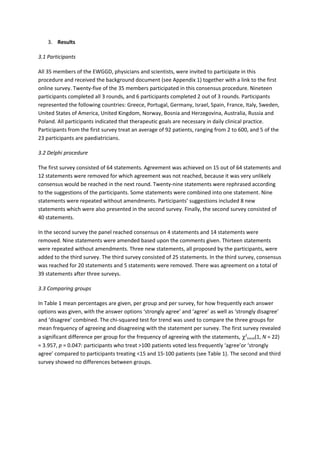
a significant difference per group for the frequency of agreeing with the statements, χ2
trend(1, N = 22)
= 3.957, p = 0.047: participants who treat >100 patients voted less frequently ‘agree’or ‘strongly
agree’ compared to participants treating <15 and 15-100 patients (see Table 1). The second and third
survey showed no differences between groups.
Table 1: Comparing groups; frequency table
Answer
option
<15 patients 15-100 patients >100 patients
Survey 1 2 3 1 2 3 1 2 3
Mean % per
answer
option
(Strongly)
agree
83,4% 73,2% 92,0% 83,7% 63,8% 95% 65,8% 71,4% 91,4%
Neither
agree nor
disagree
11,6% 9,4% 7,3% 13,1% 11,7% 3% 16,4% 13,9% 5,7%
(Strongly)
disagree
4,0% 5,9% 0,7% 2,7% 7,9% 2% 11,3% 13,2% 1,1%
Missing 0,9% 10,6% 9,7% 0,4% 15,8% 0% 6,4% 1,1% 1,7%
3.4 Management goals for which consensus was achieved
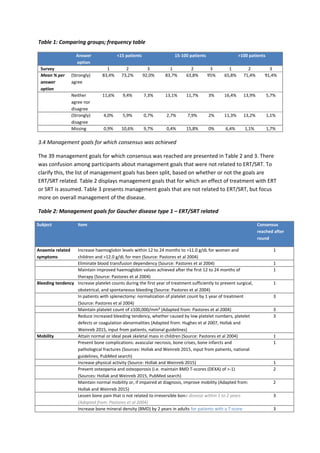
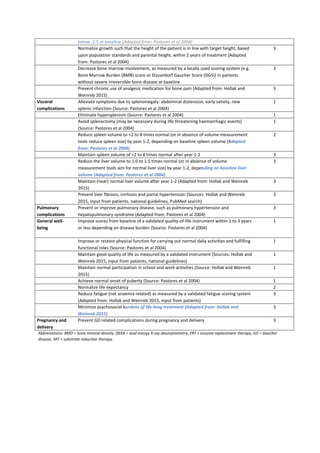
The 39 management goals for which consensus was reached are presented in Table 2 and 3. There
was confusion among participants about management goals that were not related to ERT/SRT. To
clarify this, the list of management goals has been split, based on whether or not the goals are
ERT/SRT related. Table 2 displays management goals that for which an effect of treatment with ERT
or SRT is assumed. Table 3 presents management goals that are not related to ERT/SRT, but focus
more on overall management of the disease.
Table 2: Management goals for Gaucher disease type 1 – ERT/SRT related
Subject Item Consensus
reached after
round
Anaemia related
symptoms
Increase haemoglobin levels within 12 to 24 months to >11.0 g/dL for women and
children and >12.0 g/dL for men (Source: Pastores et al 2004)
1
Eliminate blood transfusion dependency (Source: Pastores et al 2004) 1
Maintain improved haemoglobin values achieved after the first 12 to 24 months of
therapy (Source: Pastores et al 2004)
1
Bleeding tendency Increase platelet counts during the first year of treatment sufficiently to prevent surgical,
obstetrical, and spontaneous bleeding (Source: Pastores et al 2004)
1
In patients with splenectomy: normalization of platelet count by 1 year of treatment
(Source: Pastores et al 2004)
3
Maintain platelet count of ≥100,000/mm³ (Adapted from: Pastores et al 2004) 3
Reduce increased bleeding tendency, whether caused by low platelet numbers, platelet
defects or coagulation abnormalities (Adapted from: Hughes et al 2007, Hollak and
Weinreb 2015, input from patients, national guidelines)
3
Mobility Attain normal or ideal peak skeletal mass in children (Source: Pastores et al 2004) 1
Prevent bone complications: avascular necrosis, bone crises, bone infarcts and
pathological fractures (Sources: Hollak and Weinreb 2015, input from patients, national
guidelines, PubMed search)
1
Increase physical activity (Source: Hollak and Weinreb 2015) 1
Prevent osteopenia and osteoporosis (i.e. maintain BMD T-scores (DEXA) of >-1)
(Sources: Hollak and Weinreb 2015, PubMed search)
2
Maintain normal mobility or, if impaired at diagnosis, improve mobility (Adapted from:
Hollak and Weinreb 2015)
2
Lessen bone pain that is not related to irreversible bone disease within 1 to 2 years
(Adapted from: Pastores et al 2004)
3
Increase bone mineral density (BMD) by 2 years in adults for patients with a T-score 3
below -2.5 at baseline (Adapted from: Pastores et al 2004)
Normalize growth such that the height of the patient is in line with target height, based
upon population standards and parental height, within 2 years of treatment (Adapted
from: Pastores et al 2004)
3
Decrease bone marrow involvement, as measured by a locally used scoring system (e.g.
Bone Marrow Burden (BMB) score or Düsseldorf Gaucher Score (DGS)) in patients
without severe irreversible bone disease at baseline
3
Prevent chronic use of analgesic medication for bone pain (Adapted from: Hollak and
Weinreb 2015)
3
Visceral
complications
Alleviate symptoms due to splenomegaly: abdominal distension, early satiety, new
splenic infarction (Source: Pastores et al 2004)
1
Eliminate hypersplenism (Source: Pastores et al 2004) 1
Avoid splenectomy (may be necessary during life threatening haemorrhagic events)
(Source: Pastores et al 2004)
1
Reduce spleen volume to <2 to 8 times normal (or in absence of volume measurement
tools reduce spleen size) by year 1-2, depending on baseline spleen volume (Adapted
from: Pastores et al 2004)
2
Maintain spleen volume of <2 to 8 times normal after year 1-2 3
Reduce the liver volume to 1.0 to 1.5 times normal (or in absence of volume
measurement tools aim for normal liver size) by year 1-2, depending on baseline liver
volume (Adapted from: Pastores et al 2004)
3
Maintain (near) normal liver volume after year 1-2 (Adapted from: Hollak and Weinreb
2015)
3
Prevent liver fibrosis, cirrhosis and portal hypertension (Sources: Hollak and Weinreb
2015, input from patients, national guidelines, PubMed search)
3
Pulmonary
complications
Prevent or improve pulmonary disease, such as pulmonary hypertension and
hepatopulmonary syndrome (Adapted from: Pastores et al 2004)
3
General well-
being
Improve scores from baseline of a validated quality-of-life instrument within 2 to 3 years
or less depending on disease burden (Source: Pastores et al 2004)
1
Improve or restore physical function for carrying out normal daily activities and fulfilling
functional roles (Source: Pastores et al 2004)
1
Maintain good quality of life as measured by a validated instrument (Sources: Hollak and
Weinreb 2015, input from patients, national guidelines)
1
Maintain normal participation in school and work activities (Source: Hollak and Weinreb
2015)
1
Achieve normal onset of puberty (Source: Pastores et al 2004) 1
Normalize life expectancy 2
Reduce fatigue (not anaemia related) as measured by a validated fatigue scoring system
(Adapted from: Hollak and Weinreb 2015, input from patients)
3
Minimize psychosocial burdens of life-long treatment (Adapted from: Hollak and
Weinreb 2015)
3
Pregnancy and
delivery
Prevent GD related complications during pregnancy and delivery 3
Abbreviations: BMD = bone mineral density, DEXA = dual energy X-ray absorptiometry, ERT = enzyme replacement therapy, GD = Gaucher
disease, SRT = substrate reduction therapy.
Table 3: Management goals for Gaucher disease type 1 – not ERT/SRT related
Abbreviations: ERT = enzyme replacement therapy, SRT = substrate reduction therapy.
Most statements derived from the set of therapeutic goals presented by Pastores et al [25] again
reached agreement. Participants requested an amendment for some of these therapeutic goals
before consensus was found. ‘Lessen or eliminate bone pain within 1 to 2 years’, for example, was
changed to ‘Lessen bone pain that is not related to irreversible bone disease within 1 to 2 years’,
since participants indicated that a choice should be made between lessen or eliminate, and that this
goal is not achievable for irreversible bone disease. In compliance with statements on prevention of
complications, such as splenectomy or pulmonary disease, presented as therapeutic goals by
Pastores et al [25], new goals were added on, for example, prevention of liver fibrosis, cirrhosis and
portal hypertension, and prevention of bone complications. Further, new goals included
improvement in PROMs (e.g. fatigue, social participation, quality of life) and early detection of long
term complications.
3.4.1 Goals related to ERT/SRT treatment
In the first round, agreement was reached on improving classical symptoms, such as normalization of
haemoglobin, increasing platelet count and to alleviate symptoms due to splenomegaly. These
statements were considered valuable as management goals, since treatment with ERT or SRT has the
potential to improve these outcomes. Goals for which the effect of ERT or SRT, as known from
literature and clinical experience, is more divergent, were more extensively discussed. The panel
emphasized the importance of a proper differential diagnoses of symptoms or complications
described in the management goals before starting treatment or changing the dosage. For example,
in case of ongoing anaemia despite ERT/SRT treatment, other causes, such as iron deficiency or auto
immune haemolytic anaemia, should be explored.
3.4.2 Goals not directly related to ERT/SRT treatment
Consensus was reached on 4 statements about early detection of long term complications and
associated diseases. These goals are not directly related to treatment with ERT/SRT, therefore
participants profoundly debated these statements since previous set of goals were exclusively
focused on therapeutic management. In the end, it was agreed that this consensus procedure is
about management of GD1 and is not confined to therapeutic goals. Participants indicated that not
all long term complications and associated disease have benefit form early detection. Early detection
Subject Statement Consensus
reached after
round
Early detection of long
term complications
Early detection of haematological malignancies, including multiple myeloma,
lymphoma and amyloidosis (Sources: Hollak and Weinreb 2015, Hughes et al 2007,
input from patients, national guidelines, PubMed search)
3
Early detection of solid tumours, including hepatocellular carcinoma and renal cell
carcinoma (Sources: Hollak and Weinreb 2015, input from patients, national
guidelines, PubMed search)
3
Early detection of parkinsonism/Parkinson disease (Sources: Hollak and Weinreb
2015, input from patients, national guidelines, PubMed search)
3
Early detection of insulin resistance and type 2 diabetes mellitus (Source: PubMed
search)
3
was found valuable in case of solid tumours, such as hepatocellular carcinoma,
parkinsonism/Parkinson disease, haematological malignancies, and insulin resistance and type 2
diabetes mellitus. In these cases early detection provides the opportunity of an early start of
treatment and thereby might result in a better outcome for patients.
3.4.3 Discussion by panel on goals for which consensus was reached
Several statements on bleeding tendency were discussed before reaching consensus. Other causes
besides low platelet count can be present for increased bleeding tendency [34, 35]. Although
participants indicated that it might be difficult to diagnose and prevent, they eventually reached
consensus on the statement ‘Reducing bleeding tendency, whether caused by low platelet numbers,
platelet defects or coagulation abnormalities’.
Also, the goal with respect to platelet count was debated. As an increase described in a 1.5 to 2.0
fold change in platelet count was found too arbitrary, a target count of ≥100,000/mm³ was
discussed. Although maintaining a target count of ≥100,000/mm³ did eventually reach consensus,
this was not the case for achieving this aim in the first years after starting treatment. Almost all
participants, agreed to reach for a target count of ≥100,000/mm³ in the first years of treatment as
well, however, one participant disagreed and commented to strive for normalisation.
Statements on mobility that needed more than one round before reaching consensus involved
statements for which specific measuring techniques are needed. These techniques are used to
measure presence and severity of bone disease, such as the bone mineral density (BMD) score and
the bone marrow burden (BMB) score. The usefulness of these techniques and the time period
necessary to reach the goal were discussed. After several amendments, such as changing the
statement on BMB score to a more general statement ‘to decrease bone marrow involvement, as
measured by a locally used scoring system’, most statements reached consensus. Further, it was
debated if lessening bone pain was achievable for all patients. This was found achievable in all cases,
except for irreversible bone disease. The statement was therefore amended accordingly.
Statements on liver and spleen focused on reducing organ volumes in the first round, but based on
the comment that techniques needed to measure volumes are not available in all centers, we added
that the aim could also be to reduce organ size, which can be measured with more simple
techniques. Reducing fatigue was considered an important goal, although participants indicated that
it is difficult to measure and to know whether it is GD-related. After the addition that this should be
measured by a validated fatigue scoring system, participants reached consensus.
3.5 Statements for which no consensus was achieved
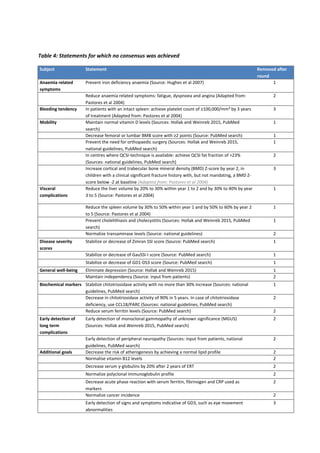
Statements for which no consensus was achieved, are presented in Table 4.
Table 4: Statements for which no consensus was achieved
Subject Statement Removed after
round
Anaemia related
symptoms
Prevent iron deficiency anaemia (Source: Hughes et al 2007) 1
Reduce anaemia related symptoms: fatigue, dyspnoea and angina (Adapted from:
Pastores et al 2004)
2
Bleeding tendency In patients with an intact spleen: achieve platelet count of ≥100,000/mm³ by 3 years
of treatment (Adapted from: Pastores et al 2004)
3
Mobility Maintain normal vitamin D levels (Sources: Hollak and Weinreb 2015, PubMed
search)
1
Decrease femoral or lumbar BMB score with ≥2 points (Source: PubMed search) 1
Prevent the need for orthopaedic surgery (Sources: Hollak and Weinreb 2015,
national guidelines, PubMed search)
1
In centres where QCSI-technique is available: achieve QCSI fat fraction of >23%
(Sources: national guidelines, PubMed search)
2
Increase cortical and trabecular bone mineral density (BMD) Z-score by year 2, in
children with a clinical significant fracture history with, but not mandating, a BMD Z-
score below -2 at baseline (Adapted from: Pastores et al 2004)
3
Visceral
complications
Reduce the liver volume by 20% to 30% within year 1 to 2 and by 30% to 40% by year
3 to 5 (Source: Pastores et al 2004)
1
Reduce the spleen volume by 30% to 50% within year 1 and by 50% to 60% by year 2
to 5 (Source: Pastores et al 2004)
1
Prevent cholelithiasis and cholecystitis (Sources: Hollak and Weinreb 2015, PubMed
search)
1
Normalize transaminase levels (Source: national guidelines) 2
Disease severity
scores
Stabilize or decrease of Zimran SSI score (Source: PubMed search) 1
Stabilize or decrease of GauSSI-I score (Source: PubMed search) 1
Stabilize or decrease of GD1-DS3 score (Source: PubMed search) 1
General well-being Eliminate depression (Source: Hollak and Weinreb 2015) 1
Maintain independency (Source: input from patients) 2
Biochemical markers Stabilize chitotriosidase activity with no more than 30% increase (Sources: national
guidelines, PubMed search)
1
Decrease in chitotriosidase activity of 90% in 5 years. In case of chitotriosidase
deficiency, use CCL18/PARC (Sources: national guidelines, PubMed search)
2
Reduce serum ferritin levels (Source: PubMed search) 2
Early detection of
long term
complications
Early detection of monoclonal gammopathy of unknown significance (MGUS)
(Sources: Hollak and Weinreb 2015, PubMed search)
2
Early detection of peripheral neuropathy (Sources: input from patients, national
guidelines, PubMed search)
2
Additional goals Decrease the risk of atherogenesis by achieving a normal lipid profile 2
Normalise vitamin B12 levels 2
Decrease serum y-globulins by 20% after 2 years of ERT 2
Normalize polyclonal immunoglobulin profile 2
Decrease acute phase reaction with serum ferritin, fibrinogen and CRP used as
markers
2
Normalize cancer incidence 2
Early detection of signs and symptoms indicative of GD3, such as eye movement
abnormalities
3
Proper education of the patient and his family about the disease and therapy 3
Early detection of autoimmune diseases, such as idiopathic thrombocytopenic
purpura (ITP) and autoimmune haemolytic anaemia (AIHA)
3
Abbreviations: BMB = bone marrow burden, CCL18/PARC = chemokine ligand 18/pulmonary and activation-regulated chemokine, CRP = C-
reactive protein, ERT = enzyme replacement therapy, GauSSI-I = Gaucher Disease Severity Score Index – Type 1 , GD1-DS3 = Gaucher
disease severity scoring system , GD3 = Gaucher disease type 3, QCSI = Quantitative chemical shift imaging, SSI = Severity Scoring Index.
Statements were removed for the following reasons: the complication has a high prevalence in the
general population, thereby making it difficult to relate the complication to GD1; the goal was not
achievable for a large patient group; or the supporting evidence was considered too limited/weak.
For disease severity scores and biochemical markers none of the statements reached consensus.
Three different disease severity scoring systems are currently available: the Severity Scoring Index
(SSI) [36], the Gaucher Disease Severity Score Index – Type 1 (GauSSI-I) [37], and the Gaucher disease
severity scoring system (GD1-DS3) [38]. None of these scoring systems so far have been validated for
general use. Therefore, and because scoring systems represent several statements already taken into
account, participants did not agree to add reducing scores from the different scoring systems to the
list of management goals.
Various biomarkers reflecting disease severity have been studied. Currently, the strongest evidence
exists for chitotriosidase [39], chemokine ligand 18/pulmonary and activation-regulated chemokine
(CCL18/PARC) [40, 41] and ferritin [42]. In the end, participants considered these biomarkers to be
too unreliable as stand-alone goals and therefore no consensus was reached on these statements.
As previously stated, several statements on the early detection of long term complications were
debated. Early detection of monoclonal gammopathy of unknown significance (MGUS) and of
peripheral neuropathy were considered to be more harmful than beneficial to the patient.
Diagnosing MGUS is important as it can progress to multiple myeloma [43], suggesting that early
detection of MGUS might be relevant. However, participants indicated that early detection of MGUS
will only increase the period of follow-up and might even lead to more distress for patients. As there
is no treatment for MGUS, it was emphasized that no benefit for early detection exists. Early
detection of peripheral neuropathy was seen as good clinical practice. However, several participants
who disagreed doubted whether early detection would lead to an improvement of outcome since no
treatment for peripheral neuropathy is available.
4. Discussion
4.1 Summary of results
The aim of this Delphi procedure was to develop a set of internationally supported management
goals with a specific focus on long-term complications, associated conditions, and patient reported
outcomes. Participants in this consensus procedure are all experts in GD1. Twenty-five of the 35
EWGGD members participated. The members who decided not to participate were mainly scientists
who considered their experience insufficient to take part in this clinical study. Therefore, the results
of this study represent the view of large group of European GD experts.
Three rounds of surveys were needed to reach consensus on short term and long term management
goals. The short term, easily measurable management goals, are consistent with the previously
reported and currently used goals by Pastores et al [25]. The patients’ perspective has been taken
into account in this consensus procedure as well. Patients indicated quality of life, independence and
associated diseases to be very important. In comparison to previous therapeutic goals, this study
added new management goals on PROMs, associated diseases and long term complications.
Management of the disease is first and foremost intended to serve the patient. With the current
treatment modalities by which many of the short term symptoms can be reversed, long term
management goals have become equally important for patients.
The panel emphasized that individualization of treatment is necessary. Baseline characteristics,
severity of disease, and the period between diagnosis and start of treatment all need to be taken into
account when tailoring the goals to the individual patient. The presented list of management goals is
achievable for patients with minimal organ and bone involvement. However, patients can present
with irreversible symptoms, such as avascular necrosis, making it difficult or even impossible to reach
the mobility goals as presented. This especially accounts for patients who were diagnosed with GD
before ERT was introduced. In addition, it was emphasized that physicians should always consider
the differential diagnosis, especially when the management goals are not achieved. For example, if
no increase in platelet count is seen during treatment with ERT, other causes such as
idiopathic thrombocytopenic purpura should be explored.
A group difference was found in the first survey for how frequent participants agreed with a
statement. Participants treating >100 patients voted less frequently ’agree’or ‘strongly agree’ in the
first survey than participants treating <15 or 15-100 patients. However, as no group differences were
found in the second and third survey, it is not expected to have influenced the results.
4.2 Comparison with literature
Almost all previously accepted therapeutic goals again reached agreement [25]. Opinions on short
term management goals therefore do not seem to have changed much over the last decade.
Recommendations for additional therapeutic goals presented by Hollak and Weinreb [35] and
Hughes et al [34] were discussed as well as statements based upon the literature review. Previous
literature on management goals is therefore well represented in this consensus procedure.
4.3 Explanation results
The list of management goals we present has a broader scope than the previously reported
therapeutic goals. We expect that it can serve as an important basis for managing the disease.
Because this list of management goals is widely supported, it can provide a physician with
argumentation to start, stop or change a certain treatment. Therefore, full initial assessment and
regularly follow-up are required to adequately implement the management goals presented. The
collection of this data can also be used for research purposes. For example, to study the frequency
and dosage of ERT and SRT. The list of management goals also covers subjects found most important
by patients, which might improve therapeutic compliance. Especially since the management goals
provide a method to educate patients and their families, generating feasible expectations.
No consensus was reached on the statement to achieve a platelet count of ≥100,000/mm³, as
opposed to maintain a platelet count of ≥100,000/mm³, after the first years of treatment. The study
team recognizes this as an important issue. ERT and SRT have a significant effect on platelet count
[44] and therefore a goal should be formulated. Consequently, further discussion will follow on this
statement to reach consensus on this subject.
4.4 Strengths and limitations
The Delphi procedure has become a widely-used tool in consensus procedures. However, there are
some limitations to such a procedure [45]. First, no clear-cut guidelines exist with respect to cut-off
values. In our study, we used strict criteria (at least 75% agreement, and no disagreement) which
sometimes resulted in the removal of an item even if only a very limited number of participants
disagreed. We still believe, however, that such strict criteria are needed in order to retain broad
support for the set of management goals. Second, the decision to remove or amend a statement was
made by the study team, and a certain amount subjectivity cannot be excluded. To overcome this
problem as well as possible, the analysis of each round was done by 3 researchers, and decisions
were made transparent to participants by presenting in each round all accepted, amended and
removed statements. Third, no direct discussion was possible between participants which might have
influenced voting behaviour.
Although direct contact might increase the number of arguments and could reduce the influence of
the study team, an important strength of the study is the anonymity of the participants. Therefore,
voting reflects the opinion of the participants themselves and group opinion has not been influenced
by hierarchical structures. Another strength of the study is that the group of experts have different
backgrounds, thereby representing a broad range of expert opinions.
4.5 Recommendations for future research
Because GD is a complex disease, not all complications and symptoms are fully understood. Also, we
expect that more and more interest will go out to the long term outcomes of the disease, since ERT
and SRT have such a good effect on the short term symptoms of the diseaee. Therefore, this
document needs reconsideration as soon as relevant new evidence becomes available.
5. Conclusion
A set of 39 management goals for GD1 was developed with the use of a modified Delphi procedure.
The goals presented are expected to serve as a basis for further research on dosage and frequency of
ERT and SRT, and ultimately to improve treatment guidelines, which may benefit all patients with
GD1. With the complexity of the disease, and limited knowledge on the long term outcomes and
PROMs, the current set of management goals should be reconsidered as soon as relevant new
evidence is available.
Funding
The study was funded by ZonMw, and no funding was received from pharmaceutical companies.
Conflict of interest
None of the authors stated a conflict of interest.
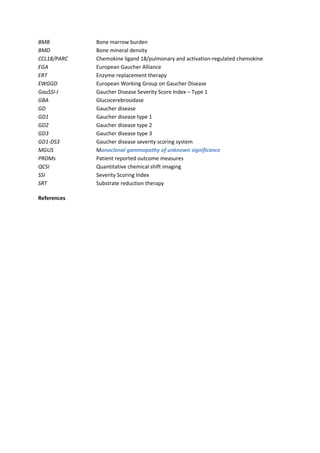
Abbreviations
BMB Bone marrow burden
BMD Bone mineral density
CCL18/PARC Chemokine ligand 18/pulmonary and activation-regulated chemokine
EGA European Gaucher Alliance
ERT Enzyme replacement therapy
EWGGD European Working Group on Gaucher Disease
GauSSI-I Gaucher Disease Severity Score Index – Type 1
GBA Glucocerebrosidase
GD Gaucher disease
GD1 Gaucher disease type 1
GD2 Gaucher disease type 2
GD3 Gaucher disease type 3
GD1-DS3 Gaucher disease severity scoring system
MGUS Monoclonal gammopathy of unknown significance
PROMs Patient reported outcome measures
QCSI Quantitative chemical shift imaging
SSI Severity Scoring Index
SRT Substrate reduction therapy
References
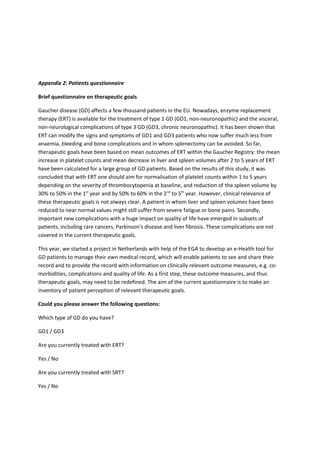
Appendix 2: Patients questionnaire
Brief questionnaire on therapeutic goals
Gaucher disease (GD) affects a few thousand patients in the EU. Nowadays, enzyme replacement
therapy (ERT) is available for the treatment of type 1 GD (GD1, non-neuronopathic) and the visceral,
non-neurological complications of type 3 GD (GD3, chronic neuronopathic). It has been shown that
ERT can modify the signs and symptoms of GD1 and GD3 patients who now suffer much less from
anaemia, bleeding and bone complications and in whom splenectomy can be avoided. So far,
therapeutic goals have been based on mean outcomes of ERT within the Gaucher Registry: the mean
increase in platelet counts and mean decrease in liver and spleen volumes after 2 to 5 years of ERT
have been calculated for a large group of GD patients. Based on the results of this study, it was
concluded that with ERT one should aim for normalisation of platelet counts within 1 to 5 years
depending on the severity of thrombocytopenia at baseline, and reduction of the spleen volume by
30% to 50% in the 1st
year and by 50% to 60% in the 2nd
to 5th
year. However, clinical relevance of
these therapeutic goals is not always clear. A patient in whom liver and spleen volumes have been
reduced to near normal values might still suffer from severe fatigue or bone pains. Secondly,
important new complications with a huge impact on quality of life have emerged in subsets of
patients, including rare cancers, Parkinson's disease and liver fibrosis. These complications are not
covered in the current therapeutic goals.
This year, we started a project in Netherlands with help of the EGA to develop an e-Health tool for
GD patients to manage their own medical record, which will enable patients to see and share their
record and to provide the record with information on clinically relevant outcome measures, e.g. co-
morbidities, complications and quality of life. As a first step, these outcome measures, and thus
therapeutic goals, may need to be redefined. The aim of the current questionnaire is to make an
inventory of patient perception of relevant therapeutic goals.
Could you please answer the following questions:
Which type of GD do you have?
GD1 / GD3
Are you currently treated with ERT?
Yes / No
Are you currently treated with SRT?
Yes / No
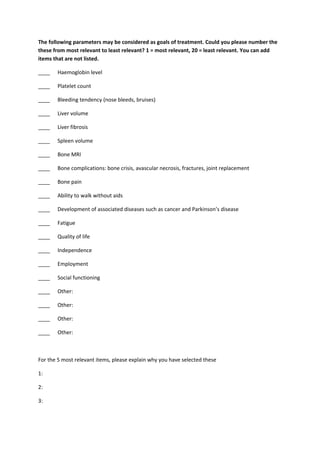
The following parameters may be considered as goals of treatment. Could you please number the
these from most relevant to least relevant? 1 = most relevant, 20 = least relevant. You can add
items that are not listed.
____ Haemoglobin level
____ Platelet count
____ Bleeding tendency (nose bleeds, bruises)
____ Liver volume
____ Liver fibrosis
____ Spleen volume
____ Bone MRI
____ Bone complications: bone crisis, avascular necrosis, fractures, joint replacement
____ Bone pain
____ Ability to walk without aids
____ Development of associated diseases such as cancer and Parkinson’s disease
____ Fatigue
____ Quality of life
____ Independence
____ Employment
____ Social functioning
____ Other:
____ Other:
____ Other:
____ Other:
For the 5 most relevant items, please explain why you have selected these
1:
2:
3:
4:
5:

Master thesis - Consensus procedure on Gaucher disease type 1

  • 1.
    Delphi study onmanagement goals for type 1 Gaucher disease Final report research internship Master Medicine Name student: A.I. Kiewiet Student number: 1745514 Date of submission: February 2nd 2016 Number of words: 6,493 Name of placement organization: Academisch Medisch Centrum (AMC) Amsterdam Address of placement organization: Meibergdreef 9, 1105 AZ, Amsterdam On-site supervisor: Dr. M. Biegstraaten (m.biegstraaten@amc.uva.nl) VU-supervisor: Dr. E.M.W. Eekhoff (emw.eekhoff@vumc.nl Master programme: Master Medicine Number of EC’s: 33
  • 2.
    Abstract Introduction: Gaucher Diseasetype 1 (GD1) is a lysosomal storage disorder leading to a variety of symptoms, such as hepatomegaly, splenomegaly, anaemia, thrombocytopenia and bone complications. The introduction of enzyme replacement therapy (ERT) has dramatically changed the phenotype of the disease. Treatment with ERT leads to significant improvements in visceral and haematological manifestations in GD1 patients. Since management of the disease for short term complications is improved and and a near-normal life expectancy is supposed, long term complicatons and diseases associated with GD1 received more attention. In general, patient reported outcome measurements (PROMs) also gained more awareness. Therefore, we aim to develop a rewened set of management goals, through a Delphi procedure among GD1 experts. Methods: A modified Delphi procedure was performed to reach consensus on management goals for GD1. All members of the European Working Group on Gaucher Disease (EWGGD) were invited to participate. Sixty-four statements, all potential management goals, were formulated based on the results of a literature review. Three rounds of surveys were sent out to discuss these statements. Participants were asked to indicate on a 5-point Likert-scale whether or not they agreed to have that statement be part of the management goals. Consensus was defined to be reached when 75% of the participants agreed and no one disagreed. Results: Consensus was reached on 39 statements in three rounds of surveys by 25 participants. These management goals include previous therapeutic goals, mainly focused on short term outcomes, and newly added goals that also involve improvement in PROMs (e.g. fatigue, social participation, quality of life) and early detection of long term complications. Conclusion and discussion: Consensus was reached on a new set of management goals for GD1, with more attention towards long-term complications, associated conditions, and PROMs. When applying this set of management goals in clinical practice the individual situation of each patient should be taken into account. 1. Introduction Gaucher disease (GD) is an autosomal recessively inherited lysosomal storage disorder with prevalence of 1:57,000 at birth [1]. It is caused by mutations in the glucocerebrosidase (GBA) gene, which leads to reduced activity of GBA and consequently to a build-up of glucosylceramide in the lysosomes of macrophages (so called ‘Gaucher cells’) [2, 3]. This accumulation of glucosylceramide can result in a multi-system disease, with a variety of symptoms. The disease is classically divided into three types. Type 1 GD (GD1) is mainly characterized by visceral manifestations, including splenomegaly, hepatomegaly, anaemia, thrombocytopenia, bone disease and growth retardation. In type 2 and type 3 GD (GD2 and GD3, respectively) there are also neurological symptoms, ranging from rapidly progressive neurological deterioration in GD2 leading to death in the first 2 years of childhood, to slowed horizontal saccadic eye movements in GD3 [4-6]. In this Delphi study, we will focus on GD1, the most common type, occurring in 95% of the GD cases [7]. Currently, two therapeutic approaches for the treatment of GD1 are used: enzyme replacement therapy (ERT) and substrate reduction therapy (SRT). Intravenously administered ERT supplements the deficient enzyme. It reaches the lysosomes from the extracellular space via endocytosis mediated by the mannose receptor, resulting in degradation of the accumulated lipids [8]. Two enzyme preparations are available in Europe: imiglucerase and velaglucerase alfa, while in the US a third
  • 3.
    enzyme has beenapproved: taliglucerase alfa [9]. ERT has been proven to be very effective in the treatment of the visceral complications of the disease [10]. Decreases in splenic and hepatic size and improvement in cytopenia are already apparent after 6 months of treatment [11]. Treatment with ERT is expensive, with yearly costs ranging from €124,000 to €258,000 per patient in the Netherlands [12]. In contrast to ERT, which increases the breakdown of the accumulated lipids, SRT reduces the amount of glucosylceramide by inhibiting its synthesis. Two compounds have been approved: miglustat and eliglustat [13, 14]. The first is only approved for mildly affected patients for whom ERT is unsuitable, e.g. in case of needle phobia or a way of life not compatible with regular intravenous infusions [15]. Side effects, predominantly gastrointestinal disturbances, have limited the clinical use of miglustat [16]. The results from the clinical trials on eliglustat are positive, and similar effectiveness when compared to ERT is assumed [13]. Although ERT has been used for over 20 years, little is known about the effectiveness of therapy on long term complications [17, 18]. Also, limited evidence is available on the effects on patient well- being and survival of GD [19, 20]. An epidemiological study showed that the life expectancy at birth in GD1 is 68.2 years, compared to 77.1 years for the reference population [20]. It should be noted, however, that at the time this study was performed, ERT had been available for approximately 15 years, which implies that many patients were not optimally treated. Therefore, the current life- expectancy is probably even higher. With a near-normal life expectancy and a good response of the short term visceral and haematological complications to ERT, and the consequent change of the disease’s phenotype, long term complications and associated disease, such as certain types of cancer [21], pulmonary hypertension [22], Parkinson’s disease (PD) [23], and metabolic syndrome [24] have gained more attention. Although conclusive studies have not yet been published, it is hypothesized that ERT could prevent or postpone at least some of the long term complications and associated diseases. It is therefore important to monitor their occurrence. Traditionally, most studies on the effectiveness of ERT/SRT have used haemoglobin levels, platelet counts and the reduction in spleen and liver volumes as primary outcome measures. Therapeutic goals are also mainly based on these parameters; an essential example in this is the list of therapeutic goals presented by Pastores et al [25]. Ideally, therapeutic goals include both primary and secondary goals with quantitative as well as qualitative items. However, in the currently used therapeutic goals the secondary, mainly qualitative health parameters that really matter to patients are lacking, such as: the improvement of quality of life [26, 27], alleviating fatigue [28] and pain [29]. This is in line with current insights to focus more on patient reported outcome measurements (PROMs). These PROMs reflect how a patient feels and functions (in contrast to laboratory values), and it is increasingly recognised that this type of information is essential in the treatment of patients [30]. With more awareness for long term complications, associated diseases and PROMs in GD1, management goals in GD1 need to be redefined. With a modified Delphi procedure we aim to develop consensus among GD1 experts on relevant management goals, with a specific focus on long- term complications, associated conditions, and patient reported outcomes. An updated set of management goals, with international agreement, is expected to serve as a basis for further research on dosage and frequency of ERT and SRT, and ultimately to improve treatment guidelines.
  • 4.
    2. Methods 2.1 Studydesign A modified Delphi procedure was used to achieve consensus on management goals for GD1 [26]. The Delphi procedure is a technique in which multiple rounds of online surveys aim at reaching consensus on a certain subject [27]. For the first round, the study team (AK, MB, CH) compiled a structured survey based on a non-systematic review of literature and a patient questionnaire. The non-systematic review of literature and results of the patient questionnaire were presented as a background document to all participants together with the first survey (see Appendix 1). By distributing this document, we aimed to provide the expert panel with up-to-date information which could be used throughout all rounds of the consensus procedure. All members of the European Working Group on Gaucher Disease (EWGGD) were invited to participate in the Delphi procedure. The surveys were administered as online questionnaires using SurveyMonkey and were repeated until all statements either reached consensus or were adequately discussed to be removed. Usually, in a modified Delphi procedure, 3 rounds of surveys are sufficient to reach consensus [26]. 2.2 Literature search A non-systematic review of the literature was performed on the basis of which the first survey was compiled. A search for currently used management goals was done, as well as for potential new management goals with specific focus on long term complications. For the currently used management goals, the Cochrane Library and databases for guidelines were searched, and a search in PubMed with the terms ‘Gaucher’, ‘consensus’ and ‘recommendation’ was done. A second search with the terms ‘Gaucher disease’ and ‘long term’ was performed to obtain information on potential new management goals. An additional search per complication was done for the identification of further relevant studies. Both searches were done in August 2015. Synonyms and MeSH terms were included in the search. Articles were assessed on title and abstract and included if they were considered relevant for the definition of management goals of GD1, being articles on current or recommended therapeutic goals, or articles which described complications of GD1 that were not part of the current therapeutic goals. Only English written articles were included. Results from the literature search can be found in Appendix 1. 2.3 Patient questionnaire Patients were invited to give their view on what they considered clinically relevant management goals. To this end, a questionnaire (see Appendix 2) was sent to the patient organisations known by the European Gaucher Alliance (EGA) in the spring of 2015. The Dutch population was contacted directly or through email in the same period. The answers from 17 respondents were analysed and used as input for the first survey. No replies were received from outside the Netherlands. Results from this patient questionnaire can also be found in Appendix 1. 2.4 Surveys Three rounds of surveys were presented to the expert panel from November 2015 until January 2016. Time to respond for each survey was two weeks. Participants were asked to indicate on a 5- point Likert-scale whether or not they agreed to include a specific statement in the management
  • 5.
    goals. This scaleincluded the following options: strongly agree, agree, neither agree nor disagree, disagree and strongly disagree. We encouraged participants to add comments to support their vote. In the first and second survey participants were invited to suggest additional, possibly relevant goals. In the first survey a total of 64 statements (i.e. potential management goals) were presented, including all therapeutic goals previously presented by Pastores et al [25]. The statements were divided into the following 11 categories: general well-being, fatigue, bleeding tendency, mobility, visceral complications, pulmonary complications, malignancies, metabolic complications, neurological complications, disease severity scores and biochemical markers. In each survey, these categories were divided into short term and long term complications. After each round, the responses were analysed and statements were removed, amended or repeated without revision; new statements were added as suggested by the participants. Statements were not repeated if consensus to include the statement was reached. Statements were removed when the study team thought it very unlikely, based on a significant number of participants who disagreed, or the comments raised by one or more participants, that the panel would reach consensus on that statement in the next round, even if the statement was amended. Although the removed statements were not voted on in the next round, they were presented in the survey to give participants full insight in choices made by the study team. Statements were amended based upon the comments raised when considered beneficial. If the argumentation of the participants who disagreed was considered insufficient to either remove or revise the statement, this statement was repeated without amendment. Arguments used by the study team for this were: comments were unclear or missing, or only one participant disagreed. Along with the second and third round, participants were provided with anonymized results of the previous round, consisting of absolute scores and comments, and argumentation used by the study team to amend the survey. In the second round the argumentation was presented in an e-mail with general remarks and in the third survey arguments were given per statement, including the most important comments of the participants. Statements that did not reach consensus after the third round were removed. Finally, the results were presented to the participants as a manuscript for review and final approval. 2.5 Data analysis Consensus was defined to be reached when 75% of the participants agreed on inclusion of that statement in the management goals, and no one disagreed [31, 32]. To investigate whether there was an effect of the number of patients the physician takes care of, a chi-squared test for trend was performed. To this end, the data was split into three groups, based upon the number of patients treated by the physicians. In the first survey 7 physicians indicated that they follow <15 patients in their centre, 8 physicians reported 15-100 patients and another 8 physicians >100 patients. For the analysis the answer options ‘strongly agree’ and ‘agree’ were combined as well as ‘strongly disagree’ and ‘disagree’. The groups were compared for how frequently they agreed or disagreed with a statement. Participants were removed from this analysis if >10% of the values were missing. The chi- squared test for trend was performed using SPSS Statistics 22.0 [33]. A p-value of less than 0.05 was considered statistically significant.
  • 6.
    3. Results 3.1 Participants All35 members of the EWGGD, physicians and scientists, were invited to participate in this procedure and received the background document (see Appendix 1) together with a link to the first online survey. Twenty-five of the 35 members participated in this consensus procedure. Nineteen participants completed all 3 rounds, and 6 participants completed 2 out of 3 rounds. Participants represented the following countries: Greece, Portugal, Germany, Israel, Spain, France, Italy, Sweden, United States of America, United Kingdom, Norway, Bosnia and Herzegovina, Australia, Russia and Poland. All participants indicated that therapeutic goals are necessary in daily clinical practice. Participants from the first survey treat an average of 92 patients, ranging from 2 to 600, and 5 of the 23 participants are paediatricians. 3.2 Delphi procedure The first survey consisted of 64 statements. Agreement was achieved on 15 out of 64 statements and 12 statements were removed for which agreement was not reached, because it was very unlikely consensus would be reached in the next round. Twenty-nine statements were rephrased according to the suggestions of the participants. Some statements were combined into one statement. Nine statements were repeated without amendments. Participants’ suggestions included 8 new statements which were also presented in the second survey. Finally, the second survey consisted of 40 statements. In the second survey the panel reached consensus on 4 statements and 14 statements were removed. Nine statements were amended based upon the comments given. Thirteen statements were repeated without amendments. Three new statements, all proposed by the participants, were added to the third survey. The third survey consisted of 25 statements. In the third survey, consensus was reached for 20 statements and 5 statements were removed. There was agreement on a total of 39 statements after three surveys. 3.3 Comparing groups In Table 1 mean percentages are given, per group and per survey, for how frequently each answer options was given, with the answer options ‘strongly agree’ and ‘agree’ as well as ‘strongly disagree’ and ‘disagree’ combined. The chi-squared test for trend was used to compare the three groups for mean frequency of agreeing and disagreeing with the statement per survey. The first survey revealed a significant difference per group for the frequency of agreeing with the statements, χ2 trend(1, N = 22) = 3.957, p = 0.047: participants who treat >100 patients voted less frequently ‘agree’or ‘strongly agree’ compared to participants treating <15 and 15-100 patients (see Table 1). The second and third survey showed no differences between groups.
  • 7.
    Table 1: Comparinggroups; frequency table Answer option <15 patients 15-100 patients >100 patients Survey 1 2 3 1 2 3 1 2 3 Mean % per answer option (Strongly) agree 83,4% 73,2% 92,0% 83,7% 63,8% 95% 65,8% 71,4% 91,4% Neither agree nor disagree 11,6% 9,4% 7,3% 13,1% 11,7% 3% 16,4% 13,9% 5,7% (Strongly) disagree 4,0% 5,9% 0,7% 2,7% 7,9% 2% 11,3% 13,2% 1,1% Missing 0,9% 10,6% 9,7% 0,4% 15,8% 0% 6,4% 1,1% 1,7% 3.4 Management goals for which consensus was achieved The 39 management goals for which consensus was reached are presented in Table 2 and 3. There was confusion among participants about management goals that were not related to ERT/SRT. To clarify this, the list of management goals has been split, based on whether or not the goals are ERT/SRT related. Table 2 displays management goals that for which an effect of treatment with ERT or SRT is assumed. Table 3 presents management goals that are not related to ERT/SRT, but focus more on overall management of the disease. Table 2: Management goals for Gaucher disease type 1 – ERT/SRT related Subject Item Consensus reached after round Anaemia related symptoms Increase haemoglobin levels within 12 to 24 months to >11.0 g/dL for women and children and >12.0 g/dL for men (Source: Pastores et al 2004) 1 Eliminate blood transfusion dependency (Source: Pastores et al 2004) 1 Maintain improved haemoglobin values achieved after the first 12 to 24 months of therapy (Source: Pastores et al 2004) 1 Bleeding tendency Increase platelet counts during the first year of treatment sufficiently to prevent surgical, obstetrical, and spontaneous bleeding (Source: Pastores et al 2004) 1 In patients with splenectomy: normalization of platelet count by 1 year of treatment (Source: Pastores et al 2004) 3 Maintain platelet count of ≥100,000/mm³ (Adapted from: Pastores et al 2004) 3 Reduce increased bleeding tendency, whether caused by low platelet numbers, platelet defects or coagulation abnormalities (Adapted from: Hughes et al 2007, Hollak and Weinreb 2015, input from patients, national guidelines) 3 Mobility Attain normal or ideal peak skeletal mass in children (Source: Pastores et al 2004) 1 Prevent bone complications: avascular necrosis, bone crises, bone infarcts and pathological fractures (Sources: Hollak and Weinreb 2015, input from patients, national guidelines, PubMed search) 1 Increase physical activity (Source: Hollak and Weinreb 2015) 1 Prevent osteopenia and osteoporosis (i.e. maintain BMD T-scores (DEXA) of >-1) (Sources: Hollak and Weinreb 2015, PubMed search) 2 Maintain normal mobility or, if impaired at diagnosis, improve mobility (Adapted from: Hollak and Weinreb 2015) 2 Lessen bone pain that is not related to irreversible bone disease within 1 to 2 years (Adapted from: Pastores et al 2004) 3 Increase bone mineral density (BMD) by 2 years in adults for patients with a T-score 3
  • 8.
    below -2.5 atbaseline (Adapted from: Pastores et al 2004) Normalize growth such that the height of the patient is in line with target height, based upon population standards and parental height, within 2 years of treatment (Adapted from: Pastores et al 2004) 3 Decrease bone marrow involvement, as measured by a locally used scoring system (e.g. Bone Marrow Burden (BMB) score or Düsseldorf Gaucher Score (DGS)) in patients without severe irreversible bone disease at baseline 3 Prevent chronic use of analgesic medication for bone pain (Adapted from: Hollak and Weinreb 2015) 3 Visceral complications Alleviate symptoms due to splenomegaly: abdominal distension, early satiety, new splenic infarction (Source: Pastores et al 2004) 1 Eliminate hypersplenism (Source: Pastores et al 2004) 1 Avoid splenectomy (may be necessary during life threatening haemorrhagic events) (Source: Pastores et al 2004) 1 Reduce spleen volume to <2 to 8 times normal (or in absence of volume measurement tools reduce spleen size) by year 1-2, depending on baseline spleen volume (Adapted from: Pastores et al 2004) 2 Maintain spleen volume of <2 to 8 times normal after year 1-2 3 Reduce the liver volume to 1.0 to 1.5 times normal (or in absence of volume measurement tools aim for normal liver size) by year 1-2, depending on baseline liver volume (Adapted from: Pastores et al 2004) 3 Maintain (near) normal liver volume after year 1-2 (Adapted from: Hollak and Weinreb 2015) 3 Prevent liver fibrosis, cirrhosis and portal hypertension (Sources: Hollak and Weinreb 2015, input from patients, national guidelines, PubMed search) 3 Pulmonary complications Prevent or improve pulmonary disease, such as pulmonary hypertension and hepatopulmonary syndrome (Adapted from: Pastores et al 2004) 3 General well- being Improve scores from baseline of a validated quality-of-life instrument within 2 to 3 years or less depending on disease burden (Source: Pastores et al 2004) 1 Improve or restore physical function for carrying out normal daily activities and fulfilling functional roles (Source: Pastores et al 2004) 1 Maintain good quality of life as measured by a validated instrument (Sources: Hollak and Weinreb 2015, input from patients, national guidelines) 1 Maintain normal participation in school and work activities (Source: Hollak and Weinreb 2015) 1 Achieve normal onset of puberty (Source: Pastores et al 2004) 1 Normalize life expectancy 2 Reduce fatigue (not anaemia related) as measured by a validated fatigue scoring system (Adapted from: Hollak and Weinreb 2015, input from patients) 3 Minimize psychosocial burdens of life-long treatment (Adapted from: Hollak and Weinreb 2015) 3 Pregnancy and delivery Prevent GD related complications during pregnancy and delivery 3 Abbreviations: BMD = bone mineral density, DEXA = dual energy X-ray absorptiometry, ERT = enzyme replacement therapy, GD = Gaucher disease, SRT = substrate reduction therapy.
  • 9.
    Table 3: Managementgoals for Gaucher disease type 1 – not ERT/SRT related Abbreviations: ERT = enzyme replacement therapy, SRT = substrate reduction therapy. Most statements derived from the set of therapeutic goals presented by Pastores et al [25] again reached agreement. Participants requested an amendment for some of these therapeutic goals before consensus was found. ‘Lessen or eliminate bone pain within 1 to 2 years’, for example, was changed to ‘Lessen bone pain that is not related to irreversible bone disease within 1 to 2 years’, since participants indicated that a choice should be made between lessen or eliminate, and that this goal is not achievable for irreversible bone disease. In compliance with statements on prevention of complications, such as splenectomy or pulmonary disease, presented as therapeutic goals by Pastores et al [25], new goals were added on, for example, prevention of liver fibrosis, cirrhosis and portal hypertension, and prevention of bone complications. Further, new goals included improvement in PROMs (e.g. fatigue, social participation, quality of life) and early detection of long term complications. 3.4.1 Goals related to ERT/SRT treatment In the first round, agreement was reached on improving classical symptoms, such as normalization of haemoglobin, increasing platelet count and to alleviate symptoms due to splenomegaly. These statements were considered valuable as management goals, since treatment with ERT or SRT has the potential to improve these outcomes. Goals for which the effect of ERT or SRT, as known from literature and clinical experience, is more divergent, were more extensively discussed. The panel emphasized the importance of a proper differential diagnoses of symptoms or complications described in the management goals before starting treatment or changing the dosage. For example, in case of ongoing anaemia despite ERT/SRT treatment, other causes, such as iron deficiency or auto immune haemolytic anaemia, should be explored. 3.4.2 Goals not directly related to ERT/SRT treatment Consensus was reached on 4 statements about early detection of long term complications and associated diseases. These goals are not directly related to treatment with ERT/SRT, therefore participants profoundly debated these statements since previous set of goals were exclusively focused on therapeutic management. In the end, it was agreed that this consensus procedure is about management of GD1 and is not confined to therapeutic goals. Participants indicated that not all long term complications and associated disease have benefit form early detection. Early detection Subject Statement Consensus reached after round Early detection of long term complications Early detection of haematological malignancies, including multiple myeloma, lymphoma and amyloidosis (Sources: Hollak and Weinreb 2015, Hughes et al 2007, input from patients, national guidelines, PubMed search) 3 Early detection of solid tumours, including hepatocellular carcinoma and renal cell carcinoma (Sources: Hollak and Weinreb 2015, input from patients, national guidelines, PubMed search) 3 Early detection of parkinsonism/Parkinson disease (Sources: Hollak and Weinreb 2015, input from patients, national guidelines, PubMed search) 3 Early detection of insulin resistance and type 2 diabetes mellitus (Source: PubMed search) 3
  • 10.
    was found valuablein case of solid tumours, such as hepatocellular carcinoma, parkinsonism/Parkinson disease, haematological malignancies, and insulin resistance and type 2 diabetes mellitus. In these cases early detection provides the opportunity of an early start of treatment and thereby might result in a better outcome for patients. 3.4.3 Discussion by panel on goals for which consensus was reached Several statements on bleeding tendency were discussed before reaching consensus. Other causes besides low platelet count can be present for increased bleeding tendency [34, 35]. Although participants indicated that it might be difficult to diagnose and prevent, they eventually reached consensus on the statement ‘Reducing bleeding tendency, whether caused by low platelet numbers, platelet defects or coagulation abnormalities’. Also, the goal with respect to platelet count was debated. As an increase described in a 1.5 to 2.0 fold change in platelet count was found too arbitrary, a target count of ≥100,000/mm³ was discussed. Although maintaining a target count of ≥100,000/mm³ did eventually reach consensus, this was not the case for achieving this aim in the first years after starting treatment. Almost all participants, agreed to reach for a target count of ≥100,000/mm³ in the first years of treatment as well, however, one participant disagreed and commented to strive for normalisation. Statements on mobility that needed more than one round before reaching consensus involved statements for which specific measuring techniques are needed. These techniques are used to measure presence and severity of bone disease, such as the bone mineral density (BMD) score and the bone marrow burden (BMB) score. The usefulness of these techniques and the time period necessary to reach the goal were discussed. After several amendments, such as changing the statement on BMB score to a more general statement ‘to decrease bone marrow involvement, as measured by a locally used scoring system’, most statements reached consensus. Further, it was debated if lessening bone pain was achievable for all patients. This was found achievable in all cases, except for irreversible bone disease. The statement was therefore amended accordingly. Statements on liver and spleen focused on reducing organ volumes in the first round, but based on the comment that techniques needed to measure volumes are not available in all centers, we added that the aim could also be to reduce organ size, which can be measured with more simple techniques. Reducing fatigue was considered an important goal, although participants indicated that it is difficult to measure and to know whether it is GD-related. After the addition that this should be measured by a validated fatigue scoring system, participants reached consensus. 3.5 Statements for which no consensus was achieved Statements for which no consensus was achieved, are presented in Table 4.
  • 11.
    Table 4: Statementsfor which no consensus was achieved Subject Statement Removed after round Anaemia related symptoms Prevent iron deficiency anaemia (Source: Hughes et al 2007) 1 Reduce anaemia related symptoms: fatigue, dyspnoea and angina (Adapted from: Pastores et al 2004) 2 Bleeding tendency In patients with an intact spleen: achieve platelet count of ≥100,000/mm³ by 3 years of treatment (Adapted from: Pastores et al 2004) 3 Mobility Maintain normal vitamin D levels (Sources: Hollak and Weinreb 2015, PubMed search) 1 Decrease femoral or lumbar BMB score with ≥2 points (Source: PubMed search) 1 Prevent the need for orthopaedic surgery (Sources: Hollak and Weinreb 2015, national guidelines, PubMed search) 1 In centres where QCSI-technique is available: achieve QCSI fat fraction of >23% (Sources: national guidelines, PubMed search) 2 Increase cortical and trabecular bone mineral density (BMD) Z-score by year 2, in children with a clinical significant fracture history with, but not mandating, a BMD Z- score below -2 at baseline (Adapted from: Pastores et al 2004) 3 Visceral complications Reduce the liver volume by 20% to 30% within year 1 to 2 and by 30% to 40% by year 3 to 5 (Source: Pastores et al 2004) 1 Reduce the spleen volume by 30% to 50% within year 1 and by 50% to 60% by year 2 to 5 (Source: Pastores et al 2004) 1 Prevent cholelithiasis and cholecystitis (Sources: Hollak and Weinreb 2015, PubMed search) 1 Normalize transaminase levels (Source: national guidelines) 2 Disease severity scores Stabilize or decrease of Zimran SSI score (Source: PubMed search) 1 Stabilize or decrease of GauSSI-I score (Source: PubMed search) 1 Stabilize or decrease of GD1-DS3 score (Source: PubMed search) 1 General well-being Eliminate depression (Source: Hollak and Weinreb 2015) 1 Maintain independency (Source: input from patients) 2 Biochemical markers Stabilize chitotriosidase activity with no more than 30% increase (Sources: national guidelines, PubMed search) 1 Decrease in chitotriosidase activity of 90% in 5 years. In case of chitotriosidase deficiency, use CCL18/PARC (Sources: national guidelines, PubMed search) 2 Reduce serum ferritin levels (Source: PubMed search) 2 Early detection of long term complications Early detection of monoclonal gammopathy of unknown significance (MGUS) (Sources: Hollak and Weinreb 2015, PubMed search) 2 Early detection of peripheral neuropathy (Sources: input from patients, national guidelines, PubMed search) 2 Additional goals Decrease the risk of atherogenesis by achieving a normal lipid profile 2 Normalise vitamin B12 levels 2 Decrease serum y-globulins by 20% after 2 years of ERT 2 Normalize polyclonal immunoglobulin profile 2 Decrease acute phase reaction with serum ferritin, fibrinogen and CRP used as markers 2 Normalize cancer incidence 2 Early detection of signs and symptoms indicative of GD3, such as eye movement abnormalities 3
  • 12.
    Proper education ofthe patient and his family about the disease and therapy 3 Early detection of autoimmune diseases, such as idiopathic thrombocytopenic purpura (ITP) and autoimmune haemolytic anaemia (AIHA) 3 Abbreviations: BMB = bone marrow burden, CCL18/PARC = chemokine ligand 18/pulmonary and activation-regulated chemokine, CRP = C- reactive protein, ERT = enzyme replacement therapy, GauSSI-I = Gaucher Disease Severity Score Index – Type 1 , GD1-DS3 = Gaucher disease severity scoring system , GD3 = Gaucher disease type 3, QCSI = Quantitative chemical shift imaging, SSI = Severity Scoring Index. Statements were removed for the following reasons: the complication has a high prevalence in the general population, thereby making it difficult to relate the complication to GD1; the goal was not achievable for a large patient group; or the supporting evidence was considered too limited/weak. For disease severity scores and biochemical markers none of the statements reached consensus. Three different disease severity scoring systems are currently available: the Severity Scoring Index (SSI) [36], the Gaucher Disease Severity Score Index – Type 1 (GauSSI-I) [37], and the Gaucher disease severity scoring system (GD1-DS3) [38]. None of these scoring systems so far have been validated for general use. Therefore, and because scoring systems represent several statements already taken into account, participants did not agree to add reducing scores from the different scoring systems to the list of management goals. Various biomarkers reflecting disease severity have been studied. Currently, the strongest evidence exists for chitotriosidase [39], chemokine ligand 18/pulmonary and activation-regulated chemokine (CCL18/PARC) [40, 41] and ferritin [42]. In the end, participants considered these biomarkers to be too unreliable as stand-alone goals and therefore no consensus was reached on these statements. As previously stated, several statements on the early detection of long term complications were debated. Early detection of monoclonal gammopathy of unknown significance (MGUS) and of peripheral neuropathy were considered to be more harmful than beneficial to the patient. Diagnosing MGUS is important as it can progress to multiple myeloma [43], suggesting that early detection of MGUS might be relevant. However, participants indicated that early detection of MGUS will only increase the period of follow-up and might even lead to more distress for patients. As there is no treatment for MGUS, it was emphasized that no benefit for early detection exists. Early detection of peripheral neuropathy was seen as good clinical practice. However, several participants who disagreed doubted whether early detection would lead to an improvement of outcome since no treatment for peripheral neuropathy is available. 4. Discussion 4.1 Summary of results The aim of this Delphi procedure was to develop a set of internationally supported management goals with a specific focus on long-term complications, associated conditions, and patient reported outcomes. Participants in this consensus procedure are all experts in GD1. Twenty-five of the 35 EWGGD members participated. The members who decided not to participate were mainly scientists who considered their experience insufficient to take part in this clinical study. Therefore, the results of this study represent the view of large group of European GD experts. Three rounds of surveys were needed to reach consensus on short term and long term management goals. The short term, easily measurable management goals, are consistent with the previously reported and currently used goals by Pastores et al [25]. The patients’ perspective has been taken
  • 13.
    into account inthis consensus procedure as well. Patients indicated quality of life, independence and associated diseases to be very important. In comparison to previous therapeutic goals, this study added new management goals on PROMs, associated diseases and long term complications. Management of the disease is first and foremost intended to serve the patient. With the current treatment modalities by which many of the short term symptoms can be reversed, long term management goals have become equally important for patients. The panel emphasized that individualization of treatment is necessary. Baseline characteristics, severity of disease, and the period between diagnosis and start of treatment all need to be taken into account when tailoring the goals to the individual patient. The presented list of management goals is achievable for patients with minimal organ and bone involvement. However, patients can present with irreversible symptoms, such as avascular necrosis, making it difficult or even impossible to reach the mobility goals as presented. This especially accounts for patients who were diagnosed with GD before ERT was introduced. In addition, it was emphasized that physicians should always consider the differential diagnosis, especially when the management goals are not achieved. For example, if no increase in platelet count is seen during treatment with ERT, other causes such as idiopathic thrombocytopenic purpura should be explored. A group difference was found in the first survey for how frequent participants agreed with a statement. Participants treating >100 patients voted less frequently ’agree’or ‘strongly agree’ in the first survey than participants treating <15 or 15-100 patients. However, as no group differences were found in the second and third survey, it is not expected to have influenced the results. 4.2 Comparison with literature Almost all previously accepted therapeutic goals again reached agreement [25]. Opinions on short term management goals therefore do not seem to have changed much over the last decade. Recommendations for additional therapeutic goals presented by Hollak and Weinreb [35] and Hughes et al [34] were discussed as well as statements based upon the literature review. Previous literature on management goals is therefore well represented in this consensus procedure. 4.3 Explanation results The list of management goals we present has a broader scope than the previously reported therapeutic goals. We expect that it can serve as an important basis for managing the disease. Because this list of management goals is widely supported, it can provide a physician with argumentation to start, stop or change a certain treatment. Therefore, full initial assessment and regularly follow-up are required to adequately implement the management goals presented. The collection of this data can also be used for research purposes. For example, to study the frequency and dosage of ERT and SRT. The list of management goals also covers subjects found most important by patients, which might improve therapeutic compliance. Especially since the management goals provide a method to educate patients and their families, generating feasible expectations. No consensus was reached on the statement to achieve a platelet count of ≥100,000/mm³, as opposed to maintain a platelet count of ≥100,000/mm³, after the first years of treatment. The study team recognizes this as an important issue. ERT and SRT have a significant effect on platelet count
  • 14.
    [44] and thereforea goal should be formulated. Consequently, further discussion will follow on this statement to reach consensus on this subject. 4.4 Strengths and limitations The Delphi procedure has become a widely-used tool in consensus procedures. However, there are some limitations to such a procedure [45]. First, no clear-cut guidelines exist with respect to cut-off values. In our study, we used strict criteria (at least 75% agreement, and no disagreement) which sometimes resulted in the removal of an item even if only a very limited number of participants disagreed. We still believe, however, that such strict criteria are needed in order to retain broad support for the set of management goals. Second, the decision to remove or amend a statement was made by the study team, and a certain amount subjectivity cannot be excluded. To overcome this problem as well as possible, the analysis of each round was done by 3 researchers, and decisions were made transparent to participants by presenting in each round all accepted, amended and removed statements. Third, no direct discussion was possible between participants which might have influenced voting behaviour. Although direct contact might increase the number of arguments and could reduce the influence of the study team, an important strength of the study is the anonymity of the participants. Therefore, voting reflects the opinion of the participants themselves and group opinion has not been influenced by hierarchical structures. Another strength of the study is that the group of experts have different backgrounds, thereby representing a broad range of expert opinions. 4.5 Recommendations for future research Because GD is a complex disease, not all complications and symptoms are fully understood. Also, we expect that more and more interest will go out to the long term outcomes of the disease, since ERT and SRT have such a good effect on the short term symptoms of the diseaee. Therefore, this document needs reconsideration as soon as relevant new evidence becomes available. 5. Conclusion A set of 39 management goals for GD1 was developed with the use of a modified Delphi procedure. The goals presented are expected to serve as a basis for further research on dosage and frequency of ERT and SRT, and ultimately to improve treatment guidelines, which may benefit all patients with GD1. With the complexity of the disease, and limited knowledge on the long term outcomes and PROMs, the current set of management goals should be reconsidered as soon as relevant new evidence is available. Funding The study was funded by ZonMw, and no funding was received from pharmaceutical companies. Conflict of interest None of the authors stated a conflict of interest. Abbreviations
  • 15.
    BMB Bone marrowburden BMD Bone mineral density CCL18/PARC Chemokine ligand 18/pulmonary and activation-regulated chemokine EGA European Gaucher Alliance ERT Enzyme replacement therapy EWGGD European Working Group on Gaucher Disease GauSSI-I Gaucher Disease Severity Score Index – Type 1 GBA Glucocerebrosidase GD Gaucher disease GD1 Gaucher disease type 1 GD2 Gaucher disease type 2 GD3 Gaucher disease type 3 GD1-DS3 Gaucher disease severity scoring system MGUS Monoclonal gammopathy of unknown significance PROMs Patient reported outcome measures QCSI Quantitative chemical shift imaging SSI Severity Scoring Index SRT Substrate reduction therapy References
  • 16.
    Appendix 2: Patientsquestionnaire Brief questionnaire on therapeutic goals Gaucher disease (GD) affects a few thousand patients in the EU. Nowadays, enzyme replacement therapy (ERT) is available for the treatment of type 1 GD (GD1, non-neuronopathic) and the visceral, non-neurological complications of type 3 GD (GD3, chronic neuronopathic). It has been shown that ERT can modify the signs and symptoms of GD1 and GD3 patients who now suffer much less from anaemia, bleeding and bone complications and in whom splenectomy can be avoided. So far, therapeutic goals have been based on mean outcomes of ERT within the Gaucher Registry: the mean increase in platelet counts and mean decrease in liver and spleen volumes after 2 to 5 years of ERT have been calculated for a large group of GD patients. Based on the results of this study, it was concluded that with ERT one should aim for normalisation of platelet counts within 1 to 5 years depending on the severity of thrombocytopenia at baseline, and reduction of the spleen volume by 30% to 50% in the 1st year and by 50% to 60% in the 2nd to 5th year. However, clinical relevance of these therapeutic goals is not always clear. A patient in whom liver and spleen volumes have been reduced to near normal values might still suffer from severe fatigue or bone pains. Secondly, important new complications with a huge impact on quality of life have emerged in subsets of patients, including rare cancers, Parkinson's disease and liver fibrosis. These complications are not covered in the current therapeutic goals. This year, we started a project in Netherlands with help of the EGA to develop an e-Health tool for GD patients to manage their own medical record, which will enable patients to see and share their record and to provide the record with information on clinically relevant outcome measures, e.g. co- morbidities, complications and quality of life. As a first step, these outcome measures, and thus therapeutic goals, may need to be redefined. The aim of the current questionnaire is to make an inventory of patient perception of relevant therapeutic goals. Could you please answer the following questions: Which type of GD do you have? GD1 / GD3 Are you currently treated with ERT? Yes / No Are you currently treated with SRT? Yes / No
  • 17.
    The following parametersmay be considered as goals of treatment. Could you please number the these from most relevant to least relevant? 1 = most relevant, 20 = least relevant. You can add items that are not listed. ____ Haemoglobin level ____ Platelet count ____ Bleeding tendency (nose bleeds, bruises) ____ Liver volume ____ Liver fibrosis ____ Spleen volume ____ Bone MRI ____ Bone complications: bone crisis, avascular necrosis, fractures, joint replacement ____ Bone pain ____ Ability to walk without aids ____ Development of associated diseases such as cancer and Parkinson’s disease ____ Fatigue ____ Quality of life ____ Independence ____ Employment ____ Social functioning ____ Other: ____ Other: ____ Other: ____ Other: For the 5 most relevant items, please explain why you have selected these 1: 2: 3:
  • 18.