Everything You Need to Know About Project Budgeting
This blog will show you how to master estimation, real-time tracking, and agile budget adjustments using Orangescrum’s robust project management software.
Everything You Need to Know About Project Budgeting
1.
1
2011-2025 Orangescrum ResearchLab, San Jose, California | www.orangescrum.com
Project budgeting is more than just crunching numbers — it’s the lifeblood of
every successful project. Yet according to PMI, nearly 1 in 3 projects exceed their
original budgets due to poor estimation, lack of tracking, or inadequate adjustments.
In a world where every dollar counts, poorly managed budgets can lead to overrun
timelines, unhappy clients, and reduced profit margins. That’s why getting project
budgeting right — from start to finish — is essential.
2.
2
2011-2025 Orangescrum ResearchLab, San Jose, California | www.orangescrum.com
This blog will show you how to master estimation, real-time tracking, and agile
budget adjustments using Orangescrum’s robust project management software.
You’ll discover how the right digital tools help teams forecast better, monitor
spending proactively, and respond to financial risks before they escalate.
Why Project Budgeting Matters in
Business
Whether you’re running a marketing agency or managing product development,
project budgeting impacts your bottom line. Without it, even the most well-planned
initiatives can spiral out of control.
3.
3
2011-2025 Orangescrum ResearchLab, San Jose, California | www.orangescrum.com
So why should businesses care?
Uncontrolled spending leads to budget blowouts and reduced profits.
Lack of visibility causes delays, last-minute compromises, and misaligned
teams.
Reactive corrections cost more than proactive planning.
Who benefits most from effective budgeting?
Professional service firms use detailed budgets to avoid scope creep and
deliver profitable client work.
Marketing teams align ad spend, creative output, and freelance costs using
budget forecasts.
Product teams estimate R&D and QA costs, ensuring timely releases within
budget constraints.
With an integrated project collaboration software like Orangescrum, all budget
elements — from task assignments to billing — live in one place. You get full visibility
and control over how time and money are being spent.
4.
4
2011-2025 Orangescrum ResearchLab, San Jose, California | www.orangescrum.com
Best Practices & Actionable Strategies for Project
Budgeting
Let’s dive into how to budget smarter from day one.
Do’s and Don’ts
Do create a clear work breakdown structure (WBS) to assign costs to every
task. Orangescrum helps you plan scope, estimate hours, and apply hourly rates at
each phase.
Don’t make guesses. Avoid vague numbers like “a couple of days” — get granular
with cost-per-task estimates and assigned responsibilities.
Do track hours and costs using a time tracking tool. Live timers and manual logs feed
directly into your budget dashboard for real-time updates.
Don’t overlook small tasks. Forgotten deliverables often accumulate hidden costs —
track everything.
Do review the variance weekly. Orangescrum’s real-time reports show how close you
are to budget thresholds and alert you when you’re at risk of overspending.
Don’t reconcile budgets only at the end. Make rolling adjustments based on live data
to stay on target.
5.
5
2011-2025 Orangescrum ResearchLab, San Jose, California | www.orangescrum.com
Best Practices for Seamless Project Budgeting
Use budget templates for recurring projects. Save time and improve
forecasting accuracy with reusable structures.
Set up threshold alerts. Automatically notify project leads when spending
crosses 75% or 90% of the planned budget.
Integrate with task management tools. Orangescrum syncs budget values
with evolving tasks — helping you adjust cost estimates on the fly.
Tag billable tasks. Link time entries directly to client invoices for accurate
billing and reporting.
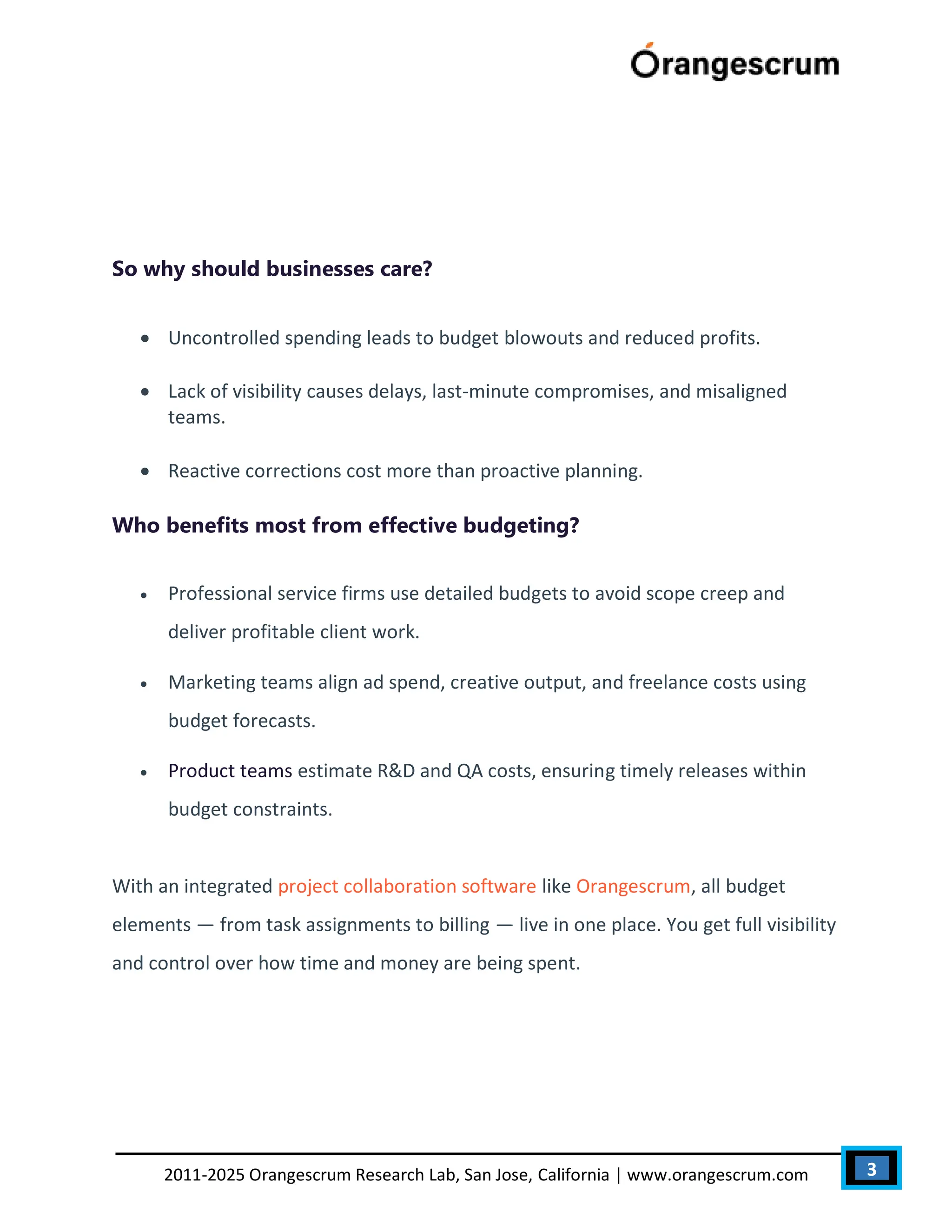
6-Step Framework for Better Budget Control
1. Define scope & structure: Break the project into tasks with cost and hour
estimates.
2. Establish a baseline budget: Enter all planned hours and cost rates
into Orangescrum.
3. Start tracking: Use the time tracking tool to record time as work happens.
4. Monitor progress: Watch real-time budget utilization via visual dashboards.
5. Adjust dynamically: Reallocate time or reduce scope if budget burn is too fast.
6.
6
2011-2025 Orangescrum ResearchLab, San Jose, California | www.orangescrum.com
6. Report & close: Generate end-of-project budget reports — compare forecasts
to actuals and document lessons learned.
When done through an all-in-one project management software, this process brings
total transparency to teams, stakeholders, and clients.
Customer Story: Acme Marketing
Acme Marketing, a fast-growing digital agency, struggled with inconsistent budgeting
across its campaign teams. By switching to Orangescrum, they implemented
standard project budgeting templates for content creation, design, and paid ads.
Each freelancer’s hourly rate was mapped to specific deliverables. As team members
logged time, project leads got real-time alerts when costs neared predefined
thresholds.
The results?
50% fewer budget meetings thanks to automatic reporting.
Variance dropped from 20% to just 5%.
Client retention increased by 30%, driven by transparent cost communication.
This case shows how integrating task management, time tracking, and budgeting
tools into one platform drives performance and trust.
Key Takeaways & Summary
7.
7
2011-2025 Orangescrum ResearchLab, San Jose, California | www.orangescrum.com
Effective project budgeting isn’t optional — it’s essential. With the right tools, your
team can:
Estimate tasks accurately using detailed structures
Track budgets in real time
Adjust spending before it’s too late
Communicate clearly with stakeholders
Orangescrum brings together time tracking, task management, and budget
visibility — all in one smart project collaboration software. Start small, stick to the
basics, and evolve as you go.
FAQs
8.
8
2011-2025 Orangescrum ResearchLab, San Jose, California | www.orangescrum.com
1. What’s the difference between a project budget and a project estimate?
An estimate is a rough prediction of project costs at the planning stage, while a
budget is a finalized financial plan that includes allocated resources, contingency, and
cost tracking for execution.
2. How detailed should a project budget be?
The more detailed, the better. Break your budget down by task, resource, and time
duration. A clear work breakdown structure (WBS) allows for precise tracking and
helps avoid oversights.
9.
9
2011-2025 Orangescrum ResearchLab, San Jose, California | www.orangescrum.com
3. What if my project goes over budget?
Going over budget isn’t always a failure — but it needs immediate corrective action.
Use real-time budget variance tracking, reassess your scope, or adjust allocations.
Orangescrum allows agile mid-project adjustments to reduce impact.
4. How does time tracking impact project budgeting?
Time tracking feeds real-time data into your budget dashboards, helping you
understand where hours (and money) are being spent. This ensures more accurate
billing and proactive budget control.
5. Can project budgeting be automated?
Yes, partially. With tools like Orangescrum, you can automate time tracking, budget
alerts, cost calculation based on task effort, and even invoice generation based on
billable hours.
6. What’s a baseline budget, and why is it important?
A baseline budget is the original, approved financial plan for a project. It serves as a
benchmark to measure actual spending and helps identify variances early.
7. How often should I review my project budget?
At least weekly. Regular reviews help catch overspending early and allow agile
corrections. Orangescrum’s live dashboards make this process continuous and
proactive.
10.
10
2011-2025 Orangescrum ResearchLab, San Jose, California | www.orangescrum.com
8. How do I handle unexpected costs in a project?
Build a contingency buffer into your budget during planning. If unexpected costs
arise, analyze whether to reallocate the budget, reduce the scope, or negotiate with
stakeholders based on real-time data.
9. Is Orangescrum suitable for both small and large projects?
Absolutely. Orangescrum is flexible — ideal for freelancers, small teams, and large
enterprises. You can start with basic budget tracking and scale up with templates,
reports, and integrations.
10. Can I link client billing directly to project budgets?
Yes. With Orangescrum, billable tasks and time entries can be directly mapped to
invoices, ensuring accurate and transparent client billing tied to real work done.