Seismic Response of Braced Frames with
Slotted-Bolted Friction Dampers
Considering Limited Slip
Assawin Wanitkorkul
Advisor: Prof. Panitan Lukkunaprasit
Outlines
• Introduction
• Objectives, scopes, research significance
• Experiments
• Enhanced slotted-bolted connection
• Mathematical model
• Numerical studies
• Conclusions
Introduction
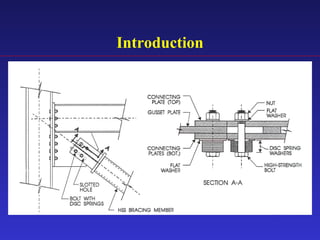
• Slotted-bolted connection (SBC)
– low-cost friction dampers
– simplicity
– effective to be used as seismic protection
devices (Fitzgerald et al., 1989; Grigorian et al.,
1993; Tremblay and Stiemer, 1993)
– suitable for developing countries
Introduction
Problems
• Past studies:
– normally assume that sufficient slip length can
be provided.
• Earthquakes are unpredictable.
• Cannot guarantee that the bolts will slide
“freely” in the provided slot lengths.
• Not practical to provide very long slot.
Problems
What happen if the bolts
hit the ends of the slots ?
Objectives
• Investigate behaviour of SBC in the event
of bolt impact.
• Model of SBC with limited slip length
• Analytical assessment of the seismic
performance of buildings equipped with
limited slip length SBC
Scopes
• Series of cyclic tests of SBC specimens
with bolt impacts
• 2-D nonlinear dynamic analyses
• Horizontal ground motions only
• Exclude environmental and long-term effect
• Buckling phenomena is neglected in
analyses.
Research Significance
• Performance and behaviour of SBC in the
event of bolt impacts
• Enhancement of the SBC device
• Mathematical model of the enhanced SBC
Experiments on SBC
SBC Specimen
• Steel-on-brass friction type
• 2 slots in the central plate
• Two φ12 A325 bolts
• Belleville washers
• Bolt load cell
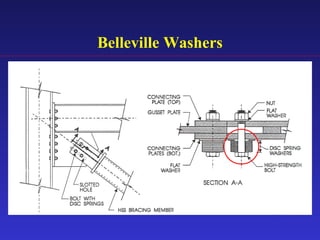
Belleville Washers
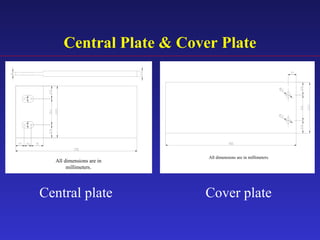
Central Plate & Cover Plate
All dimensions are in millimeter.All dimensions are in
millimeters.
All dimensions are in millimeter.All dimensions are in millimeters.
Central plate Cover plate
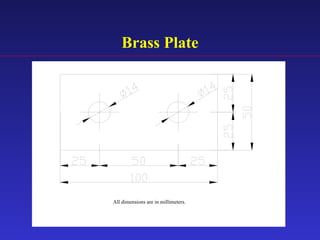
Brass Plate
All dimensions are in millimeter.
All dimensions are in millimeters.
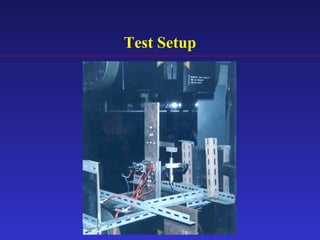
Test Setup
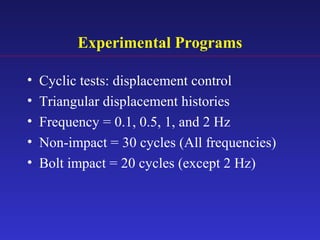
Experimental Programs
• Cyclic tests: displacement control
• Triangular displacement histories
• Frequency = 0.1, 0.5, 1, and 2 Hz
• Non-impact = 30 cycles (All frequencies)
• Bolt impact = 20 cycles (except 2 Hz)
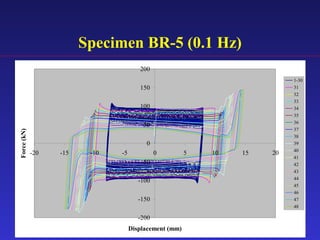
Specimen BR-5 (0.1 Hz)
-200
-150
-100
-50
0
50
100
150
200
-20 -15 -10 -5 0 5 10 15 20
Displacement (mm)
Force(kN)
1-30
31
32
33
34
35
36
37
38
39
40
41
42
43
44
45
46
47
48
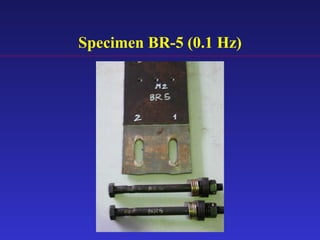
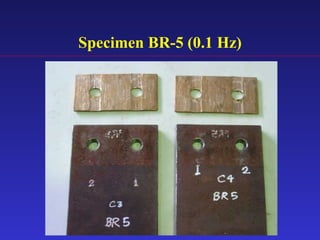
Specimen BR-5 (0.1 Hz)
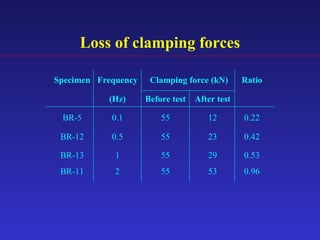
Loss of clamping forces
Specimen Frequency Clamping force (kN) Ratio
(Hz) Before test After test
BR-5 0.1 55 12 0.22
BR-12 0.5 55 23 0.42
BR-13 1 55 29 0.53
BR-11 2 55 53 0.96
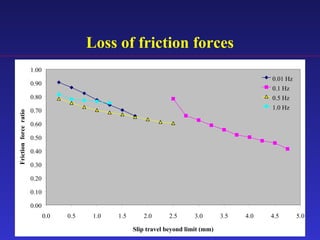
Loss of friction forces
0.00
0.10
0.20
0.30
0.40
0.50
0.60
0.70
0.80
0.90
1.00
0.0 0.5 1.0 1.5 2.0 2.5 3.0 3.5 4.0 4.5 5.0
Slip travel beyond limit (mm)
Frictionforceratio
0.01 Hz
0.1 Hz
0.5 Hz
1.0 Hz
Conventional SBC
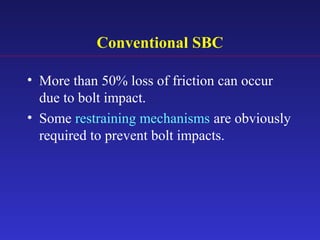
• More than 50% loss of friction can occur
due to bolt impact.
• Some restraining mechanisms are obviously
required to prevent bolt impacts.
Enhanced SBC
Enhanced SBC
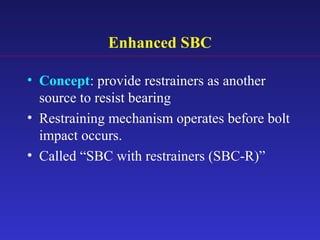
• Concept: provide restrainers as another
source to resist bearing
• Restraining mechanism operates before bolt
impact occurs.
• Called “SBC with restrainers (SBC-R)”
SBC-R
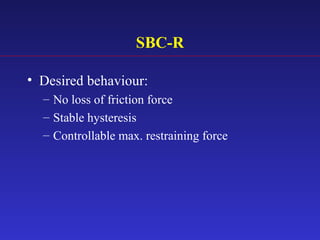
• Desired behaviour:
– No loss of friction force
– Stable hysteresis
– Controllable max. restraining force
SBC-R
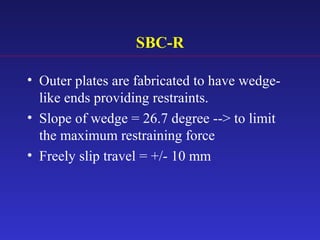
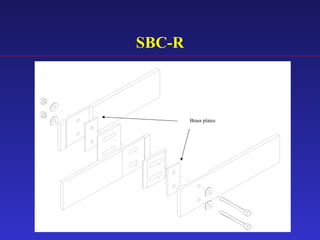
• Outer plates are fabricated to have wedge-
like ends providing restraints.
• Slope of wedge = 26.7 degree --> to limit
the maximum restraining force
• Freely slip travel = +/- 10 mm
SBC-R
Brass plates
SBC-R
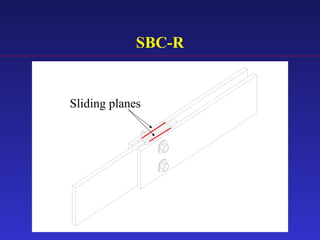
Sliding planes
Experimental Programs
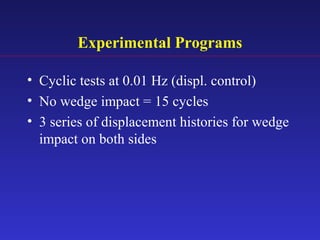
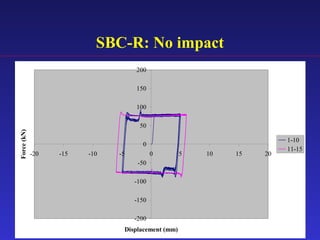
• Cyclic tests at 0.01 Hz (displ. control)
• No wedge impact = 15 cycles
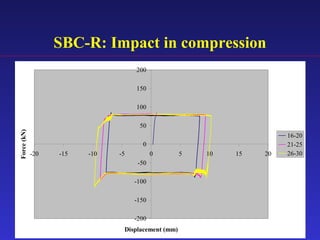
• 3 series of displacement histories for wedge
impact on both sides
SBC-R: No impact
-200
-150
-100
-50
0
50
100
150
200
-20 -15 -10 -5 0 5 10 15 20
Displacement (mm)
Force(kN)
1-10
11-15
SBC-R: Impact in compression
-200
-150
-100
-50
0
50
100
150
200
-20 -15 -10 -5 0 5 10 15 20
Displacement (mm)
Force(kN)
16-20
21-25
26-30
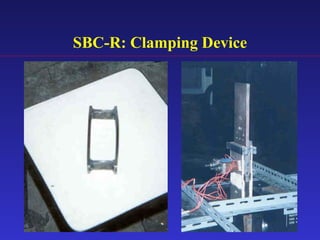
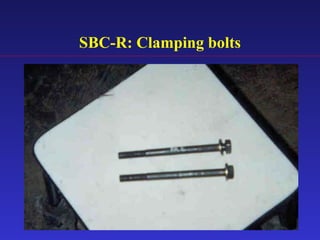
SBC-R: Clamping Device
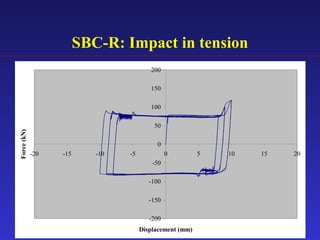
SBC-R: Impact in tension
-200
-150
-100
-50
0
50
100
150
200
-20 -15 -10 -5 0 5 10 15 20
Displacement (mm)
Force(kN)
SBC-R: Clamping bolts
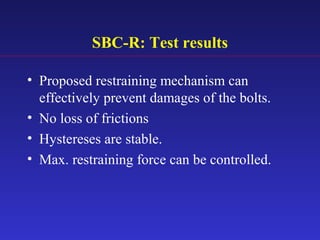
SBC-R: Test results
• Proposed restraining mechanism can
effectively prevent damages of the bolts.
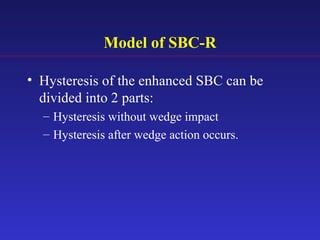
• No loss of frictions
• Hystereses are stable.
• Max. restraining force can be controlled.
Model of SBC-R
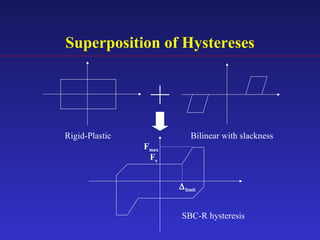
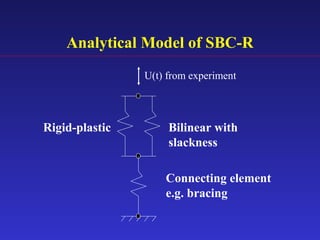
• Hysteresis of the enhanced SBC can be
divided into 2 parts:
– Hysteresis without wedge impact
– Hysteresis after wedge action occurs.
Superposition of Hystereses
Fs
Fmax
∆limit
Rigid-Plastic Bilinear with slackness
SBC-R hysteresis
Analytical Model of SBC-R
Rigid-plastic Bilinear with
slackness
Connecting element
e.g. bracing
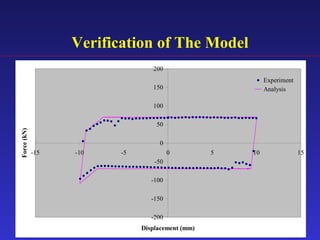
U(t) from experiment
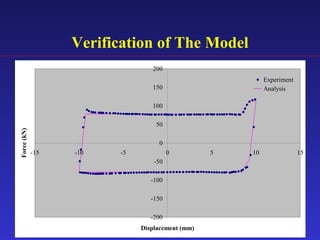
Verification of The Model
-200
-150
-100
-50
0
50
100
150
200
-15 -10 -5 0 5 10 15
Displacement (mm)
Force(kN)
Experiment
Analysis
Verification of The Model
-200
-150
-100
-50
0
50
100
150
200
-15 -10 -5 0 5 10 15
Displacement (mm)
Force(kN)
Experiment
Analysis
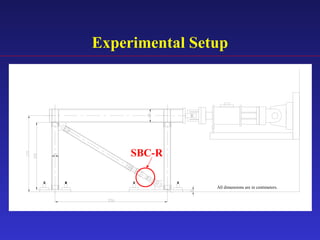
Experimental Setup
All dimensions are in centimeters.
SBC-R
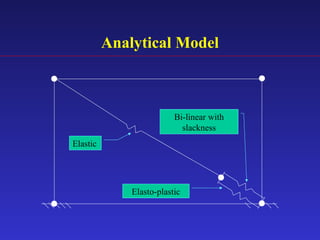
Analytical Model
Bi-linear with
slackness
Elasto-plastic
Elastic
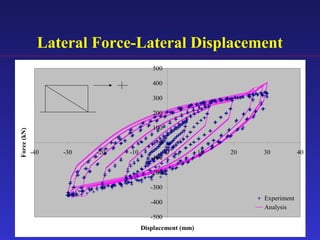
Lateral Force-Lateral Displacement
-500
-400
-300
-200
-100
0
100
200
300
400
500
-40 -30 -20 -10 0 10 20 30 40
Displacement (mm)
Force(kN)
Experiment
Analysis
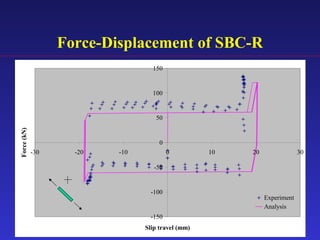
Force-Displacement of SBC-R
-150
-100
-50
0
50
100
150
-30 -20 -10 0 10 20 30
Slip travel (mm)
Force(kN)
Experiment
Analysis
Non-ductile RC frame retrofitted with
limit-slip friction damper
Limited-slip friction damper
• SBC-R --> prevent loss of design friction
force
• Slip limit may be useful in case of large
deformation.
Steel MRF retrofitted with SBC-R
Conclusions
• Bolt impacts result in an unacceptable
behaviour of a conventional SBC.
• Proposed SBC-R can effectively prevent
loss of the design friction force.
• Slip limit friction damper provides more
safety to the retrofitted structure compared
with the conventional one.

Master Slides