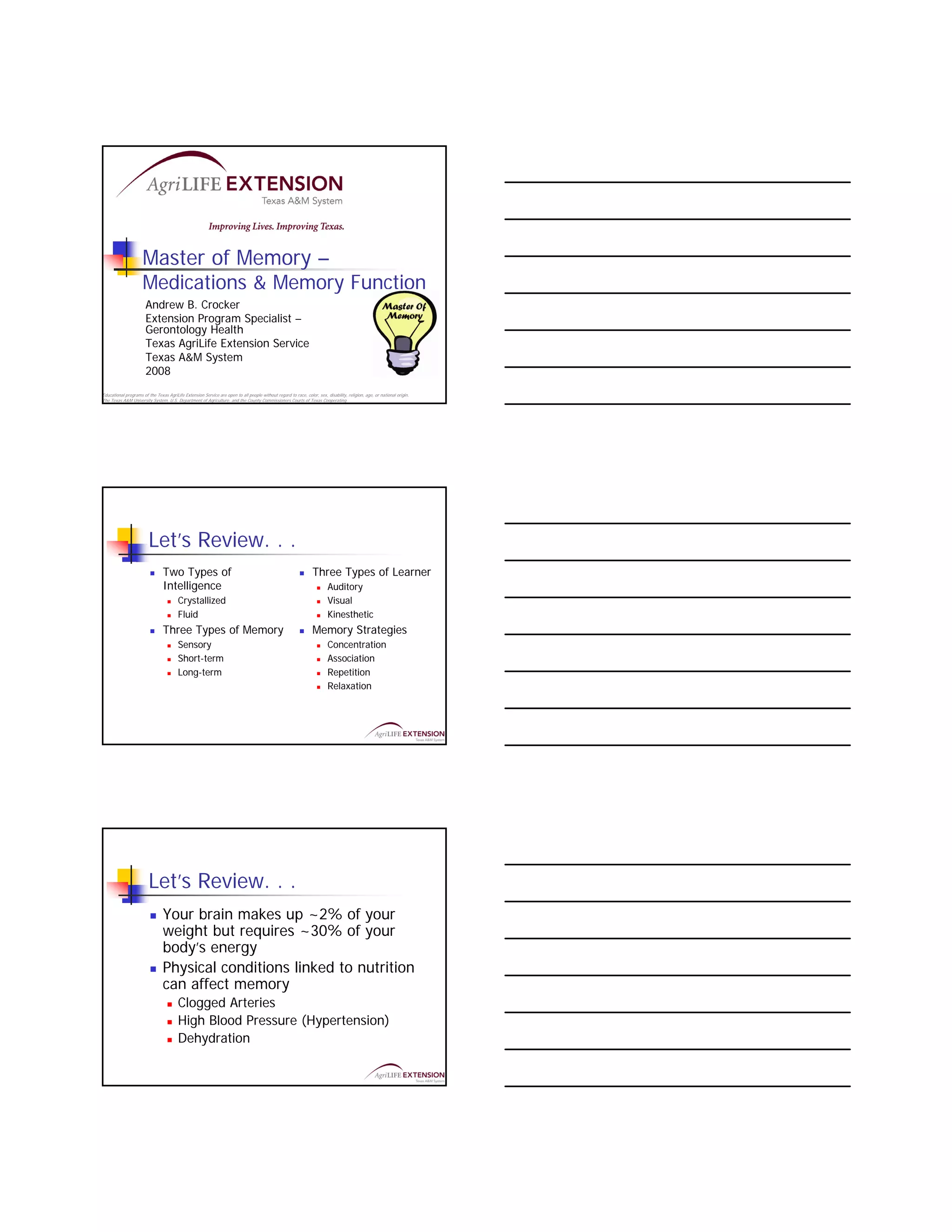
Master of Memory –
                     Medications & Memory Function
                       Andrew B. Crocker
                       Extension Program Specialist –
                       Gerontology Health
                       Texas AgriLife Extension Service
                       Texas A&M System
                       2008
Educational programs of the Texas AgriLife Extension Service are open to all people without regard to race, color, sex, disability, religion, age, or national origin.
The Texas A&M University System, U.S. Department of Agriculture, and the County Commissioners Courts of Texas Cooperating


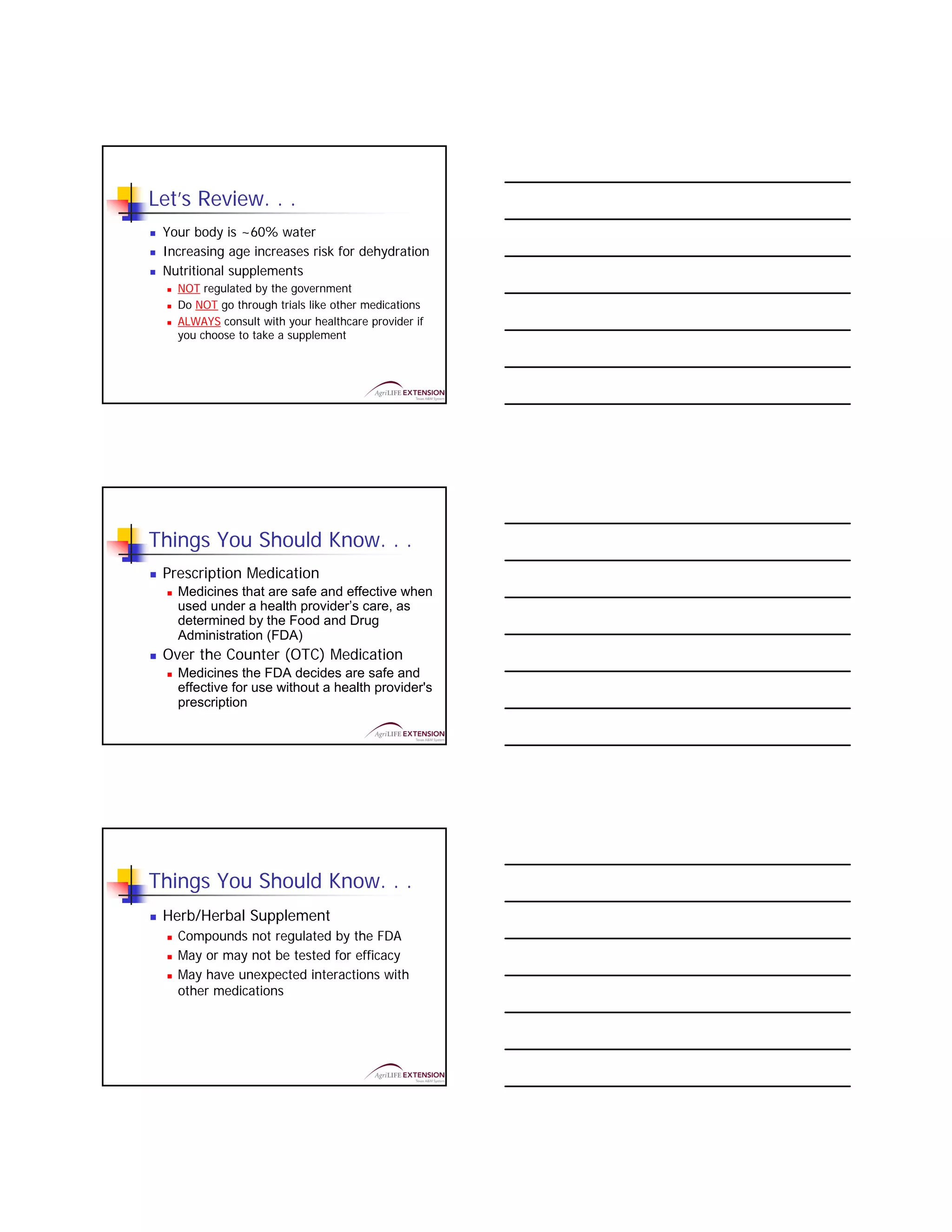
                         Let’s Review. . .
                                Two Types of                                                                     Three Types of Learner
                                Intelligence                                                                             Auditory
                                        Crystallized                                                                     Visual
                                        Fluid                                                                            Kinesthetic
                                Three Types of Memory                                                            Memory Strategies
                                        Sensory                                                                          Concentration
                                        Short-term                                                                       Association
                                        Long-term                                                                        Repetition
                                                                                                                         Relaxation


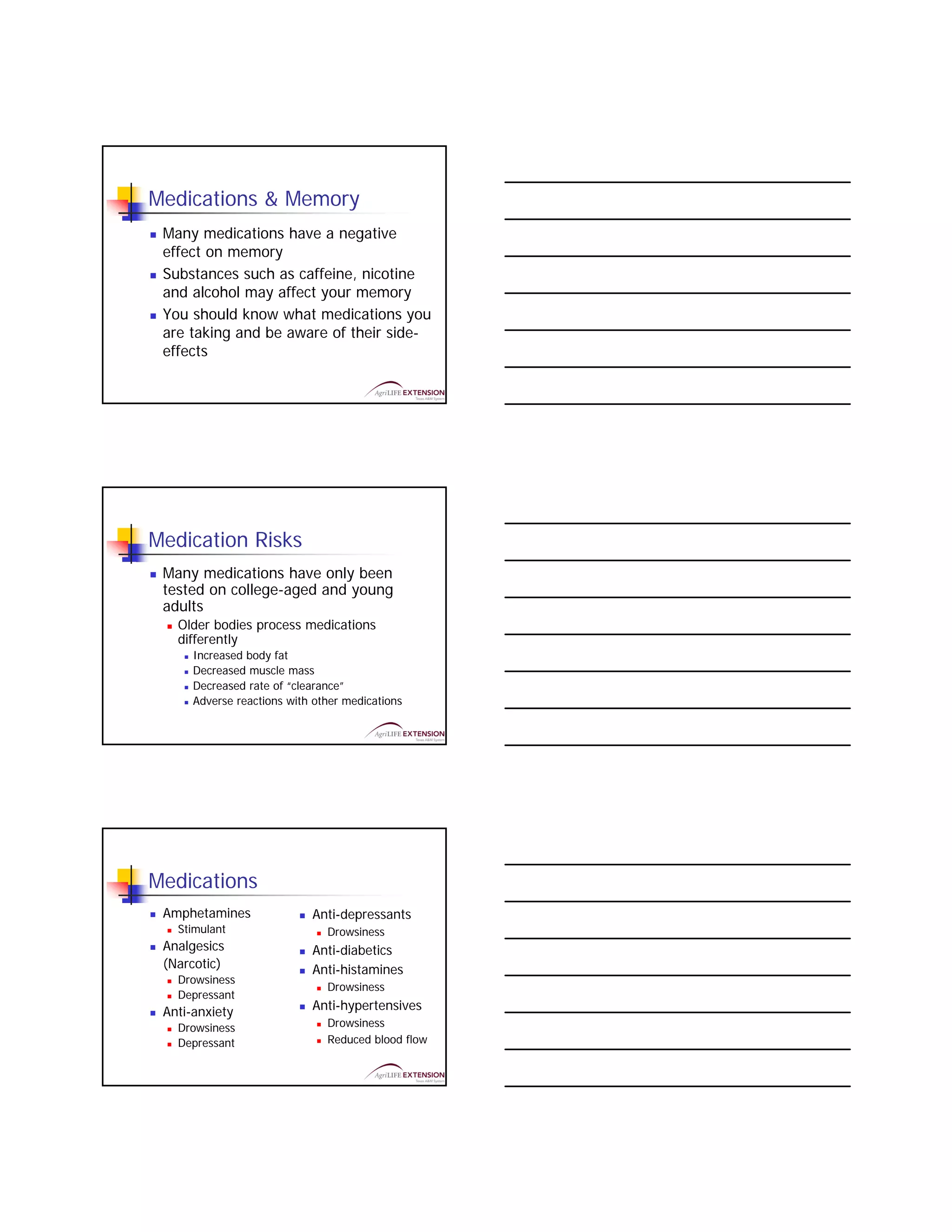
                         Let’s Review. . .
                                Your brain makes up ~2% of your
                                weight but requires ~30% of your
                                body’s energy
                                Physical conditions linked to nutrition
                                can affect memory
                                        Clogged Arteries
                                        High Blood Pressure (Hypertension)
                                        Dehydration
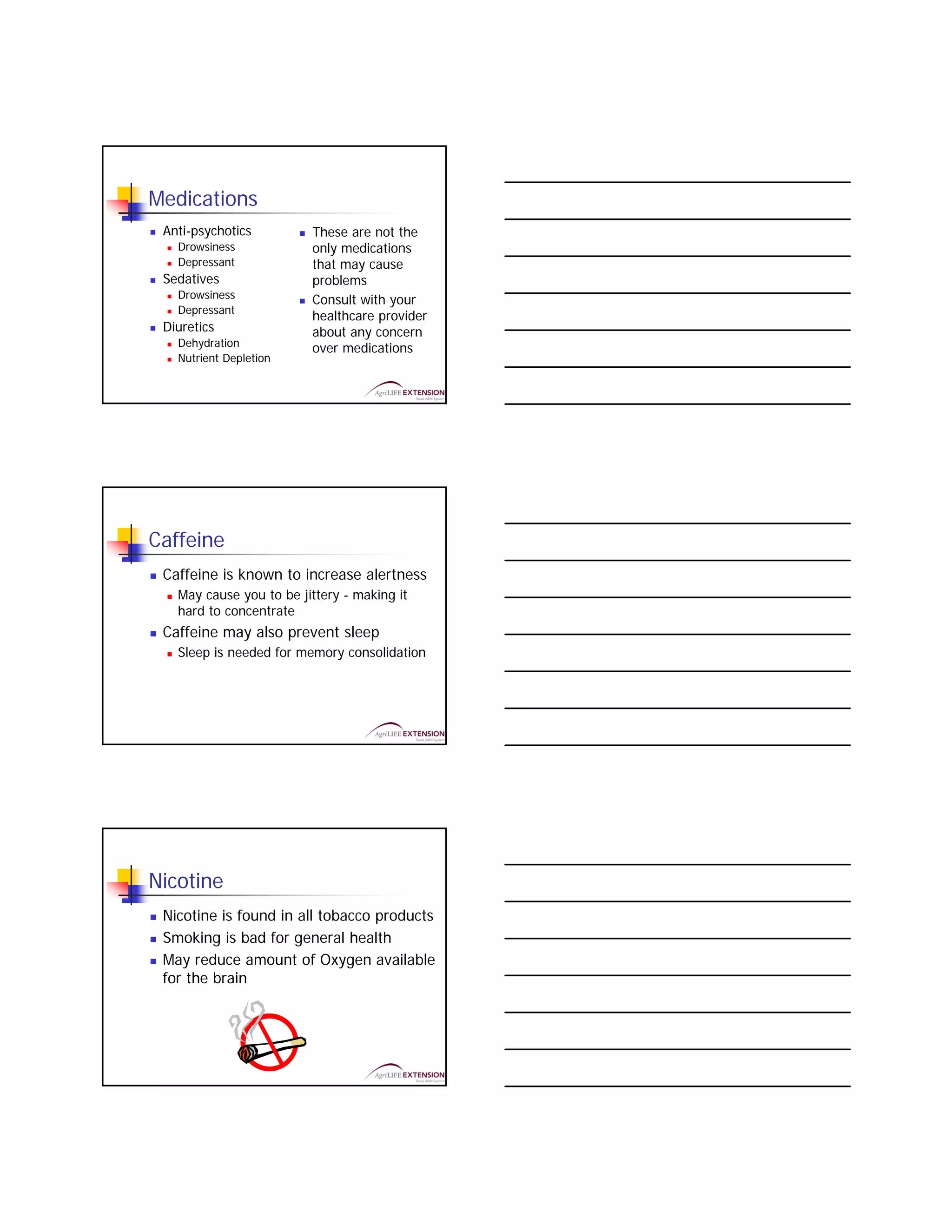
Let’s Review. . .
 Your body is ~60% water
 Increasing age increases risk for dehydration
 Nutritional supplements
   NOT regulated by the government
   Do NOT go through trials like other medications
   ALWAYS consult with your healthcare provider if
   you choose to take a supplement


Things You Should Know. . .
 Prescription Medication
   Medicines that are safe and effective when
   used under a health provider’s care, as
   determined by the Food and Drug
   Administration (FDA)
 Over the Counter (OTC) Medication
   Medicines the FDA decides are safe and
   effective for use without a health provider's
   prescription


Things You Should Know. . .
 Herb/Herbal Supplement
   Compounds not regulated by the FDA
   May or may not be tested for efficacy
   May have unexpected interactions with
   other medications
Medications & Memory
 Many medications have a negative
 effect on memory
 Substances such as caffeine, nicotine
 and alcohol may affect your memory
 You should know what medications you
 are taking and be aware of their side-
 effects


Medication Risks
 Many medications have only been
 tested on college-aged and young
 adults
   Older bodies process medications
   differently
      Increased body fat
      Decreased muscle mass
      Decreased rate of “clearance”
      Adverse reactions with other medications


Medications
 Amphetamines               Anti-depressants
   Stimulant                   Drowsiness
 Analgesics                 Anti-diabetics
 (Narcotic)                 Anti-histamines
   Drowsiness
                               Drowsiness
   Depressant
 Anti-anxiety               Anti-hypertensives
   Drowsiness                  Drowsiness
   Depressant                  Reduced blood flow
Medications
 Anti-psychotics         These are not the
   Drowsiness            only medications
   Depressant            that may cause
 Sedatives               problems
   Drowsiness            Consult with your
   Depressant
                         healthcare provider
 Diuretics               about any concern
   Dehydration           over medications
   Nutrient Depletion


Caffeine
 Caffeine is known to increase alertness
   May cause you to be jittery - making it
   hard to concentrate
 Caffeine may also prevent sleep
   Sleep is needed for memory consolidation


Nicotine
 Nicotine is found in all tobacco products
 Smoking is bad for general health
 May reduce amount of Oxygen available
 for the brain
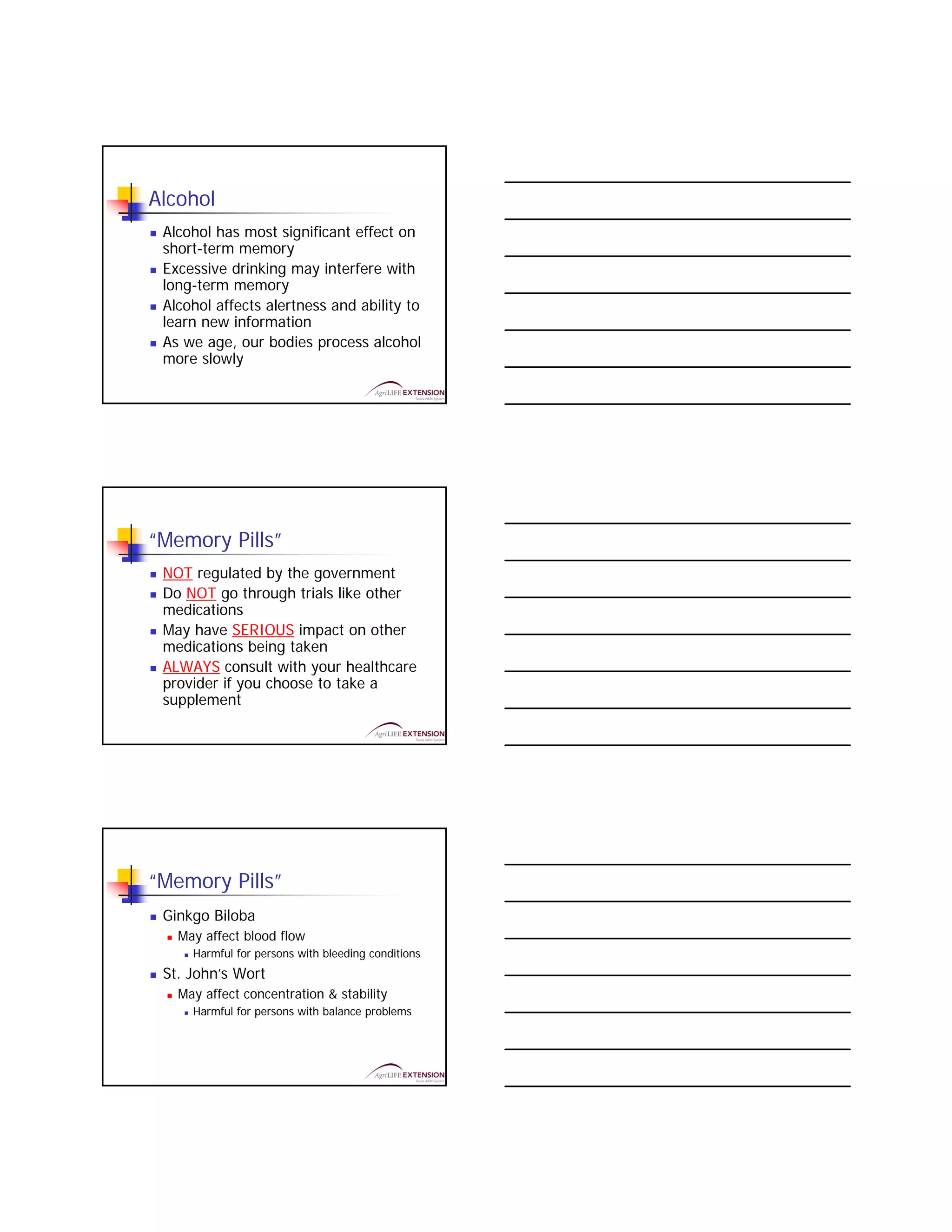
Alcohol
 Alcohol has most significant effect on
 short-term memory
 Excessive drinking may interfere with
 long-term memory
 Alcohol affects alertness and ability to
 learn new information
 As we age, our bodies process alcohol
 more slowly


“Memory Pills”
 NOT regulated by the government
 Do NOT go through trials like other
 medications
 May have SERIOUS impact on other
 medications being taken
 ALWAYS consult with your healthcare
 provider if you choose to take a
 supplement


“Memory Pills”
 Ginkgo Biloba
   May affect blood flow
     Harmful for persons with bleeding conditions
 St. John’s Wort
   May affect concentration & stability
     Harmful for persons with balance problems
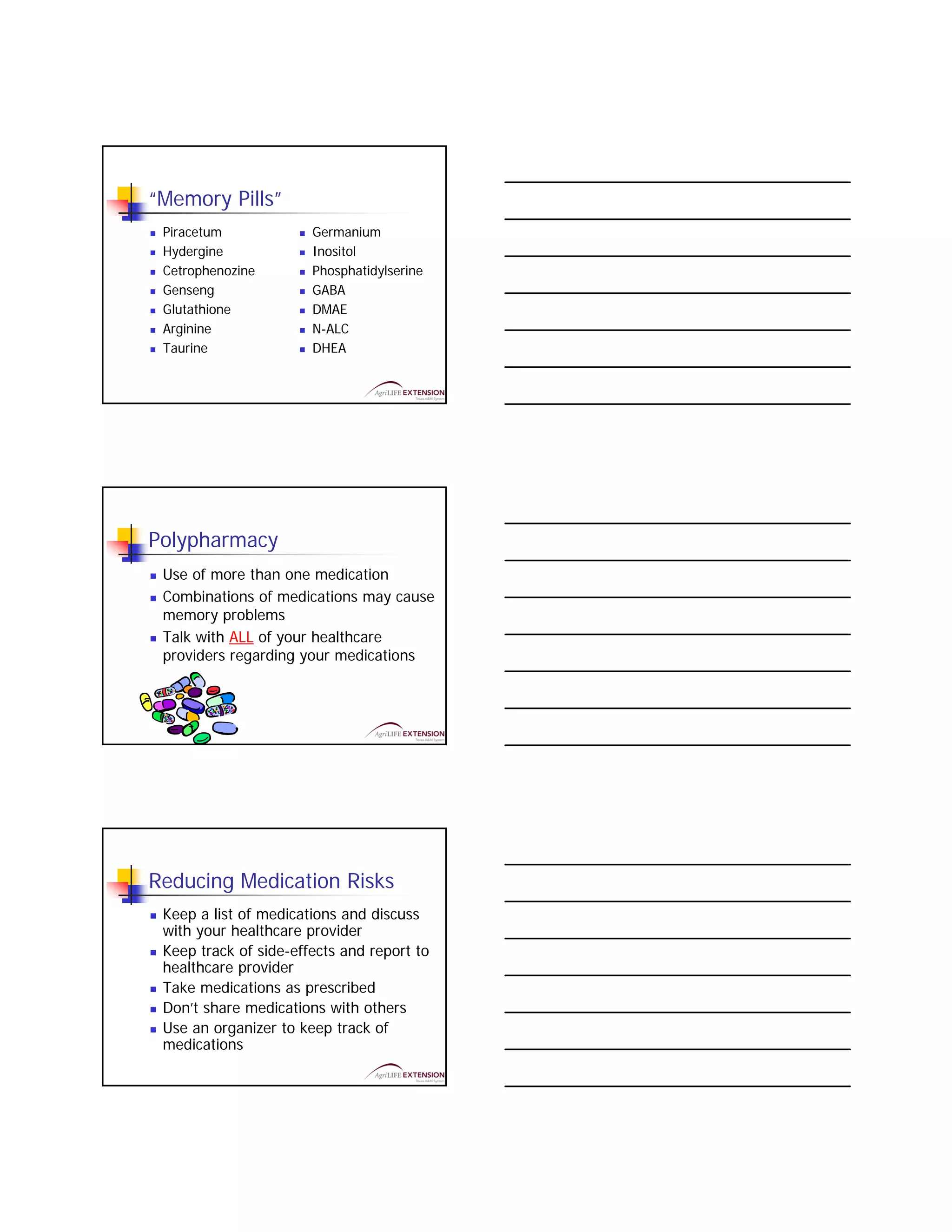
“Memory Pills”
 Piracetum             Germanium
 Hydergine             Inositol
 Cetrophenozine        Phosphatidylserine
 Genseng               GABA
 Glutathione           DMAE
 Arginine              N-ALC
 Taurine               DHEA


Polypharmacy
 Use of more than one medication
 Combinations of medications may cause
 memory problems
 Talk with ALL of your healthcare
 providers regarding your medications


Reducing Medication Risks
 Keep a list of medications and discuss
 with your healthcare provider
 Keep track of side-effects and report to
 healthcare provider
 Take medications as prescribed
 Don’t share medications with others
 Use an organizer to keep track of
 medications
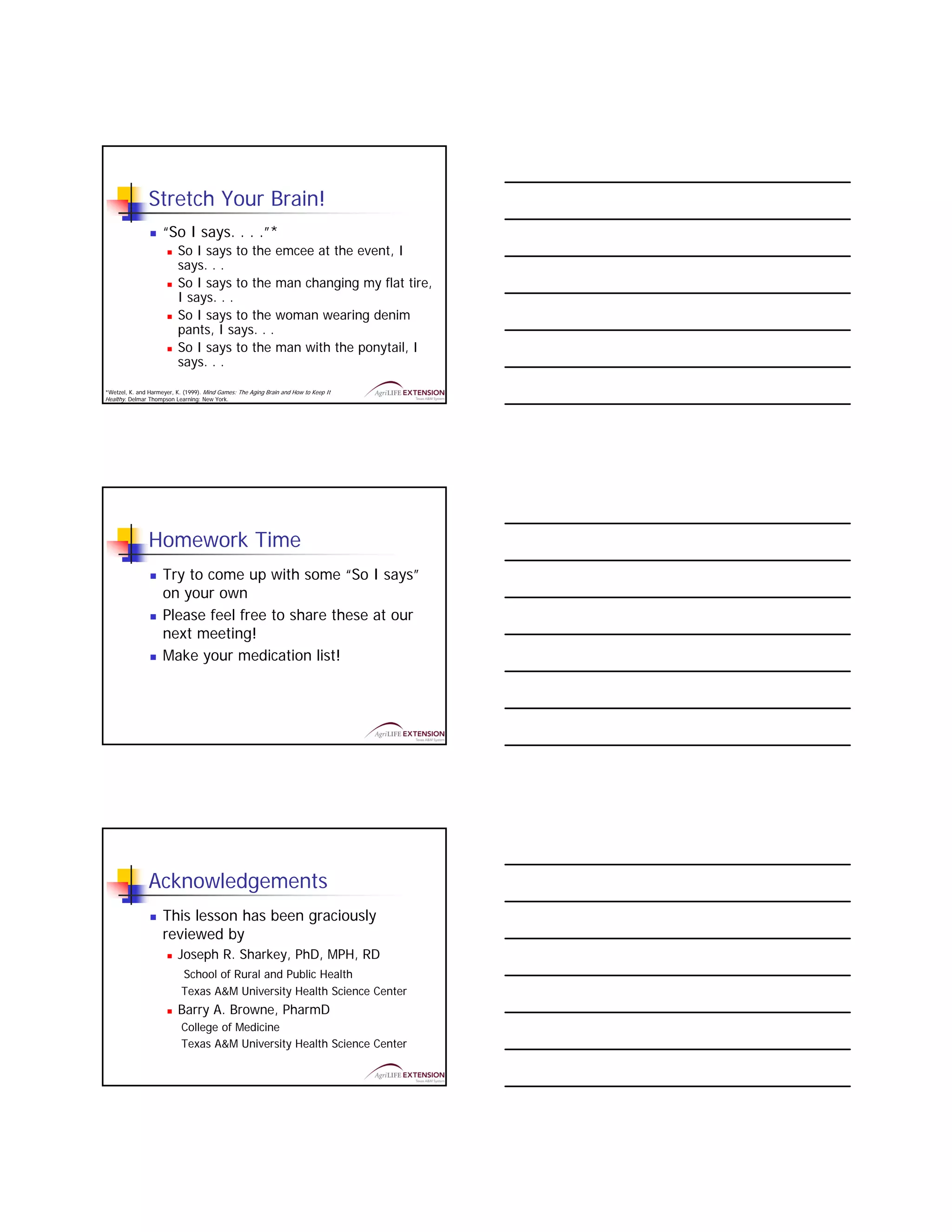
Stretch Your Brain!
                     “So I says. . . .”*
                          So I says to the emcee at the event, I
                          says. . .
                          So I says to the man changing my flat tire,
                          I says. . .
                          So I says to the woman wearing denim
                          pants, I says. . .
                          So I says to the man with the ponytail, I
                          says. . .

*Wetzel, K. and Harmeyer, K. (1999). Mind Games: The Aging Brain and How to Keep It
Healthy. Delmar Thompson Learning: New York.


                Homework Time
                     Try to come up with some “So I says”
                     on your own
                     Please feel free to share these at our
                     next meeting!
                     Make your medication list!


                Acknowledgements
                     This lesson has been graciously
                     reviewed by
                          Joseph R. Sharkey, PhD, MPH, RD
                            School of Rural and Public Health
                            Texas A&M University Health Science Center
                          Barry A. Browne, PharmD
                            College of Medicine
                            Texas A&M University Health Science Center
References
 Benjamin, Jr., LT, JR Hopkins & JR Nation. (1994). Psychology. 3rd edition. New York:
 Macmillan College Publishing Company.
 Butler, RN, MI Lewis & T Sunderland. (1998). Aging and Mental Health. 5th edition. New
 York: Prentice Hall.
 Chou, JY & CM Brown. (2002). “Receptivity to Peer Teaching and Peer Learning About the
 Safe and Appropriate Use of Medications Among Older Adults.” Educational Gerontology 28.
 pp 761-75.
 Duyff, RL. (1998). The American Dietetic Association’s Complete Guide to Food and
 Nutrition. Minneapolis: Chronimed Publishing.
 Fogler, J & L Stern. (1994). Improving Your Memory. Baltimore: Johns Hopkins University
 Press.
 Garfunkel, F & G Landau. (1981). A Memory Retention Course for the Aged. Washington,
 D.C.: The National Council on the Aging.
 Grayson, C, ed. (2004). “Brain Boosters: Eating for the Mind.”
 http://my.webmd.com/content/Article/11/1671_50418.htm. Last Accessed: 19 July 2006.
 Guyton, AC & JE Hall. (1996). Textbook of Medical Physiology. 9th edition. Philadelphia:
 W.B. Saunders Company.
 Ham, R & P Sloane. (1997). Primary Care Geriatrics: A Case Based Approach. 3rd edition. St.
 Louis: Mosby.


References
 Harnack, LJ, KL DeRosier & SA Rydell. (2003). “Results of a Population-Based Survey of
 Adults’ Attitudes and Beliefs About Herbal Products.” J Am Pharm Assoc 43(5):596-601.
 Kane, RL, JG Ouslander & IB Abrass. (1999). Essentials of Clinical Geriatrics. 4th edition.
 McGraw-Hill Health Professions Division: New York.
 McDougal, GJ. (1995). “Memory Self-Efficacy and Strategy Use in Successful Elders.”
 Educational Gerontology. Taylor and Francis. 21 (4).
 Matlin, MW. (1998). Cognition. 4th edition. Fort Worth: Harcourt Brace College Publishers.
 Nader, K. “Re-recording Human Memories.” Nature 425. 09 October 2003. pp.571-2.
 Robinson, SF. (June 2000). Dietary Guidelines for Americans, 2000. (Available from Texas
 Cooperative Extension, 352 Kleburg Center, TAMU MS 2471, College Station, Texas, 77843).
 Robinson, SF. (December 2001). “What’s Missing in your Pantry?: Nutrients Likely to be
 Lacking in the Diets of Older Adults. (Available from Texas Cooperative Extension, 352
 Kleburg Center, TAMU MS 2471, College Station, Texas, 77843).
 Schardt, D. “Brain Boosters & Busters.” Nutrition Action Healthletter. Center for Science in
 the Public Interest. October 2002.
 Timiras, PS. (1994). Physiological Basis of Aging and Geriatrics. 2nd edition. Boca Raton:
 CRC Press.
 Wetzel, K & K Harmeyer. (1999). Mind Games: The Aging Brain and How to Keep it
 Healthy. New York: Delmar.

Master of Memory Class 4 Handout

  • 1.
    Master of Memory– Medications & Memory Function Andrew B. Crocker Extension Program Specialist – Gerontology Health Texas AgriLife Extension Service Texas A&M System 2008 Educational programs of the Texas AgriLife Extension Service are open to all people without regard to race, color, sex, disability, religion, age, or national origin. The Texas A&M University System, U.S. Department of Agriculture, and the County Commissioners Courts of Texas Cooperating Let’s Review. . . Two Types of Three Types of Learner Intelligence Auditory Crystallized Visual Fluid Kinesthetic Three Types of Memory Memory Strategies Sensory Concentration Short-term Association Long-term Repetition Relaxation Let’s Review. . . Your brain makes up ~2% of your weight but requires ~30% of your body’s energy Physical conditions linked to nutrition can affect memory Clogged Arteries High Blood Pressure (Hypertension) Dehydration
  • 2.
    Let’s Review. .. Your body is ~60% water Increasing age increases risk for dehydration Nutritional supplements NOT regulated by the government Do NOT go through trials like other medications ALWAYS consult with your healthcare provider if you choose to take a supplement Things You Should Know. . . Prescription Medication Medicines that are safe and effective when used under a health provider’s care, as determined by the Food and Drug Administration (FDA) Over the Counter (OTC) Medication Medicines the FDA decides are safe and effective for use without a health provider's prescription Things You Should Know. . . Herb/Herbal Supplement Compounds not regulated by the FDA May or may not be tested for efficacy May have unexpected interactions with other medications
  • 3.
    Medications & Memory Many medications have a negative effect on memory Substances such as caffeine, nicotine and alcohol may affect your memory You should know what medications you are taking and be aware of their side- effects Medication Risks Many medications have only been tested on college-aged and young adults Older bodies process medications differently Increased body fat Decreased muscle mass Decreased rate of “clearance” Adverse reactions with other medications Medications Amphetamines Anti-depressants Stimulant Drowsiness Analgesics Anti-diabetics (Narcotic) Anti-histamines Drowsiness Drowsiness Depressant Anti-anxiety Anti-hypertensives Drowsiness Drowsiness Depressant Reduced blood flow
  • 4.
    Medications Anti-psychotics These are not the Drowsiness only medications Depressant that may cause Sedatives problems Drowsiness Consult with your Depressant healthcare provider Diuretics about any concern Dehydration over medications Nutrient Depletion Caffeine Caffeine is known to increase alertness May cause you to be jittery - making it hard to concentrate Caffeine may also prevent sleep Sleep is needed for memory consolidation Nicotine Nicotine is found in all tobacco products Smoking is bad for general health May reduce amount of Oxygen available for the brain
  • 5.
    Alcohol Alcohol hasmost significant effect on short-term memory Excessive drinking may interfere with long-term memory Alcohol affects alertness and ability to learn new information As we age, our bodies process alcohol more slowly “Memory Pills” NOT regulated by the government Do NOT go through trials like other medications May have SERIOUS impact on other medications being taken ALWAYS consult with your healthcare provider if you choose to take a supplement “Memory Pills” Ginkgo Biloba May affect blood flow Harmful for persons with bleeding conditions St. John’s Wort May affect concentration & stability Harmful for persons with balance problems
  • 6.
    “Memory Pills” Piracetum Germanium Hydergine Inositol Cetrophenozine Phosphatidylserine Genseng GABA Glutathione DMAE Arginine N-ALC Taurine DHEA Polypharmacy Use of more than one medication Combinations of medications may cause memory problems Talk with ALL of your healthcare providers regarding your medications Reducing Medication Risks Keep a list of medications and discuss with your healthcare provider Keep track of side-effects and report to healthcare provider Take medications as prescribed Don’t share medications with others Use an organizer to keep track of medications
  • 7.
    Stretch Your Brain! “So I says. . . .”* So I says to the emcee at the event, I says. . . So I says to the man changing my flat tire, I says. . . So I says to the woman wearing denim pants, I says. . . So I says to the man with the ponytail, I says. . . *Wetzel, K. and Harmeyer, K. (1999). Mind Games: The Aging Brain and How to Keep It Healthy. Delmar Thompson Learning: New York. Homework Time Try to come up with some “So I says” on your own Please feel free to share these at our next meeting! Make your medication list! Acknowledgements This lesson has been graciously reviewed by Joseph R. Sharkey, PhD, MPH, RD School of Rural and Public Health Texas A&M University Health Science Center Barry A. Browne, PharmD College of Medicine Texas A&M University Health Science Center
  • 8.
    References Benjamin, Jr.,LT, JR Hopkins & JR Nation. (1994). Psychology. 3rd edition. New York: Macmillan College Publishing Company. Butler, RN, MI Lewis & T Sunderland. (1998). Aging and Mental Health. 5th edition. New York: Prentice Hall. Chou, JY & CM Brown. (2002). “Receptivity to Peer Teaching and Peer Learning About the Safe and Appropriate Use of Medications Among Older Adults.” Educational Gerontology 28. pp 761-75. Duyff, RL. (1998). The American Dietetic Association’s Complete Guide to Food and Nutrition. Minneapolis: Chronimed Publishing. Fogler, J & L Stern. (1994). Improving Your Memory. Baltimore: Johns Hopkins University Press. Garfunkel, F & G Landau. (1981). A Memory Retention Course for the Aged. Washington, D.C.: The National Council on the Aging. Grayson, C, ed. (2004). “Brain Boosters: Eating for the Mind.” http://my.webmd.com/content/Article/11/1671_50418.htm. Last Accessed: 19 July 2006. Guyton, AC & JE Hall. (1996). Textbook of Medical Physiology. 9th edition. Philadelphia: W.B. Saunders Company. Ham, R & P Sloane. (1997). Primary Care Geriatrics: A Case Based Approach. 3rd edition. St. Louis: Mosby. References Harnack, LJ, KL DeRosier & SA Rydell. (2003). “Results of a Population-Based Survey of Adults’ Attitudes and Beliefs About Herbal Products.” J Am Pharm Assoc 43(5):596-601. Kane, RL, JG Ouslander & IB Abrass. (1999). Essentials of Clinical Geriatrics. 4th edition. McGraw-Hill Health Professions Division: New York. McDougal, GJ. (1995). “Memory Self-Efficacy and Strategy Use in Successful Elders.” Educational Gerontology. Taylor and Francis. 21 (4). Matlin, MW. (1998). Cognition. 4th edition. Fort Worth: Harcourt Brace College Publishers. Nader, K. “Re-recording Human Memories.” Nature 425. 09 October 2003. pp.571-2. Robinson, SF. (June 2000). Dietary Guidelines for Americans, 2000. (Available from Texas Cooperative Extension, 352 Kleburg Center, TAMU MS 2471, College Station, Texas, 77843). Robinson, SF. (December 2001). “What’s Missing in your Pantry?: Nutrients Likely to be Lacking in the Diets of Older Adults. (Available from Texas Cooperative Extension, 352 Kleburg Center, TAMU MS 2471, College Station, Texas, 77843). Schardt, D. “Brain Boosters & Busters.” Nutrition Action Healthletter. Center for Science in the Public Interest. October 2002. Timiras, PS. (1994). Physiological Basis of Aging and Geriatrics. 2nd edition. Boca Raton: CRC Press. Wetzel, K & K Harmeyer. (1999). Mind Games: The Aging Brain and How to Keep it Healthy. New York: Delmar.