European Aviation Safety Authority (EASA)
Part 147 Aviation Maintenance School
1www.atbconsultgroup.com
Why EASA ?
2www.atbconsultgroup.com
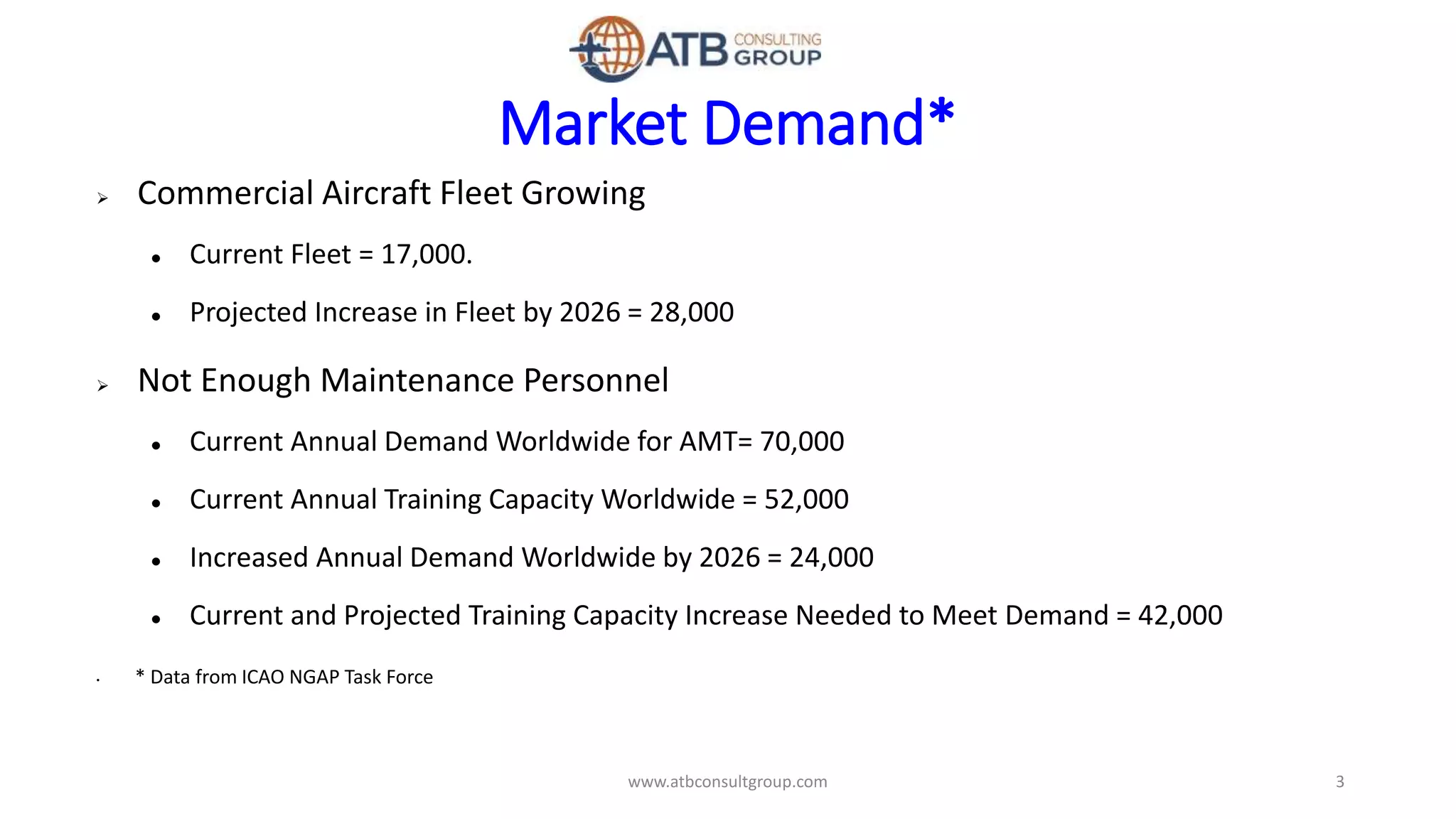
Market Demand*
 Commercial Aircraft Fleet Growing
 Current Fleet = 17,000.
 Projected Increase in Fleet by 2026 = 28,000
 Not Enough Maintenance Personnel
 Current Annual Demand Worldwide for AMT= 70,000
 Current Annual Training Capacity Worldwide = 52,000
 Increased Annual Demand Worldwide by 2026 = 24,000
 Current and Projected Training Capacity Increase Needed to Meet Demand = 42,000
• * Data from ICAO NGAP Task Force
3www.atbconsultgroup.com
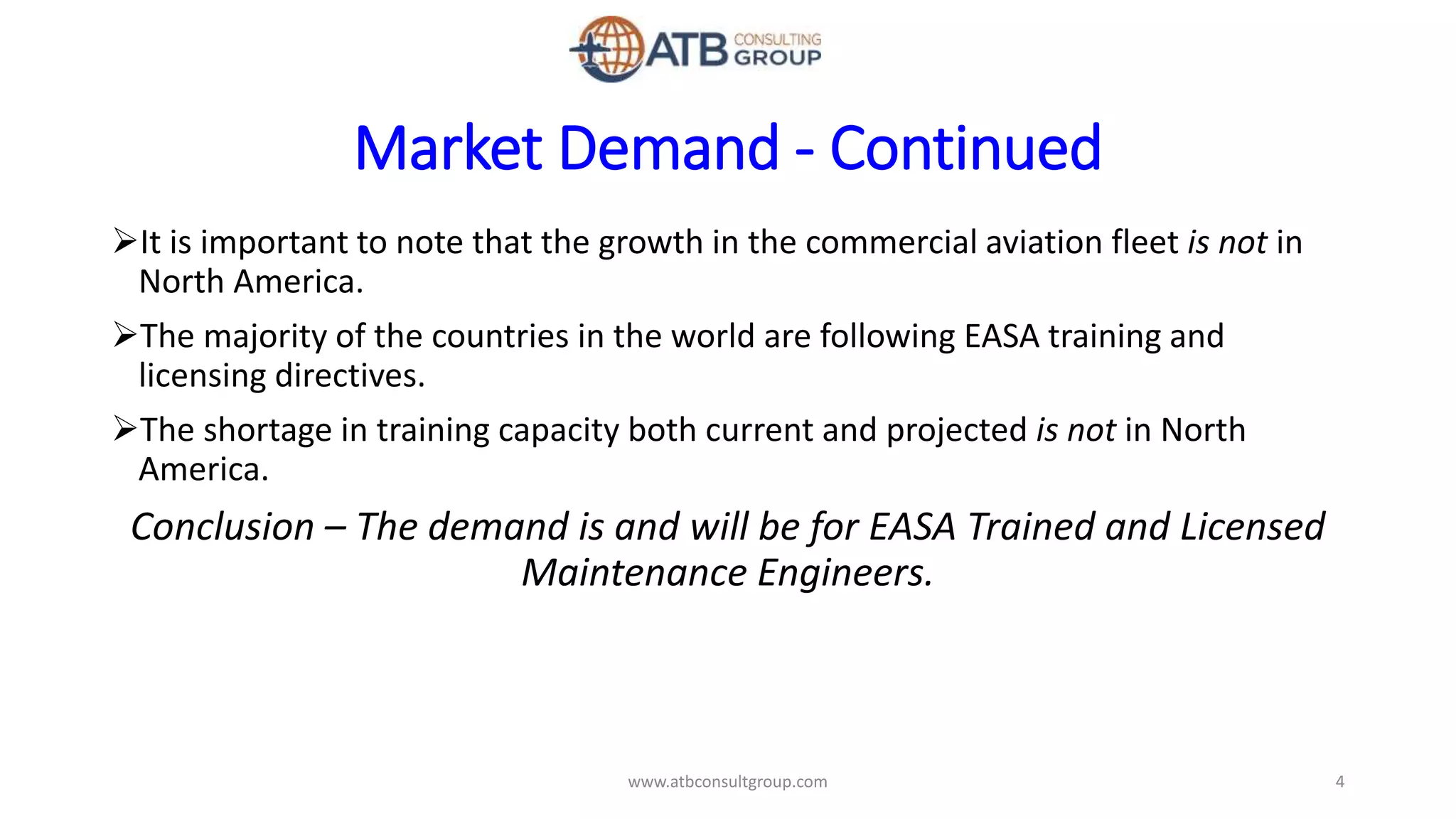
Market Demand - Continued
It is important to note that the growth in the commercial aviation fleet is not in
North America.
The majority of the countries in the world are following EASA training and
licensing directives.
The shortage in training capacity both current and projected is not in North
America.
Conclusion – The demand is and will be for EASA Trained and Licensed
Maintenance Engineers.
4www.atbconsultgroup.com
International Recognition
5www.atbconsultgroup.com
Opportunity
Meet the demand for EASA trained maintenance engineers by
offering EASA Part 147 approved training.
6www.atbconsultgroup.com
EASA and FAA
How Do They Compare
7www.atbconsultgroup.com
EASA vs FAA
Key Differences
EASA Part 66:
1. Requires more training hours
2. Requires more training in specific technologies.
3. Has more license categories.
4. Requires aircraft-specific training and certification.
5. Requires recurrent training.
6. Training and syllabus.
8www.atbconsultgroup.com
EASA vs FAA
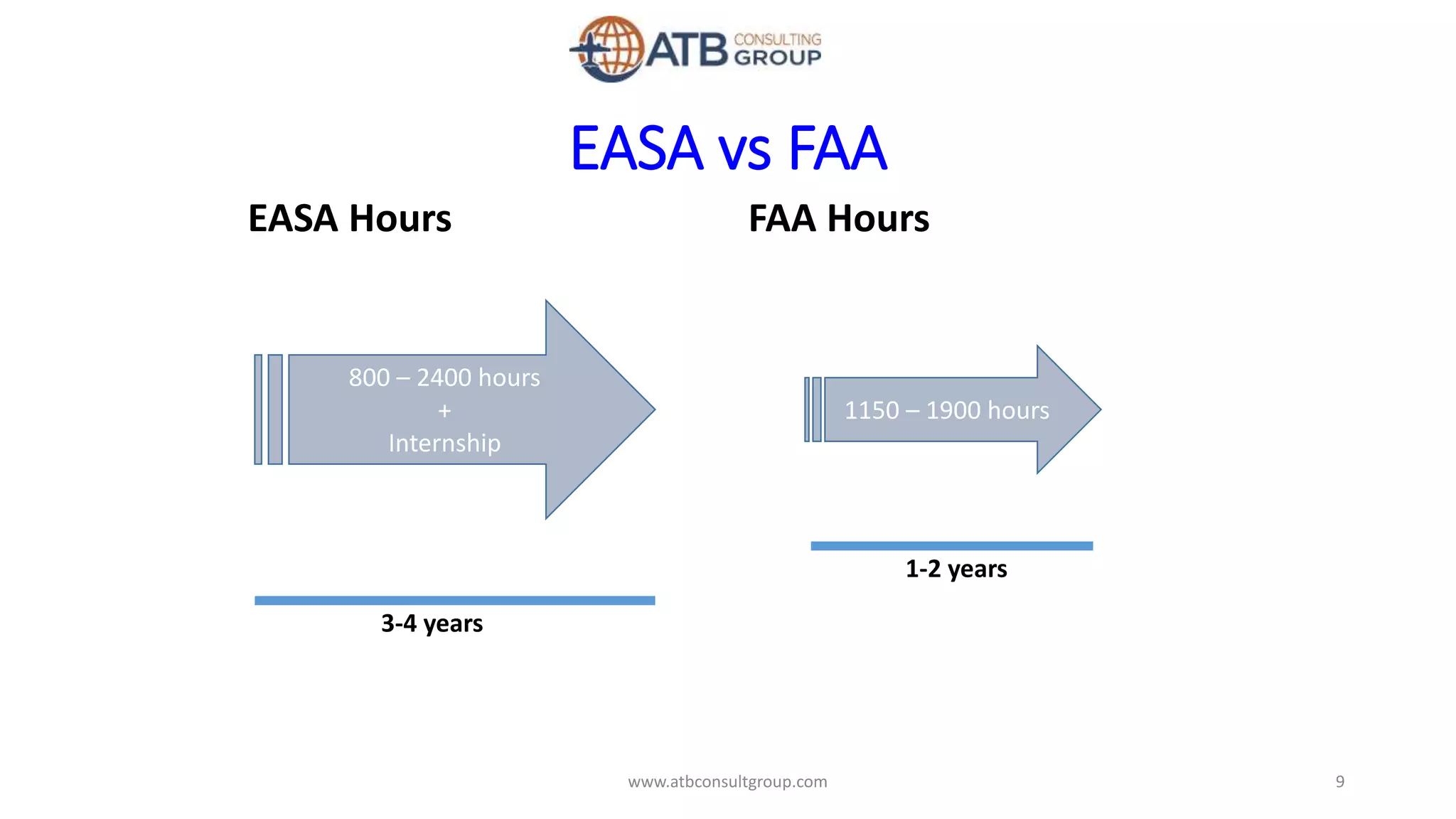
EASA Hours FAA Hours
800 – 2400 hours
+
Internship
1150 – 1900 hours
3-4 years
1-2 years
9www.atbconsultgroup.com
EASA vs FAA
EASA License
Category A
• 800 hours
• Scheduled line maintenance
Category B1 (Mechanical rating)
• 2,400 hours
• Maintenance on aircraft structure, powerplants,
mechanical and electrical systems
Category B2 (Avionics rating)
• 2,400 hours
• Maintenance on avionics and electrical systems
Category C
• Issues Certificate of Release to Service (CRS)
• No license needed. Academic Route.
FAA License
Airframe Certificate
• 1,150 hours
• Maintenance on aircraft structure and
airframe systems.
Powerplant Certificate
• 1,150 hours
• Maintenance on powerplants, propellers, and
engine systems.
Airframe & Powerplant Certificate
• 1,900 hours
• Maintenance on all aircraft systems.
Inspection Authorization
• A&P + 3 years OJT
• Major Repairs, major alterations, and annual
inspections
10www.atbconsultgroup.com
EASA
How Does it Work
11www.atbconsultgroup.com
EASA Licensing Tracks
As opposed to the one category A & P License,
EASA has a variety of licenses
12www.atbconsultgroup.com
Formal
School
A
B-1
B-2
avionics
C*
B-3
Piston A/C
˂2000 kg
A1
Turbine A/C
800 hr. Course
1 yr. Exp.
A2
Piston A/C
650 hr. Course
1 yr. Exp.
A3
Turbine Heli.
800 hr. Course
1 yr. Exp.
A4
Piston Heli.
800 hr. Course
1 yr. Exp.
B1.1
Turbine A/C
2400 hr. Course
2 yrs. Exp.
B1.2
Piston A/C
2400 hr. Course
1 yr. Exp.
B1.3
Turbine Heli.
2400 hr. Course
2 yrs. Exp.
B1.4
Piston Heli.
2400 hr. Course
1 yr. Exp.
1000 hr. Course
1 yr. Exp.
2400 hr. Course
2 yrs. Exp.
* “C” License requires University degree.
Issues CRS Only. 13www.atbconsultgroup.com
Program Durations
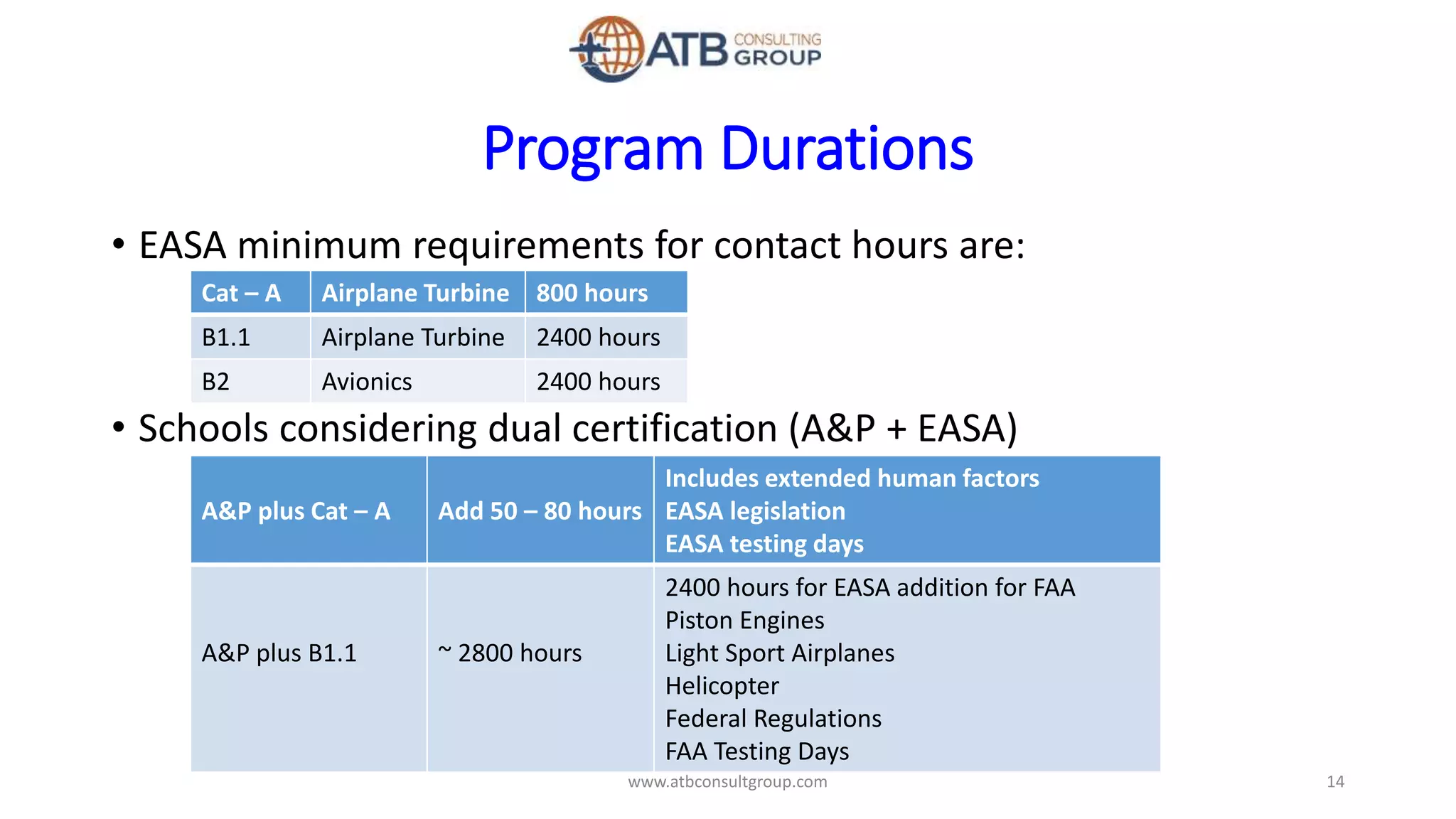
• EASA minimum requirements for contact hours are:
• Schools considering dual certification (A&P + EASA)
Cat – A Airplane Turbine 800 hours
B1.1 Airplane Turbine 2400 hours
B2 Avionics 2400 hours
A&P plus Cat – A Add 50 – 80 hours
Includes extended human factors
EASA legislation
EASA testing days
A&P plus B1.1 ~ 2800 hours
2400 hours for EASA addition for FAA
Piston Engines
Light Sport Airplanes
Helicopter
Federal Regulations
FAA Testing Days
14www.atbconsultgroup.com
Some Options For Adopting EASA
Certification/Training
B1 with A & P
B2 Avionics
Category “A” License with A & P License
Testing
15www.atbconsultgroup.com
B1 with A&P Dual Certification
• Estimated 2,800 hour program
• B1 curriculum can be either integrated with the A & P curriculum or
as an add-on “differences” course
16www.atbconsultgroup.com
B2 Avionics Certification
• The B2 avionics path is similar to the B1 option
• 2400 Hour Program
• Your curricula will be stand-alone and does not need to be meshed with the
separate requirements of an FAA program.
• This eliminates the most difficult task required by those developing a dual
B1/FAA program.
17www.atbconsultgroup.com
Category A License with A & P License
• While A&P is a higher rating, thus limiting the benefit of a dual
A&P/Category-A license, a few points can be considered.
1. Having a Category-A will allow an A&P to legally work in any EASA aligned
country and will provide advantage when applying to many of the 1500+
EASA Part 145s in the US.
2. The 1900+ hour A&P curricula already covers practically all that is needed to
include a Category-A in a current program. Less than 100 additional hours
will be required to cover EASA Legislation and Human Factors.
18www.atbconsultgroup.com
Additional Revenue -EASA Testing Option
• Testing Experienced A & P’s who want an EASA License
1. Those exams must be given by an EASA accredited Part 147 school.
2. An accredited school is entitled to set up other testing locations.
• Opportunities
1. Revenue from a share of student testing fees.
2. Offering of non-accredited review and exam prep classes.
3. Ongoing educational opportunities for alumni.
4. A valuable licensing service to offer the local 145 community and major student
employers.
5. Early establishment of a school’s EASA reputation and experience in your region.
6. Accustom teaching staff to working with the EASA Part 66 curricula.
7. Allows exploration of the demand for EASA licensing in a market with minimal
expense and committed time.
19www.atbconsultgroup.com
What is the Investment ?
20www.atbconsultgroup.com
Basic Estimated Costs for EASA Approvals*
Less than 5 staff 6 – 10 staff 11 – 49 staff
Application fee $3,500 $10,000 $25,000
Initial Surveyor’s Fees $10,000 $10,000 $10,000
Annual renewal fee $2,700 $8,000 $20,000
Annual Surveyor’s Fees $8,000 $8,000 $8,000
21
*Subject to Exchange Rate and
Inflation Adjustments
www.atbconsultgroup.com
Other Considerations
1. Quality Management System
• ISO Quality Management System (QMS) principles are the foundation for
evaluating Part 147 certifications
• Ensure end product conforms to regulation.
2. What does this mean for a U.S. Part 147 AMTS
• QMS system must be in place to satisfy EASA
• The Maintenance Training Organization Exposition (MTOE) is a roadmap for a
QMS system
• Requires personnel to manage the QMS system
22www.atbconsultgroup.com
Process
• Prepare MTOE (Maintenance Training Organization Exposition).
• Four Major Sections:
• Management Structure
• Training and Examination Procedures
• Training System Quality Procedures
• Appendices – Samples of Documents Used including textbooks and lesson
plans
23www.atbconsultgroup.com
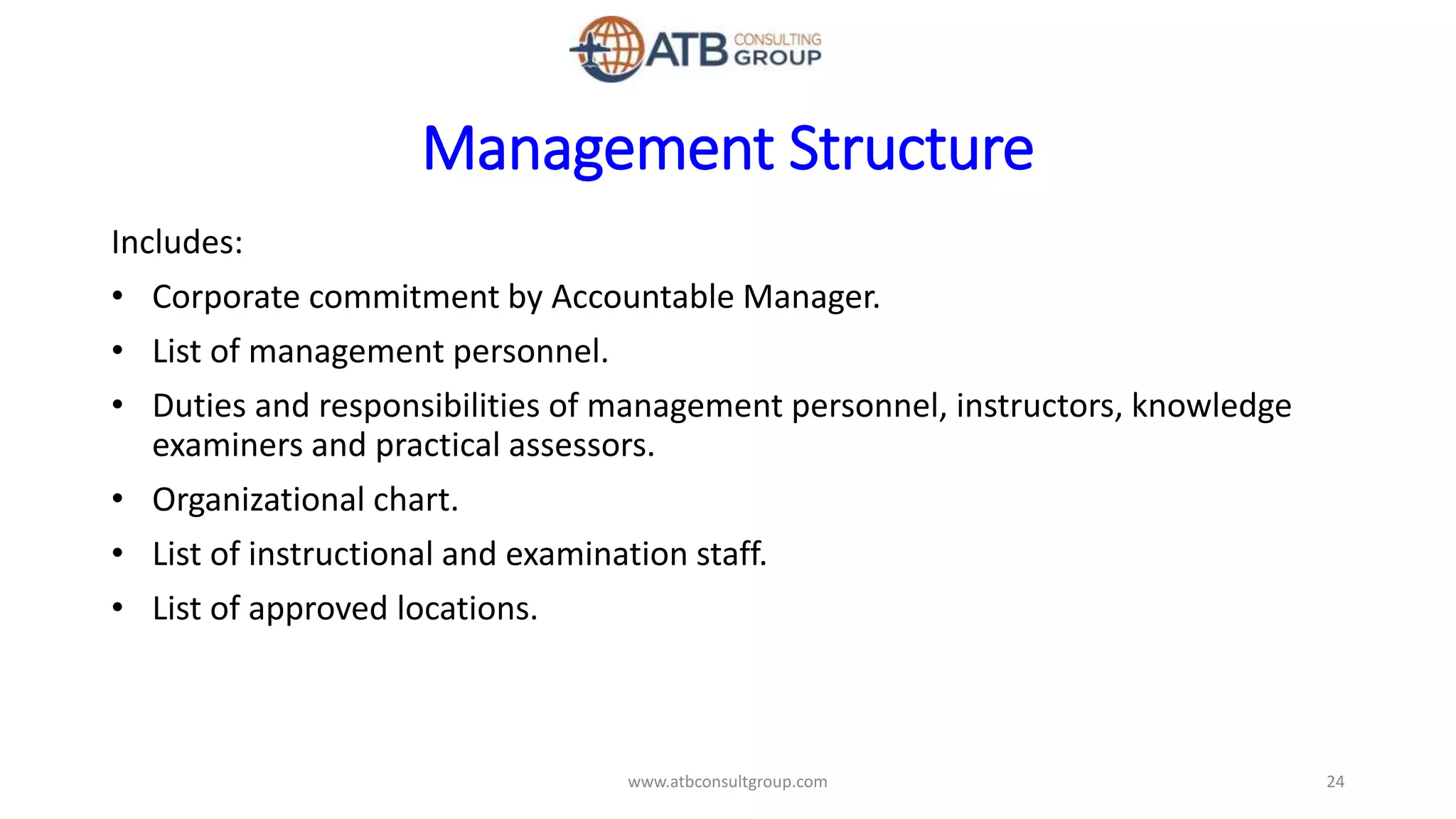
Management Structure
Includes:
• Corporate commitment by Accountable Manager.
• List of management personnel.
• Duties and responsibilities of management personnel, instructors, knowledge
examiners and practical assessors.
• Organizational chart.
• List of instructional and examination staff.
• List of approved locations.
24www.atbconsultgroup.com
Management Structure
Includes:
• List of sub-contractors.
• General description of facilities.
• Specific list of courses approved by the Agency (EASA).
• Notification procedures regarding changes to the organization.
• Exposition and associated manuals amendment procedures.
25www.atbconsultgroup.com
Training and Examination Procedures
Include:
• Organization of courses
• Preparation of course material
• Preparation of classrooms and equipment
• Preparation of workshops/maintenance facilities and equipment
• Conduct of Basic/Type knowledge & practical training
• Records of training carried out
26www.atbconsultgroup.com
Training and Examination Procedures
Include:
• Storage of training records
• Training at locations not listed
• Organization of examinations
• Security and preparation of examination material
• Preparation of examination rooms
• Conduct of examinations
• Conduct of Basic/Type practical assessments
27www.atbconsultgroup.com
Training and Examination Procedures
Include:
• Marking and recording of examinations
• Storage of examination records
• Examinations at locations outside of main campus
• Preparation, control & issue of course certificates
• Control of sub-contractors
28www.atbconsultgroup.com
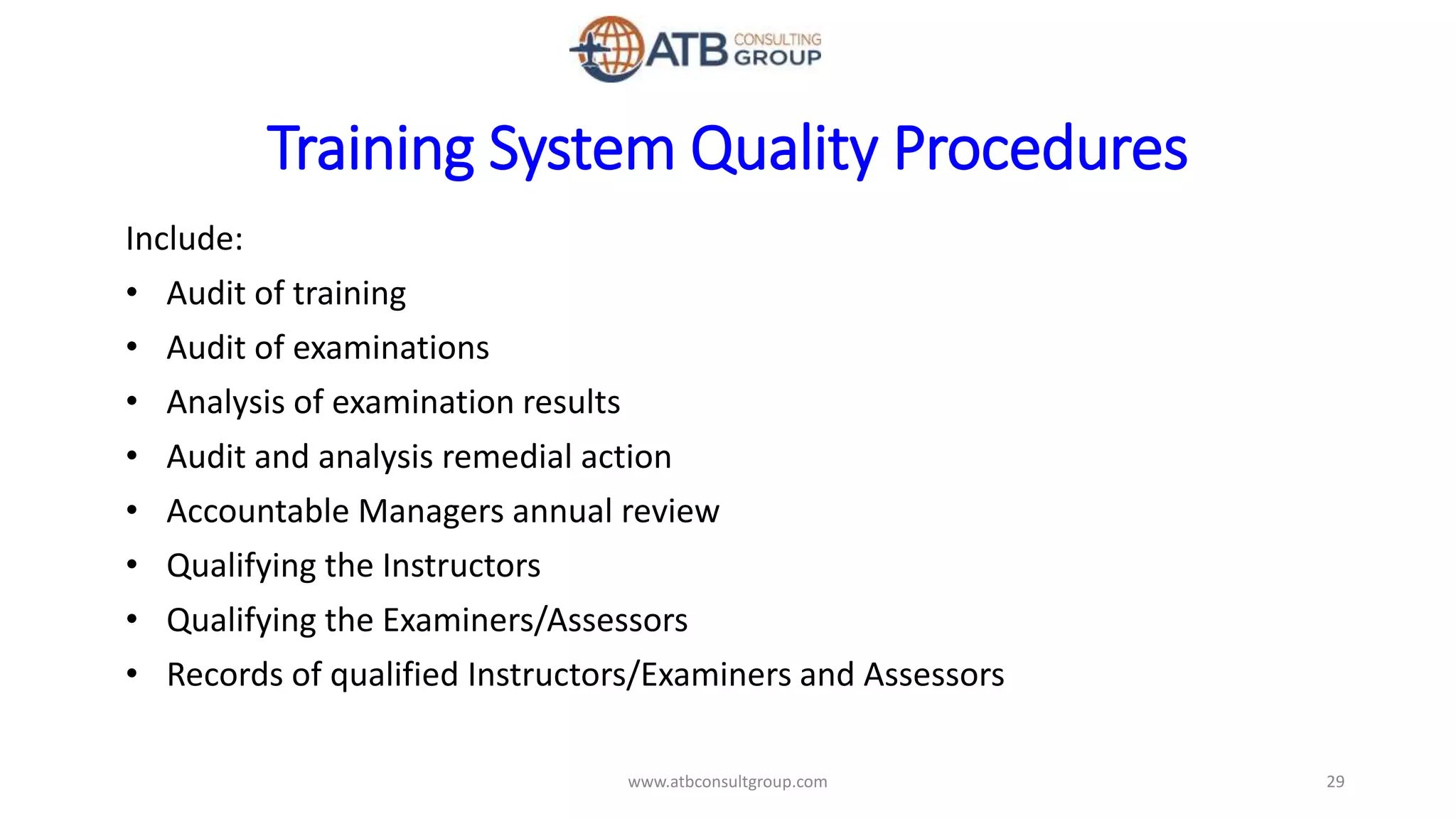
Training System Quality Procedures
Include:
• Audit of training
• Audit of examinations
• Analysis of examination results
• Audit and analysis remedial action
• Accountable Managers annual review
• Qualifying the Instructors
• Qualifying the Examiners/Assessors
• Records of qualified Instructors/Examiners and Assessors
29www.atbconsultgroup.com
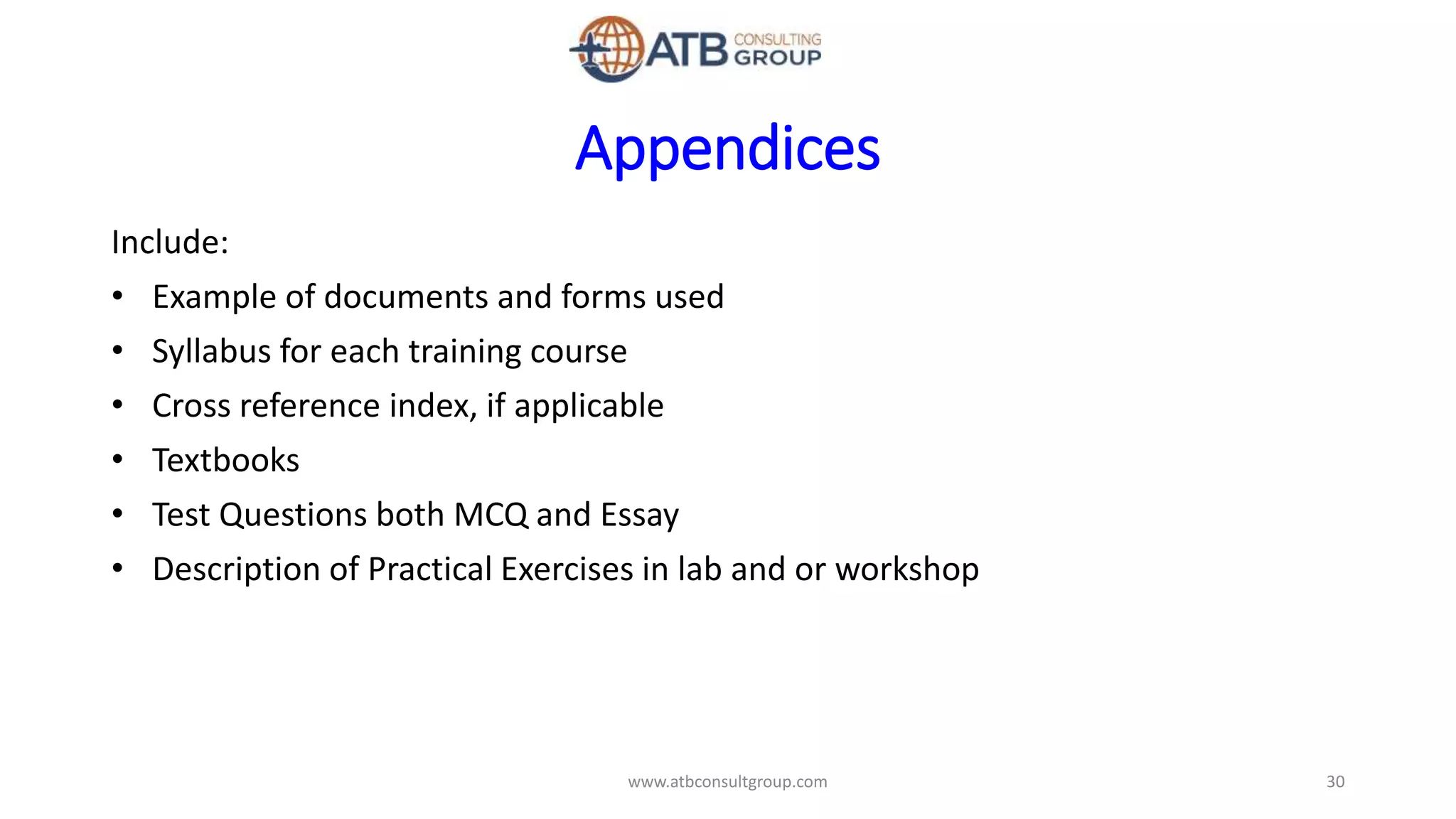
Appendices
Include:
• Example of documents and forms used
• Syllabus for each training course
• Cross reference index, if applicable
• Textbooks
• Test Questions both MCQ and Essay
• Description of Practical Exercises in lab and or workshop
30www.atbconsultgroup.com
Timing
Approximately 8 to 12 months from assignment of the EASA
surveyor to issuance of an approval
31www.atbconsultgroup.com
Sample Timeline
32www.atbconsultgroup.com
What We Offer:
• Maintenance Training Organization Exposition (MTOE) Preparation for
all EASA license categories.
• QMS Design and Implementation
• Curriculum Design and Development
• Lesson Planning including Practical Labs
• Staff Training for Part 66 and Part 147
• Internal Compliance Auditing
33www.atbconsultgroup.com
Why ATB Consulting Group
ATB Consultants have appropriate education, experience and
certifications including:
• Line and Base Maintenance Management
• EASA Licenses including A, B1 and B2
• FAA A & P Licenses
• EASA and FAA Part 147 School Set up and Approval
• EASA and FAA Part 147 School Management
34www.atbconsultgroup.com
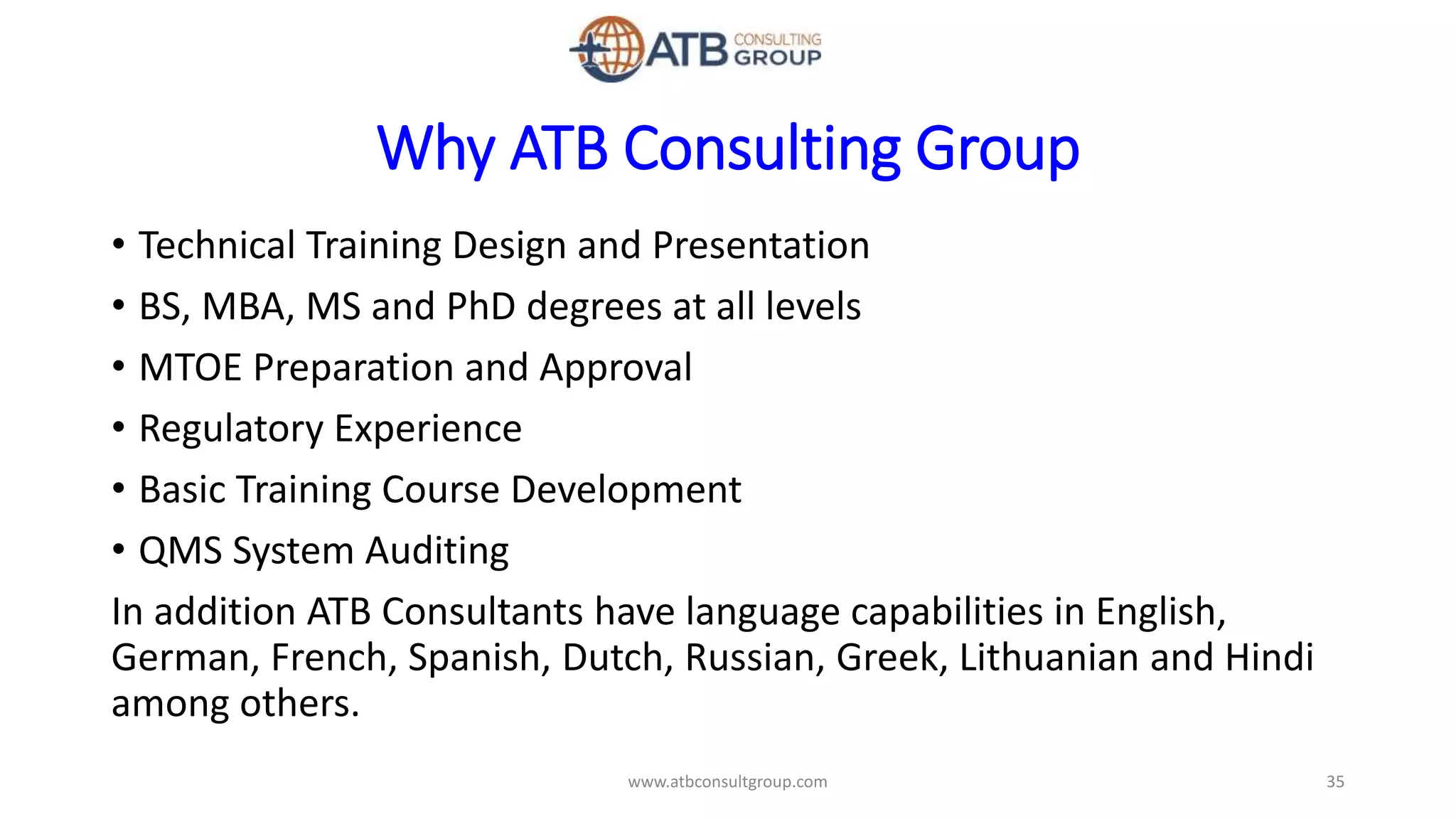
Why ATB Consulting Group
• Technical Training Design and Presentation
• BS, MBA, MS and PhD degrees at all levels
• MTOE Preparation and Approval
• Regulatory Experience
• Basic Training Course Development
• QMS System Auditing
In addition ATB Consultants have language capabilities in English,
German, French, Spanish, Dutch, Russian, Greek, Lithuanian and Hindi
among others.
35www.atbconsultgroup.com
Contact:
Craig Pollitt
cpollitt@atbconsultgroup.com
+1-720-295-8212
36www.atbconsultgroup.com

Master EASA presentation

  • 1.
    European Aviation SafetyAuthority (EASA) Part 147 Aviation Maintenance School 1www.atbconsultgroup.com
  • 2.
  • 3.
    Market Demand*  CommercialAircraft Fleet Growing  Current Fleet = 17,000.  Projected Increase in Fleet by 2026 = 28,000  Not Enough Maintenance Personnel  Current Annual Demand Worldwide for AMT= 70,000  Current Annual Training Capacity Worldwide = 52,000  Increased Annual Demand Worldwide by 2026 = 24,000  Current and Projected Training Capacity Increase Needed to Meet Demand = 42,000 • * Data from ICAO NGAP Task Force 3www.atbconsultgroup.com
  • 4.
    Market Demand -Continued It is important to note that the growth in the commercial aviation fleet is not in North America. The majority of the countries in the world are following EASA training and licensing directives. The shortage in training capacity both current and projected is not in North America. Conclusion – The demand is and will be for EASA Trained and Licensed Maintenance Engineers. 4www.atbconsultgroup.com
  • 5.
  • 6.
    Opportunity Meet the demandfor EASA trained maintenance engineers by offering EASA Part 147 approved training. 6www.atbconsultgroup.com
  • 7.
    EASA and FAA HowDo They Compare 7www.atbconsultgroup.com
  • 8.
    EASA vs FAA KeyDifferences EASA Part 66: 1. Requires more training hours 2. Requires more training in specific technologies. 3. Has more license categories. 4. Requires aircraft-specific training and certification. 5. Requires recurrent training. 6. Training and syllabus. 8www.atbconsultgroup.com
  • 9.
    EASA vs FAA EASAHours FAA Hours 800 – 2400 hours + Internship 1150 – 1900 hours 3-4 years 1-2 years 9www.atbconsultgroup.com
  • 10.
    EASA vs FAA EASALicense Category A • 800 hours • Scheduled line maintenance Category B1 (Mechanical rating) • 2,400 hours • Maintenance on aircraft structure, powerplants, mechanical and electrical systems Category B2 (Avionics rating) • 2,400 hours • Maintenance on avionics and electrical systems Category C • Issues Certificate of Release to Service (CRS) • No license needed. Academic Route. FAA License Airframe Certificate • 1,150 hours • Maintenance on aircraft structure and airframe systems. Powerplant Certificate • 1,150 hours • Maintenance on powerplants, propellers, and engine systems. Airframe & Powerplant Certificate • 1,900 hours • Maintenance on all aircraft systems. Inspection Authorization • A&P + 3 years OJT • Major Repairs, major alterations, and annual inspections 10www.atbconsultgroup.com
  • 11.
    EASA How Does itWork 11www.atbconsultgroup.com
  • 12.
    EASA Licensing Tracks Asopposed to the one category A & P License, EASA has a variety of licenses 12www.atbconsultgroup.com
  • 13.
    Formal School A B-1 B-2 avionics C* B-3 Piston A/C ˂2000 kg A1 TurbineA/C 800 hr. Course 1 yr. Exp. A2 Piston A/C 650 hr. Course 1 yr. Exp. A3 Turbine Heli. 800 hr. Course 1 yr. Exp. A4 Piston Heli. 800 hr. Course 1 yr. Exp. B1.1 Turbine A/C 2400 hr. Course 2 yrs. Exp. B1.2 Piston A/C 2400 hr. Course 1 yr. Exp. B1.3 Turbine Heli. 2400 hr. Course 2 yrs. Exp. B1.4 Piston Heli. 2400 hr. Course 1 yr. Exp. 1000 hr. Course 1 yr. Exp. 2400 hr. Course 2 yrs. Exp. * “C” License requires University degree. Issues CRS Only. 13www.atbconsultgroup.com
  • 14.
    Program Durations • EASAminimum requirements for contact hours are: • Schools considering dual certification (A&P + EASA) Cat – A Airplane Turbine 800 hours B1.1 Airplane Turbine 2400 hours B2 Avionics 2400 hours A&P plus Cat – A Add 50 – 80 hours Includes extended human factors EASA legislation EASA testing days A&P plus B1.1 ~ 2800 hours 2400 hours for EASA addition for FAA Piston Engines Light Sport Airplanes Helicopter Federal Regulations FAA Testing Days 14www.atbconsultgroup.com
  • 15.
    Some Options ForAdopting EASA Certification/Training B1 with A & P B2 Avionics Category “A” License with A & P License Testing 15www.atbconsultgroup.com
  • 16.
    B1 with A&PDual Certification • Estimated 2,800 hour program • B1 curriculum can be either integrated with the A & P curriculum or as an add-on “differences” course 16www.atbconsultgroup.com
  • 17.
    B2 Avionics Certification •The B2 avionics path is similar to the B1 option • 2400 Hour Program • Your curricula will be stand-alone and does not need to be meshed with the separate requirements of an FAA program. • This eliminates the most difficult task required by those developing a dual B1/FAA program. 17www.atbconsultgroup.com
  • 18.
    Category A Licensewith A & P License • While A&P is a higher rating, thus limiting the benefit of a dual A&P/Category-A license, a few points can be considered. 1. Having a Category-A will allow an A&P to legally work in any EASA aligned country and will provide advantage when applying to many of the 1500+ EASA Part 145s in the US. 2. The 1900+ hour A&P curricula already covers practically all that is needed to include a Category-A in a current program. Less than 100 additional hours will be required to cover EASA Legislation and Human Factors. 18www.atbconsultgroup.com
  • 19.
    Additional Revenue -EASATesting Option • Testing Experienced A & P’s who want an EASA License 1. Those exams must be given by an EASA accredited Part 147 school. 2. An accredited school is entitled to set up other testing locations. • Opportunities 1. Revenue from a share of student testing fees. 2. Offering of non-accredited review and exam prep classes. 3. Ongoing educational opportunities for alumni. 4. A valuable licensing service to offer the local 145 community and major student employers. 5. Early establishment of a school’s EASA reputation and experience in your region. 6. Accustom teaching staff to working with the EASA Part 66 curricula. 7. Allows exploration of the demand for EASA licensing in a market with minimal expense and committed time. 19www.atbconsultgroup.com
  • 20.
    What is theInvestment ? 20www.atbconsultgroup.com
  • 21.
    Basic Estimated Costsfor EASA Approvals* Less than 5 staff 6 – 10 staff 11 – 49 staff Application fee $3,500 $10,000 $25,000 Initial Surveyor’s Fees $10,000 $10,000 $10,000 Annual renewal fee $2,700 $8,000 $20,000 Annual Surveyor’s Fees $8,000 $8,000 $8,000 21 *Subject to Exchange Rate and Inflation Adjustments www.atbconsultgroup.com
  • 22.
    Other Considerations 1. QualityManagement System • ISO Quality Management System (QMS) principles are the foundation for evaluating Part 147 certifications • Ensure end product conforms to regulation. 2. What does this mean for a U.S. Part 147 AMTS • QMS system must be in place to satisfy EASA • The Maintenance Training Organization Exposition (MTOE) is a roadmap for a QMS system • Requires personnel to manage the QMS system 22www.atbconsultgroup.com
  • 23.
    Process • Prepare MTOE(Maintenance Training Organization Exposition). • Four Major Sections: • Management Structure • Training and Examination Procedures • Training System Quality Procedures • Appendices – Samples of Documents Used including textbooks and lesson plans 23www.atbconsultgroup.com
  • 24.
    Management Structure Includes: • Corporatecommitment by Accountable Manager. • List of management personnel. • Duties and responsibilities of management personnel, instructors, knowledge examiners and practical assessors. • Organizational chart. • List of instructional and examination staff. • List of approved locations. 24www.atbconsultgroup.com
  • 25.
    Management Structure Includes: • Listof sub-contractors. • General description of facilities. • Specific list of courses approved by the Agency (EASA). • Notification procedures regarding changes to the organization. • Exposition and associated manuals amendment procedures. 25www.atbconsultgroup.com
  • 26.
    Training and ExaminationProcedures Include: • Organization of courses • Preparation of course material • Preparation of classrooms and equipment • Preparation of workshops/maintenance facilities and equipment • Conduct of Basic/Type knowledge & practical training • Records of training carried out 26www.atbconsultgroup.com
  • 27.
    Training and ExaminationProcedures Include: • Storage of training records • Training at locations not listed • Organization of examinations • Security and preparation of examination material • Preparation of examination rooms • Conduct of examinations • Conduct of Basic/Type practical assessments 27www.atbconsultgroup.com
  • 28.
    Training and ExaminationProcedures Include: • Marking and recording of examinations • Storage of examination records • Examinations at locations outside of main campus • Preparation, control & issue of course certificates • Control of sub-contractors 28www.atbconsultgroup.com
  • 29.
    Training System QualityProcedures Include: • Audit of training • Audit of examinations • Analysis of examination results • Audit and analysis remedial action • Accountable Managers annual review • Qualifying the Instructors • Qualifying the Examiners/Assessors • Records of qualified Instructors/Examiners and Assessors 29www.atbconsultgroup.com
  • 30.
    Appendices Include: • Example ofdocuments and forms used • Syllabus for each training course • Cross reference index, if applicable • Textbooks • Test Questions both MCQ and Essay • Description of Practical Exercises in lab and or workshop 30www.atbconsultgroup.com
  • 31.
    Timing Approximately 8 to12 months from assignment of the EASA surveyor to issuance of an approval 31www.atbconsultgroup.com
  • 32.
  • 33.
    What We Offer: •Maintenance Training Organization Exposition (MTOE) Preparation for all EASA license categories. • QMS Design and Implementation • Curriculum Design and Development • Lesson Planning including Practical Labs • Staff Training for Part 66 and Part 147 • Internal Compliance Auditing 33www.atbconsultgroup.com
  • 34.
    Why ATB ConsultingGroup ATB Consultants have appropriate education, experience and certifications including: • Line and Base Maintenance Management • EASA Licenses including A, B1 and B2 • FAA A & P Licenses • EASA and FAA Part 147 School Set up and Approval • EASA and FAA Part 147 School Management 34www.atbconsultgroup.com
  • 35.
    Why ATB ConsultingGroup • Technical Training Design and Presentation • BS, MBA, MS and PhD degrees at all levels • MTOE Preparation and Approval • Regulatory Experience • Basic Training Course Development • QMS System Auditing In addition ATB Consultants have language capabilities in English, German, French, Spanish, Dutch, Russian, Greek, Lithuanian and Hindi among others. 35www.atbconsultgroup.com
  • 36.