FAA CPL
Commercial Pilot License
F LY I N G A C A D E M Y. C O M
About Us
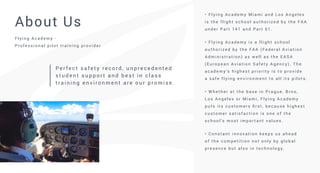
• F l y i n g A c a d e m y M i a m i a n d L o s A n g e l e s
i s t h e f l i g h t s c h o o l a u t h o r i z e d b y t h e FA A
u n d e r P a r t 1 4 1 a n d P a r t 6 1 .
• F l y i n g A c a d e m y i s a f l i g h t s c h o o l
a u t h o r i z e d b y t h e FA A ( Fe d e r a l A v i a t i o n
A d m i n i s t r a t i o n ) a s w e l l a s t h e E A S A
( E u ro p e a n A v i a t i o n S a fe t y A g e n c y ) . T h e
a c a d e m y ’s h i g h e s t p r i o r i t y i s t o p ro v i d e
a s a fe f l y i n g e n v i ro n m e n t t o a l l i t s p i l o t s .
• W h e t h e r a t t h e b a s e i n P r a g u e , B r n o ,
L o s A n g e l e s o r M i a m i , F l y i n g A c a d e m y
p u t s i t s c u s t o m e r s fi r s t , b e c a u s e h i g h e s t
c u s t o m e r s a t i s f a c t i o n i s o n e o f t h e
s c h o o l ’s m o s t i m p o r t a n t v a l u e s .
• C o n s t a n t i n n o v a t i o n ke e p s u s a h e a d
o f t h e c o m p e t i t i o n n o t o n l y b y g l o b a l
p re s e n c e b u t a l s o i n t e c h n o l o g y.
F l y i n g A c a d e m y -
P ro fe s s i o n a l p i l o t t r a i n i n g p ro v i d e r
P e r fe c t s a fe t y re c o rd , u n p re c e d e n t e d
s t u d e n t s u p p o r t a n d b e s t i n c l a s s
t r a i n i n g e n v i ro n m e n t a r e o u r p ro m i s e .
On top of that, both locations are
well known for their amazing sights
that will become the perfect
addition to your flight training.
Busy airspace with intensive ATC
communication will prepare you for
challenges of modern aviation.
FAA Training
Locations
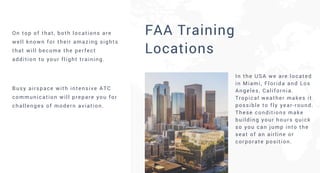
In the USA we are located
in Miami, Florida and Los
Angeles, California.
Tropical weather makes it
possible to fly year-round.
These conditions make
building your hours quick
so you can jump into the
seat of an airline or
corporate position.
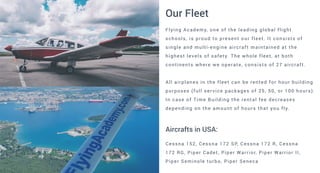
Flying Academy, one of the leading global flight
schools, is proud to present our fleet. It consists of
single and multi-engine aircraft maintained at the
highest levels of safety. The whole fleet, at both
continents where we operate, consists of 27 aircraft.
All airplanes in the fleet can be rented for hour building
purposes (full service packages of 25, 50, or 100 hours).
In case of Time Building the rental fee decreases
depending on the amount of hours that you fly.
Aircrafts in USA:
Our Fleet
Cessna 152, Cessna 172 SP, Cessna 172 R, Cessna
172 RG, Piper Cadet, Piper Warrior, Piper Warrior II,
Piper Seminole turbo, Piper Seneca
FAA CPL
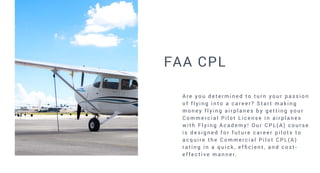
A re y o u d e t e r m i n e d t o t u r n y o u r p a s s i o n
o f f l y i n g i n t o a c a re e r ? S t a r t m a k i n g
m o n e y f l y i n g a i r p l a n e s b y g e t t i n g y o u r
C o m m e rc i a l P i l o t L i c e n s e i n a i r p l a n e s
w i t h F l y i n g A c a d e m y ! O u r C P L ( A ) c o u r s e
i s d e s i g n e d f o r f u t u re c a re e r p i l o t s t o
a c q u i r e t h e C o m m e r c i a l P i l o t C P L ( A )
r a t i n g i n a q u i c k , e f fi c i e n t , a n d c o s t -
e f fe c t i v e m a n n e r.
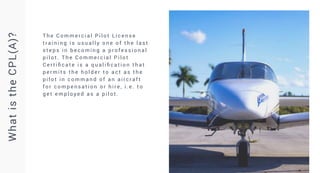
T h e C o m m e rc i a l P i l o t L i c e n s e
t r a i n i n g i s u s u a l l y o n e o f t h e l a s t
s t e p s i n b e c o m i n g a p ro fe s s i o n a l
p i l o t . T h e C o m m e rc i a l P i l o t
C e r t i fi c a t e i s a q u a l i fi c a t i o n t h a t
p e r m i t s t h e h o l d e r t o a c t a s t h e
p i l o t i n c o m m a n d o f a n a i rc r a f t
f o r c o m p e n s a t i o n o r h i re , i . e . t o
g e t e m p l o y e d a s a p i l o t .
What
is
the
CPL(A)?
Course
Requirements
At least 17 years of age
You can start flight training at any age; however, you need
to be at least 17 years old to obtain your Private Pilot rating
PPL(A) before you can obtain your CPL (A)
FAA Pilot Medical Certificate or Basic Med
You need to be able to pass an aviation medical exam in order
to fly. Only a 3rd Class FAA Pilot Medical Certificate is required
to become a Private Pilot; however, a 2nd Class Certificate is
required for Commercial Pilots.
Proficient in the English language
One of the requirements to become a Private Pilot is to be able
to read, speak, write and understand the English language
(FAA Aviation English Language Standard)
United States citizenship or TSA background check
via the AFSP
To fly within the US you need to either be a US citizen or
receive a background check from the Transportation Security
Administration by joining the Alien Flight Student Program at
the Department of Homeland Security
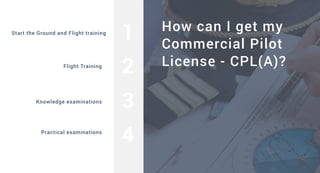
1
2
3
4
1
2
3
4
Start the Ground and Flight training
Flight Training
Knowledge examinations
Practical examinations
How can I get my
Commercial Pilot
License - CPL(A)?
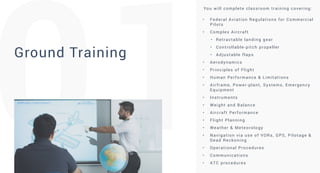
Ground Training
You will complete classroom training covering:
• Federal Aviation Regulations for Commercial
Pilots
• Complex Aircraft
• Retractable landing gear
• Controllable-pitch propeller
• Adjustable flaps
• Aerodynamics
• Principles of Flight
• Human Performance & Limitations
• Airframe, Power-plant, Systems, Emergency
Equipment
• Instruments
• Weight and Balance
• Aircraft Performance
• Flight Planning
• Weather & Meteorology
• Navigation via use of VORs, GPS, Pilotage &
Dead Reckoning
• Operational Procedures
• Communications
• ATC procedures
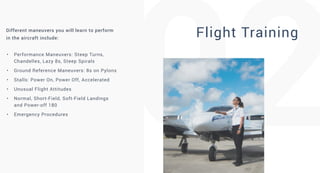
Flight Training
Different maneuvers you will learn to perform
in the aircraft include:
• Performance Maneuvers: Steep Turns,
Chandelles, Lazy 8s, Steep Spirals
• Ground Reference Maneuvers: 8s on Pylons
• Stalls: Power On, Power Off, Accelerated
• Unusual Flight Attitudes
• Normal, Short-Field, Soft-Field Landings
and Power-off 180
• Emergency Procedures
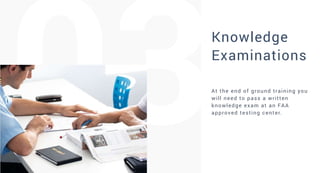
03At the end of ground training you
will need to pass a written
knowledge exam at an FAA
approved testing center.
Knowledge
Examinations
04
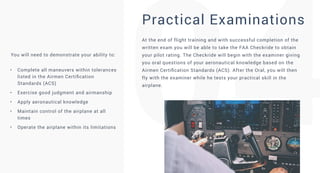
Practical Examinations
At the end of flight training and with successful completion of the
written exam you will be able to take the FAA Checkride to obtain
your pilot rating. The Checkride will begin with the examiner giving
you oral questions of your aeronautical knowledge based on the
Airmen Certification Standards (ACS). After the Oral, you will then
fly with the examiner while he tests your practical skill in the
airplane.
You will need to demonstrate your ability to:
• Complete all maneuvers within tolerances
listed in the Airmen Certification
Standards (ACS)
• Exercise good judgment and airmanship
• Apply aeronautical knowledge
• Maintain control of the airplane at all
times
• Operate the airplane within its limitations
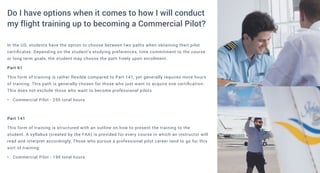
In the US, students have the option to choose between two paths when obtaining their pilot
certificates: Depending on the student’s studying preferences, time commitment to the course
or long term goals, the student may choose the path freely upon enrollment.
Part 61
This form of training is rather flexible compared to Part 141, yet generally requires more hours
of training. This path is generally chosen for those who just want to acquire one certification.
This does not exclude those who want to become professional pilots
• Commercial Pilot - 250 total hours
Part 141
This form of training is structured with an outline on how to present the training to the
student. A syllabus (created by the FAA) is provided for every course in which an instructor will
read and interpret accordingly. Those who pursue a professional pilot career tend to go for this
sort of training
•. Commercial Pilot - 190 total hours
Do I have options when it comes to how I will conduct
my flight training up to becoming a Commercial Pilot?
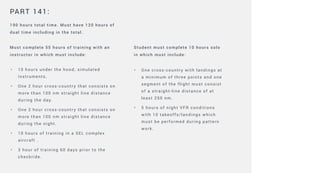
PART 141:
190 hours total time. Must have 120 hours of
dual time including in the total.
Must complete 55 hours of training with an
instructor in which must include:
Student must complete 10 hours solo
in which must include:
• 10 hours under the hood; simulated
instruments.
• One 2 hour cross-country that consists on
more than 100 nm straight line distance
during the day.
• One 2 hour cross-country that consists on
more than 100 nm straight line distance
during the night.
• 10 hours of training in a SEL complex
aircraft .
• 3 hour of training 60 days prior to the
checkride.
• One cross-country with landings at
a minimum of three points and one
segment of the flight must consist
of a straight-line distance of at
least 250 nm.
• 5 hours of night VFR conditions
with 10 takeoffs/landings which
must be performed during pattern
work.
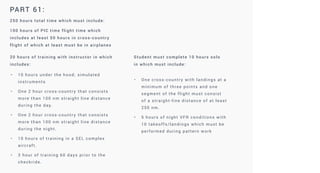
PART 61:
250 hours total time which must include:
100 hours of PIC time flight time which
includes at least 50 hours in cross-country
flight of which at least must be in airplanes
20 hours of training with instructor in which
includes:
Student must complete 10 hours solo
in which must include:
• 10 hours under the hood; simulated
instruments
• One 2 hour cross-country that consists
more than 100 nm straight line distance
during the day.
• One 2 hour cross-country that consists
more than 100 nm straight line distance
during the night.
• 10 hours of training in a SEL complex
aircraft.
• 3 hour of training 60 days prior to the
checkride.
• One cross-country with landings at a
minimum of three points and one
segment of the flight must consist
of a straight-line distance of at least
250 nm.
• 5 hours of night VFR conditions with
10 takeoffs/landings which must be
performed during pattern work
• Student Instruction (requires CFI rating)
• Nonstop Commercial Air Tours in an airplane having a standard airworthiness certificate
and passenger-seat configuration of 30 seats or fewer and a maximum payload capacity
of 7,500 pounds or less that begin and end at the same airport, and are conducted within
a 25-statute mile radius of that airport, in compliance with the Letter of Authorization
issued under 14 CFR Part § 91.147
• Ferry or training flights
• Aerial work operations, including -
(i) Crop dusting, seeding, spraying, and bird chasing;
(ii) Banner towing;
(iii) Aerial photography or survey;
(iv) Fire fighting;
(vi) Powerline or pipeline patrol
• Nonstop flights conducted within a 25-statute-mile radius of the airport of takeoff
carrying persons or objects for the purpose of conducting intentional parachute
operations.
What are examples of different pilot jobs I can acquire
after obtaining the Commercial Pilot License in Airplanes?
How much does
Commercial Pilot
License CPL(A)
course cost?
Flying Academy is offering one of the most cost-efficient training packages
in the United States. The fees for the complete course includes everything
needed for compliance with the FAA CPL(A) issuance requirements.
The course price starts from $10,175 USD.
No taxes are applied for pilot training in USA.
Training fees cover the following items and services:
• Access to the Learning Management System and FAA question bank
• Flight Instructor time for ground school & practical training
• Airplane usage, including fuel
• Rental Insurance
*All training fees are bound to the actual exchange rates of the local currency of the
Flying Academy base where the training or a part of the training is provided. Learn
more about complete training fees on our website FLYINGACADEMY.COM.
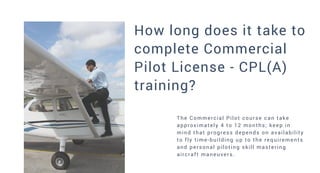
The Commercial Pilot course can take
approximately 4 to 12 months; keep in
mind that progress depends on availability
to fly time-building up to the requirements
and personal piloting skill mastering
aircraft maneuvers.
How long does it take to
complete Commercial
Pilot License - CPL(A)
training?
Contact
Us
FLYINGACADEMY.COM
fly@flyingacademy.com
+1 305 255 8753
Miami, Florida
Los Angeles, California
Europe (Hot Line)
+1 951 272 3942
+420 2 2888 2444

FAA-CPL.pdf

  • 1.
    FAA CPL Commercial PilotLicense F LY I N G A C A D E M Y. C O M
  • 2.
    About Us • Fl y i n g A c a d e m y M i a m i a n d L o s A n g e l e s i s t h e f l i g h t s c h o o l a u t h o r i z e d b y t h e FA A u n d e r P a r t 1 4 1 a n d P a r t 6 1 . • F l y i n g A c a d e m y i s a f l i g h t s c h o o l a u t h o r i z e d b y t h e FA A ( Fe d e r a l A v i a t i o n A d m i n i s t r a t i o n ) a s w e l l a s t h e E A S A ( E u ro p e a n A v i a t i o n S a fe t y A g e n c y ) . T h e a c a d e m y ’s h i g h e s t p r i o r i t y i s t o p ro v i d e a s a fe f l y i n g e n v i ro n m e n t t o a l l i t s p i l o t s . • W h e t h e r a t t h e b a s e i n P r a g u e , B r n o , L o s A n g e l e s o r M i a m i , F l y i n g A c a d e m y p u t s i t s c u s t o m e r s fi r s t , b e c a u s e h i g h e s t c u s t o m e r s a t i s f a c t i o n i s o n e o f t h e s c h o o l ’s m o s t i m p o r t a n t v a l u e s . • C o n s t a n t i n n o v a t i o n ke e p s u s a h e a d o f t h e c o m p e t i t i o n n o t o n l y b y g l o b a l p re s e n c e b u t a l s o i n t e c h n o l o g y. F l y i n g A c a d e m y - P ro fe s s i o n a l p i l o t t r a i n i n g p ro v i d e r P e r fe c t s a fe t y re c o rd , u n p re c e d e n t e d s t u d e n t s u p p o r t a n d b e s t i n c l a s s t r a i n i n g e n v i ro n m e n t a r e o u r p ro m i s e .
  • 3.
    On top ofthat, both locations are well known for their amazing sights that will become the perfect addition to your flight training. Busy airspace with intensive ATC communication will prepare you for challenges of modern aviation. FAA Training Locations In the USA we are located in Miami, Florida and Los Angeles, California. Tropical weather makes it possible to fly year-round. These conditions make building your hours quick so you can jump into the seat of an airline or corporate position.
  • 4.
    Flying Academy, oneof the leading global flight schools, is proud to present our fleet. It consists of single and multi-engine aircraft maintained at the highest levels of safety. The whole fleet, at both continents where we operate, consists of 27 aircraft. All airplanes in the fleet can be rented for hour building purposes (full service packages of 25, 50, or 100 hours). In case of Time Building the rental fee decreases depending on the amount of hours that you fly. Aircrafts in USA: Our Fleet Cessna 152, Cessna 172 SP, Cessna 172 R, Cessna 172 RG, Piper Cadet, Piper Warrior, Piper Warrior II, Piper Seminole turbo, Piper Seneca
  • 5.
    FAA CPL A rey o u d e t e r m i n e d t o t u r n y o u r p a s s i o n o f f l y i n g i n t o a c a re e r ? S t a r t m a k i n g m o n e y f l y i n g a i r p l a n e s b y g e t t i n g y o u r C o m m e rc i a l P i l o t L i c e n s e i n a i r p l a n e s w i t h F l y i n g A c a d e m y ! O u r C P L ( A ) c o u r s e i s d e s i g n e d f o r f u t u re c a re e r p i l o t s t o a c q u i r e t h e C o m m e r c i a l P i l o t C P L ( A ) r a t i n g i n a q u i c k , e f fi c i e n t , a n d c o s t - e f fe c t i v e m a n n e r.
  • 6.
    T h eC o m m e rc i a l P i l o t L i c e n s e t r a i n i n g i s u s u a l l y o n e o f t h e l a s t s t e p s i n b e c o m i n g a p ro fe s s i o n a l p i l o t . T h e C o m m e rc i a l P i l o t C e r t i fi c a t e i s a q u a l i fi c a t i o n t h a t p e r m i t s t h e h o l d e r t o a c t a s t h e p i l o t i n c o m m a n d o f a n a i rc r a f t f o r c o m p e n s a t i o n o r h i re , i . e . t o g e t e m p l o y e d a s a p i l o t . What is the CPL(A)?
  • 7.
    Course Requirements At least 17years of age You can start flight training at any age; however, you need to be at least 17 years old to obtain your Private Pilot rating PPL(A) before you can obtain your CPL (A) FAA Pilot Medical Certificate or Basic Med You need to be able to pass an aviation medical exam in order to fly. Only a 3rd Class FAA Pilot Medical Certificate is required to become a Private Pilot; however, a 2nd Class Certificate is required for Commercial Pilots. Proficient in the English language One of the requirements to become a Private Pilot is to be able to read, speak, write and understand the English language (FAA Aviation English Language Standard) United States citizenship or TSA background check via the AFSP To fly within the US you need to either be a US citizen or receive a background check from the Transportation Security Administration by joining the Alien Flight Student Program at the Department of Homeland Security 1 2 3 4
  • 8.
    1 2 3 4 Start the Groundand Flight training Flight Training Knowledge examinations Practical examinations How can I get my Commercial Pilot License - CPL(A)?
  • 9.
    Ground Training You willcomplete classroom training covering: • Federal Aviation Regulations for Commercial Pilots • Complex Aircraft • Retractable landing gear • Controllable-pitch propeller • Adjustable flaps • Aerodynamics • Principles of Flight • Human Performance & Limitations • Airframe, Power-plant, Systems, Emergency Equipment • Instruments • Weight and Balance • Aircraft Performance • Flight Planning • Weather & Meteorology • Navigation via use of VORs, GPS, Pilotage & Dead Reckoning • Operational Procedures • Communications • ATC procedures
  • 10.
    Flight Training Different maneuversyou will learn to perform in the aircraft include: • Performance Maneuvers: Steep Turns, Chandelles, Lazy 8s, Steep Spirals • Ground Reference Maneuvers: 8s on Pylons • Stalls: Power On, Power Off, Accelerated • Unusual Flight Attitudes • Normal, Short-Field, Soft-Field Landings and Power-off 180 • Emergency Procedures
  • 11.
    03At the endof ground training you will need to pass a written knowledge exam at an FAA approved testing center. Knowledge Examinations
  • 12.
    04 Practical Examinations At theend of flight training and with successful completion of the written exam you will be able to take the FAA Checkride to obtain your pilot rating. The Checkride will begin with the examiner giving you oral questions of your aeronautical knowledge based on the Airmen Certification Standards (ACS). After the Oral, you will then fly with the examiner while he tests your practical skill in the airplane. You will need to demonstrate your ability to: • Complete all maneuvers within tolerances listed in the Airmen Certification Standards (ACS) • Exercise good judgment and airmanship • Apply aeronautical knowledge • Maintain control of the airplane at all times • Operate the airplane within its limitations
  • 13.
    In the US,students have the option to choose between two paths when obtaining their pilot certificates: Depending on the student’s studying preferences, time commitment to the course or long term goals, the student may choose the path freely upon enrollment. Part 61 This form of training is rather flexible compared to Part 141, yet generally requires more hours of training. This path is generally chosen for those who just want to acquire one certification. This does not exclude those who want to become professional pilots • Commercial Pilot - 250 total hours Part 141 This form of training is structured with an outline on how to present the training to the student. A syllabus (created by the FAA) is provided for every course in which an instructor will read and interpret accordingly. Those who pursue a professional pilot career tend to go for this sort of training •. Commercial Pilot - 190 total hours Do I have options when it comes to how I will conduct my flight training up to becoming a Commercial Pilot?
  • 14.
    PART 141: 190 hourstotal time. Must have 120 hours of dual time including in the total. Must complete 55 hours of training with an instructor in which must include: Student must complete 10 hours solo in which must include: • 10 hours under the hood; simulated instruments. • One 2 hour cross-country that consists on more than 100 nm straight line distance during the day. • One 2 hour cross-country that consists on more than 100 nm straight line distance during the night. • 10 hours of training in a SEL complex aircraft . • 3 hour of training 60 days prior to the checkride. • One cross-country with landings at a minimum of three points and one segment of the flight must consist of a straight-line distance of at least 250 nm. • 5 hours of night VFR conditions with 10 takeoffs/landings which must be performed during pattern work.
  • 15.
    PART 61: 250 hourstotal time which must include: 100 hours of PIC time flight time which includes at least 50 hours in cross-country flight of which at least must be in airplanes 20 hours of training with instructor in which includes: Student must complete 10 hours solo in which must include: • 10 hours under the hood; simulated instruments • One 2 hour cross-country that consists more than 100 nm straight line distance during the day. • One 2 hour cross-country that consists more than 100 nm straight line distance during the night. • 10 hours of training in a SEL complex aircraft. • 3 hour of training 60 days prior to the checkride. • One cross-country with landings at a minimum of three points and one segment of the flight must consist of a straight-line distance of at least 250 nm. • 5 hours of night VFR conditions with 10 takeoffs/landings which must be performed during pattern work
  • 16.
    • Student Instruction(requires CFI rating) • Nonstop Commercial Air Tours in an airplane having a standard airworthiness certificate and passenger-seat configuration of 30 seats or fewer and a maximum payload capacity of 7,500 pounds or less that begin and end at the same airport, and are conducted within a 25-statute mile radius of that airport, in compliance with the Letter of Authorization issued under 14 CFR Part § 91.147 • Ferry or training flights • Aerial work operations, including - (i) Crop dusting, seeding, spraying, and bird chasing; (ii) Banner towing; (iii) Aerial photography or survey; (iv) Fire fighting; (vi) Powerline or pipeline patrol • Nonstop flights conducted within a 25-statute-mile radius of the airport of takeoff carrying persons or objects for the purpose of conducting intentional parachute operations. What are examples of different pilot jobs I can acquire after obtaining the Commercial Pilot License in Airplanes?
  • 17.
    How much does CommercialPilot License CPL(A) course cost? Flying Academy is offering one of the most cost-efficient training packages in the United States. The fees for the complete course includes everything needed for compliance with the FAA CPL(A) issuance requirements. The course price starts from $10,175 USD. No taxes are applied for pilot training in USA. Training fees cover the following items and services: • Access to the Learning Management System and FAA question bank • Flight Instructor time for ground school & practical training • Airplane usage, including fuel • Rental Insurance *All training fees are bound to the actual exchange rates of the local currency of the Flying Academy base where the training or a part of the training is provided. Learn more about complete training fees on our website FLYINGACADEMY.COM.
  • 18.
    The Commercial Pilotcourse can take approximately 4 to 12 months; keep in mind that progress depends on availability to fly time-building up to the requirements and personal piloting skill mastering aircraft maneuvers. How long does it take to complete Commercial Pilot License - CPL(A) training?
  • 19.
    Contact Us FLYINGACADEMY.COM fly@flyingacademy.com +1 305 2558753 Miami, Florida Los Angeles, California Europe (Hot Line) +1 951 272 3942 +420 2 2888 2444