URBAN TRANSPORTATION SYSYTEM
By
Prof. Dhananjay M
Index
Introduction to Urban Mass Transportation System
Requirement of Mass transportation system
Concept of travel demand for modeling
-Aspects in travel demand
Factors affecting travel demand
Sequential & Simultaneous models
-Aggregate & Disaggregate approach
Types of Mass transit system
Advantages of Mass Transportation System
Opportunities in Mass Transportation System
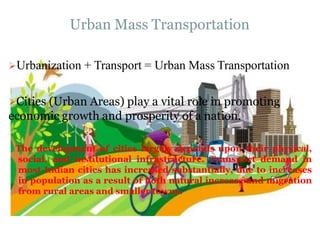
Urban Mass Transportation
➢Urbanization + Transport = Urban Mass Transportation
➢Cities (Urban Areas) play a vital role in promoting
economic growth and prosperity of a nation.
The development of cities largely depends upon their physical,
social, and institutional infrastructure. Transport demand in
most Indian cities has increased substantially, due to increases
in population as a result of both natural increase and migration
from rural areas and smaller towns.
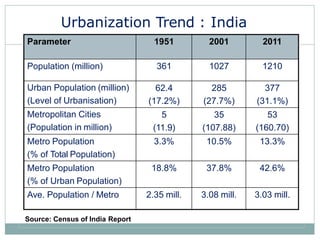
Urbanization Trend : India
Parameter 1951 2001 2011
Population (million) 361 1027 1210
Urban Population (million)
(Level of Urbanisation)
62.4
(17.2%)
285
(27.7%)
377
(31.1%)
Metropolitan Cities
(Population in million)
5
(11.9)
35
(107.88)
53
(160.70)
Metro Population
(% of Total Population)
3.3% 10.5% 13.3%
Metro Population
(% of Urban Population)
18.8% 37.8% 42.6%
Ave. Population / Metro 2.35 mill. 3.08 mill. 3.03 mill.
Source: Census of India Report
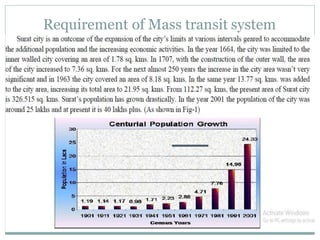
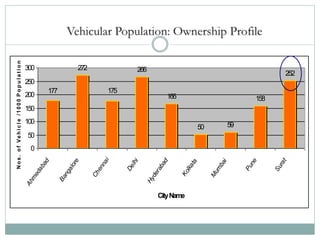
Requirement of Mass transit system
177
272
175
266
166
50 59
158
252
300
250
200
150
100
50
0
CityName
N
o
s
.
o
f
V
e
h
i
c
l
e
/
1
0
0
0
P
o
p
u
l
a
t
i
o
n
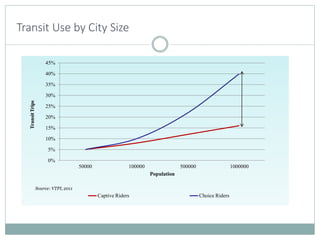
Transit Use by City Size
45%
40%
35%
30%
25%
20%
15%
10%
5%
0%
50000 100000 500000 1000000
Transit
Trips
Population
Captive Riders Choice Riders
Source: VTPI, 2011
9
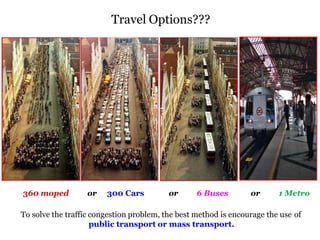
360 moped or 300 Cars or 6 Buses or 1 Metro
To solve the traffic congestion problem, the best method is encourage the use of
public transport or mass transport.
Travel Options???
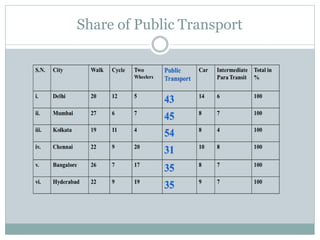
Share of Public Transport
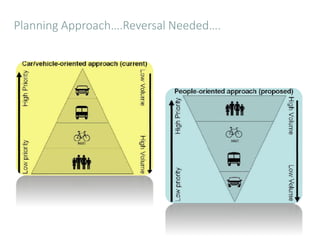
Planning Approach….Reversal Needed….
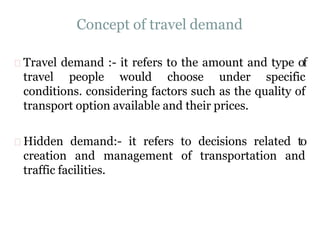
Concept of travel demand
Travel demand :- it refers to the amount and type of
travel people would choose under specific
conditions. considering factors such as the quality of
transport option available and their prices.
Hidden demand:- it refers to decisions related to
creation and management of transportation and
traffic facilities.
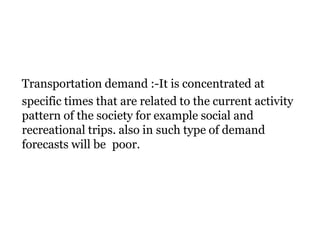
Transportation demand :-It is concentrated at
specific times that are related to the current activity
pattern of the society for example social and
recreational trips. also in such type of demand
forecasts will be poor.
Major Aspects in travel demand
Land use :- It refers to pattern of land usage in
an area. Land use affects the transportation
demand through generation and distribution of
trips.
Trip purpose:- It refers to purpose for which
the trip is being undertaken. A trip is a
movement from origin to destination, the
distance between origin and destination is
called trip length. and the time taken is known
as trip time.
Factors affecting travel demand
Socio-economic factors
Location factors
Public transport accessibility factors
Socio-economic factors :
➢Household income
➢Occupation status
➢Family size and composition of household
➢Cultural aspects
➢Number of cars per household
Location factors
➢Population
➢Residential density
➢Distance of household from town center( central
business district)
Public transport accessibility factors
➢Nearness of public transport facility
➢Efficiency and reliability of public transport
➢Fare structure, routing etc.
▪ Factors affecting choice of travel mode
✓ Purpose of trip
✓ Distance traveled
✓ Income of traveler
✓ Occupational status of the traveler
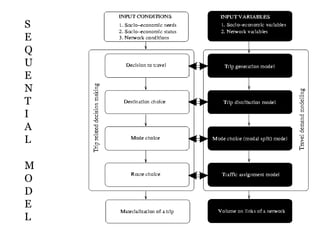
Sequential and simultaneous models
It consists of four descriptors.
➢Trip frequency
➢Destination
➢Mode
➢Route and other choice
S
E
Q
U
E
N
T
I
A
L
M
O
D
E
L
Aggregate and disaggregate approaches
▪ Aggregate approach:- This develops
between trip production and attraction with
relationship
appropriate
independent variable, at zone level, using regression analysis. It
refers to grouped data & pattern but may vary from zone to
zone.(simultaneous models)
▪ Disaggregate approach :- This is based on
development of equations describing independent variable on the
trip making as a basic unit. Data required is based on household
characteristics.(sequential models)
Urban mass transit system
It is based on two types and they are as follows :-
1. Road based transit
2. Rail based transit
Road base transit involves
Buses and coach
City buses / commuter buses
BRTS
Rail based transit
Trains
Commuter rails & suburban rails
Metro trains
Mono rail
Light rail transit system
Sky rail
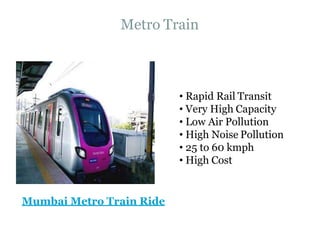
Metro Train
• Rapid Rail Transit
• Very High Capacity
• Low Air Pollution
• High Noise Pollution
• 25 to 60 kmph
• High Cost
Mumbai Metro Train Ride
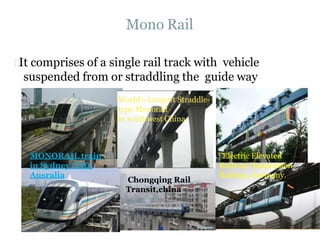
Mono Rail
MONORAIL train
in Sydney CBD,
Ausralia
It comprises of a single rail track with vehicle
suspended from or straddling the guide way
World’s Longest Straddle-
type Monorail
in southwest China
Chongqing Rail
Transit,china
"Electric Elevated
Railway (Suspension
Railway, Germany.
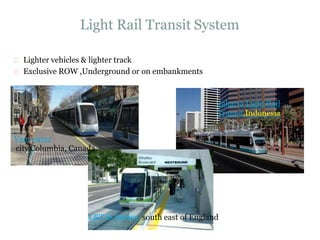
Light Rail Transit System
Lighter vehicles & lighter track
Exclusive ROW ,Underground or on embankments
Jakarta Light Rail
Transit,Indonesia
Vancouver
city Columbia, Canada.
LRT in Surrey, south east of England
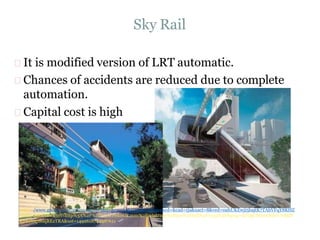
Sky Rail
It is modified version of LRT automatic.
Chances of accidents are reduced due to complete
automation.
Capital cost is high
https://www.google.com/url?sa=i&rct=j&q=&esrc=s&source=images&cd=&cad=rja&uact=8&ved=0ahUKEwji5bajtK7TAhVFqY8KHZ
jVAkUQjRwIBw&url=http%3A%2F%2Fwww.riskovik.com%2Farbitrage%2Fpsn%2Ffull%2F1033%2F&psig=AFQjCNGmO9hcVwMdY
Kjrkoh4p8oqREzTRA&ust=1492618744987611
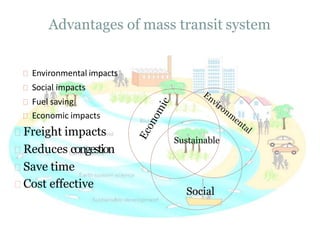
Advantages of mass transit system
Environmental impacts
Social impacts
Fuel saving
Economic impacts
Freight impacts
Reduces congestion
Save time
Cost effective
Sustainable
Social
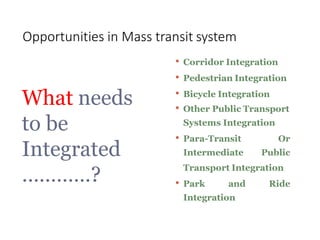
Opportunities in Mass transit system
• Corridor Integration
• Pedestrian Integration
• Bicycle Integration
• Other Public Transport
Systems Integration
• Para-Transit
Intermediate
Or
Public
Transport Integration
• Park and Ride
Integration
What needs
to be
Integrated
…………?
Opportunities in Mass transit system
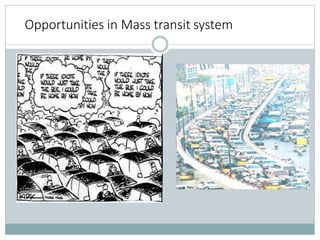
Opportunities in Mass transit
system
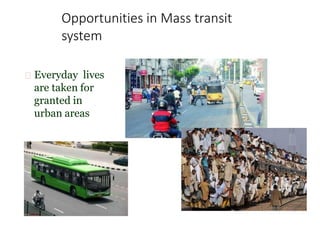
Everyday lives
are taken for
granted in
urban areas
Source:Google.com
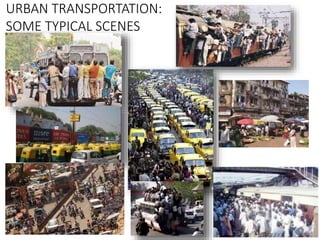
URBAN TRANSPORTATION:
SOME TYPICAL SCENES
Opportunities in Mass transit system
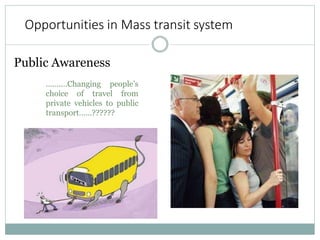
Public Awareness
……….Changing people’s
choice of travel from
private vehicles to public
transport……??????
Opportunities in Mass transit system
Its setup is incredible expensive
Possibility of attacked or being robbed
Malfunctioning of equipment as well as service
disruptions caused due to labor strikes
Passengers may be attacked by infectious diseases
Late night safety is not assured
Accident may cause large casualties
Change in time of certain buses may cause
inconvenience to passengers
Refrence
Urban Transportation System –Atul Prakashan By
Dr.R.P.Rethaliya
http://www.civil.iitb.ac.in/~dhingra/ce751.htm
http://nptel.ac.in
http://iihs.co.in/knowledge-gateway/wp-
content/uploads/2015/07/RF-Working-Paper-
Transport_edited_09062015_Final_reduced-
size.pdf
https://drive.google.com/open?id=0Bz4FPosKK0L
DLVlyYmVId2s2a2M
Mass Transit System.pdf

Mass Transit System.pdf

  • 1.
  • 2.
    Index Introduction to UrbanMass Transportation System Requirement of Mass transportation system Concept of travel demand for modeling -Aspects in travel demand Factors affecting travel demand Sequential & Simultaneous models -Aggregate & Disaggregate approach Types of Mass transit system Advantages of Mass Transportation System Opportunities in Mass Transportation System
  • 3.
    Urban Mass Transportation ➢Urbanization+ Transport = Urban Mass Transportation ➢Cities (Urban Areas) play a vital role in promoting economic growth and prosperity of a nation. The development of cities largely depends upon their physical, social, and institutional infrastructure. Transport demand in most Indian cities has increased substantially, due to increases in population as a result of both natural increase and migration from rural areas and smaller towns.
  • 4.
    Urbanization Trend :India Parameter 1951 2001 2011 Population (million) 361 1027 1210 Urban Population (million) (Level of Urbanisation) 62.4 (17.2%) 285 (27.7%) 377 (31.1%) Metropolitan Cities (Population in million) 5 (11.9) 35 (107.88) 53 (160.70) Metro Population (% of Total Population) 3.3% 10.5% 13.3% Metro Population (% of Urban Population) 18.8% 37.8% 42.6% Ave. Population / Metro 2.35 mill. 3.08 mill. 3.03 mill. Source: Census of India Report
  • 5.
    Requirement of Masstransit system
  • 6.
  • 7.
    Transit Use byCity Size 45% 40% 35% 30% 25% 20% 15% 10% 5% 0% 50000 100000 500000 1000000 Transit Trips Population Captive Riders Choice Riders Source: VTPI, 2011
  • 8.
    9 360 moped or300 Cars or 6 Buses or 1 Metro To solve the traffic congestion problem, the best method is encourage the use of public transport or mass transport. Travel Options???
  • 9.
    Share of PublicTransport
  • 10.
  • 11.
    Concept of traveldemand Travel demand :- it refers to the amount and type of travel people would choose under specific conditions. considering factors such as the quality of transport option available and their prices. Hidden demand:- it refers to decisions related to creation and management of transportation and traffic facilities.
  • 12.
    Transportation demand :-Itis concentrated at specific times that are related to the current activity pattern of the society for example social and recreational trips. also in such type of demand forecasts will be poor.
  • 13.
    Major Aspects intravel demand Land use :- It refers to pattern of land usage in an area. Land use affects the transportation demand through generation and distribution of trips. Trip purpose:- It refers to purpose for which the trip is being undertaken. A trip is a movement from origin to destination, the distance between origin and destination is called trip length. and the time taken is known as trip time.
  • 14.
    Factors affecting traveldemand Socio-economic factors Location factors Public transport accessibility factors
  • 15.
    Socio-economic factors : ➢Householdincome ➢Occupation status ➢Family size and composition of household ➢Cultural aspects ➢Number of cars per household
  • 16.
    Location factors ➢Population ➢Residential density ➢Distanceof household from town center( central business district)
  • 17.
    Public transport accessibilityfactors ➢Nearness of public transport facility ➢Efficiency and reliability of public transport ➢Fare structure, routing etc. ▪ Factors affecting choice of travel mode ✓ Purpose of trip ✓ Distance traveled ✓ Income of traveler ✓ Occupational status of the traveler
  • 18.
    Sequential and simultaneousmodels It consists of four descriptors. ➢Trip frequency ➢Destination ➢Mode ➢Route and other choice
  • 19.
  • 20.
    Aggregate and disaggregateapproaches ▪ Aggregate approach:- This develops between trip production and attraction with relationship appropriate independent variable, at zone level, using regression analysis. It refers to grouped data & pattern but may vary from zone to zone.(simultaneous models) ▪ Disaggregate approach :- This is based on development of equations describing independent variable on the trip making as a basic unit. Data required is based on household characteristics.(sequential models)
  • 21.
    Urban mass transitsystem It is based on two types and they are as follows :- 1. Road based transit 2. Rail based transit
  • 22.
    Road base transitinvolves Buses and coach City buses / commuter buses BRTS
  • 23.
    Rail based transit Trains Commuterrails & suburban rails Metro trains Mono rail Light rail transit system Sky rail
  • 24.
    Metro Train • RapidRail Transit • Very High Capacity • Low Air Pollution • High Noise Pollution • 25 to 60 kmph • High Cost Mumbai Metro Train Ride
  • 25.
    Mono Rail MONORAIL train inSydney CBD, Ausralia It comprises of a single rail track with vehicle suspended from or straddling the guide way World’s Longest Straddle- type Monorail in southwest China Chongqing Rail Transit,china "Electric Elevated Railway (Suspension Railway, Germany.
  • 26.
    Light Rail TransitSystem Lighter vehicles & lighter track Exclusive ROW ,Underground or on embankments Jakarta Light Rail Transit,Indonesia Vancouver city Columbia, Canada. LRT in Surrey, south east of England
  • 27.
    Sky Rail It ismodified version of LRT automatic. Chances of accidents are reduced due to complete automation. Capital cost is high https://www.google.com/url?sa=i&rct=j&q=&esrc=s&source=images&cd=&cad=rja&uact=8&ved=0ahUKEwji5bajtK7TAhVFqY8KHZ jVAkUQjRwIBw&url=http%3A%2F%2Fwww.riskovik.com%2Farbitrage%2Fpsn%2Ffull%2F1033%2F&psig=AFQjCNGmO9hcVwMdY Kjrkoh4p8oqREzTRA&ust=1492618744987611
  • 28.
    Advantages of masstransit system Environmental impacts Social impacts Fuel saving Economic impacts Freight impacts Reduces congestion Save time Cost effective Sustainable Social
  • 29.
    Opportunities in Masstransit system
  • 30.
    • Corridor Integration •Pedestrian Integration • Bicycle Integration • Other Public Transport Systems Integration • Para-Transit Intermediate Or Public Transport Integration • Park and Ride Integration What needs to be Integrated …………? Opportunities in Mass transit system
  • 31.
    Opportunities in Masstransit system Everyday lives are taken for granted in urban areas
  • 32.
  • 33.
    Opportunities in Masstransit system
  • 34.
    Opportunities in Masstransit system Public Awareness ……….Changing people’s choice of travel from private vehicles to public transport……??????
  • 35.
    Opportunities in Masstransit system Its setup is incredible expensive Possibility of attacked or being robbed Malfunctioning of equipment as well as service disruptions caused due to labor strikes Passengers may be attacked by infectious diseases Late night safety is not assured Accident may cause large casualties Change in time of certain buses may cause inconvenience to passengers
  • 36.
    Refrence Urban Transportation System–Atul Prakashan By Dr.R.P.Rethaliya http://www.civil.iitb.ac.in/~dhingra/ce751.htm http://nptel.ac.in http://iihs.co.in/knowledge-gateway/wp- content/uploads/2015/07/RF-Working-Paper- Transport_edited_09062015_Final_reduced- size.pdf https://drive.google.com/open?id=0Bz4FPosKK0L DLVlyYmVId2s2a2M